Scripture picture theme this week: The Blood. Each scripture photo will be accompanied by a song about the blood of Jesus. Never forget about the blood.
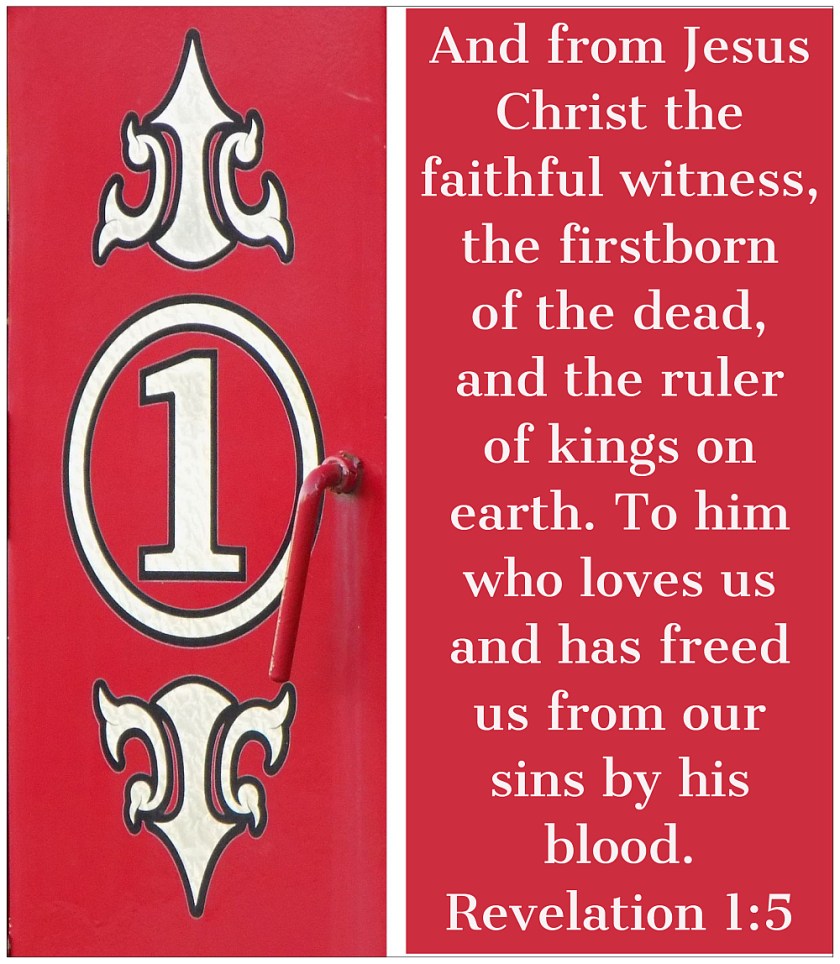
Covered By The Blood
Scripture picture theme this week: The Blood. Each scripture photo will be accompanied by a song about the blood of Jesus. Never forget about the blood.
Covered By The Blood
Scripture picture theme this week: The Blood. Each scripture photo will be accompanied by a song about the blood of Jesus. Never forget about the blood.
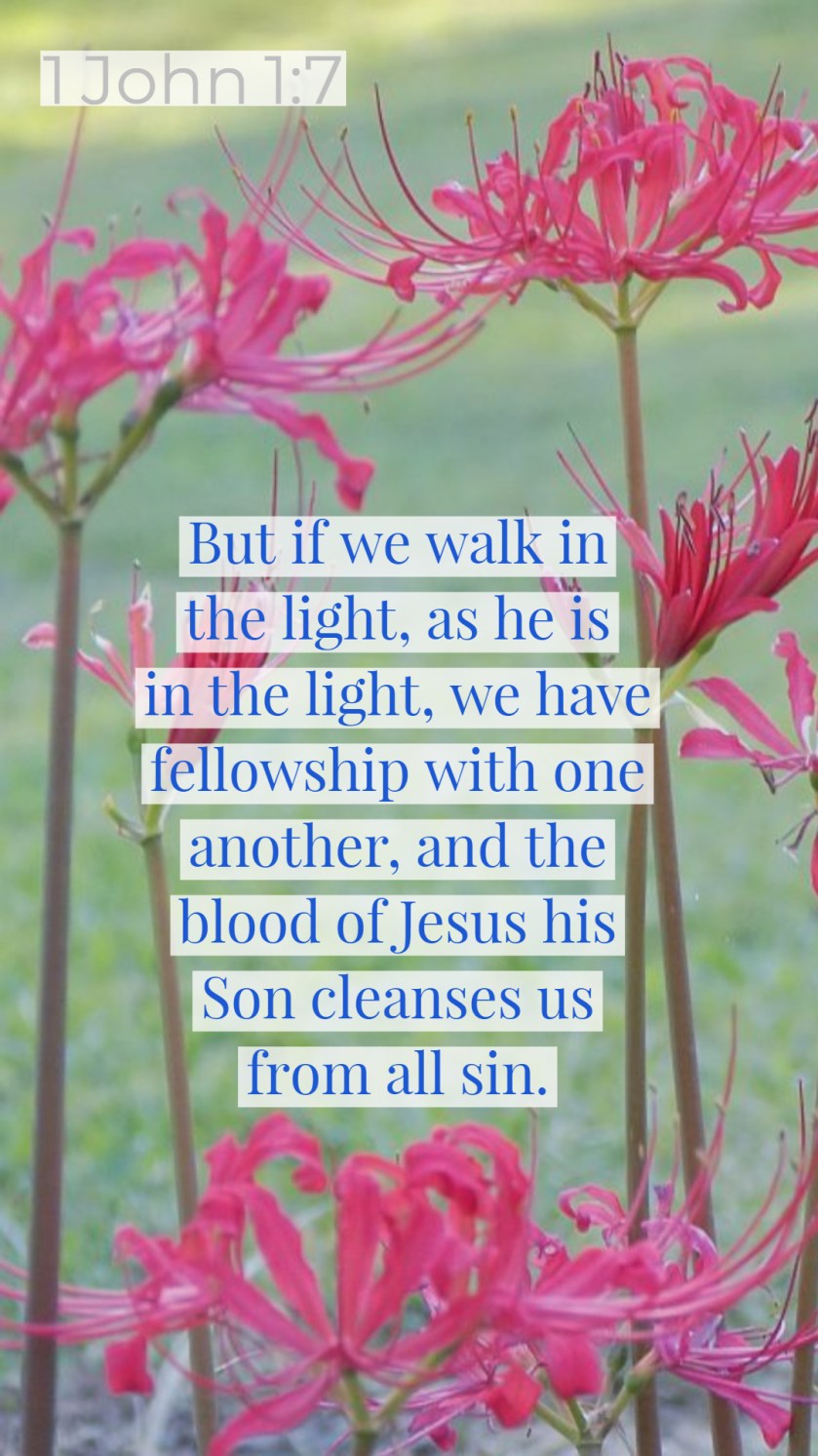
Scripture picture theme this week: The Blood. Each scripture photo will be accompanied by a song about the blood of Jesus. Never forget about the blood.

There Is A Fountain
For from his fullness we have all received, grace upon grace. (John 1:16).
What do you mean grace upon grace? What does he mean? He means grace literally grace in the place of grace. That’s the Greek. Grace in the place of grace. Grace just keeps replacing itself. It’s overlapping.
It’s like waves. If you go down to the beach, and you watch the waves, you don’t know where one ends and one begins, they just roll on top of each other. That’s the notion expressed in the way this is framed. Waves of grace rolling on us. Romans 5:2 says, “We stand in grace, we literally are engulfed in waves of grace.” You don’t live on past grace, you don’t live on stale grace, you live on grace replacing grace replacing grace, replacing grace. Grace on top of grace, His mercies are new every morning. There are no gaps in His grace. This is an amazing, amazing statement. ~John MacArthur We Beheld His Glory
What a tremendous gift His grace is. I’m so thankful for my salvation, that I have the privilege of knowing Jesus as Savior and Friend, and no longer as my enemy. He is a good, good Father.

Scripture picture theme this week: The Blood. Each scripture photo will be accompanied by a song about the blood of Jesus. Never forget about the blood.

Scripture picture theme this week: The Blood. Each scripture photo will be accompanied by a song about the blood of Jesus. Never forget about the blood.

Nothing But The Blood
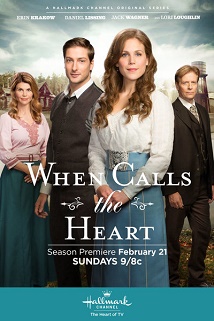
Challies posted a link to an article by The Gospel Coalition about Janette Oke and the TV series from her book titled When Calls the Heart. I used to watch WCTH for the first couple of seasons.
The Theology and True-Life Tragedy behind Hallmark’s Hit Show, “When Calls the Heart”
The television series features a pampered city woman who relocates to Alberta Canada in the early part of the 20th century to become a schoolteacher. Her love interest is a do-right Canadian Mountie. The series is based on Oke’s books, developed by Michael Landon Jr, and presented on the Hallmark Channel. It stars Erin Krakow as the teacher, Daniel Lissing as the Mountie, Lori Loughlin and Jack Wagner. I remember Jack Wagner from my avid General Hospital-watching days. I love Lori Loughlin, especially the Hallmark Garage Sale Mysteries she stars in.
At the time I was watching When Calls the Heart I was also watching another Canadian show called Murdoch Mysteries that was set in the late 1800s and early 1900s. I became disappointed with Murdoch because of the overt preaching of feminism by the co-star to her TV-believing love interest (he is a Catholic). I abandoned the series even though I enjoyed the premise. In similar Hallmark Mysteries as Loughlin’s Garage Sale Mysteries, I found feminism present also, mostly in the Aurora Teagarden Mysteries and Murder She Baked movies. I stopped watching. Only Lori Loughlin’s seemed to be largely absent of the bossy woman syndrome.
I felt that though less overt than Murdoch, WCTH, was also heading down the feminism road. Oke’s novels are known for their plucky Pioneer heroines who survive against all odds, tragedies, and difficulties, carried by their faith. WCTH follows that same pattern. But there’s a fine line between plucky pioneer survivor woman and bossy feminist.
Did I abandon When Calls The Heart too soon? Was I too sensitive about feminism? It’s a stumbling block to me so I avoid even the aroma of it, having been raised as one and having mothers and sister and aunts that are feminists. I may be overly biased against it. I’d like your take on the series, since I don’t have a truly objective perspective.
I abandoned When Calls the Heart series for another reason, lol. The first season was lush and the scenery and cinematography was a feast for the eyes. The wardrobe was terrific and beautiful. The suits, coats, and dresses were absolutely gorgeous. However in the second season, they changed the wardrobe person and the clothing became anachronistic. Hallmark intentionally did this, seeking a less historical feel and ‘blending’ of modern. I don’t know why. Maybe the expense. However, in my opinion they went too far and the clothing became too modern and did not match and 1910’s setting. It drove me crazy, it absolutely did. My brain screamed every time they emerged from some house wearing 1950s-looking clothes. I couldn’t take it.
I’m not alone in this opinion. There was even a petition to bring back a more historically accurate wardrobe in season 2 of When Calls The Heart.
Good, wholesome television is hard to come by these days. If I made a mistake giving up on the show, then I’d like to return to it. So, what do you ladies think of Janette Oke, her theology, and the TV series When Calls the Heart?
Are we broken?
According to the dictionary definition of broken, are we “fractured or damaged”? As humans, do we need fixing?
Christians know that there is something wrong with the world, indeed. Even unsaved people mutter and wonder what in the world is going on. Why is the world like this? they ask. Why has it always been like this? they wonder.
I hear and read the word ‘broken’ a lot now in reference to this issue. The word has come into popular Christian use. Here are just a few recent published essay titles-
Is it acceptable to use the word broken when referencing already-saved Christians? Or even non-saved people?
It’s my stance that it is not. As was stated so well here,
For Christians, it is vital that we be open-eyed and discerning about the destructive ways that language is being manipulated. We need to recover the biblical view of words …
We well know that language gives words meaning, but that meaning can be fluid. For example, the American definition of marriage, of a legal union between one man and one women, had been stable for centuries. The over the last few decades, marriage has come to mean any civil union between any number of people of any (or no) gender or sexual orientation.
Or this from the website Darrow Miller and Friends
In the old dictionary, justice was defined as equal treatment regardless of race, sex or religion. In the new dictionary, justice is equal outcome, regardless of personal action or behavior.
In this example, Tolerance in the old definition meant “ability or willingness to tolerate something, in particular the existence of opinions or behavior that one does not necessarily agree with.” Nowadays the word tolerance has come to mean rejecting all moral absolutes, including biblical absolutes.
When we use important Christian words, we need to say what they mean, too. Just because we say the word sin, doesn’t mean who you are speaking to will have the same understanding of what sin is that you do. It seems basic, but that’s where we are now.
Manipulation of words to change perceptiopn or to catalyze movements is an entire academic field of study. It’s called Linguistic Anthropology. Satan changes word meanings in order to confuse both believers and non-believers, and to push forward his agenda.
I argued that a new religion has taken root in the West, and it advances by redefining words — vacating them of their true meaning, and hijacking them to serve new purposes. (Source)
For example,
… As John Stonestreet reminds us, “there’s a long history detailing the manipulation of language for the purpose of social control”. George Orwell described the process well in his book 1984. The language was forever being altered, “to make all other modes of thought impossible. … This was done partly by the invention of new words, but chiefly by eliminating undesirable words and stripping such words as remained of unorthodox meanings….” Source
The word broken is one of those words that is being used to change perceptions, in this case, to redefine sin. Broken can indicate anything that is massively fractured, down to only a little dented. Being only broken can mean-
My car is broken, it needs a new transmission.
My car is broken, the tail light is out.
The truth is, we are not broken. We are sinners WITHOUT righteousness. We are totally corrupt. We need HIS external righteousness. We are not just broken, but beyond repair. We’re dead! That’s why the Bible says when we’re saved, we are a new person, from a new birth, regenerated, born again, given a new heart. And so on.
We are not entities that need a patch or a fix or a tweak. Using broken instead of sinner allows wiggle room for seeing my sin as small. One might start our magnanimously seeing one’s sin as big, as the essay headline above, but if you see yourself only as broken, inevitably you’ll reduce your sin to only a minor indiscretion.
Secondly, we are not broken (in need of a fix). We must be remade completely! This is because we are thoroughly corrupt. Sin pervades us, our entire nature is one of sin. There is no corner of light in us, it is all darkness and evil. (Genesis 6:5).
Can a leopard change its spots? Can an Ethiopian change his skin? (Jeremiah 13:23). Can a lion become a vegetarian? No. Our essential nature is one of unholy acts in sin and evil intentions,a ll the time. We can adopt an external moralism but none of our actions will be pleasing to a holy God. (Romans 7:18,24; Ephesians 2:1,2). We must be made new. (John 3:7).
You were taught to put off your former way of life, your old self, which is being corrupted by its deceitful desires; 23to be renewed in the spirit of your minds; 24and to put on the new self, created to be like God in true righteousness and holiness (Ephesians 22-24)
and have put on the new self, which is being renewed in knowledge in the image of its Creator. (Colossians 3:10).
Do not marvel that I said to you, ‘Youd must be born again.’ (John 3:7).
Now this might not seem like such a huge deal. Big woop, some words are being redefined. But you see, the latest hot evangelism training trend is to use this concept of brokenness as the basis for needing Jesus. It’s not true as the caption on the video below claims, that this world is characterized by brokenness.
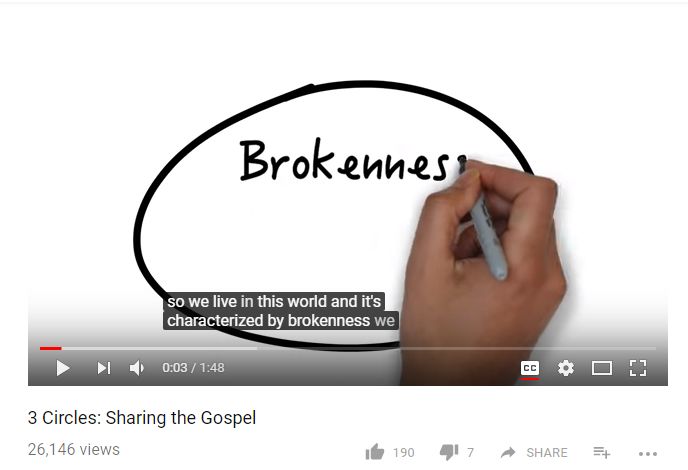
The world is cursed, and the curse is because of sin. (Genesis 3:17, Romans 8:20-21). Even the universe will be made new.
that the creation itself will be set free from its bondage to decay and brought into the glorious freedom of the children of God. (Romans 8:21)
The only thing we, the animals, and the creation itself can do is decay, because we are corrupt and enslaved to sin. That sounds more than ‘broken’ to me. Our very nature prevents us from righteousness. No fixing will do.
Be careful of the words you use. Know the important words of our faith, use them, and explain them. Be precise.
Emerging Church Glossary (satire)
Part of this essay appeared on The End Time in 2010.
The Wayside Cross is a huge tradition in Canada and Europe, where it has abounded for over a thousand years. “In Quebec, and Europe, a wayside cross marks a place where the members of a community gather to meet and pray, and often commemorates an important moment in their communal history.” Charles Bourget reports that there are 3000 wayside shrines dotting the countryside in Quebec, however, many of them are falling into disrepair because the tradition is waning. I wrote at one time about the fate of one American Wayside Cross in East Greenwich RI.
Below, a wayside crucifix in Europe

In America, the tradition never really caught on. If one does stumble upon a wayside cross, they are usually a cricifix- which represents an entirely different religion. They are seen occasionally, especially in central rural Wisconsin. Wayside crosses dot the landscape there. In Bedford NY, one was erected in 1936 and it was hoped that the sight of it would invite the prayers of the passersby. In 1922 East Greenwich, it was hoped by “those who placed this beautiful memorial to an exemplary life feel that it will indeed be a light by the way and a guide post to Heaven.” By and large wayside crosses are not seen much and those that do exist are under increasing challenge.
The point of the cross in public life is that it would point the way to Jesus. That upon seeing it, thoughts of Him and the Good News would ruminate in the mind, and through the strength of the Holy Spirit, those thoughts would germinate. For people seeing such displays, who have already heard the Good News, perhaps its sight would loosen the bonds around the heartstrings and their conviction would grow, as in the allegorical depiction of Christian at the Wayside Cross.
A wayside cross was a pivotal point in the very famous book Pilgrim’s Progress by John Bunyan, published in 1678 and has remained on the ‘bestseller list’ ever since, never having been out of print. The passage is below:
“He ran thus till he came at a place somewhat ascending, and upon that place stood a cross, and a little below, in the bottom, a sepulchre. So I saw in my dream, that just as Christian came up with the cross, his burden loosed from off his shoulders, and fell from off his back, and began to tumble, and so continued to do, till it came to the mouth of the sepulchre, where it fell in, and I saw it no more. Then was Christian glad and lightsome, and said, with a merry heart, ‘He hath given me rest by his sorrow, and life by his death.’ Then he stood still awhile to look and wonder; for it was very surprising to him, that the sight of the cross should thus ease him of his burden. He looked therefore, and looked again, even till the springs that were in his head sent the waters down his cheeks. Now, as he stood looking and weeping, behold three Shining Ones came to him and saluted him with Peace be unto thee. So the first said to him, Thy sins be forgiven thee;”
It is amazing that the sight of the cross should ease a person’s burdens, but it does, for the person who is ready to receive grace. For every individual on the planet, there comes that critical moment, upon which the eye falls to the cross and a decision is made either aye or nay. The cross to the unsaved does make one’s soul burn, satan would have it so. But in the process of that the soul-singe the cross is emblazoned on the mind and heart and soul, thereafter to linger as a brand. It stays there, to rankle. Opponents of Christ do not want that rankle, and therefore strive to remove the cross from all areas of life except homes and churches.
This article from 2011 by John Witte Jr., Director of the Center for the Study of Law and Religion at Emory University in Atlanta, Ga., is interesting: Lift High the Cross? Religion In Public Spaces
It made 6 points about court challenges to religious symbols in public spaces:
While not entirely convergent in their religious symbolism cases, the American and European high courts now hold six teachings in common.
Lift high the cross. Value it, present it, wear it, but above all, cherish it and obey it. We can and should beautify the Gospel that the cross stands for by our obedient and gentle adornment of obedient behavior because of it.
Editor Note: It seems that the page in question from Mrs Fitzpatrick has disappeared. Below at the bottom, I posted a link to the cached version. I also posted screen shots of the essay.
————————————————
Jesus knew what she was doing and he welcomed it.
The above is from Elyse Fitzpatrick and I’ll get to the problem in her essay further down.
Elyse Fitzpatrick holds a certificate in biblical counseling from CCEF (San Diego) and an M.A. in Biblical Counseling from Trinity Theological Seminary. She has authored 23 books on daily living and the Christian life. She also has a website where she blogs and is a conference speaker.
Fitzpatrick wrote a blog essay the other week titled Mary’s Wedding Vows (page deleted, screenshots below) where a biblical scene of humbly offering an anointing to the Sovereign God preceding His death, is twisted to an impetuous moment of a love-struck girl hurling herself with abandon at her lover. In order to make the verses she quoted fit her unbiblical scene, Fitzpatrick had to twist the scripture. (2 Peter 3:16). It was a theological train wreck full of doctrinal error and crass sensuality.
Sadly, a few years ago Fitzpatrick became involved in the hypergrace movement. Her 2012 book Give Them Grace seemed to reveal more antinomian stances. She was spoken of negatively in this 2015 article at Grace to You and this one in 2015. Her theological trajectory has been noted and warned against.
The invasion of such sensual imagery by these influential writers is a sad event. One would hope and pray that Christian women would have more sense and more spiritual maturity and discernment than to chase after things that are not much different than Tantric Buddhism. Anything that connects the divine through the body should be a no-go zone. The faith comes by hearing, not by sensuous feeling. It is an intellectual faith that comes in through the mind. What we know is most important.
Baker’s Evangelical Dictionary explains the word know
Know, Knowledge
To know is not to be intellectually informed about some abstract principle, but to apprehend and experience reality. Knowledge is not the possession of information, but rather its exercise or actualization.
I sadly cannot recommend Elyse Fitzpatrick to you and must sadly issue a warning against using her materials. This is doubly sad because of her long experience with Biblical Counseling. But anyone who sees Jesus in such a light is seeing a Jesus that does not exist, except perhaps in her own mind.
See to it that no one takes you captive by philosophy and empty deceit, according to human tradition, according to the elemental spirits of the world, and not according to Christ. (Colossians 2:8)
Let no one deceive you with empty words, for because of such things God’s wrath comes on the sons of disobedience. (Ephesians 5:6).
Screen shots of Mrs Fitzpatrick’s essay in question


