Posted in encouragement, Uncategorized

The Prayer Machinery of Heaven #7: The Debt

If I had cherished sin in my heart, the Lord would not have listened. (Psalm 66:18).

If we confess our sins, he is faithful and just to forgive us our sins and to cleanse us from all unrighteousness. (1 John 1:9).

Prayer straddles our lives both on earth when we pray and in heaven when Jesus hears. All week I’m focusing on prayer. It’s important. I need to do better in my life, and I can’t imagine a Christian who doesn’t think they can do better at prayer either.

Charles Spurgeon said,

Prayer meetings are the throbbing machinery of the church.

Last weekend, I was thinking of one of Spurgeon’s sermons, called God’s Providence. (#3114). Spurgeon likened the cherubim’s acts near the throne and the wheels within wheels as described by Ezekiel as machinery of Providence. He described, hypothetically of course, the wheels going up and down and left and right in tandem as the machinery of Providence carrying out God’s will and decrees. It’s an interesting thought, and Spurgeon is vivid about his descriptions.

This series of ‘prayer machinery of heaven’ is inspired by those two thoughts.

Please enjoy this scripture photo I made of the machinery of prayer. Under that will be some further resources on prayer suggestions.

prayer machinery 7

There are two ‘If’s’ there. If we confess, He is faithful to forgive. If we hold onto our sins and cherish them, He does not listen. Prayer is the vehicle of communion with the Lord, and dealing with sin is the oil that expedites the prayer or it falls to the ground with a thud.

In “The Lord’s Prayer” from Matthew 6:9-13, Jesus said “pray in this way” which includes instructions to pray for forgiveness of sin,

And forgive us our debts, as we also have forgiven our debtors. (Matthew 6:12)

Gill’s Commentary mentions the use of the word debts for sins

And forgive us our debts,…. Nothing is more frequent in the Jewish writings than to call sins “debts”; and the phrase, of forgiving, is used both of God and men.

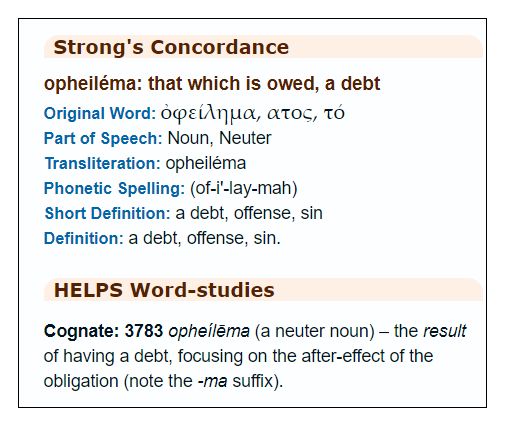
And sins are debts, aren’t they. Strong’s Concordance explains the Greek word used here

And to Him we owe it all! Jesus paid it all, all to Him I owe!!!

He paid the debt, and He set us free. We are mindful of the two ‘Ifs’ however, do not cherish sin, and confess it daily. What a privilege to pray. What a gift that He hears us.


Prayer Machinery of Heaven series:

Prayer Machinery #1: Introduction and Praying for Missionaries

Prayer Machinery #2: Praying for pray for our Elders (pastors, deacons, teachers, etc).

Prayer Machinery #3: Praying for each other

Prayer Machinery #4: How to Pray

Prayer Machinery #5: A focus on Jesus in heaven who hears our prayers, and what a comfort that is

Prayer Machinery #6: Persevering in Prayer

Prayer Machinery #7: The Two ‘If’s’ and the Importance of confessing Sin

Posted in encouragement, Uncategorized

The Prayer Machinery of Heaven #6

And he told them a parable to the effect that they ought always to pray and not lose heart. (Luke 18:1)

Prayer straddles our lives both on earth when we pray and in heaven when Jesus hears. All week I’m focusing on prayer. It’s important. I need to do better in my life, and I can’t imagine a Christian who doesn’t think they can do better at prayer either.

Charles Spurgeon said,

Prayer meetings are the throbbing machinery of the church.

Last weekend, I was thinking of one of Spurgeon’s sermons, called God’s Providence. (#3114). Spurgeon likened the cherubim’s acts near the throne and the wheels within wheels as described by Ezekiel as machinery of Providence. He described, hypothetically of course, the wheels going up and down and left and right in tandem as the machinery of Providence carrying out God’s will and decrees. It’s an interesting thought, and Spurgeon is vivid about his descriptions.

This series of ‘prayer machinery of heaven’ is inspired by those two thoughts.

Please enjoy this scripture photo I made of the machinery of prayer. Under that will be some further resources on prayer suggestions. Monday I suggested praying for the persecuted and missionaries around the world, with some resources to check out along those lines. Tuesday I suggested praying for our elders (pastors, deacons, teachers, etc), again, with resources. Wednesday I suggested praying for each other. Today focuses on how often to pray. Thursday I offered information about frequency of prayer. Friday we focused on Jesus in heaven who hears our prayers, and what a comfort that is. For this next-to-last picture in the series, I’ll offer some thoughts and resources on persevering in prayer.

I thought Barnes’ Notes said it well. There are different kinds of prayers and seasons for each kind. There are different attitudes of prayer.

Always – At all times. That is, we must not neglect regular stated seasons of prayer; we must seize on occasions of remarkable providences as afflictions or signal blessings to seek God in prayer; we must “always” maintain a spirit of prayer, or be in a proper frame to lift up our hearts to God for his blessing, and we must not grow weary though our prayer seems not to be answered.

Not to faint – Not to grow weary or give over. The parable is designed to teach us that, though our prayers should long appear to be unanswered, we should persevere, and not grow weary in supplication to God.

The parable is instructive for us, to never give up in prayer. Jesus receives prayer around the clock, every day, all the time. For us, it’s a battle to put hands together and carve out time to pray, Satan does not want us to pray. Jesus does. We have to work toward satisfying the one and not the other. Spurgeon again, said-

It is well said that neglected prayer is the birthplace of all evil.

I believe this. Jesus spent time instructing the disciples how to pray. (Luke 11:1-13). He spent time instructing through the parable of the importance of persisting in prayer. (Luke 18:1-8). Prayer is important. I need to do better in lots of ways- in my closet, in persisting, in focus, in content, and in earnestness and fervor. Lord, help me to pray.

prayer machinery 6b

Further Reading

Sermon Series: Elements of True Prayer

Valley of Vision devotional of Puritan Prayers (a wonderful wonderful resource!)

Tim Challies: Persistence in Prayer

Full of Eyes: Visual theology & exegesis of Colossians 4:2-4 being steadfast in prayer

Prayer Machinery of Heaven series:

Prayer Machinery #1: Introduction and Praying for Missionaries

Prayer Machinery #2: Praying for pray for our Elders (pastors, deacons, teachers, etc).

Prayer Machinery #3: Praying for each other

Prayer Machinery #4: How to Pray

Prayer Machinery #5: A focus on Jesus in heaven who hears our prayers, and what a comfort that is

Prayer Machinery #6: Persevering in Prayer

Prayer Machinery #7: The Two ‘If’s’ and the Importance of confessing Sin

Posted in encouragement, Uncategorized

The Prayer Machinery of Heaven #5

The Lord is near to all who call on him, to all who call on him in truth. He fulfills the desire of those who fear him; he also hears their cry and saves them. (Psalm 145:18-19)

Prayer straddles our lives both on earth when we pray and in heaven when Jesus hears. All week I’m focusing on prayer. It’s important. I need to do better in my life, and I can’t imagine a Christian who doesn’t think they can do better at prayer either.

Last weekend, I was thinking of one of Spurgeon’s sermons, called God’s Providence. (#3114). Spurgeon likened the cherubim’s acts near the throne and the wheels within wheels as described by Ezekiel as machinery of Providence. He described, hypothetically of course, the wheels going up and down and left and right in tandem as the machinery of Providence carrying out God’s will and decrees. It’s an interesting thought, and Spurgeon is vivid about his descriptions.

This series of ‘prayer machinery of heaven’ is inspired by that thought.

Please enjoy this scripture photo I made of the machinery of prayer. Under that will be some further resources on prayer suggestions. Monday I suggested praying for the persecuted and missionaries around the world, with some resources to check out along those lines. Tuesday I suggested praying for our elders (pastors, deacons, teachers, etc), again, with resources. Wednesday I suggested praying for each other. Today focuses on how often to pray. Thursday I offered information about frequency of prayer. Today let’s focus on Jesus in heaven who hears our prayers, and what a comfort that is.

In John Gill’s Commentary on verse 19, he writes,

He will fulfil the desire of them that fear him,…. That have the true fear of God put into their hearts; that fear him not with a servile, but godly fear; that fear the Lord and his goodness, and are true worshippers of him in a spiritual and evangelic manner; for the fear of God includes the whole worship of him, private and public: and the Lord grants to such whatever they desire of him, in his fear, under the direction of his spirit, according to his will, and in submission to it. Do they desire good things of him, temporal or spiritual? there is no want of any good thing to them that fear him; how should there, when such great goodness is laid up for them? Do they desire his presence, and the discoveries of his love? the sun of righteousness arises on them that fear his name, and his secrets are with them, and his mercy is upon them from everlasting to everlasting. Do they desire his protection from enemies? the Angel of the Lord encamps round about them, and the Lord himself is their, help and their shield;

he also will hear their cry, and will save them; that is, he will hear and answer their prayer, which they put up to him in their distress: they cry to him either mentally or vocally, in their troubles, and his ears are open to their cries, and they enter into them; and he regards them, and saves them out of them; out of their temporal and out of their spiritual troubles; he saves them with a temporal and with an eternal salvation.

We have such a good God who hears. Our fear and devotion to Him, and His careful attention and love toward us, makes a wonderful relationship. And that is what our religion is, not formalist with rituals and rules, but a relationship with a Holy God who cares.

prayer machinery 4

Further Resources

Essay: How’s Your Prayer Life? by Dr. Martyn Lloyd Jones

Sermon S. Lewis Johnson: The Lord’s Prayer: A Primer for Prayer

Prayer Machinery of Heaven series:

Prayer Machinery #1: Introduction and Praying for Missionaries

Prayer Machinery #2: Praying for pray for our Elders (pastors, deacons, teachers, etc).

Prayer Machinery #3: Praying for each other

Prayer Machinery #4: How to Pray

Prayer Machinery #5: A focus on Jesus in heaven who hears our prayers, and what a comfort that is

Prayer Machinery #6: Persevering in Prayer

Prayer Machinery #7: The Two ‘If’s’ and the Importance of confessing Sin

Posted in encouragement, Uncategorized

Prayer machinery of heaven #4

Pray in the Spirit at all times, with every kind of prayer and petition. To this end, stay alert with all perseverance in your prayers for all the saints. (Ephesians 6:18)

Prayer straddles our lives both on earth and in heaven. All week I’m focusing on prayer. It’s important. I need to do better in my life, and I can’t imagine a Christian who doesn’t think they can do better at prayer either.

Last weekend, I was thinking of one of Spurgeon’s sermons, called God’s Providence. (#3114). Spurgeon likened the cherubim’s acts near the throne and the wheels within wheels as described by Ezekiel as machinery of Providence. He described, hypothetically of course, the wheels going up and down and left and right in tandem as the machinery of Providence carrying out God’s will and decrees. It’s an interesting thought, and Spurgeon is vivid about his descriptions.

This series of ‘prayer machinery of heaven’ is inspired by that thought.

Please enjoy this scripture photo I made of the machinery of prayer. Under that will be some further resources on prayer suggestions. Monday I suggested praying for the persecuted and missionaries around the world, with some resources to check out along those lines. Tuesday I suggested praying for our elders (pastors, deacons, teachers, etc), again, with resources. Wednesday I suggested praying for each other. Today focuses on how often to pray.

In an article called Pray Like a Puritan, Tim Challies interviewed Dr Joel Beeke. Here is an excerpt of their conversation as it relates to frequency of prayer:

TC: Matthew Henry wrote a very popular book on prayer and among his first directions was “begin each day with God.” What might the Puritans have said if someone suggested that the Bible does not command daily devotions or daily private worship?

JB: Manton said, “Though there be not an express rule particularly set down how often we should be with God,” yet God’s commands and calls to prayer “are very large.” He pointed out that the Word commands us to “pray without ceasing” (1 Thess. 5:17) and to be “praying always” (Eph. 6:18). This implies a continual habit of prayer, and also set times especially devoted to prayer. He offered us the examples of David (Ps. 55:17) and Daniel (Dan. 6:10), both of whom prayed three times a day. It is true that we can shoot up sudden prayers (Neh. 2:4) in the middle of our ordinary work. But we must also “strive” in prayer (Rom. 15:30), which implies a longer time given exclusively to prayer. Some of those longer prayer times are with the family or with the church, but Christ taught us especially to pray alone in a secret place (Matt. 6:6), and in that same context to pray “daily” (Matt. 6:11). We should not view prayer as a mere religious performance, asking, “How often do I have to do it?” Instead, Manton said that prayer is the conversation of “a loving soul with God,” and “acts of friendship and communion must not be rare and unfrequent, but constant and often.” He wrote, “If we have a love to God, we cannot keep long out of God’s company, but will be with him pouring out our hearts to him.”


prayer machinery 5

Further Resources

GotQuestions: How to Pray?

Evangelical Times: John Bunyan on Prayer

Meet The Puritans: John Bunyan on Prayer

Prayer Machinery of Heaven series:

Prayer Machinery #1: Introduction and Praying for Missionaries

Prayer Machinery #2: Praying for pray for our Elders (pastors, deacons, teachers, etc).

Prayer Machinery #3: Praying for each other

Prayer Machinery #4: How to Pray

Prayer Machinery #5: A focus on Jesus in heaven who hears our prayers, and what a comfort that is

Prayer Machinery #6: Persevering in Prayer

Prayer Machinery #7: The Two ‘If’s’ and the Importance of confessing Sin

Posted in encouragement, Uncategorized

The Prayer Machinery of Heaven #3

Therefore, confess your sins to one another and pray for one another, that you may be healed. The prayer of a righteous person has great power as it is working. (James 5:16).

Those blessings are sweetest that are won with prayers and won with thanks.
—Thomas Goodwin

I’m convinced also that the sweetness increases when it’s a prayer request granted for another person.

Prayer straddles our lives both on earth and in heaven. All week I’m focusing on prayer. It’s important. I need to do better in my life, and I can’t imagine a Christian who doesn’t think they can do better at prayer either.

Last weekend, I was thinking of one of Spurgeon’s sermons, called God’s Providence. (#3114). Spurgeon likened the cherubim’s acts near the throne and the wheels within wheels as described by Ezekiel as machinery of Providence. He described, hypothetically of course, the wheels going up and down and left and right in tandem as the machinery of Providence carrying out God’s will and decrees. It’s an interesting thought, and Spurgeon is vivid about his descriptions.

This series of ‘prayer machinery of heaven’ is inspired by that thought.

Please enjoy this scripture photo I made of the machinery of prayer. Under that will be some further resources on prayer suggestions. Monday I suggested praying for the persecuted and missionaries around the world, with some resources to check out along those lines. Tuesday I suggested praying for our elders (pastors, deacons, teachers, etc), again, with resources. Today’s let’s let’s pray for each other.

prayer machinery 3.jpg

Further Reading/Resources

Spurgeon quotes on Prayer

Sermon: Elements of True Prayer

Ligonier: Essay by Don Whitney, Praying for One Another

GotQuestions: What is Intercessory Prayer?

Prayer Machinery of Heaven series:

Prayer Machinery #1: Introduction and Praying for Missionaries

Prayer Machinery #2: Praying for pray for our Elders (pastors, deacons, teachers, etc).

Prayer Machinery #3: Praying for each other

Prayer Machinery #4: How to Pray

Prayer Machinery #5: A focus on Jesus in heaven who hears our prayers, and what a comfort that is

Prayer Machinery #6: Persevering in Prayer

Prayer Machinery #7: The Two ‘If’s’ and the Importance of confessing Sin

Posted in encouragement, Uncategorized

The prayer machinery of heaven #2

Do not be anxious about anything, but in everything, by prayer and petition, with thanksgiving, present your requests to God. And the peace of God, which transcends all understanding, will guard your hearts and your minds in Christ Jesus. (Philippians 4:6-7).

The purest actions of the purest men need Christ to perfume them; and this is his office. When we pray, we need to pray again for Christ to pardon the defects of our prayers. ~ The Bruised Reed by Richard Sibbes

Isn’t that descriptive, we pray, because we can, and then pray again for Christ to pardon the prayer’s defects. I think the Romans 8:26 verse below is getting to that idea.

Prayer straddles our lives both on earth and in heaven. All week I am focusing on prayer. It’s important. I need to do better in my life, and I can’t imagine a Christian who doesn’t think they can do better at prayer either.

I was thinking of one of Spurgeon’s sermons, called God’s Providence. (#3114). Spurgeon likened the cherubim’s acts near the throne and the wheels within wheels as described by Ezekiel as machinery of Providence. He described, hypothetically of course, the wheels going up and down and left and right in tandem as the machinery of Providence carrying out God’s will and decrees. It’s an interesting thought, and Spurgeon is vivid about his descriptions.

Th is series of prayer machinery of heaven is inspired by that thought.

Please enjoy this scripture photo I made of the machinery of prayer. Under that will be some further resources on prayer suggestions. Yesterday I suggested praying for the persecuted and missionaries around the world, with some resources to check out along those lines. Today, let’s pray for our elders (pastors, deacons, teachers, etc).

prayer machinery 2

Further Reading/Resources

Revive Our Hearts: Your Pastor Challenge

Ligonier: How to Pray for Your Pastor

Challies: Pray for Your Pastor! (lots of other links inside)

Prayer Machinery of Heaven series:

Prayer Machinery #1: Introduction and Praying for Missionaries

Prayer Machinery #2: Praying for pray for our Elders (pastors, deacons, teachers, etc).

Prayer Machinery #3: Praying for each other

Prayer Machinery #4: How to Pray

Prayer Machinery #5: A focus on Jesus in heaven who hears our prayers, and what a comfort that is

Prayer Machinery #6: Persevering in Prayer

Prayer Machinery #7: The Two ‘If’s’ and the Importance of confessing Sin

Posted in Uncategorized

The prayer machinery of heaven #1

This is the confidence which we have before Him, that, if we ask anything according to His will, He hears us. (1 John 5:14)

Andrew Bonar: “I have been endeavoring to keep up prayer…every hour of the day, stopping my occupation, whatever it is, to pray a little. I seek to keep my soul within the shadow of the throne of grace and Him that sits thereon.”

Isn’t that descriptive, keeping one’s soul in the shadow of the One who sits on the throne. Prayer does that for us. Spurgeon said,

Prayer meetings are the throbbing machinery of the church

Prayer straddles our lives both on earth and in heaven. All week I am going to focus on prayer. It’s important. I need to do better in my life, and I can’t imagine a Christian who doesn’t think they can do better at prayer either.

Spurgeon’s reference to machinery got me thinking of another of Spurgeon’s sermons, one called God’s Providence. (#3114). Spurgeon likened the cherubim’s acts near the throne and the wheels within wheels as described by Ezekiel as machinery of Providence. He described, hypothetically of course, the wheels going up and down and left and right in tandem as the machinery of Providence carrying out God’s will and decrees. It’s an interesting thought, and Spurgeon is vivid about his descriptions. Here are a few-

So in God’s Providence, there is an axle which never moves. Christian, here is a sweet thought for thee! Thy state is ever changing; sometimes thou art exalted, and sometimes depressed; yet there is an unmoving point in thy state. What is that axle? What is the pivot upon which all the machinery revolves? It is the axle of God’s everlasting love toward his covenant people. he exterior of the wheel is changing, but the center stands forever fixed. Other things may move; but God’s love never moves: it is the axle of the wheel; and this is another reason why Providence should be compared to a wheel.

My firm belief is, that angels are sent forth somehow or other to bring about the great purposes of God. The great wheel of Providence is turned by an angel.

That you will see by the text: “Behold one wheel upon the earth by the living creatures, with his four faces.” The wheel had “four faces.” I think that means one face to the north, another to the south, another to the east, and another to the west. There is a face to every quarter. Providence is universal, looking to every quarter of the globe.

And so on. Neat, huh?

In further imagining this ‘throbbing machinery’ of prayer, I created some scripture pictures that will be my theme this week. I enjoy imagining how God works and thinking about what things look like in heaven, given the glimpses we have been given in scripture. My favorite doctrine is Providence. Combining that with the imagined ‘machinery’ of prayer is intriguing.

Please enjoy.

Further Reading

Let’s pray for the persecuted and the missionaries around the world. Read this story, I hope it moves you.

Banner of Truth Magazine: He Gave His Life So Another Might Live

Voice of the Martyrs: Pray Today App (free)
Voice of the Martyrs: Global Prayer Guide (free)

Prayer Machinery of Heaven series:

Prayer Machinery #1: Introduction and Praying for Missionaries

Prayer Machinery #2: Praying for pray for our Elders (pastors, deacons, teachers, etc).

Prayer Machinery #3: Praying for each other

Prayer Machinery #4: How to Pray

Prayer Machinery #5: A focus on Jesus in heaven who hears our prayers, and what a comfort that is

Prayer Machinery #6: Persevering in Prayer

Prayer Machinery #7: The Two ‘If’s’ and the Importance of confessing Sin

Posted in poetry, Uncategorized

Kay Cude poetry: Risen and Ascended

Resurrection Sunday is past, the day we mark as the day to specifically celebrate Christ’s resurrection. However, Christians know that each Sunday in attending the gathering of the saints, hearing the preaching, singing the praises, giving cheerfully, we celebrate the resurrection again and again. Just the gathering is signal that we know and believe that Christ is alive, on His throne, hearing and receiving praises and worship. His glory and power are to be wondered at and praised.

Here is a beautiful work by poet Kay Cude. First, her Artist’s Statement:

I had begun this piece several months ago with only Spurgeon’s one quote, “Tis all my business here and below to cry, ‘Behold the Lamb!’ We are to point sinners to Jesus – all the while looking at Him ourselves, and praying that they also may look to Him, and live.” I was captivated by the image of the radiant glory of Christ in His transfiguration and subsequent ascension, but couldn’t settle on what I needed to say to complete the message, for it is directed at the unregenerate and the redeemed of Christ.


Thank you for your piece, “The Power of the Resurrection vs. the Stupidity of Easter,” for within it I found John MacArthur’s “The Power of the Resurrection” and within it another Spurgeon quote that completed the intent the first quote and Acts 1:10-11.

HE IS RISEN AND IS ASCENDED

Posted in encouragement, Uncategorized

A simple reminder about hope

Blessed be the God and Father of our Lord Jesus Christ! According to his great mercy, he has caused us to be born again to a living hope through the resurrection of Jesus Christ from the dead, (1 Peter 1:3)

Well that says a lot! Each phrase is an encouragement. I’m focusing on living hope this morning. Our living hope is not a dead hope. It is not surmise, speculation, or empty ‘what if’. It is a living hope because we are IN Christ and He is living and *He* is our Hope.

Gill’s Commentary says

Saints are both begotten again to the grace of hope, and to the glory which that grace is waiting for”. Our hope is because of Christ, it is in Christ and it is Christ. It is a living hope

hope

Posted in encouragement, Uncategorized

The Pilgrim’s Progress, John Bunyan, and Helpful Resources

Pilgrim's_Progress_2I really love this book. I’ve read it once, picked through it several times, and now I’m listening to Derek Thomas lecture on it at Ligonier.org’s Daily Video. (1st lecture in the series here).

There is a part 2 to Pilgrim’s Progress that Thomas urges us to read, as both parts are meant to be a coherent whole. I had not known that.

Pilgrim’s Progress was written by John Bunyan while he was in prison for 12 years for preaching the Gospel. Wilkipedia has a bio of the man, more at link

John Bunyan (unknown birth date, baptised on November 30, 1628 – August 31, 1688) was an English writer and Puritan preacher best remembered as the author of the Christian allegory The Pilgrim’s Progress. In addition to The Pilgrim’s Progress, Bunyan wrote nearly sixty titles, many of them expanded sermons.

He also penned the world’s first recognized visual theology, the Mapp Shewing Order and Causes of Salvation & Damnation“. Tim Challies updated the Map to modern graphical styles, though let it be said I enjoy the original, with its angels and dragons and soaring language. Challies said of the maps,

In a pair of side-by-side timelines he traced the salvation of the believer (or the elect) and the damnation of the unbeliever (or the reprobate). …

Let me start you with a hint: Begin on the left side and read through circles one to 25 as a big, long sentence. When that’s complete, do the same for the other side. Finally, go back to read the verses and additional information. I think you will find, as I did, that the first sentence is terrible and chilling while the second is beautiful and encouraging. Whatever you do, linger. Bunyan has a lot to teach us through this infographic.

Here’s a link to Bunyan’s original (and IMO, better) map. Bunyan’s spiritual autobiography, Grace Abounding to the Chief of Sinners, is also a wonderful book. You can find a free text version online here. Or here in .pdf form, which you can download and then send to your Kindle via Kindle email attached as a file and it will be installed on your device.

Since Bunyan is so well known for Pilgrim’s Progress, few people know he wrote so many other books.

Anyway back to the book Pilgrim’s Progress. Why is this book important?

Leland Ryken said in a foreword at Desiring God about the 2 books(s) The Pilgrim’s Progress parts 1 & 2,

The book that became known to posterity as The Pilgrim’s Progress is a Christian classic whose importance is impossible to overstate. For more than two centuries after its first publication, The Pilgrim’s Progress ranked just behind the King James Bible as the most important book in evangelical Protestant households. Te book has been translated into some two hundred languages, including eighty in Africa. Any book that has achieved such popularity has a very large claim to our attention. Facts of Publication The Pilgrim’s Progress actually has two publication dates, corresponding to the two books that comprise it. The first book was published in 1678 and bore the title The Pilgrim’s Progress: From This World to That Which Is to Come, Delivered Under the Similitude of a Dream. It tells the story of the spiritual journey of the protagonist named Christian from the City of Destruction to the Celestial City (meaning heaven).

Book II was published six years later as part of an old artistic tradition known as a “companion piece.” It tells the story of the same journey, this time undertaken by Christian’s wife, Christiana, and their four sons.

The hard part for me when reading Pilgrim’s Progress is not the 350-year-old language. Though, if the language presents a difficulty, there are free updated, modern language versions available, both for free online and in hard copy.

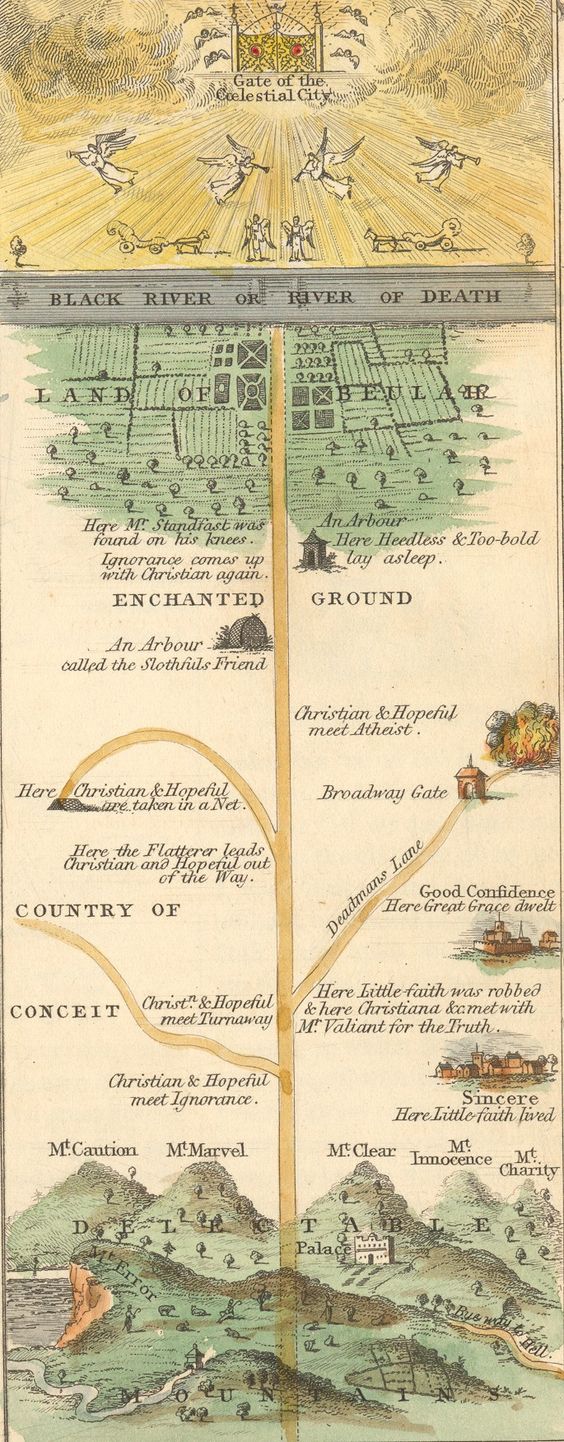
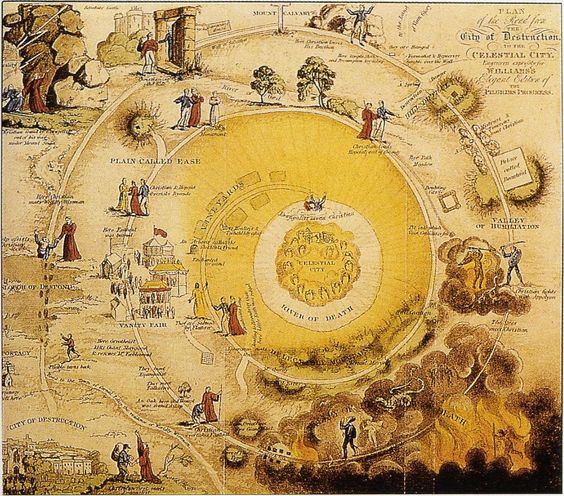
800px-John_Bunyan,_The_Road_From_the_City_of_Destruction_to_the_Celestial_City_1821_Cornell_CUL_PJM_1038_01

A Plan of the Road From the City of Destruction to the Celestial City, Adapted to The Pilgrim’s Progress, 1821. Public Domain

What I find hard is the abstractness of it, because I’m very literal. I do not understand allegory or symbols in literature.

Pilgrim’s Progress is an allegory. An allegory is a literary device. Here is allegory defined

Allegory is a figure of speech in which abstract ideas and principles are described in terms of characters, figures, and events. It can be employed in prose and poetry to tell a story, with a purpose of teaching or explaining an idea or a principle. The objective of its use is to teach some kind of a moral lesson.

Difference Between Allegory and Symbolism
Although an allegory uses symbols, it is different from symbolism. An allegory is a complete narrative that involves characters and events that stand for an abstract idea or event. A symbol, on the other hand, is an object that stands for another object, giving it a particular meaning. Unlike allegory, symbolism does not tell a story.

I enjoyed Ligonier Theologian Derek Thomas in these free 23-minute lectures explaining Pilgrim’s Progress, both parts one and two. I found them extremely helpful in understanding the book. In addition to explaining the allegories and what they (likely) stood for, Thomas folded in Puritan history and culture of Bunyan’s day and set the context for how Bunyan thought and what was happening in his life as he wrote the book. This information gives depth and nuance to understanding it.

The City of Destruction
The Wicket Gate
The Interpreter’s House
The Cross & the Sepulcher
The Hill Difficulty
The Palace Beautiful
The Valley of Humiliation
The Valley of the Shadow of Death
The Godless City: Vanity Fair
The Castle of Giant Despair
The Delectable Mountains
The Celestial City

Another resource for this marvelous book is Notes & Commentary, Guide to Pilgrim’s Progress by Ken Puls.

An additional resource is Mt Zion Chapel Library, Pilgrim’s Progress for Everyone

I hope you enjoy the resources and would consider reading The Pilgrim’s Progress.