Posted in apostles, encouragement, jesus, nathanael, philip

“Can Anything Good Come from Nazareth?”

By Elizabeth Prata

Philip found Nathanael and said to him, “We have found him of whom Moses in the Law and also the prophets wrote, Jesus of Nazareth, the son of Joseph.” Nathanael said to him, “Can anything good come out of Nazareth?” (John 1:45-46a)

This verse is from chapter 1 of the Gospel of John. The context is that Jesus has begun calling His disciples, who would become the Apostles later. In the previous verses, He had called Andrew and his brother Simon (who shall be called Peter). Now, Philip who was from Bethsaida, went to Cana where Nathanael was from, to tell him the news.

Nathanael’s skepticism rested on the fact of Jesus’ origins, which were from Nazareth, a backwater. So Nathanael’s skepticism revolved around the location, not the Person. Though we often focus on the part of the verse that says “from Nazareth?!” let’s focus on the part before that. Note Nathanael said, “can anything GOOD…” This shows that Nathanael knew of the Messiah and was looking for Him. He knew His appearance would be GOOD. Nathanael believed.

Nathanael had a seeking heart because he truly studied the scriptures. As verse 45 shows, Philip and Nathanael studied the Law, Moses and the Prophets. As for Nathanael’s character, in verse 47 when Jesus saw Nathanael coming toward Him, Jesus said there was no deceit in Nathanael and that he was a true Israelite.

Nathanael was a simple man, indeed from a similar backwater than Nazareth (Cana), in a backwater district, in a time of apostasy. Not many people around him believed the truth. The Samaritans believed a blended religion, the Pharisees believed a works religion, the Sadducees didn’t believe in supernatural resurrection or angels and were against the Pharisees who did, and most regular people were either unknowing, hypocrites, or apathetic. As a matter of fact, Luke 4:33-34 records Jesus at Capernaum teaching at the synagogue. A demon-possessed man in the synagogue cried out when Jesus taught, because of His authority in His proclamation of the truth of God. Jesus cast him out, His first exorcism. Can you imagine a synagogue so devoid of truth that before Jesus’ arrival, the demon inside the man felt so secure he had never cried out before? Demons should never feel comfortable in church!

It was a time of apostasy, God hadn’t spoken in 400 years. He had sent no prophet since Malachi (until John the Baptist). God had done no miracles. He had been silent.

Synagogues in the small towns had limped along, (with demons in them), the Temple in Jerusalem grew bloated with wares, graft, and hypocrisy thanks to the religious hierarchy.

And yet, among all this, there was faithful Simeon, and Anna, there was Zacharias and Elizabeth, Joseph and Mary, John the Baptist, and the men who would become the Apostles. And there was Nathanael, who was looking for something GOOD (just had a hard time believing it would come from Nazareth, lol).

In this current time of apostasy (when wasn’t the world apostasizing?!) we look at our leaders and sometimes we are greatly disappointed. Just as those regular people of Nathanael’s time were looking at the hypocritical Pharisees, the corrupt Annas or Caiaphas, the arrogant and zealous Saul (later, Paul), the ordinary people must have felt let down by those who were in charge of leading them in the truth just as we are let down by many of our leaders today. There has always been a shepherd problem.

“Woe to the shepherds who are destroying and scattering the sheep of my pasture!” declares the LORD. (Jeremiah 23:1)

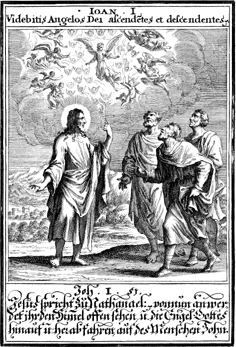
Jesus and Nathanael
WEIGEL, Johann Christoph 1695, Woodcut. Source

Yet there were simple people in small towns, laboring diligently during the week and on Sabbaths, attending synagogue to learn about the promised Messiah. Who was the first person Philip went to tell the good news that Messiah had been found, the priest in their local synagogue? No! Philip went immediately to tell his friend, Nathanael. These first century men and women persevered, they believed with a child-like faith, simple and in which there was no deceit. There were no layers of corruption to the faith that Nathanael evidenced, no arrogance. With seeking heart he and his friend Philip must have gone to hear John the Baptist, and when Jesus arrived, and said ‘Follow Me,’ they did.

And we should do the same. We labor during the week, we worship on Sunday, we follow Jesus as He commanded. His word is in the Bible now, not spoken to us on a hillside at Bethsaida, but we believe. No matter what our leaders do, we trust the promises in His word just as Nathanael and Philip did in that long-ago apostate time. We follow, seek, trust. Nathanael was looking for something GOOD, and He came. We should also have seeking hearts.  Are you looking for He who was written of in Moses and the Prophets? Like Nathanael during a time of low worship and little truth, we are also looking forward to something GOOD. He will come again

in a moment, in the twinkling of an eye, at the last trumpet; for the trumpet will sound, and the dead will be raised imperishable, and we will be changed. For this perishable must put on the imperishable, and this mortal must put on immortality…(1 Corinthians 15:52-53)

Posted in encouragement, holy, Lamb

Be ye reconciled to God

By Elizabeth Prata

And Isaac said to his father Abraham, “My father!” And he said, “Here I am, my son.” He said, “Behold, the fire and the wood, but where is the lamb for a burnt offering?” Abraham said, “God will provide for himself the lamb for a burnt offering, my son.” So they went both of them together. (Genesis 22:7-8)

The Sacrifice of Isaac is a familiar chapter to most Christians. We study it in Sunday School, it’s taught in VBS, we read it familiarly as mature Christians, our eyes having passed over the verses many times.

But sometimes the gravity of the moment just grabs you and won’t let go. The Father DID provide the Lamb for the sacrifice. The grandest, most beautiful, most terrible moment in all of history or ever shall be, was the death of Jesus on the Cross at Calvary.

Therefore, we are ambassadors for Christ, God making his appeal through us. We implore you on behalf of Christ, be reconciled to God. He made Him who knew no sin to be sin on our behalf, so that we might become the righteousness of God in Him. (2 Corinthians 5:20-21)

Ambassadors have all the authority of the sending nation behind them. As Christ’s ambassadors, we have all the authority of heaven behind us!

Sometimes just thinking about how Jesus died for us and absorbed the wrath that was rightfully due me, is overwhelming. Sometimes thinking of how despite my craven sinful nature, God cleaned me and forgave me. Sometimes thinking of the fact that God uses me, a poor clay vessel, for His glory, is just too immense for my mind to absorb.

The Christian journey is sometimes not easy, and it is always demanding, but it is also the most joyous and entrancing life a person could ever imagine. If you have not turned to Jesus for forgiveness of your sins, sins that incur the wrath of a Holy God against you every minute of every day, please do it. The life, death, and resurrection of Jesus of Nazareth split history. The event divided the world into two paths. One is narrow and leads to everlasting life. The other path is broad and many find it, and will descend to hell for everlasting wrath.

The Father did provide the Lamb. And He is exalted.

The Lamb Exalted
Then I looked, and I heard the voice of many angels around the throne and the living creatures and the elders; and the number of them was myriads of myriads, and thousands of thousands, saying with a loud voice, “Worthy is the Lamb that was slain to receive power and riches and wisdom and might and honor and glory and blessing.” And every created thing which is in heaven and on the earth and under the earth and on the sea, and all things in them, I heard saying, “To Him who sits on the throne, and to the Lamb, be blessing and honor and glory and dominion forever and ever.” (Revelation 5:11-13)

Posted in encouragement

Casting Our Cares Together

By Elizabeth Prata

To all my sisters who have lost a loved one and are facing the first holiday alone…

To all my sisters who have spoken up for the pure doctrine of Jesus Christ in bible study and have been kicked out because of it…

To all my sisters who have approached their pastor with concerns of false teaching and have been spiritually abused instead of comforted…or even heard…

To all my sisters who are struggling to be a good Christian wife with a non-believing husband…or an apathetic husband…

To all my sisters who have a spouse deployed overseas…

To my lonely and hurting and grief-stricken and saddened sisters. You’re not alone.

Casting all your anxieties on him, because he cares for you. (1 Peter 5:7)

Bear one another’s burdens, and so fulfill the law of Christ. (Galatians 6:2)

Therefore encourage one another and build one another up, just as you are doing. (1 Thessalonians 5:11)

Jesus is WITH you.


Posted in creation, creator, encouragement, fragrance, magnolia

Aroma of Christ: Lessons from a Magnolia Bloom

By Elizabeth Prata

Say “magnolia” and people automatically think of the South. I grew up in New England I know I certainly did. Never once did I think I’d live in the south, and with a magnolia tree across from my front door no less!

It is a stately tree, solid and aristocratic. Kenneth W. Outcalt wrote about the magnolia grandiflora tree, “Southern magnolia (Magnolia grandiflora), also called evergreen magnolia, bull-bay, big-laurel, or large-flower magnolia, has large fragrant white flowers and evergreen leaves that make it one of the most splendid of forest trees and a very popular ornamental that has been planted around the world.

The magnolia flower of the grandiflora tree is just as grand as its host. The petals are enormous but velvety and have a rich ivory color. I don’t have a sense of smell so I can’t tell you directly. Locals say it smells great. Apparently the scent varies, it can smell like lemons, or violets, or vanilla.

Like the magnolia blossom’s physical scent, we humans emit a spiritual scent.

And walk in love, as Christ loved us and gave himself up for us, a fragrant offering and sacrifice to God.” (Ephesians 5:2).

But thanks be to God, who always leads us as captives in Christ’s triumphal procession and uses us to spread the aroma of the knowledge of him everywhere. For we are to God the pleasing aroma of Christ among those who are being saved and those who are perishing.” (2 Corinthians 2:14-15)

Magnolia blossoms are blooming now. The trees are so tall, and most of the blossoms are far above my head, making a close inspection difficult. However this year, there was one bloom that was at eye level. With the flowers being so large and beautiful and emblematic of an entire region of the south, and a blossom blooming literally before my eyes, I decided to photograph one blossom each day for its entire life cycle.

The blossom here as it appears initially is tightly wound, straight as an arrow, and contains no hints of the surprise inside.

EPrata photo

It popped open! Revealing more layers! How pretty!

EPrata photo

Each petal is larger than my entire hand. The color ranges from white to ivory and the entire blossom looks so stately.

EPrata photo

The petals are revealing a surprise inside!

EPrata photo

The petals are velvet-y.

EPrata photo

Now the petals are turning brown, barely hanging on to the stem, speckled on the edge with more brown. The leaves immediately under the blossom are dead. Bugs were crawling over the petals, looking for a good place to stake a claim to start munching.

Four days, that is all it took for the bloom to appear in its final form, open, live, and die. I was so surprised. There are many blooms on the tree, and I just assumed that they lasted a while. I’d never tracked just one. Its life is so short, a mere breath.

I was pondering that for a while today. What seemed so strong and beautiful was only a few days later fodder for death, decay, and insects. In addition, what was presented so starkly to me in the story of the magnolia is something that is repeated in our human body and our short lives. Most of us live more than 4 days, but to God, our life is a mere vapor, a mist.

yet you do not know what tomorrow will bring. What is your life? For you are a mist that appears for a little time and then vanishes.” (James 4:14)

You have made my days a mere handbreadth; the span of my years is as nothing before you. Everyone is but a breath, even those who seem secure.” (Psalm 39:5)

So what are we going to do with the time afforded us on our short time on earth?

Therefore be careful how you walk, not as unwise men but as wise, making the most of your time, because the days are evil.” (Ephesians 5:15-16)

Once the petals fall away the seed inside is fully revealed. The magnolia fruit will continue to dry out, and eventually open, revealing tiny red seeds. These drop to the ground-

Mature Magnolia fruit just starting to open, with a few seeds visible.
Wikimedia Commons

One botanist wrote that it hardly seems credible that such a large tree could come from such a small seed.

Paul wrote about how our body is a seed, a mere kernel.

The Resurrection Body

“35But someone will ask, “How are the dead raised? With what kind of body do they come?” 36You foolish person! What you sow does not come to life unless it dies. 37And what you sow is not the body that is to be, but a bare kernel, perhaps of wheat or of some other grain. 38But God gives it a body as he has chosen, and to each kind of seed its own body. 39For not all flesh is the same, but there is one kind for humans, another for animals, another for birds, and another for fish. 40There are heavenly bodies and earthly bodies, but the glory of the heavenly is of one kind, and the glory of the earthly is of another. 41There is one glory of the sun, and another glory of the moon, and another glory of the stars; for star differs from star in glory.”

“42So is it with the resurrection of the dead. What is sown is perishable; what is raised is imperishable. 43It is sown in dishonor; it is raised in glory. It is sown in weakness; it is raised in power. 44It is sown a natural body; it is raised a spiritual body. If there is a natural body, there is also a spiritual body. 45Thus it is written, “The first man Adam became a living being”; the last Adam became a life-giving spirit. 46But it is not the spiritual that is first but the natural, and then the spiritual. 47The first man was from the earth, a man of dust; the second man is from heaven. 48As was the man of dust, so also are those who are of the dust, and as is the man of heaven, so also are those who are of heaven. 49Just as we have borne the image of the man of dust, we shall also bear the image of the man of heaven.” (1 Corinthians 15:35-49)

Dried out and used up, the small seeds inside the husk have all spilled out and are doing their job in planting themselves into the ground for the next cycle.

When the magnolia seed drops to the ground it is a bare kernel, it looks nothing like what it will become. It is red, the flower is white. It is small, the flower is large. It has no smell, the magnolia scent is lovely. The mature blossom lives a short time, bearing witness to the Creator, who is pleased with its beauty and scent, and then it dies. It endures decay and becomes bug-eaten and eventually, dust. (Ecclesiastes 3:20).

The parallel to people is the same. Our lives are short and ends in decay. While we are living we have a job to do, glorify the Creator and testify to His works. Will we redeem the time? Is our Lord pleased with our aroma? When we awaken to receive our final bodies, will it be to shame and contempt or to everlasting life? (Daniel 12:2).

Do not be amazed at this, for a time is coming when all who are in their graves will hear his voice.” (John 5:28)

I pray you are awakened to eternal life, saved by thegrace of our Lord, working to redeem the time on His behalf. Because, it bears repeating,

And walk in love, as Christ loved us and gave himself up for us, a fragrant offering and sacrifice to God.” (Ephesians 5:2)

Posted in encouragement, forgiveness, good shepherd, sheep

Our Great Shepherd: His care and love are everlasting

‎By Elizabeth Prata

In biblical times, a shepherd’s main concern was the welfare of the flock. Providing the sheep with food and waters as well as guarding them from predators and thieves were primary responsibilities. Highlighting this relationship, Jesus says in the scripture, “I am the good shepherd. The good shepherd lays down his life for the sheep.” (John 10:11). [from Logos Bible Software]

But he brought his people out like a flock; he led them like sheep through the wilderness. (Psalm 78:52).

Since moving to this county twenty years ago, I have never ceased to enjoy the sight of numerous animals dotting the landscape. We are a high-producing agriculture county. Lots of animals around, domestic and otherwise.

There are many pastures. I regularly see cows, horses, donkeys, sheep, chickens, and sometimes emus, buffalo, hawks, foxes, and even coyotes.

Reading about the animals in the Bible is wonderful and interesting. However, being among the animals mentioned in the Bible and observing them is another layer of understanding entirely. WHee I lived for 13 years, for a period of time the neighbor on the other side of the duplex was a shepherdess. I love watching the pastured sheep next door. Their life cycle, cavorting lambs, the nursing, the hay, grass, and stubble that they eat, the wool, their grazing, their recent escapes from the field lol, all interesting.

The Bible refers to the body of Christ as sheep. Am I a sheep? Yes, says Jesus, metaphorically. He is my Shepherd. What a glorious metaphor. I love to think of The Perfect herding me, caring for me, leading me, protecting me. Everything He does is perfect so His care of the sheep will also be perfect, and I can and do rest in that knowledge.

It’s a good metaphor. He could have likened us to badgers, angry and contentious. He could have called us after the evil one who is god of the earth- a lion, a prowling predator seeking after sin and devouring others. He could have called us a spider, an insect nobody likes. I mean, really. A sheep is good.

In my Logos 6 software one can research by topic. I found these biblical facts about sheep:

The sheep is the first animal specified by name in the sacred writings. Abel, himself a shepherd, offered the firstlings of his flock to the Lord (Gen. 4:4). Abraham was very rich in sheep, and Job at one time had 14,000 amongst his herds. In 2 Kings 3:4 we read of a Moabitish shepherd-king who gave a tribute of a hundred thousand lambs and a hundred thousand rams; and this country is still inhabited by owners of vast herds of sheep, the Beni Sakkr sheikhs. Solomon celebrated the dedication of the temple by the sacrifice of 120,000 sheep. 

The Sheep is perhaps the most important of all the animals in the Scriptures. It formed the chief portion of the wealth of the patriarchs, and it is not merely as an article of food that its value is to be estimated. The clothing of those days was almost entirely made of wool; cotton, silk and flax being hardly known or quite out of reach until a later period. The number of flocks was the chief measure of property. Tillage was, comparatively speaking, but little resorted to in Palestine, and there was only very local or in most places no possession in land. Hence sheep were of primary value; and from its nature the country was, and is still, better adapted to the rearing and feeding of sheep than other domestic animals.

Source- Hart, H. C. (1888). The Animals Mentioned in the Bible (pp. 193–194). London: The Religious Tract Society.

Interesting! How about the beloved 23rd Psalm-

The LORD is my shepherd; I shall not want.
2 He makes me lie down in green pastures.
He leads me beside still waters.
3 He restores my soul.
He leads me in paths of righteousness
for his name’s sake.

4Even though I walk through the valley of the shadow of death,
I will fear no evil,
for you are with me;
your rod and your staff,
they comfort me.

5You prepare a table before me
in the presence of my enemies;
you anoint my head with oil;
my cup overflows.

6Surely goodness and mercy shall follow me
all the days of my life,
and I shall dwell in the house of the LORD
forever.

Here is Matthew Henry Commentary on the famous first line of the Psalm, ‘The Lord is my Shepherd, I shall not want.’

Confidence in God’s grace and care. – “The Lord is my shepherd.” In these words, the believer is taught to express his satisfaction in the care of the great Pastor of the universe, the Redeemer and Preserver of men. With joy he reflects that he has a shepherd, and that shepherd is Jehovah.  

A flock of sheep, gentle and harmless, feeding in verdant pastures, under the care of a skilful, watchful, and tender shepherd, forms an emblem of believers brought back to the Shepherd of their souls. The greatest abundance is but a dry pasture to a wicked man, who relishes in it only what pleases the senses; but to a godly man, who by faith tastes the goodness of God in all his enjoyments, though he has but little of the world, it is a green pasture.  

The Lord gives quiet and contentment in the mind, whatever the lot is. Are we blessed with the green pastures of the ordinances, let us not think it enough to pass through them, but let us abide in them. The consolations of the Holy Spirit are the still waters by which the saints are led; the streams which flow from the Fountain of living waters. Those only are led by the still waters of comfort, who walk in the paths of righteousness.

Do you have confidence in God’s grace and care? Do you have quiet contentment of the mind, knowing the Great Shepherd would not only lay down His life for the sheep, but He has done it? Are you consoled by the knowledge that His protection is mighty and everlasting? That His pastures remain green? That the waters are always living and fresh?

We are blessed with good care. Though we stray, the Good Shepherd brings the lost sheep home. This is the ultimate blessing, forgiveness of our many sins, and promise of eternal joy.

All we like sheep have gone astray; we have turned—every one—to his own way; and the LORD has laid on him the iniquity of us all. (Isaiah 53:6)

To him the gatekeeper opens. The sheep hear his voice, and he calls his own sheep by name and leads them out. (John 10:3)

As Jonathan Edwards said in his “Farewell Sermon“,

Whoever may hereafter stand related to you as your spiritual guide, my desire and prayer is that the great Shepherd of the sheep would have a special respect to you, and be your guide (for there is none teacheth like him), and that he who is the infinite fountain of light, would “open your eyes, and turn you from darkness unto light, and from the power of Satan unto God; that you may receive forgiveness of sins, and inheritance among them that are sanctified, through faith that is in Christ;” that so in that great day, when I shall meet you again before your Judge and mine, we may meet in joyful and glorious circumstances, never to be separated any more.

~~~~~~~~~~~~~~~~~~~~~~~~~~~

Further Reading

Exposition of The Lord is My Shepherd

Posted in encouragement, Uncategorized

Praise for the Light

By Elizabeth Prata

Before I was saved I breathed in the air of common grace, grace that is filled with the creation knowledge of Him. It was poison to my lungs. I flopped around like a caught fish on the deck, breathing grace but longing for the murky waters to envelop me once again, the weeds wrapping around my head, because I loved the darkness. (cf Jonah 2:5b)

And this is the judgment: the light has come into the world, and people loved the darkness rather than the light because their works were evil. (John 3:19).

as it is written:

None is righteous, no, not one;
no one understands;
no one seeks for God.
(Romans 3:10)

And yet He loved me, a sinner, and set me upright, washed me, had given gave me common grace all my unsaved life and now added saving grace to my soul.

For the law of the Spirit of life has set you free in Christ Jesus from the law of sin and death.(Romans 8:2).

After salvation I breathe in the sweetness of special grace, the savor of Jesus and His sanctifying work of atonement. The Light came.

Posted in encouragement, Uncategorized

Praying to a Listening God

By Elizabeth Prata

Doesn’t it just amaze you to pray to Jesus…and know He hears us? It’s incredible, and a privilege we always remember in gratitude.

As Isaiah cried in his wonder and grief, “I am a man of unclean lips!” (Isaiah 6:5). In my case, a woman of unclean lips. Why should I be able to use these lips to pray to Jesus when I am the chief of sinners, wretched woman that I am? What is man that God should be mindful of us? (Psalm 8:4). Why should He hear us?

But He does.

Though ‘El Shama’ is not an official name of God, it refers to the fact that God hears…He listens. God told Hagar to name her soon to be born son Ishmael. Ishmael is is a combination of el and shama, “God hears” or “God listens”. The name would be a reminder to Hagar and all who knew them that He heard Hagar’s cry in the wilderness. (Genesis 16:11). He listens.

Psalm 17:6 says

I have called on you, for you will hear me, O God: incline your ear to me, and hear my speech.

Gill’s Expositions says of the Psalmist’s plea in verse 6,

“for thou wilt hear me, O God; God is a God hearing prayer; he is used to hear his people, and they have frequent experience of it, and they may be assured that whatsoever they ask according to his will, and in the name of Christ, he will hear; and such an assurance is a reason engaging the saints to a constant calling upon God, Psalm 116:2; and such confidence of being always heard Christ had, John 11:41;”

1 John 5:14 says,

And this is the confidence that we have toward him, that if we ask anything according to his will he hears us.

Did Peter forever relive his anguish in his remaining life, when he heard the rooster crow the day awake and remembered his own perfidy? Owww, Peter, I understand your grief, the pain of betraying Jesus in word or in deed from our own sinful actions. Yet…Jesus prayed for Peter. Luke 22:32. He did not pray for Judas. Both men betrayed Jesus, but Jesus prayed for Peter.

If you’re a Christian, Jesus prays for you, too. It’s staggering to consider that the God of the Universe prays for us. He hears us, and He prays for us. We have a superlative God, One who is true and kind and loving and compassionate. Sister, no matter what you are going through, Jesus hears your prayer and He takes your cares to the Father in prayer. Be encouraged.

be strong verse

Posted in encouragement, grace, repentance, salvation, sin

When God Stops Restraining Sin

By Elizabeth Prata

Some years ago, Tim Challies posted an article titled The Most Terrifying Thing God Can Do. It’s a terrifying article. It impacted me when I read it and apparently it did for many others as well. I saw this article referred to and re-posted numerous times.

EPrata photo

The most terrifying thing God can do is to turn an unsaved person over to his sin as they slide to perdition. Before that moment, He may release His restraint upon a sinner and lets him or her have the flavor of sin they want. Because, you see, we are all born wanting sin and rejecting holy God. But we are not all as depraved as we could be. We really have no day-to-day idea of how deep our sin could go. But it goes deep.

Here is a sample of the scriptural truths the article contains, here’s Challies-

We speak often of hell and eternal consequences for sin, but perhaps we give too little attention to God’s action against sin in this world and this life. God’s punishment for sin is sin. His punishment is allowing people to experience the life-stealing, soul-rotting consequences of their sin. He expresses his wrath by allowing them the very thing they want. He does this because when they get the thing they want, it only deepens their destruction. 

In this way, sin is its own punishment. And in all the world I see nothing more terrifying than this: the prospect of God allowing people to experience the full impact and weight of their sinfulness. Nothing is more terrifying than God determining that he will no longer restrain the evil within them.

This is a terrifying thought.

This would be a terrifying event.

It is a fearful thing to fall into the hands of the living God. (Hebrews 10:31)

Before the cross and repentance came, I’d lived for 43 years as a sinner, but I had a sin that consumed me. After some years, the Lord sunk me deeper into it and released restraint. I was choking on my sin, and by virtue of contrast, I think, thirsting for His purity and holiness. After a few mercifully short years of His loosening restraint on it, I cried to the God that I would finally acknowledge and the sin that I would finally admit.

I remember that day when I realized that the sin wasn’t so fun anymore. I realized that my sin had me, I didn’t have it. Like a rabbit in a snare, I tried to shake loose of it, and could not. This perplexed me, because I had always been able to do anything I’d set my mind to. This was different. I was trapped. (Romans 7:14).

And you were dead in the trespasses and sins in which you once walked, following the course of this world, following the prince of the power of the air, the spirit that is now at work in the sons of disobedience— among whom we all once lived in the passions of our flesh, carrying out the desires of the body and the mind, and were by nature children of wrath, like the rest of mankind. But God, being rich in mercy, because of the great love with which he loved us, even when we were dead in our trespasses, made us alive together with Christ—by grace you have been saved… (Ephesians 2:1-5)

EPrata photo

Sinking into one’s sin is terrifying. That feeling of guilt and desperation made a deep impression. Sin is a terrible thing. Thankfully God gives believers the grace of the Holy Spirit’s indwelling to resist sin. Obey the Lord. Be grateful for His grace. He saved us from a ghastly fate.

Posted in encouragement, Uncategorized

The Lawyer and the Lawgiver

Elizabeth Prata

SYNOPSIS: A lawyer tested Jesus about the greatest commandment, unknowingly standing before the only One who perfectly kept the Law. Christ’s humble answer reveals His majesty and calls us to deeper love.

Let’s think about this verse today:

And when the Pharisees heard that Jesus had silenced the Sadducees, they themselves gathered together. One of them, an expert in the law, tested Him with a question: “Teacher, which commandment is the greatest in the Law?” (Matthew 22:34-36).

This lawyer was an expert in religious law. By that time of Jesus’ incarnation, there had been added to the original ten, another 603 laws. The Jews were laboring under a heavy yoke of an expectation to keep 613 laws.

Here is a website with which I’m not familiar, but lists a simple version of all 613 laws with their scripture-

Continue reading “The Lawyer and the Lawgiver”
Posted in encouragement, Uncategorized

From unclean to pure lips

By Elizabeth Prata

Do you ever feel like such a terrible sinner that the very words of repentance and sorrow pouring from your lips in prayer to heaven is a blot on the name of Jesus?

But the tax collector, standing far off, would not even lift up his eyes to heaven, but beat his breast, saying, ‘God, be merciful to me, a sinner!’ (Luke 18:13)

I can relate to Isaiah (the lips part, not actually seeing the LORD!)

Then I said, “Woe to me, for I am ruined! Because I am a man of unclean lips, And I live among a people of unclean lips; For my eyes have seen the King, the LORD of armies.”” (Isaiah 6:5).

But then in His Day He will purify our lips and when we praise Him we will be clean! Imagine praising Him from pure lips!

“For then I will restore to the peoples pure lips, So that all of them may call on the name of the LORD, To serve Him shoulder to shoulder.” (Zephaniah 3:9)