
By Elizabeth Prata
SYNOPSIS: This essay examines Beth Moore’s early role as a sorority chaplain, critiques her experiential approach to Christianity, and urges discernment regarding chaplaincy in general.
Chi Omega sorority is widely considered a top-tier or “elite” national sorority. Beth Moore, then Beth Green, attended Southwest Texas State University, now called Texas State University–San Marcos. She became President of her chapter, the Alpha Zetas.
I recently learned that in addition to being G.H. (President, as the Greek sorority language goes), she was also chaplain of her sorority, information learned from Kate Sullivan’s introduction of Moore in her recent interview with Beth on Kate’s podcast To Dine For.
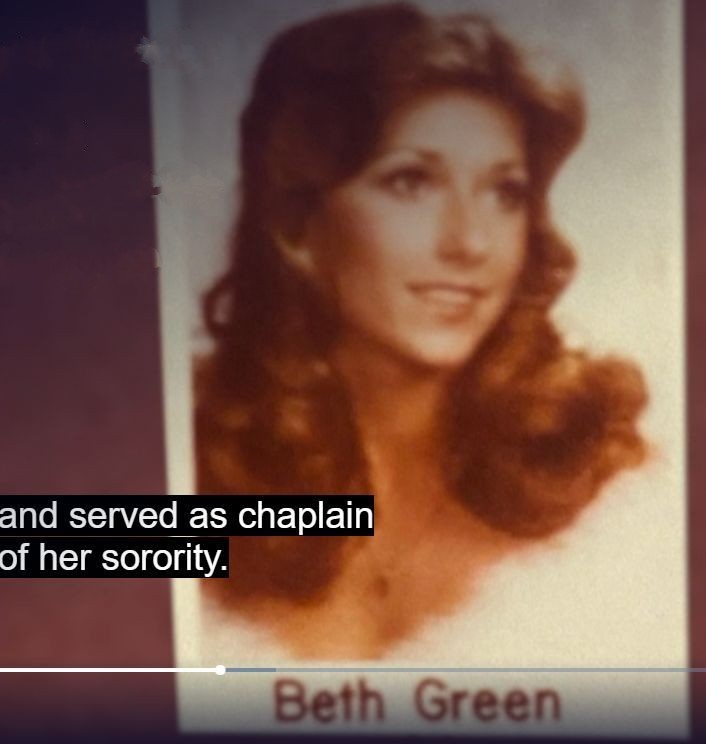
Beth has always been energetic. As Sorority President one of her duties would be organizing campus activities related to her sorority and I can definitely see she’d be good at it. She was a college cheerleader, too, so her high energy has always been a feature of her personality.
What do college student chaplains do?
There are ordained adult chaplains at hundreds of Universities and private colleges all through the US. According to the Association for Chaplaincy and Spiritual Life in Higher Education (ACLSHE, pronounced “axle”), adult chaplains at these higher learning institutions,
“…are professional clergy and laypersons who seek to enhance the spiritual, ethical, and educational experience of the whole person—mind, body, and soul.”
Similarly, student chaplains, including the young sorority sister Beth Moore-
“…is a Christian leader that aims to be a voice for the fraternity or sorority’s religious community. In practice, this often looks like leading Bible studies and acting as a spiritual counselor,” as this article describes: Greek Life chaplains praise their spiritual opportunities
Fraternities also have student chaplains,
“Cummings described weekly Bible studies, collaborative spiritual events with sororities and being an unofficial spiritual counselor as a few of his chaplain responsibilities.” [same source as above].
The student chaplaincy is an Executive Officer position. It means that the chaplain leads prayers, organizes Bible studies, plans devotions, offers spiritual counseling and so on. She functions as a peer spiritual leader.
While the office of college student chaplain seems not to be an ordained office, but an executive one, adult chaplains are ordained. They are lay ministers. They offer spiritual, emotional, and pastoral care not solely in colleges, but also in settings such as prisons, nursing homes, hospitals, the military, and so on. Adult Chaplains, like student chaplains, offer non-judgmental listening, spiritual counseling, and encouragement.
A Poor Choice
But I cannot think of a worse person than a young Beth Moore to offer women spiritual truths or emotional-spiritual support, which is what a chaplain does. Beth’s religious life has always been one of performance, legalism, and laced with charismania-lite. By her own admission she didn’t even really begin learning doctrine (proper understanding of the Bible) until into her late 20s.
Beth says she gave her life to Jesus before she was 6 by learning that she preferred heaven to ‘the bad place’, and walking the aisle to cement her ‘decision’. In another interview Beth said she ‘accepted Jesus’ at age 9. But it wasn’t until she took a group of 6th-grade girls to a missions camp in her late teens as their counselor that she had an experience that caused her to think of a career in religion, though what that career would look like didn’t form until later, when she became an alleged Bible explainer.
As Beth tells it, at that long ago camp, early one morning when the girls were still asleep, Beth says, the presence of the Holy Spirit surrounded her. In a 2003 interview with Charisma Mag, she said of that moment- “I felt His presence on my skin. I did not hear a voice, but I knew what was being said into my spirit, and it was: ‘You are Mine. I have called you.‘” (Source) Her quote of course mirrors God’s call to Isaiah in chapter 43:1-
Do not fear, for I have redeemed you;
I have called you by name; you are Mine!
In this recent interview with Kate Sullivan, Beth said of that moment, she was about to brush her teeth in the camp’s bathroom when she felt a tangible presence of ‘the Divine’ on her skin and all around her. This, she said, she “knew” was Jesus and she “knew” it was her calling to submit her life to His. Here is a partial transcript of Beth’s interview with Kate Sullivan where Beth describes the event:
Transcript begins-
BETH: I felt such a sudden presence of God around me. Not in me, around me. There was no noise, I did not see anything, I did not hear anything. But something so vivid happened to me- In the bathroom!
KATE: You’re white-knuckling the sink.
BETH: His presence, uh huh.
KATE: Yes, and you’re feeling God.
BETH: Uh huh.
KATE: And what is he saying?
BETH: Nothing.
KATE: Nothing?
BETH: Absolutely nothing.
But I’ll tell you, and in fact, when the moment passed, I stood there and thought to myself, what does one do next? Because, what in the world was that? And so, you know, I brush my teeth- and I, I’m just, it makes me laugh every time I think about it because I brushed my teeth and spit, you know, what- [laughs]
BETH: At the same sink where I’d sensed the divine presence- I’m just gonna spit in the sink-
KATE: But what did you, at that moment, what did you think that was? Was that just a nod you were in the right direction?
BETH: I knew it was the Lord. A call comes all sorts of different ways. Even in the scriptures Genesis to Revelation, there’s no one way, there’s no one paradigm, uh, for a calling. But when I’ve been asked what word would you put with it: ownership. I would tell you that what I knew, cause I knew, my entire future had just changed.
–end of transcript.
It is not the first or last time Beth interpreted a sensory experience as a divine pronouncement from God, rather than just read and submit to the Bible as her reason or decision for doing something. She has sought experiences all her life. It is not the first or last time Moore has extracted a scripture and applied it to herself, either.
Here, mimicking the call of Isaiah to his prophetic office. Later, Beth saying that the direction of God to write her next book was so strong, “had I not, the rocks in my yard would have cried out“, which of course is a rip-off of a phrase from Luke 19:40, where Jesus states that if his followers kept silent during his triumphal entry into Jerusalem, the very stones would shout his praise. Quite a verse for Beth to apply to herself, isn’t it.
(Source- book When Godly People do Ungodly Things, Preface, page xi.)
Be discerning
Beth Moore has lived an experiential life professing Christ- but does she possess Him? I say no. As a 4 or 5-year-old she “committed to Christ” by walking the aisle as she admits her whole family except one had done also. As a 17 or 18 year old, she sensed a presence on her skin while at the camp bathroom and decided she was like Isaiah, with Jesus calling her to submit her life to Him. As a young adult she saw how emotional her Bible teacher became over doctrine and earnestly she sought to include experiential events into her spiritual walk-
“I was not about to let somebody convince me that Scripture and experience were always mutually exclusive. I wanted them both. I wanted to thrill to the Word of God with everything in me AND I wanted to experience the presence of Christ as palpably as He’d permit me.” Source
Back to that “non-judgmental listening”… the description of ‘non-judgmental listening’ is from Queens College Charlotte, a Presbyterian-associated college and in addition to helping a student through grief, prayers in hospital, and so on, it also may include:
Curious about other faiths or cultures;
Questioning who you are and aspects of your identity;
If you are a parent worried about your youngster who is living apart from you for the first time, you would desire a strong pastoral approach to your child’s doubts and fears, not the ‘pluralistic’ non-judgmental approach. Pointing out that Protestantism is the only true faith is not judgmental, it’s just truth. Pointing out that desiring to change one’s gender or explore a different religion is folly, is truth, not judgment. You want your child to be properly guided in spiritual matters. The chaplaincy is not that agency to do this.
They do provide a gentle function, says Christian Leaders Alliance. “Chaplains bring a ministry of presence, walking the halls, listening with compassion, and offering hope. They are trusted adults who remind students that they are seen, valued, and never forgotten. Chaplains provide encouragement during stressful seasons, prayer in moments of crisis, and soul care without pressure or coercion.”
If you are a college student and need Christian counseling for whatever reason, use discernment when looking for spiritual guidance, counseling, mentors, or just seeking a spiritual calming presence. Chaplains, whether student or adult, need to have a solid conversion testimony, and have demonstrated fruit on their walk with Christ via the Bible, not fleshly interpreted sensory experiences.
Many if not most chaplains in colleges work in an interfaith approach. Though originally developed out of the Christian faith, contemporary campus chaplaincies often operate as teams comprised of diverse faiths. These teams often include rabbis, Muslim imams, and Hindu chaplains—who collaborate in a network to support the entire campus population on spiritual matters. You might want to search for and connect your college student with a solid pastor in the area instead.
Female Adult Chaplains?
The debate is ongoing as to whether adult women should be ordained as Chaplain. Women offering counsel to other women, leading women’s devotions, or organizing events as either a student chaplain in a sorority or adult ordained in the role would not seem to violate the Bible’s complementarian mandate that women are not to teach men or preach in church. It would seem to support the Titus 2 mandate that women (usually the elder) help and teach other women.
Adult female ordained chaplains abound in the military, and supporters of this say that women offering support and help to other military women is a good thing. Whether women should even be in the military is another whole debate!
Female chaplains also function in women’s prisons where, if the chaplain is a Christian, such help and support would be needed.
Famously, the Catholic Church (which is not Christian and not a church of God) does not ordain women as priests. So, women have found ways to become ordained and function in a pastoral role as chaplain outside the organized church. Here is a quote from The Franciscans, who define the chaplaincy similarly to Protestants-
The role of a chaplain is broadly defined as providing essential religious guidance and emotional support in secular settings. These spiritual professionals are uniquely equipped to offer non-denominational counseling and care to individuals from diverse backgrounds, including those who identify as agnostic or atheist.
Though the role was long reserved strictly for ordained male clergy members, women are increasingly stepping into chaplaincy roles and making a profound impact in the field. Whether employed directly or contracted by organizations with a consistent need for trusted spiritual support, female chaplains bring a compassionate presence and an empathetic ear to hospitals, universities, military units, prisons, and corporate environments. Their role transcends traditional religious boundaries; they strive to create an inclusive atmosphere where every person can find solace and guidance, regardless of their faith (or lack thereof). (Source).
Just as in days of yore, Baptist women have found ways to function in pastoral-like roles by going to a far-flung mission field and now the chaplaincy, too.
Conclusion
If I was a Christian parent I would be careful and research your child’s chaplain if he or she attends college or the military. There are Fellowship of Christian Athlete chaplains, fraternity and sorority chaplains, Cru is at University of Georgia and other colleges and Universities. Their interdenominational and even interfaith approach may not be the counseling your child needs as they live away from home and begin to navigate life and make decisions for themselves.
And avoid Beth Moore at all costs. She is a false teacher. Her early roles as camp counselor and student chaplain only show how long and how well an unrepentant sinner can keep up the fake role of committed, converted Christian.


I have recommended to two different churches that I have attended not to use Beth Moore’s materials. They did it anyway.
LikeLike
It is a shame they seem to lack discernment regarding some of these false teachers
LikeLiked by 1 person
It really is. Both of these churches I considered “solid” theologically but they went ahead with their plans for a women’s study with Moore’s materials. I must say that I can’t remember that either have had her materials used again though.
LikeLike