I lived in Maine for 30 years. The Gospel is so needed in Maine. Maine has one of the highest proportions of Pagans and Wiccans in the United States. Data from the Pew Research Center shows that 4 percent of Mainers identified as Pagan or Wiccan in a 2023-24 survey, the highest amount in any state. This is double from the previous Pew survey, conducted in 2014.
Researchers like Marilyn R. Pukkila, a research librarian emerita at Colby College and eclectic Pagan, attribute the growth in part to the second-wave feminist movement of the 1960s and 1970s, where many were interested in the idea of the feminine goddess at the center of Wicca, and in the independent nature of its rituals, which attracted women and LGBTQ people who felt shut out by Christianity.
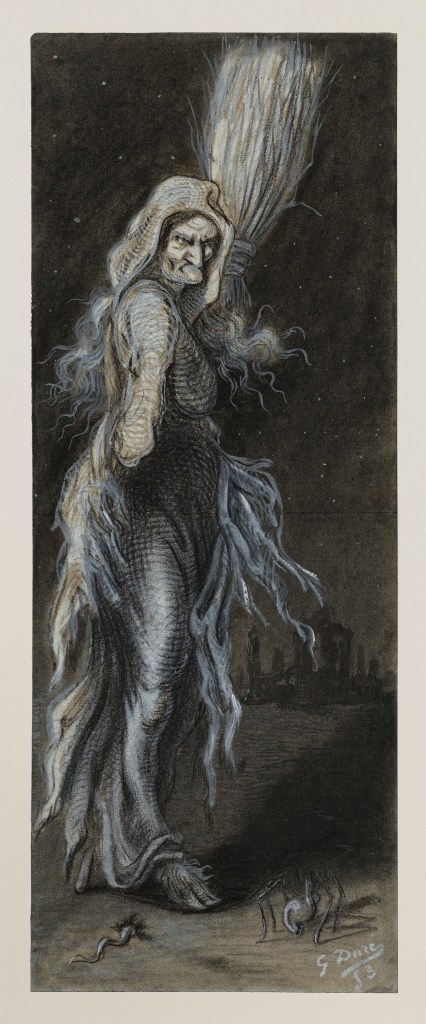
Gustave Dore “The Witch” Public domain
The Maine Monitor isn’t the only media outlet linking Wicca with feminism. Here we have The Christian Post’s research. There are actually more Wiccans than Presbyterians in the US, according to the Christian Post article from last month
“The actual practice of witchcraft today presents a bit differently. It is still predominantly practiced by women and has been entangled with feminism and female empowerment since the 1960s. Today, there are more self-identified Wiccans in America than Presbyterians, and that does not include those who practice witchcraft without identifying with Wicca. In fact, there are even those who self-identify as Christian witches, though that is somewhat unsurprising in a culture of self-identification where people hold “whirled-views” more than coherent worldviews.”
I remembered the excellent episode of the Just Thinking podcast where co-hosts Virgil Walker and DB Harrison covered this issue in their episode on Feminism, (#140) and quoted the book “Twilight Goddess: Spiritual Feminism and Feminist Spiritualism”, quoting,
“The widening appeal of Goddess theology and spiritual feminism in the present day may reflect perennial relevance in these traditions. The resurgence of these interests in the modern West is taking place in an era in which religious aspirations are dovetailing with social and scientific concerns about the rights of women and our relation to the earth.”
Though one can go on for many pages listing the reasons feminism has wrought ill upon our society, and mourning its unintended (or perhaps intended) consequences, we need to acknowledge one of the consequences of feminism’s pagan philosophy is its link to earth based paganism, including Wicca.
There are standards to enter Christianity. Believing in Jesus’ life, death, resurrection, and ascension is critical to that first step. We must repent of our sins to Him on whom we believe. He alone is qualified to forgive them, having absorbed God’s wrath for our sins on the cross. Christianity indeed ‘shuts out’ all sinners, as mentioned in the quote above. It only accepts repentant sinners. You cannot enter Christianity with your sin. It only accepts God as the center of worship. Not creeping things, not the creation, only God, for He is holy.
Portland Maine Druid Paul Ridlon was featured in a Maine Monitor article explaining why the rise in the wiccan and druid religion in Maine, where we read,
“He was raised Catholic and remembers early in his life being taught by nuns that God is in all people, which he compares to his belief today that everything has a spirit.”
This is one danger with thinking that Catholicism is part of the faith. It isn’t. It is a false religion that teaches falsely. Whether Mr Ridlon interpreted the teaching wrongly, or whether the nuns taught wrongly (either and both are possible), the errant thinking that God is in all of us, AKA ‘we are all children of God’ illustrates the fatal flaw if the thought is taken to the end point. Here is a good example of how a false religion or a false doctrine leads people astray.
We are all made in the image of God, but only when we confess our sins to Jesus, believing on His life, death, resurrection, and ascension do we become indwelled by God’s Holy Spirit.
We are not all children of God. We are children of wrath and stand condemned already. Just after the famous verse in John 3:16
For God so loved the world, that he gave his only Son, that whoever believes in him should not perish but have eternal life.
We read in John 3:18,
Whoever believes in him is not condemned, but whoever does not believe is condemned already, because he has not believed in the name of the only Son of God. (ESV).
God did not give Jesus to us unreservedly. We must believe in Jesus and Jesus only. Why worship the earth when it is God who created the earth?
In Matthew 23:16-22, Jesus rebuked the Pharisees for their shift in worship, thinking they found a loophole that didn’t obligate them to God. Don’t swear by the temple, swear by the gold of the temple. Don’t swear by the altar, but by the offering on the altar. Don’t swear by God’s throne, swear by heaven.
Jesus said, “You blind men, which is more important, the offering or the altar that sanctifies the offering? Therefore, the one who swears by the altar, swears both by the altar and by everything on it. And the one who swears by the temple, swears both by the temple and by Him who dwells in it. And the one who swears by heaven, swears both by the throne of God and by Him who sits upon it.”
Wiccans who believe they are doing something good by worshiping the creation and not the creator are making the same mistake.
Therefore God gave them up to vile impurity in the lusts of their hearts, so that their bodies would be dishonored among them. For they exchanged the truth of God for falsehood, and worshiped and served the creature rather than the Creator, who is blessed forever. Amen. (Romans 1:24-25)
The Creator is blessed forever, and so is anyone who has repented of their sin and confessed Him as Savior.
Yesterday I wrote about the forehead. This is a prominent part of the head and usually the most visible thing people see upon meeting. The Lord uses it in verses to indicate a set determination, shame, stubbornness, rebellion. etc. It is a representation of where our thoughts and desires reside in our mind.
Even people unfamiliar with the Bible as a whole know about the “mark of the Beast” on the forehead (or hand), a mark of allegiance and without which they may not buy or sell. Revelation 13:16, 17; 14:9; 17:5; 20:4.
Many others know of the mark on the foreheads of the 144,000 witnesses designating them as Christ’s. (Revelation 7:3).
Catholics smudge the forehead with ashes on Ash Wednesday, the traditional start of Lent. Some denominations such as Lutheran or Episcopal make a mark of the cross on the forehead of the person being baptized.
Did you know the seal on the forehead was also in Ezekiel?
And the LORD said to him, “Go through the midst of the city, through the midst of Jerusalem, and make a mark on the foreheads of the people who groan and sigh over all the abominations which are being committed in its midst.” 5But to the others He said in my presence, “Go through the city after him and strike; do not let your eye have pity and do not spare. 6Utterly kill old men, young men, female virgins, little children, and women, but do not touch any person on whom is the mark; and you shall start from My sanctuary.” So they started with the elders who were before the temple.
God’s wrath for sin is real. He values those who mourn over their and others’ sins.
Jamieson, Fausset, & Brown Commentary says, upon the foreheads—the most conspicuous part of the person, to imply how their safety would be manifested to all (compare Je 15:11; 39:11–18). It was customary thus to mark worshippers (Rev 13:16) and servants. So the Church of England marks the forehead with the sign of the cross in baptizing. At the exodus the mark was on the houses, for then it was families; here, it is on the foreheads, for it is individuals whose safety is guaranteed.
2 Timothy 2:19 also confirms the seal- “Nevertheless, the firm foundation of God stands, having this seal: “The Lord knows those who are His;” and, “Everyone who names the name of the Lord is to keep away from wickedness.”
In these New Testament days, we are sealed with the Holy Spirit as a guarantee of the deposit. We do not have a mark on us, visible or invisible.
In Him, you also, after listening to the message of truth, the gospel of your salvation—having also believed, you were sealed in Him with the Holy Spirit of the promise, 14 who is a first installment of our inheritance, in regard to the redemption of God’s own possession, to the praise of His glory. (Ephesians 1:13-14).
The Lord knows who is His. Without fail and with a certainty we can only imagine. You will know if you are sealed with the Spirit if your affections have turned from your former fleshly indulgences to holy behavior and desires. If your sanctification is progressing, you are sealed. You are on the rock!
Ezekiel 3:8, “Behold, I have made your face just as hard as their faces, and your forehead just as hard as their forehead.“
Isaiah 48:4, “For I knew that you are stubborn; your neck is iron and your forehead is bronze.”
In Jeremiah 3:3 we read, “Therefore the showers have been withheld, And there has been no spring rain. Yet you had a prostitute’s forehead; You refused to be ashamed.”
What is with the focus on the forehead? What can it mean?
Topical Bible explains, “The forehead, in biblical literature, often symbolizes identity, character, and allegiance. It is a prominent part of the human body and serves as a visible marker in various scriptural contexts, both literal and metaphorical.”
The forehead is a most prominent feature of a person. It is what we normally see first. It is a representation of where the mind and thoughts reside, and thus, our focus and devotion. In the Holman Illustrated Bible Dictionary it is explained-
The Bible indicates that a person’s character can be determined by observing the forehead. A set forehead indicates opposition, defiance, and rebellion (Jer. 3:3).
Hardness of the forehead indicates determination to persevere (Isa. 48:4; Ezek. 3:8–9).
It has been used as a representation of Satan (Rev. 13:16–17).
At the same time, it stands for courage as when God told Ezekiel that He had made the prophet’s forehead harder than flint against the foreheads of the people (Ezek. 3:9). underlines mine.
The forehead is used as a very dishonorable word when read of the harlot’s forehead (Jer. 3:3), indicating utter shamelessness.
Shame is a long-lost emotion, in my opinion. People are shameless these days. In the case of the verse in Jeremiah 3:3 referring to a prostitute’s forehead, it indicates such shamelessness they don’t even blush, the forehead never reddens in shame or remorse. It was a metaphorical statement of Israel’s unashamed apostasy and faithlessness. It is the same sense in Ezekiel 3:7-8, Israel’s hard forehead of shamelessness.
Honor & Shame
Honor is spoken of frequently in the Bible. Honor is due God, authorities, parents, brethren. In Bible times, honor was the main measure of social status. A person could accumulate honor by inheriting via genealogy, having it ascribed to them from the community or synagogue, or acquiring it via deeds. For example, Job was living the fully blessed Hebrew life. He had accumulated wealth, family, health, and honor. His honorable height is what his seeming fall into the depths of shame was so shocking that his friends could not wrap their heads around it.
If honor was a highly blessed social currently in Bible times, its tethered opposite, shame, was a highly cursed standing. There were shame codes understood by all. Shame was associated with moral failure and sin, such as the woman caught in adultery. The Bible hints that Mary had the taint of shame all her life as a loose woman. (Mark 6:3; John 8:41; Matthew 1:19). The Woman at the Well was shocked that ‘The Prophet’ (Jesus) loved her despite her shame of so many husbands and immoral living situation.
Shame did not exist before the fall. Adam and Eve lived in a state of innocence and purity.
And the man and his wife were both naked, but they were not ashamed. (Genesis 2:25).
Shame arrived after the first sin, (Genesis 3:7) and along with it, blame, guilt, and hiding.
In these days, shame is such a long-lost emotion that people do not hide any more. Abortions are touted. Adulteries are open and accepted. Bigamy is visible. Neglect of children is rampant. Is there anything that would cause shame any more?
Recently, the once credible magazine Christianity Today published an article rife with gossip, assumptions, and innuendo, claiming that Elisabeth Elliot was a bisexual in a lesbian relationship. The now departed Elisabeth Elliot was the widow of Christian martyr Jim Elliot, famously speared in the jungles of Ecuador. Elisabeth remained in the jungle after her husband’s death and ministered to the very peoples who had killed her husband and 4 other missionaries. She eventually returned home and wrote many devotionals and other books that have edified generations of women.
Elliot remarried 13 years later, and her second husband passed away from cancer. Four years after that she remarried and her husband of 38 years cared for Elisabeth in her final years as she passed away from dementia in 2015.
CT used to stand for biblical truth and propagating the Gospel. Speculations, assumptions, and even acknowledged that a key exchange between Elliot and her possibe paramour supposedly giving credence to the speculation may not even have happened at all.
What this adds up to is gossip. Shamelessly, after taking down the article due to sharp criticism, CT re-posted it publicly the next day. No shame at all. No journalistic integrity. Only a perverted agenda and seeking for clicks, at the expense of Elliot’s family.
For author Austen and CT to play kickball with Elliot’s reputation after her death (where she can’t defend herself) under the guise of ‘history’ is utterly shameless. This is a modern example of a hardened prostitute’s forehead as per Jeremiah 3:3.
CT has a prostitute’s forhead.
We don’t have as much of an honor culture nowadays either. Honor isn’t inherited so much based on a family name, although some are given honor due to that. Honor isn’t a word that’s discussed much.
Famously, in 2018, Beth Moore wrote an open letter to her Southern Baptist Brothers complaining she didn’t receive the honor she was due her ‘stature’ as a Bible teacher. Of course she didn’t frame it that way, it was embedded in a faux concern for ‘her gender,’ but the complaints were there. Complaining about not being honored is not a good look.
The only Person who has reason to lament a misplaced or missing honor is Jesus. He submitted to dishonor of the highest degree in order to fulfill God’s plan for redeeming His people. Jesus had nothing to be ashamed about yet died in the eyes of the world in shame.
“Perhaps the most vivid honor/shame text is Phil. 2:5–11. Jesus had unquestionable inherited, ascribed honor; yet He gave it all up and took the most humble of all honor bases (a slave) and died the most shaming of all deaths, crucifixion. However, God gave Him the highest of all honor positions and a name above all names on the honor scale, causing all to bow before Him. The honor code is thus defined by God instead of men.” Source- Warren, B. (2003). Shame and Honor. Holman Illustrated Bible Dictionary.
If you feel ashamed of a sin, an incautious word, a moment of misplaced anger, or something else, good. Peter was ashamed of his betrayal, and cried bitterly over it. Jesus restored Peter and demonstrated his trust in Peter by giving him the important task of feeding His lambs. The Lord is forgiving. Shame is a Holy Spirit indicator that your conscience is unsettled.
1 John 1:9 says: “If we confess our sins, He is faithful and righteous, so that He will forgive us our sins and cleanse us from all unrighteousness.“
Repentance is purifying and cleansing. We serve a gracious God who allows us to feel shame and wipes away the shame after repentance. Let your forehead be soft!
Jeremiah 10 is a powerful chapter. Vivid, clear, convicting. This verse at Jeremiah 10:22 caught my attention-
The sound of a report! Behold, it is coming— A great roar from the land of the north— To make the cities of Judah a desolation, a haunt of jackals.
We frequently read in the Old Testament that God is promising or threatening to make a certain city or region desolate. Sometimes we read it is ‘laid waste’. In Jeremiah 34:22 we read, “and I will make the cities of Judah a desolation, without inhabitant.”
Ezekiel 12:20 The inhabited cities will be laid waste, and the land will become desolate. Then you will know that I am the LORD.’”
Jeremiah 9:11 And I will make Jerusalem a heap of rubble, a haunt for jackals; and I will make the cities of Judah a desolation, without inhabitant.
Isaiah 34:13 Her towers will be overgrown with thorns, her fortresses with thistles and briers. She will become a haunt for jackals, an abode for ostriches.
When I read verses like that my mind envisions places like Death Valley; hot, deserted, lone tumbleweeds rolling through, the piercing cry of a hawk looking for food.
EPrata photo
But it also occurred to me that when the Lord promises destruction to the point of wasted emptiness, it could also a mirror for the spiritual condition of the People.
I wondered…so I looked it up. Yes, the condition of the Land is also a symbol for the spiritual waste of the people.
The concept of the devastation of the land is a recurring theme throughout the Bible, often serving as a manifestation of divine judgment or a consequence of human sinfulness. This theme is woven into the narrative of Israel’s history, prophetic literature, and apocalyptic visions, reflecting the covenantal relationship between God and His people.
Old Testament Context
In the Old Testament, the devastation of the land is frequently depicted as a direct result of Israel’s disobedience to God’s commandments. The land, which was promised to the descendants of Abraham, Isaac, and Jacob, is portrayed as a gift contingent upon the people’s faithfulness. In Leviticus 26:32-33, God warns, “And I will lay waste the land, so that your enemies who dwell in it will be appalled. But I will scatter you among the nations, and I will draw out a sword after you, and your land will become desolate and your cities will become waste.”
The prophetic books often echo this theme, with prophets like Isaiah, Jeremiah, and Ezekiel foretelling the desolation that would come upon the land due to the people’s idolatry and injustice. Isaiah 24:3-4 states, “The earth will be utterly laid waste and thoroughly plundered. For the LORD has spoken this word. The earth mourns and withers; the world languishes and withers; the exalted of the earth waste away.”
Theological implications
The devastation of the land serves as a powerful reminder of the consequences of sin and the seriousness of God’s covenant with His people. It underscores the biblical principle that the physical world is deeply interconnected with spiritual realities.
The land’s condition often mirrors the spiritual state of its inhabitants, reflecting the broader biblical narrative of creation, fall, redemption, and restoration. –end Topical Bible. Bold mine.
It would be interesting if we were able to see our spiritual condition. God can. He knows us inside out- literally. He loves us anyway. But if we were to see ourselves, our true spiritual condition, we’d faint. Even with the Holy Spirit given to us as the indwelling deposit, there is plenty of sin left over to make us run away in horror.
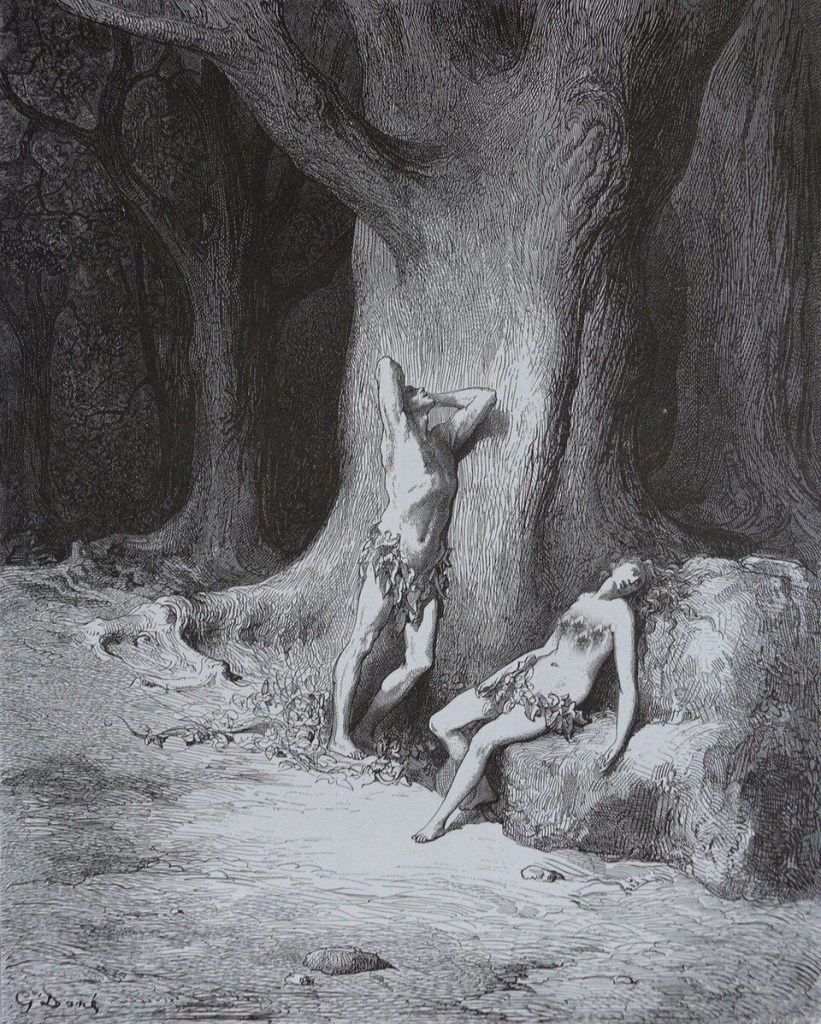
Paradise Lost illustration by Gustave Dore. Their inner landscape moved from innocence to chaos. “They sat them down to weep; nor only tears Rained at their eyes, but high winds worse within Began to rise, high passions, anger, hate,”
Anything we do that is not for God’s glory is a wasteland. Paul used the words rotten garbage, refuse, rubbish in Philippians 3:8 when referring to works done in the flesh. Just how nasty our sins, idols, and blasphemies are likely is beyond our comprehension.
Instead let the symbol for our interior spiritual life be a lush, Edenic garden, full of a variety of flowers, pleasing aromas, and verdant landscapes. That landscape is where we began before the Fall. It is where we will finish on the New Earth. Meanwhile, plant beautiful flowers in your soul. Praise the Lord, read His word, pray to Him, cultivate the soul as the lush landscape it can be, and avoid the wasteland.
Psalm 46:10 which in many translations such as the ESV, says
“Be still and know that I am God; I will be exalted among the nations, I will be exalted on the earth.”
All the NASBs say-
“Stop striving and know that I am God; I will be exalted among the nations, I will be exalted on the earth.”
‘Be still’ is one of the more well-known verses. It’s used and overused everywhere. It has sparked devotionals, it’s on totes, tee shirts, bookmarks. It’s a merchandisable verse, for sure. See some of the subtitles on these products. They are all along the same lines:
Be Still 365-Day Devotional to Quiet Your Heart
Be Still: 90 Devotions for the Hopeful Heart (A 90-Day Devotional to Rest in God’s Presence) – The Perfect Gift for Christian Women
BE STILL: A 30-Day Guided Journal for Slowing Down, Grounding & Coming Home to Yourself
Be still: Be Still Renewing Peace & Reclaiming Joy
It stands to reason that being still means ceasing from movement. But do we really have to stop moving in order to commune with God? Stripping away the clutter and noise to settle in when we read the Bible is always a good idea…but does ‘Be still and know that I am God’ really mean what we think it means?
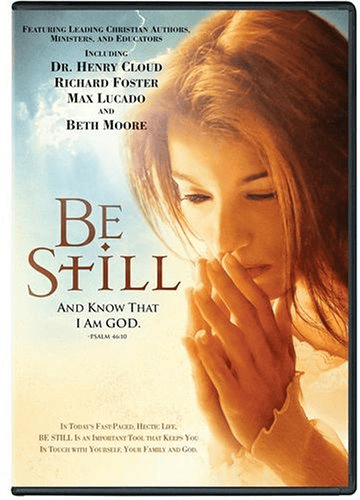
And then there was this 2006 little beaut of a DVD:
Blurb: “Be Still is an extraordinary film that demonstrates contemplative reflection as a vital part of our everyday lives and as a remedy for the ills of the frenzied, fast-paced modern world.”
Contemplative reflection is the remedy for the ills of the world? I thought Jesus was the remedy for the ills of the world.
‘Be still’ doesn’t mean what we think it means.
It does not mean stop moving and wait to hear God, though slowing down to blot out distractions is always a good idea. No, it actually means stop striving- in your own strength- and wait for God. The point of the Psalm in context is to cease working out our problems in our own strength and cease striving. It means to watch the Lord. Observe His works. Surrender to Him.
“Be still, and know that I am God” is not a call to a contemplative life. It is a call to total surrender.” HB Charles, Psalms of Trust
Barnes’ Notes- It is also employed in the sense of not making an effort; not putting forth exertion; and then would express the idea of leaving matters with God, or of being without anxiety about the issue. Compare Exodus 14:13, “Stand still, and see the salvation of God.” In this place the word seems to be used as meaning that there was to be no anxiety; that there was to be a calm, confiding, trustful state of mind in view of the displays of the divine presence and power.
Matthew Henry’s Complete Commentary says- Let his own people be still; let them be calm and sedate, and tremble no more, but know, to their comfort, that the Lord is God, he is God alone, and will be exalted above the heathen; let him alone to maintain his honour, to fulfil his own counsels and to support his own interest in the world. Though we be depressed, yet let us not be dejected, for we are sure that God will be exalted, and that may satisfy us; he will work for his great name. Henry, M. (1994). Matthew Henry’s commentary on the whole Bible: complete and unabridged in one volume (p. 810). Hendrickson.
Be still, yes, by attending to the spiritual disciplines with focus. But…surrender. Cease striving and trust Him. Know He is God.
Do not lie to one another, since you stripped off the old self with its evil practices, and have put on the new self, which is being renewed to a true knowledge according to the image of the One who created it—a renewal in which there is no distinction between Greek and Jew, circumcised and uncircumcised, barbarian, Scythian, slave, and free, but Christ is all, and in all. (Colossians 3:9-11).
I put Scythian in bold because as I was reading this verse and I wondered ‘who are the Scythians?’ I don’t recall them being mentioned anywhere else in the Bible. Are they different from the barbarians who were listed just before the Scythians?
A Nomadic Warrior People
Topical Bible at Bible Hub states, The Scythians were nomadic warrior peoples who inhabited vast regions north of the Black Sea and into Central Asia. They appear in secular historical sources-such as those by Herodotus-and in significant archaeological findings that validate their cultural complexity and influence. Scripture’s mention of them is brief but vital in demonstrating the comprehensive inclusivity of the Christian faith.
The ancient historian Herodotus traveled extensively to do research for his eventual book “Histories.” In his research he wrote a bit about this nomadic people. Some of the things he wrote were legends exaggerated into truth, such as drinking wine from the skulls of their defeated enemies, but much of what he discovered was accurate. The Scythians’ burial mounds were called kurgans.
From The Historian’s Hut we read: The framework of Herodotus’ history of the Scythians is fairly accurate. He wrote that the Scythians were a fierce nomadic tribe that specialized in horsemanship and archery. As warriors, they were powerful enough to strike fear into the hearts of both the Greeks and the Persians. They even successfully repelled a massive invasion led by the Persian King Darius I in the late 6th-century, years before the Persians decided to launch their ill-fated campaigns against Greece. …at least 5,700 golden artifacts were uncovered in a Scythian burial mound (called a kurgan) excavated in Tuva, Siberia, yet not a single skull chalice was found among the horde of treasure. Similarly, furs and the fragments of cloth garments were discovered in the mound.
Surprise skills!
The Scythians as mentioned were warriors, both the men and the women. They were known for training hard and being exceptional at archery, especially with pinpoint accuracy while riding on their horses.
Normally when we think of a warrior tribe or people, we think of their barbarity. They are thought of as cruel, ignorant, indecent, or vulgar. Certainly the Jews thought so of the Scythians. The Scythians were a feared foe and cast a widespread shadow over their region.
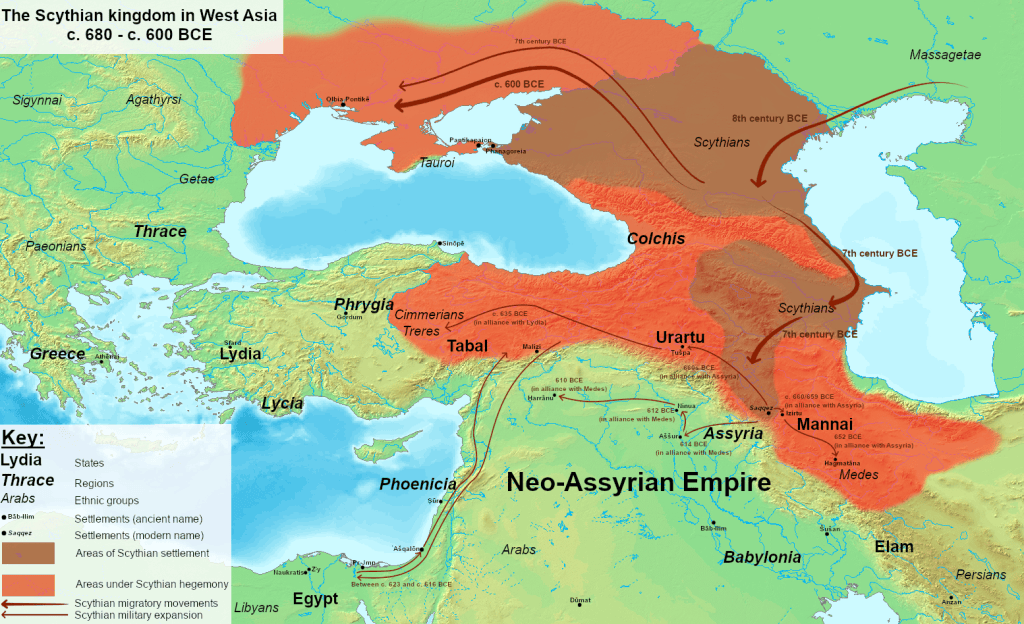
By Antiquistik – Own work based on:Barnett, R. D. (1991). Source
Abbott called them “barbarians, even Scythians, the lowest type of barbarians.”
“They were thought of as more barbarian than the barbarian!” (JA Bengel, a German theologian of the early 1700s)
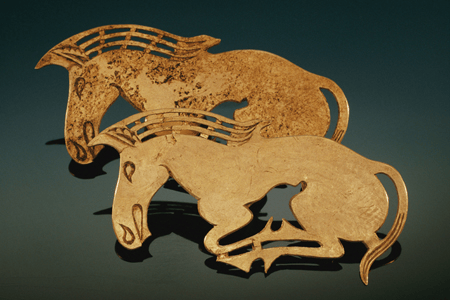
However, what did the archaeologist see when he squinted down the hole into the kurgan vault? Gold. LOTS of gold.
Gold horses found in a 2,700-year-old tomb in Siberia. Source
A seasoned archaeologist—he had spent a dozen summers on Russian excavation teams—Leus had just become the first person in 2,700 years to look into this chamber, a royal tomb of the shadowy people we call Scythians. Nomads and fierce warriors, they lived in Central Asia as early as the ninth century b.c., and their culture spread westward to southern Russia and Ukraine, and even into Germany, before gradually disappearing early in the Christian era. Source archived article Masters of Gold
They eventually excavated 44 pounds of gold from the Scythian kurgan. Often nomadic, warrior-culture tribes are assumed to have little artistic skill. Yet with this find, the Scythians were viewed in a new light. Not simply masters archers,
From this entry at the British Museum, “Introducing the Scythians“, we read, “When the Scythians weren’t being hide and seek champions, or being fobbed off with foreign princesses, they even developed a powerful new type of bow which was made from different layers of wood and sinew. It was much more powerful than a regular wooden bow, as the different layers increased the forces and energy when the string was released.”
No wonder they were so feared! But unlike many other barbaric tribes, they were master craftsmen too.
“The ornaments of Arzhan-2 “exhibit workmanship of the highest quality,” Nagler said. “The people were excellent craftsmen. This puts the Scythian quality of life in a new light. It rejects the stereotype that Scythians were just wild horsemen and warriors, migrating and destroying other people. They had a high level of cultural development.” But isn’t it true, I asked, that they fought and pillaged, as Herodotus wrote? “Yes,” Nagler replied, “but so did other peoples with well developed cultures: the Egyptians, the Greeks, the Romans.” (Source).
Division/No Division
As in our world today, there are divisions between people. Poor and rich, east vs west, victor and vanquished. In Jesus’ day there were similar divisions:
The Greek looked down on slaves and barbarians and Scythian. The Greek was the aristocrat of the Roman world and lauded it over anyone who was not Greek in his culture.The Jew looked down on the Gentile. Jews refused to enter a Gentile house, would not eat a meal cooked by Gentiles and would not buy meat prepared by Gentile butchers. When Jews returned to Israel, they showed their disdain for Gentiles by shaking off the dust from their clothes and sandals. Even the apostles were reluctant to accept Gentiles as equal partners in the church (cf. Acts 10-11). The Pharisee would pray each morning, ““I thank Thee, God, that I am a Jew, not a Gentile; a man, not a woman; and a freeman, and not a slave.”” (Source Precept Austin).
Whatever the nuances were about the Scythian, they were an interesting people. Beyond that cultural interest, there’s a theological truth here. Paul named the Scythians for a reason.
Paul was emphasizing the divisions in peoples, classes, and nations. He (probably) deliberately chose the Scythians to show that God is merciful to even ‘the worst of the worst’. He named barbarians, but also named Scythians. Apparently they were in a barbaric class by themselves! But God, full of mercy, chose some of them out of the world too, and Paul was saying, ‘Accept them’.
Spurgeon – In the new life there is no distinction of race and nationality. We are born into one family; we become members of Christ’s body; and this is the one thing we have got to keep up—separation from all the world beside: no separations in the church, no disunion, nothing that would cause it, for we are one in Christ, and Christ is all. …These distinctions all vanish when once we come to Christ; we are one in him, and every promise to believers is good to all who are in Christ Jesus, for “Christ is all, and in all.“
Joseph Barber Lightfoot (1828–1889), English Anglican theologian, biblical scholar, and Bishop of Durham from 1879 to 1889, said–
Regeneration brings true equality. People are not equal physically, mentally or economically in this life. Only the gospel can place people on equal footing with God and others. The Christian church should have no barriers for Christ breaks down all barriers and accepts all people who come to Him. Christians should be building bridges, not walls. In Christ all distinctions are transcended; at the foot of the cross the ground is level.
Is there a ‘Scythian’ in your life? Someone whom you tolerate outwardly but privately consider a barbarian? Disdain him or her? We all stand on the same blood-soaked ground under the cross of Christ.
Love one another, no matter who they were before the cross. Even the Scythian is your sister now.
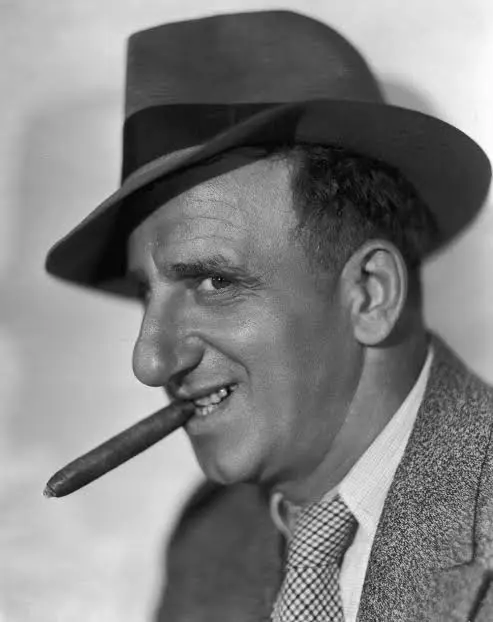
You young ‘uns won’t remember the old vaudeville-radio-early TV entertainers. There was one named Jimmy Durante. He was born in 1893 (!) and was active in the entertainment industry from 1910–1972.
He was known for his gravelly voice, purposefully mangled words (‘malapropisms) in his distinctive NY accent, and his nose. It was huge. He referred to it humorously as The Schnozzola, a blending of Yiddish for nose with an Italian twist. Durante was beloved and popular. He earned two stars on the walk of fame, one for radio and one for TV. He was in movies also. He did well for a Lower East Side 7th grade dropout.
Jimmy Durante was Roman Catholic serving as an altar boy in his youth, and marrying his first wife Jeanne Olsen in his home church of St. Malachy. They were married from 1921 to 1943, when Jeanne succumbed to her failing heart.
During the early 1940s, Durante had a radio program. He always ended it with his trademark sign-off “Good Night, Mrs. Calabash” and after the first year, Durante added “wherever you are.” He carried that same sign-off into television, saying it at the end of his television shows.
“Good Night, Mrs. Calabash, wherever you are.”
His sign-off phrase sparked a national mystery for over 20 years. Speculations abounded as to exactly who “Mrs. Calabash” was. Durante never divulged who Mrs. Calabash was…until 1966 when on the Monitor program he finally uncovered the mystery. Mrs. Calabash was his private pet name for his wife Jeanne, who he dearly missed. The couple had stopped in Calabash NC, and Jeanne loved the time they spent there and loved the name of the town. Jimmy called her that as a sweet reminder of their pleasant sojourn together.
I remember seeing Durante saying the catchphrase. I’d wonder not who Mrs. Calabash was. I didn’t care. I pondered the “wherever you are.” It was obvious even to me as a child that the person Durante was speaking of had passed away. Where does a person go after death? It was a big mystery, a bigger one to me than who the lady might be.
As a Roman Catholic, we know their dogma doesn’t include a security of heaven. That organization teaches that a person must participate in certain sacraments, do certain practices to earn and then keep salvation. They also teach there is a thing called mortal sin and venial sin. Venial sin are little sins that do not destroy a person’s sanctification. They can do penances to make up for it. If they die not having paid the penance for these venial sins, they are cast into purgatory to ‘purge’ them off the soul and then are flown to heaven. Mortal sin, on the other hand, is finite and launches them directly into hell with no period of time in purgatory to wear them off Bishop Fulton Sheen explained,
If the soul is in mortal sin at death, “dead to divine life, casts itself into hell just as naturally as a stone released from my hand falls to the ground,” he said in The National Catholic Register in 2019.
“Unrepented, it brings eternal death,”as the Catechism of the Catholic Church (CCC) puts it (1874). That’s what makes it “mortal,” or deadly: it cuts us off from God forever, unless it is “redeemed by repentance and God’s forgiveness” (CCC 1861),” says Catholic Answers.
So it is no wonder that Jimmy Durante was forever wondering at the eternal home of his beloved wife. “Wherever you are”. Heaven? Did she DO enough? Pay penance enough? Supply enough Indulgences? Perform enough good works? If not, is she in Purgatory? (This is a made-up location the Bible knows nothing about). Is she in hell, having died of some mortal sin Jimmy knew nothing of? As they say in Maine, ‘hard tellin’, not knowin’ “.
Roman Catholicism is a false religion, as false as Wicca or Buddhism or Islam.
What a praise to our Lord Jesus who gives us assurance! He spells out our lives under His sun in the Bible. He sends the Holy Spirit as the guarantee to seal us into His family as adopted sons and daughters.
For...there is salvation in no one else; for there is no other name under heaven that has been given among mankind by which we must be saved.’ (Acts 4:12).
The one who has the Son has the life; the one who does not have the Son of God does not have the life. (1 John 5:12).
As stated above, Jesus is the only Name by which we may be saved. Believing on Him, repenting of our sins to Him, is the only way to heaven. But it is a sure way to heaven.
If we believe in Christ we are made the children of God (John 1:12):
But as many as received Him, to them He gave the right to become children of God, to those who believe in His name,
Do you believe Jesus was THE sacrifice for sin once and for all? That God exhausted His wrath upon Jesus on the cross for all who would believe? if you believe in Jesus’ sacrifice as the payment for your sins and who believe in His resurrection and ascension are going to heaven.
“Whoever believes in him is not condemned, but whoever does not believe stands condemned already because they have not believed in the name of God’s one and only Son” (John 3:18).
Salvation is by grace alone. Not works, penances, indulgences, purgatorial cleanings. And once you have been adopted, you are Jesus’ Bride forever. I think any religion that infuses doubt into the heart of its adherents is evil. Muslims always wonder at the state of their soul. Have I done enough? Is allah going to be angry or merciful to me? Same with the Roman catholic god. Am I in venial sin? How many more Hail Marys must I perform to be sure I am on God’s good side?
Be praising the Lord today for your salvation, your assurance of salvation, your adoption, and your destination. If you are not sure, here are some resources to pray through and check:
This essay is not about whether you should wear had coverings. It is about discerning those who tell you you should wear head coverings.
The advent of the internet and all its social media platforms and availability of widely distributed material is a blessing, especially for those in closed countries, disabled, or are without other means of reaching Christian content. However it is also a curse, because of course satan uses it to promote his agenda, which is to disseminate false material and raise up false teachers to confuse the sheep.
There are many preachers, evangelists, and teachers out there who occupy and use the biblical title. Some are good, others are false. But beyond those, there are an abundance of what we call Christian Influencers or Christian Content Creators who do not occupy a specific title (and some aren’t even attached to a specific church) but they still influence the sheep within the faith by publishing Christian content.
All are claiming your attention and many claim to be the real deal within Christianity. Not all are the real deal.
Recently I was asked about Madaline Mikayla.
She is a 29 year old online personality, AKA content creator, who publishes at the time of this writing on Youtube, TikTok, Facebook, and Instagram. She focuses on head coverings, for which she uses the term “veiling”. She also covers the topics of modesty and marital abuse of women.
Head Coverings
In her video linked here on Instagram, Madaline Mikayla says that a woman must cover her head. Ms. Mikayla states that it is not a personal conviction. It is not a passed-away cultural norm. It is a command from God.
She explains in her testimony video that in college, her “spiritual leaders” held a night of “prayer and deliverance”. When she got back to her dorm room she “strongly felt God’s presence”, and “out of nowhere I heard God tell me, ‘Cover your head’. (Source)
Unlike Bible believers who hear and obey when God commands them, Ms Mikayla disobeyed. For years. Jonah excepted. Her reason for disobeying was that “If this is something God wanted me to do, why aren’t more Christian celebrities doing it?”
We look to the Bible for confirmation of Gods commands. Second, we do not look around at celebrities to confirm that this is what God wants us to do.
Some years later, she said God spoke to her again. This time she knew it was God because of the first encounter she’d had when “he” had told her to cover her head. But she still refused for 5 more months. “That was how badly I didn’t want to cover my hair.” Mikayla eventually succumbed to the ‘command’ she’d heard.
However, Dr. Owen Strachan, Senior Director of the Dobson Culture Center at the James Dobson Family Institute, and a teaching fellow and director of ministry at Redeemer Bible Church, says that the First Corinthian passage regarding head coverings is one of the most difficult passages to exegete, and causes the most debate in seminaries.
But Madaline Mikayla has it figured out to the point of hardened certainty? Red flag #1: when someone claims to have THE answer on a passage that has caused debate and difficulty for 2000 years for everyone else, be suspicious.
Mikayla further details the amount and the type of covering, even though the Bible does not describe it. Mikayla says handkerchiefs, hats, bandannas and the like are not appropriate because the entire head must be covered, she says.
And even beyond that, all hair must be covered, Mikayla says. Not a bit of it can show. Although a bit of it in front is OK. Again, the Bible does not describe any such thing.
Red flag #2: When a Bible personality claims to have concrete stances about a Christian’s allegedly biblically commanded behavior in details that are not in the Bible, she is a Legalist.
GotQuestions excerpt on the definition of Legalism:
It is a term Christians use to describe a doctrinal position emphasizing a system of rules and regulations for achieving both salvation and spiritual growth. Legalists believe in and demand a strict literal adherence to rules and regulations. Doctrinally, it is a position essentially opposed to grace. … Many legalistic believers today make the error of demanding unqualified adherence to their own biblical interpretations …
Mikayla is making it a rule for women to wear coverings on their heads, prescribing the type and amount, and dictating the length of hair that allegedly satisfies God’s command. Ms Mikayla says her platforms (Youtube, Facebook, etc) are ‘Modesty School, and I am your teacher’. So she is positioning herself as a teacher of the word of God, but has no training. [I did contact Ms Mikayla to ask if she is a member of a local church and she graciously replied that she is a member at a Baptist church.]
Normally an untrained teacher can be acceptable since the Holy Spirit illuminates the scriptures to those whom He will, but some training is always desirable. Importantly, if one is a teacher, be warned. “Do not become teachers in large numbers, my brothers, since you know that we who are teachers will incur a stricter judgment.” (James 3:1).
Red flag #3: Ms. Mikayla misinterprets one of the verses upon which she hinges her stance that total head and hair coverings are a commend for today for all women-
For if a woman does not cover her head, have her also cut her hair off; however, if it is disgraceful for a woman to have her hair cut off or her head shaved, have her cover her head. (1 Corinthians 11:6).
Ms Mikayla says that “1 Corinthians 11 says if a woman refuses to veil, she should cut off all her hair. This is because the length of our hair is supposed to be covered.” (Source)
No…the Bible does not specifically say all strands of a woman’s long hair must be covered. Paul was using sarcasm. At the time, temple prostitutes signaled their profession by going about uncovered with short hair. Paul is saying, if you won’t cover your head, you might as well signal you are a prostitute, so go all the way and why don’t you cut off your hair?
Ellicott’s commentary explains the verse- Let her also be shorn.—The force of this argument depends on the fact that a woman’s head being uncovered would be regarded by others as implying the same shame as was indicated by a woman’s hair being cut short (i.e., shorn), or altogether removed (i.e., shaven). It is as if the Apostle said—If a woman insists on her right to pray and speak in an assembly with uncovered head, let her carry out this principle to its logical result; let her insist on her right to have her hair cut short, so as to show her equality with man—and what would be thought of her then! No woman with a spark of shame in her would think of doing that. ~Ellicott’s commentary on 1 Corinthians 11:6
Wiersbe on 1 Cor 11:6, The Corinthian women who appeared in the assembly without the head-covering were actually putting themselves on the low level of the temple prostitutes. The prostitutes wore their hair very short, and they did not wear a head-covering in public. Their hairstyle and manner announced to others just what they were and what they were offering. “If you are going to abandon the covering,” wrote Paul, “then why not go all the way and cut your hair?” Wiersbe, W. W. (1996). The Bible exposition commentary (Vol. 1, p. 604). Victor Books.
Here is a resource for you regarding head coverings for women-
“[T]he point of the passage isn’t the cultural practice but the principle of male headship in marriage and the church. In most cultures today, a wife’s submission to male leadership isn’t signified by whether she wears a head-covering or how she wears her hair. Yet it doesn’t follow from this that the text doesn’t speak to us or isn’t authoritative today, for we learn from these verses that there must be distinctions between the sexes and that the leadership of the church comes from men.
“We could compare Paul’s instructions about head-coverings to what he says about the holy kiss. Believers are to greet each other with a “holy kiss” (Rom. 16:16; 1 Cor. 16:20; 2 Cor. 13:12; 1 Thess. 5:26). Today, we’re not required to kiss one another when we greet one another. We obey this command when we greet one another warmly whether with a hug or a handshake. In the same way, the Lord doesn’t require us to replicate the culture of the first century by having women wearing head coverings when the church meets together. What is necessary is that women are submissive to male leadership in the church (of the elders).” –end Tom Schreiner
Red flag #4: Charismaticism. Ms Mikalya relies upon mystical encounters as part of her faith. I’ve listened to several of her videos, including her foundational testimony videos, and in most of them she relates some sort of presence, God personally telling her something, dreams and their interpretation, signs, and visions. Here are a few examples-
“They were having a worship night. Out of nowhere, I felt God’s presence for the first time in my life. It was like a supernatural experience. But I felt like the presence of a spirit. And I feel like most people experience like a dark spirit, but this was like God’s spirit, which is so different. And it was so cleansing feeling and like I felt peace for the first time. And so one of my friends in the [rehab] program who I really looked up to, she’d been a Christian. She was a Christian and she’d been in the program for a while. I told her I wanted to give my life to God. And so I think she and like a staff member walked me through a salvation prayer and I have been a Christian ever since then.”
But in that moment, I had this vision of me like on this road with other people and I was like helping people get off drugs. It was like the craziest thing because I that is not something that would ever cross my mind. But I like had this vision of me helping people.
Abuse
Red flag #5: Abuse. If you watch Ms Mikayla’s testimony video she is transparent about her past sins. Good for her. She went through the wringer. She’d endured arrests, violence, sexual abuse, being a runaway, homelessness, drugs, rehab programs, juvie… Her sins ran the gamut. In this season of her life as a Christian teacher of modesty, she also focuses her teaching on abuse in marriage. By her description, she was in an abusive marriage.
Ms Mikayla teaches that “One of the most common misconceptions that Christian women believe today is that they are Biblically required to stay in a marriage where they are being emotionally, verbally, psychologically, physically, sexually, and/or financially abused by their husband. However, Biblically, this is not true.”
I find nowhere in the Bible that ‘verbal abuse’, ‘financial abuse’ or ’emotional abuse’ qualifies as a legitimate reason for divorce. The Bible lists adultery and abandonment as the only allowable reasons, and bear in mind, those are not commands to divorce. Reconciliation is still the best outcome. Sadly, the 1 Corinthians 7:15 reason of abandonment has been broadened to cover a multitude of illegitimate reasons to leave a husband.
Some counselors and clergy, wishing to be gracious, have defined abandonment in overly broad terms. Some say that it can refer to hardships experienced because of addiction, mental illness, prison sentences, or unkindness. That is not the biblical definition of abandonment, however—unless such hardships rise to the level of abuse, but that is a different topic.
Conclusion
The issue about head coverings as presented to us in 1 Corinthians 11 is a thorny and complicated one. As Dr. Strachan mentioned, it causes an exegetical problem and sparks much debate. Wherever you come down on the issue of head coverings for women, is up to you. If you believe it is a mandate, then do as your interpretation of the pertinent verses guide you, knowing that it is important not to go beyond scripture. If you believe it is a personal conscience issue, then go with God and your conscience.
The point of this essay is to warn about people who claim to have certainty in this cloudy issue. I warn about those who add extrabiblical revelation and charismaticism to their teaching, who claim to be a teacher but whose teaching indicates a naive understanding of a complex issue, as well as an interpretive error leading to Legalism.
Ms Mikayla may be well intentioned and earnest in her conviction to wear a covering on her head and her hair, and more power to her. But her conclusions AND the road on which she arrived at those conclusions is riddled with potholes of error. I’ll include some credible resources for women who seek information on head coverings.
This next is an aside, my opinion. There seem to be trends among the niche factions. Many in the Hebrew Roots movement insist on using the name ‘Yeshua’ in and writings. In the Head Covering/Modesty movement, many like Ms Mikayla, insist on calling it ‘veiling’. I find these kind of terms precious and fake. Yes, the word in Greek for covering is defined as covering OR veiling, but the centuries long commonly understood word has always been covering.
Additionally, Muslims veil. Their standards of covering the hair and head are as strict as Ms Mikayla insists upon. We do not want to align with or seem to be syncretic with such an evil false religion as Islam. In fact, many Muslim women follow Ms Mikayla and applaud her teachings. We share nothing in common with Muslims.
Excerpts from Chapel Library’s Free Grace Broadcaster Issue #251. “Time Is Exceedingly Precious”. Jonathan Edwards (1703-1758).
Redeeming the time, because the days are evil.—Ephesians 5:16
We ought to esteem time very precious because we are uncertain of its continuance. We know that it is very short, but we know not how short. We know not how little of it remains—whether a year, or several years, or only a month, a week, or a day. We are every day uncertain whether that day will not be the last, or whether we are to have the whole day. There is nothing that experience doth more verify than this…How much more would many men prize their time if they knew that they had but a few months or a few days more to live! And certainly, a wise man will prize his time the more, since he knows not but that it will be so with himself.
I follow Polk County, FL Sheriff Grady Judd. I like his approach to Law Enforcement. He’s wise, funny, and transparent. He does a morning briefing highlighting a coffee shop of the day and then goes on to show one funny or silly case, which always end with a serious warning. ‘Florida Man’ is real.
He also puts up one cartoonized scene with a different law enforcement moment that had ended in an arrest, also funny. In the program ‘Stop Arm Saturday’ he seriously discusses how important it is to stop for school buses. And in a new outreach, Polk County has ice cream trucks that distribute ice cream for free to rotating selected communities as a LE Community Outreach.
On the serious side of things, there was apparently a horrific school bus crash the other day. I watched Seriff Judd’s Press Conference regarding this mournful scene. Multiple vehicles were involved, and multiple injuries occurred. Tragically, two deaths also occurred. One of the deaths was a student. A High School girl.
As a career educator, school bus accidents always capture my attention. Those precious little souls aboard the bus being carried to and from school need the highest protection and the most careful care. The highest protection. As Sheriff Judd said, once the child enters the bus “they are ours” and it’s imperative to return them to their family at the end of the day unharmed.
In the Florida incident’s press conference, the Sheriff showed the school bus video, explaining what had happened just prior to and during the crash. The road is a busy one he said. Morning commute loads the road with so much traffic it’s nearly impossible to drive over the speed limit. All 3 vehicles involved were traveling at an appropriate speed under the limit. An oncoming Malibu car weaved over the double yellow line just a bit, and hit the school bus at the rear tire, effectively in an unintentional PIT maneuver. The car ripped off the bus tire, making the bus unstable, which immediately swerved into an oncoming Jeep, then rolled over onto the embankment.
The driver of the Jeep was killed instantly. The Malibu driver sustained injuries. A student on the bus was killed. A total of 35 people were transported. Though some sustained serious injuries, all are expected to recover.
The Malibu was driven by a nursing student, who at this time is not being charged with anything. She volunteered for a blood draw and cooperated fully with vehicular homicide investigators and was not found to have been on her cell phone nor impaired in any way.
The Sheriff emphasized that accidents can happen “in the blink an eye”. It was instant. No one saw it coming. No one expected it. It could not be avoided. Likely the young man driving his Jeep to work was listening to music, or just planning his day. In one second, he is in his Jeep, the next second, he is in his eternity.
One second the High Schooler is joshing with friends on the bus, maybe thinking about her first day of cheer practice, the next second she is in her eternity.
We know our days are numbered, but it’s so hard to fathom the suddenness of death and the immediacy of landing in eternity. Situations like the Polk County Bus crash brings these things to mind. The Superintendent was choked up, saying it was the hardest thing he ever had to do in his career when he met with the parents. One second here. The next second…gone.
for He says, “At a favorable time I listened to you, And on a day of salvation I helped you.” Behold, now is “a favorable time,” behold, now is “a day of salvation“. (2 Corinthians 6:2).
Therefore, just as the Holy Spirit says, “TODAY IF YOU HEAR HIS VOICE, DO NOT HARDEN YOUR HEARTS AS WHEN THEY PROVOKED ME, AS ON THE DAY OF TRIAL IN THE WILDERNESS, …But encourage one another every day, as long as it is still called “today,” so that none of you will be hardened by the deceitfulness of sin. (Hebrews 3:7-8, 13).
Have you settled your eternity? Do you know where you will spend it? Our sins make gaining heaven impossible. We may not enter that holy abode. But the Lord Jesus made a way. He descended to earth, lived a perfectly sinless life, and offered Himself to be slain as the sacrificial lamb. God poured out His wrath for sin upon Jesus while on the cross, who then died. He rose again after three days and ascended to heaven. If you believe in Jesus is Savior and His work on the cross and repent of your sins then the wrath due you is already poured out onto Jesus instead. He substituted for you in exhausting God’s wrath for your sin in your place.
Do not delay settling your account with God. Today is the day.
Occasionally I’m asked if so and so is a false teacher or a credible one. I like these kind of questions because it assures me there are women out there who care about their soul and what they absorb into it.
The advent of the internet and all its social media platforms and availability of widely distributed material is a blessing, especially for those in closed countries, disabled, or are without other means of reaching Christian content. However it is also a curse, because of course satan uses it to promote his agenda, which is to disseminate false material and raise up false teachers to confuse the sheep.
There are many preachers, evangelists, and teachers out there who occupy and use the biblical title. Some are good, others are false. But beyond those, there are an abundance of what we call Christian Influencers or Christian Content Creators who do not occupy a specific title (and some aren’t even attached to a specific church) but they still influence the sheep within the faith by publishing Christian content. Singers/bands, counselors, bloggers (like myself), para-church ministries (like Ligonier and IF:Gathering), podcasters, writers…the list goes on.
All are claiming your attention and many claim to be the real deal within Christianity. Not all are the real deal.
To that end, we hone our discernment before allowing such a one inside our home, access to our children, or inside our mind.
Now while I always hope that people can do their own research into discerning the answers, I’m always happy to help those who are unsure. This reply is as much a ‘how-to’ find out information in order to form a basis for discerning, as it is a single answer.
Recently I was asked about Leslie Vernick and Madaline Mikayla. Today I’ll answer about Vernick. In a day or two I’ll answer about Madaline Mikayla.
Here is what I found in researching Leslie Vernick. You may find different results in your own research or come to different conclusions.
Leslie Vernick
I always start with a biography of the person. What does she say about herself?
BIO: From her About page at Amazon: “For more than 35 years, Leslie has worked as a biblical counselor and licensed clinical social worker. She is a licensed clinical social worker (Academy of Certified Social Workers- ACSW), and Licensed Clinical Social Worker- (LCSW) who has her own private counseling practice and more than twenty years of experience counseling Christians from a biblical worldview” as the About states.
She received her Master’s degree from the University of Illinois and is an adjunct professor at Philadelphia Biblical University (which was renamed Cairn University in 2012). Leslie has authored several books. She said in a recent video that she has been married to the same man for 50 years this year, and has 2 grown children.
Then I looked up ACSW and LCSW, and learned what those initials stand for. Answer is in the above paragraph. It’s the licensing for social workers.
Leslie is a member of the American Association of Christian Counselors (AACC). This is not to be confused with the Association of Certified Biblical Counselors (ACBC). Vernick conducted her postgraduate training in biblical counseling and cognitive therapy.
Cons
The difference is that the Association Leslie belongs to uses secular psychology and professional clinical methods overlaid onto the Christian faith, whereas the ACBC rejects secular psychology and relies strictly and exclusively on the Bible for counseling. Many have warned about using secular psychology in biblical counseling. Or is is Christian counseling? Confusing. Here is an excerpt explaining, from Got Questions:
On a related note, what is usually called “Christian counseling” is different from “biblical counseling” in that Christian counseling often uses secular psychology in addition to the Bible. This is not to say that a Christian counselor is not also a biblical counselor, but often Christian counselors are Christians who integrate secular psychology into their counseling. Biblical or nouthetic counselors reject secular psychology wholesale.
Leslie does contribute to the Association of Biblical Counselors (ABC) which is broader philosophically, looser denominationally, and contains a greater openness to clinical research than is ACBC.
Though Vernick identifies herself as a Biblical Counselor, I asked Google how much of her therapy uses clinical psychology. This reply is from AI, which I am using because I am not familiar enough with the terms and strategies in professional Clinical Therapy sessions. The answer was yes, Vernick heavily uses psychology.
Heavily Rooted in Cognitive Behavioral Therapy (CBT)
Vernick’s core approach to personal transformation is clinical cognitive therapy.
Identifying Cognitive Distortions: Her “Roadmap Strategies” focus on identifying the “lies” or faulty core beliefs that individuals maintain.
Reframing Action: Her CORE framework teaches clients to actively challenge irrational or destructive self-talk, which is the textbook application of Albert Ellis’s Rational Emotive Behavior Therapy (REBT) and Aaron Beck’s CBT.
Is secular psychology helpful or unhelpful to use when counseling Christians? John MacArthur gives a logical answer.
After scanning some of Leslie’s content on her page, on her Youtube, and downloading her ‘Quick Start’ bundle, I saw that Leslie Vernick is a counselor who focuses on women in difficult marriages. Every professional has a niche or specializes on a topic. Difficult marriages is Vernick’s chosen niche.
I notice that Vernick’s motto on the About page states-
“We believe God wants you to live with safety, security, and emotional strength – whether your spouse changes or not.
Does this square with the Bible’s admonitions for life on this present earth? No. Nowhere in the Bible does God promise safety or security before He comes again. It’s the opposite. In addition, Jesus emphasizes through His word spiritual strength- which then gives rise to emotional strength. Example, Mary’s spiritual strength was well in place before her emotional trial. This allowed her to emotionally endure the taunts of her community believing she was a wanton fornicator.
There are many difficult marriages in the Bible, or marriages presenting with significant emotional obstacles. Adam and Eve, Sarai and Abram, Abigail and Nabal, Leah and Jacob, Esther and King Ahasuerus, Hosea and Gomer, Joseph and Mary…
As for ‘safety’, Paul lived one of the unsafest lives ever as a Christian. What God wants is for us to grow in His likeness, obey Him, and pursue sanctification by mortifying our sin.
I also notice Leslie focuses on ‘emotional abuse’. Emotional abuse is real, but difficult to define. In my opinion it is such a nebulous term that practically anything can be called emotional abuse and then the phrase is then used to justify things that the Bible doesn’t allow.
Leslie apparently offers helpful tips and strategies to help women in difficult marriages. I can sympathize. I was an observer of my parents’ difficult marriage and was in my own difficult marriage (neither were Christian marriages). I think being in a difficult marriage is one of the hardest paths a woman can walk.
Leslie said in an interview, that God values the safety and sanity of the people in a marriage more than sanctity of the marriage. I’m not so sure about this. Nebuchadnezzar was married, yet God made him go insane for 7 years. Didn’t God care about the King’s wife? God put Esther in a position to be killed by her husband when she approached Xerxes. Didn’t God care about her safety?
Leslie also said in that same interview that the verse in Malachi 2:16 stating “God hates divorce” “is mistranslated in the KJV. Whether you want to get involved in this interpretive dispute, and it IS a dispute, further in Malachi it says that whoever divorces splatters his garments with filth. Jesus reiterated God’s standard of marriage as a one-flesh, permanent union in Matthew 19. I can’t see in the Bible where it says the wife may divorce a husband because the husband is emotionally stunting the wife.
Pros
On the plus side, Vernick has been featured many times on interviews and podcasts at Focus on the Family.
Her adjunct work seems to be in a solidly biblical higher educational setting.
Also, Cairn University is stated to have a firm commitment to Biblical fidelity. All students at Cairn U must take a Bible minor. The University adheres to a conservative, Protestant outlook and has a strong focus on biblical integration into life.
Conclusion
Whether you agree or disagree with the extent, if at all, that clinical psychology should be used in counseling will determine your conclusion as to whether to absorb Vernick’s material. I am suspicious of secular psychology and if it was me, I’d choose an ACBC therapist or her materials instead. Others may differ in this opinion. Of those Christian or Biblical counselors who integrate psychological frameworks into their professional settings, Vernick may be the best of those hybrid counselors- IF you want to open the door to a fortress of philosophy that needs to be torn down.
Personally, I’d advise looking for an ACBC counselor instead. Recommended counselors’ materials are the passed-away David Powlison, Martha Peace, and Greg Gifford. If you wish to find an ACBC counselor in your area to meet with, here is the ACBC find page: