By Elizabeth Prata
SYNOPSIS: This reflection traces the rise of second-wave feminism and its search for identity apart from God, arguing that worldly pursuits cannot provide lasting fulfillment. Contrasting secular self-definition with biblical teaching, it presents union with Christ as the Christian’s true, eternal source of identity and purpose.
Part 2: My own exploration of identity
Part 3: Christian identity
Introduction
One of the social issues I faced growing up was that it was alleged that when a woman gets married and takes her husband’s name, she loses her identity. This was one of the big accusations of feminism, which in my growing up years of 1960s-70s was advancing in its second wave.
I absorbed this constant refrain and pondered it. Initially, it made sense. A Miss Julie Smith became Mrs Frank Ross, or Miss Sandra Jones became Mrs. David Brown, as the wives were addressed in postal mail and referred to when introduced interpersonally.
But then again, it didn’t make sense to me, as the name the women possessed in the first place was her father’s name that her mother took on when she got married. A lot of feminism didn’t make sense like that, but I was young, so I always abandoned the pondering and went outside to play. We used to do that, you know.
Feminism explodes onto the scene
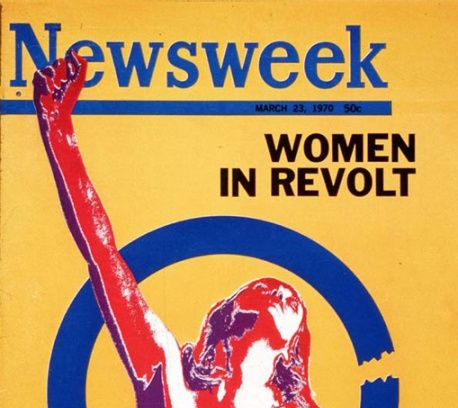
Feminism exploded into the visible culture in a splashy and dramatic way on March 23, 1970. Forty-six female employees of the national magazine Newsweek, had secretly developed a lawsuit under the new Civil Rights act Title VII that prohibits discrimination on the basis of ‘[an] individual’s race, color, religion, sex, or national origin’. This lawsuit coincided with the publication of the cover article of their own publication exploring and explaining the growing feminist movement. The cover article was titled “Women in Revolt”. The cover illustration accompanying the article depicted a woman punching the air through a female symbol, who inexplicably, is naked.

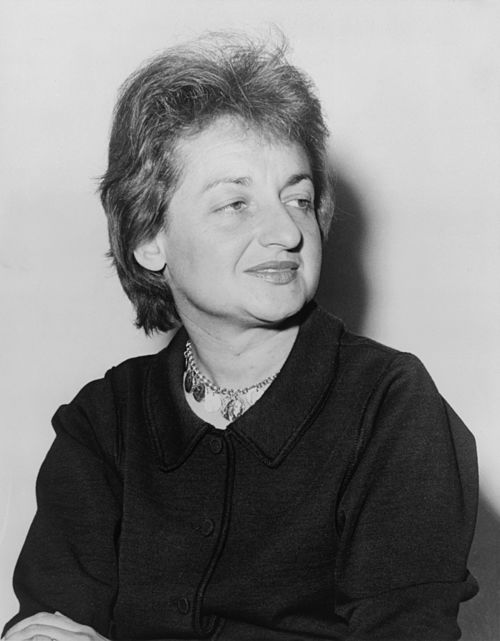
The Second Wave Feminist movement is historically said to have actually begun in 1963 with the publication of Betty Friedan’s book The Feminine Mystique,
“Mrs. Friedan told women that a male-dominated, consumer-oriented society had conned them into producing more children than their mothers had, into giving up career hopes, into lives deadened by trivia and, finally, into a mystified struggle with the emptiness and malaise that came upon them in middle age.” (Source)
That book lit a match to the fuse of anger that took only 7 years to emerge explosively onto the national scene in that 1970 shocking Newsweek lawsuit. In 1966 Friedan founded the National Organization for Women, NOW, which aimed to change the status quo of women legally and from within the system via her formal, hierarchical organization.
But by 1970 when Newsweek’s article came out, the undercurrent of anger over a perceived inequality of the status of women in American society had morphed into the Women’s Liberation Movement, splintering the movement from the original feminists. Women’s Lib was a loose collection, not a formal organization like NOW, of discontented women fueled by intense anger who wanted direct action in the form of protests and public demonstrations. It was these women who claimed that the traditional nuclear family was a patriarchal unfair system that needed to be done away with.
“We had to reject everything we were raised to believe about a woman’s role in society. We had to redefine our expectations, our ambitions and ourselves.” Lynn Povich, one of the women who lodged the sex-discrimination suit against Newsweek.
“…had to…”
It’s true that when a woman is apart from Christ she will constantly seek her identity and meaning in either cultural expectations, or self-identified ambitions or desires. A non-Christian is untethered, and must find an anchor point in which to engage in a tug of war that tethers them to…something. Here in this point in history, feminists tugged against men.
From Newsweek’s “Women in Revolt” article-
For a newcomer to women’s lib, the truly jolting experience is the first encounter with the anger that liberationists feel toward men. It bristles through the literature of the movement and it explodes into conversation in great hot blasts of doctrinaire invective. “There is no such thing as love between an adult male and a child,” a feisty working-class liberationist with four grown daughters told me. “Between mother and infant, there is a bond. But in the father there is no such thing as affection, love or any human emotion, other than the sense of power and property.” Source
Sin over-promises and under-delivers
The entire issue with feminism, aside from being satanically inspired, is a movement of people without God who are searching for an identity. For many women of that era, ‘angry woman doing good by protesting for social reform’ became their identity. For others, dispensing with men entirely and changing into lesbians became their identity. Advocate, Crusader, Disruptor, Protestor, and even Revolutionary were identities more important to these women than woman, wife, and mother.
In the Newsweek lawsuit, they were discontent with being employed in ‘female’ jobs in journalism such as clippers, fact checkers and secretaries because as the Newsweek President at the time said, “it was a tradition going back 50 years.” It was a tradition because at the time of the early 20th century, women’s jobs were seen as placeholders until her real career of wife and motherhood came along. It was the same in most other careers besides journalism, too.
There was such a thing as the informal “marriage bar”. This is a general term used to cover all hiring practices against married women, pregnant women, and mothers. Until the 1970s, the practice often called for the termination of the employment of a woman upon her marriage. In fact, I remember distinctly my own father saying unapologetically he was reluctant to even hire women of marriage age and he outright refused to hire women who had children.
NOW and Women’s Lib changed that. Explosively. But by 1970, younger adherents to the movement saw founder Friedan as an old-fashioned woman, too traditional, representing only white-middle class. She was shunted aside in favor of the more volatile style of social change, which included militant activities and lesbians, which Friedan had opposed. (She called lesbians the “Lavender Menace”.)
“Sin never delivers what it promises, and the pleasurable life sinners think they are pursuing always turns out to be precisely the opposite: a hard road that inevitably leads to ruin and the ultimate, literal dead end“. ~John MacArthur, “The Prodigal Son”
The sudden and swift expansion of women streaming to the workplace after 1970 was undergirded by the continuing feminist mantra that a woman did not have an identity unless and until she obtained a job and with it, acclamation or affirmation of some type in the public economy.
Repeating the identity mantra today
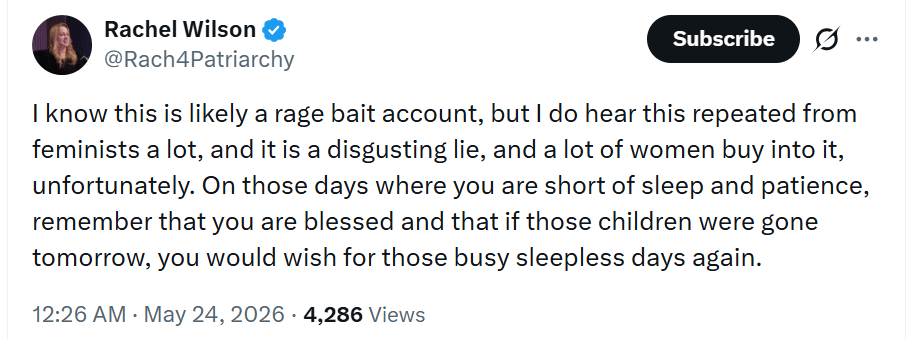
Today in 2026, fifty-six years after the feminist movement emerged with power, we still read the same sentiment online.

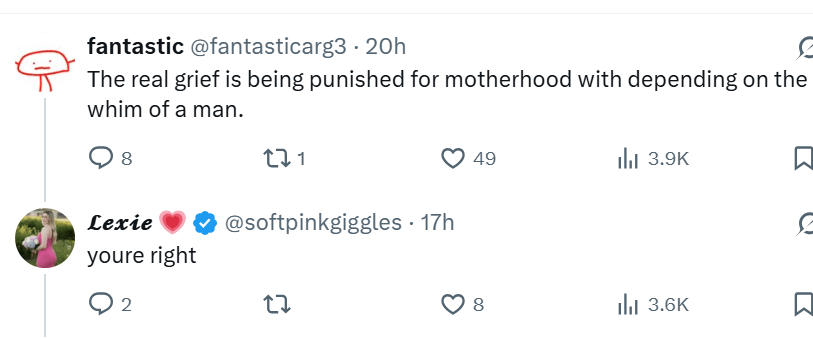
Here is a measured reply to the women above-
As an aside, it should be noted that women were less hesitant to ‘depend on a man’ for his breadwinning when divorce was illegal.
Friedan’s book asked the question of “the problem that has no name”, phrased thusly: “Each suburban wife struggled with it alone. As she made the beds, shopped for groceries, matched slipcover material, ate peanut butter sandwiches with her children, chauffeured Cub Scouts and Brownies, lay beside her husband at night—she was afraid to ask even of herself the silent question—’Is this all?’ “ ~The Feminine Mystique
Absent God, nothing is ever enough
It’s a cunning question. It harkens back to the Garden of Eden, ‘Has God said? The serpent’s question intimated the same thing to Eve, ‘Is this all? Is God holding out on you? Don’t you want more?’
It forces a person to look around at what they don’t have, forgetting what they do have. Christian women have all there is to have. We have Jesus, who is Alpha and Omega, all in all.
Sin overpromises and underdelivers. Even Friedan wrote in her book, of the First Wave Feminists of the 1800s into the 1920s, “It is a cliché of our own time that women spent half a century fighting for ‘rights,’ and the next half wondering whether they wanted them at all.”
Why would second wave feminists think it would be any different for them? The reality is that the next generation found that absent their flurry of protesting activity, which became their identity, once they possessed it, having the opportunity to participate economically in public society didn’t automatically offer the fulfillment they were promised. In fact, it actually increased both their discontent and their exhaustion. It didn’t resolve the supposed conflict between outside career and traditional homemaker. It just moved the old conflict to a different conflict. And thus we learn the hard way that kicking against the goads is always vain. (Acts 26:14).
What is identity?
Prior to repentance and conversion to Christianity, we have two main identities. One is that we are made in the image of God. (Genesis 1:27). This isn’t to say God is pleased with us, because our other identity is sinner. We are all born in sin and we sin and sin and sin from the moment we utter our first cry. There is no way NOT to sin because it is our very nature to sin.
After we convert to Christianity, we are still made in the image of God but now the work begins to conform us to the likeness of Jesus. We gain our eternal identity. We have imago dei as an unconverted person but when we repent of sins and trust Christ, we submit to Him. Submission doesn’t erase who we are, it fulfills it. It is error to think that submission means loss of identity. The Savior was co-equal to God in the Trinity, He and the Father are one. (John 10:30), However, Jesus submitted to the will of the Father in incarnating so He could die in the flesh on the cross. (Matthew 26:39).
After conversion we are tethered to Christ. We are in union with Him. Apostle Paul said so often, “in Christ”. In, in, in. Attached, part of. Outside of Christ we drift, look for meaning, unsure of who we are on this earth. But Christians are united to Christ. Satan may knock us around, we may go in circles for a while, but ultimately we are connected to Christ and nothing can snatch us from His hand. (John 10:28-29).

Greg Lanier said in the June 2019 TableTalk Magazine article, “Bodily Metaphors for the Christian Life” –
The bodily metaphors express how each individual Christian is spiritually united to Christ upon salvation as a “member” (like a limb or organ) of His body (1 Cor. 6:15; Eph. 5:30). Where the building metaphors portray the church as filled by the Spirit (1 Cor. 3:16), the bodily metaphors emphasize how we are spiritually connected to Christ Himself (10:16). The individual Christian’s life is pressed into a Christward mold in a way that is deeper than we can imagine.
In part 2 I’ll explore a personal journey of seeking my identity, and in part 3 delve into what it means to be united in Christ, a Christian’s identity.


Thank you for sharing this. I am blessed to have a Christian wife who has never taken any of the self-serving and ungodly parts of feminism seriously. I listened to this full recording and agree with it. I am 67 and I do remember Betty Friedan well.
LikeLike