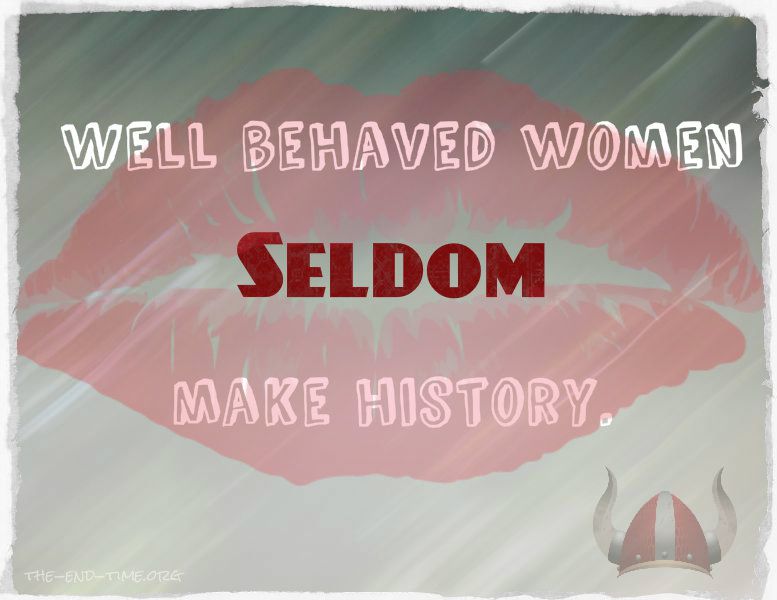
This was a bumper sticker adorning the car ahead of me at a red light. A long light. I had time to read it and think about it and then get steamed about it. Of course next to that bumper sticker there was a ‘coexist’ bumper sticker. How can those two be reconciled? If a women isn’t being well-behaved, she is being rebellious. And if she is being rebellious, she is not co-existing peacefully with those around her, is she? Illogical.
In any case, I thought that the bumper sticker’s premise was that for women to be recorded in history, they must have had to do something daring or against societal expectations, or had done something ‘out there’ in some way. This, I had mused, is illogical too, because there are plenty of women in history who were simply good at what they did, and that was why they got into the history books. Louisa May Alcott, Laura Ingalls Wilder, Marie Curie, Queen Elizabeth II, Sally Ride… Would NASA have chosen a rebellious upstart to be part of their space program? Of course not.
Curious now, I looked into the origins behind the bumper sticker and I was surprised by what I found.
The phrase comes from Harvard Professor Laurel Thatcher Ulrich. Ulrich identifies herself both as a feminist and a Mormon. It was her 1976 little-known academic paper published in American Quarterly called “Vertuous Women Found: New England Ministerial Literature, 1668-1735” where the now famous bumper sticker phrase was first seen.
Massachusetts, where Harvard is located, was populated in the 1600s by deeply religions Puritans who had emigrated from England and the Netherlands to worship God freely, something they could not do on the Continent.
Ulrich looked into the lives of ‘ordinary’ Puritan women, especially midwives, through their own diaries. The ordinary, the mundane, the repetitive nature of the life, consisting of hard work mainly at home, drew Ulrich’s attention. She expanded her paper into into a 1990 book called, “A Midwife’s Tale: The Life of Martha Ballard, Based on Her Diary, 1785-1812.” The staying power and viral nature of the adage she had coined back in 1976 led to Ulrich eventually write a book in 2007 called by the very phrase she had coined: “Well-Behaved Women Seldom Make History.” Here is an excerpt from the 1976 paper:
Cotton Mather called them “The Hidden Ones.” They never preached or sat in a deacon’s bench. Nor did they vote or attend Harvard. Neither, because they were virtuous women, did they question God or the magistrates. They prayed secretly, read the Bible through at least once a year, and went to hear the minister preach even when it snowed. Hoping for an eternal crown, they never asked to be remembered on earth. And they haven’t been. Well-behaved women seldom make history; against Antinomians and witches, these pious matrons have had little chance at all.
It turns out, that Ulrich wanted to simply promote the lives of the Puritan and the 1800s women which history had forgot.
Ulrich noted that though women were nearly invisible in society, only recording when they were born, married, or died, their standing in spiritual realms was highly elevated.
…this circumscribed social position was not reflected in the spiritual sphere, that New England’s ministers continued to uphold the oneness of men and women before God, that in their understanding of the marriage relationship they moved far toward equality, that in all their writings they stressed the dignity, intelligence, strength, and rationality of women even as they acknowledged the physical limitations imposed by their reproductive role. … Source 1976 paper, “Vertuous Women Found”
Huh. Go figure. A Mormon Harvard feminist professor who got it right. As for the popularity of the phrase I’d seen on the bumper sticker, Ulrich said that its ambiguity (when taken out of its context) accounts for its appeal. In other words, you can interpret it any way you want. Which is exactly what I had done at the red light when I first read it.
My objective when I wrote those words was not to lament their oppression but to give them a history. … [T]he ambiguity of the slogan surely accounts for its appeal. To the public-spirited, it is a provocation to action, a less pedantic way of saying that if you want to make a difference in the world, you can’t worry too much about what people think. To a few it might say “Good girls get no credit.” To a lot more, “Bad girls have more fun.” … Source: “Well-Behaved Women Seldom Make History” (Knopf, September 2007)
Well there you go.
There’s one more thing. The premise that ‘well behaved women seldom make history’ is supposed to spark a knee-jerk reaction that it’s a bad thing not to make history. Like, “Hey! I wanna get into history! Why can’t I be in the history books?! The biblical worldview would have a response to this in several respects. First, woman already are in the only history book that matters, the Bible. Well-behaved and rebellious women are both recorded throughout the pages of that holy Book. From Jezebel to Esther, from Mary to the Woman at the Well, women are recorded in biblical history doing what they do as humans.
Secondly, women already are recorded…in the Lamb’s Book of Life. There is NO OTHER book than that precious book one should aspire to have our names written.
And I saw the dead, great and small, standing before the throne, and books were opened. Then another book was opened, which is the book of life. And the dead were judged by what was written in the books, according to what they had done. (Revelation 20:12).
Nothing impure will ever enter it, nor will anyone who does what is shameful or deceitful, but only those whose names are written in the Lamb’s book of life. (Revelation 21:27).
If you have repented and believed in the risen Christ, then us well behaved women are all set with names written in the Lamb’s book. All other books will fade away. But not Jesus’ words, those are the only words and the only history that matters.
Heaven and earth will pass away, but my words will not pass away. (Matthew 24:35).
The author challenges the claim that Titus 2 limits older women to teaching homemaking. Examining context and the Greek term “teacher of good,” the piece asserts that Paul calls women to transmit sound doctrine and practical holiness, intertwining orthodoxy and orthopraxy in intergenerational discipleship, not merely domestic skills.
As a teen and young adult, I loved reading historical epics. Follett’s Pillars of the Earth, Mitchell’s Gone with the Wind, Michener’s Hawaii, and of course, Winsor’s Forever Amber.
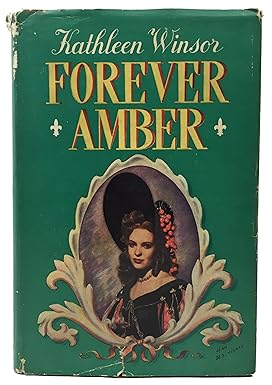
Forever Amber was written by Kathleen Winsor in 1944. It’s a romance set in Restoration England with historical events as a backdrop, such as the Great Fire of London, the Plague, and the ascension to the throne of King Charles II. It was banned in Boston, but there are no explicit sexual details or graphic scenes, just suggestions, which was enough back then. It is praised for historical accuracy. Amber was a character often likened to Scarlett O’Hara who used her fierce ambition, sensuality, (sexuality, too) to climb to the heights of social standing, acclaim, and wealth.
The book involves Amber pursuing one man, her lifelong love, Bruce, which is unrequited, as his was solely a physical attraction and he viewed Amber as just a mistress, not wife material. It shows Amber’s increasing desperation to reclaim him with a scene near the end of the book of the disappearing dress. As the King’s concubine, Amber had also sensed the King’s interest in her was waning as new court rivals emerged. Knowing Bruce had married a young virgin, Amber decides to capture Bruce and the King’s attention with a unique dress in a desperate attempt to challenge what she believed was her rival and to remain the center of the court’s attention. Amber never accepted that her and Bruce’s relationship was over and had never been substantial to begin with.
Amber is amoral, a literal whore, scheming, and unlikable. So of course at 970 pages the book was a total success. The audio book takes 42 hours.
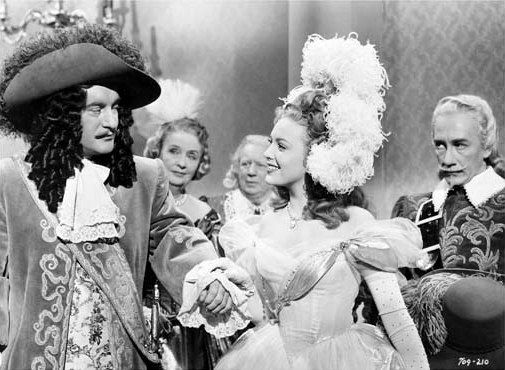
Wikimedia commons. Scene from the movie
As to the “Naked Dress” scandal: Near the end of the book in a climactic display of her desperate need for attention and status, Amber attends a court ball in a gown made of real pearls. The dress is designed to gradually “fall apart” as the pearls drop off throughout the evening, eventually leaving her virtually naked—a literal and symbolic representation of her willingness to expose everything to reclaim her unrequited love. It didn’t go as planned. After Amber makes her sweeping entrance, all eyes were indeed on her. The men whistled low, with arched eyebrows. The women sneered. Soon the men did too. Amber had gone too far. From the book:
“But aren’t you cold?” interrupted a feminine voice, and turning swiftly Amber found Mrs. Boynton beside her, looking her over with feline insolence.
Another voice, a man’s this time, came from her other side. “Ods-fish, madame. But this is the greatest display that ever I’ve seen in public since I was weaned.” It was the King, lazy, smiling, obviously amused. Amber felt suddenly as if she had been hurt inside.
She turned sick with a feeling of horror and self-disgust. What have I done! she thought. Oh, my goodness, what am I doing out here half undressed?
Her eyes swept round the room and every face she saw was secretly smiling, covertly sneering at her. All at once she felt like the person in a dream who sets out confidently to go up-town stark naked, gets halfway there and then realizes his mistake. And, like the dreamer, she wished passionately that she were back home where no one could see her-but to her wild dismay she realized that this time she was caught in her own trap. She could not wake up from this bad dream. –end quote from the book
At least Amber was ashamed. More on that in a minute.
Display is a good word. Hearing that word, the character of Amber realized what her moral descent had led to, she had descended to displaying the only thing she had left, not character, not wisdom, not gentility, not decorum, but her very flesh.
The 67th Annual Grammy Awards just concluded the other day. I did not watch it. I am out of step with today’s music, and frankly, shocked at the outfits. Or, should I say, lack of them. Literally. One male musician performed in silky boxers only. Some women bared nearly all. Class is out of style. Don’t go looking for the costumes worn at this event, they are un-edifying to pass before your eyes.
The Grammy event showed a lot of displays. If one ever wanted to see a stark realization of where this society is on the moral-immorality scale, this event is it. Lots and lots of ‘Ambers’ parading around naked. I mean, naked. Flesh displayed for all to see, in desperate attempts at what? To retain attention? To prop up one’s mistaken notion of empowerment? To bolster self-esteem? It is disgusting and a reminder that modesty is God’s command. Worse, there was barely a murmur from the press about the licentiousness. If ever there was a society that needed to look at where their immorality has descended to, this is it.
I am truly amazed to see where we are now compared to when I was young. I remember when ‘short shorts’ AKA hot pants were controversial. In 1970 they came into fashion, but a few years later extremely short hot pants had become shorthand for prostitution, particularly underage prostitution.
“Asked in 1971 to explain the popularity of hot pants, a male psychiatrist based in Manhattan borrowed language from the contemporary women’s liberation movement to suggest that they were “an expression of the female’s new freedom.” ~Girl Culture [2 volumes]: An Encyclopedia by by Claudia Mitchell (Editor), Jacqueline Reid-Walsh.
The world’s version of ‘freedom’ for women is parading around in flesh. God’s version of freedom is His eternal gift of freedom from the slavery of sin, which nakedness is one of those sins.
Empowered women do not shamelessly dangle their flesh in front of a global audience. Empowered women are powered by the Holy Spirit, on whom she relies. Her meek spirit, her gentle wisdom, her steady encouragements of her husband and children are entirely the attraction. Flesh is flesh. It will wither and die. The lasting contribution of a woman is not her paraded nakedness, but her modesty in apparel and her modest attitude.
I truly feel terrible for those women (and man) who came to a global event to celebrate music, creativity, and showmanship wearing their flesh as the display. God made humans in His image, and as image bearers they know not what they do when they uncover themselves.
Remember Noah, drunk and naked in his tent? (Genesis 9:20-24). Noah’s son Ham went in, saw his drunken naked father, and in delight, chortling, went out to tell his brothers and show them. What dishonor! To revel in someone else’s shame!
“Woe to you who make your neighbors drink, Who mix in your venom even to make them drunk So as to look on their nakedness!” (Habakkuk 2:15 LSB).
Ham father of Canaan was cursed for his dishonor. We must not delight in another’s nakedness.
Just as in Forever Amber, Bruce never considered Amber marriage material, she was too willing to use her flesh and display it to anyone who could get her further along in her agenda. Ladies, make sure what you display is what God wants: a meek and quiet spirit, with clothing.
An essay critiques feminism within conservative Christianity, arguing it disguises itself as ministry. Tracing roots from temperance to suffrage, it defines feminism, challenges female celebrity teachers, and claims biblical hierarchy is violated when women pursue public platforms, careers, and influence while neglecting home-centered roles scripturally.
The article discusses the biblical principle of women’s silence in church, citing 1 Corinthians and 1 Timothy. While it emphasizes women’s submission, it does not imply total silence. It encourages women to embrace their role in church as silent witnesses to God’s glory.
‘My little girl fell overboard!” This is not something any parent wants to experience. A family aboard the Disney Dream cruise ship was on Deck 4, playing shuffleboard. It was a sunny, calm morning on June 29 as the ship headed back from The Bahamas to Fort Lauderdale. The mom saw her 5-year-old girl clamber on to the 5’ porthole ledge, then horrifyingly, fall into the ocean. Yelling to the dad, without a second’s hesitation, dad jumped into the ocean after her.
The article discusses the misinterpretations of 1 Timothy 2:11-12 regarding women’s roles in the church. It critiques arguments allowing women to teach or preach under male authority, emphasizing adherence to biblical authority and order. The essay cites theologians like John Piper and John MacArthur, reinforcing traditional views on gender roles in ministry.
Turning Point USA’s Young Women’s Leadership Summit aims to empower women through civic engagement and political activism. However, the article critiques this initiative, questioning its alignment with biblical roles for women which are supposed to be primarily focused on home and motherhood. It highlights inconsistencies among speakers promoting activism while diverging from scriptural teachings on femininity and family responsibilities.
The other night I enjoyed reading historical newspaper articles from the early 1900s, particularly regarding women’s suffrage and First Wave feminism. While supporting women’s voting rights, I critique the underlying philosophy of feminism, saying it promotes a negative view of traditional gender roles. Editorials from that era reveal mixed sentiments on women’s societal roles from opposition prior to WWI to acceptance afterward. The Right to Vote for women passed in 1919.
Our local paper has been going since 1882. This week I was captured by reading the old, old digitized historical articles going back to the early 1900s. The writing used to be so good, even in ads. The social news cracked me up, like, so-and-so is visiting so-and-so, who is sick, who has recovered. But there were serious articles too, many about farming, especially cotton, since 100 years ago that was a major crop. And as the Women’s Suffrage debate heated up nationally, it heated up locally too.
Women’s suffrage was passed by Congress in 1919, giving women the vote. First Wave feminism historically began in 1848 at the Seneca Falls convention, and outlined the platform in a white paper called the Declaration of Sentiments, which was to secure legal rights for women.
The right to vote, own property, have a bank account, seen as independent of the husband etc., were contended issues. These are good things, of course, but look at the attitude and position behind these items of these first wave feminists that propelled their cause. In their 1848 “Declaration of Sentiments” they contended that men have perpetuated-
a long train of abuses and usurpations, pursuing invariably the same object, evinces a design to reduce them [women] under absolute despotism,
and
“the history of mankind is a history of repeated injuries and usurpations on the part of man toward woman, having in direct object the establishment of an absolute tyranny over her“
and that men have fomented
“their social and religious degradation over her“. (Source).
Viewing God’s design for men and women as a ‘degradation’ began early, I see. The notion that men have in all cases engendered a widespread ‘absolute tyranny’ and ‘absolute despotism’ over women is hyperbole. And it cannot be a ‘usurpation’ if that is the way God had designed roles for the genders, in other words, if that is how things are supposed to be.
I am for women voting. I believe if I’m represented in government, I should have a say. I also believe that women should participate in civic spheres, which includes philanthropy, volunteering, good works, hospitality, church work, and so on.
Editorials appeared in many newspapers across the country written by The President of the Texas Farmer’s Union, WD Lewis. He wasn’t wrong when he said “It is, as a rule, the city woman promoted to idleness by prosperity, who is leading the suffragette movement.” Indeed, it was many upper middle class white women from prominent families with access who were the original founders.
Suffragette Katharine Dexter McCormick, who was born to a life of wealth, which she compounded through marriage, could have sat back and simply enjoyed the many advantages that flowed her way. Instead, she put her considerable fortune — matched by her considerable willfulness into … most notably to underwrite the basic research that led to the development of the birth control pill in the late 1950s. Above, McCormick in 1914, traveling to a suffrage convention on the RMS Aquitania. She contributed financially to the movement, and ultimately took on leadership roles. Credit Bettmann Archive/GettySource, NYT.
I also agreed with some of the sentiments expressed by men who opposed the Suffrage concept, too. Like this paragraph:
“It is her hand that plants thoughts in the intellectual vineyard; It is through her heart that hope, love and sympathy overflow and bless mankind. Christ—the liberator of womankind—was satisfied to teach the lessons of life and He was a man. He chose to rule over human hearts and refused worldly power and men followed after Him, women washed His feet, little children climbed upon His knees and the Ruler of the universe said that In Him He was well pleased. Can woman find a higher calling?” from Ordway New Era, (Ordway, Colo.) 1902-1927.
Does he sound like an oppressive, tyrannical, despot?
Bettmann Archive. Despite the threat of incarceration, Suffragettes continued to march with American flags in protest, circa 1910.
The First Wave Feminists asserted that the genders were equal, as they began their Declaration with the same words as our founding document, the Declaration of Independence did:
We hold these truths to be self-evident; that all men and women are created equal…
Yes, we are equal. But we each have different roles, according to God. But for them, ‘equal’ meant ‘interchangeable’. It was a subtlety not lost on the TX Farmer’s Union President, who wrote,
“From many standpoints, perhaps a woman has as much right to vote as a man. So has she as much right to plow as a man; she has has much right to work in a factory as a man; she has as much right to shoulder a musket as a man, but we would rather she would not do so from choice and we regret that necessity ofttimes compels her to earn a living by engaging in gainful occupations.”
Of the articles I’ve read this week, I noticed the same arguments were promoted by Phyllis Schlafly in the 1970s when she organized to oppose the Equal Rights Amendment- which was originally introduced to Congress as a bill in 1923. Suffrage came to women in the US in 1920. The ERA came close to succeeding but thanks to Schlafly, with only 3 sates needed to ratify, she almost singlehandedly organized and stopped the political momentum. ERA finally failed in 1982, never recovering the momentum to regain the 3 states needed to ratify.
“Schlafly’s conservative values led her to staunchly oppose feminism in all of its forms, Faulkner says, and the ERA was certainly part of the feminist agenda. “She feared that greater sex equality would lead to a moral decline in society by changing the roles that women had traditionally held,” she says.” (History.com)
Suffragists Standing at U.S. Capitol. Bettmann Archive.
Phyllis was right. She was exactly right. So were the men in the 1913 and 1915 newspapers who said the same in opposing original suffrage.
Now, to be sure, not all the rhetoric opposing women’s suffrage was politically or even morally appropriate. When you go to the historical newspapers web page, there is a disclaimer that says some of the material contains “harmful content”. I disagree with the terminology of ‘harmful’ but it’s true that the prejudicial attitudes toward women, Chinese, and black people in 1913 were more accepted and widespread than they are today. Nonetheless, it bears reading to see how the citizens of the nation felt about women getting the vote, and their tactics both sides employed along the way.
The writers of the historical articles in the paper were also adept at sly (or wry) insults. Here, is an article I do not believe is real, since the Women’s March never planned to march IN the inaugural parade. Their march the day before the Inauguration of Woodrow Wilson was the largest Washington DC had ever seen. However, the subtle dig at women’s aims to not be satisfied with just getting the vote, but to actually supplant men is clearly seen, and the writer made a sly joke about it:
Women Won’t March. Chicago.— “There will be no band of Suffragists marching behind President Wilson and Mr. Taft in Washington, March 4 (1913). The plan has been dropped, it was announced here, by officials of the National American Woman’s Suffrage Association. Instead the Suffragists will march through the streets of the national capital March 3, headed by Mrs. Carrie Chapman Catt, Miss Jane Addams and Dr. Anna Howard Shaw. The officials said that It was poor policy to play second fiddle to anybody.”
TX Farmer’s Union president WD Lewis opposed suffrage. I saw his editorials in newspapers far flung from Texas, and they were all different in content, not repeated as a syndicated column. He asks good questions and comes at the concept the same way that Phyllis Schlafly did almost 60 years later when the Equal Rights Amendment (proposed by suffragette Alice Paul in 1923 as part of the feminists’ “Great Demand”) was eventually derailed. It was written in 1915, so as per the culture at that time, it was a little florid, but still, many good points. Here’s Lewis:
WHY IS WOMAN RESTLESS? DESTINY OF NATIONS DEPENDS UPON CONTENTED HOMES. By W. D Lewis, President Texas- Farmers’ Union, May 1915.
Why is woman dissatisfied? Why does she grow restless under the crown of womanhood? Why is she weary of the God-given jewel of motherhood? Is it not a sufficient political achievement for woman that future rulers nurse at her breast, laugh in her arms and kneel at her feet? Can ambition leap to more glorious heights than to sing lullabies to the world’s greatest geniuses, chant melodies to master minds and rock the cradle of human destiny? God pity our country when the hand shake of the politician is more gratifying to woman’s heart than the patter of children’s feet.
Woman Is Ruler Over All.
Why does woman chafe under restraint of sex? Why revile the hand of nature? Why discard the skirts that civilization has clung to since the beginning of time? Why lay aside this hallowed garment that has wiped the tears of sorrow from the face of childhood? In its sacred embrace every generation has hidden its face in shame; clinging to its motherly folds, tottering children have learned to play hide and seek and from it, youth learned to reverence and respect womanhood. Can man think of his mother without this consecrated garment? Why this inordinate thirst for power? Is not woman all powerful?
Man cannot enter this world without her consent, he cannot remain in peace; without her blessing and unless she sheds tears of regret over his departure, he has lived in vain. Why this longing for civic power when God has made her ruler over all? Man has given woman his heart, his name and his money. What more does she want? Can man find it in his heart to look with pride upon the statement that his honorable mother-in-law was one of the most powerful political bosses in the country, that his distinguished grandmother was one of the ablest filibusters in the Senate or that his mother was a noted warrior and her name a terror to the enemy? Whither are we drifting and where will we land?
God Save Us From a Hen-Pecked Nation.
I follow the plow for a living and my views may have in them the smell of the soil; my hair is turning white under the frost of many winters and perhaps I am a little old-fashioned, but I believe there is more moral influence in the dress of woman than in all the statute books of the land. As an agency for morality, I wouldn’t give my good old mother’s homemade gowns for all the suffragette’s constitutions and by-laws in the world.
As a power for purifying society. I wouldn’t give one prayer of my saintly mother for all the women’s votes in Christendom. As an agency for good government, I wouldn’t give the plea of a mother’s heart for righteousness for all the oaths of office in the land. There is more power in the smile of woman than in an act of congress. There are greater possibilities for good government in her family of laughing children than in the cabinet of the President of the United States.
The destiny of this nation lies in the home and not in the legislative halls The hearthstone and the family Bible will ever remain the source of our inspiration and the Acts of the Apostles will ever shine brighter than the acts of Congress.
This country is law-mad. Why add to a statute book, already groaning under its own weight, the hysterical cry of woman? If we never had a chance to vote again in a lifetime and did not pass another law in twenty five years, we could survive the ordeal, but without home, civilization would wither and die. God save these United States from becoming a hen-pecked nation; help us keep sissies out of Congress and forbid that women become step fathers to government, is the prayer of the farmers of this country.
A DIVINE COVENANT.
God Almighty gave Eve to Adam with the pledge that she would be his helpmeet and with this order of companionship, civilization has towered to its greatest heights. In this relationship, God has blessed woman and man, has honored her and after four thousand years of progress, she now proposes to provoke God to decoy man by asking for suffrage, thereby ending an agreement to which she is not a party. Woman, remember that the Israelite Scorn’d a divine covenant, and as a result wandered forty years in the wilderness without God. Likewise man should remember that it is a dangerous thing to debase woman by law. –end of Lewis editorial
So these are a few thoughts on the passage of the votes for women. As I said, I do believe women should have the vote, should be able to own property, to have her own bank account, and to be able to work if she needs to. However, as one editorial from an anonymous person said in the historic newspaper, “militant feminists put the rage in suffrage”. The underlying philosophy of feminism, though topped with the cream of the above civic concepts, is rotten down to the bottom. Indeed, it is right to say 100 years later, ‘God save us from a hen-pecked nation’.
I am conferenced out. I had the wonderful privilege of attending the National G3 conference a few times and I enjoyed it. But as I age, I am finding that being in a cavernous building filled with thousands of people overwhelms me more quickly than it used to. My energy drains away faster than two shakes of a lamb’s tail.
As an older women a few years away from retirement, it seems lately that all I want to do is come home from work and sit down. Sunday go to church. Repeat. LOL. However I am also grateful for the opportunity through the wonderful invention of the internet, to be able to consume material from present day solid ministries and past ones that have been uploaded, such as at Monergism, Grace Gems, and the like.
Being careful but savvy about what to consume on social media allows a woman to develop her discernment. As long as we are in the word, studying, reading, singing, and in church worshiping, we can extend our learning by testing it with material we find online. This includes buying books and listening to music, whether through Spotify, Pandora, Youtube, or Apple.
In that vein, below are a few links offering a wealth of information about women for women.
Always wise, always measured, and with a right-heart attitude, Amy broaches the subject that many women unfortunately stumble on, hearing God’s voice: Ladies, No One Is Whispering to You by Amy Spreeman at Berean Research
Grace Sutton muses on the different states of being as an adult- singleness and marriage. Desiring one over the other isn’t necessarily making an idol nor would it be sinful. God set apart some for singleness and many for marriage. Here’s Grace working through the issue: Let Me Be Single essay at For the Church
Aussie Daniel Schricker writes and speaks about cults because he grew up in one. Here, he identifies the markers and makings of a cult, and applies the scholarly information to a well-known woman on seemingly every social media there is, The Transformed Wife, Lori Alexander. The Cult of Lori Alexander, essay by Daniel Schricker, Ph.D
With all the brouhaha of gender studies in the recent past, documentary satirist Matt Walsh published a film asking ‘gender experts’ the simple question… What is a Woman? full documentary by Matt Walsh
In 2013, Sunny Shell of Abandoned to Christ ministry wrote the following essay. It was scriptural and humble. She said that consuming Piper’s material “requires more discernment than I currently possess.” She said she loved him and considered him a brother, but she couldn’t follow him any longer, not while there were so many other good ministries out there. Sunny received a LOT of push back, even though there was not an accusatory bone in the whole essay. She took it down and it stayed down for a number of years. A few years ago she put it back up.
As for me, I do not follow Piper either. His continuationism and his multi-step justification stances gave me pause some years ago as to following him or consuming his material. Never mind his lack of discernment in inviting or sharing platforms with Mark Driscoll, Beth Moore, Rick Warren etc. an issue that Sunny pointed out in 2013. Recently, Piper spoke at Pastors’ Workshop and his recorded remarks are causing consternation among the more solid theologians. Here, Ekkie points out the conundrum in a short tweet. Below, find Sunny’s humble but accurate article. Though at this time I consider Piper a brother, I do warn that he has had many confusing stances in the past and of late. Too many bones… Why I no longer follow John Piper or Desiring God ministry