I’m 65 years old. Second wave Feminism hit when I was in my formative years and early adulthood. I watched it, perplexed. It WAS a wave, it swept the country quickly and made many promises.
We are reaping regret now. A generation or two later, women who bought into the myth of having it all are on videos and blogs crying, wondering, regretting, mourning.
SYNOPSIS: This reflection traces the rise of second-wave feminism and its search for identity apart from God, arguing that worldly pursuits cannot provide lasting fulfillment. Contrasting secular self-definition with biblical teaching, it presents union with Christ as the Christian’s true, eternal source of identity and purpose.
When someone says “summer reading” it usually brings to mind beach reads, AKA light novels, that are aimed to entertain. Since people take vacations in summer, they bring with them a novel that isn’t mentally demanding, just aiming to soak up the book in their hand and the sun above as they escape briefly from their workaday life.
I’m the opposite. Summer reading for me means I choose demanding books because I’m off work for the summer. During school my mental capacities are stretched to the max. I teach reading to a succession of 6 small groups over 4 different grades using 3 different reading programs. It’s a lot. I love it, but it drains me mentally.
When I get home, I’m a zombie and it takes a pot of tea and an hour to recover. I have nNo capacity for demanding novels.
So in the summer when I’m off and I’m not being challenged mentally, it’s the perfect time to make my TBR stack of classics, or ‘books I’ve always wanted to read but haven’t yet’ or ‘a book that is hard for me. Four summers ago I tackled Moby-Dick. Then it was Treasure Island. Then Joseph Conrad’s Heart of Darkness. So this summer it’s going to be…
I saw it advertised on Grace Books’ website and it is not only one I’ve always wanted to read but this edition is a beautiful book. I mean, you had me at ‘gilt edged’. And ‘cloth bound’. Yes, I judge a book by its cover. Come at me, lol.
It’s John Milton’s epic poem, “Paradise Lost’. Written in 1667, the publisher promises that it is an unabridged version but there are margin notes for unfamiliar words. So already I know the language is going to be demanding. And harder for me personally, is the fact that it is written as an Epic Poem. I have a rough time with poetry, I just don’t understand it.
An Epic Poem is (according to Encyclopedia Britannica), “long narrative poem recounting heroic deeds. Outstanding examples of the written epic include Virgil’s Aeneid and Lucan’s Pharsalia in Latin, Chanson de Roland in medieval French, Ludovico Ariosto’s Orlando furioso and Torquato Tasso’s Gerusalemme liberata in Italian, Cantar de mio Cid in Spanish, and John Milton’s Paradise Lost and Edmund Spenser’s Faerie Queene in English.”
I read The Aeneid, The Odyssey and The Iliad, when I was in my early 20’s. Forty-five years later – ahem – my brain may have dimmed somewhat. In fact, I when I was in High School and just after, I read most of the standard classics listed in top 100 lists and I’m glad I did back then because reading or re-reading them now is much harder. But every summer, I select a classic to read or re-read, and that is my Summer Reading!
The version issued by Grace Books was on 40% off the regular price at the time (it’s still 10% off now), so of course I could not resist. The book itself (according to the blurb) contains:
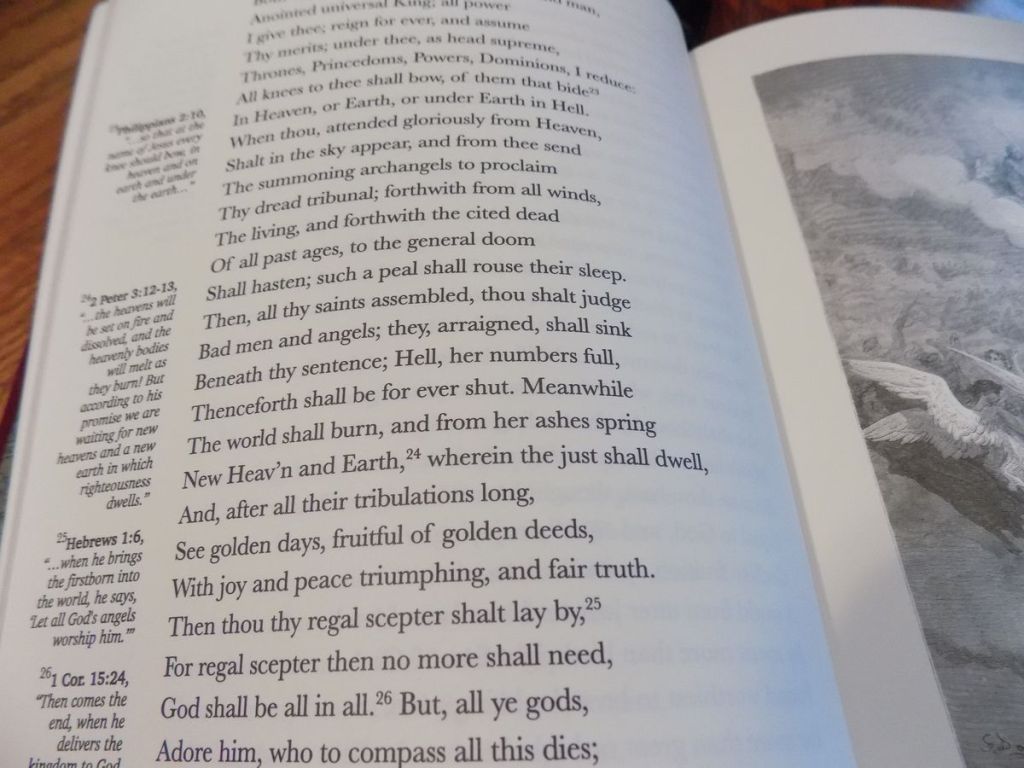
Explanatory notes are included in the margins for allusions to Greek mythology and obscure words.
Introduction by Dr. Leland Ryken
Cover design by Stephen Crotts
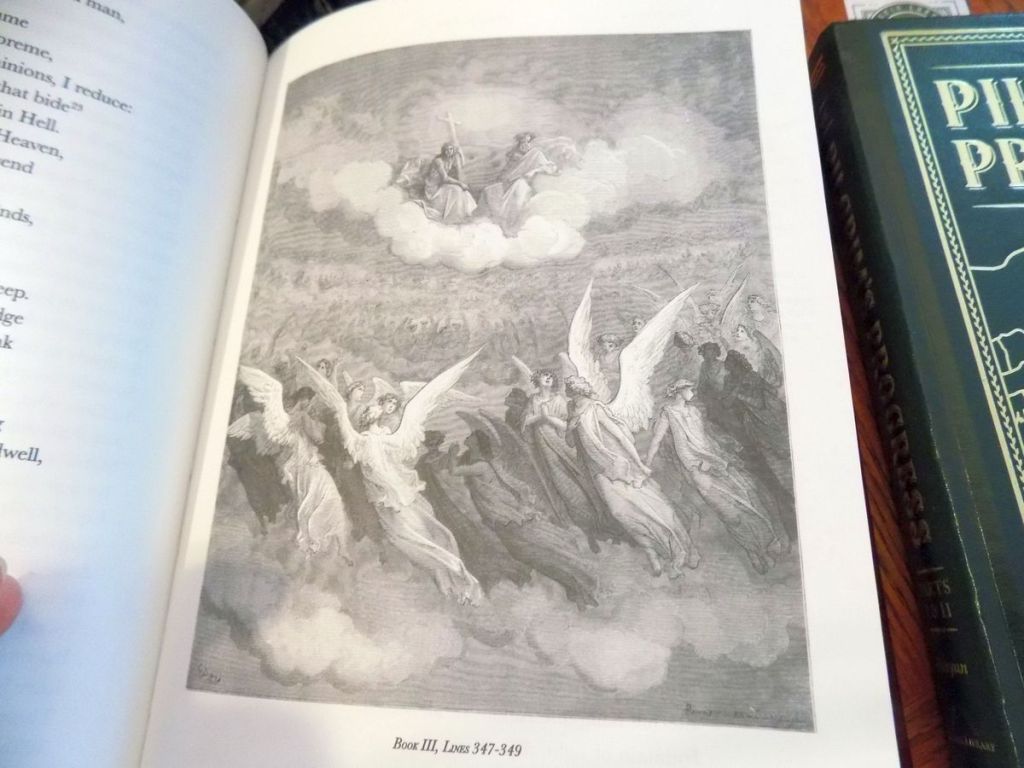
50 vintage illustrations by the renowned Gustave Doré; modified to cover nudity
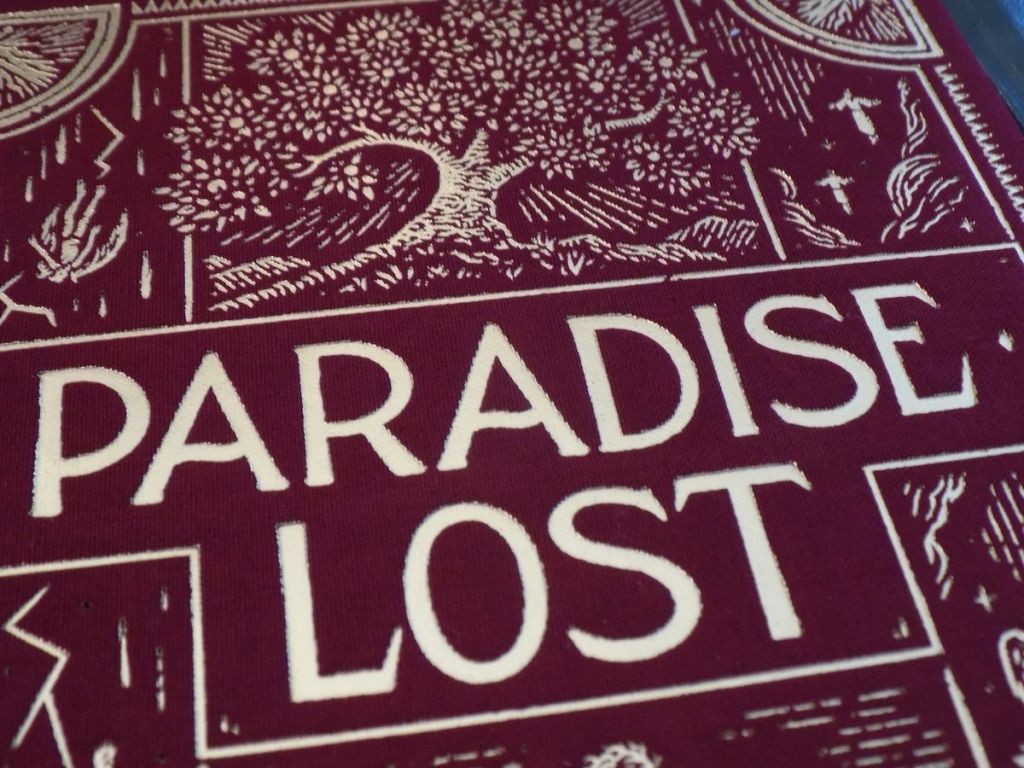
Genuine cloth cover with gold foil print and a ribbon page marker
What is Paradise Lost about? Adam and Eve’s rebellion and humanity’s fall from grace. One reviewer of this edition on Amazon said,
“Having biblical backgrounds in its plot of being about Adam and Eve‘s temptation and humanity’s fall from grace, “Paradise Lost” should be read for its unparalleled sonorous language, it’s profound exploration of human freedom, disobedience and rebellion, and its impact on Western literature. It offers a complex, timeless, psychological portrait of Satan serving as a foundational text for understanding the archetypal antihero.”
OK, this should keep me busy! Here are the photos of this beautiful edition. I appreciate Gustave Doré’s illustrations. He was a famous French artist, printmaker, and caricaturist who died in 1883. He is best known for his wood-engravings illustrating classic literature, especially Dante’s Divine Comedy. What I really appreciate in this edition is that though the language has been left alone, the illustrations have been lightly edited to cover up the nudity in Doré’s illustrations.
Beautifully illustrated cloth cover
Gorgeous end papers!! AND a ribbon!
Crisp font and white pages for easy reading, side notes with explanations and scriptures.
One of Dore’s illustrations. He was a master at his craft.
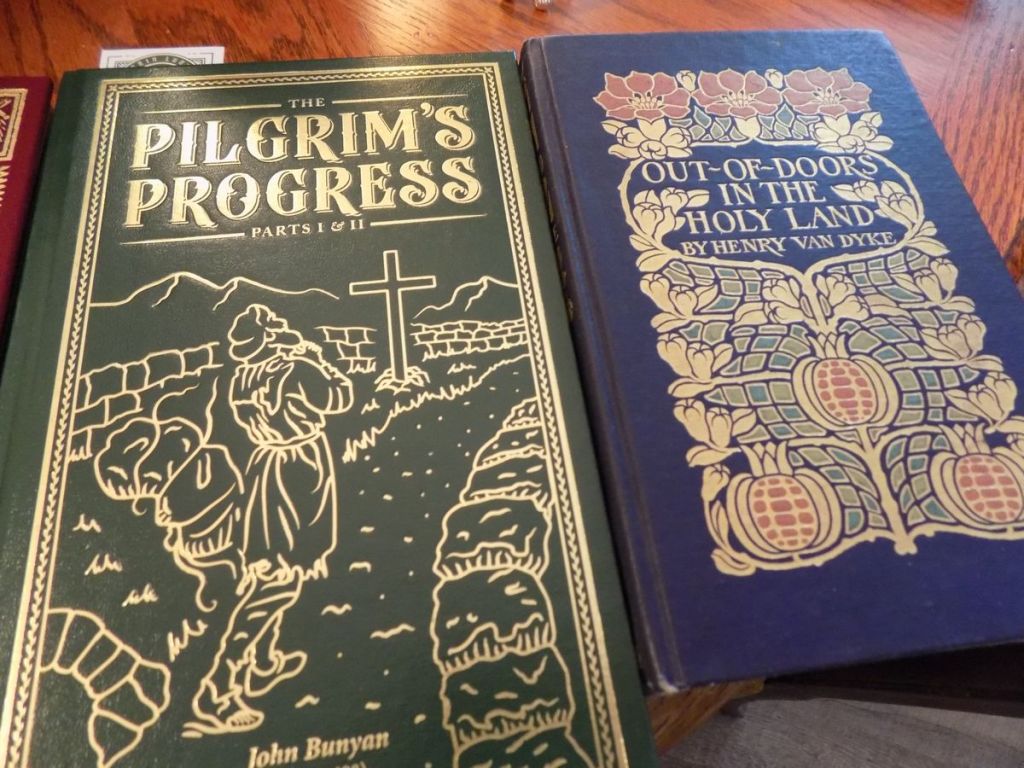
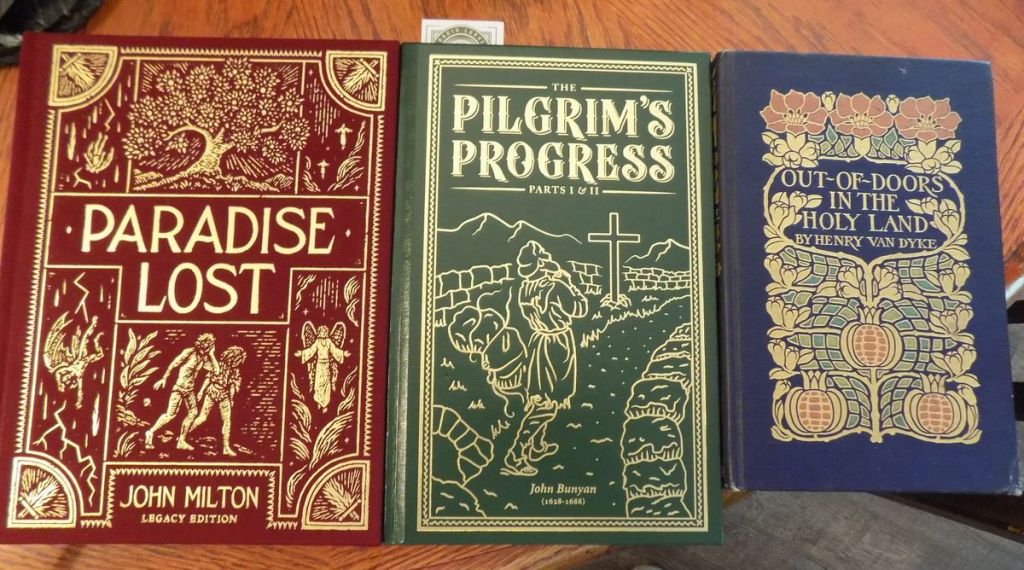
I mentioned I do judge a book by its cover. Here are two others I’ve recently acquired. The Pilgrim’s Progress was a free gift from Chapel Library, and the Van Dyke I bought myself. See what I mean? If I am going to own books, they might as well be beautiful. My other reading selection this summer is a re-read of Pilgrim’s Progress. I’ll also finish the Grisham I started, as well as Lady Audley’s Secret, Lord willing and the eyes don’t fail!
Happy reading and book-ing this summer! What is on your TBR list?
SYNOPSIS: Examining trends in Christian publishing, the article warns that bestselling breakout books often gain popularity through marketing and consumer demand rather than sound doctrine. Because false teaching can spread through widely read titles, believers should approach popular books cautiously, seek counsel, and practice discernment carefully.
This beginning part of my Advent series is a presentation of 11 verses overlaid on photos depicting the life of Jesus from prophecy to birth and boyhood. There are additional links at the end of each day’s topic leading the reader to credible ministries to further explore the topic of the day.
The next section (#12-16) will feature verses about the Son as an adult God-Man.
From #17-26 we will survey the Preeminence of the Son, His attributes, and His ministry.
From #27-36 we’ll look at His Resurrection, Ascension, & Return. Yes we go over 30 days into a postlude that ends before the new year.
All photos are by EPrata unless otherwise noted.
There is no better refreshment for the soul than to meditate on Him. Enjoy!
I will meditate on your precepts and fix my eyes on your ways. (Psalm 119:15).
Today’s verse: now that Jesus has been born, and the angels had announced His arrival to the Shepherds, who went to see with all haste this thing the angels had spoken of, now Jesus must flee. So we see from the first moments of His life, hatred against Jesus for who He is and what He has come to do. And so it will be for anyone IN Christ, as well. But His flight to Egypt did not happen before others made great efforts to come and see the Babe- namely the Magi from the East. It was their gift of gold which enabled the poverty-stricken Joseph and Mary to fund their flight to Egypt. God’s providence is perfect, and so is His timing.
This picture—at once austere and tender—belongs to a series of seven showing the life of Christ. The masterly depiction of the stable, which is viewed from slightly below, and the columnar solidity of the figures are typical of Giotto, the founder of European painting. The impetuous action of the kneeling king, who picks up the Christ Child, and Mary’s expression of concern translate the biblical account into deeply human terms. Though we know from scripture that the Magi did not arrive the night Jesus was born in the stable, but saw ‘the child’ likely at a house, the act depicted of the King from the East kneeling is representative of Jesus’ stature as King of Kings, even as a baby.
GotQuestions: What Does the Bible say about the Three Wise Men (Magi)? It is a common misconception that the wise men visited Jesus at the stable on the night of His birth. In fact, the wise men came days, months, or possibly even years later. That is why Matthew 2:11 says the wise men visited and worshiped Jesus in a house, not at the stable.
Answers in Genesis: We Three Kings The original meaning of mάgoi is likely in view here—wise men who interpreted special signs. There are at least three reasons for this identification. First, they acknowledged that they were interested in signs in the heavens.
Grace To You: Who Were the Wise Men? Vincent, who has written some very helpful word studies, says in regard to this, “Many absurd traditions and guesses respecting these visitors to our Lord’s cradle have found their way into popular belief and into Christian art. They were said to be kings and three in number. They were said to be representatives of three families of Shem, Ham, and Japheth and, therefore, one of them is pictured as an Ethiopian. Their names are given as Caspar, Balthazar, and Melchior.”
And on the seventh day God finished his work that he had done, and he rested on the seventh day from all his work that he had done. 3So God blessed the seventh day and made it holy, because on it God rested from all his work that he had done in creation. (Genesis 2:2-3).
I’m blessed to have a regular Monday-through-Friday work week, daytime hours. On Saturday I run around and do errands and cleaning and stuff that I’ve put off during the work week. So it’s like a 6th work day. Thus, when I get to Sunday, I’m tired. I go to church then I take a nap, and that is about all I do.
In 2009, I launched The End Time blog to share my journey of faith, transitioning from a personal blog focused on art to a platform for discussing theology and discernment. Inspired by my salvation, I write about biblical truths, encouraging readers to recognize the urgency of their earthly walk with Jesus.
SYNOPSIS Amy Carmichael was a dedicated missionary in India from 1895 to 1931, focusing on rescuing children from temple prostitution. She authored nearly 40 books and emphasized the concept of Calvary love, contrasting her sacrificial life with modern ministry approaches that prioritize comfort and doubt.
I discuss reading fiction as a Christian. Despite the notion that some people have that “God’s word is enough” and that other reading isn’t required, I and others argue that fiction enriches our understanding of human experience and offers valuable leisure. I share insights from Leland Ryken and Tony Reinke, urging people to consider the importance of good literature in a busy life.
I share my summer experiences as an educator enjoying time off to read, reflect, and engage with media. I experienced a lengthy internet outage that interrupted my studies and entertainment. I mention various books, focusing on their content and spiritual themes, while expressing gratitude for the opportunity to use my time wisely.