Posted in chile, good news, tsunami, wrath

Chile endures 8.3 quake, tsunami

Yesterday Chile was rocked by a large 8.3 earthquake. It is the first quake of this magnitude this year. Annually, the United States Geological Survey (USGS) expects about 1 quake per year in the 8.0-8.9 range. Many years, there are none in that range. In recent history, there has been a statistically remarkable year in which there were 4, something that had never happened in the years of USGS tracking (since 1912). That happened in 2007.

Chart by EPrata. Click to enlarge

Here are yesterday’s Chile quakes with large aftershocks the USGS has listed:

6.7 53km W of Illapel, Chile
6.5 54km S of Ovalle, Chile
6.4 64km NW of Illapel, Chile
7.0 25km W of Illapel, Chile
6.4 58km W of Illapel, Chile
8.3 46km W of Illapel, Chile

There were many other quakes of various lower than 6.0+ magnitudes, as you can see from this USGS map.

The quake sparked a tsunami warning. Tsunami waves hit the Chilean shores. The nationwide tsunami warning for Chile has since been lifted.

Chile quake triggers mass evacuation and tsunami alert

At least five people died when the 8.3-magnitude quake hit. Residents of Illapel, near the quake’s epicentre, fled into the streets in terror as their homes began to sway. In the coastal town of Coquimbo, waves of up to 4.5m (15ft) in height hit the shore. A tsunami alert was issued for the entire Chilean coast but has since been lifted. … The authorities were quick to issue tsunami alerts keen to avert a repeat of the slow response to the 8.8-magnitude quake in 2010, which devastated large areas of the country. More than 500 people died in the quake and the tsunami it triggered and memories of the tragedy are still raw. … Three people died of heart attacks and another two were crushed by falling rocks and masonry, officials said.

Many news articles went on to describe the panic and fear that overcame residents as the quake continues to make the buildings and the earth sway, roll, and jump. It gives a slight insight into the great fear and panic of what the Tribulation will be like, when quakes so large they bust out the USGS monitoring instruments, when people drop dead on the spot for fear of what is coming on the earth.

people fainting with fear and with foreboding of what is coming on the world. For the powers of the heavens will be shaken.
(Luke 21:26)

The Tribulation is a real period of time when God’s wrath will be unleashed in full force. His wrath rests restrained upon the condemned ungodly now, (John 3:18) but a day is coming when His wrath will be poured out.

But because of your hard and impenitent heart you are storing up wrath for yourself on the day of wrath when God’s righteous judgment will be revealed. (Romans 2:5)

We are living in a time where His grace reigns, and He is calling many to Himself. But the day will come when grace ends and wrath reigns, to show His holiness and His justice in a different way than restraint and love. It will be a day of blood and anger and terror.

I say these things to Christians because of the Christian culture that excessively focuses on love to the exclusion of the reality of wrath. But when we fail to remember the reality of the doom for the ungodly and His righteous anger to punish them, we only give half the story of the News. There is Bad News (wrath, sin, death, and hell) and there is the Good News (grace, repentance, salvation, and peace).

Earthquakes are always a reminder of Who is in charge of the earth and its inhabitants, and that while grace and love are poured out now, the day will come when things will change. Please witness with love but offer the entire News story to those who need it.

Posted in "The Menace of the Religious Movie", aw tozer, bible, discernment, second commandment

"The Menace of the Religious Movie" by AW Tozer

Sometime in the mid 1950s, AW Tozer wrote and preached on the topic of worship and entertainment. These works are sermon excerpts, essays and thoughts on the infiltration of entertainment into worship and also entertainment that is based on the Bible. These writings were eventually compiled into a book called On Worship and Entertainment. In 2007 at The Gospel Coalition, Trevin Wax wrote a review of On Worship and Entertainment. Wax’s review of the book is here.

One of the essays in the book is titled “The Menace of the Religious Movie.” Wax said in his review that the latter half of Tozer’s book is more critical than the first half, and some of Tozer’s ideas may be overstating things. As to that last point, Wax was referring to Tozer’s stance that all biblical acting is bad. I don’t mean bad as in poorly acted, but bad for the faith. Does that notion seem extreme?

I’d like to point out though that if I read it correctly, Tozer was objecting to the substitute of religious entertainment for sermons inside the house of God, not objecting to all movies in general, though he does take a dim view of religious movies in general. He makes this clear early in the essay.

Well, since Tozer wrote his essay about religious movies over 50 years ago, one wonders what Tozer would think now about entertainment in churches such as skits, comedies, “praise dancing” by women in leotards, contemporary music with smoke machines, and the spate of religious movies produced since his day. Perhaps a zero-tolerance, negative view would have saved us from the excesses and distorted faith presented in movies like 90 Minutes in Heaven, Heaven is for Real, The Bible, and many others.

Personally, I have often wondered about the legitimacy of an actor playing Jesus. How daring! How potentially blasphemous! Can a mere man be a copy of the Divine Godhead? Is it good to have a man be an actor which is a copy, acting as a copy of Jesus who was an exact copy of God (Hebrews 1:3) speaking His words a copy of a copy of a copy… Can this be a good thing? What of the Second Commandment, Exodus 20:2,

“You shall not make for yourself a carved image, or any likeness of anything that is in heaven above, or that is in the earth beneath, or that is in the water under the earth.” [emphasis mine]

I’d said in my review of the Kendrick Brothers movie “War Room” that I object to God’s word being made into entertainment and worse, I hate the merchandising of it. At least secular movies don’t pretend to honor God. They are what they are. Religious movies aren’t what they are. I totally agree with all the ideas in his essay. I especially agree with Tozer’s point #2 and point #7.

These things are worth pondering. In any case, here is Tozer’s essay on the ‘menace of the religious movie’. It’s a long essay but worth it. Decide for yourself if Tozer was right to feel as he did. And then I challenge you to come to terms with your own entertainment watching- and define what you call entertainment.

The Menace of the Religious Movie

By A. W. Tozer (1897-1963)

When God gave to Moses the blueprint of the Tabernacle He was careful to include every detail; then, lest Moses should get the notion that he could improve on the original plan, God warned him solemnly, “And look that thou make them after their pattern, which was shown thee in the mount.” God, not Moses, was the architect. To decide the plan was the prerogative of the Deity. No one dare alter it so much as a hairbreadth.

The New Testament Church also is built after a pattern. Not the doctrines only but the methods are divinely given. The doctrines are expressly stated in so many words. Some of the methods followed by the early New Testament Church had been given by direct command; others were used by God’s specific approval, having obviously been commanded the apostles by the Spirit. The point is that when the New Testament canon was closed the blueprint for the age was complete. God has added nothing since that time.

From God’s revealed plan we depart at our peril. Every departure has two consequences, the immediate and the remote. The immediate touches the individual and those close to him; the remote extends into the future to unknown times, and may expand so far as to influence for evil the whole Church of God on earth.

The temptation to introduce “new” things into the work of God has always been too strong for some people to resist. The Church has suffered untold injury at the hands of well intentioned but misguided persons who have felt that they know more about running God’s work than Christ and His apostles did. A solid train of box cars would not suffice to haul away the religious truck which has been brought into the service of the Church with the hope of improving on the original pattern. These things have been, one and all, positive hindrances to the progress of the Truth, and have so altered the divinely-planned structure that the apostles, were they to return to earth today, would scarcely recognize the misshapen thing which has resulted.

Our Lord while on earth cleansed the Temple, and periodic cleansings have been necessary in the Church of God throughout the centuries. Every generation is sure to have its ambitious amateur to come up with some shiny gadget which he proceeds to urge upon the priests before the altar. That the Scriptures do not justify its existence does not seem to bother him at all. It is brought in anyway and presented in the very name of Orthodoxy. Soon it is identified in the minds of the Christian public with all that is good and holy. Then, of course, to attack the gadget is to attack the Truth itself. This is an old familiar technique so often and so long practiced by the devotees of error that I marvel how the children of God can be taken in by it.

We of the evangelical faith are in the rather awkward position of criticizing Roman Catholicism for its weight of unscriptural impedimenta and at the same time tolerating in our own churches a world of religious fribble as bad as holy water or the elevated host. Heresy of method may be as deadly as heresy of message. Old-line Protestantism has long ago been smothered to death by extra-scriptural rubbish. Unless we of the gospel churches wake up soon we shall most surely die by the same means.

Within the last few years a new method has been invented for imparting spiritual knowledge; or, to be more accurate, it is not new at all, but is an adaptation of a gadget of some years standing, one which by its origin and background belongs not to the Church but to the world. Some within the fold of the Church have thrown their mantle over it, have “blessed it with a text” and are now trying to show that it is the very gift of God for our day. But, however eloquent the sales talk, it is an unauthorized addition nevertheless, and was never a part of the pattern shown us on the mount.

I refer, of course, to the religious movie.

For the motion picture as such I have no irrational allergy. It is a mechanical invention merely and is in its essence amoral; that is, it is neither good nor bad, but neutral. With any physical object or any creature lacking the power of choice it could not be otherwise. Whether such an object is useful or harmful depends altogether upon who uses it and what he uses it for. No moral quality attaches where there is no free choice. Sin and righteousness lie in the will. The motion picture is in the same class as the automobile, the typewriter, or the radio: a powerful instrument for good or evil, depending upon how it is applied.

For teaching the facts of physical science the motion picture has been useful. The public schools have used it successfully to teach health habits to children. The army employed it to speed up instruction during the war. That it has been of real service within its limited field is freely acknowledged here.

Over against this is the fact that the motion picture in evil hands has been a source of moral corruption to millions. No one who values his reputation as a responsible adult will deny that the sex movie and the crime movie have done untold injury to the lives of countless young people in our generation. The harm lies not in the instrument itself, but in the evil will of those who use it for their own selfish ends.

I am convinced that the modern religious movie is an example of the harmful misuse of a neutral instrument. There are sound reasons for my belief. I am prepared to state them.

That I may be as clear as possible, let me explain what I do and do not mean by the religious movie. I do not mean the missionary picture nor the travel picture which aims to focus attention upon one or another section of the world’s great harvest field. These do not come under consideration here.

By the religious movie I mean that type of motion picture which attempts to treat spiritual themes by dramatic representation. These are (as their advocates dare not deny) frank imitations of the authentic Hollywood variety, but the truth requires me to say that they are infinitely below their models, being mostly awkward, amateurish and, from an artistic standpoint, hopelessly and piteously bad.

These pictures are produced by acting a religious story before the camera. Take for example the famous and beautiful story of the Prodigal Son. This would be made into a movie by treating the narrative as a scenario. Stage scenery would be set up, actors would take the roles of Father, Prodigal Son, Elder Brother, etc. There would be plot, sequence and dramatic denouement as in the ordinary tear jerker shown at the Bijou movie house on Main Street in any one of a thousand American towns. The story would be acted out, photographed, run onto reels and shipped around the country to be shown for a few wherever desired.

The “service” where such a movie would be shown might seem much like any other service until time for the message from the Word of God. Then the lights would be put out and the picture turned on. The “message” would consist of this movie. What followed the picture would, of course, vary with the circumstances, but often an invitation song is sung and a tender appeal is made for erring sinners to return to God.

Now, what is wrong with all this? Why should any man object to this or go out of his way to oppose its use in the house of God? Here is my answer:

1. It violates the scriptural law of hearing.

The power of speech is a noble gift of God. In his ability to open his mouth and by means of words make his fellows know what is going on inside his mind, a man shares one of the prerogatives of the Creator. In its ability to understand the spoken word the human mind rises unique above all the lower creation. The gift which enables a man to translate abstract ideas into sounds is a badge of his honor as made in the image of God.

Written or printed words are sound symbols and are translated by the mind into hearing.

Hieroglyphics and ideograms were, in effect, not pictures but letters, and the letters were agreed-upon marks which stood for agreed-upon ideas. Thus words, whether spoken or written, are a medium for the communication of ideas. This is basic in human nature and stems from our divine origin.

It is significant that when God gave to mankind His great redemptive revelation He couched it in words. “And God spake all these words” very well sums up the Bible’s own account of how it got here. “Thus saith the Lord” is the constant refrain of the prophets. “The words that I speak unto you, they are spirit, and they are life,” said our Lord to His hearers. Again He said, “He that heareth my word, and believeth on him that sent me, hath everlasting life.” Paul made words and faith to be inseparable: “Faith cometh by hearing, and hearing by the word of God.” And he also said, “How shall they hear without a preacher?” (Romans 10:14)

Surely it requires no genius to see that the Bible rules out pictures and dramatics as media for bringing faith and life to the human soul.

The plain fact is that no vital spiritual truth can be expressed by a picture. Actually all any picture can do is to recall to mind some truth already learned through the familiar medium of the spoken or written word. Religious instruction and words are bound together by a living cord and cannot be separated without fatal loss. The Spirit Himself, teaching soundlessly within the heart, makes use of ideas previously received into the mind by means of words.

If I am reminded that modern religious movies are “sound” pictures, making use of the human voice to augment the dramatic action, the answer is easy. Just as far as the movie depends upon spoken words it makes pictures unnecessary; the picture is the very thing that differentiates between the movie and the sermon. The movie addresses its message primarily to the eye, and the ear only incidentally. Were the message addressed to the ear as in the Scriptures, the picture would have no meaning and could be omitted without loss to the intended effect. Words can say all that God intends them to say, and this they can do without the aid of pictures.

According to one popular theory the mind receives through the eye five times as much information as the ear. As far as the external shell of physical facts is concerned this may hold good, but when we come to spiritual truth we are in another world entirely. In that world the outer eye is not too important. God addresses His message to the hearing ear. “We look,” says Paul, “not at the things which are seen, but at the things which are not seen: for the things which are seen are temporal; but the things which are not seen are eternal” (2 Corinthians 4:18). This agrees with the whole burden of the Bible, which teaches us that we should withdraw our eyes from beholding visible things, and fasten the eyes of our hearts upon God while we reverently listen to His uttered words.

“The word is nigh thee, even in thy mouth, and in thy heart: that is, the word of faith, which we preach” (Romans 10:8). Here, and not somewhere else, is the New Testament pattern, and no human being, and no angel from heaven has any right to alter that pattern.

2. The religious movie embodies the mischievous notion that religion is, or can be made, a form of entertainment.

This notion has come upon us lately like a tidal wave and is either openly taught or tacitly assumed by increasing numbers of people. Since it is inextricably bound up with the subject under discussion I had better say more about it.

The idea that religion should be entertaining has made some radical changes in the evangelical picture within this generation. It has given us not only the “gospel” movie but a new type of religious journalism as well. It has created a new kind of magazine for church people, which can be read from cover to cover without effort, without thought–and without profit. It has also brought a veritable flood of religious fiction with plastic heroines and bloodless heroes like no one who has ever lived upon this well known terrestrial ball.

That religion and amusement are forever opposed to each other by their very essential natures is apparently not known to this new school of religious entertainers. Their effort to slip up on the reader and administer a quick shot of saving truth while his mind is on something else is not only futile, it is, in fact, not too far short of being plain dishonest. The hope that they can convert a man while he is occupied with the doings of some imaginary hero reminds one of the story of the Catholic missionary who used to sneak up on sick people and children and splash a little holy water on them to guarantee their passage to the city of gold.

I believe that most responsible religious teachers will agree that any effort to teach spiritual truth through entertainment is at best futile and at worst positively injurious to the soul. But entertainment pays off, and the economic consideration is always a powerful one in deciding what shall and what shall not be offered to the public–even in the churches.

Deep spiritual experiences come only from much study, earnest prayer and long meditation. It is true that men by thinking cannot find God; it is also true that men cannot know God very well without a lot of reverent thinking. Religious movies, by appealing directly to the shallowest stratum of our minds, cannot but create bad mental habits which unfit the soul for the reception of genuine spiritual impressions.

Religious movies are mistakenly thought by some people to be blessed of the Lord because many come away from them with moist eyes. If this is a proof of God’s blessing, then we might as well go the whole way and assert that every show that brings tears is of God. Those who attend the theater know how often the audiences are moved to tears by the joys and sorrows of the highly paid entertainers who kiss and emote and murder and die for the purpose of exciting the spectators to a high pitch of emotional excitement. Men and women who are dedicated to sin and appointed to death may nevertheless weep in sympathy for the painted actors and be not one bit the better for it. The emotions have had a beautiful time, but the will is left untouched. The religious movie is sure to draw together a goodly number of persons who cannot distinguish the twinges of vicarious sympathy from the true operations of the Holy Ghost.

3. The religious movie is a menace to true religion because it embodies acting, a violation of sincerity.

Without doubt the most precious thing any man possesses is his individuated being; that by which he is himself and not someone else; that which cannot be finally voided by the man himself nor shared with another. Each one of us, however humble our place in the social scheme, is unique in creation. Each is a new whole man possessing his own separate “I-ness” which makes him forever something apart, an individual human being. It is this quality of uniqueness which permits a man to enjoy every reward of virtue and makes him responsible for every sin. It is his selfness, which will persist forever, and which distinguishes him from every creature which has been or ever will be created.

Because man is such a being as this all moral teachers, and especially Christ and His apostles, make sincerity to be basic in the good life. The word, as the New Testament uses it, refers to the practice of holding fine pottery up to the sun to test it for purity. In the white light of the sun all foreign substances were instantly exposed. So the test of sincerity is basic in human character. The sincere man is one in whom is found nothing foreign; he is all of one piece; he has preserved his individuality unviolated.

Sincerity for each man means staying in character with himself. Christ’s controversy with the Pharisees centered around their incurable habit of moral play acting. The Pharisee constantly pretended to be what he was not. He attempted to vacate his own “I-ness” and appear in that of another and better man. He assumed a false character and played it for effect. Christ said he was a hypocrite.

It is more than an etymological accident that the word “hypocrite” comes from the stage. It means actor. With that instinct for fitness which usually marks word origins, it has been used to signify one who has violated his sincerity and is playing a false part. An actor is one who assumes a character other than his own and plays it for effect. The more fully he can become possessed by another personality the better he is as an actor.

Bacon has said something to the effect that there are some professions of such nature that the more skillfully a man can work at them the worse man he is. That perfectly describes the profession of acting. Stepping out of our own character for any reason is always dangerous, and may be fatal to the soul. However innocent his intentions, a man who assumes a false character has betrayed his own soul and has deeply injured something sacred within him.

No one who has been in the presence of the Most Holy One, who has felt how high is the solemn privilege of bearing His image, will ever again consent to play a part or to trifle with that most sacred thing, his own deep sincere heart. He will thereafter be constrained to be no one but himself, to preserve reverently the sincerity of his own soul.

In order to produce a religious movie someone must, for the time, disguise his individuality and simulate that of another. His actions must be judged fraudulent, and those who watch them with approval share in the fraud. To pretend to pray, to simulate godly sorrow, to play at worship before the camera for effect–how utterly shocking to the reverent heart! How can Christians who approve this gross pretense ever understand the value of sincerity as taught by our Lord? What will be the end of a generation of Christians fed on such a diet of deception disguised as the faith of our fathers?

The plea that all this must be good because it is done for the glory of God is a gossamer-thin bit of rationalizing which should not fool anyone above the mental age of six. Such an argument parallels the evil rule of expediency which holds the end is everything, and sanctifies the means, however evil, if only the end be commendable. The wise student of history will recognize this immoral doctrine. The Spirit-led Church will have no part of it.

It is not uncommon to find around the theater human flotsam and jetsam washed up by the years, men and women who have played false parts so long that the power to be sincere has forever gone from them. They are doomed to everlasting duplicity. Every act of their lives is faked, every smile is false, every tone of their voice artificial. The curse does not come causeless. It is not by chance that the actor’s profession has been notoriously dissolute. Hollywood and Broadway are two sources of corruption which may yet turn America into a Sodom and lay her glory in the dust.

The profession of acting did not originate with the Hebrews. It is not a part of the divine pattern. The Bible mentions it, but never approves it. Drama, as it has come down to us, had its rise in Greece. It was originally a part of the worship of the god Dionysus and was carried on with drunken revelry.

The Miracle Plays of medieval times have been brought forward to justify the modern religious movie. That is an unfortunate weapon to choose for the defense of the movie, for it will surely harm the man who uses it more than any argument I could think of just offhand.

The Miracle Plays had their big run in the Middle Ages. They were dramatic performances with religious themes staged for the entertainment of the populace. At their best they were misguided efforts to teach spiritual truths by dramatic representation; at their worst they were shockingly irreverent and thoroughly reprehensible. In some of them the Eternal God was portrayed as an old man dressed in white with a gilt wig! To furnish low comedy, the devil himself was introduced on the stage and allowed to cavort for the amusement of the spectators. Bible themes were used, as in the modern movie, but this did not save the whole thing from becoming so corrupt that the Roman Church had finally to prohibit its priests from having any further part in it.

Those who would appeal for precedent to the Miracle Plays have certainly overlooked some important facts. For instance, the vogue of the Miracle Play coincided exactly with the most dismally corrupt period the Church has ever known. When the Church emerged at last from its long moral night these plays lost popularity and finally passed away. And be it remembered, the instrument God used to bring the Church out of the darkness was not drama; it was the biblical one of Spirit-baptized preaching. Serious-minded men thundered the truth and the people turned to God.

Indeed, history will show that no spiritual advance, no revival, no upsurge of spiritual life has ever been associated with acting in any form. The Holy Spirit never honors pretense.

Can it be that the historic pattern is being repeated? That the appearance of the religious movie is symptomatic of the low state of spiritual health we are in today? I fear so. Only the absence of the Holy Spirit from the pulpit and lack of true discernment on the part of professing Christians can account for the spread of religious drama among so-called evangelical churches. A Spirit-filled church could not tolerate it.

4. They who present the gospel movie owe it to the public to give biblical authority for their act: and this they have not done.

The Church, as long as it is following the Lord, goes along in Bible ways and can give a scriptural reason for its conduct. Its members meet at stated times to pray together: This has biblical authority back of it. They gather to hear the Word of God expounded: this goes back in almost unbroken continuity to Moses. They sing psalms and hymns and spiritual songs: so they are commanded by the apostle. They visit the sick and relieve the sufferings of the poor: for this they have both precept and example in Holy Writ. They lay up their gifts and bring them at stated times to the church or chapel to be used in the Lord’s work: this also follows the scriptural pattern. They teach and train and instruct; they appoint teachers and pastors and missionaries and send them out to do the work for which the Spirit has gifted them: all this has plain scriptural authority behind it. They baptize, then break bread and witness to the lost; they cling together through thick and thin; they bear each other’s burdens and share each other’s sorrows: this is as it should be, and for all this there is full authority.

Now, for the religious movie where is the authority? For such a serious departure from the ancient pattern, where is the authority? For introducing into the Church the pagan art of acting, where is the authority? Let the movie advocates quote just one verse, from any book of the Bible, in any translation, to justify its use. This they cannot do. The best they can do is to appeal to the world’s psychology or repeat brightly that “modern times call for modern methods.” But the Scriptures–quote from them one verse to authorize movie acting as an instrument of the Holy Ghost. This they cannot do.

Every sincere Christian must find scriptural authority for the religious movie or reject it, and every producer of such movies, if he would square himself before the faces of honest and reverent men, must either show scriptural credentials or go out of business.

But, says someone, there is nothing unscriptural about the religious movie; it is merely a new medium for the utterance of the old message, as printing is a newer and better method of writing and the radio an amplification of familiar human speech.

To this I reply: The movie is not the modernization or improvement of any scriptural method; rather it is a medium in itself wholly foreign to the Bible and altogether unauthorized therein. It is play acting—just that, and nothing more. It is the introduction into the work of God of that which is not neutral, but entirely bad. The printing press is neutral; so is the radio; so is the camera. They may be used for good or bad purposes at the will of the user. But play acting is bad in its essence in that it involves the simulation of emotions not actually felt. It embodies a gross moral contradiction in that it calls a lie to the service of truth.

Arguments for the religious movie are sometimes clever and always shallow, but there is never any real attempt to cite scriptural authority. Anything that can be said for the movie can be said also for aesthetic dancing, which is a highly touted medium for teaching religious truth by appeal to the eye. Its advocates grow eloquent in its praise–but where is it indicated in the blueprint?

5. God has ordained four methods only by which Truth shall prevail—and the religious movie is not one of them.

Without attempting to arrange these methods in order of importance, they are (1) prayer, (2) song, (3) proclamation of the message by means of words, and (4) good works. These are the four main methods which God has blessed. All other biblical methods are subdivisions of these and stay within their framework.

Notice these in order:

(1) Spirit-burdened prayer. This has been through the centuries a powerful agent for the spread of saving truth among men. A praying Church carried the message of the cross to the whole known world within two centuries after the coming of the Holy Spirit at Pentecost. Read the book of Acts and see what prayer has done and can do when it is made in true faith.

(2) Spirit-inspired song has been another mighty instrument in the spread of the Word among mankind. When the Church sings in the Spirit she draws men unto Christ. Where her song has been ecstatic expression of resurrection joy, it has acted wonderfully to prepare hearts for the saving message. This has no reference to professional religious singers, expensive choirs nor the popular “gospel” chorus. These for the time we leave out of consideration. But I think no one will deny that the sound of a Christian hymn sung by sincere and humble persons can have a tremendous and permanent effect for good. The Welsh revival is a fair modern example of this.

(3) In the Old Testament, as well as in the New, when God would impart His mind to men He embodied it in a message and sent men out to proclaim it. This was done by means of speaking and writing on the part of the messenger. It was received by hearing and reading on the part of those to whom it was sent. We are all familiar with the verse, “Speak ye comfortably to Jerusalem, and cry unto her” (Isaiah 40:2). John the Baptist was called “The voice of one crying in the wilderness” (Matthew 3:3). Again we have, “And I heard a voice from heaven saying unto me, Write” (Revelation 14:13). And the Apostle John opens his great work called the Revelation by pronouncing a blessing upon him that readeth and them that bear and keep the words of the prophecy and the things which are written therein. The two words “proclaim” and “publish” sum up God’s will as it touches His Word. In the Bible, men for the most part wrote what had been spoken; in our time men are commissioned to speak what has been written. In both cases the agent is a word, never a picture, a dance or a pageant.
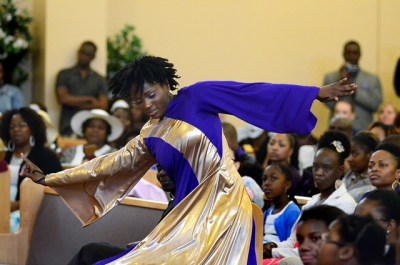
Rasheena Vail of the Highest Praise Dance Team from Renton’s Preach the
Word Christian Center danced to “Don’t Cry” at the 6th annual
Praise Dance Showcase April 27 at JBLM Lewis North Chapel. CC. source

(4) By His healing deeds our Lord opened the way for His saving Words. He went about doing good, and His Church is commanded to do the same. Faber understood this when he wrote:

“And preach thee too, as love knows how
By kindly deeds and virtuous life.”

Church history is replete with instances of missionaries and teachers who prepared the way for their message with deeds of mercy shown to men and women who were at first hostile but who melted under the warm rays of practical kindnesses shown to them in time of need. If anyone should object to calling good works a method, I would not argue the point. Perhaps it would be more accurate to say that they are an overflow into everyday life of the reality of what is being proclaimed.

These are God’s appointed methods, set forth in the Bible and confirmed in centuries of practical application. The intrusion of other methods is unscriptural, unwarranted and in violation of spiritual laws as old as the world.

The whole preach-the gospel-with-movies idea is founded upon the same basic assumptions as modernism–namely, that the Word of God is not final, and that we of this day have a perfect right to add to it or alter it wherever we think we can improve it.

Q. Was anything else left out of the [Son of God Movie by Roma Downey] movie that could have stirred up controversy? Yes. The film omits certain parts of the Bible that could have sparked more Bible miniseries/Son of God controversy. Son of God v. Bible

A brazen example of this attitude came to my attention recently. Preliminary printed matter has been sent out announcing that a new organization is in process of being formed. It is to be called the “International Radio and Screen Artists Guild,” and one of its two major objectives is to promote the movie as a medium for the spread of the gospel. Its sponsors, apparently, are not Modernists, but confessed Fundamentalists. Some of its declared purposes are: to produce movies “with or without a Christian slant”; to raise and maintain higher standards in the movie field (this would be done, it says here, by having “much prayer” with leaders of the movie industry); to “challenge people, especially young people, to those fields as they are challenged to go to foreign fields.”

This last point should not be allowed to pass without some of us doing a little challenging on our own account. Does this new organization actually propose in seriousness to add another gift to the gifts of the Spirit listed in the New Testament? To the number of the Spirit’s gifts, such as pastor, teacher, evangelist, is there now to be added another, the gift of the movie actor? To the appeal for consecrated Christian young people to serve as missionaries on the foreign field is there to be added an appeal for young people to serve as movie actors?

[Ed. Note: actors… or Producers such as the Kendricks of Fireproof, Courageous and War Room who quit being pastors to make movies?]

That is exactly what this new organization does propose in cold type over the signature of its temporary chairman. Instead of the Holy Spirit saying, “Separate me Barnabas and Saul for the work whereunto I have called them” (Acts 13:2), these people will make use of what they call a “Christian talent listing,” to consist of the names of “Christian” actors who have received the Spirit’s gift to be used in making religious movies.

Thus the order set up in the New Testament is openly violated, and by professed lovers of the gospel who say unto Jesus, “Lord, Lord,” but openly set aside His Lordship whenever they desire. No amount of smooth talk can explain away this serious act of insubordination.

Saul lost a kingdom when he “forced” himself and took profane liberties with the priesthood. Let these movie preachers look to their crown. They may find themselves on the road to En-dor some dark night soon.

6. The religious movie is out of harmony with the whole spirit of the Scriptures and contrary to the mood of true godliness.

To harmonize the spirit of the religious movie with the spirit of the Sacred Scriptures is impossible. Any comparison is grotesque and, if it were not so serious, would be downright funny. To imagine Elijah appearing before Ahab with a roll of film! Imagine Peter standing up at Pentecost and saying, “Let’s have the lights out, please.” When Jeremiah hesitated to prophesy, on the plea that he was not a fluent speaker, God touched his mouth and said, “I have put my words in thy mouth.” Perhaps Jeremiah could have gotten on well enough without the divine touch if he had had a good 16mm projector and a reel of home-talent film.

Let a man dare to compare his religious movie show with the spirit of the Book of Acts. Let him try to find a place for it in the twelfth chapter of First Corinthians. Let him set it beside Savonarola’s passionate preaching or Luther’s thundering or Wesley’s heavenly sermons or Edwards’ awful appeals. If he cannot see the difference in kind, then he is too blind to be trusted with leadership in the Church of the Living God. The only thing that he can do appropriate to the circumstances is to drop to his knees and cry with poor Bartimaeus, “Lord, that I might receive my sight.”

But some say, “We do not propose to displace the regular method of preaching the gospel. We only want to supplement it.” To this I answer: If the movie is needed to supplement anointed preaching it can only be because God’s appointed method is inadequate and the movie can do something which God’s appointed method cannot do. What is that thing? We freely grant that the movie can produce effects which preaching cannot produce (and which it should never try to produce), but dare we strive for such effects in the light of God’s revealed will and in the face of the judgment and a long eternity?

7. I am against the religious movie because of the harmful effect upon everyone associated with it.

First, the evil effect upon the “actors” who play the part of the various characters in the show; this is not the less because it is unsuspected. Who can, while in a state of fellowship with God, dare to play at being a prophet? Who has the gall to pretend to be an apostle, even in a show? Where is his reverence? Where is his fear? Where is his humility? Any one who can bring himself to act a part for any purpose, must first have grieved the Spirit and silenced His voice within the heart. Then the whole business will appear good to him. “He feedeth on ashes; a deceived heart has turned him aside” (Isaiah 44:20). But he cannot escape the secret working of the ancient laws of the soul. Something high and fine and grand will die within him; and worst of all he will never suspect it. That is the curse that follows self-injury always. The Pharisees were examples of this. They were walking dead men, and they never dreamed how dead they were.

Secondly, it identifies religion with the theatrical world. I have seen recently in a fundamentalist magazine an advertisement of a religious film which would be altogether at home on the theatrical page on any city newspaper. Illustrated with the usual sex-bate picture of a young man and young woman in tender embrace, and spangled with such words as “feature-length, drama, pathos, romance,” it reeked of Hollywood and the cheap movie house. By such business we are selling out our Christian separation, and nothing but grief can come of it late or soon.

Thirdly, the taste for drama which these pictures develop in the minds of the young will not long remain satisfied with the inferior stuff the religious movie can offer. Our young people will demand the real thing; and what can we reply when they ask why they should not patronize the regular movie house?

Fourthly, the rising generation will naturally come to look upon religion as another, and inferior, form of amusement. In fact, the present generation Yahwist has done this to an alarming extent already, and the gospel movie feeds the notion by fusing religion and fun in the name of orthodoxy. It takes no great insight to see that the religious movie must become increasingly more thrilling as the tastes of the spectators become more and more stimulated.

Fifthly, the religious movie is the lazy preacher’s friend. If the present vogue continues to spread it will not be long before any man with enough ability to make an audible prayer, and mentality enough to focus a projector, will be able to pass for a prophet of the Most High God. The man of God can play around all week long and come up to the Lord’s Day without a care. Everything has been done for him at the studio. He has only to set up the screen and lower the lights, and the rest follows painlessly.

Wherever the movie is used the prophet is displaced by the projector. The least that such displaced prophets can do is to admit that they are technicians and not preachers. Let them admit that they are not God-sent men, ordained of God for a sacred work. Let them put away their pretense.

Allowing that there may be some who have been truly called and gifted of God but who have allowed themselves to be taken in by this new plaything, the danger to such is still great. As long as they can fall back upon the movie, the pressure that makes preachers will be wanting. The habit and rhythm which belong to great preaching will be missing from their ministry. However great their natural gifts, however real their enduement of power, still they will never rise. They cannot while this broken reed lies close at hand to aid them in the crisis. The movie will doom them to be ordinary.

In conclusion

One thing may bother some earnest souls: why so many good people approve the religious movie. The list of those who are enthusiastic about it includes many who cannot be written off as borderline Christians. If it is an evil, why have not these denounced it?

The answer is, lack of spiritual discernment. Many who are turning to the movie are the same who have, by direct teaching or by neglect, discredited the work of the Holy Spirit. They have apologized for the Spirit and so hedged Him in by their unbelief that it has amounted to an out-and-out repudiation. Now we are paying the price for our folly. The light has gone out and good men are forced to stumble around in the darkness of the human intellect.

The religious movie is at present undergoing a period of gestation and seems about to swarm over the churches like a cloud of locusts out of the earth. The figure is accurate; they are coming from below, not from above. The whole modern psychology has been prepared for this invasion of insects. The fundamentalists have become weary of manna and are longing for red flesh. What they are getting is a sorry substitute for the lusty and uninhibited pleasures of the world, but I suppose it is better than nothing, and it saves face by pretending to be spiritual.

Let us not for the sake of peace keep still while men without spiritual insight dictate the diet upon which God’s children shall feed. I heard the president of a Christian college say some time ago that the Church is suffering from an “epidemic of amateurism.” That remark is sadly true, and the religious movie represents amateurism gone wild. Unity among professing Christians is to be desired, but not at the expense of righteousness. It is good to go with the flock, but I for one refuse mutely to follow a misled flock over a precipice.

If God has given wisdom to see the error of religious shows we owe it to the Church to oppose them openly. We dare not take refuge in “guilty silence.” Error is not silent; it is highly vocal and amazingly aggressive. We dare not be less so. But let us take heart: there are still many thousands of Christian people who grieve to see the world take over. If we draw the line and call attention to it we may be surprised how many people will come over on our side and help us drive from the Church this latest invader, the spirit of Hollywood.

Posted in church age, jesus, millennial kingdom, prophecy, rapture

What is ‘heaven’? Is it the Millennial Kingdom?

Sunday, I began a series looking at what the Bible says is heaven. There is more to is than just saying “if we’re redeemed we’re going to heaven.” Heaven is a term used synonymously for God. There is Paradise, where Jesus went between His death and resurrection (most likely). There’s the present heaven containing the redeemed souls. There will be a Millennium Kingdom. And then there will be the new heaven/eternity after the chapter of human history concludes. So let’s take a look at this wonderful, complex, eternal, real place called HEAVEN.

Previously I examined the terms “Abraham’s Bosom”, and Paradise. Today, let’s look at the Millennium Kingdom.

When we think of “heaven” we often think of the peaceable kingdom spoken of in Isaiah and depicted in Edward Hicks’ 62 versions of the Peaceable Kingdom paintings of the early 1830s.

Hicks’ series of images are based on Isaiah 11:6-8 and Isaiah 65:25. Here in the first line we see the correct part of the verse, commonly mis-spoken as “the lion shall lay down with the lamb”.

And the wolf will dwell with the lamb,
And the leopard will lie down with the young goat,
And the calf and the young lion and the fatling together;
And a little boy will lead them.
7Also the cow and the bear will graze,
Their young will lie down together,
And the lion will eat straw like the ox.

8The nursing child will play by the hole of the cobra,
And the weaned child will put his hand on the viper’s den.

9They will not hurt or destroy in all My holy mountain,
For the earth will be full of the knowledge of the LORD
As the waters cover the sea. (Isaiah 11:6-9)

The wolf and the lamb shall graze together; the lion shall eat straw like the ox, and dust shall be the serpent’s food. They shall not hurt or destroy in all my holy mountain,” says the LORD. (Isaiah 65:25)

But even though all seems idyllic, this is not heaven. It is not even the new earth spoken of in 2 Peter 3:13.

Here is an overview of Bible history from the Days of His Flesh to future eternity. We are in the church age at present. These illustrations are from a pamphlet by Fred Overton Seminars. Click to enlarge.

The wolf shall lie down with the lamb during the Kingdom Age, which shall last for 1000 years. This is why it’s called “The Millennium Kingdom”, due to its prophesied length of time.

You see by the chart that we are in the Church Age. At some point, when the final elect soul will be redeemed, filling the quota Jesus has set for filling His church (Romans 11:25), we will be raptured. The trumpet will sound, and we who are living will fly upward and our bodies will be glorified instantly. The souls of the dead who died during the Church Age will also be resurrected and installed into a reconstituted glorified body and together we will meet Jesus in the air. It all hapens in the blink of an eye. This is described in 1 Thessalonians 4:15-17 and 1 Corinthians 15:51-52.

The Lord removes His Bride via the “catching up” because after that He will unleash His stored-up wrath onto an unbelieving world. The 7-year Tribulation will begin. The Bride is not appointed to wrath, so we are removed. (1 Thessalonians 5:9; Revelation 3:10).

[Note to readers- I do not plan to debate the pretribulation rapture in the comments section. The pretribulation rapture is a biblical concept and can be learned of in many different studies here, here, here, here, here, here, here, here, and here for starters!)

Of the Tribulation, Jesus said it will be the worst time on earth human flesh has ever known. (Matthew 24:21-22). This should give one pause, because He already has sent a worldwide judgment in the form of the Flood to drown everything with the breath of life, including almost all of humanity (except for Noah’s family aboard the Ark.) So the Tribulation will be worse.

Yet for all the horror predicted to befall the unbelieving world, many people will be redeemed and come to faith in Jesus during this Great Tribulation. Many of those will not die during the judgments, and when Jesus returns in the Second Coming, they will enter alive into the Kingdom Jesus will set up for 1000 years.

During the Tribulation, massive earth changes occur. This is actually UNcreation, or a reversal back to the original state of the earth prior to the Fall of Man during Adam and Eve’s time. The Flood reshaped the earth’s form. (Psalm 104:6-9). During the Tribulation, Mountains are flattened, islands flee away (Revelation 6:12-14). Great earthquakes occur, sending the earth back to its original shape and form. Think of the Tribulation as a renovation of the earth, or a re-shaping.

During the Millennium Kingdom period, earth is renovated, but not perfected.

  • Every valley shall be lifted up, and every mountain and hill be made low; the uneven ground shall become level, and the rough places a plain. (Isaiah 40:4)
  • The fish of the sea and the birds of the heavens and the beasts of the field and all creeping things that creep on the ground, and all the people who are on the face of the earth, shall quake at my presence. And the mountains shall be thrown down, and the cliffs shall fall, and every wall shall tumble to the ground. (Ezekiel 38:20)
  • The mountains quake before him; the hills melt; the earth heaves before him, the world and all who dwell in it. (Nahum 1:5)
  • And every island fled away, and no mountains were to be found. (Revelation 16:20)
  • Your people shall all be righteous; they shall possess the land forever, the branch of my planting, the work of my hands, that I might be glorified. (Isaiah 60:21)
  • Then the eyes of the blind shall be opened, and the ears of the deaf unstopped; then shall the lame man leap like a deer, and the tongue of the mute sing for joy. For waters break forth in the wilderness, and streams in the desert;  (Isaiah 35:5-6)
  • No more shall there be in it an infant who lives but a few days, or an old man who does not fill out his days, for the young man shall die a hundred years old, and the sinner a hundred years old shall be accursed. (Isaiah 65:20)
  • And I will make them and the places all around my hill a blessing, and I will send down the showers in their season; they shall be showers of blessing. (Ezekiel 34:26) [Source Overton Seminars]

Jesus personally rules and reigns on earth from His Temple! If you read Ezekiel 40-48, especially Ezekiel 43:1-9, it is a description of the restored Temple and life on earth with Jesus as the center of worship. The Milennium Kingdom is the fulfillment of all His promises to Israel. Their will Messiah ruling among them, their lands are given to them, their life revolves around Jesus, who they have since recognized as THE promised King.

The animals are peaceful, there is no curse to make them have the fear and dread of man as happened after the Fall. (Genesis 9:2).

One of folk artist Edward Hicks’ 62 Peaceable Kingdom paintings

However, remember that when the Great Tribulation ended at His Second Coming, there were believers alive who entered the Kingdom? These people are mortal. They live long lives. They have babies and they live long lives. As the verse from Isaiah 65:20 says above, if such a one dies at age 100, they all say what a shame he died so young.

During this period, satan and his demons are bound in the abyss-jail. They are not present on earth to trouble mortal humans who are living in the Kingdom age and of course he is not bothering the us, the redeemed/glorified either. Jesus is ruling, David is reigning, people are living long lives, and there is no satan to bother them. How perfect!

Not so fast. The mortals born during the Kingdom Age will certainly enjoy peaceful Messianic rule, a non-cursed animal realm, and no temptations by satan or his demons- but they will still possess a sin nature. During the peaceful Milennium Kingdom, sin will be present. Hidden, but present.

At the end of the Milennium Age Satan is let out of the jail along with his demons. Satan quickly draws out the venomous sin that is in people, and believe it or not, they rebel against Jesus. It’s depressing to see how fast that satan can draw people to his side again, and not just a few either. All this is recorded in Revelation 20. Here is an excerpt.

And when the thousand years are ended, Satan will be released from his prison 8and will come out to deceive the nations that are at the four corners of the earth, Gog and Magog, to gather them for battle; their number is like the sand of the sea. 9And they marched up over the broad plain of the earth and surrounded the camp of the saints and the beloved city, but fire came down from heaven and consumed them, 10and the devil who had deceived them was thrown into the lake of fire and sulfur where the beast and the false prophet were, and they will be tormented day and night forever and ever. (Revelation 20:7-10).

That is why the Milennium Age which occurs subsequent to the Great Tribulation and Second Coming is not “heaven”. It looks like it. It seems like it. But it isn’t. Sin is still present. Satan still has power to deceive. People still reject Jesus.

After the Millennial rebellion is put down, the Great White Throne Judgment occurs. This is when all the unredeemed dead of all ages are resurrected and judged according to their works. It’s the final dealing with sin. They are thrown into the Lake of Fire along with satan and his demons to begin their eternal punishment in their eternal bodies. Hell and Death are also thrown into the Lake of Fire too. The earth is melted in a fervent heat and completely remade. (2 Peter 3:10).

Remember, at the end of the Tribulation as the mortals entered the Millennium Kingdom, the earth still contained graves and bones. It still had death upon it. The Lord remakes earth completely new, and the heavens too. No taint of sin or death or hell will ever touch it again.

Tomorrow, the difference between the Present Heaven and the Future Heaven which is the Eternal State.

May these things encourage you and spark you to delve further into the wonderful promises of Jesus the Christ for His people!

———————————-

Heaven introduction

Heaven part 1

Randy Alcorn’s Eternal Perspective Ministries

Talking to Your Children about Creation, Christ, and Heaven

Theological definition of heaven

Heaven: FALSE views of heaven

Sermon, Martyn Lloyd-Jones: Death and Heaven

Posted in abraham's bosom, encouragement, jesus, paradise, resurrection

What is Heaven? Part 1- Abraham’s Bosom and Paradise

Yesterday I’d remarked about the article The Atlantic wrote about the movie 90 Minutes in Heaven. The author had said that the movie offered so few details regarding Christian heaven the movie was almost a metaphor.

The subject of heaven is often overlooked, or if it is studied, it presents errors like we all float around on insubstantial clouds playing harps.

The biblical record doesn’t gush effusively about heaven, but it does offer concrete details. It is an important study to undertake, because after all, it’s where the righteous dead will dwell for all eternity. More importantly, it is our home already, we are citizens of heaven.

The Bible uses different names for the place where God dwells. Heaven is a term that has come to mean a catch-all for the place where the righteous dwell. There is Abraham’s Bosom, Paradise, present heaven, the Millennial Kingdom, future heaven, New Jerusalem, and the eternal state. And what are the three heavens? Paul was taken up to the Third Heaven. While some of these are nicknames, these different places are real and exist for different reasons and at different times.
Scripture refers to heaven as God’s habitation but also uses the term as an alternative for God himself. Manser, M. H. Dictionary of Bible Themes.
The three heavens are easy to define. The First Heaven is the earth’s atmosphere, where the birds fly, clouds scud, and wind blows. The Second Heaven is space. It’s where the planets are, the stars, asteroids, black holes, and all the rest. The Third Heaven where Paul was taken, (2 Corinthians 12:2) is where God is.

No one knows where Third Heaven is, if it is another dimension, or some place way out there, or what. But it is definitely where God is and it is definitely a real place. God’s temple is there, the altar is there, the angels come and go, His throne is there, His glory is there, prayers ascend to there, prophets have seen visions of there, and much more. It is a busy place. Read Isaiah 6, Ezekiel 1, and Revelation 4. But studying actual heaven is for another day. Let’s look at what the term “Abraham’s Bosom” means.

Do the Terms “Abraham’s Bosom” and “Paradise” Refer to Heaven or Somewhere Else? (Luke 16:22)

Abraham’s bosom. This same expression (found only here in Scripture) was used in the Talmud as a figure for heaven. The idea was that Lazarus was given a place of high honor, reclining next to Abraham at the heavenly banquet.

So it’s a nickname.

So what is “Paradise?”

In order to answer that I need to talk about hell a bit.

Illustration by Fred Overton of Frank Overton Seminars

I’m actually going to talk about 4 places: Hell AKA Hades, Paradise, Heaven, and the Abyss.

Since time immemorial, when someone died, they were buried. They were either put into a hole in the ground, or mummified under a pyramid, or into a cave, or under rocks as a cairn. This is called “the grave” and it’s where the dead body goes. Where the soul then goes is the point of the study.

Prior to the crucifixion, all the dead souls went to the same place. In Hebrew it’s Sheol and in Greek it’s Hades. It was a place that is referred to as “down”, and was split by a great gulf, as the rich man said in Luke 16:26.

One side of this place called Sheol or Hades is where the unrighteous dead go, as the rich man unfortunately discovered. It’s hot and the fire is a torment, as again the rich man said. (All this is in Luke 16).

The other side of the place is nicknamed Abraham’s Bosom, or Paradise. That’s where Lazarus went, the story goes. It’s where all the righteous dead went (remember, this is prior to the crucifixion). All the OT saints, and people who died during the Incarnation went there. It was a pleasant place of rest and comfort. Between them is a great gulf, fixed, so no person may cross from one side to the other. You can read all this in Luke 16:19-31.

So we have the lock-up Abyss where the unholy angels are chained, (Jude 1:6; 2 Peter 2:4), Hell/Hades where the unrighteous dead are, and Paradise. Now, after Jesus descended to the abyss and preached to the demons, then spent 40 days on earth topside teaching His apostles, then Jesus rose to heaven. As He rose, He emptied Paradise and took all the righteous dead with Him to heaven, where they still dwell. (Eph 4:8).

Now, when someone in the faith dies, they don’t go to Abraham’s bosom/Paradise any more which is down, as Jesus had told the thief on the cross, but they go to heaven which is up. The blood of Jesus & His resurrection made it possible.

Though be advised some disagree on the location and use of the term Paradise. MacArthur says it is an error to interpret the Luke 16 passage about the Rich Man and Lazarus being in proximity to each other with a gulf between, yet S. Lewis Johnson interprets Luke 16 as depicted in the above illustration by Fred Overton, who obviously interprets it that way too. I agree with Johnson. So you can see that it is a complicated subject.

However no one in either heaven or hell/Hades has their glorified body yet. At the rapture, the saints will get their glorified body. However the unrighteous dead will still wait for their body, not that they can complain. The unrighteous dead all be resurrected after the Millennial Kingdom, judged at the Great White Throne judgment, receive their eternal body that will for their eternal punishment, and be cast into the Lake of Fire. Death and Hell will be thrown in there too. The eternal state will begin. (There is no such thing as soul sleep at any time nor is there any such thing as soul annihilation. The Bible teaches neither).

Here is an excerpt from S. Lewis Johnson’s sermon “Death and Afterwards“.

Now with the experience of Jesus Christ, things change. With the experience of Jesus Christ we have an apparently quite an important transformation of one aspect of Sheol. Remember the Lord Jesus when he died descended into the lower parts of the earth. I’m going to ask you if you will to turn with me to Ephesians chapter 4. Now it is impossible for us to do justice to this great passage. Let me just suggest to you the things that it seems to mean. Now the apostle is speaking about the gifts of the risen Christ. He says in the 7th verse, “But unto every one of us is given grace according to the measure of the gift of Christ. Wherefore he saith, When he ascended up on high, he led captivity captive, (or as Weymouth renders it, ‘he led captive a host of captives) and gave gifts unto men. (Now that he ascended, what is it but that he also descended first into the lower parts of the earth? He that descended is the same also that ascended up far above all heavens, that he might fill all things.)”do 

Jesus said to the thief on the cross, “Today thou shalt be with me in paradise.” Jesus descended into the lower parts of the earth. Apparently paradise was located in Hades as a separate compartment. When the death of Christ occurred and he went to the realm of the dead and gave his message of doom to the opponents of the gospel of Christ, he took the believers with him, and he took paradise. And now paradise is in the third heaven, as Paul says, and it is up. And so a tremendous change has taken place in paradise as a result of the ministry of the Lord Jesus. So paradise is relocated.

It’s a rich, full, complicated topic, this concept of Abraham’s Bosom & Paradise. There was much more to it than one would think!

The bottom line is that where Christ is, is Paradise.

————————————-

Where did Jesus go after He died?

THE THIEF ON THE CROSS, PARADISE and the place of the dead

Heaven introduction

Heaven part 2 Millennium Kingdom

Posted in 90 minutes in heaven, encouragement, thomas watson

What is heaven?

Heaven part 1 Abraham’s Bosom & Paradise

Heaven part 2 Millennium Kingdom

The Atlantic wrote an article about the spate of Christian movies lately. They focused on the most recent release on September 11 of the movie based on Don Piper’s book, 90 Minutes in Heaven.

Only think about it, Piper didn’t spend 90 minutes in (alleged) heaven, he was “there” only a minute. According to his story, he spent most of the time outside the ‘gate’ hobnobbing with his welcoming committee. But I digress.

The Atlantic article was interestingly titled. “How Heaven Became a Secular Word“. More on that in a moment. In the article, the writer said something about the movie 90 Minutes in Heaven that I thought was funny. She had spent some time in her opening describing the lead actress and relating quotes from the interview with her. The author had asked the actress if working on the movie made her think about heaven more. Then the article goes into the meat of the point it wants to make. The movie is:

“at least somewhat based on those described in the Christian scriptures, but they’re light on concrete details—Jesus, for example, is nowhere to be found.”

Any “heaven” that is absent Jesus is not heaven. Scriptures make that very clear. (2 Corinthians 5:8; Philippians 1:23). The point was, the movie is SO light on details that:

The heaven of 90 Minutes is more than a metaphor, but just barely.

LOL, the movie was so light on details, so ephemeral, so insubstantial in detailing this very real place most of humanity aspires to, that it is barely more than a metaphor. Sadly though, in addition to being funny phrasing, recognizing that the movie is barely more than a metaphor is an actual tragedy. Why? Heaven is a concrete place, described in real terms in the bible. And despite the fact that most of humanity aspires to a restful and happy place after death, few will find it. (Matthew 7:14).

The lead actress worked on the movie for months, delving into the subject matter at hand, as actors and actresses do, but came away with not one whit more of an understanding of what heaven is, than she had before. When asked what she thought heaven would be like, she responded:

“I would love to have either Mike waiting for me or me waiting for Mike with our dogs running around—I mean, that’s heaven, you know?” she said. “Whatever heaven is for each individual, that would certainly be it for me.” This sense of a vague, happy afterlife, filled with romping animals and loving relationships, is the one embraced by 90 Minutes in Heaven.

What a shame. A man-centered, felt needs kind of heaven. She will be occupied with her Lord, her Groom, not longing for her husband, because there is no marriage in heaven. (Matthew 22:30). As for the felt-needs aspects, Billy Graham also happens to believe this kind of heaven is heaven. Marshall Frady wrote of him in his book Billy Graham: A Parable of American Righteousness:

Even during his crusades, according to Frady, Graham would return from playing nine holes to dictate that evening’s sermon. Graham even exclaimed about Heaven, “Boy, I sure hope they have a golf course up there!”

Worse, is this quote from Ken Garfield’s biography of Graham, Billy Graham: A Life in Pictures, where Graham said that “Somebody once asked me, ‘Will there be golf courses in heaven?’ I said, ‘If they’re necessary for our happiness, they’ll be there.’”

Is THAT what heaven is, a personal, felt-needs kind of heaven where if you love dogs, you get dogs, and if you love golf, you get golf? No. Most assuredly no.

The subsequent parts of this essay will examine two concepts.
1. What is the purpose of heaven?
2. What is heaven like?

Heaven is a place where all our needs are met in One Person: Jesus. HE is what he had needed all along. Heaven is the place where our chief end of even having been born will come to perfect fruition. Puritan Thomas Watson describes the chief end of man, which is fulfilled in the eternal state, commonly (but incorrectly) stated as “heaven.”

Question. 1. What is the chief end of man?
Answer. Man’s chief end is to glorify God, and to enjoy him for ever. Here are two ends of life specified.

1. The glorifying of God.
First. The glorifying of God, 1 Pet. 4:11. “That God in all things may be glorified.” The glory of God is a silver thread which must run through all our actions. l Cor. 10:31.

“Whether therefore ye eat or drink, or whatsoever ye do, do all to the glory of God.”

Everything works to some end in things natural and artificial; now, man being a rational creature, must propose some end to himself, and that should be, that he may lift up God in the world. He had better lose his life than the end of his living. The great truth asserted is that the end of every man’s living should be to glorify God. Glorifying God has respect to all the persons in the Trinity; it respects God the Father who gave us life; God the Son, who lost his life for us; and God the Holy Ghost, who produces a new life in us; we must bring glory to the whole Trinity.

2. The enjoying of God.

This brings us to the second thing: 2nd. The enjoyment of God in the life to come. Man’s chief end is to enjoy God forever. Before the plenary fruition of God in heaven, there must be something previous and antecedent; and that is our being in a state of grace. We must have conformity to him in grace, before we can have communion with him in glory. Grace and glory are linked and chained together. Grace precedes glory, as the morning star ushers in the sun. God will have us qualified and fitted for a state of blessedness. Drunkards and swearers are not fit to enjoy God in glory; the Lord will not lay such vipers in his bosom.

Only “the pure in heart shall see God.” We must first be, as the king’s daughter, glorious within, before we are clothed with the robes of glory. As King Ahasuerus first caused the virgins to be purified and anointed, and they had their sweet odours to perfume them, and then went to stand before the king, Esth. 2:12, so must we have the anointing of God, and be perfumed with the graces of the Spirit, those sweet odours, and then we shall stand before the king of heaven. Being thus divinely qualified by grace, we shall be taken up to the mount of vision, and enjoy God for ever; and what is enjoying God for ever but to be put in a state of happiness?

As the body cannot have life but by having communion with the soul, so the soul cannot have blessedness but by having immediate communion with God. God is the summum bonum, the chief good; therefore the enjoyment of him is the highest felicity.

Do you see anything in Watson’s explanation, and you can be assured it is but a minute part (the entire sermon is 16 full pages) about having your own personal golf course? About romping around outside with your husband, when we all know from scripture there is no marriage in heaven? (Matthew 22:30). Watson had said:

The great truth asserted is that the end of every man’s living should be to glorify God.

And by His grace we are given an eternal living, then that means our entire eternal life will be one where He receives His due worship. It means we have the privilege of glorifying Him in perfected body (Philippians 3:21) and proclaiming His majesty from pure lips. (Zephaniah 3:9).

So…what is heaven like? Is there anything concrete about this future swelling place we can read about? Yes.

Just as the word hell has come to mean a catch-all for the place where the wicked dwell, heaven has come to mean a catch-all for the place where the righteous dwell. But there is hell, Hades, Sheol, the abyss, Gehenna, and the Lake of Fire. Some of these existed for different reasons and at different times and at different locations. Some are nicknames. Alternately, there is Abraham’s Bosom, Paradise, present heaven, the Millennial Kingdom, future heaven, New Jerusalem, and the eternal state. These exist for different reasons and at different times. Some are nicknames.

However! Heaven is not a secular word. It is a real place with real redeemed people and it is where we are headed if we are one of His. This week, I’ll look at one of these biblical terms per day and explore what they mean and what the bible says about them.

  • Paradise/Abraham’s Bosom
  • Millennial kingdom
  • Heaven
  • New Jerusalem
  • The Eternal State

Be encouraged now, however. Our names are written in the Lamb’s Book of Life, and this means our citizenship is in heaven! No matter what you call it, when we depart this earth, we will be glorifying God, and enjoying Him for ever!

——————————-

Heaven part 1 Abraham’s Bosom & Paradise

Heaven part 2 Millennium Kingdom

Posted in elam, end time, iran, joel c. rosenberg, last days, nuclear, prophecy, uranium

"Iran says finds unexpectedly high uranium reserve"

DUBAI (Reuters) – Iran has discovered an unexpectedly high reserve of uranium and will soon begin extracting the radioactive element at a new mine, the head of Iran’s Atomic Energy Organisation said on Saturday. … After decades of efforts, Iran – which has consistently said its program is for peaceful purposes – has achieved a full nuclear fuel cycle, ranging from the extraction of uranium ore to enrichment and production of fuel rods for nuclear reactors. (source)

Immediately prior to this news, just days before in fact, Joel C. Rosenberg had published a bulleted list/factsheet regarding the danger the Iranian Government poses to the world. He lists the Iranian statement of beliefs and intents, especially with regard to wiping out Israel the the US. He lists past and very current statements that Iran intends at all costs to go forward with their dastardly and evil plan to rule the world and wipe out Christians and Jews.

Fact Sheet: The Iranian Leadership’s Apocalyptic Beliefs Joel C. Rosenberg Updated: September 4, 2015
What Iran’s Leaders & Allies Say They Will Do: Annihilate America

• “The slogans of the Iranian nation on Al-Qods Day show what its position is. The slogans ‘Death to Israel’ and ‘Death to America’ have resounded throughout the country, and are not limited to Tehran and the other large cities. The entire country is under the umbrella of this great movement [of ‘Death to Israel’ and ‘Death to America’].”—Supreme Leader Ayatollah Ali Khamenei, July 18, 2015.

And now we discover that they had access to uranium all along.
And now we discover Iran has achieved a full nuclear fuel cycle.

We know from prophecy that Iran plays an important role in God’s plan of judgment. What does the bible say about Persia at the end of time?

The word of the LORD came to me: 2“Son of man, set your face toward Gog, of the land of Magog, the chief prince of Meshech and Tubal, and prophesy against him 3and say, Thus says the Lord GOD: Behold, I am against you, O Gog, chief prince of Meshech and Tubal. 4And I will turn you about and put hooks into your jaws, and I will bring you out, and all your army, horses and horsemen, all of them clothed in full armor, a great host, all of them with buckler and shield, wielding swords. 5Persia, Cush, and Put are with them, all of them with shield and helmet; 6Gomer and all his hordes; Beth-togarmah from the uttermost parts of the north with all his hordes—many peoples are with you. (Ezekiel 37:1-6)

It is interpreted that of course Persia is Iran. That one is easy because Persia held the name until 1935 when the Shah asked foreign dignitaries to use the name Iran, the name the people themselves used.

Map of Achaemenid Persian Empire at its Greatest Extent (490 BC.) Source

The ancient name for the Persians, which was a name used until the early 1935 before it was changed to Iran, was Elam. People in the tribe of Elam were Elamites.

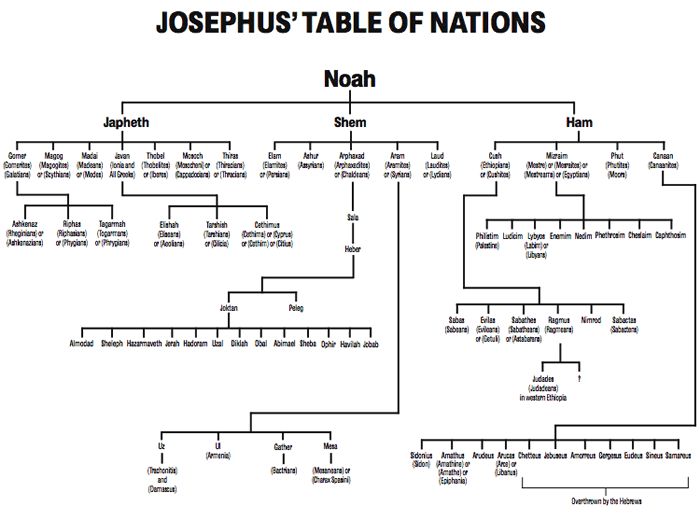
Elam is first mentioned in Genesis 10:22 as a son of Shem. Shem was Noah’s son. Elam was a real person, Noah’s grandson. You remember the early sons went out and founded tribes. This is recorded as a Table of Nations in Genesis 10. Answers In Genesis has an article with the table, which is like a genealogical family tree but of nations and not individuals. Click to enlarge. You will notice the same names on the Table as are recorded as the nations that fight at the time of the end. Togarmah, Gomer, Tubal…those guys all there at the beginning and their founded nations are there at the end. God is very precise.

The following points regarding Elam/Persia/Iran are from Bible History Online

The Persian Empire was founded by Cyrus in 536 BC., after they succeeded the Babylonian Empire. The first king of the Persian Empire was Cyrus, who issued the famous decree for the Jews to return to their homeland to rebuild their Temple. 

Under Cyrus the Great and Darius the Great, the Persian Empire eventually became the largest and most powerful empire in human history up until that point. The Persian Empire represented the world’s first global superpower.

The capital of the Persian Empire was Shushan. The Empire lasted about 200 years, and came to an end in 330 BC.

From Negev, A. (1990). In The Archaeological encyclopedia of the Holy Land:

ELAM a) The biblical name of a hilly country, ‘Elamtu’ in Accadian, east of the River Tigris (Hiddekel) bordered by Assyria (Mesopotamia) and Madai on the north, the Persian Gulf on the south and Persia on the east and southeast. Its capital was Susa (Shushan). Most of our knowledge of it derives from Sumerian, Babylonian and Assyrian sources.

There was a constant state of war between Elam and the kingdoms of Lagash and Assyria. By the end of the 2nd millennium BC the Elamites had succeeded in deposing the Sumerian Dynasty of Ur. According to Genesis (14) Chedorlaomer, King of Elam, ruled over all the countries which were formerly under the yoke of Babylon, and the countries on the Jordan were his tributaries.

Abram Rescues Lot
14 In the days of Amraphel king of Shinar, Arioch king of Ellasar, Chedorlaomer king of Elam, and Tidal king of Goiim, hat they made war with Bera king of Sodom, and with Birsha king of Gomorrah, Shinab king of Admah, and Shemeber king of Zeboiim, and the king of Bela (that is, Zoar). (Genesis 14:1-2).

From DD Lowery in his book Elam,

The fall of Elam was foretold by Jeremiah (49:34–9) and by Ezekiel (32:24–5). During the period of the Persian Empire Elam was one of the satrapies, with Susa as its capital. Elamites who had been settled in Samaria impeded the Jews who returned from the Babylonia exile (Ezra 4:8–9).

ELAM (עֵילַם, eilam). An ancient Near Eastern kingdom located in Iran. A rival to the Mesopotamian kingdoms for over 2,000 years. The Elamite Empire influenced many great empires that shaped the biblical world. Over its long history, Elam interacted with the Sumerians, Akkadians, Babylonians, and the Assyrians. Under the Persians, Susa—one of Elam’s great cities—makes several biblical appearances.

Biblical Mentions 

Kedorlaomer, king of Elam, appears in Gen 14 as the king whom Abram defeats to bring Lot and his family back home. The next occurrences in the Bible are not until the prophets and the exile. In the biblical text, Elam appears as a prophetic instrument of judgment (Isa 21:2; 22:6), as the object of judgment (Jer 49:34–38), and also as an object lesson for those yet to be judged (Ezek 32:24–25). Assyria deported many Israelites to Elam upon conquering it, which sets the stage for Ezra, Nehemiah, and Esther. According to Acts 2:9, a Jewish population still remained in Elam into the New Testament period. 

Determining how close the connection was between these earlier peoples and later Elamites remains difficult. Archaeology has shed light on many originally distinct groups during this period, most notably from Elam (Fars) and Susa, which come to be associated together later in history. 

End of Elam (Achaemenid Period, 539–331 BC): Elam Absorbed by Persia. Elam was geographically reduced to Susiana by the Assyrians, and the Medes and the Persians were firmly rooted in the Plateau. When Cyrus II (Cyrus the Great) conquered Babylonia (539) and established the great Persian Empire, Elam (Susiana) fell into Persian hands, becoming a valuable Persian province. The Persians inherited many characteristic traits from the Elamites, who continued to serve in various administrative roles under them. In fact, archives of Elamite clay tablets have been found in Persepolis—an important Persian center—from late in the reign of Darius to that of Artaxerxes (late fifth century). These shed considerable light on the political and cultural atmosphere of the time.
Under Darius, Susa became a prominent city in the empire. Here, set up as the winter citadel for the Persian Empire, that the biblical book of Nehemiah begins, and where Esther is also set. Recent archaeological discoveries in Susa have given clarification to the book of Esther. However, by this time, “Susa, in the province of Elam” (Dan 8:2) had ceased to be anything but the shell of Elam that it once was

Lowery, D. D. (2012, 2013, 2014, 2015). Elam. In J. D. Barry, D. Bomar, D. R. Brown, R. Klippenstein, D. Mangum, C. Sinclair Wolcott, … W. Widder (Eds.), The Lexham Bible Dictionary. Bellingham, WA: Lexham Press.

When we read of the Elamites being comprised of many different Mesopotamian peoples, it is so. At Pentecost, we’re told that “staying in Jerusalem God-fearing Jews from every nation under heaven.” (Acts 2:5).

Including:

Parthians and Medes and Elamites and residents of Mesopotamia, Judea and Cappadocia, Pontus and Asia, (Acts 2:9).

Now in the latter days, a glorious thing will happen.

In that day the Lord will extend his hand yet a second time to recover the remnant that remains of his people, from Assyria, from Egypt, from Pathros, from Cush, from Elam, from Shinar, from Hamath, and from the coastlands of the sea.

The LORD has a remnant of His people inside the lands that we read about in the news today. How glorious it will be when He restores them! Daniel had a vision of the end time/last days of the very last days, in which he saw the Elamites-

And I saw in the vision; and when I saw, I was in Susa the citadel, which is in the province of Elam. And I saw in the vision, and I was at the Ulai canal. (Daniel 8:2).

On September 7 I posted a prescient quote from 1967 by S. Lewis Johnson regarding his long-ago perspective of seeing the ascendancy of Biblical nations. The Iranian rise is nothing to be surprised at nor worried about in this day and age. God is incredible and His hand works all that He wills. The things which were prophesied for thousands of years are coming to pass, and will come to pass, because God decreed it.

More to the individual point, when we read of rabid hatred contained in speeches by Iranians declaring death to America and death to Israel, let us not hate them back. In those nations, though there are many Muslims and many false Christians such as Orthodox, a few remnant Christ people dwell. They are being prepared to receive the calling when He deems it the right moment. Some already have been called, and others will become … our brethren.

God deals in remnants. That is His way. And God does mighty things through remnants. 300 against Midian. Two against the Philistine army. 7,000 among the millions in Israel. 120 on Pentecost. A handful of Puritans coming to the shores of North America 400 years ago.

And in our time, faithful men and women in many parts of the world who have left apostate churches meet in tents, homes, schools, libraries, firehouses, storefronts, the buildings of liberal churches, and even less likely places. In countries like Zimbabwe in Africa, men and women who have left the bondage of false religions often meet under the shade of a tree in an otherwise forbidding landscape to worship the one true and living God and hear His Word preached.

Men and women around the world meet in unlikely places, sometimes coming incredible distances on foot just to be together. God’s remnant is truly an unlikely assembly. But His people come together because they understand that it is not numbers, or a building, or other trappings that are of true importance – but the truth as it is found only in Christ and His Word. They understand that it is “not by might nor by power, but by My Spirit, saith the Lord of hosts” (Zechariah 4:6). source

God is mighty and wonderful. Praise His name!

Posted in depravity, encouragement, sin, tulip

Total depravity in a baby

Wikimedia Commons

I remember very shortly after being saved I was witnessing to a friend. She was the kind of person who was ‘rational’, ‘logical’ and ‘mathematical.’ Since Paul witnessed to Gentiles by starting with the creation, I did too. Sadly, she dismissed Genesis’ creation account because obviously, the light being created as Genesis 1:3 could not have come before the sun’s creation, as Genesis 1:14. Obviously. Therefore the creation account must be wrong.

So I skipped ahead and told her about Eve’s and Adam’s sin in the garden. I shared that after the sin had occurred, their very biology was now polluted and cursed, and all subsequent children, such as murderous Cain, were totally depraved since birth. Therefore we do not do right and are excluded from God’s heaven- unless we repent and ask Jesus to forgive.

That didn’t get a logical reaction. It got an emotional one. She heatedly rejected the notion that children and babies are totally depraved. She fervently argued against the concept that babies and children naturally do wrong. Even associating the word sin with baby caused a visceral reaction in her.

EPrata photo

That was 11 years ago and I never forgot.

First some definitions. Total depravity does not mean that everyone, including children, are as bad as they can be all the time. There’s your Hitlers and there’s your Mother Teresas. Both are in hell now BTW.

Total depravity is about the original sin and how it affects us today. It speaks to the extent of our sin, our sin nature, and our complete inability to do anything for God that will be pleasing to Him. Some people such as John MacArthur prefer the term “absolute inability” rather than total depravity.  John MacArthur said of the concept,

“…we are so hopelessly and thoroughly wicked that not one of us could ever truly love God unless God Himself enabled us to do so. That is the doctrine of total depravity in a nutshell. It means that we are totally unable to save ourselves.” 

Charles Spurgeon said of total depravity,

By original sin we mean the evil quality which characterizes man’s natural disposition and will. We call this sin of nature original, because each fallen man is born with it, and because it is the source or origin in each man of his actual transgressions. By calling it total, we do not mean that men are from their youth as bad as they can be. Evil men and seducers wax worse and worse, “deceiving and being deceived” (2 Tim. 3:13). Nor do we mean that they have no social virtues toward their fellowmen in which they are sincere. … What our Confession says is, “That they have wholly lost ability of will to any spiritual good accompanying salvation.”

In 1985 John Piper said of total depravity,

Total Depravity Our sinful corruption is so deep and so strong as to make us slaves of sin and morally unable to overcome our own rebellion and blindness. This inability to save ourselves from ourselves is total. We are utterly dependent on God’s grace to overcome our rebellion, give us eyes to see, and effectively draw us to the Savior

Now, surely babies aren’t totally depraved? They’re so cute and such a blank slate and not even able to comprehend what sin is. Right?

Wrong.

There is a cottage industry of Americas Funniest Videos (AFV) that show the “cute” things babies, toddlers, and kids do. The audience laughs and titters and applauds, and goes “awww.” But it’s not funny. These clips from AFV have been wow-ing and charming and entertaining audiences for 25 years. Yes, AFV is 25 years old. But when I see clips like this, it only makes me sad, because they are a 25 year chronicle of our sin nature.

This clip won. It is in the top pantheon of best loved clips.

Why waste a good tantrum when no one is around to see it?

This toddler is absolutely totally aware of what he is doing. He knows how to present screams and anguish to maximum effect, and knows when it’s useless to continue. He is manipulating the adults. He is lying.

Not so innocent, eh?

But some may protest, how about babies. Little, little babies, they surely don’t know right from wrong. They don’t lie, manipulate, or do things in secret?! How could you think they are totally depraved and have a heart full of sin.

Here, 18-month-old twins play, scream, and jump with each other during nap time. The mom heard the noise and turned on the baby monitor so she could talk to them.

The second the twins hear the mom’s voice, they drop. They know they are supposed to be sleeping and weren’t. They knew they were disobeying the higher authority.

Total depravity is in us, it is our very nature. It goes from corner to corner in all areas of our mind, heart, strength,and soul. There is no “flawed thinking.” There is no untainted corner of our mind whereupon one day we will suddenly become spiritual and be able to retreat to that pure corner and “choose Jesus.” We are fallen creatures completely unable to do right in God’s eyes. We need Him.

Thank God He knows this. God sent His Son to live the life we cannot, due to our complete inability to be righteous. Born of woman and from the Father in heaven, He lived the sinless life we could not. He was hated, spit on, mocked, stripped, beaten and hung from a tree. He endured God’s wrath for sin. He took it- our punishment. Then He died.

Pleased with His Son’s life, and His death, and God’s wrath exhausted upon the Son, He raised Jesus to life and ascended Him to heaven. Now, anyone who cannot and never will do right in God’s eyes, but who are at enmity with Him and are His enemy, can come through the Door, who is Jesus. He is the Door to life, and if confessing and repenting to Jesus, He will forgive and they may enter heaven through Him.

Jesus said to him, “I am the way, and the truth, and the life. No one comes to the Father except through me. (John 14:6)

Our sin nature is so total, even babies show it. But if we have the faith of a child and repent, He will grant everlasting life. He sends the Spirit to dwell in us and give us His power to resist sin. He grows us in Christ’s likeness.

At the resurrection of the saints He will blessedly remove us from the presence of sin. Imagine a world where every conversation will be holy. Where every emotion will be perfect. Where there are no hidden agendas, no secret sins, no hypocrisy. Where we worship Jesus perfectly. Where our motives are pure and no one is manipulated, lied to, or pressured. No depravity, and total ability.

What a day that will be. Thank you Jesus, for saving your elect.

Posted in discernment, Justin Peters, war room

Justin Peters’ Review of the movie "War Room" by the Kendrick Brothers

Posted with permission by Justin Peters. See it here at Justin Peters’ site.

War Room
A Review by Justin Peters
September, 2015

If you do not know the Kendrick brothers by name, you almost certainly know them by their films: Flywheel (2003), Facing the Giants (2006), Fireproof (2008), and Courageous (2011). Stephen, Alex, and Shannon Kendrick have just released their fifth faith-based film, War Room. War Room, starring popular Bible teachers Priscilla Shirer and Beth Moore, looks like it may well be the most successful of their films to date bringing in $11 million just on its opening weekend; more than triple it’s $3 million production budget.

Given the popularity of Christian themed films and the considerable buzz about this one in particular, my wife, Kathy, and I went to see War Room on the evening of September 3rd so that I could write a review. For those of you who read my review of Mark Burnett and Roma Downey’s movie, Son of God, you know that I am a bit skeptical of the Christian movie genre as a whole. Nonetheless, I do want to offer what I hope to be a fair review. This review will not touch on every single facet of the movie or even on every theme it presents, but I do hope to address what I believe to be the most important of them.

Plot Overview

War Room is centered around Tony and Elizabeth Jordan, their ten year old daughter, Danielle, and Elizabeth’s real estate client-turned Christian friend, Mrs. Clara. The Jordan marriage is in serious trouble. Tony, a pharmaceutical salesman who travels extensively in his work, is the kind of husband and father one loves to hate. Though a hard worker, he shows little interest in his daughter and pursues a female work interest behind his wife’s back. Elizabeth, played by Priscilla Shirer, goes to Mrs. Clara’s home discuss the particulars of putting it on the market. The meeting, however, went far beyond deciding on a listing price for the house.

Mrs. Clara, an older widow, is a Christian fiercely devoted to prayer which she does in a closet she has dubbed her “War Room.” Mrs. Clara goes to war here, battling Satan who is portrayed as the source of every form of evil plaguing mankind. Rather than plotting troop positions on a military map, Mrs. Clara pins prayer requests and Scripture verses on the wall of her war room, prays to God, and rebukes the Enemy.

Mrs. Clara begins to ask Elizabeth some probing questions about her family, marriage, and church attendance. Upon learning that the Jordan family is at the point of collapse, Mrs. Clara exhorts Elizabeth to fight for her marriage in her own war room.

Slowly but surely, Elizabeth is changed by her newly found prayer life and by reading the Bible. One day in her war room, she discovers via a friend’s text that Tony has been seen in a restaurant with another woman. Elizabeth immediately prays for her husband and asks God to stop him. God gives Tony a stomach ache in the restaurant preventing him from following through with his adulterous plans.

Shortly after this, Tony is fired from his job. Rather than the anger and sarcasm he expected to receive from Elizabeth upon hearing this news, she offered him love and support. The change he sees in his wife eventually changes Tony as well. He confesses his sin and turns back to God. He seeks and is granted forgiveness from both Elizabeth and Danielle, and the Jordan family is on the fast track of restoration.

Despite his new life, Tony is fired from his job. What his boss did not know, though, was that Tony had been stealing drugs from the company, selling them and pocketing the profits. Though he had gotten away with it, his now sensitive conscience drove him to return to meet with his former boss, confess his theft and make restitution. His boss could easily have turned Tony in to the authorities to face prison but chose not to do so. The Jordan family was spared the loss of being torn apart again just as it had begun to heal. Tony eventually found a new, though less lucrative job, his family grew closer to one another and the Lord, Mrs. Clara’s house sold to a pastor and his wife, and all was well because of the battles fought in the War Room.

Strengths

The movie was, of course, clean. There was neither foul language nor any innuendos (other than what was about to happen between Tony and his almost-mistress at the restaurant) anywhere to be found.

War Room emphasized the importance of fidelity to one’s spouse and cutting off any potential threats to the sanctity of the marital covenant. The film championed the virtues of character, integrity, and selflessness. The importance of family, and the need for regular church attendance were stressed. Mrs. Clara (a very winsome character in the film) taught Elizabeth the importance of reading Scripture and, of course, prayer. The movie did teach the biblical truth that man is unable to reform himself. “You can’t fix Tony. Only God can.” said Mrs. Clara to Elizabeth.

The Gospel was, well, mostly there. Mrs. Clara presented the Gospel to Elizabeth in one of their meetings and she talked about sin, that Jesus died on the cross to pay the penalty of sin, was raised from the dead and that a person must believe in Jesus and repent. These are all essential elements of the Gospel and I am glad that they were included. That having been said, even though the proper biblical terms were used, often these terms were not explained. The term “repent,” for example, was used but never fleshed out. The lingo was there to be sure, but without a biblical understanding of these terms they are just that, lingo.

Weaknesses

As I’m sure you are expecting, I did find much with which to be concerned. Some of the film’s failures could have been avoided with more careful attention to doctrine and theology and some of the failures, as I will explain in the conclusion, are inherent to the genre itself and unavoidable. I will outline my concerns in a series of “Outs:” Out of Home, Out of Order, Out of Focus, Out of Bounds and Out of Context.

Out of Home

I may as well begin with the most politically incorrect and probably the most controversial point I will make in this review and get it out of the way. Not everyone reading this will agree but truth is truth.

That men and women are of equal value before God is beyond dispute (Gal. 3: 28-29). That having been said, men and women do have different roles and the role of a young wife and mother is to be a worker in the home. The Apostle Paul writes that older women are to teach “the young women…to love their husbands, love their children, to be sensible, pure, workers at home, kind, being subject to their own husbands, so that the word of God will not be blasphemed” (Titus 2:4-5). Note the “workers at home” part.

The context makes it quite clear that the “young women” are those who are married and have children in the home. This text makes it quite clear that such women’s primary place of service is not to be outside of the home but within.

Pastor and teacher Dr. John MacArthur has written that if a young woman is adequately fulfilling all seven of the requirements listed in this passage then she “will probably be a very busy individual” and have little time for work outside of the home. If, however, “she still has time left over, then she would be free to pursue enterprising and creative activities outside the home.”(1)  It is not that a young woman should never engage in wage earning work of any kind. Proverbs 31, in fact, depicts the godly woman who may do some enterprising work from within the home.

One of the first things I noticed in the film is that Elizabeth worked outside of the home as a real estate agent. Had she been adequately fulfilling all of her duties inside the home, then the case could have been made that this was permissible. This was not the case, however. In fact, the movie actually makes a point that Elizabeth was so involved at her job that she did not know what her daughter, Danielle, was doing at school or in her jump-rope team.

The sad reality is that the fallen world in which we live often requires young women to work outside of the home. Some “young women” (2) have been abandoned by their husbands and some may have husbands unable to work due to some type of infirmity. In situations such as these work outside of the home is, unfortunately, unavoidable.

When a young woman can avoid working outside of the home, though, she should. If a young woman works outside of the home out of preference rather than absolute necessity, then a biblical principle has been violated. The issue is not a minor one. Note that if a young woman works outside of the home at the expense of her biblical household duties, then the result is that the Word of God is βλασφημῆται (blasphemetai), literally, blasphemed.

Writes Dr. MacArthur:

The home is where a wife can provide the best expressions of love for her husband. It is where she teaches and guides and sets a godly example for her children. It is where she is protected from abusive and immoral relationships with other men and where, especially in our day, she still has greater protection from worldly influences—despite the many lurid TV programs, magazines, and other ungodly intrusions. The home is where she has special opportunity to show hospitality and devote herself to other good works. The home is where she can find authentic and satisfying fulfillment, as a Christian and as a woman. (3)

Out of Order

War Room is a theological train wreck chronologically speaking. In other words, it totally gets out of order the Holy Spirit’s work of regeneration in a person with the fruits of regeneration.

In their first meeting, Elizabeth tells Mrs. Clara of the distressed state of her marriage to Tony. Upon hearing this, Mrs. Clara asked her, “Have you prayed for him?” There is nothing, of course, wrong with this in and of itself except the fact that Mrs. Clara made this inquiry without having first made certain that Elizabeth understood the Gospel herself. Though Elizabeth certainly was not guilty of the overtly egregious sins of her husband, like he, she displayed little understanding of the Gospel. She attended church only “occasionally” and was biblically illiterate. There was no discernible spiritual fruit in her life to indicate that she was a believer.

Another example occurs after Elizabeth hears the Gospel (most of it anyway) from Mrs. Clara and begins to get on the straight and narrow. Shortly after Elizabeth found out about Tony’s attempt to cheat on her, he came home from his failed dalliance to a meal she had prepared for him. She looked at her husband and asked, “You wanna pray?” At this point in the movie there is absolutely no reason to believe that Tony had been converted. He had little interest in Danielle and he did not love his wife. (4) He was selfish, arrogant, was a thief, and had no conviction over his sin. He cared only for himself, had no godly sorrow, and showed no affections for things holy and pure. He was ignorant of Scripture and comfortably so. That Elizabeth, by this time walking with the Lord, would ask her husband to pray assumes that this is something he could do which, as a lost man, he could not.

Save the prayer that one may prayer at conversion, prayer is a spiritual discipline that can only be done by the saved. The movie gives the impression that praying for one’s spouse or asking God to bless the evening meal can be done by one who is lost. This, of course, is an impossibility. Before coming to Christ we are enemies of God (Col. 1:21), dead in our sins (Eph. 2:8-9), and cannot seek Him (Rom. 3:10-11); a condition which precludes any ability to pray (Is. 59:2).

Now, this having been said, I am not saying that this was the intention of the Kendrick brothers. It is probably the case that they were simply portraying how people normally speak. I am not at all saying that theologically they would believe that lost people can pray. The problem, though, is the vagueness in which it was portrayed.

Additionally, and even more worrisome, is that the film gives the impression that one can live a life of habitual, unrepentant sin and still be a believer. In her own war room, Elizabeth petitioned “Lord, I pray for Tony that you would turn his heart back to you.”

My issue here is not that Elizabeth is praying for her husband, but that her prayer gives the viewer the impression that Tony was a just backslidden Christian. (5) “Turn his heart back to You,” she prayed. Again, Tony was an absolutely loathsome individual at this point in the movie who displayed zero evidence he had ever experienced regeneration.

Christians can and do sin (1 Jn. 1:8) but their lives are not to be characterized by sin. It has been said that a Christian can stumble into sin, but he cannot swim in it. A believer is a new creature in Christ (2 Cor. 5:17) indwelt by the Holy Spirit of God Who produces in him good fruit (Gal. 5:22-23). Many people living lives of habitual sin are told they are just “backslidden” when they’ve never slidden forward in the first place. Charles Spurgeon stated, “Unless our faith makes us pine after holiness and pant after conformity to God, it is no better than the faith of the devils, and perhaps it is not even so good as that.” Whether intentional or not, there is a danger of this film giving some of its viewers a false assurance of their salvation.

Out of Focus

War Room certainly did deal with sin but it did so, I thought, primarily on a horizontal basis. In other words, though it showed the damaging consequences of sin in relation to our fellow human beings, it did not focus nearly so much on sin’s deadly consequences in our relationship to God.

Tony and Elizabeth both sinned in that they focused on their employment at the expense of their daughter, Danielle. Tony, of course, sinned in his pursuit of a woman who was not his wife. Eventually both came to see how their sin hurt others and they repented. In and of itself, this is good.

What I did not see – or at least what I believed was not emphasized nearly enough – was the vertical nature of sin. There was no mention anywhere in the film of the wrath of God that our sin incurs. There was no mention of God’s wrath abiding on the unbeliever (Jn. 3:36) or that we are saved from it (Rom. 5:9). There was no mention of eternal judgment for those who die in their sins (Lk. 16:19-31).

Without first understanding the wrath of God, one cannot rightly understand the mercy of God. Without first realizing that our sins are storing up God’s wrath (Rom. 2:5) which will be poured out on the ungodly for all of eternity (Rev. 14:10), we cannot truly appreciate His mercy. It is only in understanding God’s deserved wrath that we can fully understand His undeserved mercy. It is His wrath that makes His mercy so precious.

In watching the film both my wife and I were looking for one thing which is a hallmark of every genuine believer: a godly sorrow over sin.

The Bible speaks of two types of sorrow over sin. There is a worldly sorrow which is merely a guilty conscience. A worldly sorrow is one that is concerned only for the horizontal consequences of sin and it leads to death (2 Cor. 7:10).

The other type of sorrow, however, is a godly sorrow. A godly sorrow comes about when we understand that our sin is first and foremost against God. A godly sorrow is when we grieve over our sin because we understand that our sin grieves God and we desire to turn from sin because we do not want to grieve Him. It is this godly sorrow which “produces a repentance without regret leading to salvation” (2 Cor. 7:10).

Unless we both missed it, neither Kathy nor I saw any godly sorrow evidenced in either Tony or Elizabeth’s life. There definitely was sorrow over hurting others, but nowhere in the film did we see the kind of godly sorrow exhibited by David when he humbled himself before the Lord and said to Him, “Against You and You alone have I sinned and done what is evil in Your sight” (Ps. 51:4).

Out of Bounds

The Apostle Paul in 1 Corinthians 4:6 exhorts the immature believers in Corinth “not to exceed what is written.” In other words, we as believers are not to exceed biblical parameters. Whether in our theology or in our practice we are to stay safely within biblical parameters for when we exceed these God-given parameters we are opening ourselves up to demonic influence and demonic deception.

Sadly, biblical parameters dealing with spiritual warfare are exceeded throughout the movie. The entire film is saturated with Word-Faith/N.A.R. spiritual warfare lingo. (6) There seemed to be as much time and effort expended in binding, rebuking and casting out Satan by Mrs. Clara and Elizabeth in their respective war rooms as there was praying to God.

In one of the more emotionally rousing scenes of the film, upon discovering her husband’s philandering ways, Elizabeth retreats to her war room. As she repeatedly cites to herself James 4:7b, “Resist the devil and he will flee from you,” indignation swells within her and she begins to talk to the devil. “No more, you are done! Jesus is Lord of this house and there is no room for you anymore! Go back to Hell where you belong and leave my family alone!” she shouts.

There are at least two significant problems with this. First, Satan is not in Hell. Only when the eschatological events of Revelation 20 take place will he be thrown into the lake of fire and “tormented day and night forever and ever” (vs. 10). (7). The Bible makes it very clear that, for now at least, Satan is quite free “prowling about like a roaring lion seeking someone to devour” (1 Pet. 5:8).

Secondly, and more significantly, we as believers are not to be addressing Satan. Ever!

Consider that in Jude we have the record of Michael the archangel disputing with the devil and arguing over the body of Moses. Jude records for us that when he disputed with the devil, Michael the archangel “did not dare pronounce against him a railing judgment, but said, ‘The Lord rebuke you!’” Think about that for just a moment and let it sink in. If Michael the archangel – the archangel – did not “dare” to rebuke Satan then I think it’s probably a safe bet that we should not do so either. Pastor Jim Osman in his excellent book Truth or Territory writes, “What God’s highest holy angel would not dare to do, sinful, fallen men presume the authority to do. It is unthinkable. I have been in the presence of Christians who boldly declare, ‘Satan, I rebuke you in the name of Jesus,’ and I wonder, ‘Who do you think you are?’ Rebuking, commanding, or ridiculing the devil are not tools of effective spiritual warfare; they are marks of prideful, arrogant, self-willed false teachers.” (8)

It is troubling that noted Bible teacher Priscilla Shirer does not know this and would model such a dangerous and unbiblical practice. By exceeding biblical parameters, people are exposing themselves to the very enemy that they fancy themselves as rebuking. (9)

Incidentally, given that so many people are rebuking and binding Satan, have you ever wondered how he seems to keep getting back out? It seems that as soon as someone binds him, he’s free again. All of these people binding Satan don’t seem to be tying him up very tightly. And if we can bind and rebuke Satan (Be sure to bind him first. The last thing you’d want to do is rebuke an unbound Satan as he might give you a nasty uppercut when you’re not looking.), why not just bind him from all places at all times and be done with it?

But I digress.

The movie also has a decidedly mystical bent. Towards the end of the film, an older pastor named Charles and his wife, clients of Elizabeth, are shown the home. Charles notices the closed door to the “war room,” opens it and slowly walks inside. He looks around, pauses, backs out of the closet, and then walks back in as though he feels something different in the atmosphere. His wife asks him what he is doing and he says that there has been a lot of praying in this room. “It’s almost like it’s baked in,” said the old pastor.

This is pure mysticism. God speaks to us through the Bible and we speak to Him through prayer. Prayer is an act of obedience that serves to conform our will to that of the Father but it in no way changes the atmosphere in a closet, house, hospital, gymnasium, state or country. This is hyper-charismatic, Word-Faith mysticism.

In another scene Mrs. Clara, Elizabeth and Danielle were on their way to get ice cream when their trip was interrupted by a knife wielding thug demanding their money. The unflappable Mrs. Clara stared him in the eye and commanded, “You put that knife right down in the name of Jesus.” All of the sudden the thug looked dazed and confused. Powerless to follow through with his criminal plans, he fled the scene. Saying “in the name of Jesus” to this miscreant was like giving Kryptonite to Superman.

Throughout the film the name of Jesus is used in this way. It is used almost like a magical incantation, a Christianized version of Abracadabra, to manipulate the physical realm toward one’s desired outcome. Whether used in prayer to restore a marriage or to thwart a mugging, the name of Jesus always got results in War Room.

Contrary to the way in which it is portrayed in the film, saying “in the name of Jesus” is not like putting in coins in some theological vending machine. The name of Jesus is synonymous with the will of Jesus. When we pray for things in Jesus’ name rightly, we are praying for Jesus’ will to be done (Jn. 14:13-14; 1 John 5:14-15). Using the name of Jesus does not always bring the results we desire.

It was fidelity to the name of Jesus that led nearly all of the Apostles to gruesome deaths. It is fidelity to the name of Jesus that has brought horrific persecution to untold millions of Christians during the last two thousand years. Many Christians throughout the world face persecution to this day because of the name of Jesus. Sometimes the name of Jesus gets us not what we want, but what we may not want. Often it is in times of trial and persecution for the believer that God is most glorified.

Out of Context

“The thief comes to steal, kill and to destroy; I have come that they might have life and have it abundantly” (Jn. 10:10) was quoted several times throughout the movie. In War Room the “thief” is identified as Satan who has come to steal people’s joy and marriages.

While it is not necessarily incorrect to identify the thief in John 10:10 as Satan, the context of the passage argues for a much broader view. The context indicates that the thief includes not only Satan, but any false teacher who claims any way of salvation other than that which is found exclusively in Christ. What the “thief” is attempting to steal is not one’s joy or marriage but rather one’s reception of the Gospel itself. The context is that of salvation, not one of life enhancement.

The movie concluded with one of the most familiar, beloved, and yet taken out of context passages in the Old Testament, 2 Chronicles 7:14: “If My people who are called by My name will humble themselves, and pray and seek My face, and turn from their wicked ways, then I will hear from Heaven, and will forgive their sin and heal their land.” The text was shown superimposed on a shot of the United States capitol the insinuation, of course, being that if we will repent that God will heal our nation’s many societal ills.

Though a thorough treatment of this passage is beyond the scope of this article, to apply this verse to the United States of America (or any other country for that matter) is to employ poor hermeneutics. The context of this verse is that it is God’s answer to Solomon’s prayer dedicating the temple recorded in the previous chapter. There has only been, is now, and only will be one country in a covenant relationship with God – Israel.

Another aspect of the movie that was out of context is the entire premise of having a prayer closet in the first place. The film portrayed this room almost as having magical powers. If you want your prayers to be effective, it’s best to pray them in a closet emptied of its contents. Upon first consideration, this idea appears to have biblical support:

When you pray, you are not to be like the hypocrites; for they love to stand and pray in the synagogues and on the street corners so that they may be seen by men. Truly I say to you, they have their reward in full. But you, when you pray, go into your inner room, close your door and pray to your Father Who is in secret, and your Father who sees what is done in secret will reward you. – Matthew 6:5-6.

As we were driving home from the theater that night, Kathy and I talked about how we would be willing to bet that thousands of people will see this film and then go to their homes, clean out a closet and make their own “war rooms” believing that their prayers will become more effective.

Sure enough, just this morning as I was writing this piece, I was watching the Daystar channel as presidents and hosts Marcus and Joni Lamb played a clip from Eyewitness New Fox 58 as Aaran Perlman interviewed two of the Kendrick brothers. A visibly emotional Perlman said, “I saw this movie last weekend with a group of people, I’m gonna start crying before I even get into this. It changed my life so much. This movie, it’s about prayer. It’s about finding a room called the war room and immediately after this movie I went home and ripped everything out of my closet and made my own war room.” “Wow, that’s incredible, awesome! You will see a difference in the days ahead. Write ‘em down so you can keep up with them. It’s great to be able to check off those prayer requests to realize God is alive and well and at work in your life,” Stephen Kendrick responded.

While there is certainly nothing wrong with praying in a closet if that is what one wants to do, the location is not the point. The point Jesus made in this text was not about location but attitude. The point is that we are not to make a show of our prayers as did the scribes and Pharisees and should remove any distractions which may divert our attention away from the One to Whom we are praying. Sincere, humble prayers offered in a living room, a backyard, or in an airplane at 40,000 feet halfway across the Pacific Ocean are heard just as well as those offered in an empty closet. Believing that there is some special power in the location itself is not only mystical, but borders on idolatry. The Object of our prayers and the condition of our hearts are the important things – not the location.

Conclusion

Some will read this review and undoubtedly think that I am being too nitpicky and critical. I have talked to some who have seen War Room and thought that it was great and that it had a solid biblical message. There is no doubt that the film was Christian themed – an element that has drawn the ire of numerous secular critics – but we are enjoined to “test all things” (1 Thess. 5:21) through the lens of Scripture and to “study to show ourselves approved unto God” (2 Tim. 2:15). Charles Spurgeon once said, “Discernment is not a matter of simply telling the difference between right and wrong; rather it is telling the difference between right and almost right.”

Finally, as I hinted at the beginning of this piece, I am not a fan of the whole Christian movie (I am not including documentaries in this) thing in general. It is not that I am inherently opposed to the genre per se, but rather that I believe there to be an inherent danger in them. For one, in order to be successful at the box office, Christian movies must be intentionally vague when it comes to many doctrinal matters. Christian films never really go past the basics of the Gospel and, sadly, often even fail at that. Yet the Bible says that we are to pay close attention to doctrine (1 Tim. 4:13) and to persevere in it (vs. 16).

Additionally, these movies are highly emotional. They tug at our heart strings. There is nothing wrong in and of itself with emotion, but emotion cannot be a substitute for obedience to objective biblical truth. Movies in and of themselves cannot bring lasting change to anyone’s life. It seems that every few years or so something new is introduced to the evangelical masses and is portrayed as the next great evangelistic super-tool. Whether it’s a blockbuster movie like the Passion of the Christ, or best-selling books like The Purpose-Driven Life, or Jesus Calling, (10) people get all excited. Spin-off products follow and incredible amounts of money are spent chasing after the latest fads. But they are just that – fads. Recall the Prayer of Jabez craze about fifteen years ago? Remember how everyone was praying for God to enlarge their territory? Do you have any friends still praying the prayer of Jabez? Me neither. Without a foundation of sound doctrine, without a constant and proper hermeneutic, all of these things are the spiritual equivalent of a sugar pill.

It is a sad commentary, in my estimation, that so many professing believers get so excited about the latest thing to come down the evangelical pike, but show little enthusiasm in and put precious little effort into reading, studying and obeying God’s Word. Watching a movie is easy. Laboring in the Word is not. But only the latter will bear fruit that remains.

———————-

Footnotes

1. Source: http://www.gty.org/resources/questions/QA188/is-it-wrong-for-wives-to-work

2. For the purposes of this article when I write “young women” I am referring to the biblical definition of the term per Titus 2.

3. Source: https://www.gty.org/resources/bible-qna/BQ101712/Does-Scripture-Permit-Women-to-Work-Outside-the-Home

4. No matter how he may argue to the contrary, if a man cheats on his wife (or vice versa) he does not love her. Such a sin breaks the marriage covenant and is in direct contradiction to the biblical definition of love.

5. The New Testament never uses this word. It is only used in the Old Testament in reference to Israel.

6. New Apostolic Reformation is a twin movement of Word-Faith but has even more emphasis on signs and wonders and modern day Apostles. Some of its prominent leaders include Bill Johnson, John Arnott, C. Peter Wagner, Cindy Jacobs and Heidi Baker.

7. Technically, there will never even be a time when Satan resides in Hell. Revelation 20:14 states that Hell and death are thrown into the lake of fire where Satan and the demons will already be by that time. It is a distinction with probably little meaningful difference, but a distinction nonetheless.

8. Osman, Jim (2015-01-24). Truth Or Territory: A Biblical Approach to Spiritual Warfare (Kindle Locations 1905-1908). Jim Osman, Kootenai Community Church. Kindle Edition.

9. For an excellent book on spiritual warfare from a biblically sound perspective see Truth or Territory: A Biblical Approach to Spiritual Warfare by Pastor Jim Osman. Also available is a 6 CD set of 12 interviews with Jim Osman and this writer on the topic of Spiritual Warfare. It is available at http://justinpeters.org/store/

10. All of these mentioned have massive doctrinal errors.

Posted in mary kassian, strength in the Lord, weaker vessel

Ladies, are you weak, the bad kind of weak?

Source

Women, are you silly? Gullible? Weak?

“Of course not!” many would say.

Well, that is good to hear, because many women who claim to be Christian are weak. Being weak, vulnerable, gullible, or silly makes you satan’s target. And this is a problem.

Have you noticed that satan uses women to enter into households? He uses emotionalism, mysticism, Jesus Calling, Beth Moore, psychology, Ann Voskamp, IF:Gathering and many more teachings and teachers and books like this that lead women astray. Not as many are targeted to men.  Satan gets at men other ways. But satan targets women in very successful ways, and Kassian unpacks some of the techniques to which we succumb and knowing this, can avoid these traps.

At the 2014 True Women Conference, Mary Kassian expounded on the verse from 2 Timothy 3:6-7,

For among them are those who creep into households and capture weak women, burdened with sins and led astray by various passions, always learning and never able to arrive at a knowledge of the truth

The title of her sermon is “Don’t Be a Wimp: Kicking the Habits That Make Women Weak”, where Kassian looks to Scripture to explore seven characteristics of weak women. These 7 characteristics are the 7 clauses in the verse. In the sermon, Kassian unpacks them for her hearers.

From the scripture the 7 characteristics are:

1. creep into households
2. weak women
3. burdened with sins
4. led astray
5. various passions
6. always learning
7. never able to arrive

Don’t be a wimp, Ladies! A weak woman is captivated by lies, a woman of strength takes her thoughts captive. ~Mary Kassian

The end of the sermon was terrific, because Kassian focused on the fact that in some way or another, we are ALL weak, and in every way we always need Jesus and His strength. Check it out and be encouraged!