By Elizabeth Prata
SYNOPSIS: AI-generated personas and books mimic Christian teaching without truth, accountability, or the Holy Spirit, risking deception, plagiarism, and trivializing faith while replacing authentic human discipleship with hollow, machine-driven imitations.
I watched a short video on X formerly Twitter. It was of a well-dressed black lady named Miss Pearl. She had ten tips for staying close to God. Intrigued, because I always want to stay close to God, I tuned in.
The tips were all solid. Miss Pearl’s delivery was engaging. I thought, “Hm, Miss Pearl is a charming lady, I’d follow her.” Then I watched again, and noticed a waxy skin glow, disappearing and reappearing rings on her fingers, and changing color nail polish. I saw at the bottom of ‘her’ video that it was AI generated. I was disappointed that Miss Pearl was not real. She is a digital fake. A figment. A robot.

But it was hard for me to tell, at first. AI is being advanced to higher levels and many people are unaware they are watching digital fakery and not real people or events.
In a concerning turn, Tim Challies warned last week that AI is cranking out author-less systematic theologies! In his article, “AI Is Coming For Your Systematic Theology” we read,
A recent article at The American Scholar asks Who Is Blake Whiting? … But as you no doubt guessed, he is not an individual at all. Rather, Blake Whiting is fabricated, and the books under his name have been generated using AI.
The AI personality named Whiting has ‘published’ on the topics of archaeology and history, but Challies said the same thing is happening with systematic theologies. Challies wrote,
If you were to visit Amazon today and search for “systematic theology,” it would not take you long to find a host of similar works. Many of them have scads of enthusiastic reviews and feature realistic-sounding author bios that say things like, he “is a Christian author and teacher of systematic theology with a passion for making biblical doctrine clear, accessible, and meaningful for today’s readers.” Yet in reality, he does not exist at all, and the books under his name have been generated through nothing more than clever prompting of a Large Language Model.
This is incredibly concerning. Just as visual AI videos are harder to spot as fakes, so are the theology books being cranked out by AI.
How it works is these AI ‘authors’ take existing works and reshuffle them into a supposedly new work. But it is not original. This is plagiarism “on an industrial scale” as Challies wrote, quoting Lawlor. Reshuffling old ideas into new patterns is also massively derivative.

EM Forster’s 1909 novella, “The Machine Stops”. It’s a dystopian work that eerily predicted where we are now. It’s a prescient 1909 science fiction short story that depicts a cold future where humanity lives in isolated underground cells separated from each other- by choice. They are completely dependent on a global “Machine” for all needs, communication, and even thought.
Forster predicted technologies such as instant messaging and video conferencing. The novella is a warning and serves to show us what happens when a society over-relies on technology. The loss of human connection is dangerous for our psyche, and pertinent to today’s discussion, overreliance on technology is dangerous to a society because ultimately it discourages original thought and direct experience.
Because the humans’ experiences in their underground cells are so limited, they are not developing fresh ideas. All they do is regurgitate, reshape, and revise stale ideas. A person who lectures via their video conferences who has come up with a unique reshaping gets the most applause. No one seeks for new ideas, for human connection, for even the green grass on ‘the surface’. And now 117 years after The Machine Stops was published, we see exactly the same thing happening with systematic theologies; rehashed, reshaped, and totally derivative.
“Cannot you see, cannot all you lecturers see, that it is we that are dying, and that down here the only thing that really lives is the Machine? We created the Machine, to do our will, but we cannot make it do our will now. It has robbed us of the sense of space and of the sense of touch, it has blurred every human relation and narrowed down love to a carnal act, it has paralysed our bodies and our wills, and now it compels us to worship it. The Machine develops — but not on our lines. The Machine proceeds — but not to our goal. We only exist as the blood corpuscles that course through its arteries, and if it could work without us, it would let us die.
Remarkably prescient.
I am against digital AI personas spouting God’s truth. I know there are people out there who would say to me, “Aw you’re just an old fashioned lady unused to technology. Get with the times! It’s harmless!’
No, it is not harmless.
AI stands for “artificial intelligence.” The ‘intelligence’ is literally artificial. God’s intelligence is real. Why am I against digital personas influencing us by speaking God’s truth?
These digital fake people like Miss Pearl do not have a soul. They do not know Jesus. They are devoid of the Holy Spirit.
After John MacArthur passed away last year, social media outlets were immediately overrun with fake AI videos of JMac purporting to preach. Many of these put words in MacArthur’s mouth he never said or believed. As a result, Phil Johnson, Executive Director of Grace To You (MacArthur’s media ministry), issued an AI statement:
For all the utility AI technology represents (under the oversight of human minds and hands), it cannot replicate the work of the Holy Spirit through His chosen ministers, just as it cannot replace the spiritual gifts of any member of the body of Christ.
The Holy Spirit is not operating through a ‘Miss Pearl’. If a social media content developer wants to offer ten tips for staying close to God, THEY should be the ones presenting it, not a digital figment.
Also, using AI in this manner trivializes the majestic nature of the relationship a believer has with Jesus. The union and connection we are blessed to have. We want human communication over spiritual things, not machine output.
Thirdly, ‘using’ a digital person to mimic biblical content is in my opinion, a grubby attempt to get money. Clicks, likes, viral, all these new vocabulary words we’re so used to these days, in a monetized account gives the influencer money. How long would it be until the influencer manipulates the content in incremental shifts away from truth in order to keep eyeballs looking at their videos and getting more money in their pockets?
AI doesn’t worship the risen Jesus, it doesn’t suffer for the faith, and it doesn’t model genuine discipleship.
Christianity’s entire point is the Incarnation. God became human, descended from glory, to teach, suffer, and die, as a human God-man. He established union with us, our flesh and blood to His flesh and blood. He is NOT disembodied algorithms.
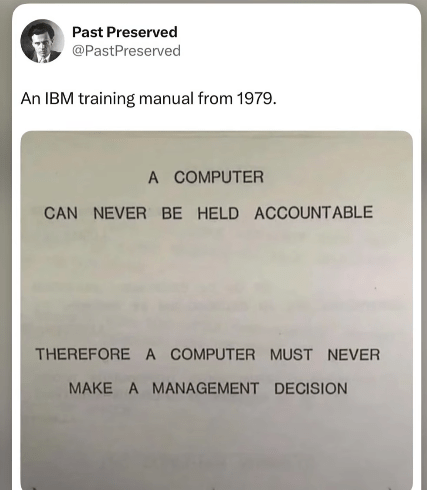
With regard to the above computer old training manual, I will edit it slightly to say-
‘A computer can never be held accountable. Therefore a computer must never make a doctrinal decision’.
Below, these are not real fruits. They are marzipan. They are fake. By their fruits you shall know them…



@the-end-time.org welcome to The Mold of Yancy …
LikeLike
For people who may not know what Mr Randall is referring to, The Mold of Yancey is a dystopian sci fi novel where an off-Earth colony has given rise to a totalitarian regime.
LikeLike