My favorite doctrines are Grace, followed by Providence.
Grace that is extended by our loving God is shocking and amazing and wonderful. I was saved later in life and I remember what it felt like to live a sinful life in rebellion against God. It was confusing and upsetting, most of the time.
I read a lot, and enjoyed historical books and the world’s myths. As I read books, all the world’s made-up gods were capricious or unloving or dismissive of humans. That seemed right to me. Even when I read of the Founding Fathers and learned about their deism, that god also seemed right to me. The deist god created everything – including humans – but then retreated from humankind’s affairs and let us wind down of our own accord.
Grace given by a loving God was foreign to me and unthinkable. Because that would mean He was involved with humans, lovingly. Weird.
But that and only that God is the one true God.
He came in the form of a baby who grew to be a man-God, teaching and loving and performing miracles. He died for our sins and absorbed the wrath of God on our behalf.
Amazing Grace! how sweet the sound
It was not a sweet sound to me then, but it is now.
That saved a wretch like me
I used to close my mouth if I happened to be at a Church service, like at Christmas, and this hymn came on. I wasn’t a wretch!, I’d utter. And close my mouth, refusing to say the lyrics.
I once was lost, but now am found
I didn’t know I was lost and I didn’t know I needed to be found.
Was blind but now I see
I didn’t know I was blind. Revelation 3:17 applies here:
For you say, I am rich, I have prospered, and I need nothing, not realizing that you are wretched, pitiable, poor, blind, and naked.
That the Lord of All would stoop to save a wretch like me, covered in mud and dwelling with the pigs, like the Prodigal, is amazing. That He would walk into Jerusalem, knowing the cries of Hosannah! would turn bloody and hateful a week later. That He went toward his kangaroo trials, his scourging, and his death, even death upon a cross, to save filthy sinners, is amazing. What grace!
Thank you Lord, for your grace!! How wonderful that even when we’ve been there 10,000 years, we’ve no less days to sing God’s praise than when we first begun. An eternity praising You is not enough, but what grace that I am able to do so in the first place.
Was blind but now I see…
Not by works of righteousness which we have done, but according to his mercy he saved us, by the washing of regeneration, and renewing of the Holy Ghost; Which he shed on us abundantly through Jesus Christ our Saviour; That being justified by his grace, we should be made heirs according to the hope of eternal life. (Titus 3:5-7)
We have a few weeks to go before we’re sprung and can go out to the world again. The President of the United States called a state of national emergency, and we are told by executive order here in Georgia to stay at home. We are not to go out except for necessary trips, and when we do, we are told to stay 6 feet apart from each other and to wear a face mask. This is due to the global pandemic COVID-19, which has struck almost all nations on earth after originating fin and escaping from China. Our school has been cancelled for the rest of the year and non-essential businesses are closed. We may not gather in person for church.
I wonder in ten years as I look back on this essay what I will think or feel. It is all so surreal right now, will seem to be a bad dream to me in the future? Something I look back on from heaven because I’ve died from the pandemic, natural causes, or have been raptured? Time will tell what God is doing through this, but we know for sure that “all things work together for good to them that love God, to them who are the called according to his purpose“. (Romans 8:28). Try changing “What is happening to me?” to “What is God doing? I can’t wait to see!”
Meanwhile, how many photographs can I take of the yard? The forced sheltering in place has sure stretched my creativity on shooting the same scenes over and over! How many books can I read? Should I worry that my reading list has turned grim?
Love in the Time of Cholera
One Hundred Years of Solitude
The Great Influenza
A Journal of the Plague Year
The Stand
The Bell Jar
Just kidding! Just kidding!! I’m actually reading Contagious Christian Living by Joel Beeke, Man Overboard! Jonah, by Sinclair Ferguson, and the biographical novel The Whisper of the River by Ferrol Sams.
This is a time where if you have been fed a diet of cotton candy, you are discovering about now that you have nothing to stand on. Has what you wrapped yourself with melted away at the first sign of trouble? If you have been fed a diet of meat and as everything is stripped away you see you are standing on the Rock, you are in good shape.
I hope you are doing well, staying healthy and sane in this topsy-turvy world. Here are a few links to peruse for your consideration-
We can be thankful in the providence of God to be living in a time when that [global deaths via black plague] doesn’t happen. And what we face now would be considered in comparison to that a very minor concern. And yet, because you have an entire world of people cut off from any eternal hope, everything becomes fearful to them. For those who do not know the Lord Jesus Christ, who have no true hope after death, it’s reasonable to fear, it’s reasonable to be concerned about death and because they face, as we know, divine judgment and eternal punishment.
RedeemTV, A ministry of Christian History Institute and Vision Video, has clean programs for your viewing. Free for now.
Darryl Dash has a point, we need more than tips if we’re going to make it through the next weeks. We need meat.
Ruth Clemence says ‘I am not stuck at home, I am safe at home.’ As a stay-at-home mom her routine hasn’t changed much, she shares 9 Truths that Quiet My Soul in Quarantine
Tim Challies shares how to Build Your Home Theological Library. I know I’ve found that during this downtime in the lockdown I have ‘shopped’ my own shelves and enjoyed reading books that I have wanted to read for a long time. I also have a stack ready to share with friends as they run out (and come get them from a safe social distance)
I’m very grateful to Jesus for all He does for me, undeserving as I am. The more I read His word, pray, and watch the Spirit’s work in me and the world, the more I am in awe of His holy Being. And David’s question is a good one. I ask it too, “what is man that you are mindful of him, and the son of man that you care for him?” Indeed?! Who am I? Yet He saves us, provides for us, teaches us, loves us, and so much more, despite our faltering and ridiculous fumbles. O Lord, you are loving! How wonderful will be the day when all will know your majestic name in all the earth!
LORD, our Lord,
how majestic is your name in all the earth!
You have set your glory above the heavens.
Out of the mouth of babies and infants,
you have established strength because of your foes,
to still the enemy and the avenger.
When I look at your heavens, the work of your fingers,
the moon and the stars, which you have set in place,
what is man that you are mindful of him,
and the son of man that you care for him?
Yet you have made him a little lower than the heavenly beings
and crowned him with glory and honor.
You have given him dominion over the works of your hands;
you have put all things under his feet,
all sheep and oxen,
and also the beasts of the field,
the birds of the heavens, and the fish of the sea,
whatever passes along the paths of the seas.
O LORD, our Lord,
how majestic is your name in all the earth!
Psalm 8
*This essay first appeared on The End Time in June 2012
How are you coping, my sisters? This is going on a while longer than we would like or hope, right? We received word yesterday from our Governor here in Georgia that school is closed for the rest of the year. Many people had an emotional reaction to that news, including me, so I wrote the essay The Grief of an Unsaid Goodbye, and then escaped to my bed for the night.
The extra time at home for many of us during this pandemic quarantine period is allowing for a more stress free, mind uncluttered, time to read the Bible. You night be venturing into uncharted waters, trying some of the books of the Old Testament for the first time. If you are, good for you! The foundations set in Genesis 1-11 are thrilling. The ‘severe compassion’ seen in Nahum is incredible, and who doesn’t love that big fish story of Jonah?
But admittedly, there are books of the Old Testament that are difficult to read for a variety of reasons. The constant woes and judgments of Jeremiah are emotionally hard to take. They were for Jeremiah, who cried fountains of tears until his eyes could produce no more, and then he wrote Lamentations! The prophetical denseness of Obadiah or Daniel are hard to follow, or the history of various nations and their old names in Chronicles makes for a lot of looking up in the atlas.
The Old Testament is filled with books of various genres. Though the Bible is one book, it contains many different genres of writing styles. There are books of prophecy, poetry, history, wisdom literature, and Law. If you’ve ever read the novel Moby-Dick, you know that that book contains switches from one genre to another. The Old Testament (and the New) are like that. So when you read an OT book of poetry like the Psalms there will be more imagery, a prophetical book will have more symbolism. History is straight history, though sometimes the timeline jumps around. You have to prepare your mind to read differently in different books. More on that below.
Genesis (the history of Creation, the fall, and God’s covenantal dealings with the patriarchs)
Exodus (the history of Israel’s liberation and formation as a nation)
Joshua (the history of the military conquest of the Promised Land)
Judges (Israel’s transition from a tribal federation to a monarchy)
1 Samuel (Israel’s emerging monarchy under Saul and David)
2 Samuel (David’s reign)
1 Kings (Solomon and the divided kingdom)
2 Kings (the fall of Israel)
Ezra (the Israelites’ return from exile)
Nehemiah (the restoration of Jerusalem)
Amos and Hosea (examples of minor prophets)
Jeremiah (an example of a major prophet)
Ecclesiastes (Wisdom Literature)
Psalms and Proverbs (Hebrew poetry)
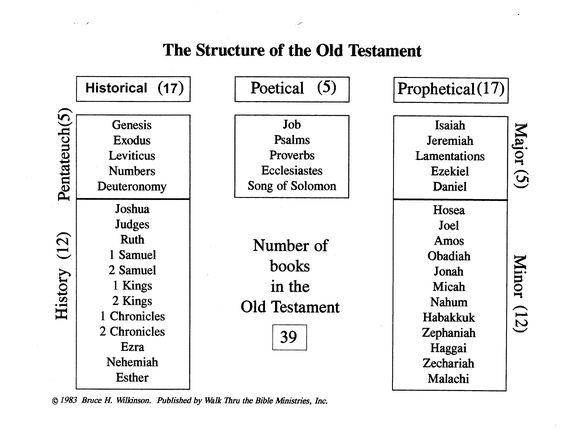
Here are the OT books divided by genre. This split-up is generally accepted. The Major vs. Minor prophets are not due to importance, but length.
Why is reading the Old Testament hard(er)?
First, because many churches today don’t preach from it. Congregants aren’t familiar with it.
Why does unfamiliarity of the text matter?
Ah, here’s where I explain about the mind and its ability to receive new genres or new types of information. It’s not your imagination and it’s not your lack of mental ability that sometimes people find reading the Old Testament a bit harder than the New. If you’ve ever tried to read a non-fiction book on a new subject, and you’re reading along and understanding the words themselves but can’t figure out the topic? Like, if you’ve picked up a biology book or a natural history book and you can parse each word but nothing is making sense overall?
It’s because we don’t have prior knowledge. Prior knowledge refers to all the knowledge of the world we have so far, cataloged in our memories.
Picture your brain like a bank of file cabinets. When you absorb something, your brain puts it in the file cabinet set up for that topic. There, the information you’ve just absorbed connects to information that’s already there. It’s like a ball of velcro floating through your brain, coming to settle and attach to other velcro balls in that file cabinet.
Comprehension, or understanding a text, involves constructing a relationship between what we already know about a topic and what is in the text. So your understanding, or comprehension, of a topic grows as you add more velcro balls to it. Picture a model of a molecule:
So comprehension involves drawing on prior knowledge, linking the new knowledge to the known, and classifying and organizing your new information.
Several things impact your ability to process new information. One is called concept density. When as a first or second grader and you read a lot of fiction books, there was a rhythm to it that you were familiar with. It began with once upon a time, introduced characters, presented a problem, worked through the problem, and resolved, usually with ‘happily ever after’ or some familiar ending. Reading fiction was like putting on an old blanket.
When you transitioned in 3rd grade to reading non-fiction, the rhythm, or schema, changed. There was no rhythm! Instead, you were given a lot of concepts right away, with no context. Something like, the subject of the Explorers in social studies, Magellan, Columbus, Drake, de Gama, Hudson, Vespucci…all at once and in short order. It was concept dense. Reading unfamiliar, concept dense texts is like wearing a hair shirt!
Add to that you were given lots of new vocabulary, all at once. Circumnavigate, passage, voyage, navigate, expedition, maroon, fleet, scurvy… phew. It’s a lot. With all the new information and all the unknown vocabulary, you have nothing to ‘hang your hat’ on so to speak. All this new information is floating in your brain as a velcro ball but it has no place to attach.
Talking about vocabulary and concept density, how about this example:
“There’s a bear in a plain wrapper doing flip-flops around the 77 and passing out green stamps.”
You likely know each word in that sentence individually, but as a whole? It doesn’t make sense. You understand how to read it mechanically but you can’t create meaning out of it unless you have prior knowledge of CB radios (concept) and trucker lingo (vocab).
That sentence means that there is a policeman in a plain car on Rt 77 driving up and down passing out tickets.
So is there hope for reading the Old Testament? Or the New, if you’re completely new to Christianity? Yes and for one huge reason.
The Holy Spirit. It’s His ministry of Illuminating the Bible to our minds. Here is the definition of illumination. (Please read this great article for what illumination is, and is not.)
Illumination is that ministry of the Holy Spirit whereby He develops in the believer a clearer understanding of, a stronger certainty in, a deeper love for, and a greater obedience to the meaning of the text of Scripture. Source
The Holy Spirit makes the Bible clear to us. Not perfectly, and it’s hard work, but the LORD didn’t inspire the scriptures and then trick us by making it too hard to understand. Mary was a young teenaged peasant girl who understood the Old Testament’s presentation of us as sinners and her need for a coming savior. (Luke 1:46).
The Reformers rebutted the Roman Catholic’s assertion that lay people couldn’t understand the Bible, saying “the Bible was clear enough for all believers to study and understand (the doctrine of the perspicuity of Scripture), and that the Holy Spirit was given equally to all who are born of God (the doctrine of the priesthood of all believers”). source.
There are two new vocabulary words for new concepts for you: Illumination and Perspicuity.
Here is an example of John the revelator attempting to put into words something completely new, in relating what he was seeing in the apocalyptic vision in the Book of Revelation. In this first set he makes a direct comparison that readers will understand because they can connect the new to the known. We all know what trumpets, furnaces, and emeralds are like:
a loud voice like a trumpet
The hair of His head was white like wool, as white as snow
His eyes were like a blazing fire
His feet were like polished bronze refined in a furnace
His voice was like the roar of many waters.
His face was like the sun shining at its brightest.
The One seated there looked like jasper and carnelian
a rainbow that gleamed like an emerald encircled the throne
In this second set, he tries to make a direct comparison but struggles, saying instead ‘something like’ because what he was trying to comprehend was SO out of the realm. Still, connecting the new to the known is possible, even with things in the Bible that are nearly incomprehensible:
And before the throne was something like a sea of glass, as clear as crystal
And I heard what sounded like a voice from among the four living creatures, saying…
something like a great mountain burning with fire was thrown into the sea.
And the locusts looked like horses prepared for battle, with something like crowns of gold on their heads
And I saw something like a sea of glass mixed with fire
Tips:
What you can do is, read the Old Testament! Pray before you begin, for help from the illuminating ministry of the Holy Spirit. Then just read. If you don’t understand, that is OK. If you ever lived or adventured where there is a lot of snow, you know the first time you walk through thigh-high snow it’s hard. You’re cutting the trail. The second time you benefit from the broken trail and it is easier.
That’s how it is with reading unfamiliar texts. You have to start somewhere, sometime. Cut the path. The things you don’t understand the first time you will gain a bit more clarity on the second, and so on. The more you tread the path, the more you will find your non-comprehension turning to comprehension.
Reading the Old Testament or even the New Testament is hard. It takes work. The Holy Spirit’s illuminating ministry doesn’t drop huge swathes of clarity to your mind as we sit there and go ‘Ohmmm’. We participate in our relationship with Christ by being diligent and studying the scriptures. Even Peter said there are things in the scriptures that are hard to understand. (2 Peter 3:16.) We won’t attain perfection but the sanctification process drives us ever forward in weaving a tapestry of understanding.
What to read? I’d suggest starting with Ruth or Jonah. Both are short and straightforward. Neither require a lot of knowledge of of history. Jonah can be paired with Nahum, which is the second part of the prophecy of Jonah, or, ‘what happened after’. If you read Ruth and the first 11 chapters of Luke you may see the similarities of the types being presented. Pairing some books is one way of connecting new to the known.
The entire Bible is inspired for our education, correction, and advancement of sanctification. All of it is profitable. (2 Timothy 3:16-17). So, go for it! Just read, plunge in and wade in the waters of truth and refreshment!
*Jesus came for God’s glory. (Hebrews 1:3). Jesus said this over and over. He came for us, of course, to seek and save the lost, but Jesus came to increase God’s glory. God is passionate about His glory, “I am the LORD, that is My name; I will not give My glory to another, Nor My praise to graven images.” (Isaiah 42:8)
God’s glory is increased when He redeems sinful man to Himself. It is the single greatest act of a Holy God. Redeeming. Sinful. Man. THAT is the expression of His highest glory in the most glorious act, and that His Son would incarnate (not just for 33 years, but forever) and live a human life and die a horrendous death, and in between would seek God’s glory at every moment. This is something admirable to ponder.
Philippians 4:8 – “Finally, brothers, whatever is true, whatever is noble, whatever is right, whatever is pure, whatever is lovely, whatever is admirable—if anything is excellent or praiseworthy—think about such things.”
Think on the admirable things.
1 Corinthians 10:31 – “Whether therefore ye eat, or drink, or whatsoever ye do, do all to the glory of God.” This verse is saying that even if we are not missionaries leading thousands to Christ, even if we are not fiery preachers speaking before thousands, even if we are not teachers publishing hundreds of books, we, the small and mundane, should do everything we do for the glory of God. The small tasks, the routine, the everyday, are glorious to Him if performed with Him in mind as the utmost audience. Do all with an awareness that you are doing it for God. And it will be a fragrant aroma unto Him.
“and walk in love, just as Christ also loved you and gave Himself up for us, an offering and a sacrifice to God as a fragrant aroma.” (Ephesians 5:2).
So think on the admirable things.
*A version of this post first appeared on The End Time in 2011
I love to join Tim Challies’ Christian Reading Challenge every year, despite the fact that I usually fail and then end up hating myself, lol.
I usually choose the ‘Avid Level’, which is a book every two weeks, or 26 books per year. I start to stall out early on, arriving home after a demanding day at school pretty tired, and after devotions and Bible reading, and writing the blog, it’s time for bed, which seems to come earlier and earlier with each passing year.
My eyes are getting older too, and weakening, according to the Doctor, so there’s that.
Anyway, with this quarantine happening and the forced stay-at-home mandate, I have been reading. I have lots of time to read. If I didn’t read, there would be indisputable proof that I have turned into a non-reader, despite having enjoyed that activity all my life. So there’s that. Continue reading “Book Review: The Rain”→
Writing in the mid-1500s, John Foxe was living in the midst of intense religious persecution at the hands of the dominant Roman Catholic Church. In graphic detail, he offers accounts of Christians being martyred for their belief in Jesus Christ, describing how God gave them extraordinary courage and stamina to endure unthinkable torture.
From the same link, the book’s purpose was fourfold:
Showcase the courage of true believers who have willingly taken a stand for Jesus Christ throughout the ages, even if it meant death,
Demonstrate the grace of God in the lives of those martyred for their faith,
Expose the ruthlessness of religious and political leaders as they sought to suppress those with differing beliefs,
Celebrate the courage of those who risked their lives to translate the Bible into the common language of the people.
Paul
The Apostle Paul was imprisoned in Rome in AD 61. and there wrote his prison Epistles: Ephesians, Philippians, and Colossians. His imprisonment ended approximately three years later during the year that Rome burned, which was in May AD 64. (See Acts 28:30). During his brief freedom, Paul may have visited western and eastern Europe and Asia Minor- he also wrote the first Epistle to Timothy and his Epistle to Titus.
At first, Nero was blamed for setting fire to Rome, so to direct the blame away from himself, he blamed the Christians. As a result, a fierce persecution broke out against them. During it, Paul was arrested and put back into prison in Rome. While in prison this second time he wrote his second letter to Timothy. It was his last.
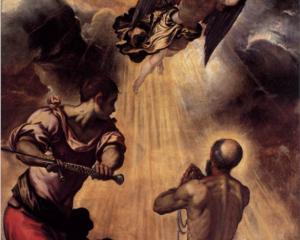
Not long after, he was judged guilty of crimes against the Emperor and condemned to death. He was taken to the execution block and beheaded. It was AD 66, just four years before Jerusalem fell.
The Martyrdom of Paul – Tintoretto, c.1556
*This essay first appeared on The End Time in June 2013
I have worked in a school almost exclusively my entire adult professional life. I was a teacher, a daily substitute, a long-term substitute, and now I’m a teacher’s aide.
I love kids very much. They are my favorite people. I love how they are so open, and loving, and funny. I love their quirks, and their knock-knock jokes, and their earnest attempts to please. I love how when they arrive at school they’re all dressed and combed and tucked in. By the end of the day they’re a wreck, ketchup stains on the shirt, shoes untied, hair bow gone, things spilling out of unzipped backpack as they plod to the door at car riders. Life hits little kids hard.
I love helping them in any way throughout the day. When a friend hurts their feelings, I cheer them when they cry. To see that smile break through is heart-melting. When they struggle with tying their shoe, or can’t open a mustard pack at lunch, or when the door is too heavy, I can help them. When they need help sounding out a word or adding some numbers, I can help them. I can smooth their path throughout the day, in big or little ways, as they contend with all the little-kid obstacles in front of them.
After the two-week Christmas break or on the first day of school, when we haven’t seen our kids for a long while, it’s exciting to be reunited.
They come thru the door from the car or the bus, down the long hallway, and they spot us on duty. They start running. They throw themselves full bore around our waist and fling their arms around us. We hug back, and look down into their little faces, smiling ear to ear. “I love you!” “I missed you!” we say. We bend down to hear all their little stories about the puppy they got or the tooth they lost. Hugs pile-up as the momentum of the kids streaming back into the school increases, and we love it. We eagerly look down the hall to see the next child come through the door, listening for the door squeak to know it’s opening again. The relief we feel when we see they are safe and happy and back in our school again is a precious feeling.
When the National Emergency due to the COVID-19 pandemic was declared, it was a surprise. The kids left school on a Thursday in advance of a three-day weekend due to Friday being a Teacher Work Day. But then the leaders decided to close school for disinfecting and to comply with guidelines for no gathering, so as not to spread the virus. We’d said goodbye on Thursday like usual, but then it felt like we fell off a cliff. We took for granted that we would see them again a few days later. We cling to the school year calendar as a given, in cement. But it wasn’t. For the first time, it was an unexpected closure, and not for a snow day.
Had we known we would not see our children for over a month, would we have given a more fervent goodbye? Looked a little longer in their eyes as we said ‘see you later!’ Hugged them a little tighter? We have regrets. We can’t wait to see them again.
One thing that is common to all of us educators and bus drivers is that we MISS THE KIDS. We long for the day when we are reunited and see their little smiles and know they are back into a routine. Kids thrive on routine. We want them to thrive and learn, and know they are loved by the other adults in their life.
OK, all this earnest emotion and angst and feels is for a reason. If we who work with children feel so eager to see ‘our kids’ again, imagine how Jesus feels. He is a Father, waiting to reunite with his children. He is a Teacher, we are His kids, and He is longing to see us, be with us.
In Matthew 23:37 Jesus lamented over Jerusalem, saying He had longed to gather His children together as a hen gathers her brood under her wings..
The Bridegroom anticipates His bride,
For as a young man marries a young woman, so shall your sons marry you, and as the bridegroom rejoices over the bride, so shall your God rejoice over you. (Isaiah 62:5).
He is waiting for us until that time, (Hebrews 10:13). He is expectantly waiting for the Father to say ‘go get your Bride’. And when God does, the picture of the Father in the parable of the Prodigal Son comes to mind,
But while he was still a long way off, his father saw him and felt compassion, and ran and embraced him and kissed him. (Luke 15:20).
He runs to us.
He is going to rejoice over us with gladness; He will quiet us by His love; He will exult over us with loud singing. (Zephaniah 3:17; Isaiah 62:5; Jeremiah 32:41).
No matter how lonely you feel in your place during this isolation time, remember that as much as you long to see your adult kids, grandkids, colleagues, extended family, students…Jesus longs to see you even more! He anticipates that great reunion, when we will look up into His face as the children we are, and eagerly tell Him of our lost tooth or our new puppy, and He indulgently has all the time in the world to listen, love, and be with us.
The introduction will be a bit long. This is for two reasons. In case the reader is not familiar with the movement of IF:Gathering, and also for the reason I’ll state in the conclusion.
Introduction
Jennie Allen, founder of IF:Gathering, and Beth Moore, founder of Living Proof Ministries, recently sat together in Jennie’s living room and recorded their conversation about Jesus, trials, and living out their passion for God. Jennie assured viewers at the opening of the video the in-person sit-down occurred prior to the mandated stay-at-home quarantine. The one-hour discussion was posted at the IF:Gathering’s niche inside the RightNow media host of streaming Bible studies.
Jennie Allen introducing IF:TV
IF:Gathering is a digital para-church ‘discipling’ movement founded by Jennie Allen in 2014 after she heard, in her words, “a voice from the sky” that instructed her to “gather and equip this generation.” The first conference was held in 2014.
That initial conference was touted mainly on digital media with a vague motto, “If God is real, then what?” with no speakers announced. Interest was sparked on Christian blogs, other social media, and word of mouth. This digital approach worked- the initial conference sold out in 42 minutes, surprising organizers, so digital-savvy founders quickly set up local watch parties across the U.S. and 22 other countries to allow for participation via simulcast.
Reportedly, over 40,000 people watched and 1200 attended in person, and the hashtag #IFGathering trended to the top on Twitter. Initial speakers of this below-the-radar movement busy gathering and equipping your women were Allen, of course, Ann Voskamp, Christine Caine, Shelley Giglio and Jen Hatmaker. Original advisers to Allen and other leaders in the of the corporation were Christine Caine, Shelley Giglio, and Debbie Eaton- all women.
Six years later, the corporation is a 501(c)3 non-profit with recent revenues standing at 3.6 million dollars (but net assets of half a million). Their stated goal for the annual conference held in Austin at that time, was, “If Austin: a two-day gathering that brought thousands of women together in Austin and at local gatherings across the globe. The gathering is a fresh, deep, honest space for a new generation of women to wrestle with the essential question: if God is real… Then what?” and for the rest of the year, “If Equip: a holistic, strategic, deep way to connect online with a like-hearted community and relevant resources. We hope to prepare women around the world to know God more deeply and to live out their purposes by sharing comments and feelings about daily passages posted online”.
Thus, If Equip is centered around local gatherings studying IF-written devotionals and discussing their feelings about the verses outside of the church and apart from pastoral oversight.
The movement is ecumenical, not mentioning any particular denominations specifically but stressing that women “from different traditions” or “different camps” are welcome “for the sake of unity.”
Webinar
Jennie opened the Webinar conversation by relating a story of her earliest memory of meeting Beth Moore. It was early days, Jennie said, she was in college and Beth had just started. She said she wept hard during Moore’s talk to about 300 women, because she connected with the passion and love for Jesus that Moore displayed. Allen said it was a relief to meet someone who felt the same way about Jesus that she did. As that long-ago event concluded, Allen approached Moore and stated that she felt about ministry like Moore does. Moore put her hands on both Jennie’s shoulders and proclaimed, “I affirm that calling of God in your life. Now go and learn your Bible.”
The webinar conversation published this week began with Moore talking of the importance of fulfilling one’s gifting to communicate, if that is the gifting, but on a larger scale for women to find traction in their walk of faith. “Fulfilling that place that God has for them. I believe with all my heart Jennie that we really get into the momentary that seasonal place God wants us to be,” Moore said.
Jennie shared that she worries that the generation coming up has made an idol out of their phones and digital life. (?! A startling admission from the founder of a movement whose promotion and existence is almost entirely digital.)
Jennie asked Moore how do we do ministry well. Moore answered that “it’s much more compelling that it’s harder than ever. That we have taken out everything so seeker friendly, fun, and comfortable, that we have taken out everything that is compelling. Are we ready to come forward and die? What is worth it to them to give everything?”
Jennie affirmed that the enemy is ‘getting us’ through distraction, numbness, and comfort. That said, how does Moore choose to follow Jesus in a better way and not get distracted? (and not too comfortable was tacitly hanging in the air). Moore said that it’s Jesus Himself that is the reason she is ‘still in it.’ She is still extremely interested in Him and is still extremely compelled by him, and mesmerized by him, and that is the reason she is still ‘willing to take the risk.’ In this numb, drunken sloppy culture that’s lulling us into self fulfillment Moore said, she is still willing to lose herself to find herself, to do the opposite of what the culture and even the Christian culture is asking us to do.
Moore stated the obvious, that women in other cultures might not have what we have, noting that they were sitting on a couch and many other women don’t even have that. “We’re not suggesting we don’t have those things, but…” and continued.
I’d like to insert here, in the discussion about ministry v. comfort, that Moore owns 4 homes, one is a ranch in Menard TX, and another more than a three-quarters of a million dollar home on a rare double waterfront lot on Galveston Bay, complete with private dock and a boat. She flies private jet to venues, a perk for which Lifeway pays half and her own ministry pays the other half. Moore’s salary is a quarter of a million dollars. She is more than comfortable. Allen herself is a successful multi-book author and is at this moment on a book tour for her latest book. Also, please don’t forget that last year Moore was asked a very simple question, whether she believes homosexuality is a sin, and Moore refused to answer. This in my opinion contradicts her statement that Moore is willing to be counter-cultural and take a risk in ministry.
Jennie asked Moore about finishing well after “so many years” in the ministry. Moore said, and I’m quoting,
“I’ve told Him, I said if you give me presence of mind in my last moments, I want to see my, in this order, my grandkids, then I want to be with my daughters, then I’d like to be with my husband, then let me have 30 seconds where I’m aware before I go home, and let me be able to say to Him, ‘I’ve had the biggest blast with you. In the midst of so much crap, yeah, I’ve had this insane adventure with him.”
Jennie asked about retiring. Moore’s reply was that she wanted to do what Jesus asks her to do, whether public or private, and if it’s private she is ready for that. But she also said she does not want to succumb to a failure due to spiritual warfare.
Their conversation ranged from there to the dark night of the soul, in which Jennie shared that she is deathly afraid of the dark and shared that she had an 18-months season of doubt so severe she thought she would lose her faith completely. They spoke of persevering, fame, impact in ministry, promoted each of their new books, fruitfulness, and generally continued in this manner with Allen asking and Moore answering, for the rest of the hour.
Review/Impressions
The conversation was genteel and wide-ranging. Allen asked Moore questions of ministry and Christian life, and remained quiet, allowing Moore to answer expansively. For this reason, I noticed that Moore’s answers were more disorganized than usual. She answered in circular fashion, interrupting herself, inserting parenthetical comments, and occasionally even losing her train of thought. I also noticed that Moore’s answers were vague than ever. It seemed like she was being extraordinary careful with her answers. As casual as the conversation was, Moore was picking and choosing the most high-emotion but most drained of meaning words she could. Here is one example. It does not make sense,
“I believe with all my heart Jennie that we really get into the momentary that seasonal place God wants us to be.”
By contrast, Jennie Allen seemed sincere and eager. She was like a puppy looking up to her idol, and bounding from one topic to another with joy and a delight that was endearing. I was affected when she shared the depth to which she dislikes the dark and really felt empathy when she described her season of doubt.
Nevertheless, it saddens me to see the pairing of the two women, who talk of handing the reins to new generations, because both do not teach rightly. Yet both combined have a digital footprint and a resulting following of millions. I am talking millions. As an aside, Joyce Meyer is 76, Beth Moore is 61, Christine Caine, who claims Meyer as her ‘spiritual mother’ is 53, and Allen, who idolizes Moore, is 41. They have sparked generations of women all the way down the line, as influencers but went more and more unorthodox, as this insightful article unintentionally makes the point of, the rise of the female influencers. Who will be the next influencer coming up the ranks? Who is Allen influencing?
I am against Allen’s IF movement specifically because it draws women away from their home churches and creates a ‘community’ based on feelings about the Bible and not the theology of the Bible. I am against its main premise, “IF God is real”. I am against it because it seems not to have any male oversight. (Though Allen’s husband Zac is on the corporate board now). I am also against it because IF’s self-stated emphasis on social justice and spiritual formation.
I am against their secretiveness. They aren’t secretive as in dastardly, but secretive as savvy protectors of their digital content. Being mainly digital, they’re fiercely protective of their content behind their paywalls. They also don’t post a list of scheduled speakers before the annual gathering. You must buy the ticket based on the concept, not the speakers. To me this is backward, you want to know whose content you will be absorbing, and not blindly ingest. This is likely the reason many pastors are unaware of the influence from this movement on their women.
The Big Announcement
Jennie Allen’s organization sent out a follow up to the webinar announcing that since the quarantine time has hit, they wanted to help. So they developed IF:TV. Allen said in her announcement video,
We have a new dream. It’s called IF:TV. Because, what we’re good at is coming to you with content, with experiences around God, bringing together your people, while you’re in your pajamas! It’s our expertise.
The first IF:TV program is called MADE FOR THIS- Live with Jennie Allen. Beginning Wednesday, April 1st at 7pm CT I’m going to share the stories we need right now and have some fun! We’ll have a free resource each week to work through with your people from afar!
The second IF:TV show will be THE BEST OF IF:GATHERING -Your Favorite Messages, Beginning Friday, April 3rd at 12pm CT, Features some of your favorite moments from IF:Gathering over the years. We’ll give you conversation cards to start convos with your people.
Allen’s sincerity is evident and her joy seems boundless and undiminished after several years of nurturing her movement and corporation along. I give her that. It is true that given their shrewdness in managing content through digital media they are more prepared than most to share what they have to offer on their various platforms via a screen during this coronavirus time. But that, as we know, is not the church. Yet IF:Gathering now has another digital platform on which to send out their poorly constructed Bible studies and false conclusions.
Because their main thrust is digital, they capitalize on a well-known phenomenon called Fear of Missing Out (FOMO). Wikipedia describes it as
a pervasive apprehension that others might be having rewarding experiences from which one is absent”. This social anxiety is characterized by “a desire to stay continually connected with what others are doing”.
Their promotions usually include tantalizing phrases such as ‘don’t miss out’ or ‘be the first to sign up’ or ‘get early access’, ‘be the first to know’, or ‘want to learn more? sign up below!’ In my opinion they trade, probably unwittingly, on the FOMO many younger people deal with these days.
I agree with Carol Coppens’ assessment of Jennie Allen here expressed in her review of Allen’s 2018 book Anything: The Prayer that Unlocked My God and My Soul at Michelle Lesley’s website-
This is not a book that will help you to dive deep into the character of God and to know Him better but instead, Jennie’s book is a tedious, self absorbed, experience driven, hermeneutically unsound, over-stepper of scriptural boundaries, mish-mash of emotionalism and repetitive “wrecked-ness”.
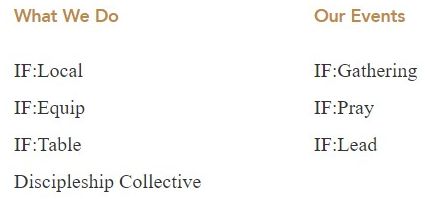
Conclusion
In the research I’ve done in listening to Jennie Allen’s speeches and interviews, such as the above webinar, my opinion is the same as Ms Coppens’. Bad hermeneutics, drawing away from the local church, emotionalism, and not to mention Allen’s “voice from the sky” that directed her to found the corporation and audibly delivered the motto. The entire movement is founded on doubt, which they elevate to an exalted position, as many post-modernists do. As Phil Johnson said, emergents often “doubt seeking justification”. Please avoid IF:Gathering, IF:Equip, IF:TV and all the other IF’s, which have grown tremendously since 2014, as you see below from their website.