Posted in bible reading plan, Uncategorized

Bible Reading Plan thoughts: The LORD hardened their heart and killed them all

For it was the Lord’s doing to harden their hearts that they should come against Israel in battle, in order that they should be devoted to destruction and should receive no mercy but be destroyed, just as the Lord commanded Moses. (Joshua 11:20).

The Bible Reading Plan passage for today is Joshua 11-15. I read and re-read this verse from chapter 11. It’s a hard passage. It’s Old Testament passages like these where God gets his stern and tyrant reputation.

The John MacArthur Study Bible helps here:

God turned the Canannites’ hearts to fight in order that Israel might be his judging instrument to destroy them. They were willfully guilty of rejecting the true God with consequent great wickedness, and were as fit to remain in the land as vomit spewed out of the mouth (Leviticus 18:24-25).

Individual and national sin is a serious offense against God. RC Sproul called it cosmic treason. And for all that, God is patient. He waited 400 years for the Amorites’ sin to come to full measure. (Genesis 15:16). He gave the false prophetess Jezebel who was teaching his children sexual immorality and eating food sacrificed to idols time to repent. (Revelation 2:21). Whether it is an individual person or a national sin, He is patient. It is said in 2 Peter 3:9 that God is not willing that anyone should perish, but that all should come to repentance. This is the same God. He is immutable, unchangeable, the same yesterday, today, and forever.

His patience and willingness to give time to repent does not mean that he will forget His promise to deal with sin. Sin is a crime and all crimes have punishments. For the Canaanites, that day eventually came, and they were judged for their cosmic treason.

Our God is in the heavens; he does all that he pleases. (Psalm 115:3).

tues cracked and hardened.jpg

Posted in prophecy, Uncategorized

Bible reading Plan thoughts: The First Mourning

Our Bible Reading Plan for today includes a text from Genesis 4.  The first murder- Cain killed his brother Abel. Yesterday we read that “all have sinned and fallen short of the glory of God” and this has been true of all humans ever born or made, including Adam and Eve, with the sole exception of Jesus. The wages of sin is death.

Shortly after the Fall, we see all the sins begin to rear their head; lying, blame, guilt, jealousy, rebellion, and murder. Cain did not fear God. He argued with God and was irreverent with Him. “Am I my brother’s keeper?” Soon after, he killed his brother.

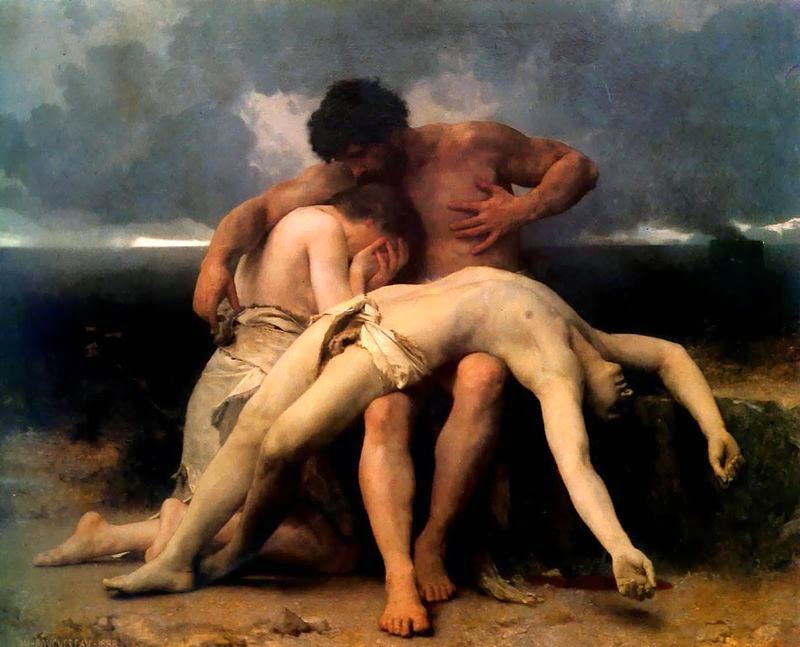
A scene which is not in the Bible but must have happened, was depicted in the painting called The First Mourning (Adam and Eve mourn the death of Abel); oil on canvas 1888 by William-Adolphe Bouguereau. Here it is:
800px-Bouguereau-The_First_Mourning-1888
God had said when He told the First Parents not to eat of the fruit that on the day they eat of it they shall surely die. They did die, spiritually. Their physical death took place many years later. Adam lived over 900 years. That is a long time to remember. Eve, the mother of all the living, was now the mother of the first to die.

When they discovered the body of their son lying lifeless on the ground, they must have mourned. They knew what death was, since God had killed an animal and given them its skins to wear for clothing. They must have killed animals in order to eat, since having been thrown out of the Garden. Abel was a keeper of sheep. Their death was graciously staved off, but their son! O, their son! Their original sin comes back to haunt them in a devastating way. I wrote about this scene in 2014:

We know both of them were familiar with death. Their spiritual life died the moment they disobeyed (“surely you won’t die” the serpent lied in Genesis 3:4). They were familiar with death because God killed the first animal to make clothing out of its skin (the first sacrifice to cover them in their sin). We know they must have killed an animal themselves because they had to eat.

And then…the blood of their son. The Bible does not record the discovery of Abel’s body, nor his burial (as far as I know). But perhaps the scene looked like the one above.

Oh, the searing pain of losing a son! A pain that would be replicated again and again through history as sin took its toll on a million mothers in epochs to come! A grief that the Father Himself would know soon enough!!

The first death was of a beloved son.

The last death was of a beloved Son.

Praise our Holy Savior for His death, for through Him we have life! Praise our Resurrected Savior for vanquishing sin!

Posted in Uncategorized

Bible Reading Plan thoughts: All have sinned and fall short

romans 3 sunday

(Bible Reading Plan for Sunday is Romans 3-4).

Romans 3:23 is a familiar verse to us. For all its familiarity, don’t let it skim in and out of your mind as you read.

for all have sinned and fall short of the glory of God,

All.

Even you.

Especially me.

Genesis 6:5 says that

The Lord saw that the wickedness of man was great in the earth, and that every intention of the thoughts of his heart was only evil continually.

This verse doesn’t stand for just that pre-deluge time. (antediluvian). It’s for all time. As then, now people now live in a time of great wickedness, their hearts’ every intention thinking evil, all the time. That is the natural state of unsaved man. For saved man, it’s the natural state we resist against, with the aid of the indwelling Holy Spirit.

So, all have sinned and fallen short.

The Strong’s definition for the word fallen short is:

5302 /hysteréō (“failing to fulfill a goal”) means to be in lack and hence, unable to meet the need at hand because depleted (“all run out”). This state of lack (insufficiency, privation) naturally results when a person misses out on what is vital.

I grew up during the time when American stunt performer Evel Knieval was active. He was a guy in a Captain America-type suit who would line up a zillion semi-trucks and go really fast on a motorcycle and jump them. He was always jumping something. Of course, being a daredevil stunt performer, his feats had to become increasingly daring to keep his audience.

In 1974 he decided he wanted to jump the Snake River Canyon. This is a 1600 foot jump. A motorcycle can’t jump that far so Knieval invented a ‘sky-cycle.’ His contraption was a bucket seat attached to a steam-powered thrust engine. Knieval attempted the jump in August 1974. He fell short. The parachute accidentally deployed and the sky-cycle was dragged by winds back to the launch site.

knieval 2
Sports Illustrated photo
knieval
Sports Illustrated photo

We all fall short, all the time. If we think our Bible reading will get us into heaven, it won’t. If we think our good deeds will get us in, they won’t. If we think our donations and charity will get us in, they will not. God’s glory is so far and so high, there is nothing we can do to arrive into His light and dwell there. Our sin prevents it. We are unrighteous.

Fortunately, Jesus came to live, die as the perfect sacrificial sacrifice for sin, and be resurrected. His cross bridges that gap. We don’t have to strive, construct contraptions to get across, or worry if our own merits and good works are enough. Jesus is enough. If we are in Him, we will never fall short- because He didn’t.

But now the righteousness of God has been manifested apart from the law, although the Law and the Prophets bear witness to it— the righteousness of God through faith in Jesus Christ for all who believe
. (Romans 3:21-22)

Posted in encouragement, Uncategorized

Thirty Days of Jesus: Day 26, Jesus’ sinlessness

This section of verses that show Jesus’ life are focused on His attributes & earthly ministry. We’ve seen Him as servant, teacher, shepherd, intercessor, and healer. We looked at His attributes of omniscience, His authority, and now His sinlessness.

thirty daysof jesus 26

~~~~~~~~~~~~~~~~~~~~

Further Reading:

The Cripplegate/Nate Busenitz: In what way was Jesus ‘made sin’ on the cross?

GotQuestions: Why does Christ’s righteousness need to be imputed to us?

~~~~~~~~~~~~~~~~~~~~

Thirty Days of Jesus Series-

Introduction/Background
Day 1: The Virgin shall conceive
Day 2: A shoot from Jesse
Day 3: God sent His Son in the fullness of time
Day 4:  Marry her, she will bear a Son

Day 5: The Babe has arrived!
Day 6: The Glory of Jesus
Day 7: Magi seek the Child
Day 8: The Magi offer gifts & worship
Day 9: The Child Grew
Day 10: The boy Jesus at the Temple
Day 11: He was Obedient!
Day 12: The Son!
Day 13: God is pleased with His Son
Day 14: Propitiation
Day 15: The gift of eternal life
Day 16: Two Kingdoms
Day 17: Jesus’ Preeminence
Day 18: Jesus is highest king
Day 19: Jesus emptied Himself
Day 20: Jesus as Teacher
Day 21: Jesus as Shepherd
Day 22, Jesus as Intercessor

Day 23: Jesus as Compassionate Healer
Day 24: Jesus as Omniscient
Day 25: Jesus’ authority


Posted in prophecy, Uncategorized

Pleading for a reduced charge

People who are unsaved have a list of charges against them. These are the sins (crimes) they have committed against Jesus during their lifetime. At the end of time, Jesus will assemble all the unsaved and judge them. The judgment is not whether or not they will be going to heaven or hell. The one and only standard against which people are judged is whether they believed in the Son.

They will be judged on their crimes. God keeps track.

And I saw the dead, great and small, standing before the throne, and books were opened. Then another book was opened, which is the book of life. And the dead were judged by what was written in the books, according to what they had done. (Revelation 20:12).

For the Son of Man will come in His Father’s glory with His angels, and then He will repay each one according to what he has done. (Matthew 16:27)

This is not just a New Testament concept. It is in the Old Testament too, seen in the eschatological book of Daniel.

A river of fire was flowing And coming out from before Him; Thousands upon thousands were attending Him, And myriads upon myriads were standing before Him; The court sat, And the books were opened. (Daniel 7:10).

Unsaved people are judged according to their deeds they did in life, and their words, and their thoughts. (Luke 8:17, Romans 2:16, Matthew 12:37).

The sea gave up its dead, and Death and Hades gave up their dead, and each one was judged according to his deeds. (Revelation 20:13).

John MacArthur said of this verse,

The record, by the way, for each person will be unique and so will the punishment. That’s an important thing to think about. Hell is not like some great big hole where everybody gets thrown into the same place with the same level of torment. No. Every person’s life will be evaluated uniquely and every person’s punishment will be consistent with that unique evaluation.
For example, and I need to explain this cause it’s very important to understand there are degrees of punishment consistent with degrees of sinfulness. … So there is a more and a less tolerable punishment, fitting the level of sin.

Knowing this, all this foundation I just laid, that we’re judged on our deeds, thoughts, and words, and that the punishment corresponds in relativity to other how many crimes they committed, let’s turn now to two other verses.

And falling to his knees he cried out with a loud voice, “Lord, do not hold this sin against them.” And when he had said this, he fell asleep. (Acts 7:60).

Then Jesus said, “Father, forgive them, for they do not know what they are doing.” And they divided up His garments by casting lots. (Luke 23:34).

What does this mean? I’m sorry that after looking at the scriptures and many commentaries, I do not have an answer. I don’t know how this plea turns out in the heavenlies. But my thoughts are, if punishment is relative, and if we plead with God to forgive a sinner’s sin against us, would He remove that sin from their charge, reducing the severity of the punishment by a jot or a tittle? Stephen prayed so. Jesus did as well. It’s worth thinking about.

You’ve heard, no doubt, in the earthly judicial system about a reduced charge. You’ve seen lawyers on TV plea bargaining and listing the charges and then the judge might decide to remove a charge or two and the person serves a sentence with a lesser degree of punishment. There legal terms are familiar to to you.

Recently the adult son of a well-known theologian-pastor was charged with two felonies and two misdemeanors. When it came time for sentencing they decided to forego a trial. The judge wiped one felony and two misdemeanors from the list of this man’s charges and the man was only charged with one misdemeanor. He’s serving 18 months of probation and no jail time. Some charges were removed and thus the punishment was lessened.

Jesus commanded in the Lord’s prayer to forgive those who trespass against us. Is it too bold to plea that He remove the charge of those who trespassed against us from their list of crimes thus lessening their punishment? Stephen did not think it too bold. Does God actually do so if we pray it? I do not know.

I do know that when I pray for my enemies, and specifically for God to remove the charge of their crimes against me from the list of crimes which we know are ultimately perpetrated against Him, it is a prayer of grace and humility that changes me.

Do nothing from selfish ambition or conceit, but in humility count others more significant than yourselves. (Philippians 4:3).

Can I forgive as God asked us to forgive? Can I pray this as Stephen had? If I think of others more highly than myself, I will.

Gill’s Exposition says of the Acts 7 verse and Stephen:

Lord, lay not this sin to their charge: do not impute it to them, or place it to their account; let it not rise and stand in judgment against them, or they be condemned for it; grant them forgiveness for it, and for every other sin: there is a great deal of likeness between Christ and this first martyr of his at their deaths; Christ committed his Spirit into the hands of his Father, and Stephen commits his into the hands of Christ; both prayed for forgiveness for their enemies; and both cried with a loud voice before they expired; for so it follows here,

Pray for your enemies, for those who have done you wrong. God will dole out the punishment as He wills, the Lord knows, I do not know. But meanwhile, we grow in grace when we think of others more highly than ourselves, even our enemies, and plead with the Lord to remove this charge from their list of deeds and not hold it against them.

angel lamb's book of life

Posted in discernment, Uncategorized

Homosexuality is still a sin, despite plaudits for the scene in #Victoria

I’ve been watching the TV series Victoria, a series about Queen Victoria and her monarchy. It’s fictionalized, but with episodes focusing on actual historical incidents. The reviews seem to render it historically accurate for the most part. There are a few minor things that aren’t exactly correct, and some things they collapsed in time or for effect. However, there is one scene which, well, isn’t accurate at all.

The homosexual community had heard that season 2 of the series was going to feature a gay sub-story. The LGBTQ’s were happy about this. As it happened, Lord Alfred Paget and Edward Drummond (Prime Minister Robert Peel’s private secretary) have been depicted all season as two men attracted to each other, with longing looks across drawing rooms, yearning among the manicured gardens, loaded innuendo, and sly smiles. The tension between the two men had been building until they exploded into a kiss while ambling along a pond shore.

Sadly, many tweets and messages along these lines emerged afterward:

Source Radio Times

The scene to which I refer today is the one afterward with the Lady in Waiting Duchess of Buccleuch, played by a historically inaccurate 79 year old Diana Rigg (the real Duchess was only 8 years older than the Queen, not 50-plus years.)

Spoiler…

In history, there was an assassination attempt on PM Peel’s life. Peel’s secretary Drummond really was shot by a bullet meant for Peel. He died five days later at home, not instantly as the show depicted. In the show, Drummond heroically leaped in front of the Peel, shoving him aside and saving his life. Creative license for dramatic tension, that’s OK. But Paget was left bereft that his blossoming love affair with Drummond was cut quite short. When the Duchess received the news of Drummond’s sacrificial death, she called for Paget and brought him into a private drawing room. She compassionately told him the news about Drummond’s death. Then she gave sage advice about hiding his grief from the mother and the fiance at the funeral. “They must be the chief mourners”, she said.

The Duchess said with care and concern in her eyes that she may be old but she is not blind, and had seen how the two looked at each other.

This is anachronistic. The British attitude toward homosexuality was that it was repulsive and reprehensible, and a threat to family life. It was immoral, as encapsulated in the various laws that were not eventually repealed in all corners of the United Kingdom until 1992. They even coined a term for it, “The Love That Dare Not Speak Its Name.”

Laws for society combatting same sex relations have dated back to the sixteenth century (Upchurch 14), and much of British society deemed homosexuality as ‘the worst of crimes’ (Upchurch 49). This unspeakable act threatened the stability of Victorian society (Brady 46) so much so that a homosexual identity did not exist in this era (Brady 17). This does not mean that British citizens did not know the characteristics of these types of men, and they had a great distaste for them (Brady 11) during the nineteenth century (Upchurch 13).
Many believed that one could not be moral and have these sexual relations (Upchurch 16), and for this reason homosexuality was the most problematic issue facing British society (Upchurch 16). For this fundamentally British society, it was embarrassing to speak of this sexual issue (O’Connor 112). If it was a wildly spoken of topic, the structure of society would ‘have been shaken at its foundations (Brady 1-2; Brady 24). Source

So a Duchess cooing and comforting a young man devastated at the loss of a homosexual lover would never have occurred, partly because such things were never discussed, and partly because such a co-ed discussion would be considered uncouth.

These modern-day attitudes inserted into historical dramas are a problem. They might make certain powerful lobbies happy, but they aren’t an accurate window of the general attitude of the times. Once we see these kind of anachronistic attitudes often enough, we might start to believe the propaganda.

Though homosexuality has been with us since after the Fall, it might be good to look at what the Bible says about it, rather than listening the constantly pressuring culture. Even though we reject the pressure, at some point it might be making inroads to our mind, which is supposed to be transformed to holiness in the likeness of Christ.

The Bible is clear that God created humans to enjoy sex only within the marriage between a man and a woman. (Genesis 1:27, 28; Leviticus 18:22; Proverbs 5:18, 19). The Bible condemns sexual activity that is not between a husband and wife, whether it is homosexual or heterosexual. (1 Corinthians 6:18).

When Jesus smote Sodom and Gomorrah for homosexuality it was actually an example of judgment that will come upon all those who indulge “unnatural desires.” As Jude 1:7 states,

just as Sodom and Gomorrah and the surrounding cities, which likewise indulged in sexual immorality and pursued unnatural desire, serve as an example by undergoing a punishment of eternal fire.

Romans 1:28-32 shows the progression of sin in an individual heart or a nation’s heart. Homosexuality is nearly last in the progression into darkness, demonstrating how far a society has sunk when they finally begin to engage in the sin of homosexuality.

Because of this, God gave them over to shameful lusts. Even their women exchanged natural sexual relations for unnatural ones. In the same way the men also abandoned natural relations with women and were inflamed with lust for one another. Men committed shameful acts with other men, and received in themselves the due penalty for their error. (Romans 1:26-27)

Homosexuality according to the Bible is detestable, shameful, contrary to sound doctrine, and people practicing it are wrongdoers. (Leviticus 20:13, 1 Corinthians 6:9, 1 Timothy 1:10, Romans 1:27)

God never accepts homosexuality as normal. It isn’t.

However, if you repent, He will forgive you and He sends the Holy Spirit to help resist ungodly lusts.

If you or someone you know are struggling with a loved one who indulges homosexual desires, here are a couple of excellent resources. Though we do not condone any sinful behavior, including homosexuality, we must

Show proper respect to everyone, (2 Peter 2:17a, NIV)

What Letter Would You Write to A Gay Son?

David Murray explains,

Five years ago, Redditor RegBarc “came out” to his father. Shortly afterwards, his dad disowned him in a handwritten letter which RegBarc shared with the world on Tuesday, adding the comment: “This is how hate sounds.”

He’s right, it was a hateful letter. Murray continues,

As I find it hard to believe that a true Christian would ever write such a letter, I’ve drafted a letter that I hope a Christian father would write (although I’m sure we all hope we’ll never have to write it).

The second, hypothetical letter is beautiful. It’s what love sounds like.

The 9Marks Mailbag is the best thing I read online on a consistent basis. Their answers are grace filled and practical, firmly based on a biblical worldview. It’s very helpful. This answer by ex-homosexual Rosaria Butterfield is the most helpful I’ve seen on this subject.

How should parents treat their 18-year-old daughter’s relationship with her girlfriend? How do we love them without condoning their sin?

Posted in encouragement, Uncategorized

We’re not THAT bad of sinners, are we??

Who goes to heaven?

“I’m a pretty good person. I’m going to heaven for sure.”

“I’m nice. Definitely I’m going to heaven.”

“I’m certainly not a Hitler! It’s people like serial killers or dictators that won’t go to heaven.”

If you’re like me, you hear comments like that all the time. I used to think that I was nice enough and that I was headed for heaven too.

But then a little worm of doubt would set in. I’m nice, most people are nice, but if that was true why is the world like it is? Why would heaven be any different than earth if all the same people just transfer from here to there?

In witnessing to people and telling them they are sinners as I am, they reject almost instantly the notion that their sins would prevent them from going to heaven. This is because they compare their sins to other people, and always the worst people, of course. Hitler, Idi Amin, OJ Simpson, Jeffrey Dahmer… now those are some bad people. I’m not like them. Ergo, I am heaven bound.

Trying to let people know the level of their depravity is a hard task. Even most Christians don’t truly understand the depths to which our sin have plunged. I’m reminded often by the Holy Spirit that no matter how wretched I know I am, there are still many layers of muck I can sink to. I’m often astonished at how deep my sin goes.

We’re not good. We’re bad. As a matter of fact, we’re a lot worse than we think.

Unsaved people will balk at this truth. We’re wretched, really putrid. Here is an example from the bible of how wretched we are.

As we were going to the place of prayer, we were met by a slave girl who had a spirit of divination and brought her owners much gain by fortune-telling. She followed Paul and us, crying out, “These men are servants of the Most High God, who proclaim to you the way of salvation.” And this she kept doing for many days. Paul, having become greatly annoyed, turned and said to the spirit, “I command you in the name of Jesus Christ to come out of her.” And it came out that very hour.

But when her owners saw that their hope of gain was gone, they seized Paul and Silas and dragged them into the marketplace before the rulers. (Acts 16:16-19).

demons
EPrata collage

Notwithstanding the issue of slavery, the owners of the girl were using her to get rich. She had a demon and that demon could access the world behind the veil and prophesy unknown things. Since people have always been curious about the future and what is hidden to us, they paid good money to hear fortunes told.

When the owners saw that their means of gain was gone, they roused a riot and went to the lawmakers and decision-makers for redress.

They did not celebrate that the girl had been delivered. They were not happy that her very body was now released from use by a potent spirit. They did not care that this young, vulnerable girl had been used by demons. They were only ticked that their fortune was vaporizing.

This is exactly the same situation as a child molester kingpin now ticked that his best girl had been saved out of his grip. Exactly. The. Same. This is deep wretchedness. We are sinners through and through. Do not think for a moment that your sin (and mine) is not as bad. It is and it could and would wax worse and worse had not the Lord saved your soul.

This link goes to a short bio of this young girl from BibleGateway, called All the Women of the Bible: The Demon-Possessed Damsel. It is extremely interesting.

We are wretches, sinners and we are due the righteous penalty for our sin. But God…if not for Him…if not for His proactive election of those who would become His… Oh! Oh!

We love because he first loved us. (1 John 4:19).

He loved us despite our wretchedness. He loved us despite our dirtiness. He loved us anyway. I’m eternally grateful for His love. I’m eternally relieved He has dealt with my sin. It is now forgotten, nailed to the cross, and as far from the east is from the west.

Thank you Lord for dealing with my wretched sin in this magnificent way you have ordained.

unspeakable glory
EPrata art
Posted in encouragement, Uncategorized

Miserable Wives

Author and blogger Doug Wills wrote an essay last week about “Miserable Wives.” Many wives might see themselves in the essay. I know I did.

The article centers on wives who are in a good enough marriage, with husbands who are loving enough, in churches that are solid enough, living on means that are, well, enough. But for some reason, these wives are still discontented.

Her discontent grows and it threads through her entire outlook, until her current mood is king (or queen, actually) of the house. The husband then begins a cycle of indulging her temper and her mercurial moods. Eventually, if it becomes an entrenched pattern, it is usurpation by the wife, who is effectively leading the house through her emotions/tempers/disconsolate outlook. This is sin.

Here is one excerpt from the essay Miserable Wives that I thought was especially perceptive:

You said that Jon isn’t meeting your needs, and that you don’t feel nourished and cherished. You said that he isn’t “feeding” you. But Jon is not failing to feed you in the midst of a famine. He is trying to figure out what to do about the fact that you have gone on a hunger strike. When Jon reads Scripture to the kids, what do you do? Are you off in the kitchen doing the dishes? Perhaps making a little extra noise?

I used to do that. Make a little extra noise. And feel perversely satisfied in doing it, too.

Here’s another excerpt from  Doug Wills’ article:

The hidden assumption in this (for both you and Jon) is that you take these emotional states as reliable and authoritative, instead of rejecting them as being the most manifest and bald-faced liars. You say that you know Jon loves you, but then you say in the next breath that you feel unloved. And in every battle between your knowledge and your feelings, which one wins? You take the word of your lying feelings over the word of your accurate assessment, over against your knowledge. Your feelings are your authority, even when you know they are being deceitful.

Today I’d like to launch my main point from Doug Wills’ essay about the wifely discontent. Women today are fairly bombarded with claptrap from Women’s Ministries, female Bible Studies, and lady Bible leaders who often teach to the lie that it is OK to indulge our emotions even if they are opposed to the knowledge of what Christ has done for us and our life in Him. There are lessons which are mainly based on the destructive notion that our self-esteem, or some kind of inherent female “value” has more import than it actually does. But that is a blog essay for another day.

The main cause is discontentment with Jesus. There’s another I’ll explore below. Many female Bible teachers are explicitly and overtly teaching women to be discontent with Him. The quotes below are from women who are alleged Bible leaders. These are popular female ‘Christian’ teachers busy publicly expressing the highest and most corrupt kind of discontent there can be: discontent in Jesus.

Example #1: Priscilla Shirer explains that she became sad at the daily ‘chore’ of the spiritual disciplines such as prayer and Bible study because,

My spiritual disciplines became more of a chore, a duty, an effort. … He just wasn’t knocking my socks off anymore, and I wasn’t sure why. (source – NYT)

The Westminster Shorter Catechism says that Man’s chief end is to glorify God, and to enjoy him forever. (Psalm 86, Psalm 16:5-11, 1 Peter 4:11). The Catechism doesn’t say, “Jesus’ chief end is to knock our socks off and enjoy us forever.” The NY Times author noted that Shirer’s description of her relationship with her Creator-Savior sounded more like a marriage on the rocks. Even secular people get it. Shirer was discontent with the quantity or the quality of what Jesus wasn’t doing for her. Piled on top of the Genesis 3 affliction is discontent with the affliction-giver Himself.

Example #2: Author of the perennial devotional bestseller Jesus Calling, Sarah Young, who said,

“I began to wonder if I … could receive messages during my times of communing with God. I had been writing in prayer journals for years, but that was one-way communication: I did all the talking. I knew that God communicated with me through the Bible, but I yearned for more. Increasingly, I wanted to hear what God had to say to me personally on a given day.” (underline mine. Source – Challies).

It wasn’t enough for Sarah to enjoy Jesus as creator, priest, intercessor, savior, friend, groom, provider, etc. It wasn’t enough for her to enjoy Him through His word, delivered by His own blood, the Spirit, and kept alive by the blood of the saints. No, she yearned for more. Her declaration means that she believes the sufficiency of the Bible is not enough. She is discontented with Jesus. The entire cottage industry of her Jesus Calling books is based squarely on female discontent.

Example #3: Beth Moore. source Charisma Magazine,

“We are settling for woefully less than what Jesus promised us,” said Moore. “I read my New Testament over and over. I’m not seeing what He promised. I’m unsettled and unsatisfied.

Beth Moore. Please stop speaking. Just please stop.

Lysa TerKeurst wrote a book called Becoming More Than a Good Bible Study Girl. In one of the chapters the question is posed, Is Something Missing in Your Life? The synopsis states:

Lysa TerKeurst knows what it’s like to consider God just another thing on her to-do list. For years she went through the motions of a Christian life: Go to church. Pray. Be nice.

Longing for a deeper connection between what she knew in her head and her everyday reality, she wanted to personally experience God’s presence. Source: Becoming More Than a Good Bible Study Girl, Amazon book blurb.

Why is there a disconnect between what TerKeurst knew in her head and what she experienced every day? Why is she seeking an experience over that which she knows to be true? Isn’t what we know from the Bible, enough? Not for these women. And these women teach.

The issue of discontent is also rooted in a forgetfulness of who we are in Christ. Who are we? What is our purpose? As women, are we forgotten? Do we matter? Key questions, all!

“In Christ” is a key phrase. Our identity is “in Christ”. Paul wrote the phrase ‘in Christ’ about 83 times! Here is a great example from Ephesians.

so that Christ may dwell in your hearts through faith—that you, being rooted and grounded in love, 18 may have strength to comprehend with all the saints what is the breadth and length and height and depth, 19 and to know the love of Christ that surpasses knowledge, that you may be filled with all the fullness of God. (Ephesians 3:17-19).

Women, sisters, wives, moms, grandmoms, we are IN Christ. He is the pinnacle of all the universe. He is the apex, the majestic mountaintop, the perfect image of God. Jesus is pre-eminent. And we are IN Him.

As Wills concluded his article, he wrote, “Self-identity comes through surrender. This way of contentment really is plausible.”

Yes it is. We can do all things through Christ who strengthens us, including living a contented life for His glory as a wife, mother, woman, in Christ. It’s who we are. I pray you are satisfied in the knowledge of our identity in Christ, and that it fills your heart as well as fill your head. Don’t let the fake Bible teachers inspire discontent in you. Don’t let your own flesh spark discontent in you, either. 🙂 Our identity is In Christ, and He is sufficient.

wedding gown wife

——————————————-

Further reading:

John MacArthur 5-min clip and short essay on discontentment

Focus on the Family: Divorce begins with deception
Discontent is dealt with in this essay

Desiring God, Jon Bloom: Lay aside the weight of discontentment
Posted in encouragement, Uncategorized

A Response to the Las Vegas Shooting

I did not know about the massacre in Las Vegas until this afternoon. I read about it on my lunch break, and I was absolutely crushed. It is the worst mass shooting in US history, surpassing the Pulse Nightclub shooting in Orlando that occurred in June 2016, that killed 49 people and wounded 58 others.

Below, the windows of the hotel room from which the shooter blew out in his rampage against humanity…and God. (Psalm 51:4).

Las_Vegas_Shooting-640
Photo credit: John Locher/Associated Press

Staying for an extended time at the Mandalay Bay hotel in Las Vegas, man named Stephen Paddock has been named by officials as the Texas man who apparently or allegedly used one of a number of available guns in his possession to massacre 58 people attending a concert below, and injuring 515 others. He shot out his hotel room windows and rapid fired into the crowd. Terror reigned for 10 long minutes, while people dropped all around. Others huddled behind makeshift shelters, while others lay motionless on the ground wondering if this was their last moment on earth.

Inevitably, after a mass shooting or terror incident like this, there is outcry and perplexity as to the nature of evil. Why do these things happen? Why are some people so evil? Why does God allow this? These are common questions bounced around on the interview shows, pews, or dinner tables subsequent to events like this.

I came across a tweet by a woman recently wondering about a fictional character named Thulsa Doom that appears in stories, comics, and movies. She wrote:

tweet

I know the author of the tweet and her husband, neither of them believe in Jesus as savior.

If one is not a believer, they are still led by satan, the father of lies, who was a murderer from the beginning. If one is saved and believes in Jesus, they have come to the light and are no longer evil, but holy. There are only evil people, and holy people. They might be totally nice people, but they are evil because they are rebelling against God and they refuse to believe on His Son. (John 6:29).

However, the unsaved never, ever, ever understand the nature of evil. Rejecting evil would be rejecting their very selves, their nature, and their worldview. But people still wonder. The big question of evil is ever-present.

After 9/11/2001 John MacArthur delivered a sermon addressing the issue of that terrible day when Muslim terrorists attacked the United States by flying planes into buildings and killing many thousands of people. There is a justified and mournful anger we feel when sin has reached a level of such evil. MacArthur said at that time,

But all of that frames up a kind of anger that is, I guess, what we could call “holy anger,” or “righteous indignation,” as it’s been called. I think…I think we have to be angry at what sin has done to this world. I think we have a right to be angry at the wretchedness of sinful people. I think we have to be angry when…when life is taken because murder…that’s murder…all of these are acts of mass murder, we certainly have a right to be angry with a mass murderer. We have every right to be angry with a man who shoots up and kills his family, as we’ve seen in the last few days out here on the west coast, a couple of places, one in our own area. We have every right to be angry with a man who walks laden down with bombs into a pizza parlor in Jerusalem and blows up 21 people. And it isn’t that our anger is reserved just for the man himself, although it is certainly right to have a righteous anger against one who violates the command of God not to kill, one who is so wicked and so wretched as to take life. It’s a bigger anger than that. It’s anger with the whole of the unrighteous reality that exists in our fallen world.

But … the wages of sin is death. Death exists and it is going to happen to each and every person (save those who are glorified in the unique forthcoming event of the rapture). Hebrews 9:27 says it is appointed to man to die once, then the judgment.

Four years ago a shooter entered an elementary school and shot 20 small children and 6 adults. It was terrible. Pastors all around the world tried to help their congregants understand this evil, an evil so foreign that it defies comprehension. Pastor John MacArthur made some remarks prior to beginning his sermon that Sunday, and his comments are biblical and helpful then and they are the same today in the wake of the Las Vegas massacre. The clip is five minutes and I have transcribed much of it below. A Pastoral Response to the Newtown Massacre

It’s important to be able to answer the questions when they come to us about why things like this happen. I’ll give you some things to think about.

But first, understand that to a severe degree this was a young man whose life was given over to satan. Satan is a murderer from the beginning. He is the ultimate killer who, in effect, brought temptation to Eve which killed the entire human race. So he [the shooter in Newtown] is an agent of satan in every sense.

You also know from the New Testament that God has turned over to satan the power of death – but only within the limits within which God will allow him to operate. So yes, this is a satanic act.

At the same time we know from Genesis verse 50:20 that man meant it for evil but God meant it for good. The good in this is that very one of those little children entered the presence of Christ in the eternal. Such is the kingdom of heaven. God gathered them to himself’…

The other message is this. Everybody is going to die and you don’t know when. You better be prepared. You are not in charge of when your death will take place, necessarily, and you need to be ready by putting your trust in Lord Jesus Christ. No one died who was not going to die. Everybody faces that. The only salvation is in Jesus Christ.

The lesson here is that sin in the world means those who are enemies of God are evil, and they do evil things, like murder.

However, God means it for good. Some good, somewhere or some time, will occur. If any of those who died were saved, the good is that they are now are enjoying eternity with their Groom. Salvations might occur. Other Good will come about we are not privy to as yet. However, God meant it for GOOD.

The next lesson is that everyone dies. It might be in a horrific shooting or cancer or a freak accident, but death happens to us all. Therefore the question is not ‘why do these things happen?’ The question is, ‘after these things occur, what happens next?

Jesus is our only hope. He IS hope. He welcomes those who repent of their sins and turn to Him in faith. May this horrific event be used for GOOD in your life and your heart and your mind. May it result in a holy GOOD in ways we will later find wondrous. Meanwhile, God’s wrath is upon the ungodly because sin still reigns in this world. Jesus is the hope.

For the grace of God has appeared, bringing salvation for all people, 12training us to renounce ungodliness and worldly passions, and to live self-controlled, upright, and godly lives in the present age, 13waiting for our blessed hope, the appearing of the glory of our great God and Savior Jesus Christ, 14who gave himself for us to redeem us from all lawlessness and to purify for himself a people for his own possession who are zealous for good works. (Titus 2:11-14)