Posted in abram, encouragement, genesis, Sarai

Our Lord’s tenderness toward women: Sarai

I’ve written before about how tender our Lord is. There are many scenes in particular when He is tender with women. His quiet leading of the sinful Woman at the Well…his gentle chiding of Martha … His dawn appearing to Mary in the garden after His resurrection…all beautiful and tender.

I especially love His care of Hagar in the wilderness. Badly used, cast off, alone and about to die, the Lord incarnated and appeared to her, and personally reassured her. I wrote about that twice.

Our Tender and Loving Jesus

Hagar in the Wilderness Drinking from the Living Waters of Life

Harem bed in Istanbul

Here is another example of our Lord’s amazing care and tenderness toward His people. Sarai. See the passage in Genesis 12:10-16,

Now there was a famine in the land. So Abram went down to Egypt to sojourn there, for the famine was severe in the land. When he was about to enter Egypt, he said to Sarai his wife, “I know that you are a woman beautiful in appearance, and when the Egyptians see you, they will say, ‘This is his wife.’ Then they will kill me, but they will let you live. Say you are my sister, that it may go well with me because of you, and that my life may be spared for your sake.” When Abram entered Egypt, the Egyptians saw that the woman was very beautiful. And when the princes of Pharaoh saw her, they praised her to Pharaoh. And the woman was taken into Pharaoh’s house. And for her sake he dealt well with Abram; and he had sheep, oxen, male donkeys, male servants, female servants, female donkeys, and camels.

The Bible is great because it shows us the sins of the sinful people the Lord with which the Lord is building His bride. We are all flawed and sinful, and here Abram was no exception. Counted as righteous, a great man, and a Patriarch of the faith, Abram was still a human…and we know what that means. Sometimes we stumble. Badly.

He lied and a worse, didn’t have a thought for Sarai, knowing likely she would end up in a harem. He knew her beauty would attract the attention of the harem keeper and this would be reported to Pharaoh. That is exactly what happened.

But did God say ‘Because Abram will be my Patriarch, I will fix this.” ? Or, “Because of Abram who is great in my sight, I will fix this.”? No. What did God say?

But the LORD afflicted Pharaoh and his house with great plagues because of Sarai, Abram’s wife. (Genesis 12:17)

Because of Sarai.

God personally intervened. His rescue of the situation focused on the protection of Sarai. Calvin’s Commentary says,

And here we have a remarkable instance of the solicitude with which God protects his servants, by undertaking their cause against the most powerful monarchs;

If you are feeling lonely tonight, marginalized, overlooked, or downtrodden, remember the Lord’s intervention with the Woman at the Well, His tenderness to Martha and Mary, and His descent from heaven itself to comfort Hagar in the desert. He protected Sarai and restored her marriage.

Hagar praised Him, saying

So she called the name of the LORD who spoke to her, “You are a God of seeing,” for she said, “Truly here I have seen him who looks after me.” (Genesis 16:13)

We have a good and gracious God. Lord Jesus is in control and whatever is happening is for your good and His glory. What a comfort.

Posted in God, Michelle Lesley, providence, sovereign

Freedom from Sin, 10 Things about Southern Baptists, Heart problems, But God…

It is said that a flippant young man remarked to a preacher in mocking fashion, “You say that unsaved people carry a great weight of sin. Frankly, I feel nothing. How heavy is sin? Ten pounds? Fifty pounds? Eighty pounds? A hundred pounds?”

The preacher thought for a moment, then replied, “If you laid a four hundred pound weight on a corpse, would it feel the load?”

The young man was quick to say, “Of course not; it’s dead” Driving home his point the preacher said, “The person who doesn’t know Christ is equally dead. And though the load is great, he feels none of it”

The Christian, unlike the average non-Christian, is not indifferent to the weight of sin. He is actually hypersensitive to it. Having come to Jesus Christ, his senses are awakened to the reality of sin. His sensitivity to sin intensifies as he matures spiritually. Such sensitivity prompted a saint as great as Chrysostom, the fourth century church father, to say he feared nothing but sin (Second Homily on Eutropius).

More at link

10 Things I Wish Southern Baptists Knew About Southern Baptists

Yes, there is a lot of ignorance about Southern Baptists out there among those who aren’t part of our denomination. However, there’s also a lot of ignorance inside the SBC about what’s really going on in our denomination, our doctrine, practices, leadership, and so on. These are ten SBC realities I wish the average Southern Baptist church member were more aware of.

The Lord is stunningly graceful. Read this from Sunny Shell and see if you don’t weep.

My Flesh and My Heart May Fail, But God…

This past Friday, my Cardiac Electrophysiologist confirmed that I have an uncommon heart arrhythmia called sick sinus syndrome (SSS). What this means is that my heart can no longer keep a steady rhythm because it’s “sick”.

But God… such powerful words. We read in Ephesians 2:4

But God, being rich in mercy, because of the great love with which he loved us,

Here is a devotional from Our Daily Bread on “But God…”

But God demonstrates His own love toward us, in that while we were still sinners, Christ died for us. —Romans 5:8 

Howard Sugden, my pastor when I was in college, preached many memorable sermons. After all these years, the one titled “But God . . .” still makes me stop whenever I come to those words in the Bible. Here are a few examples of verses that encourage me with the reminder of God’s righteous intervention in human affairs: 

“You meant evil against me; but God meant it for good, in order to . . . save many people alive” (Gen. 50:20). 

“Their beauty shall be consumed in the grave . . . . But God will redeem my soul from the power of the grave” (Ps. 49:14-15). 

“My flesh and my heart fail; but God is the strength of my heart and my portion forever” (Ps. 73:26). 

“For scarcely for a righteous man will one die; yet perhaps for a good man someone would even dare to die. But God demonstrates His own love toward us, in that while we were still sinners, Christ died for us” (Rom. 5:7-8). 

“Eye has not seen, nor ear heard . . . the things which God has prepared for those who love Him. But God has revealed them to us through His Spirit” (1 Cor. 2:9-10). 

Whenever you feel discouraged, look up some “but God” verses and be reassured of God’s involvement in the lives of those who love Him. 

Creator of the universe
Who reigns in awesome majesty:
How can it be that You’re involved
With such a one as me? —Sper 

God’s involvement in our lives should reassure us of His love.

Posted in church life, discernment, doctrine, false, false teacher, sister

"My Sister in the faith is reading a heretical book/studying heretical material. How do I tell her?"

A sister in the faith asked me that question in the title the other day. I responded in the comments but now I’m making a stand-alone piece. These are my experiences and advice, but are based on my understanding of scripture. I it helps any sister. If you have had experience in helping a sister in the faith turn away from using poor, unedifying materials, please chime in. This essay isn’t the be-all and end-all, just a starting point.

I know that when I go to church and see a sister in the faith carrying a book by Ann Voskamp, or attending a Beth Moore study, my stomach clenches and my heart drops. Then, I worry. I know that heretical materials have just enough truth to seem good but so much heresy it will soon pollute my sister’s thinking. False teaching is meant to destroy, and my sister is in its cross-hairs. This is not something we can ignore.

But how to tell her? It’s uncomfortable and difficult to do. We don’t want to hurt anyone’s feelings yet it must be done because false teaching is a blight on the name of Jesus. In addition, we will have to answer for our failure to act in love. James 4:17 says,

“Anyone, then, who knows the good he ought to do and doesn’t do it, sins.”

We also know that in these dark days where the truth is not exalted, that we will more than likely be labeled as a troublemaker. I have had this experience myself. Of course we seek to be diplomatic in these kind of conversations, so take care that we are speaking the truth gently and not roughly. But no matter how gentle and diplomatic you are, there is a good chance the person will take offense. Since there are so many false converts these days, there’s also a good chance they will subsequently label you as critical, intolerant, and trouble with a capital T.

In addition, we have the problem of deception by investment. (Term coined by Glenn Chatfield). This means that people who follow false teachers are invested in them. They have spent money on their books or devotionals, they have perhaps attended a meeting or conference. Thus, they are invested financially, emotionally, and time-wise. They’ve been seen and heard letting their chips fall in the side of what you’re telling them is a false teacher. Puncturing that will pierce pride because you’re piercing their very selves. They will want to be defensive. No one likes a conversation like that.

So with these things in mind, here is a teaching called The Gentle Art of Correction based on 2 Timothy 2:23-26. It is aimed at pastors and leaders but its principles are good for ladies too. 🙂

So, how? I take two examples from the bible. In the first example, Priscilla and Aquila took Apollos aside to instruct him (Acts 18:24-28). Apollos was a believer, hadn’t sinned, but needed to have the full counsel of God given to him before he went too much further in preaching like he’d been doing. The duo did not embarrass him by correcting him in public, but took him aside and to Apollos’ credit, he sat at their feet and learned.

Secondly, in Matthew 18:15-20 it describes what to do when someone in church sins against you. And isn’t following a false teacher a sin? There is flesh involved. So in the case of Mt 18:15, even though the verse says ‘if a brother sins against you’ and technically they have not sinned against you personally but against Jesus as the Head of the Church, the restoration began in private.

I think that the spirit of the Acts and Matthew verses tell us that the first step is to go to the sister you want to talk with quietly in private. So that is what I do.

What I’ve done is something like this: “I see you are carrying a new Joyce Meyer book. I have learned some things about her that I think are important for you know. Are you open to me putting my thoughts down on paper and sharing it with you later?” That way they do not feel sandbagged or cornered. If they say “No, thanks, I really like Joyce Meyer,” then pray for them. The Spirit might help them change their mind, and they might return to you later and ask for that information. Sometimes a nudge takes a while.

In another case the opportunity just seemed right and presented itself when it came up in a conversation. I gently and with tears, pleaded for the woman to turn from her false doctrine. She was a good listener and at the end asked me to offer her some biblical advice on it. I did so the next time we were together, I gave her a paper. I believe the 2nd situation came about because I had been praying over the issue and asked the Lord to make a way for me to bring it up. Prayer is always an important component of these conversations, before, during and after.

Since emotions run high in these situations I’ve found it helpful to have written the bible verses and issues down on paper so they can look at it later. It also guards against being misquoted. Third, it helps me maintain my focus. In these kinds of talks with sisters, since women are emotional, we tend to stray to the emotional side of the conversation. Having the verses written down helps keep the focus on Jesus. It is the Word that changes minds, not our tears, and not our persuasion.

Other pastors I listen to said they have asked to person to coffee at a later time some they could discuss it. This works too.

If you are considering approaching a sister who has strayed into false territory in lockstep with a false teacher, I encourage you to read the Bible.org link above, and to pray. Ultimately the battle is the Lord’s and the battle is spiritual. The dear sister we wish to approach is not the enemy but the spirit behind her favored book or curriculum is the enemy.

As you pray, the Lord will open your mind as to what He wants you to do in any given situation. And don’t be startled if the person gets huffy or angry. The more genuine a sister is, the more they may get embarrassed thinking that they have been spotted doing something wrong by carrying this book or touting that teacher, because they truly love the Lord. If they do indeed truly love the Lord, they will calm down and thank you for it later.

If they don’t, then you have a clean conscience before Jesus because you tried. Continuing to pray for them will help soften any disharmony in your own heart you may feel after the encounter. 🙂

——————————–

Further Reading

Responding with Grace: When Emotionalism Trumps Discernment

Nine Reasons Discerning Women are Leaving Your Church

Posted in encouragement, mighty waters, prophecy, the end time

The voice of mighty rushing waters

And behold, the glory of the God of Israel was coming from the east. And the sound of his coming was like the sound of many waters, and the earth shone with his glory. (Ezekiel 43:2)

His feet were like bronze glowing in a furnace, and his voice was like the sound of rushing waters. (Revelation 1:15)

And I heard a sound from heaven like the roar of rushing waters and like a loud peal of thunder. The sound I heard was like that of harpists playing their harps. (Revelation 14:2)

When the creatures moved, I heard the sound of their wings, like the roar of rushing waters, like the voice of the Almighty, like the tumult of an army. When they stood still, they lowered their wings. (Ezekiel 1:24)

When you’re canoeing or kayaking on a silent river, the only sounds you can hear are birds, whisper of wind in the trees, and the drip of water rolling off the paddle as it comes out of the water.

The sound of rapids can be heard a distance off. The tumult of rushing water is distinctive and signals a major change in the status of the river. Once calm and nearly still, the closer you approach to the rapidly rushing water, the louder it is, and the faster it goes. When you’re right on top of the rapids, that’s all you can hear. One must shout to be heard.

When the prophets were given a glimpse of the throne room and heard the sound like of “many waters”, I don’t pretend to understand what that means or how it sounded in real life to their ears. It’s hard to describe something so supernaturally incomprehensible as the voice of God translated to mere human words. One can only imagine what the sound of His voice is like at full, glorified throttle.

I do know two things though. The sound of Niagara Falls is about 95 decibels, roughly equal to a rock concert. That’s loud.

Second, the voice of Jesus when He returns is a voice that will drown out all other voices. The Mighty Rushing Waters will drown out all voices that deny Him. The Many Waters will drown out all voices that blaspheme Him. The roar of the Rushing Waters will drown out all voices that proclaim a different god.

Albert Bierstad (1830–1902) oil painting, Niagara Falls

In Revelation 6:15-17 it says

Then the kings of the earth and the great ones and the generals and the rich and the powerful, and everyone, slave and free, hid themselves in the caves and among the rocks of the mountains, 16calling to the mountains and rocks, “Fall on us and hide us from the face of him who is seated on the throne, and from the wrath of the Lamb, 17for the great day of their wrath has come, and who can stand?”

On His Day, when He speaks with a voice like Many Waters, who can hear another voice? NO ONE. The voice of Jesus in power and strength will be the first, the last, and the only voice of holiness and glory, proclaiming His father the Almighty God! All those that dwell on the earth, the great and the small, the mighty and the lowly, will hear His voice, and who can hear another?

Each day that passes is a day we are in that kayak paddling downstream to the rapids, or on that boat Maid of the Mist approaching Niagara, getting closer to the day when the mighty rushing voice of God will be heard throughout the land. And what a day that will be.

Posted in abraham, abram, encouragement, worship

The first worship in the Land

Then the LORD appeared to Abram and said, “To your offspring I will give this land.” So he built there an altar to the LORD, who had appeared to him. (Genesis 12:7)

“By this act, Abram made an open confession of his religion, established worship of the true God, and declared his faith in God’s promise. This was the first true place of worship ever erected in the Promised Land.” ~MacArthur Commentary

“The March of Abraham” József Molnár – 1880

The first true worship in the Land… a worship of a worthy Lord which will never end. We are privileged to proclaim His excellencies forever and ever, in that marvelous Light of the eternal heavens.

But you are A CHOSEN RACE, A royal PRIESTHOOD, A HOLY NATION, A PEOPLE FOR God’s OWN POSSESSION, so that you may proclaim the excellencies of Him who has called you out of darkness into His marvelous light; (1 Peter 2:9)

Posted in bible, church, discernment, disharmony, factions, prophecy, unity

When unity is not preferred

Are there factions in your church? EPrata photo

Factions in church are a deed of the flesh.

Now the deeds of the flesh are evident, which are: immorality, impurity, sensuality, 20idolatry, sorcery, enmities, strife, jealousy, outbursts of anger, disputes, dissensions, factions, (Galatians 5:20)

Here, the progression is given. Enmities result in strife, then morphs into jealousy, which are inward attitudes. Eventually the inward attitude becomes outward behavior in the form of fits of anger, then progresses to disputes, entrenched into dissensions (which literally means here ‘standing apart’), and then these harden into factions.

The word factions in Greek as it’s used here in the Galatians verse means ‘personal choice due to strong opinion’. As an example to show rivalries gravitating to factions, some Jews chose to be Sadducees as opposed to Pharisees. Pharisees believed in an afterlife containing rewards for the righteous and and punishments for the wicked, and had added many traditions to the faith. Sadducees believed only the Torah and therefore no afterlife. Little discussed in the Bible but existing at the same time as the Pharisees and Sadducees were two other factions within Judaism, the Zealots and the Essenes. These four factions had splintered the religion as given by God to Moses and the Prophets. The dividing lines were hard and fast until it came to Jesus and then the adage ‘the enemy of my enemy is my friend’ came to life and they set aside their jealousies and rivalries to kill their Messiah.

One wonders if the Sadducees and Pharisees had not spent hundreds of years in jealousies and rivalries they might have been thinking straight regarding who Jesus is when He came. But anyway…that’s a speculation. The lesson here is that Paul warns that these attitudes become entrenched, and then make an outward progression into undesirable behavior.

Is your church splitting due to rivalries or dissensions?
EPrata photo

Factionism is often mentioned in the New Testament. Because humans populate the church, the sinful tendency to divide along theological, moral, or just plain silly lines is always present. Paul chastised the Corinthians for ‘following’ preferred teachers, Peter, Apollos, himself, or none at all and only Christ. (1 Corinthians 1:12). He reminded them that Christ has not been divided, then he reminded them in Whose name they had been baptized.

In another case of mentioned factionalism, in Apostolic authority Paul pleaded with Euodia and Syntyche to set aside their differences and come together. (Philippians 4:2). As Pulpit Commentary says, “Their dissensions disturbed the peace of the Church.” Paul called them sisters and so they were believers risking a church unity that is desirable and should be sought after by all members, not pursuing disharmony and upset by entrenching into their own supposed correct positions on whatever it was they were arguing about.

Ephesians speaks to the importance of unity in the church. Paul says we should be-

eager to maintain the unity of the Spirit in the bond of peace. (Ephesians 4:3)

 In 1 Corinthians 1:10 Paul says for there to be no divisions among us-

I appeal to you, brothers, by the name of our Lord Jesus Christ, that all of you agree, and that there be no divisions among you, but that you be united in the same mind and the same judgment.

We do this through love, which is the perfect bond of unity (Colossians 3:14), forbearing and forgiving one another, (Colossians 3:13). And so on and so on. Unity is important.

The Christian life is marked with a thin line, on which we stay only through the grace of Christ and the guidance of the Spirit, and our diligence in searching the Word. Because … the opposite of the above is also true. There are times we are NOT supposed to unite. At times, we are supposed to mark those who cause divisions and avoid them. (Romans 16:17). We’re called to shake the dust off and go away from those who won’t listen (Mark 6:11). Paul and Peter didn’t hold back when warning the members of those who put stumbling-blocks in their way, they variously called them dogs in vomit, blots, and blemishes. Even gangrene and cursed ones. Those are warnings not to unite, or even tolerate (Revelation 2:20).

But those are unbelievers mentioned in those verses. What about believers? Should we pursue unity at all costs with believers? No. In 2 Thessalonians 3:6 Paul urged,

In the name of the Lord Jesus Christ, we command you, brothers and sisters, to keep away from every believer who is idle and disruptive and does not live according to the teaching you received from us.

The 2 Thessalonians verse is about believers and it is a command! In Matthew 18, the last part of the multi-step process for dealing with sin in a believer is to treat them as a pagan or a tax-collector if the sinner refuses to heed.  (Matthew 18:17).

In another Thessalonians verse, Paul reiterates how to treat believers, in this case idlers who were using the church as a welfare state.

Take special note of anyone who does not obey our instruction in this letter. Do not associate with them, in order that they may feel ashamed. (2 Thessalonians 3:14 )

So when do we do what? How do we know when to pursue unity and when to allow separation? It is especially hard when we are being told by the shallow end of the church culture that any disunity whatsoever is to be avoided.

It’s obvious that there are different kinds of unity. We unite in Christ into one body in theological unity in the Gospel, forbearing and overlooking the theological points of disagreement where possible and are “non-essential.” We do not overlook sin but we display some patience with people in the process of helping them overcome it, especially the babes in Christ. In this, the moral imperative is strict; help, point out, warn, all the while forbearing in love as they are given a chance to rectify. However, we never overlook persistent or flagrant or rebellious sin. Ever.

Who are the peacemakers among you?

So be careful when using the word unity. Just like there is with any human involvement with anything, there are gradations and nuances. During the hopefully short period when situations are being addressed and resolved there will be some disharmony. Depending on the maturity of the church, in some places this disharmony will be more evident than others. Of course overall given human penchant for selfishness, there will be seasons of unity and seasons of disharmony in any church for whatever reason. Even these take time to settle.

While unity is to be pursued and factionalism is to be avoided, sometimes the Lord uses it to the good. There IS a good that comes with factions in churches. Paul wrote in 1 Corinthians 11:18-19,

For, in the first place, when you come together as a church, I hear that there are divisions among you. And I believe it in part, for there must be factions among you in order that those who are genuine among you may be recognized.

In verse 18 Paul strongly chastises the divisive Corinthians by saying when they get together for the Lord’s supper it is for the WORSE! How would you like to hear your pastor say that? “Y’all make Christianity worse when you’re together, you big ole bunch of squabbling firecrackers.”

Matthew Henry says, “The apostle rebukes the disorders in their partaking of the Lord’s supper. The ordinances of Christ, if they do not make us better, will be apt to make us worse.”

Yet in the next breath Paul says something very interesting:

“There MUST be factions”

Here, the word factions is heresies. It indicates a worse state than in verse 18, which was divisions. In verse 19 divisions have become heresies. Now the problem mirrors the Sadducees and Pharisees, with the hard and fast and permanent division in the faith. One faith then becomes two, or nearly so. Schism, because of heresy.

Yet why would Paul say ‘there MUST be heresies’ (factions)? I thought we were to avoid disharmony and pursue unity? This may sound abrupt or unbelievable to innocent ears, but God actually intended for there to be factions. Because, how are we to know who the peacemakers are if there is never any disruption to the peace? How are we to know to whom ministries should be given if there is never an opportunity for one to display wisdom or patience? Divisions and disharmony is the way Jesus uses circumstances to reveal genuine believers.

If you pardon the long excerpt, after reading widely and wrestling with writing an explanation myself, I have found no better explanation than Pastor John MacArthur’s. Here is his commentary on 1 Corinthians 1:19, ‘there must be factions’:

The Celebration of the Lord’s Supper part 1

Now, he goes further in verse 19. And this is really an interesting statement. He says, “I believe it for this reason, I believe it because there must be also heresies among you that they who are approved may be made manifest among you.” Boy, that is a strange statement, folks. Did you hear what he said? He says the reason I believe you’ve got division is because there must be division among you so that the ones who are approved might be made manifest. 

You say, “Is he saying that the church has to have heresy?” Yes. What does the word “heresy” mean? I’m glad you asked because that’s very important. The word “heresy” doesn’t mean totally what we’ve made it mean today. The word “heresy” basically means, it comes from a root that stresses the idea of a choice, choosing. It simply means a choice of a group who hold a given opinion. I’ll tell you how you’ll understand it. It’s translated again and again in the gospels by the word “sect.” It’s a group of people who hold an opinion. It doesn’t have to be bad. It doesn’t mean that it’s good. It’s used in a neutral sense in, say, Acts 24. It talks about the sect of the Nazarenes. 


It isn’t necessarily bad. It’s used in a bad sense in Galatians 5:20 where it refers to one of the works of the flesh, is hairesis, or heresies, or what it means is differences of opinion. And there it has to do with the selfish contention, has to do with a self-centered factious clique kind of thing, and that’s its use here. 

There has to be contention, if you will. Or there has to be factions in the church. There has to be problems in the church. There has to be differences of opinions in the church. You say, “Well, why? I mean, you just said in 1 Corinthians1:10 get rid of them all, now you’re saying they’ve got to be there. … Well, what’s he saying here?” No, he’s saying it has to be that they who are approved might be manifest among you. 

Now, wait a minute. Paul says I believe there are those groups because they’re necessary. Now, notice the statement, “there must be.” That’s dei. D-E-I in the Greek. It is a word that means it is necessary. “It is necessary”, and then you should translate the word factions, that’s how it should be. It is necessary that there be factions among you. That little word “it is necessary” is used again and again and again in the new Testament. A very common particle; very, very, very useful. And in many of its uses, it singles out something that is necessary because of the will of God. It is used of something that is necessary because of the will of God. For example, it is necessary that Jesus suffer and, right, and die and rise again. It is necessary that I go to Jerusalem. You find that little particle again and again and again connected with something that Jesus must do because that is God’s will.

And here we have the same thing. It is necessary. Why? Because God is doing something that needs it. What’s He doing? He is approving certain people and making them manifest to you. How? Because when problems arrive and when factions arrive you will soon find out who the good folks are, the dokimoi: the approved, the tested, the gold who come out of the fire purified. Evil is necessary to manifest good. 

You don’t know who the peacemakers are in your church unless you need somebody to make the peace, right? You don’t know who the people are who show the love in the church unless you know how they’ve been related to the people who don’t show it. You see, it’s adversity and struggle and contention that causes the true leadership, the true godly people, the true walking in the Spirit folks to rise to the top and be visible to everybody. Trouble has a way of manifesting personality and it has a way also of manifesting spirituality. The dokimoi are the ones that hang in there and give evidence of walking in the Spirit in the midst of a difficult situation

Perhaps your church has had a change of leadership or a change of heart and now wants to root out female leadership that had infiltrated. This will cause disharmony. Unity will be shattered. There will inevitably be some who don’t appreciate the change of direction nor the removal of women. As is the way of rivalries some will go around gossiping and complaining and mounting up for sides to be taken. The Lord uses this time of factioning and disruption to manifest true believers. Whatever the Godly reason that unity has been interrupted, and there are oh, so many possibilities, Jesus will use it to show to one and all who the genuine ones are.

Pursue unity when possible,
but not at the expense of truth

Now the opposite could be happening. Maybe a disharmony is occurring not for a Godly reason but because the leadership wants to initiate or perpetuate a false doctrine. Maybe the genuine ones have warned, pleaded, prayed, and offered proofs. Yet despite the true believers’ attempts to sway them from their willful path, they insist. During this time also, there will be disunity. Sides will be taken. The patient yet firm stand of the genuine ones will be noticed and remembered either now or later. And if not on this side of the veil, then certainly at the Bema seat.

Now for one last, important thought. The crux of this essay. After all this, if you are still with me, dear reader, please take this thought with you as I close. If God says there must be heresies in order to manifest true believers, isn’t it to satan’s advantage to whitewash all divisions so that true believers will NOT be made manifest? Couldn’t it be that this culture’s current insistence in unity at all costs be a satanic ploy to intimidate the genuine ones so they are not made manifest?

I understand that when Jesus wants something to happen, He will make it happen. I am not saying satan has power to controvert Jesus. But think on it. If Jesus as the Head uses divisions and heresies to advance His church by manifesting true believers, it is in satan’s evil interest not to let that happen.

So keep that in mind when you hear “unity at all costs!” As I said at the outset, unity is preferred, but not at the expense of tolerating false doctrine. Unite is not preferred when it’s a ploy to silence the ones who Jesus intends to stand apart as genuine.

When Brothers Dwell in Unity
A Song of Ascents. Of David.

133 Behold, how good and pleasant it is
when brothers dwell in unity![a]
2 It is like the precious oil on the head,
running down on the beard,
on the beard of Aaron,
running down on the collar of his robes!
3 It is like the dew of Hermon,
which falls on the mountains of Zion!
For there the Lord has commanded the blessing,
life forevermore
. Psalm 133

And yet you know that when rivalries come and the Lord uses you to be seen as genuine, the period of testing is sometimes painful. But Peter has encouragement–

But in your hearts honor Christ the Lord as holy, always being prepared to make a defense to anyone who asks you for a reason for the hope that is in you; yet do it with gentleness and respect, having a good conscience, so that, when you are slandered, those who revile your good behavior in Christ may be put to shame. (1 Peter 3:15-16).

Posted in discernment, lysa terkeurst, Michelle Lesley, proverbs 31 ministry, the best yes

Re-Blog: Leaving Lysa: Why You Shouldn’t Be Following Lysa TerKeurst or Proverbs 31 Ministries

Michelle Lesley writes at Michelle Lesley Books. Last week she wrote a wonderful article to which I’d linked, called “Nine Reasons Discerning Women Are Leaving Your Church“.

In the ‘Nine Reasons’ article’s comments section a reader had asked Ms Lesley to offer some biblical discernment regarding a new and popular author Lysa TerKeurst. Ms Lesley replied, and then expanded that reply into a stand-alone article. The article is re-blogged below.

Parallel to that, I’ve noticed a new popularity in a certain young author/teacher/social justice champion: Lysa TerKeurst. Her book “The Best Yes” was featured heavily by the “She Reads Truth/IF:Gathering” ladies, a group/ministry of which I’d researched and rated negatively. These women are not edifying to you nor are they helping the cause of Jesus Christ. Though associations are important, I don’t believe guilt by association should be the only factor to warn about this or that person or ministry, but it is an indicator. This put Ms TerKeurst on my radar, but I waited. Since then, I have not had time to review Ms TerKeurst further.

Now Ms Lesley has done so, and has graciously allowed me to re-blog her work here. Yesterday I wrote extensively on the phrase that Paul begins his warning to the Colossians about mysticism and ascetic practices. He said in Colossians 2:18 “Let no one disqualify you for the prize…”. One of the problems with false teachers and false teachings is that they hinder the Christian in his or her walk, color our perceptions so that we cannot think clearly about Jesus, and defraud us of our rewards. If we should see a sister falling under the sway of a false teacher we should help them by letting them know they are at risk of being defrauded. We do this because we love them and want the best in Christ’s name for our sisters.

Here is Ms Lesley:

Leaving Lysa: Why You Shouldn’t Be Following Lysa TerKeurst or Proverbs 31 Ministries

According to her web site, “Lysa TerKeurst is president of Proverbs 31 Ministries and the New York Times best-selling author of The Best Yes, Unglued, Made to Crave, and 16 other books.” She also blogs prolifically and speaks at numerous Christian women’s conferences.

Lysa is charming, friendly, and down to earth- the type of person I would probably want to be friends with if I knew her personally. We have several things in common: a big family (she has 5 kids, I have 6), women’s ministry, we’re even just a couple of months apart in age (which shocked me, since she looks so much younger!).

I first became familiar with Lysa a year or so ago when her name, articles, and memes of her quotes (and those of Proverbs 31 Ministries) began appearing in my news feed on Facebook. What I was seeing sounded good, and I hoped against hope that she was a doctrinally sound teacher of God’s word that I could recommend to my friends and readers. In fact, I resisted vetting her for a while because I was afraid of being disappointed by another popular Christian women’s author and teacher who seemed biblical on the surface but turned out not to be.

Sadly (and I genuinely mean that- I was sad), that is exactly what I found when I began to research Lysa TerKeurst at the request of several of my friends and readers. It’s my prayer that Lysa will repent of the areas in which she is acting against Scripture, learn biblical hermeneutics so she can rightly handle God’s word, and have a tremendous – doctrinally sound – impact on the thousands of women who love her so much. I would love nothing more than to give her a virtual “high five” and highly recommend her to others if she would do so.

Until such time, I regret that I must recommend that women not follow Lysa TerKeurst or Proverbs 31 Ministries (including the other women who write for and are leaders in this ministry) for the following reasons:

1. Lysa unrepentantly preaches to and instructs men in violation of 1 Timothy 2:12-14 (as well as the many other passages of Scripture that do not allow this). Without exception, every female Bible teacher I know of who unrepentantly instructs men also teaches other doctrinal error (usually Word of Faith or seeker driven false doctrine).

If a woman is supposedly knowledgeable enough about the Bible to be in the position of teaching and authoring, yet doesn’t understand or obey such a basic biblical truth, what does that say about the rest of her knowledge of the Bible? How can you trust that anything else she teaches you about the Bible is accurate and true?

2. Lysa is a member of Steven Furtick’s Elevation Church (where she has preached the Sunday morning service on multiple occasions), and has written articles and made videos supporting his false and eisegetical teaching. She has also preached the Sunday morning service at Perry Noble’s New Spring Church.

If you are not familiar with either of these men, you should know that they both egregiously and narcissistically mishandle God’s word (click links above). Both of them support and agree with prosperity preachers such as T.D. Jakes, Joyce Meyer, Christine Caine, etc., and many of these have preached at their churches. Perry Noble is perhaps most famous for having AC/DC’s “Highway to Hell” played during his Easter Sunday service a few years ago.

This is the type of false teaching Lysa supports and is being fed each time she attends her home church. The old adage, “You are what you eat,” is true in both the physical and the spiritual realm.

3. Lysa partners with and calls Christine Caine a “dear friend”. Christine Caine also unrepentantly preaches to men and is a proponent of the false Word of Faith (prosperity gospel) doctrine, as a leader at Word of Faith “church,” Hillsong. Because this is “another gospel,” (Galatians 1:6-9), partnering with Caine is a violation of 2 Corinthians 6:14-18.

For these reasons, plus her habitual mishandling of Scripture (as outlined in the resources below), I unfortunately must recommend that women not follow, support, or receive teaching from Lysa TerKeurst or Proverbs 31 Ministries (including any writers or speakers affiliated with Proverbs 31 Ministries).

Posted in colossians, discernment, false teachers, lloyd-jones, spurgeon

Don’t let anyone disqualify you from the prize!

Puffed up in visions they have seen

Colossians is a tremendous book. Of this verse in Colossians, let’s first focus on the first five words, Paul’s warning, underline mine-

Let no one disqualify you, insisting on asceticism and worship of angels, going on in detail about visions, puffed up without reason by his sensuous mind, (Colossians 2:18 ESV)

Let no one keep defrauding you of your prize by delighting in self-abasement and the worship of the angels, taking his stand on visions he has seen, inflated without cause by his fleshly mind, (Colossians 2:18, NASB)

“Let no man beguile you of your reward in a voluntary humility and worshipping of angels, intruding into those things which he hath not seen, vainly puffed up by his fleshly mind,” (Colossians 2:18 KJV).

The word disqualify/defraud/beguile here in context refers to an umpire. Strong’s defines it,

“to deprive” refers to discouraging (misleading) believers, diverting them from their full potential for receiving their unique glorification.

Paul uses the same metaphor with the result being the prize in Philippians 3:7-14. In the MacArthur commentary the prize is explained. Now, be assured that no one can deprive you of the ultimate prize, salvation. Of that, Jesus said “and I give eternal life to them, and they will never perish; and no one will snatch them out of My hand. “My Father, who has given them to Me, is greater than all; and no one is able to snatch them out of the Father’s hand.” (John 10:28-29).

Spurgeon said in his excellent sermon on the verse titled “A Warning to Believers“,

THERE is an allusion here to the prize which was offered to the runners in the Olympic games, and at the outset it is well for us to remark how very frequently the Apostle Paul conducts us by his metaphors to the racecourse. Over and over again he is telling us so to run that we may obtain, bidding us to strive, and at other times to agonize, and speaking of wrestling and contending. Ought not this to make us feel what an intense thing the Christian life is—not a thing of sleepiness or haphazard, not a thing to be left now and then to a little superficial consideration?

Though you can’t be disqualified for the ultimate prize, an umpire can sideline you. Or, he can make calls that affect the other players in the game around you, diminishing your effectiveness. MacArthur said of the umpire metaphor,

The false teachers claimed a mystical union with God. Paul exhorts the Colossians not to allow those false teachers to keep defrauding them of their prize. It was as if the heretics assumed the role of spiritual referees and disqualified the Colossians for not abiding by their rules. ~MacArthur Commentary on Colossians & Philemon

False doctrine is not only a corruption in the church, it does damage to you individually. One way false teaching and false teachers harm you is that following them even temporarily and certainly for a long period disqualifies you for the prize. That much is clear.

What is inferred is our responsibility to our brethren who are following a false teacher. How will it be when they are judged, when told to give an account of themselves (Romans 14:12, 1 Corinthians 3:11-15). Service to Jesus and our works for him while in the flesh is examined, as well as conscience, words spoken, and how well we overcame the flesh, in addition to other things. We will cringe and cry when we hear Jesus say that a friend has lost some prizes because they followed a false teacher and thus were disobeying Jesus, while we knew all along and never said anything.

Christ’s soldiers are striving for the prize

And will that be counted as sin against us? A sin of omission is just as bad as a sin of comission. James 4:17 says,

“Anyone, then, who knows the good he ought to do and doesn’t do it, sins.”

Pursuing evil is sinful (sin of commission) and avoidance of doing good is also bad. (sin of omission) What, then, as we see a sister sliding into the influence of a false teacher and we fail to warn, even as Paul warned the Colossians? We are supposed to build each other up. (1 Thessalonians 5:11, Romans 14:19). What will Jesus say to us regarding a sister we let down?

As for the rest of the verse, I listened to 4 sermons and read 4 different commentaries, just on Colossians 2:18. It’s a powerful verse and has within it portents, warnings, and explanations. It’s dense and difficult. But here is the master of logic, Martyn Lloyd-Jones, who made it so clear. I enjoyed his sermon on the verse best. (Although Spurgeon’s was a close second).

In this portion of his sermon, “The Danger of Error“, Lloyd-Jones is talking about the ones who were upsetting the Colossians, the Gnostics. He said they were people who are false, and in that falsity have a striking characteristic which gives them away. It’s not the only characteristic, but it is one you’ll see often. As you read this transcribed part of the sermon, see if this doesn’t bring anyone to mind. Of course, listening to the sermon is preferred because his accent, inflections, and word emphases bring the piece to life.

[Of the cults and false religions]…don’t they always give you an impression they are much more zealous and enthusiastic than you are? Always talking about it, always advocating it, always urging you to go to their meetings. They’re tremendous in enthusiasm, and zeal, and activity. Now the scriptures teach us that it’s always a characteristic of such people. It is one of the great errors of course, that the devil always makes, he always overdoes what he’s trying to do. He produces therefore this carnal excitable zeal. The Apostle doesn’t hesitate to use the term like “delusion.” He says let no man beguile you with enticing words. Yes! It is a beguiling. It is a form of delusion. And the result of such a delusion always is that you get this…excess. This overplus, somehow always overdone.

Let’s be clear about these things. Oftentimes this very enthusiasm is the thing that that attracts innocent Christian people. “Look at their zeal, they can’t be wrong! Look at what they’re prepared to sacrifice, look at the time they give to it! They must be right’, says the innocent Christian. The NT has much to say about this. They have itching ears to start with, then they’re carried away by this false zeal.”

Here is Spurgeon on that excitable zeal the false mystics put forth to beguile you:

A notion is abroad that if you are but earnest and sincere, you will be all right. Permit me to remind you that if you travel never so earnestly to the north, you will never reach the south, and if you earnestly take prussic acid you will die, and if you earnestly cut off a limb you will be wounded. You must not only be earnest, but you must be right in it. Hence is it necessary to say, “Let no man beguile you of your reward.” “I bear them witness,” said the Apostle, “that they had a zeal for God, but not according to knowledge, but went about to establish their own righteousness,

Don’t let their mystical visions beguile you!

Keep thinking about who teaches falsely with zeal and enthusiasm, so much so that many others are confounded by their energy, as Lloyd-Jones says, believing that so much zeal must stem from a Godly source.

Lloyd-Jones concluded by offering some practical tests to see if someone is false, these mystical ascetics, puffed up with visions-

Here are the tests:

1. Keep Christ and your relationship to him central
2. A way to test any teaching is this: does it make you think better of Christ? Does it magnify Him? Does it exalt Him? You’ll find with these other things, my friends, that they don’t do that. You’ll be praising their teaching.

Keep thinking about those false teachers who inspire impassioned defenders, saying that he or she is great, rather than how he or she pointed them to the Great One.

Keep thinking about them that go on and on about their messages from God, their visions, dreams, personal revelations delivered to them in the bathroom or a cabin in Wyoming or half-asleep in bed, and check your mind and heart to see if you don’t think they are a little bit more mystical and theologically higher up than you are because of it. Or worse, if the false teacher himself or herself thinks they are higher up than you poor saps who don’t get the regular direct deliveries … but they’ll humbly share them with you anyway.

Let’s end where we started. Don’t let anyone defraud you of the prize. The ultimate prize is Jesus, His faith, His comfort. Spurgeon said,

Let no man deprive you of the present comfort which your faith should bring to you. … Let me just for a few minutes have your attention while I speak upon this. Dear brethren, you and I, if we are believers in Christ, are this day completely pardoned. There is no sin in God’s book against us. We are wholly and completely justified. The righteousness of Jesus Christ covers us from head to foot, and we stand before God as if we had never sinned. Now let no man rob you of this reward. Do not be tempted by anything that is said to doubt the completeness of a believer in Christ. Hold this, and, as you hold it, enjoy it. Let no man beguile you of the reward of feeling that you are complete in Christ.

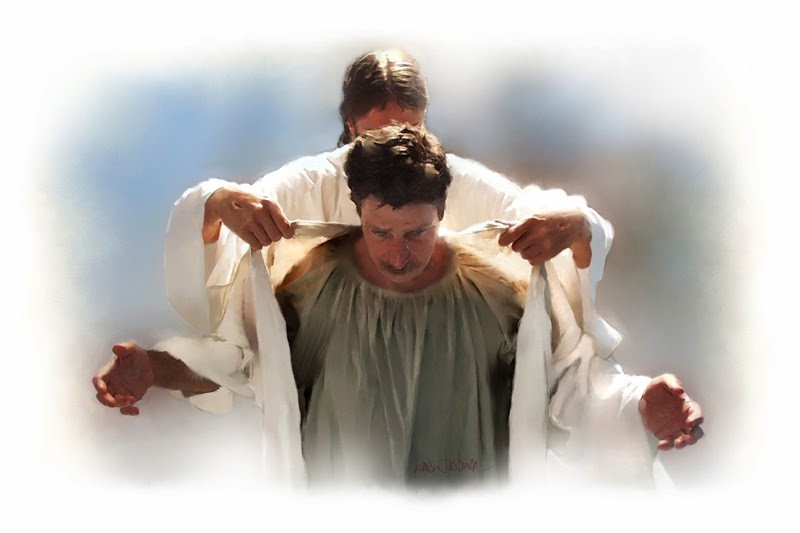
Lars Justinen, Robe of Righteousness