

Art by Kay Cude, poetry by Kay Cude, all rights retained by Kay Cude. Photography used by permission
Art by Kay Cude, poetry by Kay Cude, all rights retained by Kay Cude. Photography used by permission
I attended High School between 1974 and 1978. It was an excellent high school, offering high-end academics, a thriving sports program, a beautiful campus, and star teachers. To us, though, it was just high school, and the best thing about it was none of those things.
It was Senior Privileges.
Seniors were allowed entry to spaces in the school that no other students were allowed to enter. These spaces were severely restricted, and anyone who was not senior was barred.
For example, the Health Room was once a senior-only room, and was furnished with couches, a television, and refrigerator, if you can believe it. Even more unbelievable in this generation’s health-conscious era, of the area of the school’s inner courtyard where three brick walls connect was once reserved as a smoking area for students. Smoking is now banned on the entire campus.
I never took advantage of those privileges but there were two others that I enjoyed.
Seniors during the 1970’s and 1980’s could sign themselves in and out of school. If we had a study hall first period of the day, we were able to come in late. We were able to sign out of school in the case of a last period study hall. I used to sign out and go to McDonald’s and get breakfast, which was a new offering back then. McDonald’s introduced the Egg McMuffin in 1972 and a full breakfast in 1977. That was the year I became a senior and the novelty of the McMuffin and hash browns was too luscious to resist. I signed myself out of study hall and drove to get breakfast a la McD’s style, also bringing back orders for friends who didn’t have a car.
But the greatest privilege to me was that seniors-only could use the courtyard. The courtyard was not an arborist’s dream. It was a scrubby place, not really a greenspace, just well-worn paths amid gasping grass, concrete benches, the aforementioned smoking area, and some trees. But the school was large and being able to cut down travel time between classes to beat the bell was extremely compelling. Plus only seniors could go there.
All the Freshmen knew about senior privileges. We’d look upon the seniors emerging from the courtyard with awe, and excitedly talk about the day we, too, would be allowed entry into this most prized restricted area. I don’t have enough words to relate to you the thirst, angst, and yearning for senior privileges. WE were blocked out, but THEY could go hang out! They could go in and come out! They could remain in a private area just for them! We wanted that!
 |
| Courtyard at Hotel Inca Real, Cuenca, Ecuador. EPrata photo |
The parallel to God’s courts is the point I want to make here. Do we possess the same fervency to be in God’s courts? Do we yearn for the privilege of being in His courts?
The Psalmist said,
For a day in your courts is better than a thousand elsewhere. I would rather be a doorkeeper in the house of my God than dwell in the tents of wickedness. (Psalm 84:10)
The righteous man will flourish like the palm tree, He will grow like a cedar in Lebanon. Planted in the house of the LORD, They will flourish in the courts of our God. (Psalm 92:12-13)
Enter his gates with thanksgiving, and his courts with praise! Give thanks to him; bless his name! (Psalm 100:4)
I know when the time comes to enter His fabulously luxuriant and holy courts, it will be with thanksgiving and praise. But until then, do we yearn for His home, which is our home? Do we look with joy and anticipation when it will finally be our turn to enter the restricted area, the private area reserved for only those chosen? Do we crave to be there, enjoying the privilege of being in His court?
I can’t imagine what it will look like or what it will be like to enter His courts. The Bible tells us that we can’t conceive of it. My juvenile mind could not conceive of any privilege or any courtyard sweeter than the High School Courtyard reserved for those of a certain age. Just as now, my juvenile Christian mind cannot conceive of a courtyard sweeter or more tranquil that, say, the one at the Hotel Inca Real in Cuenca Ecuador, adorned with plants, tiled floors, resting benches, beauty and peace.
But, as it is written, “What no eye has seen, nor ear heard, nor the heart of man imagined, what God has prepared for those who love him”– (1 Corinthians 2:9)
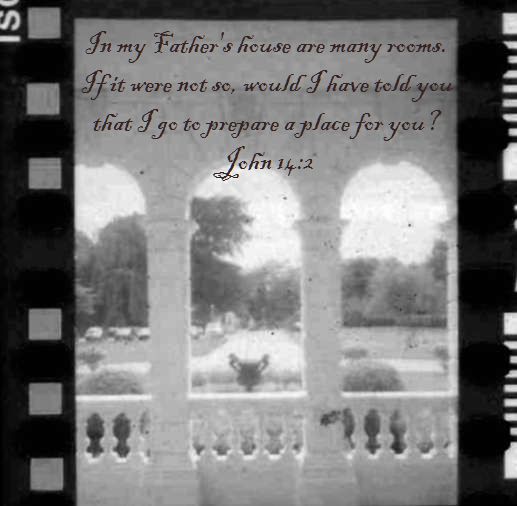
But I can and do joyfully anticipate His courts even without being able to visualize them. It is quite humbling to think of Jesus preparing this place for us.
 |
| EPrata photo |
We know Jesus is the Man-God. His divinity was on display when He healed, did miracles, or taught with such authority that the hearers were astounded.

His human nature was on display when He was weary (John 4:6), hungry (Mark 11:12), or thirsty (John 19:28).
When Jesus appeared before the magistrate, Pilate said to the crowd, Behold the man. Here is the verse:
So Jesus came out, wearing the crown of thorns and the purple robe. Pilate said to them, “Behold the man!” (John 19:5)
Most of us are familiar with that phrase, and that momentous event in the life of Jesus. But did you know that Zechariah said it first? In one of the many visions God gave the prophet Zechariah, the phrase appears. Thus Pilate’s utterance was a fulfillment of an Old Testament picture pointing to a New Testament truth.
And say to him, ‘Thus says the LORD of hosts, “Behold, the man whose name is the Branch: for he shall branch out from his place, and he shall build the temple of the LORD. (Zechariah 6:12)
Though the vision actually shows Joshua being crowned, it is in reality a picture of the crowning of Jesus. The Jamieson Fausset Commentary explains further:
Behold, the man—namely, shall arise. Pilate unconsciously spake God’s will concerning Him, “Behold the man” (Jn 19:5). The sense here is, “Behold in Joshua a remarkable shadowing forth of Messiah.” It is not for his own sake that the crown is placed on him, but as type of Messiah about to be at once king and priest. Joshua could not personally be crowned king, not being of the royal line of David, but only in his representative character.
[Source: Jamieson, R., Fausset, A. R., & Brown, D. (1997). Commentary Critical and Explanatory on the Whole Bible (Vol. 1, p. 723). Oak Harbor, WA: Logos Research Systems, Inc.]
Roy Gingrich’s outlines on the prophetic books are helpful here explaining Zechariah’s vision of Joshua’s crowning, and the Heavenly utterance “Behold the Man whose name is the branch!”
THE SYMBOLISM OF THE CROWNING OF JOSHUA
The crowning of Joshua, a priest, with a regal crown symbolizes the future crowning of Christ, a priest (after the order of Melchisedec), with a regal crown (as Israel’s and the world’s, King) at His Second Advent.
During Christ’s earthly ministry, He was crowned with a crown of thorns, Matt. 27:29; during His present sitting at His Father’s right hand, He is crowned with a crown of glory and honor, Heb. 2:9; at His Second Advent, He will be crowned with many crowns, Rev. 19:12 (as the King of Israel, Matt. 27:37, and as the King of all the earth’s Kings, Rev. 19:16).
THE PROPHECIES CONCERNING THE MESSIAH (Zechariah 6:12, 13, 15)
(Here we have one of the Old Testament’s most complete, yet concise, prophecies concerning the person, the office, and the work of the coming Messiah.)
1. The Messiah will be the antitype of Joshua (6:12).
To “behold the man,” Joshua, was to “behold the man,” the Messiah, for the one is typical of the other. The Jews, at Christ’s first advent, “beheld the man,” the Messiah, crowned with thorns, John 19:5. The Jews, at Christ’s second advent, will “behold the man,” the Messiah, crowned with many crowns, crowns of glory, Rev. 19:12.
See the four “beholds,” Zech. 6:12; Isa. 42:1; Zech. 9:9; Isa. 40:9.
[Source: Gingrich, R. E. (1999). The Books of Haggai and Zechariah (p. 34). Memphis, TN: Riverside Printing.]
Here are the four Beholds Mr Gingrich mentioned.
Behold the Man!
And say to him, ‘Thus says the Lord of hosts, “Behold, the man whose name is the Branch: for he shall branch out from his place, and he shall build the temple of the Lord. (Zechariah 6:12)
Behold the Servant!
Behold my servant, whom I uphold,
my chosen, in whom my soul delights;
I have put my Spirit upon him;
he will bring forth justice to the nations.
(Isaiah 42:1)
Behold the King!
Rejoice greatly, O daughter of Zion!
Shout aloud, O daughter of Jerusalem!
Behold, your king is coming to you;
righteous and having salvation is he,
humble and mounted on a donkey,
on a colt, the foal of a donkey.
(Zechariah 9:9)
Behold your God!
Go on up to a high mountain,
O Zion, herald of good news;
lift up your voice with strength,
O Jerusalem, herald of good news;
lift it up, fear not;
say to the cities of Judah,
“Behold your God!”(Isaiah 40:9)
We’re entering the Thanksgiving season, and gratitude and thankfulness are much on our minds. I am thankful for the fact that I shall behold Him! All knees will bow and all tongues will confess, meaning all peoples will behold Him, their God. But I’m grateful I shall behold Him as one who is forgiven by His grace, not ashamed or crushed by fear – but worshiping Him rightly- in Spirit and in truth. My gratitude for Him having delivered the means by which to dwell in righteousness now and forever and to behold His face in love knows no bounds. Brethren, WE SHALL BEHOLD HIM, OUR MAN-GOD, Savior, Lord and King!
Jesus only calls those sheep whose names have been written down since before the foundation of the world. (Ephesians 1:4). Those sheep know His voice and listen to them. Those sheep follow Him out of the sheepfold and into green pastures. He doesn’t put a general call into the sheepfold and wait to see who will come out. He knows them by name, and He calls them.
 |
| EPrata photo |
Truly, truly, I say to you, he who does not enter the sheepfold by the door but climbs in by another way, that man is a thief and a robber. But he who enters by the door is the shepherd of the sheep. To him the gatekeeper opens. The sheep hear his voice, and he calls his own sheep by name and leads them out. When he has brought out all his own, he goes before them, and the sheep follow him, for they know his voice. (John 10:1-4)
John 10:1–2. Verses 1–5 describe a morning shepherding scene. A shepherd enters through a gate into a walled enclosure which has several flocks in one sheep pen. The enclosure, with stone walls, is guarded at night by a doorkeeper to prevent thieves and beasts of prey from entering. Anyone who would climb the wall would do it for no good purpose.
John 10:3–4. By contrast, the shepherd has a right to enter the sheep pen. The watchman opens the gate, and the shepherd comes in to call his own sheep by name (out from the other flocks). Shepherds knew their sheep well and gave them names. As sheep hear the sound of their owner’s familiar voice, they go to him. He leads them out of the pen till his flock is formed. Then he goes out toward the fields with the sheep following him.
John 10:5–6. If a stranger enters the pen, the sheep run away from him because his voice is not familiar. The point of this figure of speech consists in how a shepherd forms his flock. People come to God because He calls them (cf. vv. 16, 27; Rom. 8:28, 30). Their proper response to His call is to follow Him (cf. John 1:43; 8:12; 12:26; 21:19, 22). But this spiritual lesson was missed by those who heard Jesus, even though they certainly understood the local shepherd/sheep relationship. In their blindness, they could not see Jesus as the Lord who is the Shepherd (cf. Ps. 23).
John 10:7–9. Jesus then developed the shepherd/sheep figure of speech in another way. After a shepherd’s flock has been separated from the other sheep, he takes them to pasture. Near the pasture is an enclosure for the sheep. The shepherd takes his place in the doorway or entrance and functions as a door or gate. The sheep can go out to the pasture in front of the enclosure, or if afraid, they can retreat into the security of the enclosure. The spiritual meaning is that Jesus is the only Gate by which people can enter into God’s provision for them.
When Jesus said, All who ever came before Me were thieves and robbers, He referred to those leaders of the nation who cared not for the spiritual good of the people but only for themselves. Jesus the Shepherd provides security for His flock from enemies (whoever enters through Me will be saved, or “kept safe”). He also provides for their daily needs (the sheep come in and go out, and find pasture).
Source: Blum, E. A. (1985). John. In J. F. Walvoord & R. B. Zuck (Eds.), The Bible Knowledge Commentary: An Exposition of the Scriptures (Vol. 2, pp. 309–310). Wheaton, IL: Victor Books.
 |
| The People’s Bible Encyclopedia, Charles Barnes |
 |
| EPrata photo |

The passage today is from Genesis 26:17-22. I found that as far as my interpretation of it goes, there seems to be a historical/practical meaning, a spiritual meaning, and a metaphorical meaning. God’s word is great. Here is the passage.
So Isaac departed from there and encamped in the Valley of Gerar and settled there. And Isaac dug again the wells of water that had been dug in the days of Abraham his father, which the Philistines had stopped after the death of Abraham. And he gave them the names that his father had given them. But when Isaac’s servants dug in the valley and found there a well of spring water, the herdsmen of Gerar quarreled with Isaac’s herdsmen, saying, “The water is ours.” So he called the name of the well Esek, [contention] because they contended with him. Then they dug another well, and they quarreled over that also, so he called its name Sitnah. [enmity]. And he moved from there and dug another well, and they did not quarrel over it. So he called its name Rehoboth, [room] saying, “For now the LORD has made room for us, and we shall be fruitful in the land.”
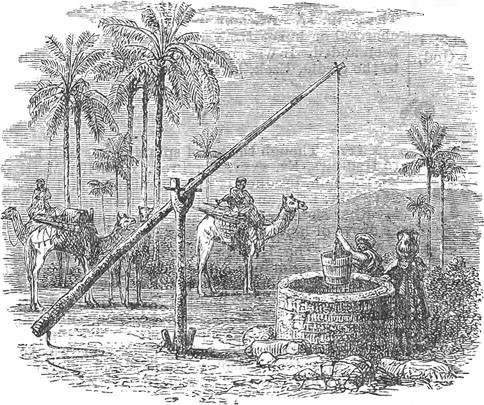
Ancient well diggers dug a shaft to obtain water from a water-bearing layer beneath the ground. They lined the shaft with wood, stone, or baked brick to prevent it from caving in. To keep contaminants from the well and to protect people from falling in, well diggers often built a low stone wall like the one shown here and covered the well opening with a large flat stone. Gen 16:14, Gen 21:19, 25, 30, Exod 2:15, Isa 12:3, Luke 14:5, John 4:1–45. (Source, Myers, R (2012) Logos Bible Images, Lexham Press, images are public domain.)
Practically, as a herdsman Isaac would have depended greatly on water to keep his flock alive. Water was a precious commodity in a dry and thirsty land. Earlier in Genesis 26 it had been reported that Isaac had become a very wealthy man.
And Isaac sowed in that land and reaped in the same year a hundredfold. The LORD blessed him, and the man became rich, and gained more and more until he became very wealthy. He had possessions of flocks and herds and many servants, so that the Philistines envied him. (Now the Philistines had stopped and filled with earth all the wells that his father’s servants had dug in the days of Abraham his father.)
Isaac’s father Abraham had obtained the land legally and rightly, and he had dug the wells. Yet the Philistines stopped them up. And the Philistines’ envy and hatred carried through to Isaac’s day, when they contended with Isaac over the water and there was strife. It must have been a great hardship for Isaac with all his herds, servants, and flocks to go without enough water during the periods the Philistines contended against him. Calvin said of the stopped-up wells,
Moreover, the fact that the wells had been obstructed ever since the departure of Abraham, shows how little respect the inhabitants had for their guest; for although their own country would have been benefited by these wells, they chose rather to deprive themselves of this advantage than to have Abraham for a neighbor; for, in order that such a convenience might not attract him to the place, they, by stopping up the wells, did, in a certain sense, intercept his way. It was a custom among the ancients, if they wished to involve any one in ruin, and to cut him off from the society of men, to interdict him from water, and from fire: thus the Philistine, for the purpose of removing Abraham from their vicinity, deprive him of the element of water.
Aside from the physical need of the practical matter of water, the second item to note is Isaac’s placid response. Stopping up a well is akin to a declaration of war because no water equals financial ruin and perhaps death. The Philistines had already noted Isaac’s large retinue and knew he could have defeated the them yet Isaac did not fight. He simply relied on the Lord’s providential care by abandoning his freshly dug well – several times – and moved on. Talk about turning the other cheek! (Luke 6:29).
Calvin again, this time of the spiritual relationship Isaac had with YHWH-
First, Moses, according to his manner, briefly runs through the summary of the affair: namely, that Isaac intended to apply again to his own purpose the wells which his father had previously found, and to acquire, in the way of recovery, the lost possession of them. He then prosecutes the subject more diffusely, stating that, when he attempted the work, he was unjustly defrauded of his labor; and whereas, in digging the third well, he gives thanks to God, and calls it Room, because, by the favor of God, a more copious supply is now afforded him, he furnishes an example of invincible patience. Therefore, however severely he may have been harassed, yet when, after he had been freed from these troubles, he so placidly returns thanks to God, and celebrates his goodness, he shows that in the midst of trials he has retained a composed and tranquil mind.
Thirdly, the metaphorical aspect. Whenever there is water in the Bible, I pay attention. It is a blessing to me to think of the Lord Jesus as the Living water. With the stopping up of the wells and the final well finally flowing freely in an area of enough “room”, I searched to see if my hunch had been right. Matthew Henry alluded to the flowing water, metaphorical aspect of Isaac’s wells issue.
In digging his wells he met with much opposition, v. 20, 21. Those that open the fountains of truth must expect contradiction. The first two wells which they dug were called Esek and Sitnah, contention and hatred. What is the nature of worldly things; they are make-bates and occasions of strife. What is often the lot even of the most quiet and peaceable men in this world; those that avoid striving yet cannot avoid being striven with, Ps. 120:7. In this sense, Jeremiah was a man of contention (Jer. 15:10), and Christ himself, though he is the prince of peace. What a mercy it is to have plenty of water, to have it without striving for it. The more common this mercy is the more reason we have to be thankful for it.
Source: Henry, M. (1994). Matthew Henry’s commentary on the whole Bible: complete and unabridged in one volume (p. 60).
The two verses which come to my mind are:
With joy you will draw water from the wells of salvation. (Isaiah 12:3).
Upon God’s providence, even in the greatest straits and difficulties. God can open fountains for our supply where we least expect them, waters in the wilderness (Isa. 43:20), because he makes a way in the wilderness, v. 19. Those who, in this wilderness, keep to God’s way, may trust him to provide for them. While we follow the pillar of cloud and fire, surely goodness and mercy shall follow us, like the water out of the rock. 2. Upon Christ’s grace: That rock was Christ, 1 Co. 10:4. The graces and comforts of the Spirit are compared to rivers of living water, Jn. 7:38, 39; 4:14. These flow from Christ, who is the rock smitten by the law of Moses, for he was made under the law. Nothing will supply the needs, and satisfy the desires, of a soul, but water out of this rock, this fountain opened. The pleasures of sense are puddle-water; spiritual delights are rock-water, so pure, so clear, so refreshing—rivers of pleasure.

There are two responses to the Gospel, yea or nay. Here is S. Lewis Johnson with an anecdote about a person who said yea.
Paul, His Gospel, and Thomas Jefferson
George Cutting is a man who is best known for the fact that he’s the author of a little pamphlet. You usually find it in tract racks of Christian churches. It’s entitled, “Safety, Certainty, and Enjoyment.” Mr. Cutting was just a simple Christian man who went around preaching the gospel. He was also a business man, as I remember, and one day he was bicycling through Norfolk in England. He was an Englishman. And he said it was early in the morning, and as he was going through, he was a very quiet man, he suddenly gained from the Lord the distinct impression that he should shout out a Bible verse. And so, right in the midst of this small town, there were just a few houses around, he shouted out “Behold the Lamb of God, which taketh away the sin of the world.” He said he cycled on a little bit longer, and the Lord seemed to say definitively to him, “Say it again.” So he said he shouted out, “Behold the Lamb of God which taketh away the sin of the world.”
Six months later he was visiting in that little village, and he was doing, as he frequently did, just knocking on door after door. His first question, he said, was always, “Are you saved?” That’s called the direct approach. [Laughter] So a woman opened the door and he said, “Are you saved?” And she said, “Oh yes. About six months ago I was in great distress of soul. I plead with God to help me, and even while I was calling upon him, I heard a voice cry out, ‘Behold the Lamb of God which taketh away the sin of the world.’” And she said, “I was startled. I wondered if I had really heard right.” She said, “I prayed again to the Lord, and I said, “Lord if that is the message, repeat it again.”
[Laughter] And she said, “And I heard it again and I trusted Christ, and I’m saved.” And Mr. Cutting had the joy of telling her that it was he who had called out the verse. That’s preaching. You know, when Paul tells us to be instant in season and out of season. And imagine there were lots of citizens in that little village who thought that it was very much out of season to hear a Bible verse shouted out early in the morning from one of their streets. But it was in season for that lady.
there is only one response to the message of the apostle, and that is to believe in our Lord Jesus Christ. Does salvation come by praying through? No. Does salvation come by paying the church? No. Does salvation come by good works? No. Does salvation come through religion? No. Does salvation come through some religious ritual which we practice, baptism, or sitting at the Lord’s Table? No. Does salvation come through the organization of the Christian church? No. You must be born again.
Here is John MacArthur with an anecdote on a person who said nay.
The Tragedy of Neglecting Salvation
And so, we believe it is a warning to the intellectually convinced, those who have heard the gospel, know the facts about Jesus Christ, know that He died for them, know that He desires to forgive their sin, know that He can some into their life and change their life but are not willing to receive Christ as Savior. And may I hasten to add that’s the most tragic category of people in existence. And I’ve told you a story once before that points it up as graphically as anything. I’ll never forget on one occasion when a lady came into my office and informed me that she was a prostitute. And she said, “I need help” And I said, “I guess you do.” And she said, “Please, I’m desperate.”
And so I presented the claims of Christ to her from beginning to end and I said, “Would you like to invite Jesus Christ into your life?” And she said yes. She said, “I’ve had it.” She was at the bottom to say the least through the dope scene, the whole bit. So she prayed a prayer and evidently she invited Christ into her life. And I said, “Now,” I said, “I want to ask you to do something.” I said, “Do you have your little book that you have all your contacts in with you?” And she said yes. I said, “Well, let’s just take a match here and we’ll burn it.” And she looked at me and she said, “What do you mean?” I said, “Just what I said. I mean, if you’re really going to live for Jesus Christ and you’ve really accepted His forgiveness and you really met Him as your Savior, let’s burn that book and we’ll just have a little party here and just praise the Lord.” And she said to me, “That’s worth a lot of money.” She said, “That’s worth an awful lot
Then she said to me, “I don’t want to burn my book.” Put it in her purse and looked at me right in the eye and said, “I guess I don’t really want Jesus, do I?” And she left.
Now you see, there was somebody who when the..when it really came down to the nitty gritty and counted the cost, she wasn’t ready. I don’t know what the story of that dear girl is. My heart has often ached for her and I’ve often thought about her. But I do know that she knows the facts and she believes them, but she’s not willing to make the sacrifice. And it’s a bad bargain, for what she kept wasn’t worth anything compared to what she could have had in Jesus Christ forever.
These days in 2015 it is not popular nor even accepted to speak of hell or demons. But they exist, they are active in the world, and they still do possess people, just as they did in the time of Luke 4:31-37. That’s the passage John MacArthur was preaching when he related this anecdote:
This is a rare thing. I’ve preached the gospel for a long time and only about three times in my whole life have I ever heard demons speak, been confronted. One of them was a few weeks ago, I told you about last week, right down in the front when a demon-possessed person came running down the aisle after I was preaching the gospel, exalting Christ’s power over the kingdom of darkness, came at me and said, “Why are you attacking me? Why are you trying to hurt me?” Which is exactly what the demon said here.
But it was some years ago when I had first come to Grace. We had built the family center and we were having services there before we built this facility. It was a Sunday night and after the service was over I was over having some food with somebody from the church and I got a call from Jerry Mitchell who was here a few weeks ago. He was on the staff at the time. He said, “You’ve got to come down here, John, I’ve got a…I’ve got a girl in here whose got all kinds of demon voices.” He had never experienced anything like this and I never had either. And I said, “Well I don’t know if I could be much help but I’ll come right down.”
So I came down, I walked in and there was chaos in the office. It was over in the building by the family center, and I walked in and the place was in disarray and it was obvious that she had been terrorizing things. She had overturned the desk and poor Jerry who was a boxer in the Navy was having a hard time defending himself against this girl, and that is characteristic of New Testament accounts where there’s a certain level of strength that’s beyond normal. And I’ll never forget the greeting when I walked in the door. I walked in the door and this…out of this girl’s mouth — whom I had met and with whom I had spoken because she had been coming to the church — came this voice, and I can’t, obviously, replicate it. But in my memory I know what the voice said. It’s something like: “Not him, not him, not him, get him out, get him out, get him out,” to me.
Well my first reaction was, “I’m leaving. I’m not sure I’m up to this.” Wow! And my second reaction was, “They know who I am and they know whose side I’m on, that’s very affirming.” It was affirming. I sort of started feeling apostolic. Paul I know and Jesus I know and John MacArthur, you know? Wow! Amazing!
I don’t think that demon was afraid of me humanly. I don’t have any human power to deal with demons. In fact, Jerry and I didn’t know what to do. We started trying to send the demons away. We sent them everywhere you could think of, the pit, the abyss, Phoenix, anywhere hot, you know. And the bottom…the bottom line is they didn’t go anywhere and so we just were praying and saying, “You know, this isn’t working, this casting out thing isn’t working. I’m not Jesus and we’re not apostles and we don’t have authority over that kingdom.” There’s only one way that this girl will ever be delivered and that is when Christ delivers her in the act of salvation.
So we wrestled, literally physically trying to restrain her and get her in a chair and she was so exhausted physically and finally calmed down and we gave her the gospel. And she confessed her sin. I’ll never forget it, just really gushed out her sin before the Lord and embraced Jesus Christ and then it was just this calm that came everywhere. There was deliverance. Nothing to do with me, nothing to do with a formula, nothing to do with an exorcism, nothing to do with that at all, that…that is not what deals with demons. She needed to be delivered from the kingdom of darkness, you understand that? And she was. She was.
The demon was terrified of me not because of something I could do in the human. The demon was terrified of me because the demon connected me with the message of the gospel. And the demon knew that if the gospel came to this girl and she believed that he was finished. And that’s exactly what happened. She was as clean as the driven snow after that and never had another occasion of that kind of terrifying experience.
Anyone who is not of Christ and in His sheepfold is under bondage to the god of this world, satan They are serving him, whether they believe it or not. And anyone who has not confessed their sins and submitted to the Gospel is at risk for being possessed by a demon.
Seek the LORD while he may be found; call upon him while he is near” (Isaiah 55:6). Does that means He might be far? Yes. Someday, He might turn a person over to their sin in a hardened heart and salvation might not be possible after that. His grace, peace, mercy, and love is manifold. Having the gentle and lovely Spirit inside of us is a ‘burden’ that is easy. As we saw from the anecdote about the demon, having satan in us is a burden that is harsh and heavy. How many woes lay in the demon direction, and how many blessings there are in Christ. Seek Him while ye may!

I am the door. If anyone enters by me, he will be saved and will go in and out and find pasture. (John 10:9)
This is one of the famous I AM statements by Jesus. Here they all are.
1. And Jesus said to them, “I am the bread of life. He who comes to Me shall never hunger, and he who believes in Me shall never thirst” (John 6:35).
2. Then Jesus spoke to them again, saying, “I am the light of the world. He who follows Me shall not walk in darkness, but have the light of life” (John 8:12).
3. “I am the door. If anyone enters by Me, he will be saved, and will go in and out and find pasture” (John 10:9).
4. “I am the good shepherd. The good shepherd gives His life for the sheep” (John 10:11).
5. Jesus said to her, “I am the resurrection and the life. He who believes in Me, though he may die, he shall live” (John 11:25).
6. Jesus said to him, “I am the way, the truth, and the life. No one comes to the Father except through Me” (John 14:6).
7. “I am the true vine, and My Father is the vinedresser” (John 15:1).
Any study on these statements would be rich and edifying. However let’s just look at the door. The door is narrow. There is only one door. It is an exclusive door. No other door will allow entry to heaven. If anyone tries to come another way, he is a thief and a robber. (John 10:1)
Jesus leads his Jews out of the fold into salvation. He has another fold (John 10:16) where He leads His Gentiles out into salvation and green pastures. No one can go to green pastures another way except through Jesus. His way is exclusive because He is the ONLY way. His way requires repentance, a realization of our utter inability to perform any act He would consider righteous and a realization of His total ability to crush us like a bug if He so desired- and that would be just. We understand His holiness but also His mercy in saving us. One would think that a conversion testimony would include acknowledgement of at least some of those positional truths.
Here are a few conversion testimonies I found online. Compare them. And in the back of your mind, keep thinking about the Door. At the bottom I’ll have the moral of the story.
—————————
Conversion story #1
At the end of the sermon, the preacher had “Young man, look to Jesus Christ. Look! Look! Look! You have nothing to do but look and live!” I saw at once the way of salvation. I know not what else he said—I did not take much notice of it—I was so possessed with that one thought . . . . I had been waiting to do fifty things, but when I heard that word, “Look!” what a charming word it seemed to me. Oh! I looked until I could almost have looked my eyes away.
There and then the cloud was gone, the darkness had rolled away, and that moment I saw the sun; and I could have risen that instant, and sung with the most enthusiastic of them, of the precious blood of Christ, and the simple faith which looks alone to Him. Oh, that somebody had told me this before, “Trust Christ, and you shall be saved.” … I listened to the Word of God and that precious text led me to the cross of Christ. I can testify that the joy of that day was utterly indescribable. I thought I could have sprung from the seat in which I sat, and have called out with the wildest of those Methodist brethren . . . “I am forgiven! I am forgiven! A monument of grace! A sinner saved by blood!” My spirit saw its chains broken to pieces, I felt that I was an emancipated soul, an heir of heaven, a forgiven one, accepted in Jesus Christ, plucked out of the miry clay and out of the horrible pit, with my feet set upon a rock and my goings established … Simply by looking to Jesus I had been delivered from despair…
That young man certainly was aware of his position in Christ prior to salvation. He had been in despair, he heard the Gospel and he was saved by blood.The young man was Charles Spurgeon. His subsequent life certainly reflects the foundational understanding he had of the Gospel.
———————————
Conversion story #2
“I didn’t have a fireworks moment for my salvation, I had a falling in love with Jesus in Sunday school when I was a very young child.” But she did have an altar call moment. In high school, she had planned to become a lawyer, but one summer while leading a group of sixth-grade girls at camp, she received what she considers a call from God. “I had no words, nothing but a sense,” she says. “God took a very troubled young woman and made sure that she understood.” She walked down the aisle of her church, committing herself to ministry.”
So she had a mystical sense to walk down an aisle and commit to the idol of ministry. Not the standard Gospel call of realizing our depravity in brokenness and turning to a resurrected, blood shedding Jesus as the exclusive hope for reconciliation with God… The woman is Beth Moore. Her subsequent life certainly reflects the lack of understanding she should have had of her position in Christ both before and after salvation.
——————————
Conversion story #3
in 1914 at the encouragement of their minister the young man was now beginning to take a hard look at the reality of his spiritual condition. “For many years I thought I was a Christian when in fact I was not. It was only later that I came to see that I had never been a Christian and became one.” As he struggled with his salvation a grace truth came into focus. He said he had not really heard sound preaching of the gospel in his early life. “What I needed was preaching that would convict me of sin and … bring me to repentance and tell me something about regeneration. But I never heard that. The preaching we had was always based on the assumption that we were all Christians …” As the young man read for himself he slowly but surely saw the logic and the power of the gospel of Jesus Christ. Like the waves of the incoming tide, the reality of God’s grace swept over his heart until trusting Christ was all he could do. As surely as that reality overwhelmed him personally it overwhelmed him professionally.
The young man was Martyn Lloyd Jones, (source) a preacher called “logic on fire” and certainly his long and fruitful life subsequent to his conversion testifies to the grace of Christ in bringing him to regeneration from brokenness in sin.
——————————
Conversion story #4
A certain young man began attending a tent revival.
“And then it happened, sometime around my sixteenth birthday. On that night, [the preacher] finished preaching and gave the Invitation to accept Christ… On the last verse of that second song, I responded. I walked down to the platform, feeling as if I had lead weights attached to my feet, and stood in the space before the platform… My heart sank when I looked over at the lady standing next to me with tears running down her cheeks. I was not crying. I did not feel any special emotion of any kind just then. Maybe, I thought, I was not supposed to be there. Maybe my good intentions to be a real Christian wouldn’t last. Wondering if I was just making a fool of myself, I almost turned around and went back to my seat…” As [the young man] stood at the platform, a friend of the family’s, testified to the young man and guided him to pray.
“He prayed for me and guided me to pray. I had heard the message, and I had felt the inner compulsion to go forward. Now came the moment to commit myself to Christ… I checked ‘Recommitment’ on the card I filled out. No bells went off inside me. No signs flashed across the tabernacle ceiling. No physical palpitations made me tremble. I wondered again if I was a hypocrite, not to be weeping or something. I simply felt at peace.”
The young man was Billy Graham, attending Mordecai Ham’s tent revival. The subsequent life of Graham testifies to his lack of a foundational understanding. Especially when in his mature decades, Graham said things like a person could go to heaven without ever hearing the gospel, knowing Jesus Christ, or having lived a sincere life just knowing he needed something. “They’re going to come another way” Graham said. No. They’re not.
———————–
You see the weakness of Moore’s and Graham’s theology in describing their conversion. Their descriptions posted were not immediately after conversion, either, they were statements made decades later when one presumes some sanctified maturity has set in.
You see the strength of Spurgeon’s and Jones’ conversion stories. They talk of sin, grace, redemption, resurrection, regeneration.
Jesus is the Door. It is a narrow door. It is the only door. It isn’t easy to become a Christian. It involves a deep, soulful agony. Here’s Don Green on how to recognize true repentance,
Look at verse 4, where Jesus said, “Blessed are those who mourn for they shall be comforted.” This word for mourning describes deep, inner agony…agony. Jesus is describing a spiritual mourning here, not an earthly mourning. It’s easy enough to see that. There are a lot of people that suffer earthly loss and mourn that, that don’t receive comfort from Christ. Unbelievers who are mourning their losses don’t receive comfort from Christ. What Jesus is talking about here is spiritual mourning over sin. He had just talked about poverty of spirit. It’s in the context of repentance.
…the tax collector in Luke 18, verse 13…Luke 18, verse 13, you don’t need to turn there. The tax collector standing some distance away was even unwilling to lift up his eyes to heaven but was beating his breasts saying, “God, be merciful to me, the sinner.” He was beating his breast, his agony, his mourning over sin was so great that he had to release it physically. This was no superficial response. This was no quick nod of the head to the question, “Do you think you’re a sinner?” And then move on to whatever the next topic of discussion was. No, the kind of mourning, the kind of sorrow that repentance expresses is a sorrow that stops you in your tracks, a sorrow that you can’t get over.
Salvation is no easy-breezy nod to the Holy I AM whilst wiping one’s feet on the doormat saying, “Gee, thanks for the ministry.” It isn’t ambling down an aisle, and checking off a ‘recommitment’ box after a quick prayer. Salvation is agony and going through the door means you leave all else behind, enter alone, and worship. Jesus isn’t relieved you have recommitted. He isn’t wringing His hands in hopes that you will fall in love with Him. He doesn’t have an ‘easy button’ you push. He has a narrow way of entry with strict requirements. Jesus is THE DOOR. He is not a doorMAT.
~~~~~~~~~~~~~~~~~~~~~~~~~
Further Reading
Re-post from 2011.
Today could be the day. For many of these, today IS the day. For others, soon will be the day. The Lord’s promises are true. They will be fulfilled. May His name be forever blessed.


In interesting little incident happened on Beth Moore’s twitter stream yesterday. Mrs Moore wrote:

Even some of her followers were puzzled by Moore’s inadvertent unbiblical admission.

I tweeted the following:

A few other people made mention of Moore’ puzzling admission too. And then the usual happened. Usual for these apostate days:
Beth Moore’s tweet went POOF.

There are a few discernment things to understand here. First, on the literal side of things, Beth Moore’s tweet demonstrates two simple biblical failures. Of course Keith Moore is not “inclined” to study scripture. None of us are. Our flesh always battles Godly disciplines. However the point of the Christian life is that we deny those fleshly indulgences by picking up our cross (Mt 16:24), and we rely on the Holy Spirit to help us overcome the flesh (our ‘inclinations’) to pursue holiness. All of 2 Peter exhorts for growth in godliness and pursuing the holiness our Lord deserves. That Mr Moore gives in to the flesh so as to avoid pursuing holiness is not sanctification.
Secondly it fails the husbandly aspects of a Godly marriage. The Southern Baptist Theological Seminary has a guide for husbands regarding this aspect of marriage. I quote it because the Moores have stated many times they are Southern Baptist, belong to a Southern Baptist church and are proudly Southern Baptist. “Lead Your Wife Spiritually: A Guide for Husbands”
it’s especially true of husbands who bear the responsibility to lead in a marriage. Your marriage should be a significant source of your wife’s sanctification. Consider Paul’s words to the Ephesians again:
Husbands, love your wives, as Christ loved the church and gave himself up for her, that he might sanctify her, having cleansed her by the washing of water with the word, so that he might present the church to himself in splendor, without spot or wrinkle or any such thing, that she might be holy and without blemish. In the same way husbands should love their wives as their own bodies. He who loves his wife loves himself. (Ephesians 5:25-28)
Clearly, you’re not Christ. There is a sanctifying work that only Jesus can do, but as you model your love on the sanctifying relationship of Christ in the church, you do have a role in your wife’s sanctification. Even if your wife is more spiritually engaged and mature than you are, you still have a responsibility to lead.
Next, moving away from the literal aspects to the conceptual aspects of Moore’s tweet, teachers of God’s word, as Beth Moore claims to be, should be mature, wise, careful, and self-controlled.
Paul advised young Timothy to “set the believers an example in speech, in conduct, in love, in faith, in purity.”
Show yourself in all respects to be a model of good works, and in your teaching show integrity, dignity, and sound speech that cannot be condemned, so that an opponent may be put to shame, having nothing evil to say about us. (Titus 2:7-8).
Titus 2:3 also advises elder women on behavior and comportment in Christian life. As does 1 Timothy 3:11-
In the same way, the women are to be worthy of respect, not malicious talkers but temperate and trustworthy in everything.
I would further state that advice for elder women goes in spades for when they are speaking publicly about their husbands.
On the discernment side, if you’re having red flags about a certain teacher or preacher, one thing to look for is if he or she makes hasty statements. Do they have to retract things often? Do they have to go back the next week and fix a wrong thing they said? I’m not saying teachers don’t ever make a mistake, but if the teacher or preacher you like or follow has a habit of always having to re-explain, correct, or retract, it’s an issue. Real teachers consider their words carefully and speak wisely to minimize such problems, as the 1 Tim 3:11 and Titus 2:7-8 verses says they should do.
I’ve said before that Beth Moore is not qualified to teach partly because of her undignified delivery. She speaks casually, quickly (both in tempo and in heart-haste). Her haste, multitudes of words, and thoughtlessness in her teaching was replicated in posting that tweet for the world to see. It was careless, as evidenced by her almost immediate deletion of it. The Bible says of a person who is hasty in words,
Do you see a man who is hasty in his words? There is more hope for a fool than for him. (Proverbs 29:20)
Be not rash with your mouth, nor let your heart be hasty to utter a word before God, for God is in heaven and you are on earth. Therefore let your words be few. (Ecclesiastes 5:12)
Now someone could say, “Gee, that was one tweet, maybe Beth Moore meant Keith wasn’t inclined to study scriptures with her right then.” That could well be what she meant. So in discernment, we don’t jump to conclusions but we watch fruit grow. LOL, it takes a long time to watch fruit grow. It’s like watching paint dry. It takes time and patience. So, in Keith’s case, is there any? What is the overall, long-term pattern and is there any evidence to support that this is a consistent husbandly failure on his part?
Yes, and yes. The Moores have had a long, public spiritual life. There is much evidence to support that Keith Moore has consistently failed his wife by abandoning the husbandly role, and in so doing, rebelled against his God and allowed a Jezebel-type to be born.
Beth Moore chose to be President of her multi-million dollar corporation, Living Proof Ministries. Her husband chose to be Vice President. In one video interview I watched of Beth, she said her husband Keith has no part in the company (ministry). She was saying that as if it was a good thing, but it is really a bad thing. In looking at Living Proof Ministries’ tax returns, Moore’s reported hours working at the ministry were 50 hours per week and Keith’s were 8 hours per week. She was President and he was Vice-president. He took no compensation. So what she said was true.
However, in ministry, the wife is supposed to be led by the husband. He is supposed to oversee her. If her non-profit was a ministry as she claimed on her IRS forms, the man needed biblically to be very involved so he could rightly make decisions and lead his wife. If it isn’t a ministry but is a corporation, then why was she taking the lead role, in that case she would be be leading a feminist lifestyle? Either way, it was a #fail.
In an interview in Charisma Magazine some years ago, Moore explained how she and her husband worked out their roles as Living Proof Ministries grew and placed increasing demands on Moore.
The only time Keith ever voiced any objection, both women say, was in the early days of the ministry when Beth, at God’s prompting, quit teaching aerobics classes and began to write Bible studies. The aerobics classes had brought in at least “a little part-time money,” Beth says. But at that time, the Bible studies were not for-pay publications; they were simply a tool she prepared gratis for the women who were attending her Thursday morning Bible class at Metropolitan Baptist Church in Houston. Keith didn’t understand Beth’s willingness to invest so much time in a project she wasn’t being paid for.
So her husband objected to Beth STOPPING her work outside the home and OBJECTED to her being at home more. In fact, biblically, it should be the opposite.
When Moore’s children were small the growing ministry required her to travel away from home. This was not a problem for Mr Moore. In the interview, Beth said that he simply stepped in to the wifely role as the wife stepped into the husband’s. From the same article linked above, it is reported in the interview and using their own words, that the children endured long and/or frequent absences of their mother away from home, that they strove to maintain normalcy when Beth was gone, that they lost family privacy, that the family endured trials because of Beth’s choice to work outside the home, that they all had to sacrifice for the sake of Beth’s ministry, that each time Beth left home the children saw their father (unbiblically) performing in the wife’s role, and that Keith totally supported Beth’s choices all the while. Moore says of her absences from home as a mother, her children
“invested in the kingdom every time they kissed their mother goodbye.”
This is what happens when the husband follows his fleshly “inclinations”, and fails to rightly lead. It is not surprising then, we end up with a false teacher like Beth Moore who does not know how to handle scripture. In the end, the answer is yes, there is along-term pattern of unfruitfulness so as to be able to credibly say enough evidence exists to support that this is a consistent husbandly failure on his part? We can answer the question Pastor Mike Abendroth asked, Where is Beth Moore’s Husband?
So the take-away discernment lessons here are:
1. Use social media wisely. It’s embarrassing for someone to speak impiously and worse to see the twitter stream littered with “unavailable tweets.” Proverbs 12:4 here, An excellent wife is the crown of her husband, but she who brings shame is like rottenness in his bones. Sin and error never lead to courage. They usually lead to hiding the sin and deleting the tweet. When you tweet, post, blog, vlog, or otherwise, do you stand behind what you’ve said? Even under fire, does what you’ve said, stand on solid ground?
2. Do not be hasty when speaking, especially publicly. If you are a teacher, be even slower with your words. Proverbs 12:18 says, There is one whose rash words are like sword thrusts, but the tongue of the wise brings healing.
3. Women, help your men do their duty of protecting and overseeing you. First, because it is a biblical command, and second, because the false teachers are just waiting to “creep into households and capture weak women, burdened with sins and led astray by various passions,” (Ephesians 5:22-24, 2 Timothy 3:6).
4. Women, you know that we have a tendency to be led astray and usurp the husband (Genesis 3:16). Stay submitted.
5. Sin always finds you out. (Numbers 32:23). Where a false teacher is concerned, both their doctrine and their lives (behavior) will be suspect. Yes, even Billy Graham’s. We detect the false doctrine earlier and more easily because false teachers can’t hide their teaching, that is their moneymaking, stock-in-trade. They can and do hide the sin in their lives more easily, but as the verse says, it will find you out. The natural man can’t keep a lid on his sinful behavior forever. It WILL come out.
In Beth Moore’s case she tries very hard to hide her private life. The Charisma interview I linked to is 13 years old. Not many interviews occurred after that. Or if they did, Moore insists on prepared questions ahead of time, denies tours of her office, and refuses to speak of certain periods or issues in her life (untransparent to the extreme). There are always some glimpses and gleanings of the all-important moral side emerging, though. She can’t keep a lid on all of it.
Usually at some point a critical mass is reached, the cracks in the dam can’t be plugged and the whole thing comes down. Every false teacher always has some moral issue that emerges. We saw this with Mark Driscoll. Tullian Tchividjian. Creflo Dollar. Jimmy Swaggart. Joyce Meyer. Jack Schaap. The list is seemingly endless. That’s because a false teacher or false pastor has no hope of restraining the sin in him, and even a secret sin always finds its way out.
6. Honor your husband. It is a great example to set for the younger women. A solid, biblical marriage is wondrous to behold and that is because marriage is a picture of Jesus and His Bride.
Then I heard what seemed to be the voice of a great multitude, like the sound of many waters and like the sound of mighty thunder peals, crying, “Hallelujah! For the Lord our God the Almighty reigns. Let us rejoice and exult and give him the glory, for the marriage of the Lamb has come, and his Bride has made herself ready; it was granted her to be clothed with fine linen, bright and pure”– for the fine linen is the righteous deeds of the saints. And the angel said to me, “Write this: Blessed are those who are invited to the marriage supper of the Lamb.” And he said to me, “These are true words of God.” (Revelation 19:6-9)

