Posted in birth, encouragement, jesus, melchers, nativity

Biblical Art: Gari Melchers’ Nativity

I love art. I love beauty. Despite having been blessed to view the world’s most famous art in the top museums, I was not saved during the years of my biggest travels when I viewed them. I wish dearly that I could see again the biblical art I saw then, when I didn’t appreciate them, but see them now  through my Christian perspective. Nevertheless, there is some biblical art I view online now that truly moves me.

We are all familiar with the  famous biblical art, such as Da Vinci’s Last Supper. There is so much to learn and appreciate by studying Da Vinci’s portrayal of the moments during the Last Supper when Jesus announces that one of the Apostles will betray Him. The drama of the scene compounds from left to right as one views the expressions on the faces of the Apostles. Da Vinci sought actual living models and painted actual emotional and psychological reactions to the news Jesus delivered of His coming betrayal on their faces quite vividly. In repose is Christ, and in shadow is Judas. There is more to the painting and you can read about it at the link above or here.

Not much thought of is the scene which is not recorded in the Bible but is assumed to have happened: Adam and Eve discovering the dead body of their son, Abel, whom Cain slew. It is the first recorded human death in the Bible. It pictures the death of the First Son, Jesus. The grief in the painting is palpable, as no doubt the first human parents learned that the wages of their sin certainly is death.The artist is William-Adolphe Bouguereau, a 19th century French painter of high traditionalist style. The painting is aptly called The First Mourning.

Hagar in the Wilderness by Camille Corot is another of the biblical art depictions I enjoy. Hagar’s grief, loneliness, yet salvation comes in the tender ministrations from The Angel of the Lord. Here, I’ll quote the Metropolitan Museum of Art’s synopsis of his painting:

This picture, shown at the Salon of 1835, is the earliest of four large ambitious biblical paintings that Corot exhibited in the 1830s and 1840s. Like the Museum’s Destruction of Sodom (1843–44; 29.100.18), it illustrates the story of the family of Abraham, the father of Israel. Hagar, the servant of Abraham’s wife Sarah, bore Abraham’s son Ishmael. Later, when Isaac was born to Sarah, she drove Hagar and Ishmael into the desert of Beersheba. For this painting, Corot chose the moment of divine salvation of the mother and child (Genesis 21:15–17). Following an old pictorial tradition, Corot has included the angel from an earlier episode in which the pregnant Hagar, expelled by Sarah, was sent back to her by an angel (Genesis 16:7–9).

Now here is another piece of biblical art that I’ve discovered, thanks to Facebook. I’m so thrilled. Julius Gari Melchers’ The Nativity is beautiful and tender. It takes the scene from a different perspective and a different moment in time. We know that usually a nativity scene shows the babe being adored by his parents, the shepherds, animals and sometimes the Wise Men, though they didn’t arrive until a year or two later.

But Melchers, a painter of German descent, took the scene from the point of view of immediately after the birth of the Savior. In looking at Mary’s pose, one can almost feel her exhaustion, both emotional and physical. Joseph’s expression is one of concern and perturbation and near overwhelming responsibility. All among a dirty alley…and yet the Babe’s head is aglow with the promise of God having sent the Light into the world. What were Mary and Joseph thinking and feeling then? We can ask them when we get there, but meanwhile, please enjoy this representation of the glorious moment when all was quiet, before heaven shouted with joy and all hell broke loose…of the coming of Jesus Christ the Lamb.

The Nativity

Posted in false religion, ISIS, islam, muslim, prophecy

Islam is not a religion, it is a government

Shah’s official portrait. Wikipedia

I remember the overthrow of the Shah of Iran, Mohammad Reza Pahlavi, in 1979. Shah is another name for king. As world events went, it was right up there in terms of impact and import, even to my then college-aged sensibilities. Wikipedia says

A secular Muslim, Mohammad Reza gradually lost support from the Shi’a clergy of Iran as well as the working class, particularly due to his strong policy of modernization, secularization, conflict with the traditional class of merchants known as bazaari, relations with Israel, and corruption issues surrounding himself, his family, and the ruling elite. … By 1979, political unrest had transformed into a revolution which, on 17 January, forced him to leave Iran. Soon thereafter, the Iranian monarchy was formally abolished, and Iran was declared an Islamic republic led by Ruhollah Khomeini. (source)

The revolution was considered a surprise to most Western observers. Unlike in other revolutionary situations, there had not been an extended period of demonstrations or protests, nor did unrest seem to have permeated the kingdom to any threatening extent. Yet between September 1978 and February 1979, Iran was transformed.

Ruhollah Mūsavi Khomeini known in the Western world as Ayatollah Khomeini, was an Iranian Shia Muslim religious leader, revolutionary, politician, the founder of the Islamic Republic of Iran and the leader of the 1979 Iranian Revolution which saw the overthrow of the Pahlavi monarchy and Mohammad Reza Pahlavi, the Shah of Iran. Following the revolution, Khomeini became the country’s Supreme Leader, a position created in the constitution of the Islamic Republic as the highest-ranking political and religious authority of the nation, which he held until his death. He was succeeded by Ali Khamenei. Khomeini was a marja (“source of emulation”) in Twelver Shi’a Islam, a Mujtahid or faqih (an expert in Islamic law) and author of more than 40 books. (source)

The Ottoman Empire was in existence from 1299 to 1923, yet we forget the power, force, violence, Mohammedans” if they mentioned Muslims at all, apart from the oil.

Ayatollah Khomeini

and duration of the historical Islamic kingdom. That’s one reason why the Iranian Revolution was such a shock, at least to us lay people. The tectonic shift in the balance of power and stability in the Middle East with the coming of the revolution in the Middle East cannot be overstated. Prior to the Ayatollah Khomeini’s appearance and elevation to power, mostly we were only familiar with Islam when we saw flashes and clips on the news of desert people wearing turbans and the announcer was speaking of oil. We were not familiar with Islam, and indeed many of the Western religious leaders of the times prior to the 1970s simply referred to the adherents as “

Then came the Ayatollah Khomeini. His influence and power was another thing that was underestimated.

He was named Man of the Year in 1979 by American news magazine TIME for his international influence, and has been described as the “virtual face of Islam in Western popular culture” where he remains a controversial figure. He was known for his support of the hostage takers during the Iran hostage crisis, his fatwa calling for the death of British Indian novelist Salman Rushdie, and for referring to the United States as the “Great Satan”. Khomeini has been criticized for these acts and for human rights violations of Iranians (including his ordering of execution of thousands of political prisoners), and the pursuit of victory in the Iran–Iraq war that ultimately proved futile.

He has also been lauded as a “charismatic leader of immense popularity”, a “champion of Islamic revival” by Shia scholars, who attempted to establish good relations between Sunnis and Shias, and a major innovator in political theory and religious-oriented populist political strategy. (source)

All this to set the foundation for what I’m writing next. The above quote mentioned that Ayatollah Khomeini wrote 40 books. He was a revered figure in Islam, who lectured often. One series of those lectures was made into a book and is the foundation for the political attitude of his and succeeding generations of Iranians.

In Iran, the Revolution was not merely an outgrowth of economic unrest or instability. It was not merely dissatisfaction with political status quo. Islam is not a religion. It is a government.

One of the books that Ayatullah Sayyid Imam Ruhallah Musawi Khomeini wrote was, Islamic Government: Governance of the Jurist. From the website Al-Islam.org, we read the Ayatollah’s works. Remember, the concepts contained in the Khomeini lectures a mere 8 years later formed the basis for the government that Iran governs itself still today. In the Introduction of the book,

This book originated in a series of lectures given at Najaf between January 21 and February 8, 1970. Three major points emerge from the lectures. The first is the necessity for the establishment and maintenance of Islamic political power for Islamic goals, precepts, and criteria. The second is the duty of the religious scholars (the fuqahā) to bring about an Islamic state. Third, a program of action for the establishment of an Islamic state, including various measures for self-reform by the religious establishment.

The faith branch of Islam is the mechanism by which citizens of the Caliphate learn about how to live their lives under the Law- Sharia law. The faith IS the government, because the Quran is their constitution given by Allah through Mohammad. The mosque is where they go to learn about how to govern themselves, according to Allah’s dictates, which again, is contained in the Quran. I will quote from Ayatollah Khomeini’s book, Islamic Government: Governance of the Jurist. This is from the chapter, The Form of Islamic Government

Islamic government is neither tyrannical nor absolute, but constitutional. It is not constitutional in the current sense of the word, i.e., based on the approval of laws in accordance with the opinion of the majority. It is constitutional in the sense that the rulers are subject to a certain set of conditions in governing and administering the country, conditions that are set forth in the Noble Qur’an and the Sunnah of the Most Noble Messenger (s). It is the laws and ordinances of Islam comprising this set of conditions that must be observed and practiced. Islamic government may therefore be defined as the rule of divine law over men.

You are beginning to see that Muslim faith and Muslim governance are intertwined and never shall an adherent reject one or the other. He would not be a Muslim if he did. To continue with quotes from the Ayatollah’s book, the chapter on The Necessity for Islamic Government,

A body of laws alone is not sufficient for a society to be reformed. In order for law to ensure the reform and happiness of man, there must be an executive power and an executor. For this reason, God Almighty, in addition to revealing a body of law (i.e., the ordinances of the sharī‘ah), has laid down a particular form of government together with executive and administrative institution. The Most Noble Messenger (s) headed the executive and administrative institutions of Muslim society. In addition to conveying the revelation and expounding and interpreting the articles of faith and the ordinances and institutions of Islam, he undertook the implementation of law and the establishment of the ordinances of Islam, thereby, bringing into being the Islamic state.

He did not content himself with the promulgation of law; rather, he implemented it at the same time, cutting off hands and administering lashings, and stonings. After the Most Noble Messenger (s), his successor had the same duty and function. When the Prophet (s) appointed a successor, it was not only for the purpose of expounding articles of faith and law; it was for the implementation of law and the execution of God’s ordinances.

The precepts are not for a previous time, with only the faith portion of Islam to be followed by the faithful Muslim. No, the intertwining of with and government is inextricable and permanent. Islamic government includes performing all the typical tasks as, say the United States Government does. I’d remind us all again that these quotes are from the book which formed the foundation for the successful revolution of the nation of Iran and is their basis for governance today. They are not cherry-picked quotes from an obscure Imam or from a discredited segment of Islam.

According to one of the noble verses of the Qur’an, the ordinances of Islam are not limited with respect to time or place; they are permanent and must be enacted until the end of time. They were not revealed merely for the time of the Prophet, only to be abandoned thereafter, with retribution and the penal code no longer be enacted, or the taxes prescribed by Islam no longer collected, and the defense of the lands and people of Islam suspended. The claim that the laws of Islam may remain in abeyance or are restricted to a particular time or place is contrary to the essential creedal bases of Islam.

Therefore as the Ayatollah outlined the Necessity of Islamic Government, and then the Form of Islamic Government, he instructs on the Program for the Establishment of Islamic Government. Here is how to get the job done, and remember, he actually did:

You teach the people matters relating to worship, of course, but more important are the political, economic, and legal aspects of Islam. [underline mine] These are, or should be, the focus of our concern. It is our duty to begin exerting ourselves now in order to establish a truly Islamic government. We must propagate our cause to the people, instruct them in it, and convince them of its validity. We must generate a wave of intellectual awakening, to emerge as a current throughout society, and gradually, to take shape as organized Islamic movement made up of the awakened, committed, and religious masses who will rise up and establish an Islamic government.

It worked in Iran, and it is working in the rest of the coming caliphate with al-Qaeda and ISIS.

Source NBC

The major point here is that the religion aspect of Islam is NOT the important aspect. It is only the important aspect in that it teaches the men who attend mosque as to the duties and rules regarding ‘Allah’s’ divine command for establishing an Islamic government. Here is the Ayatollah again-

Propagation and instruction, then, are our two fundamental and most important activities. It is the duty of the fuqahā to promulgate religion and instruct the people in the creed, ordinances, and institutions of Islam, in order to pave the way in society for the implementation of Islamic law and the establishment of Islamic institutions. [underline mine] In one of the traditions we have cited, you will have noticed that the successors of the Most Noble Messenger (s) are described as “teaching the people”—that is, instructing them in religion.

Many of the ordinances of Islam that refer to worship also pertain to social and political functions. The forms of worship practiced in Islam are usually linked to politics and the gestation of society. For example, congregational prayer, the gathering on the occasion of hajj, and Friday prayer, for all their spirituality, exert a political as well as moral and doctrinal influence.

Ayatollah Khomeini was not simply a religious figure, as some biographies put it. For a decade he was formerly the Supreme Leader of Iran, a nation with borders and a population of 40 million people at the time. Islam is a government, and they want and are aiming for global theocratic rule by Islamic jurists.

The Ayatollah and Iran itself are Shia Muslim, one of two branches that comprise the major points of Islam. However Shia Muslims  comprise only 15% of all Islam, Sunni Muslims make up the rest. The Iranian Revolution was an empowering event for Shias, which make up most of Syria also.

There are a few differences between Shia and Sunni but they are not major in terms of how non-Muslims are to be treated, nor do they wildly differ in terms of Sharia Law.

The important thing about Sharia law is that it is perfect and sacred. Law based upon democratic process is offensive to Islam because such law is based upon people. Sharia law is based upon the Koran and Mohammed, the only perfect guidance. Therefore, it is an offence to Islam for Muslims to have to live under democratic constitutional law. (source)

Because Islam is a political institution which rejects government by democracy, Islam and a Constitutional Republic are incompatible. A Muslim who lives under a democracy and not Sharia is living treasonously to Islam and if they are a Muslim living under Sharia Law in the US (or working toward that end) they are living treasonously to the Republic.

In my own opinion we can safely say that to deny a Muslim’s practice of his religion is not a violation of the Second Amendment protection of religion, because it is not a religion- it is a government. A divided government cannot stand. Just as Jesus said that one cannot live divided between the world governance of satan and the kingdom of God, so our democracy and a Sharia enclave of Muslims cannot live peacably together (as we have repeatedly seen in Beirut, Baghdad, Paris, San Bernardino CA and elsewhere).

And knowing their thoughts Jesus said to them, “Any kingdom divided against itself is laid waste; and any city or house divided against itself will not stand. “If Satan casts out Satan, he is divided against himself; how then will his kingdom stand? (Matthew 12:25-26)

Our spiritual loyalties are with the One True God, but in our earthly life as Christians we submit to government. Ours in America happens to be a Constitutional Republic. We look forward to the day when we will become not only full citizens of the Kingdom of Heaven as we are now, but are physically present in our homeland. Until then, if you are an American as I am, it is sad to see our once-great nation and our once-strong country succumb to divided loyalties and self-indulgence and outright sin.

EPrata photo

Due to America’s continued rebellion against God, I fully expect His wrath to be poured out on us as Romans 1:18-32 states. The Wrath of Abandonment is a difficult thing to watch, and I am sorrowful that God may indeed decide to use Islam as the hammer against which He will render His verdict against us here in America. It seems that in coming months or years, it may be a bloody time, a difficult time, and a sorrowful time. The flood of false religion will not be stopped,because it is prophesied that apostasy will rise (Matthew 24:10, 1 Timothy 4:1, 1 John 4:3) until the Great Apostasy takes over and the world staggers under the sin of its one world religion. (2 Thessalonians 2:3-4).

We have hope, a secure and a glorious hope. We cling to the promises of His soon return, His everlasting kingdom, and the TRUE theocracy under which we Christians are subject. The Lamb reigns!

And on His robe and on His thigh He has a name written, “KING OF KINGS, AND LORD OF LORDS.” (Revelation 19:16)

—————————————–

Further reading:

Shia and Sunni Muslims: Do You Know the Difference? The link goes to a page with nation-by-nation listing of who is what and also the main differences between the two branches.

Thefts of propane tanks and bulk cell phone buys in Missouri puts FBI on alert

Posted in false gods, false worship, idols, self-worship, truth

Rachel’s household gods, and worshiping idols

Pixabay, free to use

Worshiping false gods has always been a problem for mankind. God is one, there is but one God. (Isaiah 46:9, 1 Corinthians 8:6). Yet mankind insists on creating idols and gods made of stone and wood, idols which can do nothing. (Isaiah 41:29).

I am reading through Genesis. Because human nature is displayed honestly, there are many parts which sadden me. However, there is one which saddens me more than the others. When Jacob prepared to leave his father-in-law Laban, Rachel stole and hid the household idols to bring with her. The fact that household idols existed in a house of a man and his family who worshiped the one true God is a terrible thing. Had Jacob been lax in his duty to God in leading his family? Had Rachel become so enamored of the false god idols that she could not bear to leave them behind? Apparently so. Worse, when Laban came looking for his idols, knowing they had been stolen, Rachel pretended to be in the throes “of the way of women” so that she would not be asked to rise from her saddle so Laban could check her saddle bags. And of course that is where Rachel had hidden them. Her theft prompted a lie which devolved into a contention between her husband that in order to conclude, required a ritual covenant and witnessing of their relationship not to harm each other again.

Worshiping false gods never, ever leads to a betterment of the human spirit. It always leads to a worsening.

Here is a list of False gods that people in the Old Testament worshiped, sources MacArthur Study Bible and Bible Gateway.

Rachel’s household gods. (Genesis 31:19).
The golden calf at Sinai. (Exodus 32)
Nanna, the moon god of Ur, worshiped by Abraham prior to his salvation. (Joshua 24:2)
Asherah or Ashtaroth, the chief goddess of Tyre,referred to as the Lady of the Sea. (Judges 6:24-32).
Dagon, the chief Philistine Agriculture and sea god, father of Baal. (Judges 16:23-30; 1 Samuel 5:1-7).
Ashtoreth, a Canaanite goddess another consort of Baal. (1 Samuel 7:3-4).
Molech, the god of the Ammonites and the most horrible idol in the scriptures. (1 Kings 11:7; 2 Chronicles 28:14; 33:6).
The two golden images made by King Jeroboam, set up at the shrines of Dan and Bethel. (1 Kings 12:28-31).
Baal, the chief deity of Canaan. (1 Kings 18:17-40; 2 Kings 10:28, 11:18).
Rimmon, the Syrian god of Naaman the leper. (2 Kings 5:15-19).
Nisroch, the Assyrian god of Sennacherib. (2 Kings 19:37).
Nebo, the Babylonian god of wisdom and literature. (Isaiah 46:1).
Merodach, also called Marduk, the chief god of the Babylonian pantheon. (Jeremiah 50:2).
Tammuz, the husband and brother of Ishtar (Asherah) goddess of fertility. (Ezekiel 8:14).
The golden image in the plain of Dura. (Daniel 3).
Amon god of Thebes. (Jeremiah 46:25)
Baal-Zebub, a popular deity of the Philistines. (Mt 12:24, Lk 11:15; 2Ki 1:1-6, 16-17)
Chemosh, the chief god of Moab (1 Kings 11:7).

There is another idol that was brought to my mind. Moses was told by God to make the brazen serpent and lift it up, that anyone looking upon it would be saved from death by poisonous snake bite. The pole with the brazen snake was originally a good thing, a true God-given miracle. However, given the nature of humankind to transfer worship from the true God to false idols, by the time we read of Israel’s history in 2 Kings 18:4, the Israelites had made an idol of it and burned incense to it. The bronze snake had become an object of idolatrous worship, having transferred their affection from God in heaven to a bronze statue.

We remember the very first idol of all. The root-idol from which all OT idols flow (And NT idols) is self and that self-worship is expressed in pride. Pride- an evil which originated in heaven, and was transferred down to earth by the serpent. (Ezekiel 28:15; Genesis 3:1). Pride is the worship of one’s self, one’s ways, ideas, decisions. It is reliance on one’s self and not upon God. All idols are man-made and therefore all idol worship is really worship of self. (Psalm 115:4).

Pride is defined as “inordinate self-esteem.” Yet our esteem should be totally upon God, His Son and His Spirit. What have we to commend ourselves that we should esteem our selves so highly? Sin? Deceit? Perversion? Depravity? That is what is in us, without God. No, these things are not commendable at all, but condemnable.

Pride is viewed as a great evil because it involves pretending to a greatness and glory that belong rightly to God alone. The sinfulness of pride is condemned as evil 1Samuel 15:23; Proverbs 21:4; James 4:16 See also Mark 7:22-23; Romans 1:29-30; 2 Corinthians 12:20; 2 Timothy 3:1-2; 1 John 2:16. Manser, M. H. (2009). Dictionary of Bible Themes

One day our Holy God will destroy all idols and false gods!

And on that day, declares the LORD of hosts, I will cut off the names of the idols from the land, so that they shall be remembered no more. And also I will remove from the land the prophets and the spirit of uncleanness. (Zechariah 13:2).

and I will cut off your carved images and your pillars from among you, and you shall bow down no more to the work of your hands; (Micah 5:13).

The LORD will be awesome against them; for he will famish all the gods of the earth, and to him shall bow down, each in its place, all the lands of the nations. (Zephaniah 2:11)

And in the time of the end of the end, when all the world is folded under the umbrella of one religion, worshiping the final false god through the whore of Babylon, God will destroy it.

For this reason her plagues will come in a single day, death and mourning and famine, and she will be burned up with fire; for mighty is the Lord God who has judged her. (Revelation 18:8)

We are grateful for His deliverance to us His Son, the means by which we can and do believe which is the Spirit, and for the Father who is sovereign over all. We worship the one true God. May it never be so that we transfer our faith in Him even an inch, not even for an hour, to any man-made idol. Worshiping Him in righteousness is so much sweeter than tasting our own pride, depravity, and sin, which is always bitter. The sweetness of belief in God is unimaginably wonderful. Not that it’s easy, But trusting in and worshiping our One True God is sweet, because it is life itself!

Now Jesus did many other signs in the presence of the disciples, which are not written in this book; but these are written so that you may believe that Jesus is the Christ, the Son of God, and that by believing you may have life in his name. (John 20:30-31).

Posted in book of life, daniel, judgment, prophecy

"and the books were opened…"

Even in these casual, pagan, secular days, there are still a few places which engender a gravitas and causes proper behavior to be displayed and proper clothing to be worn: funerals, and court.

The somber scene where the anticipation of the gallery, the nerves of the plaintiff and defendant, the busyness of the defense and prosecuting lawyers as they bustle to their seats and open attache cased and extract papers and files…then the bailiff comes and says ALL RISE! and the gravity of the scene deepens as the Judge enters. You stand before the judge, you don’t lounge, sit, squirm, or are in any way inattentive. He commands the courtroom! Then He opens his file and the proceedings begin. It is a somber and serious scene.

Imagine, then, the exponentially deeper gravity of that scene when the JUDGE comes to hear the cases of each and every person who ever lived.

“He told me all I ever did!” (John 4:39).

Jesus will judge each person and the proceedings will be the most serious, the most grave that were ever conducted anywhere ever. Here is from Daniel 7:9-10. Please read it slowly and ask the Spirit to impress the scene upon your heart. There is little attention paid to prophecy, judgment and accountability these days. This scene will happen for the hundreds of millions of people who do not know Christ. Is your colleague, friend, loved one going to be among them?

Is the name of your friend, loved one or colleague’s name in the Lamb’s Book of Life? Or is their name in the Books that recount all they ever did, which was sin against our Holy God unto everlasting judgment. Share the Gospel and the reason for the season today. Jesus our Savior, Hallelujah, the Lamb has come!

“As I looked,
thrones were placed,
and the Ancient of Days took his seat;
his clothing was white as snow,
and the hair of his head like pure wool;
his throne was fiery flames;
its wheels were burning fire.
10A stream of fire issued
and came out from before him;
a thousand thousands served him,
and ten thousand times ten thousand stood before him;
the court sat in judgment,
and the books were opened…
Daniel 7:9-10

EPrata photo

——————————-

Further Reading

The Holy Spirit: God’s Prosecutor

Posted in discernment, jesus, martyn lloyd-jones

Martyn Lloyd-Jones on preaching one’s experience as the Gospel

In his sermon on Acts 8:4-5 “Facing the Facts” Martyn Lloyd-Jones expounded on the fact of the Gospel and proclaiming it, refuting the tendency even in his day, the preaching of one’s “experience”. The Gospel is not “your experience” of it. The Gospel message is the Word, and a very particular word at that. It is a set of facts which, as ambassadors commanded to deliver the exact message we are given, is to be proclaimed. It is not how happy we’ve become through it. The message is not how our lives have changed from it. The message is not about how abundant our lives have been since hearing it. It is a message resting on particularly unique historical facts and heavenly bread, given us to speak. We do have experiences from God and through God. However the experiences we have are not the message. We should never preach ourselves, but Jesus only.

Here is Dr Martyn Lloyd-Jones refuting experience AS the Gospel.

One’s experience is not a defense of the truth. That is what the cults say. It is what psychology says. Proclaiming the Gospel is answering the questions, Who is Jesus Christ? how have these things happened? What are the historical events? And what is their relationship to me? That is what these men spoke about. 

They certainly had an experience. It was such an experience that they were ready to suffer for it, and be persecuted for and to be driven out of their homes for it rather then deny it. But that wasn’t what they talked about. 

I don’t apologize for the intolerance of the New Testament. Let me put it like this to you, I would not be in this pulpit if I haven’t got an intolerant Gospel. If I were not certain that this and this alone is the word of God, I wouldn’t be in this pulpit. I’m not here to express my hopes, my fears, my anticipations, my thoughts, my desires..no! no! I’m here to proclaim to you, to tell you. It is because I am certain of it, sure of it, not because of my experience, but because of what it IS.

Posted in christmas, potppurri, the friendly agnostic

Prata’s Potpourri- vintage Christmas photos, the Friendly Agnostic, Panspermia, Pop Culture Christmas Cards, and more

Potpourri: a combination of incongruous items.

Jeopardy! Potpourri: a category of game show answers collected from unpicked clues in previous games.
Prata’s Potpourri: a collection of links to interesting and quirky articles.

10 Rare, Vintage Photos of Christmases Past That Will Make You Feel Warm and Fuzzy Inside
If the past is a different country, as the saying goes, we invite you to take a trip via these charming images to celebrate the holidays in a simpler, smaller place.

~~~~~~~~~~~~~~~~~~~~

The Inspiring Story of the Friendly Agnostic
My friend James Bell wrote:

And did you ever hear of the HAVEN OF REST Quartet… for years they had a radio broadcast… I never heard of them or of it… but A MUSIC LOVING AGNOSTIC DID!

And she wrote them, complemented them on their fine music and for the fact that they never asked for money. She told them that she ‘was not one of them’… that she was AGNOSTIC and would never become a Christian; and therefore, certainly did not want anyone contacting her. Thus gave no name or address… only signed her letter as… THE FRIENDLY AGNOSTIC.

She said that she did have one request…. but since she was not one of them… she would understand if they did not honor it… she said she always listened on Mondays… and that of all the songs the Quartet sang… one above all others was her favorite… maybe on some Monday they could sing it again— “There is a Fountain Filled with Blood!”

WHEN THE QUARTET received the Agnostic’s letter… they prayed and decided to sing “There is a Fountain Filled with Blood” EVERY MONDAY!  As the year went forward… the Agnostic… wrote letters…finally giving her name and address… and a number of months, SHE WAS FULLY CAPTURED by the amazing grace of God!

Apparently preserved by the narrator of those Haven of Rest programs is the story and a reading of the letters. Listen to the quartet… and listen to EACH OF THE AGNOSTIC’S LETTERS being read… this is an amazing story!

Note: You can listen while you are doing other things… and then give full attention when the various letters are being read!

~~~~~~~~~~~~~~~~~~~~

A Geeky Collection of Pop Culture Christmas Cards by P.J. McQuade Featuring Movie Characters

Brooklyn, New York-based illustrator P.J. McQuade has created new geeky collection of Christmas cards and ornaments for 2015 featuring pop culture characters from movies. McQuade features memorable characters from Star Wars: The Force Awakens, Mad Max: Fury Road, Ghostbusters, Step Brothers, and more. They are all available to purchase online from Etsy.

~~~~~~~~~~~~~~~~~~~~

Double facepalm moment of the month: we’re all just sperm-spatter?

Panspermia Theory Mars

A theory called panspermia, which dates back to the 5th century BC, posits that certain life forms can hop between planets, and even star systems, to fertilize them with life. Following this theory, some scientists suspect that the first life on Earth never formed on our planet at all, but instead, hitched a ride inside planetary fragments from Mars that were flung into space after a powerful impact and eventually fell to Earth. We could be the aliens!

Because of course that’s not how it happened

~~~~~~~~~~~~~~~~~~~~

For photographers, here is a link to a page showing inspiring or interesting Instagram streams. Lots to look at.

20 Absolutely Fascinating Instagram Accounts Every Photography Lover Should Follow

~~~~~~~~~~~~~~~~~~~~

This is hilarious and totally adorable.

A new amusing holiday-themed commercial for Fresh Pet features cats and dogs dressed as elves. The adorable workers diligently keep lists, build toys and wrap gifts, each with a set of handy human hands to keep the line moving along for Santa. With each share of the video, Fresh Pet is also donating meals to animals who need them. For each share of this video, Freshpet will donate one fresh meal to a pet in need from our network of pet rescues and shelters.

Enjoy!

Posted in deliverance, judgment, micah, old testament, wrath

Micah’s question: Who is like God in His judgments?

EPrata photo

The faithful have been swept from the land; not one upright person remains. (Micah 7:2 NIV)

Some thoughts on Micah’s entreaty regarding the moral breakdown of Isaraelite society, after listening to James Montgomery Boice’s exposition of Micah 7.

God has stored up His wrath on sinners for His great Day. We know this because it is promised repeatedly throughout the Bible. But that does not mean He is not judging now, also. He does send His wrath onto the earth when He judges nations. (Romans 1:18). He is supreme in His holiness, and one of those supreme attributes is that He judges now. When He judges a nation, its rulers, and its people,  He shows us that the wages of sin really is death. (Romans 3:10). On a more individual level or regarding a family unit, when we go our way He begins to show us the frustration of sin in our lives, and eventually if someone is unrepentant, destruction comes- ether now or later.

Micah begins his picture of judgement on national Israel by showing a three-pronged cycle.

1. God judges moral breakdown in a society. “Everyone lies in wait to shed blood; they hunt each other with nets.” (Micah 7:2b).

2. It continues with a breakdown in leadership. “Judges accept bribes. Rulers demand gifts. The powerful dictate what they desire— they all conspire together.” (Micah 7:3).

3. His judgment finalizes with breakdown in the family, the most personal and foundational of all. Do not trust a neighbor; put no confidence in a friend. Even with the woman who lies in your embrace guard the words of your lips. For a son dishonors his father, a daughter rises up against her mother, a daughter-in-law against her mother-in-law— a man’s enemies are the members of his own household. (Micah 7:5-6)

The cycle Micah describes above begins with a general immorality in a society, descends to more personal immorality such as corrupt leaders, rulers, and judges. It ends with neighbors betraying one another and one’s own intimate family members being an enemy. A society exhibiting that kind of judgment is truly at the end of its national life.

We see that last-stage internal family betrayal as an indicator of a society’s moral breakdown is repeated in Matthew 10:36, “And a person’s enemies will be those of his own household.”

Societies break down, that happens. What Micah is doing in recording his own day’s societal breakdown is that he was showing the breakdown against God’s moral excellency. In chapter 7, Micah is talking about the judgment of God upon a rebellious society. What makes this so significant, is that this is an aspect of God’s judgment in the here and now (of Micah’s day, of Jesus’ day and of our day and of the future day) and not only a future Day of the LORD. It’s like this- if a society refuses God who made them and blesses them and protects them, then breakdown will follow. This promise of wrath revealed upon corrupt and rebellious societies is mirrored in the New Testament cycle of Romans 1:18-32, a cycle which I’ve mentioned often.

When you see this kind of breakdown is should be evident to the people as to what has happened in their national life. In Romans 1 it effectively states that when they would not have God, He would not have them. When a society rejects God, the decline of national life is inevitable. They reject God, He rejects them. They rebel against God, He gives them over to rebellion. After a while it is impossible to detect who is doing the rejecting, as the very sin a society chose becomes their very own judgment.

Micah asked, Who is like our God in His judgments? and it is good and wise thing to remember and ask ourselves in this day.

Yet for all the reality of wrath and judgment, there is a promise of deliverance! There is no one like God in His judgments, yet there is no one like God in His deliverance. God judges, but He delivers and when He delivers, He shepherds! He is a good God who cares for His flock. Micah was speaking specifically of Israel and to Israel here, look at the promise of future deliverance of the nation God has elected!

You do not stay angry forever
but delight to show mercy.
You will again have compassion on us;
you will tread our sins underfoot
and hurl all our iniquities into the depths of the sea.
You will be faithful to Jacob,
and show love to Abraham,
as you pledged on oath to our ancestors
in days long ago.

He is a God who fulfills His promises! What do we need to do in the meantime, as we wait for the glorious return?

But as for me, I watch in hope for the Lord,
I wait for God my Savior;
my God will hear me.
(Micah 7:7)

Posted in encouragement, good shepherd, living water, sheep

Sheep lie down

The Lord is my shepherd; I shall not want.
He makes me lie down in green pastures.
He leads me beside still waters.
He restores my soul.
He leads me in paths of righteousness
for his name’s sake.
(Psalm 23:1-3)

Regarding the sheep who lie down, I was listening to James Montgomery Boice exposit the 7th chapter of Micah, verse 14.

Shepherd your people with your staff, the flock of your inheritance, which lives by itself in a forest,
in fertile pasturelands. (Micah 7:14)

Mr Boice explained about the Shepherd and the sheep. He said that he had heard, but did not know if it was true, that sheep won’t lie down until their needs are met. Only when they are full, their thirst slaked, and their surroundings peaceful, will they rest. I began looking that up because having lived next to a flock of sheep for the past year, I like looking at them and learning their qualities so as to better understand the Bible’s use of them as an example. O.P. Gifford, Pastor of First Baptist Church of Brookline MA in 1909, wrote an exposition of the Twenty Third Psalm for the Homiletic Review Minister’s Monthly. Pastor Gifford remarked-

A sheep has four stomachs. When its first stomach is full, he will lie down and ruminate, that is, chew his cud so that it can pass to the second stomach. But it will still not lie down if there is restlessness within the flock, or if there is friction between sheep family members, or if there is a predator. A lying down sheep means he is full, peaceful, and content.

EPrata photo

Here is an excerpt from Pastor Gifford regarding the still waters:

The pictures in the Bible are tremendous for allowing us to see biblical truths, no matter our age, culture, or epoch in which we live. I look forward tot he day when I can lie down, thirst slakes, hunger dismissed, and no friction in the flock, and no predators. Ahhh, the Lord is good, or should I say the Good Shepherd is good!

——————————————————–

Further Reading

Sheep Know His Voice: Inspiring Video

Wells of Living Water

Posted in prophecy, rapture, salvation, tribulation

Will any people be saved after the rapture, during the tribulation?

A friend on Facebook asked me a question. I like questions. They send me searching the Bible for a Spirit-led answer. I enjoy studying for a purpose. Here is the question:

How it can be that the bible states that most people will go to hell, yet in the tribulation, so many are saved they can’t be counted? Is the dynamic different in the Tribulation?

As for most people going to hell, yes that’s true. The Bible says that Jesus promised-

Enter through the narrow gate; for the gate is wide and the way is broad that leads to destruction, and there are many who enter through it. For the gate is narrow and the way is hard that leads to life, and those who find it are few. (Matthew 7:13-14)

A specific answer as to how many will be saved during the wrath known as the Tribulation period can’t be given, because we cannot quantify “many” and “few”. We know for example, that many people died in the Flood (most actually). Few were on the narrow way, (only 8 people actually. Noah and his family). We know that most were sent to destruction when four of the five cities of the plain were destroyed. Admah, Zeboiim, Sodom and Gomorrah were thriving cities full of people, and most were sent to destruction when the angels came to destroy them with brimstone. (Genesis 19:13, 24-25; Deuteronomy 29:23). Only a few were saved (4 actually, and one of those turned out to be a false convert).

Over the course of world history we can’t know how many means few and how many means many. But we notice the fact that as soon as Jesus began teaching the hard truths, most left him. (John 6:60, 66). If we look at the scene in context as a microcosm of the world population, most people throughout history have either rejected Him outright or left the faith showing they never were of Him at all.

Therefore I believe the dynamic in the Tribulation is different. I base this on the verse in Matthew where Jesus said the Tribulation will be a unique time in world history. (Matthew 24:21,

For then there will be great tribulation, such as has not been from the beginning of the world until now, no, and never will be.

As for why so many would be saved, it is because the Tribulation is the fulfillment of the Bible’s promises. John MacArthur says in his sermon “Tribulation Saints part 1”,

“We have prayed that some day there would be a sweeping revival across the world that would bring millions of souls into the Kingdom. It has been the prayers of God’s people through the centuries that God would bring a great harvest of souls. And He will. One day it will come. It will be the greatest movement of God’s saving power in terms of sheer numbers that the world has ever known. Now that anticipation of that should not shock us because God longs to save…”

Revival is something we always pray for, but we don’t often realize that the revival that comes might look very different than the revival we envision in our head. Usually we envision a peaceful, joyful revival that sparks cultural change and personal peace. Yet the revival ahead in the Tribulation will be in a time of blood and war and grief and widespread martyrdom.

The reasons so many will be saved are found in Romans 11:26, that all Israel will be saved, and in Genesis 12, the fulfillment of Abraham’s covenant that all (pagan) nations through Abraham will be blessed.

If you’re interested, you can hear about salvation during the Tribulation explained more fully in John MacArthur’s sermon “Tribulation Saints” parts 1 and 2, expositing these verses from Revelation 7 under discussion.

After this I looked, and behold, a great multitude that no one could number, from every nation, from all tribes and peoples and languages, standing before the throne and before the Lamb, clothed in white robes, with palm branches in their hands, 10 and crying out with a loud voice, “Salvation belongs to our God who sits on the throne, and to the Lamb!” (Revelation 7:9-10).

Then one of the elders addressed me, saying, “Who are these, clothed in white robes, and from where have they come?” 14 I said to him, “Sir, you know.” And he said to me, “These are the ones coming out of the great tribulation. They have washed their robes and made them white in the blood of the Lamb. (Revelation 7:13-14)

Praise the Lord who saves!!

Posted in encouragement, jesus, john bunyan, lion, pilgrim's progress, prophecy

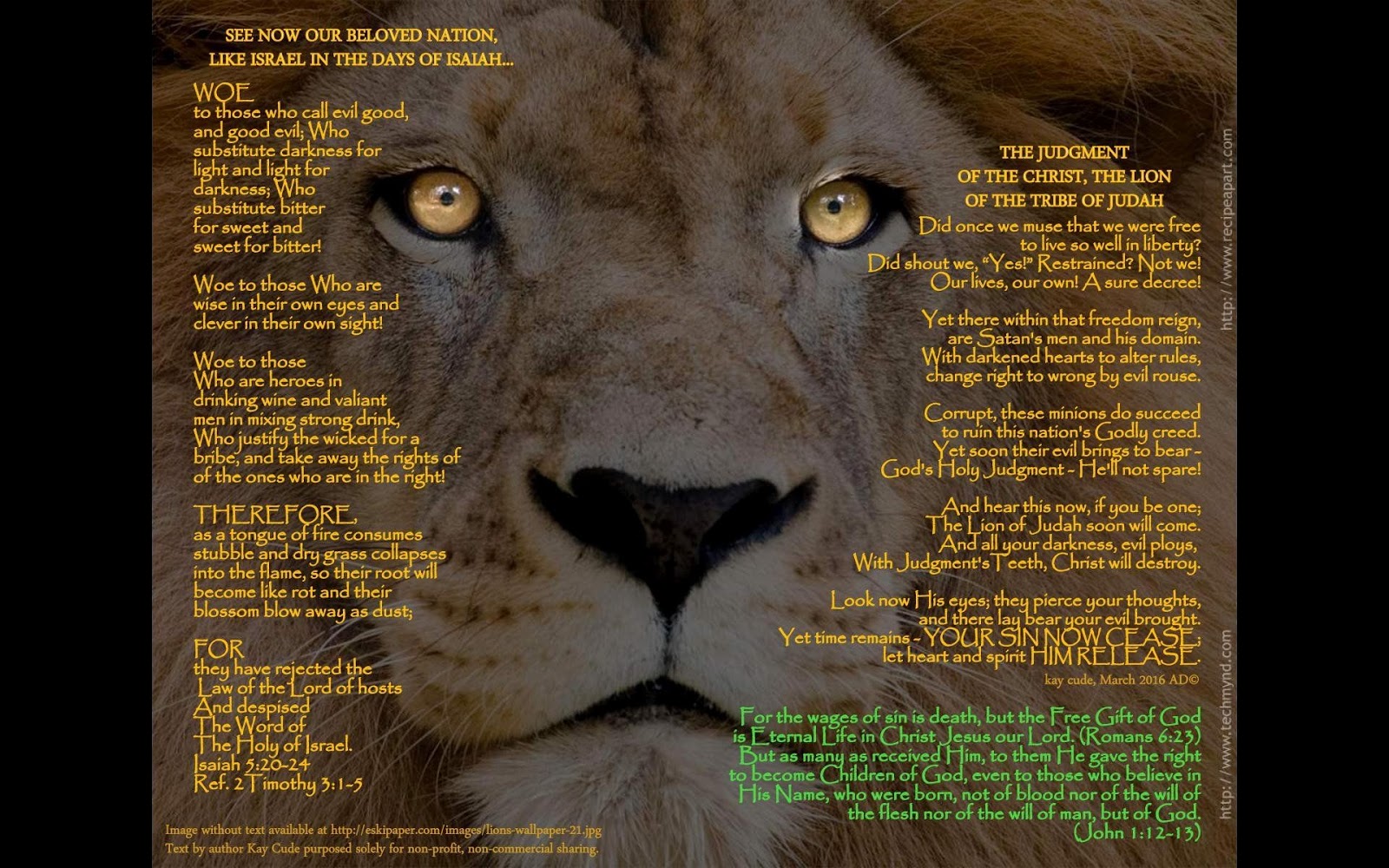
Lunging Lions along the Way

Pilgrim’s Progress by John Bunyan is a tremendous book. It’s an allegory of the Christian’s life from salvation to heaven (“The Celestial City”). In the book, there is a scene where Christian Pilgrim is attempting to climb the way to Porter’s Lodge Up ahead he can see two lions crouching at the edge of the path. What Pilgrim doesn’t know is that the lions are chained, and if Pilgrim stays in the middle of the path, he will not be harmed by the lunging lions. Here is the excerpt:

Now before he had gone far, he entered into a very narrow passage, which was about a furlong off the Porter’s lodge, and looking very narrowly before him as he went, he espied two lions in the way. Now, thought he, I see the dangers that Mistrust and Timorous were driven back by. (The lions were chained, but he saw not the chains.) Then he was afraid, and thought also himself to go back after them; for he thought nothing but death was before him. But the Porter at the lodge, whose name is Watchful, perceiving that Christian made a halt, as if he would go back, cried unto him, saying, Is thy strength so small? Mark 4:40. Fear not the lions, for they are chained, and are placed there for trial of faith where it is, and for discovery of those that have none: keep in the midst of the path, and no hurt shall come unto thee.

We ourselves are pilgrims in a strange land. Our way is clear because, “Thy word is a lamp unto my feet, and a light unto my path.” (Psalm 119:105). The way is lit by His word and it is made clear, but it is a narrow way. Take care to stay on the middle line of that Way, dear friend, as I strive to do myself. And look, see what good promises are ahead for His people the Jews and those of us grafted in!!

Isaiah 35:1-9

The Ransomed Shall Return

1The wilderness and the dry land shall be glad;
the desert shall rejoice and blossom like the crocus;
2it shall blossom abundantly
and rejoice with joy and singing.
The glory of Lebanon shall be given to it,
the majesty of Carmel and Sharon.
They shall see the glory of the LORD,
the majesty of our God.

Pink flowers bloom after a rare rain ignited seeds
 that had lain dormant in the desert for years
.

3Strengthen the weak hands,
and make firm the feeble knees.
4Say to those who have an anxious heart,
“Be strong; fear not!
Behold, your God
will come with vengeance,
with the recompense of God.
He will come and save you.”

5Then the eyes of the blind shall be opened,
and the ears of the deaf unstopped;
6then shall the lame man leap like a deer,
and the tongue of the mute sing for joy.
For waters break forth in the wilderness,
and streams in the desert;
7the burning sand shall become a pool,
and the thirsty ground springs of water;
in the haunt of jackals, where they lie down,
the grass shall become reeds and rushes.

Rushes thriving by a pond. EPrata photo

8And a highway shall be there,
and it shall be called the Way of Holiness;
the unclean shall not pass over it.
It shall belong to those who walk on the way;
even if they are fools, they shall not go astray.
9No lion shall be there,
nor shall any ravenous beast come up on it;
they shall not be found there,
but the redeemed shall walk there.

The redeemed shall walk there. A promise we can cling to, hope on, and await expectantly. How beautiful the feet…

How beautiful upon the mountains
    are the feet of him who brings good news,
who publishes peace, who brings good news of happiness,
    who publishes salvation,
    who says to Zion, “Your God reigns.” (Isaiah 52:7)