Posted in easter, joy, resurrection

Resurrection Sunday!

What strikes me very forcibly is this—no mere man going to his grave could say, “I have power to take my life again.” The departure of life leaves the man necessarily powerless—he cannot restore himself to life. Behold the sacred Body of Jesus embalmed in spices and wrapped about with linen. It is laid within the sealed and guarded tomb—how can it come back to life? Yet Jesus said, “I have power to take My life again.” And He proved it. Strange power—that spirit of His which had traveled through the under lands and upwards to the eternal Glory—had power to return and to re-enter that holy Thing which had been born of the virgin and to revivify that flesh which could not see corruption.

Behold the dead and buried One makes Himself alive again! Herein is a marvelous thing. He was master over death, even when death seemed to have mastered Him—He entered the grave as a captive but left it as a conqueror. He was compassed by the bonds of death but He could not be held by them. Even in His burial garments He came to life—from those wrappings He unbound Himself—from the sealed tomb He stepped into liberty. If, in the extremity of His weakness He had the power to rise out of the sepulcher and come forth in newness of life, what can He not accomplish now?  ~Charles Spurgeon “The Power of the Resurrection

Posted in charismatic, discernment, doctrine, strange fire

Strange Fire Q&A: How does God use false teachers and their heresies?

One hundred years ago, the modern Pentecostal movement was born. By October 2013 the Pentecostal movement has morphed into the Charismatic movement with its particular brand of false doctrine and had infected much of western Christianity and polluted quite a bit of Christianity abroad. The excesses of the movement include faith healing, reports of raising the dead, babbling tongues, alleged prophecies and direct revelation, disorderly church services and worse. The movement assaulted the sufficiency of scripture, the inerrancy of scripture, besmirched the name of Jesus Christ and damaged the faith of many.

John MacArthur and his team at Grace To You took a stand against this movement and sought to bring clarity to why its doctrines needed comparison to the Bible correction. To that end, they organized the Strange Fire Conference, held in the fall of 2013. One of the main purposes of the conference was to initiate a substantive discussion about these issues. It achieved its purpose. Every sermon preached at the conference rebuked the movement simply by preaching the truth, and brought correct biblical doctrine to the fore. Given the outcry, it seems that the effect was immediate.

There were many good questions asked at the various seminars and Q & A sessions held during the conference period, but not all of them could be immediately answered. After the conference concluded, ministers and theologians at Grace Community Church and The Master’s Seminary wrote out answers to these unanswered questions, compiled them, and put them on one web page.

The page is a treasure trove of good, solid rebuttals to and practical helps about what to do if encountering Charismatic doctrines in your church, in your family, or in yourself. Here is just one of the Questions and Answers in the Strange Fire Q&A page.

~~~~~~~~~~~~~~~~~~~~~~~~~~~~

Does God allow false teaching to continue so believers can distinguish between true and false doctrine? 

Paul told the Corinthian church, “There must be heresies among you so that those who are approved might be made manifest’ (1 Corinthians 11:19). Would you please comment on this verse in light of the charismatic movement? Does God allow these false movements, in part, so the distinction is made clear to His people? Thanks. 

The Greek word translated as “heresies” in the King James Version is hairesis. While that word can refer to false teaching or heresy in certain contexts, Paul’s intended meaning when using the word in 1 Corinthians 11:19 is clearly the other possible meaning of “division, faction, separate group.” In this paragraph Paul is confronting the Corinthian believers’ selfishness and sectarianism (see vv. 18, 21–22, 33). The text of the New King James Version clarifies the meaning by updating the translation from “heresies” (KJV) to “factions” (NKJV). Paul says that when those inevitable divisions happen, they serve the good purpose of distinguishing between the sinful and the righteous people in the church.  

Having said that, the situation Paul describes regarding disunity in the Corinthian church is similar to the result of the error being taught within the charismatic movement today. The doctrines they tolerate and often perpetuate distort, pervert, and contradict sound, biblical teaching. The truly saved who revere and carefully study God’s Word can see the difference between false charismatic teaching and sound theology. While we would never condone false doctrine and practices, we do rest in our confidence that God uses even the wickedness of man for His good purposes (cf. Genesis 50:20; Acts 2:23; Romans 8:28)

Posted in culture shock, discenrment, encouragement, jesus

The very real effects of culture shock, Part 3 (final)

Introduction
Part 1: Examine the very real effects of expatriate living and culture shock.
Part 2: Examine the very real effects of expatriate living and culture shock on the Christian, this time from a Christian worldview.
Part 3: What to do about those stresses

In the Introduction to this Culture Shock series, I’d related several expatriate experiences I’d had while visiting abroad for longer than usual vacation periods. There are very real stresses which emerge physiologically, mentally, and emotionally when chooses to dwell in a nation in which one was not born. This fact also applies even when a person has moved from one nation to the next and their native language is spoken in both places, such as moving from the US to the UK, or Canada to Australia. Culture shock is a real event.

I’d said the earth is not our home. In that sense we believers are expatriates. Our citizenship is in heaven. The jarring difference between our home by citizenship and our home by residency is growing wider every day.

In part 1 I’d shared a list of stressors secular expatriates feel when living abroad. In the second part, I translated those secular stressors into stresses Christians feel as expatriates from heaven living in a hostile world. Things are getting more disorienting every day. The “glory days” of Christianity, are all gone, if they ever existed at all. We ARE strangers in a strange land and the times show us that more as every month passes. Yet many Christians are still shocked at the hostility and unfriendliness in their work or in their social circle or even within their families for their faith. Christians become upset over the political process currently happening in America. They are surprised when friends on Facebook suddenly turn angry, bitter, and mean. They are astounded when seemingly solid marriages break up. They are complaining on social media and at the proverbial water cooler about the state of the church (which is admittedly declining, and declining fast).

Expatriation means a break with home – where you come from and your mother tongue – it requires a mental readjustment to meet the demands of your new life which is often governed by specific rules to which you need to adapt and familiarise yourself. Source

The mental – and emotional –  expatriation that occurs when transferring one’s citizenship from the nation of Earth to the City of Heaven does require a major readjustment. The new Christian life is demanding, and this does not change if one is an old Christian, either. The Lord said to pick up one’s cross every day, (Luke 9:23) and from newbies to veterans, pew-sitters to leaders, the adjustment is daily and ceaseless because sanctification is ceaseless. (Until the moment of glorification, that is!) Releasing attachment from the world is ongoing. Scanning one’s life for idols is constant.It takes energy adn sometimes heartache not to assimilate in the world even while we are in it. (John 17:14-15). Just imagine Jesus, who was not of this world but lived in it for 33 years, perfectly and without sin. The Original expatriate. (John 8:23).

In this part: what to do about our surprise, shock, and upset as we grow apart from the culture that wants to hold tight to us.

First, let’s give ourselves a bit of a break. The earth is the only home we’ve known. Though we know by faith and from the Bible that our home is in heaven, we have not seen it. So when we are caught off guard during a controversy, a tragedy, or a disappointment, though the head-knowledge is strongly present, it sometimes takes a while for the heart to catch up and sort it out. It hurts to lose your church. It pains us to be marginalized from a previous social circle. It is a grief when family distances themselves.

The remedy for culture shock as always is Jesus. He is the remedy for everything.

First, you know the old adage, “Some Christians are so heavenly minded they are no earthly good.” This is a lie straight from satan’s doubly forked tongue. The ONLY way we can be of any good is from, to, through, and because of Jesus, and He is in heaven. Further, the Bible says,

Colossians 3:2 says, Set your mind on things above, not on the things that are on earth.

Contrast the above command with the enemies of Christ who focus on earthly things. It does not end well.

Philippians 3:19 says, Their end is destruction, their god is their belly, and they glory in their shame, with minds set on earthly things.

Matthew 16:23 says, Jesus turned and said to Peter, “Get behind me, Satan! You are a stumbling block to me; you do not have in mind the concerns of God, but merely human concerns.

This is what it means to be in the world but not of it. Don’t become too attached to human concerns. Of course we can be concerned when our favorite candidates’s presidential campaign does not go well, but we should not engage in public hand-wringing. Of course we can be attuned to the economy’s ups and downs, but the schemes and philosophies of man should not rule us. Of course we are involved with the other elements that make up a society, such as technology, business, culture, trade, communications – but those will not last. We might care about the wind farm going over the hill or the bypass being planned for the neighborhood or the bandwidth of our local communications utility – but those things will pass away. Getting TOO involved in the cultural details will shift our focus from the heavenly home above and Jesus as the ruler, creator, sustainer, savior, priest, judge, etc. Shepherd the things that are impacting our lives here on earth but let them go if they are causing a stumbling in our witness.

Have you ever met someone who was so heavenly minded they were so earthly good? No, you haven’t, and I haven’t either. I have met heavenly people who exhibit the fruits of the spirit and they are plenty good on earth, as a witness to the grace of Jesus Christ. They are patient, joyful, kind, self-controlled, kind, good, and gentle. Their Facebook page is not littered with rants against this candidate or that one. Their conversation is not peppered with complaints about the lousy internet service. Their faces are not all sour because their stock took a slight dip.

From the essay The Futility of Political Change:

Part of the fallout from the emphasis on political activism in the church is the denigration of God’s sovereignty. If we truly believe the Lord is the Author of history and that He is orchestrating all things according to His will, do we really need to throw so much of our time, energy, and resources into supporting candidates and ballot measures? Or is it that He has temporarily lost control, and we need to gain it back for Him? 

As John MacArthur explains, that’s simply not the work we’ve been set aside for:

We can’t protect or expand the cause of Christ by human political and social activism, no matter how great or sincere the efforts. Ours is a spiritual battle against worldly ideologies and dogmas that are arrayed against God, and we achieve victory over them only with the weapon of Scripture. The apostle Paul writes: “For though we walk in the flesh, we do not war according to the flesh. For the weapons of our warfare are not carnal but mighty in God for pulling down strongholds, casting down arguments and every high thing that exalts itself against the knowledge of God, bringing every thought into captivity to the obedience of Christ” (2 Corinthians 10:3-5 NKJV). 

God simply is not calling us to wage a culture war that would seek to transform our countries into “Christian nations.” To devote all, or even most, of our time, energy, money, and strategy to putting a façade of morality on the world or the appearance of “rightness” over our governmental and political institutions is to badly misunderstand our roles as Christians in a spiritually lost world.

So as heavenly expatriates, keep focused on the home to which we will all return.

Secondly, all the expatriate sites say how important it is to make friends in the new location. For Christians, this means developing relationships in and among solid Christians who will lift you or help you by a sacred word, pray for you, and keep you accountable. Start with friendships at church. Make overtures, or host a couple or a new friend or two. Be friendly and kind.

I know this isn’t some of “y’all’s” cup of tea. It isn’t really mine. It isn’t a negotiable though. (Hebrews 10:25). Anyway, I like the old story about the man who quit coming to church. After a while his pastor came to visit the man in his home. A roaring fire was burning in the fireplace. The two sat in companionable silence for a while. The Pastor asked the man why he stopped coming to church and being involved with the people there. The man had a list of complaints that were mostly petty. In response the pastor simply poked the fire iron into the fire, and drew out one ember. Soon, the ember faded and then went out. The pastor simply got up and left, and the next week the man was back in church.

Third, in secular expatriate advice, they advise being ‘open to new experiences’. In Christian expatriate life, we translate their advice to at to “serve”. Doing so gets your mind off yourself. We stretch ourselves when we are called to serve in an area of ministry. (Romans 7:6)

In a secular list of advice for the expatriate, it is warned, “Don’t keep all the pressure of your new life to yourself.” We translate that to “pray without ceasing.” (1 Thessalonians 5:17). Who should we list our complaints to? Jesus. I find this index card very helpful. It was posted on Facebook by a friend today. As the world becomes more brutal, people are more raw. This includes Christians.

Prayer helps us keep our perspective. Lay it all at His feet, from the trivial to the mundane to the tragic woe. He is listening, because He is our priest, interceding for us. (Romans 8:34).

I think I’ve dragged out the metaphor long enough. In order to minimize the very real effects of Christian culture shock in these brutal days:

–Set your mind on the things above
–Develop Godly relationships
–Serve
–Pray

If you do those things you will not be so culture shocked. Personally, I’m looking forward to the shock of living my little life on earth and then the next second being called by Jesus in the rapture and established upon the New Jerusalem which is in heaven! I will have a lovely time being shocked senseless amid the presence of the Savior, the Tree of Life, the saints, the angels, and the glory of God. Now THAT’S culture shock!
Posted in charismatic, discernment, jesus calling

Strange Fire Q & A: Jesus Calling

One hundred years ago, the modern Pentecostal movement was born. By October 2013 the Pentecostal movement had morphed into the Charismatic movement with its particular brand of false doctrine and had infected much of western Christianity and polluted quite a bit of Christianity at home and abroad. The excesses of the movement include faith healing, reports of raising the dead, babbling tongues, alleged prophecies and direct revelation, disorderly church services and worse. The movement assaulted the sufficiency of scripture, the inerrancy of scripture, besmirched the name of Jesus Christ and damaged the faith of many.

John MacArthur and his team at Grace To You took a stand against this movement and sought to bring clarity to why its doctrines needed comparison to the Bible and thus correction. To that end, they organized the Strange Fire Conference, held in the fall of 2013. One of the main purposes of the conference was to initiate a substantive discussion about these issues. It achieved its purpose. Every sermon preached at the conference rebuked the movement simply by preaching the truth, and brought correct biblical doctrine regarding the sign gifts of the Spirit to the fore. Given the outcry, it seems that the effect was immediate.

There were many good questions asked at the various seminars and Q & A sessions held during the conference period, but not all of them could be immediately answered. After the conference concluded, ministers and theologians at Grace Community Church and The Master’s Seminary wrote out answers to these unanswered questions, compiled them, and put them on one web page.

The page is a treasure trove of good, solid rebuttals to and practical helps about what to do if encountering Charismatic doctrines in your church, in your family, or in yourself.

~~~~~~~~~~~~~~~~~~~~~~~~~~~~

Epidemic in the Charismatic movement is the acceptance of personal revelations. Everybody and their brother it seemed was hearing from Jesus and were eager to share “a word from the Lord”. Such practices assault the sufficiency of scripture, of course, and must be corrected. However, one book is doing its level best to continually to attack the sufficiency of God’s word-  and that book is “Jesus Calling”. Jesus Calling was published in 2004, 16 years ago now, but is still on the bestseller lists. The book has spawned a cottage industry of studies, devotionals, children’s books, and other material that has never stopped polluting the faith. Indeed, it seems to be increasing in its staying power and corrupt work.

Here is just one of the Questions and Answers in the Strange Fire Q&A page.

Last year a friend gave me the book Jesus Calling by Sarah Young.  How do I approach my many friends who love this and similar books? 

Scripture has true spiritual power to save and sanctify those who listen and obey it, but human writings masquerading as divine prophecy—such as Jesus Calling—have no such power.  Nevertheless, many people today are enticed by the idea that God is speaking supernaturally through these frauds.  

In order to help your friends, you should gently point out the superior authority of Scripture and refer them to passages such as 2 Peter 1:16–21, 2 Timothy 3:16, Jude 3, and Psalm 19:7–11.  Another good resource is John MacArthur’s two-part series, The Sufficiency of Scripture.

Posted in culture shock, encouragement, jesus

The very real effects of culture shock, Part 2

Introduction
Part 1: Examine the very real effects of expatriate living and culture shock.
Part 2: Examine the very real effects of expatriate living and culture shock on the Christian, this time from a Christian worldview.
Part 3: What to do about those stresses

—————————————

Top, GraphicsFairy.com. Bottom, EPrata photo

In the Introduction to this Culture Shock series, I’d related several expatriate experiences I’d had while visiting abroad for longer than usual vacation periods. There are very real stresses which emerge physiologically, mentally, and emotionally when chooses to dwell in a nation in which one was not born. This fact also applies even when a person has moved from one nation to the next and their native language is spoken in both places, such as moving from the US to the UK, or Canada to Australia. Culture shock is a real event.

I’d said the earth is not our home. In that sense we believers are expatriates. Our citizenship is in heaven. The jarring difference between our home by citizenship and our home by residency is growing wider every day. Left, heaven above, earth below.

In part 1 I’d shared a list of stressors secular expatriates feel when living abroad. In this part, I’m translating those secular stressors into stresses Christians feel as expatriates living in a hostile world. Things are getting more disorienting every day.

I am writing from a westerner’s perspective. America was founded by Pilgrims seeking freedom to worship. Puritans were almost successful for a short while in instituting a near theocracy. The First and Second Great Awakenings were events from times past on which today’s Christian looks fondly. We fervently wish all to be saved, and we look back onto those past eras in America of the 1600s, 1700s and 1800s, and even the early part of the 20th century, and long for the times when it seemed everybody believed.

However those are vestiges, mere shadows of a Christianity that even at the time, wasn’t all it seemed to be. The word is hostile to Christianity. America is hostile to Christianity. it always has been. The Christians of any perceived Golden Era were merely cultural Christians, shallow believers going along to get along, pressured by the wider culture to conform. But most of them didn’t really believe.

Today’s Christian of a certain age grew up in church, the Bible Belt was a real section of the country where it seemed that everyone worshiped the same Jesus, and our nation was strong, thriving, respected, and great. God and country.

No more, if it ever was.

I personally believe the Lord is doing us a favor by showing us, albeit rapidly, how shallow the American Christianity was and is, and how few people adhered to what the Bible commands from us as true believers. However much we understand the head knowledge that we are considered as enemies, it still hurts when that fact is brought home to us. Head knowledge from accepting the word from the Bible and boots on the ground experience are two entirely different beasts, and it sometimes takes a while before the latter catches up with the former.

In rapid fashion, even the most head-in-the-ground Christian is beginning to experience lost friendships and splits over faith. More and more false teachers are being promoted by satan. The more believers point them out, the more furious fellow pew sitters, friends or even family become. It hurts to lose friendly or family relations, even as we know that it would occur (because Jesus said it would). (Matthew 10:35, Matthew 10:21, Luke 12:53).

Cultural attitudes toward work, finances, the economy, politics, our nation, schooling, sexuality, marriage, and even gender are changing fast. It’s disorienting, even as we attempt to adjust to the changing landscape yet remain tranquil and calm with the peace of Jesus as our aura. Made even harder is that secular expatriates try to assimilate, but as Christians we must remain in the world and not of the world. We want to integrate, but not assimilate.

Integration occurs when individuals are able to adopt the cultural norms of the dominant or host culture while maintaining their culture of origin. Source

I’d posted in the last part that secular expatriates experience ten major stress-related triggers. Below, I reformatted those top ten secular stresses into stresses that hopefully may seem similar to today’s Christian. Even without my re-formatting, a Christian would easily recognize the ten stressors if they wanted to apply them to their own circumstance.

1.) Long and unusual work hours due to the fact that Christians are never “off” and are always “on” and like the Father, always working. (Col 3:23, John 5:17).In these brutal days, there is all the more work to do, ministries to fill, and faltering friends to hold accountable or to comfort when tragedy happens.

2) A “trailing Christian spouse” who has given up a career to move abroad with her working spouse and is adjusting to not only a new country, but a new lifestyle, especially when the feminist culture mocks women for submitting to her husband. (1 Peter 3:1)

3) New stresses for our Christian children: school, new non-Christian friends, a different native language, counter-Christian teachers and teaching methods, and not to mention, full immersion into a culture other than their own. It stresses the parents to know how best to protect children from secular influences. (Proverbs 1:8).

4) As new Christians, our most comfortable support system of non-Christian friends and family have gone from being neighbors and parents to enemies of the Christ in us. (Matthew 19:29). Creating a new local support system takes a lot of time and emotional energy, and can be a stressful endeavor, especially for babes in the faith.

Finding a church so as to merge into a support system of comfort and accountability early on in your Christian expatriate life is essential. (Acts 2:42). Yet many churches teach false doctrine and babes are especially vulnerable because they cannot always detect the false, and instead of a new support system for growth in the faith, what they get is drawn into a pit from which, if they escape by grace of God, having then to start over and dispense with the teachings that have now polluted their brain. (Hebrews 3:13).

5) A certain amount of lost independence due to language barriers.

6) The dynamics of a Christian marriage inevitably change with the new responsibilities and roles that come along with a move of citizenship from the World to the nation of Heaven, creating stress for each spouse. (Ephesians 5:22-27)

7) For “Single Global Christians,” between building a social network outside of work without the benefit of a spouse, and not having a sense of “community” or roots, being abroad alone can be both a stressful and lonely place, especially if one has been disowned for the faith or lives where there literally is no visible network and speaking of Jesus means death.

8) Finances. In many instances, the transfer of citizenship from the World to the City of Heaven reduces the Christian’s economic status in life. This is especially stressful when one has been immersed in hearing Prosperity Gospel and one wonders why “it’s not working for me.” For others, being a citizen of Heaven means persecution comes in stolen property, schemes to steal one’s home, or persecution where one loses everything.

9) Being Unhappy. Having a negative attitude or feelings about where you are; unrealistic expectations of your new life in your new country, and expecting perfectionism from yourself and the culture around you is a breeding ground for self-induced stress and a recipe for marital unhappiness. Your unhappiness is a feeling even your children pick up on.

10) Poor stress coping skills. Usually due to a lack of prayer and a lack of studying the Bible.

Over the last decades, who hasn’t been influenced in perspective when watching grainy lack and white Billy Graham Crusades and saw thousands of seekers streaming forward? Who hasn’t been affected by seeing many ‘walk the aisle’ at revival after revival? Which grandmother doesn’t fondly recall the glory days of Christianity when the churches were full and everybody came to dinner on the ground?

Those days are all gone, if they ever existed at all. We ARE strangers in a strange land and the times show us that more each day. Yet still, many Christians are shocked at the hostility and unfriendliness in their work or in their social circle or even within their families.

In the next part: what to do about it.

Introduction
Part 1: Examine the very real effects of expatriate living and culture shock.
Part 2: Examine the very real effects of expatriate living and culture shock on the Christian, this time from a Christian worldview.
Part 3: What to do about those stresses.

———————————

Further reading

How can Believers be in the world but not of the World?

What does it mean for Christians to be in the world but not of the world?

Blog Series at Grace to You, In the World, but not of it

Posted in culture shock, encouragement, jesus, the world

The very real effects of culture shock, Part 1

Introduction
Part 1: Examine the very real effects of expatriate living and culture shock.
Part 2: Examine the very real effects of expatriate living and culture shock on the Christian, this time from a Christian worldview.
Part 3: What to do about those stresses.

~~~~~~~~~~~~~~~~~~~~~~~~~~~

Laundromat in Baños, Ecuador. It cost a quarter and they give you
a rock to use to scrub. Soap not included. EPrata photo

In the Introduction to this Culture Shock series, I’d related several expatriate experiences I’d had while visiting abroad for longer than usual vacation periods. There are very real stresses which emerge physiologically, mentally, and emotionally when chooses to dwell in a nation in which one was not born. This fact also applies even when a person has moved from one nation to the next and their native language is spoken in both places, such as moving from the US to the UK, or Canada to Australia. Culture shock is a real event.

I’d mentioned that in these days with quickly shifting cultural sands disorienting us and putting us off balance, Christians experience a similar culture shock. The earth is not our home. In that sense we are expatriates. Our citizenship is in heaven.

Expatriates find that they experience stress while living abroad. In this essay I’ll look at the stresses expatriates experience from a secular perspective. In the next essay I’ll compare these stresses to the Christian’s experience of living on earth while not being OF the earth, heaven’s expatriates, as it were.

I do want to mention that I’m not a fan of Psychology or secular counseling, but the fact is the body and mind do go through physiological changes when living under pressure in an unfamiliar culture in which one is NOT trying to assimilate. It’s hard when we are in the world but not trying to reach the world nor adopt the world’s habits. Let’s acknowledge it’s stressful. The following is from The Expat Exchange. Though they were written for the secular Expat, one can see the pattern can be applied to the citizen of Heaven in today’s hostile World. I’ll explore this more in the next essay. And incidentally, I am sure that missionaries are given a thorough grounding in what to expect when moving overseas, but the shock of adjusting to being there can’t be learned from a classroom, but experienced mentally, physically and emotionally.

Top Ten Reasons why Expats get stressed

1) Long and unusual work hours due to doing business in different time zones and a 70%-of-the-year travel schedule for the working spouse.

2) A “trailing expat spouse” who has given up a career to move abroad with his or her working spouse and is adjusting to not only a new country, but a new lifestyle.

3) New stresses for our expat children: a new school, new multi-cultural friends, a different native language, new teachers and teaching methods, and not to mention, full immersion into a culture other than their own.

4) As new expats, our most comfortable support system of friends and family have gone from being neighbors and parents to voices on the phone or words on an email. Creating a new local support system takes a lot of time and emotional energy, and can be a stressful endeavor, especially for first time expats.

5) A certain amount of lost independence due to language barriers is stressful, making everything from arranging for house repairs to ordering a pizza over the phone very frustrating.

6) The dynamics of an expat marriage inevitably change with the new responsibilities and roles that come along with a move overseas, creating a certain amount of stress for each spouse.

7) For “Single Global Professionals,” between building a social network outside of work without the benefit of a spouse, and not having a sense of “community” or roots, being abroad alone can be both a stressful and lonely place to be.

8) Finances. In many instances, home leaves, house hold expenses and medical procedures/visits are all paid out-of-pocket before employer reimbursement (depending on your employer situation), so having a healthy savings account and good credit is a must to move abroad.

9) Being Unhappy. Having a negative attitude or feelings about where you are; unrealistic expectations of your new life in your new country, and expecting perfectionism from yourself and the culture around you is a breeding ground for self-induced stress and a recipe for marital unhappiness. Your unhappiness is a feeling even your children pick up on.

10) Poor stress coping skills.

Ponder these, and think about them both in terms of the intent of the original article aimed toward secular expats, but also think of them in terms of being a Christian expat. Tomorrow, I’ll re-phrase the above top ten stresses into Christian expat stresses and perhaps they will speak to what you may be going through.

Do not be conformed to this world, but be transformed by the renewal of your mind, that by testing you may discern what is the will of God, what is good and acceptable and perfect. (Romans 12:2)

Introduction
Part 1: Examine the very real effects of expatriate living and culture shock.
Part 2: Examine the very real effects of expatriate living and culture shock on the Christian, this time from a Christian worldview.
Part 3: What to do about those stresses.

————————————

Further reading

How can Believers be in the world but not of the World?

What does it mean for Christians to be in the world but not of the world?

Blog Series at Grace to You, In the World, but not of it

Posted in culture shock, encouragement, expatriate, the world

The very real effects of culture shock, Introduction

This is an Introduction to a series.

Part 1: Examine the very real effects of expatriate living and culture shock.
Part 2: Examine the very real effects of expatriate living and culture shock on the Christian, this time comparing the effects through a lens of the Christian worldview.
Part 3: What to do about those stresses.

——————————————-

Visible Christianity as it has been known for these past decades is declining in the West. Of course the true church still spotless and gleaming white. But the surface “Christian-y” (not Christianity) culture in America is fast falling away. It has been a disorienting process for some. The ground is made of shifting violently sand, and especially unaware or new Christians, have been put off balance.

Friends quickly anger if you talk negatively about a favored idol-teacher. Facebook comment sections blow up in anger from previously mild-mannered friends. Family members are irritated by all your Jesus talk. Work spaces no longer tolerate your prayer lunch group- if it’s Christian. Muslim employees receive a private prayer room and Halal cafeteria. Portrayals of our faith in media have become simply cartoonish. All this and more gives the Christian coming to terms with the new normal (read: hostile world) a feeling of upset and disorientation.

It’s culture shock. That is because the moment we’re justified, our citizenship transfers from the world to heaven. We become expatriates, dwelling in a place that is not our home any longer.

I’ve mentioned before on this blog and my other blog that during the 1990s I traveled widely. My husband and I loved to pick up and go, and the sub-text was that we would also keep our eyes open for a warm weather, inexpensive place to winter over. Maine is cold. Brrr.

We spent time in Florida, Texas, the desert of the American Southwest, but also the Bahamas, and Ecuador. We traveled to Europe but it seemed too expensive to become an expatriate in those places. The European Union hadn’t been formed yet, and even after it was, the borders were still pretty tight in those early days. Of course as Maine residents, we visited Canada frequently but as a winter getaway for snowbirds, well, it defeats the purpose.

The sprawling city of Quito, Ecuador. EPrata photo

We liked Ecuador a lot. At the time, American money would last a long time there. The government had been pretty stable, and thanks to Ecuadoreans we knew, we were given a tour from north to south. My husband I liked Cuenca, a colonial city of universities and at a lower altitude than Quito. The height of Quito’s location at nearly 10,000 feet made for pretty thin air and a long time to cook anything, so we liked Cuenca which was at about 8200 feet above sea level. Warm, but not hot like at the seacoast or the jungle.

When we were in Quito, we found a cool bookstore called Confederate Books. It is touted as South America’s best selection of English-language books. Indeed, I found a rare Brautigan there. We spoke to the owner, who was from America, for a long time about what it is like to live as an “ex-pat.” An Expatriate is someone who lives outside their native country. It’s a person who is settled in another land. We were considering living in Ecuador for the mild winters down at the equator. Though we were in Ecuador for a month, we knew there was a huge difference between visiting and living in a third world nation.

Culture shock is an experience a person may have when one moves to a cultural environment which is different from one’s own; it is also the personal disorientation a person may feel when experiencing an unfamiliar way of life due to immigration or a visit to a new country, or a move between social environments… Source

After our conversation at Confederate Books, we emerged into the strong equatorial light onto Amazonas St, which is the bustling main shopping street in the high-altitude city of millions, we began walking toward where the restaurants were. My husband had a special kind of belt where he kept the money and copies of our passports for ID etc. Since we were always together, he carried the money and papers for us both. Pickpockets were a huge problem. As we walked, we began talking as we were jostled in the crowd, and then we began arguing. I don’t remember what over. Angry, at one point I turned on my heel and stomped off in the other direction.

The crowd quickly closed in and within a minute I realized I had done something very stupid. I was a woman alone, in a non-English speaking country (and not many Quitenos spoke English) and I had no ID and no money. It was in my husband’s belt, who had now disappeared from sight and was lost in the crowd. I couldn’t even take a cab back to the rental apartment, nor was there anyone home for me to call even if I managed to find a phone, scrape some coins, and know how to dial in a third world country. (This was pre-cell phone days). Suddenly my sunny shopping day was fraught with danger and anxiety. I quickly turned around and hustled to find my husband.

Life as an expatriate requires significant effort to adapt to new social and cultural environments. Source
In my inaugural trip of my decade of traveling, I spent a month alone in Italy. The first week was with an ex-pat American family my mother had known. The last two weeks I was going to meet up with a group and I would participate in an archaeological dig. So in reality I was only totally on my own for a week. I wanted to make my way down from Milan where the plane had landed, to the Italian Riviera to Siena, Florence, then Rosia, the little Tuscan town where the dig was going to happen.

What living in Italy for a week all on my own meant was that reading train schedules, ordering food in a restaurant, finding the grocery store, completing a reservation at a hotel, had to be done by no one else but me, all by myself in a foreign language with no support system. Finding attractions, safely walking the streets, handling money and making sure I received the correct change, etc, was all very taxing. Not knowing what to do with even the smallest of details gives you a fight or flight feeling. One is never sure if one is stumbling into a dangerous situation or not. All the signals are mixed.

Me in Portofino, Italy

Traveling from Portofino to Florence we hurtled through mountains and the train would go through tunnels. At one point I was standing outside my little compartment and a nice looking well dressed Italian gentleman tried to start a conversation. I had no clue if he was hitting on me, casing my pockets, or something else. It was something else. He said through gestures that when we go thru a tunnel it’s a good time for pickpockets to grab what they can from your person or your luggage. He was patiently trying to give me a warning. He recommended sitting back in my compartment with my valuables on me. I went from being scared of him to being scared of pickpockets during the brief but frequent tunnel blackouts.

When you’re alone in a strange land, you have no idea who is a threat or what situation is safe or could lead to disaster. You have no idea that a benign situation could suddenly explode into a dangerous one, or a trying one, or a misunderstanding one. Your normal reactions are all off.

Culture shock is a real thing. Shock being the focus. Here is some information from Expat Exchange on the stress of living abroad in another culture. Here is the ExPat Exchange-

It only takes six weeks and one foreign language for the average expat to figure out that life overseas is not for the faint of heart. …

What is stress?

According to thinkquest.org “stress is a particular pattern of disturbing psychological and physiological reactions that occur when an environment event threatens important motives and taxes one’s ability to cope. In plain English, stress is the “wear and tear” our bodies experience as we adjust to our continually changing environment.”

This 4-part series is one of encouragement. Here is the point, if you have not seen it by now.

Christians are expatriates.

Let me say that again. This world is not our home. We are born on earth, we live on earth, and we are OF the world … until the moment of justification. When we are saved, our citizenship immediately transfers to Heaven, and we become strangers in this land. (Philippians 3:20). Those around us are enemies of us becuase they are at enmity with the God in us. (Romans 8:7). We still live here, but we are strangers. We think of heaven, we long for heaven, we are of heaven. (Colossians 3:2). The citizens of earth consider us their enemy (consciously or unconsciously). We are not of this world, but we are still in this world. (John 17:14–19).

Lately, pressures have been building even for those fortunate enough to have been placed by God in nations where persecution is not overtly occurring. Christians are finding that we are standing on very shifting sand as expatriates. The times are changing rapidly and hostility against us here in the former land of free speech are living through a culture shift that, taxes our ability to cope. As the ExPat Exchange site mentioned, living for a prolonged time in a nation that is not our own and is in fact hostile to us taxes us to the point of stress, where physiological reactions occur.

Culture shock, personal loss, and discouragement are at all time highs, just as discernment is at all time lows. It’s taxing all right.

Of course, over this series, I will reiterate that unlike earthly expatriates, we have the Spirit in us to help us live tranquilly even if everything around us is being dismantled. So our experience isn’t exactly like other expatriates, but it is similar and I’d like for us to recognize the real stresses many of the brethren are enduring.

This was the introduction. So what’s next?

Part 1: Examine the very real effects of expatriate living and culture shock.
Part 2: Examine the very real effects of expatriate living and culture shock on the Christian, this time comparing the effects through a lens of the Christian worldview.
Part 3: What to do about those stresses.

Posted in bible study, commentaries, discernment

Commentary author recommendation: Roy Gingrich

Dr Roy Gingrich, source Faithlife

We study the Bible because we love Jesus and want to know more about Him. The only place where we can reliably learn more about our Savior is in His word, which is THE authoritative word. We ladies like to learn theology, so we read God’s word.

I cut my teeth on the Old Testament, loving it from the beginning even as a babe in Christ. I spent the first years of my salvation reading all the Old Testament Prophets. They’re hard, though, complicated at times and filled with symbolism, idioms, and long history which requires understanding for context. The Holy Spirit is the main help to us, because scripture teaches scripture. He illuminates the word to us as we study and pray. Psalm 119:18 says,

Open my eyes that I may see wonderful things in your law.

Ephesians 1:17-18 says

that the God of our Lord Jesus Christ, the Father of glory, may give you the Spirit of wisdom and of revelation in the knowledge of him, having the eyes of your hearts enlightened, that you may know what is the hope to which he has called you …

However, for information regarding the histories or interpretations of other difficult passages, we also use commentaries. God has raised up men before us who wrote down explanations and comments regarding the books of the Bible. In researching the book of Jeremiah, for example, I found few sermons, and fewer commentaries (which were available to me or reasonably priced enough to access).

Some people look down their noses at using commentaries, saying “I just use scripture.” Really? you don’t also listen to your pastor who stands there week after week explaining the scriptures to you? In his essay 20 Tips on How to Use Bible Commentaries, Professor and Pastor David Murray quotes Spurgeon,

It seems odd, that certain men who talk so much of what the Holy Spirit reveals to themselves, should think so little of what he has revealed to others. My chat this afternoon is not for these great originals, but for you who are content to learn of holy men, taught of God, and mighty in the Scriptures. It has been the fashion of late years to speak against the use of commentaries…A respectable acquaintance with the opinions of the giants of the past, might have saved many an erratic thinker from wild interpretations and outrageous inferences” (C H Spurgeon).

The essay linked above with HOW to use commentaries, because there is a right way and a wrong way. Just as you study alone, you learn from your pastor, and listen to online sermons, definitely read commentaries also. Do use them.

On my Logos 6 software, I learned of a theologian called Roy Gingrich. I had not heard of him before and yet I was intrigued. He has commented on all the Bible and some Bible topics besides. He lived relatively recently and most of his writing was finished in the latter part of his life, in the 1970s to the ’90s and even into the 2000s.

The bio at the Faithlife (Logos) wiki states,

Roy Gingrich was an American pastor and author best known for his comprehensive commentary series. He was born to Arthur and Arista Gingrich on February 3, 1920 in Ozark, Illinois, the youngest of four children. Roy received God’s call to enter the Christian ministry in 1941. After intensive preparation and pastoral stints in Illinois and Indiana, he became pastor of Faith Bible Church in Memphis, Tennessee, where he remained for over 40 years.

In 1963, Gingrich graduated cum laude from Victory University (formally Mid-South Bible College) and soon thereafter joined the teaching staff. Gingrich began writing conservative Bible commentaries in 1964. Roy Gingrich’s Commentaries in Outline Form (100 vols.) includes 60 different commentaries on the books of the Bible, and 40 additional commentaries on major Bible themes.

In 2001, Dr. Gingrich retired from a long and fruitful ministry, but continued to revise his commentaries and lecture at colleges and churches in the US. In 2003, he was inducted into the Crichton College Hall of Fame.

Here is one revoew of one of the commentaries. Of Dr Gingrich’s Commentary on Isaiah, fellow Professor of Theology Paul M. Davidson at Mid-South Bible College wrote in 1977 in the preface to Gingrich’s Commentary on Isaiah,

The book of Isaiah is named for its author, the prophet Isaiah. Isaiah means “Jehovah is salvation” or “Salvation is of Jehovah.” He is rightly called “the Evangelical Prophet of the Old Testament.” By common consent, he ranks among the great literary geniuses of all time and his book is recognized as a part of the world’s great literature. 

According to tradition, Isaiah was martyred, sawn asunder, Hebrews 11:37. Just so, in the hands of destructive modern critics his book has suffered, being cut up into many parts. Consequently, liberal Biblical scholars today deny the unity as well as the Isaiah an authorship of this great work. They affirm that it is the product of various authors, writing at different times, long after Isaiah’s death. Then an unknown redactor combined the various elements into the book that we know today as Isaiah. 

In view of the above errors, it is refreshing to read Mr. Gingrich’s thoroughly orthodox, expanded, analytical outline of Isaiah. His exposition comes from a balanced and responsible conservatism which gives the work an abiding value. Like his other books, this one begins with a full general introduction, treating such topics as authorship, unity, historical background, importance, etc. This is followed by a succinct exegesis and explanation of the text. Both the layman and the busy preacher can use this commentary and quickly come to the heart of a passage and receive much help. For the greatest profit, this outline should be both read and studied with an open Bible. It is designed for both personal and group use.

For many years, Mr. Roy Gingrich has been pastor of Faith Bible Church, Memphis, Tennessee. He is a graduate of Mid-South Bible College, where he is presently a much loved and respected professor. He is truly a humble man of God and a diligent, tireless student of the Word. The reader of these pages has before him the fruit of many hours of prayerful research and the insights of six or seven of the most outstanding and scholarly commentaries on Isaiah.

Heartily and without reservation, I encourage pastors, teachers, and lay persons desiring a thorough grasp of Isaiah to study carefully this analytical outline, this outline being an interesting and effective aid to an understanding of this portion of the Scriptures.

The really interesting thing about Dr Gingrich’s approach to writing commentaries, is that they are all outlines. I love me some Matthew Henry but in accessing his Whole Commentary on the Bible through Logos, sometimes it takes me a long time of reading before I get to the single nugget I want. Mr Gingrich wrote all his commentaries, including the Prophets, as an outline, with a one or two clear, concise sentences for each verse. It’s very helpful. Here is an example of a page from his commentary on Zechariah.

I have not read all of his commentaries, obviously. Just last night I completed downloading the final commentary on the major and minor prophets, to that end, my set is now complete. I’ve enjoyed what I’ve read so far of Dr Gingrich’s work and I especially love he outline form. They are great for small group, too. If you are looking for an alternative to long, complicated commentaries which seem to be orthodox and best of all, affordable, please consider Dr Gingrich’s outlines. They have proved invaluable.

Most of his outlines are available as a download through Logos 6 or Kindle or other method. There are paperback copies available through Amazon also.

Available from RoyGingrich.com

Available at Amazon

————————————

Further Reading

20 Tips on How To Use Bible Commentaries

Posted in be sober, beth moore, discernment, hair

Beth Moore’s hair pride

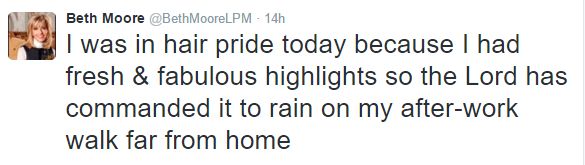
A friend on Facebook put up a screen shot of a Beth Moore tweet, which is truly outlandish.

HT Bud Ahlheim

I had written a comment, “Troubling is the narcissism, but more troubling to me is purporting to KNOW and positively state that she has knowledge of why God does things at any particular moment. She is mistress of the theological humblebrag.”

Someone asked a very reasonable question:

Come on, guys. I know there are plenty of Beth Moore issues, but do you seriously think this wasn’t a joke?

Is it a joke? Should we all just lighten up? I thought about it for a while then wrote back,

If this was the only tweet, essay, book blurb, or audio statement she ever made of this nature, then yes, joke. Sadly, in context of the body of all her work over many decades, such shallow narcissism, self-.involvement, and comfy cozy God-talk is all too usual for Moore. So I conclude it is not a joke, or only a half-hearted joke.

The points here are both good. Don’t take one thing a teacher or leader said once and blow that up especially if it’s obviously meant as a joke. Common sense should prevail. However if a certain unbiblical behavior is constant, for example, anger or sarcasm or boasting, then by all means take the totality of the person’s work or speech and compare it to scripture.

In one other thought, I replied again,

And let’s say in devil’s advocate fashion, that it was a joke, a lighthearted comment meant for fluff. Remember, Moore says she teaches God’s word, speaks for God in her lessons and influences millions of women over several generations. Is this the kind of speech a mature Bible teacher should be constantly and ‘light-heartedly’ tweeting? (Tweets of this nature are constant).

Would a mature teacher with gravitas, say a John MacArthur, ever tweet, “I had tie pride so God made me spill soup on it right before I went to the pulpit so I’d have to take it off.”? No, Titus 2:7b-8 applies.

Some teachers take their relationship with God seriously and other teachers don’t.

There are several things to unpack here. As for the totality of her casual rapport with God, such Twitter comments are all too sadly common from Mrs Moore. She says God calls her honey, baby, babe, kiddo, and other terms of intimate endearment. Setting aside the allegations of direct revelation, can one believe that God calls Moore these things? Did God call John His pal? Did He refer to John the Baptist as kiddo? Did He announce the birth of Christ by shouting from heaven, “Hey, Mary baby!” No. Not that there aren’t tender and intimate moments (Jesus comforting Hagar in the desert, an angel baking bread for a tired Elijah, etc,) but the casualness of such speech diminishes God’s august stature and our own witness.

When Beth Moore goes on a Sabbath play date with God at the zoo and says she and God had a blast, compare that casual kind of language to the Bible by inserting one of the Patriarchs, Prophets, or Apostles’ names. In the Bible lesson where Moore claimed she and God went on a date, contained in her book The Beloved Disciple, she had said God took over her steering wheel and as if on autopilot He steered her into the zoo where she and God watched a baby koala sleep while she sipped a Starbucks fancy drink. Nothing was reported as to what God had sipped. As her date with God to learn how to Sabbath rest concluded, Moore declared she and God had a blast.

Let’s compare that scene to the moment when the real God actually taught Moses about the Sabbath. Sadly for Moses, God did not take over Moses’ legs and put him on autopilot as Moses trudged up Mount Sinai. He did that on his own. When Moses got to the top, did he and God watch a sleeping mountain lion while Moses sipped brewed tea and God wrote the Ten Commandments? Was it a picnic atmosphere when Moses met with God up there? Did Moses then feel restful and walk back down the mountain and face all Israel and declare, “God and I had a blast! We played!” I think not.

As for the casualness of declaring what God is doing and saying at any given moment, we have lost the gravitas due our Savior, thanks in no small part to Moore and her silly statements. Remember John the Baptist’s father, Zechariah. He was a priest and labored in the Temple on rotation, it was his rotation when Gabriel appeared and announced to Zechariah that he would be blessed with the forerunner prophet to Messiah despite he and his wife Elizabeth being advanced in years. (Luke 1:8-23). Zechariah was then struck mute when he asked an impertinent question. God is serious! That Moore’s impertinence has been overlooked for this long is a measure of how much common grace He bestows upon unbelieving sinners like her.

As for the silly self-involvement of Moore’s statement, that God made it rain specifically so that her hair would be flattened, it’s just too over the top to comment on. The pride in which someone would actually say that and believe it is just sad. God didn’t make it rain in order to bring sustenance to farmers so people could eat? (Leviticus 26:4, James 5:18). God didn’t make it rain so He would prove He is still ordering the progression of the seasons in His capacity as Creator and sustainer of all things? (Genesis 8:22). No, He made it rain so Beth Moore’s hair would be squashed down, never mind the thousands of other people nearby who do not have hair pride and who would also suffer the woe of flat hair for the rest of their journey.

My points are several:

1. Do not follow Beth Moore
2. Give Jesus His due and respect Him on social media
3. If you’re not sure if something a teacher has said or a Bible anecdote really applies, insert a Bible character’s name into it and if you can’t picture him or her saying it then there’s your answer. Examples:

Moses said, “God and I had a blast up on Sinai!”
Paul and Silas were singing in jail and God appeared and said “Baby, you have not even begun to believe Me. You haven’t even begun!’”
Mary said, “Elizabeth, guess what! God hollered from heaven and said “Baby, you’re gonna have a baby!”

Comment to the naysayers:

No. I have not contacted Moore. She already has been contacted, multiple times, and she refuses to repent. Also, contacting her is not necessary. See here and here.

No, I am not against lighthearted tweets. This from Moore was appropriately fun and lighthearted:

Goofing around with her daughter after her grandkids were sleeping is a mom-daughter fun thing to do. Fine. Not fine is when you start tweeting you know what God is doing and including His name in your silliness. It’s offensive to me as a Christian and as a woman.

The Second Commandment says not to take the Lord’s name in vain. At Desiring God, that is defined:

How do you define the sin of taking the Lord’s name in vain? 

Well that’s a quote from the Ten Commandments: “Don’t take the name of the Lord your God in vain.” The idea of vanity (and I think the Hebrew carries this connotation) is “don’t empty the name.” 

So it doesn’t just refer to a certain tone of voice or a certain use of the word. It’s dealing with God and speaking of God in a way that empties him of his significance. This includes both throw-away words—like “God!” or “Jesus!”—as well as speaking about him in trifling and flippant ways. Not just swear ways but cheap ways, low and insignificant ways that just treat him like a commodity. And when you hear them you sense that there is no weight to that sentence, no corresponding emotion to that statement. It seems to have just been gutted.

Older women likewise are to be reverent in behavior, not slanderers or slaves to much wine. They are to teach what is good, 4and so train the young women to love their husbands and children, 5to be self-controlled, pure, working at home, kind, and submissive to their own husbands, that the word of God may not be reviled. (Titus 2:3-5).

Self-control. Does the Body of Christ good.
——————————————–
Further Reading:

Breaking up with Beth Moore, by Pam Terrell

The Apotheosis of Beth Moore, by the husband of the woman above, Robert Terrell. Very good essay.

Strange Fire Q&A,

How do I respond to people who refuse to admit that those who supposedly receive divine revelation are dangerous even though they don’t teach outright heresy? 

Can you talk about the dangers of popular teachers who are not heretical but say that God talks to them?  I am thinking specifically of Beth Moore.  What are we to do with people who refuse to see the danger and insist such teachers are OK? 

Believers must always listen carefully when any teacher or preacher speaks about the Bible and theology.  They must share the nobility of the Berean saints whom Luke commended for double checking Paul’s teaching according to Scripture (cf. Acts 17:1–11).  While Beth Moore teaches with accuracy on some points, she also holds positions and teaches doctrines that are both incorrect and dangerous.  

Beth Moore promotes contemplative prayer, a mystical practice not found in Scripture which includes elements of eastern mysticism.  She chooses not to draw firm doctrinal lines on her website while implying the Roman Catholic Church is a Christian denomination alongside the Methodist, Baptist, and other denominations.  Beth also claims that she has received visions from God and sometimes receives revelation from Him in her heart.  From these examples we must conclude that the lack of biblical and theological depth in Beth Moore’s teaching renders her a dubious and dangerous source of Bible teaching.  You may read a critique of Beth Moore’s teaching here.