Posted in encouragement, glory, joy, praise

A Sinner’s Joy Unspeakable

Sunday, and every day, is a good time to think about our salvation. And I do. I’m forever grateful, fully knowing my sinfulness, reprobate mind, and hate toward God prior to salvation.

but God shows his love for us in that while we were still sinners, Christ died for us (Romans 5:8)

How humbling it is to know that though I hated Him, He loved me, and in His due time, He brought me to salvation.

I’m often struck by Jonathan Edwards’ sermon Sinners in the Hands of an Angry God. the image of the gossamer thread holding us aloft while we dangle unknowingly over the open flame of hell is a potent one. I wrote this poem, and then below my poem are the excerpts from which I took inspiration from Edwards sermon and his book religious Affections.

With all Due Gratitude Toward the One Who is Able to Save
By Elizabeth Prata

Sinking in sorrow and shame
A slender thread
was enough
to keep me from the flame

The slender thread
The blood of Christ
My sin my shame
His blood sufficed

He lifted me from the muck and mire
Forever free from damning hellfire
Turning to Him who loves and saves
Fearing never the darkest graves

The slender thread pierced my cold dead soul
To worship life’s eternal flame
In one fell stroke
Sin’s power no longer my yoke

What sweet refrain can I freely sing
What joy in Jesus forevermore,
His blood it banished
My sins from east to west, O King!

~EPrata

“There is nothing that keeps wicked men at any one moment out of hell, but the mere pleasure of God.” — By the mere pleasure of God, I mean his sovereign pleasure, his arbitrary will, restrained by no obligation, hindered by no manner of difficulty, any more than if nothing else but God’s mere will had in the least degree, or in any respect whatsoever, any hand in the preservation of wicked men one moment.

O sinner! Consider the fearful danger you are in: it is a great furnace of wrath, a wide and bottomless pit, full of the fire of wrath, that you are held over in the hand of that God, whose wrath is provoked and incensed as much against you, as against many of the damned in hell. You hang by a slender thread, with the flames of divine wrath flashing about it, ~Jonathan Edwards,Sinners in the Hands of an Angry God

After the Bad News, comes the Good News

1 Peter 1:8: Whom having not seen, ye love; in whom, though now ye see him not, yet believing, ye rejoice with joy unspeakable and full of glory.

Their joy was full of glory. Although the joy was unspeakable, and no words were sufficient to describe it, yet something might be said of it, and no words more fit to represent its excellency than these, that it was full of glory; or, as it is in the original, glorified joy. In rejoicing with this joy, their minds were filled, as it were, with a glorious brightness, and their natures exalted and perfected. It was a most worthy, noble rejoicing, that did not corrupt and debase the mind, as many carnal joys do; but did greatly beautify and dignify it; it was a prelibation of the joy of heaven, that raised their minds to a degree of heavenly blessedness; it filled their minds with the light of God’s glory, and made themselves to shine with some communication of that glory. ~Jonathan Edwards, Religious Affections

Posted in bible, forgiveness, God, joseph, sovereign

Blame Game

Do you blame others? Try to dodge responsibility for your actions by blaming others? Are you full of excuses? I spent four decades on the planet as an unsaved person, I had honed blame-shifting to near perfection. I could rationalize away the worst sins. “What you did caused me to…” or “Despite what YOU did, I rose above…”

The mark of a spiritually mature person is one who not only accepts responsibility without excuses but seeks to give God glory and thinks of the other person first. Let’s look at three examples from the Bible.

The immediate blame-game that comes to mind are Adam and Eve. It’s disappointing that their first response was one of blaming each other. So much for Adam being a leader, he threw Eve under the bus at the first obstacle. God is asking Adam and Eve what they have done, since they knew they were naked and were hiding from God.

He said, “Who told you that you were naked? Have you eaten of the tree of which I commanded you not to eat?” The man said, “The woman whom you gave to be with me, she gave me fruit of the tree, and I ate.” Then the LORD God said to the woman, “What is this that you have done?” The woman said, “The serpent deceived me, and I ate.” (Genesis 3:11-13)

Neither of them were spiritually mature. But perhaps we can give them a slight break, neither of them had encountered sin before.

Let’s look at Cain and Abel. Cain worked the ground, and Abel was a shepherd (the first one in the Bible?). We know that God accepted Abel’s sacrifice over Cain’s.

In the course of time Cain brought to the LORD an offering of the fruit of the ground, and Abel also brought of the firstborn of his flock and of their fat portions. And the LORD had regard for Abel and his offering, but for Cain and his offering he had no regard. So Cain was very angry, and his face fell. (Genesis 4:4-5)

Cain killed his brother Abel. When God asked Cain about it, Cain deflected his responsibility and denied knowing anything of Abel’s whereabouts. Eve had to be talking into her sin, but Cain couldn’t be talked out of it. Not even by God. Cain remained angry and surly towards God. (Genesis 4:9).

Joseph is the third example. You remember, he was the youngest at the time of Jacob’s sons, and the firstborn of Jacob’s favorite wife, Rachel. Joseph’s older brothers were jealous of Joseph, and conspired to kill Joseph, but then at the last minute decided to profit from their scheme and sold Joseph into slavery in Egypt. That was the last the brothers saw of Joseph until they were facing death in a very severe famine, and traveled to Egypt to buy grain. After a period of time and testing, Joseph revealed who he was to his brothers.

So Joseph said to his brothers, “Come near to me, please.” And they came near. And he said, “I am your brother, Joseph, whom you sold into Egypt. And now do not be distressed or angry with yourselves because you sold me here, for God sent me before you to preserve life. (Genesis 45:4-5).

Of anyone who had reason to blame, it was Joseph. He had been an innocent party of his brother’s sins, and Joseph had suffered terribly for it. Adam, Eve, and Cain were overtly choosing wrong, and blamed others for their acts. Joseph chose right, and ever blamed anyone. Abandoned by his brothers, betrayed by them at a horrific level, (conspiracy of fratricide), falsely accused, being put in jail, attempted rape by Potiphar’s wife, Joseph had reason more than practically anyone in the Bible to blame his brothers.

He could have said,

“Look what you did, and God is repaying you, but I will forgive you!”
“You mocked me when I dreamed of you bowing down to me, and yet here you are, bowing down to me!”
“Don’t you know I hold your life in my hands?”

But Joseph didn’t. First of all Joseph praised God for His providential hand. Recognizing God’s sovereignty is always the best place to start. Then Joseph reassured the brothers, saying they should not be distressed by their act. Joseph sought their good, and removed opportunity for self-blame by emphatically showing he did not blame them. He was seeking the brothers’ good.

That’s what spiritually mature people do. They seek the good of the other person and ignore opportunities to lord it over them.

But Jesus called them to Himself and said, “You know that the rulers of the Gentiles lord it over them, and their great men exercise authority over them. 26″It is not this way among you, but whoever wishes to become great among you shall be your servant, (Matthew 20:25)

In this great text, Jesus was teaching the disciples that the style of greatness and leadership for believers is different. Gentile leaders dominate in dictatorial fashion, using carnal power and authority, Believers are to do the opposite, they lead by being servants and giving themselves away for others, as Jesus did.

A mark of spiritual authority is to accept responsibility for our sins, and if we are the innocent party, to love the sinner and seek their good without lording it over.

I pray the Lord continues His work of reforming me from the inside out, growing me in maturity and to have the strength to humbly repent when I’m wrong; and to love others with a servant attitude who may have harmed me, always pointing to Christ as the one who is sovereign over all.

Posted in beth moore, bible, false teacher, truth

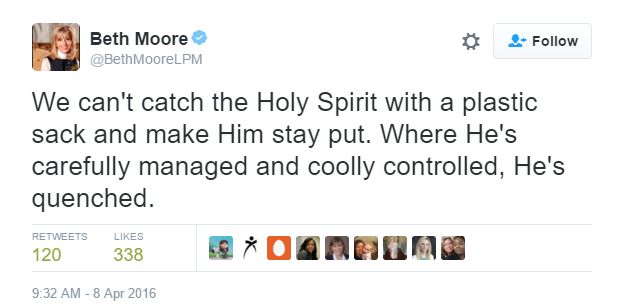
In which Beth Moore says something unbiblical. Again

Do you ladies see the internal inconsistency in this? You “can’t catch the Spirit & make stay Him put” but you CAN catch Him & control Him. On the surface, false teachers’ doctrine always sounds Christian-y, but upon digging only slightly deeper, it falls apart. That’s because it’s cotton candy, all clouds and no water. (Jude 1:12).

Ladies, dig deeper. Don’t accept what teachers say at face value. Examine the Scriptures to see if these things are so. (Acts 17:11). In this particular case, John 3:8 would apply here-

“The wind blows where it wishes, and you hear its sound, but you do not know where it comes from or where it goes. So it is with everyone who is born of the Spirit.”

The Bible Knowledge Commentary says of John 3:8,

“This verse contains a wordplay which cannot be adequately expressed in English. The Greek word pneuma means both wind and Spirit. The work of the Spirit (pneuma) is invisible and mysterious like the blowing of the wind (pneuma). Man controls neither.”

What is really sad to me is how many people retweeted it and ‘liked’ it within just a couple of hours of Moore having published the tweet. The bane of Twitter. Correct theology takes time and care to explain, exceeding Twitter’s 140 characters. But wrong theology can fit neatly into a 140 character limit, and they propagate like the weeds they are.

Posted in bible, feminism, gender roles, social justice, Sojourner Magazine, usurper

‘Down with Patriarchy! Up with women pastors!’ Sojourner’s video about women pastors making a splash

Someone sent me a video that is making a very big hit online. The news article about it said that within 24 hours, the video had garnered 1 million views. “The video has struck a nerve” the article explained. What is this big, splashy, video?

It is from an organization called Sojourners. Sojourners has the latest news and commentary on faith, politics, and culture, their tagline says. Sojourners is a website/social media outlet/movement aiming to transform the world. That is actually their slogan, “Building a Movement to Transform the World.” So this should tell you something about the organization’s mission and overall focus. Their focus is not on Jesus, but what the world thinks about Jesus. Or should think about Jesus. Or should think about the world. Or something.

Anyway, they are all about “social justice” and one glaring injustice, according to Sojourners, is that there is a glass ceiling in the church and women need to break it. It is a 2000 year old trend that just needs to be smashed. Right now. Women’s “sacred worth” isn’t being taken seriously, because they are continually being denied opportunity to serve at the top. They should be allowed to lead, the thrust of the message goes, because it’s 2016, after all.

Their video is very clever and funny. Since they focus on culture, and right now the biggest culture war is the one regarding gender and gender roles, the video is a satirical push-back on why women should not be pastors. They took the usual old excuses which had been used to deny women places of authority in the culture, and applied them to the church, and reversed the roles. So when women used to hear “Their time of the month makes them hysterical and emotional,” Sojourners took that excuse and applied it to men…in the church…as a satirical look at why women have been denied opportunities to lead.

Scholer’s basis is that men and women are equal despite their gender, but the Bible asserts that men and women are equal through their gender. There’s a difference.
However, their video, in addition to being clever and well-done and therefore attractive to those without biblical understanding, is founded on some old work they dug up from Fuller Seminary’s recently deceased Professor, Dr David Scholer. Dr Scholer was a biblical feminist. For 36 years at four seminaries he taught that women should lead, explaining that a careful reading of the gospels and letters of Paul demands full inclusion of women in church leadership. So says his In Memoriam notice.

As a side note, one can immediately see how the liberal theologians do damage to the faith. The video and its main thrust having been founded on a seminary professor’s work, lends it additional credibility. “Look! A Seminary Professor thinks women should be ordained! It must be true!” Never mind that Fuller Seminary jumped the shark years ago. John MacArthur writes a short piece on Fuller’s slide into ultra-liberalism, here, but as far as most people are concerned, a seminary is a seminary.

I read Scholer’s paper on women leading in the church, female ordination etc, and it is very well-written and makes a great argument. An unbiblical argument to be sure, but a solid and credible argument using logic with scripture interwoven throughout, that would be difficult for the lay person to refute. If you read it, you might think, ‘Hey, they make great points, maybe I ought to rethink this.’ No. No you shouldn’t. If you watch the video, you might say, ‘This is funny and true, I like it. Maybe I ought to rethink this.’ No. No you shouldn’t.

And so Sojourners, wading into the culture wars over gender roles, produced “7 Reasons Men should not be Pastors.”

“Can women really lead in the church?” We still hear this question in our churches, often coupled with silly, irrational, or demeaning thinking. Would we put up with the same excuses for excluding men from leadership?

The video’s introduction above from Sojourners is devilishly excellent. Just as satan did, the issue is phrased in the form of a question, and inverted too, just as satan did. God had told Adam “You are free to eat from any tree in the garden; but you must not eat from the tree of the knowledge of good and evil, for when you eat from it you will certainly die.” (Genesis 2:16).

Yet satan reversed that command, asking the woman, “Did God really say, ‘You must not eat from any tree in the garden’?” (Genesis 3:1) [emphasis mine]

The Sojourner query, can women really lead in the church, is phrased to insinuate doubt, form a negative, and lead the willingly deluded to the poisonous water from which they will soon drink, as the next line states. The reasons women can’t lead in the church are “silly and irrational”. Not biblical. A neat blame-shifting trick.

Dr Scholer’s 1983 paper stated,

Modern debates over the ordination of women often miss the crucial and basic issues of the holistic concept of the ministry of the Church reflected in the New Testament. Of course, no person should be ordained or given any responsibilities of ministry within the Church because of gender or for the sake of a “point.” On the other hand, we have affirmed in the Church that no person, called and gifted by God, should be denied any role of ministry or leadership in the Church because of one’s gender. 

The phrasing here is that no one should be denied any role of ministry or leadership… Well, of course no one should be denied the opportunity to minister in the church. It’s what we’re all called to do. But attaching the word leadership with ministry is disingenuous, because though all are called to minister, not all are called to lead. Not even all men are called to lead. But the insinuation here is that ministry IS leadership and vice-versa.

Secondly, the video posits the old canard that gender distinction is a bad thing. There are two distinct genders (though it seems not for long) and because they are distinct this is bad. It is the feminist and liberal theologian’s duty to equalize the two genders into mutually indistinguishable humans with interchangeable roles.

Scholer’s basis is that men and women are equal despite their gender, but the Bible asserts that men and women are equal through their gender. There’s a difference.

The Bible shows that first, man needed woman. The need is real and it exists because men and women complement each other. After man had named and examined all the animals there was no mate suitable for him. He was still alone. It is not good for man to be alone, and so God made woman.

However hard the feminists try, man will always have been made first (1 Timothy 2:13), and man began a relationship with God first and man received his instructions and duties first. Women are cursed with feminism (Genesis 3:16). It is a curse, instilled in us is a desire to rule over our husbands, to want to usurp the natural order of things. At the root, what feminists are attempting to do is reverse the order of creation. Yet they also cannot reverse the fact that God gave man dominion over the earth and a command to work the garden and keep it. It is man who has authority. (Genesis 1:26). He has been given this authority in the home and in the church.

This is not to say that man-woman-children-animals is a top-down hierarchy where women have no say, no worth, and no work to do. In Christianity, submission is a mutual submission, a joyful following of each other and of Jesus. (Ephesians 5:22-33). Each gender has their own role, created exactly for them by an omniscient God who knows what is best.

Women should thank God that “patriarchy is alive and well in the church” as I read in one of the video’s comments. The Head of the Church is a Man-God who has a Father to whom even He submits. Of course, they satirically and they THINK cleverly puncture the excuses for excluding women from leadership in a precious video they’re so proud of, but avoid the one excuse that truly excludes women from leadership- Father God’s prohibition.

The Ultimate Patriarchy is real, and thank God for that. Jesus came to earth as a God-Man, not a goddess, not a god-woman, and not a hermaphrodite. Jesus is a Man, under whom all authority in the universe rests. God Himself, though He is a spirit, is referred to as Father.

So the video is worldly clever, but the Bible says “Woe to those who are wise in their own eyes, and shrewd in their own sight!” (Isaiah 5:21). Ladies, don’t be swayed by a clever video promoting a coyly precious false doctrine. See the resources below which explain from the Bible in a true and not a twisted way as Scholer did, why women’s roles are prescribed, defined, and permanent. Even in 2016.

Resources:

Should women be pastors and elders?

In a social climate of complete equality in all things, the Biblical teaching of only allowing men to be pastors and elders is not popular. Many feminist organizations denounce this position as antiquated and chauvinistic. In addition, many Christian churches have adopted the “politically correct” social standard and have allowed women pastors and elders in the church. But the question remains, is this Biblical? The Bible’s answer to this question is, “No, women are not to be pastors and elders.” Many may not like that answer, but it is, I believe, an accurate representation of the Biblical standard. First of all, women are under-appreciated and under-utilized in the church. There are many gifted women who might very well do a better job at preaching and teaching than many men. However, it isn’t gifting that is the issue. It is God’s order and calling. What does the Bible say?

Response to Dr John Jefferson Davis’ advocacy for female ordination

One of reasons for male-only ordained leadership is the indisputable fact that Jesus Christ appointed only males to the office of apostle. The importance of this observation is often dismissed as being demanded by the social conventions of Jesus’ time, which supposedly left our Lord with no other possible approach.  The idea is suggested that if Jesus were to start the church today, He would of course include women as apostles.  But a little reflection on this will give us pause.

Can a woman be a pastor or a preacher?

There is perhaps no more hotly debated issue in the church today than the issue of women serving as pastors/preachers. As a result, it is very important to not see this issue as men versus women. There are women who believe women should not serve as pastors and that the Bible places restrictions on the ministry of women, and there are men who believe women can serve as preachers and that there are no restrictions on women in ministry. This is not an issue of chauvinism or discrimination. It is an issue of biblical interpretation.

Women pastors – what does the Bible say?

The only way to have a productive dialogue on the women pastors issue is to discuss it biblically. Yes, undeniably, there are men whose views on the issue are clouded by chauvinism. At the same time, there are men and women on both sides of the discussion. So, it should never be assumed that one holds a particular view due to latent chauvinism. The issue should be decided based on what the Bible teaches, not on who can make the strongest ad hominem attack.


Posted in faith, garden of eden, God, repentance

What does it mean to "Walk with God"?

Enoch walked with God, and he was not, for God took him. (Genesis 5:24).

Noah was a righteous man, blameless among the people of his time, and he walked faithfully with God. (Genesis 6:9)

And they were both righteous before God, walking blamelessly in all the commandments and statutes of the Lord. (Zechariah and Elizabeth, Luke 1:6)

I therefore, a prisoner for the Lord, urge you to walk in a manner worthy of the calling to which you have been called, (Ephesians 4:1)

Our pastor gave this explanation and example last Sunday in his sermon,

What does it mean to walk with God? I’m sure it means many things. If you think of it this way, walking with each step, back and forth, the two footsteps that we use as we walk with God are the footsteps of repentance and faith. Repentance means that we own the fact that we sin. I’ve acted incorrectly, I’ve acted wrongly. And I put that forward, I confess who I am. And then, I put faith in what Christ has done. … Repentance and faith are the feet that we walk with as we walk with God. It means we continually admit who we are [sinners] and our need; and we continually admit that Christ has met that need.  

Walking with God does not mean perfection. Job is said to be blameless and yet we see Job make mistakes. In the New Testament in Luke we’re told Elizabeth and Zechariah the mother and father of John the Baptist, called “blameless and righteous walking in all the commandments of the Lord” and yet before the chapter is over, Zechariah sins. Does blameless and righteous mean that you’re sinless? No it does not. It means the general direction of your life is toward Jesus.

Pastor teaches High School Bible at a Christian Academy. In discussing being blameless and righteous, one of his students had asked, “Doesn’t blameless mean without blame? How can they not be perfect if they’re called blameless?” Pastor used the example of cross-country running, which is popular at his school.
The trails go through the woods, up muddy hills, over a creek, through fields. Some of the terrain is level and some is difficult. He said picture two runners who start out. However after a while one stumbles and falls down the embankment and into a ditch. The other runner also stumbles and falls in the woods. He said the runner who fell into a ditch got up and angry and frustrated, decided to quit the race and go back to the car. Angrily tearing off his number, he threw that into the ditch.
The second runner is also tired, angry and frustrated. The hills are hard and the race is long. However when he fell, he did not stay down. He did not stomp off the path. He said, “I’m tired but I’m going to keep running. I’m going to run the race.” And he does, finishing at last.
Is there a difference between the two runners? Yes. Did both of the stumble? Yes. We all stumble in many ways. (James 3:2). Did both of them get back up and keep going on the path? No. This is the difference between someone who is walking blamelessly in all the statutes and commandments of God and someone who is not. It is not describing a perfect person.
He gave a good example there and it’s comforting to hear the James verse. Isn’t God good to us in allowing our crazed and mournful hearts to be salved in knowing that He knows we stumble? And in many ways, at that? At least, I know it is true for me. I do stumble in many ways. Is the life trajectory of my walk with God persevering and upward and sanctifying? I believe so. I certainly hope so.
There are only two paths and there are only two guides, one for each path. Jesus guides us on our way on the narrow path. Satan leads us along our way on the broad path.
Can two walk together, except they be agreed? (Amos 3:3, KJV)

Gill: And to a spiritual walk with God, and communion with him, agreement is requisite. 

And they heard the sound of the LORD God walking in the garden in the cool of the day, and the man and his wife hid themselves from the presence of the LORD God among the trees of the garden. (Genesis 3:8)
The moment Adam and Eve were in disagreement with God, they did not walk with Him. 
Agreement with God…walking with Him in all His commands requires repentance and faith. May God bless your walk and my walk with Jesus as we traverse this wonderful, difficult, muddy, beautiful trail through life’s race, until we reach the Celestial City.
Posted in burden, joseph, old testament, sin

Who was the real prisoner?

We know the story of Joseph and his brothers. Genesis 37 to 47 recounts Joseph’s two dreams of superiority over his elder brothers, his coat of many colors, the murderous plot to kill Joseph (Genesis 38:18) and his sale into slavery in Egypt. (Genesis 38:28)

We know that Joseph’s faith was great, and that despite arriving in Egypt as a slave, God was with him. Joseph rose to a place of prominence in Potiphar’s house, (Genesis 39:2), was then unjustly accused of rape and thrown into jail. Even in jail, Joseph’s faith was great and he rose to a place of authority within the jail, (Genesis 39:23) then to a place of prominence in all of Egypt. (Genesis 41:40). Twenty-four years or thereabouts pass before Joseph’s brothers return to Egypt a second time.

Initially the brothers had plotted to kill Joseph. But Judah said “What profit is it if we kill our brother and conceal his blood? Come, let us sell him to the Ishmaelites…” (Genesis 37:26a).

Indulge your sin of jealousy, conspiracy, fratricide, anger, AND profit from it.

So they did, they waffled on killing their brother, they ended up stuffing Joseph in a pit but then dragged him out when the caravan passed by so they could sell him into slavery. And that seemed to be the end of Joseph for the brothers, for all they knew.

Decades later, the famine had become very severe in all the surrounding region. Unbeknownst to the brothers, Joseph had foreseen the famine coming, thanks to a dream the LORD had sent to Pharaoh, and which Joseph and interpreted by His grace. Facing starvation, the brothers decided to travel to Egypt to buy grain, and they were of course faced with Joseph who had become vizier to Pharaoh, second most powerful man in all of Egypt. The brothers did not recognize Joseph, but Joseph recognized the brothers. Joseph accused the brothers of being spies and held them in custody. He told them to return to Canaan and bring back Benjamin, the youngest, to him. The brothers huddled and said to one another,

In truth we are guilty concerning our brother, in that we saw the distress of his soul, when he begged us and we did not listen. That is why this distress has come upon us.” And Reuben answered them, “Did I not tell you not to sin against the boy? But you did not listen. So now there comes a reckoning for his blood.” (Genesis 42:21-22).

Reuben was referring to the death penalty for taking a life, but there is also a spiritual aspect to this.

Source Wikimedia

Joseph had been in actual prison, and no doubt had some dark days. But the LORD was with Joseph, it says so during the recounting of Joseph’s life, many times. (Genesis 39:2, Genesis 39:21, Genesis 39:23…). When the LORD is with you, no matter the circumstance, one can dwell in joy and peace. (Philippians 4:4). Being “in the Lord” brings with it a sphere of peace that is unrelated to the circumstances of this worldly life. Being in the Lord means you possess an unchanging, invincible bubble of joy that none can penetrate. (Philippians 4:7).

Contrast Joseph’s spiritual success with his brothers’. When accused, they crumbled at once under the weight of their collective guilt. They’d been carrying this tremendous burden of guilt since the day they rode off, deaf to the pleas of the teenager they conspired to sell. It was their prison.

The scriptures declare we are all prisoners of sin, release only comes in faith in the Lord Jesus. (Galatians 3:22, John 8:34, Romans 7:14).

That is why Joseph, though imprisoned, was free; and the brothers, though free, were imprisoned. The burden of sin is heavy, but a clean conscience is light.

The solution:

Wretched man that I am! Who will set me free from the body of this death? Thanks be to God through Jesus Christ our Lord! So then, on the one hand I myself with my mind am serving the law of God, but on the other, with my flesh the law of sin.” (Romans 7:24–25).

Are you like Christian, the man in the allegory Pilgrim’s Progress by John Bunyan? Christian was weighted by a burden on his back of which he could not rid himself and was causing much distress.

Christian: I cannot go as fast as I would, by reason of this burden that is on my back.
Now I saw in my dream, that just as they had ended this talk, they drew nigh to a very miry slough that was in the midst of the plain: and they being heedless, did both fall suddenly into the bog. The name of the slough was Despond. Here, therefore, they wallowed for a time, being grievously bedaubed with the dirt; and Christian, because of the burden that was on his back, began to sink in the mire.

Slough of Despond, Dyer Library, Saco, Maine

Evangelist explained to Christian why the ground was so bad at the Slough of Despond:

‘This miry Slough is such a place as cannot be mended; it is the descent whither the scum and filth that attends conviction for sin doth continually run, and therefore is it called the Slough of Despond: for still as the sinner is awakened about his lost condition, there ariseth in his soul many fears, and doubts, and discouraging apprehensions, which all of them get together, and settle in this place; and this is the reason of the badness of this ground.

Are you sinking deep into guilt and shame, as were Joseph’s brothers, weighted in guilt by their heinous acts? Do you long for freedom from sin and a cleansed heart, forgiven of the sins which are burdening you? Only Jesus can provide that, and He has.

Jesus answered him, “Truly, truly, I say to you, unless one is born again he cannot see the kingdom of God.” (John 3:3)

The time is fulfilled, and the kingdom of God is at hand; repent and believe in the gospel.” (Mark 1:15).

THE GOSPEL

Posted in ark, brimstone, sodom, wrath

He will shut the door; which side will you be on what that day arrives?

I like doors. How can so many rectangles be so different and so descriptive of who the people are who live behind them? I take pictures of doors a lot.

When I arrive home from a loud and busy day at school, being on the Spectrum, I’m especially sensitive to noise. I savor the quiet.  So when I unlock my door, open it and step inside, and close it behind me, I breathe an audible sigh of relief. Doors shut out the outside, barring unwanted things. Doors allow for rest and repose for those inside. Doors are amazing.

The Bible references doors frequently. One of the seven I AM statements Jesus made, in fact, was that He is the Door.

I am the door. If anyone enters by me, he will be saved and will go in and out and find pasture. (John 10:9).

Christ is the door. This he saith to those who pretended to seek for righteousness, but, like the Sodomites, wearied themselves to find the door, where it was not to be found. [Genesis 19:11] (Matthew Henry’s commentary on the whole Bible)

The Sodomites could not enter through the door. Neither could the unwise virgins.

And while they were going away to make the purchase, the bridegroom came, and those who were ready went in with him to the wedding feast; and the door was shut. “Later the others also came. ‘Lord, Lord,’ they said, ‘open the door for us!’ (Matthew 25:10).

The Lord does not open the door for the pleading virgins. He says He never knew them, and condemningly, the door remains shut.

The Ark which Noah built had a door, too. For 120 years, Noah, a preacher of righteousness, (2 Peter 2:5) pleaded with all to enter into God’s safety. They refused. They perished.

And those that entered, male and female of all flesh, went in as God had commanded him. And the LORD shut him in. (Genesis 7:16)

Our pastor preached on the Flood this past Sunday. He said that Noah and the family went inside, and then God shut the door. What a terrible thing it would have been for Noah himself to shut the door against his neighbors and friends. “But he wasn’t asked to shut it,” our pastor said. “God did it.”

The door was shut against the Sodomites. The door was shut against the unwise virgins. The door was shut against the antediluvian world.  In Isaiah 55:6-7 we read,

Seek the LORD while he may be found;
call upon him while he is near;
let the wicked forsake his way,
and the unrighteous man his thoughts;
let him return to the LORD, that he may have compassion on him,
and to our God, for he will abundantly pardon.

God is love and He is mercy. He is long-suffering, but His mercy, love, and patience will end. At a point at which only He knows, the door will shut, the number of the Church will be complete, (Romans 11:25-26) and He will call His Bride home to heaven. Then He will send His wrath upon the unrighteous and the Great Tribulation will be terrible in its effect. Though many will come to faith during that woeful time, they will not be protected from His wrath as the Church is promised to be. (1 Thessalonians 5:9).

Just because it’s not the rapture or even the Tribulation do not delay entering through the Door of Jesus Christ. There is no other way to obtain salvation, forgiveness of sins, and to escape the wrath. Flee from the wrath to come!

Who has warned you to flee from the wrath to come? (Matthew 3:7).
Who have fled for refuge to lay hold upon the hope set before us. (Hebrews 6:18). 

We will first consider the question of John the Baptist. “When he saw many of the Pharisees and Sadducees come to his baptism, he said unto them, O generation of vipers, who has warned you to flee from the wrath to come?” 

I have no doubt that the Pharisees and Sadducees were very much surprised to hear John addressing them in that way, for men who wish to win disciples ordinarily adopt milder language than that—and choose more attractive themes—for they fear that they will drive their hearers from them if they are too personal and speak too sharply. 

There is not much danger of that, nowadays, for the current notion now abroad is that Gospel ministers can sew with silk without using a sharp needle and that, instead of piercing men with the sword of the Spirit, they should show them only the hilt of it—let them see the bright diamonds on the scabbard, but never let them feel the sharpness of the two-edged blade! They should always comfort, console and cheer, but never allude to the terror of the Lord. 

Charles Spurgeon, Flee from the wrath to come! 

But I do not see fire and brimstone smoking in the distance, you argue. It is a fine and lovely spring day, and all things are going on as they have been? Why worry about some kind of wrath, which is hard to believe anyway?

Because He will shut the door! He hates sin and His long-suffering regarding sin will end, just as it did at Noah’s time.

Put to death therefore what is earthly in you: sexual immorality, impurity, passion, evil desire, and covetousness, which is idolatry. On account of these the wrath of God is coming. (Colossians 3:5-6)

At an hour or day you do not know but God knows, He will shut the door and rain down His anger. His plan is specific. It could be in ten years it could be in the next moment of time. God has planned it and it surely will come to pass, just as it did in Noah’s time.

In the six hundredth year of Noah’s life, in the second month, on the seventeenth day of the month, on that day all the fountains of the great deep burst forth, and the windows of the heavens were opened. 12And rain fell upon the earth forty days and forty nights. (Genesis 7:11-12).

And in addition, because God isn’t seeming to rain down fire and brimstone at this moment in your section of the ungodly world, does not mean He isn’t about to harden your heart so that you will never be able to go through that door of righteousness. (Romans 9:18). His wrath could manifest itself in your internal standing, and not just the external disaster of His visible wrath.

When the door shuts, you want to be on the right side of it. The palpable sense of relief and joy you feel when you arrive home to a loving family and a warm supper and rest and safety from the plagues of the day will be magnified a million-billion-google-fold when you are carried to the bosom of Jesus in His ark of safety and love, forgiven of sins and cleansed, washed and nurtured and grown when you receive your glorified body and given the mind of Christ in full, and knowledge of Him face to face.

Imagine what a day that will be. And because the terror of the LORD is real, imagine being a resident of Sodom, futilely beating on the door until you weary yourself. Imagine uselessly appealing to Jesus from outside to open it and hearing Him say, “I never knew you.”

On which side of the door will you be when you breathe your last, or when the wrath finally comes?

And to the angel of the church in Philadelphia write: ‘The words of the holy one, the true one, who has the key of David, who opens and no one will shut, who shuts and no one opens. (Revelation 3:7).

Posted in charismatic, discernment, strange fire

Strange Fire Q & A: How do we distinguish between the Spirit prompting us, and our own thoughts?

One hundred years ago, the modern Pentecostal movement was born. By October 2013 the Pentecostal movement has morphed into the Charismatic movement with its particular brand of false doctrine and had infected much of western Christianity and polluted quite a bit of Christianity abroad. The excesses of the movement include faith healing, reports of raising the dead, babbling tongues, alleged prophecies and direct revelation, disorderly church services and worse. The movement assaulted the sufficiency of scripture, the inerrancy of scripture, besmirched the name of Jesus Christ and damaged the faith of many. 

John MacArthur and his team at Grace To You took a stand against this movement and sought to bring clarity to why its doctrines needed comparison to the Bible correction. To that end, they organized the Strange Fire Conference, held in the fall of 2013. One of the main purposes of the conference was to initiate a substantive discussion about these issues. It achieved its purpose. Every sermon preached at the conference rebuked the movement simply by preaching the truth, and brought correct biblical doctrine to the fore. Given the outcry, it seems that the effect was immediate.

There were many good questions asked at the various seminars and Q & A sessions held during the conference period, but not all of them could be immediately answered. After the conference concluded, ministers and theologians at Grace Community Church and The Master’s Seminary wrote out answers to these unanswered questions, compiled them, and put them on one web page.

The page is a treasure trove of good, solid rebuttals to and practical helps about what to do if encountering Charismatic doctrines in your church, in your family, or in yourself.

~~~~~~~~~~~~~~~~~~~~~~~~

Epidemic in the Charismatic movement is the acceptance of personal revelations. Everybody and their brother it seemed is hearing from Jesus and were eager to share “a word from the Lord”. Such practices assault the sufficiency of scripture, of course, and must be corrected. However, one book is doing its level best to continue to attack the sufficiency of God’s word-  Jesus Calling. Jesus Calling was published in 2004, 16 years ago now, but is still on the bestseller lists. Friends, Jesus is not calling. he has spoken and His word is contained in the closed canon of scripture. The book has spawned a cottage industry of studies, devotionals, children’s books, and other material that has never stopped polluting the faith. Indeed, it seems to be increasing in its staying power and corrupt work.

Here is just one of the Questions and Answers in the Strange Fire Q&A page.

Q. How do we distinguish between the legitimate prompting of the Holy Spirit and our own thoughts or will?
A. While God can prompt us to think or do something, He has not given a clear and objective mechanism to identify when He is doing that. Since no one can identify with absolute certainty the source of the impressions he experiences, he must not ascribe authority to them or rely upon them as direction from God. John MacArthur gives good advice on that point in this downloadable audio. Mistaking a personal impression for divine guidance can lead us far astray from God’s will and may cause serious problems in our lives. 

How should a Christian respond to what he thinks might be a leading of the Holy Spirit? By comparing the impression with the objective, authoritative revelation God gave us—the Scripture. So, does the thought you are having agree with biblical theology? Is the action condemned or condoned in God’s Word? Will that choice ultimately bring glory to God? As you answer these questions in light of biblical teaching, you can know whether you are walking in the will of God.

I would also encourage you to listen to John’s two messages on the topic of understanding God’s will for your life. You can listen to the messages here.

Posted in eschatology, prophecy, rapture, second coming, tribulation

12 Things to Know about the Antichrist, or, Why Prophecy is Important

There are niche segments of study within the theological world that are more valued than others. Discernment gets a bad name, often rightly, because many discernment writers tend to drift toward a more “censorious spirit” as Gill said in his Exposition, stating, “Censorious persons rarely have the good will of their fellow creatures” in mind. However as the pendulum tends to swing, it makes a full arc and for a while discernment receives a poor reputation in total, even while there are good discernment writers and speakers out there (Justin Peters comes to mind) mixed in with the cranks and angry ones.

Though all Christians are called to discern between right and wrong, some have been given extra discernment as a gift of the Holy Spirit (1 Corinthians 12:10). While on the one hand it’s not to be abused, it’s also not to be dismissed. (FMI on the gift of discerning of spirits, go here).

Eschatology is another area of study which also receives a poor reputation, in no thanks to many Christians themselves. Eschatology is the study of last things, AKA, prophecy, especially the period since the First Coming of Jesus Christ. Though it’s forbidden, some date-set and of course the end date at which their predictions pass with no fulfillment make a mockery of Christ’s name to unbelievers and a disappointment to the believers who were drawn in. Others who study eschatology badly simply perpetuate ridiculous theories concerning the end times. Others wrongly insist that eschatological subjects are biblically unknowable.

My blog covers three areas; discernment, prophecy and encouragement. I’ve seen the pendulum swing from side to side in each of these areas over the last 7 years of daily blogging here at The End Time. I have maintained from the beginning of my blogging life and my Christian witness in real life, that prophecy is important – because it was important to Jesus. Last days are spoken of in almost every book of the New Testament. Paul spent a good deal of time teaching it to the Thessalonians. Even as the babes in Christ that they were, Paul pulled out all the stops to ensure that these Thessalonian Christian babies knew the importance of living with a very present knowledge of Christ’s imminent return. Doing so gives us a heart for the lost, a fervency in life, and a strength to look forward beyond persecution or trouble. I refuse to marginalize prophecy as a legitimate area of study.

Here is Michael Holst stating the point of eschatology so much better than I ever did.

12 THINGS TO KNOW ABOUT THE ANTI-CHRIST
by Matthew Holst • April 01, 2016

One of the Apostle Paul’s great preoccupations in both of his letters to the church at Thessalonica is the second coming of Christ. He was not only concerned with getting the doctrine “right” but also with the great pastoral implications of such teaching. In 1 Thessalonians he writes concerning the second coming of Christ in relation to the resurrection of the dead and the gathering together of saints who are alive at that time. In 2 Thessalonians he reinforces what he had already taught at Thessalonica (2 Thess. 2:5) concerning the dangers of the last days, specifically with regard to the great apostasy in the church induced by the revelation of the Man of Lawlessness. 

Depending on your eschatological framework, your identification of the Man of Lawlessness and his activities may differ from what I wish to offer in this post. Coming to terms with the fact that there will indeed be a Man of Lawlessness plays an important role in the life of the believer as he or she eagerly waits for the day of Christ’s coming. In days of relative peace, we must ready ourselves and forthcoming generations–especially our own children–for the days of anarchic deception that will accompany the Man of Lawlessness. 

We, in the Calvinistic and Reformed church, have not done justice to the Scripture’s teaching on this matter. We often rightly respond to the “Left Behind” industry with dismay and sarcasm. In so doing, however, we have, perhaps inadvertently failed to sufficiently and soberly grasp Scripture’s teaching on this period of history which will be instrumental in bringing about a catastrophic and irreversible apostasy. Here then, are twelve biblical observations about the Man of Lawlessness (MoL) to help prepare us for that day.

For the rest of Mr Horst’s essay, go to the Alliance of Confessing Evangelicals.

I’d like to reiterate that the Rapture (when Christ calls for His Bride in the air, 1 Thessalonians 4:15-17) and the Second Coming (when His feet touch down at the Mount of Olives at the end of the Tribulation, Mt 16:27, Zechariah 14:4) are two separate events.