Posted in discernment, expository preaching, Jesus preaching, word

Why emergent/liberal churches will never have the power of the first century church they want

“I want our church to be like an Acts 2 church.”
“Oh, Holy Spirit, come down in power and presence to us today.”
“The original church was the best, we should be like them. We can be like them.”

I hear and read comments like those a lot today. The liberal or emergent churches stand on stage with a fog machine and the praise band plays the same refrain over and over, millennials are swaying and hands are upstretched. They cry out for power and wisdom and for the Holy Spirit to descend upon them in force. They crave ever more potent “experiences” and “power” and “anointing” as the early church seemed to have had.

And yet there is one critical ingredient that they lack, and in so lacking, they will NEVER have the power of the spirit that they crave. Can you guess what that ingredient is?

The word of God.

Preaching from the Bible.

Expository preaching in the power of the Spirit.

Teaching the people from God’s word.

Do you realize how much preaching from God’s word took place in the first century church? ALL OF IT. Jesus, (in Luke 24:13-35) Peter, Stephen, Paul…all preached the Old Testament and taught the new covenant as given to them by Jesus. Sermons, sermons, sermons. Expository preaching is what drove the first century church of Acts. Preaching. Much of Acts are recorded sermons preaching God’s word.

The book of Acts gives a unique glimpse into the life and practice of the early church. It describes the coming of the Holy Spirit at Pentecost in Acts 2, the spread of the Gospel outside of Jerusalem in Acts 8 and to the Gentiles in Acts 10, how the church made decisions in regards to doctrine (Acts 15), and more.
The sermons recorded in Acts give us a window into the preaching ministries of Peter, Stephen, Philip, James, and Paul, along with the immediate impact those sermons had.
Below is a list of sermons preached in Acts along with a short description and reference for each are listed below. Not every passage below quotes the preacher’s sermon directly, but each passage will share something important about the content of the sermon or the response of the hearers. (source & chart below)

Many of these churches/preachers them tacitly or overtly declare expository preaching as old, dusty, and/or unnecessary. Or worse, some say it’s so easy it’s cheating. Yet such preaching is entirely necessary.

It is the preaching from God’s word that is the power. The liberal/emergent/millennials want power but they deny the vehicle that will bring them that power. They want wisdom but deny the only place where wisdom resides. They want Spirit power by bypass Jesus, who IS the Word.

From The Cripplegate, an excerpt from an interview with expositor Steven Lawson on the nature of expository preaching.

I believe that the Apostle Paul lays out the essentials of preaching in 1 Timothy 4:13 when he writes, “Until I come, give attention to the public reading of Scripture, to exhortation, and to teaching.” 

In true expository preaching, there must be the reading of the text, the teaching of the text, and the exhorting with the text. Expository preaching informs the mind, ignites the heart, and impels the will. 

The supposed preaching that only instructs the mind is not a sermon, but a lecture. The supposed preaching that merely touches the heart is not a sermon, but a mere devotion. The supposed preaching that merely challenges the will is not a sermon, but a manipulation. True expository preaching must address all three aspects of the inner life of a person — mind, emotion, and will. Anything less, is not expository preaching.

Is your preacher more excited to read the announcements than to read the word of God? Or does he unashamedly proclaim the Word in power and truth?

In the beginning was the Word, and the Word was with God, and the Word was God. He was in the beginning with God. All things were made through him, and without him was not any thing made that was made. In him was life, and the life was the light of men. The light shines in the darkness, and the darkness has not overcome it. (John 1:1-5)

——————————

Further Reading

Six Characteristics of a Healthy Church

[hint: one of them is expository preaching]

Posted in assurance, encouragement, pilgrim's progress, salvation

How to guard from carnal thoughts and actions. What will do it?

I am reading and studying the John Bunyan book Pilgrim’s Progress. John Bunyan wrote this book in 1678. I am using a study guide from Mount Zion Bible Institute (free) and also notes and commentary from Ken Puls of Founder’s Ministries/Founder’s Press.

I absolutely love the language of the old Puritan times. At one point, Christian had fallen asleep and now had to retrace his steps because he had lost his scroll. The sun was setting and he worried would not make it to the safe and secure way-station Porter’s Lodge before dark. He had been told there were lions awaiting (though chained). He was nervous about the noise the doleful creatures would make.

I wrote this during my reflection time-

When I stray from the righteous path or lose my scroll, the night time noise of the doleful creatures disturbs my heart and troubles my mind.

Christian made it to the Porter’s Lodge, where he engages in conversation with Prudence. She asks Christian,

Saco Museum Panorama of Pilgrim’s Progress

Prudence: Can you remember by what means you find your annoyances at times as if they were vanquished?
Christian: Yes:
–when I think what I saw at the cross, that will do it;
–and when I look upon my broidered coat, that will do it;
–and when I look into the roll that I carry in my bosom, that will do it;
–and when my thoughts wax warm about whither I am going, that will do it.

What a wonderful summation of how to remain on the righteous path, and so to banish carnal thoughts and wayward behavior!

Ken Puls wrote: [excerpted]

The conversation at Palace Beautiful continues with Prudence asking Christian some questions. Prudence represents our carefulness to walk in the wisdom and truth of God’s Word. To be prudent is to live and act with discretion and to exercise good judgment. Prudence is the practical outworking of wisdom. Christian prudence is godly wisdom in action, as we apply God’s Word to what we think, say and do.
Piety began the discussion by drawing out Christian’s story and testimony for the benefit of all in the Palace; Prudence probes deeper. She presses Christian into a more weighty conversation that explores his inner motivation and struggles. Her questions focus on: 

1. His inward battles with former lusts
2. His fortitude to fend off carnal thoughts and worldly temptations
3. His strategy to guard his heart and mind against sin

I’ll focus on the third question and excerpt Puls’ notes here-

Prudence then asks Christian about his strategy to guard against carnal thoughts. What means are most effective in vanquishing besetting sin? 

Christian mentions the value of meditating on God’s Word. He ponders the truth of Scripture and preaches it to himself. He anchors his thoughts in the promises of the gospel: the cross of Christ (the place of deliverance), the imputed righteousness of Christ (the coat he now wears), the assurance of salvation (his roll that he carries close to his heart), and his destination (eternal life in heaven). 

Finally Prudence asks him why he is so eager to reach heaven. Christian is anchored in God’s Word and aiming for eternity. He has embarked on a journey and understands that this world is not his home. It is filled with sin, death, trials and afflictions, and it can wearisome as we press on day by day. We must remember that we are just passing through. Christian longs for the joys that await us in glory: 

There we will see Christ face to face (1 John 3:1-3; Revelation 22:4).
There we will be free, not just from sin’s condemnation and power, but from its presence (Revelation 21:27, 22:3).
There we will have life eternal; there will be no more death (Isaiah 25:8; Revelation 21:4).
There we will be in the company of angels (Revelation 4:8) and the redeemed (Philippians 3:20) forever.

When you are discouraged…plagued by carnal thoughts…have sinned…drifted a bit…with ease and alacrity one can return to Jesus! Think of the cross, reflect on your salvation, look into the Book, and ponder your eternal destination.

That will do it.

Posted in earthquake, ecuador, god's wrath, sin

Powerful 7.8 quake hits Ecuador

7.8 magnitude quake 170 miles WNW of Quito Ecuador.

Screaming shoppers run for their lives as powerful 7.8 earthquake strikes Ecuador

… Ecuador’s Vice President Jorge Glas said in a televised address that the dead were located in the cities of Manta, Guayaquil and Portoviejo. He said the earthquake was the strongest to hit Ecuador in decades. … The major jolt came as rescuers in Japan were racing against the weather and the threat of more landslides to reach people still trapped by two big earthquakes that hit that country’s south.

Deadly earthquake hits Ecuador

A powerful 7.8-magnitude earthquake has killed at least 28 people in Ecuador, Vice-President Jorge Glas says. A state of emergency was declared in six provinces and the National Guard has been mobilised. The quake, centred near the coastal town of Muisne, destroyed an overpass in the city of Guayaquil about 300km (190 miles) away, local media say. The tremor also shook buildings in the capital Quito, forcing residents to flee their homes. “We have 16 people dead in the city of Portoviejo, 10 in Manta and two in the province of Guayas,” Mr Glas said at a news conference.

It has been a busy week for quakes. I’d written yesterday, Powerful series of jolts hits Japan. At that essay you can see the list of powerful earthquakes this week, as well as a short paragraph noting the link between God’s displeasure with sin and earthquakes, from john Newton.

The Lord shakes the earth as He wills, as a token sign of His anger with sin.

Posted in assurance, faith, john macarthur, salvation

The dreadful reality of the apostate Church

One of my most fervent prayers is that your church is not filled with comfortable unbelievers. Why? I dread this day:

Artist: Boris Sajtinac

Not everyone who says to me, ‘Lord, Lord,’ will enter the kingdom of heaven, but the one who does the will of my Father who is in heaven. 

On that day many will say to me, ‘Lord, Lord, did we not prophesy in your name, and cast out demons in your name, and do many mighty works in your name?’ And then will I declare to them, ‘I never knew you; depart from me, you workers of lawlessness.’ ” (Matthew 7:21-23)

Today is the day we should…

...draw near with a sincere heart in full assurance of faith, having our hearts sprinkled clean from an evil conscience and our bodies washed with pure water. (Hebrews 10:22)

Here is a resource for you to test your faith and find assurance

Is It Real?– 11 Biblical Tests of Genuine Salvation
1 John; 1 John 5:1; John 10: 10; 1 Peter 5:10

Throughout the letter is a series of tests to determine whether you possess eternal life. If you don’t pass these tests, you’ll know where you stand and what you need to do. If you do, you’ll have reason to enjoy your eternal salvation with great assurance.

Posted in earthquake, end time, japan

Powerful series of quakes in Japan cause landslide, kills 11

Earthquakes: a token sign of God’s displeasure over sin. See below, John Newton’s Messiah.

Update at bottom: “Swaying every hour

A powerful 7.3 magnitude earthquake occurred in Japan today, causing a landslide and 11 deaths. The large temblor was followed by a series of 5.7 and 5.4 magnitude quakes and other aftershocks as well.

It has been a busy week for quakes these last two weeks. After a period of several months of relative quiet, there have been 13 quakes in the 6.0-6.9 range.

A more powerful earthquake has rocked the southern Japanese city of Kumamoto in the middle of the night, a day after an earlier tremor killed nine people. The magnitude-7.3 quake hit at a depth of 10km (six miles) at 01:25 on Saturday (15:25 GMT on Friday) in Kyushu region. At least three people died and hundreds were injured. A village has been evacuated after a dam collapsed, media reports say. (Source)

Rescue crews scrambled through rubble Saturday morning in a desperate search for survivors of a magnitude-7.0 earthquake that struck Japan’s Kyushu Island, the same region rattled by a 6.2 quake two days earlier. (CNN)

Small eruption on Japan’s Mount Aso after earthquake

A small eruption occurred at Mt. Aso in southern Japan on Saturday around 8:30 a.m. local time (2330 GMT Friday) following a strong earthquake in the area, with smoke rising about 100 meters (300 feet) high, public broadcaster NHK reported. The Japanese Meteorological Agency kept its alert level at 2 on a scale of 5 for Mt. Aso, which has had eruptions in the past.
(Reporting by Chris Gallagher; Editing by Michael Perry)

Update: Japan earthquakes: Dozens killed, region ‘swaying every hour’

One can but hope and pray for the soon return of Jesus Christ. Since the fall of man into depravity and sin entered the world, life has been a terrible cycle of disasters, diseases, and death

Messiah, Vol 2, by John Newton (author of Amazing Grace hymn)

Can there be a stronger confirmation of what we read in Scripture, concerning the depravity of man? Can we conceive an employment more suited to gratify the malignity of Satan and the powers of darkness, if they were permitted to appear and act amongst us in human shapes? Could such enormities possibly obtain, if the mild and merciful spirit of the Gospel generally prevailed? But it shall prevail at last, and then the nations shall learn war no more (Isaiah 2:4). 

How transporting the thought! That a time shall yet arrive, when the love of God and man, of truth and righteousness, shall obtain [shall prevail] through the earth. The evils (and these are the greatest evils of human life) which men bring upon themselves, and upon each other, by their wickedness, shall cease; and we may believe that the evils in the natural world will be greatly abated. Sin will no longer call down the tokens of God’s displeasure, by such public calamities as hurricanes, earthquakes, pestilence, and famine.

Posted in Kay Cude, poetry

Kay Cude: The Extension of the Nature of Narcissus

Poet Kay Cude said she felt …

…compelled to write this piece after I happened upon the image and then several days later, happened upon Bud Ahleim’s  

TOGETHER AGAIN: BETH MOORE AND CHRISTINE CAINE – OUTRAGING THE SPIRIT OF GRACE (iProtest, March 28, 2016)

and 

BETH MOORE NARCIGESIS ACTS 16:14: YOU ARE THE WOMAN IN THE STORY (Jeff Maples, Psalm 12 Outreach, February 6, 2016).

Click to enlarge

Posted in bible, prophecy, prophetic interrogation, social justice

Prophetic interrogation, what it is and why to watch out for people using the term

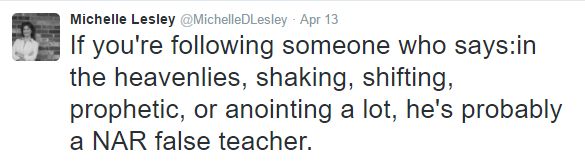
I was reading up on an organization called Sojourners. It is an organization whose focus is fighting against social injustice with some faith thrown in. In their “About us” page they used the phrase “prophetic interrogation”. I was intrigued by that. New terms popping up that have a Christian overlay to them interest me. Like this tweet from Michelle Lesley.

Here is the Sojourners blurb where they audaciously announce they they are prophetic interrogators.

Sojourners magazine and Sojourners online publication sit at the intersection of faith, politics, and culture. Our coverage goes beyond the trending headlines to uncover and explore in depth the hidden injustices in the world around us. Our call to prophetic interrogation means we seek the truth as informed by our biblical roots.

Apparently it is not enough to address obvious injustices, one must now uncover hidden injustice, too. Designating one’s organization or the people in it prophetic interrogators is audacious because they have not been called to perform prophetic interrogation. The term is an old term used to describe a rhetorical device in the Bible whereupon the ACTUAL prophets speak words to the nation Israel (or other nations as designated by God) to question them either actually or rhetorically. Here are a couple of descriptions of what the term prophetic interrogation means.

Elements of Prophetic Interpretation. 

THE INTERROGATION — while its legitimate use is to ask a question — is also used to affirm or deny with great emphasis. Affirmative interrogations usually have no or not in connection with the verb. Example. — “Is not God in the height of the heavens?” Job 22:12. Examples of a negative. — “Shall the earth be made to bring forth in one day? or shall a nation be born at once?” Isa.66:8. “Can the rush grow up without mire?” Job 8:11.

From the book Minor Prophets Part 2, by Michael H. Floyd,

Prophets would often provoke their audience with accusatory or confrontational questions (e.g., Isaiah 7:13, 22:1b, 16; Jeremiah 4:30; Ezekiel 18:2, 25, 29; cf. Psalm 50:16, 53:3), and inferential questioning would serve as one way of pursuing this rhetorical strategy (e.g., Amos 3:8; Isaiah 50:7-9). In prophetic discourse inferential questioning usually serves to foster an assessment of some claim about the nature of Yahweh’s involvement in human affairs (—-> prophecy).

I hope the reader can see why it is audacious (brash, arrogant) to designate one’s self a prophet called by God to interrogate entire nations, systems, or organizations. First, prophetic interrogation as seen in the Bible always points back to God.

Secondly, God calls prophets, one does not designation one’s self as a prophet (in NT times, a pastor). Third, the willingness to call one’s self prophetic interrogators reveals an even more symptomatic problem. I mentioned that Sojourners is a social justice organization that ‘intersects where faith, politics and culture meet’. The church is called to share the Gospel, period, not entertain politics and culture. However, social justice organizations often lose their singular focus and dilute or even do away with Gospel proclamation. See this paper published in Britain in 2005 titled, Exploring ethos? Discourses of `charity’ in the provision of emergency services for homeless peopleThe author John May compared three systems of generosity, and took a particular interest in the reasons why individuals and organisations become involved in the task of caring for, or serving, homeless people.

We Christians know that loving our neighbor is our response to the saving grace Jesus bestowed on us and our desire to nurture, help, and serve as a logical and an emotional response to that grace. Sometimes this perplexes secular people, and so the thrust of the paper was to compare charity work among “Christian caritas, secular humanism, and postsecular charity.” Mr May writes of Christians engaged in social justice,

The Christian ethical impulse to charity is most clearly displayed in the reforming zeal of evangelicals in the 19th century. Underpinned by the great evangelical revival which began at the end of the 18th century, a widespread depth of religious faith became a motivating factor for the establishment of a far-reaching charitable network, three quarters of which, according to Heasman, was evangelical Christian in nature. As Owen (1965) suggests, “So unwearied in well-doing were certain groups of Bible Christians that in the public mind the word ‘philanthropist’ became all but synonymous with ‘evangelical’, and ‘philanthropy’ was applied to the good works that appeals most to evangelical tastes” (page 93). 

…These outpourings of 19th-century Christian charity relied on an overtly evangelical underpinning of action. Charitable activity was essentially entwined with an urgency to convert people to Christian ways of living. As the impacts of the evangelical revival waned, Christian theology became increasingly liberalised, undermining the link between social welfare and salvation. [emphasis mine]

…Another, related dilemma, relates to the intersection of faith and political worldview. Some Christians view their caritas through an individualist political lens – believing that social problems result from an individual’s failures, so the emphasis is on individual conversion as a means of over-coming personal failure (Steinfels, 2001). Others see poverty as caused by unjust social, economic, and political structures and life circumstances largely beyond the control of individuals. Christian charity in this context not only provides personal strength for these individuals, but also presents a ‘prophetic interrogation’ (Wallis, 2001) of social injustice more generally.

That is the problem with organizations that focus on social injustice to the exclusion of the Gospel. The historical trend went like this:

  • serving others in social welfare as a Gospel response, conversion in mind
  • crusading for social justice to rectify the symptoms that caused the person to need the welfare in the first place
  • to speak for God in interrogating entire nations or systems as to why the injustice exists.

Each step in this trend removes the Gospel from center focus and elevates the people performing the service to exalted positions they do not warrant.

My message today: watch out for the term “prophetic interrogation.” Add it to your list of terms like anointing and the others that do not mean what the speaker thinks it means.

Posted in discernment, mystery, scientology

Scientology opens new building in Atlanta, Martyn Lloyd Jones’ Mystery of God’s will

which He lavished on us. In all wisdom and insight He made known to us the mystery of His will, according to His kind intention which He purposed in Him. (Ephesians 1:8-9)

Martyn Lloyd-Jones preached a phenomenal series through the Book of Ephesians. His sermon on the verse from 8-9 is called The Mystery of God’s Will. It is so rich with insight and profundity I listened to it twice and then transcribed part of it so as to study more. Here is MLJ on the word mystery in Ephesians and other verses:

Mystery is a key term. If we do not understand its meaning we shall certainly go astray. … What, then, does this term mean? Well, let us have a few negatives. It does not mean the same as the manner of the cults and the mystery religions which were common in Paul’s day. A kind of mystic secret, which is only revealed to a few initiates and which is deliberately kept from and guarded from everybody else. No, that was the characteristic of the mystery religions. You went into the temples and you went through certain procedures. It was a secret that was really confined to a few philosophers and exceptional people. It was never given to the common, ordinary people.  

Oh no, it was closely guarded and kept, and there was a great ceremony and ritual and then you were initiated. There are certain cults as you are familiar with at the present time which are clearly based upon such practices and are the very antithesis of the Christian faith. Behind closed doors, the secret must be kept and never divulged, and nobody knows. It’s the opposite of Christianity which proclaims, preaches, expounds, heralds, and wants everybody to know it. It isn’t a closely guarded secret to which only initiates are admitted. No, it isn’t that. 

More important perhaps is that we should say this: that when this truth is described as a mystery, it doesn’t mean that it is something that is incomprehensible to the human mind in and of itself and therefore vague and nebulous and indefinite. Now that is the more important point to emphasize today. Because, there is a popular school of thought which says something like this: it is that the Christian faith can never be stated in propositions. Those of you who are following the journals will recognize this as part of the Barthian movement, followers of Karl Barth of Switzerland. They say that truth, salvation, cannot and must not be stated in propositional terms.

Well what is it then? They say it is essentially an encounter. It is this existential moment when God speaks to man and addresses him and then something happens. And all man’s attempts and endeavors to put it into print of necessity are wrong and false and misleading. That is why they say that ultimately all you have in the Bible is very fallible. That it is only man’s attempts to state this thing that happened at the moment of encounter. You mustn’t tell men that you must believe certain propositional truths, they say that truth can never be stated propositionally. It’s a mystery. In other words, their definition of a mystery is that it is something incomprehensible, something that men cannot state and cannot express. Any attempt to do so detracts from it.

Now, I say that it is vitally important that we should realize that that is not the meaning of mystery. That view of mystery is not confined to the Barthian movement and to its various adherents, there are others who believe the same thing. …

I suggest that those definitions of mystery are utterly erroneous.

Gill’s Exposition explains the Ephesians verse, what God’s mystery is

the mystery—God’s purpose of redemption hidden heretofore in His counsels, but now revealed (Eph 6:19; Ro 16:25; Col 1:26, 27). This “mystery” is not like the heathen mysteries, which were imparted only to the initiated few. All Christians are the initiated. Only unbelievers are the uninitiated.

And yet, there are so many false religions around the world and on our own doorstep that take the word mystery and build an entire false religion around it. People follow a track or a hierarchy in attempting to climb toward solving the “mystery”. They will all perish if they adhere to their track on the mystery religion. So many men and women have founded religions where people fruitlessly seek to perform tasks and rituals which will eventually (they hope) reveal the mystery. In all cases, these false religions or secret societies are attempting to contact god or gods. As this page explains,

The idea of there being different levels then moves the process on and ensures that the new initiate strives to become an adherent or full member by learning the ways of the club or society – and thus the initiate becomes fully engulfed in the world of the society.

Secret societies take this membership a step further by including certain devices within the “knowledge bank” that the initiate must learn. These devices include secret handshakes and words, special days of the year known only to the few, and insights into standard texts. All this, and more, makes the initiate feel ever more important. In all instances, the ultimate enlightenment experience seems to be kept back for the very highest levels of initiation – lower levels of illumination are permitted and used for the lower degrees.

One modern secret society which proposes to unlock “mysteries” is the Scientology cult. One knows that cults attract large numbers. Cults indulge the flesh, appeal to intellect, or make a person feel exalted or special. It’s disheartening to see how many people fall for the false claims.

Cults have

excellent ways of drawing in members and utilizing a heightened state in the individual for their own ends – whatever they may be.

Scientology in particular, according to their own definition,

In one form or another, all great religions have held the hope of spiritual freedom—a condition free of material limitations and misery. The question has always been, however, how does one reach such a state, particularly while still living amidst a frantic and often overwhelming society?
Although modern life seems to pose an infinitely complex array of problems, Scientology maintains that the solutions to those problems are basically simple and within every man’s reach. Difficulties with communication and interpersonal relationships, nagging insecurities, self-doubt and despair—each man innately possesses the potential to be free of these and many other concerns.
Scientology offers a pathway to greater freedom.

No, it does not. The only pathway to freedom is through Jesus, because He forgives our sins and frees us from bondage to them.

I live within range of Atlanta. In this essay we are speaking of mystery religions, (cults) one of which is Scientology. Scientology says they offer “total freedom” but only through a veil of secret teachings. The following was news last weekend. Even at that, the information that published in the paper was not reported on by an unbiased journalist, it was from a carefully scripted press release from the organization itself. This means that the information we learn is only what the Organization wants us to know. The Church of Scientology-Atlanta held the grand opening of its new campus in Sandy Springs on Saturday and it seemed to be quite a draw.

So much wasted flesh… (photo source)

It’s quite disheartening to see so many people seek mysteries which have no resolution, when the resolution to everything is Jesus, and he is out in the open. We must address our sin, not indulge it, as the mystery religions do. Even more sad, is this article below reporting from the press release of the same event,

The Atlanta opening continues an explosive growth period for the Church in the past 12 months. And more is on the way, with openings in the coming year planned for cultural epicenters in Australia, New Zealand, Europe and North America. Joining the Church’s opening celebration were 1,500 Atlanta Scientologists, plus those from along the Eastern Seaboard. (source)

Many people are seeking what is false. These people seeking the false are not just in Atlanta like in the picture above, but they are all around the world. And they are seeking what is false not just through Scientology but other mystery religions too. It’s saddening to the point of mourning to see so many people in one photo applauding the mystery religion that will reveal no mystery but only send them to hell.

Enter through the narrow gate; for the gate is wide and the way is broad that leads to destruction, and there are many who enter through it. “For the gate is small and the way is narrow that leads to life, and there are few who find it. (Matthew 7:13-14)

The problem with the mis-definition of “mystery” is that non-believers seek knowledge to resolve the mystery, but never seek the resolution to our universal problem, which is sin. And sin is no mystery to anyone, even the unbeliever. (Romans 1:18).

If anyone acknowledges that Jesus is the Son of God, God lives in them and they in God. (1 John 4:15)

For there is one God and one mediator between God and mankind, the man Christ Jesus. (1 Timothy 2:5)

Posted in barnhouse, discernment, social justice

What is God doing in the world today?

The following is a sermon excerpt transcribed from Dr Donald Grey Barnhouse. The sermon “What is God Doing Today?” can be found here. Dr Barnhouse launched his long-running radio program in 1927, and he pastored from 1927 until his death in 1960. Therefore this sermon had to have been preached sometime in that time frame, yet its age, at youngest perhaps 56 years old and at oldest, perhaps 90, is fresh and relevant today. 

We so often hear the cry of the social religious liberals to that they plan to change the world with their acts, or bring about social justice through this or that organization or these millions in donations. This of course is not a new theme. Dr Barnhouse’s sermon lets us know just how off-kilter the social justice cries really are. And how stale.

I recommend the sermon in its entirety at the link above.

————————————–

What is God Doing Today?

The question I am going to ask and answer today is ‘will the church save the world?’ What is God’s purpose in our age? God has but one purpose for the church, and He is confining that purpose to this age. In the Bible, God reveals that purpose.

Now we know that all Bible revelation centers around the work of the Lord Jesus Christ in two phases. First, He came to suffer for the sins of men. And He will come the second time to rule with a rod of iron and to bring righteousness to the earth. The Old Testament reveals nothing about the period between His First and Second coming. That revelation was made after Pentecost. 

What are God’s plan and purpose for this age? We need to find out so that we may not work contrary to them. A great New England preacher was once asked why he did not cooperate with Dwight L. Moody. The minister replied that he and Mr Moody did not agree on the purpose of life and work. This minister looked upon the church as a great ship, sailing through stormy seas, perhaps, but sailing on nevertheless in triumph, sure to come into port someday, with all the world on board. He expected that all the world would be Christianized and that everyone would be brought under the domination of the Gospel.

Mr Moody, on the other hand, looked upon the world as a sinking vessel, from which the church was to save as many souls as possible before the world foundered in great catastrophe. Obviously, it’s impossible to harmonize these two points of view. Therefore we need to examine God’s word so that our plans and purpose may be in harmony with His.

Never in the prophetic outline of the Church Age given in the word of God do we find the Church comprising more than a fraction of the population of the earth. Never is this Church spoken of as ‘all-inclusive’. Not one verse in the Bible teaches or even allows one to infer that the world is ever to be converted through the work of the church. Rather it is definitely taught that never will all people be in the true church. The low spiritual condition of many churches today is due in large measure to the fact that leaders have failed to recognize this truth and have been seeking to accomplish purposes that are out of harmony with the plan of God. Many leaders, lay and clerical alike, are trying to change the intellectual currents of the age. They are seeking to transform the social and economic order. Their aim is to build a new civilization for children to be born into. All this is foreign to the plan of God. Such ideas cannot be found in the New Testament.

Anyone who claims to be a follower of Jesus Christ can only adopt the attitude of the Lord Jesus toward the age in which we live. Our Lord spoke in no uncertain terms about the intellectual currents of this world system…its civilization…its social and economic order… He said in John 15, “If the world hates you, know that it has hated Me before it has hated you. If you were of the world, the world would love its own.”

There is no word here about trying to change the attitudes of the world toward believers in Lord Jesus Christ. … Christ NEVER hinted that there was any hope for this world as it is in its present condition. There is hope for believers, salvation for those who turn to Christ, but no hope for the unbelieving world. In John 17 Christ even refused to pray for the world. In His last, great prayer, recorded in John 17, He said “I have manifested your name to the people whom you gave me out of the world…9I am praying for them. I am not praying for the world but for those whom you have given me, for they are yours.” 

It is not God’s purpose in this age to improve the social or moral order of the world. Anybody who seeks to make this world a better place to live in has failed to understand the purpose of God today. For God’s purpose is to form His church, the Body of called-out ones.

Posted in boyfriend, discernment, romance

Jesus is not our boyfriend

By Elizabeth Prata

Not all girls universally desire a romantic groom to come sweeping in on a white horse to rescue them. Not every woman is a romantic.

Ladies, don’t buy into the current attitude that because all women want a romantic groom, that we can envision Jesus as that romantic groom. The romantic Jesus-boyfriend complex is an unfortunate trend that in fact diminishes the august majesty of our King. He is also Savior, Redeemer, Priest, Father, Friend, Healer, Provider, and a host of other facets to His personality that are the complete God-man whom we worship. He is not our boyfriend.

Jesus is not a Prince Charming jousting for a lady fair’s attention. Jesus is not Prince Charming trying to win a fair maiden’s attention. He is GOD! He doesn’t woo. He doesn’t plead. He doesn’t leave small favors on our doorstep so we would finally fall, smitten, at His feet. He is GOD! He decides whose name will go in His lamb’s Book of Life. He decided that before we were even formed. Then he makes it happen.

Now the main point in what has been said is this: we have such a high priest, who has taken His seat at the right hand of the throne of the Majesty in the heavens, (Hebrews 8:1)

And He is the radiance of His glory and the exact representation of His nature, and upholds all things by the word of His power When He had made purification of sins, He sat down at the right hand of the Majesty on high, having become as much better than the angels, as He has inherited a more excellent name than they. (Hebrews 1:3-4)

“Yours, O LORD, is the greatness and the power and the glory and the victory and the majesty, indeed everything that is in the heavens and the earth; Yours is the dominion, O LORD, and You exalt Yourself as head over all. (1 Chronicles 29:11)

Does that sound like a man who is supposed to woo his woman and fall head over heels, weaving a daisy chain together to bestow with a kiss? No.

Bless the LORD, O my soul! O LORD my God, You are very great; You are clothed with splendor and majesty, (Psalm 104:1)

And yet we women are subjected to titles like this, depicting our majestic God as as a foppish suitor. This terrible book was actually written, actually published and is actually on sale:

The Wild Romancer: Uncovering the Romance Jesus Longs to Lavish on You, by Brenda Cobb Murphy.

Jesus longs for something? This would indicate an impotence that does not exist. It evokes a weak man who wishes, hopes, tries, but does not accomplish. But Jesus accomplished it all. He defeated death by the power of His sinless will! Yet these kind of titles are all too common. This theme is all too frequent in “women’s studies”. One ‘teacher’ urges women to “make Jesus the supreme romance of your life, if we would “only let Him.” Ann Voskamp says that we “make love to God.” Sarah Young carries this erotic-romantic theme forward in her book, Jesus Calling Grads. That’s idolatry, projecting our own emotions onto Jesus and worshiping the image we have created.

He did not come to woo us gently to His heart. He came to shed His blood so as to exhaust God’s wrath for His elect’s sin. Even the concept of wooing toward salvation is foreign to the Bible. No one seeks for God, no not one. (Romans 3:10-11). We women are not wandering romantics looking for our Prince Charming, who whispers sweet nothings into our ear and satisfies the need for glamour and mystique in our love lives as we finally, sweetly succumb. He is the avenging Savior ransoming us from sin’s bondage in His inestimable timing. Sometimes salvation is hard, messy, and initially unwanted.

It is the romanticizing of Jesus that is one of the ways we remake God into our own image. This is idolatry. We have a human desire or need, and we make God into an image that fills that need.

Isaiah 44:15 & 17 say of idolatry,

Then it becomes fuel for a man. He takes a part of it and warms himself; he kindles a fire and bakes bread. Also he makes a god and worships it; he makes it an idol and falls down before it.

From the rest he makes a god, his idol; he bows down to it and worships. He prays to it and says, “Save me! You are my god!”

The romantic whispery Jesus is the false God some women have made, and this is concerning because these women have a platform for publishing books or speaking to thousands of women. This is the false Jesus they urge women to fall down before.

Jesus is not our prom date. He is the creator, sustainer and destroyer of worlds. (Genesis 1:26, Colossians 1:17, 2 Peter 3;10). He decided to create man for a relationship with Him, so that man may know Him and glorify Him. (Psalm 86).

Jesus is not our boyfriend.

————————————————–

Further Resources

Critique: Why Jesus isn’t your boyfriend

Jesus did not accomplish redemption to marry us individually. He died for the church corporate, of which we are a part. His death accomplished something much greater than simply meeting our deep-seated desires for a significant other.