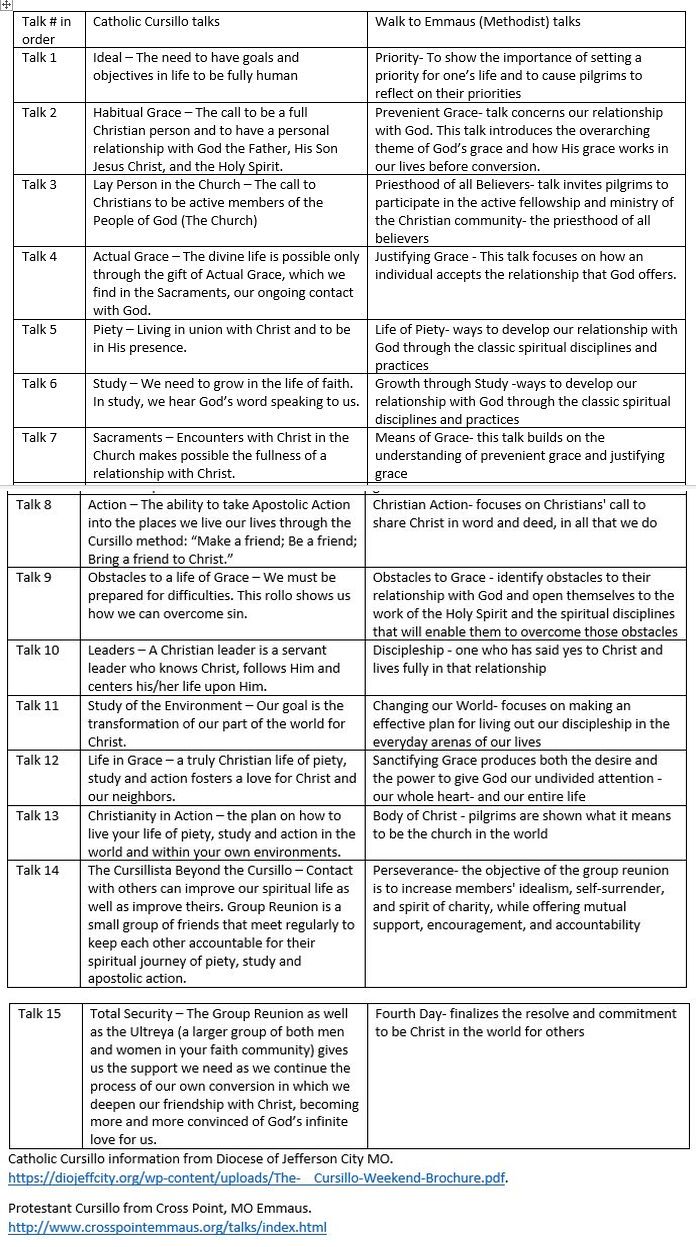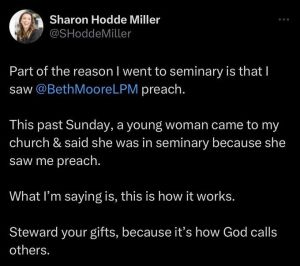
Posted in discernment, theology

Beth Moore has a lot to answer for in normalizing women preaching/teaching to men

By Elizabeth Prata

Sometimes the pot warms its water so slowly even the most discerning frog swimming in it doesn’t realize the change in temperature in his environment until it’s too late. Even though this isn’t scientifically true, “the story is often used as a metaphor for the inability or unwillingness of people to react to or be aware of sinister threats that arise gradually rather than suddenly,” as Wikipedia explains.

It was a given that for more than 2000 years women are not to be teachers or preachers of men. We women can and do teach, we minister, and we evangelize. We discuss, we help, we clarify perhaps in a private setting, but we are not to have biblical authority over men in church expository situations.

I do not permit a woman to teach or to exercise authority over a man; rather, she is to remain quiet.” (1 Timothy 2:12)

How is a women preaching to men a sinister situation? It’s sin. As RC Sproul said, sin is cosmic treason!

Ask the metaphorical Jezebel of Revelation 2:20 who was teaching things God did not say. Jesus promised to kill her and her followers. Inserting words into God’s mouth is sin.

Look at the Garden. One certain fruit was eaten against God’s command, and the entire race of humankind was polluted with sin. Ignoring what God said is sin.

What God says to do or not do matters. We don’t need 50,000 verses. One is enough. Women are not allowed to teach the Bible to men.

But Beth Moore does.

She has been doing it for 30 years.

Woe to Beth Moore.

A female generation is about 25 years. Therefore, it’s woe to the generation of women coming up in Christian circles who have for the entire time been seeing Moore’s preaching to men as normal, even with her pastor’s overt blessing, or the tacit blessing of her denomination the Southern Baptist Convention and its arm, Lifeway.

For years Moore taught Bible to a co-ed Sunday School class of 600-700 people as you read in that link above and later up to 900 people as stated in this link:

At that time, God began to do a new thing, stirring the heart of Beth to move to a new meeting place, meeting time, change the name of the class, and allow men to attend.

Is it God stirring the heart of a woman to disobey scripture and to teach men? I think not. In Revelation 2:23 it’s noted that Jesus will strike Jezebel’s children dead. These are not Jezebel’s biological children, but the spiritual daughters she is raising up in her polluted, sinful likeness.

The 1 Timothy scripture seems not to bother Moore. She has not repented of this cosmic treason. She describes her origins as a Bible teacher. Her Sunday School class began in 1985 and she was still teaching it in 2005. Her class almost from the beginning had a mixed audience.

Being a woman called to leadership within and simultaneously beyond those walls [of an SBC church] was complicated to say the least but I worked within the system. After all, I had no personal aspirations to preach nor was it my aim to teach men. If men showed up in my class, I did not throw them out. I taught. ~Beth Moore

It does not matter if you “had personal aspirations to preach” to men or not. If you do, you’re sinning. If you fail to stop it, you’re sinning.

How did this begin? Moore began teaching an aerobics class in Texas in the 80s at her church. It gravitated somehow (don’t ask me how, that’s a leap I can’t figure) to a Bible class in 1985. That soon turned to a co-ed class, then a 600-700 member coed class.

Moore eventually founded Living Proof Ministry in 1994. By 2003 her Living Proof Live conferences had gone beyond the confines of her church and beyond the Texas border. A national magazine took notice. Their opening sentence called her a minister.

“Once a victim of abuse, Beth Moore is one of America’s most popular ministers today.”

The article went on to note that men attended her Sunday School class. It was popular, so crowded with both sexes that attendees were asked to car pool because the parking lot was so jammed.

But the crowded conditions don’t seem to deter them. Not even the men, who came for a while in large numbers, were put off–until the ministry limited them by asking them to sit in the back, and if necessary, give up their seats to women. It is a women’s Bible study, after all. And though men are not restricted from attending, they aren’t encouraged, either. The selectivity has nothing to do with the location. With her pastor’s sanction, Beth teaches a co-ed Sunday school class of 600 to 700 in the same Southern Baptist church each week. But her ministry “really is to women,” she says. “My love is women in the body of Christ.” [emphasis mine]

An obedient teacher says “My love is for Christ and His word, and I asked the pastor to restrict the class to women only.” But as Beth Moore said above, “I didn’t throw them out. I taught.” She sought bigger rooms to accommodate them all.

The ‘aw, shucks, I’m really just a women’s teacher’ won’t cut it when pleading for mercy in front of the throne. Failure to obey the Word is failure to obey. She has been a usurper from the beginning.

And she keeps on teaching.

In 2010 when her fame was rising, Christianity Today did a 6-page cover story on her. The article cites the following:

Before she begins, she addresses the few men in the crowd. A Southern Baptist, Moore emphasizes that her ministry is intended for women. “The gentlemen who had such courage to come into this place tonight, into this estrogen fest if you will ever find one in your entire life: we are so blessed to have you,” Moore says. “I do not desire to have any kind of authority over you.”

It’s laughable to pronounce a blessing on the men in attendance, welcome them, preach the Bible to them, and then meekly deny any authority over them. Is her teaching from the Word authoritative over the women but not the men sitting next to them? Or do the women reject her authority to teach and they’re just coming, say, for the music? You see the illogic. If she teaches authoritatively, she teaches authoritatively to all in the hearing of it.

As far as Moore’s coyness that she does not desire to be authoritative over them, this is false. Genesis 3:16 tells us it is IN us to want to usurp male authority. It doesn’t matter if you desire to break God’s command or not, if you DO, you’re sinning. Try telling the traffic policeman that “I did not desire to speed on the highway” and see if he lets you go.

The Christianity Today story is page not found anymore. However, the link is here in the web archive split into 6 pages if you want to see the source.

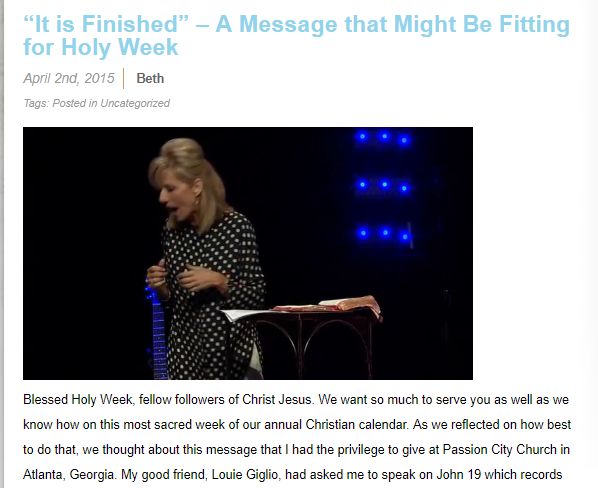
Moore’s occasional weak protest, that men attend her classes and conferences on their own volition so it isn’t really her fault, doesn’t hold water. She taught men in her SS class for 20 years. By 2012, she was personally asked to substitute for pastor Louie Giglio preaching the Sunday Service at Louie Giglio’s Passion City Church, and she accepted. It was Holy Week, and she preached John 19 to a very, VERY large crowd of congregants. Some of these people, men included, lined up two hours early just to hear her.

Brian Dodd was one of those men. He attended Passion City Church that weekend and wrote a recap of her sermon. Gushing about how Moore is “a church leader” and how excited he was that he showed up hours early.

Moore affirmed on her blog that she was asked to preach at Giglio’s church and that she accepted.


Screen grabs from videos like this in 2012 harm women when they see a female on stage preaching from the Bible shoulder to shoulder with men. It’s visual egalitarianism. Photos like this are damaging. L-R, Lecrae, Moore, Chan, Giglio, Piper preaching at Passion Conference in 2012:
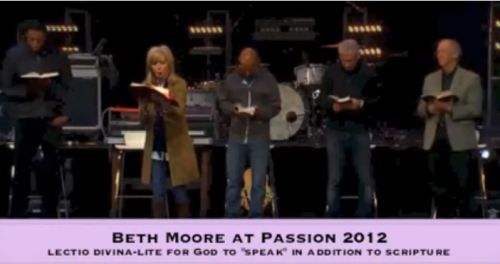
In addition to Moore’s actual preaching to men, a sin, she sins by failing to separate from other women who preach and call themselves pastors. She encourages women in their preaching to men.

We must separate from false teachers and heretics. Moore does not do that, and by her continued support of these people, and they of her, more confusion is added to the body of believers, particularly younger women. Women are the weaker vessel, (1 Peter 3:7), gullible to false teaching if we are unrepentant (2 Timothy 3:6), and our flesh wants to usurp the husband (Genesis 3:16). It is unwise to partner with heretics and to encourage them. By partnering with them, Moore proves her allegiance.

After decades of teaching men and preaching to men, any declarations otherwise are only lip service.

If a woman publicly preaches to men for decades, is seemingly accepted in this role, and even promoted in it, the cumulative damage to the greater body of women is great. In June 2018, the Washington Post published an incredible article about Moore. The title was,

How Beth Moore is helping to change the face of evangelical leadership

In the article she is called a ‘great preacher’,

She has her audience laughing, tearing up and clapping, much like they would listening to any great preacher.

The article’s author notes that the Southern Baptist Convention doesn’t allow female preachers, and then went on for a paragraph describing how Moore gets around it by using tweets, books, and speaking engagements as her pulpit. The article also describes how Moore is the face of global evangelism and is personally the transition linchpin for this new future:

Moore is one of the evangelical leaders today who represent the future of the global church, in which people outside Europe and the United States will be dominant. … Moore represents this transition, which is shaping even the most conservative corners of evangelicalism.

There is the danger. After so many decades of preaching and teaching, Moore has warmed the pot and the girl froglets see women preaching to men from pulpits, in churches, at conferences, or other settings, as normal. Desirable. Meanwhile, despite the Bible’s instruction to women to be gentle, meek, quiet, and industrious, tending to their homes and children, Moore has become culturally confrontational. Political. As the lengthy article about Moore last month in The Atlantic reveals,

“Privately, however, Moore has never cared much for the delicate norms of Christian femininity.”

We know. If she did, she would not preach to men. The pot is boiling now. Is this what we want for our young women? Women who are confrontational, rebellious, vocal, political, taking on the culture, preaching to men, partnering with other rebellious preacher women and ignoring her home duties?

Though she often performs domestic femininity for her audience, in her own life she has balanced motherhood with demanding professional ambitions. She traveled every other weekend while her two daughters were growing up—they told me they ate a lot of takeout. Source The Atlantic

Performs’ domestic femininity? Pretends. AKA, lip service. (Isaiah 29:13).

Writers like J. Lee Grady would love to see more women preach like Moore does. He writes in Ministry Today Magazine that it’s finally about time that women take the reins in the pulpit.

What is baffling about this whole experience is that there are large numbers of Christians today who don’t believe Beth Moore should be preaching to [mixed gender] audiences like the one in Orlando. In fact, some fundamentalists have launched attacks on her because she preaches authoritatively from pulpits.

We need an army of women like Beth Moore, and my prayer is that more women will seek the Lord and dig into His Word with the same passion that Moore has. I believe she is a forerunner for a new generation of both men and women who will carry a holy Pentecostal fire that cannot be restricted by gender.

The Washington Post predicts that, as well. Grady’s desire may yet come true. There was talk this summer of Moore being nominated for president of the Southern Baptist Convention. Her virtue signalling tweets, politically charged ‘Open Letters‘ on social media and timely hopping onto cultural topics such as social justice are akin to a Senator’s moves before a presidential run.

Imagine, within one generation a woman whose former claim to fame was the latest aerobics moves climbed steadily up to being seriously considered for president of the world’s largest denomination, a conservative one, at that. One generation, after 2000 years of holding fast to scripture on this issue. Sin is amazing in its power.

I began this essay chronicling Moore’s journey to normalizing women’s usurpation of men from the pulpit by saying ‘It was a given that for more than 2000 years women are not given to be teachers or preachers of men.’ It was. It WAS. Past tense.

Yet the LORD our God is still on His throne and He still maintains a hard line on the roles women and men are to operate within in His church. That is a given.

For God is not a God of confusion but of peace. As in all churches of the saints, the women should keep silent in the churches. For they are not permitted to speak, but should be in submission, as the law also says. If there is anything they desire to learn, let them ask their husbands at home. For it is shameful for a woman to speak in church. (1Corinthians 14: 33-35).

Posted in encouragement, theology

Abecedarium, Bestiary, and Emblem books: What do they have to do with the Bible?

By Elizabeth Prata

“I don’t have time to read.” I hear this a lot. I say this a lot. I used to read widely and incessantly before I was saved. Nowadays I am working a day job and ministering/serving at night, with Bible reading too. That leaves me either no time to read other books or tired eyes if I do have time. The pile of books grows high and the finished pile is small.

I’m preparing an essay “On Reading” for later this week, but in researching for it, and in researching for another essay I’m doing on a scene from Pilgrim’s Progress, I am discovering some things that inform my background on reading and the importance of immersing one’s self in a variety of types of literature.

Let this essay be considered an introduction to “On Reading” that I’ll write later this week.

We know that John Bunyan wrote Pilgrim’s Progress. We also know that it is the second-best selling book in the English language. The book is an allegory. What is an allegory?

An allegory is: a story, poem, or picture that can be interpreted to reveal a hidden meaning, typically a moral or political one. “Pilgrim’s Progress is an allegory of the spiritual journey”

Bunyan’s book contains literary devices and genres within it of which we may not be familiar. These are are good to know as we read his amazing allegory. What are some other types of literature? Abecedarium, Bestiary, Emblem books were popular at Bunyan’s time and before.

Abecedarium: (plural abecedaria)

A book used to teach the alphabet; alphabet book; primer. An inscription consisting of the letters of an alphabet, almost always listed in order.

In past eras childrens’ abecedaria lessons included Bible lessons and verses. I have an abecedarium (of course I do!) and here is its first page. It is an illuminated alphabet from the court of Emperor Rudolf II.

Rudolf II (1552 – 1612) was Holy Roman Emperor, King of Hungary and Croatia, King of Bohemia and Archduke of Austria. He was a member of the House of Hapsburg. The illuminated ‘A’ and picture represents a verse from Revelation 1:8,

I am the Alpha and the Omega,” says the Lord God, “who is and who was and who is to come, the Almighty.”

The explanation of the picture from the abecedarium is that: “the first written symbol pays homage to God, the ruler of heaven and earth, the “beginning and the end”. The biblical verse, accompanied by the tetragram of Gods’ name is quoted within a stylized Omega in the middle of the page and in a cartouche at the bottom margin. With this verse, the first letter of the Greek alphabet simultaneously refers to the last one. The blue medallion containing the tetragram of his name occupies the the center of the folio. It connects the constructional drawing of the letter A with its executed version and is surrounded by the Omega, which generates flashes of lightning and thunderheads as symbols of God’s might.”

“In the upper margin, a cherub is surrounded by a laurel wreath, a sign of God’s fame, and flanked by incense burners. This angel praises the Lord along with the cherubim at the right margins. At both left and right, eternal lights burn in praise of God, as so candles entwined by olive branches, which symbolize his peace, Four demonic winged insects (the two antennae on the abdomens of the upper ones indicate that they are Ephemerae, whose life span is a single day) are attracted by the flames.”

A children’s book can be very sophisticated. Another antique book style was a Bestiary.

Bestiary is “a descriptive or anecdotal treatise on various real or mythical kinds of animals, especially a medieval work with a moralizing tone. The natural history and illustration of each beast was usually accompanied by a moral lesson. This reflected the belief that the world itself was the Word of God, and that every living thing had its own special meaning. For example, the pelican, which was believed to tear open its breast to bring its young to life with its own blood, was a living representation of Jesus. The bestiary, then, is also a reference to the symbolic language of animals in Western Christian art and literature.

Illustration from from the Oxford Bestiary; Perindens, a magic tree and keeper of the birds.

Another kind of book that was popular when Bunyan was writing Pilgrim’s Progress was the Emblem Book:

An emblem book is a book collecting emblems (allegorical illustrations) with accompanying explanatory text, typically morals or poems. This category of books was popular in Europe during the 16th and 17th centuries.

In part 1 and in part 2 when Christian and Christiana are in the House of the Interpreter, there seems to be a similarity to the scenes Bunyan records there with an Emblem Book. This Wiki entry explains.

“Many of the pictures in the House of the Interpreter seem to be derived from emblem books or to be created in the manner and spirit of the emblem. … Usually, each emblem occupied a page and consisted of an allegorical picture at the top with underneath it a device or motto, a short Latin verse, and a poem explaining the allegory. Bunyan himself wrote an emblem book, A Book for Boys and Girls (1688) …”, cf. Sharrock, p. 375.

Right, Wisdom – from George Wither’s Book of Emblems (London 1635)

So…that is all pretty interesting. We know that the Bible itself contains many different kinds of literary styles. From GotQuestions’ list

historical literature (1 and 2 Kings),
dramatic literature (Job),
legal documents (much of Exodus and Deuteronomy),
song lyrics (The Song of Solomon and Psalms),
poetry (most of Isaiah),
wisdom literature (Proverbs and Ecclesiastes),
apocalyptic literature (Revelation and parts of Daniel),
short story (Ruth),
sermons (as recorded in Acts),
speeches and proclamations (like those of King Nebuchadnezzar in Daniel),
prayers (many Psalms),
parables (such as those Jesus told),
fables (such as Jotham told), and
epistles (Ephesians and Romans).

I recently read an epistolary novel, The Guernsey Literary and Potato Peel Pie Society. I read Pilgrims Progress part 1 this summer and I’m reading part 2 now, which is an allegory. I’m reading poetry, a book of short stories, and a non-fiction historical. This past summer I read Moby-Dick, which is a little of every genre, I think!

Reading widely in various genres helps the Christian when s/he reads the Bible. Reading the Bible with its many genres helps the Christian when s/he reads widely. It works both ways. Christians should be readers. Challies explains why. An abecedarium might not be your cup of tea, neither a bestiary or an emblem book, but there are many different kinds of books besides the standard Christian novel or the non-fiction theology book. Try one! I had a hard time at first with Pilgrim’s Progress because I don’t connect well to abstractions like symbolism or allegory, but I’m glad I stuck with it. The skill helps me when I read the Bible. The word pictures in the allegory also stay with me.

Let me know what different genre you tried and how you liked or didn’t like it!


Posted in theology

Is scripture clear? Should we speak declarative truth?

By Elizabeth Prata

I hope this fine fall week has offered you beautiful glimpses of God’s creative intellect and His wonderful power. It’s finally cooled down here in north Georgia. We always enjoy the march of the seasons. “He appointed the moon for seasons: the sun knoweth his going down.” (Psalm 104:19, KJV). Wherever we are in the world, reading this blog, we see and understand the times and seasons. We look for the colorful leaves, the pumpkins, the migrating geese. The orderliness and consistency of the seasons since His ordination of them is a comfort. Yet even in Jeremiah 8:7 it is said of the seasons, meaning HIS season, “Yes, the stork in the heaven knows her appointed times; and the turtle and the crane and the swallow observe the time of their coming; but my people know not the judgment of the LORD.”

I’ve always been interested in language, and how language, particularly through media, influences the mind. How it can clarify or obfuscate. The Emergent Church’s penchant for insisting on ‘respectful dialogue’ was part of the tactic of obfuscation. It brought muddiness to the clarity of scripture and it is simply a defense mechanism for satan to deflect dogmatic truth. I posted a blog entry a long while ago titled “It’s 2012 and homosexuality is still a sin” as a jab at emergent post-modern culture that says we have to get with the times and dialogue about these points to see whether they are still relevant. I have an answer for you. They are still relevant. End of dialogue.

Phil Johnson has said,

“Let’s just agree to disagree.” Well, no. How about we just argue until one of us actually refutes the other and we come to a common understanding of God’s Word?

As a result of my interest in how language is used or misused, I’ve heard much of what John MacArthur has said or written on the subject. Here is his explanation of the tendency toward “tolerant dialogue” in his essay “The perspicuity of scripture

“A new movement is now arising in evangelical circles. Apparently, the main object of attack will be the perspicuity of Scripture. Influenced by postmodern notions about language, meaning, subjectivity, and truth, many younger evangelicals are questioning whether the Word of God is clear enough to justify certainty or dogmatism on points of doctrine. Ironically, this new movement to a certain extent ignores all the previous debates. Instead, its proponents are more interested in dialogue and conversation. As a result, they scorn and rebuff propositional truth (which tends to end dialogue rather than cultivate it) as an outmoded vestige of twentieth-century modernism.”

He’s right. Proclamation of an incontrovertible truth tends to shut down conversation. It’s supposed to, because there is no debating it. Strong’s Concordance says the authoritative (binding) word of God, brings eternal accountability to all who hear it.

Do you really believe that scripture is so unclear about what’s a sin? It isn’t.

It is also just as clear on Jesus’ love for us. People will accept that incontrovertible truth, while dismissing the truth of sin. God Sent His Son into the world to die for our sins. Jesus is the best person to ever live, die and live again. He is superlative, beautiful, and perfect. He saves us from our sins. Scripture is clear on that.


Posted in discernment, theology

Gay demographics: what are the REAL numbers?

By Elizabeth Prata

This post first appeared on The End Time in June 2012

If the homosexual lobby is to be believed, every other person you bump into is gay. At work, at home, in town, in the city, in church, the more vocal activists in the lobby make it seem like people who self-identify as homosexual or lesbian are a major portion of the population.

They scream about rights, and their civic due, and not being marginalized any more like any other large minority group, such as African Americans. Black people as a major minority rose up in the 1960s to claim their civil rights, the gay lobby says, and homosexual lobby now makes the same claims. Homosexually-oriented people are elected to office, serve as community leaders, even preach from pulpits. There is a homosexual character on most sitcoms now, either as a regular character or as a recurring character. Homosexual references are made on scripted shows and on reality television shows, movies, and books. Christian colleges have gay support clubs now. We are literally saturated with the notion that homosexuality is the norm. Heck, even the animals do it, so it must be normal, right?

Not so fast.

I opened with “If the homosexual lobby is to be believed…” but what are really the statistics on numbers of self-identified gay and lesbian people in America? Can we believe those numbers? I am not talking about a girl who experimented once when she was 12, or the guy who woke up sorry and embarrassed after the drunken orgy of a frat party. I am talking the militant, life-long, “out” homosexuals who choose to live that lifestyle as mirror to heterosexuality.

No. We can’t believe the numbers. They’re a crock.

Americans Have No Idea How Few Gay People There Are
“One in ten. It’s the name of the group that puts on the Reel Affirmations gay and lesbian film festival in Washington, D.C., each year. It’s the percent popularized by the Kinsey Report as the size of the gay male population. And it’s among the most common figures pointed to in popular culture as an estimate of how many people are gay or lesbian. But what percentage of the population is actually gay or lesbian? With the debate over same-sex marriage again an emerging fault line in American political life, the answer comes as a surprise: A lower number than you might think — and a much, much, much lower one than most Americans believe.”

So, what are the numbers? Well, Americans believe a quarter of the population is gay. The true number is about 4% and is probably probably closer to 2%. A 2011 report by the Williams Institute on Sexual Orientation estimated that 4 million adults identify as gay or lesbian, representing 1.7% of the population over 18. (source)

That is some very successful perception-altering on their part. So how is it that the homosexual lobby has made it seem like you can’t swing a cat in the Bible Belt without hitting a queen or a dyke? Because of this.

Bunheads.

Bunheads is (was- it didn’t last) a new ABC Family show by the producers of Gilmore Girls. I never saw the tv show Gilmore Girls but every news story I read about Bunheads identifies the show that way so I will too. Bunheads is the nickname for ballerinas, and the show that made its debut last Monday is touted as a new family oriented entertainment.

I saw the pilot and I liked it. I thought the writing was sophisticated and witty, the show was emotional without being sentimental, and I put it on the list for future watching.

So what is my concern with the show and how does it relate to the vastly overestimated homosexual numbers? Here:

At one point toward the end of the pilot episode, which is on ABC Family I remind us all, the mom-in-law character was having a heart to heart talk with her new daughter-in-law. The girl had just married the mom’s son and had moved into their home in a town called Paradise.

The scene took place in a roadhouse toward the end of the show, a show in which constant references had been made for the last 90 minutes to the smallness of this rural seaside town. It is small. There is no movie theatre. It has just about one store. (Giving directions to a newcomer- “Go to Main Street, turn left, and look for the store called Sparkles.”) The teens, when feeling frisky and up to no good, break into the library and, gulp, read. It’s so small that teenagers literally have nothing else to do but read? THAT is how small, out of the way, and retiring this little town is. Even the show synopsis calls it a “sleepy coastal town.”

So back to the scene. The new daughter-in-law asks about the dancers attending the mom-in-law’s ballet class. The teenage girls all had a story, and of one, the mom-in-law said,

“Her dad’s gay. Oh, he thinks it’s a big secret but we all know. Thing is, if he would just come out of the closet he would smile once in a while. And plus, there are a lot of very nice, single gay men in town.”

A town so small has “a lot” of gay men? The perception the homosexual lobby would have us believe, and uses family entertainment to do it, is that literally just about everyone is gay. Bombard a population with that message for thirty years and you get a new generation coming up who thinks everyone is gay. And if there are so many gays, then it must be normal. That is the strategy. Normalization through numbers.

Of course I’m not blaming the entire skewed perception on one television show, but it is representative of the insidious but casual nature that scripted tv and movies: that every closet has a gay person lurking inside it, summoning up the courage to leap “out.” We have been saturated with casual one-off lines like the one in Bunheads casually declaring that there are “a lot” even in this small town. ‘We don’t have a theater but we’ve got our gays!’

You can see the success the homosexual lobby has had in altering the perception of a nation of over 300 million souls. The homosexual lifestyle is an aberration. Some succumb and choose it. Make no mistake, though, it is a choice, not an identity. I understand the fight that homosexual people have in resisting that aberrant behavior. All people attempt to resist sin in some form or fashion. I understand also that some sins are more besetting than others. God will still judge them.

BUT, God in His loving kindness, accepts the repentance of one who seeks to shed that lifestyle and turn to Him. His mercy is greater than any sin, and He listens to prayers beseeching deliverance. Here is a moving three minute clip from a testimony John MacArthur shared of a homosexual’s repentance. (The clip says 7 minutes but the audio goes out after three minutes.) It is quite moving:

If you are involved in a homosexual lifestyle, or any lifestyle that is unacceptable to God, please repent. Ask Him to forgive your sins, and make Him Lord. His wisdom is so vast that he will lead you into a life that is purer and more peaceful than you can ever imagine.

Posted in theology

A Day in the Life of A: Potter

By Elizabeth Prata

Previous essays in the series:

A Day in the Life of: A Roman Centurion
A Day in the Life of: A Professional Mourner
A Day in the Life of: A Fisherman

A Day in the Life of: A Potter
A Day in the Life of: A Scribe
A Day in the Life of: A Shepherd
A Day in the Life of: A Tanner
A Day in the Life of: A Seller of Purple
A Day in the Life of: Introduction

We’ve looked at the sellers of purple. Lydia was one. The manufacturing process of purple dye was lengthy and expensive, making purple dye a luxury only a few could afford. However, everyone needed pots. Rich or poor, woman or man, mansion or hut, every person in the ancient biblical world needed ceramics. Therefore, pottery was ancient Palestine’s biggest industry.

POTTERY The production of pottery was one of man’s great innovations in the later stages of the prehistoric period (Prehistory), and one of the most important landmarks in the long process of transition from the nomadic life of hunters and food-gatherers towards a settled existence. Pottery is made of clay, a type of soil almost universally available, which with the addition of water acquires plasticity, enabling the potter to shape it as required. Once fired, the shape given to it is retained.
Source: Negev, A. (1990). In The Archaeological encyclopedia of the Holy Land (3rd ed.). New York: Prentice Hall Press.

I am fascinated with marine archeology. I remember as a kid watching documentaries about finding and old ship. The excavators always got excited when they found an amphora. Amphorae were ancient Roman or Greek cargo pots that goods were shipped in. They could date the wreck by the design of the amphora. Every single ship carrying anything had ceramics on board as the cargo containers.

Amphorae are of great use to maritime archaeologists, as they often indicate the age of a shipwreck and the geographic origin of the cargo. They are occasionally so well preserved that the original content is still present, providing information on foodstuffs and mercantile systems. (Wikipedia)

Ceramics for common uses such as shipping containers (amphorae) and water, wine and oil jugs were so ubiquitous that-

Amphorae were too cheap and plentiful to return to their origin-point and so, when empty, they were broken up at their destination. At a breakage site in Rome, Testaccio, close to the Tiber, the fragments, later wetted with Calcium hydroxide (Calce viva), remained to create a hill now named Monte Testaccio, 148 ft high. (Wikipedia)

You can picture Job sitting near the pot sherd pile scraping his boils. When Paul was on the ship that was in the terrible storm (Jonah too) the men who threw the cargo overboard were most likely throwing over pots like these.

Amphorae stacking. Suggestion on how amphorae may have been stacked on a galley. (Bodrum Castle (Turkey). A Galley (from Greek γαλέα – galea) is an ancient ship which is entirely propelled by human oarsmen. Source Wikimedia

Smith’s Bible Dictionary says of potters and pottery-

The art of pottery is one of the most common and most ancient of all manufactures. It is abundantly evident, both that the Hebrews used earthenware vessels in the wilderness and that the potter’s trade was afterward carried on in Palestine. They had themselves been concerned in the potter’s trade in Egypt, (Psalms 81:6) and the wall-paintings minutely illustrate the Egyptian process. The clay, when dug, was trodden by men’s feet so as to form a paste, (Isaiah 41:25) Wisd. 15:7; then placed by the potter on the wheel beside which he sat, and shaped by him with his hands. How early the wheel came into use in Palestine is not known, but it seems likely that it was adopted from Egypt. (Isaiah 45:9; Jeremiah 15:3) The vessel was then smoothed and coated with a glaze, and finally burnt in a furnace. There was at Jerusalem a royal establishment of potters, (1 Chronicles 4:23) from whose employment, and from the fragments cast away in the process, the Potter’s Field perhaps received its name. (Isaiah 30:11)

Before 2500BC pottery was handmade. After 1500 or so, a wheel was used.
EPrata photo

Pitchers, water jugs, cups. Perfume jars, juglets, cruets. Wine and oil storage up to 25 quarts. Wide mouth jars stored grain. Sadly, household gods was a thriving pottery industry. Remember Rebekah in Genesis 31, she stole the household gods. These were called teraphim, and they probably looked something like this:

Three Syrian terra cotta idols, 2nd millennium BC, Source

Pottery objects were made for children, too. War horses for boys and and small cooking pots for girls have been found, as well as rattles and baby feeding bottles for infants. Oil lamps for household illumination were made of pottery. Even broken pottery had uses. Larger sherds would be used as scoops and dippers. Others, to carry coals from one fire to another.

Pottery represented one of the major manufacturing industries of the ancient world, and the Israelite potters were what we called  “up and coming businessmen.” With the potter’s wheel, they had assembly line methods of manufacture with different men performing different parts of the process. They knew the temperatures various clays with their various impurities would fire at. They had standard sizes which ran in staggered sizes. Pride of manufacture is indicated by potter’s marks.

Pottery industry was organized by families and guilds (1 Chronicles 4:23).The most difficult part for the apprentice was mastering the firing of the kiln and this was probably passed from father to son. Greeks used to pray to the gods before firing the kiln and the medieval potters offered prayers first.

(Source for above information, Palestinian Pottery in Bible Times, J. L. Kelso and J. Palin Thorley,  The Biblical Archaeologist, Vol. 8, No. 4 (Dec., 1945), pp. 81-93 (13 pages) )

The life of a potter was good, because what he produced is always in demand. His wares were not for the luxe crowd as was the purple seller’s, even the poorest of the poor could afford a thrown small water jug. It cost a penny. It was a physical job (see jpg) but not as physical as a dyer or a tanner, nor as dangerous as a shepherd. The local potter was a middle to upper class businessman.

Click to enlarge. Source “Public Life in Bible Times”, JI Packer

Clay was plentiful in Palestine, the potter never had far to go for gathering raw materials. He couldn’t perform his craft just anywhere, though. His shop was likely at the edge of town so that the smoke from the kilns would not offend residents. It was a safety feature also, as it prevented fires in the crowded town.

This is what the LORD says: “Go, buy a clay jar from a potter. Take some of the elders of the people and leaders of the priests, and go out to the valley of Ben-hinnom near the entrance of the Potsherd Gate.” (Jeremiah 19:1-2).

Note the verse in Jeremiah 18:2 where God said for Jeremiah to “go down” to the potter’s house, no other direction was necessary. Pottery was a necessity and everyone would know where the potter’s house was. There would be at least one in every village.

The Psalms have a series of songs called Song of Ascents, this was to be sung on the way up. So when God said for Jeremiah to go down to the Potter’s House, it was likely that the potter was situated outside the city at the bottom of the mount. The raw materials were there, anyway.

The specific area where potters were is noted in Jeremiah 19:1-2,

Ben-hinnom later was transliterated to Gehenna, the waste dump with fires that Jesus likened to the fires of hell. One can imagine this quarter of the city and environs, with kiln fires constantly blowing smoke over the valley, piles of raw material clay, clay covered potters at work, waste mountains like the one mentioned above in Italy that was 148 feet high. source Biblical Archeology 

In one of the Bible’s most beautiful metaphors, God likened Himself to a Potter and His creations as clay. His work is completely sovereign.

Jeremiah 18:1-6

The Potter and the Clay
18 The word that came to Jeremiah from the Lord: 2 “Arise, and go down to the potter’s house, and there I will let you hear my words.” 3 So I went down to the potter’s house, and there he was working at his wheel. 4 And the vessel he was making of clay was spoiled in the potter’s hand, and he reworked it into another vessel, as it seemed good to the potter to do.

5 Then the word of the Lord came to me: 6 “O house of Israel, can I not do with you as this potter has done? declares the Lord. Behold, like the clay in the potter’s hand, so are you in my hand, O house of Israel.

There is a traditional saying about the roots of the word sincere. Not all potters were honest, as happens in every trade, there were a few bad apples floating around.

Here, John MacArthur explains.

On the other hand, it also could have as its root two words in the Greek, one word meaning sun, the other meaning to judge, so that it literally in its root meaning has the idea of testing something by sunlight – testing something by sunlight.  That, by the way, we don’t know for sure if that’s the root of eilikrins, which is the Greek term, but it is the root of sincere, which is a Latin derivative.

The Latin word is sin cerae, and it literally means “without wax.” Now, let me explain what that means. A potter who was making a jar, or a bowl, or a plate, or a dish of some kind, would turn it on his wheel; and then when it was completed, he would take it and fire it, bake it, as you know.  Frequently, because of some impurity in the clay, or some error in judgment in terms of the temperature, or whatever, it would come up with a crack. A cracked jar, or pot, or bowl, or dish, would be useless.

But because of the money invested in it, the unscrupulous potters would try to cover up the crack, and they would take a hard wax, and they would fill the crack with wax. And then they would cover it over with whatever they were using to coat or to paint the pot or the bowl. And so when any wise person went into the marketplace to buy a piece of pottery, they would typically hold the pottery up to the sunlight and rotate it to see if it was without wax, because the sunlight could shine through the crack and reveal the wax – which, of course, the first time anything heated was put in it, would melt, and it would be discovered as useless.

A life, then, needs to be held up to the sunlight to determine whether it’s got any flaws that are being falsely covered over by the wax of hypocrisy. That’s the idea. That may well be the root of the word “sincere.” That certainly is behind the Latin concept, sine cera, which means without wax.

I ‘sincerely’ hope you’ve enjoyed this peek at the potter. There is actually much more to be enjoyed about the long history of pottery, which began in or near Egypt perhaps as early as 5000 BC. There are different ages of the evolution of pottery, Palestinian trends in pottery, the painting and decoration of ceramics. A potter was a skilled artisan, busy from dawn to nightfall, creating useful and decorative items for the many people and tribes in his area. He was one of many workers depicted  in our Bible, such as the Seller of Purple, Tanner, and Shepherd.

If you have a suggestion for ‘a day in the life of’, please let me know in the comments!

Posted in discernment, theology

Should you attend a Cursillo weekend? (Great Banquet/Walk to Emmaus/Tres Dias etc). These people did

By Elizabeth Prata

cursillo1

Part 1 here: The Cursillo Theology
Part 2 here: The Cursillo Experience

The plaudits and accolades and gushes of past participants of the many different Cursillo programs are readily available online. Many people have gone through a Cursillo Weekend (in their terminology, “made Cursillo”) and have loved it. The aim of the program is to make known to people the love of God and to revive them for service to others as a lifetime priority. This is a good thing.

However, Cursillo’s theological grounding is from the Catholic religious system, its methods use emotional and psychological manipulation (to purposely “break you down”), it is theology-lite, and as a parachurch ministry it tends to separate people from their own church, or undermine it, requiring constant reunion meetings and written “service sheets” to track your Cursillo efforts.

I have collected first person reviews of the Cursillo program either from the internet or directly from friends and acquaintances who have a different story to tell than the glowing reports one usually reads.

It must be said that though you may never have heard of this movement, it is huge and growing. The Cursillo movement takes place through one-on-one personal invitations, and much of the program is held in a private retreat, with its activities kept secret.

As a result, a lot of people have never heard of Cursillo programs (Walk to Emmaus, Great Banquet, Tres Dias, and so on). I only heard about Great Banquet because a reader asked me to research it, since she had been invited and knew very little about the weekend. Great Banquets are thriving in the American midwest where the founder is from, especially Indiana and Illinois.

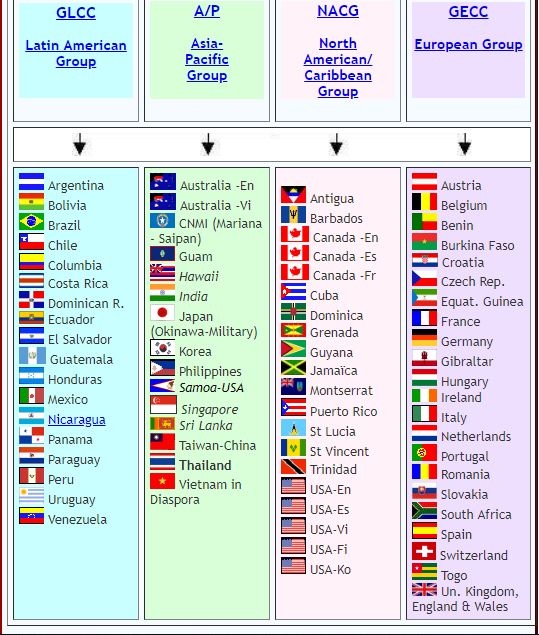
Therefore, I researched the program at her urging. It has taken me three months to gather enough information to write a comprehensive review. Since publishing part 1 & part 2, many readers have contacted me to tell me they either went through the program and were upset by it, or they know someone who is involved and are saddened by their involvement. Cursillo is bigger than I knew. See photos:

global cursillo
This screen grab shows all the countries Cursillo programs are in

From Wikipedia: Today, Cursillo is a worldwide movement with centers in nearly all South and Central American countries, the United States, Canada, Mexico, Puerto Rico, Great Britain, Ireland, France, Spain, Portugal, Italy, Germany, Austria, Australia, New Zealand Aotearoa, Japan, Korea, Taiwan, the Philippines, Sri Lanka and in several African countries. The movement is recognized by the Holy See as member of the International Catholic Organizations of the Pontifical Council for the Laity in Rome.

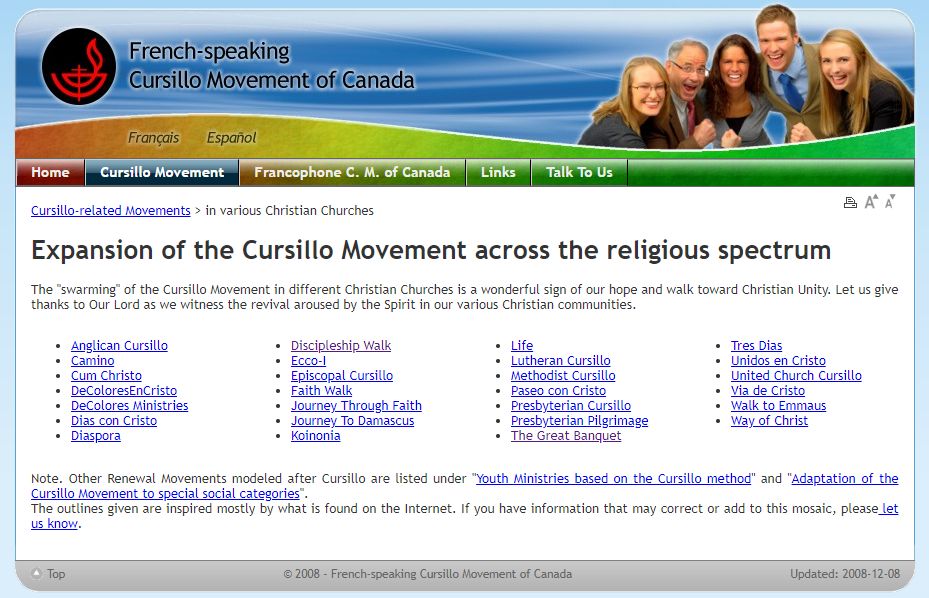
cursillo list.jpg
This screen grab is a listing of all the different titles of the various
Cursillo programs. Some are denomination-specific, others are non-denom

Two authors that I know of have written an objective review of the movement. One is Marcene Marcoux, who wrote her thesis on it, “Cursillo, Anatomy of a Movement: The Experience of Spiritual Renewal” (1982). Another is Brian V. Janssen whose 2009 book is called “Cursillo: Little Courses in Catharsis”. Both of these are available at Amazon and elsewhere.

Marcoux writes,

Clearly, Thursday is structured to effect a disorientation of the candidates, that is, to plunge them into a shocking state of self-awakening. The individuals must handle this shock in isolation since they are prohibited from speaking with other candidates and must maintain silence. They are segregated from others and left without any supportive group to share their frustrations and anxieties. Candidates listen to words that may upset them and that are designed to do exactly this. The images and examples are purposefully selected to instil aloneness and helplessness…

All of the techniques and methods are hurled, if you will, toward the candidates to disturb their sense of themselves and to instigate a process of transformation. The years of planning and perfecting by the early team in Mallorca, and all that has been learned in the years of expansion, have shaped a powerful methodology that assails the candidates from many directions. Nudged, disturbed, worried, upset, the candidates wrestle with questions planned to affect them: to shock, to startle them…

The cursillo is not a superficial gathering haphazardly established, but a well-structured method with a significant history and regional, national, and international structures continually shaping its process. It is this phenomenon the candidates confront, with all its momentum and the force of its potential impact. …those who approach their religion from a more rational perspective may be taken aback by the emotional level of the cursillo, considering its methods too demonstrative and reminiscent of Protestant revival meetings.

The First Person reviews below support Marcoux’s observation. These reviewers note the lack of Bible use, the canned aspect of the lectures, and the physical disorientation via lack of sleep/solitude/meals/heat/rest room, etc.

FIRST PERSON REVIEW
This commenter was a 73 year old female at the time of her participation. She attended Discipleship Walk, non-denominational Cursillo. She also found a leader’s manual at a library and read it. She related,

She could tell something was wrong the first night, the next morning for sure something was wrong.
You sit at the same table each time. Monitors at each table checking you out even in your room.
She was not allowed to turn the heat on in her room.
She was not allowed a nap.  Only 5 minutes of free time.
The leaders manual stressed keeping you off balance. It also stressed choosing people under 55 (this candidate was 73).
The manual calls Cursillo a method.  If you break the method at any point, there will not be a conversion at the end of the movement (the weekend). Cursillo is a movement.
The lectures are canned.
She was able to get a thesis from Northwestern University’s library, “An Anatomy of a Movement”, by Professor Marcene Marcoux.
Leaders manual dated 1962. A  librarian found the manual for her. A footnote she recalls “long boring lectures”.
She doesn’t recall ever hearing the Bible quoted. They tell you to bring your Bible, but you just leave it opened on the table.
The monitors are over-bearing.
No time for personal things.
Skimpy meals.

FIRST PERSON REVIEW.
This is a pastor from a Southern Baptist church who went one weekend and his wife went the next. He attended the Methodist Walk to Emmaus.

Little to no scripture used. A lot of sweet stories a lot of singing. Everything is done in secret no explanation to really any reason why everything is done in secret. They take your watch, cell phone and any kind of communication device. You go to gather in groups to different meetings.
It felt like every lesson was kind of like that old book that came out years ago “Chicken Soup for the Soul”.
You know my struggle with my Assurance salvation. I walked away in doubt from the whole entire event. I don’t feel that anything was directly against the Bible. But nothing was directed to me to read my Bible. And in that it’s very dangerous. The entire time was an emotional roller coaster.
The letters from loved ones was touching but I could have done that on my own.

I would not recommend anyone to go. I know you know this but if it’s not grounded in the word of God, I say stay away. It was very edifying for me in my flesh. That is extremely dangerous.

FIRST PERSON
(female, Tres Dias)

Yes, whatever you can to deter people from being involved in this. I attended this is 2007, so I don’t remember everything. But there are certain things that stick out to me. I imagine you will be exploring the theological inaccuracies taught there, which is important but I often reflect on the cult-like principles of it. I believe I was a false convert at the time and yet by God’s grace and a whole bunch of particular circumstances I had already started questioning some of the things taught in the church and their behaviors were alarming.

I’m not sure if you are aware that at these retreats they take your watch so you don’t ever know what time of day it is. They tell you when to get up, go to bed and eat. You are not allowed to talk between moving from one place to another. They choose your roommate for your stay and they choose which table you sit at and who sits with you. No one is told there is a spy at the table who has been to a retreat before, and they are there to take back to the organizers all you say. They reveal this the last day.

This is deception, lying and spying is what communists do to Christians, it should not be a behavior found among each other. I felt very angry about this without understanding what I was angry about.

There is also a session where you are led into a room and seated in a circle on the floor and one fellow goes around the room just looking you in the eye and you are not allowed to look away. No one is allowed to speak. Does all this not sound cultish? I mean where is this found in the Bible? It makes me very upset because I know lots of people still running this that I attended the church with who are nice people, just deceived, like I was.

FIRST PERSON REVIEW.
This person is a female, Methodist, with a MA in Christian Education from Southwestern Seminary. She attended a Walk to Emmaus and wrote about her experience on her blog, which can be found here.

My first impression was that I was being initiated into some weird “Christian” cult (and, I’m not sure that my impression changed until the very end on Saturday). I believe that as Christians we are called to represent Christ with truth and excellence, and I did not see that in the weekend. Don’t get me wrong, the end result was good, but for the most part it was frustrating, annoying, weird, and made me angry. It took me almost the entire Walk to get over all of the things that kept me from spending time with my Father, and it shouldn’t have been that way.

I was turned off at many points during the weekend, and if I hadn’t come into this weekend rooted deeply in my faith and understanding of Christ, I probably would have run screaming. Following a script. Life doesn’t follow a script. Jesus didn’t follow a script. And the original walk to Emmaus with the men and Jesus definitely didn’t follow a script.

Maybe it’s so everyone can have the same experience, but come on, no one ever has the same experience. I felt like I was being read to the entire weekend, and it seemed to suck so much life out of the stories and experiences shared. Christ came to bring us LIFE not a script.

This next review is from a web page called Questioning Cursillo, which I recommend. This excerpt below is from a male participant, who at the time was/is a pastor of a Baptist church and a professor at a Seminary. I recommend you go to the page and read the reviews in their entirety.

FIRST PERSON REVIEW
(Male Baptist pastor/professor.)

Cursillo-based retreats are at best a social experiment in conformity and a distraction from the Christian life, and at worst, for some sensitive individuals, a true potential trauma. They are not a cult in the sense that they do not extract money from participants, seek to control them long-term, or commit serious abuses. But they do use techniques that are psychologically manipulative—techniques quite similar to cult techniques—to produce a supposed experience of God. If God is real, God has no need of such things; they only serve to give faith a bad name as mindless conformity.

1. Cursillo is heavily influenced by Catholic theology. No one denies that the Cursillo movement began as an effort at spiritual renewal within the Catholic Church in Spain. The weekend I attended was sponsored by the _______ Cursillo Council, a Protestant organization. However, on the first evening we recited Catholic liturgy underneath a Crucifix. It was the first time in my life I had ever heard of Veronica. [A Catholic saint].

2. Cursillo is influenced by a charismatic approach to sanctification. Many people involved in the Cursillo movement seem to think that three days at a Cursillo retreat means someone is instantly mature and ready for service. The whole concept is similar to the Charismatic belief in a “second blessing” whereby one becomes instantly sanctified and free from sin.

This is my primary objection to Cursillo. Maturity does not come in three days and it is misleading to teach someone that it does. Instead, maturity comes from a consistent, daily walk with Christ. There are no short-cuts to Christian growth. I do not recommend the Cursillo movement for anyone who is serious about spiritual growth. Doctrinally, the concept has a flawed view of sanctification. Practically, it creates a super-spiritual attitude that is divisive to the local church.
_____________________________________

Conclusion

My own bias is that I’m suspicious of para-church organizations. Sometimes they are quite helpful. But many times they compete with the local church.

Cursillo is at root a Catholic movement in its theology. It is also an ecumenical movement. It deliberately downplays theology in pursuit of unity based on emotion. For example, here is part of a FAQ page from a Walk to Emmaus saying to overlook theology in pursuit of what I personally would consider a false unity. –

Emmaus is for fostering unity in Christ, not for theological debate and arguments about denominations. Emmaus tries to foster appreciation and openness to the different faith-perspectives of the participants. Bring a spirit of Christian tolerance and charity toward others, including members of other denominations. If you cannot affirm your unity with other kinds of Christians, if you tend to define Christianity narrowly and legalistically or are intolerant of those who see things differently, then Emmaus is probably not for you.

One of the things that a different Walk to Emmaus page said, was that doctrine and social issues divide. One issue they say to set aside, that is too divisive, is salvation. Let that sink in.

The issues of doctrine & social issues, can, and have been, divisive within the church. Doctrinal issues have included the method of baptism, gifts of the Spirit, salvation, and eschatology to mention a few. Social issues have included marginalized persons who are homeless or imprisoned, pro-life vs. pro-choice, abortion, caring for the aged, ethnic inclusiveness or exclusiveness, and gender affinity. Clearly, the issue of whether or not the practice of homosexuality is compatible with Christian lifestyle is at controversy in the church today. … In Emmaus, such social issues are transcended and set aside as we affirm one another in our fundamental beliefs …

[underline mine] Source (pdf). And while homosexuality and gender affinity are social issues, they are also issues that directly contradict Imago Dei and everything we read in Genesis 1 and 2. Therefore, I consider them theological, foundational issues.

—————————————-
I contacted the United States founder of the Great Banquet, Jack Pitzer. I had read on the Great Banquet pages that the GB is “Governed by an ecumenical board of directors.” That phrase is repeated on almost all FAQ Great Banquet pages. Curious that though the Board was mentioned frequently, the names or denominations of the Directors were not. I wanted to know which denominations they were from, if there were any women on the board, and if any of those women were pastors or in control of spiritual direction or curriculum. So I contacted Mr Pitzer to ask. I wrote,

Hello,
I would be interested in knowing who is on the Board of Directors of The Great Banquet and what faith background they come from?
Thank you so much!
Elizabeth

Mr Pitzer replied the next day. This was his reply in total:

Who is Elizabeth Prata?

It was not the reply I was expecting.

I sent back an answer. At the time I was sincerely just interested in finding out a bit more about the GB on behalf of my friend. Little did I know that secrecy and stonewalling would spin me out on a three-month odyssey of discovery about Cursillo, which in turn would prompt me to write these essays about the movement. My emailed reply:

I’m a Christian woman in Georgia whose friend was invited to The Great Banquet and I’m just interested in knowing more about it. On the websites I read they said that there is an ecumenical National Board. Several of the sites encouraged interested parties to contact the people in charge FMI. Would you be so kind as to share who is on the Board and which faith backgrounds they come from? Thanks!

Though Mr Pitzer is no doubt a busy man, I did appreciate that he replied.

I wrote the Great Banquet back in 1990. It is a “short course” in Christianity. It is a “cursillo-model” experience. The Board is made up of Presbyterians, Baptist, and Independent Christian. If you want to know about me – get on line and look up Lampstandpc.org. I am the Head Pastor and you can even listen or watch sermons or Bible studies I have done.  Jack Pitzer

I did contact other regional Great Banquet leaders to find out more specific information for my friend who is in the Midwest, (where GB is most popular) asking about who comprises the “ecumenical Board”. One woman who was very kind to answer my questions, said at one point, “We don’t talk about the name of our church or what denomination we are. We are all Christians who believe that Christ Jesus is our Lord and Savior.”

And that is a problem. Mormons, Jehovah’s Witnesses, and Catholics all believe that Jesus is Lord and Savior. Methodists believe that too but rebel against their Lord and Savior by ordaining women. ‘Jesus as Lord’ is not the only benchmark to determine if one should participate in a a 72 hour course in Christianity. For the discerning woman, prior to committing to 72 hours of lectures and a cathartic intimate community experience, I’d want to know who is behind the curriculum and who is guiding the movement’s direction.

For example, The Master’s Seminary’s Institute for Church Leadership (ICL) is organized specifically to train up lay leaders, just as Cursillo is. I can take a similar quantity of credit hours at ICL. If I am deciding whether to invest 72 hours of time at Cursillo (which IS Spanish for “short course”) or take a short course for 60-70 hours at The Master’s Seminary Institute for Church Leadership, I need to make an assessment on which is best to devote my time and/or money. Cursillo’s curriculum and Board of Directors should not be secret.

I looked at other para-church organizations and all of them with the exception of Great Banquet, published the names, photos, and bios of who is on their National Boards. It’s not an unreasonable request to ask of a Christian organization whose forefathers and head of the church were always transparent. (John 18:20; Mt 26:55; John 7:26). Can you imagine Paul being cagey about the names and spiritual biographies of the 7 chosen deacons? (Acts 6:1-6). “Uh, they’re just men from around. Why do you want to know? Who are you, anyway?”

I did get the sense that the people involved in these Cursillos are sincere about helping people become more service-oriented and grow closer to Christ. In my opinion, though, the emotionalism and manipulation is not necessary in a Christian movement.

I leave you with this,
If a “method” can be so readily applied across the world’s different cultures and in so many different denominations, with strikingly similar results, even to the moment, is it of the Spirit? Is the Holy Spirit cookie cutter? Does the Holy Spirit need man’s methods to grow saints in discipleship and service? If one’s service is based on emotionalism and catharsis, what happens when the mood dissipates?

Women should base their service on knowing who Christ is from the Bible. Our emotions we feel about Him and serving others stem from our mind, that is, knowing who He is from His word. He is the rock that never dissipates.

Further resources:

Blog review:Should Baptists Participate in a ‘Walk to Emmaus?’ By Mike McGuire, a SBC pastor

Book: Marcene Marcoux, “Cursillo, Anatomy of a Movement: The Experience of Spiritual Renewal” (1982).

Book: Brian V. Janssen “Cursillo: Little Courses in Catharsis”. (2009)

Thesis: Doug Hucke: The Great Banquet Retreat as a Strategy to Transform Northminster Presbyterian Church (2008)

Episcopal Clergy Talk letter (pdf)

Blog: THE CURSILLO MOVEMENT IN AMERICAAn Interview with Kristy Nabhan-Warren

Short video- this is good.

—————————

The Cursillo method is used by:
ACTS,
Encounter,
Antioch,
Awakening (college students),
Cum Christo,
DeColores (adult ecumenical),
The Great Banquet,
Happening,
The Journey (United Church of Christ),
Kairos Prison Ministry,
Kairos (for older teenagers),
Emmaus in Connecticut (for high school age teens),
Gennesaret (for those living with a serious illness),
Koinonia,
Lamplighter Ministries,
Light of Love,
LOGOS (Love Of God, Others, and Self) (Lutheran teen),
Teens Encounter Christ (teen ecumenical),
Residents Encounter Christ (REC) (a jail/prison ministry),
Tres Dias,
Unidos en Cristo,
Via de Cristo (Lutheran Adult),
Chrysalis Flight (Methodist Youth),
Walk to Emmaus (Methodist Adult),
The Walk with Christ (interdenominational),
Anglican 4th Day (Anglican Adult),
The Way of Christ (Canadian Lutheran adult),
Tres Arroyos (Charismatic Episcopal Church)
Journey to Damascus (Catholic hosted Ecumenical with weekly reunion groups for alumni) in The Corpus Christi, Houston, and Austin, TX areas. Source-Wikipedia


Posted in theology, word of the week

Sunday Word of the Week: Fruit of the Spirit, Joy

By Elizabeth Prata

On Sundays I usually post a theological word with its definition, then an explanation, and use it in a verse. I also use a picture to represent the concept. This is my effort to maintain a theological literacy among the brethren and between generations, something I believe is critical. We have to know what we believe, why, and know the words to express it. Words like Justification, Immanence, and Perspicuity have all been a Sunday Word of the Week.

8341e-word2bcloud

Similarly, when we discuss other words such as love, peace, and joy, we think we know what they mean, but often times these culturally embedded words have a totally different flavor when used from a biblical context. It is true of the words pertaining to the Fruit of the Spirit. Even these ‘simpler’ biblical words are misunderstood.

Therefore, over the next 9 weeks the Word of the Week will be one of the 9 Fruit of the Spirit.

Joy


The following is from the systematic theology book Biblical Doctrine, by John MacArthur and Richard Mayhue, eds.

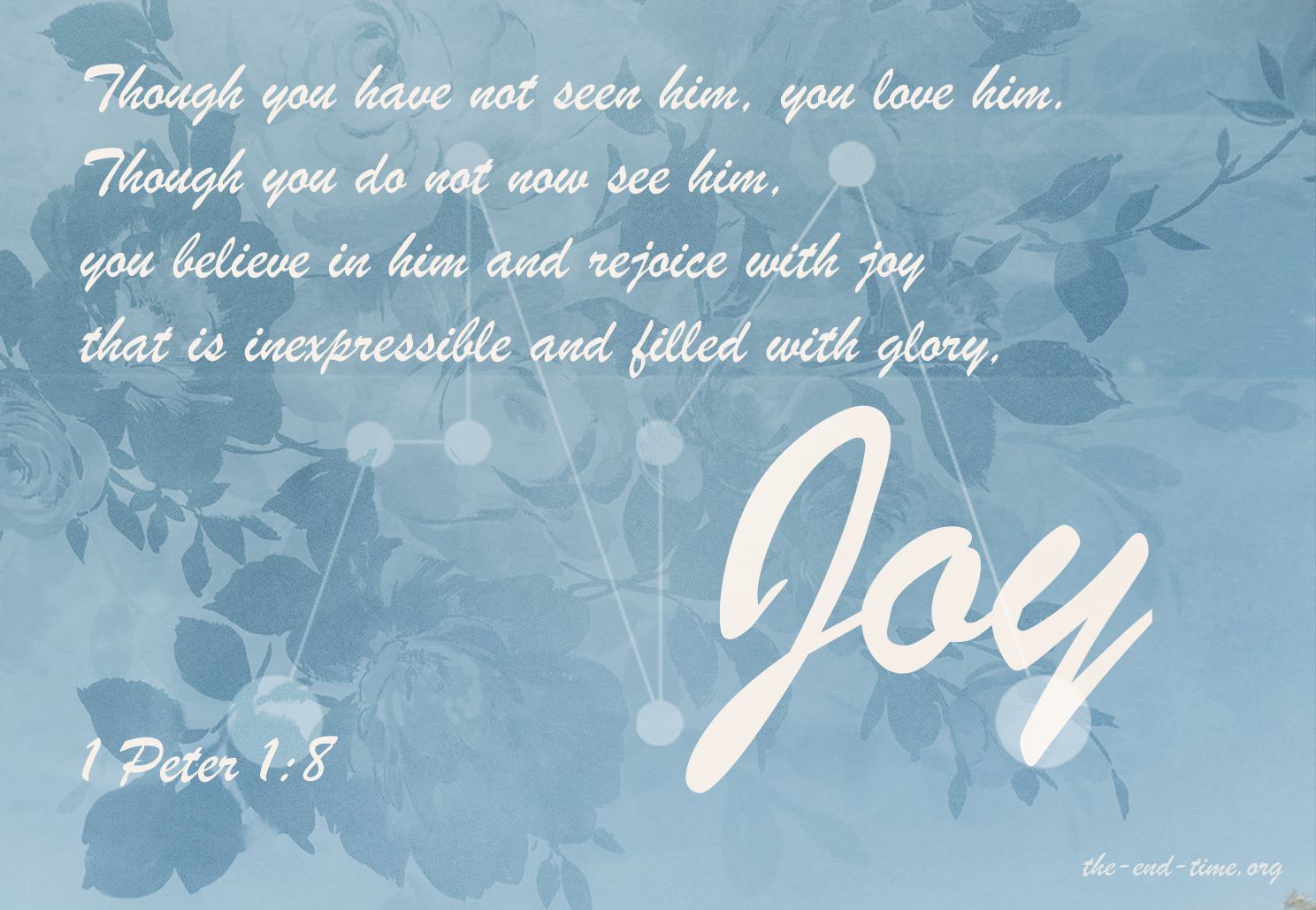
Joy is a happiness based on unchanging divine promises and eternal spiritual realities. It is a sense of well-being expressed by one who knows that all is well between oneself and the Lord. (1 Peter 1:8). Joy is not the result of favorable circumstances but occurs even when those circumstances are the most painful and severe. (John 16:20-22; 1 Thessalonians 1:6). Joy is a gift from God, and as such, believers are not to manufacture it but to delight in the blessings they already possess. (Philippians 4:4).

Produced by the Holy Spirit, (Romans 14:17), joy is appropriate both in the good times (3 John 4) and in the times of testing (James 1:2-4). Joy is a deep, abiding inner thankfulness to God for His goodness that is not diminished or interrupted when less-than-desirable circumstances intrude on one’s life.

joy verse

Posted in theology

What happens at The Great Banquet/Walk to Emmaus/Tres Dias etc weekend? Part 2

By Elizabeth Prata

ae827-cursillo1
This is part 2 of a 3-part series. Part 1 here. Part 3 here.

Introduction

Please forgive the length. I researched scrupulously and collected a good amount of original source material. I put it together in a way I have not seen widely on the internet, barring one or two books for purchase one might buy. Though a plethora of positive reviews abound, any concerns regarding the Cursillo movement are not as readily available. My goal is to present enough information so that people who are aware of or who have been invited to one of these events can assess the invitation by the information gathered here or going to one of the links provided. It is intended to be a resource for discerning persons making decisions about Cursillo weekends in all its forms.

From this statement, one might surmise that my assessment of the movement is largely negative. This saddens me, because of course one would like to see movements tied to the Bible, founded on teaching grace, and working to revive the saint. This, the Cursillo movement claims to do, but unfortunately its methods are dubious and its ties to the Word shaky. I also have a bias against any para-church movement that draws congregants away from their home church in time, attention, or energy.

The emotional high it produces in participants does not last, and the let-down for some is not only unhelpful, but harmful. For those whose positivity toward the movement say it is personally fulfilling and life-altering, it creates a seed pocket of believers whose loyalties are divided between the movement and their own church. Some even say it creates more of a loyalty to the movement than it does to Christ.

Recap

In Part 1 I looked at what The Great Banquet/Walk to Emmaus/Tres Dias AKA Cursillo actually is. I examined its theology from Cursillo press releases and from online published scripts of talks given at the three day immersive event.

The weekend is touted as a time for ‘pilgrims’ (who have been observed, selected by a ‘sponsor’, vetted, and accepted into the program) to renew their spiritual fervor, re-orient their priorities, and to focus on a life of Christian service. It is a para-church ecumenical program that continues beyond the weekend by pressuring the participants to gather even more attendees, and to work future weekends away from their own church.

I noted that the theology of the weekend is structured by successive talks given by trained Cursillo lay-people and clergy. Some of these clergy may be female. Each talk builds upon another, and the overarching theme is grace.

I’d noted theological concerns with the Cursillo notion of prevenient grace, heavy Arminianism, strong emphasis on God’s love to the exclusion of wrath, watered down/one size fits all theology, ecumenism, the direction for leaders to refrain from mentioning God, Christ, Salvation or other theological words in the first talk because that ‘sets the tone’ (and organizers want the tone to be ‘light and humorous’), separation of husbands from wives, and Cursillo’s Catholic roots which haven’t been adjusted for Protestant believers to any observable degree. Here is one example of the script to leaders to downplay scripture and focus on personal experience:

Rather than talking about God’s mercy, share how you have experienced God’s mercy and love.

I’d said that while catalyzing attendees for service is a good thing, the program could and does have latent negative impacts on the ‘pilgrim’, something I’ll explore more deeply in part 3.

The Purpose of the Movement

How it works is, a sponsor is urged to select a candidate for participation in the program. It aims to be a multiplying program. Once a Cursillo participant has observed their candidate and leaders OK their invite, candidates are formally invited to the Walk/Banquet/Three Days etc. The candidate must then apply and be accepted.
This is because the program is recruiting for specific kind of people. Cursillo is not transparently offering a helpful revival weekend to just anyone. So, who are they looking for?

Not anyone can join
(Only those deemed leadership material)

Unlike normal Christianity, the movement is selective as to who gets in. The ultimate goal is-

1) locating the people who are the “backbone” of various “environments,”
2) “converting” them into leaders during the Cursillo weekend, and
3) turning them back to evangelize their environments, all the while connecting them and supporting them through continued Cursillo group reunions and ultreya meetings. These three phases are called respectively the Precursillo, the Cursillo and the Postcursillo. Source here and here.

The seed-leavening of environments with the Gospel, which is the public purpose of the Cursillo Movement, is sought not by means of a direct and global action on all Christians as the Spirit does, nor by various churches supporting one another’s efforts in local environs as pastoral leaders do, but by choosing from among them those who have the required characteristics according to Cursillo, and giving promise of being the living vertebrae (as backbone of the faith) that animate communities. [underline mine]. (Source here).

Not everyone should be invited to attend a Cursillo weekend. Those sought out are “the vertebrae of their environment,” those with “deep personality,” who exhibit the potential for “effectiveness: The effectiveness [they] will have as… vertebrae in Christianity.” Eduardo Bonnín, Bernardo Vadell, and Francisco Forteza, Structure of Ideas:[Vertebration], 14-15.

Of course this selection process raises serious questions. What place do these “backbone” people have in their local churches once they are “converted” through Cursillo? Is their primary loyalty to their Cursillo community or the church? And how can they be expected to submit to their church leadership who may be perceived as “non-backbone” pastors or elders if these have not “made Cursillo”? (Source)

Far be it for people to wait for the Holy Spirit to direct them as which part of the Body they will become. Cursillo wants and seeks people specifically to be the spine, seeing that as a superior position for them to grow future leaders for various churches, regardless of denomination.

However, the Bible says we are to submit to our own pastors, whose task it is to raise up leaders for their own ‘environments’ AKA local congregations. (Hebrews 13:17;  1 Thessalonians 5:12; Hebrews 13:7; 2 Timothy 2:2). Paul did not round up leadership candidates from Galicia to train secretly as super-Christians and sent them back seeded into their own congregations with continued associations and accountability to the para-church super-group. Sometimes he left behind a leader to continue his work in the nascent church, as he did with Titus on Crete. But he didn’t cherry-pick ripe candidates from other churches for his own ecumenical purposes with ongoing extra-congregational training and growing loyalty.

What Occurs on a Cursillo Weekend?

As candidates AKA pilgrims arrive for their weekend, the Leaders have been preparing. The entire program is highly scripted. Leaders are told how to walk, where and how to sit, when to make eye contact, and what to say. One example is as the candidates are walking in to the main room for the first time, leaders are told in the “Minute By Minute” schedule,

Position yourself BEHIND the pilgrims closest to the doors. LD will direct pilgrims.

Lean forward in your chair and make eye contact during the discussion … You will sit with your back to the speaker at all times.

WAIT ABOUT 5-10 minutes – Then speak: 1st and I will now model the introductions.
The candidate partners begin. The rest of the Saints table introduces each other as their “NEW BEST FRIEND”.

If the weekend is highly scripted for leaders, it is even more so for participants. They are even told what to do on their break, as in this example of when to brush their teeth or go to the bathroom.

Now you may have a short break (measure time with finger and thumb –15 min.) You will have time to return to your cabin to brush your teeth and use the restroom if you wish.

Ladies, we will now go for a group photo outside the Conference room. After the photo session, we will have a break this long (15 minutes) before we meet again in the Conference room. During your break you may go to the restroom and enjoy food from the snack table. Please stay in this area, do not go to your cabins.

 As Tables finish poster, they may take a short potty break; if time permits. [underline mine] Source: Minute By Minute

Scripted Manipulation

During the 72 hours participants are highly controlled. For example, pilgrims are not allowed to drive to the venue, they are driven there by their sponsor, who leave on Thursday night after ceremonies. If you are a wife, your husband is not present. He participated the previous weekend. Candidates must not bring watches or time pieces or hand them over if they do, they must give over cell phones and other electronic devices, and even hand in their medications! One set of instructions given to the pilgrims says,

If you are taking any medication at a particular time, please give the containers in a Ziploc bag (marked with your name and when you need to take your meds) to a team member. The team will make sure you receive your medication at the appropriate time.

I know of no other mainstream religious program or retreat where such an amount of personal autonomy is required to be suspended. As we read on, we see there is even further control over the participants. This is a concern.

Because the entire weekend is scripted to the minute, participants are told at the outset to discontinue rational and critical thinking, which ends up easier to do when one is hustled to and fro for 18 hours at a stretch. To that end, during the main part of the weekend, participants are not allowed alone time to think or process or even discuss it until the very end, outside of the close monitoring of leaders. Here is part of the script for the Walk to Emmaus (and remember, the scripts are largely the same for Great Banquet, Tres Dias, etc):

*Never leave a pilgrim at the Table alone. During breaks, if a pilgrim stays, then the TL [Table Leader] or ATL [Assistant Table Leader] needs to stay with her.

In the morning, check for stragglers, count to make certain all present. (check rest rooms too)

Stand at Chapel door – count as they come in. Alert LD when all are present and accounted for.

Participants are hustled from one scene to the next and are directly told not to think as seen here, except the words prejudge, worry, and anticipate are used instead of ‘think,’

Please don’t PREJUDGE or ANTICIPATE during the next three days. Let’s simply do what is asked of us at the time it is asked. Let’s not worry about the next day, or the next hour, or even the next minute. Instead, let’s live in the moment… I believe you’ll find The Walk to Emmaus a moving experience. Don’t anticipate what the next part will be. Don’t judge Emmaus based only on part of the experience.

I would have an issue with submitting uncritically to anyone, let alone unknown leaders I’ve just met. Paul urges all of us to be Bereans, (Acts 17:11), not to join blindly in ecumenical immersion weekends with unknown curriculum, nor to follow unthinkingly along.

The weekend is purposely disorienting. This is because organizers want pilgrims to experience an intense time of emotional breaking down and building up. That is the point. Leaders are urged to follow the schedule scrupulously to the minute and not to allow anyone to get off track. The talks are broken up by times of entertainment, skits, songs, and there is even a scripted “joke time” in the program. Leaders continually ply the participants with small love gifts all weekend. This is to soften the pilgrim. “Agape Letters” are given out. These are pre-written letters collected from friends and family, unknown to the participant, and given to them as a surprise at pointedly emotional moments in order to heighten the emotional breakdown and catharsis.

The apex of the catharsis occurs at the “Dying Moments” part of the weekend, which is near the end. Dying Moments has sometimes been renamed Candlelight or Conclusion. Participants are told to think of a particular sin that needs forgiveness, and to confess it aloud.

How are the Dying Moments and Holy Communion Service carried out? The Weekend Spiritual Director explains and personally illustrates dying moments in a Communion meditation and invites the pilgrims to get in touch with a part of their lives that needs to die or be released in order to make space for new life … the Weekend Spiritual Director invites the pilgrims to break off a piece of bread as a sign of their own brokenness as they name aloud their dying moment…Just as Jesus used the broken bread to represent his broken body, the pilgrims are invited to break a piece from a loaf of bread and to name some aspect of their own brokenness giving our brokenness to God in the presence of others. Sharing aloud in the sanctity of the cloistered environment is another step in the process of building community. Source

The intent of the weekend is to create an emotional bond with pilgrims among so-called ‘Cursillistas’. The leaders desire to show the pilgrim a deep love that God has for us (but not the love we should have for Him). They show this love via experience, not by the Bible.

Is it a Cult?

The Cursillo movement in all its forms (Tres Dias, Walk to Emmaus, Great Banquet, etc) have been charged with cult-like behavior from various quarters. From my observation of the source documents and the experiences of participants, this is true.

Brian V. Janssen has written a book examining the movement. He said of its manipulative techniques,

[T]he Cursillo method employs such powerful psychological elements so skillfully that God is practically unnecessary. Cursillo: Little Courses in Catharsis

Janssen’s book proposes the theory that the weekend was designed specifically according to psychological techniques to produce a strong cathartic effect at the end. I’ve read several leaders’ manuals, and those techniques include lack of solitude, lack of sleep, constant stimuli, emotional pressure, secretive techniques such as ‘spies’ at the table (unrevealed staff members who report to leaders), disruption of normal physical habits (rest room, eating, talking, etc). For example, one participant said that after arriving and while unpacking in her cabin, she was instructed not to speak to her roommate, a woman unknown to her. They unpacked in uncomfortable silence until the other woman said she hoped the participant didn’t mind being awakened at 6:30 due to her having to take medication. Both women breathed a sigh of relief but both also felt that they had ‘broken the rules.’

As one past attendee online stated, the main techniques cults use are absent, for example, asking for money, long-term control, or serious abuses. At present, the movement is not a cult. It does use cult techniques though.

What Do Past Attendees Say?

In part 3 there will be first person excerpts of stories from people who have attended Cursillo weekends. They speak to the cult-like techniques.

Though many people report glowing experiences, life-altering or shattering in its depth, the purposeful off-balance nature of the program, its heavy manipulation, the secrecy and indoctrination, contribute to the negative air many other pilgrims feel as the weekend concludes. I’m speaking for them.

As I have read in many Cursillo websites and newsletters, leaders report a fading of the experience, which they expect, but with that comes a dearth of attendance at reunion meetings. The reunions are supposed to revive that initial spark and keep the experience going, and also is designed ‘keep them accountable.’ But remember, we submit to our own pastors for accountability, not para-church retreat leaders or people outside our own church membership. Otherwise, any random person could claim accountability over us, to whom by definition we’d have to submit. Accountability is what church membership is for- to clearly delineate member responsibilities, and to whom, according to the Bible.

Christianity does not need these manipulative techniques to produce sanctification. The Holy Spirit guides each person into long-term growth. Christianity does not need secrecy to force a catharsis. Doctrine according to the Holy Word does that.

Part 3 will look at first person experiences, conclude with warnings, and offer further resources.

Posted in discernment, theology

Are you invited to The Great Banquet? (Not the one hosted by Jesus, another one). If so, read this

By Elizabeth Prata

This is part 1 of a 3-part series. I’ll look in this part at the theology behind The Great Banquet/Tres Dias/Walk to Emmaus retreats (all parallel movements under the same origin, Cursillo, a Roman Catholic three-day course).

In part 2 I look at the experience participants undergo in front of the scenes and the work behind the scenes to make it happen.
In Part 3 I’ll share comments from people who have attended.

You might have heard talk of people having been exclusively invited to attend a three-day retreat called Walk to Emmaus or The Great Banquet. You might have heard that these folks later attend weekly/monthly ‘reunion meetings’. You might notice the youth of your church going to something called Chrysalis or Awakening. What are these events? What do they do there?

It’s hard to discover, because the events seem shrouded in secrecy. One must be invited by a “sponsor.” Invitees are carefully pre-vetted. Afterward, if the “candidate” wants to take up the sponsor’s offer, they must apply. If accepted, the so-called “pilgrim” must in like turn be told not to let out the secrets after attending. Past participants decline to speak of exactly what goes on, they are especially told not to reveal about the Agape letters and the Dying Moments (now called Candlelight), maintaining they don’t want to spoil the “surprise.”

Yet the popularity of these events is growing massively. There is now a youth version of The Great Banquet called Awakening, and a youth version of the Walk to Emmaus called Chrysalis. There is a prison version called Kairos.

So what IS The Great Banquet? (Or its parallel event Walk to Emmaus?).

The Great Banquet (And Walk to Emmaus) is a 72-hour, [immersion] experience (usually Thursday evening to Sunday evening) that focuses on one’s relationship with God and with others, and training attendees to become effective Christian leaders. The three days include fifteen structured talks, given by both clergy and lay people. The talks are outlined and presented in a specific order for teaching attendees about grace and priorities. The talks are based in scripture and are peppered with personal experiences of the individual speaker.

There are some good intentions about the movement. The thrust is to arouse in the Christian a fervor to love others and be diligent in service to others. The organizers say that The Walk to Emmaus weekend is to “remember that the whole intent of The Walk to Emmaus movement is to develop church leadership and strengthen the witness of the Christian community in word and deed.”

On the surface this sounds great. Digging deeper reveals issues that impact the local church and the congregant, mainly negatively.

But first, what about the theology of the program?

The 3 days is broken down into 5 talks each day given by members of the Banquet/Emmaus team. Some talks are delivered by lay-persons and others given by clergy. Here is a link to the 15 talks with the scripts and advice for speakers. It is a list of talks for Walk To Emmaus organized by Cross Point Church in OK. It should be noted that this church has female pastors, some of whom serve at the Weekend event in their capacity as “pastor”.

The Great Banquet and Walk to Emmaus (and Tres Dias etc) are fairly interchangeable. In some cases I say Great Banquet (which was founded by a former Emmaus leader Jack Pitzer) and other times I refer to the Walk to Emmaus. I’ve excerpted the portions of the talks I desire readers to see most, and I’ve added my comment after. All the talks are listed below in the .jpg

First day talks
1. Priority

In discussing priorities, avoid mentioning God, Christ, salvation, or the usual theological words. This is because the talk should not even imply what the participants’ priorities ought to be. … The talk should be reasonable, speaking to the common sense and experience of the participants. A helpful way to illustrate the points of the talk may be a story, anecdote, or personal experience.

Setting a priority without mentioning Jesus or God is very sad. It is sad that at the outset, the first talk which leaders are told “will set the tone for the day,” trains speakers NOT to mention the most important Person in the universe.

The talk continued with presenting the false notion that we have ability in human power to set priorities and carry them out above and beyond our sin nature (sin is not mentioned in this first talk. Leaders are expressly told to keep it light and humorous.) For example, it is stated,

We have the capacity to rise above mere instinctual responses…we are not created to be slaves to the forces of nature and instinct.

True that we were not originally created to be slaves to our nature, but we fell. Every person born after Adam and Eve is a slave to sin, helpless and hopelessly enslaved to our base instincts. We need the salvation of Christ and the power of the Holy Spirit to overcome our nature and our instincts. It presents the notion that we have strength and power on our own to do service that’s pleasing to God. We don’t. This first talk sets the tone for the me-nature of the weekend.

The next talks focus a lot on grace. What can possibly be the matter with that, you ask. Well, there’s grace of the Bible and the grace not of the Bible. Grace not of the Bible is what is taught at these weekends, and it’s called prevenient grace.

2. Prevenient Grace
“Prevenient grace serves as the foundation of all other grace talks…”
“Prevenient grace is the courtship period of our relationship with God, God woos us into this relationship of grace.”
“Prevenient grace works through the Holy Spirit courting us, not forcing us.”

I think Saul/Paul would beg to differ about being forced into conversion. His conversion was definitely not “wooing”. Jesus said that Peter did not choose Jesus because it was not his flesh and blood that chose Him but the Father who revealed Jesus as Messiah. (Mt 16:17). Flesh and blood nor the will of man decides for God. (John 1:13).

The thrust of this talk, and thus all other talks since this one is the foundational talk, is Arminian. Adam and Eve, they say, made “wrong choices” in the Garden that separated them from God. What Walk To Emmaus and Great Banquet call a ‘wrong choice’, RC Sproul called “cosmic treason.” Big difference.

They say God is at work in our lives through grace before conversion.

Ligonier explains prevenient grace and its main error: that grace is not cooperative.

Arminius and Wesley understood the necessity of grace for salvation, but they wanted to preserve our ability to accept or reject saving grace. Thus, based on passages such as Titus 2:11, they proposed what is called “prevenient grace,” a grace given to all people that frees us enough from our bondage to sin that we have the ability to choose Christ but that does not finally persuade us to make that choice or guarantee that we will be saved. (Many Roman Catholics speak of God’s prevenient grace in a similar way.) This view has the advantage of stating that no one can be saved without grace or even God’s initiative in freeing our wills just enough to choose Him. The problem is that the doctrine of prevenient grace ends up creating a kind of de facto semi-Pelagianism. If prevenient grace is indiscriminate and merely restores our ability to choose, then it is hard to see how salvation is truly all of grace.

Here are a couple of other concerning scripts for leaders that I had an issue with-

3. Priesthood of All Believers
“The word priesthood may bring negative associations to some Protestant minds. However, when properly understood, “the priesthood of all believers” expresses the core of the Protestant Reformation and has been reaffirmed among Roman Catholics through the action of Vatican II.”

Using Vatican II as an affirmation for acceptable Protestant definitions is not reassuring.

3rd day talks
11. Changing Our World
“Changing our world begins with changing ourselves and sustaining that change in our heart (piety), mind (study), and will (action).”

It is true that we participate with the Spirit in being diligent to mortify sin and pursue holiness. However this aspect is not brought up in the talks, at least according to the script I had read. We don’t “change ourselves”.

As any Christian would like to do before committing to three-day immersion experience, one would want to know what is taught. I searched for many days and weeks in collecting background for this essay before finally finding the scripts for each talk at the Cross Point Church site. The average person won’t know the substance of the talks until he hears it live from the lay and clergy leaders during the weekend.

Question/Concern #1: Is it wise to submit to teaching by unknown people on unknown topics? No. Jesus said,

Jesus answered him, “I have spoken openly to the world. I have always taught in synagogues and in the temple, where all Jews come together. I have said nothing in secret. (John 18:20).

Moreover, the weekend is gender specific. Men attend on one weekend, their wives or other women the next weekend. I have never been a fan of separation. The Passion conferences separate youths from their parents, who are forbidden to attend unless he is the youth pastor. He is the only adult allowed to accompany the youths.

I do not see that exclusion attitude modeled in the New Testament. Women and men, husbands and wives attended the sermons, dinners, and events Jesus was involved in (with the exception of the few times Jesus drew aside His apostles to explain a parable or ascend the Mountain for Transfiguration).

For the same reason it is not wise to separate youths from the parents and pour into them an intense theological and emotional experience. Women are vulnerable theologically (1 Peter 3:7) and should not be forced to spend 72 hours of intense theological training by unknown leaders in an unknown curriculum without their husbands present. For that reason alone, husbands should say no to their wives participating.

The Methodists adopted the Catholic’s Cursillo retreat model and called it Walk to Emmaus. The Presbyterians adopted it and called it The Great Banquet. Other denominations followed suit, including Lutherans, Reformed, Pentecostals, etc. How has the theology been adapted from Catholicism and re-formed for Lutherans/Methodists/Dutch reformed/Episcopal/Presbyterians/Pentecostals, the denominations using the model at present? Doesn’t that seem one-size-fits-all?

Brian V. Janssen wrote in his book examining the movement that-

It is evident that Cursillo is not really about theology from the fact that the method is so readily adaptable to very divergent theological perspectives: Roman Catholicism, Lutheranism (Via de Christo), Methodism, (Walk to Emmaus), Anglicanism (Episcopal Cursillo), Presbyterianism (Presbyterian Cursillo and [Great Banquet], Pentecostalism, (Tres Dias), and Dutch Reformed (Reformed Cursillo). Janssen, “Cursillo: Little Courses in Catharsis

See chart. This chart compares the original Catholic talks with the Methodist talks, which has been relayed into all the other Protestant talks almost intact.

cursillo

Question/Concern #2: Can one participate in an immersion weekend and emerge unaffected by an all-purpose or watered down theology? A theology born of Catholicism no less?

No, one cannot. Jesus said in Matthew 7:14 that –

For the gate is small and the way is narrow that leads to life, and there are few who find it.

The gate is narrow and the way after that is narrow. The way doesn’t broaden as it sheds unwanted theologies or waters them down to accommodate more and more people. It remains narrow. Ecumenism is deadly. There is one Gospel, as Galatians 1:6-8 reminds us. We have seen above that the theology is downplayed, and what theology there is, is riddled with Roman Catholic error (prevenient grace, etc) or other error (Arminianism, downplaying sin/our sin nature, calling it “wrong choices”…excessive focus on love and none on wrath…emphasis on service in our own strength).

So if the theology isn’t the point, what is the weekend about? It’s about the experience, the feelings, and the catharsis.

More on that in part 2. I’ll go into specifics about what happens minute by minute at a Walk to Emmaus or The Great Banquet weekend. Stay tuned.


Posted in theology

Why can’t they see she’s a false teacher? One reason: “Deception by investment”

By Elizabeth Prata

This first appeared on The End Time in July 2011.

We are told that in the last days, deceivers will come. They will carry false doctrines, false teachings, and they will want to follow their own lusts instead of sound doctrine. This web page has a list of all the verses in the bible that speak to false doctrine. This web page lists all the warnings about false prophets (which are teachers, too).

In some cases, it is easy to tell who is false. Todd Bentley down in Lakeland FL was easy to spot as false for Christians – but he still deceived a great many.

Other false teachers we’re warned about, like in 2 Timothy 3:5, have a form of godliness but deny its power… those teachers are harder to spot.

Even as babes in the faith, still on milk, the Word is so transparent and so sure that relying on it brings clarity as to whether a teacher is teaching falsely. (Hebrews 5:12; 1 Cor 3:2).

But because we ARE flesh, it gets tangled in everything. We can’t separate the flesh from who we are but continual submission and obedience regenerates us and we grow in His Christlikeness. Excising the flesh where it has fallen prey to sin or where lies are embedded within is sometimes a violently difficult process. This includes recognizing of a favorite teacher is false and going away from him or her.

Sometimes someone will come up to you and say “So and so may be a false teacher bringing false doctrines.” You get angry, because you like that teacher. The first reaction will always be fleshly. Translation: emotional. People’s reactions will range from peeved to furious. When my friend and I were talking about false teachers and she asked me about Joyce Meyer, I said I believed Mrs. Meyer teaches a different gospel and therefore is false. She agreed. She wasn’t angry because she had already come to the same conclusion I had and therefore no anger flared up. But when I said I had concerns about Beth Moore, she got ticked because she had not come to that conclusion. Challenging Beth Moore as a teacher was also challenging my friend as a student. That anger arises because of something called “deception by investment”.

Deception by investment as defined by Glenn Chatfield is here, “When one learns their favorite teacher is a false teacher, they continue with the deception because they’ve invested so much of their life in them. They’d rather continue in deception than admit they were deceived.” And the term is used again, here at his blog The Watchman’s Bagpipes.

When we invest time, energy, even money in a teacher or a ministry and then some bubbling reservations or charges are raised, our fleshly response is to dismiss them out of hand. But that’s exactly when the lie firms its grip. It is simply pride that won’t let go. This is why, I suspect, when many of you ladies report that you brought a concern about a female teacher to your Ladies Leader, she became angry. This happens a lot. Pride won’t allow some Ministry Leaders to accept that they have made a grave error and publicly humble themselves in apology and explanation. Rather than listen to the concerns, they are so invested in their false teacher that they continue in the deception and get angry at you.

Look at the situation as a morning glory. It’s so pretty! But its delicacy is deceptive. It actually has a hard grip and won’t let go.

I had a morning glory on the left side of my door for about a year. Boy, that thing grew fast! It soon wound around the wrought iron plant stand and up over the awning. The flowers looked so pretty in the morning when they bloomed! But then my landlord said that he had to excavate that area and was going to pave it over. I had to get rid of the wrought iron stand and the flowers.

I’d never dealt with morning glory flowers before. I was amazed at how firmly they were wound in! I thought I could just pull them down but no way. I thought I could just use a knife to cut them away but nope, that didn’t work either. I had to use scissors and personally excise each strand. It took hours. Each vine was stronger than it looked.

A year later, on the right side of my door, I spotted some more morning glories! Look at the bottom of the photo below. I really can’t tell where the root is, or which stalk is the main one. Just suddenly one day there was a clump.

In the photo below, we can see how tightly wound the vine is to the thing which it claims, in this case, an old cable wire.

Left unattended, there will be shoots sprouting off to go in other directions to claim other things to cling to.

This how false teaching is. It emerges from whence you least expect. You’re surprised by it. Its root or origin is often difficult to determine. If left unattended, it winds among your flesh tighter and tighter. It gets harder and harder to excise.

Here is my practical advice when hearing a charge of false teaching, either about yourself, or about another favored teachers you’ve invested in: be ready for the flesh to rebel. It will flare up like a match.

But if you wait, what happens to a match? It burns out quickly. Let the emotions about the charge of false teaching leveled on your favorite teacher dissipate. If you don’t allow them to lead you, they will dissipate. Then begin the work the Holy Spirit wants to guide you into. He will either confirm or deny the charge, but allowing yourself to let the anger drive you means you are allowing the morning glory vine a tighter grip.

Be careful out there, brethren. Don’t let the morning glory vine choke off truth through its fleshly grip but instead, let His pure glory lead you into truth. Even if you have to cut off your hand to do it.