Posted in discernment, theology

An Open Letter To Beth Moore

Dear Mrs. Moore,

Hello – we hope this finds you doing well.

We as female Bible teachers ourselves write this letter to you in hopes of receiving clarification of your views on an important issue: homosexuality.

In the last few years, particularly since 2016, you have been very vocal in your opposition to misogyny and racism. Anytime a story with so much of a whiff of these issues comes to the forefront you are very quick to speak out. The actions of the Covington kids, for example, you said “is so utterly antichrist it reeks of the vomit of hell” in a January 19, 2019 tweet; a tweet you deleted, without apology to the kids, once the full video was shown that portrayed a very different reality than what initial reporting suggested.

It is this Johnny-on-the-spot readiness to engage issues related to misogyny and racism that makes your virtual silence on the issue of homosexuality so puzzling.

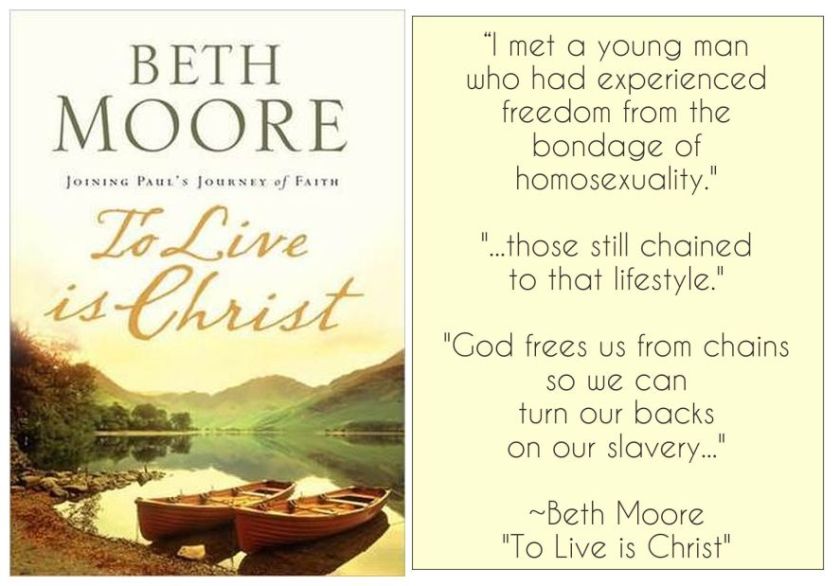
To your credit, in your book To Live is Christ: The Life and Ministry of Paul, you wrote, “I met a young man who had experienced freedom from the bondage of homosexuality” (pg. 119). This book was first published in 1997 and then republished in 2008 but it seems since then you have said very little if anything publicly about this issue.

Another factor prompting our open letter to you is the very public mutual affection and admiration between you, Jen Hatmaker and Jonathan Merritt.

Jen Hatmaker and you regularly exchange affirming posts of one another on social media. In just one recent example, Hatmaker on September 17, 2018 wrote “Beth Moore will enjoy my respect and devotion forever. She is worthy of being a mentor to an entire generation. And friends, I wish you knew how deeply and profoundly she has loved me these last two years” (Source). In an interview two years before this post, October of 2016, Jen Hatmaker said she was a “left-leaning moderate,” came out as fully supportive of homosexual marriage (saying it can be “holy”) and said practicing homosexuals can be part of the regenerate body of Christ (Source). It was then that LifeWay decided to pull all of her books from its shelves.

More recently, on April 9, 2019, Jonathan Merritt tweeted, “I no longer believe @BethMooreLPM is a human. I think she is an angelic being having a human experience.” (Source). Jonathan Merritt has admitted to having at least one homosexual encounter about a decade ago (Source). Today, by his own admission he rejects biblical inerrancy, says a “liberal Protestant” would be an accurate description of him, and says his sexual orientation he no longer views as “broken” (Source).

In a crass response to Dr. Owen Strachan tweeting, rightly so, that there should never be an occasion in which men “cuddle” with one another, Merritt on May 1, 2019 tweeted in response, “C’mon, Owen. You can be my little spoon” (Source). Merritt also openly affirms that “queer” and LGBTQ people are included in God’s Kingdom and it is a “carrot of false promises” that the Gospel can make such people straight (Source, Source). He supports “Drag Queen Story Time” in which drag queens read stories to young children in public libraries (Source 27:40 mark– NOTE, the video has already been deleted. Try this one.). He even appears to doubt the exclusivity of Christ (Source).

Both Jen Hatmaker and Jonathan Merritt are known for their belief that practicing homosexuals can be Christians. Given that this is such a deeply held conviction that both share and this conviction (wrong though it is) has cost them both in their standing amongst theologically conservative evangelicals, and that they both praise you so highly, it raises the natural question as to where you stand on this issue.

Given his beliefs, Merritt publicly saying that he believes you to be “an angelic being having a human experience” strongly suggests that his high praise of you is, at least partially, rooted in your views on this issue that you have shared with him privately. It seems most unlikely that he would be praising you so highly if you had told him that as a homosexual man he will perish for all of eternity unless he repents. It likewise seems unlikely that Hatmaker (a married, straight woman) would praise you so highly if you told her that her affirmation of homosexuality and homosexual marriage is sinful and that she must repent.

When all of this is coupled with your total silence on homosexuality (in stark contrast to your very vocal stance on gender/racial/abuse issues) it naturally raises the question as to what your beliefs on it truly are.

With these factors in mind, and knowing that millions of people follow your teachings, we would like to ask you:

  • Do you believe homosexuality is inherently sinful?
  • Do you believe that the practice of the homosexual lifestyle is compatible with holy Christian living?
  • Do you believe a person who dies as a practicing homosexual but professes to be a Christian will inherit eternal life?
  • Do you believe same sex attraction is, in and of itself, an inherently sinful, unnatural, and disordered desire that must be mortified?
  • Why have you been so silent on this subject in light of your desire to “teach the word of God?”

We ask these questions to you out of genuine concern. As Bible teachers, all of us are held to a very high standard and will give an account for how we handle God’s word.

As you know, homosexuality is widely discussed and debated amongst evangelicals and society at large.

Many families are affected by this issue. The most loving thing obedient Christians can do for them is to clearly communicate God’s truth. We look forward to your clarification on these pressing issues.

Thank you.

Kind regards,

Susan Heck
http://www.withthemaster.com/

Debbie Lynne Kespert
http://www.headstickdeb.com/

Michelle Lesley
http://www.michellelesley.com/

Martha Peace
http://marthapeacetew.blogspot.com/

Elizabeth Prata
http://www.the-end-time.org/

Amy Spreeman
https://bereanresearch.org/
https://naomistable.com/

Added:

Kristy Kapp
https://www.narrowmindedwoman.com
Clipboard

Posted in encouragement, theology

Theology Gals: Encouragement for Singles

By Elizabeth Prata

I don’t “struggle with singleness.” There are lots of things I do struggle with, but living single isn’t one of them.

My parents’ marriage was not the best, and other marriages I’d observed weren’t glowing with love and gentleness either. Divorce was rampant in my growing up years. The US was changing from strict divorce laws to less restrictive, or no-fault.

I was saved at age 43 so that meant for a long time I was a heathen, living for myself. I had an idol, and that was marriage. I wanted to be married, to be a wife. The guy the idol of marriage came with didn’t matter so much as me longing to be in the state of marriage. I felt marriage was important, offered security, and I wanted to be somebody’s number one. Not being saved, I had no clue about the state of marriage being a picture of Jesus with His Bride. I got married. But the Lord showed me the error of my thinking. Painfully.

But in my 20s when I so badly wanted to “be married” I remember the yearning, the wondering, the silence of the empty house, the aching of time passing. I know that being single is an issue that many women deal with. In order to learn more, I listened to Theology Gals’ podcast on the subject. Angela Whitehorn, Coleen Sharp, and Ashley Glassick are co-hosts. The blurb for the podcast states,

Theology Gals is a podcast by women on Reformed theology. The podcast addresses a variety of topics on the study of God’s Word, sound theology and the Christian life.

The co-hosts talked with their friend Jean Keeley about singleness. Jean offers encouragement to other singles through sharing of her journey and also scripture. The hosts also discussed singles and the Church.

What I appreciated about the interview was that when one of the co-hosts asked a question, they allowed the interviewee to answer at length, without interruption, diversion, or laughing/joking/giggling (as so many podcasters are wont to do). I learn more when I can listen to a reply unbroken and with no rabbit trails or personal anecdotes from the hosts.

In this interview Jean Keeley made some insightful statements about her reconciliation with being single. She said she has remained in her church for decades, the first one she joined. From that vantage point, she said she remembers when her church was small with few members. There were one or two women who were older (to her at that time older was mid-thirties) who weren’t married. She thought to herself, “That won’t be me. I’ll find somebody.” Then suddenly she was in her late 40s and still not married and thought, “Gee, that IS me!” It was then she had a long struggle with her status as a single woman. She said whether you’re a woman in your 20s and seeing all your friends get married, or you’re as she was, awakening one day to find you’re on the shadow side of the hill and still not hitched, I found her thoughts and journey for both/all demographics to be helpful.

The quote I remember best from the interview was,

“Ladies, this isn’t God’s Plan B for your life. This is God’s best for you.”

Jean Keeley described how she came to the Lord, which was an encouraging portion of the podcast. Then Keeley revealed some aspects she delights in with the single life and some things that for her aren’t so delightful. She discusses the difference between aloneness and loneliness. She offers practical advice on resting on God’s word in these matters. The hosts and Kelley discussed the verse from 1 Corinthians 7:34 and how it applies to each of them in the different states in which God has provided for them, married and single.

The woman who is unmarried, and the virgin, is concerned about the things of the Lord, that she may be holy both in body and spirit; but one who is married is concerned about the things of the world, how she may please her husband.

The conversation progressed with grace, in grace, with neither status -married or single- being elevated nor disparaged.

For me, my singleness forces me to trust wholly in Jesus, and to lean totally on Him. He knows best. The Lord does know best for each one of us. I enjoy being in a narrow chute, like a horse with blinders, having to look only to Jesus. When other struggles come, and they do- I was in one just yesterday- I pray to Him, read about Him, and look only to Him, and that in the end is sweet to me.

If this topic interests you, Ladies, for whatever reason, I commend the podcast. I hope you enjoy it as I did.

Encouragement for Singles

rings

Posted in theology

The only way to deal with sin is to mortify it

By Elizabeth Prata

Reading through 1 and 2 Kings is tough. The same patterns are shown, the sinful kings who did right, only … It’s like saying you’re sorry, but. Over and over we read the same refrain,

Amaziah the son of Joash king of Judah became king…He did right in the sight of the LORD, yet not like David his father; he did according to all that Joash his father had done. Only the high places were not taken away; the people still sacrificed and burned incense on the high places. (2 Kings 14:1b, 2-4)

Azariah son of Amaziah king of Judah became king. … He did right in the sight of the LORD, according to all that his father Amaziah had done. Only the high places were not taken away; the people still sacrificed and burned incense on the high places. (2 Kings 15:1b, 3-4)

In the second year of Pekah the son of Remaliah king of Israel, Jotham the son of Uzziah king of Judah became king. He did what was right in the sight of the LORD; he did according to all that his father Uzziah had done. Only the high places were not taken away; the people still sacrificed and burned incense on the high places. (2 Kings 15:32, 34-35).

We cannot let any part of sin remain. Remember when God told Saul to slay all the Amalekites, down to the last man and woman, child and infant, ox and sheep, camel, and donkey? But Saul disobeyed and let king Agag live, plus the better animals. (1 Samuel 15).*

Remember when God told Solomon to stay true to worship and not intermarry with foreign women, because they will lead him astray? Solomon didn’t listen. He didn’t stop at one foreign wife, either. He took 1000.

So Solomon did evil in the eyes of the Lord; he did not follow the Lord completely, as David his father had done. (1 Kings 11:6).

We can’t play with sin. We can’t pet sin. We can’t tolerate sin. We have to put sin to death. Completely.  Remember when God told Cain that sin was crouching at the door, wanting to have you? “But you must master it.” (Genesis 4:11).

John Owen is helpful here. His book “The Mortification of Sin in Believers” is all about the rules for and the activity of killing sin in our selves and through that process, not to have peace with the world, a great concern of Owen’s.

Do you mortify? Do you make it your daily work? Be always at it whilst you live; cease not a day from this work; be killing sin or it will be killing you. ~John Owen

Here is a Cliff’s Notes on Owen’s work, from an essay at Meet The PuritansThe entire article is good, I encourage you to read it.

Principles of Mortification
Mortification is the duty of all believers (Col. 3:5; 2)
Mortification Is by the Spirit
Mortification Is of Great Benefit

Explanation of Mortification
What Mortification Is Not
What Mortification Is

Rules of Mortification
Only Believers Can Mortify Sin
The Only Goal Must be Universal Mortification:

“He who truly and thoroughly seeks to mortify any disquieting lust, must be equally diligent in all parts of obedience” (53). We make a mistake if we think we can only fight against the few sins that trouble our conscience. ~John Owen

Owen is careful to note that we can never eradicate sin from our heart, mind, and soul completely in this life. Yet it is the wholehearted pursuit of its mortification (putting to death) that is the goal. David pursued sin when he pursued Bathsheba. Solomon pursued sin when he married 1000 foreign wives. Saul pursued sin when he failed to obey to the letter. The Kings of Judah and Israel pursued sin when they did right in the eyes of the LORD, and here’s that dreaded word…”only they did not…” They did right, only… They did right, but… There can be no buts about it.

We cannot let a little sin remain, or pursue righteousness and ignore the dark corner in our heart over there. We can’t deceive ourselves into thinking that just because we’ve done good over here, that the little disobedience over there will go unremarked.

Sin wants you. No matter how small it is, it will grow and master you. We see that endlessly through the books of the Kings (And Judges. And the whole Bible). Sin’s tentacles will creep and grow and strangle. Then those tentacles will drag you and encircle you and lead you where you do not want to go but you will go. So we must master it. Don’t let there be an ‘only’ in your life.

Prata Corner Graceful Garlands 1 Slay sin

On the Agag issue:

*It’s hard to reconcile the loving God with the wrathful God when we read passages like the one where God told Saul to kill all the men, women, and children. Here is an explanation.

Gill’s Exposition of the Entire Bible

Now go and smite Amalek,…. This was one of the three things the Israelites were obliged to do when they came into the land of Canaan, as Kimchi observes; one was, to appoint a king over them, another, to build the house of the sanctuary, and the third, to blot out the name and memory of Amalek, see Deuteronomy 25:19 and this work was reserved for Saul, their first king:
and utterly destroy all that they have, and spare them not; all were to be devoted to destruction, and nothing remain to be made use of in any way, to any profit and advantage; living creatures were to be put to death, and everything else burnt and destroyed:

but slay both men and women, infant and suckling; neither sex nor age were to be regarded, no mercy and pity shown to any; they had shown none to Israel when weak and feeble, and by the law of retaliation none was to be exercised on them:

ox and sheep, camel and ass; though useful creatures, yet not to be spared; as not men, women, and children, through commiseration, so neither these through covetousness, and neither of them on any pretence whatsoever. Children suffered for their parents, and cattle because of their owners, and both were a punishment to their proprietors; an ox, or any other creature, might not be spared, lest it should be said, as Kimchi observes, this was the spoil of Amalek, and so the name and memory of Amalek would not be blotted out.

Posted in old testament, theology

Dead bodies and live bodies

By Elizabeth Prata

I’m reading through 1 and 2 Kings this month. There are certainly many interesting and strange things happening in those books of history. Remember, the events in those Bible books really happened. Elijah really slew 400 prophets of Baal. God really threw down fire and consumed the sacrifices in the showdown with the prophets of Baal. Wars happened. In 1 Kings 20:29 we read that the Israelites killed 100,000 Aramean foot soldiers in one day. I looked up the slaughter at Gettysburg, well-known to be one of the bloodiest battles, and about 50,000 died. The same with Waterloo. Can you imagine, twice as many Arameans dying on one day?

Here are two other unusual happenings:

In 1 Kings 17:19-21, we read of the prophet Elijah raising the Zarephath’s widow’s son, who had died.

He said to her, “Give me your son.” Then he took him from her bosom and carried him up to the upper room where he was living, and laid him on his own bed. 20He called to the LORD and said, “O LORD my God, have You also brought calamity to the widow with whom I am staying, by causing her son to die?” 21Then he stretched himself upon the child three times, and called to the LORD and said, “O LORD my God, I pray You, let this child’s life return to him.”

In 2 Kings 4:18-37 we read of the prophet Elisha’s raising of the Shunammite’s son, who had died. Here are verses 32-34,

When Elisha came into the house, he saw the child lying dead on his bed. 33 So he went in and shut the door behind the two of them and prayed to the Lord. 34 Then he went up and lay on the child, putting his mouth on his mouth, his eyes on his eyes, and his hands on his hands. And as he stretched himself upon him, the flesh of the child became warm. 

The prophets laid outstretched on the dead person and the LORD graciously used their body as a vehicle for life-giving resurrection power.

It reminded me of the same but opposite historical punishment. Paul was probably thinking of this punishment when he wrote in Romans 7:24,

“Who will set me free from this body of death?”

As John MacArthur explains the punishment:

In the ancient times, one of the ways they punished murderers was to take the victim, the dead corpse, and strap them to the back of the murderer. And eventually the rotting body would cause the rotting of the murderer…a horrific way to suffer for your crime.

The corpse was used to bring death to a living body. The bodies of the prophets were used to bring life to the dead.

The wages of sin is death. Only God can resurrect life, both physical and spiritual.

As I read along, I just thought it was an interesting juxtaposition. It’s what I was thinking about.

new life 4

Posted in encouragement, theology

Where are the good and godly men in your life?

By Elizabeth Prata

standing

I know there’s a lot of “where are the strong Christian men” themes around. I know that male headship is under attack and the rise of feminism in the church has perhaps caused a seeming widespread dearth of strong and principled male leadership in homes and in the church. But…

I’ll extol the many strong men who ARE laboring, who DO adhere to principles, who MIGHTILY glorify God. I’ll start w/my 4 elders at my church. Diligent, wise, loving men who live moral lives, gently guide, gracefully receive repentance, &teach humbly. You know many others, surely
We see & interact many of them on Twitter every day. You know who they are. We listen to many of them online from podcasts & their church websites. You know who they are. And from that, we know there must be and are others out there too. Godly men are everywhere, busy being godly.

If we shouldn’t overstate that the majority of evangelical women are angling for egalitarianism, we also should not overstate the seeming dearth of godly men. Thank you to men unafraid to lead, unashamed of home headship, unapologetic about submission – because THEY are submitted.

I think that while it’s important to be clear-eyed about the evil times in which we live, and point to evil when we find it, we should also diligently search for and proclaim what is right, what is true what is noble,…wait, Paul said it better:

Finally, brethren, whatever is true, whatever is honorable, whatever is right, whatever is pure, whatever is lovely, whatever is of good repute, if there is any excellence and if anything worthy of praise, dwell on these things. (Philippians 4:8).

Barnes’ Notes says

Think on these things – Let them be the object of your careful attention and study, so as to practice them. Think what they are; think on the obligation to observe them; think on the influence which they would have on the world around you.

And not only think on them, look for them, talk about them, proclaim them, exult in them, and thank Jesus for them.

Posted in discernment, theology

On having ears to hear

By Elizabeth Prata

You can hear the difference, can’t you? When a sermon is full of truth or if it isn’t. When a person is sincere and when they aren’t. Discernment is a gift given to some on the Body (1 Corinthians 12:10), discernment is also a skill demanded of all (Hebrews 5:14).

The illustration below is an example of how you can hear discernment.

There was an old pastor, so old that he had been forced to retire. His voice cracked from years of preaching. He was a humble old gentleman. He was invited to a high society kind of luncheon by a friend. He really was out of his league, frankly, but he went. And there was a famous actor there, and the one who was heading up the luncheon said to that actor in the midst of all of the folderol,

“Oh, would you stand up and recite something for us?” And he said, “Of course, I have an endless repertoire. What would you like?” The old pastor thought this is his moment. He said, “How about the 23rd Psalm” And the actor said, “Well, that’s an unusual request, but I happen to know that, and I’ll do it on one condition: that you’ll do it after I do it.”

Well, the old pastor hadn’t bargained for that, but for the sake of the Lord he said, “All right.”  The actor got up, and he recited the 23rd Psalm with great intonation, beautiful, lyrical voice, tremendous interpretation. And he finished, and everyone applauded. The old pastor stood up and cracking voice and just went through the 23rd Psalm in his humble way. And when he was done, there was not a dry eye in the room.

And sensing the emotion of the moment, the actor stood and said, “I think I understand the difference in your response to me and to him. You clapped for me; you wept for him. The difference is: I know the Psalm, but he knows the Shepherd.” ~John MacArthur, The Calling of the Church

And that IS the difference when you hear it. Some recite from the mind, others know from the heart. A worthless shepherd who doesn’t know the Shepherd will be empty, though he deliver his words confidently, or with flair, or eloquently. Lord, give us ears to hear. See Revelation 2:7, “He that has an ear, let him hear what the Spirit said to the churches;”

He that hath an ear—This clause precedes the promise in the first three addresses, succeeds it in the last four. Thus the promises are enclosed on both sides with the precept urging the deepest attention as to the most momentous truths. Every man “hath an ear” naturally, but he alone will be able to hear spiritually to whom God has given “the hearing ear”; whose “ear God hath wakened” and “opened.” (Jamieson-Fausset-Brown Bible Commentary)

Discernment is something we can ask for more of (Psalm 119:66). It is something you can pray for others to be given it (Philippians 1:9). What a privilege to be able to ask the Wise one for more wisdom and discernment.

discernment1

Posted in theology

On Every High Hill…

By Elizabeth Prata

‘Judah did evil in the sight of the LORD’.

For they also built for themselves high places and sacred pillars and Asherim on every high hill and beneath every luxuriant tree. 24There were also male cult prostitutes in the land. They did according to all the abominations of the nations which the LORD dispossessed before the sons of Israel. (1 Kings 14:23-24).

Reading through 1 Kings is just killing me. I mourn, cry the sins of Israel & Judah, and then take a look at myself and my own sins and idols and mourn some more. We’re no different than the folks in that book, but when such abominable sins stain from the bottom right up to the top, the kings and rulers, it’s a sure course toward judgment, individually and nationally. And it sure came. Reading the book, remember this really happened. God really judged King Jeroboam and the result surely came to pass.

you also have done more evil than all who were before you, and have gone and made for yourself other gods and molten images to provoke Me to anger, and have cast Me behind your back— 10therefore behold, I am bringing calamity on the house of Jeroboam, and will cut off from Jeroboam every male person, both bond and free in Israel, and I will make a clean sweep of the house of Jeroboam, as one sweeps away dung until it is all gone. 11″Anyone belonging to Jeroboam who dies in the city the dogs will eat. And he who dies in the field the birds of the heavens will eat; for the LORD has spoken it.'” (1 Kings 14:9-11).

I think I exclaimed out loud when I read it. Woe! Any individual failure to follow the commands of God resulted in judgment. Any failure of the nation to follow the commands of God resulted in judgment. Any failure of the Kings God had raised up to follow the commands of God resulted in judgment.

One part of the above verse in the chapters I read this morning really got to me: “on every high hill”. They worshiped their false gods by building altars and pillars and poles on the high places, which they thought brought them closer to heaven.

Do we individually here in America, or as a nation, or think our rulers and judges and governors will escape judgment as they not only turn their backs on God but applaud themselves for doing so? Here in America we have abominations ON EVERY HIGH HILL. Planned Parenthood facilities (baby killing stations), false religions welcomed and spoken of highly, homosexuality flags waving from high places and more and worse.

My friend Pastor Phil wrote this morning:

“In my reading of Romans 1:18-32, I believe we as a nation are not aware of that God’s judgment is upon us. How? First, God has given us over to the “lusts of our hearts.” Second, God has given us over to “dishonorable passions,” specifically homosexuality. Third, God has given us over to a “debased minds.” Moreover, those who give their approval to those who practice these unrighteous actions are just as guilty. The only hope for our nation and those who do not honor the Lord is to repent of these sins and to turn to Jesus Christ for His forgiveness and new life.”

I pray for individuals to be saved by being given the spirit of repentance, and I pray for leaders. But I also pray for the Lord to soon come. It’s hard to see so much sin & evil every day ON EVERY HIGH HILL.

But I am also grateful and joyful. He has given me eternal life. He has given me knowledge of the Savior. He has given me the mind of Christ, a mind that was once as debased as all the others on the high hill. He has given me life, joy, purpose, and illuminating wisdom from scripture.

As Paul ruminated, we are torn. We decry the evil that’s in the world, it feels almost like it must have to Noah, but again, we remain on earth to do His work and His will, which is also good. I’m grateful the world did not end before I myself was saved. Others being saved today and tomorrow and the next will no doubt feel the same. So as Paul wrote in Philippians 1:21-24,

For to me, to live is Christ and to die is gain. 22But if I am to live on in the flesh, this will mean fruitful labor for me; and I do not know which to choose. 23But I am hard-pressed from both directions, having the desire to depart and be with Christ, for that is very much better; 24yet to remain on in the flesh is more necessary for your sake.

I don’t know for whose sake He is keeping me here, lol. The work I do for Jesus is certainly not as significant as Paul’s was, but if the Lord is pleased to keep me here on earth to do His will and work, then I am relieved I have the Spirit to pray to for help in withstanding the woes and griefs and traps of the sin and evil all around.

What a Savior. His ways are transparent but inscrutable. This we know though: The evil on every high hill will not stand in the end. The idols and poles and altars will melt away and righteousness will reign. Jesus is higher than every high hill and His power exceeds the evil that satan can do. Hallelujah.

high hill

Posted in encouragement, theology

Panting after more light

By Elizabeth Prata

light
A little light

We’ve all got our favorite metaphors from the Bible and mine’s the “light”. Just before I was converted, I first understood sin and redemption as concepts of darkness and light. Afterward, I loved the idea of Jesus as the Light, his glory brightness, and the glittering heaven where His light is shining forever.

As I lived aboard a sailboat for two years (pre-conversion era) there are now many metaphors that I gravitate to through that life experience that I cherish. Like lighthouses, anchors, the storms of life, waves buffeting, etc. But especially the lighthouse with the light!

Yesterday I read the following in the Valley of Vision, the Puritan devotional prayers (Ladies, get this book! I mean it!!)

Let not “Satan and my natural abilities content me with a little light, so that I seek no further for the Spirit of life. Teach me what to do.” ~Valley of Vision, God the Spirit

How often are we content with ‘a little light’? Half the time I think I’m content with it because I have allowed my eyes to adjust to the dimness and that has become my comfortable status quo. And how I do love the status quo. The other half of the time I think it’s because if I allow full-blast Light into my life it’d expose too many idols, sins, and pet behaviors I don’t want exposed. It’s a brave thing to ask for “more light”. I need to be braver.

Then a short while later I read this-

Open my eyes, that I may behold Wonderful things from Your law.
Psalm 119:18

Open mine eyes – David was not blind, his eye was not dim. He could read the Bible from end to end, and yet felt that he needed more light. He felt that he needed to see deeper, to have the eyes of his understanding opened. He felt that if he had nothing but his own eyes and natural understanding, he would not discover the wonders that he panted to see. He wanted Divine teaching, the eye-salve of the Spirit, and therefore he would not open the Bible without this prayer, ‘Open Thou mine eyes! ~Robert Murray M’Cheyne, The Believer’s Joy

Not content with a little light, David yearned for and even begged for more light. It is the Holy Spirit who opens our eyes to receive more Light (i.e more understanding of who God is through His word). David was a grievous sinner as we know, but he repented fully and threw himself upon the throne of grace asking for forgiveness and as we see here, understanding. This is why he was a man after God’s own heart.

More light also means more love. As we grow in understanding of who God is, we love Him more. Doctrine inspires love for the one who wrote it as we strive to live it.

More light also means, gulp, more obedience. As we grow in understanding of who God is, we love Him more and we want to obey him more- because of who He is.

It’s a brave thing to ask for more Light. Do I have such courage? I must. And even if I don’t, I must.

sunshine beams in yard
More light

Posted in book review, theology

Practical, helpful questions for the sermon hearer; plus Book Review

By Elizabeth Prata

crown
I love to listen to sermons, especially my own pastor’s sermons. They are rich and deep with a lot to think about. He exposits verse by verse or chapter by chapter through a book of the Bible, and along the way he challenges us with his points. Just the way I like it.

I’m such a dunce though. I long to apply the words to my life so as to partner with the Spirit in my progressive sanctification. But I often don’t know the questions to ask myself in order to kick-start the process for that day. I found a helpful aid in the book I just finished reading, “Her Husband’s Crown,” a short exhortation of 9 points and a conclusion by Sara Leone.

Below are some good questions a woman can ask herself after hearing a sermon. Though the author’s intended audience is pastors’ wives, these questions are good for any woman to ask of herself after hearing her pastor’s sermon, or any sermon. I hope they help you as they helped me.

We remember the exhortation to “…receive with meekness the implanted word.” (James 1:21).

What has the word of God taught me today? Has it pointed to a sin I must confess? What promise has it encouraged me to claim? Is there a godly example for me to follow, a Christian grace to develop in my life? How should I apply the lessons of the sermon to my daily living? In other words, our goal should not be to critique our husbands’ sermons but to benefit spiritually from them.

Her Husband’s Crown, p 20 Sara Leone

BOOK REVIEW:

summer reading

As I finish the books I’ve set aside for this summer’s reading, I’ll review them.

Her Husband’s Crown by Sara Leone is for sale at Amazon for only $3. It’s 42 short and sweet pages that I found practical and helpful. Sara is a pastor’s wife. The blurb says “Although written primarily for pastors wives, this booklet will encourage Christian wives in general and will stimulate prayer for and support of pastors and their wives everywhere.

I say it’s a helpful book for any Christian woman who is a member of her church, married, unmarried, pastor’s wife or not.

What I liked about it is that the advice inside is practical, no-nonsense and nothing you haven’t really heard before. But it’s bundled in such a way that the advice and points are brought to mind again in a good way. There are blessedly few anecdotes of a personal nature, just only enough to be lightly sprinkled throughout and helpful to her chapter’s point. There is a lot of scripture. Just the way I like it.

For example, Chapter 3’s point, “Be a sympathetic and confidential listener to your husband,” based on Romans 12:15, is a wonderful treatment on the importance of pastor’s wives to be, well, sympathetic to your husband’s cares and concerns but also keep them confidential. This can be applied to any situation where a person confides in you. In other words, it’s easy to apply her points if you are a pastor’s wife and easy to adapt her points if you are not. And her points are good.

Another example, chapter 2, Fulfill your responsibilities as a mother before seeking other ministries in the church. Here, Mrs. Leone speaks to a common misperception, that the pastor’s wife is ‘First Lady’ of the church and in that role must fill the gap or lead the way for many of the ministries going on. Not so.

If you’re not a pastor’s wife then the advice is still good to be reminded of that a mother’s primary role is mother, not ministry leader. I mentioned that her advice isn’t anything you haven’t heard before, so of course we know that if you’re a mom then motherhood is a primary essential. But I also said that her advice is needed. Why? When we see many Christian mothers podcasting, running all over the US in their book tours, being guests on podcasts, writing books, maintaining a strong social media presence, and raising 7 children or 4 children and the like, it makes many true stay-at-home Christian mothers wonder if they, too can “do it all” like these other, more famous women who seem to have successful myriad ministries yet claim also to be focused on raising their children. So, Leone’s advice is needed.

The author does not come across as bossy but gentle. She is sharing these 9 points from a long life of experience but also as reminders from scripture. Reading this book is like sipping a cup of tea with a friend in the shade under a dappled dogwood tree.

Recommended.