The thread of Christianity depends on a unity from one generation to the next of mutual understanding of our important words. Hence the Word of the Week.
This is a repost from September 2018
Normally I write about a little-used word but one that we as believers need to know (and use in our vocabulary). I’ve written about aseity, omnipotence, and justification, for example. But this week’s word will be Light.
It seems like it is an easy word, and it is, but as with all things in the Bible, there are layers of meaning.
The word Light is used in the Bible in several different ways. There is created light, as when God said “Let there be light”…and He separated the light from the dark. This is literal. There is miraculous light, as in the glory light of Jesus when He transfigured. And there is figurative/symbolic Light, as in the Word is a light or when we are ‘in the light’ as opposed to those sinners who are ‘in darkness’, or ‘don’t hide your light under a bushel’.
Once you see the different ways the word light is used you can’t unsee it, nor would you want to, lol.
One of the most wonderful, cheering, and useful of all the works of God; called into being on the first of the six days of creation, by his voice: “Let there be light;” and there was light. No object better illustrates whatever is pure, glorious, spiritual, joyful, and beneficent. Hence the beauty and force of the expressions, “God is light,” 1 John 1:5, and “the Father of lights,” James 1:17; Christ is the “Sun of righteousness,” and “the light of the world,” John 1:9 8:12. So also the word of God is “a light,” Psalm 119:105; truth and Christians are lights, John 3:19 12:36; prosperity is “light,” Esther 8:16; and heaven is full of light, Revelation 21:23-25. The opposite of all these is “darkness.”
The word “light” is Divinely rich in its comprehensiveness and meaning. Its material splendor is used throughout the Scriptures as the symbol and synonym of all that is luminous and radiant in the mental, moral and spiritual life of men and angels; while the eternal God, because of His holiness and moral perfection, is pictured as “dwelling in light unapproachable” (1 Timothy 6:16). Every phase of the word, from the original light in the natural world to the spiritual glory of the celestial, is found in Holy Writ.
The ISBE even goes on to further separate the different concepts of Light into Natural Light, Artificial Light, Miraculous Light, Mental, Moral, Spiritual Light; and explores its symbolism, expressive terms, and more. Check it out!
We first read the word light in Genesis 1:3 and the Bible closes with it in Revelation 22:5. Light. It’s such a simple word, but such a complex theme.
My friend Pastor Phil wrote this on Facebook. It got me thinking about the conscience. What is conscience? Dare we obey it when it is scarred by sin? Does the person know when their conscience has become seared? First, Pastor Phil’s thoughts, then some scriptures and thoughts musing on my questions and Phil’s.
Phil Andrukaitis:
Proverb for Today
“He who walks with integrity walks securely, but he who perverts his ways will become known” (Proverbs 10:9).
The lesson: A person whose reputation, career, and/or character are based on deception will be humiliated and brought to ruin.
Therefore, here are four actions to help each of us to walk with integrity: First, listen to your conscience; obeying the Scripture will never lead a person astray. Second, cultivate your relationship with your family because your example will impact their lives forever. Third, respect and obey governing authorities as they are commissioned by God for our good. Fourth, become intimately involved with a local church that honors Jesus Christ. After all, every Christian needs other believers to mature in Christ.
Amen.
Pastor Phil answered a question from a friend who had posted a reply, this way:
Conscience is that “device” God has given to each of us because each person is made in the image of God. Having a conscience is one of the distinguishing ways separates a person from the animal world. Conscience is a personal authority to which each of us either listen to or ignore.
Second, beginning with Adam and Eve, I believe God created us and fashioned our hearts to know the difference between right and wrong (Romans 1:18-19). But when they sinned, their sinfully marred spiritual DNA was passed down to each of us. Yes, we still have a conscience and it is scarred by sin, but it still is the first means by which God speaks to us. Even without the knowledge of the Scripture in our minds, even before sinners are regenerated by the Holy Spirit and Holy Scripture, we know the difference between right and wrong. Therefore, conscience will scream at us saying, “STOP!”
Third, I see your point in that we can be led astray with our conscience. I believe this occurs when a person continually ignores his conscience and the Scripture. When we ignore our conscience, though it has been impacted by sin, and experience the painful consequences of our actions, remember, it was our conscience – a gift from God – that warned us to stop. Sadly, when we ignore our conscience, we also tend to ignore, distort, and eventually reject the Scripture. And the consequences are far more painful as our hearts become hardened; God withdraws His hand [influence] from our lives.
————————end Phil’s Facebook comment and reply————————
The heart/conscience is mentioned in the Bible explicitly over 1000 times. For example, in Romans 2:15,
They show that the work of the law is written on their hearts, while their conscience also bears witness, and their conflicting thoughts accuse or even excuse them
And in Hebrews 10:22,
let us draw near with a true heart in full assurance of faith, with our hearts sprinkled clean from an evil conscience and our bodies washed with pure water.
and in 1 Peter 3:15-16,
But in your hearts sanctify Christ as Lord. Always be prepared to give a defense to everyone who asks you the reason for the hope that you have. But respond with gentleness and respect, 16keeping a clear conscience, so that those who slander you will be put to shame by your good behavior in Christ
and Titus 1:15,
To the pure, all things are pure, but to the defiled and unbelieving, nothing is pure; but both their minds and their consciences are defiled.
And so on. So, conscience IS a thing.
J. I. Packer wrote in Rediscovering Holiness,
An educated, sensitive conscience is God’s monitor. It alerts us to the moral quality of what we do or plan to do, forbids lawlessness and irresponsibility, and makes us feel guilt, shame, and fear of the future retribution that it tells us we deserve, when we have allowed ourselves to defy its restraints. Satan’s strategy is to corrupt, desensitize, and if possible kill our consciences. The relativism, materialism, narcissism, secularism, and hedonism of today’s western world help him mightily toward his goal. His task is made yet simpler by the way in which the world’s moral weaknesses have been taken into the contemporary church.
The heart functions as the conscience. After David showed insubordination against the anointed king by cutting off the corner of his robe, his heart smote him (1 Sam 24:5 ), and after Peter’s sermon the audience was “cut to the heart” (Acts 2:37 ). The heart may condemn us, but God is greater than our hearts (1 John 3:20 ). David prays that God would create for him a pure heart to replace his defiled conscience (Psalm 51:10 ).
The Hebrew word for conscience is leb, usually translated “heart” in the Old Testament. The conscience is so much at the core of the human soul that the Hebrew mind did not draw a distinction between conscience and the rest of the inner person. Thus when Moses recorded that Pharaoh “hardened his heart” (Exodus 8:15), he was saying that Pharaoh had steeled his conscience against God’s will.
What is the seared conscience? 1 Timothy 4:1-2 mentions it,
Now the Spirit expressly says that in later times some will depart from the faith by devoting themselves to deceitful spirits and teachings of demons, 2 through the insincerity of liars whose consciences are seared
JI Packer wrote, “when moral and spiritual light has been resisted it may become ‘seared’ (i.e. cauterized, rendered insensitive) (1 Timothy 4:2; cf. Ephesians 4:18).”
This essay first appeared on The End Time in November 2010.
“For the time will come when they will not endure sound doctrine; but wanting to have their ears tickled, they will accumulate for themselves teachers in accordance to their own desires…” (2 Timothy 4:3)
Do you notice that word “endure”? The verse does not say “they will not like sound doctrine…” It does not say “they will not enjoy sound doctrine…” It doesn’t even say “they will not accept sound doctrine.” It uses the word endure. When you endure something, you writhe. You wish you were not there in the midst of it. If anyone has ever undergone physical therapy, you know that you have to endure it but if you could you would shoot out of the gym so fast you’d be like a speeding bullet. If anyone has ever had to get a root canal, you know that you endure it. You do not seek it, you do not like it, and if you could, you go away from it.
That is the process by which lukewarm Christians, fake Christians, and unholy pastors feel about the true Gospel of Jesus Christ. To be sure, the true Gospel of the Risen Savior is full of warm fuzzies. He loves us. (John 13:1). He prospers us. (2 Corinthians 9:8). He sends angels to us. (Hebrews 1:14). But the True Gospel is also full of truth, the unpalatable truth that the iniquitous lawless cannot endure: we are sinners. (Psalm 51:5). Rejection of the remedy for your sin (1 Corinthians 6:9-10) means you will spend eternity in torment, apart from God. That there is nothing good in us. (Mark 10:18). That we are fallen, craven, and deserve judgment. No, they will not endure that. So they don’t.
Instead they seek teachers to tempt us with what the devil has always tempted us with, and tempted Jesus too: health, wealth, fame. (Luke 4:1-13). They may find it in some “preachers” and in some “churches”, but it is for a season. Hebrews 11:25). Most do not find prosperity in health, wealth and fame. The only ones becoming famous and rich are the false pastors who urge the hapless and desperate to send money.
In his series, “Toxic Television: Unmasking the Prosperity Gospel part 1” Bible teacher John MacArthur spends a few minutes below of his one-hour sermon (linked above) explaining why Joel Osteen is false, dangerous, and unholy. He also spends time explaining why the Trinity Broadcast Network is also false, dangerous and unholy. MacArthur says, Osteen “is a quasi-pantheist where Jesus is a footnote that satisfies his critics and deceives his followers.” As for Osteen’s book, MacArthur says ‘Your Best Life Now’, the title, is a dead giveaway. The only way you can have your best life now is if you’re going to hell.”
A watered down gospel removes the book-end to the parts that they seek love and only ‘love’. The missing book-end is judgment. They will not endure sound teaching of His holiness involving love but also including righteous judgment.
“I have sworn by Myself,
The word has gone forth from My mouth in righteousness
And will not turn back,
That to Me every knee will bow, every tongue will swear allegiance.
“They will say of Me, ‘Only in the LORD are righteousness and strength.’
Men will come to Him,
And all who were angry at Him will be put to shame. (Isaiah 45:23-24)
A watered down gospel that removes the other book-end is less filling but it tastes great. The Bible shows us that the True Gospel tastes great, and also the watered down false Gospel tastes great. In the verses telling us of Ezekiel’s commission,
“Then He said to me, “Son of man, eat what you find; eat this scroll, and go, speak to the house of Israel.” So I opened my mouth, and He fed me this scroll. He said to me, “Son of man, feed your stomach and fill your body with this scroll which I am giving you.” Then I ate it, and it was sweet as honey in my mouth.” (Ez 3:1-3).
The true word absorbed by submissive believers is sweet. But it is also sometimes accompanied by a bitterness felt by even the most beloved of followers, even the most obedient of disciples. Sometimes the true word is hard to hear and bitter even for believers, because it reveals to us the true state of our sinfulness, our sorrow over our sin, and the fate of those who refuse His hand, those mockers and scorners whom we mourn over-
“I took the little scroll from the angel’s hand and ate it. It tasted as sweet as honey in my mouth, but when I had eaten it, my stomach turned sour.” (Rev 10:10)
The only way to endure the knowledge of judgment that is coming is to rest on His truth and His promises. Those who do not rest in that truth, bitter as it sometimes is, do not endure it. Not only have they stopped asking the Spirit for wisdom, but they simply stop ingesting the sweet Words of the LORD and they flee away, being unstable in all they do.
“But if any of you lacks wisdom, let him ask of God, who gives to all generously and without reproach, and it will be given to him. But he must ask in faith without any doubting, for the one who doubts is like the surf of the sea, driven and tossed by the wind. For that man ought not to expect that he will receive anything from the Lord, being a double-minded man, unstable in all his ways.” (James 1:5-8)
But we do endure! Paul said to in 2 Tim 2:3, 10. Peter said to in 1 Peter 2:20. The writer in Hebrews 12:7 advised us to endure. Endure what? Hardship. Beatings. Wrongdoing. Life. Hardship. Persecution. And there are those today who cannot sit still in a chair or a pew and ‘endure’ the Word of the Living God who loves them. They seek tickling instead. They are gaining the world only to lose their lives forever.
Has solid preaching become an endurance test for you? Or are the hard but truthful words uplifting to you and filling in every way? If you have recently changed churches because the pastor is “a little too Bible thumping for my taste”, or have drifted away from regular worship lately because the sermons are too long, too convicting, or demand endurance on the part of your deceitful heart, then ask yourself if you are really just trying to accumulate a teacher in accordance with your own desires, and are wanting your ears tickled with a less filling but great tasting sermon. If so, you may be at risk.
Why at risk? Because we all live forever in eternity in one of two places. The day will come when the eternity you are beginning will either not have the word endure associated with it, which is heaven, or it will have the word endure associated with it, for an eternity!
You may try to avoid enduring a convicting sermon from a ticklish teacher today, but the end result will be that you will have to endure an eternity separated from Him in torment. O, faithful one, let it not be so!
Judas, exhibiting false righteous indignation, said, “Why was this ointment not sold for three hundred denarii and given to the poor?” John 12:5. Proof that apostates & hypocrites say & do say things that sound pious but hide an evil heart. He sounded pious. It seemed appropriate. But Judas the treasurer didn’t say that because he cared about the poor. had they sold the perfume, Judas was a thief privately mourning the list revenue he could have pinched from the common purse. (John 12:6).
Don’t listen to friends who urge you, against your better discernment, to listen to that teacher or this one by caving in to their pleas such as, “But s/he talks about Jesus!” Or, “S/He uses the Bible!”
False teachers will always try to fool you with pious sounding speeches and fine flatteries. They specialize in manipulation so it’s no wonder that they can match their speech to what we expect. The disciples would expect a disciple as close to Jesus as Judas was, with his responsibility of keeping the money as Treasurer, to care for the poor and to want 300 denarii to serve those less fortunate. But the Bible tells us outright that Judas did not care for the poor at all.
Judas fooled the other disciples! He did not fool Jesus though. No one can. If we pray for discernment, keep in the Word, and ask the Spirit to reveal to us those whose hearts are far from Him, He will. He will alert you to anomalies and inconsistencies in the person’s behavior and theology.
Don’t let false teachers fool you. Test them!
Real Denarii
Top row left to right: 157 BC Roman Republic, AD 73 Vespasian, AD 161 Marcus Aurelius, AD 194 Septimius Severus; Second row left to right: AD 199 Caracalla, AD 200 Julia Domna, AD 219 Elagabalus, AD 236 Maximinus Thrax
Source public domain Wikipedia
Counterfeit denarius
Tiberius Denarius – Biblical Tribute Penny 14-37 AD
I lived through this. I remember, vividly. Even if you didn’t live through it or were too young, never forget America was cravenly attacked. Many people lost their lives that day in a terrible, long, horror.
Worse, some who died who were outside Christ met their Maker, and it wasn’t a friendly encounter.
The men who perpetrated this heinous act are the mission field.
Never forget the attack. But always remember the ultimate goal of our lives is to witness of Christ to the saving of their souls. Share the Gospel with your neighbor, with a Muslim, with all who you encounter. This day might be their last.
Nothing seems more homey than coming into the house and smelling the good smells coming from the kitchen. It’s a warm and comfy feeling to see mom in the kitchen cooking dinner. You feel secure, happy, and at peace. All is right with the world.
My mom was famous for her mashed potatoes. She was among the early ones in our neighborhood to experiment along with Julia Child. Her Pork Loin was noted. My siblings loved her hamburgers and meat loaf. There were a host of other kitchen goodies we ate at home that our mother cooked for us from scratch.
I bet you stopped right now and thought of your mom’s special dish that you loved so much!
I laughed when Michelle Lesley tweeted that her kids asked for chili for supper…only thing is…it was barely out of August….they live in Louisiana … and it was over 100 degrees outside. She tweeted later, “I love my kids, so I made the chili anyway.”
Do you remember asking begging mom for her ____ fill in the blank there. Mom’s homemade cooking is just home.
It is therefore a sadness to me when I see celebrity Christian mothers who neglect their children for the sake of their chosen competing ministry. Moms who don’t have to work outside the home, or are working outside the home even more than career single secular moms in order to build their ministry brand, or to go on a book tour, or to take a social justice trip, and leave their kids behind is just too regrettable.
Jennifer Foster, wife of Pastor Jeremy Foster, co-pastors of America’s fastest-growing church, Hope City Church in Houston. She and her husband Jeremy have 5 children. She said the following in a written interview:
Interview Question: With a large (and growing) family, how do you personally make sure that you’re not taking on too much? Jennifer: Practical stuff like date nights are crucial. Our family comes together around the dinner table every day (even if it’s take out, which it usually is). 😊 The last thing I’ll say on this is that I believe we have our priorities right. It’s Jesus at the center and then we build out from there, our marriage, our kids and then our church.
Jesus is not at the center when a wife believes she is a pastor, and when her ministerial duties take her away from the home to the extent that she says that hers does, and when time with the children has to be scheduled around a bucket of takeout. A mom’s ministry IS the children.
Yet sadly, this model of a family lifestyle of Christian moms is continually presented as normal no thanks to secular AND Christian media sources. Their subtle feminist message is, celebrity minister moms working outside the home is OK, as long as you claim to love Jesus and call it ministry.
Beth Moore of Living Proof Ministries, interviewed by The Atlantic Magazine noted the same:
Privately, however, Moore has never cared much for the delicate norms of Christian femininity. Her days are tightly scheduled and obsessively focused on writing. She spends hours alone in an office decorated with a Bible verse written in a swirling font (“I tell you, her many sins have been forgiven,” Luke 7:47). Though she often performs domestic femininity for her audience, in her own life she has balanced motherhood with demanding professional ambitions. She traveled every other weekend while her two daughters were growing up—they told me they ate a lot of takeout.
‘Mom is gone on another book tour, how about some KFC, kids?’ Does that sound as homey to a five-year-old as it could be? Being present with and for the children and husband should be the mom’s ‘obsession,’ or at least, acceptance of a gift and a role given by God as best for the family.
Raechael Myers, founder of the IF: Gathering gushed in an Instagram post (in 2014),
My husband just texted me this photo of the kids watching our @shereadstruth interview at the @ifgathering. Seeing my baby girl perched on the table watching her mommy talk about her Jesus- so blessed!!!! #SheReadsTruth #ifgathering
Yes, because that’s how to minister to your children, leaving your husband at home to do the mommying, and texting about your kids watching mom through a screen.
Many of these celebrity ministering moms, and there do seem to be many of them, if criticized, refer to Proverbs 31 as their basis for doing what they do.
Proverbs 31 is by King Lemuel, from an oracle his mother taught him. This part of the proverb extols the virtues of an excellent wife and mother, as the husband’s confidence in her increases (Proverbs 31:11). She works very hard and carefully provides for her household and those within it.
But rather than interpreting the salient portion of the Proverb as understanding the value and godliness of a wife and mother who devotes herself in a large sphere to her ministry-home and hearth, they take it to mean that a wife can and should be entrepreneurial outside the home, even if her merchandising competes with it.
–She considers a field and buys it; with the fruit of her hands she plants a vineyard. (Proverbs 31:16)
–She makes linen garments and sells them; she delivers sashes to the merchant. (Proverbs 31:24)
Yet,
While dad is the leader in the house, mother sets the tone. The hours her children spend in her presence will have a lasting influence on their lives. They will become largely what she makes them. She faces the noble challenge of molding their young lives for eternity. Motherhood is one of life’s highest honors, and one of its heaviest responsibilities. The Majesty of Motherhood
God gives the woman a husband and opens her womb to bear children. When He chooses to bless the wife with progeny, it changes the dynamic and the lifestyle of the woman. The mother alters her orientation now toward the home, almost exclusively.
Can anyone serve two masters? (Matthew 6:24). Are there two masters in the home? Two co-authorities? As in the worse case scenario of couples like the Fosters, co-pastors?
Now, please don’t misunderstand me. I am not opposed to mothers who need to work outside the home, or where the husband-and-wife have made considered and biblical decisions for her to do so. Normally, a mother’s primary orientation however, is supposed to be toward the home. The Proverbs verses, especially the two I’d shared above, demonstrate a wife & mother’s thoughtful consideration of how to personally, emotionally, and financially invest in her family, not sacrifice her family for her own ministry or career.
Please don’t misunderstand me. I’m not judging buying takeout. Who doesn’t like an occasional pizza on a Friday night? Who doesn’t like some takeout for the Big Game? Takeout is not bad in and of itself. Not at all.
I know that there are sincere and loving stay-at-home mothers relying on takeout simply because the children are over-scheduled and it’s easier to grab a burger at the drive-thru on the way to the game/practice/rehearsal/dance/piano/voice lessons…
But, when takeout as opposed to a nourishing homemade dinner cooked with love is the consistent default, then becomes a symbol of something wrong in the home.
Nevertheless, Proverbs 31 is a high model of a devoted wife and mother. Her job is not easy and it is often thankless, for a while. How wonderful it is when the mother cooks dinner and settles in to read to her kids and tuck them into bed at night, she sets the tone of security, love, and warmth that will last them a lifetime. When her children grow up she will have provided them a model of enduring ministry that will last them a lifetime, and then they will thank her by caring for their own children the same way. When she meets Christ, she will earn His accolade for a well done service of a good and faithful servant.
Back in the day in education when rote was an acceptable learning style, there were copybooks:
A copybook, or copy book is a book used in education that contains examples of handwriting and blank space for learners to imitate.
Typical uses include teaching penmanship and arithmetic to students. A page of a copy book typically starts with a copybook heading: a printed example of what should be copied, such as a single letter or a short proverb. The rest of the page is empty, except for horizontal rulings. The student is expected to copy the example down the page. By copying, the student is supposed to practice penmanship, spelling, reading comprehension, punctuation, and vocabulary. Wikipedia
Here is an example of one, from Copy book, Boston, 1840-1850, manuscript on paper, board – Concord Museum – Concord, MA , photo is public domain:
There were art copybooks for art students to learn watercolor painting, business copybooks to enhance penmanship (since no computers or typewriters existed then, good penmanship was essential for business), and copybooks for learning geography where students had to label maps.
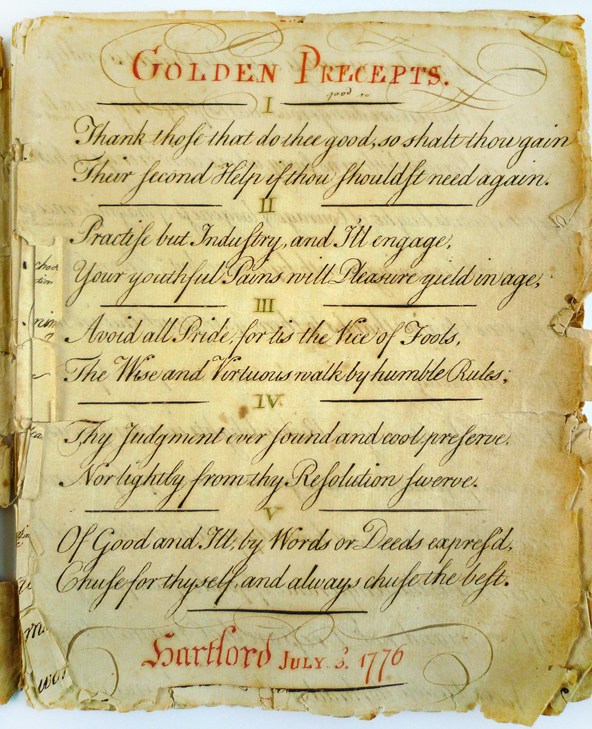
Below is a copybook from Samuel Holbrook that he composed between June and September 1776 in Hartford, Connecticut and Boston. Note the date on the page below, lol.
Copybooks always had a source line from which the students were tasked with imitating as closely as possible. Official minutes from School Board meetings indicate that students were tasked with this daily and usually at the same hour in the school day.
The educational history aside, we ourselves as Christians ARE a copybook for the original which is Jesus. We are to be imitators of Him.
For to this you have been called, because Christ also suffered for you, leaving you an example, so that you might follow in his steps. (1 Peter 2:21).
But we all, with unveiled face, beholding as in a mirror the glory of the Lord, are being transformed into the same image from glory to glory, just as from the Lord, the Spirit. (2 Corinthians 3:18).
Be imitators of me, just as I also am of Christ. (1 Corinthians 11:1
the one who says he abides in Him ought himself to walk in the same manner as He walked. (1 John 2:6).
Christ is our copybook. Imitate Him, daily. Delve into his likeness constantly. There is no better example anywhere on earth or the universe to copy.
I am fascinated by grace. I think as a Christian matures, we see our sin more and more for what it really is. The picture of the Prodigal Son wallowing in the pig pen eating scraps is a vivid, if not enough mental picture of us before salvation. Our sin sadly persists in us, though forgiven and overlaid with Christ’s righteousness. We still have to work at killing what is ‘crouching at the door’ waiting to have us.
The grace that lifted us from our pigsty and washed us is all the more precious as we see the depths from which we have come. Seeing the heights from which he stooped to save us and the grace that flew Him there on wings of love is a wondrous thing. I can’t stop thinking about it.
I read this short account of grace from the Lexham Survey of Theology trying in human words to explain the mystery and incredible gift of grace. I especially loved the last paragraph.
—————————
God’s grace is unmerited divine favor, a favor from which comes many gifts.
God’s grace flows out of his inter-Trinitarian, gift-giving life. Even in humanity’s fallen state, God freely grants to his creatures good things they do not deserve. The greatest of these goods is Jesus Christ.
The bold thread of grace in the Bible is a distinctive marker of Christianity, one that sets it apart from other religions. J. Gresham Machen noted, “The very center and core of the whole Bible is the doctrine of the grace of God.” The works of God in creation as well as his covenants, his promises, his word, and his work of redemption all spring from his grace. All we have is due to grace, but, as Michael Horton says, grace itself is “not a third thing or substance,” for “in grace, God gives nothing less than Himself.”
God’s grace toward mankind arises from the fullness of his being. He is gracious. When God appeared to Moses he declared his name, Yahweh, the I AM, as the sum of his eternal being. This nature includes his graciousness: “The Lord, the Lord, a God merciful and gracious, slow to anger, and abounding in steadfast love and faithfulness”. (Exod 34:6). J. I. Packer suggests that grace is simply God’s love demonstrated toward those who deserve the opposite. God’s grace is his gift-giving life, and the gift is himself.
The grace of Yahweh is not a reaction to our creaturely ways but the extension of God eternally giving himself as Father, Son, and Spirit. Jesus Christ brought to man the grace he was already as the eternal Son within the Trinity (“full of grace and truth,” John 1:14–18). Thus, in receiving “the grace of the Lord Jesus Christ” we participate in divine fullness of “the love of God and the fellowship of the Holy Spirit” (2 Cor 13:13).
On Sundays I had posted a theological word with its definition, then an explanation, and used it in a verse. I also use a picture to represent the concept. This is my effort to maintain a theological literacy among the brethren and between generations, something I believe is critical. We have to know what we believe, why, and know the words to express it. Words like Justification, Immanence, and Perspicuity have all been a Sunday Word of the Week. I am reposting this series on Sundays. This post first appeared on The End Time in October 2018.
Similarly, when we discuss other words such as love, peace, and joy, we think we know what they mean, but often times these culturally embedded words have a totally different flavor when used from a biblical context. It is true of the words pertaining to the Fruit of the Spirit. Even these ‘simpler’ biblical words are misunderstood.
Therefore, over the next 9 weeks the Word of the Week will be one of the 9 Fruit of the Spirit.
You notice the fruit is singular. The Holy Spirit develops fruit, not fruits. Believers can and do manifest all its elements simultaneously. The nine representative qualities refer to the whole work of the Spirit’s sanctifying labor in the believer. One doesn’t work on patience today and then love tomorrow and then joy, etc. The fruit is one fruit with various characteristics.
Paul began with identifying love as the first fruit of the Spirit. Jesus said that love is the greatest commandment.
Love in the biblical context doesn’t mean what it means in the songs. The culture says we are always falling in and out of love (Pure Prairie League, Amie), as if love was a tide we had no control over and washes in and out. Whitesnake wanted to know Is This Love? They weren’t sure. Foreigner famously pleaded with the universe, that I Want to Know What Love Is.
Love addles people. Romance is mistaken for love. So is lust. The world thinks it knows love as an external thing that comes upon people who must grab it and plead for it not to go away. As if it can dissipate like steam. But that is not what love is according to the Bible.
I found the section from the MacArthur/Mayhue systematic theology book Biblical Doctrine helpful and illuminating here. The section on the Fruit of the Spirit of love reads as follows:
Christ’s substitutionary death provided the ultimate example of love. (Greek: agape). He said, “Greater love has no one than this, that someone lay down his life for his friends.” (John 15:13). Paul called for this supreme love to be characteristic of a husband’s love for his wife: “Husbands, love your wives as Christ loved the church and gave himself up for her.” (Ephesians 5:25). First Corinthians 13:8 promises that “love never fails.” (NASB).
Thus, love is a communicable, divine attribute that is central to the Father’s character, (1 John 4:8), put on display by Christ at the cross, enabled in believers by the Holy Spirit. Love can be defined broadly as the conscious, sacrificial, and volitional commitment to the welfare of another person, in obedience to God’s Word (2 John 6), regardless of the person’s response or what one does or does not receive from him or her, or what love costs one to give. The love of Christians toward other Christians (Colossians 1:8), as might be expected, is the most commended “one another” response in the New Testament.
The issue covered in this essay today concerns participating with folks who might not be the most solid. Concerns were raised when John MacArthur participated in the Sing! Getty Music Worship Conference last month where also slated to speak were Anne Graham Lotz, Jackie Hill Perry, Conrad Mbewe, and in 2018, Tim Keller on video, Ravi Zacharias, and so on. There were over 30 speakers slated to speak at the conference.
Discernment isn’t cookie cutter nor is it dot to dot. Making decisions upon what one notices discernment-wise rests on the individual’s maturity, depth of study, conscience, and ability to apply scripture. It’s a process rather than a snapshot.
There were many people who became distressed when it came out that Jackie Hill Perry had partnered with the Christine Caine crowd at Caine’s Propel Activate Women’s conferences for the last few years, and more distressed when she declared Jenn Johnson of Bethel Church a friend and a sister. Many also became alarmed when Beth Moore did the same with Joyce Meyer, appearing on Meyer’s interview show and declared each other friends & spiritual sisters.
If one is partnering with known heretics, then they are not brothers and one should not partner with them. Nor should one definitively declare them in the faith. If a person does, that is cause for concern over their own discernment.
If one is participating in a conference and someone else is participating that promotes some doctrines that you disagree with but they can’t definitively be declared a heretic, then it’s up to the individual’s conscience to make that decision whether to participate and we should leave it to trust them to make it well.
Gerhard Woest also made the following comment on Facebook about partnerships. Sometimes people who claim to be discernment teachers use these issues to purposely confuse people and divide. Their own intents are not good and their activities certainly aren’t discernment but are discontent and stirring up strife.
JOHN MACARTHUR’S PARTICIPATION IN “SING 2019” by Gerhard Woest-
A lot of rumours are going around about John MacArthur sharing the stage with some “heretics” at the Sing 2019 conference.
And to be honest, although I have the utmost respect for John MacArthur, after I saw this ad I also became concerned and asked myself, “What on earth is John MacArthur doing there?”
Well, the Bible teaches us to judge fairly, but it also says “believe not every spirit, but try the spirits whether they are of God: because many false prophets are gone out into the world.” I therefore decided to look a little deeper into the matter and discovered that John MacArthur also participated in the Sing 2018 conference!
My next step was to watch the video (8 minutes) and it then became clear to me that he used his time as an opportunity to glorify God. There was nothing Charismatic or “strange” about it. As a matter of fact, I believe his motives for attending is right – most probably to open some eyes.
People like Servus Christi (Joshua Chavez) are so quick to run with a skewed sensational video and sadly, we often buy into these ungodly types of ministries so easily. –end Gerhard Woest
Todd Friel spoke to that issue in this short clip, “Rules of Discernment”
John MacArthur at Sing! 2019-
You will want to make your own decisions when you see a person participating with wonky folks but do so with good intent, thinking the best of the person first, exhibiting patience, and watching them over time. A one-time stumble isn’t enough to dispense with an other wise solid brother or sister who had for decades or years demonstrated their trustworthiness.