Posted in discernment, Uncategorized

What is ‘Bridal Mysticism’? And why is it so prevalent?

In 2005, Beth Moore was interviewed by Today’s Christian Woman magazine. They asked Moore:

Q. What led you to Jesus?

A. Beth Moore’s [2005] answer:

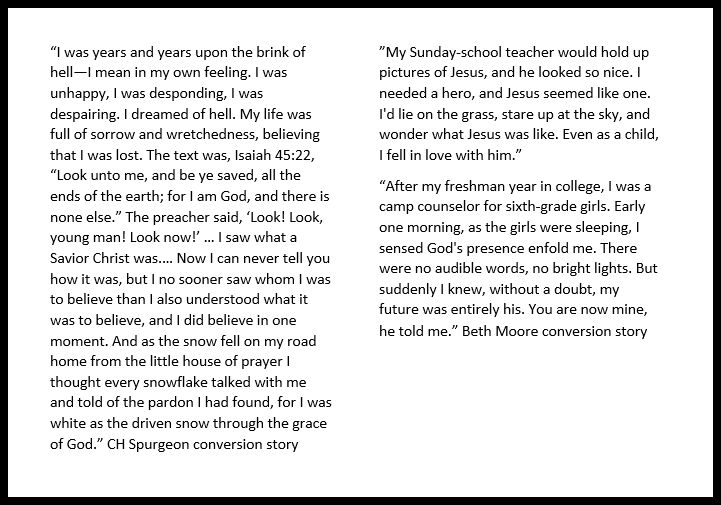
My Sunday-school teacher would hold up pictures of Jesus, and he looked so nice. I needed a hero, and Jesus seemed like one. I’d lie on the grass, stare up at the sky, and wonder what Jesus was like. Even as a child, I fell in love with him. After my freshman year in college, I was a camp counselor for sixth-grade girls. Early one morning, as the girls were sleeping, I sensed God’s presence enfold me. There were no audible words, no bright lights. But suddenly I knew, without a doubt, my future was entirely his. You are now mine, he told me. (source)

If that sounds familiar, it’s because it is very much like many other false teachers’ conversion stories.

It’s a testimony devoid of essential Gospel elements such as sin or repentance, but rife with romantic eroticism. Sarah Young describes her experience this way:

Suddenly I felt as if a warm mist enveloped me. I became aware of a lovely Presence, and my involuntary response was to whisper, ‘Sweet Jesus.’ This utterance was totally uncharacteristic of me, and I was shocked to hear myself speaking so tenderly to Jesus. As I pondered this brief communication, I realized it was the response of a converted heart; at that moment I knew I belonged to Him. (source)

Bob Dewaay explains the problems with such erotic romanticism.

The Bible speaks of the church as the Bride of Christ but does not describe the universal call of the gospel in sensual terms of a lover pursuing His love interest (who may have no interest in return). God is commanding sinners to repent. The gospel calls for repentance and faith, not romantic feelings looking for satisfaction. Voskamp’s romanticism is enhanced by her skill at describing things in a most sensual manner. The sensual terminology is designed to create a mood, a feeling, a sense of romantic mystery that longs for discovery and fulfillment. Those like me who relish clear description of theological concepts meant to be understood and discerned, will be horribly frustrated by the book. Her book is not meant to be a theological text filled with ideas to be judged true or false, but is instead a literary piece filled with feelings to be relished.

Conversion and life in Christ is not the fulfillment from a young girl’s romantic heart, yearning for a boyfriend. It’s the majestic gift of grace from a powerful but merciful God who draws people to Himself and forgives of sin, making them a new creation. Moore’s yearning for a heroic boyfriend is not the same as Godly reconciliation and peace from the spiritual battle in which all are engaged. Sadly, Moore has built a career on the false premise, and many millions have followed her down that path.

Such romanticism is not new nor did it originate with Protestants. Some Catholic mystics were adept at seeking and enjoying such unions. These women were popular in the Middle Ages. Here is an explanation of this kind of conversion story related to a famous Catholic mystic, Teresa of Avila:

Teresa described the soul’s intense desire for God in the language of erotic passion. In this, she belongs to a long tradition of mystical experience that is known as bridal mysticism. … 

The symbolism of bridal mysticism is found already in early gnostic forms of Christianity, where the central sacrament is called the Bridal Chamber. There the feminine soul of the gnostic unites with the masculine spirit and is in this way spiritualized, that is, liberated from the limitations of mundane existence.

The Catholic Encyclopedia explains mystical marriage:

In a more restricted sense, the term mystical marriage is employed by St. Teresa and St. John of the Cross to designate that mystical union with God which is the most exalted condition attainable by the soul in this life. … This state consists of three elements:
1. The first is an almost continual sense of the presence of God, even in the midst of external occupations.
2. The second element is a transformation of the higher faculties in respect to their mode of operation: hence the name “transforming union”;
3. The third element consists in an habitual vision of the Blessed Trinity or of some Divine attribute.

You notice in the writings of these women, especially Voskamp and Young, they mention “Presence”. That’s mystical bridal union state #1.  For example, Voskamp wrote,

The practice of giving thanks . . . eucharisteo . . . this is the way we practice the presence of God, stay present to His presence, and it is always a practice of the eyes.

This notion of continual presence and feeling it tangibly comes from a book written by Brother Lawrence, called Practicing the Presence, who was, you guessed it, a 17th century Catholic mystic.

These “mysti-chicks” such as Voskamp, Moore, Kim Walker Smith and Young, also mention that they have experienced bridal mysticism’s heightened senses and a clarity of thought, and third, they say they continually hear God or see angels or have habitual visions. Just as the Catholic encyclopedia says occurs in their descriptions of what they claim is the state of bridal mysticism.

Compare those flimsy, feelings & emotion saturated female ecstasy conversion stories with a real conversion story. This one is drenched in the scriptures.

Beth Moore’s conversion answer to the Christian reporter was terribly sad in its absence of anything remotely Gospel. A mysti-chick seeking a handsome hero to enfold her and keep her forever is a conversion story more attuned to bridal mysticism than the gritty realty of a repentant sinner saved by grace through faith.

And that’s bridal mysticism. As for the second part of my original question, why is it so prevalent? It is because apostasy is always present. As long as Christianity exists in this age, there will be those who claim to possess a transformed heart but do not possess one.

Now the Spirit expressly says that in later times some will depart from the faith by devoting themselves to deceitful spirits and teachings of demons, (1 Timothy 4:1)

Some of these people making the claim will be teachers, pastors, leaders. If you believe that false converts should be easy to spot, you’re wrong. Judas lived intimately with the disciples and Jesus for three and a half years and none of the disciples even suggested Judas as the false one when Jesus said there is one among them. Philip baptized Simon the Sorcerer, who later was cursed because he thought he could obtain the Spirit by money. Demas walked with Paul, the greatest evangelist on earth, but he showed his true colors when he left Paul because he loved the world more.

If the Disciples, Philip, and Paul could not initially spot a false convert under their nose, neither can we. However, false converts always do or say something eventually to reveal who they really are.

So, mysti-chicks did not originate with post-modern Christianity, nor did they originate in the Middle Ages’ Catholic bridal mysticism. They’ve been around as long as metaphorical Jezebel, whom Jesus threatened to strike dead. (Revelation 2:20-23). Be wary of teachers who have a conversion story absent of the necessary elements, who have added elements, or who have relied on some sort of temporal experience as the basis for their conversion. They must have a clear view of who Jesus is, (Savior) and who they are, (sinner) from the start. Not a mature perspective, because converts are babes in Christ, but a correct one. A house built on sand will not last.

For the ladies who wonder if it is OK to read or study under these false female teachers’ earlier works, ‘when they still seemed solid,’ just remember their conversion was based on sand. They were never solid.

Build Your House on the Rock
Everyone then who hears these words of mine and does them will be like a wise man who built his house on the rock. And the rain fell, and the floods came, and the winds blew and beat on that house, but it did not fall, because it had been founded on the rock. And everyone who hears these words of mine and does not do them will be like a foolish man who built his house on the sand. And the rain fell, and the floods came, and the winds blew and beat against that house, and it fell, and great was the fall of it.” (Matthew 7:24-27).

See below the conversion story of a 16 year old Charles Spurgeon, compared to the 18 year old Beth Moore conversion story. House of sand indeed.

Posted in prophecy, Uncategorized

A mighty scene in heaven

The Tribulation is a future prophesied time of distress on the earth that will be unequalled in affliction, so Jesus said. (Matthew 24:21). This is because He will pour out all His stored-up wrath onto the unbelieving world, and He will punish the nation Israel for their rebellion against Him.

A series of judgments in sets of 7 are unleashed from heaven to earth in proceedings that become progressively worse as each set is executed. The angels are mainly the agents who deliver the wrath.

The judgments go in this order-

The 7 Seals. The seal judgments open the events with a dramatic moment in heaven where John of Patmos had been given the vision which recorded that Jesus is the only One who is worthy to open them. Revelation 5:1-5 records this scene:

Then I saw in the right hand of him who sat on the throne a scroll with writing on both sides and sealed with seven seals. 2And I saw a mighty angel proclaiming in a loud voice, “Who is worthy to break the seals and open the scroll?” 3But no one in heaven or on earth or under the earth could open the scroll or even look inside it. 4I wept and wept because no one was found who was worthy to open the scroll or look inside. 5Then one of the elders said to me, “Do not weep! See, the Lion of the tribe of Judah, the Root of David, has triumphed. He is able to open the scroll and its seven seals.”

The detail that the document was sealed on both sides has meaning. It indicates that it is a legal document. Bible Study Tools explains,

Concerning this practice, Weemse wrote, “For the manner of writing the contract, he who was to buy the ground wrote two instruments; the one to be sealed with his own signet, the other he showed unclosed to the witnesses, that they might subscribe and bear witness of that which was written. This, the witnesses did subscribe UPON THE BACK of the enclosed instrument” . . . Gaston Maspero gave an example of an enclosed document being used as evidence. “Contracts stamped upon clay tablets have been found in Babylonia, enclosed in an envelope of clay, on the outside of which an exact duplicate of the contract is impressed: if in the course of time any disagreement arose and it was suspected that the outside text had been tampered with, the envelope was broken in the presence of witnesses to see if the inside text agreed with it or not.” The fact that the sealed scroll of Revelation Rev. 5:1+ had writing on both the inside and the outside (Rev. Rev. 5:1+), in the same manner as Jeremiah’s and other deeds of purchase in Israel’s land redemption system, indicates that it is a deed of purchase.

The document with the seals upon it is in fact the title deed to the earth.

The revelation then turns to the actual opening of the seals. Jesus has triumphed – on the cross –  and the document is opened by Him who is triumph itself. The judgments begin. The 7th seal unlocks the next series of judgments, which are the Trumpet Judgments. (Revelation 8). These are worse. The ultimate purpose of the judgments are to render wrath for His glory onto the peoples, so they will repent under the knowledge of His active anger. Revelation 8 has the first half of the Trumpet Judgments and the angel announces woe to those on the earth as the worsening of the second half of the trumpet judgments begin. (Revelation 9).

Revelation 10 announces the beginning of the next series of judgments, the Seven Thunders. However in an unusual move, the voice from heaven called out for John to seal up this series of judgments and not to write them down. We do now know why the Seven Thunders are sealed nor do we know what they contain, if they are judgments at all.

The last set of judgments are the Bowls. These are truly the worst of the worst. By now the world has either repented and given Jesus glory, or has confirmed their permanent state of rebellion by accepting the devil’s mark of the beast. The mark is a mark of worship of the antichrist and displays allegiance to him (and the devil). (Revelation 13:15-16).

The scene shifts from the throne as seen in previous judgments, to the sanctuary. The door to the sanctuary is opened and it is an incredible view. Revelation 15:5-8 concludes this chapter and the introduction to the last judgments.

After this I looked, and the sanctuary of the tent of witness in heaven was opened, and out of the sanctuary came the seven angels with the seven plagues, clothed in pure, bright linen, with golden sashes around their chests. And one of the four living creatures gave to the seven angels seven golden bowls full of the wrath of God who lives forever and ever, and the sanctuary was filled with smoke from the glory of God and from his power, and no one could enter the sanctuary until the seven plagues of the seven angels were finished.

No one was allowed to enter. Not the other angels, not glorified humans, no one. Is the reason so that no man or angel may intercede? Is it because God’s glory is so powerful, even for a holy angel or a glorified man? Nevertheless, the angels, those mighty and holy angels, are given the task of delivering the last 7 judgments on the earth.

This is the God of power and judgment. His mercy seat has become a judgment seat. All the millennia of patience, the times of overlooking man’s ignorance (Acts 17:30) are over. He is no longer reasoning with man. (Isaiah 1:18). His might is come to the fore and the sanctuary is filled with smoke. No one is allowed entry. God commands the 7 powerful angels to dispense His final wrath.

It reminds me of the verse in Isaiah 63:3.

I have trodden the winepress alone, and from the peoples no one was with me; I trod them in my anger and trampled them in my wrath; their lifeblood spattered on my garments, and stained all my apparel.

He does indeed tread the wine-press, but it is the great wine-press of the wrath of God (Rev. 14:19, M. Henry). Our precious Lord had taken on all of God’s wrath, had drunk the cup on the cross. He “treads the wine-press” here not as a sufferer, but as an inflicter of vengeance.

It’s good to dwell on God’s love. It”s also good to remember His other attributes- power, wrath, sole arbiter of justice. It is good to remember that these scenes in heaven are future, perhaps to occur in our own generation.  Be clear-eyed about who our God is. He isn’t a romantic Jesus skipping among the daisies to wrap us in His manly arms. He is not a cash machine dispensing wealth from heaven. His attributes include love and mercy, to be sure, but also power, wrath, and justice from the very sanctuary in heaven. He is mighty.

For our God is a consuming fire. (Hebrews 12:19)

Posted in discernment, Uncategorized

Discerning Jen Hatmaker: New stance on affirming homosexual marriage causes Lifeway to pull her books

Christianity Today is reporting on some news Jen Hatmaker has sparked. Jen Hatmaker is an author and reality television personality whose most famous book, 7: An Experimental Mutiny Against Excess was reviewed here on The End Time in 2013. That link is below. At that time I engaged in a two part look at Jen Hatmaker. Part 1 was a review of her book. Part 2 was a closer look at her emerging Catholic-based mysticism.

Hatmaker is in the news of late because she has come out solidly for homosexual marriage, claiming it is not only biblical, but can be a holy ordinance. As a result, Christian bookstore LifeWay, an arm of the Southern Baptist Convention, has stopped selling her books.

LifeWay Stops Selling Jen Hatmaker Books over LGBT Beliefs
One of evangelical women’s favorite authors loses her place in one of America’s largest Christian chains. In an interview published Tuesday, the Austin-based author and pastor’s wife told Religion News Service columnist Jonathan Merritt that she supports same-sex marriage and believes that LGBT relationships can be holy. … The Southern Baptist chain stated Thursday that the author’s statements “contradict LifeWay’s doctrinal guidelines,” and it has discontinued selling her books in its 185 stores or online.

Now is a good time to review what makes Hatmaker’s theology aberrant and why she should be avoided.

The following book review published in 2013 at The End Time gives an overview of how Hatmaker approaches the Bible and her response to it.

Book Review & Discernment- “7: An Experimental Mutiny Against Excess” by Jen Hatmaker, part 1

Part 2 looks at some key phrases in her book which reveal her entrancement with Catholic mysticism and liturgy. If you are a solid teacher of the Bible and a discerning student of it, you will not be promoting practices from false religions. It’s that simple.

Book Review & Discernment- “7: An Experimental Mutiny Against Excess” by Jen Hatmaker, part 2

Here is another good essay discerning Hatmaker,  written in May 2016 by Timothy J. Hammons, titled Jen Hatmaker’s Messiah Complex. Mr Hammons takes issue with Hatmaker’s flawed view of homosexual sin.

Amy Spreeman at Berean Research posted an article about Hatmaker in January 2016 which references her own essay and re-posts Christine Pack’s essay on Hatmaker, too. Four Concerns about Jen Hatmaker’s Teachings.

Just because a Bible teacher or leader is popular does not mean they are solid. In fact, oftentimes the opposite is true. (Luke 6:26).

As always, think these things through and do your investigations comparing to the Bible. Ask the Spirit for help and wisdom. He will give it!

If any of you lacks wisdom, let him ask God, who gives generously to all without reproach, and it will be given him. (James 1:5).

Posted in encouragement, Uncategorized

The ‘Wondrous Strange’ Gospel

Back in 1998 I drove a few hours from my home in Gray, Maine to Rockland, Maine. The destination was the Farnsworth Library & Art Museum. The Farnsworth is a gorgeous museum tucked away on the rockbound coast. The New York Times wrote of the opening of the Farnsworth and the Wyeth collection this way,

Ever since N. C. Wyeth bought a place in Port Clyde, south of Rockland, in the early 1930’s, the family has summered here, and Andrew Wyeth’s painting ”Christina’s World” is, for many people, synonymous with Maine. The Wyeth center is attached to the Farnsworth Art Museum, a respected 50-year-old institution that focuses on artists connected with Maine and that has built one of the best small, specialized collections in the country.

They had advertised a collection I was dying to see. It was called, “Wondrous Strange: the Wyeth Tradition: Howard Pyle, N.C. Wyeth, Andrew Wyeth, James Wyeth.” You might or might not know that the three generations of Wyeths have a deep connection to Maine, and all three generations owe inspiration to Pyle. The generations went like this- Turn-of-the-last-century illustrator Howard Pyle; His student was N. C. Wyeth; N. C.’s student and son was Andrew Wyeth (wife Betsy); Andrew’s student and son was Jamie Wyeth. Betsy Wyeth chose the paintings and illustrations for the show I was driving to see, and named it Wondrous Strange.

The theme of the show is described from the catalog as, “an imaginative, often disquieting, dreamlike imagery.” The catalog/book describes the paintings- “Demonic eyes shining out of a shadowy tree. A blind man staggering through a moonlit landscape. Disembodied, dark hands rising out of snow. A feral dog with one blue eye. Ambiguous shadows harboring human shapes.”

The NY Times described it this way:
While Andrew and Jamie work in cooler times, there is no question that some of the images in ”Wondrous Strange” are really weird. Andrew paints a corpse emerging from a block of melting ice and severed hands perched on ice floes; Jamie portrays himself with a pumpkin head and as a clownish scarecrow. He depicts lighthouses with the same fierce perspective that his grandfather used for Peg Leg Pete.

One of the paintings’ raison d’etre is described by the artist Andrew Wyeth himself as ”to memorialize the emotions he felt upon viewing his father, N. C. Wyeth, in his casket.” Yes. Weird indeed.

Here are a few of the paintings that were mounted in that long-ago show.

“Mischief Night,” by Jamie Wyeth.
“Pumpkinhead Visits the Lighthouse,” by Jamie Wyeth

Treasure Island illustration, NC Wyeth, 1911

One painting that was included in the show was this one, called simply, “Lighthouse”, by Jamie Wyeth. This painting adorns the cover of the catalog/book.

It’s eerie. There’s nothing particularly ghoulish about the scene. In fact, many other paintings were more weird and fiendish. But there is something maniacal and out of control in this painting. The scudding clouds evoke thoughts of monstrous hands strangling the world, the fortress-like lighthouse, the wild hair, the jarring vestment of a wrinkled military uniform worn on a wild hill… the painting is a perspective of the world that’s cracked, tilted, and agitated.

Perhaps that was the appeal- weirdness, agitation, and ghoulish specter of the disquieting. As I said, I’d driven a few hours and it was going to be a day trip, no less. After seeing the exhibition and having lunch with the friend accompanying me, we’d turn around and drive home. The attraction of the wondrous strange to the pagan heart is strong.

The title of the show comes from Shakespeare’s Hamlet Act I Scene V-

HORATIO
O day and night, but this is wondrous strange!
HAMLET
And therefore as a stranger give it welcome.
There are more things in heaven and earth, Horatio,
Than are dreamt of in your philosophy.

Returning from nostalgia, on Saturday I was listening to John Gerstner’s Handout Apologetics this morning. The lesson was on The Gospel of God, lesson 10. Gerstner said of the Gospel,

The question remains, how do I know that this Jesus of Nazareth, a man among men, was more than a man among men? You ask me to believe He was actually God incarnate? When did anybody ever stretch the credulity of the human mind more than when it is asked to believe that that simple peasant of Galilee was God dwelling in human flesh?!

The mind of man couldn’t think it up. To think a Person in the Godhead, would unite humanity with deity, and suffer in that humanity and yet as deity, survive the wrath of the Godhead, that is something that when you read about it in the Bible you know it has to be true, it couldn’t be fictional. It is so strange, so wonderful so beyond human anticipation that it has to be a God-given reality.

Well, you know of course why I spent time writing about the Wyeth wondrous strange exhibition. The mind of man I’d thought was so imaginative in painting and illustrating eerie and strange scenes, is not so wondrous strange after all. The REAL wondrous strange is the reality of the Gospel, of a God whose act of sacrificial incarnation, suffering, and death is SO strange that man had never ever thought it up in any religion, before or since. The wondrous strange mind of God, who had planned this devastatingly necessary separation of His Son from the Godhead since before the foundation of the world, in merciful love and grace, is the strangest wonder of all. As Halloween proceeds through this day, please ponder the most strange philosophy, Horatio, ever not dreamt of in earth, but is real and true from heaven.

Posted in prophecy, Uncategorized

Did you know…about ‘The Nazarene’? Bible fact

We know that Jesus was from Galilee in a region called Nazareth. The region’s largest city is Nazareth. People from that region were often dubbed Nazarenes. Geographic identifiers in the Bible are pretty common. Saul of Tarsus is one. Mary Magdalene might have been so named because she was likely from the town of Magdala. But did you know there might also be a prophecy associated with the name Nazarene? Faithlife Study Bible has more.

Within the four gospels and the book of Acts, the term “Nazarene” (translated from the Greek nazōraiōn or nazōraios) appears about 19 times. It occurs once in an allusion to a prophecy (Matt 2:23) and is applied once to the newly formed group of Christians (Acts 24: 5). All 17 remaining instances of “Nazarene” apply directly to Jesus (Matt 26:71; Mark 1:24; 10:47; 14:67; 16:6; Luke 4:34; 18:37; 24:19; John 18:5, 7; 19:19; Acts 2:22; 3:6; 4:10; 6:14; 22:8; 26:9).

The prophecy quotation from Matthew 2:23 comes in the context of Joseph receiving a dream which tells him to leave Egypt and go to Israel. The passage recounts that in response to the dream, Joseph settles his family in a town called Nazareth (Matt 2:19–23). The Gospel of Matthew connects this geographical movement fulfilled what was spoken by the prophets: “He will be called a Nazarene.” However, an Old Testament text making any statement similar to this does not exist—meaning that another explanation is required.

A few plausible options are available to resolve this issue. The author of the Gospel of Matthew may have been employing a pun or wordplay by associating the Hebrew word for “branch” (netser) in Isaiah 11:1 with the word designating a person as a resident of Nazareth (a “Nazarene”; nazōraios in Greek). The reference to “branch” would have been significant because it symbolized Jesus as a king from the lineage of David.

A second more plausible explanation is that the author may have been alluding to several statements made by a variety of Old Testament texts that focus on the obscurity and humility of the Messiah (e.g., Psa 22:6–8; 69:8, 20–21; Isa 49:7; 53:2–3; 7–8). The term Nazarene had a derogatory connotation, referring to someone from an obscure or insignificant town (John 1:45–47). During Jesus’ day, the town of Nazareth was insignificant from the perspective of Jerusalem (John 7:41–42, 52).

Much later, the term Nazarene appears in the account of the charges leveled against the Apostle Paul. He was facing trial for stirring up dissension, supposedly desecrating the temple, and serving as the ringleader of the “sect of the Nazarenes” (Acts 24:1–5). Jewish Christians were probably given the label because of their connection with Jesus of Nazareth. It likely served as a pejorative term when applied to the Christian community.

DAVID SEAL, Barry, J. D., Mangum, D., Brown, D. R., Heiser, M. S., Custis, M., Ritzema, E., … Bomar, D. (2012, 2016). Faithlife Study Bible. Bellingham, WA: Lexham Press.

There is always more to study with the Bible. We know what we know until there is more to know!

Posted in discernment, Uncategorized

Two divorce cases: Summer White and Melissa Moore

Many Christians have a sin or an issue which they have a particular affinity against or former involvement with. Children of alcoholics tend to have an interest in the Christian discussion of teetotaling. People who had been deceived by charismatic doctrine tend to be focused on deception/purity in the church. And so on.

Mine is divorce.

Continue reading “Two divorce cases: Summer White and Melissa Moore”
Posted in poetry, Uncategorized

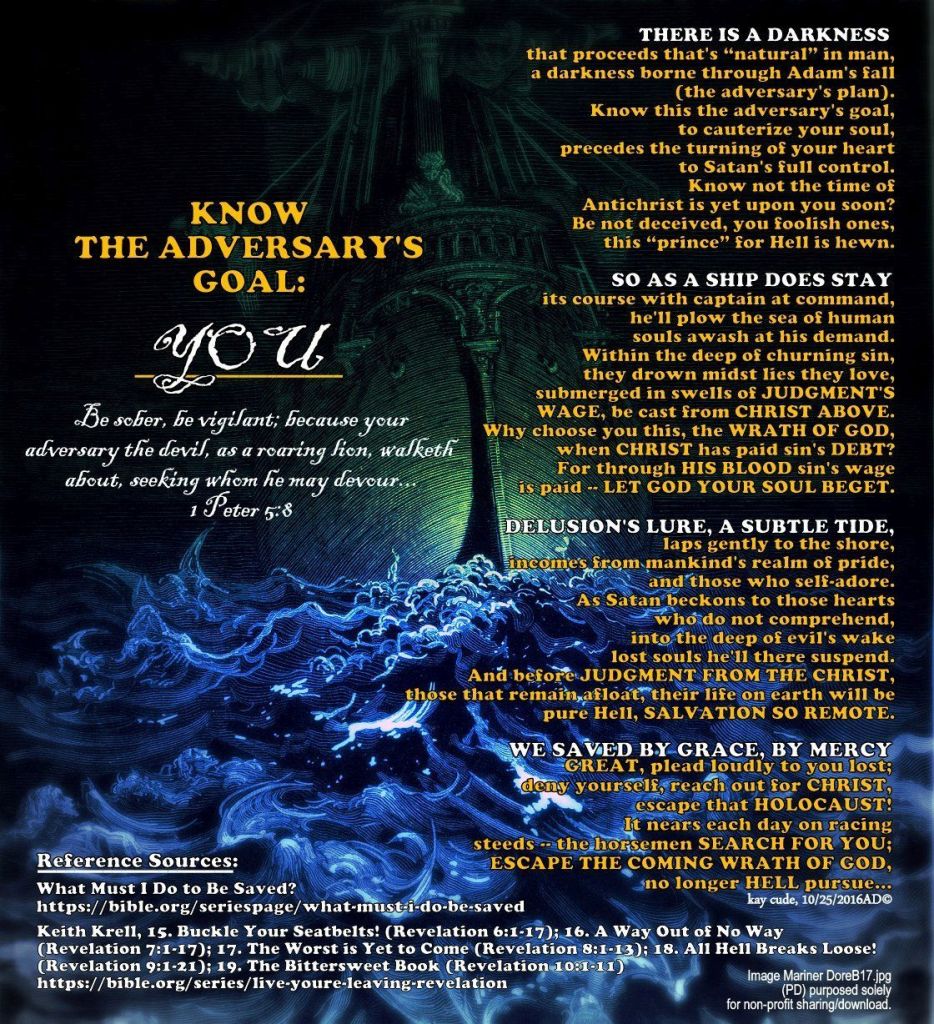
Kay Cude poetry: The Lost, Adrift on a Sea of Deception

Kay Cude poetry. Used with permission. Right-click to open in new tab larger

Artist’s Statement-

If you’ll look closely at the ship’s path forward through the sea, you can make out the images of people suspended within. To me they are representative of the truly lost (never heard the Gospel of Christ) as well as those who have been deceived into a false religion or another gospel–they’ve never met Christ through God’s Sovereign Act of Salvation through His Son. As the onslaught of the Tribulation rapidly approaches, we’ve seen a dramatic and continuous increase of evil capturing countless people; and they, many seemingly unaware, remain afloat within deception.

Then there are those who willfully determine atheism as their god and religion. Greed, evil, pride and “self” are rampant within this nation, reigning within every form of this nation’s governing bodies; within the educational systems; the banking and financial institutions; the media and advertising entities; within our neighborhoods and families; within business institutions and worse, within a preponderance of the “religious denominations and “churches,” organizations and charities claiming to “speak for and serve” Christ.

Surely, God has abandoned this nation to its own desires, to let sin run its fullest course. Yet there remains time for whoever will listen and respond to the call of God through His Holy Spirit to be sovereignly drawn and saved by God the Son, Christ Jesus.

YOU ARE THE ADVERSARY’S GOAL
Posted in potpourri, Uncategorized

Prata Potpourri: Secret Nazi Base, Gay man dislikes Church Discipline action, Star Trek Uniforms, Luther & Reformation Day- more

Our school closes for a few days at the end of October for a mini-Fall Break. We all look forward to this, both the staff and the students. Lots of people take trips. The mountains aren’t far and Fall is a great time of year in Georgia to go tuck away in a cabin somewhere. Others go to Disney because it isn’t so hot, or the beach, for the same reason. I love Fall in Georgia, it’s my favorite time of year. It lasts longer than Fall lasts up north. Its gradual slope into winter leads us to toward holiday season in a gentle way. We can finally turn off the loud air conditioner and start using the oven to bake wonderful things without making the house too hot.

The progression of the seasons is orderly and beautiful. Each season with its distinct colors and meaning is due to the creative mind and power of Christ.

For in Him all things were created, things in heaven and on earth, visible and invisible, whether thrones or dominions or rulers or authorities. All things were created through Him and for Him. He is before all things, and in Him all things hold together. (Colossians 1:16-17)

Here are a few items I believe may be of interest. Enjoy the day, the season, the Savior 🙂

This is interesting. Man starts social media campaign over his church dismissal for unrepentant homosexuality. The next big thing I see coming are lawsuits emerging from church discipline. As a side note, please notice in the article where it says the man had repented and lapsed several times prior to his final repudiation of God’s standards. Remember, repentance should be viewed as something that happens over time. Fruit takes time to grow. Be patient, either way, to see if what is growing in the heart is an apple or a thorn.

Oh the agonizing pull to check notifications or respond to texts…the overarching need for new stimulation even after a few minutes…Samuel D. James has more in his essay The Phone and His Boy.


A Secret Nazi Base in the Arctic has been discovered? And it’s not a wartime myth or clickbait? No, it turns out to be true. Russian researches stumbled onto it and found within over 500 relics, including well-preserved papers. /shudder/ Nazis are still extending their shadowy reach into even this millennium. We will only be removed from the presence and memory of that terrible history when we are resurrected into glory. The UK Independent also has the article and photos.

Death has always troubled the pagan man. Cemeteries have always troubled the aggressive realtor. Decaying biomass has always troubled the zealous environmentalist. Now, these concerns are combined in an unusual proposal for where or how to bury the dead. Is this the future of death?

With Halloween coming, with the inevitable Star Trek costumes abounding, which is as it should be, here is how to read the secret language of the Star Trek uniforms of that most unabating TV show. Which is 50 years old this year by the way. Oy, I suddenly feel old…

The Narrow Minded Woman has a great essay on Luther and Reformation Day.

Ignore the one reference to Rick Warren and enjoy the author’s case for quantifying discernment/judgment of each other. The 10 Percent Grace Rule: Judging Without Being Judgmental

I really like this man’s writing. He muses on You Get What You Pay For, an essay on shepherding financial resources wisely, Philippians 4:8, the election, and Netflix which is cohesive and concise. Really, the guy has mad writing skills.

Julia at Steak & a Bible said, “Hillsong Music: Popular Yes, but Is it Biblical?

Hillsong is an enormous church network and through its music, the church reaches far outside of that network. Many churches use Hillsong songs on Sunday mornings. But I wonder how many of them ever stopped to examine the songs for doctrine. That’s precisely what Chris Rosebrough, Steve Kozar and Amy Spreeman did on a recent episode of Fighting for the Faith. Given the popularity of the music I highly recommend listening to it.

I recommend it too!

Dr. Michael J. Kruger, President and Samuel C. Patterson Professor of New Testament and Early Christianity, RTS Charlotte answers the question of does the Bible have mistakes? Length, 2:40.

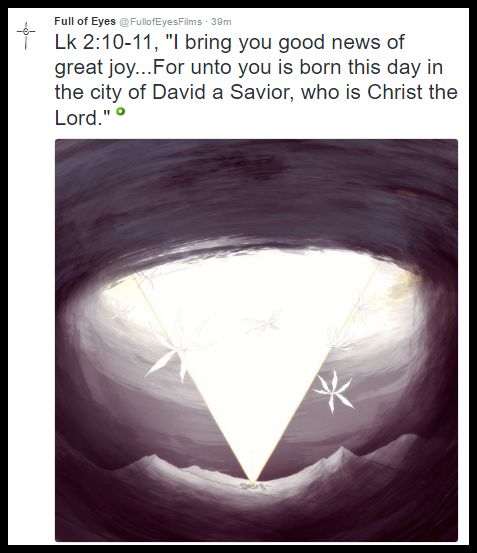
Chris Powers has illustrated another Bible verse with his usual skill, insight, and sensitivity. Take a look,and please take a look at his overall ministry at Full of Eyes. Everything he makes he gives for free for the edification of the body and evangelization of the lost.

Posted in encouragement, Uncategorized

What does it mean to “reason together”?

People are surprised when they learn that the following verse is not in the New Testament. It sounds New Testament-ish. But it’s not in that book.

Come now, let us reason together, says the LORD: though your sins are like scarlet, they shall be as white as snow; though they are red like crimson, they shall become like wool. (Isaiah 1:18).

It’s from Isaiah.

Things get even more interesting. It is the LORD God telling His people to approach Him to reason with Him, and to do it in confidence and not in fear. In the verse, God is speaking to His chosen people Israel.

Gill’s Exposition explains:

Come now, and let us reason, together, saith the Lord,…. These words stand not in connection either with the preceding or following, but are to be read in a parenthesis, and are thrown in for the sake of the small remnant God had left among this wicked people, in order to comfort them, being distressed with sin.

These, seeing their sins in their dreadful colours, and with all their aggravating circumstances, were ready to conclude that they were unpardonable; and, seeing God as an angry Judge, dared not come nigh him, but stood at a distance, fearing and expecting his vengeance to fall upon them, and therefore put away the promises, and refused to be comforted;

when the Lord was pleased to encourage them to draw near to him, and come and reason with him: not at the bar of his justice; there is no reasoning with him there; none can contend with him, or answer him, one of a thousand; if he marks iniquity in strict justice, none can stand before him; there is no entering the lists with him upon the foot of justice, or at its bar:

but at the bar of mercy, at the throne of grace; there the righteous may dispute with him from his declarations and promises, as well as come with boldness to him; and at the altar and sacrifice of Christ, and at the fountain of his blood:

here sinners may reason with him from the virtue and efficacy of his blood and sacrifice; and from the Lord’s proclamation of grace and mercy through him; and from his promises to forgive repenting and confessing sinners: and here God reasons with sensible souls from his own covenant promises and proclamations to forgive sin; from the aboundings of his grace over abounding sin; from the righteousness of Christ to justify, his blood to cleanse from sin, and his sacrifice to atone for it.

We have a good God, abounding in mercy and patience. His grace is eternal. His Son’s atoning sacrifice is eternal. Our communion and reasoning with Him is eternal.

Posted in discernment, Uncategorized

Ted Dekker’s The Forgotten Way: Book Review and a Discernment Lesson

Ted Dekker is a Christian novelist who writes Christian thrillers. He has also written several book series of historical nature, several fantasy books, and Christian fiction. Dekker’s interests and range are diverse. He has won the Christy Award for best fiction book, ECPA Gold Medallion Award, INSPY Award, among other awards and recognition.

This month, Dekker has published a book which diverges from his usual genre of fiction. His new book is a study/devotional. It’s called The Forgotten Way of Yeshua for Power and Peace in This Life. I’ve been asked to look into the book and give an opinion as to its doctrinal solidity.

This article will serve a two-fold purpose. The first part will be to explain and teach how I approach the decision-making process on whether to read a Christian book or engage in a published study. Time is short in our lives and we do not have it to waste on absorbing poor or unhelpful material. Secondly and more importantly, the name of Jesus is tantamount. The material must reflect Him, His word, and His precepts correctly so His name is glorified. Thirdly, as women, we are more prone to error and tend to be unduly influenced by unbiblical things so we must be sure that what we take into our brain doesn’t pollute our brain. (1 Timothy 2:14, 2 Timothy 3:6). Be discerning, wise, and careful.

The second part of this article, as you scroll further down, will be a book review by a man who is familiar with Dekker’s works and who has read The Forgotten Way. So, a lesson, and a review.

How to Approach Whether to Read a Book or Study

I looked at Dekker’s website, and I read the sample lessons in his study and I downloaded the free sample devotionals. I read 30 pages of the devotional.

1. What I do first is, I look for contemporary buzzwords that indicate where a person’s heart or mind lay. If they use standard, biblical words to describe the standard biblical concepts such as justification, sin, repentance, etc, then all well and good. The first red flag I noticed is calling Jesus “Yeshua”. I’ve observed that many mystics seem to think this gives them more piety when they use the Hebrew name. Also people in the Hebrew roots movement call Jesus ‘Yeshua’. It’s an affectation. More buzzwords below.

2. The second big red flag is any leader who says he has discovered a new way, or a forgotten method, or an overlooked verse, or claims new meaning, it’s a problem. The point of Christianity is its unchanging nature because it’s founded on God and He does not change. It also indicates a mountainous pride. “Everyone else has forgotten this, no one else has noticed this, but I am here to rectify that.” Dekker’s promotional material is rife with promises that this ‘new way’ will revolutionize your faith, which leads to the third red flag-

3. Any promotional material that says it will change your life is of concern. The Holy Spirit changes your life, not a method. The point is to get to know Jesus better, not to change our temporal lives. Any time we are with Him in the word or worship or hymns or prayers, we become transformed and our transformation through ongoing sanctification changes our life. But short cuts like a 21 day devotional with a newly rediscovered method such as Dekker’s? I’m always suspicious of claims that promise an immediate jump in sanctification.

4. Fourth, notice if the author uses trendy buzzwords or buzzwords that are from another religion. In Dekker’s case, the promo material as well as the actual study contain many terms associated with New Age. Words such as “alignment, resonating, tuning fork, vibrate, same frequency” abound. These are not biblical words. There are biblical words that describe the concepts Dekker is attempting to get across. Other words that he uses have no biblical grounding. Either way, use the biblical word and not the words that are widely associated with a different religion. Never mind the obvious, that with the Holy Spirit IN us, we are already ‘aligned’ with Him and always on His ‘frequency.’

In considering whether to take up a study or read a Christian book, I ask myself if the writer seems to have a grounded, balanced view of Jesus. It seems that in this new study, Dekker’s entire emphasis is solely on the love of Jesus and not His wrath, justice, holiness etc. In fact, it seems he focuses on what WE can get out of Jesus rather than focusing on His attributes for His own glory’s sake. The constant references to “who we are” and being “able to love ourselves”(I got those from his promo video) are concerning.

There are sweeping claims in the promo material and in the part of the study I’d read. I read such outlandish things as “The whole world longs for the Way of Yeshua” and “An awakening is sweeping the world.” I do not like it when authors make sweeping statements about God as if they know things. Dekker does not know that all 8 billion people of the world long for the way of Yeshua. As a matter or fact, the world rejected and still rejects Jesus and He said they always will. (John 15:18). No one seeks after God. They all go their own way, (Isaiah 53:6), which is not the way of “Yeshua”. So Dekker’s sweeping statements are a problem.

Last, I look at who has supported the book or Bible study, or who promotes it. Dekker has blurb support and recommendations from Elevation Church, which is bad. Other readers liken Dekker’s book to Henri Nouwen, who in fact is a Catholic mystic.

From these flags, I’d say that the book seems to be a misstep for Dekker. It’s sad, because in his video he said he’d been working on it for years. As a woman, I would choose not to read the book/take the study because these red flags are enough to show me there are problems. I don’t want to use the bulk of my brain power while in a study busily warding off potential doctrinal issues. I want to be able to fairly safely engage in the study so as to learn from it and enjoy biblical truths. With so many better studies out there, I’d say give this one a pass.

The Book Review

Here is a review from a friend, Bryn Jones, who has read Ted Dekker’s The Forgotten Way.

I did read his e-book Waking Up, which is essentially a promo for the 21 Day “cleanse,” as he puts it. I wrote a review (2 stars). He gets a couple things very right. For instance, he stresses that we need to find our identity in Christ, not in our own efforts to measure up or prove ourselves. But there’s some wrong in there, too. Like you pointed out, he loves the “love” of God, and he comments on the omnipotence of God, but then fails when defining love. To him, love means never being offended and just showing kindness to everyone, never pointing out wrong, just accepting… etc. 

Oddly, John defines love as obedience to Christ (1 John 5:3). Also, if we’re never to correct anyone, or never to be offended, then there would be no content to the epistles (which were often corrective) and there’d be no reason for Jesus to outline how we are to address issues where a brother sins against us. What I heard is “planks of offense” in Dekker’s promo, which is a phrase I’ve heard from a charismatic friend who regularly quotes from the Word-Faith movement. In that version, they change Jesus’ teaching to say people have “planks of offense” in their eye, rather than the meaning of being guilty of the same issue they intend to correct in other people. I imagine the subtle change is so that these domineering pastors can chastise anyone who tries to correct them by claiming they have “planks of offense.” 

So, Dekker has some good in regard to the identification with Christ, that our position is secured and not in need of our efforts … but then he ignores the actual “elephant in the room” that many who “got saved” but are living lives that are so sinful they’ve “forgotten who they are” might actually not be saved. So, his advice that they need to just “awaken” to the “reality” of their position in Christ sounds rather … universalist.

The other thing that got me about the book was how the author claimed that the Ted Dekker he sees in the mirror, the novelist, is not the real person. It’s like a role he’d play on TV … it’s passing away … the true Ted is this spiritual one in Christ. He assures the readers that he’s not a Gnostic, but it sure sounds like it. I don’t think the “putting off of the flesh” meant that our personalities and occupations and interests are all worldly. God made us who we are and we will be perfected. Maybe I’m being picky. But it sure read very mystic/gnostic to me.

Bryn Jones is the author of the apocalyptic novella RESISTANCE, the thriller, The Next Chapter,the supernatural suspense novella, The Fold, & The End Times Christmas novella, The Last Christmas

~~~~~~~~~~~~~~~~~~~~~~~~~~~~~~~~~~~~~~

I hope this helps. As always, search out these things for yourself, and remember that prayer is the best vanguard. Pray to the Holy Spirit to give wisdom and discernment. (James 1:5). Read your Bible to grow, and be careful of what you choose to study, even from formerly solid teachers.

Be sober-minded; be watchful. Your adversary the devil prowls around like a roaring lion, seeking someone to devour. (1 Peter 5:8)