Posted in encouragement, Uncategorized

God created a colorful world. He didn’t have to…

Genesis 1:1:

In the beginning, God created the heavens and the earth

When God created the earth, He could have made it colorless. He could have used only His brush strokes of black, or gray, or brown. The world could look like this:

Did you ever wonder why God graced us with a common grace of color? He has made the world beautiful in its time, says Ecclesiastes 3:11. This beauty includes the spectrum of colors which we enjoy in all its prettiness. I particularly enjoy colorful flowers.

The Bible has in it of course, references to colors. It doesn’t, however, really explain if colors of the tabernacle meant anything, if they individually had a symbolism. Other colors do have a symbolism. Here is Baker’s Evangelical Dictionary’s entry on color:

Color, Symbolic Meaning Of

Although the Bible contains relatively few references to individual colors, their symbolic associations are theologically significant. Colors usually symbolize redemptive and eschatological themes. The Bible is, however, silent on whether the colors used in the tabernacle, temple, and priestly garments held symbolic meaning.

Black signifies gloom, mourning, evil, judgment, and death (Lam 4:8; Micah 3:6; Zechariah 6:2 Zechariah 6:6; Revelation 6:5 Revelation 6:12). Its image is often one of dense, impenetrable darkness (Job 3:5; Isa 50:3). The terms “darkness” and “night” parallel this usage (Job 3:3-7; Joel 2:2; Zeph 1:15). Hell is the place of “blackest darkness” reserved for the godless (2 Peter 2:17; Jude 13).

The pale horse of Revelation 6:8 resembles the color of the terror-stricken and corpses (cf. Jer 30:6; Dan 10:8). The horse’s color matches the work of its rider. Its rider is called Death, who, with Hades, goes forth to kill a fourth of humankind.

An expensive dye, purple represents wealth and royalty (Judges 8:26; Est 8:15; Daniel 5:7, Daniel 5:16, Daniel 5:29; Luke 16:19); for this reason, idols were attired in purple (Jer 10:9). The purple dress of the harlot symbolized Roman imperial rank (Rev 17:4; Revelation 18:12, Revelation 18:16). Before his crucifixion, Jesus was robed in purple in mockery of him as “king of the Jews” (Mark 15:17, Mark 15:20; John 19:2, John 19:5; cf. Matt 27:28,; “scarlet robe”). Garments of purple suitably clothe a wife of noble character (Prov 31:22).

Red symbolizes blood. Israel’s sin as brilliant scarlet and deep-red crimson is analogous to the bloodstained hands of murderers (Isaiah 1:15 Isaiah 1:18). The images of red, blood-soaked garments of God as an avenging warrior (Isa 63:1-6) and the fiery red horse bringing slaughter through warfare (Zech 6:2; Rev 6:4) describe divine retribution against evildoers (see also Joel 2:31; Rev 6:12). The red color of the dragon (Rev 12:3) and beast (17:3) symbolizes the shedding of innocent blood (11:7; 16:6). The red heifer (Nu 19:1-10) and scarlet wool (Heb 9:19) symbolize the Old Testament means of purification through blood; the New Testament powerfully expresses the fullness of Christ’s atoning work through a contradictory color image: believers’ robes are washed pure white through the blood of the Lamb (Revelation 7:9 Revelation 7:13-14 ; 19:13-14).

White signifies purity and holiness. It depicts complete forgiveness of sin. David and Israel’s bloodguilt would be fully removed, leaving them whiter than snow/wool (Psalm 51:7; Isa 1:18). It represents the absolute moral purity of God (Da 7:9), Christ (Rev 1:14; Mark 9:3; pars.), angels (Mark 16:5 ; pars. Acts 1:10), and believers (Rev 2:17; 3:4-5; 4:4), and thus of the divine judgment of God (20:11) and Christ (14:14). It indicates the certainty of God’s conquest and victory over evil (Zechariah 6:3 Zechariah 6:6; Rev 6:2; 19:11).

H. Douglas Buckwalter, Bibliography. G. W. Thatcher, Hasting’s Dictionary of the Bible, 1:456-58; P. L. Garber, ISBE, 1:729-32; A. Brenner, Colour Terms in the Old Testament; “Color, ” BEB, 1:494-96.

Color is a common grace. Every person on the planet whether young or old, saved and acknowledging the creator or unsaved and worshiping the creation, enjoys the colors of this earth. Everyone can admire a sunset, colorful avian plumage, floral hues that delight the senses.

Theopedia defines common grace as

Common Grace refers to the grace of God that is common to all humankind. It is “common” because its benefits are experienced by the whole human race without distinction between one person and another, believers or unbelievers. It is “grace” because it is undeserved and sovereignly bestowed by God.

The Lord God created a world that is beautiful. Its beauty is enhanced by the colors He created for us (and Him!) to enjoy in our common grace. The painted desert, the lush tropics, the animals, insects, and fish in all their rich tones and hues are a joy. He didn’t have to But He did.

Thank you Lord!

Posted in encouragement, Uncategorized

El Shama: A God who hears, He is a God who listens

Doesn’t it just crush you to pray to Jesus…and know He hears us? It’s incredible, and a privilege we always remember in gratitude.

As Isaiah cried in his wonder and grief, “I am a man of unclean lips!” (Isaiah 6:5). In my case, a woman of unclean lips. Why should I be able to use these lips to pray to Jesus when I am the chief of sinners, wretched woman that I am? What is man that God should be mindful of us? (Psalm 8:4). Why should He hear us?

But He does.

Though ‘El Shama’ is not an official name of God, it refers to the fact that God hears…He listens. God told Hagar to name her soon to be born son Ishmael. Ishmael is is a combination of el and shama, “God hears” or “God listens”. The name would be a reminder to Hagar and all who knew them that He heard Hagar’s cry in the wilderness. (Genesis 16:11). He listens.

Psalm 17:6 says

I have called on you, for you will hear me, O God: incline your ear to me, and hear my speech.

Gill’s Expositions says of the Psalmist’s plea in verse 6,

“for thou wilt hear me, O God; God is a God hearing prayer; he is used to hear his people, and they have frequent experience of it, and they may be assured that whatsoever they ask according to his will, and in the name of Christ, he will hear; and such an assurance is a reason engaging the saints to a constant calling upon God, Psalm 116:2; and such confidence of being always heard Christ had, John 11:41;”

1 John 5:14 says,

And this is the confidence that we have toward him, that if we ask anything according to his will he hears us.

Did Peter forever relive his anguish each morning of his remaining life, when he heard the rooster crow the day awake and remembered his own perfidy? Owww, Peter, I understand your grief, the pain of betraying Jesus in word or in deed from our own sinful actions. Yet…Jesus prayed for Peter. Luke 22:32. He did not pray for Judas. Both men betrayed Jesus, but Jesus prayed for Peter.

If you’re a Christian, Jesus prays for you, too. It’s staggering to consider that the God of the Universe prays for us. He hears us, and He prays for us. We have a superlative God, One who is true and kind and loving and compassionate. Sister, no matter what you are going through, Jesus hears your prayer and He takes your cares to the Father in prayer. Be encouraged.

be strong verse

Posted in Uncategorized, visual theology

He Will Glorify Me: By Chis Powers

Chris Powers is creating visual resources for the global church. As an artist, Powers illustrates and animates theological concepts, and along with his explanations based on and in scripture, he presents thoughtful and beautiful tracts, studies, and videos for the brethren to consume freely. His work can be found on fullofeyes.com, and at Patreon under Full of Eyes, and of course Youtube at his channel Full of Eyes.

Here is a recent drawing:

He Will Glorify Me
By Chris Powers

John 16:14-15, “He will glorify me, for He will take what is mine and declare it to you. All that the Father has is mine…”

“I was reading through John 16 this morning and was once again struck by the unique role that Jesus tells us the Spirit fulfills. The Spirit glorifies the Son, which is to say, He takes from the fullness of the Son’s glory–from the beauty of who the Son is–and makes that known (With the result that the world is convicted, 16:8-11, and the Church is build up in truth 12-15).”

“So, the Spirit shows us the Son, and the Son shows us the Father–an awesome Trinitarian model of divine self-revelation. And its also interesting to note that the Spirit doesn’t come in His Son-revealing work until after Christ the climactic redemptive work of the crucifixion and resurrection. God’ self-revelation has not reached its climax until the Son has poured Himself out for creation’s redemption on the cross. Supreme redemption serves supreme revelation, and the crucified and risen Son is the one declared to us by the Spirit.”

“For this picture, I also wanted to be clear that the Spirit-illuminated revelation of God in Christ happens primarily in SCRIPTURE. How deadly it is when we go wandering outside the Bible for a definitive revelation of the One True God….it happens in the pages of scripture as the Spirit reveals the glory of God in the Son to His bride”

powers

Posted in discernment, Uncategorized

How does the Holy Spirit lead us?

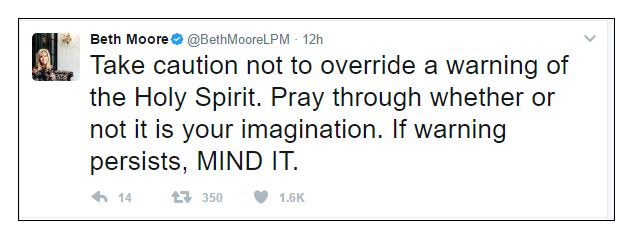
On Facebook last night I’d posted a mini-discernment lesson regarding a tweet Beth Moore had written advocating a process for distilling whether a prompt from the Holy Spirit is legitimate or if it’s your own imagination. I wrote the following in response to her tweet:
moore tweet

Beth Moore is an alleged ‘Bible teacher’. She has 753,000 followers on Twitter alone. The following comment is something she taught a few hours ago on Twitter. Nothing in the Bible says what she taught and teaches. What solid and credible Bible teachers do is teach their pupils to go externally and seek the source of all truth, the Word of God. Moore teachers women to go internally and rely on mystical warnings, feelings, and prompts. What Moore is actually teaching is the insufficiency of scripture and the sufficiency of ourselves in obeying personal feelings.

If Moore was a true Bible teacher she should have written that we seek wisdom from the Bible and follow its commands. We do not rely on the timing of mystical feelings in order to make decisions. We don’t even have to wonder if it is our imagination if we read it in the Word of God. Here is what she should have written-

“Take caution not to override a command of the Lord in His word. Pray persistently in seeking the strength from the Lord you need to obey what is written. Mind the Lord and His statutes.”

I thought that it would be obvious that Moore is teaching something extra-biblical. Obvious.

I was wrong.

I received several comments, one of which asserted that I’d misunderstood the tweet. While it’s always possible I misinterpret an author’s intent within the confines of a 140 character tweet, in this case I’ve studied Moore’s work widely enough to know that I had not done that in this case. I also thought the tweet was plain enough in its assertion.

Another commenter tried to to convince me that there was room for direct revelation. She knows there’s room, she said, because though 99% of the time scripture is enough, sometimes God speaks “very clearly” to her and she knows it’s Him because what He says comes true according to her wishes and wants at the time.

If scripture isn’t sufficient 100% of the time, it is not sufficient at all. God is not speaking clearly or audibly to anyone in any form, not in…

whispers
prompts
leadings
warnings
impressions on our heart
‘told me’
spoke audibly

…because the Bible says that God has spoken though His Son, who IS the Word. (Hebrews 1:2)

Peter said personal experience is never a proper validation of God’s authority, because the word is more sure. (2 Peter 1:19). I notice in these kind of discussions that people assert that it must be God is telling them stuff because what they wanted is coming true. However I notice it never seems to be the case that ‘the Lord told us very clearly one of us will die from cancer’, or ‘the Lord told us very clearly that we will never have children,’ or ‘the Lord told us very clearly that I should stop sinning via pornography.’ No, the direct leading of the Spirit people claim they receive are never that kind, the type that brings bad news against their wish list or commands the person to slay their besetting sin.

Worse, women who claim “He told me very clearly that…” means the woman is claiming prophet status – which elevates her to a position she does not have. Moreover, it discourages other women who have not had the privilege of “hearing directly from God”. They begin to doubt their situations when they aren’t given such personal, clear commands.

One commenter did ask a good question, which formed the basis for this post. She asked, “Where does the Holy Spirit come into it?” Her question is a good one, but a sad one. An entire generation of women have been taught by the Beth Moores etc. that we should expect to be directly (or audibly) led by God, that they do not know what to be led by the Spirit actually means. So here is a post on what it means to be led by the Spirit.

We know the Spirit does lead us. One verse in particular comes to mind, Romans 8:14, where it says so.

For those who are led by the Spirit of God are the children of God.

Now, the Holy Spirit does guide us and convict us and teach us and help us but not in a way we know at the time. You might look afterwards and say, gee, that sure was from the Lord. But at the time, we cannot, must not, rely on feelings, prompts, whispers, inclinations, or imaginations, and attribute them to God. That is dangerous because the flesh is at war with the Spirit. One can never really know if it’s the flesh or not. We are commanded not to obey the flesh, but to slay it. (Mt 16:24). Just because Beth Moore teaches that if the feeling hangs around long enough it must be God is ridiculous on the face of it. The flesh is persistent. Very persistent.

It’s also mysticism and divination to follow promptings and claim they were from God. How can we interpret? We can’t, we’re sinful. So while the Spirit leads, His main ministry is to point to Jesus, who is the Word. John 16:14. That’s why a good teacher also points to the Word, which is more sure.

Here is John MacArthur on the Romans verse 8:14, with a very simple explanation of the Spirit’s leading:

How does He lead us? Two ways. Externally, by the Scripture – externally, by the Scripture, Psalm 119:18: “Open my eyes that I may behold wonderful things from Your law.” Show me the truth of Scripture. Externally by Scripture, internally by sanctification. Those two ways. Externally, Scripture; internally, sanctification.

Therefore, there’s no need for a teacher such as Moore to teach an extra-biblical process for figuring out if the prompting is imagination or not.

Sinclair Ferguson at Ligonier Ministries has a good take on leading by the Spirit, which concurs with MacArthur’s in terms of the main leading of the Spirit being illumination of the scriptures. Remember, the point of the Spirit’s ministry is to point to Christ – who is the Word. (John 16:14, 1 John 4:2).

Spirit of Light, by Sinclair Ferguson
Why, then, are Christians today—in contrast to their fathers—so thirsty to experience immediate revelation from God, when His desire for us is the ongoing work of the Spirit opening up our understanding through the mediated revelation of the New Testament? There seem to be three reasons:

1. It is more exciting to have direct revelation rather than Bible revelation. It seems more “spiritual,” more “divine.”

2. For many people, it feels much more authoritative to be able to say, “God has revealed this to me” than to say, “The Bible tells me so.”

3. Direct revelation relieves us of the need for painstaking Bible study and careful consideration of Christian doctrine in order to know the will of God. In comparison to immediate revelation, Bible study seems—to be frank—boring.

Lest we be brow-beaten and develop a kind of siege mentality as Reformed Christians, here are some things we should bear in mind about the work of illumination:

This is the divine method that produces authentic Christian growth, because it involves the renewal (not the abeyance) of the mind (Rom. 12:2) and it is progressive (it takes time and demands the obedience of our wills). Sometimes God does things quickly. But His ordinary way is to work slowly and surely to make us progressively more like our Lord Jesus.

The result of the Spirit working with the Word of God to illumine and transform our thinking is the development of a godly instinct that operates in sometimes surprising ways. The revelation of Scripture becomes, in a well-taught, Spirit-illumined believer, so much a part of his or her mindset that the will of God frequently seems to become instinctively and even immediately clear—just as whether a piece of music is well or badly played is immediately obvious to a well-disciplined musician. It is this kind of spiritual exercise that creates discernment (see Heb. 5:11–14).

In other words, the Spirit leads us by slowly conforming us to Christ-likeness through the application and illumination of the word in us. Our affections change. As MacArthur above said, by the word externally and by inner sanctification as the word works through us.

Now, is there such thing as impressions or promptings? Ferguson below then Phil Johnson below that, explain…yes…and no.

Ferguson from the Ligonier article above:

Well-meaning Christians sometimes mistake the Spirit’s work of illumination for revelation, which, unhappily, can lead to serious theological confusion and potentially unhappy practical consequences. But the doctrine of illumination also helps us explain some of the more mysterious elements in our experience without having to resort to the claim that we have the gift of revelation and prophecy.

Here the late John Murray spoke with great wisdom: “As we are the subjects of this illumination and are responsive to it, and as the Holy Spirit is operative in us to the doing of God’s will, we shall have feelings, impressions, convictions, urges, inhibitions, impulses, burdens, resolutions. Illumination and direction by the Spirit through the Word of God will focus themselves in our consciousness in these ways. (Collected Writings, I, p. 188).

Again, it’s through the Word.

Phil Johnson, Shepherds Conference 2002, “Super Seminar: Private Revelations”

Now, does the Spirit of God ever move our hearts and impress us with specific duties or callings? Certainly. But, even in doing that, He works through the Word of God. Experiences like this, impressions and all, are not in any sense prophetic or authoritative except as they echo what the Word already says. They are not revelation. Those sensations, those impressions, those feelings you get are not revelation, but they are the effect of illumination. When the Holy Spirit applies the Word to our hearts, and opens our spiritual eyes to His truth. And, we need to guard carefully against allowing our experiences and our own subjective thoughts and imaginations to eclipse the authority and the certainty of the more sure Word of God. This is a very practical application of the principle of Sola Scriptura.

Think about this…to what ever degree you seek private messages from God outside His Word, you have abandoned the principle of Sola Scriptura.

It is simpler and more direct to say something like “My husband and I decided to adopt 3 children” rather than “The Spirit led us to the adoption agency.” It’s more honest to say, “We decided to purchase the organ for the church because we adhere to the biblical principle of cheerfully giving” than to say “We felt led by the Spirit to drive down Main Street where we saw the organ store and God clearly told us to buy it.”

The Spirit leads us into sanctification, where we gradually and inexorably conform to Jesus’ likeness, not by having Him specifically give us explicit directions for certain actions at any given time. But what a joy to know He does lead us!

Posted in encouragement, Uncategorized

Our struggles are not so different

“Help me never to mistake the excitement of my passions for the renewing of the Holy Spirit, never to judge my religion by occasional impressions and impulses…”

Excerpt from the Valley of Vision, today’s devotional, ‘True Religion’. The set of Puritan prayers edited by Arthur Bennett is copyrighted and requested not to be published so I won’t post the entire devotional, as energizing and encouraging as it is. You can read today’s full devotional here.

More info on the book here:

“In this classic volume, edited by Arthur Bennett, the prayers of the Puritans are brought to life. Including prayers of Richard Baxter, John Bunyan, Isaac Watts, Charles Spurgeon, and others, The Valley of Vision is a selection of petitions and meditations in the Puritan tradition. This compilation of prayers is intended to teach and encourage Christians to be faithful in their private and family worship.”

What I love about the book is not just the quality writing, the stirring sentiments, and the deep theological pleas and truths. It’s also that we can see that in the 1600s, 1700s, 1800s Christians prayed and pleaded for the same things we do in the 2000s, go through the same things, have the same cares and wants. O, the thread that connects us to the brothers of the past. It’s glorious and it’s Jesus. He keeps us, He hears us, and He knows us. We are truly family with these precious brethren who lived and loved and struggled, just as we do. Yes, they were heroes, but they were men and women, and thus, had a flesh nature that plagued them until the end. Just as we have and we do.

Sister, are you fighting against temptation to mistake personal passionate emotion for Holy Spirit enlivenment? So did the Puritans. Perhaps it was Bunyan or Watts, or one of the other men who wrote today’s devotional, who asked the Lord in his prayer to help him not mistake passion for Holy Spirit. Are you seeking “to be enrolled amongst the earthly great and rich”? Or are we asking “to be numbered with the spiritually blessed”? as the devotional writer stated. Are we ‘feeling and confessing ourselves a stranger and a pilgrim here’ or do we seek to hide, meld in, or worse, pursue earthly goods and fame? The Valley of Vision writers sought the same spiritual blessings we pursue we do and were yet tempted to stray toward the same paths we encounter today.

The good news is that foremost, Jesus is the same yesterday, today, and forever. (Hebrews 13:8). He responds to our please with the same compassion, care, and perfection that He did to all the previous pray-ers and pursuers we read of in the Valley of Vision.

It is also good news that Jesus knows what is in a man. (John 2:24-25). And He loves us anyway.

He also knows what temptation is, having encountered it at all points. And so He sympathizes with us. (Hebrews 4:15).

He is also God, who is above us and beyond us in comprehension, but He gave us His word so as to know Him and be encouraged by His love and strength when we’re tempted. For when we’re sad. For when we’re confused. For when we fail. For everything.

All Scripture is breathed out by God and profitable for teaching, for reproof, for correction, and for training in righteousness, (2 Timothy 3:16).

Whether we are John Bunyan in the 1600s, the author of Pilgrim’s Progress and nearly 60 other books, whether we are Isaac Watts in the 1700s, writer of 750 hymns and acknowledged as the father of English Hymnody, whether we are 1800s Charles Spurgeon, the Prince of Preachers and deliverer of over 3500 sermons, or whether we are Elizabeth Prata in the new millennium, a Christian woman who isn’t anybody, or whether you are you, we all share the same struggles, the same fears, wants, and affections. We share Christ.

We’re blessed that the Lord raised up good men like the aforementioned ones, and also the editor of Valley of Vision, who compiled these monumental prayers and devotions. We take encouragement from them, and thus strengthened, we go forth as the writer said, paying attention to our principles as well as our conduct, to our motives as well as our actions.

As it says in today’s devotional, please, Jesus-

Give me large abundance of the supply of the Spirit of Jesus, that I may be prepared for every duty…

Posted in natural history, Uncategorized

Natural History moment: Palm branches

How wonderful it must have been to a caravan of spice traders to climb the latest hill and see green instead of brown. Swaying palm branches clustered at oasis signaled water, refreshment, and perhaps, an arrival to their destination and an end to their journey.

When I was a freshman attending college way up in freezing Bangor, Maine, and I traveled to Florida during March/Winter break, the sight of the palm trees gracefully swaying in the blue skies at Palm Beach were a most welcome sight. They signaled warmth, and a relaxing of the strain to constantly keep warm.

Palm trees and their branches figure frequently in the Bible. The first mention of palm trees in the Bible is in Exodus 15:27.

Then they came to Elim, where there were twelve springs of water and seventy palm trees, and they encamped there by the water.

Ahhh, rest. Refreshment, shade. In the Holman Illustrated Bible Dictionary we read about palm trees.

EPrata photo

PALMS: Date palm (Phoenix dactylifera) was among the earliest cultivated trees. Five thousand-year-old inscriptions from Mesopotamia give instruction for their cultivation. Palms are characteristic of oases and watered places (Exod. 15:27; Num. 33:9). The fruit of the date palm is highly valued by desert travelers since it may be consumed fresh or else dried or made into cakes for a portable and easily storable food.

Jericho was known as the city of palms (Deut. 34:3; Judg. 1:16; 3:13). The judge Deborah rendered her decisions under a palm bearing her name (Judg. 4:5). The palm was a symbol of both beauty (Song 7:7) and prosperity (Ps. 92:12). Thus, images of palms were used in the decoration of the temple (1 Kings 6:29, 35; 7:36) and were part of Ezekiel’s vision of the new temple (Ezek. 40:16, 22, 26). Palms were used in the construction of the booths for the festival of booths (Lev. 23:40; Neh. 8:15). In John 12:13 the crowd used palm branches to welcome Jesus to Jerusalem.

When the biblical palm is mentioned, it’s usually the date palm. The palm tree in Florida is usually the royal palm. Here is a page that has photos of all the types.  After a storm in Florida there would be huge palm fronds all over the road. They are huge. A lot bigger and sturdier than they look while the frond is on the tree. The Road Crews would have to come pick them up or they’d end up presenting a hazard to bikers, motorcyclists, and even some cars.

They have similar characteristics like long feathery leaves-although when you are looking up at them they don’t seem that large on the tree. Once pruned or have fallen you quickly realize they are huge. Some get to be 12-15 ft long. That’s a lot of green and also one reason they are often used in the thatch roofs. With leaves this size they provide some real strength once woven together, allowing the roofs to last upwards of 10 years. (Source)

In Leviticus we read,

And you shall take on the first day the fruit of splendid trees, branches of palm trees and boughs of leafy trees and willows of the brook, and you shall rejoice before the Lord your God seven days. (Leviticus 23:40).

Other translations call the palm tree (along with willow, olive, and pine) luxuriant, impressive, majestic, goodly, or magnificent. The context of the Leviticus verse is that God is instructing the people how to make booths for the Festival of Booths AKA the Feast of Tabernacles. The palm leaves were not only used in thatching their booth, but were representative of the joy the Israelites would feel in honoring their LORD.

Speaking of honoring the Lord with palms, we read this in two other verses. Palms were laid on the ground under Jesus feet and waved at Him as he entered Jerusalem. At that time, palm fronds were part of the Israelites’ rejoicing:

So they took branches of palm trees and went out to meet him, crying out, “Hosanna! Blessed is he who comes in the name of the Lord, even the King of Israel!” (John 12:13).

Tribulation saints in heaven will use palms to wave and praise the Lord.

After this I looked, and behold, a great multitude that no one could number, from every nation, from all tribes and peoples and languages, standing before the throne and before the Lamb, clothed in white robes, with palm branches in their hands, and crying out with a loud voice, “Salvation belongs to our God who sits on the throne, and to the Lamb!” (Revelation 7:9-10).

Palm trees of any type are beautiful to me. They are made more beautiful knowing how the LORD uses palm trees to provide refreshment, shade, and sustenance.

The righteous flourish like the palm tree and grow like a cedar in Lebanon. (Psalm 92:12).
Praise the Lord for His greenery.

Posted in encouragement, Uncategorized

Losing my salvation

John MacArthur has famously said on more than one occasion, “If I could lose my salvation, I would.” His comment is a succinct but devastatingly incisive statement about the fallenness of man. The fleshly part of man wants to be in control. It wants to be king of our lives. Even Christians who understand our own depravity and desire to work FOR God soon find that if they do not carefully reign in the flesh, that we are not participating in our own sanctification, but we’re bossing God around and replacing Him with the idol of works.

MacArthur wasn’t guessing when he said what he said. I’ts grounded in the bible. There is biblical precedent for his statement.

God instituted a Doctrine of Works. Don’t bristle. Stay with me. In Genesis 2, God told Adam,

The LORD God took the man and put him in the garden of Eden to work it and keep it. 16And the LORD God commanded the man, saying, “You may surely eat of every tree of the garden, 17but of the tree of the knowledge of good and evil you shall not eat, for in the day that you eat of it you shall surely die.” (Genesis 2:15-16).

As Martyn Lloyd Jones said of the Doctrine of Works in his sermon “The Covenant of Grace in the Old Testament“, the Genesis verses are obviously a doctrine of works. God told Adam to–

–work the Garden
–keep the Garden
–not eat of the fruit.

The inheritance of the reward from God was entirely dependent upon what Adam did or did not do. This is works.

It failed.

It failed immediately and utterly. Adam failed to work correctly for his reward from God. Since we are all in Adam from the moment of birth, from the moment of conception even, (Romans 5:12, Psalm 51:5) we, too, will fail to please God with our works. (Hebrews 11:6).

Once again Lloyd Jones, “If man in a perfect position didn’t keep the covenant of works, then what is the point of God making a new Covenant of Works? And indeed He didn’t. He then made a Covenant of Grace.”

We cannot, cannot, inherit any reward from God based on our own works. We have proved this. It was tried, it failed, it’s done. God made a Covenant of Grace which is that we receive a reward from Him based on HIS choice, HIS will, HIS election, HIS grace. Our reward is all based on faith, and guess what? The faith we have is also a granted gift from Him. (Galatians 3:22). It is a faith that HE keeps for us and in us. It’s sealed. (2 Corinthians 1:22, Ephesians 1:13).

This knowledge of works v. faith has import for those who are in a works-based religion – which is to say everyone else in all other religions, even atheism. Mormons try to reach god through their covenant of works. Catholics try to pile up works so as to acquire enough to please God. Islam teaches “To those who believe and do deeds of righteousness hath Allah promised forgiveness and a great reward,” (Surah 5:9). And so on. And so on. And so on…

Our working out of our salvation through fear and trembling is a result of the sovereign choice of God to dispense faith and repentance to us. It’s based on our knowledge of the above, that our works while in the flesh count as filthy rags. It’s all Jesus, from start to finish, including His reward to us. We receive a glorified body so that we may no longer sin against Him. We become sons, adopted to His family, and thus co-heirs. We receive manifold and eternal mercies in heaven. Most of all we receive HIM. Jesus is our treasure. In His grace he shared Himself with us, gladly, voluntarily.

Praise God for the Covenant of Grace. Because, if I could lose my salvation, I would.

riches of his grace verse