Posted in prophecy, Uncategorized

Holy Week: A Personal God

God is a personal God. Even the thunderous, Mt. Sinai, pestilence-bringing, smiting God of the Old Testament. Yes. Especially the Old Testament God. And of course in the New Testament God is a personal God, too. We see Him in Jesus, who is both fully man and fully God. He had come to serve. He did so meekly and humbly, even washing feet.

We read in Genesis that God created the worlds, He did it personally and carefully, with precision. He spoke them into life.

‘In the beginning, God said’… He spoke.

And God said, And God said, Genesis 1:3, 6, 9, 11, 14, 20, 24.

When it came time to form man, God did not speak. He did it Himself, personally, and with His own breath.

then the LORD God formed the man of dust from the ground and breathed into his nostrils the breath of life, and the man became a living creature… (Genesis 2:7)

Therefore, we see that God’s intimate formation of the world got even more intimate when He made man.

It gets even better.

Because of the life, death, and resurrection of Jesus, we have an even more intimate relationship with Him and He with us. We are His body, His blood covers us. We are IN Him.

It is holy week, so it bears thinking about Him on a special level. We are “in Christ”. We read it in 1 Peter 5:14; Philippians 1:1; Romans 8:1, Colossians 3:3. We have it explained in Galatians 3:26-28-

for in Christ Jesus you are all sons of God, through faith. For as many of you as were baptized into Christ have put on Christ. There is neither Jew nor Greek, there is neither slave nor free, there is no male and female, for you are all one in Christ Jesus.

John MacArthur explained about what it means to be “in Christ” in his inimitable way in the sermon, Under the Law, or In Christ? He opened the salient portion of the sermon this way before going on to spend time expounding what it means to be In Christ. I recommend the sermon.

To ask the question, “What is a Christian?” That question is simply answered, right here. A Christian is one who is in Christ. That’s all. You can imagine following the teachings of Buddha, following the teachings of Confucius, or following the teachings of Muhammad, but you can’t imaging anyone saying, “I’m in Confucius. I’m in Buddha. I’m in Muhammad.” There’s no such thing as a Christian who isn’t in Christ. You see, we’re not following the teachings of a man, we’re in union with Him. If that boggles your brain, you haven’t heard anything yet. In Christ.

We have a personal God. We have a loving God. He is expressly concerned with His creation, and particularly concerned with His children.

It is holy week. Hallelujah to the Lamb!

Posted in encouragement, Uncategorized

New England’s mission drift

I saw a series of unrelated tweets and Facebook statuses which got me thinking about New England…again.

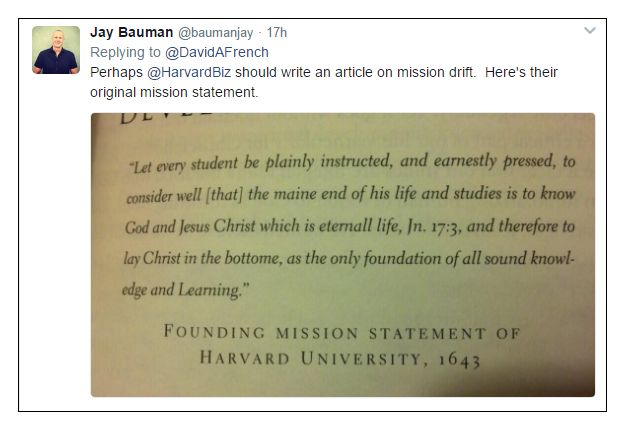
Here is the first tweet:

When Christ came to America, it was to a region later known as New England. In 1620 the Pilgrims actually landed at Provincetown, not Plymouth. They anchored and took 2 weeks to long-boat around the area to scout a suitable harbor and final settling spot. That ended up being Plymouth, and they later expanded outward to Boston and Cambridge.

The Puritans later spanned out across the region, bringing Jesus with them. The reason they left Holland and England was to find a place where they could worship in peace, and they came to the new world to do so. The fire was in their belly and Jesus was in their heart and evangelism was on their mind. With that, by 1636 they had begun a College, established for the express purpose of educating young men in Christian ways and doctrine, so as to become godly leaders of families and good witnesses to the natives for His name. That University was Harvard. Princeton and Yale soon followed.

Wikipedia has the origins of Harvard:

With some 17,000 Puritans migrating to New England by 1636, Harvard was founded in anticipation of the need for training clergy for the new commonwealth, a “church in the wilderness.” Harvard was formed in 1636 by vote of the Great and General Court of the Massachusetts Bay Colony. It was initially called “New College” or “the college at New Towne”. In 1638 the school received a printing press‍—‌the only press in North America until Harvard acquired a second in 1659.

In 1639, the college was renamed Harvard College after clergyman John Harvard, a University of Cambridge alumnus who had willed the new school £779 pounds sterling and (perhaps more importantly) his library of some 400 books

New Light Presbyterians founded the College of New Jersey, later Princeton University, in 1746 in order to train ministers dedicated to their views.

Yale was founded in 1701 in Saybrook Colony to train Congregationalist ministers.

New England was ground zero for religious evangelism and training, but by 2017, the original mission has drifted off center by miles. New England is he most ‘godless’ section of this nation

Back to Harvard. Its original mission and motto was:

Harvard’s “Rules and Precepts,” adopted in 1646, stated (original spelling and Scriptural references retained):

Let every Student be plainly instructed, and earnestly pressed to consider well, the maine end of his life and studies is, to know God and Jesus Christ which is eternal life (John 17:3) and therefore to lay Christ in the bottome, as the only foundation of all sound knowledge and Learning. And seeing the Lord only giveth wisedome, Let every one seriously set himself by prayer in secret to seeke it of him (Prov. 2:3).

Every one shall so exercise himselfe in reading the Scriptures twice a day, that he shall be ready to give such an account of his proficiency therein, both in Theoreticall observations of Language and Logick, and in practical and spiritual truths, as his Tutor shall require, according to his ability; seeing the entrance of the word giveth light, it giveth understanding to the simple (Psalm 119:130).

The motto of the University adopted in 1692 was “Veritas Christo et Ecclesiae” which translated from Latin means “Truth for Christ and the Church.

Yet today (well actually in 2015) according to a major new Pew Study as reported in the LA Times,

The U.S. has become notably less Christian in the last few years, but the shift has come unevenly, with New England and the Pacific Northwest at the leading edge of the social transformation and the South holding fast to more traditional religious beliefs.
Among the 10 states with the largest percentage of adults who profess no religion, New England has four — Maine, New Hampshire, Vermont and Massachusetts — and the other six are in the West, according to a major new study by the Pew Research Center.

Which is all very sad, but not surprising. After the first wave of original apostles, do we hear much about the churches there? Is there a church at Sardis? Corinth? By the time John was an aged man, Jesus gave the Revelation to him and several of the 7 churches in Asia Minor received no commendation from Jesus at all. They were charged with coasting on reputation, having their love for Him gone cold, of allowing false prophetesses to flourish uncorrected, and worse. And that was just within the lifespan of one apostle. After nearly three hundred years, of course if left unchecked, or if compromise had proceeded unaddressed, the churches of New England would falter and die.

Here are some interesting articles about New England’s decline in fervor for Jesus.

Harvard, Yale, Princeton, Oxford—Once Christian?

Most of the colleges in the United States that started over 300 years ago were Bible-proclaiming schools originally. Harvard and Yale (originally Puritan) and Princeton (originally Presbyterian) once had rich Christian histories…

Harvard was named after a Christian minister. Yale was started by clergymen, and Princeton’s first year of class was taught by Reverend Jonathan Dickinson. Princeton’s crest still says “Dei sub numine viget,” which is Latin for “Under God she flourishes.”

The cracks first appeared in the late 1700s and early 1800s, culminating with the influence of Charles Lyell’s three volumes of Principles of Geology in the 1830s. Belief in an old-earth seriously wounded widespread acceptance of the Flood and the biblical chronology, and Lyell just “finished off the victim and nailed the coffin shut,” as AiG historian Dr. Terry Mortenson says.

This old-earth belief permeated universities by the mid 1800s, setting the stage for Darwin’s evolutionary model in 1859 (Origin of Species) and his later work on human evolution The Descent of Man (1871), both of which required long ages. After Christian universities adopted these compromises, the slide from biblical Christianity to naturalism soon followed.

The End Time, July 2014:

Mission New England, the city on a hill where the light has (almost) gone out

No matter where we are in the world, spiritual decline is inevitable. Fear not! The world hates Jesus. (John 15:18). No matter what the type of beginning a nation had, high or low, sacred or profane, all will fall. All parts of all nations will fall. Satan is working mightily to try and overthrow heaven’s gates. The areas we hold dear, where we grew up, or where we live now, will some day be renewed! Every Christian who dwells in the places that are so dark now, will cry with joy when the Light comes. Jesus will revive every ember, bursting into glory light of pure and holy truth.
Until then, pray for New England.

Nate Pickowicz wrote a good book called Reviving New England. Google Books has more

At one time in history, New England was a light to the nations. From its origination, the Northeast region has been a spiritual powerhouse, leading the way for Christianity to flourish in America and beyond. However, after three centuries of vibrant Christian influence, it encountered a perfect storm comprised of false doctrine, liberalism, and materialism, which crippled the church, and plunged the region into spiritual darkness. In Reviving New England, Nate Pickowicz makes a case for the inestimable value of the region, and offers a series of biblical prescriptions for faithfulness. Revival is desperately needed-a mighty work of the Spirit of God to stir the hearts of the people. Now, more than ever, the church must devote herself to the Lord. Not only will the reader be encouraged and spurred on, but Reviving New England offers plausible steps for churches to rededicate themselves, be revitalized, or be planted anew. This is a passionate call to action! (Endorsed by: Mike Abendroth, Hershael York, Dave Jenkins, Todd Friel, Scott Christensen, Terry Wragg, Jimmy Snowden, Ves Sheely)

Whatever your mission statement is or was, whether it was in your church plant, your foreign mission field, your seminary studies, your New Year’s resolution, whatever it was, cherish your mission statement. Be aware of compromises that cause a drift from Christ. Be wary of making decisions that are founded on something other than Jesus and His cross. Be mindful of letting your love grow cold as you seek man’s approval. Mission drift is going to happen. (Revelation 2:4, Revelation 2:14-15, Revelation 2:20, Revelation 3:1, Revelation 3:16, Galatians 1:6, 2 Corinthians 11:4…)

Pray strongly. Stay with Christ. Cling.

Posted in encouragement, Uncategorized

Salvation shall never pass away: art by Chris Powers

Full of Eyes is a support-based ministry of exegetical art that creates still and moving images intended to point people to the beauty of God in the crucified and risen Son. All art and animations are done by Chris Powers. Powers’ goal is to help people see and savor the faith-strengthening, hope-instilling, love-kindling beauty of God in Christ. And he does this by creating free exegetical art in the form of pictures, animations, and discussion guides. His work is at Patreon.com, Youtube, and his website fullofeyes.com

My Salvation Will Be Forever

Isaiah 51:6, “Lift up your eyes to the heavens, and look to the earth beneath; for the heavens vanish like smoke, the earth will wear out like a garment, and they who dwell in it will die in like manner, but my salvation will be forever, and my righteousness will never be dismayed.”

This is one of those simple and yet profoundly beautiful and paradigmatic truths–the vastness and solidity of the heavens will pass away like smoke in the wind, and the depth and strength of the earth will wear out like the knees in my blue jeans. We live in a world of mist. As Paul said, everything that we see around us is transient (2 Cor.4:17-18). And God calls us to remember this, indeed, here in Isaiah the reason for looking at the heavens and earth is precisely to remember that they will not remain. YHWH intends for us to live with the ever present recognition that the world around us is not eternal, it is not forever, it will not always be as it is now, it is passing away.

But….the salvation of YHWH, the righteousness of YHWH–this is everlasting (because He is everlasting), this is sure, this is unshakable and will never pass away.

Oh, to get this into our heads and hearts and imaginations! The world is a tossing surf of change and uncertainty, but the strong rock of YHWH’s Name and Character and of the salvation He works for His people–that is where our hope is to be found, that is where we are to cling and hold and hide and hope. And note also that if the Lord’s salvation is forever, the implication is that those who are saved by this salvation will, in some way, be forever also. This is not a fully developed doctrine of the resurrection and eternal state of new creation (though I think that Isaiah does think in those categories), but it certainly hints in that direction.

And how will the Lord work this everlasting salvation? How will He reveal this never-dismayed righteousness? Through the Suffering Servant, through the gospel of the glory of Christ who is the image of God, the gospel that is the power of God unto salvation to all who believe because in it the righteousness of God is revealed. The surrounding passages in Isaiah introduce the Servant (50) and move into a foretelling of His suffering, death, and resurrection (52-53), this is how the eternal salvation of God breaks into the transient world of humanity…..And we cling to Him!…..we lay hold of this rock of salvation, this anchor of righteousness and are unmoved…….those who trust in YHWH–who trust in the crucified and risen Son–will sing songs of joy and see visions of beauty long ages after the sun has burned down and Everest has blown away in the wind.

Posted in discernment, Uncategorized

What does it mean to teach by allegorizing the scriptures?

Twisted scriptures

In 2 Peter 3:16, Peter wrote,

as he does in all his letters when he speaks in them of these matters. There are some things in them that are hard to understand, which the ignorant and unstable twist to their own destruction, as they do the other Scriptures.

First, please note that he said that those who twist the scriptures do so to their own destruction. So often when I write about false teachers, false doctrine, and actually name the false teachers of doctrine, the ignorant and unstable become upset with it. They fire angry emails and comments asking what have I done lately for the Lord. They charge me with failing to pray for these misguided souls. They claim the false teachers are just making a temporary mistake and all will come out right in the end if we but have patience and love.

Not so.

Scripture twisters to be destroyed

They twist the scriptures to their own destruction. Here is MacArthur commentary on that part of the verse:

By distorting the scriptures, the false teachers were simultaneously securing their own destruction, (cf. 2:2, 3-12, 3:7; Jude 10, 13; Rev 22:18-19) as well as the spiritual demise of their followers. That’s why Peter warns his beloved readers beforehand,  so that they might be on their guard against the error of such unprincipled men (Phil 3:2; 1 Tim 4:1-7, 6:20-21; 2 Tim 2:15-19; Titus 1:16, 3:10).

Distorting the scriptures is a serious business. The many warnings not to do so should be taken seriously, not the least reason is that there are so many ways to distort the scriptures. This essay discusses two of them, spiritualization and allegorization, which are very similar.

Allegorization: A Twisted Practice

Here is John MacArthur defining spiritualization/allegorization:

What do you mean spiritualize or allegorize? Well, you use Scripture like some kind of story and make it mean whatever you want.

Here is Rev. Matt Slick defining allegorization:

To allegorize means to use a symbol as representing a more complex idea.

An example of this erroneous method of interpreting the Bible is recounted by John MacArthur, when he did just that in his very first sermon:

John MacArthur on “Don’t Spiritualize

Third, don’t spiritualize the straightforward meaning of a Bible verse. The first sermon I ever preached was a horrible sermon. My text was “An angel of the Lord descended from heaven and came and rolled away the stone” (Matthew 28:2). My sermon was “Rolling Away Stones in Your Life.” I talked about the stone of doubt, the stone of fear, and the stone of anger. That is not what that verse is talking about; it’s talking about a real stone. I made it into a terrific allegory at the expense of its plain meaning.

On another occasion I heard a sermon on “they cast four anchors…and wished for the day” (Acts 27:29 KJV); the anchor of hope, the anchor of faith, and so on. Those Acts 27 anchors were not anchors of anything but metal. … Don’t spiritualize the Bible; study it to gain the right meaning.

It’s not just men who allegorize. This wrong method of interpretation appeals to many false women teachers, too. It seems like a good method for the women who are emotionally driven and spiritually lazy. Like Beth Moore.

Exegetical Errors – If Mrs. Moore is exercising the position of a Bible teacher, then she should be able to properly exegete Scripture. Unfortunately, she is guilty of frequent allegorization where she misapplies Scripture. To allegorize means to use a symbol as representing a more complex idea. The problem is that with allegorizing, Scripture can be made to say almost anything. Let’s take a look at a few of the many examples of Beth Moore’s improper biblical interpretive practices.

Quote: Speaking of the demoniac of Matt. 8:28-34, she says, “before we proceed to the next point, consider a fact revealed in verse 27. The demonic didn’t live in a house. He resided in the tombs. I wonder how many people today are living “in the tombs”? I know a woman who is still so oppressed by despair that decades after the loss of a loved one, she still lives “in the tombs.” (Jesus, the One and Only, by Beth Moore, B & H Publishing Group, Nashville, Tenn., 2002, p. 143-144).

Response: The biblical text is about Jesus’ authority over the demonic realm, not about people living “in the tombs.” The two demoniac’s that were living in these dark places were exceedingly violent (v. 28). They said to Jesus, “What do we have to do with you, Son of God?  Have you come here to torment us before the time?” Jesus then commanded the demons in these two men to leave, and they went and entered into swine (vv. 31-32). The point of the text has nothing to do with people who are held in bondage by emotional traumas. Beth’s allegorizing the text to make it fit her need is a wrong use of the text.

As both John MacArthur and Matt Slick stated, the danger of spiritualizing and allegorizing is that the person who is spiritualizing can just pick out of the air any symbol they want to make mean something and use it to interpret the Bible that way. Once you unhitch from the text you can then insert any symbol for any meaning or interpretation you like. “In the tombs” are not actual tombs, but symbolizes woman in despair. The “anchors” are not anchors but stand for faith, hope, etc. The “stone” was not a stone but symbolized fear. If I decided to allegorize those same texts I could decide that tombs means marginalized people in social injustice, anchors means lack of sanctification progress, and stone means hindrance to prosperity. Voila.

The only acceptable allegorizations

The Bible does have some allegories within it that can be explained as they are. There’s –

  • Nathan’s parable of the rich man who killed a poor man’s beloved pet lamb, 2 Samuel 12:1-4
  • Jesus’ parables have a wide range of degrees of allegorical symbols, many of them explained in the text just after the recording of the parable itself.
  • In Galatians 4:21-31 Paul uses the story of the children of Sarah (Isaac) and Hagar (Ishmael) and the images of Jerusalem above and Mount Sinai as a double allegory, which Paul then goes on to explicitly explain. “Now this may be interpreted allegorically: these women are two covenants…(v. 24)

No need to make up our own symbols when the few times allegories are used in the Bible they are already explained for us. Nor does the presence of allegories in the Bible give us license to continue our own allegorizations. Scripture interprets scripture.

Good interpretive practices

This article from 9Marks discusses the 9 marks of a prosperity gospel church by comparing good church practices with prosperity church practices. One could just as easily substitute any false practice by comparing to these 9 good marks. Topping the list is that a good church will practice expositional preaching on a regular basis.

Expositional preaching is

…at its simplest is preaching that is focused on explaining the meaning of Scripture in its historical and grammatical context. Expositional preaching involves explaining what the Bible says to a contemporary audience that is likely unfamiliar with the cultural and historical settings that the passage was written in.

The word exposition simply means “a setting forth or explanation.” So expositional preaching is the explanation of Scripture that is based upon diligent study and careful exegesis of a passage. It is the primary call of the pastor or preacher as we see in 2 Timothy 4:2: “Preach the word! Be ready in season and out of season. Convince, rebuke, exhort, with all longsuffering and teaching.”

No need for application

Where many preachers get into trouble is that they believe their sermon needs some sort of ‘application’ at the end. It could be that they have interpreted rightly, have explained the text in a solid expositional sermon, but when they get to the end they feel that it needs explicit teaching on how to apply the text to their congregants’ lives.

Here is an answer to the oft-asked question “Why Doesn’t John MacArthur Add much Application to His Sermons?” He is asked this because he is one of America’s best known-preachers for teaching exposionally, having taught verse-by-verse through the entire New Testament over the course of 42 years. Yet there is very little application in any of his sermons. Here’s why:

Now let me tell you what happens when you preach effectively. You do explanation. In other words, you explain the meaning of Scripture, okay? The explanation carries with it implication. In other words, there are implications built into this truth that impact us. You add to that exhortation. And I’ve said things tonight to exhort you to follow what is implied by the text. Now when you deal with the text and the armor of God, like tonight, all I can do is explain it. That’s all it does. There aren’t any applications in that text. It doesn’t say, “And here’s how to do this if you’re 32 years old, and you live in North Hollywood.” “Here’s how to do this the next time you go to a Mall.” “Here’s how to do this when you go in your car and you’re driving in a traffic jam.” It doesn’t tell you that. And if I made my message mostly a whole lot of those little illustrations, I would be missing 90 percent of you who don’t live in that experience.

It’s not for me to do that. Application belongs to the Spirit of God. All I’m interested in is explanation and its implications. And the power comes in the implication and the Spirit of God takes the implications of what I’ve said tonight, all these things I’ve said, I don’t need to say all kinds of little scenarios to you and paint all kinds of little individual circumstances. All I need you to know is this is what the Word of God says and the implications are powerfully brought to bear with authority on your life and I exhort you to respond to those implications, it is the Spirit’s work to drive those implications into direct and personal application.

Ladies, I Warn About Beth Moore Again

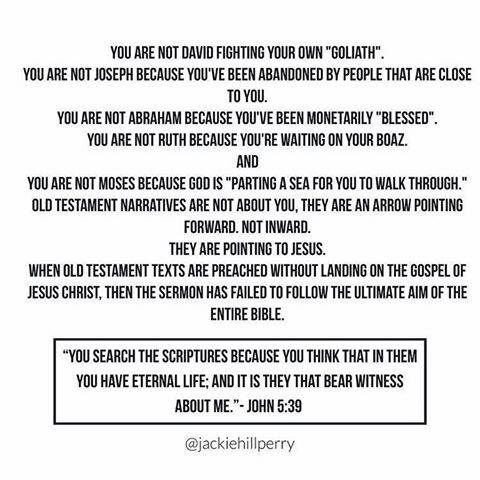
I’d like to refer you again to the picture at the top. I’ve listened to a lot of Beth Moore as well having listened to as other ladies who claim to be good Bible teachers. Beth Moore is not a good Bible teacher. If you have gone through her “Bible studies” please think about how many of the examples Moore has used like the ones in the picture at the top. The example from Matt Slick is only one of the several of Moore’s faulty interpretations he reported. Chris Rosebrough has also explained why Moore’s allegorizations are faulty. So has Justin Peters. Mike Abendroth. And so on.

I consider Moore “patient zero” in the infection into conservative, evangelical circles of her faulty way of teaching through made-up allegory. She has done it that way for so long that generations coming up are now also teaching it that way.

I warn you to avoid any teacher who consistently uses allegorization as their main way of interpreting scripture. Remember, they twist to their own – and their followers’ destruction.

Posted in discernment, Uncategorized

Re-Post: Paul said, “Be Not Ignorant!”

I wrote and posted this 6 years ago, in April 2011. It’s even more true today, as masses of believers are ignorant of eschatology, spiritual gifts, and Israel’s future. What’s worse, they think that’s OK.

~~~~~~~~~~~~~~~~~~~~~~~~~~~~~~~~~~

Paul warned his readers in three different Epistles not to be ignorant of something. In all three cases, the word is the same, agnoeó. It means ignorant of facts. In terms of comprehending the bible, there are certain things to be aware of. When imperatives are used, we need to be pay special attention. When a command is used, we should perk up to something we are being told to do, or not do. The Holy Spirit inspired all the bible writers to write these words, and the Holy Spirit is one part of the Triune God. So God is commanding something, and we have to PAY ATTENTION.

Paul said, “I do not want you to be ignorant of this mystery, brothers and sisters, so that you may not be conceited: Israel has experienced a hardening in part until the full number of the Gentiles has come in,” (Romans 11:25). Barnes Notes explains the word ‘mystery’ thus:

“Ignorant of this mystery – The word “mystery” means properly what is “concealed, hidden, or unknown.” And it especially refers, in the New Testament, to the truths or doctrines which God had reserved to himself, or had not before communicated. It does not mean, as with us often, that there was anything unintelligible or inscrutable in the nature of the doctrine itself, for it was commonly perfectly plain when it was made known. Thus, the doctrine, that the division between the Jews and the Gentiles was to be broken down, is called a mystery, because it had been, to the times of the apostles, concealed, and was then revealed fully for the first time.”

Paul was explaining to the Jews that though the Gentiles were now coming in, God would not forsake the Jews totally. After all, Paul said Jesus had saved Paul, hadn’t He? It wasn’t over for the Jews, but Paul did remind them that God was now rejecting a large part of the nation because of their past rebellion. His attention and grace would be showered on the Gentiles, who were being grafted in. The Jews would remain hardened of heart – until the full number of Gentiles was met. But just as God had always done in the past, a remnant would be saved.

The Jews would receive their Kingdom as promised, but their entry into it must as always be by faith through His grace, not birthright. As for us today who have claimed salvation through Jesus – Whom we recognize as our Messiah – we will continue in the Church Age until the full number is filled and then we fly. It is why the rapture isn’t a date, it is a number. It will not be May 21, unless that is the day that God has deemed the Church quota filled.

The second thing Paul said not to be ignorant about is spiritual gifts. “Now concerning spiritual gifts, brethren, I do not want you to be ignorant:” (1 Corinthians 12:1-3). Paul was reminding the Church of the importance of the gifts, through which we accomplish the work the Holy Spirit wants us to accomplish to build up the church. (1 Corinthians 14:12) The gifts are important, they are given (which is a grace and a blessing) to build up the church (ditto) and they grow the Christian himself as well (bonus). Bible.org explains, “a spiritual gift is the supernatural ability to carry out the work of Christ through his church.”

And yet the spiritual gifts doctrine is precisely what many people are mixed up over. ‘You must speak in tongues or you’re not a real Christian.” “What’s my spiritual gift, let me take this questionnaire.” People certainly are ignorant of the gifts, sad to say. Satan did a good job of mixing us all up on that. If we are mixed up as to the truth of the spiritual gifts, then we are not as effectively building the church, are we?

Thirdly, Paul warned the church not to be ignorant of the doctrine of Last Days and the Coming of The Lord. “But I do not want you to be ignorant, brethren, concerning those who have fallen asleep, lest you sorrow as others who have no hope.” (1 Thessalonians 4:13)

Jamieson-Fausset-Brown Bible Commentary explains:

“The leading topic of Paul’s preaching at Thessalonica having been the coming kingdom (Acts 17:7), some perverted it into a cause for fear in respect to friends lately deceased, as if these would be excluded from the glory which those found alive alone should share. This error Paul here corrects.”

What are the exact three things the Church is ignorant of? What are most arguments over these days? The rapture doctrine and what is forecast for Israel, the spiritual gifts doctrine (speaking in tongues and healing gifts, and the Charismatics, for example) and the doctrine of the Coming of the Lord.

Paul said do not be ignorant three times, and yet in this day and age so many people are three times as ignorant as they ever were.

A solution for ignorance is available. The Spirit. He helps interpret scripture: 1 Cor. 2:1,14; Eph. 1:17. If your house was on fire, you would call the fire department for help, wouldn’t you? If a robber was breaking into your house, you would call the police department wouldn’t you? Both are dire circumstances, signifying events that need an authority of higher power and skill to help you. And yet we so often fail to call the Holy Spirit, our higher authority possessing more skill and knowledge to bring to the situation than we could ever hope to see anywhere! Praise Him. Here is a good page outlining the ministry of the Holy Spirit.

Ignorance leads to error. “Jesus answered and said unto them, Ye do err, not knowing the scriptures, nor the power of God.” (Matthew 22:29) Call on Him through prayer, and abide in the Spirit’s power:
But if the Spirit of him that raised up Jesus from the dead dwell in you, he that raised up Christ from the dead shall also quicken your mortal bodies by his Spirit that dwelleth in you.” (Romans 8:11).

blind to the truth
Do not be blind to satan’s schemes. Life is not a game and it is not to be frivolously wasted. Collage by EPrata
Posted in discernment, Uncategorized

Billy Graham Rule: a short, touching follow up by Jared C. Wilson

Yesterday I’d published a piece on the criticism of Vice-President Mike Pence and his statement that he does not eat alone or spend time alone with women other than his wife. Pence’s commitment stems from what’s known as the ‘Billy Graham Rule.’ Early in his career Graham had set out 4 rules by which he and his team would follow.

-Don’t be alone with women
-Don’t criticize the local church
-Be scrupulous with reporting Crusade attendance
-Be transparent with Crusade finances

In my piece yesterday, I’d looked at the issue of one’s motivation for instituting personal rules for behavior. If your motivation is to serve and honor God, personal rules can be an enhancement to one’s sanctification, although caution is needed so one’s rules don’t become a substitute for scripture, nor a hard-and-fast blind tradition. If your motivation for instituting personal rules is external-only and to win man’s approval and applause, and to avoid man’s criticism, then no rule is going to aid your sanctification, ever.

Today’s follow-up piece has one point. Man will always criticize you, especially if you’re a pastor. The flesh in man, sanctified or unsanctified, always finds a negative in which to fill in a gap. Even if you institute ‘Billy Graham Rules’ like Graham did, where he chose even to avoid eating with his adult daughter because of how people might perceive it if they didn’t know she was his daughter, man will still find something with which to criticize you. That’s what the part below clearly shows us.

So, are strict rules worth it especially they cause you to violate other scriptures in the process? No. And if you somehow miraculously achieve being well-spoken of by many, it may be a woe to you! (Luke 6:26). Though we do care about appearances because we do care about holiness, we also know that there will always be someone on the fringes watching and accuse you, (me) either to our faces or behind our backs.

Finally, Jesus behaved perfectly and followed ALL the rules, and He was killed. We can never escape criticism, if that is your reason for instituting personal rules for behavior.

If we are SO concerned with appearances that we alter our behavior to the degree that the rules we institute to guide us overtake our genial and joyful nature in Jesus and trust in Him as our ultimate Advocate, then we have become a Pharisee.

The best thing to do with respect to personal holiness is to follow the Bible’s prescriptive commands. Follow the spirit of the descriptive gray areas. Be scrupulous and transparent in behavior. If you follow the center line of Jesus’ path you will be well-served, because Jesus is your Advocate.

The crucible is for silver and the furnace for gold, And each is tested by the praise accorded him. (Proverbs 27:21)

Jamieson-Fausset-Brown Bible Commentary explains the Proverbs verse:

Praise tests character. A man to his praise—according to his praise, as he bears it. Thus vain men seek it, weak men are inflated by it, wise men disregard it, &c.

With those thoughts in mind, here is Pastor Wilson’s recounting of his experience with the Pharisaical accusers. The sentences are in short bursts because this was a Twitter blast. In my opinion, the recounting of that experience is a good illustration of Matthew 23:23-24, where people were so concerned with appearances they forgot love, mercy, and kindness.

Woe to you, scribes and Pharisees, you hypocrites! You pay tithes of mint, dill, and cumin, but you have disregarded the weightier matters of the Law: justice, mercy, and faithfulness. You should have practiced the latter, without neglecting the former. 24You blind guides! You strain out a gnat but swallow a camel.

~~~~~~~~~~~~~~~~~~~~~~~~

I [Jared C. Wilson] was once accused of eating a meal with a woman for lustful reasons, even though it was in plain view of our church in fellowship hall.

She was a lady from our town, an unbeliever, and dressed immodestly. I entered the hall late after most everyone was seated at tables.

She was at a table all by herself. Numerous church folks, women included, filed past her to sit at other tables. The image stunned me.

I stood there for a second & watched this lady sitting all alone, ignored and unmet. And my heart was broken for her. I sat down w her.

I was not attracted to her at all. She was dressed immodestly but she wasn’t, to my taste, attractive. (Not sure why I share that.)

I heard her story. Drug addict. Single mom. In and out of hospital for constant surgeries after a car accident.

I listened mostly. Invited her to come to church service. (This was a community fellowship-type thing.) But I mostly listened.

Almost immediately after, 2 ladies approached me, smirking, cracking jokes about pastor sitting with woman w “boobs hanging out”

I said, “If either one of you, or anybody else, had deemed her worthy of your time, I might not have needed to.”

I also told them I didn’t appreciate the accusations, which could do great harm to the reputations of me, my family, and the church.

One of them apologized. The other kind of snooted & walked away.

In that instance, at least, I was willing as a pastor to have my reputation “tarnished” for doing what I think Jesus would have done.

Not sure if that relates to the “Billy Graham rule,” which I mostly hold to personally out of respect for my wife. But, The End.

Jared C. Wilson is‏ Director of Content Strategy, @MBTS. Managing Editor, of For the Church, Gospel-centered resources from Midwestern Seminary, Director, Liberty Baptist Church Pastoral Training Center, @jaredcwilson.

Posted in discernment, Uncategorized

Mike Pence, the “Billy Graham Rule” and Pharisees

Of late the secular world has mocked a Christian. It’s not news.

Except that the Christian they mocked was the Vice President of the United States, which tends to be news. Further, the mocking ensued because Pence had said he chooses to honor his wife by not spending time alone with women, including eating in restaurants alone with them.

Gasp. Yawn.

This week Vice President Mike Pence was called everything from crazy to bizarre to employing ‘benevolent sexism’ to being a misogynist. In one of the more tame news articles about the issue was the UK Guardian. I chose The Guardian over CNN, NPR, Time Magazine etc. specifically because the media outlet is not American and hopefully they would have some objectivity. Author of the article, Jessica Valenti, opened it this way:

this week a Washington Post article about Karen Pence revealed that the vice-president will not eat a meal with a woman other than his wife. Those on the right are commending Pence’s marital devotion and moral fortitude, claiming that such a rule is a smart defense against sexual temptation.

One conservative blogger questioned where there was ever a good reason for a married person to eat out alone with a member of the opposite sex; the former CEO of the blog RedState chimed in to answer: “Planning your spouse’s surprise party or funeral and that is it.”

penceLeft, VP Pence with wife Karen at Pre-Inaugural dance. Source

So far, so good. Valenti ended her article this way:


Pence is a misogynist. We know it from his voting record, we know it from the things that he’s said about women’s rights and now we know it because of his odd personal rule not to dine with women alone. But let’s not let one man’s sexism distract us from his whole party’s sexist agenda.

OK, so maybe the objective perspective I was hoping for isn’t there after all. But are we surprised? No.

Alternately, The Baptist Press wrote:

Southeastern Baptist Theological Seminary President Daniel Akin responded that he has made the same commitment to his wife Charlotte … Akin, author of two books about marriage based on the Bible’s Song of Solomon, told Baptist Press, “The day I married Charlotte I made the same pledge to her that Mike Pence has made to his wife. I have never broken it. I promised her I would never be alone with any woman other than she. I did not make this promise because I am afraid of women or think they are of lesser value and worth than men. I made it because I know the sinfulness of my own heart.

“The Bible teaches us that King David was a man after God’s own heart,” Akin said in written comments. “But because he was at the wrong place, at the wrong time and with the wrong person, he lied, committed adultery and murdered. I doubt I love God more than David. If something like that could happen to him, then it could happen to me. My goal is to go to my grave being faithful to Charlotte. I really don’t care what the world thinks when it comes to this issue.”

Akin’s explanation goes to the heart of Godly conduct. There is a difference between loving God and wanting to honor Him through our behavior, and men who want to appear sincere because they seek man’sglory and applause.

In the late 1940s and 1950s, the Rev. Billy Graham became the
‘primary engine of America’s Cold War religious revival.’ Source
Courtesy of Billy Graham Evangelistic Association BY TIM FUNK

Mike Pence’s vow comes from what’s colloquially called “The Billy Graham Rule.”

In 1948 when the famed traveling evangelist was starting what became his itinerant global program, Graham realized that certain problems had consistently plagued previous traveling preachers. At that time, Graham was also grievously affected after reading the 1927 book by Sinclair Lewis, Elmer Gantry.

Gantry is an incendiary indictment upon huckster preachers. Author Lewis exposed the fictional character’s hypocritical mindset from the inside of the huckster’s conscience and showed the true evil of religious charlatanism. The book infuriated America. Here is Wikipedia with a synopsis of the book’s reception:

The result is a novel that satirically represents the religious activity of America in evangelistic circles and the attitudes of the 1920s toward it. On publication in 1927, Elmer Gantry created a public furor. The book was banned in Boston and other cities and denounced from pulpits across the United States.

Elmer Gantry had a profound effect not just on America, but on the young up and coming traveling evangelist Billy Graham, who urgently and vocally stated he wanted to avoid any perception of similarity to the scurrilous Gantry.

Adding insult to injury, Graham was particularly stung after seeing an Atlanta Journal Constitution photographic array that juxtaposes one photo of a smiling, hearty, waving Graham with another photo of men carrying away two huge bags of money after the Crusade’s love offering in that city. Graham wrote,

The day after the closing meeting on December 10 [1950], the Atlanta Constitution, accompanying its wrap-up story of the Crusade, printed two pictures side by side. In the first, I was grinning broadly and waving good-bye as I stepped into a car for my departure to South Carolina. In the next, two Crusade ushers, with a uniformed police sergeant between them, could barely wrap their arms around four bulging money sacks. “GRAHAM ‘LOVE OFFERING’ COLLECTED AT FINAL SERVICE,” read the caption. I was horrified by the implication. Was I an Elmer Gantry who had successfully fleeced another flock? Many might just decide I was.

Graham wanted at all costs to avoid that perception. Graham’s main concern, as he wrote in his autobiography and stated in interviews and press conferences, was public perception. Obedience to Biblical precepts were not mentioned nearly so often and never as the main reason Graham instituted his Rules, one of which involved the ‘never alone with women’ vow. There are actually 4 “rules” the then-group created for themselves as a boundary of their personal conduct while away from home. One was the aforementioned “never eat alone/be alone with a woman”. Also, never to inflate attendance numbers and always report honestly. Third, be scrupulous and transparent in finances. Last, they would avoid criticism of local churches.

According to Graham’s autobiography Just As I Am,the magazine Christianity Today has a short recounting of how this ‘rule’ began:

“Sinclair Lewis’s fictional character Elmer Gantry had given traveling evangelists a bad name. To our sorrow, we knew that some evangelists were not much better than Lewis’s scornful caricature. One afternoon during the Modesto meetings, I called the team together to discuss the problem. Then I asked them to go to their rooms for an hour and list all the problems they could think of that evangelists and evangelism encountered. When they returned, the lists were remarkably similar, and we soon made a series of resolutions that would guide us in our future work.”

I make the point that it is good that men (and women) want to conform to God’s standards of behavior with respect to personal piety. It’s good. However where the sticky wicket comes in is the motivation for doing so. Is the person doing it to please God, or men? (Galatians 1:10).

Graham says of the issue, “There is always the chance of misunderstanding. I remember walking down the street in New York with my beautiful blond daughter, Bunny. I was holding her hand. I heard somebody behind us say, ‘There goes Billy Graham with one of those blond girls.'”

Graham and his associates also charted a careful, if rather unusual strategy to ensure the evangelist would not be tainted by the suspicion of sexual impropriety. From that point on, Graham would not to travel, meet, or dine alone with any woman other than his wife Ruth — even his very own daughters when they came of age.

~Source, Billy Graham, Elmer Gantry, and the Performance of a New American Revivalism, a dissertation by Kurt A. Edwards

The favorable side of adopting “rules” are that they can be a personal stamp on biblical precepts, applied to life. Following rules is to be done unto the glory of God to the praise of God. Personal piety is an act of worship, it’s not an external performance. The danger with man-made “rules” are more numerous. You have the danger of hypocritical piety. You have the danger of elevating your rule over the Bible. You have the danger of the rule becoming codified into tradition. You have rather than upholding God’s precepts, disobedience of them. In Graham’s case, if Mr Edwards’ quote is correct, Graham chose to sacrifice his relationship with his adult daughters so as to avoid perceptions of impropriety and man’s disapproval.

The Bible says in Ephesians 6:4, “Fathers, do not exasperate your children; instead, bring them up in the training and instruction of the Lord.” And in Colossians 3:1 we read, “Fathers, do not provoke your children, lest they become discouraged.”

Early Graham Crusade poster

Here at Ligonier, Jerry Bridges discusses:

The most proximate cause of the Pharisees’ antagonism toward Jesus, however, lay in His ignoring of their hundreds of elaborate but petty rules that they had devised for interpreting the law of God. Not only did they devise these hundreds of man-made rules, but they had also elevated them to the level of Scripture, so that to break one of their rules was to violate the law of God itself. And yet these rules not only obscured the true intent of God’s law, but also, in some cases, actually violated it (see Mark 7:9–13).

Are Billy Graham’s four “rules” God-honoring, or Pharisaical? Again, it depends on the reason for creating the rules and it depends a few other things, too. Here, Cameron Buettel’s recent series at John MacArthur’s site helps. He wrote that there were several biblical earmarks of these corrupt [Pharisaical] characters. One of them is:

If You Supplement Scripture with Man-Made Rules, You Might Be a Pharisee

The Pharisees were far more fixated with enforcing their own pharisaical legal code than they were with administering God’s law. They did this by adding mountains of unbiblical fine print to biblical commands as well as inventing their own doctrines apart from Scripture:

Cameron wrote in another part to the Legalism series,

Thankfully, we don’t have to live under the oppressive minutia of pharisaical rules. Nonetheless, many Christians do live their lives in bondage to a similar strain of legalism—one where their Christian identity is largely defined by man-made rules.

That was certainly the case in my earliest experiences as a new Christian. The church I attended had roots in the holiness movement, and the pastor was certainly old school. He believed that salvation was solely by God’s grace, but maintaining that salvation was another story altogether.

My early Christian education primarily revolved around what not to do. Drinking, gambling, dancing, and close proximity to the opposite sex were all strictly taboo. Maintaining that code of conduct made me a member in good standing at my local congregation. Admittedly, I believe following those rules spared me from a lot of personal grief as a young man. But trying to live out those prohibitions was detrimental to my theology—I developed an inverted view of sanctification, believing that good works were the requirement rather than the natural fruit of spiritual regeneration. Source

Establishing our own rules bounding our personal godly conduct can be good. However, they can easily morph into external appearances for man’s approval. As I read numerous and voluminous primary and secondary sources in Graham’s case, Graham had primarily instituted the rules known as the Modesto Manifesto due to his intent to avoid public perception as an Elmer Gantry huckster-type character. And that’s not a good enough reason. (Matthew 23:5).

If one plans to institute rules for one’s life along biblical lines, I believe President Akin’s intent proves the more eternal one. It is an intent grounded in the question, ‘Do I love God more than I love the applause and regard of men?’ It is, ‘Am I being faithful to His precepts and carrying them out in life, to His glory?’ Only the individual man or woman knows their most secret temptations, and appeals to the Spirit might have resulted in their decision to establish personal rules. Others deal with temptations a different way. Ultimately, don’t let the rules become all.

As Buettel stated, we need to be wary of  ‘adding mountains of unbiblical fine print to biblical commands as well as inventing our own doctrines apart from Scripture’ in order to pursue holiness. Though personal rules might help. It’s the Holy Spirit who conforms us to Jesus, through our resistance to temptation and mortification f sin, not how well we appear to others.

For you did not receive a spirit of slavery that returns you to fear, but you received the Spirit of sonship, by whom we cry, “Abba! Father!” (Romans 8:15).


Posted in encouragement, Uncategorized

Powers’ work in visual exegesis & Challies’ book “Visual Theology” come with study guides

Even at the beginning, when God ordered the Israelite craftsmen to build the tabernacle, He instructed the men to create objects that were not merely functional, but beautiful. Some of the items were not functional at all, but solely for beauty’s sake. Most people enjoy things that are more beautiful rather than less beautiful. Since then, people created beautiful things dedicated to God through paintings, drawings, or sculptures intended to honor Him by beautifying their church. The beautiful theological visual is not an oxymoron, nor it is unorthodox. Here is RC Sproul on beauty as one of the legs of the stool we include as foundational to faith, in his essay For Glory and Beauty

The Christian faith is like a stool with three legs, but we have a tendency to make our stools with only one or two legs. The three legs that properly belong to the Christian faith, the three elements of the faith, are the good, the true, and the beautiful. It is obvious that God is concerned about goodness, for He is the fountainhead of everything that is good (Gen. 1:31; James 1:17). As His people, we are called to mirror and reflect who He is, which means we are called to reflect the good. Likewise, God is deeply concerned about truth, for He is Himself the essence of truth (Isa. 65:16; John 14:6). Therefore, we are to be people who love and practice truth. Finally, as we have seen, God is highly concerned about that which is beautiful. As we read and study the Scriptures, we have to come to the conclusion that there is an ultimate source of beauty — the character of God. Just as the normative standard for goodness and truth is God, so the ultimate standard of beauty is God, and He is very interested in beauty in His creation.

John Bunyan is credited with making the first visual theological chart, his Ordo Salutis. In today’s time, there have recently been two books published which explore visual theology.

Chris Powers’ book Visual Exegesis, Vol. 1; and Tim Challies’/Josh Byers’ Visual Theology. As Justin Taylor said in his review of the Byers/Challies’ book,

Most theology books merely convey what we are to believe, but this one uses creative and beautiful design to capture and portray these crucial truths.

By themselves, both these books are worth your time. However what I wanted to point out also is that the Challies book comes with an 80-page study guide. And many of Powers’ animations as well as all his still pieces also come with written guides and explanations from scripture, which you can find at his site fullofeyes.com. The pictures plus the study guides, make these books valuable group teaching tools as well insightful as for individual learning.

As Chris Powers explains,

Imagery will always be secondary when it comes to declaring the glory of God in Christ, and so I want to make an explicit link between the imagery I am sharing and the words of scripture from which they spring

Westminster Books is offering until April 7, 2017, a free printed study guide with each purchased book Visual Theology ($11). If you miss the deal, or already own the book, you can download the Visual Theology Study Guide for free, here.

Posted in Uncategorized, visual exegesis

Chris Powers: Shall I Not Drink the Cup?

Chris Powers is creating visual resources for the global church. These include artistic renderings of scripture, animations, and his first book, Visual Exegesis, Vol. 1, available on Amazon. These resources also include study guides for use in small groups.

His work is biblical, moving, and expertly rendered. Please take a look at his work at FullOfEyes.com, or on https://www.patreon.com/fullofeyes/posts

Shall I Not Drink the Cup…

Matthew 26:39, “My Father, if it be possible, let this cup pass from me…”
Mark 14:36, “Abba, Father, all things are possible for you. Remove this cup from me…”
Luke 22:42, “Father, if you are willing, remove this cup from me…”
John 18:11, “Shall I not drink the cup that the Father has given me?”

While reading in John18 this morning I decided to do a quick word search on the Greek work behind “cup” (using biblearc, which is a wonderful study tool).

What was especially moving about doing this was to see that, while it is used a number of times in the Synoptics, the climactic use of “cup” in Matthew, Mark and Luke is always the prayer in Gethsemane. And then the only use in John is the one above. It’s as if in doing the word search I heard the threefold prayer of Christ to the Father: Father, let this cup pass, yet not as I will, but as you will…Abba, let this cup pass, but not my will, yours be done….Father, if it is possible let this cup pass, but your will be done……….and then, the next time we see the word, Jesus is saying, “put away your sword, Peter, shall I not drink the cup the Father has given me?”

The Lord’s hope was not granted to Him….His genuine desire and–I think we must say–genuine hope that, perhaps the cup would pass from Him….this was shattered before His eyes as He saw Judas and the others approaching……the cup would not pass, He would have to drink it to its dregs. And see the love and grace and humility with which He receives the cup! “Shall I not drink the cup that the Father has given me?”

This is the love of the Savior….it is His love for the Father (14:31), and it is His love for His Church (15:9, 13). Love–the enjoyment and communication of God–Love takes the cup of wrath from the Father and drinks it to the final damning drop. Yes, it is love that does this, love that bears this most horrific of sufferings…..what is stronger than love? As the Song of Songs reminds us, it is strong(er) than death and fierce(er) than the grave, the very fire of YHWH.

Indeed, it is the Fire of YHWH, His love IS the fire of His wrath that would consume all that opposes the communion of His Trinitarian life, and His love IS the fire of Christ’s heart that swallows up and extinguishes the flames of wrath in itself. Love has wrought the greatest work of reality, it has borne the greatest burden, faced the greatest test, endured the deepest hardships……what can steel the soul for war and strengthen the mind to endure and drive the body into torments? Love alone. Love alone….only God known and enjoyed. This is what moved our Lord–after pouring out His soul in pleading that it might pass from Him–to reach up and take the cup of wrath that we deserved and to bear it fully in Himself.

Posted in encouragement, Uncategorized

Behold the Works!

On Sunday, our pastor was preaching through Galatians 5. Paul is reminding the Galatians about the grace that saved them, and how they have fallen away from it by adding works (of the Law-circumcision). Our pastor spent some time dwelling on this.

Galatians 5:2-6:

Look: I, Paul, say to you that if you accept circumcision, Christ will be of no advantage to you. 3 I testify again to every man who accepts circumcision that he is obligated to keep the whole law. 4 You are severed from Christ, you who would be justified by the law; you have fallen away from grace. 5 For through the Spirit, by faith, we ourselves eagerly wait for the hope of righteousness. 6 For in Christ Jesus neither circumcision nor uncircumcision counts for anything, but only faith working through love.

At one point he was talking of how we must remember how utterly depraved we are in the sight of Jesus. Our sins are dirty, polluted, corrupted and our sins dirty, pollute and corrupt everything and anything we try to do for Jesus, unless we are saved by Grace. Even if we try to preach that salvation is grace PLUS works, it is still a dirty doing. People think they can be saved by works, or add works to grace, because they forget just how holy Jesus is, and how filthy we are. The Galatians certainly did.

Our pastor said it’s like a master artist, who had painted a glorious masterpiece, and someone came along and added to it. Someone thinks, “Let me just add to this…” and wrongly believes that Jesus will accept or even needs our help. How could we even possibly believe that even one atom of our help could be added to a work of Jesus and not immediately pollute it?

When he said that, it reminded me of the very real event that had occurred a few years ago in Spain. What happens when you have an old church, an elderly woman, and a fresco that needs restoring?

An elderly woman has unintentionally destroyed a valuable piece of artwork after she decided to ‘restore’ the painting herself. The painting was a 19th century Spanish fresco titled “Ecce Homo” by painter Elias Garcia Martinez. It was donated to the Centro de Estudios Borjanos in Borja, Spain, by the painter’s granddaughter, according to the Telegraph. The centro reportedly holds an extensive archive of regional religious paintings. The woman, a neighbor of the church reportedly in her 80s, thought she would save the church both time and money by restoring the painting herself. The Telegraph described the restoration as, “a botched repair where the intricate brush strokes of Martinez were replaced with a haphazard splattering of the octogenarian’s paint. Years of carefully calculated depth of expression simply washed out by copious amounts of red and brown.” (source)

Cecilia Ginenez, the octogenarian aforementioned, truly was sincere in her attempts to “help” the painting. She was not out to ruin it. But she thought more highly of her ability and works than she ought. And so, her results made the painting worse for the wear.

Three versions of Ecce Homo: left, the original version;
center, the deteriorated fresco; right, the attempted restoration by Cecilia Giménez

Wikipedia describes the event:

The Ecce Homo (Behold the Man) in the Sanctuary of Mercy church in Borja, Spain, is a fresco painted circa 1930 by the Spanish painter Elías García Martínez depicting Jesus crowned with thorns. …[I]ts fame derives from a good faith attempt to restore the fresco by Cecilia Giménez, an untrained elderly amateur, in 2012. The intervention reinterpreted the painting and made it look similar to a monkey, and for this reason it is sometimes known as Ecce Mono (Behold the Monkey).

No…we are saved by glorious grace alone. We do not add works to our salvation as part of the initial justification event. Afterward, of course, while we are being sanctified, we work for Jesus because we obey Him, we love Him, and we are grateful to Him. But before justification, our works are nothing but filthy rags, rubbish, dung, and counts for nothing toward righteousness. What a relief that Jesus does it ALL. Otherwise, take heed, or you will Behold the Monkey!

—————————————–
Further Reading:

What Role do Works have in Salvation?

Is Salvation by Faith Alone, or faith plus works?

Are we saved by faith alone, or do we need works, too?