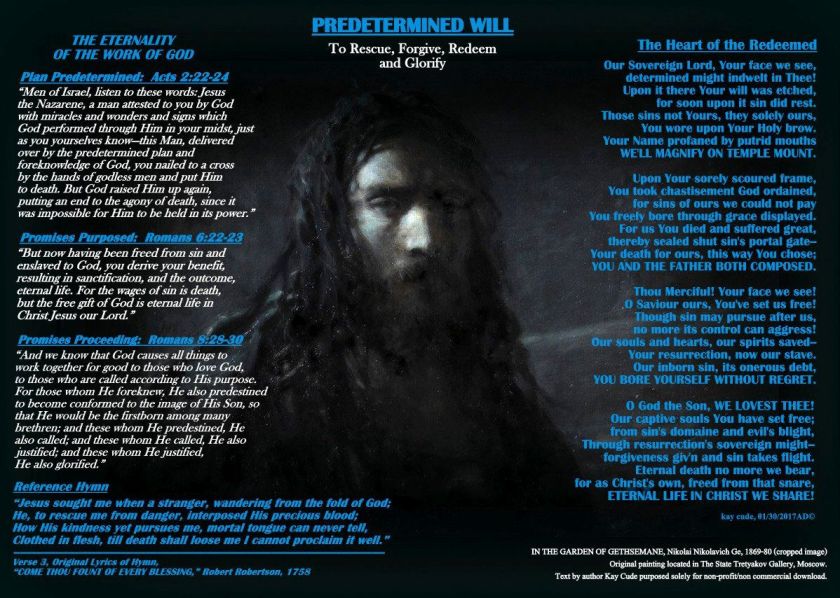
Kay Cude poetry. Used with permission. Click to enlarge

Kay Cude poetry. Used with permission. Click to enlarge

A version of this was originally published on The End Time in December 2009
![]() |
| Jan Brueghel the Elder THE GARDEN OF EDEN WITH THE FALL OF MAN |
In these waning days of the Age, do you think about the Garden of Eden? What untainted creation must have looked like? I do. The only mirror I have of earth as originally intended is in Genesis 1, and there, the LORD called it “good.” The reverse of that is earth in today’s condition. And today it looks pretty bad.
How far and deep has the effect of sin permeated our waters, our land, our food, and our very bodies and brains? Everything seems as poison now. Creation itself is laboring under the poisonous effects of a sinful world. “For the creation was subjected to futility, not willingly, but because of Him who subjected it, in hope that the creation itself also will be set free from its slavery to corruption into the freedom of the glory of the children of God. For we know that the whole creation groans and suffers the pains of childbirth together until now.” (Romans 8:20-22)
“[T]herefore thus says the LORD of hosts, the God of Israel, “behold, I will feed them, this people, with wormwood and give them poisoned water to drink.” (Jer 9:15) Matthew Henry writes of that verse, “Every thing about them, till it comes to their very meat and drink, shall be a terror and torment to them. God will curse their blessings.” Malachi 2:2 is that reminder of His promise to curse even the blessings of food and water.
I am not referring to the curse of oil spills or overflowing landfills or garbage scows nor greenhouse effects. I am talking the tide of sin-pollution and its impact on a falling world. “Therefore thus says the LORD of hosts concerning the prophets, ‘Behold, I am going to feed them wormwood And make them drink poisonous water, For from the prophets of Jerusalem pollution has gone forth into all the land.’” (Jeremiah 23:15). If we insist on wallowing in sin, then the Lord obliges by sending its visible manifestation to us and causes us to eat and drink of it.
Worse, “Behold, I will corrupt your seed, and spread dung upon your faces, even the dung of your solemn feasts; and one shall take you away with it.” (Malachi 2:4). Does the dung promise to mean that if we speak refuse, live in refuse, offer Him refuse, that we will eat refuse? That just as we punish a puppy who messes in the house with rubbing his face in it, God will do the same?
How we have allowed sin’s effects to creep like a tide of polluted water to poison the world. How often we see the bitter herb ‘wormwood’ used in the bible as a visible materialization of our sin. And so it will be again: “The name of the star is called Wormwood, and a third of the waters became wormwood, and many men died from the waters, because they were made bitter.” (Revelation 8:11)
Sin is a terminal condition. Do not underestimate how seriously God takes it when we refuse to turn away from sin!! Do not underestimate your own sin! Do not think you will escape! The only remedy is the blessed Hope, His forgiveness, made possible because of His sacrifice of blood on the cross. If you feel burdened with guilt for your misdeeds, and believe Jesus died and rose again for your sin, then ask him with sincere heart to forgive you. Believe on His name. Only the forgiven of sin can dwell with the Most High and Holy. Those with sin in them will be given over to the poison that it truly is, now made increasingly visible and manifest in this dying world.
A question was asked at our Bible Discussion Group on how to sensitively approach someone who is in a false religion in order to open discussion as to the truth. This same question has been asked of me personally regarding how to approach a friend whom you see carrying around a book by a false teacher.
At Discussion Group, I’d offered my process of how I deal with friends involved with false teachers, false doctrine, or false religion. I’d said that first, it depends on the relationship you have with them. If you don’t know the person or are only bare acquaintances, it won’t do to walk up to them and just say something brusque or out of the blue that in effect, amounts to saying “You’re doing it wrong.”
The Bible encourages and commands discipling relationships with one another. This is so we can keep each other accountable. We can carry each other’s burdens. Ultimately, close involvement with each other means can edify and grow one another and one way we do this is by helping sisters course-correct.
Therefore encourage one another and build one another up, just as you are doing. (1 Thessalonians 5:11).
We can’t build up a sister if we let them wallow in false doctrine. (Jude 1:23). Alternately, we won’t build them up if we are tactless and brusque. (2 Timothy 2:25, Galatians 6:1).
Assuming you are close enough with the sister to have established trust and are known to each other in a friendly way, then what I do is begin by asking questions. Perhaps the person is reading the book for research purposes. Maybe someone less discerning gave it to them and they haven’t thrown it out yet. Maybe they are getting ready to give it to someone else. Maybe a lot of things. Just ask. “Are you reading that book? What do you think of it?” “Let me know when you’re done, I’d love to get your take on it…” Etc.
Finally, I always have something else to offer the person in the books’ stead. It doesn’t help the person as much to just say that their book is a dangerous book, without having something in which to substitute. If they’d lacked discernment enough in the first place to get or read that book, then offering them material written by a credible author steers them into a better direction.
I was pleased when I’d come across this short discussion from 2016 where Noël Piper, Kathleen Nielson, and Gloria Furman discuss this very question. I was even more pleased when they shared that they do the same: ask, be gentle, discuss. Phew, at least I’m not off the deep end with this.
The women also discuss two other questions. If you can’t play back videos, here is a link to just listen.
One final thing. Their title mentions ‘a dangerous book.” Undoctrinal books ARE dangerous. Books like The Shack, Love Wins, The Circle Maker, any and all non-doctrinal, unorthodox books present a danger to the Christian. Adam and Eve only had to obey one command, and within a shockingly short time, satan easily managed to twist that command into a suggestion. Paul said to Titus that false doctrine upsets whole families (Titus 1:11). Paul warned Timothy that false doctrine undermines the faith. (2 Timothy 2:18). Make no mistake, (because satan isn’t making the same mistake), the false doctrine contained in books, movies, pamphlets, and Bible studies is a very present danger to the Christian mind and heart.
Here is the blurb for the short video:
Your friend is gushing about that book she’s been reading. It’s on the Christian Living bestseller list, but for whatever reason you suspect the book is more influenced by the spirit of the age than by a biblical worldview. … Nielson cautions against the overcorrection of reading only the Bible, since reading widely can actually enhance Bible reading, and Piper warns against becoming the kind of reader who only reads books from your own “tribe.”
Help! My Friend Is Reading a Dangerous Book
Noël Piper, Kathleen Nielson, and Gloria Furman Discuss
The lost are in the night, the cold, the outside. The lost are stumbling around, leading each other into a pit. They know not what they do. They dwell in a land of darkness with no hope.
For that reason, we can have compassion and pity.
This week I read an article that pulled at my heart strings. It was one of those articles that evoked pity, but also gratitude. I say gratitude because the Lord transferred me from the Kingdom of Darkness into His kingdom of Light. I have hope for an afterlife, the assurance of His more sure word on what is going to happen.
![]() |
| The phone of the wind. CC BY-SA 4.0 |
Wind Telephone
A disconnected rotary phone for “calling” lost loved ones offered a unique way of dealing with grief in disaster-stricken Japan.
When Itaru Sasaki lost his cousin in 2010, he decided to build a glass-paneled phone booth in his hilltop garden with a disconnected rotary phone inside for communicating with his lost relative, to help him deal with his grief.
Only a year later, Japan faced the horrors of a triple disaster: an earthquake followed by a tsunami, which caused a nuclear meltdown. Sasaki’s coastal hometown of Otsuchi was hit with 30-foot waves. Ten percent of the town died in the flood.
Sasaki opened his kaze no denwa or “wind phone” to the now huge number of people in the community mourning the loss of loved ones. Eventually, word spread and others experiencing grief made the pilgrimage from around the country. It is believed that 10,000 visitors journeyed to this hilltop outside Otsuchi within three years of the disaster.
The article goes on to assure the reader that the wind phone is meant to be used as a one-way communication. In other words, the people dialing the rotary dial and speaking their grief to the wind do not expect to hear anything in return at all. It’s just a symbol, a process, and an activity to help people feel more in control during their time of grief.
But we do not want you to be uninformed, brothers, about those who are asleep, that you may not grieve as others do who have no hope. (1 Thessalonians 4:13).
Not knowing about what happens after death is a number one issue for the unsaved. They might utter it, or they might never utter it, but we know that the gaping maw that is the great, unanswered question of eternity always lurks behind their thoughts. We know this because they are children of wrath (Ephesians 2:3) and the wrath abides on them all the time. (John 3:36). As Paul said, If our hope in Christ is for this life alone, we are to be pitied more than all men. (1 Corinthians 15:19).
We Christians have the assurance of a sinless, perfect afterlife with Jesus. We also have the promise of loving attention by a God who hears our prayers. (Psalm 34:15). We do not need a wind phone, we have the ear of the Almighty God! What praise there is in that! We are encouraged to take our supplications to Him, He hears us from His mighty temple. (Psalm 18:6).
Doesn’t it just tug your heart strings to see something like a wind phone atop a lonely hill in Japan? Doesn’t it pierce you, knowing the sadness and grief of the lost will not be salved? But doesn’t it also pierce you (as it does me) to have the ability to pray to the Holy One, and not? While the lost are installing phantom phones to whisper their grief into the wind, we are assured we have the ear of the High Priest at our disposal.
Pray more. Jesus is the God who sees and hears. He knows the voices of His sheep. Our griefs, supplications, petitions, cares, burdens, praises, and joys reach Him even though He is an unutterable distance away. But He is this close, too, inside us, knowing our sinews and heartbeats. He knows what we will ask before we ask it. He knows the need to be comforted even as we clasp our hands and open our mouth. He is great, attentive, wise, and concerned. Pray more. And tell the lost before they need a wind phone, that there is One who will listen, if they repent.
——————————————-
Further Reading
The Master’s Seminary: When an Unbeliever Dies: Offering Comfort without Distorting the Truth
Desiring God: How Do You Deal with the Death of an Unsaved Loved One?
In Matthew 16:24-26 we read,
Then Jesus told his disciples, “If anyone would come after me, let him deny himself and take up his cross and follow me. 25 For whoever would save his life will lose it, but whoever loses his life for my sake will find it. 26 For what will it profit a man if he gains the whole world and forfeits his soul? Or what shall a man give in return for his soul?
We know that passage means we turn our back on the kingdom of darkness and everything it represents, including self-aggrandizement, self-absorption, selfishness, anything self, &etc. We know we are supposed to die to self. We know we are supposed to hold others in higher regard than ourselves. We know it is written that we should be willing to lay down our life for our friends.
It’s hard.
Very hard.
Oh, does the flesh rebel against this.
We read in Psalm 7:3-5, the following prayer by David.
O Lord my God, if I have done this,
if there is wrong in my hands,
if I have repaid my friend with evil
or plundered my enemy without cause,
let the enemy pursue my soul and overtake it,
and let him trample my life to the ground
and lay my glory in the dust.
In that section of the Psalm, David is saying that if he has violated his Godly principles and done evil to a friend, may the Lord crush him. He is saying that if he has done evil to an enemy without cause, may him be trampled to the ground without honor.
Barnes Notes explains,
repaid friend with evil – The meaning here is simply that if he were a guilty man, in the manner charged on him, he would be willing to be treated accordingly. He did not wish to screen himself from any just treatment; and if he had been guilty he would not complain even if he were cut off from the land of the living.
plundered enemy without cause – The allusion here is to the manner in which the vanquished were often treated in battle, when they were rode over by horses, or trampled by men into the dust. The idea of David is, that if he was guilty he would be willing that his enemy should triumph over him, should subdue him, should treat him with the utmost indignity and scorn.
No wonder David was a man after God’s own heart. It is a hard thing to pray. Because, God will do it.
Sometimes I try to pray this kind of prayer. The words stick in my throat. Or, as the words come out, I soften them. I am a weakling when it comes to the battle between myself and others. ‘Lay my glory in the dust’? I am far from mastering that.
Praise God for the Psalms. They are comforting yes, but they are convicting too. Lord, help me by giving me the strength to more deeply obey Your principles. As I take up my cross today and go down the dusty road, give me the strength to truly care for others beyond myself, in spite of myself, denying myself.
![]() |
| EPrata photo |
Jesus accomplished the work God sent Him here to do. He did it perfectly, sinlessly, and died on the cross after absorbing all God’s wrath for sin. He even endured a horrific separation from the Father. Jesus had only ever known perfect harmony with God and love and sweet communion. O! To be cruelly dismissed from His presence! Jesus was not afeared of the pain of the crucifixion as much as he was dreading being separated from God. It was the loneliest moment in history forever.
He endured that separation and bore the wrath, so we would never have to. We can come into sweet communion with the Father, justified, sanctified, and someday, glorified.
God was pleased with His Son, and resurrected Him from the dead.
God raised him up, loosing the pangs of death, because it was not possible for him to be held by it. (Acts 2:24)
For you will not abandon my soul to Sheol, or let your holy one see corruption. (Psalm 16:10)
Therefore he says also in another psalm,
‘”You will not let your Holy One see corruption.’
For David, after he had served the purpose of God in his own generation, fell asleep and was laid with his fathers and saw corruption, but he whom God raised up did not see corruption. (Acts 13:35-37).
O! It is grievous to think of our precious Lord being nailed to the cross as He was on ‘Good’ Friday. It IS a Good Friday because His life, death, and resurrection makes it possible for sins to be forgiven once and for all. Jesus’ work on the cross made permanent reconciliation with His called ones possible. It was effectual and final.
But oh! To think of his broken body being carefully lowered from the cross, quickly prepared for burial, and laid in a dark tomb…. it wounds the conscience. It darkens the heart. It grieves the flesh. Death is final, the body no more thriving with movement and color. Only limp, pale, dead tissue- a lump of nothing that came from dust and will turn to dust.
And Joseph bought a linen shroud, and taking him down, wrapped him in the linen shroud and laid him in a tomb that had been cut out of the rock. And he rolled a stone against the entrance of the tomb. (Mark 15:46).
But no! Not Christ’s body! He will not see decay. However, the grief and suffering of His disciples who did not know that at the time, is woeful to consider.
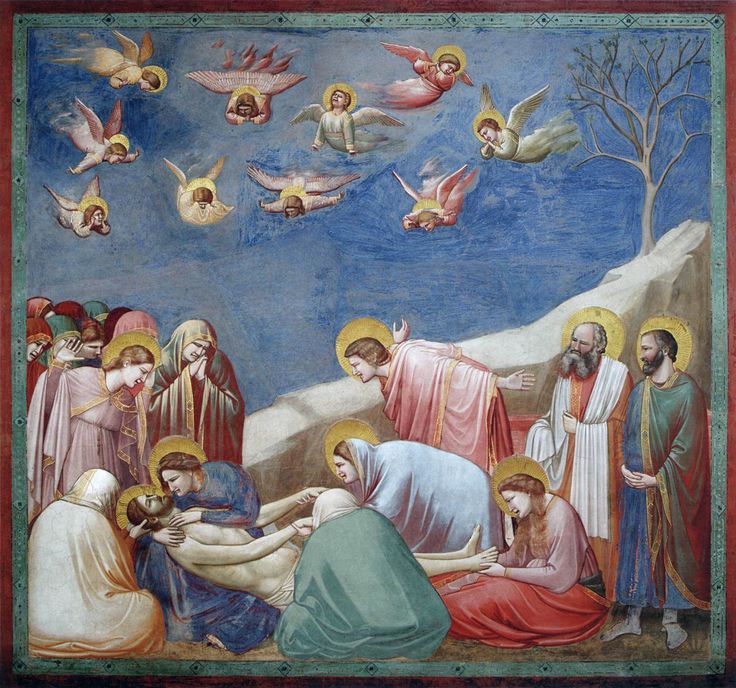
Giotto painted the lamentation over Christ’s death in the early 1300s. Grief is palpable to the viewer. The dead tree on the hillside symbolizing the tree in the garden where Adam and Eve made their fatal choice…the three women surrounding his limp body, likely Mary Magdalene gently cradling His feet and the mother Mary holding His head, the angels who long to look into these thing also shown affected by the death and burial of Christ, their God whom they had known since their own creation created in eons past.
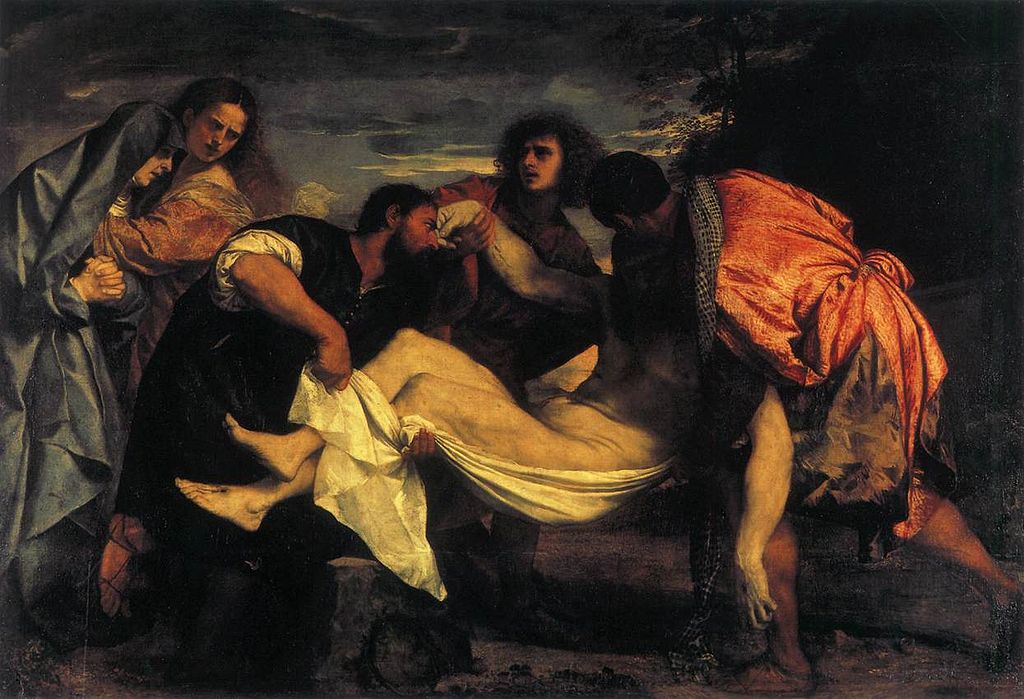
Titian also depicted the entombment of Christ, painting the more intimate scene below in 1520. The major figures are at Christ’s death, including Mary, John, Nicodemus, Peter, and Joseph of Arimathea, displaying more restraint that Giotto’s depiction, still carefully remove the body and prepare Him for entombement. The twilight timing allowed Titian’s usual use of darkened tones to add depth to the lamentation. Christ’s upper body itself is receding into the darkness, foreshadowing the tomb. What strength they had to carry Him without staggering under unimaginable grief, and place Him behind the rock!
Bela Čikoš Sesija’s Mourning of Christ is an even more intimate portrait. Painted sometime in the late 1800s, this Croatian painter shows the undeniably lifeless Christ in shadow, but His white robe, symbolizing purity and sinlessness is highlighted by a heavenly glow, along with the crown of thorns, symbolizing His suffering. The grief of the two women is also palpable, as is their resignation to the finality of death.
Praise God, Sunday is coming! What joy they will know in one more day’s time! For all eternity, death is conquered, swallowed by His suffering and propitiation for sin, absorbing the wrath for His chosen sinners once for all. Hallelujah!
Full of Eyes is a support-based ministry of exegetical art that creates still and moving images intended to point people to the beauty of God in the crucified and risen Son. All art and animations are done by Chris Powers. Powers’ goal is to help people see and savor the faith-strengthening, hope-instilling, love-kindling beauty of God in Christ. And he does this by creating free exegetical art in the form of pictures, animations, and discussion guides. His work is at http://patreon.com/, Youtube, and his website fullofeyes.com
———————————————–
In This Is Love.
Artist’s statement
By Chris Powers:
1 John 4:10, “In this is love, not that we have loved God, but that He loved us and sent His Son to be the propitiation for our sins.”
Today, from 9am to 3pm, Jesus–fully man and fully God–would swallow all of our death and hell and horror and hopelessness into Himself so that we could be drawn into eternal fellowship with God.
May we be given grace to know the love of Christ that surpasses knowledge and so be filled with all the fullness of God.
———————————————–
I wish you all a happy Good Friday. Because of Jesus’ life, death, and resurrection, our sins can be forgiven. We can be reconciled to God. Praise the Lamb!
And they shall mock him, and shall scourge him, and shall spit upon him, and shall kill him: and the third day he shall rise again. (Mark 10:34).
For as Jonah was three days and three nights in the whale’s belly; so shall the Son of man be three days and three nights in the heart of the earth. (Matthew 12:40)
This was first published in January, 2011 at The End Time
——————————–
Here is a small thing that is good and nice. It is a news piece out of Wisconsin, ripped from 2 Kings 22. First, the modern version:
“A centuries old relic has been discovered in a Bonduel (WI) church, tucked away for decades. No one realized it was even there, or what it was. In a cramped, rarely seen safe, no bigger than a kitchen pantry, at St. Paul Lutheran Church are heaps of old books and pamphlets. Many of which are more than 100 years old and in foreign languages. Most of the artifacts wouldn’t fetch a high price at auction, but represent the church’s nearly 150 year history and heritage. Now, one item kept there for an unknown length of time has taken the entire congregation by surprise. “This is an authentic 340-year-old Bible. We don’t know how we got it. We don’t know how it got into the safe. We’ve been asking some of our elderly folks and people in the nursing home and nobody seems to remember,” said Pastor Timothy Shoup.” source
How amazing! A beautiful original bible from over three centuries ago! How could they forget that it was there? Here is a bit more:
“A 340-year-old bible discovery can attest to the fact that they sure don’t make things like they used to. The German bible was discovered by a sixth grade teacher inside an old safe in a small Lutheran church school where she works in Bonduel, Wisconsin. “I was looking for the old baptism records to show my students and then up here in the corner was where the Bible was tucked,” explained Court, not realizing what a rare find she stumbled upon.”
Imagine, in a dusty closet of the church, lay the precious treasure, there all along but quite forgotten.
And a bit more:
“How the book ended up in Bonduel is still a mystery. But either way, Pastor Shoup says the 17th century discovery has brought him closer to his faith.”
How beautiful that the revealing of the Word caused the pastor such a sensitive and blessed reaction. Did you know that the Old Testament records another, similar instance? I’m not making a huge doctrine out of it, I believe that the news spot out of Wisconsin is a nice event that happens more often than we know. But the similarities with the bible’s discovery and our Sunday School lesson focusing on Hilkiah, Huldah, and King Josiah was too sweet to ignore drawing some parallels. In Josiah’s reign, a long and evil, corrupt line of kingship was coming to an end. Josiah’s grandfather and father were terrible kings that did much evil in the eyes of the LORD and provoked the LORD greatly. His people had not only fallen away, had forgotten Him and His word, but they engaged in perverse and horrible worship practices to other gods. Finally came Josiah, a good king of Israel, was endeavoring to have the Temple repaired. As you can imagine, no one really used the Temple for real worship and had not for a very long time. Here is the biblical piece about it:
The Lost Book (2 Kings 22:8-11)
Then Hilkiah the high priest said to Shaphan the scribe, “I have found the book of the law in the house of the LORD.” And Hilkiah gave the book to Shaphan who read it. Shaphan the scribe came to the king and brought back word to the king and said, “Your servants have emptied out the money that was found in the house, and have delivered it into the hand of the workmen who have the oversight of the house of the LORD.” Moreover, Shaphan the scribe told the king saying, “Hilkiah the priest has given me a book.” And Shaphan read it in the presence of the king. When the king heard the words of the book of the law, he tore his clothes…”
As the workmen were moving furniture around and inventorying items, this book of the Law was found! Hilkiah the Priest wasn’t sure what exactly it was, and Shaphan the scribe wasn’t exactly sure, either! The two men, along with three others searched high and low at the king’s command, so they could inquire of the LORD. (2Kings 22:13) They found Huldah the Prophetess, who told them.
Huldah Predicts (2 Kings 22:14)
“So Hilkiah the priest, Ahikam, Achbor, Shaphan, and Asaiah went to Huldah the prophetess, the wife of Shallum the son of Tikvah, the son of Harhas, keeper of the wardrobe (now she lived in Jerusalem in the Second Quarter); and they spoke to her.”
Ahikam was Shaphan’s son, a helper. Achbor was an officer of Josiah, as was Asaiah. Shaphan was a scribe of King Josiah. It is shame and a testament on the men that though they held lofty positions in the religious hierarchy, none felt they had the ear of the LORD, and they went to find someone who did, ending up with Huldah. Huldah is named as “keeper of the wardrobe”, and wardrobe then is as it is now: a closet for storing clothes. 2 Kings 10:22 is another example of the keeper of the wardrobe: “And Jehu said to the keeper of the wardrobe, “Bring robes for all the ministers of Baal.” So he brought out robes for them.”
![]() |
| The small closet where the bible had been stored |
Huldah was also a prophet. She told the men that the LORD said that since Josiah had been repentant and tender in his heart toward the LORD, the LORD would stay His wrath upon Judah until Josiah was laying peacefully in his grave.
It is interesting to note that the King’s faith deepened upon finding the Word. Tearing of clothes was an act that was meant to convey either great grief or great righteous indignation. The custom was also done as a symbolic removal of authority i.e. the tearing of a king’s royal robe. Here is a link to a short study on the biblical act of tearing of clothes, by Wayne Blank. Josiah was immediately convicted upon hearing the words of the LORD, and he tore his clothes. He sent out a search for a person who could relate the meaning of the words and help them come into obedience to them. It is also interesting to note that the Wisconsin Pastor’s faith deepened upon finding the word. Finding the precious treasure that is God’s word is always a blessing.
Josiah’s men found the Scriptures in an old wardrobe when doing routine repairs and inventory, and the School teacher found the word of the Lord while doing routine rummaging in a forgotten closet in search of old records. The LORD reveals Himself when and where He chooses, and at unexpected times!
I think about the bible itself, being twenty pounds. It’s huge! Someone carried that bible all the way from Germany across Europe, across the Atlantic Ocean, across half the American continent! Look at it, its size and heft. Yet, the Word of God meant so much to him that he took the trouble and expense to bring it with him , on horseback, in canoes, in ships, by hand…and protected it so well all along the way!
I hope that if you own several bibles, that none of them are laying on the back of the car window, fading as the sunlight drains the print away. I hope that your bible is meaningful to you and that it is used daily, lovingly, reverently. I hope that you do not travel so far away from the Word that you forget what it says and have trouble even finding a person who can relate its meaning to you.
The Wisconsin Pastor said of the find, “To hold something that tells us in 1670 the same message of God’s grace in Christ, that tell one another other today helps me be even more thankful.” Yes, the best lesson out of all of this is God’s word is eternal! (Mt 24:35)
Tweet
Robert Burns was a Scottish poet who lived in the second half of the 1700s. You might know his work from singing Auld Lang Syne on New Year’s Eve, or “my love is like a red, red rose.” Holden Caulfield famously misquoted Burns’ poem Coming’ Thro the Rye as Catcher in the Rye.
Another famous poem Burns wrote is “To A Louse.” Many people don’t know the title nor the context of the poem, but they remember the most famous line:
O would some Power with vision teach us
To see ourselves as others see us!
The context is that Burns was attending church service one Sunday, sitting behind a lovely young

lady dressed in all her finery. His attention drifted from the sermon to the lady’s hat and ribbons, as Burns became captivated with watching a louse (plural, lice) wander indiscriminately through her hear, hat, and ribbons.
The bulk of the poem is wryly suggesting that the louse go off to fine more customary living grounds, perhaps a housewife’s flannel tie, or maybe on some ragged boy’s pale undervest. But on a lady’s bonnet? Surely you jest!
The lady had dressed in all her finery and frippery that morning, and had traveled to church to see and be seen in it. She was sitting in the pew, with gloves and best dress, scrubbed and looking splendid. She was, of course, completely unaware that a louse was traversing her elaborately coiffed curls. She thought she was looking good. The man sitting behind her saw the louse that she could not. The embarrassing pestilential creature ruined the entire carefully crafted public presentation the lady had no doubt taken many pains to complete.
Burns’ finals stanza with the pertinent line, To see oursels as ithers see us! is a plea which has been heard.
1. The Lord see sees us as Burns saw the lady, except worse. He sees us as we are. He sees the metaphysical lice crawling all over us, which are the sins we preform, traversing our body like the “hair fly”. He sees the rubbish as Paul would say, the dung clinging to us in our natural state. He loved us anyway.
2. He allows us to see ourselves as He sees us, thorough the written word. The Bible is a reflection of us, in our sin and depravity, and it is a reflection of Him, in His glory and power. We see ourselves as He sees us when we go into a woman who is another man’s wife, as David did. When we murder Christians because we are a religious zealot in a false religion, as Paul was. He shows us our lice ridden selves when Peter denied Christ to save himself in his own cowardice. In Cain who murdered, in Eli who was complicit in blasphemy, in Abraham who lied.
When we do see ourselves as He sees us, we cry out, O! It is too much! I cannot stand it! I am too corrupt! perverted! deviant! degenerate! debased! immoral! unprincipled!
In truth, the lice are actually better than the natural man, ‘For the creation was subjected to futility, not willingly’ (Romans 8:20a) but Adam chose to Fall.
As we would crumble into instant dust if in the natural we saw God’s glory, we also would crumble if we saw ourselves as truly depraved as we are. Sinners, all. The Bible reveals it, confirms it, shows it so any who care to look.
The cross is the place where depravity met glory. He loved us so much, He sent His Son, to live, teach, and die for sinners, who are in truth no better than the louse on the lady’s hair, though we try to dress up. With every heartbeat, love flowed through His veins.
Lord, thank you for opening your veins and sharing Your love with us.
During this week upcoming to Resurrection Sunday, please be in prayer to thank the Lord for shielding us from the true depths of our own depravity and from the true heights of Your glory, both of which if we saw in the natural, we would instantly die. And yet because of the cross, we live.