Posted in encouragement, Uncategorized

Throwback Thursday: If We had X-ray Vision, what would Sin Look Like?

This was first published in January 2014 on this blog.

—————————
When satan was created, He was the most beautiful angel. Ezekiel 28:12 says

Son of man, raise a lamentation over the king of Tyre, and say to him, Thus says the Lord GOD: “You were the signet of perfection, full of wisdom and perfect in beauty.”

Inside or out, satan was not only beautiful, but he was the very seal of perfection. But it didn’t last. Though he was created perfect, one day, unrighteousness was found in him.

You were blameless in your ways from the day you were created, till unrighteousness was found in you.” (Ezekiel 28:15)

Initially, sin might look beautiful but the more a person becomes trapped in it, the less beautiful it seems to them and the more they are eternally destroyed.

The woman may be beautiful, and the sin so enticing, Proverbs 5:3 says,

For the lips of the adulterous woman drip honey and her speech is smoother than oil.

But the end of it all is is hell.

In the end she’s as bitter as wormwood and as sharp as a double-edged sword. Her feet go down to death; her steps head straight for Sheol. (Proverbs 5:4-5)

But sin at first has to look great, and not like ot really looks, or else no one would engage in it.

How does sin really look? Remember Superman’s X-Ray vision?

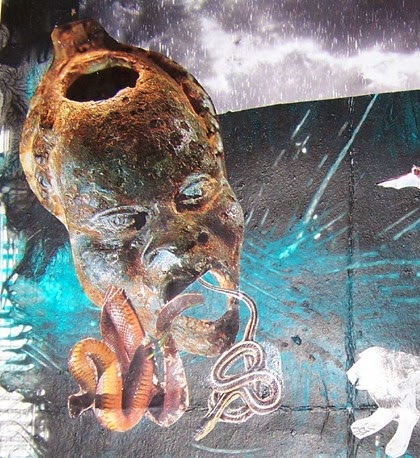
THIS is what sin might look like. Here is the Old Man. Once so beautiful and shining, it is what satan’s soul looks like. Eve thought the fruit looked good and a delight to the eyes, (Genesis 3:6) but shortly after all it had brought was pain and bondage (Genesis 3:16). If we had X-ray vision and could see beyond the enticing surface, this is what we would see:

“Sin”, collage on handmade paste paper, by EPrata

O, would that sin looked like this to our eyes, then we would not be so attracted to it! And sadly, horrifically, it is what us inside us. This ugliness is what Jesus sees when He looks at a non-believer. Lovingly, He still died for us.

but God shows his love for us in that while we were still sinners, Christ died for us. (Romans 5:8)

However, being that sin is so gross and deadly, it makes the triumph of Jesus all the more glorious.  Where satan is all-darkness that fools us into thinking it is light, Jesus never had one blot, one lie, one corrupt thought, one serpent slither. Not once, not ever. He IS the Light!

God is light, and in Him is no darkness at all. (1 John 1:5)

If we had X-ray vision looking at Jesus, our eyes would see only glory upon glory, shining like the sun. He is a prism of Light, reflecting throughout all the universe and into the eternity we will share with Him! When He looks upon a believer He sees that same righteousness-

For He has made Him to be sin for us, who knew no sin; that we might be made the righteousness of God in Him. (2 Corinthians 5:21)

Don’t be fooled by the initially enticing beauty of sin. It is gross, destructive, horrible. Put on your X-ray vision to see beyond the surface lie. Run from it toward Jesus who set us free from its bondage, and gave us the Spirit’s vision to see through its enticing spoils. Satan’s offerings are nothing. Jesus is our all in all.

Posted in discernment, Uncategorized

I’m not broken

Do you hear a lot of conversation these days involving the word ‘broken’ and ‘brokenness’? I do. It is the newest trendy word.

Words matter. They present reality, create meaning, knit a cultural understanding. Words matter.

The Lord revealed Himself to us by His Word. He IS the Word made flesh. He could have revealed Himself to us in pictures, symbols, or any other method. He chose the Word.

We will be judged by our words. Jesus said, “I tell you, on the day of judgment people will give account for every careless word they speak, 37 for by your words you will be justified, and by your words you will be condemned.” (Matthew 12:36).

Words matter.

In Genesis 11:1 we read, “Now the whole earth had one language and the same words.” In Genesis 11:7 God said, “Come, let us go down and there confuse their language, so that they may not understand one another’s speech.” [Literally, ‘one lip’].

How did the LORD choose to restrain man? By confusing their languages. He will reverse that on His Day. Zephaniah 3:9 has the prophecy-

For at that time I will change the speech of the peoples to a pure speech, that all of them may call upon the name of the LORD and serve him with one accord.” [literally, “one lip”].

Words matter.

Christians speak the one language of faith. Or we are supposed to, anyway. The Bible clearly explains the important concepts by which we live and construct meaning. They are in words, and the words are: sin, wrath, grace, sanctification, justification, imputation, atonement, good, evil … & etc. When we speak them to each other the meanings of these words should be clear to Christians. When we say, “I am a sinner” we know what we mean. When we say “God is good” we know what is meant by it. “I’m a depraved sinner” is understood. We should be ‘of one lip.’ But we’re not. By dropping and substituting words commonly understood for millennia, we are creating new understandings of the basics of the faith.

In today’s example, no longer are we sinners. We’re ‘broken.’

Brokenness the way it’s used nowadays does not mean what you think it means. In this piece by The Gospel Coalition, the opening paragraph succinctly describes my concerns with the increasing use of the word ‘brokenness.’ Unfortunately, the rest of the essay goes on to state the exact opposite of my point here today, so I don’t endorse the article.

In Christian circles, much has been made of brokenness, vulnerability, and authenticity in recent years. Some have expressed concern that these ideas have been overemphasized while holiness has taken a backseat. Brokenness in this context has tended to be of a faux variety. Much of it amounts to a confession of socially acceptable sins and mommy bloggers making messiness cool.

How does using brokenness the trendy way it is being used in Christian circles underestimate sin’s power? Brokenness evokes minor imperfections, not depravity. It removes the impetus from the sinner as the one performing the sin. We’ve gone from ‘I am a depraved sinner in need of grace’ to ‘I’m broken through no fault of my own and I need a heavenly butler to fix me’.

These mommy bloggers with messy lives authentically telling you about their brokenness are no different from the Pharisees who lengthen their tassels or make long prayers with long faces in order to show they are good.

Showing you are ‘bad/broken’ is no different than the Pharisees showing they were ‘good’. It’s still ‘look at me’. The result is the same also – hypocrisy.

“Maybe wholeness is embracing brokenness as part of your life.” Ann Voskamp, The Broken Way.

Maybe NOT. When we display our shining faces and our heavenly glow, we are demonstrating His victory to the world. Embracing brokenness is not displaying a victorious life.

And when you fast, do not look gloomy like the hypocrites, for they disfigure their faces that their fasting may be seen by others. Truly, I say to you, they have received their reward. (Matthew 6:16).

I do not know where these women are getting all this brokenness from, because before we’re saved, we’re not broken and in need of a little fix, as Lysa Terkeurst seems to think-

Brokenness where we are split open. Redemption where God knits us back together. Lysa TerKeurst

Before salvation, we are whole. Wholly evil, wholly depraved. We function unbroken and unabated in a cursed world where we fit in perfectly fine. After salvation, we are not fixed (as is the opposite of broken.) We are made a new creation. It’s not that our thoroughly depraved soul is dented and needs pounding out and fixing like a car mechanic doing body work on a bumper or a little knitting and voila, we’re fixed. We are so thoroughly evil that we must be made a new creation. So after salvation, nothing is broken then, either.

We’re not supposed to promote our brokenness by mooning around with a long face, writing endlessly about how broken we are. Personally, I believe doing so is an insult to Jesus, who saved us perfectly. Lest someone think I am being heartless, I do know that both before salvation and after salvation, we grieve, are bereft, lonely, sad, melancholy, stricken, and all the rest. Life hurts. It really does.

If ever there was anyone who had cause to call himself “broken” it was Paul. He was betrayed, abandoned, imprisoned, shipwrecked, beaten, lonely and even at one point “despaired of life”! He wrote in 2 Corinthians 1:8,

For we do not want you to be unaware, brothers, of the affliction we experienced in Asia. For we were so utterly burdened beyond our strength that we despaired of life itself.

Broken! For sure! But did he write anywhere in the Bible that we should dwell in our griefs? Wallow in brokenness? Embrace it? Never! What a ghastly thought! He wrote,

But even if I am being poured out like a drink offering on the sacrifice and service of your faith, I am glad and rejoice with all of you. (Philippians 2:18).

In whatever circumstance Paul found himself in, he urged rejoicing in the Lord. He never urged his people to wallow in brokenness. He never even said that as grief-stricken as he was at times that he himself was ‘broken.’

Sisters, we are not broken. If the current trendsetters using the word mean broken as in prior to salvation, well, before salvation we’re evil and depraved sinners who have no chance to please God, not broken. After salvation, we are a new creature, not broken.

If the trendsetters using the word broken to indicate a certain emotional state, well, call it what it is. Grief, broken-hearted, depression, melancholy, annoyance, overwhelmed. That’s OK, we all feel those things at times. But again, that’s not being broken. And in any case, as Paul said, rejoice, sisters, rejoice! Mooning around with a long face as a broken individual doesn’t earn you any points with Jesus. He said as much regarding the Pharisees, as I stated above.

If you’re sad, depressed, rejected, melancholy, whatever it is, rejoice! I know it’s hard. I’m not making light. But watch the words you say (and sing, and write). Saying that you’re broken is insulting to Jesus and unnecessarily transforming the Christian vocabulary into something trendy and indistinct.

I’m not broken. Are you?
Posted in encouragement, Uncategorized

Paul’s warm letters

These are the openings of all of Paul’s letters, except Galatians. Please don’t skip, read them through.

I thank my God in all my remembrance of you, always in every prayer of mine for you all making my prayer with joy, 5 because of your partnership in the gospel from the first day until now. And I am sure of this, that he who began a good work in you will bring it to completion at the day of Jesus Christ. (Philippians 1:3-6).

I give thanks to my God always for you because of the grace of God that was given you in Christ Jesus, 5 that in every way you were enriched in him in all speech and all knowledge— 6 even as the testimony about Christ was confirmed among you— 7 so that you are not lacking in any gift, as you wait for the revealing of our Lord Jesus Christ, 8 who will sustain you to the end, guiltless in the day of our Lord Jesus Christ. 9 God is faithful, by whom you were called into the fellowship of his Son, Jesus Christ our Lord. (1 Corinthians 1:4-9).

Grace to you and peace from God our Father and the Lord Jesus Christ. … Our hope for you is unshaken, for we know that as you share in our sufferings, you will also share in our comfort. (2 Corinthians 1:2,7)

For this reason, because I have heard of your faith in the Lord Jesus and your love toward all the saints, I do not cease to give thanks for you, remembering you in my prayers… (Ephesians 1:15-16).

We always thank God, the Father of our Lord Jesus Christ, when we pray for you, 4 since we heard of your faith in Christ Jesus and of the love that you have for all the saints, 5 because of the hope laid up for you in heaven (Colossians 1:3-5).

We give thanks to God always for all of you, constantly mentioning you in our prayers, 3 remembering before our God and Father your work of faith and labor of love and steadfastness of hope in our Lord Jesus Christ. (1 Thessalonians 1:203).

We ought always to give thanks to God for you, brothers, as is right, because your faith is growing abundantly, and the love of every one of you for one another is increasing. Therefore we ourselves boast about you in the churches of God for your steadfastness and faith in all your persecutions and in the afflictions that you are enduring. (2 Thessalonians 3-4).

To Timothy, my true child in the faith: Grace, mercy, and peace from God the Father and Christ Jesus our Lord. (1 Timothy 1:2).

To Timothy, my beloved child: Grace, mercy, and peace from God the Father and Christ Jesus our Lord. I thank God whom I serve, as did my ancestors, with a clear conscience, as I remember you constantly in my prayers night and day. As I remember your tears, I long to see you, that I may be filled with joy. (2 Timothy 2:2-4).

To Titus, my true child in a common faith: Grace and peace from God the Father and Christ Jesus our Savior. (Titus 1:4).

To Philemon our beloved fellow worker 2 and Apphia our sister and Archippus our fellow soldier, and the church in your house: Grace to you and peace from God our Father and the Lord Jesus Christ. I thank my God always when I remember you in my prayers, because I hear of your love and of the faith that you have toward the Lord Jesus and for all the saints, and I pray that the sharing of your faith may become effective for the full knowledge of every good thing that is in us for the sake of Christ. For I have derived much joy and comfort from your love, my brother, because the hearts of the saints have been refreshed through you. (Philemon 1:1-7).

A hallmark of Christianity is love.

By this all people will know that you are my disciples, if you have love for one another. (John 13:35).

Barnes Notes says of the John verse,

That is, your love for each other shall be so decisive evidence that you are like the Saviour, that all people shall see and know it. It shall be the thing by which you shall be known among all men. You shall not be known by special rites or habits; not by a special form of dress or manner of speech; not by special austerities and unusual customs, like the Pharisees, the Essenes, or the scribes, but by deep, genuine, and tender affection. And it is well known it was this which eminently distinguished the first Christians, and was the subject of remark by the surrounding pagans. “See,” said the pagan, “see how they love one another! They are ready to lay down their lives for each other.” 

I think it’s clear that Paul genuinely loved his people and cherished his overseers. His letters were full of approbation for them. He had high regard for his fellow workers, and wasn’t shy about saying so.

Wouldn’t it be lovely to receive a letter like Paul’s? Wouldn’t it be great to be received in person the way that Paul greets his friends? It would, on both counts. I fail the standard Paul sets here, both in reaching out with loving, personal messages to warmly encourage as Paul does, and in displaying a genuine love in person for the believers “in the common faith.”

How about you? Is there something more you can do to ‘boast of a friend’ to other friends? To pray for them earnestly? To visit with them in love, exulting in your common love of Christ?

Please re-read the letter introductions, and think of someone you can love and encourage today. I know I will.

Posted in Uncategorized

Street photography and all its joys and pains

Grammarly has changed my life.

OK, that’s hyperbole, but Grammarly has given me relief in spades. It’s an extension you add to your browser, which checks for typos and grammar mistakes as you type. No matter where you’re typing, Facebook, Twitter, comment responses on Disqus, wherever you’re typing, it puts a red line underneath a typo or grammar mistake.

I’ve been surprised at how well it offers corrections, too. It is eerily correct in its offerings even when I’m writing cultural idioms or abbreviations. For example, I typed ASAIK and it knew I meant AFAIK (As Far As I Know). The corrections far outstrip even MS Word.

You can ignore any corrections you don’t want or don’t agree with. A little red circle at the bottom keeps track of how many words need fixing, and if you want, you can click it to see how many have already been corrected. I dare not look.

Grammarly is free, though that doesn’t stop its creators from frequently reminding you that you’re “missing out” on features and offers deals on upgrades. But these reminders are not intrusive. They’re contained in a correction, once in a while.

Hey, I don’t need an upgrade, I just need my typos corrected. They are getting so bad. I wrote a three-word response on Facebook this morning and mistyped two of the words. You see what I mean about how valuable this extension is.

I’ve been interested in street photography of late. I love photography. I noticed a book called The Birth of Graffiti by Jon Naar at the Second Time Around store a while back and bought it. He took his pics of graffiti in NYC in the 1970’s, a low point for the city and its denizens.

Naar is an accomplished portrait photographer, photographer of art and architecture and more. In his 90’s now, he is still active. Wikipedia says Naar has had a multifaceted career as an intelligence officer in World War II; a globe-trotting executive during the postwar years; and an environmentalist, with nine published books to date. Major publications like The New York Times, The Saturday Evening Post, Vogue, Fortune, Elle, and Schöner Wohnen have featured Naar. The NY Times Magasine’s very first use of color for an interior was commissioned by them of Naar.

I love-hate graffiti, it is a blight but it’s also art. Art blight. Blighted art. I dunno. Overall I’m just fascinated by it. I also like gritty city pictures, tattered handbills, signs, doorways, subways…Naar’s photos were all stupendous and so evocative. Yes, he takes shots of just graffiti, but he took many of his shots with people in them. Kids playing basketball against a backdrop of a heavily graffitied wall…a mom and toddler walking by a profane graffiti mural…and so on.

I didn’t know it at the time but his style of photo is called “Street Photography.” It is defined:

Street photography, also sometimes called candid photography, is photography conducted for art or enquiry that features unmediated chance encounters and random incidents within public places.

I’ve always loved candid photography, especially of kids. I am grateful I’ve often had the chance to legitimately take photos of kids, either through being a journalist and covering school things and sports or as a school employee asked to chronicle events on campus for the yearbook or the official Facebook page. Kids are fun to take pics of because they’re unpredictable, emotive, and a challenge to get in the frame. They’re also cute!

Kids enjoy having their picture taken, unlike adults. Adults are suspicious, guarded, and can deck you if they get mad that you’re in their face. Hence the relief in being around kids with my camera.
But I also enjoy gritty cityscapes. Or even in my rural town, gritty, industrial things. Like these pics:

Many of my photos were of the same theme with the same interest in same topics as Naar’s. Like these of his:

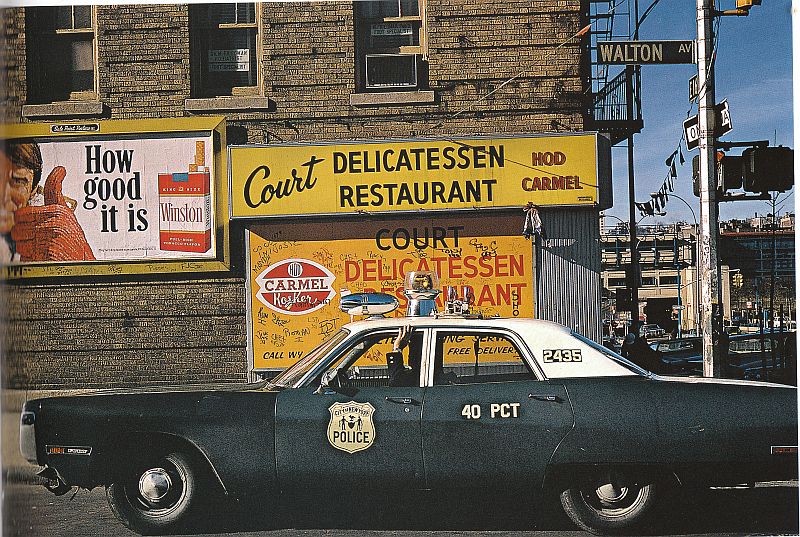
If I’d like to concentrate on street photography, as good as it is to be on the same track as someone like Naar in terms of interest in these kinds of scenes, it’s the execution that matters. I need to improve my composition, framing, and bravery in getting close to the moment. In Naar’s scene of the police car, what makes it good is that the cop is in the car. When you look closely, you see his arm in the window. This brings life to the scene. The handbills, not only colorful and framed well, but his decision to take it with the bold clenched fist above them gives the picture a foreign feel, and vaguely threatening. The new & used tires, the inclusion of the graffiti and the loneliness of both displays of the tires makes one ask, which are new and which are used? They all look tattered.

Where I fail is getting people in the picture. Getting people in the picture is key. People energize the photo. Their activity mystifies, perplexes, shocks, or comforts. It’s the people who bring emotion to it, mystery, and story.

So, then there are the stupendous pics of Naar’s like this one, my favorite. Click to enlarge. It’s absolutely tremendous-

It’s subway and graffiti. OK, so the grit is there. The lighting is great, the warm glow of the interior of the car contrasted with the steel of the exterior. The light, joy, and movement of the people through the window to the left and the right. The yellow strip which mirrors the rush and zoom of the car itself when it arrives and departs.

And then…there is one sole, still woman. One part of the entire photo where nothing is moving. There is no joy. Her face is stoic, devoid of the same lightheartedness the rest of the people display. The grittiness of her surroundings is contrasted with her obvious wealth. Her perfectly coiffed matronly hairdo. Her poised, ladylike feet in expensive shoes. Her fur around the collar.

Since every photo should tell a story – or begin one, we ask, why, if she is so obviously of means, does she take the subway?

Most incongruously of all, is her butler and the hatbox. Pink, no less.

It’s an amazing photo.

There are many street photographers out there. This web page explains 10 principles of street photography and then lists many good street photographers.

Candid photography is interesting and challenging, just the way I like it. I’ll keep trying. Meanwhile the link above has a wonderfully long list of good photographers and pictures to be inspired by!

Posted in Uncategorized, visual exegesis

Visual Exegesis: The Life of Every Living Thing

Chris Powers of Full of Eyes creates exegetical art, still and moving images, intended to point people to the beauty of God in the crucified and risen Son. His work can be found on Youtube, Patreon, and his website, fullofeyes.com. There are study guides to accompany the videos, tracts, and art- free to use for the edification of the global church and the exaltation of Jesus’ name.

Today’s presentation is called The Life of Every Living Thing. Below Powers’ illustration is the artist’s statement.

Job 12:10, “In His hand is the life of every living thing and the breath of all mankind.”

It was tough to come up with a verse picture today. I spent most of my time reading this morning in Genesis considering some of the patterns we see in the Creation week….some wonderful stuff there, but nothing that seemed to lend itself to a picture. I also read a bit in Job and came across 12:10…..I was hesitant to make the picture that I did because it is similar to another that I did a few months ago, but–since I try to get these done early without spending TOO much time on them, I went ahead with this design.

I’m also studying the “hypostatic union” right now (the orthodox understanding of Christ as one Person–God the Son–with two natures–divine and human) for a Wednesday night class I teach at our local church….that’s got me thinking about some more of the glorious realities we see in Christ….one of which is that He–as God the Son–is sustaining the universe (“in His hand is the life of every living thing…”) even as His hands are pierced and His creaturely life ebbs away. It’s an “old” truth but one that ought always to stagger….the sovereign mingling of omnipotence and helplessness that we see at the cross is unlike anything the world can produce and a self-authenticating witness to the beauty of God’s Name.

So, I hope that this picture echoes both the idea that the God-Man upheld the life of the universe with His hands even as His flesh was pierced on the cross AND that, the piercing of His hands was also the means by which He purchased the life that He was upholding. All created life–at least all terrestrial life–would rightly have been extinguished because of sin had not the wrath a ten thousand justly-deserved Noahic floods been stored up to be poured on on the Beloved Son at Calvary.

Posted in discernment, Uncategorized

The biblical worldview is that there is the righteous and the wicked

When you read chunks of the Bible at one time, patterns and themes emerge that may not be as noticeable as when you read just a few verses more deeply. That’s why both kinds of study are valuable.

In reading the Psalms, one immediately notices David’s worldview. It’s stark, solid, and biblical. With David, there are the righteous, and the wicked. Period.

We live in times where Christians are pressured to blur those lines. We’re told to accept and tolerate all manner of sin, value any and all professions of faith even if they’re unaccompanied by fruit, and to view all people as inherently good. Failure to do the above invites catcalls of “Pharisee”, “judgmental”, or worse.

However, when we blur those lines, the loss to the church is that mission fields shrink and disappear. Doctrinal lines are dismissed. Sadly, if we don’t know who is in and who is out, who do we evangelize?

I found this article from a church in MO, called The Righteous and the Wicked. I don’t agree with their KJV-only stance, but I do agree with this article.

We believe that there is a radical and essential difference between the righteous and the wicked; that such only as through faith are justified in the name of the lord Jesus, and sanctified by the spirit of our god, are truly righteous in his esteem while all such as continue in impenitence and unbelief are in his sight wicked, and under the curse; and this distinction holds among men both in and after death. …

This article also emphasizes the fact that with God, there is no middle ground. With men, we see much middle ground or gray area. With God it is all black or white, right or wrong, for him or against him. Joshua made this very clear in Joshua 24:14,15 when he demanded that Israel make a choice to either serve God or not serve God. “Now therefore fear the LORD, and serve him in sincerity and in truth: and put away the gods which your fathers served on the other side of the flood, and in Egypt; and serve ye the LORD. 15 And if it seem evil unto you to serve the LORD, choose you this day whom ye will serve; whether the gods which your fathers served that were on the other side of the flood, or the gods of the Amorites, in whose land ye dwell: but as for me and my house, we will serve the LORD.”

The Bible makes it clear so many times, using opposites in a plethora of descriptions. This verse from Isaiah 5:20 is just one:

Woe unto them that call evil good, and good evil; that put darkness for light, and light for darkness; that put bitter for sweet, and sweet for bitter!

The verse presents three of the stark opposites:

Evil-Good
Darkness-Light
Bitter-Sweet

We read of those who are cursed and those who are blessed.

Those who are dead and those who are living.

There are those in Christ and those who are in outer darkness.

There are those who draw near, and those who fall away.

There are those who are hot, and those who are cold. The middle ground of lukewarm is something Jesus hates!

The sad thing is that some of these unsaved, evil people are professing Christians. Others are simply true Christians who are stumbling. Without practicing biblical discernment, we are losing our ability as a global church to detect the difference. This is to our detriment. The biblical worldview is that there is either-or.

We need to be mindful of the two-path approach to Jesus. Now, we don’t have the omnipotence that God does. When I try to have these conversations with fellow believers, they quickly shut it down, saying, “Only God knows the heart.” That is true. I can’t see the heart of people to say with the same certainty as God that a person is saved or not saved. I’m not omnipotent. But discernment doesn’t require omnipotence.  “You will know them by their fruits,” Jesus said, twice in the same lesson. (Matthew 7:15-20). He gave us the ability to discern the difference between a thistle and a fig, the difference between a grape and a thorn.

He didn’t say, ‘You won’t know them.’ He didn’t say, ‘You may know them, perhaps. Try again later.’ He didn’t say, ‘Stay quiet because only God knows the heart.’

Therefore by their fruits you will know them. (Matthew 7:20)

I’m not saying to go around and make unsound declarations about people’s position in Christ. But I am saying two things that revolve around this concept – inconsistency and hypocrisy in Christian life brings reproach upon the cause of truth.

Many will follow their sensuality, and because of them the way of the truth will be maligned; (2 Peter 2:2).

So for that reason,

1. Remember that there are two roads and two roads only. Societal pressure, cultural tolerance, personal timidity add to the reluctance of people to remember that. The biblical worldview is that it’s either-or with nothing in the middle! The middle road with mushy doctrinal lines is lukewarm. Jesus hates lukewarm. Do not tolerate sinners among you who preach false doctrine! (Revelation 2:20).

2. If you see a long-term pattern of sin in a person or a long time of no fruit, it is allowed and even commanded by His word, to do something about it. Some of these verses are aimed at pastors but it is also incumbent on lay-people to both edify and rebuke in sincere concern for their restoration. (1 Cor. 5:1-13, 1 Timothy 5:20, 2 Timothy 4:2, Titus 1:13, Galatians 2:14, Ephesians 5:11…)

In an attempt to be kind, or caring, or non-judgmental, we too often allow a believer (or a non-believer “believer”) to go on their wicked path. The believer, if he is a believer, loses rewards every moment he continues on his course of sin. More importantly, professing believers who continue on a wicked path bring reproach onto the name of Jesus. (Romans 2:23-24). The professing person who is self-deluded and not a believer at all, may, in fact, be shaken out of their deluded complacency unto salvation if one confronts them about their lack of fruit.

Even if they aren’t shaken out of complacency or a sinning path, and the Lord hardens them further instead, His glory is manifested in that person as a vessel of wrath. Plus, you are giving Him glory by obeying. Just as the result of our salvation discussions is left to the Holy Spirit, sin-correcting discussion results are also left to Him. Sometimes the person will be amenable, sometimes they will become angry and then amenable, and sometimes they will get mad and stay mad. If you have prayed, if you have been diligent to follow His statutes, if you’ve removed the log from your own eye, if you’ve spoken with a sincerity for the betterment and concern for the person, then leave the results to the Spirit. You’ve done your part.

The Takeaway:

There are two roads. There are the righteous and the wicked. The two roads people travel lead to His domain, whether it is the kingdom of Light in heaven or His domain of Outer Darkness in the Lake of Fire. After death, there is a great gulf fixed, that none many travel from one to the other. Speak the truth in love to those who you have concerns for before the roads become unalterably fixed after death.

As David said in Psalm 6:5,

For in death there is no remembrance of you; in Sheol who will give you praise?

Matthew Henry is concise regarding this verse, and of today’s concept, his comment on Psalm 6:5 is a good way to end it:

6:1-7 These verses speak the language of a heart truly humbled, of a broken and contrite spirit under great afflictions, sent to awaken conscience and mortify corruption. Sickness brought sin to his remembrance, and he looked upon it as a token of God’s displeasure against him. The affliction of his body will be tolerable, if he has comfort in his soul. Christ’s sorest complaint, in his sufferings, was of the trouble of his soul, and the want of his Father’s smiles. Every page of Scripture proclaims the fact, that salvation is only of the Lord.

Man is a sinner, his case can only be reached by mercy; and never is mercy more illustrious than in restoring backsliders. With good reason we may pray, that if it be the will of God, and he has any further work for us or our friends to do in this world, he will yet spare us or them to serve him. To depart and be with Christ is happiest for the saints; but for them to abide in the flesh is more profitable for the church.

~~~~~~~~~~~~~~~~~~~~~~~~~~~~

Further Reading

Dealing with Sinning Christians

When Should a Christian try to correct another Christian?

In keeping with the theme of knowing there are only two roads and that there are only the righteous and the wicked, let’s look at what a Biblical worldview is, and when a Christian’s biblical worldview can become diluted:

What’s a Christian worldview anyway?

Posted in prophecy, Uncategorized

Throwback Thursday: Sin’s poison is visible in the world

A version of this was originally published on The End Time in December 2009

Jan Brueghel the Elder
THE GARDEN OF EDEN WITH THE FALL OF MAN

In these waning days of the Age, do you think about the Garden of Eden? What untainted creation must have looked like? I do. The only mirror I have of earth as originally intended is in Genesis 1, and there, the LORD called it “good.” The reverse of that is earth in today’s condition. And today it looks pretty bad.

How far and deep has the effect of sin permeated our waters, our land, our food, and our very bodies and brains? Everything seems as poison now. Creation itself is laboring under the poisonous effects of a sinful world. “For the creation was subjected to futility, not willingly, but because of Him who subjected it, in hope that the creation itself also will be set free from its slavery to corruption into the freedom of the glory of the children of God. For we know that the whole creation groans and suffers the pains of childbirth together until now.” (Romans 8:20-22)

“[T]herefore thus says the LORD of hosts, the God of Israel, “behold, I will feed them, this people, with wormwood and give them poisoned water to drink.” (Jer 9:15) Matthew Henry writes of that verse, “Every thing about them, till it comes to their very meat and drink, shall be a terror and torment to them. God will curse their blessings.” Malachi 2:2 is that reminder of His promise to curse even the blessings of food and water.

I am not referring to the curse of oil spills or overflowing landfills or garbage scows nor greenhouse effects. I am talking the tide of sin-pollution and its impact on a falling world. “Therefore thus says the LORD of hosts concerning the prophets, ‘Behold, I am going to feed them wormwood And make them drink poisonous water, For from the prophets of Jerusalem pollution has gone forth into all the land.’” (Jeremiah 23:15). If we insist on wallowing in sin, then the Lord obliges by sending its visible manifestation to us and causes us to eat and drink of it.

Worse, “Behold, I will corrupt your seed, and spread dung upon your faces, even the dung of your solemn feasts; and one shall take you away with it.” (Malachi 2:4). Does the dung promise to mean that if we speak refuse, live in refuse, offer Him refuse, that we will eat refuse? That just as we punish a puppy who messes in the house with rubbing his face in it, God will do the same?

How we have allowed sin’s effects to creep like a tide of polluted water to poison the world. How often we see the bitter herb ‘wormwood’ used in the bible as a visible materialization of our sin. And so it will be again: “The name of the star is called Wormwood, and a third of the waters became wormwood, and many men died from the waters, because they were made bitter.” (Revelation 8:11)

Sin is a terminal condition. Do not underestimate how seriously God takes it when we refuse to turn away from sin!! Do not underestimate your own sin! Do not think you will escape! The only remedy is the blessed Hope, His forgiveness, made possible because of His sacrifice of blood on the cross. If you feel burdened with guilt for your misdeeds, and believe Jesus died and rose again for your sin, then ask him with sincere heart to forgive you. Believe on His name. Only the forgiven of sin can dwell with the Most High and Holy. Those with sin in them will be given over to the poison that it truly is, now made increasingly visible and manifest in this dying world.

Posted in discernment, Uncategorized

Help! My Friend Is Reading a Dangerous Book

A question was asked at our Bible Discussion Group on how to sensitively approach someone who is in a false religion in order to open discussion as to the truth. This same question has been asked of me personally regarding how to approach a friend whom you see carrying around a book by a false teacher.

At Discussion Group, I’d offered my process of how I deal with friends involved with false teachers, false doctrine, or false religion. I’d said that first, it depends on the relationship you have with them. If you don’t know the person or are only bare acquaintances, it won’t do to walk up to them and just say something brusque or out of the blue that in effect, amounts to saying “You’re doing it wrong.”

The Bible encourages and commands discipling relationships with one another. This is so we can keep each other accountable. We can carry each other’s burdens. Ultimately, close involvement with each other means can edify and grow one another and one way we do this is by helping sisters course-correct.

Therefore encourage one another and build one another up, just as you are doing. (1 Thessalonians 5:11).

We can’t build up a sister if we let them wallow in false doctrine. (Jude 1:23). Alternately, we won’t build them up if we are tactless and brusque. (2 Timothy 2:25, Galatians 6:1).

Assuming you are close enough with the sister to have established trust and are known to each other in a friendly way, then what I do is begin by asking questions. Perhaps the person is reading the book for research purposes. Maybe someone less discerning gave it to them and they haven’t thrown it out yet. Maybe they are getting ready to give it to someone else. Maybe a lot of things. Just ask. “Are you reading that book? What do you think of it?” “Let me know when you’re done, I’d love to get your take on it…” Etc.

Finally, I always have something else to offer the person in the books’ stead. It doesn’t help the person as much to just say that their book is a dangerous book, without having something in which to substitute. If they’d lacked discernment enough in the first place to get or read that book, then offering them material written by a credible author steers them into a better direction.

I was pleased when I’d come across this short discussion from 2016 where Noël Piper, Kathleen Nielson, and Gloria Furman discuss this very question. I was even more pleased when they shared that they do the same: ask, be gentle, discuss. Phew, at least I’m not off the deep end with this.

The women also discuss two other questions. If you can’t play back videos, here is a link to just listen.

One final thing. Their title mentions ‘a dangerous book.” Undoctrinal books ARE dangerous. Books like The Shack, Love Wins, The Circle Maker, any and all non-doctrinal, unorthodox books present a danger to the Christian. Adam and Eve only had to obey one command, and within a shockingly short time, satan easily managed to twist that command into a suggestion. Paul said to Titus that false doctrine upsets whole families (Titus 1:11). Paul warned Timothy that false doctrine undermines the faith. (2 Timothy 2:18). Make no mistake, (because satan isn’t making the same mistake), the false doctrine contained in books, movies, pamphlets, and Bible studies is a very present danger to the Christian mind and heart.

Here is the blurb for the short video:

Your friend is gushing about that book she’s been reading. It’s on the Christian Living bestseller list, but for whatever reason you suspect the book is more influenced by the spirit of the age than by a biblical worldview. … Nielson cautions against the overcorrection of reading only the Bible, since reading widely can actually enhance Bible reading, and Piper warns against becoming the kind of reader who only reads books from your own “tribe.”

Help! My Friend Is Reading a Dangerous Book
Noël Piper, Kathleen Nielson, and Gloria Furman Discuss

https://player.vimeo.com/video/187825197

Posted in encouragement, Uncategorized

The Sad Story of the Wind Phone

The lost are in the night, the cold, the outside. The lost are stumbling around, leading each other into a pit. They know not what they do. They dwell in a land of darkness with no hope.

For that reason, we can have compassion and pity.

This week I read an article that pulled at my heart strings. It was one of those articles that evoked pity, but also gratitude. I say gratitude because the Lord transferred me from the Kingdom of Darkness into His kingdom of Light. I have hope for an afterlife, the assurance of His more sure word on what is going to happen.

The phone of the wind. CC BY-SA 4.0

Wind Telephone
A disconnected rotary phone for “calling” lost loved ones offered a unique way of dealing with grief in disaster-stricken Japan.

When Itaru Sasaki lost his cousin in 2010, he decided to build a glass-paneled phone booth in his hilltop garden with a disconnected rotary phone inside for communicating with his lost relative, to help him deal with his grief.

Only a year later, Japan faced the horrors of a triple disaster: an earthquake followed by a tsunami, which caused a nuclear meltdown. Sasaki’s coastal hometown of Otsuchi was hit with 30-foot waves. Ten percent of the town died in the flood.

Sasaki opened his kaze no denwa or “wind phone” to the now huge number of people in the community mourning the loss of loved ones. Eventually, word spread and others experiencing grief made the pilgrimage from around the country. It is believed that 10,000 visitors journeyed to this hilltop outside Otsuchi within three years of the disaster.

The article goes on to assure the reader that the wind phone is meant to be used as a one-way communication. In other words, the people dialing the rotary dial and speaking their grief to the wind do not expect to hear anything in return at all. It’s just a symbol, a process, and an activity to help people feel more in control during their time of grief.

But we do not want you to be uninformed, brothers, about those who are asleep, that you may not grieve as others do who have no hope. (1 Thessalonians 4:13).

Not knowing about what happens after death is a number one issue for the unsaved. They might utter it, or they might never utter it, but we know that the gaping maw that is the great, unanswered question of eternity always lurks behind their thoughts. We know this because they are children of wrath (Ephesians 2:3) and the wrath abides on them all the time. (John 3:36). As Paul said, If our hope in Christ is for this life alone, we are to be pitied more than all men. (1 Corinthians 15:19).

We Christians have the assurance of a sinless, perfect afterlife with Jesus. We also have the promise of loving attention by a God who hears our prayers. (Psalm 34:15). We do not need a wind phone, we have the ear of the Almighty God! What praise there is in that! We are encouraged to take our supplications to Him, He hears us from His mighty temple. (Psalm 18:6).

Doesn’t it just tug your heart strings to see something like a wind phone atop a lonely hill in Japan? Doesn’t it pierce you, knowing the sadness and grief of the lost will not be salved? But doesn’t it also pierce you (as it does me) to have the ability to pray to the Holy One, and not? While the lost are installing phantom phones to whisper their grief into the wind, we are assured we have the ear of the High Priest at our disposal.

Pray more. Jesus is the God who sees and hears. He knows the voices of His sheep. Our griefs, supplications, petitions, cares, burdens, praises, and joys reach Him even though He is an unutterable distance away. But He is this close, too, inside us, knowing our sinews and heartbeats. He knows what we will ask before we ask it. He knows the need to be comforted even as we clasp our hands and open our mouth. He is great, attentive, wise, and concerned. Pray more. And tell the lost before they need a wind phone, that there is One who will listen, if they repent.

——————————————-

Further Reading

The Master’s Seminary: When an Unbeliever Dies: Offering Comfort without Distorting the Truth

Desiring God: How Do You Deal with the Death of an Unsaved Loved One?