Posted in encouragement, Uncategorized

The Sweetest Frame

You know the song, The Solid Rock,

My hope is built on nothing less
Than Jesus Christ, my righteousness;
I dare not trust the sweetest frame,
But wholly lean on Jesus’ name.

On Christ, the solid Rock, I stand;
All other ground is sinking sand,
All other ground is sinking sand.
What is the frame? Did you ever wonder? It makes sense in the song without having to explain it. Like, intuitive sense. But if one is going to explain it, how would one?

The word is used in Psalm 103:14,
For he knows our frame; he remembers that we are dust.

I looked up the word frame in Hebrew. The word is yetser. It means-

a form, framing, purpose…
of what is framed in the mind …
is common in sense of impulse: of good and bad tendency in man.

Barnes’ Notes on the Bible says of the Psalm above,

For he knoweth our frame – Our formation; of what we are made; how we are made. That is, he knows that we are made of dust; that we are frail; that we are subject to decay; that we soon sink under a heavy load. This is given as a reason why he pities us – that we are so frail and feeble, and that we are so easily broken down by a pressure of trial.

He remembereth that we are dust – Made of the earth. Genesis 2:7; Genesis 3:19. In his dealings with us he does not forget of what frail materials he made us, and how little our frames can bear. He tempers his dealings to the weakness and frailty of our nature, and his compassion interposes when the weight of sorrows would crush us. Remembering, too, our weakness, he interposes by his power to sustain us, and to enable us to bear what our frame could not otherwise endure. Compare the notes at Isaiah 57:16.

So in the song, frame could mean frame of mind, or our frame like our infrastructure. It could mean our nature, the good and bad tendencies in man.

I dare not trust my sweetest tendency
I dare not trust my frame of mind
I dare not trust my own self

Like I said, makes intuitive sense!

Trust only Jesus…nothing else

frame

Posted in encouragement, Uncategorized

Justified and made righteous

Here, in 90 seconds Pastor Gabe explains what justification is. When he explained that it is the legal declaration of God as to the pardon of all our sins AND the credit to our account the righteousness of Christ, it made me think of the verse from Luke regarding the return of an unclean spirit. But first, take a listen to Pastor Gabe’s explanation:

When the unclean spirit has gone out of a person, it passes through waterless places seeking rest, and finding none it says, ‘I will return to my house from which I came.’ 25And when it comes, it finds the house swept and put in order. 26Then it goes and brings seven other spirits more evil than itself, and they enter and dwell there. And the last state of that person is worse than the first.” (Luke 11:24-26).

Without the imputation of righteousness to our account and the indwelling and sealing of the Holy Spirit, we would be damned and punished forever. We can stave off obvious sin and project a certain morality in keeping our ‘house’ empty for a while, but sin soon creeps back in to take over again. (Genesis 4:7), We can’t help it, our sin-nature demands it.

An empty house is ripe for possession again. And as we see in the verse, the unholy spirits return. But they return in force and the state of the person is worse than before.

We always remember how great and wonderful it is that not only are we forgiven of our sins, but our Lord gave us HIS righteousness, without which, we would simply be either a suppurating cauldron of putrid sin, or a temporarily swept house waiting to become the cauldron of sin once again. His purity and righteousness is fresh, clean, and given in grace to His people. Thank you Lord for justifying Your chosen sinners!

glory

Posted in prophecy, Uncategorized

Spiritual warfare is real

This post appeared on The End Time on May 24, 2011.

—————————–

I was at some friends’ house, and after dinner we played a Bible trivia game. Here is one of the questions:

“How many angels are named in the Bible?” At first blush the answer seems easy. Can you guess? Pause.

Answer: Three. Michael, Gabriel, Lucifer. Most of the teams gave the answer as two, Michael and Gabriel. Those two are easy to remember, but we forget Lucifer was an angel, who is that old serpent, satan.

Angels have many jobs.

Luke 1:19 we read of the messenger angel Gabriel-

The angel said to him, “I am Gabriel. I stand in the presence of God, and I have been sent to speak to you and to tell you this good news.”

In Daniel 10:13 we read of Michael the warrior angel, who is an archangel-

But the prince of the kingdom of Persia withstood me one and twenty days: but, lo, Michael, one of the chief princes, came to help me; and I remained there with the kings of Persia.

Paul reminds us of the hierarchies of angels, both good and fallen:

For by him were all things created, that are in heaven, and that are in earth, visible and invisible, whether they be thrones, or dominions, or principalities, or powers: all things were created by him, and for him (Colossians 1:16)

Ephesians 6 is the famous chapter where Paul reminds us that we are in enemy territory here on earth, that the territory has a hierarchy, and that we are always at war, (whether we know it or not):

For we wrestle not against flesh and blood, but against principalities, against powers, against the rulers of the darkness of this world, against spiritual wickedness in high places. (Ephesians 6:12)

We often forget about Lucifer as an angel, his name means star of the morning, or shining one. Isaiah laments Lucifer’s fall from the high holy place of guarding God’s throne, to his low position of evil rebel destined for the hell (Matthew 25:41).

Hebrews and Revelation together show us that about a third of the angels fell with Satan. (Hebrews 12:22; Revelation 12:3-9). Hebrews also reminds us, “Do not neglect to show hospitality to strangers, for by this some have entertained angels without knowing it.” (Hebrews 13:2).

If angels visit us and engage with us on a personal and even intimate level (‘hospitality’ translated, “in one’s home”, “receive as a guest”) then who is to say that we are always visited by the good angels? Sometimes we are visited by the bad ones, too. Probably more than sometimes, probably we’re visited by them often.

I was in another friend’s home, and I mentioned that a pastor’s latest series is on spiritual warfare. She replied, “Oh! I don’t even like to think about spiritual warfare!” I was stunned by this, she being a seasoned Christian. I remarked that we are at war whether we like to think about it or not.

Not only are we in war against the principalities and powers and rulers of darkness, but we are war against our own sin nature!

Because of sin, the earth is a battlefield. Satan and his angels battle for souls every day. 1 John 5:19 tells us that the entire earth is under the jurisdiction, so to speak, of the evil one. In Luke 4:5-6 satan tempted Jesus in the wilderness, and in one of the temptations, offered Jesus all the kingdoms of the world. Jesus didn’t rebuke satan for making that claim.

In Ephesians, Paul tells us to pray and to wear our spiritual armor. 1 Timothy 1:18 Paul tells Timothy to prepare for the battle. 2 Corinthians 10:2-4 describes the kind of war we Christians are in. There is war-like language all throughout the New Testament, referring to the fact that we ARE in a war. It is a spiritual war, but a war that has eternal consequences for each participant.

I was struck by the two incidents – the Bible trivia question about Lucifer where it was so easy to forget he is really an angel, and the Christian who dismissed spiritual warfare topics as something unsavory she doesn’t like to think about.

Christian, be aware that we are dwelling in enemy territory, and this is not our home. Our own flesh and blood is an enemy.

We are unwanted intruders on earth. We are under attack all the time. Not daily, but frequently and constantly. We are attacked by demons, by our own sin, and by the curse of the world. We are in a war and that war will not be concluded for us individually until we die or are raptured. That war for all of us as a body in Christ will not end until after the 1000 year Kingdom when satan will be let out of the pit, will foment one last war and he will be squashed and sent to the lake of fire forever.

But remember an even greater truth. Unlike every other warrior who ever fought in a war, we know the outcome prior to the war’s end! We may be battling, but “You, dear children, are from God and have overcome them, because the one who is in you is greater than the one who is in the world.” (1 John 4:4).

Jesus won the war for us, on our behalf and in obedience to the Father’s will. Jesus is the victor, and through Him we win the war. So, battle on in confidence, but never forget we are in a war.

———————————-

Further reading

Sometimes the subject of spiritual warfare draws out people who teach wacky theories or treat the subject either to lightly or too heavily. Here are some credible resources on the subject I can recommend

Truth or Territory: A Biblical Approach to Spiritual Warfare, book by Jim Osman

John MacArthur sermon series: Spiritual Warfare: Fighting to Win

Ligonier article: Our Ancient Foe

Posted in encouragement, Uncategorized

How are men born again? What about the Father drawing us?

Salvation is not of our will, nor our decision, nor our works. It is through the word of God, which is incorruptible, and the work of the Spirit, Who is incorruptible.

Being born again, not of corruptible seed, but of incorruptible, by the Word of God, which liveth and abideth forever. (1 Peter 1:23)

If salvation was our decision, can corrupt become incorrupt? Can we who are thoroughly corrupt then incorrupt ourselves? Never!

Can other corrupt men declare us incorrupt? Can those who are perishable declare us imperishable?

What a ghastly thought.

The Word of God will never fade away. (Matthew 24:35). It is imperishable, incorruptible, because its Author is. Salvation is by grace from above, from the incorrupt One.

Because salvation comes by the incorruptible Word of God as 1st Peter states, it must come from God Himself, not of man, works, or decisions.

Of the process of salvation, The scripture says, No one can come to me unless the Father who sent me draws them (John 6:44a).

The initial work of God is to draw men toward Him. The actual moment of salvation (“Justification”) occurs in but a moment, just as long as it takes God to declare the person justified in His sight. But the process of drawing, is something a reader emailed me about.

A reader emailed with the following question. I’m so pleased to receive good questions like this, and more pleased she sought biblical support in her quest to answer it. I admit I was stumped for a while too. I raised the question at our Bible Discussion Group, researched the Word, listened to good sermons. Her question is below and my response follows.

Q. Does God draw people to Himself (effectually call) over a duration of time (even years) or instantly? Or both?
Some people at the Bible study I attend will say things like, “Oh yes, well that was the Holy Spirit working on his heart.” Yet, the person they refer to wasn’t actually saved until years later, accordingly. I am having a hard time finding biblical support for this. So, I was just wondering if you could help shed some light on this for me. I greatly value any wisdom you can shine my way.

God’s regeneration happens in but a moment, as fast as when an earthy judge bangs the gavel and the verdict is rendered. That’s called justification and it happens quickly. (Romans 3:28, 5:1). From what I understand, if I’m understanding correctly, the question is, what happens before the actual moment of justification AKA salvation? Can there be a lengthier time of drawing as the verse in John 6:44 says of drawing men?

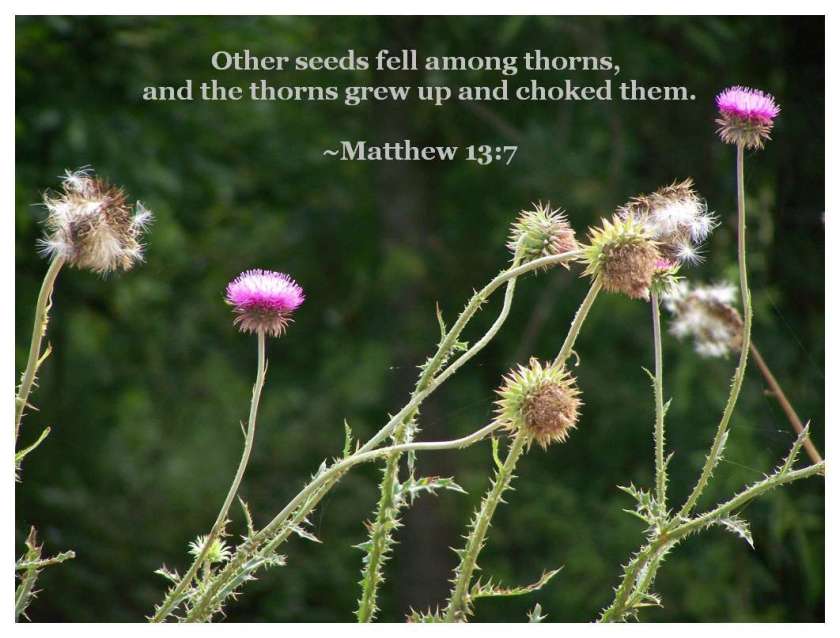
This brings us to the parable of the soils. Jesus outlined 4 kinds of soils; thorny, hard, rocky, and good. The soil is the heart. (Matthew 13:19). If we read the first three soils are hard and will not allow a Gospel seed to be planted, and the fourth is the soil that reaps a saved soul, then that soil is soft. The question remains, is it always soft? Does it get softer as the time for hearing the Gospel approaches? Does the Lord close the ears and eyes to the things of Jesus until the time for salvation draws near? How close to the time of salvation does God prepare the heart for the Gospel seed?

Though the following doctrine is hard for people to accept sometimes, whosoever will be saved is already set in God’s economy. Before the foundation of the world He wrote down the names of the people He will save. (Ephesians 1:4).

From my study of the Parable of the Soils, it seems that whatever soil you are is what soil you remain. If you’re hard soil, you always will be and are not destined for salvation. If you’re good soil, you’re good and will be saved at some point. However, since we know all people are thoroughly depraved, being a good soil does not mean one is a good person. We are still sinners. It simply means God has plowed the ground to prepare for the Gospel seed.

Where the soil is prepared by God, the results are staggering. And while we’re talking about soil here, what does that refer to? Matthew 13:19 tells us that the soil is the heart in the parallel passage in Matthew, the soil is the heart. So the only way that there’s going to be good soil is that it’s divinely prepared by God, chosen, prepared, the Spirit of God has come and done conviction. The heart is made ready and there’s a response. A Diagnosis of the Soils, Part 1

Because the soil represents the heart, when we look at a person we do not know if the Gospel that we share with them will plant and germinate or be rejected immediately. We simply do not know the heart so we share the Gospel with all.

How long before the moment of justification the Lord draws a person, is a question I cannot answer. He could be working on a person by drawing them for a long time, or He could justify them all at once when they hear the Word. I suspect it differs from person to person and it all fits into His master plan, which is perfect. The amazing part is that He draws us at all. We are putrid, wretched, filthy, mucky people and He draws us to His perfect and pure bosom, cleans us, and makes us co-heirs. I’m grateful He drew me to Himself, however long it took. I know you are too!

thorns

———————————————
Further Reading

Martin Luther on Gods’ hardening and softening the heart

Got Questions on drawing people to salvation


Posted in encouragement, Uncategorized

Worthless Sheba

Today’s reading, 2 Samuel 20:1-

“Now a worthless fellow happened to be there whose name was Sheba…”

The Bible is very honest about the people whose lives are recorded. John the Baptist the greatest man who ever lived (Mt 11:11). Noah, Daniel, Job declared righteous men, (‎Ez 14:14). David, a man after God’s own heart. (Acts 13:22). Mary found favor with God. (Luke 1:30).

We’d all aspire to lives that, if they were recorded, would be declared favorable, righteous, great. Poor Sheba, eternally declared “worthless”!

I am a sinful and flawed woman. Only in You I can do something. (John 15:5). Lord, let my life in you ever be tending toward the righteous and not the worthless!

Posted in potpourri, Uncategorized

Prata Potpourri: Tully, Royal Wedding Sermon, the Ascension, the Holy Spirit, Big Mirrors, Lawn Chair Season & the Books that go with them, more

A plethora of potpourri items from around the web for your edification and amusement.

Housewife Aimee Byrd (The Housewife Theologian) discusses the new Carlton Pearson movie Come Sunday personally and theologically in her piece The Gospel of Inclusion.

As my friend Greg said, “This is how to show appreciation and express criticism in the same article. Well said!”
What Would Jesus Say About Bishop Curry’s Royal Wedding Sermon? – Garrett Kell

Today Bishop Michael Curry gave a powerful sermon at the Royal wedding of Prince Harry and Princess Meghan. If you have not heard it, listen here or read the transcript.

Have you considered the Cross? The resurrection? Me too. All the time. But have you considered the Ascension? /crickets/ Nope, me either. Here in his essay at Reformation 21 called Ascension Matters, Tom Bertolet discusses it, and it’s good.

Justin McKitterick at The Expositors Blog reminds- Pastors, We Are Shepherds.

Dallas Holm has thoughts about what is perhaps the overlooked Person of the Trinity, the Holy Spirit in his essay Understanding the Holy Spirit

Kress Biblical Resources: is dedicated to helping those who study the Scriptures find the resources that will help them understand, apply, and proclaim the Word of God. timely, clear, and doctrinally sound books and resources for pastors and Bible students. Our authors are approved workmen, not celebrities. Our books are designed to stand the test of exegesis, not chase after every new wind of doctrine. Kress began in 2002 to provide solid, biblical resources for those who have set their hearts to study God’s Word, to practice it, and to teach it. Seeing a growing trend in unsound and insubstantial materials, even in books meant for pastoral preparation, Eric Kress, a former pastor himself and a Master’s Seminary graduate, set out to reprint previously published books that would be of help to the expositor and Bible student, and to develop new resources that rightly divide the Word of truth.

Carrie at Carrie’s Busy Nothings recommends two books in her ongoing series What’s On My Nightstand. Ahhh, summer reads.

At Delivered By Grace, in this short video Weekend Spotlight, Josh Buice, Steven Lawson, Tim Challies, and Phil Johnson talk about missions and how it’s the responsibility of the local church.

Santa Fe Texas High School shooter’s family puzzled by attack
10 died inside the high school, two teachers and 8 students

A movie review of Tully by World, and also Common Sense Media, that might not be to everyone’s taste but I include it because the depression moms of newborns feel (not postpartum) about the sameness and mundanity of motherhood isn’t often explored. World “reports the news from a Christian worldview: interpreting world events under the reality of the Christian faith”.

You might want to know of Ted Baehr and his page that reviews movies and TV shows from a Christian point of view. Common Sense Media is common sense but not an explicitly Christian site. Baehr is Founder and Publisher of MOVIEGUIDE®:  The Family Guide to Movies and Entertainment and Chairman of the Christian Film & Television Commission® ministry. His review of Tully is here. All reviews detail what might be objectionable, so I leave it to you.

Country Life UK has a pleasant article about Jackdaws and while you’re there take a gander at the real estate section, estates and castles for sale.

Victoria Elizabeth Barnes is a hoarder of Giant Fancy Things, and sees a mirror that is in Philadelphia. Only problem is, she’s in New Mexico…

Julie Ann Baumer writes (very well I might add) of Lawn Chair Season. This is an important season when you live in Maine.

As for me, I have one week of school left then I’m sprung for my own lawn chair season. I am hoping to snag the following items at my favorite deep-discount vintage store. There’s also a glider, I’ll take a look at it. Both might be snatched up before I can get there, but that is the way of things.

Also this sweet, sweet mid-century teapot. The prices on the items are what were on for the estate sale, the prices are always lower at the store they wind up in by the purchaser of the estate.


And this, this is the reason I’ve been haunting the vintage store for two years. I am in search of a little, round teapot with white background and flowers motif. It doesn’t even have to be excessively vintage. And here it is. I knew it’d show up eventually!


And if the price is right, this little mid-century teacup wouldn’t hurt, either:

Have a wonderful week ahead everyone!
Posted in prophecy, Uncategorized

Prophecy thoughts

Here are various thoughts on prophecy from me.

When men misuse the teachings of the Savior for their own evil ends it is a heinous thing to watch. It is written, “But these, as natural brute beasts, made to be taken and destroyed, speak evil of the things that they understand not; and shall utterly perish in their own corruption;” (2 Peter 2:12).

God means what He says. He will not be used, abused, or mocked.

Apostasy is a brutal condition, far worse than most Christians think.

—————————–

Often, the bible will predict owls to come to roost on places that are waste places, or ruins, or uninhabited. Same with vultures and eagles. The picture that had formed in my mind of reading the articles related to the snowy owls coming to roost silently all over the US was the verse of the angel at the end of the Tribulation calling the birds to feast on the dead. It is called The Great Supper of God

And I saw an angel standing in the sun, who cried in a loud voice to all the birds flying in midair, “Come, gather together for the great supper of God,” Rev 19:17.

This moment is after Jesus bursts back onto earth on a white horse with His saints following, and slays all those hundreds of millions assembled at the battle of Armageddon. The angel then calls to the birds to come eat the dead.

Ezekiel 39:17 at the end of the Gog-Magog war depicts God’s use of His birds

Son of man, this is what the Sovereign LORD says: Call out to every kind of bird and all the wild animals: ‘Assemble and come together from all around to the sacrifice I am preparing for you, the great sacrifice on the mountains of Israel. There you will eat flesh and drink blood.”

—————————–

No matter how serious the news is, His constancy, His sovereignty, His plan, and His ways are Good. Even if you feel you do not have much to praise Him for, you DO! Seek ways to thank Him. He is active in our lives to the n-th degree. Nothing escapes His hand, from the most high work of salvation of souls, to the smallest sparrow’s needs. How much more, then, are YOU valuable to Him? (Matthew 6:25-26)

—————————–

Despite the Great Tribulation to come for the Jews, for the Middle East, for all those left behind who delayed their decision to repent and were not raptured, the LORD is merciful! He saves His people personally, from the first day to the last days invading Gog-Magog coalition. He says He will send mercy upon the Jews, look at this verse-

I will no longer hide my face from them, for I will pour out my Spirit on the house of Israel, declares the Sovereign LORD.” (Ezekiel 39:29)

He will pour out His spirit. POUR. Not ration it out. Not mete it out. Not distribute it. Not send it. Not give it. POUR it. When you pour something it means “To stream or flow continuously or profusely.” The Hebrew word in use here means translated, “to gush”. That is what I mean by the LORD being merciful. He gives so freely, so copiously. He is good and gracious. He has not forgotten His people the Jews, nor will He forget His sheep living now on a fallen earth with terrible sins all around.

—————————–

JESUS IS COMING SOON! He has always been imminent. I pray you live with that imminence in your heart and mind.

Brethren, examine yourselves to see if you are in the faith.

Examine yourselves to see whether you are in the faith; test yourselves. Do you not realize that Christ Jesus is in you–unless, of course, you fail the test?” 2 Corinthians 13:5.

It would be devastating to fail the test. How do you know that you are in the faith?

Because you are sensitive to sin.

Because when you are tested, your faith grows stronger, not weaker.

Because you bear forth fruit

How to detect a false conversion

Posted in discernment, Uncategorized

Thoughts on introspection and journaling

DebbieLynne Kespert wrote a great piece about journaling the other day. I recommend it. I linked to it below, too.

Journaling is the act of consistently writing down one’s thoughts, feelings, and events in a notebook, as the definition goes. Some people do that to track growth, or to leave as a legacy to coming generations, or to vent. Journaling is distinct from many other kinds of diaries, like food diaries people keep for medical reasons, or weather diaries farmers keep, stress or anger management diaries, and the like. Journaling expressly focuses on one’s conscious inner thoughts, sensations, and feelings. It is a method of emotional self-examination.

I’ve never gotten into journaling. I like to experience the day and then move on. As someone on the autism spectrum, I’m not that in touch with my feelings anyway, seeing them as not precisely unnecessary, but usually as unhelpful. Yet many others see journaling as very helpful–

Ever wondered why history’s great minds including Isaac Newton, Abraham Lincoln, Andy Warhol, Leonardo Da Vinci, Marcus Aurelius, Charles Darwin, Winston Churchill, Benjamin Franklin, Ernest Hemingway, George Bernard Shaw and Maya Angelou would spend so much of their precious time writing things that will never be seen by another soul? … Many famous creatives, writers, innovators and original thinkers of our generation keep journals— for many, it is a creative necessity, for others, a place for exploration, and for some an art form in and of itself. (Source)

For Christians, some self-examination is good. It is worthwhile to examine one’s self to see if one is in the faith. Scripture admonishes us to do just that. (2 Corinthians 13:5, 2 Peter 1:10-11).

In the Christian spheres, Charles Spurgeon, the Prince of Preachers, kept a diary and also wrote letters constantly. Those became his autobiography after he died. The great theologian Jonathan Edwards kept a journal. In it, he penned his famous 70 resolutions. As the pastors say at the Netherlands Heritage Reformed Congregation, “these resolutions were birthed out of his felt weaknesses and known deficiencies, not his personal attainments. They represent, therefore, his sanctified, biblically-conditioned aspirations.”

My personal journal: In my journal below, I am trying to figure out from the Bible
about the different resurrections.

Christian journaling can be very good.

However caution abounds. Ligonier says that self-examination is important, but must be done rightly. Faulty self-evaluation, the passage tells us, is an obstacle to walking by the Spirit. If after examining ourselves we “conclude that we are superior to others” the self-examination is faulty, but alternately if we conclude that “if we consider our gifts inferior to those of others, thinking we are unable to assist burdened believers” it is also faulty.

So the Bible does call for some self-examination to be done, and there is a right way and a wrong way to do it.

But is a good thing, ever too much of a good thing? It can be. In her article, Journaling: The Pitfall We Should Recognize, DebbieLynne Kespert says that she journaled for 17 years, venting feelings, writing experiences, and meditating on her disappointments, her frustrations and her fears. Then she had an epiphany. She wrote:

So when someone uses a personal journal to ruminate on their feelings, should it surprise us that we wind up wallowing in self-absorbtion? Self-absorbtion, however, is the antithesis of Biblical Christianity. Christ demands that His followers actually die to ourselves for His sake.

It’s the tendency of sinful man to wallow in self-absorption to begin with. Journaling only increases that tendency. Excessive navel-gazing is not good as it takes our eyes off Jesus, upon whom we are supposed to fix our eyes. (2 Corinthians 4:18, Hebrews 12:2).

Jared Mellinger wrote about excessive self-examination in his piece “Self-Examination Speaks a Thousand Lies. He said,

Unhealthy introspection is a daily threat to our joy in Christ. Many of us tend to examine ourselves in a way that is excessive, inaccurate, and leads to discouragement. God calls us to examine ourselves (2 Corinthians 13:5; Lamentations 3:40), but healthy self-examination is a difficult and dangerous duty. The flesh seizes self-examination as an opportunity to turn our thoughts against us. Introspection is deceptive because it often looks like we’re doing the right thing: we’re not indifferent to our sin — we want to seek it out! But when that introspection makes us self-absorbed instead of Christ-absorbed, we undermine our faith.

Providentially, Randy Alcorn wrote an interesting piece a few days ago as well. It didn’t center on journaling per se, it was about self-control, but it speaks to the where we want our mind to go:

What is your mindset? Do you dwell on selfish, envious, jealous, bitter thoughts? Or do you dwell on what pleases God? Do you focus on God, His Word, and His mighty works on our behalf, or do you focus on woes and misfortunes and abuses suffered at the hands of others? According to Scripture, the choice is yours.

The choice is yours. Journaling can be good when the Christian employs self-control during the introspection process. Do you journal? Do you enjoy it? Has it become simply a way to focus attention on one’s self? Let me know int he comments what your experience has been.

Further reading:

The End Time: Is Christian journaling Good or Bad?

Posted in discernment, Uncategorized

Throwback Thursday: Are there codes in the Bible?

This essay first appeared in November 2010 on The End Time

I hear people all the time say that there are bible codes. That there is some secret, esoteric knowledge hidden within the 66 books of the bible that only people perspicacious enough can unlock and benefit from. This is bunk. God is not the author of confusion and He laid everything out plainly within those pages, so that His knowledge, plan, and wisdom for us would be clear.

They cite, for example, Bullinger, who derived a whole system of meanings from numbers in scripture. Some numbers do have meaning, but not to the extent Bullinger worked up. And anyway, Bullinger believed that the soul died between life and resurrection. He was also an ultradispensationalist, believing that (among other things) the church did not begin at Pentecost but at Paul’s conversion. Um…no.

In another code, “The Bible Code”, it is purported in a paper by Yoav Rosenberg that there was strong statistical evidence that biographical information about famous rabbis was encoded in the text of the Bible, centuries before those rabbis lived. Wikipedia says of the method of extracting the meaning from the coded language is

“the Equidistant Letter Sequence (ELS). To obtain an ELS from a text, choose a starting point (in principle, any letter) and a skip number, also freely and possibly negative. Then, beginning at the starting point, select letters from the text at equal spacing as given by the skip number. For example, the bold letters in this sentence form an ELS. With a skip of -4, and ignoring the spaces and punctuation, the word safest is spelled out.”

No again.

Of course, the primary fault with Bullinger’s numerical code and Rosenberg’s word codes is that the Holy Spirit is taken out of the equation. Believing in codes means man in his own mental acuity can unlock the secrets of the bible, the Spirit is not needed…which is exactly the opposite of what God said would be so.

The question is, “Are there hidden codes in the bible?” The answer is NO. John Macarthur addressed this question quite well, here. His short answer is below.

One of the foundational qualities of the Bible is its clarity (sometimes called perspicuity). That means Scripture’s main teachings are plain enough to be understood without the need of special expertise or church-sanctioned interpretations. 

The Bible frequently speaks about its own clarity. Psalm 119:130 says, “The unfolding of Thy words gives light; it gives understanding to the simple.” The average person who humbly reads the Bible can say, “I have more insight than all my teachers, for Thy testimonies are my meditation” (Psalm 119:99). Psalm 19:7 teaches, “The testimony of the Lord is sure, making wise the simple.” 

The idea of hidden codes in the Bible contradicts all of that by limiting accessibility to the real message of the Bible to so-called experts who can decipher the cryptic messages God “hid” in the Scriptures. But such “experts” aren’t needed because the Bible contains no hidden codes. 

One hidden-code theory works like a common word-search puzzle–hidden messages are supposedly embedded diagonally within the Hebrew text. But that’s as foolish as turning your daily newspaper into a word-search puzzle and expecting to find meaningful stories hidden in it. Newspapers aren’t written to convey messages in secret code, and neither was the Bible. Both should be read using ordinary rules of language. 

Of course there are concepts in the Bible that are hard to understand–even the apostle Peter admitted that (2 Peter 3:15). But the way to discover the meaning of those hard passages is not by seeking out hidden messages, but by engaging in diligent study that accurately handles the word of truth (2 Timothy 2:15). 

Take heart! The Bible is clear and even the most untrained reader can understand it. God wants you to understand the Bible, and He has provided the Holy Spirit as a guide. After all, “man does not live by bread alone, but…by everything that proceeds out of the mouth of the LORD” (Deuteronomy 8:3).

The LORD is not the author of confusion (1 Cor 14:33) but reveals Himself to one and all. If you have the Holy Spirit in you, you have an equal chance to understand what He wrote in it as anyone else. As MacArthur said, prayer, study, and diligence will “unlock” His Word. Not codes. If you believe codes exist in the bible then you accept that the Spirit is out of the equation and people like Bullinger have extra advanced knowledge that you must rely on HIM to unlock for you. No, let it not be so!