Satan attacks through the mind. He ultimately does this in two ways. He either gets you to think about God differently. (Eve). Or he gets you not to think about God at all. (Demas).
God transforms us through the mind. If we put our mind on Christ, our mind will be renewed from the craven, fallen thing it was to the holy and pure thing God wants it to be.
The place for that is through prayer, the Bible, and worship in song and preaching.
For those who live according to the flesh set their minds on the things of the flesh, but those who live according to the Spirit set their minds on the things of the Spirit. For to set the mind on the flesh is death, but to set the mind on the Spirit is life and peace. (Romans 8:5-6).
Do you want peace? I know I do, we all do. Then think on these things. (Philippians 4:8).
I used to vacation in the small village of Lubec, Maine. It is the “nose” on the map of Maine that looks like a silhouette of a dog. It sits across from Campobello Island, New Brunswick, Canada. I mean a stone’s throw. See?
The boat is docked in Lubec, USA. The lighthouse is in Canada.
Sunlight is a precious thing in Maine, especially that far north. Lubec is just 5 miles from the 45th parallel, which is the halfway point between the equator and the north pole. Daylight hours in July (when I visited) are 15 hours but in December there are only 8 hours of sunlight.
There is a street facing Canada called Water Street. There is an old cannery, the town library, a hotel, some pubs and cafes. One place you can stay is called the Betsy Ross B&B. It faces east, toward Campobello Island and has a bank of poppies and other plants growing in front. There is a slight overhang over the flwoers, plus the building is tall. The poppies are aiming, seemingly desperately reaching for the sun, as it rises over Campobello and arcs quickly across the sky before leaving the poppies in shadow again. See?
I wish I had a further-out view for you. But every flower is parallel to the wooden brace you see at a nearly 45 degree angle.
This isn’t a new thought, or an especially creative thought. But I think it is a good thought.
Though creation is fallen, it is still subject to God. Even the plants ‘know’ enough to reach for what is good for them. They need and thrive on the sun.
Isaiah 55:12,
For you will go out with joy And be led forth with peace; The mountains and the hills will break forth into shouts of joy before you, And all the trees of the field will clap their hands.
Barnes’ Notes says,
Here it is an expression of the universal rejoicing which would attend the extension of the kingdom of God on the earth.
The conscience-less creation groans now and will be praising with joy later. Metaphorically? Actually? The Bible doesn’t explain. Yet, we know that God has a relationship with creation. Maybe it’s a general call to praise, or perhaps the trees will clap and the mountains will shout.
For all our human wisdom and machinations and progress, we Christians, do we reach for what is good for us? The Son? With our superior relationship with Jesus over the creation and even over the angels, do we reach? Bask? Long for the Son?
I have pneumonia. I’ll be doing re-runs until I can clearly think and research. The essay below the line was published in October 2012 on The End Time.
A prefatory note: I’ve always been interested in prophecy. Jesus’s return has always been imminent. It was for Paul 2000 years ago and it is even more so for us. In my short time as a Christian, but having lived a long time as a pagan (through the 60s sexual revolution, the 70s feminist revolution, and the 80s decade of greed) it’s obvious that the veneer of civility and morality covering American culture is melting away like a snowflake on a hot iron. In addition, the more recent developments in evangelicalism with the high rates of biblical illiteracy, charismaticism, female rebellion, social justice replacing the Gospel, and the collapse of the Southern Baptist Convention (long thought to be a bastion of conservatism) the snowflake melting has occurred in the visible church as well.
It’s something to mourn, but nothing to be surprised about. Jesus will return soon and right every wrong. I’ve been warning of His soon return for 12 years and if I warn of it for another 50 years His return would still have been imminent.
Now on to the re-post.
____________________________
I’ve been reading Jeremiah 4, a tough, tough chapter. There are so many parallels between Jeremiah’s time and ours… So when I finished reading, I re-listened to John MacArthur’s sermon that he delivered in June 2011 about Jeremiah and his times, called, “Prophetic Message to an Ungodly Nation” and he compared it to our times. They are so similar it is amazing. I guess maybe not so amazing…because sinful people are still sinful people and pride is still pride and culture is still fallen.
I also listened to a sermon on Jesus as the Word from John 1. My favorite verses in the bible are John 1:1-5. So that was a good sermon to listen to, very edifying and beautiful. Stay in the word. Jesus is our rock to cling to.
Here is an essay by Dr. David Reagan on the topics of Urgency and Encouragement. I hope it encourages you as it did me.
—————————— Urgency
Dr. David R. Reagan,
Monday, October 29, 2012
There is a sense of urgency in the air. Our nation is on the brink of moral and economic collapse. The world is caught up in an insane frenzy of terrorism. The Middle East is about to explode. And the biblical signs of the times are shouting from the heavens that Jesus is about to return.
In the words of Charles Dickens, “It is the best of times, it is the worst of times.”
It is the worst of times because the depravity of Man is manifesting itself in the increasing rejection and blasphemy of God. The result is an exponential increase in violence and immorality.
It is the best of times because the collapse of society worldwide is the fulfillment of end time prophecies that point to the soon return of Jesus.
An Exciting But Challenging Time
We are privileged to be living in such an exciting and momentous time when we can witness the stage being set for the triumphant return of Jesus. But it is a time that calls for courage.
We simply must keep our eyes on Jesus, and we must remember that even if our nation has no hope, we as individual Christians have great hope.
But that sense of hope will prevail in our lives only if we consciously and determinedly live with an eternal perspective.
God is in Control
We must keep in mind that as the world falls apart around us, God’s Word says that He “sits in the heavens and laughs” (Psalm 2:4). His laughter is not prompted by a lack of concern. Rather, He laughs because He has everything under control, for He has the wisdom and power to orchestrate all the evil of Man and Satan to the ultimate triumph of His Son.
He has also promised that He will walk with those who are Christians, accompanying us through fire and high water (Isaiah 43:1-3).
And He has promised us an escape before the world totally collapses into absolute chaos (Luke 21:36). That escape is called the Rapture. When Paul revealed this escape in detail in 1 Thessalonians 4:13-18, he concluded by saying, “Comfort one another with these words.”
Additionally, we have the promise of the Millennial reign of Jesus to look forward to. What a day that will be!
Jesus will reign as King of kings and Lord of lords from Jerusalem. David, in his glorified body, will reign as King of Israel. We, in our glorified bodies, will be scattered across the earth to reign over those in the flesh. And the earth will be flooded with peace, righteousness and justice, as the waters cover the seas (Isaiah 2:1-4 and Isaiah 11:3-9).
Editor’s Note: I have pneumonia. I’ll be doing re-runs until I can properly think and research. This essay appeared on The End Time in June 2012.
By Elizabeth Prata
The spring has been gentle and the Lord has provided bounty from the earth. The summer garden crops have been planted and they are plenteous. The figs are coming in. The muscadine vine is full. It reminds me in particular of two verses in the Bible. They are promises. That is what prophecies are, you know. Promises of things the Lord has in store for the people who love Him and for those who don’t love Him.
Every man will sit under his own vine and under his own fig tree, and no one will make them afraid, for the LORD Almighty has spoken. (Micah 4:4).
In that day, declares the LORD of hosts, every one of you will invite his neighbor to come under his vine and under his fig tree. (Zechariah 3:10)
EPrata photo
In the Bible, vines (usually grape) and fig trees were emblematic of agricultural abundance and that abundance bespoke wealth. Many fig trees meant prosperity. The promised land was described in Deuteronomy 8:8 as “a land of wheat and barley, and vines and fig-trees and pomegranates.”
It was not described as a land flat and therefore ripe for land prospecting development. It was not described as a land full of silver and gold mines. It was not described a land of great cities producing a rich population. The prosperity that was promised was riches from a bountiful earth. Remember that after the Fall, Adam was cursed with toil, and that the land would not yield unless he worked it with sweat and labor, and even then it would produce thorns and thistles.
Cursed is the ground because of you; through painful toil you will eat of it all the days of your life. It will produce thorns and thistles for you, and you will eat the plants of the field. By the sweat of your brow you will eat your food until you return to the ground, (Genesis 3:17b-19b).
What was it like before the Fall? I can’t wait to find out, and that is what these prophecies promise. That curse will be reversed and the land will pop with generous abundance. Remember the two spies who came back, in Numbers 13:23 reporting that they saw huge grapes and figs and pomegranates? Doesn’t sitting under our own fig tree and our vine and sound relaxing? Refreshing? Like walking with God in the garden in the cool of the day.
And Jesus said, “I am the vine; you are the branches. Whoever abides in me and I in him, he it is that bears much fruit, for apart from me you can do nothing.” (John 15:5). And look what Jesus did! He did everything!
He accomplished redemption for mankind, by breaking His own body and allowing it to be poured out! We are His branches, connected to the Great Gardener whose vine covers us, and which provides all sustenance. When you’re out haying this summer, sweat running down your face, or you’re out mowing this summer, and thirsting because of the heat, or you’re gardening and battling the bugs who are killing your bean plants, remember the prophecies. Someday, working the land won’t be so hard
My people will live in peaceful dwelling places, in secure homes, in undisturbed places of rest. (Isaiah 32:18).
I will sing for the one I love a song about his vineyard: My loved one had a vineyard on a fertile hillside. (Isaiah 5:1).
How beautiful the relationship. We are the branches, closely grafted into the true vine. The true vine covers us, and we sit under it in peace and abundance. The abundance comes from the Vine Dresser who is the Father (John 15:1), who cares for the true vine in love and cares for his children, the branches.
Though the world is dark and satan prowls, the Gospel’s power to transform lives and enlarge the kindgom is advancing!
As you shake your head is dismay at the darkness that is covering the world, remember the Light is advancing MORE because Jesus is the power! I offer you this trailer from the DVD Dispatches from the Front series and I’m sure you’ll be moved by the Gospel’s power and awed at the grace and love of our Savior. THIS is what it is all about: salvation. There are more at the link below.
“Frontline Missions is an amazing ministry that produces the Dispatches from the Front DVD series. Here is what the ministry is all about: Frontline’s key objective is to advance the Gospel, forming vibrant, Word-centered, disciple-making churches, especially in those regions of the world that have the least Light. We are driven by the same desire that animated the apostle Paul who said it was always his ambition to preach the Gospel where Christ was not known (Romans 15:20). We pursue this goal by equipping Christians on the frontlines to reach their own people for Christ, by forming strategic partnerships with them, and by developing creative platforms in countries closed to traditional missions.”
Please support missionaries with your prayers and your money. They are on the frontlines. And lives are being changed, eternally.
I work in education as a teacher’s aide. That means I get summers off. At this stage of my life I enjoy the time off more than the money. Yes, I get paid through the summer, but it’s pro-rated. I live for 12 months on a 9-month salary. They just stretch it out. Which means I really stretch it out.
But as I said, the time is important to me. I live frugally and simply. I have all I need. I’ve been blessed to have had many experiences in my life that would cover many lifetimes. So I have zero to complain about. I have all I need and more.
As a single person I am ever mindful of Paul’s admonition to redeem the time (Ephesians 5:16) and to remain anxious for things of the Lord since I have no husband and I am not anxious for things of the world-
And the unmarried or betrothed woman is anxious about the things of the Lord, how to be holy in body and spirit. But the married woman is anxious about worldly things, how to please her husband. 35 I say this for your own benefit, not to lay any restraint upon you, but to promote good order and to secure your undivided devotion to the Lord. (1 Corinthians 7:34-35).
I have an opportunity to secure my undivided attention to the Lord. Yay!
But I’m lazy. Waaah.
Given half a chance, I’ll secure my undivided attention upon myself.
More than one school vacation or summer break has gone by, both before and after becoming a Christian, where I had grand plans for home or garden improvement projects, or craft projects, or reading through my piles of books, and none of it got done.
A few years ago I put two and two together and finally acknowledged that I’m on the autism spectrum. Autistic people typically have a poor sense of time and difficulties with time management (because executive function is impaired). At school I’ve got an excellent sense of time because the day is broken into segments to the minute. My day is neatly prescribed for me.
But like in tug of war, if you let go of the rope you tumble, when the school year ends and I’ve let go of the rope, I’m in free fall. Time here in this life on earth is a finite product, a discrete thing. In May I think I have all the time in the world to start reading and then suddenly it’s July 30 and I have to go back to work. All I’d accomplished is navel gazing.
Is that why the Lord made me a single person? I think not.
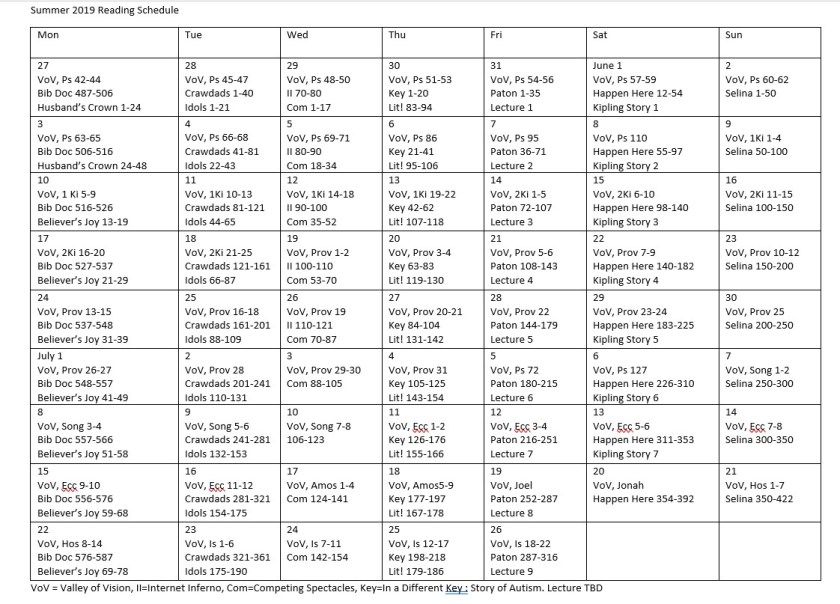
Anyway, I created a schedule. I replicated my days and weeks at school by making them segmented. I piled up the books I want to read, divided the pages into number of pages to read weekly, interspersed Bible reading and devotionals, and voila, I have something tangible to keep me on track.
I’m not rigid about it, it’s a tool, not a ball and chain.
This year’s schedule is a lot more ambitious than last year’s. Last year I read 8 books along with my personal Bible reading, Dr Abner Chou theology lectures, and Systematic Theology lessons.
This year I topped out at 14 books, personal Bible reading, devotional reading, systematic theology reading, and lectures from Ligonier (to be decided). I’m almost done with Sproul’s lectures on Life of David so I’ll buy another series this Friday at teh Ligonier $5 sale. They are usually 24 minutes long and there are about 9 to 12 lectures in the series on average.
I stalled out on my annual Bible Reading plan, but I’m looking forward to resuming. It’s organized by chronological authorship, earliest book to the latest book.
I do not have any trips planned. My cats are sick and need to go to the vet, so the timing is a blessing in that I can staying close to home to watch them, or get an appointment at any time of day.
For other hobbies, I bought a set of watercolor markers at school from the pop up shop, so I’ll do some crafting. Evenings I’ll be read-ed out, lol, so movies or TV for me. I will make a photo expedition or two, but gracious sakes, the temps have suddenly shot up to the upper 90s all of a sudden and are predicted to be that way for this week and next. This is unusual. I hope it cools down some so I can pound the pavement at the Golden Hour to get some cityscapes. I’m not THAT dedicated to my photography hobby to go to the city in hundred degree weather just to amble around and get pictures.
Here are some ideas for inspiration on a 365 photo series (A Photo a Day). I did a picture a day last year, testing my creativity to snap something just from around and within my very tiny environs here in the apartment and the yard. I might make a theme this year. Maybe “Metal.”
I’m not tied to the reading schedule, as I said, it’s a tool to help me make sure I’m doing the most for the Lord I can do. So, if something comes along in terms of fellowship, I’ll take it. Otherwise, I refuse to be a slug! Saturday and Sunday of the first two days of summer vacation are booked. Saturday is a wedding and Sunday is church and then I’ll start the Reading program on Monday. Monday is a good day to start things, isn’t it? 😉
The one on top is Kipling’s Stories, the slim one you can’t see under Competing Spectacles is Her Husband’s Crown, just 48 pages. A pamphlet, really.
The books at home on the bookshelf next to my kitchen table. Too ambitious? We’ll see
VoV is Valley of Vision II is Internet Inferno Com is Competing Spectacles Key is In a Different Key: The Story of Autism
Colossians 3:17, And whatever you do in word or deed, do all in the name of the Lord Jesus, giving thanks to God the Father through Him.
Summer is a time for relaxing and fun. It’s also a time for entertainment, as many folks’ work-schedules disappear completely (if you’re an educator like me) or lighten some. When we’re seeking entertainment, we should always make sure whatever we seek out is pleasing God.
Later today I will stack my to-read books up, make decisions, and create a reading schedule. I’ll post it when I finish. The Summer reading schedule also includes lectures. I’m almost finished with RC Sproul’s series on the Life of David. Ligonier’s $5 Friday sales always have several series to choose from and download. What a bargain. For $5, you can listen to 12-lectures of stellar teaching not just from Sproul but other men, too, in their list of Teaching Fellows. That’s just 41 cents per lecture.
But when my day is done and I’ve completed the things on my reading schedule and done my home chores, I want to relax with a good TV show or movie. I have a harder and harder time finding entertainment to watch. I’d like to think that is due to a longer walk with the Lord and His Spirit convicting my mind of impurity. I hope. I don’t know how many half-viewed or only minutes-seen movies and shows on Netflix I have littering my watch history. Even if the rating is PG or PG-13, the program still uses curse words and presents unsavory situations. Ugh.
I know, I know, this complaint isn’t anything new. Not from me. Not from any Christian.
Looking at lyrics on the top songs on Billboard’s charts is a nightmare. Reading any Twitter stream outside my hedge of carefully chosen Christian followers in even even innocuous threads like #BBCGoodFood or #TBBT will result in immediately seeing swear words and worse. Demonic lyrics, shows promoting satan’s agenda, uncivil discussion…so sad. It’s rampant.
Job said that he had made a covenant with his eyes and would not look upon a maid. (Job 31:1). Paul said, “Flee from sexual immorality. All other sins a man commits are outside his body, but he who sins sexually sins against his own body.” (1 Corinthians 6:18). In teaching about the carnality of this world, Paul wrote in Colossians 3:2, “Set your mind on things above, not on things on the earth.” He commanded them to “put to death your members which are on the earth: fornication, uncleanness, passion, evil desire, and covetousness, which is idolatry.” (Colossians 3:4). We are to set ourselves apart from the carnality of this world.
I have two months of summer break from school coming up. Friday is the last day of post-planning and then I’m sprung. I try to remain productive and I try to resist temptations to watch shows and movies I know aren’t good for me. The danger is not only looking but ignoring the prick of conscience the first moment something untoward happens on screen. That’s how sin gets hardened. (Hebrews 3:13).
In one sense I have things easy at work because I am employed in an elementary school where the work-place language is always appropriate, the dress is always modest, and social media is filtered out of the computers. I spend 8 hours a day blessedly in the company of wonderful children and decent adults. Temptation is taken from me.
But during summers I have 24/7 opportunities to be entertained on-screen or by unwise choices of reading material. Pray I make wise decisions.
In case you think that it is nearly impossible to resist fallen culture today since carnality is all around us, we’re not special. Early Christian Rome was in the same state of debauchery that we are immersed in now, with orgies, homosexuality, and licentiousness in song, poetry, and drama. The Colosseum was free to all to be entertained by bestiality, murder, and death. The pagans were used to frivolity in all forms from the numerous festivals, such as Saturnalia, a week-long festival in December. The Roman philosopher who lived during Jesus’ time, Seneca the Younger wrote, “the greatest part of the city is in a bustle. Loose reins are given to public dissipation…”
It’s not ‘just entertainment’, it’s satan’s playground. In it, he pushes forward his agenda of licentiousness and ungodliness. And when his themes are repeated endlessly and ceaselessly, hammering into our youth’s brains, sung over and over, watched over and over, they penetrate. The same with video games. For adults who watch TV and movies and play video games it’s equally dangerous to ease up just because it’s summertime. Remember, Rome’s government allowed a looser standards during Saturnalia… Don’t be Rome.
Do we memorize scripture verses as well as we easily remember lyrics like Lady Gaga’s Judas song, ‘fill me with your poison?’ or taglines from Game of Thrones? No. And there’s a reason for that.
You might have heard of that phrase, ‘vote early and vote often.’ Wikipedia describes its origins and meaning:
Vote early and vote often is a generally tongue-in-cheek phrase used in relation to elections and the voting process. Though rarely considered a serious suggestion, the phrase theoretically encourages corrupt electoral activity, but is used mostly to suggest the occurrence of such corruption.
The phrase had its origins in the United States in the mid-19th century, and had an early appearance in Britain when a newspaper reprinted correspondence from an American solicitor. The phrase, however, did not find widespread use until the early 1900s when it was used in relation to the activities of organized crime figures in Chicago.
I was reading Psalm 32 yesterday. David’s fervor for the Lord surely comes through in reading successive Psalms, doesn’t it! In addition, verse1-6 really spoke to me.
David knew that confession was critical to his walk with the LORD. He notes that when he kept his sin to himself, it afflicted him physically and physiologically. Only when he confessed he found relief.
In other Psalms David begs the LORD not to turn His face away, nor to take His Spirit from David. David knew that the Spirit was a gift that could be taken away from him, as often happened in the Old Testamnt. The Lord’s Spirit and presence left the Temple. The Spirit was given to men in the later chapters of the Exodus in order to complete artisinal work for the Temple artifacts (Exodus 31). The Spirit departed from Saul (1 Samuel 16:14). The Spirit had a different ministry then and worked in different ways, that were not always solely salvific. So, David pleaded not tohave the Spirit removed (thus signifying God’s blessing was removed). He waa eager to repent so that he would maintain tghe gift of relationship with the Holy LORD.
I was curious about the line in verse 6, “Therefore let everyone who is godly offer prayer to you at a time when you may be found;”
What does that mean? It means when we feel a conviction of sin, to confess then. Do not let it wait. Hebrews 3:13 reminds us of that-
But exhort one another every day, as long as it is called “today,” that none of you may be hardened by the deceitfulness of sin.
Barnes’ Notes further explains:
It does not mean that there were appointed or set times in which God would be gracious; or that there were seasons when he was disposed to “give audience” to people, and seasons when he could not be approached; but the meaning is, that whenever they came thus – with this penitent feeling, and this language of confession – they would find that the time of mercy. The idea is not that God is anymore disposed to show mercy at one time than another, but that they would find him “always” ready to show mercy when they came in that manner: that would be the time to obtain his favor; “that the time of finding.” The real time of “mercy,” therefore, for a sinner, is the time when he is willing to come as a penitent, and to make confession of sin.
Our fervor to confess should be vigorous and constant. I personally think many churches today and the wider church globally downplays confession and sin. We aren’t really treated to sermons that pound our heart with conviction of sin’s deceitfulness in men and confession’s importance to God.
In other words, to take the phrase I opened the essay with and twist it to make my point: confess early and confess often.
Psalm 32
Blessed is the one whose transgression is forgiven,
whose sin is covered.
2 Blessed is the man against whom the Lord counts no iniquity,
and in whose spirit there is no deceit.
3 For when I kept silent, my bones wasted away
through my groaning all day long.
4 For day and night your hand was heavy upon me;
my strength was dried up as by the heat of summer. Selah
5 I acknowledged my sin to you,
and I did not cover my iniquity;
I said, “I will confess my transgressions to the Lord,”
and you forgave the iniquity of my sin. Selah
6 Therefore let everyone who is godly
offer prayer to you at a time when you may be found;
surely in the rush of great waters,
they shall not reach him.
7 You are a hiding place for me;
you preserve me from trouble;
you surround me with shouts of deliverance. Selah
8 I will instruct you and teach you in the way you should go;
I will counsel you with my eye upon you.
9 Be not like a horse or a mule, without understanding,
which must be curbed with bit and bridle,
or it will not stay near you.
10 Many are the sorrows of the wicked,
but steadfast love surrounds the one who trusts in the Lord.
11 Be glad in the Lord, and rejoice, O righteous,
and shout for joy, all you upright in heart!
Charles Spurgeon stumbled across Puritan Thomas Manton’s works and was immediately captivated by them. Enchanted, he reformatted some of Manton’s sermons into a devotional form. The result was a book called Flowers from a Puritan’s Garden, by Charles Spurgeon, 1883. Here is one of them.
——————————–
It is time that I am done with all butterfly-hunting!
“As children catch at butterflies—the gaudy wings melt away in their fingers, and there remains nothing but an ugly worm!”
Such is the end of all earthly ambitions! They cost us a weary pursuit, and if we gain our desire—it is destroyed in the grasping of it!
Alas, poor rich man, who has wealth—but has lost the power to enjoy it!
Alas, poor famous man, who in hunting for honor, has learned its emptiness!
Alas, poor beautiful woman, who in making a conquest of a false heart, has pierced her own with undying sorrow!
A butterfly-hunt takes a child into danger, wearies him, trips him down, and often ends in his missing the pretty insect. If, however, the boy is able to knock down his victim with his hat—he has crushed the beauty for which he undertook the chase, and his victory defeats him!
The parallel is clear to every eye. For my part, let me sooner be the schoolboy, dashing after the painted insect—than his father worrying and wearying to snatch at something more deceptive still.
It is time that I am done with all butterfly-hunting! My years are warning me that I may hope soon to be with Christ Himself, and see greater beauties than this whole creation can set before me. I am now bent on pursuing nothing but that which is eternal and infinite. Keep me to this resolve, I beseech you Lord.