Posted in theology, writing

The Writer’s Responsibility

By Elizabeth Prata

Christian books, pamphlets, blogs, letters, reviews, essays…it’s all so much. It is so easy nowadays to start a blog and begin writing. I’ve mentioned before about authorial skill, ministerial calling, and tone. But now let’s speak of the responsibility writers have.

What is the responsibility of a writer, his or her ethics, so to speak? All people are accountable in their work, career, or hobby. Writers write with their audience in mind. They write to persuade, inform, or entertain. This three-fold purpose is universal. EB White eloquently opined on a writer’s responsibility from the secular side, in his piece from 1969. I recommend it. Here is one quote:

A writer must reflect and interpret his society, his world; he must also provide inspiration and guidance and challenge. Much writing today strikes me as deprecating, destructive, and angry. There are good reasons for anger, and I have nothing against anger. But I think some writers have lost their sense of proportion, their sense of humor, and their sense of appreciation

Add to that, Christian writers write for the glory of God and to share edifying content to the transforming mind. Christian writers have a responsibility to be clear, straightforward, and to keep God’s glory in front at all times.We know that teachers of the Word have a responsibility, one that is so weighty that the Bible advises that “not many” should be a teacher. (James 3:1). Writers teach, especially if they have a public platform. By default, unless you’re writing in a lockable diary, your writing is public and someone will be learning from it. If not the words, the example you (I) set. Christian writers are by default, teachers.

Derek J. Brown, a graduate of The Master’s Seminary and now a pastor, wrote in 2012’s essay “Clarity: The Responsibility of Every Christian Writer,

I am also convinced that Christians have the responsibility—if we are going to write about Biblical truth and important theological issues—to cherish clarity above all other literary qualities.

As I look back over past entries, some of what I have written causes me to grimace. In several posts, clarity was sacrificed for cleverness; precise statements gave way to long, cumbersome sentences; and healthy content was smothered under a thick layer of syrupy rhetoric.

download

I hope that what I have written does not cause anyone to grimace for the reasons stated above. I know that my theology has improved since I started this blog ten years ago, and I’d grimace over older essays that I wrote in zeal without knowledge. But I hope that I have not written cleverly for the sake of being clever. I hope I have not covered up any pointing to the Lord for the sake of syrupy rhetoric.

Derek Brown goes on in convicting manner,

What this does mean is that we should labor, every time we write, to make sure that what we write is clear, and that our communication has not been hindered by silly word games. Practically, this will mean carefully choosing words that enable learning instead of words that only show off our extensive vocabulary. It will mean spending more time over fewer entries to ensure that what we post falls under the category of quality rather than mere quantity. And it will even mean that we are willing to risk being regarded as unsophisticated and unscholarly by some of our readers because we desire their spiritual good far more than we covet their admiration.

The reader’s understanding of an important point should be the first motive of the writer. I hope I never set clarity adrift for the sake of words that display the authors’ skill.

It’s easy to use big words and make much of your vocabulary. It’s hard to use fewer words, and clearer words, because that means one is squashing one’s pride and removing ego from the piece, on behalf of the more important sake of the reader’s understanding and ultimately, God’s glory.

When you choose to spend your limited time reading any material, but especially blog posts, think about if the writer has carried through his first responsibility: clarity. See if you can intuit what should be his/her motivation; glorifying God. In sum: ask yourself, Does this piece clearly make a point that helps my understanding of Jesus, and does it glorify God- or does it glorify the author?

Whatever you do, do it all for the glory of God.” (1 Corinthians 10:31).

verse

Posted in encouragement, theology

Fasting: What it is and what it isn’t

By Elizabeth Prata

Spiritual disciplines. We all know that they are. Reading the Bible. Praying. Giving. Attending church. Doing good works.

Fasting.

Fasting isn’t talked about much and when it is, it’s sort of either glossed over or it’s folded in as part of the latest diet-fad-plan.

What IS the spiritual discipline of fasting, then?

Jesus said that we will be fasting as part of the spiritual life. In Matthew 6:16-18 He said what to do and what not to do when we do it.

And when you fast, do not look gloomy like the hypocrites, for they disfigure their faces that their fasting may be seen by others. Truly, I say to you, they have received their reward. 17 But when you fast, anoint your head and wash your face, 18 that your fasting may not be seen by others but by your Father who is in secret. And your Father who sees in secret will reward you.

If you haven’t thought of fasting like this, please do: It’s possible to fast in hypocrisy.

Just as with anything we do for the Lord, it’s possible to mix in personal motives that outweigh or outbalance why we’re doing it for Him, making it a hypocritical exercise. That’s why it’s important to know what fasting is and why we do it.

fasting final


These books above are just a very few of the books that pop up when searching for “fasting”. You can fast for breakthrough, to get an edge, to lose weight, to formulate atomic power with God, to feed your soul, to spark an awakening, to receive rewards, to cause a miracle, to start a revival…

Those are a few of the subtitles to the books that came up on my search for ‘fasting.’ If you’re new to the faith or unfamiliar with the discipline, the dangers are real in that you might accidentally absorb the simply wrong or even heretical, written by heretics. They look good, they may sound good to the newbie, but they would steer you in the wrong direction.

Solid ministries that teach rightly would be John MacArthur at Grace to You, RC Sproul at Ligonier, CARM.org, Monergism, and more.

Here is a John MacArthur sermon about Fasting without Hypocrisy. The sermon begins this way:

Now fasting is a very popular phenomenon today, but that is not to be confused with what the Bible is teaching us about fasting.

What DOES the Bible teach us about fasting? It is not to lose weight. It is not something to do for medical purposes, though your doctor may recommend fasting before taking certain tests. But that is not spiritual fasting. Spiritual fasting is not to “get” something. It is not to empty one’s self in order to receive a revelation or to go mystical via dreams or visions in an altered state.

Biblical fasting has variously been defined as-

  • Abstaining from food or drink in order to focus on prayer and seeking God’s will.
  • Abstaining from food for spiritual purposes.
  • Abstaining from food for the purpose of focusing on God

John Piper said, “Fasting is a temporary renunciation of something that is in itself good, like food, in order to intensify our expression of need for something greater — namely, God and his work in our lives.”

The Bible never deals with fasting on a physical level. John MacArthur

Examples of fasts in the Bible:

Jesus fasted for forty days in the wilderness prior to beginning His public ministry. He was there to be tempted by the devil. (Matthew 4:1, Luke 4:1-2, Mark 1:13).

Nehemiah fasted in spiritual grief when he heard the state of Jerusalem. He fasted to confess the sins of Israel and gain permission to rebuild. (Nehemiah 1:4).

David fasted when his enemies were treating him unjustly (Psalm 35:13).

The Ninevites fasted after they heard Jonah’s proclamation (Jonah 3:5) and all of them from greatest to least, fasted in repentance and humility, wearing sackcloth.

Acts 13:2 recounts the members of the early church ministering accompanied by fasting, to seek confirmation of elder appointments. (see Acts 14:23 also).

Paul fasted for three days after encountering Jesus on the road to Damascus. (Acts 9:9).

Fasting is always combined with prayer. Paul fasted often. (2 Corinthians 11:27). He could have been thinking of fasting in this verse:

But I discipline my body and keep it under control, lest after preaching to others I myself should be disqualified. (1 Corinthians 9:27).

So it seems from these examples and of course many others not listed here, that fasting is a regular spiritual activity for the Christian. One can fast for guidance, to gain spiritual strength, for clarity on a situation, to commune with God, to rectify a situation, to dispel self-sufficiency, to renew zeal (Mark 2:18-20), and other spiritual reasons, fasting is something that any Christian can and probably should do. Jesus seemed to say that it would be a regular activity, and gave directions for its proper implementation, though He did not command it. (Matthew 6:16-18).

I’ve fasted several times. I fasted for 3 days when I discovered a previous pastor had plagiarized all his sermons from other people and pretended they were his own. I needed God’s guidance to determine what I should do and how to approach the situation, or with whom.

I fasted prior to approaching a Ladies’ Minister who loved Beth Moore with my concerns about Beth Moore.

I fasted when our elders were planning and planting our new church.

I fasted on behalf of lifting a person to the Lord who was in a bad way.

All those were accompanied by prayer, too.

How do you deal with fasting? Have you done it? Do you enjoy it?

John MacArthur ends his sermon linked above this way:

God has given us every good thing to enjoy. Beloved enjoy it. But when you’re in a spiritual struggle and you’re consumed with the things of God, know this, that it’s right to abstain from those things to continue your concentration and your focus on that which is spiritual and divine. God help us to be more sensitive so that fasting in its truest sense can be a part of our lives.


Posted in encouragement, theology

“Dear Woman Feeling Called to Ministry…” By Ayanna Thomas

I like what Ayanna Thomas has to say. She makes sense, is humble, insightful, and joyous. Here is the start of her Instagram piece today: Read the rest here.

ayanna

I know how you feel. You see so many women around you “stepping into their calling.” And you feel this urge to do something too. You scroll your feeds, wishing you could just launch your blog, start a local women’s group, deliver talks at conferences, like everyone else. It feels like you’ll never be able to walk in the gift(s) God has given you and you aren’t really even sure if you’re convinced of what that looks like.” 

“But let me encourage you with something…


Read the rest of her encouraging comment, then browse her Instagram account, lots of good stuff!

Posted in book review, theology

Book Review Shots: Disciplines of a Godly Woman; Can I have Joy in my Life?; Amy Carmichael; The Machine Stops

By Elizabeth Prata

Crime novel writer James Patterson issues books in a series called “BookShots.” These are novellas, short books he writes in beteeen the longer ones. I like the idea.

I’ve been participating in Tim Challies’ annual Christian Reading Challenge. I’m keeping up pretty well, and enjoying the structure it provides so I do not lapse into total couch potato with brain of mush.

Here are a few of my Book ReviewShots, short reviews of the books I’ve recently read.

~~~~~~~~~~~~~~~~~~~~~~~~~~~~~~~

Disciplines of a Godly Woman, by Barbara Hughes

I do not recommend this book.

I like the topic, and there were a few good nuggets in it, but overall it was simply a rehash of normal things any women has already heard, if she has been saved for any length of time. Few new insights.

Issues I had with the book were:

–LOTS of anecdotes. The book would be half as long if Mrs Hughes cut the personal anecdotes and stories that supposedly cemented her point and just stuck to the Bible. Anecdotes the author thinks makes her case, don’t always connect with every reader, but the Bible unfailingly does.

–Some misused scripture, or relying on a traditional view of famous verses rather than teaching their real meaning. (Mt 18:20, Jeremiah 29:11)

–Quoting doubtful characters, i.e. William Barclay, a confirmed universalist who denied the Trinity; Watchman Nee, a mystic whose views on sanctification, the Holy Spirit, hermeneutics, baptism, the church and sin contain significant error; Christy the missionary written about by Catherine Marshall, who was a social justice warrior missionary who gravitated to Quakerism; Win Arn, church growth guru who partnered with C Peter Wagner, demon delivery guru for one of his books, and more. Her Resources page also contains iffy books.

In the book was the following statement- “Apostle Andrew became the patron saint of three diverse countries.” As if that helps his stature! But it lessens the author’s though, for promoting Greek Orthodox and Roman Catholic “tradition”. There is no such thing as a “patron saint” of a nation. Statements like these should never be included in a book aimed at evangelical women.

I found this book hard to get through and problematic to pass on.

Better books are:

Praying the Bible by Don Whitney
The Discipline of Grace by Jerry Bridges
The Discipline of Spiritual Discernment by Tim Challies
Twelve Extraordinary Women: How God Shaped Women of the Bible, and What He Wants to Do with You by John F. MacArthur
Susie: The Life and Legacy of Susannah Spurgeon, wife of Charles H. Spurgeon by Ray Rhodes Jr.
The Pursuit of God, by A. W. Tozer

~~~~~~~~~~~~~~~~~~~~~~~~~~~~~~~~


Amy Carmichael: Beauty for Ashes, by Iain Murray

A short book and an easy read. Murray seems a bit glowing over Amy, but then again, what Amy did was amazing. He didn’t gloss over some of her known issues, however, such as her subjective approach to interpreting the Bible, or her (often misunderstood, according to Murray) imperiousness. Thus, I believe this to be a fair assessment of her life. It isn’t deep, since the book is short, but it’s a good introduction to a remarkable woman’s life lived for Christ. It contains a lengthy bibliography if one wants further info on Amy’s life and work in India.

See also:

A Chance to Die: The Life and Legacy of Amy Carmichael by Elisabeth Elliot
The Little Woman by Gladys Aylward
Lady Jane Grey: Nine Day Queen of England by Faith Cook

~~~~~~~~~~~~~~~~~~~~~~~~~~~~~~~~

Can I Have Joy In My Life? (Crucial Questions #12) by R.C. Sproul

A short, extremely helpful book on the topic, from RC Sproul. (50 pages). I bought it at the Ligonier $5 Friday sale for $1.88. It’s worth much more than that. Great to keep and re-read at various times, or to give away. Recommended.

I also purchased but have not read others in the series:

Can I Lose My Salvation? (Crucial Questions #22) by R.C. Sproul
Are People Basically Good? (Crucial Questions #25) by R.C. Sproul

Crucial Questions is a good series. Many books covering oft-asked questions. Since the book length is pamphlet sized and they are inexpensive, it makes a perfect giveaway to any brother or sister struggling with any of the questions the book covers.

~~~~~~~~~~~~~~~~~~~~~~~~~~~~~~~~

The Machine Stops by E.M. Forster

Written in 1909 as a short story (only 47 pages for this edition of the paperback) it is a masterful dystopian novella with an eerie bull’s eye to today’s tendency toward individual isolationism and over-reliance on technology. Who knew that the author of A Passage To India, Maurice, Howard’s End, A Room With a View and other familiar novels, had such a prescient eye for the future and could create a totally dystopian, subterranean world. “The Machine Stops” was named one of the greatest science fiction novellas published before 1965 by the Science Fiction Writers of America. This book influenced future authors such as Isaac Asimov and filmmaker George Lucas.

Recommended.

See also:

It Can’t Happen Here by Sinclair Lewis
The Running Man by Stephen King

Posted in poetry, theology

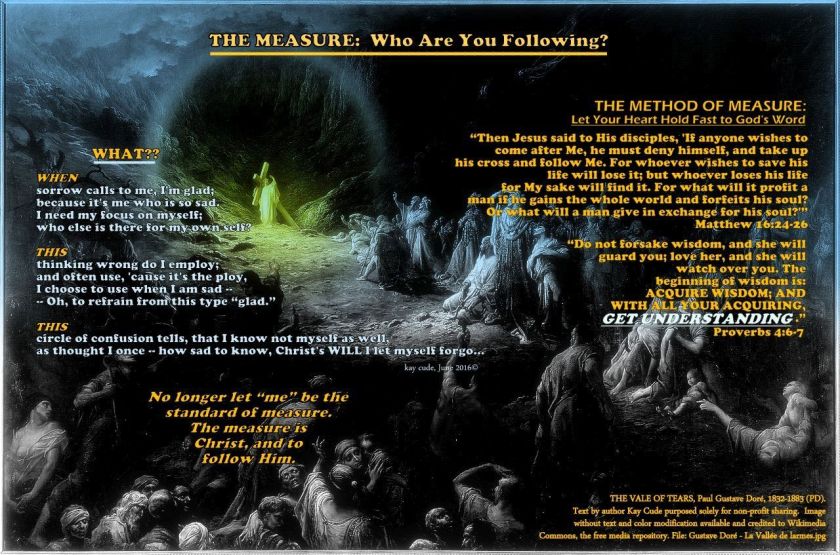
Kay Cude poetry: Treasured Memories

To all the mothers out there reminiscing over the time that has passed and your sons and daughters are now older, perhaps having left the nest, flying off to new skies and making nests of their own. The sweet time of little hugs and recious moments fly by. Cherish them.

Kay Cude did just that, revising a poem she had written long ago as she remembered just such a moment treasured in her heart.

Artist’s statement:

I had written this poem for my son many years ago to recount our sweet time together when he was a two-year old.


SWEET MEMORIES TENDERED FROM LONG-AGO

Kay Cude is a Texas poet.
Used with Permission.

Posted in love of money, theology

Is Being Rich A Sin?

By Elizabeth Prata

Not that I would know, lol. But the question has been raised.

Having money is not a sin. Abraham, Job, Nicodemus, and Joseph of Arimathea, Joseph son of Isaac and Moses were either wealthy themselves or lived in wealthy circumstances. Alternately, not having money is not a sin, either, as we see from Mary and Joseph, and Jesus Himself.

But the Bible does warn us that there will be false teachers who do not teach for the love of Jesus but for the love of money. (2 Peter 2:3). 1 Timothy 6:10 says that the love of money is the root of all evil. The issue isn’t having or not having money. It’s what you do with it. Abraham shared his wealth generously with his nephew Lot, he tithed generously to the King, he supported his family, he helped others with his provision. Abraham knew his prosperity came from God and wasn’t his to begin with.

Greedy prosperity teachers hoard it, collect worldly goods by twisting the Word and living off others’ backs by using God for their own gain. The first recorded words of Judas was about money, and the very next verse reveals his motivations: he was a greedy thief who helped himself to the purse. Properly acknowledging from whom all blessings (and material wealth) flows is paramount, as king Nebuchadnezzar found out in Daniel 4:30.

The Bible also tells us that in addition to believing right doctrine, teachers are held to a higher standard and must live a righteous lifestyle. I’ve noticed as some wealthy false teachers’ wealth has increased over the decades, their charitable giving has decreased. That’s always the proportion for the worldly. But the Bible says Do not lay up for yourselves treasures on earth, where moth and rust destroy and where thieves break in and steal, but lay up for yourselves treasures in heaven, where neither moth nor rust destroys and where thieves do not break in and steal. For where your treasure is, there your heart will be also. (Matthew 6:19-21).

Having material wealth does give rise to a danger of self-satisfaction and self-sufficiency. It IS hard for wealthy people to gain the kingdom, (Matthew 19:24), but having wealth isn’t any more a sin than being poor is a sin. It’s how you live that counts. How you obey God. How you use what He has given you, no matter how much or how little.

Where is your primary orientation, all your thoughts, your goals? If your thoughts are toward getting and maintaining your possessions, then you have nothing.

If they are pointed toward Jesus, then no matter how much money or possessions you have, you have everything.

No one can serve two masters. Either he will hate the one and love the other, or he will be devoted to the one and despise the other. You cannot serve both God and Money. (Matthew 6:24).

treasure

Posted in encouragement, theology

What is Love?

By Elizabeth Prata

Valentine’s Day is done and in the books. When you work in an elementary school in a lower grade, V-day as the kids call it, is almost as popular as Christmas. Even more so, because we’re in school for the cupid holiday and out of school for the Santa one.

The kids are so cute exchanging cards and little candies and they get excited over all of them. My teacher had brought in donuts and a juice box and they ate their snack and drank their drink and watched an old Disney movie for a few minutes, continued from the Christmas party. They considered the Valentine’s day ‘party’ a huge success.

But the day of love brings about thoughts on What is Love? as Haddaway sang in 1992. (Yes I’m that old). My notion of love was certainly different back then, as I was not saved. I often asked that question. I Wanna Know What Love Is, Foreigner asked and so did I. I was a child of divorced parents. I saw adultery, abuse, open marriage, betrayals, and disownments within the family and out. Growing up in the 1950s and 70s was confusing and a child of the world certainly had no clue about what love was. Cupid and Aphrodite didn’t help explain it, either.

Well, if one is saved by the grace of Jesus through the cross, one knows what love is. It’s not the ephemeral, cupid-like arrow dart Shot Through the Heart, which fades away. Eros is a fickle friend. It’s not the false promises that Whitney Houston sang in I Will Always Love You, because the flesh only loves itself.

Love is the love that Jesus gives and is. (1 John 4:7-21). It is sacrificial, endless, and pure. It will never die and will always surround us with its promise and never fade away. Jesus loved His disciples to the end and (John 13:1) He loves His people forever. (Romans 8:39). And so we love Him because He first loved us.

Here are a few resources for you about love-

The Prominence of Love (sermon)

You say, “Well, where does it [love] come from?”  Well, we’ve said this last time, I’m simply going to remind you of it:  When you walk in the Spirit – and to walk in the Spirit means you turn your life to His control, you confess your sin, you allow the Spirit of God to govern your thought patterns – as the Spirit of God controls you, He produces fruit, and the fruit of the Spirit is love, and love will only come in that way.  So the way you approach it is not in a self-righteous determination of your own mind; the way you approach it is simply to yield your life to the Spirit of God, “Holy Spirit, control me today, take over my life, live through me,” and the fruit of love will be manifest.

To Those Who Crave Controversy (Essay by John Newton)

If you account him a believer, though greatly mistaken in the subject of debate between you, the words of David to Joab concerning Absalom, are very applicable: “Deal gently with him for my sake.” The Lord loves him and bears with him; therefore you must not despise him, or treat him harshly. The Lord bears with you likewise, and expects that you should show tenderness to others, from a sense of the much forgiveness you need yourself. In a little while you will meet in heaven; he will then be dearer to you than the nearest friend you have upon earth is to you now. Anticipate that period in your thoughts; and though you may find it necessary to oppose his errors, view him personally as a kindred soul, with whom you are to be happy in Christ forever.

How does a person love Jesus? What does it mean to love Jesus?

Jesus said that there is no greater love than to lay down your life for your friends (John 15:13). Jesus did this and more by dying for us while we were still His enemies in order to make us His friends (Romans 5:8). Much of what it means to love Jesus comes from understanding and appreciating what Jesus has done and is doing for us. We love Jesus because He first loved us (1 John 4:19).

How Can I Love Christ More? (essay)

In his book, The True Christian’s Love to the Unseen Christ, the Puritan Thomas Vincent offers nine directions that will lead you to your desired destination. Meditate on Christ – Direction 1: “Be much in contemplation of Christ.”

Still (!!!!) Single

I am 25 years old. I have been single for the past…25 years. I have never been kissed. I have never gone on a date. I have never received a note in class that said, “Do you like me? Check yes or no.”


love verse 4

Posted in rapture, theology

How Long Must The Lord Tarry? Habakkuk Asked the Same Thing

By Elizabeth Prata

Any sensitive Christian these days is probably be feeling what I am feeling. The gravity of the times and the perilousness of the dwindling time for the lost weighs heavily on me. I mourn the lost: the hand of Jesus is outstretched to one and all, but many bat it away, or refuse to see it in the first place. The knowledge that millions will be lost forever is truly an ache in my heart. As the time of rapture grows closer, and their moment of deadline for the closing of the church age grows nearer, that ache grows worse. Jesus said that many will be lost, the way is broad, and books will be opened (while the saved are so few their names can be contained in one book). Knowing how terrible hell is, and knowing how the perishing have to literally step over Jesus to get there, the horror of their eternal loss is absolutely crushing to me.

But we are told these days would come, and that they would be perilous: “But know this, that in the last days perilous times will come: “For men will be lovers of themselves, lovers of money, boasters, proud, blasphemers, disobedient to parents, unthankful, unholy, unloving, unforgiving, slanderers, without self-control, brutal, despisers of good, traitors, headstrong, haughty, lovers of pleasure rather than lovers of God, having a form of godliness but denying its power.” (2 Timothy 3:2-5)

The violence in the world is another ache. Some days the ache is only dull, other times, like today, the ache is sharp. The regard for human life is at a low, but I won’t say an ‘all-time low’ because that low regard for life and the high violence will get worse during the Tribulation. In these last days of the Church Age, though, the violence is certainly bad enough. The commonness of child-murder in the form of abortion has lent itself to this low regard for life. Lately there have been so many shootings.

I hear of tragedies and shootings and rebellious atheism and hatred of Jesus, and I just weep for Jesus. He is so good, so kind, so patient, dying for us, and we simply spit at Him and His love. I was asking in prayer today “Why, Oh, Lord? Why do you wait so long? Why do the unjust prosper? Why do the children suffer?” and He led me to Habakkuk, an Old Testament prophet asking the same questions 2700 years ago.

clock

O LORD, how long shall I cry,
And You will not hear?
Even cry out to You, “Violence!”
And You will not save.
Why do You show me iniquity,
And cause me to see trouble?
For plundering and violence are before me;
There is strife, and contention arises.
(Hab 1:2-3)

The Lord replied:

“Write the vision
And make it plain on tablets,
That he may run who reads it.
For the vision is yet for an appointed time;*
But at the end it will speak, and it will not lie.
Though it tarries, wait for it;
Because it will surely come,
It will not tarry.”

The *cross reference in His answer is to Daniel 8:17, which is: “So he came near where I stood, and when he came I was afraid and fell on my face; but he said to me, ‘Understand, son of man, that the vision refers to the time of the end.’ ”

The LORD answered Habakkuk in chapter one that He was planning to take care of the immediate problem in Habakkuk’s days, by raising up the Babylonians to punish the Israelites. But more importantly, God said in Chapter 2 that overall justice would come, but in the last days.

I pray that people will come to know Jesus’ love. I also pray that His justice will be done. He will not be mocked. Killings and murders and knifings and beheadings and most important, hatred of God and His glory are equally tragic and troublesome to my spirit as those who refuse His love. He came as the Lamb. He will come again as the Lion. Are you ready? May His will be done.

*This essay first appeared on The End Time on August 2010.

Posted in encouragement, theology

You Are Not Alone: Lessons from Elijah

By Elizabeth Prata

Poor Elijah. He really went through it, didn’t he? He was surrounded on all sides by non-believers. They were vigorous in their false faith and Elijah was vexed to the extreme. It’s really hard to be the only one in a place where you are the only one who knows the truth and proclaims it, yet no one else will listen.

Finally after a time of build-up, there was a showdown. You know the story. Under God’s direction, Elijah set a contest with the Baal Priests and false Prophets and of course God won. Then God told Elijah to kill all 450 prophets of Baal and Elijah did. When Elijah heard how angry Queen Jezebel was to have lost all her Priests, and she said she would kill Elijah, Elijah ran away. He ran and he ran and he ran until he was exhausted. Then he cried out to the LORD-

And the word of the LORD came to him: “What are you doing here, Elijah?” He replied, “I have been very zealous for the LORD God Almighty. The Israelites have rejected your covenant, torn down your altars, and put your prophets to death with the sword. I am the only one left, and now they are trying to kill me too.” (1 Kings 19:9-10).

Remember, these Prophets were men after all. Regular men. They served the LORD directly and were given the charge and the ability to receive His Word and repeat it to the people. But their work was thankless, emotionally draining, and lonely. No one loved a prophet. (John 4:44)

Elijah was not a glorified man, nor a superhuman man. He was a regular person. And he had just gone through a debilitating and lengthy ordeal of fruitlessly trying speaking the Word of the LORD to the people, and they refused to hear. Then he went through an awful but glorious contest where the LORD manifested Himself to all. How would you react if the LORD manifested Himself in front of you? The reaction of the prophets and the apostles who see or hear God’s glory fall down as dead men. (Rev 1:17; Is 6:5; John 18:6; Acts 9:4; 1 Kings 18:39).

Not only did Elijah live through a great and powerful manifestation of God’s glory, he had to then go and kill 450 people. Personally.  “…Elijah brought them down to the Brook Kishon and executed them there.” (1 Kings 18:40b). The most highly decorated heroes of warfare in our own day receive commendations for having slain fewer of the enemy and most of those were not for hand to hand combat.

By now Elijah hides in a cave, thinks he is the last believer and cries out the God that he is finished, he wants to die. I don’t blame him.

So the man is tired, spiritually drained, afraid for his life, and alone. Or he thinks he is alone. The first thing God does is send an angel to comfort Elijah. (1 Kings 19:5). The angel gently touched Elijah’s shoulder, and refreshed him with food and drink. Elijah was not alone.

The next thing that happened was the God spoke to Elijah. He told Elijah to listen, and there the LORD sent wind and rockslides and tumultuous earthquakes but He was not in the wind nor the rocks nor the tumult, He was in the still, small voice. (1 Kings 19:12). Elijah was not alone.

God told Elijah that “I have reserved seven thousand in Israel, all whose knees have not bowed to Baal, and every mouth that has not kissed him.” (1 Kings 19:18.) Elijah was not alone.

God told Elijah to go to a certain town and find Elisha and anoint him as prophet to succeed Elijah. Just as Elijah was growing weariest, God gave him light at the end of the tunnel, and showed him that his time of service was nearing an end. He needed to train Elisha, and then Elisha will take over “in your place.” (1 Kings 19:16b). He would have a helper for a while. Elijah was not alone.

Best of all, Elijah knew to whom to cry out, and God answered. God was with Elijah. Elijah was not alone.

Elijah was blessed to have the LORD personally tell him he was not alone in his faith. But by that same token, because of its inclusion in the Bible, the Lord is telling us today that we are not alone. He sends His Spirit to us. He sends His unknown angels to us. He sends encouragers to us. He sends His Word to us. He sends hopeful doctrine to us so that we have light at the end of the tunnel, hope in the rapture of believers. We pray to Jesus and He hears us.

We are never alone. We may feel as Elijah does, weary and dispirited in the service, with no one nearby who is like-minded. We may live in a town where there are no other Bible believing Christians within your field of vision, as Elijah had thought, but we belong to a body. That body extends worldwide, and we are part of it. We are not alone, not one of us.

This essay first appeared in April, 2011. It’s been edited lightly.

Posted in theology

Another resource to consider: the teaching of Betty J. Newman

By Elizabeth Prata

I’m always delighted to find new resources. I consider one of my tasks as a Christian lady in life and online, to discern, enjoy, and pass on solid resources to fellow lady believers. It’s one of the ways I believe it’s good to use the gift of the Spirit of discernment the Lord graciously gave me.

newmanI’m also grateful to have been born in this era, where so much teaching is available to us via the world wide web. I came across Betty J. Newman and want to share her with you.

Her bio says


Described as “the Will Rogers” of Bible Study teachers, Betty possesses a natural talent and passion for teaching.  With her soft Southern Appalachian accent and dialect, Betty will share solid Bible study teaching and make you feel comfortable and right at home.

Her Twitter bio describes her as

“Farm wife/mother/grandmother/writer and teacher at Newman Valley Farm & Prayerlogue Bible Studies and Hand to the Plow on NRBTV.”

I listened to an audio teaching from Acts, a lesson Genesis 1, and a lesson on “The ‘Real’ Lord’s Prayer’ from John. There is quite a lot of teaching so perhaps 3 lessons aren’t proportional in the scheme of what is available, but I believe this sampling is representative of Mrs Newman’s teaching overall.

I tuned in to the video on Genesis 1. I did that on purpose. Genesis 1 is a literal recounting of God’s statement of the beginning. What a person believes about Genesis 1 tells me a lot about their doctrine in general. As John MacArthur said of Genesis 1, ‘If you don’t believe the first thing God said about Himself in the Bible, when does believing kick in? Chapter 3? Chapter 15?’

I enjoyed the Gen 1 lesson. Mrs Newman has a great way to set the context and acknowledging the history. Her early declaration that she believes it literally was a relief, for this is proper interpretation. She explained the Logos and rhema but as Will Rogers had the talent, hers also is being down to earth when explaining lofty concepts. She makes it understandable.

I went on to the video about The Lord’s “Real” Prayer. Again, it was consistent with my own interpretations and the others I’ve listened to in the past. It was biblical, but more than that it was insightful and offered new information, like: ‘Most of us pray in between work and other things, Jesus worked and did other things in between prayer.’

From what I’ve seen via listening and reading the titles and headlines of the material, the content focuses simply on explaining the word of God, no cultural commentary, no politics, just Bible teaching.

My opinion is that Mrs Newman is a good teacher. But content is is not all that makes a good teacher. How about delivery?

I find that often, amateur teachers who have a podcast or video lessons (as Mrs Newman has both) have annoying verbal tics that make it hard to listen to the content. The Sheologians’ constant giggling, (c’mon girls, you tout yourselves as serious, then belie that immediately with the comedy routine!) Paul Washer’s intermittent yelling, Martyn Lloyd-Jones’ nasal accent and exaggerated rolled r’s, others’ umms and ahhs or worse, ‘like, like, like’ make the listener have to listen around the tics to get to the content. John MacArthur has a voice that is well modulated. This means the voice is simply the vehicle to carry the words, making the words come front and center.

Mrs Newman’s delivery is smooth with no stumbles or tics. It is easy to listen to, meaning one is listening to what she is saying rather than how she is saying it.

She also teaches at her own church, which is another positive. Sad to say, many Bible teachers with online content these days either aren’t a member of or don’t attend their own local church. I like to know they are active and under submission to an ecclesiastical authority in real life.

Anyway, use your discernment and see what you think. This could be a good fit for you as I believe it is for me.

Website

Contact Info

SoundCloud audio podcasts

Hand to the Plow video lessons

Twitter

Facebook