Posted in grace, hope, prophecy, revelation, sin, wrath

"Be saved today"…what are we actually saved from?

I love it when preachers, teachers, theologians talk about the Wrath of God. I do love the wrath of God because it is part of Him and His holy and perfect attributes. I do not love that people will undergo the suffering of His wrath due to the penalty of their sins. The wrath is a serious, serious thing.

I love it when preachers, teachers and theologians speak of the wrath because many others of them who are supposed to teach the full counsel of God do not. I know of churches where a pastor might go into a long, involved altar call, pleading with folks to come forward as music softly plays, and yet never mention wrath, sin, death, or hell. This is not the full counsel of God. Here, Bob DeWaay explains what the full counsel of God actually is.

As I have had people explain it to me: “people don’t go to church to feel worse about themselves.” So, it is deemed irrelevant to discuss the sin nature, and relevant to help people feel better about themselves. What about the glory of God? Are we to hear a powerful, Biblical presentation of God’s glory, His holy nature, our fallen condition, and the necessity of a blood atonement to appease the wrath of God (Romans 3:25)? Again, these matters are not likely to be deemed relevant to many.

Before my own conversion, I heard people say things like ‘the lost need to be saved’. I did not understand what “lost” meant. I joked that those dumb Christians were always going on about being lost but I knew exactly where I was. Har har har. And as for “saved? I had no clue what the threat was that we needed saving from. Yet this is exactly the reason why we should not dilute or on any way water down the message Jesus gave to us, His ambassadors. Ambassadors in real political jobs must convey the message from their superiors exactly as stated. It is not up to the Ambassador to change the message. (2 Corinthians 5:20). We are only witnesses and messengers, and the message has been set. It includes the “unpalatable” doctrines of sin, death, hell, and wrath. There is nothing that keeps wicked men, at any one moment, out of hell, but the mere pleasure of God. ~Jonathan Edwards, “Sinners in the Hands of an Angry God”.

The fact is, God’s wrath is the threat. And it is very real. Here are some theological thoughts from J.A. Milliken, and E.E. Carpenter, on what God’s wrath is and why we need saving from it.

WRATH, WRATH OF GOD

Used to express several emotions, including anger, indignation, vexation, grief, bitterness, and fury. It is the emotional response to perceived wrong and injustice. Both humans and God express wrath. When used of God, wrath refers to His absolute opposition to sin and evil. When used of humans, however, wrath is one of those evils that is to be avoided.

The OT speaks very frequently of both God’s wrath and human wrath, but the wrath or anger of God is mentioned three times more often than human wrath. There are some 20 different Hebrew words, used approximately 580 times, that refer to God’s wrath in the OT.

the wrath or anger of God is mentioned three times more often than human wrath.

… These anthropopathic terms must not be construed in such a way as to attribute to God the irrational passion we find so frequently in man and which is ascribed to pagan deities. They do, on the other hand, point to the reality and severity of God’s wrath in the OT (Isa. 63:1–6). God’s wrath is not capricious but is always a moral and ethical reaction to sin. Sometimes that sin may be spoken of in general terms (Job 21:20; Jer. 21:12; Ezek. 24:13) and at other times specified as the shedding of blood (Ezek. 8:18; 24:8), adultery (Ezek. 23:25), violence (Ezek. 8:18), covetousness (Jer. 6:11), revenge (Ezek. 25:17), affliction of widows and orphans (Exod. 22:22), taking brethren captive (2 Chron. 28:11–27), and especially idolatry (Ps. 78:56–66). The means by which God expressed His wrath was always some created agency: His angels, His people the Israelites, Gentile nations, and the forces of nature.

God’s wrath is not capricious but is always a moral and ethical reaction to sin. 

In the prophetic books the wrath of God is commonly presented as a future judgment. It is usually associated with the concept of “the day of the LORD” (Zeph. 1:14–15), or simply “that day.” That day will be a great and terrible day, a day of darkness and gloominess, day of the vengeance of God (Joel 2:2, 11; Isa. 63:4). While some of these prophetic utterances may have referred to the judgment of God in history, their ultimate fulfillment will come in a final act by which the world and its inhabitants will give account to God (cp. the NT use of the “day of the Lord,” 1 Thess. 5:1–9; 2 Pet. 3:10).

The wrath of God is not mentioned as frequently in the New Testament nor is there the richness of vocabulary that is found in the OT. There are only two primary NT terms for wrath: thumos and orge. Both are used to express a human passion and a divine attribute or action. When used of human passion, wrath is repeatedly named in lists of sins that are to be avoided, and if not, may incite God’s wrath (Eph. 4:31; 5:6; Col. 3:8; Titus 1:7).

Some have seen a distinction in meaning in these synonyms, the difference being that thumos expresses a sudden outburst of anger whereas orge emphasizes more deliberateness. There may be an intentional difference in occasional uses of the terms, but this does not prevent both terms from being condemned as vices when applied to human passion. In addition, both terms are used to describe the character of God, particularly in the book of Revelation.

There is great emphasis in the NT placed on the wrath of God as a future judgment. John the Baptist began his ministry by announcing the wrath of God that is to come, from which men should flee (Matt. 3:8). Jesus, likewise, pronounced a wrath that is to come upon Israel and produce great distress (Luke 21:23). Paul speaks of a day of wrath to come that awaits some, but from which believers are to be delivered (Rom. 2:5; Eph. 2:3; 1 Thess. 2:10). The idea of a future wrath of God is unfolded on a large scale in Revelation. It is described in very graphic terms, as cataclysmic upheavals in the universe (Rev. 6:12–17), “the winepress of the fierce anger of God, the Almighty” (Rev. 19:15 HCSB), and “the cup of His anger” (Rev. 14:10).

John the Baptist began his ministry by announcing the wrath of God that is to come, from which men should flee

In the NT the wrath of God is not only a future judgment, it is a present reality. It does not merely await people at the future judgment. Jesus stated that the wrath of God abides on unbelievers, and consequently they stand presently condemned (John 3:18, 36). For Paul, God’s wrath is revealed against all ungodliness and unrighteousness of men (Rom. 1:18), all people in their natural state are “children under wrath” (Eph. 2:3 HCSB).

Theological Considerations: The doctrine of the wrath of God is unpopular in much modern theological discourse. Some deny that there is ever anger with God. Others think of God’s wrath as an impersonal moral cause-and-effect process that results in unpleasant consequences for evil acts. Still others view God’s wrath as His anger against sin but not the sinner.

God’s wrath is real, severe, and personal. The idea that God is not angry with sinners belongs neither to the OT nor to the NT. God is a personal moral being who is unalterably opposed to evil and takes personal actions against it. Wrath is the punitive righteousness of God by which He maintains His moral order, which demands justice and retribution for injustice.
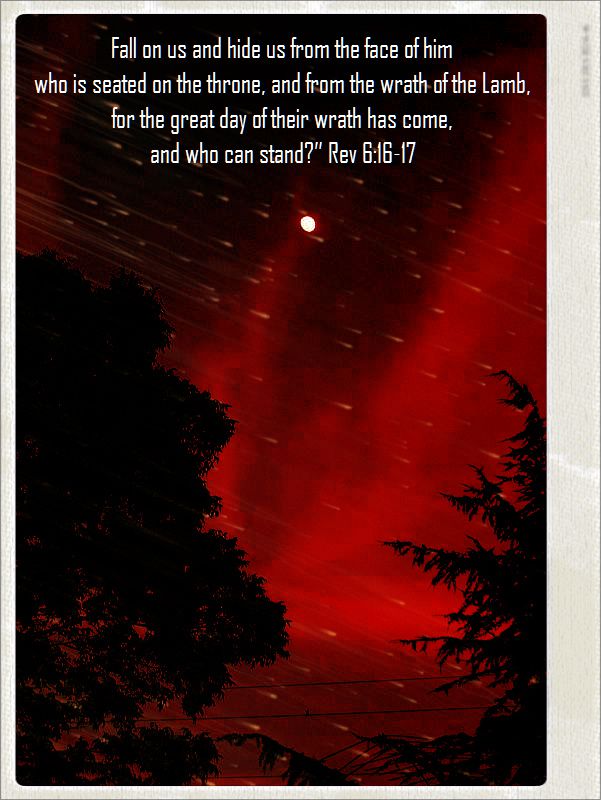
God’s wrath is real, severe, and personal.

Moreover, God’s wrath is inextricably related to the doctrine of salvation. If there is no wrath, there is no salvation. If God does not take action against sinners, there is no danger from which sinners are to be saved. The good news of the gospel is that sinners who justly deserve the wrath of God may be delivered from it. Through the atoning death of Christ, God is propitiated and His anger is turned away from all those who receive Christ (Rom. 3:24–25). Therefore, those who have faith in Christ’s blood are no longer appointed to wrath but are delivered from it and appointed “to obtain salvation” (1 Thess. 1:10; 5:9).

SOURCE: Millikin, J. A. (2003). Wrath, Wrath of God. In C. Brand, C. Draper, A. England, S. Bond, E. R. Clendenen, & T. C. Butler (Eds.), Holman Illustrated Bible Dictionary (pp. 1688–1689). Nashville, TN: Holman Bible Publishers.

What do the wrath and salvation have to do with each other?

“Wrath” is a strong term, reserved in the English language almost exclusively for describing “God’s anger” with human beings and their sinful actions. The Greek word orgē expresses the idea of “justifiable anger for unjust actions.” It is used throughout the New Testament to describe God’s anger toward the sins and unbelief of humanity.

The Old Testament and the New Testament both teach that God is storing up His anger for the great and final day of judgment. This day is frequently called the Day of the Lord. The concept of the Day of the Lord was developed by the prophets to warn Israel and the nations that no one can escape the righteous outpouring of God’s wrath (Amos 5:18–20). This day was still spoken about by the New Testament prophets, John the Baptist and John the visionary (Matt. 3:7; Rev. 6:16–17).

Those who do not profess faith in the risen Christ remain in their sins and will be subject to God’s wrath, whereas those who believe in Him are delivered (Eph. 2:3; 1 Thess. 1:10). The good news of the New Testament is that Jesus has come to deliver us from the wrath of God (Rom. 5:9). Those who have been delivered are reconciled with God because they are no longer under condemnation (Rom. 5:10; 8:1).

Those who do not profess faith in the risen Christ remain in their sins and will be subject to God’s wrath, whereas those who believe in Him are delivered

God’s wrath will be poured out on the devil, his angels, and all who rebel against Him. This is graphically portrayed in the book of Revelation, as we see scene after scene of God executing judgment on the ungodly. God’s stored-up wrath will be unleashed in awful ways, as He brings destruction on: the earth, those dwelling on the earth, the merchants of the earth, false religions, the antichrist, and all the enemies of the gospel. Ultimately, God’s wrath will be satisfied when He has put the devil, his angels, and all unbelievers in the lake of fire, to be tormented for eternity in eternal separation from God (Rev. 14:10; 20:10–15).

SOURCE: Carpenter, E. E., & Comfort, P. W. (2000). In Holman treasury of key Bible words: 200 Greek and 200 Hebrew words defined and explained (p. 427). Nashville, TN: Broadman & Holman Publishers.

Do we have hope to escape the wrath, then?

Here is how Jonathan Edwards concluded his masterpiece sermon “Sinners in the Hands of an Angry God

And now you have an extraordinary opportunity, a day wherein Christ has flung the door of mercy wide open, and stands in the door calling and crying with a loud voice to poor sinners; a day wherein many are flocking to him, and pressing into the kingdom of God; many are daily coming from the east, west, north and south; many that were very lately in the same miserable condition that you are in, are in now an happy state, with their hearts filled with love to him that has loved them and washed them from their sins in his own blood, and rejoicing in hope of the glory of God.

BE SAVED TODAY
Posted in brimstone, gomorrah, mercy, prophecy, remember lot's wife, sodom, wrath

"Homosexuality is the unfailing characteristic of paganism"

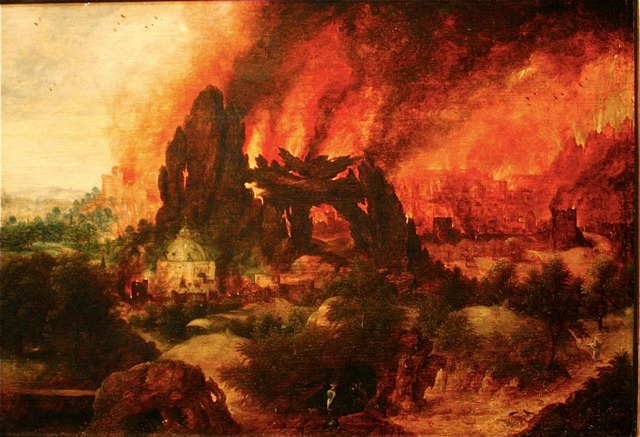
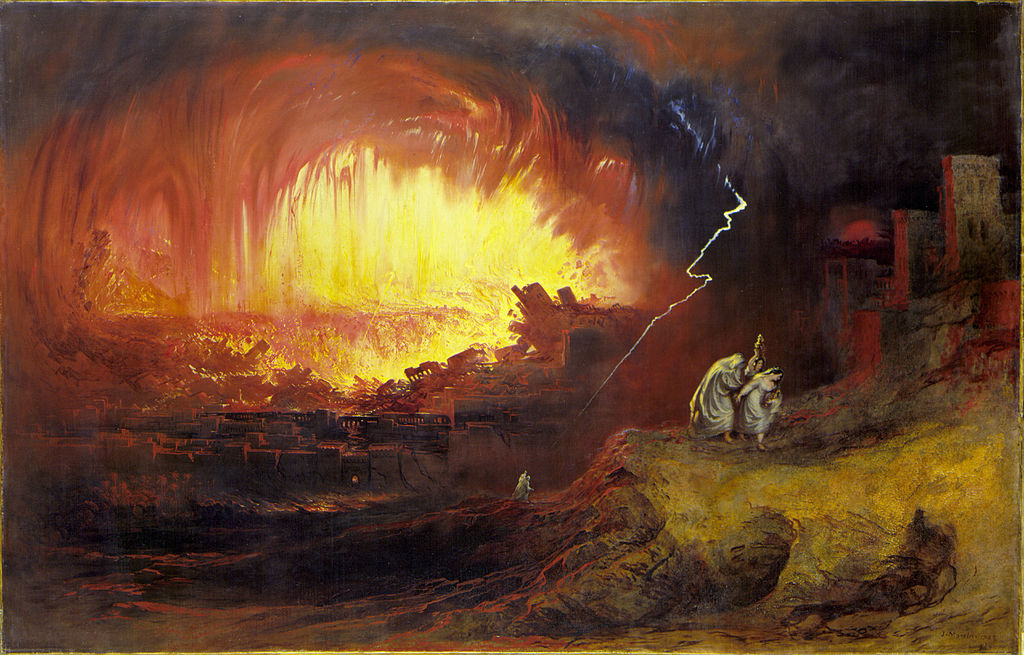
The Destruction of Sodom and Gomorrah, by John Martin, 1852

In reading the Word of God, it is such a delight when one re-reads the same passage and yet unearths new insights. It’s a delightful mystery to me how this happens, but it is also a wonderful confirmation that the Word is living and active, just as was promised. (Hebrews 4:12).

In reading through Genesis, I’m up to Genesis 19. This is the pivotal chapter where God sends Jesus in a pre-incarnate visit along with two other angels to speak with Abraham and to render destruction onto Sodom (and Gomorrah and Admah and Zeboiim, and apparently Zoar was also slated for destruction but mercy came when Lot pleaded to be allowed to live there).

In searching out the parallel scriptures the Spirit brought the following to mind:

Mrs. Lot. I’ve always wondered about her turning into a pillar of salt. I’ve always wondered about the admonition from Jesus to “Remember Lot’s wife!” (Luke 17:32).

Well, if you read right before verse 32, Jesus is saying what NOT to do when the day of Destruction comes,

31On that day, the one who is on the housetop and whose goods are in the house must not go down to take them out; and likewise the one who is in the field must not turn back. 32″Remember Lot’s wife.

Mrs Lot had turned back. She was already behind, and she did not merely glance back, but had turned back, thus becoming embroiled in the destruction. Also by her action she demonstrated which path she wanted to take (the broad path).

I was also astounded to learn there is another parallel verse which mirrors the language of Genesis 19, in Judges 19. When I read the parallel verses I had to double-check them to make sure I wasn’t reading the same incident.

Genesis 19:4-9

But before they lay down, the men of the city, the men of Sodom, both young and old, all the people to the last man, surrounded the house. 5And they called to Lot, “Where are the men who came to you tonight? Bring them out to us, that we may know them.” 6Lot went out to the men at the entrance, shut the door after him, 7and said, “I beg you, my brothers, do not act so wickedly. 8Behold, I have two daughters who have not known any man. Let me bring them out to you, and do to them as you please. Only do nothing to these men, for they have come under the shelter of my roof.” 9But they said, “Stand back!” And they said, “This fellow came to sojourn, and he has become the judge! Now we will deal worse with you than with them.” Then they pressed hard against the man Lot, and drew near to break the door down.

That we may know them …” This is a euphemism for homosexual intercourse. “This is the carnal sin of pederasty, a crime very prevalent among the Canaanites,” and also the unfailing characteristic of paganism. ~James Burton Coffman Commentary

Judges 19:22-26. Gibeah’s Crime

22As they were making their hearts merry, behold, the men of the city, worthless fellows, surrounded the house, beating on the door. And they said to the old man, the master of the house, “Bring out the man who came into your house, that we may know him.” 23And the man, the master of the house, went out to them and said to them, “No, my brothers, do not act so wickedly; since this man has come into my house, do not do this vile thing. 24Behold, here are my virgin daughter and his concubine. Let me bring them out now. Violate them and do with them what seems good to you, but against this man do not do this outrageous thing.” 25But the men would not listen to him. So the man seized his concubine and made her go out to them. And they knew her and abused her all night until the morning. And as the dawn began to break, they let her go. 26And as morning appeared, the woman came and fell down at the door of the man’s house where her master was, until it was light. (Judges 19:22-26).

James Burton Coffman Commentary says

“Stand back …” If Lot had thought up until that moment that he enjoyed any real influence in Sodom, it disappeared with this blunt rejection. The gratification of carnal lust is supreme with every homosexual. They would even subject Lot himself to their vile passions. The corollary to this is that, given the size of the sadistic mob converged upon Lot’s house, the unhindered gratification of their lust upon three men would inevitably have ended in their murder as well. The insight into this kind of situation which is provided by a similar incident in Judges 19 is all the proof that is needed that murder would have resulted.

And this brought me to pondering human nature. If a society turns away from God, aberrant sexuality always results. This is because giving in to lusts and passions always results. It is our nature. The incident at Gibeah exemplifies the parallel to Romans 1:24-25. The incident at Sodom exemplifies Romans 1:26-27.

the permissive views of the current society are not sufficient grounds for setting aside divine law. Furthermore, it may not be supposed for one moment that God is any more pleased with the sexual aberrations associated with Sodom in our own day than He was then. ~James Burton Coffman Commentary

In another interesting tidbit, Genesis 19 opens with a report that Lot sat at the gate. This means he was an administrator of some sort of the city, enjoying status in adjudicating and enjoying a measure of influence and status.

However that instantly came to naught when Lot asked the men not to gang-rape the angels. First the men revealed what they had thought about him all along, ‘you’re a foreigner, not one of us!’ Despite all of Lot’s compromises, all his trying to fit in, ‘be relevant’ amid a hostile and polluted people, it didn’t work. It will go well for us Christians if we remember this. We are aliens, and as much as we may be tempted to dampen the Gospel message, make it ‘palatable’, drinking beer with the fellows and making crude jokes, being relevant ourselves, it will not work. They know we’re not of them, even if we forget this once in a while.

Secondly, the minute Lot asked them not to gang-rape the angels, their next response was “Don’t judge us!” Again it will go well for us to remember that no matter how many happy laughs you have shared with unbelievers, the moment you point out their sin they will cry foul. Worse, if you’ve been a hypocrite and tried to blend in with them, they will have a legitimate complaint against you in saying you’re the pot calling the kettle black.

Lot was barely hanging on to righteousness there in Sodom. He was as low as he could go and still be called a righteous man. If he was a New Testament believer he’d be like one of those barely making it in, as through the fire (1 Corinthians 3:15). As for the rest of those in Sodom,

The judgment of the Lord upon Sodom was justified. The apostle Paul stated flatly that proponents and practitioners of the type of sins visible here are “worthy of death” (Romans 1:32), and the permissive views of the current society are not sufficient grounds for setting aside divine law. Furthermore, it may not be supposed for one moment that God is any more pleased with the sexual aberrations associated with Sodom in our own day than He was then. ~James Burton Coffman Commentary

And as I pondered depraved human nature after reading Genesis 19 and Judges 19, it makes me all the more in awe of God. All the scriptures testify about Jesus (Luke 24:27, John 5:39). His love for us even as we are depraved sinners is a profound truth, one that humbles my mind and crushes my heart. What a sinful degradation Sodom was (and Gomorrah and Admah and Zeboiim) yet the Lord spared Lot and his daughters. He spared them even knowing they would incestuously lie with one another and begat a tribe that would be at enmity with Him until the Day of His return. What love! What mercy! What a mystery why our God loves us so. I am tremendously glad He does though.

I am Lot. I am Mrs Lot. Do I have an intercessor pleading for me like Abraham did for Lot? I do. Not just my elder relative as Abraham was to Lot, but the Head of the Family, Jesus. (Romans 8:43, Hebrews 7:25). My High Priest intercedes for His people. What grace there is in that. What comfort there is in salvation.

Yet that comfort should not make us comfortable. The Day of Reckoning will come for the world like it did for Sodom, which is an EXAMPLE of the coming wrath to the ungodly. (2 Peter 2:6). Sodom and Gomorrah are used as warnings, repeatedly in the Old Testament to a rebellious Israel. (Isaiah 1:9; 3:9; 13:19; Jeremiah 23:14; Ezekiel 16:46-49; Amos 4:11; Zephaniah 2:9)

And through it all, Jesus said, Remember Lot’s wife!

REMEMBER LOT’S WIFE (Luke 17:32) J. B. Coffman:

I. She is a warning to all who are tempted to sacrifice their safety in order to win or keep more of this world’s goods.

II. If we strive to possess the best of both worlds, we are likely to lose both.

III. She is a reminder that being “near safety” is not enough.

IV. She is a warning that having begun to follow the Lord’s Word, one may still turn back from the way and be lost.

Yet He protects the righteous. He protects his children.

So it was that, when God destroyed the cities of the valley, God remembered Abraham and sent Lot out of the midst of the overthrow when he overthrew the cities in which Lot had lived. (Genesis 19:29).

How great is our God.

Posted in encouragement, jesus, prophecy

Jesus gave us His peace

A friend of mine made a plea on Facebook. She said she is sensitive to negativity, and she can hardly stand the awful news that has surfaced this summer. I know what she means. I quit reading the news a while ago and stuck to the headlines only, mostly on Drudge. A quick scan with eyes half closed through spread fingers like at a horror movie is still too much to bear.

She wrote:

stories of thieves, predators and murders. There is so much hate in the hearts of so many. I fear that many people can no longer see the beauty, love and compassion that is around us.

The sad fact is that she is right. Hate is building as apostasy grows. Hate is an outflow of the sinfulness of the earth that is rising to heaven. Worse, people refuse to see the beauty and compassion that is around us, the highest order of which is expressed in Jesus, then the hateful heart darkens even more.

There is not only the rising hate int he hearts of the lost, but rising hate in the heart of those who claim they are of Christ. (Matthew 24:12). This, too, is predicted.

In the Didache, an ancient writing, not inspired but important to church history, we read of the personal and national warning not to quench our lamps: (the emphasis is mine).

Watch for your life’s sake. Let not your lamps be quenched, nor your loins unloosed; but be ready, for you know not the hour in which our Lord comes. But often shall you come together, seeking the things which are befitting to your souls: for the whole time of your faith will not profit you, if you be not made perfect in the last time. For in the last days false prophets and corrupters shall be multiplied, and the sheep shall be turned into wolves, and love shall be turned into hate; for when lawlessness increases, they shall hate and persecute and betray one another, and then shall appear the world-deceiver as the Son of God, and shall do signs and wonders, and the earth shall be delivered into his hands, and he shall do iniquitous things which have never yet come to pass since the beginning. Then shall the creation of men come into the fire of trial, and many shall be made to stumble and shall perish; but they that endure in their faith shall be saved from under the curse itself. (Didache , Didache)

That’s the reality. The early church was well aware of how hard it was to live among hate. For most of the world except America, the life of the Christian has been one of targeted hate. Now it’s our turn. We’re dealing with it from even among the alleged brethren.

So, how do we stay sane, joyful, untouched by pollution of the world that has risen to our very noses? By staying in the word, by praising Jesus, by this:

Finally, brothers, whatever is true, whatever is honorable, whatever is just, whatever is pure, whatever is lovely, whatever is commendable, if there is any excellence, if there is anything worthy of praise, think about these things. (Philippians 4:8)

You know when you’re tired, you have coffee? (Or a sports drink?) When you’re extra tired you have espresso (or Turbo Sports Drink). The tired Christian should drink the Drink the Living Water for energy. In these times,  friends, let’s just cut to the highest, noblest, most joyful item to ponder: Our Savior. Think of Him, meditate on the word.

Peace I leave with you; my peace I give you. I do not give to you as the world gives. Do not let your hearts be troubled and do not be afraid. (John 14:27)

Pulpit commentary says of John 14:27,

Then follow the last words as of one who is about to go away, and says ‘Good night,’ or gives his blessing” (Luther). Peace I leave with (or, to) you. Peace answers to the shalom of ordinary converse and greeting, and signifies prosperity, health of soul, serenity, farewell. This is the sacred bestowment and Divine legacy of the Lord. “Peace” is always the result of equilibrated forces, the poise of antagonistic elements, held in check by one another. Of these the most placid lake, hidden in the hills and reflecting the sunshine and shadows, is a remarkable illustration. So the peace Christ leaves is power to hold the wildest fear in pause, to still a clamor or hush a cry

EPrata photo
Posted in beth moore, church, jesus, jesus calling, lifeway, prophecy

Then and now, compare Baptist publication list from 1870 and 2015

Baptist published book list from 1870

LifeWay is the Southern Baptist Convention’s Bookstore arm. To compare Baptist publications from 1870 to Baptist publications in 2015, here is a list of LifeWay’s 2015 best sellers. What a difference 145 years makes. Would a Baptist returning today from an extended Rip Van Winkle sleep even recognize his own denomination?

I listed the modern books in the order in which they appeared in the LifeWay list but also included a credible review of the book from a discerning person or organization next to it. Most of these books are complete nonsense. The one or two that aren’t are marginal (well, Chan’s is marginal, Platt’s is good).

LifeWay’s Best Selling NonFiction as of July 2015:

#1 Jesus Calling by Sarah Young (review of the book)

#2 Counter Culture by David Platt (review of the book)

#3 Jesus Calling Large Deluxe by Sarah Young (review of the devotional)

#4 The Best Yes by Lysa TerKeurst (review of TerKeurst and her overall ministry; review of the book)

#5 Before Amen by Max Lucado (review of Lucado’s overall fruit)

#6 The 5 Love Languages by Gary Chapman (review of the book)

#7 The Daniel Plan by Rick Warren, Daniel Amen, Mark Hyman (review of the book)

#8 Waiting on God by Charles Stanley (general review of Stanley himself)

#9 Portraits of Devotion by Beth Moore (review of Moore herself, her statements, and her other teachings)

#10 Agents of the Apocalypse by David Jeremiah (review of D. Jeremiah and his use of the novel Agents of the Apocalypse)

#11 The Mystery of the Shemitah by Jonathan Cahn (review of the book)

#12 You and Me Forever by Francis & Lisa Chan (I could not find a review of this book from an organization or person I am familiar with, but Challies gave Chan generally favorable reviews on Chan’s other books, such as Multiply, Crazy Love, Forgotten God)

Godlessness in the Last Days

But understand this, that in the last days there will come times of difficulty. For people will be lovers of self, lovers of money, proud, arrogant, abusive, disobedient to their parents, ungrateful, unholy, heartless, unappeasable, slanderous, without self-control, brutal, not loving good, treacherous, reckless, swollen with conceit, lovers of pleasure rather than lovers of God, having the appearance of godliness, but denying its power. Avoid such people. (2 Timothy 3:1-5)

I think the 2015 publication list demonstrates a wide-spread love of self, and LifeWay’s love of money.

Ever since the world was created, we have been going downhill. Even after the Flood when humanity was re-set in Genesis 9, by Genesis 11 there was the the first polygamist, first dictator, and the first ode to false religion. The LORD confused the languages at Babel and dispersed them. It has been downhill ever since.

However, in a Google Hangout yesterday with Dr John MacArthur, Dr Stephen Nichols and Nathan Bingham hosted by Ligonier, titled “Convictions and Cultural Change: A Google Hangout with John MacArthur” MacArthur said in his nearly 50 years of ministry that despite it all being downhill since the beginning, in his years he has not seen an acceleration of cultural decline this rapid. The general consensus among the three men was that we are near to mirroring the fist century church in terms of idolatry, lack of discernment, disarray, and paganism.

And yet the Lord always keeps a remnant. His people are true, righteous, and working for His name. As for the non-Christians doing these things like writing books filled with doctrines of demons and with all the blasphemies occurring in His name, how He must be storing up his anger.

But because of your stubbornness and unrepentant heart you are storing up wrath for yourself in the day of wrath and revelation of the righteous judgment of God, who WILL RENDER TO EACH PERSON ACCORDING TO HIS DEEDS... (Romans 2:5-6).

And that is our comfort. When I read of a new heretical book coming out, my heart drops and I mourn the gullible and the lost who will be sucked into its world. But I temper that with the knowledge that Jesus is King. He will render to each person according to his deeds, and even reading that, never mind living it, makes my stomach cringe. He is in charge, He is All-Knowing, He is taking care.

If you love the sovereignty of God this will comfort you.

all the inhabitants of the earth are accounted as nothing, and he does according to his will among the host of heaven and among the inhabitants of the earth; and none can stay his hand or say to him, “What have you done?” (Daniel 4:35)

Oh, magnify the LORD with me, and let us exalt his name together! (Psalm 34:3)

Posted in cotopaxi, ecuador, end time, eruption, prophecy, revelation, volcano

Ecuadoran Volcano Erupts for the First Time Since the ’40s (UPDATED)

UPDATE: Ecuador declares state of emergency over Cotopaxi volcano activity

“We declare a state of emergency due to the unusual activity of Mount Cotopaxi,” Correa said during his weekly Saturday address. “God willing, everything will go well and the volcano will not erupt.”

~~~~~~~~~~~~~~~~~~~~~~

Ecuadoran Volcano Erupts for the First Time Since the ’40s
By Erik Klemetti

ECUADOR WAS GREETED this morning with a coating of ash from Cotopaxi. This eruption would be its first since explosions rocked the volcano in 1940 and possibly 1942. Today’s eruption was quite small—two explosions that rained ash (see below) on the southern edge of Quito. Climbers on Cotopaxi heard the explosions in the early morning hours, both of which happened after earthquake swarms over the past few days. … Cotopaxi needs to be closely monitored as eruptions in 1877 produced lahars (mudflows) that travelled over 100 km from the volcano. You can watch Cotopaxi on the IG webcam. 

UPDATE 12:45 PM EDT: It looks like Cotopaxi is continuing to have explosions—check out the recent Tweet with a shot of the growing plume.

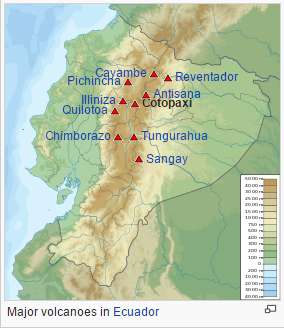
Valley of Volcanoes. Wikipedia

My husband and I spent a month in Ecuador with two of his friends. We had met some Ecuadorans when they came to Maine for an exchange program and we flew there to visit them in return. We rented an apartment in middle Quito and branched out from there with our friends ushering us around their stomping grounds.

The volcano Pichincha was front and center in the middle of the huge capital city of Quito. If I wanted to see the top, I’d have to stand on my tiptoes and lean over the sink and crane my head upward.

I was amazed that 2,671,191 people live within mere miles of an active volcano. As a matter or fact,t he entire Valley of Volcanoes, the spine of Ecuador, is filled with active volcanoes. Some population center or another is always threatened. We bathed in hot springs fed by underground magma chambers at Papallacta. We washed our clothes in hot springs tricking down the volcano sides at Baños. Baños means baths. Volcanoes are a way of life to Ecuadorans.

The fences surround little private hot tubs heated by volcanic thermal springs
at Papallacta. You can see the steam on the right behind the pumpkin
and in the middle next to the hut. EPrata photo

Here is a photo of part of populous Quito:

EPrata photo

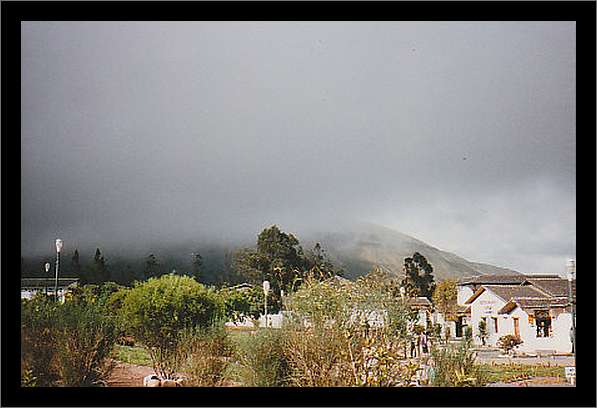
Here in northern Ecuador near Cayambe, another volcano dominates the skyline, even through the low hanging clouds.

EPrata photo

Naples Italy is another huge population center living among a growling bear. Wikipedia says,

Vesuvius has erupted many times since and is the only volcano on the European mainland to have erupted within the last hundred years. Today, it is regarded as one of the most dangerous volcanoes in the world because of the population of 3,000,000 people living nearby and its tendency towards explosive (Plinian) eruptions. It is the most densely populated volcanic region in the world.

I feel for all the people around the globe today who are under threat of active volcanoes. Japan and Indonesia are other places where people have been recently evacuated. As we go about our daily life we trust that certain things will work, like the trains, subway, planes, roads, electricity, etc. When there is an interruption like the ah fall on South Quito, it makes life harder than it is already, especially for so many people in Third World countries.

Worse is that these kind of natural interruptions and natural disasters will only continue to increase. We think that we can manage around some light ash falls, some cracks in the road after a temblor, but eventually we will not be able to manage. The seriousness of natural disasters will exceed man’s ability to not only endure them, but even to comprehend them. (Revelation 16:21, Revelation 9:3-4, Revelation 6:14 etc.)

When the rapture happens and we are gathered to Jesus He will unleash all His stored-up wrath and the earth will literally go crazy with earthquakes, volcanic eruptions, hailstorms, heat, floods, and more.

Revelation 6:12 says “And I beheld when he had opened the sixth seal, and, lo, there was a great earthquake; and the sun became black as sackcloth of hair, and the moon became as blood;”. The sentence is constructed in a way that seems causal. Earthquake occurs, and within the same sentence with no period, the sun turns sackcloth and the moon turns red. Can an earthquake cause this? Yes, if it sparks a volcano eruption. Read more about this below at the link “Of volcanoes, dry fog and sun as sackcloth

The time is drawing nearer and nearer when sin will be loosed to do its worst, when disasters will top each other again and again- daily. All those who are not true believers will be left behind to face that. Many who think they are believers will shockingly discover they are not, when the true brethren suddenly are gathered up at the last trump into glory and they are left behind.

Just a friendly reminder, that we are not on earth to play, but to work, pray, witness, and labor for the Master.

——————————————
Further reading

Of volcanoes, dry fog and sun as sackcloth

CNN: Cotopaxi sends huge ash plumes into the sky

In-Depth Economic Times: Volcano in Ecuador spews huge column of ash

Posted in death, hell, judgment, prophecy, second coming, sin, wrath

Preaching wrath-sin-death-judgment as well as salvation-grace-redemption-hope

“Wrath”. EPrata photo

A third of the Bible is prophecy. There are fulfilled prophecies, prophecies that have been fulfilled and will be again (double prophecies, Pentecost, Acts 2:14-21), and prophecies that are yet to be fulfilled. (Christ’s second coming)

There are complicated prophecies, (Book of Obadiah, Daniel’s prophecies) and simple prophecies. (Messiah will be born of a virgin, (Isaiah 7:14). Prophecies that involve war upon nations (Ezekiel 35:4) and prophecies that involve just one individual. (Eve will be the mother of all the living, Genesis 3:20; Mary a virgin would give birth, Luke 1:35).

Many Christians are fascinated by prophecy and study them diligently. But there is a prophecy that many people don’t like to study and it is one that affects all people, Christian and non-Christian alike.

Jesus said He is coming again to judge the living and the dead. (Ecclesiastes 3:17; Jeremiah 17:10). Non-believers will be judged based on their works and condemned, and believers will be judged not unto condemnation but still, judged according to our works.

No Christian likes to be thinking about the prophecy of being weighed in the scales and found wanting. No one likes to think they have disappointed Jesus. We all want to hear “Well done, good and faithful servant.” (Matthew 25:23). Not all of us will. Some will enter heaven by the skin of their teeth. (1 Corinthians 3:15).

Yet Christians are told several times about our coming judgment (not unto condemnation, but according to our works).

Believers are judged at the Judgment Seat of Christ (Romans 14:10-12). We will all have to give an account of ourselves. Jesus will judge the decisions we made, whether they were founded on the flesh or upon Him.

One subset of judgment will be teachers of His word. Teachers of the Bible will be judged more strictly-

Not many of you should become teachers, my brothers, for you know that we who teach will be judged with greater strictness. (James 3:1).

Grumblers will be judged-

Don’t grumble against one another, brothers and sisters, or you will be judged. The Judge is standing at the door! (James 4:11, James 5:9).

“Doom sky”. EPrata photo

All non-believers will be judged. As much as a Christian cringes at the thought of being judged by the Mighty Righteous God, non-believers absolutely hate us even mentioning it to them! The lost person becomes angry at the very thought of them having failed the standard God sets forth. Yet it will happen, at what is called the Great White Throne Judgment of Revelation 20:11-15.

This judgment does not determine salvation because the lost person’s eternal state is fixed at death. Everyone at the Great White Throne will be an unbeliever who has rejected Christ while they were living and is therefore already doomed to an eternity in the lake of fire. (Revelation 20:12). The judgment they will be experiencing is their life works projected like a mirror against a holy and righteous God and the level of their torment assigned. Yes, there are different degrees of punishment in hell.

Believers should think about this most difficult subject for several reasons. First, because as each person is cast (thrown) into the Lake of Fire (Revelation 20:15) we can easily what John Bradford said. He was a martyr, imprisoned for the faith in 1553. As prisoners were paraded to the execution stake, Bradford would exclaim,

The pious Martyr Bradford, when he saw a poor criminal led to execution, exclaimed, “there, but for the grace of God, goes John Bradford.” He knew that the same evil principles were in his own heart which had brought the criminal to that shameful end. (Source A treatise on prayer by Edward Bickersteth (1822).

Over time the phrase has been amended to say “There but for the grace of God, goes I.” Any one of us could be that person facing the wrath of Jesus, condemned and tossed into the torment forever, unless it had been Him sovereignly saving us. We are no longer under wrath, but at one point in our lives, we were. Don’t forget that.

Second, the Christian should ponder these things because we must give the full counsel of God as we witness. (Acts 20:27). We must share the bad news before we can get to the Good News. The bad news that there is no one righteous, no, not one. (Romans 3:10). We all fall short of the glory of God and are destined for the Lake of Fire forever, to be punished for our sins by the Judge. We tend to shorten the witnessing moment because we expect the outrage and anger when sharing that the person we are talking with is a sinner in need of the grace of Jesus. It’s hard to make someone angry. Even pastors shorten the counsel of God, by omitting the sin-death-wrath-punishment part and then quickly get to the part that they think is more palatable, or “attractive.”

“Red heaven” EPrata photo

The full counsel means both sides, His sovereign choice of the people He elects to salvation, and the personal responsibility of each man to repent and believe else be eternally responsible for their sin. Spurgeon said of the full counsel of God

Running away with half a Truth, they are like men that go through the wilderness wearing only one shoe—they become lame in one foot—and that makes them limp all over. It does not matter which foot it is that is lame—the man is a cripple if either foot is thus afflicted.

Think often of the prophecy of the Second Coming of Jesus. He spoke of it more often than anything else. The Bible refers of it constantly. Within the Second Coming are a host of different prophecies. I agree, they are interesting to study. However, we need to remember that we labor for a holy God and He will return to judge the living and the dead.

Acts 10:42
He commanded us to preach to the people and to testify that he is the one whom God appointed as judge of the living and the dead.

Romans 14:9
For this very reason, Christ died and returned to life so that he might be the Lord of both the dead and the living.


2 Timothy 4:1
In the presence of God and of Christ Jesus, who will judge the living and the dead, and in view of his appearing and his kingdom, I give you this charge: preach the word; be ready in season and out of season; reprove, rebuke, exhort, with great patience and instruction

———————————————–

Further reading

What does it mean to preach the whole counsel of God

The whole counsel of God

What is the difference between the Rapture and the Second Coming?

Posted in enoch, prophecy

Re-post: The enduring comfort of prophecy

I posted this one year ago.
——————————————

God said in Genesis 3:15, “I will put enmity between you and the woman, and between your offspring and her offspring; he shall bruise your head, and you shall bruise his heel.”

Adam in Genesis 3:20, “…named his wife Eve, because she would become the mother of all the living. (NIV)

Jesus tells us things in advance for many reasons. (to foretell). One reason is so that we may be on guard, be warned. (Matthew 24:25). Another is to show His holiness at judgment. (Ezekiel 2:5).

“Eye of God” Helix nebula, source Hubble Telescope

Prophetic declarations of future events also serve to comfort. Adam seemed to be comforted by God’s promise of a future redeemer. Perhaps Adam wondered as they faced God, if He would smite them on the spot. Instead, Adam clung to the knowledge that there would be offspring. Adam was so trusting in God’s word that Adam named his wife Eve, “because she would be the mother of all the living”. Bearing a son was still in the future, (Genesis 4:1), so Adam took comfort in God’s forthtelling, clung to His word, and took action because of it it.

We don’t have new prophecies today that forthtell new information because the canon is closed, but we still are built up when a person reiterates them and preaches truth, which is today’s prophesying. Prophesying includes referring to prophecies, as well as the bible’s poetry, truths, doctrines, and history.

On the other hand, the one who prophesies speaks to people for their upbuilding and encouragement and consolation. (1 Corinthians 14:3). In this case prophesying means forthtelling.

Helix Nebula a different view, NASA

God told the first prophecy in the bible, in Genesis 3:15. Adam re-iterated that prophesy in Genesis 3:20. But who was the bible’s first human prophet? Enoch.

Enoch was the 7th person born from Adam.

Genealogy from Adam, Adam, Seth, Enosh, Kenan, Mahalalel, Jared, Enoch, Methuselah, Lamech, Noah, Shem, Ham and Japheth. (1 Chronicles 1:1-4)

Enoch lived prior to the Flood. At the Institute for Creation Research, Dr. John Morris writes,

One of the favorite characters in the Old Testament is Methuselah, who lived 969 years (Genesis 5:27), longer than anyone else recorded. His father was Enoch, of whom it is said he “walked with God” (5:24) but who was taken to heaven without dying at 365 years. Methuselah’s son Lamech died a few years before the Flood at 777 years (5:31) after bearing Noah.

When Methuselah was born, his godly father must have prophetically known of coming things, for his son’s name means “when he dies, judgment,” and interestingly enough, Methuselah died in the same year God judged the sinful world with the great Flood of Noah’s day.

God took Enoch alive in a snatching away that is a typology of the rapture. Enoch was taken in Genesis 5:24. (Hebrews 11:5)

William Blake’s only known lithograph
(lithography was rather new and experimental in 1807),
illustrating Genesis 5:24 “Enoch walked with God; then was no more,
because God took him away”.)

Genesis 5 records a genealogy. The repetitive language forms a pattern … until you get to Enoch

Genesis 5:5, “Thus all the days that Adam lived were 930 years, and he died.”
Genesis 5:8, “Thus all the days of Seth were 912 years, and he died.”
Genesis 5:11, “Thus all the days of Enosh were 905 years, and he died.”
Genesis 5:14, “Thus all the days of Kenan were 910 years, and he died.”
Genesis 5:17, “Thus all the days of Mahalalel were 895 years, and he died.”
Genesis 5:20, “Thus all the days of Jared were 962 years, and he died.”
Genesis 5:23, “Thus all the days of Enoch were 365 years.”
Genesis 5:24, “Enoch walked with God, and he was not, for God took him.”

Who didn’t die?

By faith Enoch was taken up so that he should not see death, and he was not found, because God had taken him. Now before he was taken he was commended as having pleased God.” (Hebrews 11:5)

Before Enoch was taken up, Enoch prophesied. His prophecy is recorded in Jude.

It was also about these that Enoch, the seventh from Adam, prophesied, saying, “Behold, the Lord comes with ten thousands of his holy ones, to execute judgment on all and to convict all the ungodly of all their deeds of ungodliness that they have committed in such an ungodly way, and of all the harsh things that ungodly sinners have spoken against him.” (Jude 1:14-15)

CC, Wikipedia

This is an extremely precious prophecy. It is an heirloom seed. Why? the Flood.

FLOOD

Noah was six hundred years old when the floodwaters came on the earth. And Noah and his sons and his wife and his sons’ wives entered the ark to escape the waters of the flood. (Genesis 7:6-7)

Enoch’s prophecy was given before the Flood. Everyone on earth died. After the Flood, only 8 people knew the prophecy. For Jude to record it, it means the prophecy was carried through the Flood in the heart and mind of Noah and his family.

What comfort it must have been for Noah to have heard Enoch prophesy before the Flood that the Lord will return with ten thousand of His holy ones to execute judgment. What torture it must have been for righteous Noah, (Genesis 6:9), one of the three declared most righteous men on earth, (Ezekiel 14:14) to live among such evil. Enoch’s prophecy was a light and a pure hope amid the darkest days on earth!

When the waters receded and the family emerged onto a new earth, one where continents were split and only mud existed, Noah knew the prophecy. He told the prophecy. It was told and retold, until it became ingrained in the tradition of the Jews. Jude knew it, and the Holy Spirit inspired Jude to mention it. Though Enoch’s prophecy is not recorded by Enoch in the bible, it is recorded by Jude.

In these dark days, prophecy performs the same function. The Lord WILL RETURN to execute judgment and vindicate His holy name! While we do not take delight in the death of the ungodly, we do delight in knowing Jesus will rectify all wrongs, judge the wicked, and institute peace on earth. This is ultimate comfort. The ark carried 8 precious souls. It carried every kind of animal. And it carried with it the knowledge of the One True God, and His promises to all generations: holiness in the end.

Posted in encouragement, mighty waters, prophecy, the end time

The voice of mighty rushing waters

And behold, the glory of the God of Israel was coming from the east. And the sound of his coming was like the sound of many waters, and the earth shone with his glory. (Ezekiel 43:2)

His feet were like bronze glowing in a furnace, and his voice was like the sound of rushing waters. (Revelation 1:15)

And I heard a sound from heaven like the roar of rushing waters and like a loud peal of thunder. The sound I heard was like that of harpists playing their harps. (Revelation 14:2)

When the creatures moved, I heard the sound of their wings, like the roar of rushing waters, like the voice of the Almighty, like the tumult of an army. When they stood still, they lowered their wings. (Ezekiel 1:24)

When you’re canoeing or kayaking on a silent river, the only sounds you can hear are birds, whisper of wind in the trees, and the drip of water rolling off the paddle as it comes out of the water.

The sound of rapids can be heard a distance off. The tumult of rushing water is distinctive and signals a major change in the status of the river. Once calm and nearly still, the closer you approach to the rapidly rushing water, the louder it is, and the faster it goes. When you’re right on top of the rapids, that’s all you can hear. One must shout to be heard.

When the prophets were given a glimpse of the throne room and heard the sound like of “many waters”, I don’t pretend to understand what that means or how it sounded in real life to their ears. It’s hard to describe something so supernaturally incomprehensible as the voice of God translated to mere human words. One can only imagine what the sound of His voice is like at full, glorified throttle.

I do know two things though. The sound of Niagara Falls is about 95 decibels, roughly equal to a rock concert. That’s loud.

Second, the voice of Jesus when He returns is a voice that will drown out all other voices. The Mighty Rushing Waters will drown out all voices that deny Him. The Many Waters will drown out all voices that blaspheme Him. The roar of the Rushing Waters will drown out all voices that proclaim a different god.

Albert Bierstad (1830–1902) oil painting, Niagara Falls

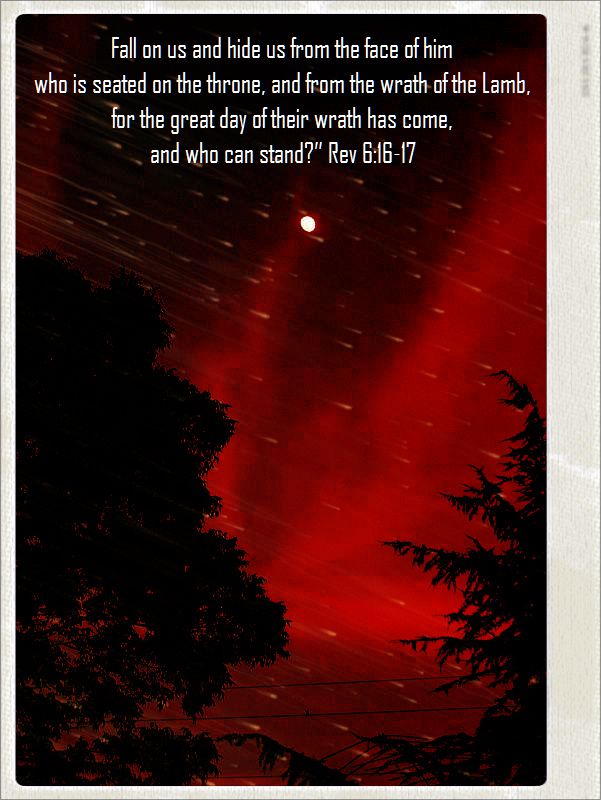
In Revelation 6:15-17 it says

Then the kings of the earth and the great ones and the generals and the rich and the powerful, and everyone, slave and free, hid themselves in the caves and among the rocks of the mountains, 16calling to the mountains and rocks, “Fall on us and hide us from the face of him who is seated on the throne, and from the wrath of the Lamb, 17for the great day of their wrath has come, and who can stand?”

On His Day, when He speaks with a voice like Many Waters, who can hear another voice? NO ONE. The voice of Jesus in power and strength will be the first, the last, and the only voice of holiness and glory, proclaiming His father the Almighty God! All those that dwell on the earth, the great and the small, the mighty and the lowly, will hear His voice, and who can hear another?

Each day that passes is a day we are in that kayak paddling downstream to the rapids, or on that boat Maid of the Mist approaching Niagara, getting closer to the day when the mighty rushing voice of God will be heard throughout the land. And what a day that will be.

Posted in bible, church, discernment, disharmony, factions, prophecy, unity

When unity is not preferred

Are there factions in your church? EPrata photo

Factions in church are a deed of the flesh.

Now the deeds of the flesh are evident, which are: immorality, impurity, sensuality, 20idolatry, sorcery, enmities, strife, jealousy, outbursts of anger, disputes, dissensions, factions, (Galatians 5:20)

Here, the progression is given. Enmities result in strife, then morphs into jealousy, which are inward attitudes. Eventually the inward attitude becomes outward behavior in the form of fits of anger, then progresses to disputes, entrenched into dissensions (which literally means here ‘standing apart’), and then these harden into factions.

The word factions in Greek as it’s used here in the Galatians verse means ‘personal choice due to strong opinion’. As an example to show rivalries gravitating to factions, some Jews chose to be Sadducees as opposed to Pharisees. Pharisees believed in an afterlife containing rewards for the righteous and and punishments for the wicked, and had added many traditions to the faith. Sadducees believed only the Torah and therefore no afterlife. Little discussed in the Bible but existing at the same time as the Pharisees and Sadducees were two other factions within Judaism, the Zealots and the Essenes. These four factions had splintered the religion as given by God to Moses and the Prophets. The dividing lines were hard and fast until it came to Jesus and then the adage ‘the enemy of my enemy is my friend’ came to life and they set aside their jealousies and rivalries to kill their Messiah.

One wonders if the Sadducees and Pharisees had not spent hundreds of years in jealousies and rivalries they might have been thinking straight regarding who Jesus is when He came. But anyway…that’s a speculation. The lesson here is that Paul warns that these attitudes become entrenched, and then make an outward progression into undesirable behavior.

Is your church splitting due to rivalries or dissensions?
EPrata photo

Factionism is often mentioned in the New Testament. Because humans populate the church, the sinful tendency to divide along theological, moral, or just plain silly lines is always present. Paul chastised the Corinthians for ‘following’ preferred teachers, Peter, Apollos, himself, or none at all and only Christ. (1 Corinthians 1:12). He reminded them that Christ has not been divided, then he reminded them in Whose name they had been baptized.

In another case of mentioned factionalism, in Apostolic authority Paul pleaded with Euodia and Syntyche to set aside their differences and come together. (Philippians 4:2). As Pulpit Commentary says, “Their dissensions disturbed the peace of the Church.” Paul called them sisters and so they were believers risking a church unity that is desirable and should be sought after by all members, not pursuing disharmony and upset by entrenching into their own supposed correct positions on whatever it was they were arguing about.

Ephesians speaks to the importance of unity in the church. Paul says we should be-

eager to maintain the unity of the Spirit in the bond of peace. (Ephesians 4:3)

 In 1 Corinthians 1:10 Paul says for there to be no divisions among us-

I appeal to you, brothers, by the name of our Lord Jesus Christ, that all of you agree, and that there be no divisions among you, but that you be united in the same mind and the same judgment.

We do this through love, which is the perfect bond of unity (Colossians 3:14), forbearing and forgiving one another, (Colossians 3:13). And so on and so on. Unity is important.

The Christian life is marked with a thin line, on which we stay only through the grace of Christ and the guidance of the Spirit, and our diligence in searching the Word. Because … the opposite of the above is also true. There are times we are NOT supposed to unite. At times, we are supposed to mark those who cause divisions and avoid them. (Romans 16:17). We’re called to shake the dust off and go away from those who won’t listen (Mark 6:11). Paul and Peter didn’t hold back when warning the members of those who put stumbling-blocks in their way, they variously called them dogs in vomit, blots, and blemishes. Even gangrene and cursed ones. Those are warnings not to unite, or even tolerate (Revelation 2:20).

But those are unbelievers mentioned in those verses. What about believers? Should we pursue unity at all costs with believers? No. In 2 Thessalonians 3:6 Paul urged,

In the name of the Lord Jesus Christ, we command you, brothers and sisters, to keep away from every believer who is idle and disruptive and does not live according to the teaching you received from us.

The 2 Thessalonians verse is about believers and it is a command! In Matthew 18, the last part of the multi-step process for dealing with sin in a believer is to treat them as a pagan or a tax-collector if the sinner refuses to heed.  (Matthew 18:17).

In another Thessalonians verse, Paul reiterates how to treat believers, in this case idlers who were using the church as a welfare state.

Take special note of anyone who does not obey our instruction in this letter. Do not associate with them, in order that they may feel ashamed. (2 Thessalonians 3:14 )

So when do we do what? How do we know when to pursue unity and when to allow separation? It is especially hard when we are being told by the shallow end of the church culture that any disunity whatsoever is to be avoided.

It’s obvious that there are different kinds of unity. We unite in Christ into one body in theological unity in the Gospel, forbearing and overlooking the theological points of disagreement where possible and are “non-essential.” We do not overlook sin but we display some patience with people in the process of helping them overcome it, especially the babes in Christ. In this, the moral imperative is strict; help, point out, warn, all the while forbearing in love as they are given a chance to rectify. However, we never overlook persistent or flagrant or rebellious sin. Ever.

Who are the peacemakers among you?

So be careful when using the word unity. Just like there is with any human involvement with anything, there are gradations and nuances. During the hopefully short period when situations are being addressed and resolved there will be some disharmony. Depending on the maturity of the church, in some places this disharmony will be more evident than others. Of course overall given human penchant for selfishness, there will be seasons of unity and seasons of disharmony in any church for whatever reason. Even these take time to settle.

While unity is to be pursued and factionalism is to be avoided, sometimes the Lord uses it to the good. There IS a good that comes with factions in churches. Paul wrote in 1 Corinthians 11:18-19,

For, in the first place, when you come together as a church, I hear that there are divisions among you. And I believe it in part, for there must be factions among you in order that those who are genuine among you may be recognized.

In verse 18 Paul strongly chastises the divisive Corinthians by saying when they get together for the Lord’s supper it is for the WORSE! How would you like to hear your pastor say that? “Y’all make Christianity worse when you’re together, you big ole bunch of squabbling firecrackers.”

Matthew Henry says, “The apostle rebukes the disorders in their partaking of the Lord’s supper. The ordinances of Christ, if they do not make us better, will be apt to make us worse.”

Yet in the next breath Paul says something very interesting:

“There MUST be factions”

Here, the word factions is heresies. It indicates a worse state than in verse 18, which was divisions. In verse 19 divisions have become heresies. Now the problem mirrors the Sadducees and Pharisees, with the hard and fast and permanent division in the faith. One faith then becomes two, or nearly so. Schism, because of heresy.

Yet why would Paul say ‘there MUST be heresies’ (factions)? I thought we were to avoid disharmony and pursue unity? This may sound abrupt or unbelievable to innocent ears, but God actually intended for there to be factions. Because, how are we to know who the peacemakers are if there is never any disruption to the peace? How are we to know to whom ministries should be given if there is never an opportunity for one to display wisdom or patience? Divisions and disharmony is the way Jesus uses circumstances to reveal genuine believers.

If you pardon the long excerpt, after reading widely and wrestling with writing an explanation myself, I have found no better explanation than Pastor John MacArthur’s. Here is his commentary on 1 Corinthians 1:19, ‘there must be factions’:

The Celebration of the Lord’s Supper part 1

Now, he goes further in verse 19. And this is really an interesting statement. He says, “I believe it for this reason, I believe it because there must be also heresies among you that they who are approved may be made manifest among you.” Boy, that is a strange statement, folks. Did you hear what he said? He says the reason I believe you’ve got division is because there must be division among you so that the ones who are approved might be made manifest. 

You say, “Is he saying that the church has to have heresy?” Yes. What does the word “heresy” mean? I’m glad you asked because that’s very important. The word “heresy” doesn’t mean totally what we’ve made it mean today. The word “heresy” basically means, it comes from a root that stresses the idea of a choice, choosing. It simply means a choice of a group who hold a given opinion. I’ll tell you how you’ll understand it. It’s translated again and again in the gospels by the word “sect.” It’s a group of people who hold an opinion. It doesn’t have to be bad. It doesn’t mean that it’s good. It’s used in a neutral sense in, say, Acts 24. It talks about the sect of the Nazarenes. 


It isn’t necessarily bad. It’s used in a bad sense in Galatians 5:20 where it refers to one of the works of the flesh, is hairesis, or heresies, or what it means is differences of opinion. And there it has to do with the selfish contention, has to do with a self-centered factious clique kind of thing, and that’s its use here. 

There has to be contention, if you will. Or there has to be factions in the church. There has to be problems in the church. There has to be differences of opinions in the church. You say, “Well, why? I mean, you just said in 1 Corinthians1:10 get rid of them all, now you’re saying they’ve got to be there. … Well, what’s he saying here?” No, he’s saying it has to be that they who are approved might be manifest among you. 

Now, wait a minute. Paul says I believe there are those groups because they’re necessary. Now, notice the statement, “there must be.” That’s dei. D-E-I in the Greek. It is a word that means it is necessary. “It is necessary”, and then you should translate the word factions, that’s how it should be. It is necessary that there be factions among you. That little word “it is necessary” is used again and again and again in the new Testament. A very common particle; very, very, very useful. And in many of its uses, it singles out something that is necessary because of the will of God. It is used of something that is necessary because of the will of God. For example, it is necessary that Jesus suffer and, right, and die and rise again. It is necessary that I go to Jerusalem. You find that little particle again and again and again connected with something that Jesus must do because that is God’s will.

And here we have the same thing. It is necessary. Why? Because God is doing something that needs it. What’s He doing? He is approving certain people and making them manifest to you. How? Because when problems arrive and when factions arrive you will soon find out who the good folks are, the dokimoi: the approved, the tested, the gold who come out of the fire purified. Evil is necessary to manifest good. 

You don’t know who the peacemakers are in your church unless you need somebody to make the peace, right? You don’t know who the people are who show the love in the church unless you know how they’ve been related to the people who don’t show it. You see, it’s adversity and struggle and contention that causes the true leadership, the true godly people, the true walking in the Spirit folks to rise to the top and be visible to everybody. Trouble has a way of manifesting personality and it has a way also of manifesting spirituality. The dokimoi are the ones that hang in there and give evidence of walking in the Spirit in the midst of a difficult situation

Perhaps your church has had a change of leadership or a change of heart and now wants to root out female leadership that had infiltrated. This will cause disharmony. Unity will be shattered. There will inevitably be some who don’t appreciate the change of direction nor the removal of women. As is the way of rivalries some will go around gossiping and complaining and mounting up for sides to be taken. The Lord uses this time of factioning and disruption to manifest true believers. Whatever the Godly reason that unity has been interrupted, and there are oh, so many possibilities, Jesus will use it to show to one and all who the genuine ones are.

Pursue unity when possible,
but not at the expense of truth

Now the opposite could be happening. Maybe a disharmony is occurring not for a Godly reason but because the leadership wants to initiate or perpetuate a false doctrine. Maybe the genuine ones have warned, pleaded, prayed, and offered proofs. Yet despite the true believers’ attempts to sway them from their willful path, they insist. During this time also, there will be disunity. Sides will be taken. The patient yet firm stand of the genuine ones will be noticed and remembered either now or later. And if not on this side of the veil, then certainly at the Bema seat.

Now for one last, important thought. The crux of this essay. After all this, if you are still with me, dear reader, please take this thought with you as I close. If God says there must be heresies in order to manifest true believers, isn’t it to satan’s advantage to whitewash all divisions so that true believers will NOT be made manifest? Couldn’t it be that this culture’s current insistence in unity at all costs be a satanic ploy to intimidate the genuine ones so they are not made manifest?

I understand that when Jesus wants something to happen, He will make it happen. I am not saying satan has power to controvert Jesus. But think on it. If Jesus as the Head uses divisions and heresies to advance His church by manifesting true believers, it is in satan’s evil interest not to let that happen.

So keep that in mind when you hear “unity at all costs!” As I said at the outset, unity is preferred, but not at the expense of tolerating false doctrine. Unite is not preferred when it’s a ploy to silence the ones who Jesus intends to stand apart as genuine.

When Brothers Dwell in Unity
A Song of Ascents. Of David.

133 Behold, how good and pleasant it is
when brothers dwell in unity![a]
2 It is like the precious oil on the head,
running down on the beard,
on the beard of Aaron,
running down on the collar of his robes!
3 It is like the dew of Hermon,
which falls on the mountains of Zion!
For there the Lord has commanded the blessing,
life forevermore
. Psalm 133

And yet you know that when rivalries come and the Lord uses you to be seen as genuine, the period of testing is sometimes painful. But Peter has encouragement–

But in your hearts honor Christ the Lord as holy, always being prepared to make a defense to anyone who asks you for a reason for the hope that is in you; yet do it with gentleness and respect, having a good conscience, so that, when you are slandered, those who revile your good behavior in Christ may be put to shame. (1 Peter 3:15-16).

Posted in christian life, last things, prophecy, trevin wax

More on Eschatological Discipleship

Destruction of Jerusalem, Wilhelm von Kaulbach, 1860

Trevin Wax is author, speaker, blogger and one of the Editors of Lifeway. He is also a student and is busy finishing up his dissertation. He said on his blog recently that he plans to pause his blog in order to make time to finish his dissertation, which was on the topic of Eschatological Discipleship.

I was intrigued by this new term, because it seems that the emphasis and giftings the Lord has placed in me is aligned with this kind of discipleship. I mentioned Mr Wax’s term “eschatological discipleship” in a recent post. After that, I thought about it more and researched more.

I’m not talking solely about prophecy, though it is the foundation for this kind of discipleship. My goal has always been to quicken the hearts and minds of fellow believers to live increasingly holy lives in fervency and diligence in light of the fact that Jesus is coming again. Discipling people to be reminded of the King to whom we will face at a moment’s notice, the rewards that are laid up for us and which we store up ourselves as well, and the fact that the more we look up the better citizens of heaven we will be on earth for His kingdom and our fellow man. It’s to tell people, prophecy matters, because we are living it.

As Mr Wax had said in his summary of what eschatological discipling is,

Taking a Break and Asking for Prayer

The topic of my dissertation is “eschatological discipleship.” Following Jesus means understanding our times in light of the biblical vision of history and having the wisdom to make the right choices when the path ahead seems unclear.

Many gospel-centered folks are right to point out that the New Testament’s moral imperatives are often grounded in Christ’s finished work for us in the past. What we sometimes overlook, however, is how many of those moral imperatives also look forward to Christ’s return in the future. We are called to be “children of the day” in a world that knows only darkness.

The question that propels me forward is this:

What kind of discipleship is necessary to fortify the faith of believers so that we understand what time it is, we rightly interpret our cultural moment, and see through the false and damaging views of history and the future that are in our world?

That is the question I posed in my workshop at TGC this year: Discipleship in the Age of Richard Dawkins, Lady Gaga, and Amazon.com: Grounding Believers in the Scriptural Storyline that Counters Rival Eschatologies. (The audio from the talk is available here.) To be alert to our times is a gospel requirement, says Oliver O’Donovan:

To see the marks of our time as the products of our past; to notice the danger civilisation poses to itself, not only the danger of barbarian reaction; to attend especially not to those features which strike our contemporaries as controversial, but to those which would have astonished an onlooker from the past but which seem to us too obvious to question. There is another reason, strictly theological. To be alert to the signs of the times is a Gospel requirement, laid upon us as upon Jesus’ first hearers.

Mr Wax also mentioned this topic in an essay at The Gospel Coalition titled 4 Marks of Biblical Discipleship, of which eschatological discipling is one of the marks.

4. Discipleship is Eschatological
Discipleship is eschatological in nature, because the church that makes and receives disciples is eschatological in nature. By eschatology, I’m not referring merely to the “last things” doctrines often relegated to the back of systematic theology textbooks. I’m speaking of eschatology in a broader sense, as encompassing the Christian vision of time and the destiny of our world. Eschatology in this sense informs both our evangelism and our ecclesiology.
I love the picture Lesslie Newbigin paints:

“The church . . . calls men and women to repent of their false loyalty to other powers, to become believers in the one true sovereignty, and so to become corporately a sign, instrument, and foretaste of that sovereignty of the one true and living God over all nature, all nations, and all human lives.”

Seeing discipleship from an eschatological standpoint impacts the way we preach and teach. The alternative is to minimize the eschatological understanding of discipleship, which will leave us with an incomplete worldview, imbalanced discipleship, and eventually, a tragic inability to model the Christian way of life, since modeling implies obedience in a particular time and place.

Discipleship is eschatological, because questions like “What time is it?” and “Where is history going?” greatly impact a disciple’s worldview and inform what modeling a life of following Jesus looks like.

There are two aspects to our walk in the faith. One is that we as humans are living in a point in time. We have a birth date and a death date. Our walk with Jesus while in the flesh is finite. Esther was placed in the King’s life “for just such a time as this.” It was pivotal, her life began and ended and reached a climactic moment we all know occurred in Esther 4:14b.

Many gospel-centered folks are right to point out that the New Testament’s moral imperatives are often grounded in Christ’s finished work for us in the past. What we sometimes overlook, however, is how many of those moral imperatives also look forward to Christ’s return in the future. Trevin Wax.Yet, the other aspect of our existence is not a point in time but a person living in a stream of time in the past, present and future all at once. This mirrors the Lord “who was, who is, and is to come.” We were saved, we are being saved, and at a future time the salvation will be completed in glorification. It’s like we’re standing in a stream, with the current of all of time swirling by our feet. We look left, upstream and we see through our biblical lens the plan of God since Adam and Eve, and our feet are in the same stream of time that they are/were/will be again. Even Esther’s climactic moment was only part of a time-stream where if she did not act, “relief and deliverance for the Jews will arise from another place.” (Esther 4:14a). The stream flows no matter what we do or what part of it we are standing in.

We look at our feet and see the fish we need to catch and so we are busy performing service to the Lord. Then we look downstream and we see the future. The stream flows but it curves and we cannot quite see what is ahead but we know there are currents and rapids and a waterfall, because we can hear them. We read the Bible and we can see ahead as far as the Lord allows by having given us glimpses from the Bible of where this great rushing stream of water is flowing to.

Wax: “eschatology…as encompassing the Christian vision
of time and the destiny of our world.”

What I gather Mr Wax is saying is that when discipling we always focus on the upstream, in looking at the past work of Christ. We also focus on our feet and fish for men and tend the creek where we are standing. However, we rarely tell our discipled members to look downstream at what is ahead. We say to the fisherman acolyte, “You don’t need to look ahead, where this great stream of time and plan of God is flowing isn’t important for catching fish today, here, now.” But it is.

Let me give a practical example of how John MacArthur eschatologically discipled his flock in this way. The Cripplegate summarized Dr MacArthur’s message We Will Not Bow, given last week.

Yet the thrust of the message was not condemnation. MacArthur clearly wanted to encourage believers, and so he ended with  2 Thessalonians 1:3-10.  In this rich passage, the Thessalonian believers are warmly commended for their “perseverance and faith” in the midst of persecution and afflictions.  Apparently this faithful congregation endured many hardships for the cause of Jesus Christ. Paul wants these believers to find relief in the doctrine of the second coming of Christ.  Paul tried to comfort the Thessalonians by assuring them that judgment will be merciless to those who reject the mercies of God in Christ.

The eschatological portions of scripture are given as a warning to the ungodly (Jude 1:7) and as comfort to the sheep not just in the coming rescue (1 Thessalonians 4:18) but we’re exhorted to find comfort in the fact that God will punish the wicked. (2 Peter 2:9).

Therefore we ourselves boast about you in the churches of God for your steadfastness and faith in all your persecutions and in the afflictions that you are enduring.  This is evidence of the righteous judgment of God, that you may be considered worthy of the kingdom of God, for which you are also suffering— since indeed God considers it just to repay with affliction those who afflict you, and to grant relief to you who are afflicted as well as to us, when the Lord Jesus is revealed from heaven…  (2 Thessalonians 1:4-7a)

The relief spoken of is the coming of Christ in which one of His intentions is to repay and rectify all things. MacArthur finishes by saying:

The key here is at the beginning of verse 7, the middle of verse 7, “when the Lord Jesus will be revealed from heaven.” That’s our focus. It’s ever and always the Christian’s hope. No matter how bad it gets, Jesus is coming.

Disciple your folks eschatologically, encouraging the brethren in the full sweep and scope of Christ’s plan on the earth and under the earth and in heaven. He was, and He is, and He is to come. He is our hope, He is our relief, He is our rescue, He is our Rock. Drink from that refreshing living stream.

and all drank the same spiritual drink, for they were drinking from a spiritual rock which followed them; and the rock was Christ. (1 Corinthians 10:4).