Posted in prophecy, Uncategorized

The second best moment in all the universe

But the day of the Lord will come like a thief, and then the heavens will pass away with a roar, and the heavenly bodies will be burned up and dissolved, and the earth and the works that are done on it will be exposed. Since all these things are thus to be dissolved, what sort of people ought you to be in lives of holiness and godliness, waiting for and hastening the coming of the day of God, because of which the heavens will be set on fire and dissolved, and the heavenly bodies will melt as they burn! But according to his promise we are waiting for new heavens and a new earth in which righteousness dwells. (2 Peter 3:10-13)

Waiting….waiting…

The best moment in all of the universe through all of time, of course, is when Jesus arose from the grave, victorious over death and sin and Hades. The second best moment in my opinion, will be the culmination of all things, when God puts an end to sin and refreshes the universe by scrubbing it from His presence forever. This will include destroying the old heavens and earth and making a new heavens and a new earth.

The end of this world is a good thing. Jesus will regenerate the earth, He will cleanse us from our sins by glorifying our bodies, He will heal us completely, He will resurrect the saved, He will restore the damaged children, He will appear to us in His full glory, and much more. Who wouldn’t wish for that?

We are blessed, yes, blessed to be watching the Lord of the Universe work visibly in the world. He gave us the Word, and He is allowing us to see His word alive, organic, living and breathing coming true before our eyes in His providence and in His people. He regenerates hearts and His children bear fruit before our eyes. He transforms lives and we watch it before our eyes. The cycle of seasons march through years, and we see His hand ordaining and sustaining it all.

His promises are true, and though no one likes to see hunger and pain and grief, but we do see through those hardships that His promises are true. His promises that trials will come also include all of the above as well- the glory and the justice concluded and the conclusion of His work in the Church Age.

And in addition, when the day comes for your death, or the rapture, you will say as Paul did, “For I am already being poured out like a drink offering, and the time for my departure is near. I have fought the good fight, I have finished the race, I have kept the faith.  (2 Timothy 4:6-7).

There is no shame in longing for His appearing!

Henceforth there is laid up for me the crown of righteousness, which the Lord, the righteous judge, will award to me on that day, and not only to me but also to all who have loved his appearing. (2 Timothy 4:8)

Do not be embarrassed at wishing for His will to be done! There is glory! His glory, made manifest in us who walk the earth doing His will, pointing to the only Hope!

We are waiting…waiting…

Posted in encouragement, Uncategorized

A note of encouragement: Don’t be discouraged by the Internet

I’m thankful for the internet. I leaped on that thing the minute it was invented! I’ve been an Amazon customer for 20 years. I’ve had the same email address for almost 20 years. Recently I was looking at my Flickr account, it’s ten years old. I have over 1500 photos there. I can’t believe so much time has passed. I’ve been blogging for ten years.  I started word processing  on a computer with Windows 3.1 in 1997. This was a big deal to a writer used to carbon, typewriter ribbon and whiteout.

I know we complain about how the internet is a vast wasteland, as Newton Minow famously said in 1961 of the then new technology of television. New technology always degrades because the unsaved human always degrades. But the opportunities today via the world wide web  to get the Gospel out, to hear long lost sermons, archived books like Pilgrim’s Progress on CCEL, is truly astonishing, says this lady who was an adult before the internet was invented.

I know that Social Media oftentimes is not social, especially if you have a conservative or evangelical point of view. Warning about false teachers, presenting the Gospel, sharing Bible verses makes people angry. If you need to limit your time on social media so as to stay encouraged, positive, and joyful, then do so.

But the technology itself is tremendously encouraging to me. I enjoy listening to music from a streaming local Christian radio station, or Pandora. I enjoy hearing sermons on RefNet.fm or Expositor.fm. I love reading the classics or getting access to posted dissertations, papers, and theological material otherwise I’d never see. Youtube’s plethora of clips and sermons is amazing, not to mention archives of long-gone but not forgotten preachers like Martyn Lloyd Jones, S. Lewis Johnson, James Montgomery Boice and Donald Grey Barnhouse… Never mind that last week was the annual Shepherds’ Conference sponsored by Grace Community Church, where 4500 pastors from around the world come to hear biblical preaching, enjoy fellowship, be encouraged, and be served- and it was live streamed and recorded for posterity.

The capacity for us to dwell on the negative is human. It’s always present. If you are having bad experiences online, it’s human nature to let those dominate your thinking and color your perspective. I use filters on Twitter to exclude certain words. I’m not shy about muting certain people. On Facebook, I use F.B. Purity, a free app that lets me exclude certain words, and arrange my wall to limit ads, crass headlines, and other things I don’t want to see. On my blog, I delete comments that tout false doctrine or are simply ad hominem- and I don’t think twice about it. If I say something that ticks someone off because of the Gospel, I reply once or maybe twice, and then end it there if the conversation isn’t going anywhere. I don’t fight. I don’t read sites that fight. I use social media to contend, but not to fight.

Use any and all means available to tailor what you need to tailor on social media so as to keep your sanity and your positive attitude.

But, don’t throw out the baby with the bathwater. Retain a wonder and a gratitude for this amazing vehicle called the world wide web. Use it to be an example of His kindness, and use it to promote His name and His gospel. 🙂 Jesus gave us His peace:

Peace I leave with you; my peace I give you. I do not give to you as the world gives. Do not let your hearts be troubled and do not be afraid. (John 14:27).

Posted in discernment, Uncategorized

Angels: Majestic messengers of God

Valentine’s Day has just passed, two weeks ago. All those chubby little Cupid cherubs flying around with stubby wings, shyly lobbing arrows to create ever more happy, lovestruck couples. Sigh. Cupid comes from Greek and Roman mythology.

The Renaissance Italians did a good job of presenting constant erroneous depictions of angels. Although initially slender, Cupid, the god of love, was increasingly shown as a chubby boy with wings. Wikipedia explains,

In classical mythology, Cupid (Latin Cupido, meaning “desire”) is the god of desire, erotic love, attraction and affection. He is often portrayed as the son of the love goddess Venus and the war god Mars. He is also known in Latin as Amor (“Love”). His Greek counterpart is Eros.

Beginning in the early 1400s, Donatello began the Renaissance revival of the Middle Ages’ depictions of the putto, Italian derivation of the word toddler or child. Soon, the myth of Cupid blended with the putti in art and you had infant angels flying all over the place in paintings, sculpture, and architecture. They became ubiquitous, so much so, that the biblical description of the majestic Cherubim were diminished in peoples’ minds down to the infantile antics by harmless flying cherubic toddlers. This is a peeve of mine.

The picture shows an architectural detail of the Old Sacristy
in the church of San Lorenzo in Florence, by Donatello, 1428-43.
The Rustic Banquet, detail of putti making music,
from the Sala di Amore e Psiche (1528)

The putti and the cherubs are as far from the truth of angelic activity and majesty as the east is from the west. So what roles do angels perform for God?First, the Bible tells us that there is a hierarchy of angels. There are thrones, and powers, and dominions.

The collection of holy (and sometimes unholy) angels is called the heavenly host, the word host in this context indicating an army. God is called the Lord of Hosts. (GotQuestions, See 1 Samuel 1:3; Psalm 24:10; Isaiah 22:14; Jeremiah 2:19; Amos 4:13; Haggai 2:9; Zechariah 8:6; and Malachi 2:16.We are more used to thinking of angels as ministering spirits, (Hebrews 1:14, Matthew 18:10), flying here and there at God’s command, delivering messages and helping people. (Daniel 9:20-21, Luke 1:26-27, Luke 2:10).

We see angels helping Jesus after His Temptation. (Matthew 4:11). We know that sometimes we entertain them unawares. (Hebrews 13:2).Though angels are servants of God, ministering, helping, watching, (Daniel 4:17) and messaging, they are in fact powerful soldiers, enacting God’s judgments. In Revelation we see the angels as extremely active in carrying out God’s judgments. We read of one event early in the Bible of this power angels have to slay many at the same time, in 2 Chronicles 32:21, where an angel of the LORD was sent to kill 185,000 Assyrian soldiers at once. Angels gave the LAW! (Acts 7:53, Galatians 3:19).

Why then the law? It was added because of transgressions, until the offspring should come to whom the promise had been made, and it was put in place through angels by an intermediary. (Galatians 3:19).

Barnes’ Notes says of the Galatians and Acts verses of the Angels giving the Law,

And it was ordained by angels – That is, the Law was ordained by angels. The word ordained here διαταγεὶς diatageis usually means to arrange; to dispose in order; and is commonly used with reference to the marshalling of an army. In regard to the sentiment here that the Law was ordained by angels, see the note at Acts 7:53. The Old Testament makes no mention of the presence of angels at the giving of the Law, but it was a common opinion among the Jews that the Law was given by the instrumentality of angels, and arranged by them; and Paul speaks in accordance with this opinion; compare Hebrews 2:2.

In Revelation, powerful angels stand on the sun, they hold back all 4 winds, they deliver the Gospel to the entire world at once…and this. Just this:

Then I looked, and behold, a white cloud, and seated on the cloud one like a son of man, with a golden crown on his head, and a sharp sickle in his hand. 15And another angel came out of the temple, calling with a loud voice to him who sat on the cloud, “Put in your sickle, and reap, for the hour to reap has come, for the harvest of the earth is fully ripe.” 16So he who sat on the cloud swung his sickle across the earth, and the earth was reaped.

17Then another angel came out of the temple in heaven, and he too had a sharp sickle. 18And another angel came out from the altar, the angel who has authority over the fire, and he called with a loud voice to the one who had the sharp sickle, “Put in your sickle and gather the clusters from the vine of the earth, for its grapes are ripe.” 19So the angel swung his sickle across the earth and gathered the grape harvest of the earth and threw it into the great winepress of the wrath of God. 20And the winepress was trodden outside the city, and blood flowed from the winepress, as high as a horse’s bridle, for 1,600 stadia.

God’s Providence is the understanding that God is in control of all things, and He commands and decrees all outcomes. Angels are important agents of providence, enacting God’s will so that His decrees come to pass in His will and timing.We do not worship angels. (Colossians 2:18, Revelation 22:8-9), but we do respect God’s creation. We respect His orderly fashioning of all things, including the angelic hosts in their spheres. Angels are not winged infants full of childish antics. They are majestic beings as part of God’s order who enact important tasks in worship and obedience for the LORD of Hosts.

~~~~~~~~~~~~~~~~

Further Reading

There is much on the internet about angels, most of it foolish and non-credible. Here are some good study resources about angels. The study of angels is called angelology. Always remember, no matter how interesting angels are, and when you begin studying them you’ll see how often they appear in the Bible, they are servants of the Most High just as we are. They are not to be worshiped or idolized.

Every reference to angels is incidental to some other topic. They are not treated in themselves. God’s revelation never aims at informing us regarding the nature of angels. When they are mentioned, it is always in order to inform us further about God, what he does, and how he does it. Since details about angels are not significant for that purpose, they tend to be omitted. Source: Millard J. Erickson, Christian Theology, Baker Book House, Grand Rapids, 1983, p. 434

Essay by Phil Johnson, Angels- Messengers and Ministers of God 

Sermon: Angelic Messengers, Revelation 14:6-11

Sermon: Good Angels, Martyn Lloyd-Jones, part of the Great Biblical Doctrines series

Who are the only named angels in the Bible?
Posted in encouragement, Uncategorized

Never forget what sinners we are, and what a Savior! (repost)

This was originally published on this blog in June 2014.

The actual wickedness of men’s lives bears a very small proportion to what is in their hearts. But when lust is inwardly cherished, it will break forth into outward sin. Those who tempt others to drunkenness never can be their real friends, and often design their ruin. Thus men execute the Divine vengeance on each other. Those are not only heated with sin, but hardened in sin, who continue to live without prayer, even when in trouble and distress.” ~Matthew Henry’s Commentary on Hosea 7:1-7

Gustav Kaser said of icebergs,

Think of an iceberg! Only about 1/7th rises above the surface of the water. The remaining 6/7ths are under water and not visible to the human eye. A human being is comparable to an iceberg.

The wickedness we see above the surface is only a small proportion to what is in our hearts…

Therefore, praise God that He sent His Son! Jesus lived a sinless life. He died shedding His blood for those appointed to salvation, and pleased with His Son, God raised Him to life on the third day. Now instead of staggering under the weight of all my sin, that which is seen and that which is unseen below the surface, Jesus sees it all, and He saved me anyway. Now I have His righteousness declared upon me by God. As long as I am in this sinful body breathing air on earth, I have been released from the power of sin via the Holy Spirit indwelling me. I have the glorification to look forward to, when I’m no longer even in the presence of sin.

I will greatly rejoice in the Lord; my soul shall exult in my God, for he has clothed me with the garments of salvation; he has covered me with the robe of righteousness, as a bridegroom decks himself like a priest with a beautiful headdress, and as a bride adorns herself with her jewels. (Isaiah 61:10)

Posted in encouragement, Uncategorized

Visual Theology: He restores my soul

Chris Powers is creating visual resources for the global church. His resources are free and meant to be shared. Chris creates tract cards, visual exegesis that can be shared separately or through his book Visual Exegesis Vol. 1, study guides and lessons, animations, and more. Please visit his website at fullofeyes.com. He is also on Patreon, and you can donate to his ministry just once or on a recurring basis. He needs $2,000/month to be self-sustaining, and currently the level of giving is $1,947. Won’t you consider being the patron who puts him over the top?

Thank you for reading and if you’re led, sharing his work and/or giving.

Click to enlarge
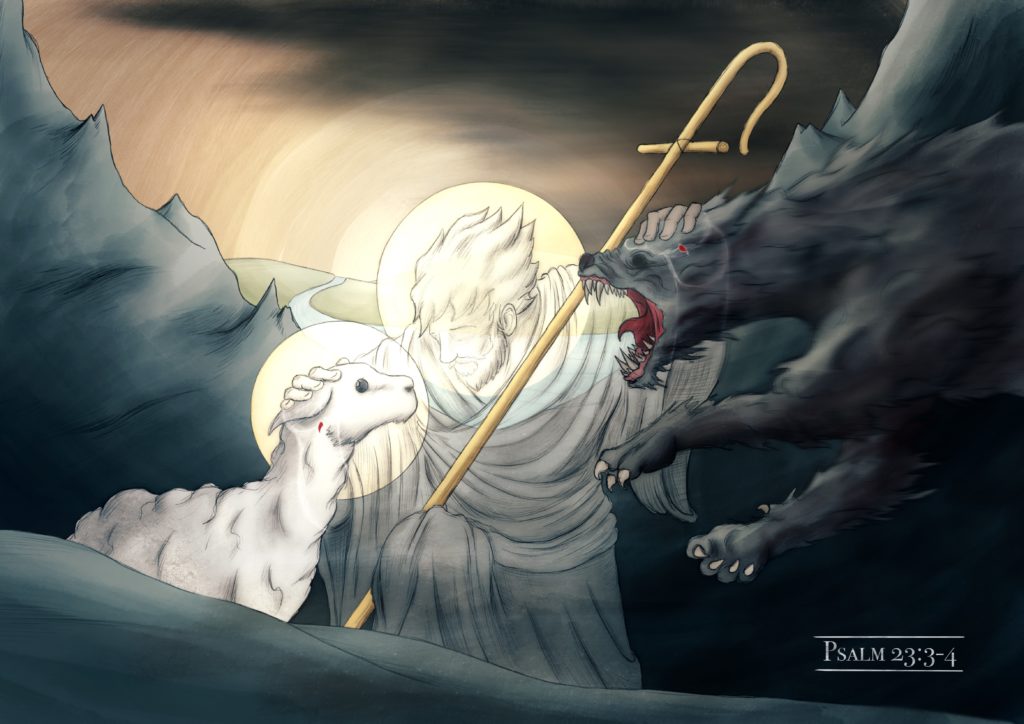
“He restores my soul. He leads me on paths of righteousness for His name’s sake.
Even though I walk through the valley of the shadow of death,
I will fear no evil, for you are with me; your rod and your staff, they comfort me.”
Psalm 23:3-4

Artist’s Explanation: By Chris Powers

I wanted this image to visually express the transition from the pastures into the valley that takes place between verses 2 and 4. The overall color scheme is much darker and the jagged edges of the valley frame the distant pastures in the background.

Verse 3 emphasizes the sovereign leading of the shepherd. It is he who guides and goes before His sheep. This is significant to note because in verse 4 we find ourselves in the Valley of the Shadow of Death. The implication is that the sheep is in the valley because the Shepherd has led him there. And—because the entrance into the valley of shadow is by the design of the Good Shepherd—I wanted to show that the sheep is no less in the almighty hand of his shepherd in verse 4 than he was in verses 1-3. In fact, the sheep’s intimacy and dependency upon the shepherd is only intensified by the valley.

In the pastures the shepherd’s presence and goodness were mediated by the grass and water, but in the valley the mediators have been removed and the shepherd himself has become the desperate and hope-filled focus of the lamb (“I will fear no evil for you are with me.”).

The attacking wolf represents the onset of the valley and its terrors (It need not be only death. The Hebrew word translated “shadow of death” can apply to various grievous and hard to bear sufferings that come as we live life in a fallen world. Sickness, loss, a season of doubt or darkness in the soul might all be categorized under this shadow). The shepherd’s hand on the wolf’s head is intentionally ambiguous. He could either crush the animal’s skull into the ground….or allow it to continue its trajectory toward the lamb. However—whatever the outcome— the hand on the wolf’s head declares the shepherd’s sovereignty over all that befalls his own (John 10:28, 21:19, 22).

The wounds of the shepherd visible behind the head of both the lamb and the wolf declare two different truths. The wound behind the head of the wolf reminds us that Christ’s death and resurrection has overcome all of His people’s enemies and that—should they be allowed to harm His beloved—it will only be to the enemy’s final downfall and His people’s exaltation (John 16:33, Philippians 1:28-29, 2 Thessalonians 1:5-8, Revelation 12:11).

The wound behind the lamb’s head is a reminder that our Lord and God and Shepherd Himself has suffered equivalent to and greater than any suffering He may ordain for us. The hand wounded in sovereign love authors our sorrows, and because He Himself is a slain yet living Lamb, He has infinite compassion on those whom He leads. The shepherd who laid down his life as a lamb is the one who goes before us (Isaiah 49:10, Micah 2:12-13, John 10:4, Hebrews 2:18, Revelation 7:17). And since he has led the way through suffering into glory, He has transformed all of our suffering into an avenue for deeper fellowship with Him, fuller joy in Him, and greater exaltation of Him (2 Corinthians 12:9, Philippians 3:10, 1 Peter 2:21).

Notice also that, if the wolf is to attack the lamb, it must pass the through the cross (represented in the staff). This is yet another reminder that the death and resurrection of our Good Shepherd has “de-fanged” the enemy. Because of Christ’s victory on Calvary, tribulation, distress, persecution, famine, nakedness, danger, sword—and whatever else might assail the people of God—cannot separate us from the love of God and, indeed, can only serve our ultimate good and His ultimate glory (Romans 8:28. 31-39).

Lastly for verse 4, I wanted to really emphasize the intimate fellowship with the Savior that often comes in the context of suffering (though it might not feel like it in the moment). First, notice that the lamb is intently focused on the shepherd and that the shepherd’s head is inclined toward the lamb. Though the wolf is slathering and raging, it is not the focus, rather, its onslaught has driven the sheep closer to the master. Second, the light of the two halos forms a sort of quiet, personal space—shared by the sheep and shepherd—amidst the darkness and motion in the rest of the image. And lastly, notice that the distant green pastures and still waters are visible through the face and torso of the Shepherd. The soul-restoring kindness of the shepherd, previously mediated through grass and water, is now accessed directly—and only—through communion with the Shepherd Himself.

In conclusion, I want to point back to verse 3. There we read that YHWH leads His people in paths of righteousness for His Name’s sake. There is much to say about that statement, but for this image the main thing I tried to emphasize is that the paths into which YHWH sovereignly leads His own are intended to make the goodness and beauty of His Name known to them and to those who observe their lives. This is true even (and especially) of those paths that lead through dark valleys because the Name of YHWH is most perfectly communicated in the death and resurrection of Christ, and when the Christ-follower is led through a time of hardship, the glory of Christ’s crucifixion and resurrection is—in a sense—echoed in their lives.

Christ’s love-borne death reverberates in His people’s sufferings as they entrust themselves humbly into the hand of God to do with them what He will for His glory (1 Peter 2:19-21). And the joy of Christ’s resurrection radiates from His Bride’s face as she endures hardship with hopes set, not on the things that are seen, but on the unseen, blood-bought, and resurrection-assured glory that is to come (2 Corinthians 4:14-18).

So, by making the practical implications of Christ’s death and resurrection visually apparent in this image, I am attempting to show that the valley experiences of God’s people bring the crucifixion and resurrection to the foreground and, consequently, glorify the name of our Shepherd and God who is climactically declared at the cross (Psalm 23:3, John 17:26).

Posted in discernment

To serve man

I used to watch the old anthology series from the 1950s and 60s called The Twilight Zone. Rod Serling used to intone a message at the beginning, and then there was doo-doo-doo-doo music, and the black and white episode would begin.

My favorite episodes were “Time Enough At Last“, “The Shelter” and “To Serve Man”

About To Serve Man, I am going to SPOIL it for you. The episode is 55 years old but still has cultural (and moral) repercussions. Don’t read this if you don’t want to hear about the ending.

Wikipedia says,

“To Serve Man” is episode 89 of the anthology series originally airing on March 2, 1962 on CBS. The story is based on the 1950 short story “To Serve Man”, written by Damon Knight. The title is a play on the verb serve, which has a dual meaning of “to assist” and “to provide as a meal”. The episode is one of the few instances in the series wherein an actor breaks the fourth wall and addresses the viewing audience at the episode’s end.

Here is Wikipedia’s full synopsis of the episode:

The Kanamits, a race of 9-foot-tall aliens, land on Earth. One of them addresses the United Nations via telepathy, announcing that his race’s motive in coming to Earth is to aid humanity by sharing their advanced technology. After answering questions, the Kanamit departs and leaves a book in the Kanamit language without comment, which leads Michael Chambers, a US government cryptographer, to be pressed into service.

Initially wary of an alien race who came “quite uninvited”, international leaders begin to be persuaded of the Kanamits’ benevolence when their advanced technology puts an end to hunger, energy shortages, and nuclear proliferation. Trust in the Kanamits seems to be justified when Patty, a member of the cryptography staff led by Chambers, decodes the title of the Kanamit book: To Serve Man. The Kanamits submit to interrogation and polygraph, at the request of the UN delegates. When declaring their benevolent intentions, the polygraph indicates that the Kanamit is speaking the truth.

Soon, humans are volunteering for trips to the Kanamits’ home planet, which they describe as a paradise. Kanamits now have embassies in every major city on Earth. With the Cold War ended, the code-breaking staff has no real work to do, but Patty is still trying to work out the meaning of the text of To Serve Man.

The day arrives for Chambers’s excursion to the Kanamits’ planet. Just as he mounts the spaceship’s boarding stairs, Patty runs toward him in great agitation. While being held back by a Kanamit guard, Patty cries: “Mr. Chambers, don’t get on that ship! The rest of the book To Serve Man, it’s… it’s a cookbook!” Chambers tries to run back down the stairs, but a Kanamit blocks him, the stairs retract, and the ship lifts off.

Michael Chambers’s ship quarters are a cot in a spartan interior. A voice offers him a choice of dish at all the regular meal times. Each time he refuses food with increasing irritation. At last he says to the audience: “How about you? You still on Earth, or on the ship with me? Really doesn’t make very much difference, because sooner or later, all of us will be on the menu… all of us.” The episode closes as he gives in and breaks his hunger strike.

The episode was rated the best twist ending ever. It certainly has stuck in my memory.

The title To Serve Man is a play on the verb serve, which has a dual meaning of “to assist” and “to provide as a meal”.

We see what we want to see, based on our expectations, and previous experience. We usually connect the new to the known.

When satan comes along, he does not announce himself as a tiny man with horns in a red jumpsuit holding a pitchfork. He deceives. He deludes the unwary into thinking he is there to serve you. But satan actually is there to serve you.

Do not give dogs what is holy, and do not throw your pearls before pigs, lest they trample them underfoot and turn to attack you. (Matthew 7:6).

Be sober-minded; be watchful. Your adversary the devil prowls around like a roaring lion, seeking someone to devour. (1 Peter 5:8)

Beware of false prophets, who come to you in sheep’s clothing but inwardly are ravenous wolves. (Matthew 7:15).

Satan wants to serve you … up on a dinner plate.

But we are not unaware of satan’s schemes. (2 Corinthians 2:11)

For examples, false teachers begin softly, humbly. They seem kind and willing to serve the local or the global body. But false teachers are actually waiting for the moment to pounce. They patiently build up a loyal following, they insulate themselves, and they wait. They are wolves. Wolves are patient, the pack will track a caribou for days. See how wolves hunt:

A wolf pack may trail a herd of elk, caribou or other large prey for days before making its move. During this time, they are already hunting, assessing the herd, looking for an animal that displays any sign of weakness, and this is just the beginning. Wolves must also factor in other conditions that will affect the hunt; weather and terrain can tip the scales in favor of predator or prey. For example, a wide-open plain favors the ungulates, who, if full-grown and healthy, can outrun the fastest wolf. On the other hand, crusty snow or ice favors the wolves whose wide round paws have evolved to perform like snowshoes and carry them effortlessly over the surface. An experienced wolf is well aware that hoofed animals break through the crust and can become bogged down in deep snow.

Do not entertain false teachers. Do not coddle them, forgive them, allow them, make excuses for them…Titus 1:16 says,

They profess to know God, but they deny him by their works. They are detestable, disobedient, unfit for any good work.

Of that verse, John MacArthur preached:

The next time you see a false teacher, you might say, “You rebellious, empty-talking, deceitful, lying, evil beast, slow-bellied glutton.” And you would certainly be within the framework of Scripture. You might have to cope a little bit with 2 Timothy 2, verse 25, which says, “We are to rebuke them with gentleness.” So say it kindly.

Remember, false teachers and false Christians don’t want to serve you, even if their mouths profess it. They want to serve you … up to the wolves…lions…pigs. Satan’s book…it’s a cookbook.

Posted in discernment, Uncategorized

Greed is good?

We know from Revelation what the very last days will be like; the people respond uniformly to the Antichrist (except for the Christians) and allow him to coalesce the world’s broken economy into a one-world economy around his mark. (Revelation 13). All of chapter 18 in Revelation gives the Christian what s/he needs to know about the world economic system run by the Antichrist just prior to Christ’s return. It is one that still has a healthy trade in luxuries, despite the desperately impoverished condition in which most of the world’s population dwells, and despite the people knowing that it is God sending the judgments! (Revelation 16:9).

For all the politically liberal people’s talk of social justice, sharing equally, and helping the poor, we see the stark opposite when push comes to shove during the Tribulation. The poor cry for bread and the rich buy and sell fine flour and wheat, ignoring their cries even as they die in the street.

It’s partly why the Tribulation will occur, to allow sin to run its full course, revealing the depths of man’s depravity.

We as humans are greedy. Greed defines us. It’s a besetting sin that the sinful person lives with every day. The Christian must guard against and slay the remnants of greed still within us. How many Bible verses warn against greed!

Then he said to them, Watch out! Be on your guard against all kinds of greed; life does not consist in an abundance of possessions. (Luke 12:15 )

The love of money is a root of all kinds of evil, (1 Timothy 6:9-10)

Do not put your trust in wealth (1 Timothy 17-18)

Greed is listed among the sins which will prevent one from attaining heaven:

For of this you can be sure: No immoral, impure or greedy person – such a man is an idolater – has any inheritance in the kingdom of Christ and of God (Ephesians 5:5).

It’s interesting that the verse connects greed and idolatry. See here in the Tribulation, when money is in short supply and supplies are in short supply, at least for the common person, they still create idols out of gold and silver in order to worship!

The rest of mankind, who were not killed by these plagues, did not repent of the works of their hands nor give up worshiping demons and idols of gold and silver and bronze and stone and wood, which cannot see or hear or walk, (Revelation 9:20)

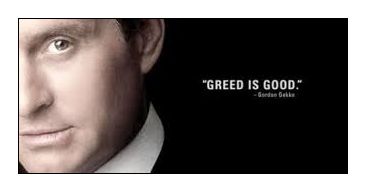
The movie Wall Street came out in 1987. The 80s were a heady time of pell-mell stock surges, whirling real estate flips, dizzying income heights…it seemed that nothing was impossible and money would last forever. In that atmosphere came the movie Wall Street, in which financier and stock raider Michael Douglas’s character Gordon Gecko famously gave his ‘greed is good’ speech. Here it is in part:

I am not a destroyer of companies. I am a liberator of them! The point is, ladies and gentleman, that greed, for lack of a better word, is good. Greed is right, greed works. Greed clarifies, cuts through, and captures the essence of the evolutionary spirit. Greed, in all of its forms; greed for life, for money, for love, knowledge has marked the upward surge of mankind. And greed, you mark my words, will not only save Teldar Paper, but that other malfunctioning corporation called the USA. Thank you very much.

It’s easy for us to look back on the 80s and point fingers at the excesses which were fueled by greed. But are the times so different now? We are still greedy, and at least the fictional character Gordon Gecko and the men he was based on were true to their sin. In today’s time we have an unhealthy attraction to the Prosperity Gospel, which is just anther ‘greed is good’ speech cloaked in Jesus’ name. Which is worse. Way worse. Yet if the remnants of greed are present in a Christian’s heart, the Prosperity Gospel will be attractive to him.

9Marks asks the question, Why Is the Prosperity Gospel Attractive?

Sadly, in spite of the Scriptures’ clear warnings, the prosperity gospel has a large and growing group of followers. This isn’t hard to understand, since the message appeals so directly to our native greed. Yet it is sad and bewildering that many people remain in the movement for a long time, even their whole life, since its preachers cannot fulfill their promises.

‘Our native greed’. Greed is not good, ladies and gentlemen. Greed is bad.

The author continues in his interesting essay to briefly present the psychology of the Prosperity Gospel, its effects, and at the end he offers ‘immunization instructions.’ In America we’re plagued with the likes of prosperity theologists Joyce Meyer, Joel Osteen, Kenneth Hagin, but other continents have their plagues too. Africa and Latin America also are rife with prosperity gospel preachers deluding the unwary.

The 9Marks article ends with this:

Above all, present Christ as the pearl of great price, who infinitely surpasses in value anything that this fleeting world may offer (Mt. 13:44-46; Phil. 3:7-8)

When you have Jesus, you already have everything. When you have Jesus, there’s no need for greed. Or a prosperity gospel, which is no gospel at all.

Posted in discernment, Uncategorized

Practical magic’s resurgence

The NY Times published an article titled The modern charm of practical magic. I found it interesting for many different reasons. I was not saved by grace of the Lord Jesus until I was 42 years old. I spent all of my adulthood prior to the salvation moment, searching for the magic key to the magic in life, the unexplainable, explained. I dabbled in lots of different kinds of magic. Ouija boards, Kirlian aura photography, dreamcatchers, sage burning, Reiki, astral projection, summoning spirits & spirit guides, clairvoyance…

We all want to know what’s on the other side. We do enjoy peeking behind the veil, knowing the unknowable. Because, the unsaved person knows there is a higher power. (Romans 1:19-20). They just deny Who it is. ‘Oh it can’t be God. It must be runes…solstice…labyrinths…”

The NYT article says that they notice more than ever, people seeking answers through magic,

You may have noticed it at work. Perhaps your co-worker has ornamented her cubicle with rose quartz crystals? Has a friend uploaded an I Ching app onto his phone? Or maybe your boyfriend blamed his failure to respond to your text messages on Mercury being in retrograde? 

Why magic, and why now? The lack of religious faith so prevalent in our age is an anomaly in history. Magic, which usually does not demand faith in a particular deity, or the sometimes exclusionary imperatives of organized religion, allows people to access a sense of the miraculous on the level of the quotidian.

The article concedes the yearning for a higher power but subtly warns against it actually being God,

There is relief to be found in simply accepting a higher order, in letting go, but what of appeals to reason? Is it not important to disbelieve things that aren’t real? Might faith in the healing powers of a vibratory sound bath lead the next day to outlandish conspiracy theories?

I liked this NY Times article, for many reasons but mainly for its use of my favorite word, quotidian. Where else are you going to read an essay where the author uses such a fancy word which means mundane?

The Christian is bombarded with practical magic all the time. Did you know that? The fads are part of the devilish worming into your home of these magical activities. Labyrinths, Breath prayer, mantras, prayer beads, Mandala coloring books, the false gospel of telling you your words have power, drawing prayer circles, horoscopes, seeking the Presence (which is actually summoning spirits)…and more, are just different kinds of old magic that satan is using to take your eyes off Jesus.

Beware of the charm of practical magic, brethren. The warning is not just for unbelievers, but for believers. Satan insinuates practical magic into our lives under the guise of it being Christian, but it never is. We have the answers. We have the mind of Christ. (1 Corinthians 2:16). Our answers are in the all-sufficient Bible. We do not need additional practices that promise to deliver information, (but never does), or promises to give added insight (but won’t) or gives a special closeness to Jesus (but never does).

Here are some resources about the dangers of Christian magic:

Desiring God:Jesus vs. the Occult

Critical Issues Commentary: Contemporary Christian Divination

GotQuestions: What does the Bible say abut Divination?

Posted in prophecy, Uncategorized

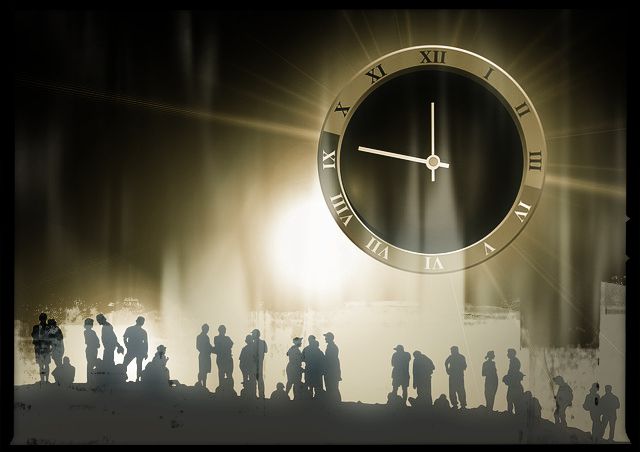
We live our lives in a waiting room

Life is a waiting room

It might seem strange to say this, but we are not living to live. Living is not the point of our living. Waiting is. We live while we’re waiting.

For the grace of God has appeared, bringing salvation for all people, 12training us to renounce ungodliness and worldly passions, and to live self-controlled, upright, and godly lives in the present age, 13waiting for our blessed hope, the appearing of the glory of our great God and Savior Jesus Christ, (Titus 2:11-13).

Paul is giving Titus some instructions and reminders as to our duties as Christians, to be done while we wait.

Matthew Henry’s Commentary on the Whole Bible reminds us also that this life is a preparatory for the one to come.

To look for the glories of another world, to which a sober, righteous, and godly life in this is preparative: Looking for that blessed hope, and the glorious appearing of the great God and our Saviour Jesus Christ. Hope, by a metonymy, is put for the thing hoped for, namely, heaven and the felicities thereof, called emphatically that hope, because it is the great thing we look and long and wait for; and a blessed hope, because, when attained, we shall be completely happy for ever.

In today’s time it’s not considered mature to speak of prophecy. I believe that’s wrong. I believe that because so many verses stress that we are to look forward, to hope in His coming promises, to wait for His return. I can’t think of a better encouragement than to dwell on His prophecies. This life is difficult. (John 16:33). It’s full of evil people and seducers waxing worse and worse. (2 Timothy 3:13). It’s full of disease, strife, challenge, and vigilance. (1 Corinthians 11:30, 2 Corinthians 12:7-10, Proverbs 28:25, Psalm 46:1,1 Peter 5:8).

We are being trained while we wait. But waiting is our task, our joy, our hope. We should look to His return for encouragement. He is the blessed hope!

Illustration by Chris Powers
Posted in encouragement, Uncategorized

Recommendation on Devotionals

If it helps anyone, here are three devotionals I like, use, and recommend. I’m just some internet lady, so as always, use your discernment when choosing theological material.

I use alternately three particular devotionals. I like them for men and women, but I especially like them for women because we are too often subjected to wispy and insubstantial devotionals aimed at our gender which are light on theology and heavy on the crayon coloring. These are my favorites:

1. Morning & EveningSpurgeon “Charles Haddon Spurgeon’s classic Morning and Evening collection of daily devotionals was written in England more than a century ago. For generations, its cherished gems of daily strength and meditation inspired millions.”

It is in hard copy and also online, so that if you’re  out and about or traveling you can get it on Kindle or just on WiFi and not miss a day. I love Spurgeon’s devotionals and I read and post one each morning. His “Faith’s Check-book” is another devotional I enjoy, these are even shorter and like the Morning & Evening devotional , are very uplifting.

2. John MacArthur: Any devotional. Heavy on scripture but short enough devotions to help fuel a daily habit and not take so much time one abandons it before beginning. Here is a great overview and review of four of his devotionals which are organized in various ways (daily verse-by-verse through one larger passage, topically, NT, or OT).

3. Valley of Vision: A Collection of Puritan Prayers. Despite being written in Puritan days the language is easily understandable.) I personally consider this book the third most important in the English language, ever (after the Bible and Pilgrim’s Progress). I cannot read one and not feel convicted and slain before the throne of Jesus. They’re wonderful!! The hard copy is available at Amazon, the online

Blurb: “Draw upon the inspiration of the elegant prayers of such Puritans as John Bunyan, Isaac Watts, David Brainerd, Augustus Toplady, and Charles Spurgeon. The Valley of Vision has been prepared not to simply supply Christians with prayers, but to prompt and encourage them as they walk upon the path of others who’ve gone before them. You’ll relish the elegance of these writings as they transport you to the heavenly throne of grace. Topics include redemption and reconciliation, holy aspirations, penitence, and more.”

Enjoy!