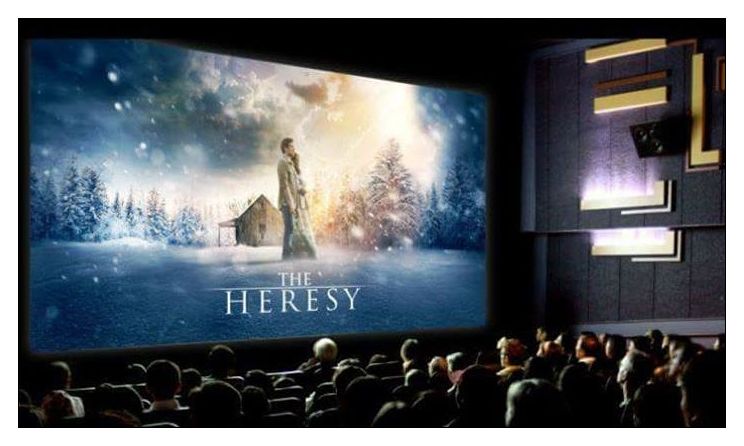
Almost ten years ago author William P. Young published what became a phenomenal success in the publishing world, a book called The Shack. It has recently been made into a movie, which was released this past weekend.
I’ve written about The Shack’s theological issues and heresies before, and many other people have written against it as well. As a matter of fact, I was so upset about The Shack’s heresies and inroads in deluding my friends, that I write about it on my personal blog in 2008. It as that essay that started me thinking about creating a second blog to deal solely with theological issues, and a few months later I began my blog The End Time, which you are reading now.
I mulled over whether to post about The Shack, and had decided against it. There is already so much circulating about the movie that any Christian can easily find what they desire about the film, both supportive AND negative, more’s the pity.
But my friend Pastor James Bell of Gallatin TN wrote an essay and emailed it out, and I truly enjoyed his perspective. Pastor Bell isn’t a towering name in the evangelical world like Paul Washer. He’s not a preacher leading a famous church like John MacArthur. Nor is he President of a seminary like Dr Albert Mohler. He’s not someone of whom you have likely to have heard. He is a regular pastor who lovingly and consistently labors over his sheep in his section of the world, contending, encouraging, and sharing his wisdom and perspective via his pulpit and Facebook. He has been pastor at his church for 42 years, a feat I greatly admire the Holy Spirit for sustaining.
I’m going to re-post his piece because it’s wise and discerning and I wanted to give it an audience that might not otherwise be exposed to it. His piece is thorough because it’s a white paper, so it’s long. That’s OK. Just settle in and read it when you have time and no distractions.
So, Pastor Bell’s piece is below and then below that I post a link to my own essay about The Shack which also contains further links explaining why The Shack, book or movie, is not good food for the Christian, no matter how fervently a friend might gush that ‘it’s just so encouraging.’ The Shack is not encouraging. Really. It’s not. Please don’t convince yourself that The Shack is OK to read or watch because ‘it’s just fiction’. It’s not. Really it’s not.
The Shack! In January, 2008, I went to Amazon.com, and was immediately amazed at all the praise of the book from pastors, theologians, and teachers along with other folk.
From the many reviews, I was promised that this was a most exciting book, that I would not be able to put it down, that it would be life-changing, that it would be a great resource to help folk win over bitterness and anger, that it was a great story of forgiveness, that most of all it was a great story about the love of God— especially about actually experiencing the love of God and experiencing close fellowship with God.
Moreover, I was promised that I would learn much about the true nature of God. So, I immediately ordered, received, and read the entire ‘SHACK’ book.
Here is some of what I found.
William P. Young, who calls himself, Willie, writes an apparently fictitious story about a man named Mack who (as a child) was beaten with a belt and with Bible verses by a drunken father. He later graduates from Seminary, marries and has a family. He, Mack, is described as not very religious and occasionally showed up at the local ‘pew and pulpit Bible church’… But Mack is an angry man. He is angry at God and especially after one of his children is abducted and murdered. However, it is evident that Mack’s concepts of God, the Bible and the Church of Jesus Christ are very flawed.
It is indeed a real life tragedy that masses folk— the religious, the not so religious and even many genuine Christians— have serious false concepts about God, the Bible and the Church of Jesus Christ. To solve this problem, Young’s book weaves an imaginary story to show how Mack was introduced to a very different god from the one he grew up hearing about.
However, now we are confronted with a new problem: The god Young creates for Mack is very different from true and living God revealed in Holy Scripture, who is quickened to believing hearts by the wonderful COMFORTER, the Holy Spirit.
Thus, The Shack is a very tragic book. As I read the book,
I went from being badly bored to being really sad.
Religious Fiction is a poor substitute for Biblical truth and also a poor substitute for truth teaching soundly grounded in and faithful to the pure revealed Word of God.
The Holy Spirit is the Spirit of Truth, He leads us into all truth; and it is the truth that sets us free.
The Shack is tragic because it is the story of a troubled man who clearly has a false concept of God, who is given yet another set of false concepts of God from the imagination of William Young.
Mack started with an idol and ends with a different idol. O, but many will protest—the story ends with Mack being forgiven and forgiving, set free and happy!
Yes, you can make fiction fit your desired conclusion. And, indeed, in real life there are multitudes who FIND a false peace and a false freedom by means of various false gods and religions.
Bottom line: Here are a few of the troubling quotes from THE SHACK.
I will reference the page numbers:
1. Page 16, We learn that Mack literally receives a type written note from ‘Papa’ [God]… telling Mack, “Mackenzie, It’s been a while. I’ve missed you. I’ll be at the shack (the place where Mack’s daughter was killed) next weekend if you want to get together. – Papa
COMMENT: Nowhere in 248 pages does Mack ever receive any specific instruction or revelation from God through the written Word of God! Instead he receives this above note; plus massive amounts of imaginary communication, via visions, dreams or whatever.
Of course, the defenders will claim that the book is ‘based upon’ much Scripture! Yes, there are a few concepts here and there that ‘square with’ Scripture… But no one ever bothered to tell Mack! For after all, Mack was enjoying a far superior way of God’s communication– God speaking in one’s mind and in visions and dreams. This is nothing but deadly… a path where every man will lean upon his own understanding.
Page 65- Mack, “In seminary he had been taught that God had completely stopped having any overt [open, not hid] communication with moderns, preferring to have them only listen to and follow sacred Scripture, properly interpreted, of course. God’s voice had been reduced to paper and even that paper had to be moderated and deciphered by proper authorities and intellects.”
COMMENT: William Young (henceforth- WY) sets forth a bad situation and then offers his solution. I’m sure that there are religionists who are as he describes above. But that is not the Biblical model. Moreover, WY never offers the Biblical model as a solution, but rather he sets forth his own imagined solutions. This is true over and over in the book.
But also, if you take at face value the above statements— WY is SLAMMING the true nature and place of God’s Word. Indeed, he obviously does not hold to the absolute authority of God’s Word… for he does not set forth the revelation of God’s Word as solution for the problems Mack faces.
Mack is presented as needing to REALLY KNOW GOD and how to enter into a LIVING RELATIONSHIP with God, of how to understand the human problem of suffering, of how to deal with bitterness and anger, of how to have hope and joy.
The Holy Bible is FULL of amazing and manifold revelation of God! Manifold attributes of God are unfolded and HUNDREDS of names of God the Father, the Son and the Holy Spirit are given.
And the Holy Spirit, who BREATHED OUT the Sacred Scriptures, is now the believer’s DIVINE COMFORTER AND TEACHER… And IN CHRIST, our hearts are now HIS HOME… By the Holy Spirit, Almighty God makes His home in the believer’s heart. Indeed, the true Christian life is not religion but a living RELATIONSHIP.
The Bible is full of divine revelation as to suffering, as to depression and anger, bitterness, forgiveness, etc… and THE HOLY SPIRIT is ever present to personalize and apply the truth to hungry hearts.
But WY never tells Mack any of this. He never tells him that every real Christian is a believer-priest with the Holy Spirit, the MASTER TEACHER indwelling! WY never points Mack to any of the DIVINELY REVEALED NAMES OF GOD… and there are over 200 of them!
INSTEAD, WY pushes aside the pure and wonderful God-breathed Word of God in favor of his imagination. And thus, WY introduces Mack and all the rest of us to WY’s triune God!
1. God the Father is ‘Papa’… and he is a SHE— (page 82)- Mack arrived at the shack, knocked on the door, “the door flew open, and he was looking directly into the face of a large beaming African-American woman.”… and her name (page 86) is… “You may call me Elousia.” How interesting. God in His God breathed book has given divine revelation of His name… In fact, He has revealed Himself by many names. ELOUSIA is not one of them! Yes, the word ‘ELOUSIA’ has historical connections with false gods and has a root meaning of ‘tenderness’…
Is there ‘tenderness’ with the LORD, GOD ALMIGHTY? Yes! But consider: Let’s say, that your name is ‘John Henry Jones’… but I refuse to call you by your name… I give you a name that I want to use! EVEN ON A HUMAN LEVEL, THAT WOULD BE ARROGANCE and disrespectful.
But in The Shack, the author is supposed to be revealing the true God. We are dealing with ALMIGHTY GOD, WHO has revealed himself in creation, in redemption and with a multitude of divinely sanctioned attributes and names.
And all of God’s names and attributes, given in sacred Scripture, REVEAL who God is and what He is like. WY rejects a ton of Biblical revelation and creates his Shack god that has the features and characteristics that WY wants and not more. Such is the way with all man-made idols.
2. God the Son, Jesus is called Jesus in the book; and the Holy Spirit is shown as an Asian woman (page 87) whose name is Sarayu. Once again, there are many glorious descriptions and names given the blessed Holy Spirit in the pure Word of God. Sarayu is not one of them. Again, much like Elousia, Sarayu has a background in manmade religion… and also means, ‘air or wind.’
BUT HERE IS WHAT WE HAVE:
WY says he wants to show us what God is like; and yet he REJECTS, ignores, counts as unworthy of consideration the God-breathed revelation of Scripture and substitutes with his own creations! This is astonishing. And the masses love him for it!
3. All throughout The Shack, WY sets forth a very humanized god– all in the name that we need a God that understands us, that loves us, that wants a relationship with us.
And WY’s ‘Papa’ god is not only a woman, but she is VISIBLE to Mack and she has the SAME WOUNDS on her body as Jesus… (Page 95)…”…and for the first time Mack noticed the scars in her wrists, like those he [Mack] now assumed Jesus also had on his. She allowed him to tenderly touch the scars, outlines of a deep piercing… tears were slowly making a way down her face…
COMMENT: There is a ‘theological’ name for this false teaching: From Wikipedia, the free encyclopedia. Patripassionism is a Christian heresy from the time of the early church. Its adherents believe that God the Father [Patri] was incarnate and suffered on the cross. This is problematic in the context of the doctrine of the Trinity because the Christian Scriptures record Jesus Christ as speaking to God the Father while he was on the cross.
Let me be plain: On the authority of God’s holy Word, there is not the slightest bit of truth in what WY is saying.
If one is writing a book about a mere human; and they take ‘literary liberties with a few of the facts and details… OK… it helped make a good story or a good movie… it was ‘based on fact’…. But not a true history lesson.
HOWEVER, in dealing with Almighty God— to deny and ignore His revelation and to create a god one likes and to set him forth as VISIBLE when He is not— SUCH is not literary liberty. It’s just not the truth.
4. And then… on page 96… When Jesus cried out, “My God, My God, why hast thou forsaken me?”….. WY’s god says, “Regardless of what he [Jesus] felt at that moment, I never left him.”
Wow! Now… who shall I believe— WY? or Jesus?
I’ll stick with JESUS!
5. Page 119-120… Mack asks the Shack god woman—“Weren’t you always running about killing people in the Bible? You just don’t seem to fit the bill…. But if you are God, aren’t you the one spilling out great bowls of wrath and throwing people into a burning lake of fire?”
WY’s created god of his imagination says, “I am not who you think I am, Mackenzie. I don’t need to punish people for sin. Sin is its own punishment, devouring you from the inside. It’s not my purpose to punish it; it’s my joy to cure it.”
BE IT FROM Mack’s misconceptions about God’s righteous judgments… set forth in a way to slander the righteous character of the True God or in WY’s blatant denial of the holy wrath of God— IN BOTH CASES, horrifying man pleasing deceptions are set forth!
In a strange twist, WY has his papa/mama god saying, “Lies are one of the easiest places for survivors to run. It gives you a sense of safety, a place where you only have to depend on yourself. But it’s a dark place, isn’t it?” (page 187)
Such are the deceptions of the Shack book— The masses run to them. Man has always loved his own creations! Man loves a humanized god. He seeks to hide from the true God revealed in the Word of God and revealed in creation and revealed in the VISIBLE image of the invisible God, Jesus; and made real to human hearts by the indwelling Holy Spirit. But in the end, such hiding only brings darkness!
6. Page 198- “Mackenzie, religion is about having the right answers,…but I am about the process that takes you to the living answer and once you get to him, he will change you from the inside… You may see me in a piece of art, or music, or silence, or through people, or in Creation, or in your joy and sorrow… And you will hear me in the Bible in fresh ways. Just don’t look for rules and principles; look for relationship—a way of coming to be with us.”
As is often the case, the false and the true are mixed. Such is the case here. By the way the reality is that you can be almost anyone from any background and love the Shack. Why? It has no clear revelation or solutions. Each man is left to his own subjective interpretations.
A false dichotomy: The informal fallacy of false dilemma involves a situation in which two alternative statements are held to be the only possible options, when in reality there exists one or more other options which have not been considered. The concept is also known as false choice, false dichotomy, falsified dilemma. WY once again sets up a false dichotomy: 1. On the one hand we have all of Mack’s false concepts about God, about the Bible and about church… 2. Then WY will produce his solution in some form of his subjective, humanized sweet all love god.
WHEN ALL THE WHILE,
1. Yes, Mack has some real problems… many folk do; and there are real, even major problems in the churches… In fact— A lot of what claims to be God’s church, according to the Word of God, is not! She is harlot. She is not bride. She is broad road to destruction…. With a multitude of options, ideas, and experiences.
2. But the REAL solution is not found in subjective imagination or humanistic creation. You see, the problem is not that the Bible and/or Biblical Christianity has been tried and found lacking. The sad reality for most… and certainly for Mack… BIBLICAL CHRISTIANITY and the true triune God had never been experienced.
From page 202, it is clear that Mack only had a ‘works’ concept of how to relate to God. He was a stranger to grace through faith in Jesus Christ.
WY IN 248 PAGES NEVER CLEARLY SETS FORTH THE BIBLICAL TRIUNE GOD NOR THE PROFOUND GOSPEL OF GOD’S AMAZING GRACE.
REALITY: God SPEAKS in and through the Bible, quickened to us by the Holy Spirit… and HE DOES NOT STUTTER! God’s Word is not opinion; nor is it for us to simply read and give our opinion. The Bible is the infallible written Word of God, quickened to us by the Holy Spirit.
In and through the Word of God, God speaks and THUS there are Sins to confess; Promises to claim; Attitudes to change; Commands to keep; Examples to follow; Prayers to pray; Errors to avoid and Truth to believe!
BUT FIRST OF ALL AND MOST OF ALL—The Word of God has been given to us that we might KNOW the God of the Word. Above all else the Bible is God-breathed revelation of GOD HIMSELF.
Closely tied into this, of course, is the God-breathed revelation of God having created man for fellowship with God, the revelation of man’s fall into sin and the glorious story of REDEMPTION… of fellowship and RELATIONSHIP restored through Jesus Christ the LAMB of God!
There are several good books dealing with the Divine Attributes of God, with lots of Scripture:
1. J. I. Packer– Knowing God.
2. A. W. Tozer– The Knowledge of the Holy.
3. A. W. Pink– The Attributes of God
The Quiet Life: The Shack is a devilish deception. More links here