Posted in hymn, theology

O for a thousand tongues

On this Lord’s Day in hopes that this sweet hymns of praise might refresh your soul, I offer this song of praise to our Redeemer. I pray you have opportunity to attend a loving and doctrinal church, meet with the saints and love the Lord through hearing His word, prayer, song, and fellowship.

O for a Thousand Tongues to Sing

Written in 1739 by Charles Wesley. Based on Psalm 35:28. Information from Wikipedia

“O for a Thousand Tongues to Sing” is a Christian hymn written by Charles Wesley. Charles Wesley wrote over 6,000 hymns, many of which were subsequently reprinted, frequently with alterations, in hymnals, particularly those of Methodist churches.

Charles Wesley was suffering a bout of pleurisy in May, 1738, while he and his brother were studying under the Moravian scholar Peter Boehler in London. At the time, Wesley was plagued by extreme doubts about his faith. Taken to bed with the sickness, on May 21 Wesley was attended by a group of Christians who offered him testimony and basic care, and he was deeply affected by this. He read from his Bible and found himself deeply affected by the words, and at peace with God. Shortly his strength began to return. He wrote of this experience in his journal, and counted it as a renewal of his faith; when his brother John had a similar experience on the May 24, the two men met and sang a hymn Charles had written in praise of his renewal.

One year from the experience, Wesley was taken with the urge to write another hymn, this one in commemoration of his renewal of faith. This hymn took the form of an 18-stanza poem, beginning with the opening lines ‘Glory to God, and praise, and love,/Be ever, ever given’ and was published in 1740 and entitled ‘For the anniversary day of one’s conversion’. The seventh verse, which begins, ‘O for a thousand tongues to sing’, and which now is invariably the first verse of a shorter hymn, recalls Böhler’s words, ‘Had I a thousand tongues I would praise Him with them all’. The hymn was placed first in John Wesley’s A Collection of Hymns for the People Called Methodists published in 1780. It appeared in every (Wesleyan) Methodist hymnal from that time until the publication of Hymns and Psalms in 1983.

Congregational singing (Shepherds’ Conference)
Grace Community Church – Sun Valley, California

O for a thousand tongues to sing
My great Redeemer’s praise,
The glories of my God and King,
The triumphs of His grace.
2
My gracious Master and my God,
Assist me to proclaim,
To spread through all the earth abroad,
The honors of Thy name.
3
Jesus! the name that charms our fears,
That bids our sorrows cease;
’Tis music in the sinner’s ears,
’Tis life, and health, and peace.
4
His love my heart has captive made,
His captive would I be,
For He was bound, and scourged and died,
My captive soul to free.
5
He breaks the power of canceled sin,
He sets the prisoner free;
His blood can make the foulest clean;
His blood availed for me.
6
So now Thy blessed Name I love,
Thy will would e’er be mine.
Had I a thousand hearts to give,
My Lord, they all were Thine!

Posted in theology

A Day in the Life of a: Shepherd

By Elizabeth Prata

What was a day in the life like for a person who lived in New Testament Bible times? It depended on what trade the person made their living. The first time I looked at the woman of Thyatira, Lydia, a seller of purple. Then we looked at tanners, such as Simon the Tanner whom Peter lodged with. Today I’m interested in what a day in the life of a shepherd would be like.

sheep1
EPrata photo

Shepherding is one of the oldest professions in the Bible. The first was gardener or overseer. God told Adam to keep the Garden (Genesis 2:15). Shepherd is mentioned second. Genesis 4:2 says, “Now Abel was a keeper of flocks…”

Many of the men and women of the Bible were shepherds. Abel, Abraham, Isaac, Jacob, Lot, Laban, Moses, Rachel, David, Amos are a few examples of shepherds in the Bible. Of course we know the angels came to announce the birth of Christ to unnamed shepherds protecting their flocks by night near Bethlehem.

Life in Palestine was lived mainly outdoors, and animal husbandry was a major occupation. Even so, by the time of Jesus, that profession was considered unskilled. Shepherds were relegated to the lower socio-economic strata of society. It is therefore poignant that God chose to send angels to shepherds for the first announcement of the Savior’s appearance on earth.

Shepherding was hard.

The duties of a shepherd in an unenclosed country like Palestine were very onerous. In early morning he led forth the flock from the fold, marching at its head to the spot where they were to be pastured. Here he watched them all day, taking care that none of the sheep strayed, and if any for a time eluded his watch and wandered away from the rest, seeking diligently till he found and brought it back. King James Bible Dictionary

David mentions that one duty of the shepherd was to protect the sheep from predators, of which there were many. Lions, bears, wolves, hyenas, and leopards were all interested in a sheep dinner. Sheep won’t fight back, run, or hide. Instead, when a predator appeared, they gather together, giving the predator a big choice on which sheep to pick for his dinner.

sheep 4
EPrata photo

David said he had protected the flock from lions and bears, single-handedly fighting off both at different times (1 Sam 17:34-37). Wolves were the worst enemy of the flock. They were more numerous than lions or bears. They were canny, constant, and fierce. They rarely left off trying to invade the fold and make off with a lamb or young sheep. Wolves are often mentioned in scripture as a symbol of treachery.

In those lands sheep require to be supplied regularly with water, and the shepherd for this purpose has to guide them either to some running stream or to wells dug in the wilderness and furnished with troughs.
King James Bible Dictionary

Water was always in short supply in desert lands. That is why it was a special trouble for Isaac when the Philistines, who envied his healthy flocks and herds, stopped up the wells. (Genesis 26:14-15). And it couldn’t be just any water, running water as in a stream or river would spook the sheep. They prefer still water, but it also has to be clean.

The shepherd is not only always on guard against predators (of which are also the human kind, thieves) but he or she must protect the sheep from themselves. If a sheep falls into running water, it will drown, their woolly coats soak up quickly and sheep cannot swim. He needs to be led to calm waters. (Psalm 23:2-3).

Drinking from puddles would give the sheep parasites and they become ill. If the shepherd moves his flocks to the pasture early enough in the morning, the dew-laden grass would contain enough moisture for the sheep.

sheep 3
EPrata photo

Sheep eat a lot of grass, they are totally focused on eating. Because they are so absorbed in nibbling grass, all day, all the time, one or two usually tend to wander away from the flock and get lost. (Luke 15:3-6).

After eating, the sheep needs to rest. She lays down and while resting, chews her cud and digests, as the sheep is a ruminant. Sometimes he won’t lie down on his own. He needs to be made to lie down. (Psalm 23:2-3).

This is not a process where the shepherd goes around and forces the sheep down (unless it’s to inspect hooves or administer medicine.) The shepherd makes them lie down by providing the condition in which the sheep feel comfortable enough to lie down. They have eaten, they feel safe, they are not at enmity with other sheep. They feel chill, they are fed and full, watered, and they will lie down since the shepherd made the acceptable environment for them.

At night he brought the flock home to the fold, counting them as they passed under the rod at the door to assure himself that none were missing. Nor did his labours always end with sunset. Often he had to guard the fold through the dark hours from the attack of wild beasts, or the wily attempts of the prowling thief (see 1 Samuel 17:34). King James Bible Dictionary

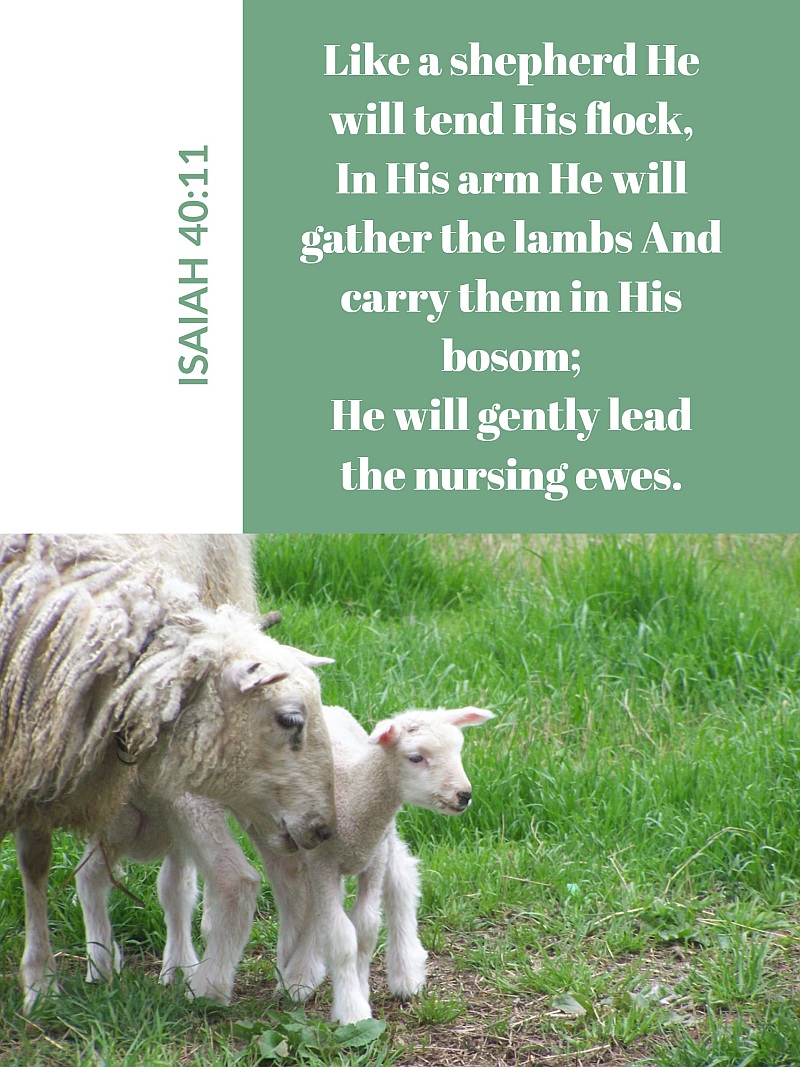
A good shepherd also delivers the lambs, (Isaiah 40:11), grooms and shears the sheep. (Deuteronomy 18:4; 1 Samuel 25:4)

He has an extra incentive to be extra vigilant. If a sheep goes missing, and the shepherd cannot prove it was shredded by predators, the shepherd must pay for the sheep himself. (Genesis 31:38-39, Exodus 22:10-13). That is one reason he is so careful to count them as he brings them into the fold at night. He uses the rod or staff to lower on each one in a careful count. He also runs the rod along the wool so he can examine the condition of the skin and the wool.

When his day is done and all sheep are accounted for, whatever kind of sheepfold he has brought he flock into (enclosed shed, circle of stones with a crude roof of boughs of thorns, cave, etc) the shepherd will sleep across the door to protect the sheep while they sleep. If a predator tries to enter, the shepherd will awaken and beat it back. He will do the same against thieves too. (John 10:1-2).

Sometimes the shepherd will mix in with other shepherds and split the night watches. It is not a problem separating out the sheep the next morning as the sheep know their own shepherd’s voice. (Genesis 29:1-3; John 10:27-28).

When Jesus preached using shepherd allusions, the local people all over Palestine knew exactly what He was speaking about. There are many examples of shepherds and their duties (which were numerous and constant) so it is no wonder that the word ‘pastor’ is often used interchangeably with shepherd.

A day in the life of a shepherd was strenuous, long, has its many dangers, with walking many miles in all weathers. But worthwhile. God chose to give many of our Bible heroes the job of shepherd, and to One, He gave the highest job of all. Jesus is THE GOOD SHEPHERD.

I am the good shepherd. The good shepherd lays down his life for the sheep. He who is a hired hand and not a shepherd, who does not own the sheep, sees the wolf coming and leaves the sheep and flees, and the wolf snatches them and scatters them. He flees because he is a hired hand and cares nothing for the sheep. I am the good shepherd. I know my own and my own know me, just as the Father knows me and I know the Father; and I lay down my life for the sheep. And I have other sheep that are not of this fold. I must bring them also, and they will listen to my voice. So there will be one flock, one shepherd. For this reason the Father loves me, because I lay down my life that I may take it up again. No one takes it from me, but I lay it down of my own accord. I have authority to lay it down, and I have authority to take it up again. This charge I have received from my Father. (John 10:11-18)

Previous essays in A Day in the Life of:

A Day in the Life of: A Concubine
A Day in the Life of: A Roman Centurion
A Day in the Life of: A Professional Mourner
A Day in the Life of: A Fisherman

A Day in the Life of: A Potter
A Day in the Life of: A Scribe
A Day in the Life of: A Shepherd
A Day in the Life of: A Tanner
A Day in the Life of: A Seller of Purple

Posted in discernment, theology

To all the commenters who reply, “Judge not” and “Did you go to her?”

Discernment is important.

Let me rephrase that.

Discernment is important.

Discernment is:

Discernment is the skill of understanding and applying God’s Word with the purpose of separating truth from error and right from wrong. ~Tim Challies

Charles Spurgeon drills down even further:

Discernment is not knowing the difference between right and wrong. It is knowing the difference between right and almost right.

Some believers are given a heightened ability to discern by virtue of possessing a gift from the Spirit.

and to another the effecting of miracles, and to another prophecy, and to another the distinguishing of spirits, to another various kinds of tongues, and to another the interpretation of tongues. (1 Corinthians 12:10).

For spirit-gifted discerning believers AND all others, we must practice discernment in our walk. (Hebrews 5:14). That means both identifying it AND acting on it. It’s non-negotiable.

Sheep, or Wolf? A Call to Discern
by Dr. Colin Eakin
Discernment: The Neglected Imperative

Where does God command believers to exercise spiritual discernment? Perhaps a better question is, where doesn’t He? The answer is Philemon. Of all the books in the New Testament, this letter of twenty-five verses is the only one in which there is no instruction for the believer to be on guard against falsehood. All remaining twenty-six books of the New Testament (and many of the Old Testament) exhort the believer, to a greater or lesser degree, to discern truth from falsehood and to act upon it.

Satan downplays the importance of discernment. How? He twists scriptures such as the ones under discussion today, two of the most abused scriptures in the Bible, plus one more-

Judge not, that ye be not judged. (Matthew 7:1)

And this one:

If your brother sins against you, go and tell him his fault, between you and him alone. (Matthew 18:15).

And this one:

Be nice. Jesus ate with sinners, you know.

Sadly, when I write an essay discerning a false teacher, or speaking against a false doctrine, inevitably I receive a slew of comments from women who insist I perform one or the other of the verses above. This makes me sad, because I know from such comments these women are not operating at peak Christian condition. Their insistence that I employ one or both of these verses usually reveals two things about them:

— they hold to an errant understanding of the verses above
— they hypocritically have failed to follow their own advice and ‘come to me privately’, and to ‘judge not’.

Wise people treasure knowledge, but the babbling of a fool invites disaster. (Proverbs 10:14).

Here is my rebuttal to the commenters lobbing the most abused discernment verses:

Judge not, that ye be not judged. (Matthew 7:1).

‘Do not judge’ cannot mean ‘do not discern.’ There are calls to discern in every book of the New Testament except Philemon, and many of the Old. (1 John 4:1, Philippians 1:9-10, Hebrews 5:14, Romans 12:2, 1 Corinthians 2:14, 1 Kings 3:9, & etc.)

Judge not can’t mean do not judge, because in John 7:24 we’re told to judge. Wisdom would suggest that rather than there being an inconsistency in the Bible, there is an inconsistency in our understanding.

So if Matthew 7:1 doesn’t mean not to discern and it doesn’t mean judge not, what does it actually mean? Well, first, read the verse in context. Here is Matthew 7:1-5,

Do not judge so that you will not be judged. For in the way you judge, you will be judged; and by your standard of measure, it will be measured to you. Why do you look at the speck that is in your brother’s eye, but do not notice the log that is in your own eye? Or how can you say to your brother, ‘Let me take the speck out of your eye,’ and behold, the log is in your own eye? You hypocrite, first take the log out of your own eye, and then you will see clearly to take the speck out of your brother’s eye.

It means when we do have to judge something, as in test, discern, check, etc, do not do so hypocritically, harshly, or wrongly. More here: GotQuestions- What does the Bible mean that we are not to judge others?

If a commenter reads one of my discernment essays and ignores the scriptures, the facts, and/or the point, but gently or harshly or anywhere in between, urges me to “judge not”, I will delete the comment but reply by pointing her to this essay.

2. Have you gone to her privately?

In this one, commenters are referring to a section in Matthew 18, where the Bible outlines procedures for church discipline. Here is the passage:

If your brother sins, go and show him his fault in private; if he listens to you, you have won your brother. But if he does not listen to you, take one or two more with you, so that by the mouth of two or three witnesses every fact may be confirmed. If he refuses to listen to them, tell it to the church; and if he refuses to listen even to the church, let him be to you as a Gentile and a tax collector. (Matthew 18:15-17 NASB)

This verse is about church discipline, when one member of a local body has sinned against another person in the local body. It is a local, internal procedure. It is not referring to our response to book reviews or other public statements false teachers have made.

Phil Johnson explained here, in a 2006 blog essay:

It would be a serious mistake to imagine that a private meeting is always a mandatory prerequisite before any Christian can legitimately express public criticism of another believer’s published work or public behavior. On the contrary, sometimes—especially when we’re dealing with a public and scandalous transgression—open rebuke may be warranted as a first response (cf. Galatians 2:11-14). Matthew 18:15-17 outlines instructions for dealing with private sins and personal offenses. These are not guidelines for dealing with false teaching or public behavior that might cloud the truth of the gospel or besmirch the reputation of the whole church.

Here is a link to a pdf “Editorial on Abusing Matthew 18” by Don Carson

Here is Tim Challies with an easy button version of Don Carson’s essay on Matthew 18 abuse.

If a commenter reads one of my discernment essays and ignores the scriptures, the facts, and/or the point, but gently or harshly or anywhere in between, urges me to “go to her privately”, I will delete the comment but reply by pointing her to this essay.

3. Jesus ate with Sinners

Strangely, in a third most abused verse in the discernment world, many of them say ‘Be nice. Don’t condemn. Jesus ate with sinners.’ What they are referring to is Mark 2:16.

And the scribes of the Pharisees, when they saw that he was eating with sinners and tax collectors, said to his disciples, “Why does he eat with tax collectors and sinners?”

If you think about it, you realize how massively ridiculous their statement that one should not cry out against false teachers or false doctrine is.

The only sinless person who ever lived was Jesus. Of COURSE He ate with sinners. He ate with sinners every time He ate. Jesus eating with sinners verse was about the Pharisees complaining that Jesus was eating with tax collectors and prostitutes whom the Pharisees believed were “sinners”, outcasts unworthy to be in polite society, while at the same time believing that they themselves were NOT sinners and worthy to eat with Jesus.

Jesus ate with sinners, having compassion on them, because they were lost sheep. However He never expected them to remain in their sin. He told the adulteress to ‘go and sin no more,’ for example. He also was very harsh with many other sinners. He whipped up a fury against the merchant greed-mongers in the temple. He called the Pharisees blind guides, fools, wicked, and greedy.

Of course we (forgiven) sinners will eat with (unforgiven) sinners because we are to be in the world. But if we see a friend involved in a false doctrine, do we take their food but leave them with a poison in their soul? No.

Jesus, Friend of Sinners: But How?
By Kevin DeYoung

As precious as this truth is—that Jesus is a friend of sinners—it, like every other precious truth in the Bible, needs to be safeguarded against doctrinal and ethical error. It is all too easy, and amazingly common, for Christians (or non-Christians) to take the general truth that Jesus was a friend of sinners and twist it all out of biblical recognition.

Jesus was a friend of sinners not because he winked at sin, ignored sin, or enjoyed light-hearted revelry with those engaged in immorality. Jesus was a friend of sinners in that he came to save sinners and was very pleased to welcome sinners who were open to the gospel, sorry for their sins, and on their way to putting their faith in Him.

More:

Why is it significant that Jesus ate with sinners?

If a commenter reads one of my discernment essays and ignores the scriptures, the facts, and/or the point, but gently or harshly or anywhere in between, urges me to “judge not”, I will delete the comment but reply by pointing her to this essay – and urge her to read the beginning section about the importance of discernment.

It’s the biggest problem.

People ask me this all the time, “What is the greatest need in the church today? What is the most compelling need? What do you see as the biggest problem in Christianity? The biggest problem in the church?

It’s simple for me to answer that. The biggest problem in the church today is the absence of discernment. It’s a lack of discernment. It’s the biggest problem with Christian people, they make bad choices. They accept the wrong thing. They accept the wrong theology. The are prone to the wrong teaching. They’re unwise in who they follow, what they listen to and what they read. ~John MacArthur, 2002.

You can enhance your discernment through constant training, (Hebrews 5:14), prayers for wisdom, (James 1:5) and staying in the word (Psalm 119:11). Then perhaps at some point you can help advise a sister and encourage her in her discernment walk. 🙂


Posted in encouragement, theology

Throwback Thursday: Do You Pass The Smell Test?

This first appeared on The End Time in January 2010

By Elizabeth Prata

“But thanks be to God, who always leads us in triumphal procession in Christ and through us spreads everywhere the fragrance of the knowledge of him. For we are to God the aroma of Christ among those who are being saved and those who are perishing. To the one we are the smell of death; to the other, the fragrance of life. And who is equal to such a task?” (2 Corinthians 2:14-17)

This is a beautiful passage, with many layered and deep elements. First, Christ uses His believers to spread the fragrance of knowledge of Him. Christ as the ultimate fragrance. The word “fragrance” can have many nuances, each with their own evocation of meaning. ‘Odor’ evokes something unpleasant, and the word ‘smell’ is simply utilitarian. But fragrance is a perfume…that is a sweet and wonderful aroma, evoking lightness and sweetness, as Christ is, of course.

Second, the verse moves from Christ as the fragrance to the believers themselves as having fragrance. Any believer is in Christ and as such, has His aroma as well. To God, this is most pleasing.

Last, the one who is perishing smells the odor of death instead of the perfumed fragrance of Christ. Why? They are perishing.

To the perishing, the knowledge of Christ is an odor unto death. They writhe under it, flee from it. If trapped with it, they try to cover it with anything handy, air freshener, orange peels…(as a metaphor) but the smell of Christ can never be covered up. The aroma remains the same, only its effects differ upon the receiver.

In this passage, Paul was evoking a common sight, the triumphal procession. The order of the participants in the procession was standard, from the generals to the soldiers carrying the spoils, to the captives in chains. Behind them, the priests come swinging the incense bowls. The captives in chains knew they would be executed soon. What was the incense smell of victory to those lining the streets was the smell of death to those in chains.

How’s your aroma? Is it pleasing to God? Are you in the triumphal procession? His fragrance through us spreading everywhere the knowledge of Him? Do you pass the smell test?

botanical garden flowers

Posted in theology

The spiritual battle is real

We are in a battle. It is real, and it is constant.

You learn about predators during shark week and when the week is over, turn it off and think of other things. You learn about raptors watching Jurassic Park and when the movie’s over think of other things. But our enemy is just as fierce, relentless, and powerful as sharks and raptors, more so, because the devil and his minions don’t need to sleep. Ans, they have a mindful, pointed, specific hate for all God’s people because they hate God Himself. They are always watching, prowling, and waiting for a more opportune time. Then, they POUNCE. (1 Peter 5:8, Job 1:7, Luke 4:13).

Don’t be pounced.

In a scene from Pilgrim’s Progress, Apollyon confronts Christian in the Valley of the Shadow of Death.

Then Apollyon, espying his opportunity, began to gather up close to Christian, and wrestling with him, gave him a dreadful fall; and with that Christian’s sword flew out of his hand. Then said Apollyon, I am sure of thee now: and with that he had almost pressed him to death, so that Christian began to despair of life.

But, as God would have it, while Apollyon was fetching his last blow, thereby to make a full end of this good man, Christian nimbly reached out his hand for his sword, and caught it, saying, Rejoice not against me, O mine enemy: when I fall, I shall arise, Mic. 7:8; and with that gave him a deadly thrust, which made him give back, as one that had received his mortal wound.

Christian perceiving that, made at him again, saying, Nay, in all these things we are more than conquerors, through Him that loved us. Rom. 8:37. And with that Apollyon spread forth his dragon wings, and sped him away, that Christian saw him no more. James 4:7.

Here is that uplifting Micah verse once again,

Rejoice not over me, O my enemy;
when I fall, I shall rise;
when I sit in darkness,
the Lord will be a light to me.
Micah 7:8

When we fall, by God’s grace and strength, we shall rise. Again. And again. And again.We cannot run from the enemy, our armor has no back. It’s only forward looking and thus, we must always be forward moving. When we confront the enemy, we do so head-on.

Until that glorious day when we shall rest once for all, to war no more, to find permanent peace.

collage
Resist the devil and he will flee from you. Do you know the word well enough to nimbly wield it in the heat of battle?

Posted in theology

The Truest Poverty Social Justice Can Never Cure

They had it all, “social justice” had been performed nearly, and Jesus told them that they were still suffering from wretchedness, nakedness, blindness, and poverty. Here is the verse:

Because you say, I am rich, and increased with goods, and have need of nothing; and know not that you are wretched, and miserable, and poor, and blind, and naked: (Revelation 3:17).

The verse context is Jesus speaking through Apostle John in His revelation to the 7 churches. Jesus is harshest to the church at Laodicea. Laodicea at that time was a thriving metropolis in the Lycus valley. It had merchants selling and producing goods. The guild system (a trade association promoting unity among craftsmen) in this area was strong, most strongly in Thyatira but guilds existed also in Laodicea. Guilds are like the Labor Unions of old, when unions were at their strongest, to help each other in maintaining standards adn for mutual aid, and influence. There was a famous medical center to which students and patients arrived from all around. Laodicea was a banking center, finance was the anchor of its commercial center.

Laodicea had it all. It had “social justice” in its nearly perfect sense.

And according to Jesus, it failed.

Social Justice will always fail.

They [Laodiceans] really had not what was necessary to meet the actual needs of their nature, and, therefore, they were poor. Their worldly property could not meet the needs of their souls; and, with all their pretensions to piety, they had not religion enough to meet the necessities of their nature when calamities should come, or when death should approach; and they were, therefore, in the strictest sense of the term, poor. Barnes’ Notes on the Bible

Jesus said the Laodiceans were rich but still poor. The only cure for poverty, despair, inequality, and injustice is the Gospel. The more that Social Justice Warriors take their eyes off the Gospel and onto temporal problems and fixes, the more they will fail. The more they argue that this is what the world needs, the more they will fail. What we are here on earth to speak for first and foremost, is the soul problem, not the social problem.

PS: Of course we help the poor, of course we establish orphanages and hospitals and of course we have concerns for the disadvantaged. But you get the point of the essay, I hope. If legitimately not, ask me in the comments and I’ll happily clarify.

copper
Alexander the coppersmith and Demetrius the silversmith were in guilds.  (Acts 19:25–27)

Posted in encouragement, theology

Staying afloat from all the negativity

I publish a scripture picture every day on my personal Facebook, my The End Time Facebook page, Instagram, and Twitter. Also Pinterest if I think of it. I usually tie the daily pictures to a theme for the week. Recently, I’ve been writing a Sunday Biblical Literacy essay (“Word of the Week”) explaining one of the foundational words of the faith. I’ve written essays on Justification, Transcendence, Immanence, Propitiation, Sanctification, Glorification, Orthodoxy, Heresy, Omniscience, Perspicuity, and Aseity. All the Scripture Pictures for that week with verses match each Word of the Week.

You likely don’t know the themes and thought that I put into each picture of the week. You might not even notice that I have a theme for the scripture pictures. You don’t have to, it’s not expected.

On another topic, I’ve been reading a lot about social justice recently. I read the race baiting and anger and accusations from Social Justice Warriors (SJW). I anticipated then read MacArthur’s sermons and blogs on the topic. I read the massive Statement that came out. I read tweeted garbage against the originators of the statement, particularly against Justin Peters this week. Disheartening for sure. I thought through whether I’m going to sign or not, and answered several emails and messages asking me just that.

I am proud of the men who met and prayed and researched and edited and ultimately stood for Jesus and His Gospel by issuing the Social Justice Statement. It was needed, and they did it. Good job.

However, with all the negativity surrounding it, and all the back and forth about theological nuances and philosophies of man and heated debates, it’s gotten really negative. By necessity, contending does that. Satan never sleeps. I felt I needed simply Jesus. I decided that my scripture picture the theme for this week will be “Jesus.”

Let’s get back to Him. Who He is, His work, His character. Whenever I feel the ‘garbage’ mounting up against me, swirling, and ready to turn my attention and heart away from the simple things, I go back to Jesus.

So the theme for my Scripture Pictures this week will be Jesus. The verses will flow from who He is to my favorite aspects about Him-

Only begotten Son of God, John 3:16

A Man of Sorrows, Isaiah 53:3

The Lamb of God, John 1:29

Jesus Christ the Righteous, 1 John 2:1

The Shepherd of the Sheep, Hebrews 13:20

The Lily of the Valley, Songs 2:1

So that is my little insight. It’s important to stay current with the theological news and debates, of course. I might be a simple person, but I think it’s also more important when things start to get heated and complicated to always go back and focus on just Jesus. He is the ultimate recalibration.

grace grace grace

Posted in jesus, theology

Remembering our earliest grace

By Elizabeth Prata

New Christians are so full of zeal and fervor! They run hither and yon, proclaiming and exclaiming the glories and perfections of Christ. Those early days of their grace-filled life are sweet to witness. Do you remember your early days?

As sanctification grows, so does the fruit of the Spirit. The fruit of the Spirit is love, joy, peace, forbearance, kindness, goodness, faithfulness, gentleness and self-control. (Galatians 5:22-23).

As a bundle of one fruit, the fruit in growing saints sweeps in as a rushing tide, later to settle as a gentle march of steady growth.

But as time passes for the mature saint, does the early zeal grow slight? Does it wane? Does the steady growth sadly slow to a state of frozen molasses, inching along only imperceptibly? Let it not be so! Let not the grace filled days of zeal sputter into a distant memory.

Spurgeon said of Christian zeal aimed rightly-

We do little or nothing, the most of us; we fritter away our time. O that we could live while we live; but our existence—that is all we can call it—our existence, what a poor thing it is! … O that we may become inexhaustible and permanent rivers of usefulness, through the abundant springs from whence our supply cometh, even the Spirit of the living God. … We cannot advance so far as the Saviour’s bloody sweat, but to something like it the Christian ought to attain when he sees the tremendous clouds of sin and the tempest of God’s gathering wrath. …

How can I see souls damned, without emotion? How can I hear Christ’s name blasphemed, without a shudder? How can I think of the multitudes who prefer ruin to salvation, without a pang?

I have to close by commending zeal. Let my words be few, but let them be weighty here. In commending zeal, let me say, I think it should commend itself to every Christian man without a word of mine, but if you must have it, remember that God Himself is zealous.

Charles H. Spurgeon, “Zealots” sermon No. 639

If we constantly hark back to our beginning days, we can fan the flame of zeal when we remember our former state. We remember His work to deliver grace. We remember our joy in the relief of the terrible burden of sin and judgment. John Bunyan wrote:

It is profitable for Christians to be often calling to mind the very beginnings of grace with their souls. … It was Paul’s accustomed manner (Acts 22), and that when tried for his life (Acts 24), even to open, before his judges, the manner of his conversion: he would think of that day, and that hour, in the which he first did meet with grace; for he found it support unto him. When God had brought the children of Israel through the Red Sea, far into the wilderness, yet they must turn quite about thither again, to remember the drowning of their enemies there (Num 14:25). For though they sang his praise before, yet “they soon forgat his works” (Psa 106:11-13).

My dear children, call to mind the former days, “and the years of ancient times: remember also your songs in the night; and commune with your own heart” (Psa 73:5-12). Yea, look diligently, and leave no corner therein unsearched, for there is treasure hid, even the treasure of your first and second experience of the grace of God toward you. Remember, I say, the word that first laid hold upon you; remember your terrors of conscience, and fear of death and hell; remember also your tears and prayers to God; yea, how you sighed under every hedge for mercy.

John Bunyan, Grace Abounding

Saint, remember the early days. Remember all that Jesus has done. Extol His virtues and perfections, His willingness to endure the cross with all its loneliness and wrath. His death and burial, and glorious resurrection. Remember all that, so the grace that He delivered to us in forgiveness of our sins will revive the quieting heart, renew the callousing heart, resound the forgetting heart. Jesus was zealous for His Father’s house. We can gather and be zealous for His house also. Zealous in love and submission and awe and worship.

Have a wonderful Lord’s Day!

fruit of the light


Posted in prophecy, theology

The only glory they’ll ever see…

…is when they are standing at the Great White Throne. It will be the ultimate flashbulb moment.

Psychologists have a thing called ‘Flashbulb memory”. It’s that moment when a piece of extremely emotional or traumatic news was heard. Cognition Magazine explains,

“Almost everyone can remember, with an almost perceptual clarity, where he was when he heard, what he was doing at the time, who told him, what was the immediate aftermath, how he felt about it, and also one or more totally idiosyncratic and often trivial concomitants.”

The prototypical event in past cognition studies was the moment President Kennedy was shot. More recent studies use the moment the news broke about the attacks on the Twin Towers in New York on September 11, 2001.

When I was a teenager, my father gave me a 1940s Argus camera, similar to the one above. It had the kind of flash you mounted on top of the camera. It was extremely bright, and you had to pop the bulb out after, which was extremely hot. The photo subject always involuntarily blinked in the microsecond after the flash went off, due to the brightness. You know when they closed their eyes, the reverse negative of the image is emblazoned on the inside of their eyelids. That’s a real flashbulb moment.

When the unsaved are exhumed and gathered to the Great White Throne, they will see Jesus in His glory. They will account for their lives, and try to explain their sin. However, they will be found without excuse. When the judgment is done, they will be sent to outer darkness.

They will see the Ancient of Days, hair white as wool, glorious in light and power. They will see. Their eyes having been blind on earth to Him, will now see Him AND His glory. It will be bright.

Then they will be cast into outer darkness, fire, and torment forever. The darkness will be complete, palpable, utter. It will contain no hope, no glimmer, no crack at all. Even when waving one’s hand in front of one’s face, the sinner will find no relief from the ink. The only light they will ever see will be the glory light of God emblazoned on the inside of their eyelids forever. The actual glory will be unreachable, its chasm unbridgeable. It is the ultimate flashbulb moment.

Sister, we have been forgiven of our sins, the sins that would have sent us to that throne to plead our case, only to be finally rejected and sent to the Hopeless Dark. Our flashbulb moment will last for eternity. We will see Him and not be consumed by wrath. We will enjoy the brightness of His glory through glorified eyes. Let’s take a moment to be grateful for His grace today, and to remember the destiny of others. Be a witness to His name.

Then I saw a great white throne and Him who sat upon it, from whose presence earth and heaven fled away, and no place was found for them. And I saw the dead, the great and the small, standing before the throne, and books were opened; and another book was opened, which is the book of life; and the dead were judged from the things which were written in the books, according to their deeds. And the sea gave up the dead which were in it, and death and Hades gave up the dead which were in them; and they were judged, every one of them according to their deeds. Then death and Hades were thrown into the lake of fire. This is the second death, the lake of fire. 15 And if anyone’s name was not found written in the book of life, he was thrown into the lake of fire. (Revelation 20:11-15).

Throw out the worthless slave into the outer darkness; in that place there will be weeping and gnashing of teeth. (Matthew 25:30).

By Elizabeth Prata