Posted in discernment, Uncategorized

17 minutes of continual sin

We need a savior. We are evil, evil continually rising from a corrupted heart. Our human nature is depraved, polluted, and thoroughly iniquitous. Don’t believe me? Think that Genesis 6:5 is only historical? You imagine I’m being unnecessarily pessimistic? “I haven’t murdered anyone,” you protest. “I’m not, like, a Nazi war criminal,” your mind challenges. Hrm. Read on.

This piece is pretty well-known. It has been floating around the internet ever since it was published in World Magazine in 2005. Our pastor read it to us on a recent Sunday and then it became known to me. Boy, did it ever. I urge you to read it. Better still, read it out loud. Best of all, read it aloud to your spouse or friend, together, with someone. The relentlessness of it picks up steam, and the commensurate heart conviction rate increases also. Or it should. The article deftly illustrates why “good” folks “like us” need a savior. We. Need. A. Savior.

Postscript at the end.

Seventeen minutes
It’s the thoughts-ordinary, daily thoughts-that count
By Andree Seu Peterson

These are the thoughts of a woman driving home from the Stop ‘N Shop on an ordinary day.

She conjures three comebacks she could’ve hurled at Ellen if she had not been caught off guard.

She spots the baby shower invitation on the dashboard and schemes a way to be out of town that weekend-then thinks better of it because she has a favor to ask the sender at a later date.

She sizes up a woman standing at the bus stop-and judges her.

She stews over a comment her brother made behind her back, and crafts a letter telling him off-and sounding righteous in the process.

She reviews the morning’s argument with her husband, and plans the evening installment.

She imagines how life would have been if she had married X (a well-worn furrow, this).

She magnanimously lets a car merge into traffic, and then is ticked off when she doesn’t get her wave.

She resolves to eat less chocolate starting today-well, tomorrow.

She replays memory tapes going back to the ’60s, trying to change the endings.

Somebody rides up the road shoulder and budges to the head of a traffic jam, and she hates the driver with a perfect hatred.

She passes the house of the contractor who defrauded her and fantasizes blowing it to smithereens.

She passes Audrey working in her garden and waves-but thinks, “If Audrey has chronic fatigue syndrome, I’m a flying Wallenda.”

She glares at a driver who runs a red light in front of her, forgetting that she did the same about a mile ago.

She checks her slightly crooked nose compulsively in the rearview mirror, and reassures herself it isn’t too bad.

An inner voice tells her to turn off the radio and pray, but she decides that’s the voice of legalism.

She brainstorms talking points for her upcoming woman’s Bible study lecture on “Ephesians” and considers how she can improve it-and make it better than Alice’s talk of last week.

She is angry at God because here she is a Christian and broke, while her good-for-nothing heathen of a brother is rolling in dough.

She thinks how much better her life would be if she were beautiful, and fantasizes all the bungee-jumping, maggot pizza-eating “fear factor” stunts she’d be willing to subject herself to to look like Gwyneth Paltrow.

She wonders how her parents will divvy up the inheritance-and how long she has to wait.

She rehearses two good reasons why her sister and not she should take care of the folks when they’re too old. She thinks about her childhood and counts the ways her parents have screwed up her life.

The Johnsons drive by, and she recalls all the meals she made for them 10 years ago when Lydia had toxemia during pregnancy, and bets they don’t even remember. Hmm, did they even send a thank-you card?

The word treachery flashes through her mind (Mr. Beaver’s succinct epithet for Edmund in The Lion, the Witch, and the Wardrobe) but leaves no footprints.

An SUV cuts her off, and she decides to punish it by tailgating.

Her heart smites her for this. So she determines to try harder to live righteously from now on. Who knows, God may reward her in some amazing way: Her husband may give her grounds for divorce, and God will lead her to the arms of Mr. Right.

She tries to pray but doesn’t get past “Our Father.”

There are lots of other people that the woman does not think of while driving home with groceries, people who are not important to her social status, or just not interesting.

She doesn’t think about AIDS-ravaged Africa, she doesn’t think about the death sentence dangling over millions in Sudan, she doesn’t think about missionaries, she doesn’t think about martyrs in Kim Jong-il’s prisons, she doesn’t think about ways she could encourage her children.

She pulls into her driveway. Total driving time: 17 minutes.

And if you were to ask the lady, as she rustles parcels from the car, what she has been thinking about on the drive from town, she would say, “Oh, nothing in particular.” And she would not be lying.

Imagine believing that we don’t need a Savior.

~~~~~~~~~~~~~~~~~~~~~~~
black
Jesus brought light and cleansing to our blackened hearts.

Hurricane Irma was approaching Georgia on that Sunday. It was due to hit on Monday. Our church service runs from 3:00-4:30. After church, I stopped at the nearby grocery store to pick up a few last minute items. It was packed. Jammed. And a sheen of tension overlay the store. People were in more of a hurry than usual, pumped up from the weather forecasters’ predictions of downed trees, lost power, and other dire unknown things that were sure to happen. I got into the self-checkout line, which was not any shorter but I was hoping that I might gain a slight time advantage.

I didn’t, and I waited in line without moving, for a long while. As I stood and waited, and my stress levels increased, so did my thoughts. I began having a stream of consciousness, nothing-in-particular thoughts about everyone else in line. I judged their clothes. I judged their slowness of movement. I even judged their purchases. Shocked, I realized that I was the same as the woman in the article, thinking evil thoughts continually. Here, ten minutes after the service ended, still in my church clothes.

Daily repentance is necessary.

Daily repentance is necessary.

Daily repentance is necessary.

Thank you Jesus that You covered us with your blood, cleansed from our sin in Your eyes. Our sin has been erased from our record to be thrown into the vast outer places, as far as the east is from the west. Seeing a sin record before me, I stagger under the weight of carrying it, never mind a lifetime. I would have justly been penalized for it, had you not submitted to the Father’s plan of the cross.

You bore the weight of eternity’s sin of all the people You have chosen since before the foundation of the world, and their/my punishment. Thank You.

Posted in discernment, Uncategorized

Dancing at the Pour-off

Camping is fun … as long as I don’t have to sleep on the ground, lol. In the mid 1990s my husband and I bought a WV Westphalia pop-up Camper van and we traveled across the USA at the southern tier. We fell in love with Texas, and especially Big Bend National Park.

Here we are in the Chisos campground. Yes, we brought our cat. Hiking and exploring was part of the allure, and in examining the trail brochures, one day we decided one day to hike the Window trail.

The Window Trail is a 5.5 mile lightly trafficked out and back trail located near Terlinguo, Texas that features a waterfall and is rated as moderate. The Window Trail begins near the Chisos Basin lodge, descending 800 feet over about two miles through rolling hills and vertical rock walls to a narrow pouroff, which overlooks the surrounding Chihuahuan Desert. The trail is usually dry, but the pouroff area is very dangerous during flash-floods. Source

We were strongly warned, very strongly, not to step too close to The Window, which is an opening in the mountains to a view over the desert. Very high up. The continual water at what’s called The ‘pour-off’ had smoothed the rocks at the pour-off and it was slippierer than it looked, even in dry conditions. The drop is thousands of feet.

Not my photo.”The Window is a slit in Chisos Mountain Ranges where one could
glimpse the Chihauhuan Desert plain below. ” Source

I am a bit hesitant of heights and a scaredy cat in general, so I heeded the warnings and stayed back. My husband thought it was funny to go closer and do a dance. Ha. Ha.We were warned how fast the fall could happen, even if you’re wearing appropriate footwear. The rocks are smooth as glass, they provided no traction and no grip. It was pure luck he didn’t fall.

~~~~~~~~~~~~~~~~~~~~~~

When you’re saved, your eyes are opened and you realize there is no such thing as luck. The LORD has numbered the days of each person on earth. We are immortal until that day arrives. However, the walk is still slippery. Any Christian could fall at any time, me included. And unlike in other life experiences where the longer you go the easier it gets due to your accumulated experience, in Christian life, the longer you go the harder it gets.

This is because we increasingly mourn over our and others’ sin. Or we get casual and then comes Jesus’ chastisement in order to grow us. Or we love people more and become sensitive to their burdens. There are lots of reasons why life with Jesus grows sweeter, but harder.

The Bible warns of the way of the slip. He who thinks that apart from Jesus he has sure footing is likely due for a slip. These verses make it clear that our ultimate security in Christ is permanent, but our walk is fraught with temptations and dangers. Take care not to temporarily slip.

They will lift you up in their hands, so you will not slip and fall on a stone. (Psalm 91:12)

My steps have held fast to Your paths. My feet have not slipped. (Psalm 17:5)

He will not let your foot slip– he who watches over you will not slumber; (Psalm 121:3).

For all that, Paul warns the Christian,

Therefore let anyone who thinks that he stands take heed lest he fall. (1 Corinthians 10:12)

I think of the dance at the edge of The Window where the pour-off was so slippery. Do we treat sin that way? Dance up to the edge of it, abusing God’s grace and tempting the devil?

We have to do our part. Resist sin, follow His commands. A true Christian can never irrevocably fall from grace, but we can slip and fall into sin. Over-confidence can be an enemy.

Let no one say when he is tempted, “I am being tempted by God”; for God cannot be tempted by evil, and He Himself does not tempt anyone. But each one is tempted when he is carried away and enticed by his own lust. (James 1:13-15).

I was listening to Martyn Lloyd Jones yesterday. He was talking about the simplicity of the Gospel and clarity of the Gospel life. Sometimes we over-complicate things, making them out to be more opaque than they are. Life in Christ is simple, very simple. Resist sin, do not tempt it, and heed the Bible’s commands.

If you do well, will you not be accepted? And if you do not do well, sin is crouching at the door. Its desire is contrary to you, but you must rule over it. (Genesis 4:7).

Posted in discernment, Uncategorized

What does a true revival look like? Part 1

We all want revival. We all want the Spirit of God to enter each one of us and make us obviously set apart into a royal priesthood, doing good and devoting ourselves to prayer, hearing of the word, and breaking bread in loving fellowship. We long for our church and life to mirror the earliest days of the first century church of Acts.

However when churches schedule a special Revival speaker, or goes to a Revival conference, and we emerge smiling for a few days but then the waves of euphoria fade, we call that revival. It’s what we’ve become used to as our experience of “revival.”

Yesterday our pastor read from a biography of Jonathan Edwards, the 18th century theologian and pastor who is ‘credited’ with sparking the Great Awakening in America with his sermon “Sinners in the Hands of an Angry God.

The extended quote Pastor Mark read was about what life was like in their village while the Awakening (revival) was going on.

Here is Jonathan Edwards from his book, A Faithful Narrative of the Surprising Work of God on what happens in a heart that is falsely revived, IF they are even lucky enough to hear a preacher who preaches sin in the first place, an increasingly rare event nowadays:

Very often, under first awakenings, when they are brought to reflect on the sin of their past lives, and have something of a terrifying sense of God’s anger, they set themselves to walk more strictly, and confess their sins, and perform many religious duties, with a secret hope of appeasing God’s anger, and making up for the sins they have committed. And oftentimes, at first setting out, their affections are so moved, that they are full of tears, in their confessions and prayers; which they are ready to make very much of, as though they were some atonement, and had power to move correspondent affections in God too. 

Hence they are for a while big with expectation of what God will do for them; and conceive they grow better apace, and shall soon be thoroughly converted. But these affections are but short-lived; they quickly find that they fail, and then they think themselves to be grown worse again. They do not find such a prospect of being soon converted, as they thought: instead of being nearer, they seem to be further off; their hearts they think are grown harder, and by this means their fears of perishing greatly increase. But though they are disappointed, they renew their attempts again and again; and still as their attempts are multiplied, so are their disappointments.

When the Spirit of God moves, it is obvious what is happening. The community changes immediately. Read what Edwards wrote about life in a truly revived community:

These awakenings when they have first seized on persons, have had two effects; one was, that they have brought them immediately to quit their sinful practices; and the looser sort have been brought to forsake and dread their former vices and extravagances. When once the Spirit of God began to be so wonderfully poured out in a general way through the town, people had soon done with their old quarrels, backbitings, and intermeddling with other men’s matters. The tavern was soon left empty, and persons kept very much at home; none went abroad unless on necessary business, or on some religious account, and every day seemed in many respects like a Sabbath-day. 

The other effect was, that it put them on earnest application to the means of salvation, reading, prayer, meditation, the ordinances of God’s house, and private conference; their cry was, What shall we do to be saved? The place of resort was now altered, it was no longer the tavern, but the minister’s house that was thronged far more than ever the tavern had been wont to be.

That is just beautiful. But why wouldn’t it be? The Holy Spirit of God is beautiful. They are simply reflecting Him in a way we are not used to seeing en masse.

The key to revival is awareness of one’s sin and God’s wrath against it. People who have become aware of their sin will naturally do the things Edwards described. Far from being a dolorous position, people who know their sin are joyful, because now they know and understand grace. See more Edwards’ Faithful Narrative-

The unparalleled joy that many of them speak of, is what they find when they are lowest in the dust, emptied most of themselves, and as it were annihilating themselves before God; when they are nothing, and God is all; seeing their own unworthiness, depending not at all on themselves, but alone on Christ, and ascribing all glory to God. Then their souls are most in the enjoyment of satisfying rest; excepting that, at such times, they apprehend themselves to be not sufficiently self-abased; for then above all times do they long to be lower. 

Some speak much of the exquisite sweetness, and rest of soul, that is to be found in the exercise of resignation to God, and humble submission to His will. Many express earnest longings of soul to praise God; but at the same time complain that they cannot praise Him as they would, and they want to have others help them in praising Him. They want to have every one praise God, and are ready to call upon every thing to praise Him. They express a longing desire to live to God’s glory, and to do something to His honor; but at the same time complain of their insufficiency and barrenness; that they are poor and impotent creatures, can do nothing of themselves, and are utterly insufficient to glorify their Creator and Redeemer.

A revived community will reflect God’s heart, which is contained in His Son, who is the Word. (John 1:1-5). People’s passion will be to seek God more, through His word. (Hebrews 1:1-2). Edwards sees a love for His word come alive in the people who have been truly revived:

While God was so remarkably present amongst us by His Spirit, there was no book so delightful as the Bible; especially the Book of Psalms, the Prophecy of Isaiah, and the New Testament. Some, by reason of their love to God’s word, at times have been wonderfully delighted and affected at the sight of a Bible; and then, also, there was no time so prized as the Lord’s day, and no place in this world so desired as God’s house. Our converts then remarkably appeared united in dear affection to one another, and many have expressed much of that spirit of love which they felt toward all mankind; and particularly to those who had been least friendly to them. Never, I believe, was so much done in confessing injuries, and making up differences, as the last year. Persons, after their own conversion, have commonly expressed an exceeding great desire for the conversion of others. Some have thought that they should be willing to die for the conversion of any soul, though of one of the meanest of their fellow-creatures, or of their worst enemies; and many have, indeed, been in great distress with desires and longings for it. This work of God had also a good effect to unite the people’s affections much to their minister.

The dominant thread in Edwards’ recounting of the aftermath of the Revival, is self-hate. It’s true. People all around had come to recognize their own depravity, and thus in contrast, God’s beauty. This was what the Awakening helped them see, understand, utter, live. The revival was thrust forward on waves of self-hate.

Martin Luther wrote, as summarized by John MacArthur,

Martin Luther, as you know, launched the Protestant Reformation. He was a Roman Catholic priest who came to understand the truth of salvation by grace through faith alone in Christ alone, apart from works, and ceremonies, and all the rest; and so he determined that he would confront the Roman Catholic system, the great monolithic system of error and deception, and he selected 95 different statements, 95 different protests – that’s why we’re called “Protestants” – 95 different assertions that ran contrary to Catholicism. He wrote them down and he nailed them on the door of the Castle Church in Wittenberg.

The fourth of his protests, the fourth of his 95 assertions was that a penitent heart, a heart that comes to God and receives salvation is characterized by – here’s his term, “self hate.” Self hate. Quoting from Luther’s fourth statement. “And so penance remains while self hate remains.” He said that self hate was the true interior penitence. “This,” said Luther, “is essential to the gospel.”

This is why revivals of today fail. The audience does not hear a message of self-hate, they hear messages of self-love. Self-love will never, ever revive a heart or convict one of sin.

Special speakers are hired to come to our churches for a week, or people clamber aboard buses to be shuttled to arenas where special speakers await…who give the message that we are worth something to God, we are good, we are just waiting to be whatever we can be. Our dreams can ambitions can be fulfilled. We can have all our rights, privileges, respect, honor, and affirmation, plus Jesus. In today’s revivals, Jesus is the add-on, nestled alongside to a person who is usually pretty good but just needs an extra boost. In Edwards’ Awakening, first the person understands his abasement, comes to see his depravity through Jesus’ eyes, and loathes it. Then and only then, can he see Jesus as He is, glorified, holy, and beautiful.

Tomorrow, we’ll look at a revival in the Bible that is tremendous in its power and effect.
jesus poster

Posted in encouragement, Uncategorized

My Great War Cry Against Sin

We read one of many verses about the importance of slaying the sin that still dwells within us.

But I keep under my body, and bring it into subjection: lest that by any means, when I have preached to others, I myself should be a castaway. (1 Corinthians 9:27 KJV).

See also also Colossians 3:5.

To that end, I strive to slay the sin in me. I pray constantly to the Lord for the Spirit’s help in sinning less against Jesus today than I did yesterday.

Sometimes, when I feel strong (boastful?) I think my war cry against sin looks and sounds like this:

But I am such a puny human! Most days I am sure that my ferocious war cry really just looks and sounds like this:

Praise the Lord for His strength, His constant love, and His faithfulness in keeping us in His hand!

Posted in encouragement, Uncategorized

There’s one thing we’re all good at

Sinning. Every human on the planet, no matter his or her age, is good at sinning. Hands down. Me included.

Look at this example from scripture.

Woe to you, blind guides, who say, ‘If anyone swears by the temple, it is nothing, but if anyone swears by the gold of the temple, he is bound by his oath.’ You blind fools! For which is greater, the gold or the temple that has made the gold sacred? And you say, ‘If anyone swears by the altar, it is nothing, but if anyone swears by the gift that is on the altar, he is bound by his oath.’ You blind men! For which is greater, the gift or the altar that makes the gift sacred? So whoever swears by the altar swears by it and by everything on it. And whoever swears by the temple swears by it and by him who dwells in it. And whoever swears by heaven swears by the throne of God and by him who sits upon it. (Matthew 23:16-21).

What this section of scripture is about is Jesus pronouncing woes upon the Pharisees. The Pharisees were one of the two ruling classes in Israel, the Sadducees being the other. The Pharisees had twisted the faith into something unrecognizable, laying incredible burdens down on the people, (like over 600 laws!) failing to minister to sinners, making sons of hell twice as worse as they were, and being total hypocrites. When Jesus pronounced His many woes upon them, this particular set of woes involved swearing by the LORD and lying.

The Pharisees has cunningly devised a way to appear to swear by the Lord but be able to get out of it later. They THOUGHT that if they swore an oath by the temple and not by the gold of the temple, they could break their oath later with no repercussions. Or swear by the altar and not the gift on the altar, or by heaven and not by the throne in heaven. “It depends on what the meaning of is is.”

Photo Pixabay.com. cc.

Look how finely they were splitting hairs! They were dead wrong, as we read Jesus’ excoriation of their sly practices. All the hairs matter.

But you see how we as humans excel at sinning and rationalizing our sin. We’re really, really good at it. “It wasn’t that bad.” “It wasn’t a real promise.” “No one keeps promises anymore.” “I’m not gossiping, I’m relating a prayer request.” “It wasn’t as bad as that other guy’s sin over there.” “No one saw.”

All rationalizations are simply self-justifications. And there is only One who justifies, Jesus. Our pitiful attempts to justify ourselves when we sin are just evil blasphemies and vain delusions. When we transgress God’s laws, we injure ourselves and dig ourselves deeper into the pit we will eventually fall into.

As I go through the day I ask Jesus to show me where I am sinning but rationalizing it away. Where I am too ignorant or blind to see my own sin. I ask Him to help me sin less against Him tomorrow than I did today, by the Spirit’s conviction and strength. I am not only the Chief of Sinners, I am Queen of Rationalizations! Open the eyes of my heart, Lord. I pray mine and your walk grows purer with each day and each step. Paul was so wise to pray this for his people:

I pray that the eyes of your heart may be enlightened in order that you may know the hope to which he has called you, the riches of his glorious inheritance in his holy people, (Ephesians 1:18).

Lord open the eyes of my heart so I may see and repent of the sins that lurk there.
All the ways of a man are pure in his own eyes, but the LORD weighs the spirit. (Proverbs 16:2).

I need Your eyes, Lord.

Posted in encouragement, Uncategorized

Throwback Thursday: If We had X-ray Vision, what would Sin Look Like?

This was first published in January 2014 on this blog.

—————————
When satan was created, He was the most beautiful angel. Ezekiel 28:12 says

Son of man, raise a lamentation over the king of Tyre, and say to him, Thus says the Lord GOD: “You were the signet of perfection, full of wisdom and perfect in beauty.”

Inside or out, satan was not only beautiful, but he was the very seal of perfection. But it didn’t last. Though he was created perfect, one day, unrighteousness was found in him.

You were blameless in your ways from the day you were created, till unrighteousness was found in you.” (Ezekiel 28:15)

Initially, sin might look beautiful but the more a person becomes trapped in it, the less beautiful it seems to them and the more they are eternally destroyed.

The woman may be beautiful, and the sin so enticing, Proverbs 5:3 says,

For the lips of the adulterous woman drip honey and her speech is smoother than oil.

But the end of it all is is hell.

In the end she’s as bitter as wormwood and as sharp as a double-edged sword. Her feet go down to death; her steps head straight for Sheol. (Proverbs 5:4-5)

But sin at first has to look great, and not like ot really looks, or else no one would engage in it.

How does sin really look? Remember Superman’s X-Ray vision?

THIS is what sin might look like. Here is the Old Man. Once so beautiful and shining, it is what satan’s soul looks like. Eve thought the fruit looked good and a delight to the eyes, (Genesis 3:6) but shortly after all it had brought was pain and bondage (Genesis 3:16). If we had X-ray vision and could see beyond the enticing surface, this is what we would see:

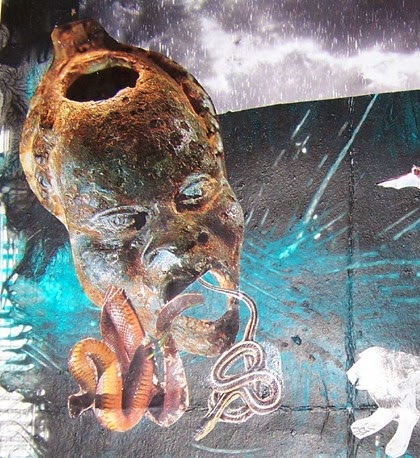
“Sin”, collage on handmade paste paper, by EPrata

O, would that sin looked like this to our eyes, then we would not be so attracted to it! And sadly, horrifically, it is what us inside us. This ugliness is what Jesus sees when He looks at a non-believer. Lovingly, He still died for us.

but God shows his love for us in that while we were still sinners, Christ died for us. (Romans 5:8)

However, being that sin is so gross and deadly, it makes the triumph of Jesus all the more glorious.  Where satan is all-darkness that fools us into thinking it is light, Jesus never had one blot, one lie, one corrupt thought, one serpent slither. Not once, not ever. He IS the Light!

God is light, and in Him is no darkness at all. (1 John 1:5)

If we had X-ray vision looking at Jesus, our eyes would see only glory upon glory, shining like the sun. He is a prism of Light, reflecting throughout all the universe and into the eternity we will share with Him! When He looks upon a believer He sees that same righteousness-

For He has made Him to be sin for us, who knew no sin; that we might be made the righteousness of God in Him. (2 Corinthians 5:21)

Don’t be fooled by the initially enticing beauty of sin. It is gross, destructive, horrible. Put on your X-ray vision to see beyond the surface lie. Run from it toward Jesus who set us free from its bondage, and gave us the Spirit’s vision to see through its enticing spoils. Satan’s offerings are nothing. Jesus is our all in all.

Posted in discernment, Uncategorized

The biblical worldview is that there is the righteous and the wicked

When you read chunks of the Bible at one time, patterns and themes emerge that may not be as noticeable as when you read just a few verses more deeply. That’s why both kinds of study are valuable.

In reading the Psalms, one immediately notices David’s worldview. It’s stark, solid, and biblical. With David, there are the righteous, and the wicked. Period.

We live in times where Christians are pressured to blur those lines. We’re told to accept and tolerate all manner of sin, value any and all professions of faith even if they’re unaccompanied by fruit, and to view all people as inherently good. Failure to do the above invites catcalls of “Pharisee”, “judgmental”, or worse.

However, when we blur those lines, the loss to the church is that mission fields shrink and disappear. Doctrinal lines are dismissed. Sadly, if we don’t know who is in and who is out, who do we evangelize?

I found this article from a church in MO, called The Righteous and the Wicked. I don’t agree with their KJV-only stance, but I do agree with this article.

We believe that there is a radical and essential difference between the righteous and the wicked; that such only as through faith are justified in the name of the lord Jesus, and sanctified by the spirit of our god, are truly righteous in his esteem while all such as continue in impenitence and unbelief are in his sight wicked, and under the curse; and this distinction holds among men both in and after death. …

This article also emphasizes the fact that with God, there is no middle ground. With men, we see much middle ground or gray area. With God it is all black or white, right or wrong, for him or against him. Joshua made this very clear in Joshua 24:14,15 when he demanded that Israel make a choice to either serve God or not serve God. “Now therefore fear the LORD, and serve him in sincerity and in truth: and put away the gods which your fathers served on the other side of the flood, and in Egypt; and serve ye the LORD. 15 And if it seem evil unto you to serve the LORD, choose you this day whom ye will serve; whether the gods which your fathers served that were on the other side of the flood, or the gods of the Amorites, in whose land ye dwell: but as for me and my house, we will serve the LORD.”

The Bible makes it clear so many times, using opposites in a plethora of descriptions. This verse from Isaiah 5:20 is just one:

Woe unto them that call evil good, and good evil; that put darkness for light, and light for darkness; that put bitter for sweet, and sweet for bitter!

The verse presents three of the stark opposites:

Evil-Good
Darkness-Light
Bitter-Sweet

We read of those who are cursed and those who are blessed.

Those who are dead and those who are living.

There are those in Christ and those who are in outer darkness.

There are those who draw near, and those who fall away.

There are those who are hot, and those who are cold. The middle ground of lukewarm is something Jesus hates!

The sad thing is that some of these unsaved, evil people are professing Christians. Others are simply true Christians who are stumbling. Without practicing biblical discernment, we are losing our ability as a global church to detect the difference. This is to our detriment. The biblical worldview is that there is either-or.

We need to be mindful of the two-path approach to Jesus. Now, we don’t have the omnipotence that God does. When I try to have these conversations with fellow believers, they quickly shut it down, saying, “Only God knows the heart.” That is true. I can’t see the heart of people to say with the same certainty as God that a person is saved or not saved. I’m not omnipotent. But discernment doesn’t require omnipotence.  “You will know them by their fruits,” Jesus said, twice in the same lesson. (Matthew 7:15-20). He gave us the ability to discern the difference between a thistle and a fig, the difference between a grape and a thorn.

He didn’t say, ‘You won’t know them.’ He didn’t say, ‘You may know them, perhaps. Try again later.’ He didn’t say, ‘Stay quiet because only God knows the heart.’

Therefore by their fruits you will know them. (Matthew 7:20)

I’m not saying to go around and make unsound declarations about people’s position in Christ. But I am saying two things that revolve around this concept – inconsistency and hypocrisy in Christian life brings reproach upon the cause of truth.

Many will follow their sensuality, and because of them the way of the truth will be maligned; (2 Peter 2:2).

So for that reason,

1. Remember that there are two roads and two roads only. Societal pressure, cultural tolerance, personal timidity add to the reluctance of people to remember that. The biblical worldview is that it’s either-or with nothing in the middle! The middle road with mushy doctrinal lines is lukewarm. Jesus hates lukewarm. Do not tolerate sinners among you who preach false doctrine! (Revelation 2:20).

2. If you see a long-term pattern of sin in a person or a long time of no fruit, it is allowed and even commanded by His word, to do something about it. Some of these verses are aimed at pastors but it is also incumbent on lay-people to both edify and rebuke in sincere concern for their restoration. (1 Cor. 5:1-13, 1 Timothy 5:20, 2 Timothy 4:2, Titus 1:13, Galatians 2:14, Ephesians 5:11…)

In an attempt to be kind, or caring, or non-judgmental, we too often allow a believer (or a non-believer “believer”) to go on their wicked path. The believer, if he is a believer, loses rewards every moment he continues on his course of sin. More importantly, professing believers who continue on a wicked path bring reproach onto the name of Jesus. (Romans 2:23-24). The professing person who is self-deluded and not a believer at all, may, in fact, be shaken out of their deluded complacency unto salvation if one confronts them about their lack of fruit.

Even if they aren’t shaken out of complacency or a sinning path, and the Lord hardens them further instead, His glory is manifested in that person as a vessel of wrath. Plus, you are giving Him glory by obeying. Just as the result of our salvation discussions is left to the Holy Spirit, sin-correcting discussion results are also left to Him. Sometimes the person will be amenable, sometimes they will become angry and then amenable, and sometimes they will get mad and stay mad. If you have prayed, if you have been diligent to follow His statutes, if you’ve removed the log from your own eye, if you’ve spoken with a sincerity for the betterment and concern for the person, then leave the results to the Spirit. You’ve done your part.

The Takeaway:

There are two roads. There are the righteous and the wicked. The two roads people travel lead to His domain, whether it is the kingdom of Light in heaven or His domain of Outer Darkness in the Lake of Fire. After death, there is a great gulf fixed, that none many travel from one to the other. Speak the truth in love to those who you have concerns for before the roads become unalterably fixed after death.

As David said in Psalm 6:5,

For in death there is no remembrance of you; in Sheol who will give you praise?

Matthew Henry is concise regarding this verse, and of today’s concept, his comment on Psalm 6:5 is a good way to end it:

6:1-7 These verses speak the language of a heart truly humbled, of a broken and contrite spirit under great afflictions, sent to awaken conscience and mortify corruption. Sickness brought sin to his remembrance, and he looked upon it as a token of God’s displeasure against him. The affliction of his body will be tolerable, if he has comfort in his soul. Christ’s sorest complaint, in his sufferings, was of the trouble of his soul, and the want of his Father’s smiles. Every page of Scripture proclaims the fact, that salvation is only of the Lord.

Man is a sinner, his case can only be reached by mercy; and never is mercy more illustrious than in restoring backsliders. With good reason we may pray, that if it be the will of God, and he has any further work for us or our friends to do in this world, he will yet spare us or them to serve him. To depart and be with Christ is happiest for the saints; but for them to abide in the flesh is more profitable for the church.

~~~~~~~~~~~~~~~~~~~~~~~~~~~~

Further Reading

Dealing with Sinning Christians

When Should a Christian try to correct another Christian?

In keeping with the theme of knowing there are only two roads and that there are only the righteous and the wicked, let’s look at what a Biblical worldview is, and when a Christian’s biblical worldview can become diluted:

What’s a Christian worldview anyway?

Posted in prophecy, Uncategorized

Throwback Thursday: Sin’s poison is visible in the world

A version of this was originally published on The End Time in December 2009

Jan Brueghel the Elder
THE GARDEN OF EDEN WITH THE FALL OF MAN

In these waning days of the Age, do you think about the Garden of Eden? What untainted creation must have looked like? I do. The only mirror I have of earth as originally intended is in Genesis 1, and there, the LORD called it “good.” The reverse of that is earth in today’s condition. And today it looks pretty bad.

How far and deep has the effect of sin permeated our waters, our land, our food, and our very bodies and brains? Everything seems as poison now. Creation itself is laboring under the poisonous effects of a sinful world. “For the creation was subjected to futility, not willingly, but because of Him who subjected it, in hope that the creation itself also will be set free from its slavery to corruption into the freedom of the glory of the children of God. For we know that the whole creation groans and suffers the pains of childbirth together until now.” (Romans 8:20-22)

“[T]herefore thus says the LORD of hosts, the God of Israel, “behold, I will feed them, this people, with wormwood and give them poisoned water to drink.” (Jer 9:15) Matthew Henry writes of that verse, “Every thing about them, till it comes to their very meat and drink, shall be a terror and torment to them. God will curse their blessings.” Malachi 2:2 is that reminder of His promise to curse even the blessings of food and water.

I am not referring to the curse of oil spills or overflowing landfills or garbage scows nor greenhouse effects. I am talking the tide of sin-pollution and its impact on a falling world. “Therefore thus says the LORD of hosts concerning the prophets, ‘Behold, I am going to feed them wormwood And make them drink poisonous water, For from the prophets of Jerusalem pollution has gone forth into all the land.’” (Jeremiah 23:15). If we insist on wallowing in sin, then the Lord obliges by sending its visible manifestation to us and causes us to eat and drink of it.

Worse, “Behold, I will corrupt your seed, and spread dung upon your faces, even the dung of your solemn feasts; and one shall take you away with it.” (Malachi 2:4). Does the dung promise to mean that if we speak refuse, live in refuse, offer Him refuse, that we will eat refuse? That just as we punish a puppy who messes in the house with rubbing his face in it, God will do the same?

How we have allowed sin’s effects to creep like a tide of polluted water to poison the world. How often we see the bitter herb ‘wormwood’ used in the bible as a visible materialization of our sin. And so it will be again: “The name of the star is called Wormwood, and a third of the waters became wormwood, and many men died from the waters, because they were made bitter.” (Revelation 8:11)

Sin is a terminal condition. Do not underestimate how seriously God takes it when we refuse to turn away from sin!! Do not underestimate your own sin! Do not think you will escape! The only remedy is the blessed Hope, His forgiveness, made possible because of His sacrifice of blood on the cross. If you feel burdened with guilt for your misdeeds, and believe Jesus died and rose again for your sin, then ask him with sincere heart to forgive you. Believe on His name. Only the forgiven of sin can dwell with the Most High and Holy. Those with sin in them will be given over to the poison that it truly is, now made increasingly visible and manifest in this dying world.

Posted in encouragement, Uncategorized

O to see ourselves as others see us! Or maybe not…

Robert Burns was a Scottish poet who lived in the second half of the 1700s. You might know his work from singing Auld Lang Syne on New Year’s Eve, or “my love is like a red, red rose.” Holden Caulfield famously misquoted Burns’ poem Coming’ Thro the Rye as Catcher in the Rye.

Another famous poem Burns wrote is “To A Louse.” Many people don’t know the title nor the context of the poem, but they remember the most famous line:

O would some Power with vision teach us
To see ourselves as others see us!

The context is that Burns was attending church service one Sunday, sitting behind a lovely young

Vintage-Lady-Easter-Bonnet-GraphicsFairy2
source thegraphicsfairy.com

lady dressed in all her finery. His attention drifted from the sermon to the lady’s hat and ribbons, as Burns became captivated with watching a louse (plural, lice) wander indiscriminately through her hear, hat, and ribbons.

The bulk of the poem is wryly suggesting that the louse go off to fine more customary living grounds, perhaps a housewife’s flannel tie, or maybe on some ragged boy’s pale undervest. But on a lady’s bonnet? Surely you jest!

The lady had dressed in all her finery and frippery that morning, and had traveled to church to see and be seen in it. She was sitting in the pew, with gloves and best dress, scrubbed and looking splendid. She was, of course, completely unaware that a louse was traversing her elaborately coiffed curls. She thought she was looking good. The man sitting behind her saw the louse that she could not. The embarrassing pestilential creature ruined the entire carefully crafted public presentation the lady had no doubt taken many pains to complete.

Burns’ finals stanza with the pertinent line, To see oursels as ithers see us! is a plea which has been heard.

1. The Lord see sees us as Burns saw the lady, except worse. He sees us as we are. He sees the metaphysical lice crawling all over us, which are the sins we preform, traversing our body like the “hair fly”. He sees the rubbish as Paul would say, the dung clinging to us in our natural state. He loved us anyway.

2. He allows us to see ourselves as He sees us, thorough the written word. The Bible is a reflection of us, in our sin and depravity, and it is a reflection of Him, in His glory and power. We see ourselves as He sees us when we go into a woman who is another man’s wife, as David did. When we murder Christians because we are a religious zealot in a false religion, as Paul was. He shows us our lice ridden selves when Peter denied Christ to save himself in his own cowardice. In Cain who murdered, in Eli who was complicit in blasphemy, in Abraham who lied.

When we do see ourselves as He sees us, we cry out, O! It is too much! I cannot stand it! I am too corrupt! perverted! deviant! degenerate! debased! immoral! unprincipled!

In truth, the lice are actually better than the natural man, ‘For the creation was subjected to futility, not willingly’ (Romans 8:20a) but Adam chose to Fall.

As we would crumble into instant dust if in the natural we saw God’s glory, we also would crumble if we saw ourselves as truly depraved as we are. Sinners, all. The Bible reveals it, confirms it, shows it so any who care to look.

The cross is the place where depravity met glory. He loved us so much, He sent His Son, to live, teach, and die for sinners, who are in truth no better than the louse on the lady’s hair, though we try to dress up. With every heartbeat, love flowed through His veins.

Lord, thank you for opening your veins and sharing Your love with us.

During this week upcoming to Resurrection Sunday, please be in prayer to thank the Lord for shielding us from the true depths of our own depravity and from the true heights of Your glory, both of which if we saw in the natural, we would instantly die. And yet because of the cross, we live.

Posted in prophecy, Uncategorized

Predestination means people are elected as vessels of wrath, too. Part 2

The verse to consider today is from Romans 9:21-24

Has the potter no right over the clay, to make out of the same lump one vessel for honorable use and another for dishonorable use? 22 What if God, desiring to show his wrath and to make known his power, has endured with much patience vessels of wrath prepared for destruction, 23 in order to make known the riches of his glory for vessels of mercy, which he has prepared beforehand for glory— 24 even us whom he has called, not from the Jews only but also from the Gentiles?

There are vessels of mercy, and there are vessels of wrath. Considering anything regarding God is weighty and should fill the saved and the non-saved with awe and humility. But to really consider His work of judgment should bring to mind the famous comment attributed to martyr John Bradford,”There but for the grace of God go I”.

Here is Scottish pastor Robert Murray M’Cheyne preaching on the Romans verse. In my opinion, it’s brilliant. I’ll post M’Cheyne’s point 3 tomorrow, Lord willing. Part 1 is hereM’Cheyne’s full sermon is here.

~~~~~~~~~~~~~~~~~~~~~
The Vessels of Wrath Fitted to Destruction

I come now to the second reason why any are left to perish–it is, that God may show his power. “What if God, willing to make his power known?” We are frequently told in the Bible of the power of God. He said to Abraham, “I am the Almighty God.” We are told in the ninety-third Psalm, that “the Lord on high is mightier than the noise of many waters; yea, than the mighty waves of the sea.” We are frequently told of his almighty power; and not only so, but we have brilliant examples of it.

The first upon record is creation. “God said, Let there be light: and there was light.” “He spake and it was done – he commanded and all things stood fast.”

Another example of the same thing is, the constant providence of God. “In him we live, and move, and have our being.” He rides on the swift wings of the wind.

Another example of the power of God is, his restraining and bridling of the wicked. “Be ye not as the horse, or as the mule, which have no understanding, whose mouth must be held in with the bit and bridle.” – Psalms 32:9. This is the way in which God holds the wicked.

Another way in which God makes his power known is, in the conversion of souls. “Not by might, nor by power, but by my Spirit, saith the Lord.” This is said to be “the wisdom of God and the power of God.” I believe the converting of a soul is something greater than the making of the world.

Brethren, there is one exhibition of divine power that yet remains – it is, the destruction of the wicked. “What if God, willing to shew his wrath, and to make his power known, endured with much longsuffering the vessels of wrath fitted to destruction?” I believe, dear friends, that the reason why God has raised up Pharaohs is to show his power in them. He said to Pharaoh, “For this cause have I raised thee up, that I might show my power in thee.” No, I say, in regard of those of you in this congregation who will die unsaved, that God has raised you up, to show his power in you. Thus, it is said in Isaiah 62, “I will tread them in mine anger, and trample them in my fury; and their blood shall be sprinkled upon my garments, and I will stain all my raiment.” And then in Revelation 18, “She shall be utterly burned with fire; for strong is the Lord God who judgeth her.” And we are told by our Lord in Matthew 10:28, to fear God, “who is able to destroy both soul and body in hell.” You will notice in this passage that he says, “God is able to destroy”; and therefore, brethren, it is plain that there must be some great power exercised in his destroying the wicked; and I think it is to consist in this – God will destroy their well-being, but not their being. Here, then, is another exhibition of the power of God.

When lately in the north of Scotland, I stood on the sea-shore, and saw the rocks standing out of the sea. It was very remarkable to stand and see the mighty waves dashing upon the rocks. There were two things remarkable in it: first, the greatness of the rocks on which the waves dashed: second, the rocks remaining unmoved – no force of the waves could move them. Brethren, this scene is an emblem of what will be witnessed another day, when God shall pour out his wrath on the wicked. Ah, brethren! will it not be fearful to see God put out his power upon the wicked – to see him upholding them with one hand, and pouring out his wrath upon them with the other? Surely, brethren, the power of God’s wrath is very great. If any of you have seen a great furnace, you will have seen the power that the fire has; but fire is God’s creature. What must his power be who is the Creator?
——————————–

Further Reading

Predestination means people are elected as vessels of wrath, too. Part 1
Predestination means people are elected as vessels of wrath, too, part 3

Jesus’ Predestined Life

Is Predestination biblical?