Posted in encouragement, Uncategorized

Throwback Thursday: If We had X-ray Vision, what would Sin Look Like?

This was first published in January 2014 on this blog.

—————————
When satan was created, He was the most beautiful angel. Ezekiel 28:12 says

Son of man, raise a lamentation over the king of Tyre, and say to him, Thus says the Lord GOD: “You were the signet of perfection, full of wisdom and perfect in beauty.”

Inside or out, satan was not only beautiful, but he was the very seal of perfection. But it didn’t last. Though he was created perfect, one day, unrighteousness was found in him.

You were blameless in your ways from the day you were created, till unrighteousness was found in you.” (Ezekiel 28:15)

Initially, sin might look beautiful but the more a person becomes trapped in it, the less beautiful it seems to them and the more they are eternally destroyed.

The woman may be beautiful, and the sin so enticing, Proverbs 5:3 says,

For the lips of the adulterous woman drip honey and her speech is smoother than oil.

But the end of it all is is hell.

In the end she’s as bitter as wormwood and as sharp as a double-edged sword. Her feet go down to death; her steps head straight for Sheol. (Proverbs 5:4-5)

But sin at first has to look great, and not like ot really looks, or else no one would engage in it.

How does sin really look? Remember Superman’s X-Ray vision?

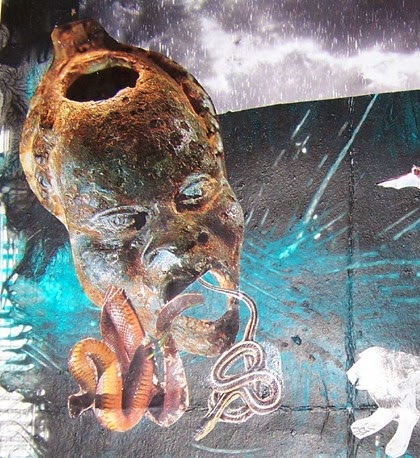
THIS is what sin might look like. Here is the Old Man. Once so beautiful and shining, it is what satan’s soul looks like. Eve thought the fruit looked good and a delight to the eyes, (Genesis 3:6) but shortly after all it had brought was pain and bondage (Genesis 3:16). If we had X-ray vision and could see beyond the enticing surface, this is what we would see:

“Sin”, collage on handmade paste paper, by EPrata

O, would that sin looked like this to our eyes, then we would not be so attracted to it! And sadly, horrifically, it is what us inside us. This ugliness is what Jesus sees when He looks at a non-believer. Lovingly, He still died for us.

but God shows his love for us in that while we were still sinners, Christ died for us. (Romans 5:8)

However, being that sin is so gross and deadly, it makes the triumph of Jesus all the more glorious.  Where satan is all-darkness that fools us into thinking it is light, Jesus never had one blot, one lie, one corrupt thought, one serpent slither. Not once, not ever. He IS the Light!

God is light, and in Him is no darkness at all. (1 John 1:5)

If we had X-ray vision looking at Jesus, our eyes would see only glory upon glory, shining like the sun. He is a prism of Light, reflecting throughout all the universe and into the eternity we will share with Him! When He looks upon a believer He sees that same righteousness-

For He has made Him to be sin for us, who knew no sin; that we might be made the righteousness of God in Him. (2 Corinthians 5:21)

Don’t be fooled by the initially enticing beauty of sin. It is gross, destructive, horrible. Put on your X-ray vision to see beyond the surface lie. Run from it toward Jesus who set us free from its bondage, and gave us the Spirit’s vision to see through its enticing spoils. Satan’s offerings are nothing. Jesus is our all in all.

Posted in discernment, Uncategorized

The biblical worldview is that there is the righteous and the wicked

When you read chunks of the Bible at one time, patterns and themes emerge that may not be as noticeable as when you read just a few verses more deeply. That’s why both kinds of study are valuable.

In reading the Psalms, one immediately notices David’s worldview. It’s stark, solid, and biblical. With David, there are the righteous, and the wicked. Period.

We live in times where Christians are pressured to blur those lines. We’re told to accept and tolerate all manner of sin, value any and all professions of faith even if they’re unaccompanied by fruit, and to view all people as inherently good. Failure to do the above invites catcalls of “Pharisee”, “judgmental”, or worse.

However, when we blur those lines, the loss to the church is that mission fields shrink and disappear. Doctrinal lines are dismissed. Sadly, if we don’t know who is in and who is out, who do we evangelize?

I found this article from a church in MO, called The Righteous and the Wicked. I don’t agree with their KJV-only stance, but I do agree with this article.

We believe that there is a radical and essential difference between the righteous and the wicked; that such only as through faith are justified in the name of the lord Jesus, and sanctified by the spirit of our god, are truly righteous in his esteem while all such as continue in impenitence and unbelief are in his sight wicked, and under the curse; and this distinction holds among men both in and after death. …

This article also emphasizes the fact that with God, there is no middle ground. With men, we see much middle ground or gray area. With God it is all black or white, right or wrong, for him or against him. Joshua made this very clear in Joshua 24:14,15 when he demanded that Israel make a choice to either serve God or not serve God. “Now therefore fear the LORD, and serve him in sincerity and in truth: and put away the gods which your fathers served on the other side of the flood, and in Egypt; and serve ye the LORD. 15 And if it seem evil unto you to serve the LORD, choose you this day whom ye will serve; whether the gods which your fathers served that were on the other side of the flood, or the gods of the Amorites, in whose land ye dwell: but as for me and my house, we will serve the LORD.”

The Bible makes it clear so many times, using opposites in a plethora of descriptions. This verse from Isaiah 5:20 is just one:

Woe unto them that call evil good, and good evil; that put darkness for light, and light for darkness; that put bitter for sweet, and sweet for bitter!

The verse presents three of the stark opposites:

Evil-Good
Darkness-Light
Bitter-Sweet

We read of those who are cursed and those who are blessed.

Those who are dead and those who are living.

There are those in Christ and those who are in outer darkness.

There are those who draw near, and those who fall away.

There are those who are hot, and those who are cold. The middle ground of lukewarm is something Jesus hates!

The sad thing is that some of these unsaved, evil people are professing Christians. Others are simply true Christians who are stumbling. Without practicing biblical discernment, we are losing our ability as a global church to detect the difference. This is to our detriment. The biblical worldview is that there is either-or.

We need to be mindful of the two-path approach to Jesus. Now, we don’t have the omnipotence that God does. When I try to have these conversations with fellow believers, they quickly shut it down, saying, “Only God knows the heart.” That is true. I can’t see the heart of people to say with the same certainty as God that a person is saved or not saved. I’m not omnipotent. But discernment doesn’t require omnipotence.  “You will know them by their fruits,” Jesus said, twice in the same lesson. (Matthew 7:15-20). He gave us the ability to discern the difference between a thistle and a fig, the difference between a grape and a thorn.

He didn’t say, ‘You won’t know them.’ He didn’t say, ‘You may know them, perhaps. Try again later.’ He didn’t say, ‘Stay quiet because only God knows the heart.’

Therefore by their fruits you will know them. (Matthew 7:20)

I’m not saying to go around and make unsound declarations about people’s position in Christ. But I am saying two things that revolve around this concept – inconsistency and hypocrisy in Christian life brings reproach upon the cause of truth.

Many will follow their sensuality, and because of them the way of the truth will be maligned; (2 Peter 2:2).

So for that reason,

1. Remember that there are two roads and two roads only. Societal pressure, cultural tolerance, personal timidity add to the reluctance of people to remember that. The biblical worldview is that it’s either-or with nothing in the middle! The middle road with mushy doctrinal lines is lukewarm. Jesus hates lukewarm. Do not tolerate sinners among you who preach false doctrine! (Revelation 2:20).

2. If you see a long-term pattern of sin in a person or a long time of no fruit, it is allowed and even commanded by His word, to do something about it. Some of these verses are aimed at pastors but it is also incumbent on lay-people to both edify and rebuke in sincere concern for their restoration. (1 Cor. 5:1-13, 1 Timothy 5:20, 2 Timothy 4:2, Titus 1:13, Galatians 2:14, Ephesians 5:11…)

In an attempt to be kind, or caring, or non-judgmental, we too often allow a believer (or a non-believer “believer”) to go on their wicked path. The believer, if he is a believer, loses rewards every moment he continues on his course of sin. More importantly, professing believers who continue on a wicked path bring reproach onto the name of Jesus. (Romans 2:23-24). The professing person who is self-deluded and not a believer at all, may, in fact, be shaken out of their deluded complacency unto salvation if one confronts them about their lack of fruit.

Even if they aren’t shaken out of complacency or a sinning path, and the Lord hardens them further instead, His glory is manifested in that person as a vessel of wrath. Plus, you are giving Him glory by obeying. Just as the result of our salvation discussions is left to the Holy Spirit, sin-correcting discussion results are also left to Him. Sometimes the person will be amenable, sometimes they will become angry and then amenable, and sometimes they will get mad and stay mad. If you have prayed, if you have been diligent to follow His statutes, if you’ve removed the log from your own eye, if you’ve spoken with a sincerity for the betterment and concern for the person, then leave the results to the Spirit. You’ve done your part.

The Takeaway:

There are two roads. There are the righteous and the wicked. The two roads people travel lead to His domain, whether it is the kingdom of Light in heaven or His domain of Outer Darkness in the Lake of Fire. After death, there is a great gulf fixed, that none many travel from one to the other. Speak the truth in love to those who you have concerns for before the roads become unalterably fixed after death.

As David said in Psalm 6:5,

For in death there is no remembrance of you; in Sheol who will give you praise?

Matthew Henry is concise regarding this verse, and of today’s concept, his comment on Psalm 6:5 is a good way to end it:

6:1-7 These verses speak the language of a heart truly humbled, of a broken and contrite spirit under great afflictions, sent to awaken conscience and mortify corruption. Sickness brought sin to his remembrance, and he looked upon it as a token of God’s displeasure against him. The affliction of his body will be tolerable, if he has comfort in his soul. Christ’s sorest complaint, in his sufferings, was of the trouble of his soul, and the want of his Father’s smiles. Every page of Scripture proclaims the fact, that salvation is only of the Lord.

Man is a sinner, his case can only be reached by mercy; and never is mercy more illustrious than in restoring backsliders. With good reason we may pray, that if it be the will of God, and he has any further work for us or our friends to do in this world, he will yet spare us or them to serve him. To depart and be with Christ is happiest for the saints; but for them to abide in the flesh is more profitable for the church.

~~~~~~~~~~~~~~~~~~~~~~~~~~~~

Further Reading

Dealing with Sinning Christians

When Should a Christian try to correct another Christian?

In keeping with the theme of knowing there are only two roads and that there are only the righteous and the wicked, let’s look at what a Biblical worldview is, and when a Christian’s biblical worldview can become diluted:

What’s a Christian worldview anyway?
Posted in prophecy, Uncategorized

Throwback Thursday: Sin’s poison is visible in the world

A version of this was originally published on The End Time in December 2009

Jan Brueghel the Elder
THE GARDEN OF EDEN WITH THE FALL OF MAN

In these waning days of the Age, do you think about the Garden of Eden? What untainted creation must have looked like? I do. The only mirror I have of earth as originally intended is in Genesis 1, and there, the LORD called it “good.” The reverse of that is earth in today’s condition. And today it looks pretty bad.

How far and deep has the effect of sin permeated our waters, our land, our food, and our very bodies and brains? Everything seems as poison now. Creation itself is laboring under the poisonous effects of a sinful world. “For the creation was subjected to futility, not willingly, but because of Him who subjected it, in hope that the creation itself also will be set free from its slavery to corruption into the freedom of the glory of the children of God. For we know that the whole creation groans and suffers the pains of childbirth together until now.” (Romans 8:20-22)

“[T]herefore thus says the LORD of hosts, the God of Israel, “behold, I will feed them, this people, with wormwood and give them poisoned water to drink.” (Jer 9:15) Matthew Henry writes of that verse, “Every thing about them, till it comes to their very meat and drink, shall be a terror and torment to them. God will curse their blessings.” Malachi 2:2 is that reminder of His promise to curse even the blessings of food and water.

I am not referring to the curse of oil spills or overflowing landfills or garbage scows nor greenhouse effects. I am talking the tide of sin-pollution and its impact on a falling world. “Therefore thus says the LORD of hosts concerning the prophets, ‘Behold, I am going to feed them wormwood And make them drink poisonous water, For from the prophets of Jerusalem pollution has gone forth into all the land.’” (Jeremiah 23:15). If we insist on wallowing in sin, then the Lord obliges by sending its visible manifestation to us and causes us to eat and drink of it.

Worse, “Behold, I will corrupt your seed, and spread dung upon your faces, even the dung of your solemn feasts; and one shall take you away with it.” (Malachi 2:4). Does the dung promise to mean that if we speak refuse, live in refuse, offer Him refuse, that we will eat refuse? That just as we punish a puppy who messes in the house with rubbing his face in it, God will do the same?

How we have allowed sin’s effects to creep like a tide of polluted water to poison the world. How often we see the bitter herb ‘wormwood’ used in the bible as a visible materialization of our sin. And so it will be again: “The name of the star is called Wormwood, and a third of the waters became wormwood, and many men died from the waters, because they were made bitter.” (Revelation 8:11)

Sin is a terminal condition. Do not underestimate how seriously God takes it when we refuse to turn away from sin!! Do not underestimate your own sin! Do not think you will escape! The only remedy is the blessed Hope, His forgiveness, made possible because of His sacrifice of blood on the cross. If you feel burdened with guilt for your misdeeds, and believe Jesus died and rose again for your sin, then ask him with sincere heart to forgive you. Believe on His name. Only the forgiven of sin can dwell with the Most High and Holy. Those with sin in them will be given over to the poison that it truly is, now made increasingly visible and manifest in this dying world.

Posted in encouragement, Uncategorized

O to see ourselves as others see us! Or maybe not…

Robert Burns was a Scottish poet who lived in the second half of the 1700s. You might know his work from singing Auld Lang Syne on New Year’s Eve, or “my love is like a red, red rose.” Holden Caulfield famously misquoted Burns’ poem Coming’ Thro the Rye as Catcher in the Rye.

Another famous poem Burns wrote is “To A Louse.” Many people don’t know the title nor the context of the poem, but they remember the most famous line:

O would some Power with vision teach us
To see ourselves as others see us!

The context is that Burns was attending church service one Sunday, sitting behind a lovely young

Vintage-Lady-Easter-Bonnet-GraphicsFairy2
source thegraphicsfairy.com

lady dressed in all her finery. His attention drifted from the sermon to the lady’s hat and ribbons, as Burns became captivated with watching a louse (plural, lice) wander indiscriminately through her hear, hat, and ribbons.

The bulk of the poem is wryly suggesting that the louse go off to fine more customary living grounds, perhaps a housewife’s flannel tie, or maybe on some ragged boy’s pale undervest. But on a lady’s bonnet? Surely you jest!

The lady had dressed in all her finery and frippery that morning, and had traveled to church to see and be seen in it. She was sitting in the pew, with gloves and best dress, scrubbed and looking splendid. She was, of course, completely unaware that a louse was traversing her elaborately coiffed curls. She thought she was looking good. The man sitting behind her saw the louse that she could not. The embarrassing pestilential creature ruined the entire carefully crafted public presentation the lady had no doubt taken many pains to complete.

Burns’ finals stanza with the pertinent line, To see oursels as ithers see us! is a plea which has been heard.

1. The Lord see sees us as Burns saw the lady, except worse. He sees us as we are. He sees the metaphysical lice crawling all over us, which are the sins we preform, traversing our body like the “hair fly”. He sees the rubbish as Paul would say, the dung clinging to us in our natural state. He loved us anyway.

2. He allows us to see ourselves as He sees us, thorough the written word. The Bible is a reflection of us, in our sin and depravity, and it is a reflection of Him, in His glory and power. We see ourselves as He sees us when we go into a woman who is another man’s wife, as David did. When we murder Christians because we are a religious zealot in a false religion, as Paul was. He shows us our lice ridden selves when Peter denied Christ to save himself in his own cowardice. In Cain who murdered, in Eli who was complicit in blasphemy, in Abraham who lied.

When we do see ourselves as He sees us, we cry out, O! It is too much! I cannot stand it! I am too corrupt! perverted! deviant! degenerate! debased! immoral! unprincipled!

In truth, the lice are actually better than the natural man, ‘For the creation was subjected to futility, not willingly’ (Romans 8:20a) but Adam chose to Fall.

As we would crumble into instant dust if in the natural we saw God’s glory, we also would crumble if we saw ourselves as truly depraved as we are. Sinners, all. The Bible reveals it, confirms it, shows it so any who care to look.

The cross is the place where depravity met glory. He loved us so much, He sent His Son, to live, teach, and die for sinners, who are in truth no better than the louse on the lady’s hair, though we try to dress up. With every heartbeat, love flowed through His veins.

Lord, thank you for opening your veins and sharing Your love with us.

During this week upcoming to Resurrection Sunday, please be in prayer to thank the Lord for shielding us from the true depths of our own depravity and from the true heights of Your glory, both of which if we saw in the natural, we would instantly die. And yet because of the cross, we live.

Posted in prophecy, Uncategorized

Predestination means people are elected as vessels of wrath, too. Part 2

The verse to consider today is from Romans 9:21-24

Has the potter no right over the clay, to make out of the same lump one vessel for honorable use and another for dishonorable use? 22 What if God, desiring to show his wrath and to make known his power, has endured with much patience vessels of wrath prepared for destruction, 23 in order to make known the riches of his glory for vessels of mercy, which he has prepared beforehand for glory— 24 even us whom he has called, not from the Jews only but also from the Gentiles?

There are vessels of mercy, and there are vessels of wrath. Considering anything regarding God is weighty and should fill the saved and the non-saved with awe and humility. But to really consider His work of judgment should bring to mind the famous comment attributed to martyr John Bradford,”There but for the grace of God go I”.

Here is Scottish pastor Robert Murray M’Cheyne preaching on the Romans verse. In my opinion, it’s brilliant. I’ll post M’Cheyne’s point 3 tomorrow, Lord willing. Part 1 is hereM’Cheyne’s full sermon is here.

~~~~~~~~~~~~~~~~~~~~~
The Vessels of Wrath Fitted to Destruction

I come now to the second reason why any are left to perish–it is, that God may show his power. “What if God, willing to make his power known?” We are frequently told in the Bible of the power of God. He said to Abraham, “I am the Almighty God.” We are told in the ninety-third Psalm, that “the Lord on high is mightier than the noise of many waters; yea, than the mighty waves of the sea.” We are frequently told of his almighty power; and not only so, but we have brilliant examples of it.

The first upon record is creation. “God said, Let there be light: and there was light.” “He spake and it was done – he commanded and all things stood fast.”

Another example of the same thing is, the constant providence of God. “In him we live, and move, and have our being.” He rides on the swift wings of the wind.

Another example of the power of God is, his restraining and bridling of the wicked. “Be ye not as the horse, or as the mule, which have no understanding, whose mouth must be held in with the bit and bridle.” – Psalms 32:9. This is the way in which God holds the wicked.

Another way in which God makes his power known is, in the conversion of souls. “Not by might, nor by power, but by my Spirit, saith the Lord.” This is said to be “the wisdom of God and the power of God.” I believe the converting of a soul is something greater than the making of the world.

Brethren, there is one exhibition of divine power that yet remains – it is, the destruction of the wicked. “What if God, willing to shew his wrath, and to make his power known, endured with much longsuffering the vessels of wrath fitted to destruction?” I believe, dear friends, that the reason why God has raised up Pharaohs is to show his power in them. He said to Pharaoh, “For this cause have I raised thee up, that I might show my power in thee.” No, I say, in regard of those of you in this congregation who will die unsaved, that God has raised you up, to show his power in you. Thus, it is said in Isaiah 62, “I will tread them in mine anger, and trample them in my fury; and their blood shall be sprinkled upon my garments, and I will stain all my raiment.” And then in Revelation 18, “She shall be utterly burned with fire; for strong is the Lord God who judgeth her.” And we are told by our Lord in Matthew 10:28, to fear God, “who is able to destroy both soul and body in hell.” You will notice in this passage that he says, “God is able to destroy”; and therefore, brethren, it is plain that there must be some great power exercised in his destroying the wicked; and I think it is to consist in this – God will destroy their well-being, but not their being. Here, then, is another exhibition of the power of God.

When lately in the north of Scotland, I stood on the sea-shore, and saw the rocks standing out of the sea. It was very remarkable to stand and see the mighty waves dashing upon the rocks. There were two things remarkable in it: first, the greatness of the rocks on which the waves dashed: second, the rocks remaining unmoved – no force of the waves could move them. Brethren, this scene is an emblem of what will be witnessed another day, when God shall pour out his wrath on the wicked. Ah, brethren! will it not be fearful to see God put out his power upon the wicked – to see him upholding them with one hand, and pouring out his wrath upon them with the other? Surely, brethren, the power of God’s wrath is very great. If any of you have seen a great furnace, you will have seen the power that the fire has; but fire is God’s creature. What must his power be who is the Creator?
——————————–

Further Reading

Predestination means people are elected as vessels of wrath, too. Part 1
Predestination means people are elected as vessels of wrath, too, part 3

Jesus’ Predestined Life

Is Predestination biblical?

Posted in prophecy

Predestination means people are elected as vessels of wrath, too. Part 1

A few days ago I’d posted an essay about predestination. This is the doctrine where the Bible teaches that God is completely sovereign over everything that happens, including individual salvations. He elects people to salvation, independently and apart from foreknowledge of any decision they make. It’s all His grace, and not our decision.

People dislike that doctrine and fight against it. One of the reasons people resist the plain truth of the doctrine is that people want to think that somewhere in their heart or mind, they chose God. However, we are dead in sins and trespasses and have no ability to choose God, or ‘make a decision’ about our salvation. It is granted to us. (Galatians 3:22). We have no part in it, except the resulting gratitude and service in His name.

The verse to consider today is from Romans 9:21-24

Has the potter no right over the clay, to make out of the same lump one vessel for honorable use and another for dishonorable use? 22 What if God, desiring to show his wrath and to make known his power, has endured with much patience vessels of wrath prepared for destruction, 23 in order to make known the riches of his glory for vessels of mercy, which he has prepared beforehand for glory— 24 even us whom he has called, not from the Jews only but also from the Gentiles?

There are vessels of mercy, and there are vessels of wrath. Considering anything regarding God is weighty and should fill the saved and the non-saved with awe and humility. But to really consider His work of judgment should bring to mind the famous comment attributed to martyr John Bradford, “There but for the grace of God go I”.

Here is M’Cheyne preaching on the Romans verse. In my opinion, it’s brilliant. I post ed M’Cheyne’s point 2 here. I’ll post point 3 tomorrow and the next day, Lord willing. The full sermon is here.

~~~~~~~~~~~~~~~~~~~~~

The Vessels of Wrath Fitted to Destruction

The following sermon preached on the afternoon of March 12, 1843, was the author’s last in St. Peter’s. “It was observed, both then and on other occasions,” says Andrew Bonar, “that he spoke with peculiar strength upon the sovereignty of God.” The following evening McCheyne’s illness commenced and on Saturday, March 25, he went to the Saviour whose glory he lived to proclaim.
“What if God, willing to shew his wrath, and to make his power known, endured with much longsuffering the vessels of wrath fitted to destruction: and that he might make known the riches of his glory on the vessels of mercy, which he had afore prepared unto glory?” – Romans 9:22,23

In a former discourse, brethren, I attempted to show you that the reason why God will punish the wicked eternally is, because he loveth righteousness. It is said in the eleventh Psalm, “Upon the wicked He shall rain snares, fire, and brimstone, and an horrible tempest: this shall be the portion of their cup, for the righteous Lord loveth righteousness.” I then tried to show you, that God has created hell, and will maintain it for ever, not because He loves human pain – I believe it is not so, nor is it because He is subject to passion, as men speak of passion – but because the righteous Lord loveth righteousness.

And I showed you, as you will remember, what a certainty hell is to the wicked. If it had its origin in the love of human pain, then you might have hoped that it would have an end; or, if it proceeded from passionateness, then it might cool; but ah! when it proceeds from Jehovah’s love of righteousness, I see, brethren, in that a reason why “the worm dieth not, and the fire is not quenched.”

There is a second question which no doubt has occurred to you: why are there any left unpardoned at all? Why was Adam left to fall? Could God not have held him up? Or, if it was necessary that Adam should fall, in order that Christ might die, why are not all saved? Surely there is efficacy in the blood of Christ to pardon all – why, then, are not all saved? There are many answers to that question which we will know in a higher state of being; but here is one; “What if God, willing to show His wrath and to make His power known, endured with much longsuffering the vessels of wrath fitted to destruction: and that He might make known the riches of His glory on the vessels of mercy, which He had afore prepared unto glory?” You will notice, brethren, that in these words the apostle Paul tries to give an answer to that question. He does not answer it directly, he employs a “what if”.

Let us enter into this subject a little more deeply. There are three reasons set down here why men are allowed to perish.

I. The first is, that God was willing to show His wrath. These words are terrible. We are told frequently in the Bible of the wrath of God. It is not like human wrath: it is calm, settled – it consists principally in a regard to what is right. This is the wrath of God. We are told a great deal about it in the Bible. It is revealed against all sin. “For the wrath of God is revealed from heaven against all ungodliness and unrighteousness of men, who hold the truth in unrighteousness.” – Romans 1:18 Observe the word “all” – it is against all sin. Then Colossians 3:6, “For which things’ sake the wrath of God cometh on the children of disobedience.” We are told also, brethren, that this anger is constant. “God is angry with the wicked every day.” – Psalms 7:11. The bow of God’s justice is, as it were, already bent against the wicked, the arrow of God’s is already on the string against the wicked. And then we are told that His wrath is intolerable. In the Psalm which we were singing (Psalms 90:11), it is said, “Who knows the power of thy wrath?” And we are told in Revelation, “The great day of His wrath is come, and who shall be able to stand?”

But we learn more by example than even by these declarations. We have many examples of God’s wrath and its consequences. The first example we have is, his casting the angels out of heaven. We are told by Jude, “That the angels which kept not their first estate, He hath reserved in everlasting chains, under darkness, unto the judgment of the great day.” And we are told by Peter, “That God spared not the angels that sinned, but cast them down to hell, and delivered them into chains of darkness, to be reserved unto judgment.” Now, brethren, in several respects this was one of the greatest examples of divine wrath we have, for it seems to have happened in one day. One day these angels were in heaven – the next in hell. One day they were angels of light – the next fiends of darkness. And then this made it fearful, when the Lord left them no room for repentance. One thing the universe might have learned from this was, that God will certainly punish sin.

Another example of God’s punishing sin was not in heaven, but one earth, when He sent the deluge upon it. “God saw that the wickedness of man was great in the earth, and that every imagination of the thoughts of his heart was only evil continually. And it repented the Lord that He had made man on the earth, and it grieved Him at His heart. And the Lord said, I will destroy man, whom I have created, from the face of the earth.” And so it came to pass: “The flood came, and carried them all away;” and it has left traces on our world still, to show that God will not fail to punish sin.

Another example of divine vengeance was, when God destroyed Sodom. “Now, the men of Sodom were wicked, and sinners before the Lord exceedingly.” The cry of its wickedness went up to heaven, and God sent down two angels, to see if it was according to the cry that came up; and they found it even so; and, when they had taken out just Lot, God rained fire and brimstone upon the devoted city; and he has left traces of it there to this hour.

There was yet another exhibition of divine wrath on earth – it was the death of God’s dear Son. If ever there was a time when God could have said that he would forego his wrath it was surely this. It was this for two reasons. First, because the object of that wrath was dear to God. There never was on in the universe so dear to God as his Son. And another reason was, Christ had no sin of his own. Just as his robe was seamless, so was his soul sinless. Nay, brethren, that one act of his – laying down his life, was so glorious, as an exhibition of God’s justice, that the universe never saw its “marrow”. “Yet it pleased God to bruise him.” These words do not give the least shadow of his suffering from God on account of our sin. Brethren, if any thing in the world can show that God will punish sin, it was the death of his dear and sinless Son.

There is one exhibition of his wrath yet to come. Verse 22 – “What if God, willing to shew his wrath, and to make his power known, endured with much longsuffering the vessels of wrath fitted to destruction?” God is yet to destroy the souls that he has made–not the angels that fell, for he has done that already, when he cast them into hell, but the souls on which he has waited. There is to be a new exhibition of wrath that the world never saw the like of before. He is going to show what he will do to the despisers of his Son – to those who despise his gospel. it will be a new thing when “God will be revealed from heaven in flaming fire, taking vengeance on them that know him not, and that have not obeyed the gospel.” God waits to show his wrath. Ah, brethren! it will be fearful to feel it – it is fearful even to think of it. so I believe it will be with the wicked: they will be beacons, to show how God will punish sin.

~~~~~~~~~~~~~~~~~~~~~
Posted in prophecy, Uncategorized

The second best moment in all the universe

But the day of the Lord will come like a thief, and then the heavens will pass away with a roar, and the heavenly bodies will be burned up and dissolved, and the earth and the works that are done on it will be exposed. Since all these things are thus to be dissolved, what sort of people ought you to be in lives of holiness and godliness, waiting for and hastening the coming of the day of God, because of which the heavens will be set on fire and dissolved, and the heavenly bodies will melt as they burn! But according to his promise we are waiting for new heavens and a new earth in which righteousness dwells. (2 Peter 3:10-13)

Waiting….waiting…

The best moment in all of the universe through all of time, of course, is when Jesus arose from the grave, victorious over death and sin and Hades. The second best moment in my opinion, will be the culmination of all things, when God puts an end to sin and refreshes the universe by scrubbing it from His presence forever. This will include destroying the old heavens and earth and making a new heavens and a new earth.

The end of this world is a good thing. Jesus will regenerate the earth, He will cleanse us from our sins by glorifying our bodies, He will heal us completely, He will resurrect the saved, He will restore the damaged children, He will appear to us in His full glory, and much more. Who wouldn’t wish for that?

We are blessed, yes, blessed to be watching the Lord of the Universe work visibly in the world. He gave us the Word, and He is allowing us to see His word alive, organic, living and breathing coming true before our eyes in His providence and in His people. He regenerates hearts and His children bear fruit before our eyes. He transforms lives and we watch it before our eyes. The cycle of seasons march through years, and we see His hand ordaining and sustaining it all.

His promises are true, and though no one likes to see hunger and pain and grief, but we do see through those hardships that His promises are true. His promises that trials will come also include all of the above as well- the glory and the justice concluded and the conclusion of His work in the Church Age.

And in addition, when the day comes for your death, or the rapture, you will say as Paul did, “For I am already being poured out like a drink offering, and the time for my departure is near. I have fought the good fight, I have finished the race, I have kept the faith.  (2 Timothy 4:6-7).

There is no shame in longing for His appearing!

Henceforth there is laid up for me the crown of righteousness, which the Lord, the righteous judge, will award to me on that day, and not only to me but also to all who have loved his appearing. (2 Timothy 4:8)

Do not be embarrassed at wishing for His will to be done! There is glory! His glory, made manifest in us who walk the earth doing His will, pointing to the only Hope!

We are waiting…waiting…

Posted in encouragement, Uncategorized

Never forget what sinners we are, and what a Savior! (repost)

This was originally published on this blog in June 2014.

The actual wickedness of men’s lives bears a very small proportion to what is in their hearts. But when lust is inwardly cherished, it will break forth into outward sin. Those who tempt others to drunkenness never can be their real friends, and often design their ruin. Thus men execute the Divine vengeance on each other. Those are not only heated with sin, but hardened in sin, who continue to live without prayer, even when in trouble and distress.” ~Matthew Henry’s Commentary on Hosea 7:1-7

Gustav Kaser said of icebergs,

Think of an iceberg! Only about 1/7th rises above the surface of the water. The remaining 6/7ths are under water and not visible to the human eye. A human being is comparable to an iceberg.

The wickedness we see above the surface is only a small proportion to what is in our hearts…

Therefore, praise God that He sent His Son! Jesus lived a sinless life. He died shedding His blood for those appointed to salvation, and pleased with His Son, God raised Him to life on the third day. Now instead of staggering under the weight of all my sin, that which is seen and that which is unseen below the surface, Jesus sees it all, and He saved me anyway. Now I have His righteousness declared upon me by God. As long as I am in this sinful body breathing air on earth, I have been released from the power of sin via the Holy Spirit indwelling me. I have the glorification to look forward to, when I’m no longer even in the presence of sin.

I will greatly rejoice in the Lord; my soul shall exult in my God, for he has clothed me with the garments of salvation; he has covered me with the robe of righteousness, as a bridegroom decks himself like a priest with a beautiful headdress, and as a bride adorns herself with her jewels. (Isaiah 61:10)

Posted in discernment, Uncategorized

Greed is good?

We know from Revelation what the very last days will be like; the people respond uniformly to the Antichrist (except for the Christians) and allow him to coalesce the world’s broken economy into a one-world economy around his mark. (Revelation 13). All of chapter 18 in Revelation gives the Christian what s/he needs to know about the world economic system run by the Antichrist just prior to Christ’s return. It is one that still has a healthy trade in luxuries, despite the desperately impoverished condition in which most of the world’s population dwells, and despite the people knowing that it is God sending the judgments! (Revelation 16:9).

For all the politically liberal people’s talk of social justice, sharing equally, and helping the poor, we see the stark opposite when push comes to shove during the Tribulation. The poor cry for bread and the rich buy and sell fine flour and wheat, ignoring their cries even as they die in the street.

It’s partly why the Tribulation will occur, to allow sin to run its full course, revealing the depths of man’s depravity.

We as humans are greedy. Greed defines us. It’s a besetting sin that the sinful person lives with every day. The Christian must guard against and slay the remnants of greed still within us. How many Bible verses warn against greed!

Then he said to them, Watch out! Be on your guard against all kinds of greed; life does not consist in an abundance of possessions. (Luke 12:15 )

The love of money is a root of all kinds of evil, (1 Timothy 6:9-10)

Do not put your trust in wealth (1 Timothy 17-18)

Greed is listed among the sins which will prevent one from attaining heaven:

For of this you can be sure: No immoral, impure or greedy person – such a man is an idolater – has any inheritance in the kingdom of Christ and of God (Ephesians 5:5).

It’s interesting that the verse connects greed and idolatry. See here in the Tribulation, when money is in short supply and supplies are in short supply, at least for the common person, they still create idols out of gold and silver in order to worship!

The rest of mankind, who were not killed by these plagues, did not repent of the works of their hands nor give up worshiping demons and idols of gold and silver and bronze and stone and wood, which cannot see or hear or walk, (Revelation 9:20)

The movie Wall Street came out in 1987. The 80s were a heady time of pell-mell stock surges, whirling real estate flips, dizzying income heights…it seemed that nothing was impossible and money would last forever. In that atmosphere came the movie Wall Street, in which financier and stock raider Michael Douglas’s character Gordon Gecko famously gave his ‘greed is good’ speech. Here it is in part:

I am not a destroyer of companies. I am a liberator of them! The point is, ladies and gentleman, that greed, for lack of a better word, is good. Greed is right, greed works. Greed clarifies, cuts through, and captures the essence of the evolutionary spirit. Greed, in all of its forms; greed for life, for money, for love, knowledge has marked the upward surge of mankind. And greed, you mark my words, will not only save Teldar Paper, but that other malfunctioning corporation called the USA. Thank you very much.

It’s easy for us to look back on the 80s and point fingers at the excesses which were fueled by greed. But are the times so different now? We are still greedy, and at least the fictional character Gordon Gecko and the men he was based on were true to their sin. In today’s time we have an unhealthy attraction to the Prosperity Gospel, which is just anther ‘greed is good’ speech cloaked in Jesus’ name. Which is worse. Way worse. Yet if the remnants of greed are present in a Christian’s heart, the Prosperity Gospel will be attractive to him.

9Marks asks the question, Why Is the Prosperity Gospel Attractive?

Sadly, in spite of the Scriptures’ clear warnings, the prosperity gospel has a large and growing group of followers. This isn’t hard to understand, since the message appeals so directly to our native greed. Yet it is sad and bewildering that many people remain in the movement for a long time, even their whole life, since its preachers cannot fulfill their promises.

‘Our native greed’. Greed is not good, ladies and gentlemen. Greed is bad.

The author continues in his interesting essay to briefly present the psychology of the Prosperity Gospel, its effects, and at the end he offers ‘immunization instructions.’ In America we’re plagued with the likes of prosperity theologists Joyce Meyer, Joel Osteen, Kenneth Hagin, but other continents have their plagues too. Africa and Latin America also are rife with prosperity gospel preachers deluding the unwary.

The 9Marks article ends with this:

Above all, present Christ as the pearl of great price, who infinitely surpasses in value anything that this fleeting world may offer (Mt. 13:44-46; Phil. 3:7-8)

When you have Jesus, you already have everything. When you have Jesus, there’s no need for greed. Or a prosperity gospel, which is no gospel at all.

Posted in discernment, Uncategorized

Crouching at sin’s door: Lessons from Lot

Then the men said to Lot, “Have you anyone else here? Sons-in-law, sons, daughters, or anyone you have in the city, bring them out of the place. For we are about to destroy this place, because the outcry against its people has become great before the LORD, and the LORD has sent us to destroy it.” So Lot went out and said to his sons-in-law, who were to marry his daughters, “Up! Get out of this place, for the LORD is about to destroy the city.” But he seemed to his sons-in-law to be jesting. (Genesis 19:12-14).

~~~~~~~~~~~~~~~~~~~~~

When their combined flocks grew too large to sustain them on the land, Abraham suggested to Lot that they separate. Abraham said he would go left if Lot chose to go right, or he would go right if Lot chose to go left. Lot had his choice of anywhere to settle. Interestingly, Lot pitched his tent NEAR Sodom. (Genesis 13:12).

We meet Lot again, and this time he is living IN the city. (Genesis 14:12.) No longer a sojourner in a tent, he has a house.

The next time we meet Lot he is serving as magistrate FOR the city. (Genesis 19:1).

What is meant by the term in Genesis 19:1, “he was sitting at the gate” is that Lot was part of its government. Middle Eastern men of that time were not simply whittling as they rocked in leisure at the front gate. This term ‘sitting at the gate’ means they were the officials of the city, both to greet visitors and determine their business, friend or foe; and also to settle disputes among its citizens.

In 2 Peter 2:7–8 Lot is called righteous. We know that God considered him so because he did not destroy Lot when the angels came to overthrow the cities. When brimstone came down, Lot had already been warned to leave. Lot had (weakly) tried to warn the aroused mob that what they were doing were evil deeds (Genesis 19:7). Perhaps he had tried to be a good leader to his household and a righteous example in the city, because the 2 Peter verse says Lot was vexed by the sin all around him.

Putting aside the ‘perhapses’, when push came to shove, Lot’s testimony had been so tarnished that his family thought he was joking when He spoke of imminent judgment from God. Joking.

And if you do not do well, sin is crouching at the door. Its desire is contrary to you, but you must rule over it. (Genesis 4:6b).

Despite the city’s reputation for evil and sin, Lot had chosen to pitch his tents near it. This was a mistake. The Bible warns us to flee from sin, not test it. (1 Corinthians 6:18, Ephesians 4:27)

My own prayer is that I beseech the Lord to aid me in fleeing sin, cutting it off, resisting it. (Genesis 39:12, Matthew 5:30, Hebrews 12:4), so that when I speak of Him, the words are taken seriously. What a crushing blow to love the Lord and to have hated sin, but to have lived so weakly that when speaking of Him, it’s a joke to the hearers. Lord, let it not be so. Let my words be honoring to You and let my life exalt you also.