I love to read the Puritans. Darrell Harrison, Dean of Digital Platforms at Grace To You Media, recommended this book, so I took a look.
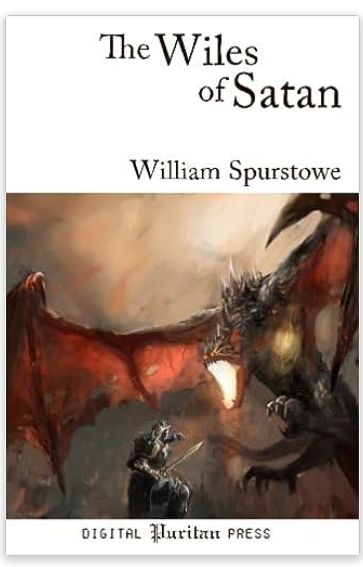
It’s The Wiles of Satan, by the previously unheard of Puritan William Spurstowe. DB Harrison said:
“Of all the Puritan books I’ve read, I have to say this little gem, “The Wiles of Satan,” by the relatively unknown William Spurstowe, is among the best. @RHB_Books.“
RHB is Reformation Heritage Books. The Publisher is Digital Puritan Press. It was out of stock at RHB but Amazon had it by the same publisher. Here is the book blurb from Amazon:
“Like it or not, every Christian is engaged in a fierce and high-stakes battle with Satan. In this enlightening book, Puritan pastor William Spurstowe succinctly illustrates from 2 Corinthians 2:11 (“…lest Satan should get an advantage of us—for we are not ignorant of his devices”) his premise: that “Satan is full of devices, and studies arts of circumvention, by which he unweariedly seeks the irrecoverable ruin of the souls of men.” Spurstowe explains how Satan’s long experience and single-minded determination make him such a formidable adversary. He then proceeds to methodically expose, explain, and disarm nearly two dozen common traps that Satan has used to ensnare every generation of the unwary. Finally, he prescribes ten helpful remedies or antidotes that can be used to counter even the most tempestuous temptation.”
“William Spurstowe (1605–1666) was a Presbyterian pastor and member of the Westminster Assembly; he served the Parliament of Richard Cromwell. Originally published in 1666, this classic treatise has been carefully prepared to benefit a new generation of Christian readers. Archaic language has been gently modernized, and dozens of helpful footnotes have been added to aid the reader. This edition includes a biographical preface, Scripture index, and review questions designed to guide group discussion or personal reflection.”
I had just written about demons the other day, since our elder is going through Matthew and we came to the Gadarene Demoniac passage. People are fascinated with satan and his unholy angels, AKA demons. The passage in Matthew 8 about the Gadarene demoniac is always astonishing when I read it. Our church elders are preaching through Matthew and we got to that passage in Matthew 8:28-34.
It’s interesting to study demons, but I offer two cautions: 1) many websites are also fascinated with the subject but tend to the sensational instead of the biblical, and 2) though it’s a biblical subject, satan would like nothing better than to ensnare you into a focus on him instead of on Jesus. Keep your eyes fixed upon Jesus.
I enjoyed CS Lewis’ “The Screwtape Letters“. I am not a fan of Lewis at all, and the only book I liked of his was Screwtape. THAT was a masterpiece, I thought. It recounts an elder demon teaching a younger one how to entice, harass, and otherwise tempt a targeted Christian. Lewis’ insight into temptation and the demonic realms was uncanny.
If you are interested in the subjects of Angelology and Demonology, Reformation Heritage Books has some for you.
–Angels: When Heaven Meets Earth by Tim Chester. –Unseen Realities: Heaven, Hell, Angels and Demons by RC Sproul. –The Scripture Revelations Respecting Good & Evil Angels by Richard Whately. This is out of stock but it may come back into stock, or find it at another online bookseller. -Also out of stock is What the Bible Teaches About Angels by Roger Ellsworth. –Spiritual Warfare: A Biblical and Balanced Perspective by Borgman & Ventura.
I offer these to you because RHB is a trusted resource. Anything on the topic of angels, demons, and spiritual warfare tends to draw a fringe crowd loaded with unbiblical notions and bad advice.
Anyway when I finish The Wiles of Satan I’ll let you know how it was. Meanwhile, keep reading! The Bible first, devotionals, and edifying books from solid authors.
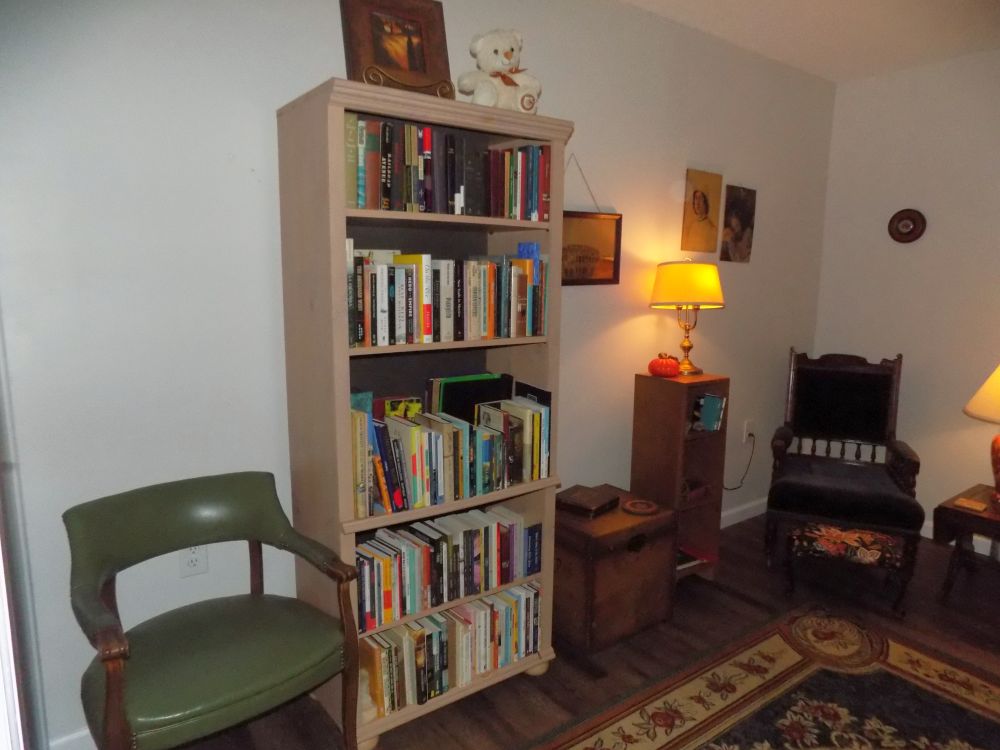
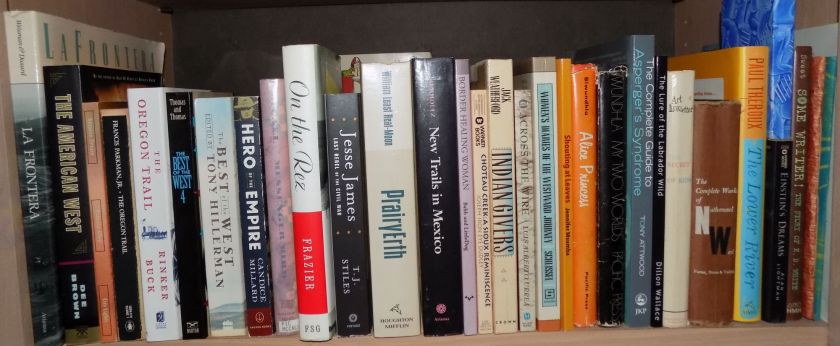
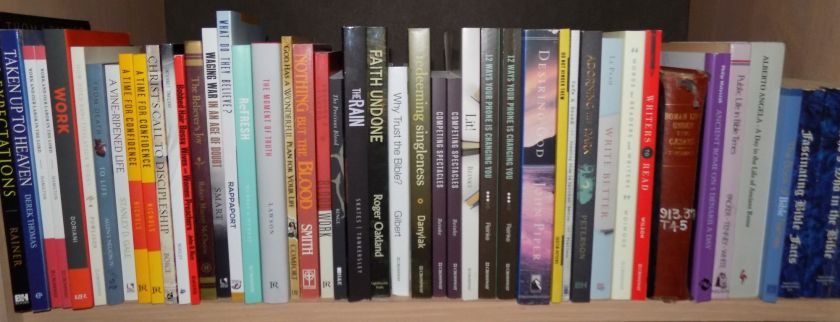
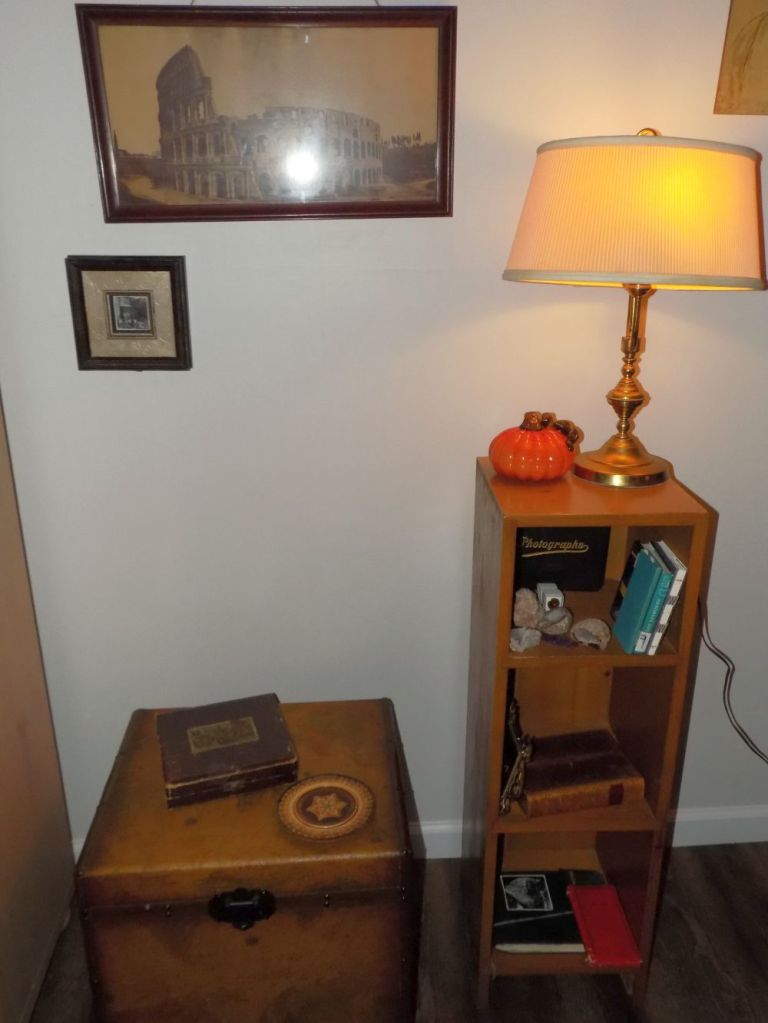
My library room. I usually sit in the chair on the right and turn on the lamp just over my shoulder.
My Library room, the other side
Joe Carter at The Gospel Coalition (a site I do not generally recommend) wrote an essay on how to build a theological library on a budget. I thought there were some helpful ideas, and so I link it here.
Mr. Carter mentioned some ways to build a library that didn’t work for me. One of the ways he recommended building a library was to focus on access, not ownership. I like owning a book to borrowing one. I stick Post-it arrows, dog ear the pages (gasp!) and sometimes make notes in the margins. Can’t do that with borrowed books. He also mentioned e-books. I am old. My eyes get tired easily. I never adjusted to reading on a screen. I just can’t. Also, he mentioned thinking beyond books, like Theological Journals. Journals are fine, but I like books.
So while I think his tips might work for many people, I wanted to share how I built a theological library of 1000 books on a budget. And by budget, I mean budget!!
1. Be patient.
It took me a long time, 15 years to get to this point. One book at a time. You can build any library fast. Building the library you want takes time. It is also fun, the thrill of the hunt.
2. Be strong. Don’t buy books just because, or when you’re at a low point budget wise. Withstand temptation, and make sure you can afford the book you want.
2a. Mind the format.
That said, also be strong and withstand buying books in a format you dislike, just to buy it. If you prefer ebooks, then withstand temptation to buy hard copy. If you prefer hardcover, withstand temptation to buy paperback. If you hate used books that have been written in or highlighted, same- don’t get it. The idea is to own a library you enjoy.
3. Set aside time to browse
Accumulating books takes time and buying the right book also takes time. Look at the bookshelves at the store carefully. It’s easy to miss a title because you’re hurrying. Set aside time to browse well.
One thrift store I haunt has a wall of books. I take a chair and sit down in front of each section so I can see the bottom shelves and so I won’t get impatient as my arthritic knee kicks up. I’m not in anyone’s way and if I am I just move aside for a while and let others browse.
4. Make an Amazon wish list
People like to help. There was someone on Twitter whose house burned and with it, his entire theological library. People asked him to post a list of books so we could help replace them. It felt good to contribute. If you have some desires for certain books, make a wishlist, Amazon has them and other online booksellers do too. People might enjoy knowing exactly what to get you for Christmas or your birthday. And be sure to contribute once in a while to others’ wish lists!
5. Be focused.
Know what ‘holes’ exist in your library and focus on filling those. What is your focus? Do you have a specific focus in the library you’re trying to build? Commentaries? Christian Life? Missionary bios? If you do, concentrate on titles related to your focus, first. Bring a list if it helps you remain focused. I do. I tend to be like a squirrel in a thrift/bookstore!
6. Repeat your successes
Have a few favorite places on hand where you have had success before. I have a few places I go to first where I am more likely to find inexpensive books in my favored genres. Make it a point to swing by frequently. I go once a month. If you are in an area near where there are a lot of churches or religious people, even better. As pastors dispense with libraries, or seminaries off-load books, as people donate because they’re moving (I live near a college town) scour those places first.
I have real good luck at a re-use store associated with a domestic violence shelter. I learned that 100% of my $ goes toward the store, (where people fleeing an abusive situation can shop with free vouchers to start life again in a new home) so I feel good about spending my money there. Thrift stores in wealthy residential areas work well too and yield fine books.

7. Library book sales
Can’t be beat! Find out when your local library(ies) have their Friends of the Library book sales. Rock bottom prices. I look not just at the table but at the boxes underneath the table. Sometimes I go twice, once near the beginning and once near the end, because they refresh the inventory.
7a. Look for other sales.
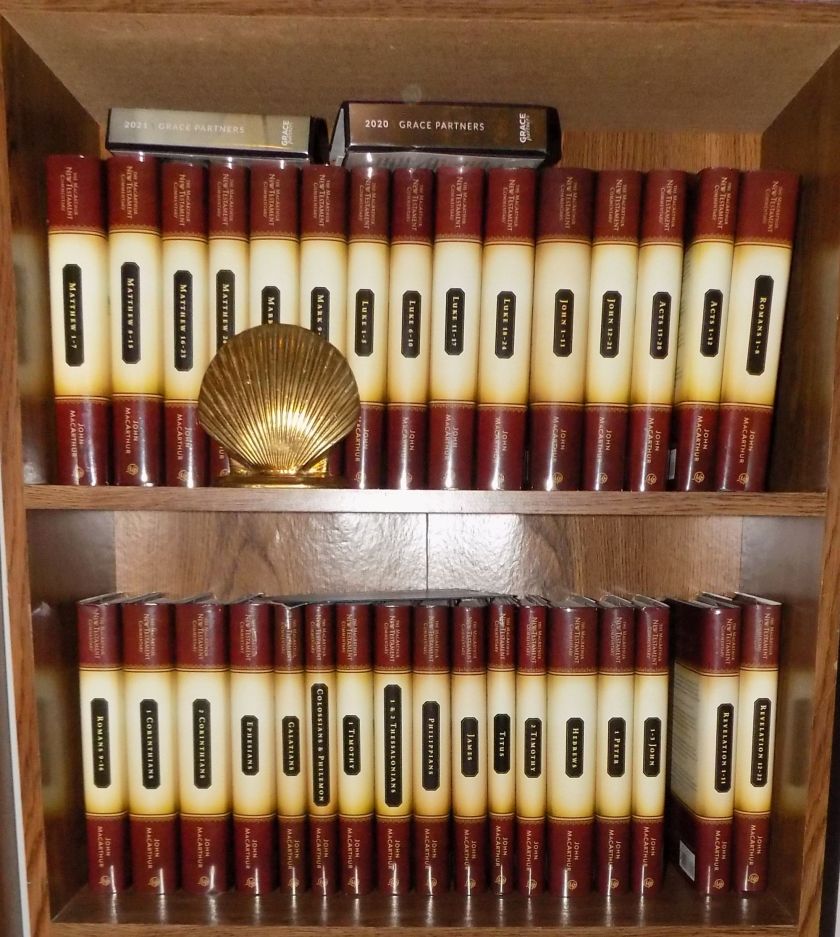
I rarely spend more than $5 on a book. But when John MacArthur finished his New Testament Commentaries, Grace To You put it on a celebratory sale. The $500 commentary set was offered for half price. A friend generously gave me half of that as a surprise gift, so I ended up paying $125 for the entire set. Moral of the story is, when you see a good deal, a once in a lifetime thing, don’t be so frugal that you pass it up. Sometimes you gotta spend to save.
8. Be wary & discerning
Just because a book is stocked in the ‘religious’ section or ‘Christian’ section, doesn’t mean it is written by a solid Christian. A lot of false teachers produce books. If you’re unfamiliar with an author, first, look at who recommended the book on the book blurbs on the back. If solid men you’re familiar with recommended the book, it’s a safer bet. If false teachers recommended the book, pass on it. You can also use your phone to google it to see reviews. Thinking that it’s only a dollar so what the hey, I’ll get it and worry about the author later, invites false teachers into your home. Don’t do it. (2 John 1:10). Your soul is worth more than a dollar.
9. Inventory your books
This is a good idea for many reasons. If a flood or fire comes, you can replicate your loss. For homeowner’s or renter’s insurance purposes. (I HIGHLY recommend renter’s insurance if you rent an abode and don’t have this insurance). And for our purposes today, so you don’t buy 2 of the same book. I’ve done that a couple of time and it annoys me because I don’t have extra to spend, and my accidental duplications were on new books!
10. Ligonier’s $5 Friday
Really, books are $5. Other material too like DVDs and audiobooks, sermon/teaching series etc. Watch the shipping though, If you buy a lot of books it spreads the shipping out so it’s still a deal, but buying one or two books, with their shipping fee hovering at $6 or $7, it makes the books regular price. Ligonier.org, every Friday.
11. Chapel Library/Open Library
Open Library is part of the Internet Archive. Go to https://web.archive.org/ and click on BOOKS at the top. They also have videos and audio, all free. I said I hate reading on screen, but there was a book that was out of print, I absolutely could not get it in hard copy. I was wild to read it, and I found it on Open Library at the Web Archive. Phew, that scratched an itch for sure! Blurb-
“The Internet Archive and participating libraries have selected digitized books from their collections that are available to be borrowed by one patron at a time from anywhere in the world for free. These books are available in BookReader format and usually in PDF and ePub formats. You can choose which format you prefer. BookReader editions may be read online immediately in your web browser. No special software is required. Other Internet Archive loans are managed through Adobe Digital Editions and will require software installation on your device.Any book that you can borrow from Open Library is also available in audio form.” Now THAT is a super deal!!
Chapel Library is part of the Mt. Zion Church’s ministry in FLorida. You can read much material for free on screen, or order it in pamphlet form sent thru the mail FREE. There are also periodicals and audio.
“We are often asked about how we select the titles that Chapel Library publishes. After prayer and careful reading, we have made regular additions over the years of tracts, booklets, and paperbacks to our catalogue that now number more than 850 titles. Chapel’s aim is to make available Christ-centered, grace-exalting literature without charge, publishing great teachers and preachers of the past, such as, Spurgeon, Calvin, Luther, Ryle, Bonar, Pink, Bunyan, the Puritans, and many more.”
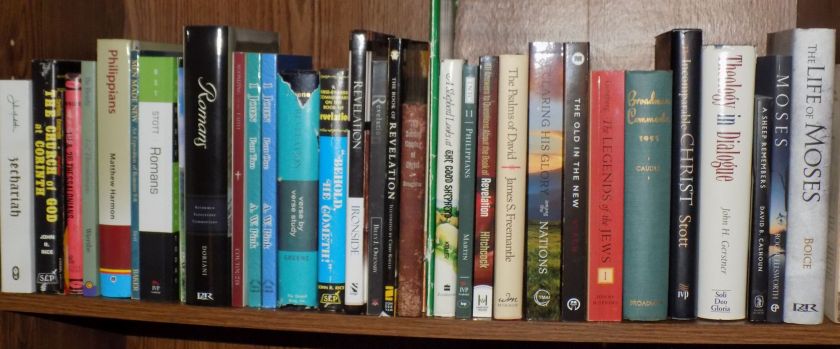
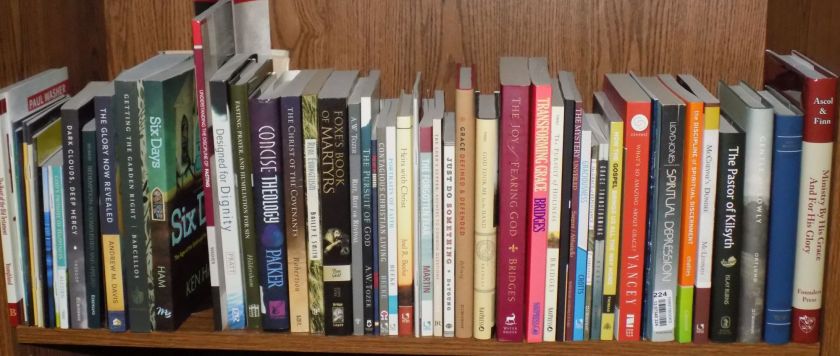
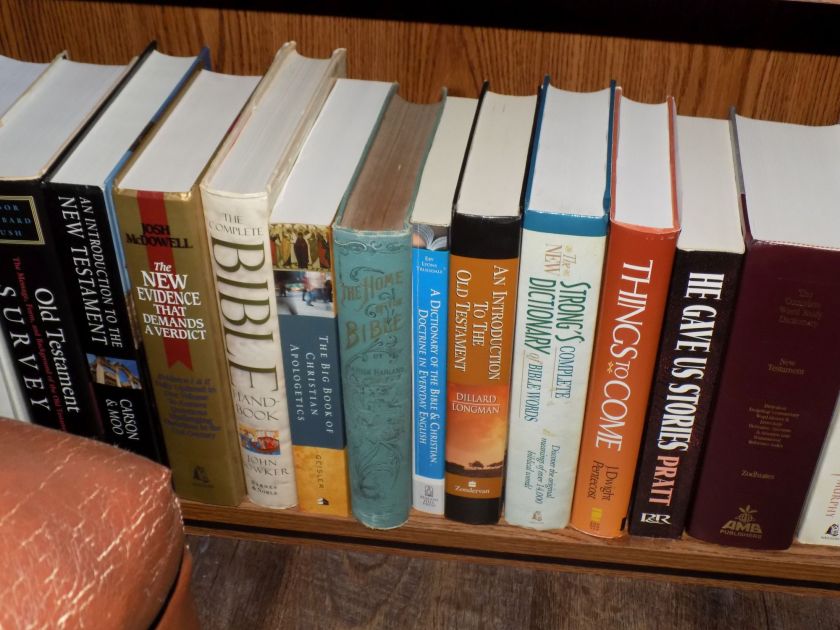
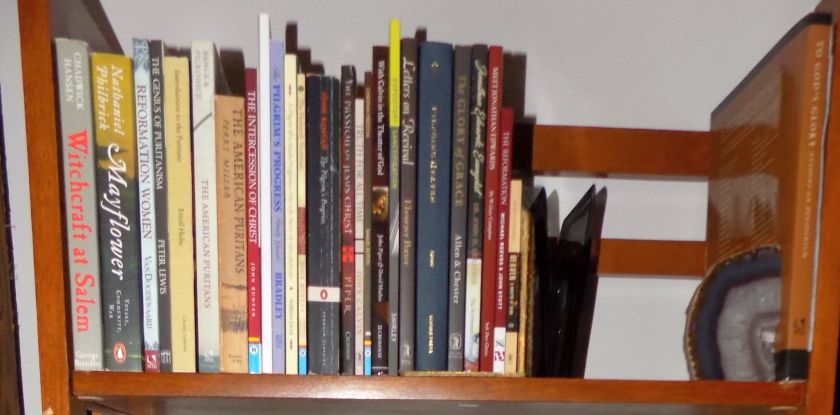
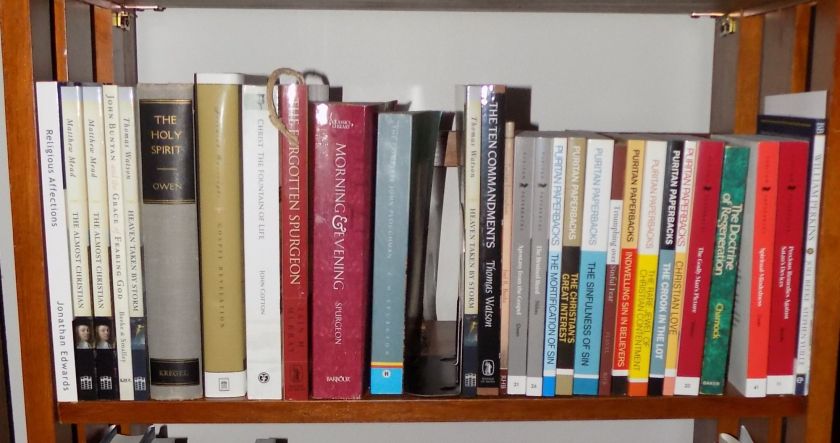
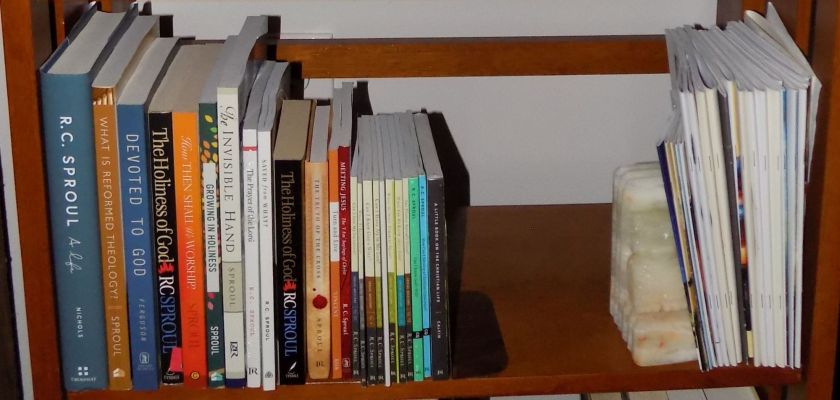
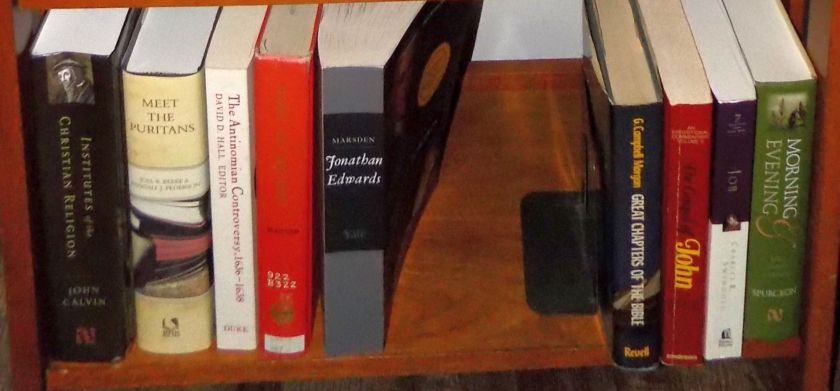
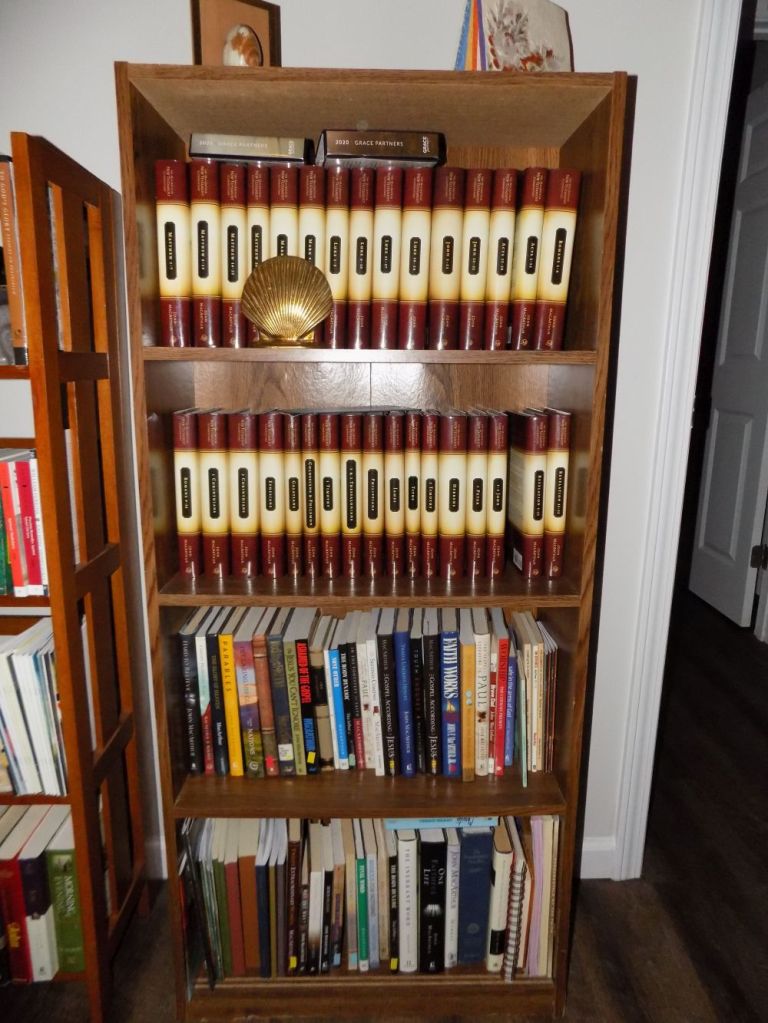
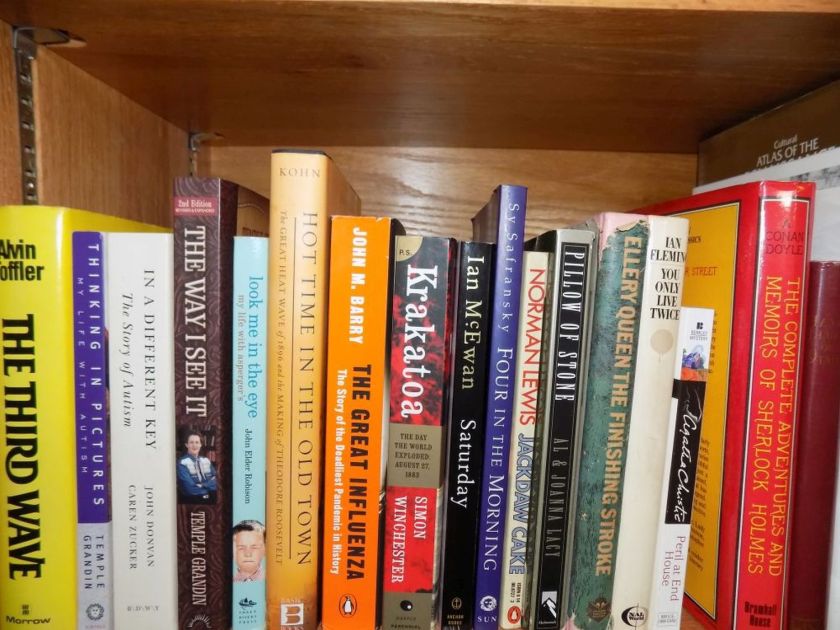
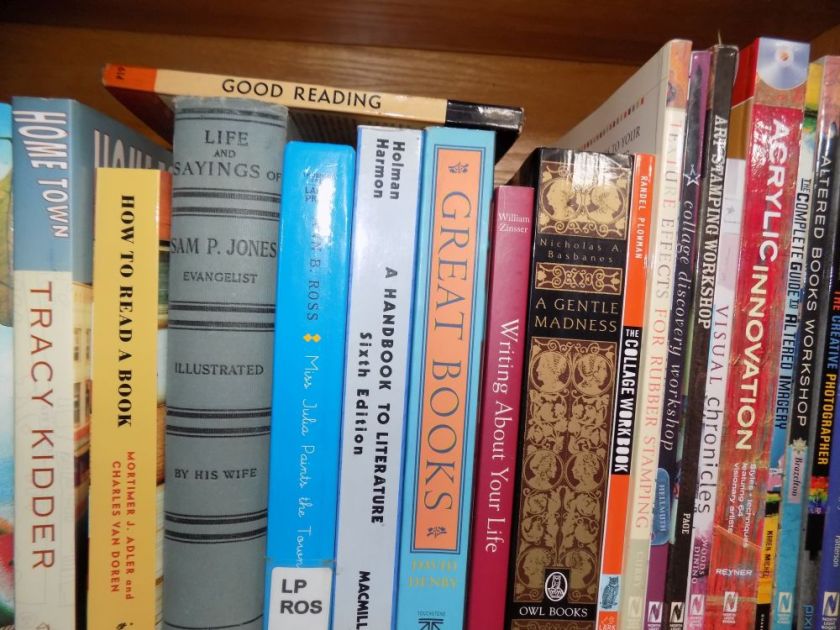
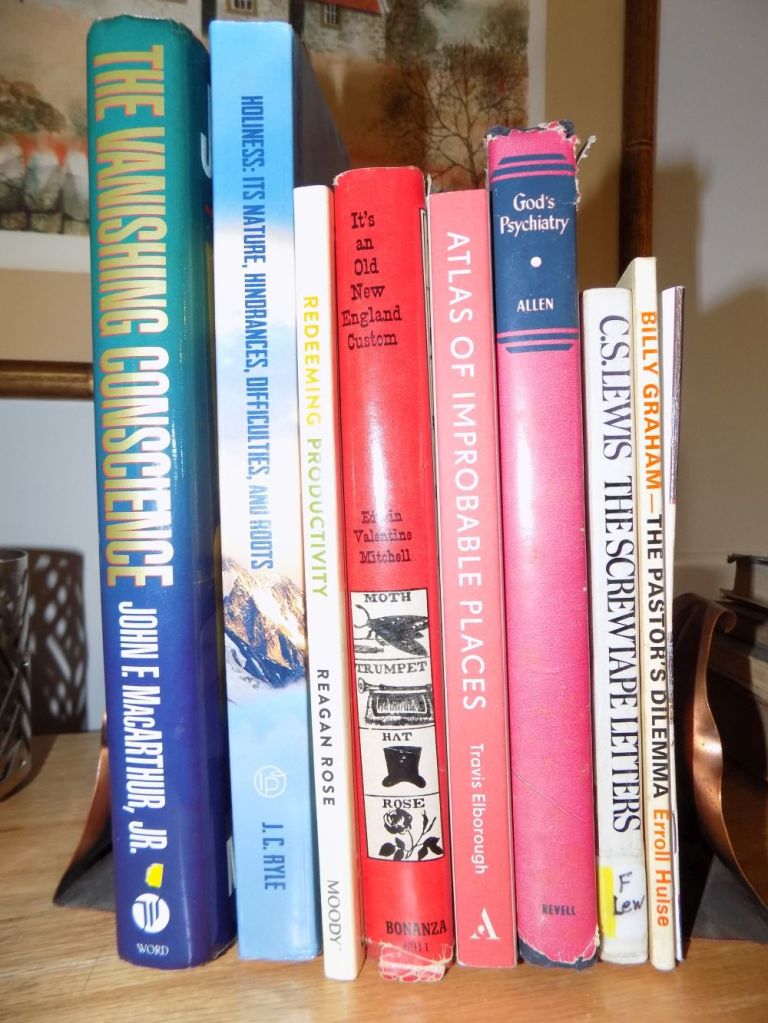
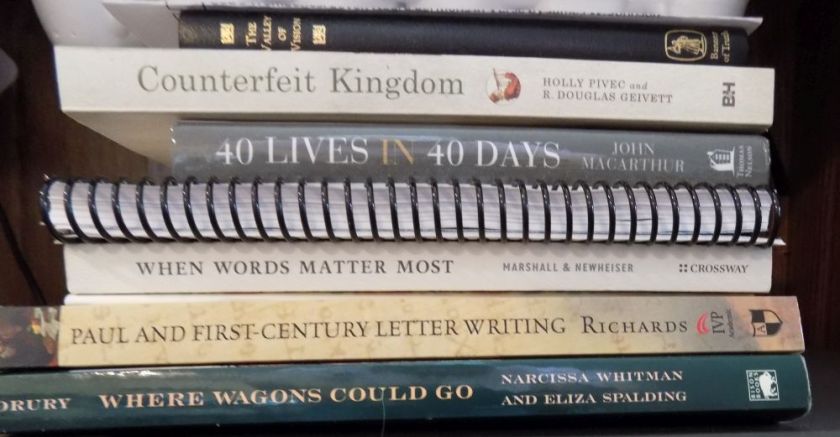
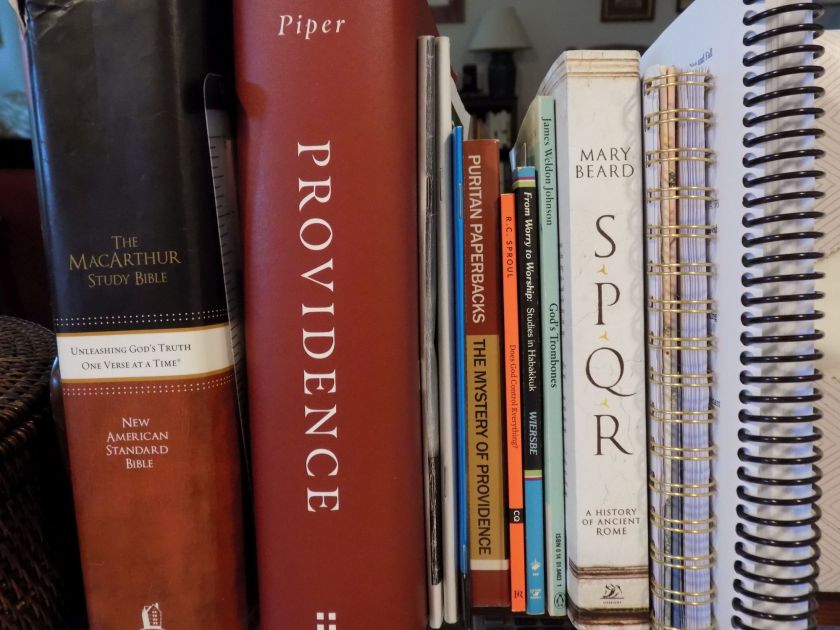
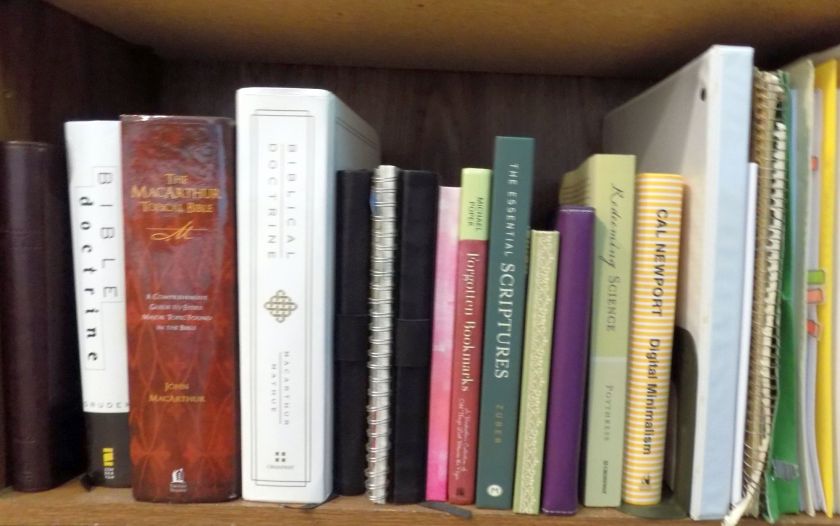
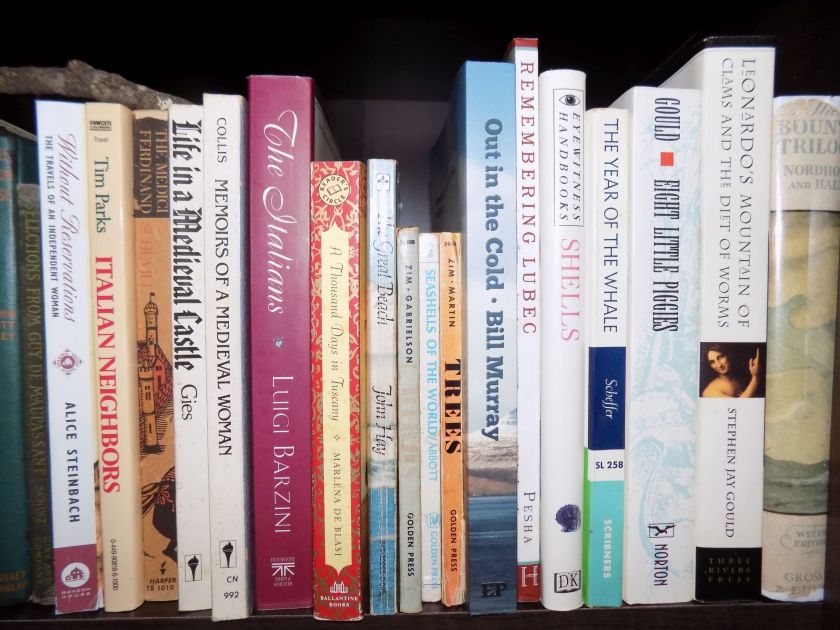
I’ve been asked to show the titles in my library. OK, here you go! I think if you right-click on particular photos you can see them larger in new tab.
OT Commentaries
NT Commentaries
grouped by subject: heaven, grace, prayer etc
heavy reference books on the bottom
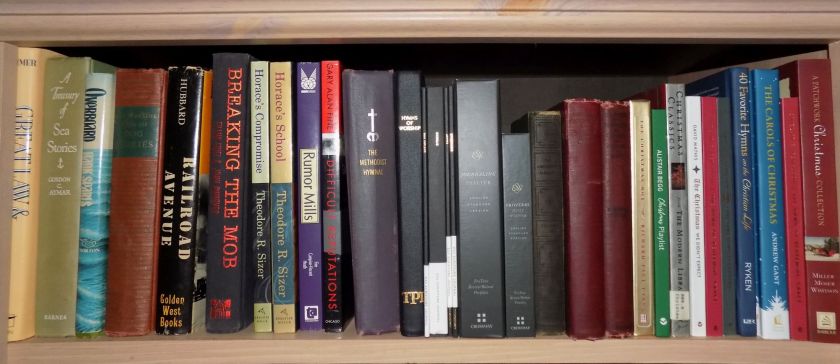
Puritans shelf: About Puritans or By Puritans
More Puritans
Left: All Sproul. Right: All Chapel Library pamphlets.
Heavy books on bottom
JMac bookshelf, commentary, complete set
JMac Commentary set
Grace to You: I donate monthly. GTY sends free books
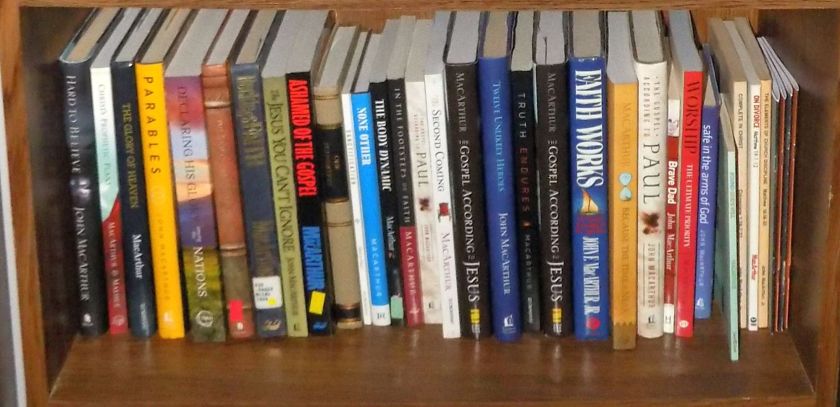
JMac books, and some heresy-for research only books
Yesterday I posted about the value of reading challenges. For me, there were at least 5 benefits to doing one last year, even though I felt I’d failed. They push you to read books you’ve always wanted to read, to read books that are already on your shelf, you read books you might not have otherwise read, you absorb good material into your heart and mind, you track your reading and objectively see that you’re not so much of a reading failure after all!
If I relied on my memory I’d have thought I’d read barely anything, but discovered I’d read 24 books. I did see my pattern, though, and why I thought I’d not been reading much. Months went by with no tracked reading of note, but during school breaks, I see I went ahead with much reading. If that’s my pattern, then oh well, OK.
Here are a few links to some good essays about reading and links to some booksellers.
Do you ever feel guilty reading a classic or even a secular novel? Do you feel like you’re ‘wasting time’? I mean, if I’m reading, shouldn’t I be reading Christian, edifying material? Spurgeon certainly read widely, and if it was good enough for him.. lol, here’s an essay about Spurgeon’s reading habits: Follow Spurgeon’s example in reading good books
I like dystopian fiction. Dystopian is the opposite of utopian. Instead of everything being perfect (utopia) it’s gone really, really wrong. I wrote about why reading dystopian literature might be useful-
100 Great Works of Dystopian Fiction: Tales about a world gone wrong. I’ve read 13 of these on this particular list. Stephen King’s The Stand is hands down THE best dystopian novel ever. I found Ender’s Game at the thrift store yesterday and scooped it up for 50 cents, I was thrilled. I started reading it.
Open Book is a podcast from Stephen Nichols at Ligonier, interviewing theologians on what books influenced them, what books are on their nightstand, and generally about their favorite books! Season 1 featured RC Sproul speaking about books he enjoyed, season 2 was interviews with John MacArthur, season 3 features Joel Beeke.
I never forgot Sproul’s passion for the Herman Melville book Redburn. He also loved Moby-Dick, in fact, wrote his thesis on “The Existential Implications of Herman Melville’s Moby-Dick,” an essay I wish I could read (I cannot find it online). Sproul loved Melville, and in his interview went on about the most monumental chapter on holiness, “The Whiteness of the Whale”
From Banner of Truth we read Why Christians Must Be Readers, when Paul called for Timothy to ‘bring the books’, “Even as the shadow of eternity fell upon him, he was anxious that his dying days should be also learning days and days of progression. Evidently there were still things he had to learn, and he was humble enough to indicate his readiness to learn from books.”
But it makes me feel good… But it has Jesus in it… But what would be the harm if I read it…
EPrata photo
In order to seek His face, and to stay on His path, before consuming any book, media, or website, Christians should always ask these questions in daily life,
–“Will this help me glorify Jesus?” –“Will this help me understand Jesus better?” –“Will this help me speak of Jesus lovingly and accurately?”
A reader asked about the Harry Potter books, and if I’d do a critique. I have only read two of books in that series, so I can’t do a deep critique, but I can offer a few thoughts.
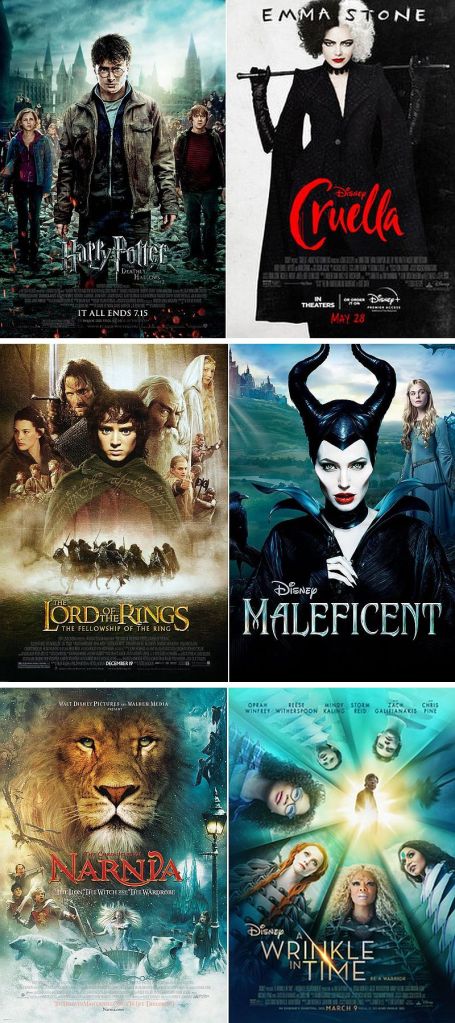
With having read just two Harry Potter books, so I don’t have a lot to go on. I haven’t read the Narnia series either, and those books contain witchcraft and other magical elements, too. And JRR Tolkien’s Lord of the Rings series, which I have read all of, many times, also contains the same.
Christians go bananas over Narnia (I never saw the draw, myself) but also go to the extreme negative over HarryPotter. All three authors claimed to be Christian and all 3 books have overt Christian symbolism and references and allusions.
The occult is a dangerous element to play with, in movies or books or TikToks or anywhere. It represents satan trying to get into the minds of the unwary, to pollute it. It is good to be careful. In Harry Potter the magic does seem to be devoid of a moral compass, while for example in Tolkien’s books the difference between good and evil was stark. Gandalf the Wizard refused to use the ring for ‘good’ because he knew he should not even touch the ring and taught Frodo why, because its inherent evil will gradually overtake a person who wears it.
I think we can be overly-sensitive on the other side. LOTS and LOTS of books and movies contain the exact same elements of occult as Harry Potter but people don’t bat an eye. How about Disney’s 1937 movie Snow White? There’s a witch, there’s casting spells, Magic Mirror, evil, etc. Aladdin? Magic carpet, genie, spells, etc. The Marvel Universe? Loki and Thor are based on false gods of Norse Mythology.
What one parent deems unsuitable, another many deem perfectly fine. Some parents decide not to allow their kids to read the Potter books while other parents do. It is in Christian liberty that one parent decides on thing while another parent decides another. And we’re not privy to ALL their decisions and why, so if they allow their kids to read Harry Potter, or see Snow White, or watch Thor, we might not have the full picture of the internal family discussions that went on, or the devotionals that happen and discussions around it. Parents’ knowledge of their child’s maturity level plays a big role, too. Part of Christian liberty is restraining the impulse to judge another family for their decisions, especially if they differ from ours.
The Bible shows in Revelation that spells, sorceries, false signs and wonders existed and even exist today, since 2 Thessalonians 2:9, Matthew 24:24, Revelation 13:13, and other verses state the fact that ‘witchcraft’ AKA false signs and wonders do happen. I think it’s important to let Christian kids and youths know this, and teach them to be discerning about the holy vs unholy activity. Unholy, demonic activity exists in real life, and in my opinion we don’t need to seek it out in our entertainment. We don’t need to delve into occult, but the Bible is replete with the fact that magicians can and do perform (Moses’ opposition in front of Pharaoh, the sorcerers could match Moses staff for staff, for a while). Watching a movie or reading a book that happen to contain such elements can be instructive and used as a caution.
On the other hand, reactions can be too UNDERstated, as in the newest addition to Disney’s stable of films aimed at kids, Cruella. From what I’ve read, the movie is dark, dark all the way through, and it is sympathetic toward its central evil character, who chose to be evil with no repercussions throughout the film. It even softens evil itself. This is a trend begun openly with the film Maleficent.
Disney is sly in introducing ungodliness and even humanistic worldviews in its movies. The corporation’s slyness makes it hard to pick out exactly what’s wrong and why kids should not watch, as opposed to Harry Potter type material where one can point to “witchcraft” and say ‘NO!” Disney is the bigger danger, IMO. For example, have you noticed that most Disney animated movies lack a mother? Cumulatively, a child on a steady diet of Disney movies will subtly absorb that fact. The insidiousness is what is dangerous. I’d rather have a Harry Potter or a Thor movie to point to the obvious.
"The heroes and heroines of most Disney movies come from unstable family backgrounds; most are either orphaned or have no mothers. Few, if any, have only single-parent mothers. In other instances, mothers are presented as "bad surrogates" eventually "punished for their misdeeds." There is much debate about the reasoning behind this phenomenon." (Source).
I think Disney’s insidious softening toward evil, the lack of mothers, and the “follow your heart” mantra in almost all their movies is cumulatively worse than an overt display of spells or magic. Kids understand magic is fairy tale, but won’t realize Disney’s subsurface agenda and will acceptingly absorb it.
As with anything involving discernment and especially with children, I believe it’s up to the individual or parent in Christian liberty to watch or read according to the level of maturity the person or child has, and to guard and converse copiously with kids as to the meaning and intent of the movie’s moral compass then to compare to the Bible. For some, Harry Potter is a no go, for others, it’s perfectly fine while anything by Madeleine L’Engle is not!
Last, I personally believe that opposition when it’s this pitched has more than opposition behind it. It’s a fad. Harry Potter was spoken against by the head of the ministry Focus on the Family, and that fanned the flames and embedded against the minds of many people, who unreasoningly oppose Potter without explicitly knowing why. That opposition has hardened into the general Christian consciousness like cement.
I see the same thing happening with The Chosen TV series. Opposition is pitched and almost manic, but after I watched season 1, I found only a very few things of concern and far more to applaud, yet any opposition against the awful and heretical Roma Downey “Bible” tv series of ten years ago from these same people was minimal or silent! It was even taught in churches! Gah!
The conclusion is, sisters, go with your own discernment and your husband’s, not the general population’s, some of whom may be individually discerning but also many of whom just jump on a bandwagon unreasoningly.
Decide for yourself what is best for yourself and family based on thoughtful and prayerful Bible beliefs where the Bible is clear and common sense where it is not.
If you’re like me, when you get home from a long day at work (or if you’re a SAHM, a long day of work at home) and after you finish your chores and put the kids to bed, you’re wiped. All you want to do with the few precious minutes of sentient thought you have left is to veg out. You don’t want anything demanding of your tired brain, and you just want to read or watch something easy, clean, and perhaps edifying.
I am reading two books and have recently watched two movies that fit the bill, in my opinion.
Gentle and Lowly: The Heart of Christ for Sinners and Sufferers by Dane C. Ortlund is the book of the year. No, really, this book has appeared on many Christian Best-Of lists for publications in 2020. Its devotional style makes for easy reading, and its wonderful content is so edifying you’ll feel like you showered in a fresh rain sprinkled with lavender afterward. Here’s the blurb: “How does Jesus feel about his people amid all their sins and failures? This book takes readers into the depths of Christ’s very heart—a heart of tender love drawn to sinners and sufferers.” Recommended so highly you should run to the store and get it now.
This novel fulfills all my expectations and needs for a relaxing journey on a rainy Saturday covered in my quilt in my easy chair, with cat. It’s Mr. Penumbra’s 24-Hour Bookstore: A Novel by Robin Sloan. Here’s the blurb: “The Great Recession has shuffled Clay Jannon away from life as a San Francisco web-design drone and into the aisles of Mr. Penumbra’s 24-Hour Bookstore. But after a few days on the job, Clay discovers that the store is more curious than either its name or its gnomic owner might suggest. The customers are few, and they never seem to buy anything―instead, they “check out” large, obscure volumes from strange corners of the store. Suspicious, Clay engineers an analysis of the clientele’s behavior, seeking help from his variously talented friends. But when they bring their findings to Mr. Penumbra, they discover the bookstore’s secrets extend far beyond its walls. Rendered with irresistible brio and dazzling intelligence, Robin Sloan’s Mr. Penumbra’s 24-Hour Bookstore is exactly what it sounds like: an establishment you have to enter and will never want to leave.”
It is well-written and I note this because a well-written novel is increasingly a rarity these days. Not being a snob, just saying of my experience lately. It also draws you in immediately, another rarity. I don’t have to slog through any bumbling first pages or chapters to get to the good part. The book is good from the start. It also proceeds at a perfect pace, unfolding the mystery and the characters like peeling an onion steadily. I’ve read half of it, so I hope my feelings about the book is sustained through the second half.
Movies: Dear Viola. It’s Hallmark-y, a chick flick romcom (not a lot of com) that’s well produced and easy to look at. The joy was discovering one of the actresses. Jackie Richardson is a secondary character with a lot of screen time, and she is a delight. A Canadian singer and actress, Richardson’s musical mainstay is Gospel. The characters in the movie go to church and Richardson gets to sing (and the songs they picked are of Jesus, who they mention by name. Just a happy tidbit). Find her on Youtube or elsewhere and enjoy her voice.
Anyway, the small town in this case is Cobourg Canada (named Bell-something or other in the film) and it’s gorgeous. On the shores of Lake Ontario, the scenic shots include yachts, lakes, lighthouse and yummy more eye candy. Here’s the blurb: “Kellie Martin plays an accountant who submits a reply to a “Dear Viola” letter to the editor that she works for. She has a real knack for writing to people and getting to the heart of the matter, and soon the whole town is involved in the romantics.” Blurbfrom a viewer at IMDB
I liked that the film was clean, featured wholesome activities such as church, baking, dad & daughter, caring for elderly-sick, etc. And the small town newspaper was right up my alley. It’s a little corny and you see where this was going the whole time, but it’s easy on the eyes, undemanding, and the sweetest ending.
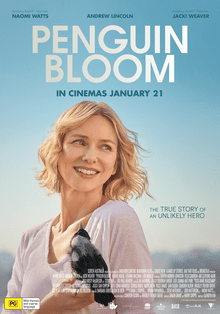
This next movie is based on a true story which makes a movie all the more compelling for me. I get to look up stuff afterward and stay with the characters after the last scene fades. The movie is Penguin Bloom, an Australian film that is also lushly filmed and extremely well acted.
Blurb: “Based on the best-selling book of the same name, the film tells the story of Sam Bloom (Academy Award® nominated Naomi Watts) a young mother whose world is turned upside down after a shocking, near-fatal accident leaves her paralyzed. Sam’s husband, (Andrew Lincoln), her three young boys and her mother (Academy Award® nominated Jacki Weaver), are struggling to adjust to their new situation when an unlikely ally enters their world in the form of an injured baby magpie they name Penguin. The bird’s arrival is a welcome distraction for the Bloom family, eventually making a profound difference on Sam’s life, teaching her how to live again.”
Australians are hearty people and extremely active. They love sports and live for the outdoors. The film portrays something we don’t get to see much these days- the three boys playing outside and at the ocean’s edge all day- building forts, running, skating, exploring. I used to do that. In the 1960s. It was a pleasure to see a family committed to each other and to exploring and imagining – and not an iphone or screen in sight. The story of the injured mother’s journey to good emotional and mental health was a well done. The magpies were tremendous. (I say magpies plural because in the credits there were a lot of them!)
I wish they’d make more movies like Penguin Bloom.
Anyway just a few recommendations for you if your’e looking for something to read or watch. Have a great week!
I often see folks’ photos of their bookcases or their offices or their podcast studios. I like to see where it all happens. Maybe you would like to see how I manage here, living tiny, and what my office looks like. Let’s be casual for a moment here on The End Time before I return to weightier topics next week, as the holidays end and we all get back to ‘reality’.
I have always liked living in smaller spaces. In the 1980s when the motto was “Greed is good” and the American dream was to have a large house, I bought a three story raised ranch with a yard. And filled it with furniture and stuff. After a while it got to be too much of an albatross around my neck, and I sought a better way of living. I’m glad I saved for, purchased, and owned a house. It taught me that I don’t want to own a house. Continue reading “Take a Tour of my Office with Me!”→
I grew up in a household that rejected God. I didn’t go to church except once in a while as a sputter here and there. I knew nothing of the Bible.
My parents were both readers. I’m glad, I turned into a reader then a student of literacy then a teacher of reading. Some of the books I remember being most read around my home were typical books of the pagan bookshelf.
I’m OK, You’re OK, 1967: a self-help book by Thomas Anthony Harris. It is a practical guide to transactional analysis as a method for solving problems in life. It stayed on the bestseller list for two years.
I’ll never forget that yellow cover, It was a highly visible book. Now that I’ve grown and like design, I see it as a typical design of the mid-century. I see psychology for what it is, a pale and paltry copy of the true answers of life, which reside in Jesus. Psychology seeks answers within one’s self, where no answers will ever emerge. Only confusion.
The Gnostic Gospels by Elaine Pagels, 1979: “Long buried and suppressed, the Gnostic Gospels contain the secret writings attributed to the followers of Jesus.”. How long will we be plagued by spurious claims that the REAL story of Jesus is suppressed and waiting to come out. The world does not want the true Jesus. But another that comes in His name, they will accept him. (John 5:43).
Jonathan Livingston Seagull, Richard Bach, 1970, “Jonathan Livingston Seagull, written by Richard Bach and illustrated by Russell Munson, is a fable in novella form about a seagull who is trying to learn about life and flight, and a homily about self-perfection.” Another book promising answers if we only look within, and one that caught the fancy of the American psyche for several years. By the end of 1972 over a million copies were in print. This book was everywhere. A new edition was just republished in 2014. The world never tires of hearing that we possess the answers to life and can self-perfect. No savior needed.
Body Language, by Julius Fast, 1971. “This classic books introduces kinetics, the science of non-verbal communication, which is used to analyze the common gestures we use and observe every day, gestures which reveal our deepest feelings and hidden thoughts to total strangers―if they know how to read them.”
Ah, we all want to know hidden thoughts. We all want to be little gods reading thoughts as the omniscient God does. ‘You will be like God’ said the serpent, in Genesis 3. This book hung around a lot at my house, too. I noticed that it was revised and updated in 2002. Where before the cover showed a woman demonstrating body language that’s “closed,” the updated version for the new millennium the woman is shown as displaying “open”.
I heard Martyn Lloyd Jones preaching a certain sermon in Acts. He mentioned a book by Rosalind Murray written during WWII, called The Good Pagan’s Failure. This review of the book states,
It is Rosalind Murray’s contention that the crucial difference which separates and divides us as human beings is, and always must be, spiritual, exemplified by an acceptance or rejection of belief in God. “Our attitude on this fundamental question determines the whole direction of our living in all of its aspects, and in all relations, and that opposition in this one decisive matter implies secondary, but resultant, opposition in outlook and in value throughout our lives.” … “The Good Pagan’s failure,” Murray writes, “can be attributed to the fundamental illusion from which he starts, the belief that it is possible to conserve all positive and constructive value of the Christian order while removing it from belief in God.” source
All the non-fiction books on the pagan’s bookshelf seeking answers are only wisps of false wisdom coupled with temporary solutions. I’m blessed that God protected me from absorbing these humanistic anti-God philosophies while I was at the impressionable stages. I read the Seagull book, and parts of I’m OK, You’re OK, and even the Gnostic book, which was read and re-read voraciously at my house. None of them made sense to me.
In His timing, the Lord gave me the mind of Christ, and now the Bible makes the most sense. It immediately showed me the order, beauty, and consistency in the world. It let me understand that there is no such thing as chaos, only hidden order through providence. I learned I had no wisdom of my own and that all I did was vanity and striving after wind. Yes. This is the wisdom of the ages, and God has it in infinite quantities. How blessed we are that He shared it in His word.
The good pagan’s failure is that she is seeking wisdom within her self. The Christian sister seeks it from the Lord. Good pagan? I’d rather be a depraved but saved sinner. My bookshelf is now filled with Bibles, commentaries, and books on seeking Jesus.
I said in my heart, “I have acquired great wisdom, surpassing all who were over Jerusalem before me, and my heart has had great experience of wisdom and knowledge.” And I applied my heart to know wisdom and to know madness and folly. I perceived that this also is but a striving after wind. For in much wisdom is much vexation, and he who increases knowledge increases sorrow. (Ecclesiastes 1:16-18).
You know how, in the foodie world, they pair different foods or drinks together for the eater to enjoy maximum flavor? “Sauvignon blanc is the classic wine pairing for goat cheese, but you could also try a crisp dry Provençal rosé…” Or, “This Sencha Green tea would be lovely with Arugula and lightly steamed vegetables…”
I do book pairings. If a book is a difficult one, I pair it with a modern treatment. Not modernized language, though that sometimes helps, but pairing an older author and a modern author who wrote about the same subject. Or simply read books by two modern day authors writing about the same subject.
I think these would be good pairings:
Work: Its Purpose, Dignity, and Transformation by Daniel M. Doriani
and Work and Our Labor in the Lord (Short Studies in Biblical Theology), by James M. Hamilton Jr.
I’ve read the Hamilton book. Challies recommended the Doriani book yesterday in his 10 New and Notable Books for April blog essay, and I think that would be fun to read it and compare to the way Hamilton treated the subject.
This might also be a good pairing:
The Power of Christian Contentment by Andrew M. Davis
and The Rare Jewel of Christian Contentment, by Jeremiah Burroughs
The Burroughs book was first published in 1648. Burroughs was an English Puritan preacher. His book on contentment is considered to be one of the gold standards on the topic, but the language is somewhat antiquated. Pairing the Burroughs book with the Davis tome (which I have not read) might be a good idea.
As a matter of fact, last summer I did pair a Puritan book with a more recently written book and it was very helpful to me in understanding the older one. I read –
The Enemy Within: Straight Talk about the Power and Defeat of Sin by Kris Lundgaard
and Mortification of Sin in Believers by Puritan John Owen
The Lundgaard book drew heavily on the original Owen works on indwelling sin and the mortification of sin. Reading a chapter of Lundgaard’s book one day and then Owen the next helped my brain prepare for Owens’ more complex treatment of the subject in his Puritan language.
I’ve paired these and I am enjoying the double treatment of how to critically read a book- Lit!: A Christian Guide to Reading Books by Tony Reinke is
A practical guide built on the gospel, Lit! models the skills needed to build a balanced reading diet of Scripture, theology, and devotional books, but without overlooking important how-to books, great stories, and books meant to be enjoyed for pleasure.
How to Read a Book: The Classic Guide to Intelligent Reading by Mortimer J. Adler and Charles Van Doren
Wikipedia’s blurb explains Adler’s 1940 book. “Adler co-authored a heavily revised edition in 1972 with Charles Van Doren, which gives guidelines for critically reading good and great books of any tradition. The 1972 revision, in addition to the first edition, treats genres, inspectional and syntopical reading.”
Adler’s book goes into much depth. Reinke’s book is a bit lighter. I like to read Reinke’s book and then the next day read Adler’s.
You might wonder, why go through all this trouble to ‘pair books’?
Because doing so helps train us, specifically in three higher order thinking skills: Analysis, Synthesis, and Evaluation.
Analysis refers to the ability to break down material into its component parts so that its organizational structure may be understood
Synthesis refers to the ability to put parts together to form a new whole
Evaluation is concerned with the ability to judge the value of material (statement, novel, poem, research report) for a given purpose. (Source)
We employ those skills when we read the Bible. We need to analyze the passages. We synthesize when we examine the different gospels, comparing them to each other. We synthesize when we strive to understand eschatology from different passages in the Old and New Testaments. Evaluation is an important skill in discernment- if we lack the ability to judge material for the purpose of edification of souls, then we open ourselves much that is false.
The Holy Spirit illuminates the scriptures’ meaning. But we still have to put in the hard work.
But solid food is for the mature, for those who have their powers of discernment trained by constant practice to distinguish good from evil. (Hebrews 5:14).
Have nothing to do with irreverent, silly myths. Rather train yourself for godliness; (1 Timothy 4:7).
Pair up two books and see what you think
——————————————————-
Further Reading:
I’ve written two other essays about the ‘how to read’ issue.
I am always thrilled when one of the ladies asks me a question, either a theological question, one on Christian life, or a book recommendation. It means she is thinking, seeking God’s glory, and striving on her walk. With so much negtivity around, it’s great to be reminded, that nothing and no one will overthrow Jesus’s church. It is thriving, growing, and will endure till the last day. There are still many Christians on earth who care about the way God wants to receive worship and prayer and who care about their Christian walk. What a blessing the brethren are.
A reader recently asked me for recommendations on books about prayer. My first thought immediately went to the Valley of Vision. Valley of Vision! It’s a book OF prayers by Puritans. But reading it will teach you to pray. It is THE most convicting, moving, and stirring book one could hope to read! (after the Bible). These Puritans’ prayers are deep and God centered. I’d say it’s #3 of best loved books in the English language, with the Bible first and Pilgrim’s Progress next. If you have those three books on your shelf, the seeds of theological solidity have been planted, with more books to sprout as you go.
Considered by his peers then and now as “The Prince of Preachers,” Charles Spurgeon built London’s Metropolitan Tabernacle into the world’s largest independent congregation during the nineteenth century. While many factors have been highlighted that help explain the effectiveness of Spurgeon’s preaching, the foremost secret that empowered Charles Spurgeon was his devotion to prayer.
This fantastic compilation brings you 7 Christian classics on PRAYER. Ever struggled with how to pray, what to pray for, or just needed encouragement to keep praying? These powerful writings will stir your heart and strengthen your faith, helping you grow in communion with God.
How To Pray – by R. A. Torrey [12 chapters]
• With Christ in the School of Prayer – by Andrew Murray [32 chapters]
• Prevailing Prayer – by D. L. Moody [11 chapters]
• How I Know God Answers Prayer – by Rosalind Goforth [10 chapters]
• Answers to Prayer – from George Muller’s Narratives [6 chapters]
• Power Through Prayer – by E. M. Bounds [20 chapters]
• A Short and Easy Method of Prayer – by Madame Jeanne Guyon [24 chapters]
Jeanne Guyon was a Catholic Mystic, so that section of the book appears to be the only dud chapter.
I am extremely hesitant to recommend something newer. Of late many people have been writing about prayer, but the authors are outight heretics or in some cases blossoming heretics. Or they quote Catholics or mystics in the book. Others twist the discipline of prayer into a prosperity or self-help notion. If you know of a recent and solid book on prayer, please do share. When I recommend, I think it’s better to stick with the more solid older books on this subject. See what a search for ‘Christian books on prayer’ yields:
One can always go to the gty.org store and look for something there, or the same at Ligonier.org. Banner of Truth books is pretty trustowrthy, this is their page on the subject of prayer