Posted in beth moore, false teacher, listening to the Lord

Beware of bible teachers who preach themselves

See to it that no one takes you captive by philosophy and empty deceit, according to human tradition, according to the elemental spirits of the world, and not according to Christ.” (Colossians 2:8)

Some years ago, some women gathered in a living room to do a Beth Moore study. It involved a

Source

DVD of Moore and some workbooks. Back then, Moore was more cloaked in her language about receiving personal revelation. She would say, “God laid it on my heart” or “God impressed upon me” which is still wrong because she was teaching from these impressions, and not the scripture.

In one segment of her study, Moore had shared a long story about how God was directly giving her specific instructions on how to act in a certain situation, and was delivering sentences directly to her ears. For a teacher that says “God laid it on my heart” so often, she was certainly telling a story with a lot of specifics and many quotes from God. In the DVD, Moore repeated the things God had “told” her to do in this situation. The story Moore was telling involved Moore’s reactions to God’s directions, and Moore sharing the result of having ‘listened’ to His revelations. Anyone who has seen Moore in television or at a conference or any other venue knows this is how Moore teaches. After her personal story, she applies an out of context bible verse to it and finishes it up. It’s like backdating a check, fraudulent and dangerous.

The ladies got done listening to this particular segment on DVD. After the DVD was turned off, a moment of silence passed as the ladies absorbed what Moore had taught. Then one of the ladies sighed and said sadly, “I wish I had what she has.”

Bible study is supposed to energize us, lift us, empower us! Yet the ladies were drained, believing that Moore has a ‘more special’ relationship with God than they did or ever could have, that Moore has more of something than us that is impossible for mere regular women to attain.

A lady spoke up and said, “We DO have what she has, the Holy Spirit! We all have Him inside us!” But they looked at her like she was crazy and did not believe it.

What ended up happening in this study group is that the women talked about Beth Moore, her ‘power’ in God, her teaching style, her life. In their desire to “have what she has,” it made them want to be like Beth Moore, not like JESUS.

You see the problem.

Yet in like manner these people also, relying on their dreams, defile the flesh, reject authority, and blaspheme the glorious ones.” (Jude 1:8)

Posted in apocalypse, end time, it's a disaster, review, the war game

Two apocalyptic movie reviews: The War Game, It’s A Disaster

The War Game, 48 minutes. So shocking to the BBC, who commissioned it, the film was banned for over 20 years.

IMDB synopsis:

The War Game is a fictional, worst-case-scenario docu-drama about nuclear war and its aftermath in and around a typical English city. Although it won an Oscar for Best Documentary, it is fiction. It was intended as an hour-long program to air on BBC 1, but it was deemed too intense and violent to broadcast. It went to theatrical distribution as a feature film instead. Low-budget and shot on location, it strives for and achieves convincing and unflinching realism.

IMDB user quotes:

‘Threads’ is good, but ‘The War Game’ is still the best portrayal of a nuclear attack on Britain ever made. It should be shown more often.

I reviewed Threads here, titling the essay, “The most unrelentingly horrific and unsettling apocalyptic movie you will ever watch that comes the closest to what the Tribulation will be like”. And it is unrelenting and horrific. Threads follows a pregnant woman for 13 years during and after the bombs fell. In that circumstance, a generation. The War Game shows the bombs falling and follows the survivors about ten months. The War Game unstintingly shows the effects of nuclear bombs on flesh. It harshly reveals the immediate truth. It shows unpreparedness physically and mentally and depicts societal collapse. Threads is slightly less graphic at the outset but the effects of nuclear war build in the mind as the years pass. It shows civilization’s collapse, and how humans are reduced in body and mind because of it. Both movies are unrelenting, but from different vantage points. I’d say that both are the most horrific for different reasons. Back to The War Game imdb.com user quotes:

Although this film clocks in at a mere 48 minutes, not a scene, second or frame is put to waste. A level-headed and all too analytical examination of civil preparedness versus the yield of nuclear weapons

This film is too important to ignore, and too powerful to dismiss.

Even though the subject matter is dark and bitter, The War Game is a compelling watch and I highly recommended it for everyone.

Close to forty fifty years after it was made, it’s still one of the most powerful and disturbing documentaries you’ll ever see.

It’s a brilliant film made by the BBC which was banned for many years because of the fact it was too real… In most cases it’s re-released because films from the 60’s tend to date somewhat compared to modern cinema standards. But the War Game is still as hard hitting as it was the day the BBC decided they couldn’t put it on television.

My reaction:

It shows in unvarnished truth the realistic picture of what those left behind will face. And as realistic as it was, the horrors of the upcoming wars will be worse. The population on earth now has doubled since 1965. Then, it was 3.3 billion. Today it is 7.2 billion. We have hydrogen bombs now, chemical means of tortuous deaths, and the supernatural prophecies of demons afoot and satan furious coming to earth.

Even without all that, the show was almost unwatchable. This was partly due to the juxtaposition of the realistic effects of a thermonuclear bomb upon a population with the recounting of the emotionless narrator’s data and facts. It was jarring and horrific. A British movie site says,

Shot on location, the wholly harrowing depiction of what could happen immediately before, during and after a nuclear attack on rural Kent; The War Game is filmed in pseudo-documentary style and is disturbing in its verbal realism.

So why put ourselves through such movies, such tension and torture? A few times a year, I watch one of these types of movies for specific purposes. At least four reasons I can think of:

1. This understanding of a post-nuclear world overlaid with our knowledge of the additional atrocities of the coming antichrist not shown in the movies should give us more urgency in witnessing about the glory of Jesus as Savior.

2. The movie showed how utterly we cannot rely on anything of this world. Man made protections, sandbags, guns, shelters, self-sufficiency, grit & determination, governments, they all fail, and right away, too. For Christians watching this movie, it should give us courage and power knowing we have all-power in us and He will never fail.

3. Though it is a movie showing complete hopelessness, that is its redeeming quality. Stripping away all of the above; self-sufficiency, infrastructure, government, pride, etc., the movie shows us how completely without hope we are without Jesus. We are craven, sinful rebellious children who will always come to a bad end. Without Him, nuclear war and extinction are the only futures for mankind. The starkness of the movie highlights the eternal hope we have in Jesus!

4. Whatever I’m going through is nothing compared to the horror of nuclear war. It puts my troubles in perspective. And even though there is no nuclear war gong on right now, there are rockets in the Middle East, atrocities and coups and beheadings of the brethren. There is starvation and disease and strife. I look around me and I’m grateful.

~~~~~~~~~~~~~~~~~~~~~~~~~~~

Now on a different vein, I also watched an apocalyptic movie called “It’s a Disaster.” Usually, apocalyptic movies feature bombs or aliens and explosions. I wish very much they would make a movie out of William Forstchen’s book One Second After, a book I discussed here, about the devastating effects of a detonated EMP over the central US. There are some apocalyptic events that occur that are not visible and less explosive and are more like carbon monoxide- colorless, odorless, and undetectable. Life seems to go on, and yet the reality is, life has ended.

It’s A Disaster is a movie about the latter. Several couples gather for Sunday brunch at one of their suburban homes. They chat, argue, passively-aggressively jab each other, all the while dim sirens in the background go unnoticed. Apparently a series of chemical bombs were detonated on their city 12 miles away and in many other cities too. The dirty bomb contained VX gas, the most deadly weaponized nerve gas known to man. Life outside looks exactly the same, yet within hours, all will be dead.

It is that which is hardest to comprehend. When a nuke falls, one knows a nuke fell. The mind can’t comprehend the effects, but it knows it happened. With a dirty bomb or other near-extinction event like EMP, the first problem is getting the mind to accept the new reality. In one moment the couples were arguing over a divorce, and the next a neighbor in a hazmat suit arrives to tell them the news and advises them to tape the windows shut. Is life the same?? Will we really die? Is it really over? The champagne in the mimosas is still bubbling and the quiche is still on the stove…how can it be that we are already dead?

The opening credits in black and white are brilliant and shall I say it again, brilliant. The director used the backdrop to illustrate in graphic visual juxtaposition the mundanity of extinction.

The opening scene where two of the characters, on their third date, discuss the 1812 overture as it plays in the car continues this theme. As the famous overture nears its climactic moment, the man pulls up to the curb and turns off the ignition. The woman, who is listening, asks why it didn’t bother him to turn off the music in the middle of the crescendo. The abrupt ending of the music was jarring. Why not finish the crescendo out? How can you just turn it off like that? It is a metaphor for the suddenness of end of life. It’s over, but it’s not finished.

This reviewer sums it up:

What’s funny is that, apart from acknowledging the whole impending death thing, they do exactly what most people do all the time: They lapse into denial and retreat into the familiar patterns of behavior they’ve become accustomed to, as if stubbornly determined to act just like themselves even under the most extreme of circumstances. It’s easier to get outraged over some newly discovered relationship betrayal than it is to wrap your head around a possible alien invasion or nerve gas attack, which you can’t really do a whole lot about with a single roll of duct tape, anyway.

As they scoured the basement ot find duct tape, they have an argument about whether it is really duck tape or duct tape. They need the duct tape to make a likely vain attempt to ward off death in the form of VX nerve gas, but as humans, they still argue about inconsequential things. That was the kind of humor.

Now, the movie is not for everyone. Though The War Game was so gripping, I do recommend everyone see it. It’s A Disaster has two things that will likely turn off a great many. First, it is a sly, witty, dialogue driven, black comedy. It is hilarious. The end is perfect, no matter how many complaints about it you read on forums and websites. But the comedy isn’t for everyone. Many people hated the end. The director utterly pierced the selfish thirty-somethings by highlighting their lack of commitment. Lots of people wanted a more demonstrable ending. And not everyone liked the black humor.

Several scenes in the middle drag a bit, but the wonderful thing about Hulu is that you can fast forward.

Secondly, there are swears. The f-word us used about ten times as well as sh– and a few others. References to sex and adultery.

For a disaster film, it is offbeat and thought-provoking.

~~~~~~~~~~~~~~~~~~

For Further reading:

Wikipedia entry on The War Game

Director Peter Watkins essay on how The War Game came about 

Posted in a city upon a hill, boston, hope, missionaries, new england

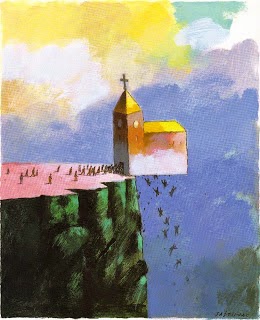
Mission New England, the city on a hill where the light has (almost) gone out

A church in Gray Maine. EPrata photo

New England is comprised of 6 states: Maine, New Hampshire Vermont (northern New England) and Massachusetts, Rhode Island, and Connecticut (southern New England). Five, and sometimes all six of these states are listed in surveys in the top ten most Godless states in the US.

Providence RI is listed as one of the ‘least bible-minded‘ cities in the US. This is ironic, given its name.

Portland Maine is known as one of the most homosexual friendly and tolerant cities in the US.

Spiritually, New England is dark. I know. I lived there for 42 years. For those who were saved by grace at an early age, or were raised in a Christian home or even live in the south or Midwest … perhaps this next statement will seem strange to you. But growing up in New England means that one can never go to church, never see anyone else go to church, never hear talk of church, never hear the name Jesus, never see a bible store or a Christian store. Never see a cross. As embedded as the visible Christian life is in the south, it is just as invisible in the north.

One of the oldest church buildings and the biggest, located in the most prominent place, the center of my old town, has no displayed cross outside. The Methodist Church and the Congregational Church staff female lead pastors. There is no bible store in town (no book store at all, as least as far as I know). Jesus doesn’t live in most of the people there and thus He isn’t seen in the culture.

New England needs missionaries. To that end, NETS is a church planting mission aimed at New England. Does it seem strange to you that New England is as dark as Norway? Or India? They write,

The New England landscape is dotted with white steeples and picturesque churches. But

North Yarmouth church. EPrata photo

look closer, and you’ll find pulpits that once held gospel preachers like Jonathan Edwards and George Whitefield now proclaiming Universalism, Liberalism and postmodernism. Halls that once echoed classic hymns stand eerily silent behind “For Sale” signs. Many church buildings have already been converted into shops and condos. And influential colleges like Harvard, Yale and Brown, founded to train gospel preachers, now lead the way into spiritual darkness. With the exception of Mormon Utah, New England is the most gospel-parched region of the nation.

Portland is one of the toughest regions to be on mission with the gospel: Some 59% of residents are considered “post-Christian.” … As shown by this homosexual publication reports that Portland, Maine is one of the top five surprisingly gay towns.

Portland Maine is on our gaydar Home to one of the biggest per capita LGBT populations on the east coast and now host of the entirely enticing Frostbite ME weekend (early March, dates TBA), a LGBT winter celebration with an alluring array of homo hijinks, activities, and events that launched in 2008, Portland is Maine’s captivating largest city (population 65,000). Portland has a venerable gay bar, Blackstones, and Styxx Video Club (3 Spring Street), where the dance floor and pool tables are popular with women on Thursdays and Saturdays.

The Portland Press Herald reported, “Maine a mecca for gay couples; Experts attribute the numbers to the state’s gay-friendly laws and its history of tolerance.”

A long-dead New England church that is now an antique store

This is the very spot in the world where European men and women of faith left all they knew to travel to a new and dangerous world, in pursuit of freedom to worship Jesus. They stepped off the Mayflower in 1620 Plymouth Massachusetts, survived, thrived, founded cities, and seminaries. Harvard College was originally a seminary institution of higher learning for men to be trained in the Gospel. So was Yale and Princeton and most other New England higher learning institutes that were founded over 300 years ago.

Harvard’s crest stated Veritas Christo et Ecclesiae (Truth for Christ and the Church) and their charter proposal read thus:

After God had carried us safe to New England and we had builded our houses, provided necessaries for our livelihood, reared convenient places for God’s worship, and settled the civil government: One of the next things we longed for and looked after was to advance learning and perpetuate it to posterity; dreading to leave an illiterate ministry to the churches, when our present ministers shall lie in the dust.

And so a mere 6 years after landing in Plymouth, the Puritans founded Harvard College in 1636.

And so satan went to work.

In 1803 Harvard voted out the Calvinist President and voted in an anti-Trinitarian president. In 1869 Harvard dropped the “Christ and Church” from their motto and crest, leaving only “Veritas”, (Truth). Cementing the long, liberal decline, Harvard expanded their mission statement in 2008,

To help in building a world in which people can live and work together across religious and cultural divides, we strive to be a primary resource in religious and theological studies for the academy, for religious communities, and in the public sphere…. 

because,

A well-educated student of religion must have a deep and broad understanding of more than a single religious tradition; [emphasis mine]

Bangor (Maine) Theological Seminary is 200 years old and liberal as liberal can be. It was not always so. Like Harvard, it was founded by a conservative Calvinist minister in the Puritan tradition. Rev. Jonathan Fisher of Blue Hill Maine was concerned that there was no institute of Christian higher learning in northern New England. Then, ‘Harvard defected, and so had many other clergymen and churches.’ (source). BTS was founded. Though it started out well, it ended up committed to scholarship, just not biblical scholarship. They adhered to ecumenical learning and the ever-deadly free thought. Another New England seminary had fallen. This month, conservative New England Bible College in Maine closed its doors, for lack of enrollments. The people of New England, its churches and its seminaries reject Jesus.

John Winthrop was the long term original governor of Boston, the first city of Massachusetts Bay Colony after Plymouth. He preached to the Puritans as they emigrated that theirs was a holy endeavor and they would found a holy “city upon a hill”. This was his famous “Modell of Christian Charity” sermon. Winthrop wrote it aboard the ship Arbella, (I edited the language from 1630 to today’s)

Winthrop: 2nd, 6th, 9th, & 12th Governor
of the Massachusetts Bay Colony

We shall find that the God of Israel is among us, when ten of us shall be able to resist a thousand of our enemies; when he shall make us a praise and glory that men shall say of succeeding plantations, “the Lord make it likely that of New England.” For we must consider that we shall be as a city upon a hill.”

The city upon a hill was from Matthew 5:14. Winthrop was so right in his next paragraph-

The eyes of all people are upon us. So that if we shall deal falsely with our God in this work we have undertaken, and so cause him to withdraw his present help from us, we shall be made a story and a by-word through the world.

Because Jesus IS hope … rather than lament the loss of our original Christian identity, one pastor in New England (a friend of mine) wrote this week an encouraging message. The decline we are seeing, the degradation of the name of Jesus in the wider community, is nothing new. It is nothing unexpected. Knowing this, we can persevere in joy and hope! He wisely wrote:

—————————–

As many families and church families struggle to meet their financial obligations amid an uncertain economy and an increasing global conflict, major changes are affecting everyone. Some folks may even sense a spirit of discouragement or worse, despair. Some folks simply dismiss what is happening in our world, as they are tired of all the bad news. Hmmm, it reminds me of the times Habakkuk lived.

God told the prophet, Habakkuk, that Israel’s worst and most fearsome enemy was coming to destroy the nation and carry off many people into captivity because of Israel’s idolatry and sinfulness. While Habakkuk wrestled with God on this issue, the prophet came to understanding that “the just shall live by faith” (2:4). As a result, Habakkuk accepted the inevitable judgment of God upon Israel by offering up praise to God.

As I close this email with the prophet’s words (3:17-19), remember, that no matter how difficult the times may get for our lives, our families, our church families, and our nation, God will be your strength as you walk with Him.

Though the fig tree should not blossom,
nor fruit be on the vines,
the produce of the olive fail and the fields yield no food,
the flock be cut off from the fold
and there be no herd in the stalls,
yet, I will rejoice in the LORD;
I will take joy in the God of my salvation.
God, the Lord, is my strength;
he makes my feet like the deer’s
he makes me tread on my high places.

————————————-

Oh Puritan New England, what happened? Satan happened!

The great preacher George Whitefield preached about satan’s schemes.

But Satan is most known for his remarkable ability to use his cleverness against mankind. Since he is not given power from God to take us by force, he is therefore required to wait for opportunities to betray us, and to catch us by the use of deception. He, therefore, made use of the serpent, which was the most crafty of all the beasts of the field, in order to tempt our first parents; and accordingly he and his accomplices are described in the New Testament as being cunning and crafty in their deceitful scheming. In the words of our text, this morning, the Apostle says, “We are not unaware of his schemes:” thereby implying, that we are more in danger of being seduced by his system of deception, than overpowered by his strength.

The people of New England throughout the recent centuries were overpowered by stealth. Little by deadly little, they succumbed. Satan entered into their minds, and led them away from the pure doctrines of the bible. They were not vigilant! Satan seduced them into installing women pastors. He slithered in to its seminaries and lured them into ecumenicalism. He is the angel of craft and subtlety. No guns were needed. No swords were drawn. The battle has been long, and it has been silent, but it has been a success. They forgot Jesus. Veritas. But no Christo.

But Jesus does not forget them! He raises up faithful pastors to staff solidly biblical churches there! He sends missionaries to plant churches in its frigid mountains where hearts need the light of God! He sustains the beleaguered congregations persevering in a place that is as corrupt as Corinth! God is good. Our High Priest, Jesus, ministers to the hearts of those who love Him, few as they may be in that northern place.

Pray for our stalwart missionaries, pastors, and brethren who dwell in a place where once the lamp was shining on a hill, but now shines only dimly in laboring flickers here and there.

No matter where we are in the world, spiritual decline is inevitable. Fear not! The world hates Jesus. (John 15:18). No matter what the type of beginning a nation had, high or low, sacred or profane, all will fall. All parts of all nations will fall. Satan is working mightily to try and overthrow heaven’s gates. The areas we hold dear, where we grew up, or where we live now, will some day be renewed! Every Christian who dwells in the places that are so dark now, will cry with joy when the Light comes. Jesus will revive every ember, bursting into glory light of pure and holy truth.

Until then, pray for New England.

~~~~~~~~~~~~~~~~~~

Further Reading:

US History: Massachusetts Bay Colony, the City upon a Hill

John Winthrop: A Model of Christian Charity

The First Baptist Church in America: in Providence RI (1638)

Posted in color, encouragement

Color in heaven: follow up

EPrata photo

I wrote an essay on the subject of the color green in heaven. Green as in green pastures, green things to eat the Lord gave us in Genesis 1:29, green in emerald (like the emerald rainbow surrounding the throne and in the foundation of the new city), etc.

I was thinking about “green.”

I pondered the beauty of the green in Ireland. The hues there are so different than the green pastures here, and if it is that beautiful in ‘The Emerald Isle’, how much more beautiful will it be in heaven? I’d posted a short quote from Randy Alcorn from his book Heaven, and in the quote he quoted himself from Dominion. It’s encouraging to think of what is ahead of us.

In response to my essay, a commenter gave me this really interesting comment. I had never thought of this but isn’t this absolutely true:

Elizabeth, Thanks so much for this blog! Did you ever think about how all our colors on earth are dependent on our light sources–the sun, incandescent or fluorescent bulbs, . . . But in our eternal home, according to Rev. 22:5, “They will not need the light of a lamp or the light of the sun, for the Lord God will give them light.” Think about what effect that will have on colors! An infinitely superior LIGHT SOURCE creating colors beyond our earthly imaginations!

Wow! I had never thought of that! The light source is all-important in the range of colors we are able to see. Colors look like they do because of the source and type of light hitting the retina. The ranges of Ultraviolet light and Infrared light are much wider than we are currently able to see. Once the Light Source is pure (Jesus) and we see through His pure and holy light, imagine what we will be able to view, including new colors!

EPrata photo

You see, you probably already know this, so pardon me if I’m repeating myself, the brain and the eye, specifically the retina and the fovea, translate light into colors. Color actually originates in light. It bounces to the object and then to our eye. What we are seeing is actually the reflection off the bounce, and the color reflected to us is only as good as the original light source.

That’s why paint helpers at Sherwin-Williams tell new homeowners to paint a swatch on their wall and look at it at different times of day. The brightness and angle of the light will make the color appear different at each time.

Imagine when we are glorified and the full spectrum of light is now reflecting the purest, most holy and good light there can be! What will we see THEN?! So. Many. Colors.

It’s gonna be GREAT!

~~~~~~~~~~~~~~~~~~~~
FMI:

“How the Eye Sees Color”

Color originates in light. Sunlight, as we perceive it, is colorless. In reality, a rainbow is testimony to the fact that all the colors of the spectrum are present in white light. As illustrated in the diagram below, light goes from the source (the sun) to the object (the apple), and finally to the detector (the eye and brain).

1. All the “invisible” colors of sunlight shine on the apple.

2. The surface of a red apple absorbs all the colored light rays, except for those corresponding to red, and reflects this color to the human eye.

3. The eye receives the reflected red light and sends a message to the brain.

The most technically accurate definition of color is:
“Color is the visual effect that is caused by the spectral composition of the light emitted, transmitted, or reflected by objects.”

~~~~~~~~~~~~~~~~~~~~

Impossible Colors

Train yourself to see impossible colors

How many colors are really in a rainbow?

Posted in encouragement, entertainment, faith, raising izzie

Movie Review: Raising Izzie

I watched a movie last night that readers might enjoy as a family. (Not the younger kids). It is called “Raising Izzie

It is about two orphaned girls aged 14 and 10, who are struggling to live on their own in an apartment their dying mother set up for them. It was only a matter of time of course, before they were found out. A year later, a caring teacher of the older girl becomes suspicious when she compares parent signatures on a school paper.

The teacher’s back story is that she wants children, and she and her husband have been trying for a while and haven’t had the desired result. This causes stress on the relationship and their strong faith is tested.

What is obvious to the viewer is that God is building a family between the two parties.

Issues explored:

–The teacher and her husband are black and the two girls are white. Can they make a family? Can family include adopting older kids? Can it be interracial?

–God’s people helping the orphan, what is our responsibility? (There were discussions of what should they do, call DFACS? The Police? Take the girls in?)

–The father says he wants children but the wife worries that underneath he is more committed to their child-free lifestyle.

–The wife wants children but begins to resent God for the lack

–The older girl is resentful she has to raise Izzie and is angry at God for failing to answer her prayer to cure her mother of cancer. (It is stated that the girls’ father had died just before Izzie was born)

Pros:

I REALLY liked the faith seen throughout, not heavy handed or preachy but living it out. When the husband and wife begin to have an argument in the car, he pulls over and prays.

The husband prayed to Jesus, and in Jesus name. That was good.

He supports his wife, not in a doormat way but in a strong, head of the family way.

The dead mother is seen in flashbacks as a caring, involved mother.

Izzie is cute as a button and in a natural way, not a movie way.

Many mentions of God throughout the movie

Is God real? How can we know? Realistic discussions and people having normal thoughts/doubts.

Godly patience is seen throughout and kind words are exalted above bitter words.

The husband is the Godly leader of his home. He is seen to be honoring his wife in many ways.

They go to church. In one of the only arguments in the movie, the teenager and the wife decide on Sunday morning they refuse to go to church. The wife yells, “I’m tired of all this! I’m sick of God!” The husband replies “That’s when you need Him the most!”

Cons:

In a certain scene the teacher says she had seen and spoken with the girls’ dead mother. (ghost). I can’t say more or it will be a spoiler.

Faith is strengthened only when God performs a miracle. It is still a movie after all. Sigh. It has the climactic moment of “God I’m praying and this is your last chance to show me you’re real or I won’t believe any more”.

At least, during the movie there were several discussions about what we hope for from God and what faith is. The teenager was crumbling in her faith because God didn’t do what she expected…but on the plus side, the husband had several discussions with her (and his wife) that God has ways higher than our ways and His will be done- sometimes unexpectedly. The movie still ended with the concept of “miracle = God is real = faith”

But knowing this, discussions could be had with your kids, “How would you have felt if the ending had been different? How can faith be strengthened in cases where adversity tests it? Isn’t God always working? Do we rely on miracles to prove God is real? Why or why not? How does God work in our lives?”

———————————–

I didn’t hear any profanity…once the teacher was in a low cut garment, but it was her pajamas after all. … Her church dress showed a bit of cleavage. That’s it.

The movie is set in the Atlanta suburbs. Rockmond Dunbar, Vanessa Williams starring. It had good production values. It was released in 2012. It can be seen on Amazon Prime, Hulu Plus, and is free on Youtube. It is a good family movie.

In a personal opinion, I especially enjoyed Mr Dunbar’s acting. I would happily look for him in other films or television programs.

Oh, and get the tissues. You’ll need them.

Posted in color, emerald rainbow, encouragement, green, jesus

Heaven and the color green

Remains of the 12th-century Trim Castle in County Meath,
the largest Norman castle in Ireland

They call Ireland “The Emerald Isle” for its deep green, undulating countryside. The island nation was first nicknamed the Emerald Isle sometime around 1780 in a poem by William Drennan called “When Erin First Rose.” Here is the first stanza
By

When Erin first rose from the dark swelling flood,
God bless’d the green island and saw it was good;
The em’rald of Europe, it sparkled and shone,
In the ring of the world the most precious stone. …

I’ve never been to Ireland but I’ve been to Scotland and the north of England. The green hills of Scotland were tremendously vibrant. Perhaps it was the quality of the northern sunrays bouncing off the grass, or the mystery of travel exhilarating my emotions, but it seemed to be to be a quality of green like no other place I’d ever been. The green there calms the eye, soothes the soul, envelops the body is its aura.

One of my favorite verses in the bible is in Revelation.

And he who sat there had the appearance of jasper and carnelian, and around the throne was a rainbow that had the appearance of an emerald. (Revelation 4:3)

Green Pastures, river Severn at Caersws, Rod Trevaskus, CC

I love that emerald rainbow. When I pray I envision Jesus sitting on the throne, accepting prayer, listening, and the emerald rainbow all around Him.

I wonder what the color green will look like, up there. The bible says-

But, as it is written, “What no eye has seen, nor ear heard, nor the heart of man imagined, what God has prepared for those who love him”—(1 Corinthians 2:9)

I suppose even the color green as we know it will be startlingly different. There will be precious stones in the foundations of the city walls, including emerald-

The foundations of the city walls were decorated with every kind of precious stone. The first foundation was jasper, the second sapphire, the third agate, the fourth emerald, (Revelation 21:19)

Benbulbin Mountain, County Sligo, Ireland. Public Domain

Dictionaries – Easton’s Bible Dictionary – Emerald

Heb. nophek (Exodus 28:18; 39:11); i.e., the “glowing stone”, … a precious stone in the breastplate of the high priest. It is mentioned (Revelation 21:19) as one of the foundations of the New Jerusalem. The name given to this stone in the New Testament Greek is smaragdos, which means “live coal.”

Lucifer walked among the precious stones in heaven, including emeralds. (Ez 28:14). They adorned him.

You were in Eden, the garden of God; every precious stone was your covering, sardius, topaz, and diamond, beryl, onyx, and jasper, sapphire, emerald, and carbuncle; and crafted in gold were your settings and your engravings. On the day that you were created they were prepared. (Ezekiel 28:13)

The breastplate of the High Priest was adorned with precious stones, four rows of three stones each.

the second row shall be turquoise, lapis lazuli and emerald;(Exodus 28:17)

Public Domain. Green Pasture, Ireland

Originally, God gave to man every green plant for food. (Genesis 1:30) When judgment came, God sent locusts to eat every green thing. (Exodus 10:15). Green is often used in the bible to represent clean growth, and goodness. (Psalm 52:8, Proverbs 11:28)

I suppose the most famous mention of green in the bible is Psalm 23

The Lord Is My Shepherd
A Psalm of David.

1 The Lord is my shepherd; I shall not want.
2 He makes me lie down in green pastures.
He leads me beside still waters.
3 He restores my soul.
He leads me in paths of righteousness
for his name’s sake

Randy Alcorn, who specializes in the study of heaven, wrote the non-fiction book called Heaven, and the fiction book Dominion. In Heaven, Alcorn said,

In the same way that the New Earth will be refashioned and still be a true Earth, with continuity to the old, the new cosmic heavens will likewise be the old renewed. In my novel Dominion I try to depict this in a scene in which Jesus takes a woman who has died to a new world:

Eventually they arrived on a world more beautiful than Dani could fathom—cascading waterfalls, rainbows of a hundred colors, mountain peaks five times higher than any on earth. Oceans with blue-green water, and waves crashing upon rocks the Page 4
size of mountains. Grassy meadows, fields of multicolored flowers—colors she had never seen before. This place seemed somehow familiar to her, yet how could it, since it was like nothing she’d ever seen? Still, she felt profoundly at home.

I believe this also. I think there will be the color green in the New Earth. Only better. Different, but the same. What will the emerald green of heaven look like? If the photos above are so beautiful, what awaits? An emerald sparkles. Green pastures are restful. The described emerald rainbow around the throne must be incredible. Yet, even then, the bible says we cannot imagine what awaits us.

No eye has seen, until we go home, that is! Then thanks to the blessed Savior atoning for our sin, and having prepared a place for us, we WILL see. What a day that will be.

Posted in discernment, doctrines, Jesus follower, power, words

Do you "follow Jesus"? Or are you "saved by Jesus?"

People today are starting to say “I follow Jesus.” Or, “I’m a Jesus follower.”  I’m sure you’ve seen this.

People used to say “I’m saved by Jesus.” Or, “Jesus saved me.”

I don’t like saying ‘I follow Jesus’. I’ll tell you why.

Saying “I follow Jesus” puts me as the subject. ‘Look at meeee, I follow.” The verb is about me too. The verb alerts the hearer to something I am doing, following. It puts a picture in the mind of the hearer on two people walking, the second one being the follower, and that is where you’re mind’s eye rests in forming the picture of the words spoken to you. On the one doing the following and not on the One doing the leading.

EPrata photo

It is also kind of boasting. If one is saved by the atoning work of Jesus Christ, it stands to reason that a person would then follow His commands and abide by His statutes. No one says, “I’m saved by Jesus but I don’t follow Him.” The following is tacitly understood by one and all.

But one can say “I follow Jesus” and not be saved. Mormons follow Jesus and are not saved. Catholics follow Jesus and are not saved. Judas followed Jesus for three years and he was not saved. I understand that saying “I’m saved by Jesus” doesn’t guarantee a person is saved, but at least it includes the acknowledgement of sin and the need for a savior. Following Jesus is something a lot of people do, and saying so only increases the likelihood that what they are doing is simply an activity. When you decide to call yourself a Jesus follower, in my opinion it increases the likelihood that are one of the people DOING things for Christ and not actually saved by Christ.

All these people followed Christ, too:

On that day many will say to me, ‘Lord, Lord, did we not prophesy in your name, and cast out demons in your name, and do many mighty works in your name?’ And then will I declare to them, ‘I never knew you; depart from me, you workers of lawlessness.’ (Matthew 7:22-23)

Saying that “Jesus saved me” puts the emphasis on Him. Referencing my salvation by constantly saying “I follow Jesus” puts a boasting aspect to the phrase the speaker may not have intended, but is there nonetheless.

Now, someone could reply that the comment is not about salvation, but is about sanctification. Sanctification is the growth we experience in Christ after we are saved (justified). They could argue that they were saved by Jesus and now they follow Him in His statutes, ever growing in sanctification. After all, Jesus said, “Follow me”.

Yes, Jesus said “Follow me” many times. He said it in Matthew 4:19, Matthew 16:24, John 8:12, Luke 5:11, 1 Peter 2:21, John 10:27, etc. It is biblical to say that one is a follower of Jesus. I cannot categorically condemn the phrase.

I can make a statement that it is unwise to speak solely of one’s salvation OR sanctification in terms of the self. The growth we experience when we follow Jesus is partly done under our own steam but not fully. The Holy Spirit grows us. Our part is aggressive obedience, fervent pursuit, and a total submission. Therefore saying “I follow” seems just so…anemic.

‘Following’ as opposed to submitting, pursuing, or obeying is one step away from Jesus. Who are we following? Why? That small shift in emphasis is incremental but dangerous nonetheless. Once the shift is made away from the object of our pursuit, then the following becomes the main theme. And one can easily go astray. One can follow your bliss.

Creative Commons, source

One can follow a leader. Paul addressed this in 1 Corinthians 1:12-13, because errant ‘following’ was causing divisions.

What I mean is that each one of you says, “I follow Paul,” or “I follow Apollos,” or “I follow Cephas,” or “I follow Christ.” Is Christ divided? Was Paul crucified for you? Or were you baptized in the name of Paul?

The members at Corinth were split along doctrinal lines and had shifted their eyes from Jesus and their unity in Him to personal preferences among different teachers and the doctrines these teachers were teaching.

Erin McCrum wrote about the “why” this trend eschews the name ‘Christian’ in favor of  ‘Follower of Jesus:

…proponents of the “follower” lingo claim two advantages over the label “Christian” or “evangelical.”  “First, it doesn’t carry baggage.  You can wear it abroad, in Islamic countries, or at home with your Jewish or Buddhist friends, without causing offense.  Second, it distances the bearer from the culture wars that have made American politics so divisive.”

In this scenario, one can envision saying to a Muslim, “I’m a follower of Jesus!” and they reply “I’m a follower of Isa!” Hugs all around. It is precisely the offense which makes a Christian a Christian. Paul said if there is no offense then the cross has been taken away (Galatians 5:11). If claiming Jesus as our Christ doesn’t offend, there is something wrong. There should be love in witnessing, but there should be no attempt to cloak, diminish or otherwise distort who we are and who Christ is. Of course the term “Christian” carries baggage. That is the point. The ‘baggage’ is the cross which offends everyone.

Satan is so subtle and so skillful. Satan managed to convince a third of the holy angels who saw the face of God every day, to follow him instead. He convinced Eve to bite the forbidden fruit just by asking a question. It is unwise to allow incremental creep into our language regarding who we are or what we do. Satan will quickly take advantage of it. Instead, we must be mindful, biblical, and vigilant in our language about Jesus and in our active holy walk. See the difference:

The Jesus Follower: I am a pretty good person who just made some mistakes and so I decided to follow Jesus and I want to live out His plan for me because after all, He loves me.

The Christian Saved by Grace: I am a totally depraved sinner saved by unmerited grace of the Son of Man who came to live a sinless life, die as the atoning sacrifice for my sin, and endure all God’s wrath for it. I pursue the resurrected Jesus who has holy standards for the ones He has saved, and am living by those standards to the best of my craven ability, by submission to and obedience in the Holy Spirit. I rest on the promises Jesus the Christ has made to His chosen ones to both activate the faith He has given me, and to empower me to live in ever-growing sanctification. I’m looking forward to obeying him all the days of my life until He deems it the time to bring me home.

I have a very small leak in the tub faucet. A tiny drop comes out every few seconds. One day, the cat had tripped the drain shut. I went into the bathroom a few hours later and there was an inch of water on the bottom of the tub. The litter box was floating. Small doctrinal leaks add up. Explosively wrong doctrine can pop a balloon or a tiny leak of slowly shifting language can drain it. The result is the same.

I’m not a Christian. I’m a Jesus follower.

The terms Christian, sinner, salvation, justification, sanctification etc have lasted so long and been so understandable to everyone for centuries is because they are biblical. These terms transcend time. Be mindful of falling into a trap of exchanging words attached to known and commonly understood concepts with new terms that are nebulous, temporary, cultural and lack Spirit power. Sometimes synonyms aren’t synonyms, but a subtle trick of satan to drain power from our witness.

~~~~~~~~~~~~~~~~~~~~~

Further Reading:

Liberals change word meanings with intent to deceive

The cults are infamous for perverting historically accepted biblical terms. “Is it any wonder then,” said the late Christian apologist/polemicist Dr. Walter Martin in The Riddle of Semantics, “that orthodox Christians feel called upon to openly denounce such perversions of clearly defined and historically accepted biblical terminology, and claim that the cults have no rights — scholastically, biblically, or linguistically — to redefine biblical terms as they do?” (Source)

Posted in faith, francesco spiera, francis spira, jesus, judas

What are the effects of final apostasy? The case of Judas, John Child, and Francis Spira part 2

Apostate church by Boris Sajtinac

In part 1 of “What are the effects of final apostasy? The case of Judas, John Child, and Francis Spira” I looked at the biblical effects of apostasy on aperson in three famous cases. I’d reviewed the case of Judas and of John Child. Francesco Spiera AKA Francis Spira’s is a longer treatise and I wanted to post it entirely, so I separated these two blog essays into two separate parts.

Last time I’d said that apostasy is hard to spot, happens openly or secretly, fast or slow, and its end is a biblically noted horror as these verses attest-

Then it goes and brings with it seven other spirits more evil than itself, and they enter and dwell there, and the last state of that person is worse than the first. So also will it be with this evil generation.” (Matthew 12:45)

If they have escaped the corruption of the world by knowing our Lord and Savior Jesus Christ and are again entangled in it and are overcome, they are worse off at the end than they were at the beginning.” (2 Peter 2:20)

The Son of Man is to go, just as it is written of Him; but woe to that man by whom the Son of Man is betrayed! It would have been good for that man if he had not been born.” (Matthew 26:24)

Judas was tormented in the end and wound up one of two suicides in the bible (Saul is the other). Judas hung himself, and in the case of John Child (Called ‘The English Spira’) he hung himself too. Now here is the case of Apostate Francis Spira. Frank Luttmer introduces the piece and intersperses his explanations in between, in italics. Original text by Bacon in regular font.

————————–

The Fearefull Estate of Francis Spira, by Nathaniel Bacon
(London, 1638), Edited from the original text by Frank Luttmer.

Among English Puritans, the most common and the most feared of Satan’s temptations was the temptation to despair, the loss of hope in one’s own salvation. Perhaps the most widely-known example of despair in the sixteenth and seventeenth century was the case of an Italian lawyer Francis Spira. In 1548, Spira converted to Lutheranism and began to spread the Lutheran message to others. Under pressure from the Catholic Church, however, he renounced his Protestant faith. He then became convinced that he was a reprobate, destined for hell. The story of Spira spread throughout Europe, surfacing in sermons and treatises dealing with despair. In England, an account of Spira’s case by a first-hand witness, Matteo Gribalde, appeared in 1550. The most influential English account of Spira, however, was written by Nathaniel Bacon in 1638. Bacon’s Fearefull Estate of Francis Spira, based on the original Latin records, became an instant best-seller and was reissued ten times in England and eight times in the American colonies in the seventeenth and eighteenth centuries. For anti-Puritans, Spira’s case exemplified the dangers of the Calvinist teachings of predestination and human corruption. Puritans, however, empathized with Spira, seeing Spira’s condition as simply an extreme example of the experience of all godly Christians. William Perkins, the preeminent Puritan theologian wrote:

[O]ft it will fall out that the conscience of Gods child shall bee so exceedingly tormented in temptation, that hee shall cry out, he is forsaken of God, and shalbe damned; when as indeed he stil remains the deare child of God, as Christ our Saviour did Gods welbeloved in the deepest assaults of Satan. And therefore the relation published of Francis Spira his desperation, doth inconsiderately taxe him for a cast-away; considering that nothing befel him in the time of his desperation but that which may befall the child of God: yea our owne land can afford many examples which match Francis Spira, whether we regard the matter of his temptation, or the deepnesse of his desperation, who yet through the mercy of God have received comfort. And therefore in this case Christian charity must ever bind us to thinke and speake the best.

Francis Spira, a Civill Lawyer, an advocate of greate rank and esteeme being of knowne learning, & eloquence; of great experience; of carriage circumspect and severe; his speech grave & composed, his countenance sharpe and austere; every way befitting that authoritie whereunto hee was advanced; endowed with outward blessings, of wife, & eleven children, & wealth in abundance: what his worst parts were, I have no other warrant, then his owne words, which (if not tainted overmuch with the bitternesse of a desperate minde, and bearing the countenance rather of passion, then of sober confession) may seeme to adde a period to all further commendations. . . .

I was (said hee) excessively covetous of money, and accordingly I applied my selfe to get by injustice corrupting justice by deceit inventing tricks to delude justice: good causes I either defended deceitfully, or sold them to the adversary perfidiously; ill causes I maintained with all my might; I wittingly opposed the knowne truth; and the trust committed unto me, I either betrayed or perverted.

When he encountered Lutheran ideas, the self-described covetous man converted and proceeded to spread the Lutheran heresy to others.

[IN 1548, the] opinions of Luther coming into those parts . . . presented an object of noveltie unto him; who being as desirous to know as he was famous for knowledge . . . . he began to taste their nature so well, as he entertaines, loves, and ownes them at length . . . . [H]e became a professor; yea a teacher of them, first to his wife, children, and family, and after to his friends, and familiar acquaintance; & in comparison, seemed to neglect all other affaires; intending ever to presse this main point, that We must wholly, and onely depend on the free, and unchageable love of God in the death of Christ, as the onely sure way to salvation. [He] continued in this private way for about six years, but at length it brake forth into publique meetings; so as the whole Province of Padua dawned by the lustre thereof. The Clergie finding the trade of their pardons to decay . . . [began] striking at Spira with grievous accusations.

The Venetian Senate gave John Casa, the Papal Legatine in Venice, the authority to examine Spira. Because Spira had been so successful in spreading Lutheran ideas, Casa demanded that Spira publicly recant his Lutheranism. Spira must weigh the option of recanting (thus committing apostasy, accepting the fate due heretics, or “falling away” from the faith) or fleeing Italy.

[H]is enemies wanted (lacked) neither power nor occasion to call him to account in Publique, when he must either Apostatize, and shamefully give his former life, yea his own conscience the lye, or indure the utmost malice of his deadly enemies, or forsake his wife, children, friends, goods, authoritie, yea, his deare Country, and betake himselfe to a forraigne people, there to endure a thousand miseries.

Being thus distracted, and tossed in the restlesse waves of doubt, without guide to trust to, or haven to flye to for succour; on the sudden Gods Spirit assisting, he felt a calme, and began to discourse with himselfe in this manner: “Why wandrest thou thus in uncertainties, unhappy man; cast away feare, put on thy shield, the shield of faith” . . .Now was Spira in reasonable quiet, being resolved to yeeld to these weightie reasons; yet holding it wisedome to examine all things, hee consults also with flesh and bloud; thus the battaile doth renew, and the flesh beginnes in this manner: Bee well advised, fond man, consider reasons on both sides, and then judge . . .thou shalt lose thy substance . . . undergoe the most exquisite torments . . . die shamefully . . bring thy friends also into danger . . .Thus did the cares of this world, and the deceitfullnesse of riches, choke the good Seed that was formerly sowne . . .
Spira went to the Papal Legate, abjured Lutheranism, begged for forgiveness, and promised never to depart again from the Catholic faith. Casa, however, is determined to exact the most from Spira.
The Legate perceiving Spira to faint, he pursues him to the utmost; hee causeth a recitation of all his Errours to be drawne in writing, together with the Confession annexed to it, and commands Spira to suscribe his name there, which accordingly he did; then the Legate commands him to return to his own Towne; and there to declare this Confession of his, and to acknowledge the whole doctrine of the Church of Rome to be holy, and true; and to abjure the Opinions of Luther, and other such Teachers, as false, and hereticall.

On his journey home, Spira began to reconsider his decision to abjure his faith. In the midst of doubt, he believes that he hears the voice of Christ.

[He considered his] constancie in Christs cause; and to be plaine, how impiously hee had denyed Christ . . . and thus partly with fear, and partly with shame being confounded; he though he heard a voice speaking unto him in this manner.

Spira, What doest thou here . .. doest thou indeed thinke eternall life so meane, as that thou preferrest this present life before it . . .

Now was Spira in a wildernesse of doubtes . . [He] consults friends, who all confirm that he needs to go through with the second abjuration [and] not to betray his wife and children [especially since] already [the] greatest part [is] performed. . . .This was the last blow of the battell, and Spira utterly overcome, goes to the Praetor, and proffers to performe his foresaid promise.

Spira went through with his public recantation, as he had been instructed by the Papal Legate. On his way home, he again thought that he heard the voice of Christ.

No sooner was he departed, but he thought he heard a direfull voice, saying to him; Thou wicked wretch, thou hast denied me, thou hast renounced the covenant of thy obedience, thou hast broken thy vow; hence Apostate, bear with thee the sentence of thy eternall damnation: he trembling and quaking in body and minde; fell down in a swoun; reliefe was at hand for the body, but from that time forwards he never found any peace or ease of his minde; but continuing in uncessant torments, he professed that he was captived under the revenging hand of the great God: that he heard continually that fearfull sentence of Christ that just Judge: that he knew he was utterly undone: that he could neither hope for grace, nor Christs intercession with God the Father in his behalfe. . . .

Convinced that he was reprobate, Spira fell into a deep depression, refusing to eat or drink.

Now began his friends some of them to repent too late of their rash counsell; others not looking so high as the judgement of God, laid all the blame upon his Melancholicke constitution; that overshadowing his judgement, wrought in him a kinde of madnesse: everie one censured as his fancie led him, yet for remedie all agreed in this, to use both the wholesome helpe of Physicians, and the pious advise of Divines, and therefore thought it meet to convey him to Padua, an Universitie of note, where plenty of all maner of meanes was to be had. . . .

His friends took him to see three physicians at the University of Padua in search of a cure for his “Melancholicke constitution.”

[T]hey could not discern that his body was afflicted with any danger or distemper originally from it self, by reason of the over-ruling of any humour; but that this Maladie of his did arise from some griefe, some passion of his minde, which being overburthened, did so oppresse the spirits, as they wanting free passage, stirred up many ill humours, whereof the body of man is full, & these ascending up into the braine, troubled the fancie; shadowed the seat of the judgement, and so corrupted it: this was the state of his disease, and that outward part that was visible to the eye of nature, this they endeavoured to reforme by purgation, either to consume, or at least to divert the course of those humours from the braine; but all their skill effected nothing.

Spira continued in his depression. He told the physicians that his malady was not physical but spiritual, that he had been condemned by Christ. The physicians were finally convinced of Spira’s story and they urged him to consult with priests. By this time, Spira’s case was attracting a lot of attention. Priests and students of divinity began to flock to his bedside to have conversation with the convinced reprobate. Spira had almost daily conversations with two people, a Bishop, Paulo Vergerio (Paulus Vergerius), and a professor of law at the University of Padua, Matteo Gribalde (Mattheus Gribauldus).

[Gribauldus said to Spira], Sir, this is but an illusion of the devil, who doth what he can to vexe you.
[As Spira spoke] the violence of his passion and action sutable, did amaze many of the beholders; insomuch as some of them said with a whispering voice, that he was possessed; hee over-hearing it, said: Doe you doubt it? I have a whole Legion of devils that take up their dwellings within me, and possesse me as their owne; and justly too, for I have denyed Christ. . . .

Heere Gribauldus said, I do verily beleeve, Spira, that God having so severely chastised you in this life, correcteth you in mercie here, that he may spare you hereafter, and that he hath mercies sealed up for you in time to come.

Nay (said Spira) hence do I know that I am a reprobate, because hee afflicteth mee with hardnesse of heart: Oh that my body had suffered all my life long, so that hee would bee pleased to release my soul, and ease my Conscience, this burthened Conscience.

Gribauldus, asked Spira to say the Lord’s Prayer with those present.

Our Father which art in heaven,) then breaking forth into teares, he stopped; but they said, it is well, your griefe is a good signe: “I bewaile (said he) my miserie, for I perceive I am forsaken of God, and cannot call to him from my heart, as I was wont to do”‘ yet let us go on, said Vergerius. Thy Kingdome come;) “O Lord (said Spira) bring mee also into this Kingdome; I beseech thee shut mee not out.” Then coming to those words; Give us this day our daily bread; he added, “O Lord, I have enough and abundance to feed this carcasse of mine, but there is another bread, I humbly beg the bread of thy grace; without which, I know I am but a dead man.” Leade us not into temptation;) “seeing Lord that I am brought into temptation, helpe mee Lord that I may escape; the enemie hath overcome; helpe mee, I beseech thee to overcome this cruell Tyrant.” These things hee spake with a mournfull voice, the teares trickling down abundantly.

Gribauldus and Vergerius tell Spira that his calling upon the Lord, as he had in the prayer, was a sign of the Holy Spirit working within him. His prayer was proof that he was not bereft of the spirit. Spira, however, denies it. He compares himself to Judas.

Then he began to reckon up what fearefull dreames and visions, hee was continually troubled withall; that hee saw the devils come flocking into his Chamber, and about his bed, terrifying him with strange noises; that these were not fancies, but that hee saw them as really as the standers by, and that besides these outward terrors he felt continually a racking torture of his minde, and a continuall butchery of his conscience, being the very proper pangs of the damned nights in hell.

Cast off these fancies (said Gribauldus) these are but illusions, humble your selfe in the presence of God, and praise him. . . . You must not, O Spira, seeke out the secret counsels of Gods election and reprobation, for no man can know so long as hee lives, whether by his good or bad deeds, hee bee worthie of Gods love or anger.

[Spira said] my heart hates God, and seekes to get above him. . . .For as the Elect have the Spirit testifying that are the sonnes of God, so the Reprobates even while they live, do often feele a worme in their conscience, whereby they are condemned alreadie.

Unable to make progress in comforting Spira, Gribaldus and Vergerius decide to call for an exorcist.

Afterwards came in a Priest called Barnardinus Sardoneus: bringing with him a booke of Exorcismes, to conjure this devill: whom when Spira saw, shaking his head hee said: “I am verily perswaded indeed that God hath left mee to the power of the devills: but such they are, as are not to bee found in your Litanie: neither will they be cast our by spels.” The Priest proceeding in his intended purpose; with a strange uncouth gesture, and a loud voice, adjured the Spirit to come into Spira’s tongue, and to answer. Spira deriding his fruitlesse labour, with a sigh turned from him.

The exorcism failed. Spira remained convinced that he was damned.

[Spira said] that Faith that works not a holy and unblameable life, worthie of a beleever; credite mee, it will faile, I have tried it: I presumed I had gotten the right faith . . . living impiously and carelesly, behold now the judgements of God have overtaken mee, not to correction, but to condemnation.

Eventually, Spira was allowed to return home, where he soon died. The text is not clear about the cause (or time) of his death. Some assumed that he died of thirst or hunger, others that he committed suicide.

Thus hee went homewards . . . hee lay about eight weekes in this case, in a continuall burning . . . so spent, that he appeared a perfect Anatomie [skeleton] . . . nothing but sinewes and bones; vehenemntly raging for drinke.

[W]ithin a few dayes after his arrivall at his owne home, he departed this present life. Yet an occasion to make us remember, that secret things belong unto the Lord our God; but charitie to man, to teach him to hope all things.

Posted in faith, john child, judas, spurgeon

What are the effects of final apostasy? The case of Judas, John Child, and Francis Spira part 1

Part 2 here

The nature of apostasy is tremendously fascinating to me. There is the quick apostasy, like Billy Graham’s partner and friend, Charles Templeton, and the slowly emerging apostasy like Billy Graham’s. There is the open apostasy like Demas’, and the secret apostasy like Judas‘.

Apostasy is a falling away from or an open rejection of the truth. No one who is truly saved is nor can ever be an apostate. John says that the apostate’s going out from us is the proof they never were of us in the first place. (1 John 2:19).

Rare in the recounting of the martyrdom of believers is the story of those who recanted. Some did, though. In reading about Judas this week in one of Charles Spurgeon’s sermons, Spurgeon mentioned two men in history who, under Catholic pressure to recant Luther’s doctrines of faith under the Reformation, recanted. They openly rejected Christ and publicly said so and signed papers to the effect. Their end was startlingly similar to Judas’.

You might remember that after Judas conferred with the Pharisees, got his 30 pieces of silver, and kissed Jesus unto betrayal, Judas was filled with remorse (but not repentance) and he hung himself. His branch fell and Judas was splashed onto the rocks below, his intestines bursting out in a gory and spectacularly failed death.

Christian looked to see if he knew him; and he thought it might be one Turn-away, that dwelt in the town of Apostacy. But he did not perfectly see his face, for he did hang his head like a thief that is found; but being gone past, Hopeful looked after him, and espied on his back a paper with this inscription, “Wanton professor, and damnable apostate.”  (John Bunyan, Pilgrim’s Progress)

Satan harasses believers, (Luke 22:31; Acts 5:3) and his demons oppress non-believers too, and even possessing some (Luke 4:33, Mark 5:2). Satan himself possessed Judas and will possess the antichrist.

What do satan and his demons do to men who have heard the Gospel, even professed the Gospel, but then have rejected the Gospel? John Child (d. 1684) and Francis Spira (d. 1638) are two horrific examples. Obviously not all men who reject Jesus and show their apostate attitude are tormented like this, but the experience of these two men is worth sharing. Always paired, Child and Spira have become almost synonymous in the retelling. The pamphlet published about their case was the runaway bestsellers of their day, and on through the 1700s and even the 1800s.  Here is the title of the pamphlet and a picture from amazon.com,

A relation of the fearful estate of Francis Spira, after he turn’d apostate from the protestant church to Popery. As also, the miserable lives, and woful deaths of Mr. John Child, and, Mr. Geo. Edwards

In his sermon, “The Betrayal” Spurgeon said this of Mr Child,

Mr. Keach, my venerable predecessor, gives at the end of one of his volumes of sermons, the death of a Mr. John Child. John Child had been a Dissenting minister, and for the sake of gain, to get a living, he joined the Episcopalians against his conscience; he sprinkled infants; and practiced all the other paraphernalia of the Church against his conscience. At last, at last, he was arrested with such terrors for having done what he had, that he renounced his living, took to a sick bed, and his dying oaths, and blasphemies, and curses, were something so dreadful, that his case was the wonder of that age. Mr. Keach wrote a full account of it, and many went to try what they could do to comfort the man, but he would say, “Get ye hence; get ye hence; it is of no use; I have sold Christ.”

Wikipedia says this,

CHILD, JOHN (1638?–1684), baptist preacher, born at Bedford about 1638, was apprenticed to a handicraft; after a while he adopted another calling, and removed to Newport Pagnel, Buckinghamshire, where he lived for some years, married twice, had several children, and increased in wealth. He held ‘the baptism of believers,’ joining himself to the baptists, or, as they were then generally called, ‘anabaptists,’ and for some years was in the habit of preaching occasionally. About 1679 he removed to London. Fear of cution and anxiety to better his position led him in 1682 to publish ‘A Second Argument for a more Full and Firm Union amongst all good Protestants,’ in which he argued against dissent from the church of England and ‘slandered his brethren.’ He appears to have published an earlier book of the same character, but neither of his pamphlets has been discovered by the writer of this notice. The idea that he had acted the part of a traitor preyed upon his mind. He fell into religious mania, and hanged himself in his house on the night of 3 Oct. 1684. A broadside was published the same year on the subject of his death, and after the declaration of indulgence and the subsequent increase in strength of the dissenting interest, pamphlets on Child’s ‘fearful estate’ obtained a large circulation.

Spira’s case was graphically written in almost torrid language. I’ll post that in its entirety in another post next. As John MacArthur said this week in his essay about sanctification,

…sanctification is essentially the believer’s work of mining out the spiritual riches that God placed within him at salvation. It is the active and aggressive pursuit of obedience.”

Source

I would presume to say that apostasy is the opposite of sanctification and thus if I paraphrase, can be said to be ‘an active and aggressive pursuit of corruption’. Apostasy is secret, open, happens fast or slow, but in all cases it is horrible. Look at this verse,

And in the synagogue there was a man who had the spirit of an unclean demon, and he cried out with a loud voice, (Luke 4:33).

Before the church was born, the synagogue was the place where God had designated men to assemble for holy worship. However, by Jesus’ day the worship had become so apostate that a demon felt perfectly comfortable hanging out in a man who was attending services there. Only when Jesus, the Holy One of Israel came, did the demon cry out. Have some of our churches become so apostate that demons would feel perfectly comfortable residing in a man attending worship services there? I would venture to say yes.

Emotionally or mentally professing Christ but failing to go all the way, with all your mind, heart, strength, and soul, will only end in failure. But the worst part about apostasy is that the end result is worse than the beginning.

Then it goes and brings with it seven other spirits more evil than itself, and they enter and dwell there, and the last state of that person is worse than the first. So also will it be with this evil generation.” (Matthew 12:45)

If they have escaped the corruption of the world by knowing our Lord and Savior Jesus Christ and are again entangled in it and are overcome, they are worse off at the end than they were at the beginning.” (2 Peter 2:20)

The Son of Man is to go, just as it is written of Him; but woe to that man by whom the Son of Man is betrayed! It would have been good for that man if he had not been born.” (Matthew 26:24)

And with Judas’ end we see that is true. With Mr Child’s end we see that it is true. And next post, with Mr Spira’s end we see that it is true. The tragedy is that when they die their end does not come. They will be tormented forever. That is why, even among brethren, we preach the Gospel. In addition, we ourselves must remain holy, so that the demons around the apostates become uncomfortable to the point of crying out, so that we will know who the apostates are. Or at least some of them if not all of them, since wheat and tares look so much the same.

Next is the “Fearfull Case of Francis Spira

Posted in daniel, Oliver B. Greene, pre-tribulation rapture, prophecy, rapture

Oliver B. Greene on Pre-trib rapture

Oliver B. Greene published a wonderful verse-by-verse exposition of Daniel in 1964. I’ve enjoyed reading it, because the book of Daniel is so hard for me to interpret. I was struck by Mr Green’s certainty and fervency regarding the pre-tribulation rapture.

A Pre-Trib rapture is biblically correct. The rapture itself has been in the bible all along, notwithstanding assertions that it was a made-up doctrine from the 1800s. And the rapture’s timing happening prior to the Tribulation has always been biblically evident too. It was only lately that man began to shy away from the clear teaching of this and muddy the waters to the extent that people now are hesitant to be dogmatic about it- so much so that they think they are being pious to show uncertainty. Look at Mr Greene’s statement on the subject (I kept his exact emphases):

The Great Tribulation has nothing to do with the church; the Church will not enter or go through any part of that terrible time. Any preacher or teacher who suggests that the bride of Christ will be subjected to any part of the reign of the Antichrist is definitely wrongly dividing the Word of Truth. God pity the preacher who will accuse Jesus of allowing the Antichrist to reign over His bride-and the Church IS the bride of Christ!

We have the blessed promise, “Because thou hast kept the word of my patience, I will also keep thee from the hour of temptation, which shall come upon all the world, to try them that dwell on the earth.” (Revelation 3:10).

In the writings of Paul we are promised. “For God hath not appointed us to WRATH, but to obtain salvation by our Lord Jesus Christ.” (1 Thess. 5:9). The Great Tribulation has to do with the nation of Israel, not with the Church.

If the Church were to enter or go through any part of the tribulation, believers would be commanded to watch for Antichrist, not for THE CHRIST. We would be commanded to watch for the great tribulation, not to wait for God’s Son from heaven. (1 Thess. 1:10).