Posted in facebook, facial recognition, mark of the beast, prophecy

One app’s facial recognition outstrips the CIA’s, you will never guess which it is

One of the most mysterious segments of prophetic scripture are the verses telling us about the Mark of the Beast. We read about it in Revelation 13:11-18. The Second Beast is the false prophet. It’s actually the false prophet who causes all to have the mark, or be excluded from the economy. The mark is an identification of allegiance to and worship of the Beast. The penalty for not taking it is that no man may buy or sell. But the reason to take it is to worship the antichrist. Here is the passage.

The Second Beast
Then I saw another beast rising out of the earth. It had two horns like a lamb and it spoke like a dragon. 12It exercises all the authority of the first beast in its presence, and makes the earth and its inhabitants worship the first beast, whose mortal wound was healed. 13It performs great signs, even making fire come down from heaven to earth in front of people, 14and by the signs that it is allowed to work in the presence of the beast it deceives those who dwell on earth, telling them to make an image for the beast that was wounded by the sword and yet lived. 15And it was allowed to give breath to the image of the beast, so that the image of the beast might even speak and might cause those who would not worship the image of the beast to be slain. 16Also it causes all, both small and great, both rich and poor, both free and slave, to be marked on the right hand or the forehead, 17so that no one can buy or sell unless he has the mark, that is, the name of the beast or the number of its name. 18This calls for wisdom: let the one who has understanding calculate the number of the beast, for it is the number of a man, and his number is 666.

Part of being entranced by the verses is the fact that there are so many questions that arise from reading them. How does one person cause all on earth to receive a mark? How will they know if someone doesn’t take the mark? If someone gos to buy something without the mark, what will happen? How long will it take until someone in authority comes to grab the person who doesn’t have the mark? Most interesting of all, much of this buying and selling and grabbing and beheading has to do with technology.

Prior to today’s technology, such massive, global tracking and marking would never have been possible. I’m only 54 years old and I clearly remember when bar codes were invented and came into ubiquitous use. Never mind laptops, internet, and now quantum computing, Artificial Intelligence, bitcoin and its ilk, iris scanning, robotics, and nanotechnology. It’s dizzying. It reminds me of the prophecy in Daniel 12:4,

“But you, Daniel, shut up the words and seal the book, until the time of the end. Many shall run to and fro, and knowledge shall increase.”

As a rabbit trail for just a moment, the Lord sends an angel to fly at mid-heaven and warn the people of the world NOT to take the mark. See below:

And another angel, a third, followed them, saying with a loud voice, “If anyone worships the beast and its image and receives a mark on his forehead or on his hand, 10he also will drink the wine of God’s wrath, poured full strength into the cup of his anger, and he will be tormented with fire and sulfur in the presence of the holy angels and in the presence of the Lamb. 11And the smoke of their torment goes up forever and ever, and they have no rest, day or night, these worshipers of the beast and its image, and whoever receives the mark of its name.” (Revelation 14:9-1)

The mark of the beast is definitely a mark of worship and allegiance to the antichrist, which means the person has declared for satan. That’s why taking it incurs so much wrath. But back to the technology of today. Managing the buying and selling of all peoples in earth via this mark is just an astounding concept to me. There is no such thing as privacy any more, tracking and hacking are things the youth of today are used to, though I’ll never get used to it. There are undoubtedly many different kinds of technologies that will merge into the one that will allow the mark of the beast to be implemented and global economic tracking to such a specific degree occur. But consider this, I’ll run it past you…

It’s from Extremetech, published last March:

Facebook’s New ‘DeepFace’ Program Is Just As Creepy As It Sounds

Facebook owns the world’s largest photo library, and it now has the technology to match almost all the faces within it. Yes, even the ones you don’t tag.  Facebook announced last week that it has developed a program called “DeepFace,” which researchers say can determine whether two photographed faces are of the same person with 97.25 percent accuracy.  According to Facebook, humans put to the same test answer correctly 97.53 percent of the time — only a quarter of a percent better than Facebook’s software.  The takeaway: Facebook has essentially caught up to humans when it comes to remembering a face.

Facebook’s facial recognition software is now as accurate as the human brain, but what now?

It would also be irresponsible if we didn’t mention the true power of facial recognition, which Facebook is surely investigating: Tracking your face across the entirety of the web, and in real life, as you move from shop to shop, producing some very lucrative behavioral tracking data indeed.

As we move from shop to shop? 97% accuracy?

Facebook will soon be able to ID you in any photo

“we’ve been able to detect faces in images for about 2 decades,” LeCun says. Even the puny computers in cheap consumer cameras have long been able to detect and focus on faces.

But “identifying a face is a much harder problem than detecting it,” LeCun says. Your face uniquely identifies you. But unlike your fingerprints, it is constantly changing. Just smile and your face is transformed. The corners of your eyes wrinkle, your nostrils flare, and your teeth show. Throw your head back with laughter and the apparent shape of your face contorts. Even when you wear the same expression, your hair varies from photo to photo, all the more so after a visit to the hairdresser. And yet most people can spot you effortlessly in a series of photos, even if they’ve seen you in just one.
In terms of perceiving the world around us, facial recognition may be “the single most impressive thing that the human brain can do,” says Erik Learned-Miller, a computer scientist at the University of Massachusetts, Amherst. By contrast, computers struggle with what researchers call the problem of A-PIE: aging, pose, illumination, and expression. These sources of noise drown out the subtle differences that distinguish one person’s face from another.

Thanks to an approach called deep learning, computers are gaining ground fast.

Now, I am not saying that Facebook is the Mark of the Beast, for heaven’s sake don’t misunderstand. However, I’m intrigued that all along as we watch technology grow to an excessively intrusive point in our lives, that quietly, unassumingly, Facebook has amassed the data and know-how to put into place a large part of the puzzle that may become part of the technology involved with the Mark of the Beast.

I’m one of the last generation to have grown up technology-free. I played outside after school, roaming the neighborhood on my book, coming home when the streetlights turned on. I’m one of a generation who loves the internet but remember a time when I read books and went skating and built snowmen and played hopscotch- outside. I remember.

Reading that Facebook has amassed the world’s largest facial recognition data dropped the penny. Facebook has my birthdate, photo, locations where I’ve lived, friends, employment, education…in short, an online profile. And I gave it to them.

It is an amazing, dizzying time, this new millnnium. Meanwhile, knowledge is increasing and technology is rapidly heading to its ultimate destination. I feel like Thumbelina on a leaf going down the rapids. But the leaf is really the hand of Jesus and I’m safe and secure. I’m not worried or scared or depressed. I’m amazed. Every day we make technological advances that enhance the lives of humanity but one day will be turned to evil use by the antichrist and false prophet. Amazing, stunning time. I want to see what happens next. Hopefully the Lord’s return to collect His Bride in the rapture!

Because, you see, we will be raptured before any of this comes to pass. We won’t have to worry about the mark of the beast, the false prophet, the antichrist, being excluded from the economy, starvation, or beheading. He will rescue us from the wrath to come, (1 Thess 1:10) and spare us His indignation poured out. (Isaiah 26:20). If you have repented of your sins, and confessed to Jesus as Lord and Savior, and know He is resurrected and reigning from heaven, soon to return as the Bible says, you are saved. (Romans 10:9). We rest securely in His arms and seek to become weak in the flesh so the Spirit will use us strongly. (2 Cor 12:9-10).

Now if you will excuse me, I need to go check my Facebook status…

Posted in church, discernment, leaving church

Leaving your church (for another)

People leave church for the right reasons. People leave church for the wrong reasons. People leave because they don’t like the music. People leave because they want to BE the music. People leave because they disagree with the pastor’s stance on minor issues. People leave because they disagree with the pastor’s stance on major issues. People leave because they didn’t get voted deacon. People leave because they heard a better church was down the road. People leave their church because after prayer and consideration and feeling legitimately led, they feel their family would be better served and they could better serve at that church across town.

For better or for worse, people leave their church all the time.

Did you see what I did there? I said ‘for better or for worse’, deliberately invoking the marital covenant, because that is what church membership is. It is a covenant with fellow believers. You you promise to love them, honor them, cherish them, in sickness and in health, bearing each other’s burdens, (Gal 6:2), admonishing and encouraging, (Col 3:16), sharing lives in vulnerability and intimacy, and worshiping Jesus- together. (James 5:13). It’s a close relationship and one not to be thrown away on petty squabbles.

Taking a biblical example, the church at Corinth. These people were fighting, getting drunk at the Lord’s table, allowing incest, having chaotic services, dividing into factions and cliques, and debating over meats. Phew! Yet Paul wrote that he gave thanks for the people at the church at Corinth. (1 Corinthians 1:4-5). There was no church down the road to move their letter to. Corinth. That was IT.

How about the folks at the church at Sardis? Jesus pronounced them dead, and their works were dead, and what wasn’t dead was about to die! (Revelation 3:1-3). Yet a few remained alive and pleasing to the Lord. How terrible did they feel being surround by dead believers?! It must have been rough.

What if you had been one of the few members of the church at Sardis that had not soiled their clothes and remained righteous? It must have been hard for those members watching their church die! (Revelation 3:4). But what comfort. Jesus sees them and is not only pleased, but He commends them personally.

Or the folks at Thyatira, suffering by seeing a false prophetess prosper, teaching false doctrines (which is an agony to endure, believe me), tempting the members for so long she birthed spiritual daughters. A few did not hold to her teaching, and are commended.

Would “the few” at Sardis and “the rest” at Thyatira have left for another church, if there had been one? Its purely speculative. They didn’t have the choice so they stuck it out. Were some that fell under the sway of the false prophetess Jezebel children or slaves of the members at Thyatira? No doubt. It is a heartbreaker.

It doesn’t help that pastors these days display a craven ambition, using smaller churches as a ladder to bigger and mega, or as a stopping/resting  place as they write their next book. Some pastors church-hop themselves, pastoring as many as 6 churches in 9 years. They do not provide a good example of shepherding commitment and staying power.

On the other hand, leaving the marriage metaphor alone for a moment, there are times people can and should leave a church. Perhaps the Lord has legitimately led you to serve elsewhere. The Spirit gives gifts as He wills, so perhaps He wants move you to use you and His gifts at another location as a better puzzle piece fit. Maybe your pastor is teaching heresy. Or maybe not heresy but has drifted too far for your comfort zone, and you don’t want to expose your children. There maybe practical matters- employment transfer, moving closer to aging parents, a road that has become too dangerous to travel. What then? Moving your membership to another church would be a legitimate thing to do.

Here are a variety of links exploring reasons to leave and reasons to stay, and if deciding to go, how to leave successfully and graciously. Just some food for thought. Apostasy is gripping all churches to an alarming degree. If a person leaves for a trivial reason, or impatiently, he or she may wind up in a worse condition at a church down the road where a worse apostasy is discovered. Apostasy is everywhere, even in that bustling church down the road. No church is perfect.

No matter how dim things have become in your church, Jesus is still in charge, sovereignly ordering all for His glory. But the nitty gritty of week-in-week-out worship in a church that preaches entertainment, or health/wealth, or Arminianism as an idol, or is teetering toward spiritual abuse, or any of the cringe-worthy fads…is hard. But no harder than the early churches in the Bible mentioned above. And they had to contend with false teachings to a major degree also. The Spirit may indeed by moving you to another worship center for His reasons. Or the Spirit might be impressing on you to stay. It’s not for me to say one way or another when it might be time to leave a church or how long to stay. In Christian liberty, it’s the decision of the spiritual leader of your home, whoever that leader is. There are many things to take into consideration, and prayer of course should be a major part of any decision.

When do you leave a church?

It is the conversation with church members every pastor dreads but inevitably comes to every man who has shepherded a local flock: “Pastor, we need to meet with you and discuss our future at the church. We have been praying about transferring our membership to another church.” Naturally, you ask the inevitable question, “Why?” 

When Should People Leave Their Church?

Leaving a church is not something that should be done lightly. Too many people abandon churches for petty reasons. Disagreements over simple matters of preference are never a good reason to withdraw from a sound, Bible-believing church. Christians are commanded to respect, honor, and obey those whom God has placed in positions of leadership in the church (Heb. 13:7, 17). However, there are times when it becomes necessary to leave a church for the sake of one’s own conscience, or out of a duty to obey God rather than men. Such circumstances would include:

When is it right to leave a church?

Believers who feel a desire to leave a church should be clear on their reasons. If the church does not proclaim truth, cling to the Bible and revere Christ as its head, and there is another church in the area that does, then there are grounds to leave. A case can be made, however, for staying and working to bring about changes for the better. We are exhorted to “contend earnestly for the faith which was once for all delivered to the saints” (Jude 3). If one is strongly convicted of the need to move the church in a more Bible-based, Christ-honoring direction, and feels he/she can do that in a loving and non-divisive manner, then that would seem to be the better course of action.

Good reasons for moving on

“What right do you ever have to leave a church?” I can remember that question being asked by my ecclesiology professor in seminary. It is a good question and one that would benefit us all to wrestle with. As Kevin has recently pointed out on this blog, there is biblical warrant and there are practical reasons for entering into covenant through local church membership. Having entered into that covenant our breaking of it should never be done lightly. Clearly, there are reasons to leave a local church. But what are they?

5 Really Bad Reasons To Leave Your Church

Let’s be honest, while there are some good reasons for leaving a church, there are a lot more bad ones. As a pastor, I hear some of them every now and then as people walk out the door. As a church planter, I hear them constantly as people walk in the door. If you’re thinking about looking for a new church home, please don’t use one of these five reasons to make the jump:

5 Tips on Leaving a Church the Right Way

I met yesterday with a friend who is leaving our church. We had a good conversation about his reasons for leaving (they are legitimate) and then some discussion about how he can “leave well.” I told him that, based on my experience with people leaving our church or coming to our church after leaving another one, most people don’t leave well.

Posted in encouragement, marriage, singleness, unmarried, virgin

Joyful in Singleness part 4 conclusion: Personal Note and Opinion

Joyful in Singleness part 1
Joyful in Singleness part 2
Joyful in Singleness part 3

Pastor, Christian Book reviewer, and blogger Tim Challies mentioned recently that in his search for recommendations of female conservative bloggers, he noticed that many of the blogs he found had gone cold. “Conservative female bloggers tend to publish less consistently than their male counterparts” he wrote. Subsequent to that observation, three of the women on his recommended blog list contacted Mr Challies to explain why. All were married.

The women bloggers mentioned a myriad of reasons why their essay production is slower than male counterparts, including the normal and reasonable fact that they have many demands on their time as either working mothers or stay at home moms. Challies illuminated the simple fact that many male theologian bloggers are employed or are in a career attached to theological writing, such as pastor, parachurch essayist, professor, or seminary student. A woman’s ‘day job’ often gives little time to theological writing at night.

Contrary to rumor, a single woman’s
life of service to the Lord
doesn’t look like this. It involves
dirty dishes, car breakdowns, and slogging
through difficult verses – alone

As a female Christian conservative blogger, I am also acutely aware, as are my sisters, that as women we must study harder and more deeply before writing, to ensure that we have not been deceived, deluded, or led astray, but that we understand the scriptures correctly. As women, the bible clearly shows that we have a tendency not to. We are the weaker vessel, it was the woman who was deceived. (1 Timothy 2:14). Thus, it takes longer to produce a piece, because so much prayer, study, more prayer, and editing are involved. At least, that is the case for me.

In her response to Mr Challies, Hannah Anderson said that productivity or sheer output is not necessarily a mark of quality. She said, “don’t evaluate a blogger’s worth based on productivity alone. In my own life, I’ve had to accept that God has called me to be both a stay-at-home mom and a writer.” 

I applaud my sisters who are busy with serving the Lord through their capacity as mothers and wives, congregants, and volunteers, and yet still write wonderful and uplifting pieces for their sisters and God’s glory.

However … I would like to report from the side of a female blogger who is not married. What of the single woman, given the spiritual gifts of discernment, teaching, and exhortation, and who possesses a God-given ability for writing? What of the single woman who has no husband and no children, no family, lots of time, and a nearly insatiable interest in the bible? What then? How can such a woman use her Spirit-given gift and her God-given time to serve the Lord?

I wrote to Pastor Challies and had a nice exchange with his blog secretary/e-mail screener. But it seemed that his interest in exploring single/unmarried female bloggers’ issues and contributions to the faith were not to be. I kept thinking about the issue, though.

I mentally looked around my church. I saw the row of youths sitting in the chairs at the back wall, between the ages of 16 and 23 or so. One young man teaches the career and college class and is headed to a Christian University in the fall. Another participates in the choir, and sometimes co-leads musical worship time. Others serve in the nursery. Most of the Youth participate in sort term mission trips in the US and even abroad; several single young people traveled to Peru to serve in an orphanage there.

In looking around further, I saw widows. One is very active in serving in the community, tirelessly, as well as serving in our church. Over there is the recently divorced man, sadly through no desire of his own. Over there is the married woman with small children whose husband is working far away for long periods. There is a widow with health issues. Some widowers. Of course there are married couples of all ages and stages, too. And me, a single loner, older in life but relatively new to the faith. What a diverse demographic spread in our small, rural Baptist church. And why wouldn’t it be? Jesus calls people to his own from all races, creeds, economic status, and stages of life.

I don’t enjoy talking about myself so much, but I think it would be disingenuous not to share my background a bit after so much writing about being single for the kingdom. People need a context so my actions and statements can be judged accordingly. I am single and childless. I came to the Lord as an older woman, at age 43. I’ve been professionally employed in all my adult life either as a teacher, or writer/journalist/editor. I was divorced prior to salvation for a biblical reason. After salvation, I joined a church and I serve there. I firmly believe that serving in real life is and should be a primary place of service for all Christians. Blogging is not a substitute for real life. It’s no substitute for discipling relationships in a church with oversight and support.

John Stott wrote of his 90-year singleness and how it came to be.

In spite of rumors to the contrary, I have never taken a solemn vow or heroic decision to remain single! On the contrary, during my 20s and 30s, like most people, I was expecting to marry one day. In fact, during this period I twice began to develop a relationship with a lady who I thought might be God’s choice of life-partner for me. But when the time came to make a decision, I can best explain it by saying that I lacked an assurance from God that he meant me to go forward. So I drew back. And when that had happened twice, I naturally began to believe that God meant me to remain single.

Though prior to salvation I had wanted very much to be married (but not have kids, interestingly), after salvation I realized, like Dr Stott, it was not God’s plan for me to have either marriage or children. I accepted this without too much protest and with some relief, but I did ask the Lord to help me with it. He did. (1 Corinthians 7:7).

When the platforms for bloggers became available and free, I started this blog on January 6, 2009 and began publicly doing the writing, researching and editing I’d been doing already informally. I had already started my personal blog in 2006. The focus of this blog is Christian prophecy, discernment, and encouragement. I’m in my seventh year and I thank the Holy Spirit for giving me endurance and catalysts for ideas by reading His word.

The Lord began designing my life so that I could sustain myself through an employment that was fulfilling but not mentally or physically taxing, (teacher’s aide) and still have the energy to arrive home and shift gears into the second part of my day- the most important part- ministry through writing. If I spend 8 hours a day at school, I will just as likely spend 8 hours a day researching, writing, blogging, praying, studying, and responding to people via email or in real life who have biblical questions or concerns. It’s my ‘second shift.’ In this regard, however, sometimes I do get undisciplined.

You see, though single and actively dedicated to Jesus most of the day, I’m not a holy, exalted person. I’m still human. There are some days to my shame, I don’t pray. I have a tendency to enjoy movies and TV shows on Netflix and Hulu (currently binging on BBC’s The Indian Doctor) to the exclusion of spiritual work. Netflix and Hulu are a blessing in that they’re inexpensive and allow me to exclude lascivious ads and manage what passes in front of my eyes to a higher degree than broadcast TV, but still, some days I have to push through an urge to just watch the tube all day and then walk around the pasture taking photos of sheep and grass and picking flowers.

For the wives and mothers who blog, my hat is off to them. Their primary means of serving the Lord is to raise a family in submission to your husband and ultimately the Lord. Yet they still find time to write and do it well.

I have no such responsibilities. What else would I do with the extra time the Lord has given me? Squandering it would be sin. And I know I’d fall into sin. We know what the bible says about idle widows, “They learn to be idle, wandering about from house to house; and not only idle but tattlers also, and busybodies, speaking things which they ought not.” (1 Timothy 5:13). That could easily be me in an instant. At root, I am lazy.

I should use the time, talents, gifts, and energies He gave me for His glory, always keeping in mind the kingdom of God. Blogging theological essays of varying depth each day is not easy, it is tiring some days and causes spiritual grief on others. But it is always fulfilling. I have an opportunity to meet with the Lord each day through His word- without distraction. Even if my blog counter read zero every day, I would still blog. I have an audience of One and I pray He is pleased.

One other item to mention: something that would go a long way toward rectifying the near-idolatrous focus on marriage and family to the near-exclusion of addressing ministry for singles and others in conservative Christian churches, is expositional preaching. Preaching through books of the Bible will result in a perfect proportion of sermons aimed at each demographic, because it would reflect the perfect proportion Jesus had in mind when He sent the Spirit to inspire its writing in the first place.

free to reuse by torbakhopper

Topical preaching is fraught with stumbling blocks. A pastor’s fears or biases will lead him to preach on his likes and comfort zone and avoid his dislikes and discomfort zone. Culture around us is filled with marrieds, so preaching usually reflects that church reality also.

It presents stumbling blocks to me personally, also. In my own case, when I see that yet another sermon series will be on “Marriage” or “The Family” I have to fight an urge to make myself absent that day. I then need to spend spiritual energy chastising myself by mentally saying ‘It’s about worshiping Jesus, not what I get out of it’ … ‘I must support and honor my pastor and leaders, not selfishly stay home because I don’t click with the topic’ … ‘I must not forsake congregating with the saints as the bible says’… Pastors, just preach the word, in season and out of season. (2 Timothy 4:2). Everything that way will always come out even.

Stott: Final words of advice for single people:

First, don’t be in too great a hurry to get married. We human beings do not reach maturity until we are about 25. To marry before this runs the risk of finding yourself at twenty-five married to somebody who was a very different person at the age of twenty. So be patient. Pray daily that God will guide you to your life partner or show you if he wants you to remain single. Second, lead a normal social life. Develop many friendships. Third, if God calls you to singleness, don’t fight it. Remember the key text: “Each person has his or her own gift of God’s grace” (1 Cor. 7:7).

Joyful in Singleness part 1
Joyful in Singleness part 2
Joyful in Singleness part 3

~~~~~~~~~~~~~~~~~~~~~~~~~

Further Reading

This blog’s tagline gives me pause as to its overall philosophy, (“social psychology + faith + reconciliation“) but this particular essay I thought was very good.
Singled Out: How Churches Can Embrace Unmarried Adults

Desiring God: How to Serve “The Singles” — Ministry to Unmarried Adults in Your Local Church by Carolyn McCulley

ChurchLeaders: 8 Single Principles for a Singles’ Ministry

Posted in encouragement, marriage, singleness, unmarried, virgin

Joyful in Singleness part 3: Famous biblical unmarrieds

Joyful in Singleness part 1
Joyful in Singleness part 2
Joyful in Singleness part 4 conclusion: Personal Note and Opinion

Are you one of a partly hidden minority in the body of Christ who has felt led by the Lord to remain single and celibate for all your days? I’m not talking about unbiblical vows of celibacy like the false Roman Catholic Church forces on its priests and nuns. I’m asking if you are one of the blessed recipients of what apostle Paul called a gift of singleness.

Though marriage is the norm for most people, and it is indeed an institution created by God, and it is a picture of our coming union with Christ, marriage is not given to everyone. Never mind that the average person on earth is single for a good portion of their lives. Americans now spend more years of their adult lives unmarried than married.

The trend toward spending more time single is not specific to the United States. Across 192 countries, people who, by age 30, had always been single, increased from 15% in the 1970s to 24% in the 1990s. The increase was greater for developed countries: In the 1990s, 38% of the women and 57% of the men reached the end of their 20s without ever marrying (World Fertility Report, 2003). Source: Single Women Fact Sheet

These demographics are reflected in the average church congregation. Yet ministry and interpersonal attitudes have not kept up, and many permanently single people feel marginalized or overlooked.

In part one I introduced these and other facts. In part 2 I looked at specific verses and passages that address marriage, singleness, celibacy, and eunuchs (old and modern-day). In this part I’ll look at the impact that single people have made for the kingdom. I’m not focusing on the status of temporarily single people who will marry at some point. I am looking at those people who are beneficiaries of the God-given gift of singleness, a status designed purposely by God for His glory through His use of these individuals. (1 Corinthians 7:6-7).

~~~~~~~~~~~~~~~~~~~~~~~

A few days ago, Aimee Byrd posted an essay reviewing Kevin DeYoung’s new book, “What Does the Bible Really Say about Homosexuality?” In her essay titled The Demythologizing of Sex, Byrd quoted DeYoung.

But, of course, none of this can be possible without uprooting the idolatry of the nuclear family, which holds sway in many conservative churches. The trajectory of the New Testament is to relativize the importance of marriage and biological kinship. A spouse and a minivan full of kids on the way to Disney World is a sweet gift and a terrible god. If everything in Christian community revolves around being married with children, we should not be surprised when singleness sounds like a death sentence.

I admire married people with children who labor in the church. I can’t imagine their exhaustion, the time it takes to raise children, and still have time to study that Sunday School lesson he will be teaching, or her volunteer work in the nursery, or their ministry to the community hungry…and remain diligent in personal Bible study and family devotions. Phew! There seems not to be enough hours in the day. Jesus designed it so that a majority of people will at some point in their lives marry and most of these will likely have children. Their focus is naturally on their family lives. And naturally, their interests are divided. (1 Corinthians 7:33, 35).

We know of famous married couples in the Bible, Adam and Eve, Ruth and Boaz, Jezebel and Ahab, Abram and Sarai, Jacob and Rachel/Jacob and Leah, David and Michal/David and Bathsheba, Solomon and all his wives, Mary and Joseph, Zacharias and Elisabeth, Priscilla and Aquila, Ananias and Sapphira…In each case God ordained for the person a spouse and in each case their marriage as recorded in scripture became something the Lord used for His glory and our instruction.

However, remember, marriage is not an institution that will last forever. In his exposition of 1 Corinthians 7:25-40, S. Lewis Johnson said,

The central thought of the apostle is that celibacy is desirable; it’s not demanded. Why? … Well, from reading the passage here and from knowing the things that our Lord had said with which the apostle was familiar, evidently for him he thinks of marriage as a temporary covenant for the propagation of the human race. But the relation to the Lord is an eternal relation — relationship.

And so in the light of that, what he seems to be suggesting to us is that we, as believers, should remember that we are heading to an eternal destiny in the presence of the Lord. … He wants to focus our attention upon the fact that we are on our way to eternity. And this is temporary. And we are to spend ourselves during this temporary period of time in seeking the Lord and ministering as believers for him in the society of which we are apart. I gather that that’s what — that’s why Paul says the things that he says when he says, “Marriage is good. It’s alright to marry, but it’s better to give yourself holy to the Lord.” And now he is going to talk about why it is so.

The unmarried man or women does not have divided interests and can focus solely on pleasing the Lord. (1 Corinthians 7:32, 34b). Let’s look at some people in the Bible who were specifically and notably single, devoting all time and energy to ministering to Him. First will be people from the Old and New Testaments we know were single, and then a list of others we can say might have been or were probably single.

Jeremiah, by Michaelangelo

Jeremiah

A prophet of the Lord and author of the book of Jeremiah and Lamentations, Jeremiah never married or had children.

The word of the Lord came to me: 2“You shall not take a wife, nor shall you have sons or daughters in this place. (Jeremiah 16:1-2)

The LORD said He was planning to still the voice of the bride and bridegroom, and plagues and hardship were going to come upon the land. Gill’s Commentary explains Jeremiah’s single status,

Thou shall not take thee a wife,…. Not because it was unlawful; for it was lawful for prophets to marry, and they did; but because it was not advisable, on account of the calamities and distresses which were coming upon the nation; which would be more bearable by him alone, than if he had a wife, which would increase his care, concern, and sorrow.

Apostle Paul alludes to the times also as a reason not to marry. (1 Corinthians 7:26). Sometimes God ordains singleness not to test a person in endurance or deny a person a pleasure, but to spare a person grief in coming calamity.

St. Anna the Prophetess by Rembrandt Van Rijn

Anna

Here is a woman who lived in apostate times, the worst of times. Her generation had drifted fully from the Old Testament law and lived under the oppressive and false rule of Pharisaical law, as we know from the many admonitions and warnings Jesus gave to the Pharisees, and Paul’s initial terrorism against the early Christians. God had been silent 400 years, since the close of the Old Testament canon in Malachi in approximately 430BC. The last chapter of Malachi is short, but contains a warning about the Day of the LORD, a warning to follow the Law given to Moses, and this, the last words Israel heard said to them by God–

“Behold, I will send you Elijah the prophet before the great and awesome day of the Lord comes. And he will turn the hearts of fathers to their children and the hearts of children to their fathers, lest I come and strike the land with a decree of utter destruction.” (Malachi 4:5-6)

Malachi’s warning was not without cause. The Jewish people were mistreating their wives, marrying pagans and not tithing, and the priests were neglecting the temple and not teaching the people the ways of God. In short, the Jews were not honoring God. (Source)

Things only worsened as 400 years ground on. Yet there were a few that remained pure in heart and pleasing to the LORD. In approximately 27-29BC, Jesus was born and was presented at the Temple according to the Law. Anna was there.

And there was a prophetess, Anna the daughter of Phanuel, of the tribe of Asher. She was advanced in years and had lived with her husband seven years after her marriage, and then as a widow to the age of eighty-four. She never left the temple, serving night and day with fastings and prayers. At that very moment she came up and began giving thanks to God, and continued to speak of Him to all those who were looking for the redemption of Jerusalem. (Luke 2:36-38).

A widow can know what it is to face a long, lonely and cheerless life, and a solitude made more acute because of the remembrance of happier days. But it was not so with Anna. When as a young, motherless wife, God withdrew from her the earthly love she rejoiced in, she did not bury her hope in a grave. In the place of what God took, He gave her more of Himself, and she became devoted to Him who had promised to be as a Husband to the widow, and through her long widowhood was unwearying in devotion to Him. She “trusted in God,” and her hoary head was a crown of glory (Proverbs 16:31). Repose of soul was hers for eighty-five years because the one thing she desired was to have God’s house as her dwelling place all the days of her life. Source.

Paul

Paul writing his epistles. Valentin de Boulogne

In 1 Corinthians 7:6 Paul declared he himself had the gift of celibacy, so we know that he was not at that time married. Had he ever been married? We don’t know for sure. At some point, if Paul had been married, his wife either had died or was not in the picture. Paul’s tremendous conversion showed that the redemption available in only Jesus Christ is not beyond even the “chief of sinners”, a murderer and terrorist of His people. (1 Timothy 1:15).

In his life lived and in the strength of Christ, Paul founded churches all over the region in his three missionary journeys, pastored them, discipled young men for the future labor in Christ, contended for the faith alongside many men and women, ‘redeemed’ a slave and reconciled him with his master, and wrote Romans, 1 and 2 Corinthians, Galatians, Philippians, 1 and 2 Thessalonians, Philemon, Ephesians, Colossians, 1 and 2 Timothy and Titus.

From conceited, legalistic terrorist, Paul became a humble, powerful witness for the glory of Christ.

Mary/Martha/Lazarus 

This sibling trio were single. They were used mightily of Jesus. In His Incarnation He lodged with them, all three of whom He loved. (John 11:5). He used Lazarus to show the glory of God, Martha illustrated her “love and piety alike found adequate and satisfying expression at all times in the ordinary kindly offices of hospitality and domestic service” according to Lockyer, and Mary of Bethany loved to sit at her Lord’s feet and absorb heavenly truths.

Philip’s four unmarried daughters

These women (Acts 21:8-9) prophesied.

Philip’s household included four virgin daughters who were prophetesses. That Luke describes them as virgins suggests that they may have been set aside by God for special ministry (cf. 1 Cor 7:34). Prophets, like apostles, were specially appointed by God in the church. They must be distinguished from individual believers with the gift of prophecy (1 Cor 12:10). They complemented the ministry of the apostles (Eph 4:11) by functioning exclusively within the body of a particular congregation, while the apostles had a broader ministry.

It has been recorded that early believers regarded these women as valuable sources of information on the early history of the church. The historian Eusebius notes that the church Father Papias received information from them (Ecclesiastical History III.XXXIX, p. 126). Perhaps Luke used them as a source of information in writing his gospel and Acts. He would have had many opportunities to talk with them, not only during this visit but also during Paul’s two-year imprisonment at Caesaria (Acts 24:27). (Source: MacArthur Commentary on Acts).
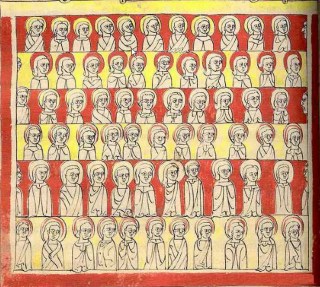
Apocalypse of Lorvao. Wimimedia Commons public domain US

The 144,000

Revelation 7:1-8 and Revelation 14:1-5 records that the Lord reserves 144,000 virgins and will supernaturally seal them from harm during the judgments of the Tribulation, in order to use them for His glory. They will evangelize the world during the Tribulation. Multitudes and myriad come to faith in Jesus Christ during this time, thanks to the supernatural energizing of these unmarried singles.

We, in the Christian church, perhaps in our day are not giving proper credit to those who, by the grace of God, have given themselves to a celibate or single life. The unmarried woman, for example, and the unmarried man who have given themselves to service for the Lord and have eschewed marriage; we should give them credit for what they have done. ~S. Lewis Johnson, Marriage Counsel III

Probably unmarried/virgin:

John the Baptist

The bible doesn’t say one way or another whether John the Baptist was married…he was in all probability a Nazirite but Nazirites were not forbidden to marry. Nazirite comes from a Hebrew word meaning “consecrated.” There were only two other lifelong Nazirites in the bible (Samuel and Samson) so it not unlikely that John was not married but consecrated for life to his task, which was forerunner of Christ. Though we can’t speculate too far, given John’s lifestyle of living in the desert, eating, locusts and honey, wearing camel hair, and being a Nazirite itinerant preacher completely submitted to Jesus, it is unlikely that he was married. (Matthew 3:1,4). Since before the foundation of the world, John was appointed forerunner of Christ. It seems as if it is not too presumptuous to say he was unmarried so that his attention would not be divided.

Daniel

Daniel 1:3, 7-9 alludes to the fact that when taken captive, Daniel might have been castrated and become a eunuch.

In Daniel 1:3, Daniel, Hananiah, Mishael, and Azariah (known by the Babylonian names Belteshazzar, Shadrach, Meshach, and Abednego) were put under the care of Ashpenaz, the chief of the saris. The Hebrew word saris is translated as “eunuch” and “court official.” It does not always refer to one who has been made a eunuch. Potiphar is called an Egyptian “saris” in Gen 39:1, yet he was married. It is unclear whether he was also a eunuch. Despite this devastating turn of events, Daniel possessed an unwavering faith in God. In Ezekiel 14:14–16, he stands with Noah and Job as the three men God commended for their righteousness. Daniel obeyed God in matters from dietary cleanliness to daily worship, and he proclaimed to everyone—at great peril—that God is above all. Source: Faithlife Study Bible, JD Barry.

Lydia

This woman ran a profitable business and had a home large enough to accommodate the entire missionary team. (Acts 16:14, 15, Acts 16:40). No husband is mentioned in association with ‘Lydia’s business’ and ‘Lydia’s household’ so it was likely she was single via widowhood. She provided a safe haven for Paul and his mission team time and again, in loving hospitality so they could rest and recover. Her home is where Paul and Silas went after being released from prison, and it was there the brethren received solace and encouragement. Baumgarten says,

“This assembly of believers in the house of Lydia was the first church that had been founded in Europe”.

Of Marriage and singleness in general, S. Lewis Johnson remarked,

I never quite understand why married people who have the comforts of home often speak in a disparaging and unkind way of unmarried people. It should be that if marriage is so delightful, that married people would speak in a very tenderness and — tender and sympathetic way of people who have not married. But instead of that, they speak sometimes in such a contentious way. I never like to hear people say, “Oh she’s just an old maid’ or “he is just an old bachelor.” Wait a minute! He whom you so designate may be glorifying the Lord in a way he could not have done if he were the head of a household and she of whom you speak, may be one who is rendering wonderful service to God and humanity. I repeat, some of most devoted Christians I have ever know have been unmarried men and women who gave themselves holy to the work of the Lord Jesus Christ. All honor to them. I agree with that. ~S. Lewis Johnson, Marriage Counsel III

Wikipedia

In modern times we can point to many people who chose to remain unmarried for the sake of the kingdom, like Pastor John Stott, for example, who was single all 90 years of his life and served the Lord actively as pastor for 65 of them. Some chose to stay unmarried after the death of a spouse, Rachel Saint, for example. MacArthur says of Mrs Saint,

Rachel Saint served as a single missionary among the Auca Indians of Ecuador for many years without companionship. She poured out her life and her love to the indians and found great blessing and fulfillment. (source)

S. Lewis Johnson said of single missionaries,

Many of the missionaries who have gone out from the shores of the United States have been women missionaries who’ve gone out, spent their lives in heathen lands and the jungles, and in the countries where things are not nearly so nice as the United States of America, and have been responsible for many, many people having an opportunity to hear the Gospel of the Lord Jesus Christ. I’ve known of some who have gone to Mexico, translated the language of tribes themselves and then written the Bible for them, so to speak, translated it, and made it possible for people to have the Bible in their own language. What a marvelous ministry. And when you remember that we are here just a short time and eternity is fairly long, you can see what a marvelous choice has been made by some people to not be entangled in marriage.

Whether God has destined a mate for you, or has consecrated you to Himself as an unmarried/single earlier than eternity, His glory always shines through His people when we submit all to Him. Whether married or unmarried, single temporarily or permanently, we are His children, loved perfectly and endowed with His Spirit to do His work. We have all been gifted, and when we look upon each other, we should not see married or single, at odds in misunderstanding or apprehension, but equally gifted individuals co-laboring for Christ’s name and His glory.

Joyful in Singleness part 1
Joyful in Singleness part 2

Joyful in Singleness part 4 conclusion: Personal Note and Opinion


Posted in celibacy, encouragement, glennon doyle melton, paul, singleness

Joy in Singleness, part 2: Gifted to live singly for Jesus

Joy in Singleness part 1 
Joy in Singleness, part 3: Famous biblical singles
Joy in Singleness part 4 conclusion: Personal Note and Opinion 

While some singles are waiting impatiently for God to change their circumstance,
other singles are not walking in a fog of depression but joyfully serve from His gift

Singleness in the church today. Singleness in the Body Christ is forming for His glory. Though there is a heavy focus on married couples in preaching, ministering, and fellowship life, there are single people in the church. We know this by the data the Census and the Christian church demographics. Yet as the number of singles in the church increases, churches are increasingly either unable or unwilling to minister effectively to this normal segment of the family of Christ.

Many single people report that they feel left out, overlooked, or worse, are treated as second-class citizens in church life.

This is part two of a three part series on being single in today’s Christian church. I’d said yesterday in part one that we can drill down even further into examining what the Bible has to say about being single. In my view, there are two branches of singles. Some people are single because they are going through a life phase in God’s timing where marriage hasn’t happened for them yet, or they were married and are now widows or widowers, perhaps to marry again. Others are temporarily single as spouses serve in the military, work far away, or are incarcerated. I’m not discussing these singles, these precious folks who know that God will provide a mate for them.


The other type of single today are men and women Jesus calls and ordains as single permanently. It’s the divinely ordained singles I’ll discuss. These are modern-day ‘eunuchs’, as Matthew 19:12 illustrates. The Bible directly teaches the gift of singleness, the status whereupon Jesus is forming people for His glory who will never marry, or if they were married, will never marry again. Rarely does preaching, ministry, or church fellowship reflect this biblical reality.

In this part I’ll look at what the scriptures have to say generally about singleness. In part 3, the last part, I’ll look at specifically named single individuals in the Bible and their work for the glory of Jesus.

In dividing singles into the two branches, the temporarily single as a phase of life and the sovereignly, ordained single as a permanent status, it allows churches to edify each by uniquely focusing on their special gift or need. Teaching about the gift of singleness also honors the Word of God as we preach or teach about this segment of our family demographic from scripture. The Bible specifically addresses the ordained single- but these verses seem to be invisible in today’s preaching and as a result, these folks are often invisible also.

But this demographic certainly was not invisible in the Bible! Yet with article titles like these,
–Why So Many Singles?
–Surviving Church as a Single
–Are Singles the Lepers of Today?

Is it any wonder many permanent singles wonder where and how to minister to the Body and honor Jesus in church?

Julia Stager at Randy Alcorn’s Eternal Perspective Ministries wrote,

I’ve always felt encouraged by how singleness is addressed from the pulpit. I hear how, being single, I have the opportunity to love and serve God in a way that’s undivided and different from how I can do it when I’m married. But things get a little more challenging in the foyer. It’s there I hear things like, “So, have you started dating anyone?” Or, “Whatever happened with you and that guy?” Or, “You’re so great. I can’t believe you’re not married!” These questions, though well-meaning, can come across as invalidating my singleness or as insinuating that the only goal of singleness is to end it.

John Stott, Wikipedia photo

The entire chapter of 1 Corinthians 7 focuses on marriage, singleness, lust, celibacy, and the duties of each person whether married at the time or not. Above all, one should understand that some people today in the body of Christ have been gifted with singleness. God has given a gift to the person and by extension to His Son’s Body. Acknowledging this is paramount, an important step in puncturing church conceptions about permanent singles. Not to say some singles are better than anyone else, but simply to say that their lifestyle has been given them by Holy God and that ministering through this gift will bring blessing to His body of believers that seems uncommon today.

The great preacher John Stott was single for 90 years. His period in office was 1945–2010. He was interviewed specifically about singleness, in this article appearing just after his death in 2011.

We must never exalt singleness (as some early church fathers did, notably Tertullian) as if it were a higher and holier vocation than marriage. We must reject the ascetic tradition which disparages sex as legalized lust, and marriage as legalized fornication. No, no. Sex is the good gift of a good Creator, and marriage is his own institution.

If marriage is good, singleness is also good. It’s an example of the balance of Scripture that, although Genesis 2:18 indicates that it is good to marry, 1 Corinthians 7:1 (in answer to a question posed by the Corinthians) says that “it is good for a man not to marry.” So both the married and the single states are “good”; neither is in itself better or worse than the other.

We know marriage is a gift from God. In 1 Corinthians 7:6-7, Paul specifically addresses singleness as a gift for some.

Now as a concession, not a command, I say this. I wish that all were as I myself am. But each has his own gift from God, one of one kind and one of another.

John MacArthur said in his commentary on 1 Corinthians 7:6-7,

His comments were not meant as a command for every believer to be married. Marriage was instituted by God and is the norm for man-woman relationships, and it is a great blessing to mankind. But it is not required for believers or anyone else. His point was, if you are single, that is good, if you are married or get married, stay married and retain normal marital relations for that is of God. Spirituality is not determined by marital status.

This biblical truth is countered and overshadowed by “Christian” writers who unfortunately have much influence, especially over young women. Mommy bloggers like Glennon Melton who claim to be a ‘truth teller and hope spreader’ wrote in her oddly titled “Ways to Secure your Happyish Ever After“,

“Marriage is still the best chance we have to become evolved, loving people.”

Source

Of course it is not true, as we see in the scripture above. Sadly, Melton’s insinuation is not uncommon, that if one is not married, one cannot become “evolved” or become loving. Yet it is the Spirit Who grows us (if that is what is meant by ‘evolved’). Further, it is the Spirit Who delivers the spiritual fruit of love. (Ephesians 5:9, Galatians 5:22). Marriage is a God-given institution but it is not the marriage itself that grows a Christian into maturity. MacArthur commentary continues,

The attitude among Christians today about singleness, however, is often like that of the Jewish tradition in Paul’s day. It is looked upon as a second class condition. “Not so,” says the apostle. If singleness is God’s gift to a person, it is God’s will for that person to accept and exercise the gift. If that person is submissive to God, he can live in singleness all his life in perfect contentment and happiness.

Yet sadly it’s often other believers who seem discontent for the content single, a concern that deepens the more the contented single asserts his or her state of unmarried peace. Jesus spoke acceptance of singleness in Matthew 19:12.

For there are eunuchs who have been so from birth, and there are eunuchs who have been made eunuchs by men, and there are eunuchs who have made themselves eunuchs for the sake of the kingdom of heaven. Let the one who is able to receive this receive it.

Here, Jesus classifies the 3 kinds of single/celibate persons. There is the one who was born with congenital deformities or other diseases which make marital relations impossible and conceiving children nonviable. Others have been made that way by men. In the Bible times, men were purposely castrated if they were destined to work in a harem, for instance, or as a court administrator, as we read in 2 Kings 20:18, Esther 2:3, or Acts 8:27. The Lord’s care for those who were born or made eunuchs was stated in Isaiah 56:3b-5, where God welcomes all believers, without distinction of persons, under the new economy of salvation-

Philip & the Ethiopian Eunuch. Source

and let not the eunuch say, “Behold, I am a dry tree.” For thus says the Lord: “To the eunuchs who keep my Sabbaths, who choose the things that please me and hold fast my covenant, I will give in my house and within my walls a monument and a name better than sons and daughters; I will give them an everlasting name that shall not be cut off.

dry tree—barren (compare Lu 23:31); not admissible into the congregation of Israel (De 23:1–3). Under the Gospel the eunuch and stranger should be released from religious and civil disabilities. (Source: Jamieson, Fausset, Brown, Commentary)

How comforting God is when announcing that those who are not by their own choice unmarried, childless, celibate eunuchs will be given a monument and a name. Their marital and family status were a lament to them but they still sought God’s glory and chose the things that pleased Him. What comfort and care He gives to the person who is made eunuch through no act of their own. What a Godly example given to show that no matter what the physical state of a person or their marital status, one can and should seek the things that please the LORD.

Singleness is not my identity. I don’t want to be separated from the Body of Christ based on my marital status.” SourceThe New Testament verse in Matthew 19:12, Jesus said there was a third kind of eunuch, “and there are eunuchs who have made themselves eunuchs for the sake of the kingdom of heaven. Let the one who is able to receive this receive it.

What kind of single/celibate person is this? MacArthur explains in his commentary,

Unlike the other two forms, this one is not physical…Jesus is speaking of voluntary celibacy of those to whom the gift has been granted by God (v. 11). In that case, celibacy should be used for the sake of the kingdom of God and be pleasing to Him and used by Him. Paul had the gift of celibacy and strongly exhorted others who had the gift to be content with it and use its obvious advantages for Gods glory. (1 Corinthians 7:32-34).

You may have noticed I shifted from discussing divinely given permanent singleness to the topic of celibacy. That is because the two are entwined. One cannot be without the other. If you are single, you are to be celibate. Outside of marriage, celibacy is a mandate from God. We are NOT to be fornicators. (1 Corinthians 6:9, Hebrews 13:4, 1 Corinthians 5:9, 1 Timothy 1:10, 1 Corinthians 5:10, Revelation 21:8). Whether young or old, virgin or widowed or divorced, we are to be chaste. (1 Timothy 2:2, 1 Timothy 5:2, 1 Timothy 4:12, Galatians 5:23, 2 Corinthians 6:6

God provides. God sustains. If He gives to some the gift of singleness, would He not also provide the strength to refrain from lust and remain chaste for His name? MacArthur’s commentary again,

Although celibacy us good for Christians who are not married, it is a gift from God that is not given to every believer. Just as it is wrong to misuse a gift we have, it is wrong to try to use a gift we do not have. For a person who does not have the gift of celibacy, trying to practice it brings moral and spiritual frustration. But for those who have it as God’s gift, singleness, like all His gifts, brings great blessing.

Both Jesus and Paul make it clear that the celibate life is not required by God for all believers and that it can be satisfactorily lived only by those to whom God has given it.

These folks are a great blessing to the church. I don’t say that because I am one, lol. I am single, childless and have a job where I have time to focus on kingdom work to a degree other church members may not be able to. This is both my choice and God’s ordination. It’s a chicken and egg situation. Yet my married brethren are rearing children for His name and leading and teaching us, so their kingdom work is equally valuable as mine or anybody else’s! We are a body, each formed uniquely as a snowflake, spiritually given gifts in unique hues to benefit each other and most importantly, Jesus.

God’s care for the celibate, permanent single is obvious from scripture. Singles of any kind are not second class citizens, nor are they in a waiting room for marriage (read: maturity and acceptance). Jesus does not look at us that way and nor should the church. Celebrate His diversity in installing people in the Body from all demographics to labor for His good and glory.

Final part: looking at named and unnamed singles in the Bible and their work for God. And lots of quotes from S. Lewis Johnson!

Joy in Singleness part 1 
Joy in Singleness, part 3: Famous biblical singles
Joyful in Singleness part 4 conclusion: Personal Note and Opinion

~~~~~~~~~~~~~~~~~~~~

Further Reading

Though this article still makes the assumption that all singles are going to be married, I can forgive it because many singles ARE going to be married. However for the permanent single, there is good advice for you here too
Desiring God: Single, Satisfied, and Sent: Mission for the Not-Yet Married

Christianity Today: John Stott on Singleness 

Biblical Christian Counseling Coalition: Single in the Church

GotQuestions: Does the Bible teach that there is a gift of celibacy/singleness?

Singled Out: Does the Church Ignore Singles?

Life does not begin at marriage. Life begins in the exact moment when we submit ourselves to Christ and make Him Lord, when the Holy Spirit comes to dwell within us and take residence within us.

Posted in church life, marriage, ministry, single ladies, singleness

Joy in singleness, though you’d never know it by Christian social media or church life. Part 1

 Joy in Singleness, part 2: Gifted to live singly for Jesus
Joy in Singleness, part 3: Famous biblical singles
Joyful in Singleness part 4 conclusion: Personal Note and Opinion

I am currently reading through and studying 1 Corinthians. In 1 Corinthians 7, Paul outlines responsibilities of life to marrieds & singles, and mentioning young men, virgins, and widows. It is a great chapter. Paul is specific, loving, and clear, focusing on marriage, lust, and conjugal duty.

Marriage is the foundation block of society, procreation is strongly urged, (Genesis 1:28, Genesis 9:7, Psalm 128:3, Proverbs 31:27), and divorce is considered a violent act, (Luke 16:18; 1 Corinthians 7:15; Matthew 5:32; Matthew 19:6,8; Genesis 2:24). As a matter of fact, unauthorized divorce prohibits men from serving in leadership capacity, (1 Timothy 3:2) so it is no wonder that churches spend a good deal of time preaching to and discipling marrieds. There are many marriage retreats, books, Sunday School curricula, and sermons given over to the subject. This is a good thing.

Marriage, the Bible tells us from the beginning of the Book of Genesis, is a divine institution. That is, it is something established by God. It is a covenant that is given by God and for that reason it is traceable to him. It has also been consecrated by him, for he has blessed the marriage relationship. And, of course, it’s the means of the preservation of the human race. ~S. Lewis Johnson, Marriage Counsel, part 1

 However oftentimes so much attention is given to married couples and their issues, that an overly myopic focus descends upon any given church that leaves the other half of the population out. There are young unmarried men and women, honorably divorced folks, and widows and widowers. Because of the excessive focus on marriage and married Christians’ concerns, one would be led to believe the entire church was composed of couples. But it is not so.

Census data from 1970 show that 70 percent of American households contained a married couple. The 2006 report from the Census Bureau disclosed that fewer than half of American households are now maintained by married couples. Eye on Unmarried America

In this series I’ll focus on singleness, its joys, benefits, church life, and ministry and civic opportunities. There are several kinds of singles: singles who are frustrated in the waiting for what they know will be God’s gift of marriage to them, or who have had that gift and are now widows or widowers and are grieving the loss. Some in today’s world are temporarily single also by the fact that their spouse is serving overseas, working far away, or are incarcerated. (Yes it happens). For these singles, a different kind of ministry is needed. Many of these people desire comfort and love and support as they yearningly await a change in their marital status.

Those aren’t the singles I am discussing. I’ll address the fact that even if some singles are acknowledged and gasp! ministered to, not all singles are in a waiting room for marriage. Some, like me, know they will be single forever, and are happy with that gift. Yes, gift. Rarely is the gift of singleness discussed in the church, or even preached about, looked upon as an enhancement to the Body, let alone acknowledged as a normal segment of the family He is creating.

Churches are so committed to the idea of a family-centered church that they’re just not sure how to handle rising rates of singleness. “Are Single People the Lepers of Today?

Further, I’ll reject the subtle cloud that usually attaches to a discussion of singles: depression, sadness, longing. There are singles out there which God has granted a life of joy and fulfillment, with nary a search for the soul mate in sight but only having eyes for the Groom.

For there are eunuchs who have been so from birth, and there are eunuchs who have been made eunuchs by men, and there are eunuchs who have made themselves eunuchs for the sake of the kingdom of heaven. Let the one who is able to receive this receive it. (Matthew 19:11)

~~~~~~~~~~~~~~~~~~~~~~~~~~~~~~

 Joy in Singleness, part 2: Gifted to live singly for Jesus
Joy in Singleness, part 3: Famous biblical singles
Joyful in Singleness part 4 conclusion: Personal Note and Opinion

Posted in brethren, commentaries, encouragement, gift

Look what came all the way from California today! Updated

I like to study the Bible. I like history, culture, commentaries, natural history, dictionaries, Greek and Hebrew lexicons…anything to help me understand God’s word better.

Of course, there is no substitute for studying God’s word directly in submission to the Spirit who illuminates it…in prayer and in a spirit of truth and repentance.
I found two large boxes leaning against my door.
So glad I am on vacation and could retrieve them immediately.
There is no covering or porch to deliver them to and weather is a factor.

However God raised up men throughout each age to help us. Some were preachers, some were scholars, some were professors, some were students…but God raises up men to help us learn His word. We are grateful to the Apostles, Augustine, Hus, Calvin, Luther, Edwards, Clarke, Gill, Henry, Spurgeon, Warfield, S. Lewis Johnson and many, many more who have left behind a written legacy of a lifetime of depth in God’s scripture. We know we benefit from their evangelical and pastoral labors, but we also benefit from their scholarly labors too.

One of these men God has raised up for this generation is John MacArthur. After 35 years of writing and a decade beyond that of preaching, Dr MacArthur completed his New Testament Commentary Series. Upon completion of verse-by-verse explanations of each book of the NT, he and his team have made the commentary available for an incredible price for a limited time.

A lot of books!

A dear, generous brother in the faith contacted me and offered to subsidize part of the sale price, and after thinking about it and prayer, I said yes. Otherwise I’d never have been able to purchase this resource for my own study.

It arrived today, 33 volumes, 3 feet 4 inches of towering knowledge. I live in a 400 square foot apartment and my four bookcases are full. When I ordered the set, I figured I’d cross that bridge when I came to it, and now that day is here. After pondering and looking around and re-arranging, I will later install these wonderful books onto my bookshelves, readily accessible and waiting to be absorbed into my daily studies.

The brother who sent me the donation said it was an investment. We are a body, united through Christ and His blood, death, and resurrection, our old men have been put to shame and death and the new man is growing in each of us. When we all use our gifts to the good of the Body and the glory of Christ, we all benefit. He believed it would benefit the body to ensure I had access to this study aid. How encouraging to be thought of. How wonderful to be given a gift.

I’m humbled by this, and I also take the responsibility seriously. I’m grateful for the opportunity to deepen my study and to be reminded every day when I look at the books, that we are not alone, none of us. What one person does affects us all, to the bad and to the good. I pray I use this gift wisely to the good and glory of the Name who made it possible to be in His body at all, and to have the mind of Christ. (1 Corinthians 2:16).

Sorry kitties, your hidey-hole has got to go.
I need the space now

UPDATE

It took some doing and a bit of culling but I fit it all. I moved several bookcases of books around and had to put away my rocks, gems, geodes and fossils that had been displayed on the shelves of a smaller bookcase. That was not too sad because I’d had to put them all in jars anyway and push them to the back of the shelf because in the wee hours Murray flung them off their decorative dishes and bashed them all around the house. A fossil shell survived the Flood but not the cat. I put them up until he gets older. That freed four shelves and it was just enough.

But in so doing I had an opportunity to re-group my books by subject and size. (Yes, I’m that way). I also cleaned the bookcases since they were emptied. Amazing how much dust collected. All my theological and bible books are together and grouped by subject. I know I’m going on about this but change is hard, even for a good thing. I sit in my wing chair sometimes and simply look at my books on the shelves. (Yes, I’m that way).

Of the half shelf of new MacArthur Commentaries I could fit all my older commentaries on the rest of the shelf. I’ve got commentary on Ecclesiastes, three on Revelation, Daniel, Corinthians, Peter and a few others. Here is how it looks now.

The top shelf is Italy, Renaissance, Art and poetry. The rest is given over to theology, dictionaries, and Christian/missionary biographies.

On my other shelves I’ve got Native American and Border issues, Mythology, classics such as The Peloponnesian war, Socrates, and Tacitus, some medieval diaries and castle stuff, and half a shelf on natural history including field guides to mammals and shells, Stephen Jay Gould and Farley Mowat. A few novels round out the newly freed up shelves with some favorites including “How Proust Changed My Life”, Isabel Allende, etc.

Spring break is here, but summer’s coming! Plenty of time to read and study. Time Enough at Last

Posted in architecture, church, encouragement, new testament, temple

Of church buildings and temples

I’m reading 1 Corinthians 6. The verses at the end of the chapter, 19-20 are as follows:

EPrata photo

Or do you not know that your body is a temple of the Holy Spirit within you, whom you have from God? You are not your own, 20for you were bought with a price. So glorify God in your body.

We are familiar with that passage and no doubt can quote it. In this portion of the chapter Paul is urging the sexually aware and culturally lascivious Corinthian believers to forgo sexual immorality. He said that because the Holy Spirit is inside us, and that we are living temples of Christ, when we sin sexually we make Christ complicit in it in a way that no other sin does. (1 Corinthians 6:15).

In reading my commentary by John R. Rice, he went further in explaining. His focus in this paragraph is not on the body in which the Spirit dwells, making it the temple of God, but on buildings.

What’s in a church building? If you’re an Old Testament worshiper, everything, absolutely everything. If you are a New Testament worshiper, nothing. Absolutely nothing.

EPrata photo

We know that God spent an inordinate amount of ink and inspiration in the Old Testament recording the specifics of the Tabernacle, and later, the Temple’s construction. We have an excellent idea of what they both looked like because of the monumental meticulousness in the OT regarding its dimensions, specifications, and adornments. Some of this information can be read in 1 Kings 5-6, 2 Chronicles 2, Exodus 38, and so on.

The Disciples looked upon the temple in Mark 13:1 and exclaimed over its majestic beauty. There is even much ink given to the construction, location, and adornments of the Temple in the Millennium Age (Ezekiel 40-41), even down to the number of cubits wide each door will be. Revelation 11:19 even mentioned God’s temple in heaven opened up and the ark of the covenant being there.

But did you ever wonder why in all the New Testament, no specificity or even reference is given over to the construction, location, adornments of any church building? None whatsoever?

Here is John R. Rice:

It is significant that not a single church building is mentioned in the New Testament. Were there any church buildings? If so, God was particularly careful that no one should revere or honor them. God does not live in church houses. Many a home where Christians pray and read God’s word and delight in His presence is more nearly a house of God than the church house. It is wrong, then, “to speak of reverence for the house of God.” We should respect the rights of other people. We should see that services are decent and in order, without confusion. We should respect the man of God. But God has no temple on earth but a human body… ~John R. Rice, The Church of God at Corinth: Commentary in 1 and 2 Corinthians, 1973

EPrata photo

We note that the disciples met in the Upper Room after the crucifixion (Acts 1:13, Acts 20:8). When Apollos was expounding in the synagogue, Priscilla and Aquila took him aside to explain the Way more accurately. The verse doesn’t say where they took him, just “aside.” In Acts 19:1 Paul arrived at the interior of Ephesus and found some believers there. The verses don’t say where. We know that early believers initially met in massive numbers in the outer court of the temple. (Acts 2:46). After Paul’s discipleship grew, he quit the synagogue and reasoned “in the lecture hall of Tyrannus” for two years. (Acts 19:9).

We read in Acts 11:25-26 that

And he left for Tarsus to look for Saul; 26and when he had found him, he brought him to Antioch. And for an entire year they met with the church and taught considerable numbers; and the disciples were first called Christians in Antioch.

EPrata photo

Here Paul stayed a year, but again, no big deal is made of the building or place where they met. The church grew hugely, in fact this was where the followers of the Way were first called Christian, and yet…biblical silence on the building or specific location where this happened.

There were house churches. Peter stayed with Simon the Tanner in Joppa (Acts 10:6), believers were gathered at Mary’s house to pray (Acts 12:12), Lydia had a house church, (Acts 16:40), and so did Aquila and Priscilla (Romans 16:3,5; 1 Corinthians 16:19). Nympha hosted a church at her house, (Colossians 4:15). Philemon and Apphia had a house church. (Philemon 1:1-2).

We have absolutely no idea as to the size of these house churches, how regularly they gathered, what their gatherings were like.

EPrata photo

What we do know is that the early believers met in homes, lecture halls, the great outdoors, stadiums, synagogues, wherever they could. Even at the end of the New Testament when Jesus dictates His letters to the seven churches at Ephesus, Smyrna, Pergamum, Thyatira, Sardis, Philadelphia, and Laodicea they must have had a known building since presumably the letter-carrier would have known where to bring the letter. Yet we do not have any specificity of the 7 churches’ size, dimensions, adornments, etc., unlike the Old Testament’s attention to the details of the worship house.

This is because WE are the temple.

Churches today meet in rented school gymnasiums, storefronts, homes, brick buildings with steeples, clapboard structures large and small, majestic buildings, traditional edifices with bell towers, or simple square humble dwellings. It doesn’t matter what the building looks like as long as the temple of people that are gathered are holy and worshiping in spirit and in truth.

Or own church was founded in 1892 and is brick with bell tower, with solid wooden pews, hymn-holders, red carpet, tin ceilings, a pulpit and other traditional architecture. I love it. I’m comfortable there. I love the tradition and solidity of the permanent location of a place that’s immediately recognizable as “worship place.” Yet our church voted to move to a larger facility down the road which is currently a factory by day. The Youth meet there every Wednesday night, and we hold special events intermittently there as we make the transition.

The Old Testament is loud and noisy about the Tabernacle and the Temple. The New Testament is silent on church houses. The obvious variety of the structures in which they met isn’t the point. The point is that they, being the temple of God, met. And they did so continuously, joyously, even when persecution came. They gathered, prayed, baptized, learned, exhorted and proclaimed the Good News from lecture halls, homes, stadiums, hillsides, and temple courts. They met, these people who are the temple of God, they met. The building does not matter. We are His temple. This is what matters-

And the word of God continued to increase, and the number of the disciples multiplied greatly in Jerusalem, and a great many of the priests became obedient to the faith. (Acts 6:7)

Posted in grace, mighty, prophecy, resurrection, risen

He is risen!

The Righteous Reign of the Branch
There shall come forth a shoot from the stump of Jesse,
and a branch from his roots shall bear fruit.
And the Spirit of the Lord shall rest upon him,
the Spirit of wisdom and understanding,
the Spirit of counsel and might,
the Spirit of knowledge and the fear of the Lord.
Isaiah 11:1-2