Posted in how to disagree, incivility, rudder

How to Disagree: Paul Graham’s Disagreement hierarchy

How to Disagree

Paul Graham wrote the essay How to Disagree in 2008. An illustration accompanies it. Our Christian behavior extends to all aspects of life, public and private. (Colossians 3:17). This includes behavior online. Yet sometimes online conversations turn nasty, angry, snarky, sarcastic, or just plain offensive pretty quickly. I’m guilty of this too.

I’m old enough to remember when civility meant something. I’m also old enough to remember life without the internet. The ability to have online discussions with people across the globe is a thrilling thing. People who were out of reach before have suddenly become accessible. Tweeting celebrities, reacting to a famous scientist’s Facebook wall, posting on a renowned theologian’s blog, it’s all possible now. It’s great fun and intellectually challenging, but the downside to online conversation is incivility. Anonymous uncivil behavior is the worst.

The presentation of theological topics, doctrines of all kinds, and spiritual ideas online is a way to disseminate truth quickly but it’s also a way to disseminate lies. How are we to disagree? Sometimes people who disagree with something I’ve written in one of my posts simply send invective or profanity. Sometimes people are angry and in my attempts to calm them down, I urge them to use scripture. When I do this and it’s a false convert, they simply send more invective and never the scripture.

Mature Christians aren’t immune to the dangers of sinning while disagreeing online, either. The tongue is a rudder.

So also the tongue is a small part of the body, and yet it boasts of great things. See how great a forest is set aflame by such a small fire. (James 3:5)

Seven years ago, Mr Graham made the observation that

But though it’s not anger that’s driving the increase in disagreement, there’s a danger that the increase in disagreement will make people angrier. Particularly online, where it’s easy to say things you’d never say face to face.

I’ve managed or edited online and real life forums since 2001. I have noticed a marked increase in anger. People don’t know how to disagree any more. Particularly of late, the instant go-to response seems to be anger, with no conversational build-up from perplexity to disagreement to questioning to ire to offense to anger. No more.

Person A makes a statement and Person B fires all missiles, profanity, invective, and wrath toward Person A as the first response. A few years ago at least we lolled in the ‘I’m offended’ territory. Nowadays quite often it’s just a great divide- either a no-comment policy or comments that include anger with no discussion or give-and-take in between.

Not that there’s NO good discussion. I find many forums and comment streams that are civil and informative. I appreciate the people on this blog who read and comment kindly even when disagreeing. The comment stream administered by the folks at Grace to You (gty.org) is wonderful. But they do take time as anger increases and civility falls by the wayside, many bloggers are turning off comments. I noticed even Challies turned off the comments recently.

I thought it might be helpful to post the hierarchy of disagreement. For people who engage in apologetics or online discussions of any kind, but especially theology, it might help to be able to spot when someone is just contradicting without grounds and when a person seems able to continue in a civilly disagreeing vein. For those who run blogs, forums or any kind of online presence as Admin to comments, maybe this will help you when you’re trying to decide whether a comment should be allowed, or deleted.

As a former editor of a newspaper and also of an online anonymous forum since 2001, and having kept blogs since 2006, I use the following general questions when deciding to allow or delete a comment:

Does it advance the question, or muddy it?
Is it on topic?
Is the comment longer than the original essay?
Does it present new information or is thought-provoking in some way?
Do they use scripture?
Do they use scripture correctly? (For example, I always delete the comments that simply say “Judge not!” etc.)
Does the tone seem sincere? Or are they combative? If someone’s first reply contains sarcasm or snark, I usually don’t allow the comment.
Do they sign their name? I allow anonymous comments. I understand that people online can sign any name, but at least it is an attempt to be real. And I truly appreciate really real people. Alternately, there’s something about people using my name but they choose to remain anonymous that always puts my radar up. “Ms Prata, you are terribly wrong about this…Anonymous”.

No doubt as Admins of your own section of the net, you have your own policies, standards, and benchmarks. No doubt when you comment or reply on various forums etc you can and do behave maturely and don’t slip and let that rudder get out of control. But just in case, here is some food for though I believe is well-stated and interesting.

For His Glory.

A triangular graphic representing a “hierarchy of disagreement” from clear refutation to mere vituperation, based on the essay “How to Disagree” by Paul Graham, posted below.

The web is turning writing into a conversation. Twenty years ago, writers wrote and readers read. The web lets readers respond, and increasingly they do—in comment threads, on forums, and in their own blog posts.

Many who respond to something disagree with it. That’s to be expected. Agreeing tends to motivate people less than disagreeing. And when you agree there’s less to say. You could expand on something the author said, but he has probably already explored the most interesting implications. When you disagree you’re entering territory he may not have explored.

The result is there’s a lot more disagreeing going on, especially measured by the word. That doesn’t mean people are getting angrier. The structural change in the way we communicate is enough to account for it. But though it’s not anger that’s driving the increase in disagreement, there’s a danger that the increase in disagreement will make people angrier. Particularly online, where it’s easy to say things you’d never say face to face.

If we’re all going to be disagreeing more, we should be careful to do it well. What does it mean to disagree well? Most readers can tell the difference between mere name-calling and a carefully reasoned refutation, but I think it would help to put names on the intermediate stages. So here’s an attempt at a disagreement hierarchy:

DH0. Name-calling.

This is the lowest form of disagreement, and probably also the most common. We’ve all seen comments like this:

“u r a fag!!!!!!!!!!”

But it’s important to realize that more articulate name-calling has just as little weight. A comment like:

“The author is a self-important dilettante.”

is really nothing more than a pretentious version of “u r a fag.”

DH1. Ad Hominem.

An ad hominem attack is not quite as weak as mere name-calling. It might actually carry some weight. For example, if a senator wrote an article saying senators’ salaries should be increased, one could respond:

“Of course he would say that. He’s a senator.”

This wouldn’t refute the author’s argument, but it may at least be relevant to the case. It’s still a very weak form of disagreement, though. If there’s something wrong with the senator’s argument, you should say what it is; and if there isn’t, what difference does it make that he’s a senator?

Saying that an author lacks the authority to write about a topic is a variant of ad hominem—and a particularly useless sort, because good ideas often come from outsiders. The question is whether the author is correct or not. If his lack of authority caused him to make mistakes, point those out. And if it didn’t, it’s not a problem.

DH2. Responding to Tone.

The next level up we start to see responses to the writing, rather than the writer. The lowest form of these is to disagree with the author’s tone. E.g.

“I can’t believe the author dismisses intelligent design in such a cavalier fashion.”

Though better than attacking the author, this is still a weak form of disagreement. It matters much more whether the author is wrong or right than what his tone is. Especially since tone is so hard to judge. Someone who has a chip on their shoulder about some topic might be offended by a tone that to other readers seemed neutral.

So if the worst thing you can say about something is to criticize its tone, you’re not saying much. Is the author flippant, but correct? Better that than grave and wrong. And if the author is incorrect somewhere, say where.

DH3. Contradiction.

In this stage we finally get responses to what was said, rather than how or by whom. The lowest form of response to an argument is simply to state the opposing case, with little or no supporting evidence.

This is often combined with DH2 statements, as in:

“I can’t believe the author dismisses intelligent design in such a cavalier fashion. Intelligent design is a legitimate scientific theory.”

Contradiction can sometimes have some weight. Sometimes merely seeing the opposing case stated explicitly is enough to see that it’s right. But usually evidence will help.

DH4. Counterargument.

At level 4 we reach the first form of convincing disagreement: counterargument. Forms up to this point can usually be ignored as proving nothing. Counterargument might prove something. The problem is, it’s hard to say exactly what.

Counterargument is contradiction plus reasoning and/or evidence. When aimed squarely at the original argument, it can be convincing. But unfortunately it’s common for counterarguments to be aimed at something slightly different. More often than not, two people arguing passionately about something are actually arguing about two different things. Sometimes they even agree with one another, but are so caught up in their squabble they don’t realize it.

There could be a legitimate reason for arguing against something slightly different from what the original author said: when you feel they missed the heart of the matter. But when you do that, you should say explicitly you’re doing it.

DH5. Refutation.

The most convincing form of disagreement is refutation. It’s also the rarest, because it’s the most work. Indeed, the disagreement hierarchy forms a kind of pyramid, in the sense that the higher you go the fewer instances you find.

To refute someone you probably have to quote them. You have to find a “smoking gun,” a passage in whatever you disagree with that you feel is mistaken, and then explain why it’s mistaken. If you can’t find an actual quote to disagree with, you may be arguing with a straw man.

While refutation generally entails quoting, quoting doesn’t necessarily imply refutation. Some writers quote parts of things they disagree with to give the appearance of legitimate refutation, then follow with a response as low as DH3 or even DH0.

DH6. Refuting the Central Point.

The force of a refutation depends on what you refute. The most powerful form of disagreement is to refute someone’s central point.

Even as high as DH5 we still sometimes see deliberate dishonesty, as when someone picks out minor points of an argument and refutes those. Sometimes the spirit in which this is done makes it more of a sophisticated form of ad hominem than actual refutation. For example, correcting someone’s grammar, or harping on minor mistakes in names or numbers. Unless the opposing argument actually depends on such things, the only purpose of correcting them is to discredit one’s opponent.

Truly refuting something requires one to refute its central point, or at least one of them. And that means one has to commit explicitly to what the central point is. So a truly effective refutation would look like:

“The author’s main point seems to be x. As he says:
[insert author’s quotation here]
But this is wrong for the following reasons…”

The quotation you point out as mistaken need not be the actual statement of the author’s main point. It’s enough to refute something it depends upon.

What It Means

Now we have a way of classifying forms of disagreement. What good is it? One thing the disagreement hierarchy doesn’t give us is a way of picking a winner. DH levels merely describe the form of a statement, not whether it’s correct. A DH6 response could still be completely mistaken.

But while DH levels don’t set a lower bound on the convincingness of a reply, they do set an upper bound. A DH6 response might be unconvincing, but a DH2 or lower response is always unconvincing.

The most obvious advantage of classifying the forms of disagreement is that it will help people to evaluate what they read. In particular, it will help them to see through intellectually dishonest arguments. An eloquent speaker or writer can give the impression of vanquishing an opponent merely by using forceful words. In fact that is probably the defining quality of a demagogue. By giving names to the different forms of disagreement, we give critical readers a pin for popping such balloons.

Such labels may help writers too. Most intellectual dishonesty is unintentional. Someone arguing against the tone of something he disagrees with may believe he’s really saying something. Zooming out and seeing his current position on the disagreement hierarchy may inspire him to try moving up to counterargument or refutation.

But the greatest benefit of disagreeing well is not just that it will make conversations better, but that it will make the people who have them happier. If you study conversations, you find there is a lot more meanness down in DH1 than up in DH6. You don’t have to be mean when you have a real point to make. In fact, you don’t want to. If you have something real to say, being mean just gets in the way.

If moving up the disagreement hierarchy makes people less mean, that will make most of them happier. Most people don’t really enjoy being mean; they do it because they can’t help it.

Tim Challies: Using technology Wisely

Here is the 40 year old but still wonderful Monty Python’s Argument Clinic:

Posted in balaam, cain, discernment, jesus, jude, korah

Jude 1:11- The process of apostasy revealed

Woe to them! For they have gone the way of Cain, and for pay they have rushed headlong into the error of Balaam, and perished in the rebellion of Korah. (Jude 1:11 NASB).

In reading Jude this weekend, a new aspect of this verse jumped out at me. Notice within the verse, there is a progression. Jude found it necessary to contend for the faith and urge the saints to whom the letter is addressed to contend for the faith, and contend against “ungodly people who have crept in.”

Jude means people who are false Christians, and teachers who teach false doctrines. The ungodly always grow in satan and never grow in grace.

These ungodly people are not immediately noticeable. Why? They creep in. Creeping indicates stealth, a purposeful attempt at NOT being noticed. They do unseen damage to the faith meanwhile.

However they do not remain unnoticed forever. The ungodly are subject to a certain progression that is indicated in the Jude 1:11 verse.

First, they “go.” Going brings to mind John’s wonderful verse from 1 John 2:19.

They went out from us, but they were not of us; for if they had been of us, they would have continued with us. But they went out, that it might become plain that they all are not of us.

Here is Strong’s on the word “go” in Jude’s verse–

to go: 4198 poreúomai (from poros, “passageway”) – properly, to transport, moving something from one destination (port) to another; (figuratively) to go or depart, emphasizing the personal meaning which is attached to reaching the particular destination.

The very act of going (out from the faith into personal sin or loving the world, or both) indicates they are likely ungodly. I say likely because sometimes we have a person who wanders briefly, a prodigal. Sometimes someone persists in a sin for a short time and seems to be going, but repentance and grace brings him back. (James 5:19-20). That’s why it’s important to be patient with those who are sinning, and it’s why the Spirit-inspired the writers wrote about the actions to perform within the church to help that person. If a brother truly is a brother or a teacher truly is of God and you go through the actions that Matthew 18:15 or Luke 17:3 and other verses tell us to do, and they repent, they will grow in grace once again and will not leave the faith.

If the person refuses to listen and persists in their ungodly way it will become evident. Cain’s example is not brought up simply because he was the first human murderer. Cain’s murder of his brother occurred after an internal wandering from the truth and a probable unseen-by-Abel rebellion against God. However it was seething inside Cain. Genesis 4:3 and Genesis 4:5 shows us this. When God addressed Cain’s sin directly, and in our case today, if a brother or sister or pastor might bring it up to the person, Cain’s rebellion, anger, jealousy, and hatred of God came out and was seen in his talk and in his subsequent actions.

We should not be like Cain, who was of the evil one and murdered his brother. And why did he murder him? Because his own deeds were evil and his brother’s righteous. (1 John 3:12)

Pulpit Commentary says of the Jude verse–

As in 2 Peter 2:15, the darkest passages in the Old Testament history are again appealed to. While Peter, however, refers only to a single instance, Jude introduces three, and prefaces the whole by a Woe! such as the Gospels repeatedly attribute to Christ himself. Woe unto them! for they have gone in the way of Cain; rather, they went in the way of Cain. The phrase is the familiar one for a habitual course of conduct (Psalm 1:1; Acts 9:31; Acts 14:16, etc.).  

But what is the point of the comparison? Cain is supposed to be introduced as the type of murderous envy, of the persecuting spirit, or of those who live by the impulse of nature, regardless of God or man. In 1 John 3:12 he is the type of all that is opposed to the sense of brotherhood, the murderer of the brother whose righteous works are an offence to him; but in the present passage he is introduced rather as the first and, in some respects, the most pronounced example of wickedness which the Old Testament offers – a wickedness defying God and destroying man.

Sometimes if I bring up something to a person gently and lovingly, even though I’d posed it in the best possible way and have the best possible relationship with the person, they become angry. If the person accepts what I’m sharing and after prayer and searching the bible they repent, I have won my sister. This is a great feeling because to me it is visible evidence of the grace of the Spirit working in Jesus’ Body. If the person remains angry and in fact become even more harsh or lashes out, (like Cain did) I know there is a deeper sin there. Wasps are fine unless you poke their nest. Look for the immediate and the subsequent reaction to a correction, it is the more telling part of the process.

The second part of Jude’s process of go-rush-perish is the break point. After a person goes the way of Cain, they begin to rush. Some translations say rush headlong. Here, Strong’s defines the word more clearly for us in the Greek–

to rush: pour out, gushed (1), poured (5), rushed headlong (1), shed (3), spilled (1).

The picture that comes to mind of the pouring out is of a river that once was held back, but then breaches a dam, and spills out everywhere in a tumble of a powerful rush, leaving destruction in its wake.

Pulpit Commentary continues exposition of the Jude verse, now focusing on the rush to Balaam:

And ran greedily after the error of Balaam for reward. The “error” in view is a life diverted from righteousness and truth. The verb rendered “ran greedily,” or “ran riotously,” is a very strong one, meaning they “were poured out,” and expressing, therefore, the baneful absoluteness of their surrender to the error in question…

Here, Hebrews 6:4-6 helps us. For the ungodly person to have wandered from the truth and then rushed headlong into unrighteousness and darkness and finally and absolutely is revealed to have succumbed to error, evil and sin, they cannot come back.

For it is impossible, in the case of those who have once been enlightened, who have tasted the heavenly gift, and have shared in the Holy Spirit, 5and have tasted the goodness of the word of God and the powers of the age to come, 6and then have fallen away, to restore them again to repentance, since they are crucifying once again the Son of God to their own harm and holding him up to contempt.

We are not talking about Christians losing their faith. No one who is a true believer will ever lose their place in heaven. (2 Corinthians 1:22). We are talking about the unmasking of the ungodly. Those whom we thought for a time were truly righteously saved, who looked saved and who acted saved but who begin to wander from the truth, don’t self-correct via repentance and don’t  correct via a rebuke, and are seemingly suddenly not a believer anymore.

The final end of the people of which Jude wrote is that they perish. Here is the Strong’s definition of the word perish as it’s used in verse 1:11–

perish: 622 apóllymi (from 575 /apó, “away from,” which intensifies ollymi, “to destroy”) – properly, fully destroy, cutting off entirely (note the force of the prefix, 575 /apó).

Words like perish fully, entirely, and with force should engender a shudder from even the most mature and secure Christian. The fate of those who we decry, like Beth Moore, or Benny Hinn or Joel Osteen is a fate in which we derive no pleasure.

More to the point, for us today here are two take-away thoughts.

First as always we must check ourselves. Are we drifting from the Way?

For I have kept the ways of the LORD; I am not guilty of turning from my God. (Psalm 18:21)

When you pray, pray not only for the Lord to keep you in His statutes, but to keep you on the center line of His narrow Way!

Do not swerve to the right or to the left; turn your foot away from evil. (Proverbs 4:27)

Second, after checking ourselves, check your friends and loved ones. Are they turning from the Way? Are they, as Jude warned, ‘going’? If it is a matter of a temporary swerve, snatch them back as of from the fire, as Jude said in verse 1:23.

Speak openly and honestly about sin, judgment and hell, so that sinners can flee it. ~John MacArthur

Sin is a process, sometimes it’s a process leading to a revealed apostasy. Sometimes it is a process that leads to a revealed glory of the Lord as He brings a wayward one to repentance and restoration. Read Jude and camp on it for a while. I’ll end as Jude does,

24Now to him who is able to keep you from stumbling and to present you blameless before the presence of his glory with great joy, 25to the only God, our Savior, through Jesus Christ our Lord, be glory, majesty, dominion, and authority, before all time and now and forever. Amen.

Posted in chris koelle, chris powers, discernment, evil, halloween, jesus, william blake

Potpourri: Halloween, Demons on a leash, evil in art, Jesus triumphant

Potpourri:
1. a mixture of dried petals and spices placed in a bowl or small sack to perfume clothing or a room.
2. a mixture of things, especially a musical or literary medley.

Remember the category “potpourri” on the long-running game show Jeopardy? I always liked that show, though I enjoyed host Art Fleming who MC’d the show from 1964 to 1975, more than Alex Trebek, who started in 1984 and is still hosting 31 years later!

Here is a mixture of items for you, potpourri-style!

Halloween is coming, a holiday that is impossible to ignore when you work in a public elementary school among the youngest of students, as I do. I have an abounding abhorrence to anything related to Halloween.

As a child with Aspergers my particular dislikes involved costumes, makeup, mascots, noise and chaos, so being among ALL of that was a trial for me. I also didn’t like approaching homes and talking to people. So, ditto. But I loved candy, running around outside with friends, and being allowed out after dark was thrilling too.

As a Christian adult, promoting a night of evil and buying into satan’s lies galls me too. Some churches forgo the evening entirely and do nothing regarding a “Fall Festival” or “Harvest Fest” while others change the name of their event from Halloween to ‘Hallelujah Fest’ and invite the community in for hot dogs and games as a Gospel outreach. I’ve wrestled with both sides of the argument: I hate satan…I love outreach. I eventually decided that I want nothing to do with the holiday, not even if it has been re-constituted into a more innocent guise like a ‘Trunk-Or-Treat’. However since it is a question of Christian liberty, I tried to do all as unto the Lord and not cause anyone to stumble, so I remained silent about my decisions and simply helped where I could and then bowed out where my conscience came in. Make your decisions thoughtfully and prayerfully, and remember not to become prideful about whatever you decide.

Here are a few balanced essays discussing the question of Christians celebrating Halloween.

Should Christians Celebrate Halloween?

Where Did Halloween Come From? Can a Christian celebrate it?

Christians and Halloween

Speaking of evil spirits, here is a terrific essay on demonology from Answers in Genesis. In American culture we are so sanitized, so scientific, such a high-falutin’ advanced First World country that even Christians find mention of demons or evil spirits distasteful. The subtle or not-so-subtle undercurrent to such discussions even in church is “haven’t we gone beyond that?” Well, no. And certainly satan has not, either.

The opposite problem holds true as well. Churches, especially ones that are starting to absorb Charismatic doctrines, tend to attribute every negative thing to satan, as if he was hiding behind every tree and was the evil force behind everything from spilling your coffee to the paper cut on your finger. Here is a biblical view of satan in an excellent article by noted scholar C. Fred Dickason. Professor Dickason is known as a biblical expert on angelology and demonology. He presents the truth of satan’s influence, extent, and limits, while focusing on the grace of God and the hope we have in Jesus. I recommend the article.

Demons on a leash
Demons are alive and active today, but we can rest in the reality of our Father’s gracious and powerful control.

He examines the following topics in the article:

Biblical Perspective on Satan’s Role
Demons Through the Ages
Demonic Activity in the World
Demonic Opposition to Believers
The Time of Satan’s Fall (and refuting the popular ‘Gap Theory’)
God’s Provision in Our Battle
God’s Sovereign Control
Our Authority in the Battle

Some artists have done an interesting job depicting biblical evil. As a blogger, I am aware that the world is not just words, but desires or needs visual images to accompany and enhance the written works. Yet whenever I write about anything from the dark side of biblical concepts, it’s always a struggle to find appropriate, biblical, measured, and interesting art to go along with the writing.

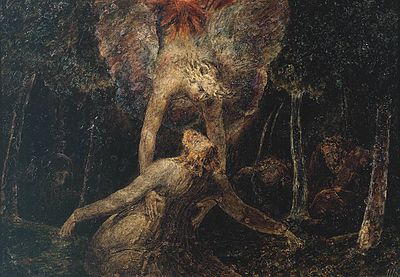
William Blake was not only a poet but a master artist. He was proficient in engraving, where he served an apprenticeship, and also watercolor and oils. Blake sought to emulate the example of artists such as Raphael, Michelangelo, and Dürer in producing timeless, “Gothic” art, infused with Christian spirituality and created with poetic genius. I do not believe William Blake adhered to orthodox Christianity, but his interest and focus over time allowed him to produce some interesting works.
Blake’s patron Thomas Butts commissioned from Blake a series of illustrations to the Bible that included about fifty tempera paintings and more than eighty watercolors. These focus on Old Testament prefigurations of Christ, the life of Christ, and apocalyptic subjects from the Book of Revelation. (Source, Metropolitan Museum of Art). Blake also is famous for 21 copperplate etchings illustrating the Book of Job in the Old Testament. Here are but two examples from the prolific works of William Blake. His art is in many major museums from around the world, including this at the British Museum

Satan inflicting Job with boils

and this from the Tate Museum, Agony in the Garden (of Gethsemane)

It is a dicey proposition, for an artist to biblically depict evil without idealizing, sanitizing, or glamorizing it. As for a more modern artist, I refer you to Chris Koelle. Mr Koelle illustrated the Book of Revelation a few years ago and his depictions are compelling. The book blurb says,

192-page graphic novel (paperback) Featuring almost 600 illustrations Including all 404 verses of the final book of the Bible Translation by Mark Arey & Philemon Sevastiades Adaptation by Matt Dorff Illustrations by Chris Koelle

Here is his page where you can buy the book and see thumbnails

Of course you know if you read my blog often enough that I enjoy artist Chris Powers. His visual theology is biblically accurate and aesthetically beautiful. Where Blake or Koelle’s depictions of evil both stir and frighten, Powers’ work has a lighter feel. However he still does a magnificent job visually depicting sin, wrath, and death in a way that is thought provoking. Since Mr Powers’ creates his works specifically to be shared, he includes explanations of the verses the powerful images depict and includes his thought process of what he wanted to convey. Like this from Isaiah 42:13-

Source

“The LORD goes out like a mighty man, like a man of war he stirs up his zeal; he cries out, he shouts aloud, he shows himself mighty against his foes.” – Isaiah 42:13

In this passage, the YHWH is talking about His zeal-fueled, end-time action against the enemies of His people and that will bring lasting joy and life to those who trust in Him, and as you read the whole of this chapter there will be many allusions that point us to the person and work of Jesus Christ.

As we read this verse in light of the cross, we know that YHWH did in fact “go out as a mighty man” when He came as a man and dwelt among us journeying unstoppably to the cross…It was there at the cross that He cried out and shouted aloud and showed Himself infinitely mighty against all His foes in a way they could never have anticipated. What glory and beauty that our God so zealously pours Himself out for the sake of His glory and the sake of our joy.

So, in this image, I wanted to represent the Cross-Event in light of YHWH’s infinite, warrior-like zeal that we read about here in Isaiah

If you write for an online journal or run a blog, I recommend Chris Powers’ work as the visual enhancement to your writing, especially because of the artist’s explanations of the verses that accompany the visual pieces and his willingness to share for the good of the Body and the glory of Christ.

http://www.fullofeyes.com

So there is your potpourri for the day. As Halloween approaches evil is increasingly on the mind of the pagans and even the Christians. Our eyes are assaulted by movie posters lauding the latest graphic depiction of the underworld. Our eyes avert from the neighbor’s brutal yard art depicting scenes of evil, all in “celebration” of Halloween.

Our sensibilities will be assaulted by seeing yet another child absorbed into accepting the occult as normal, or another adult who succumbs to performing an evil crime on that most dastardly of days. Or simply enduring the abounding sin that Halloween seems to loose. Yet we take heart. Jesus has overcome the world.

I have said these things to you, that in me you may have peace. In the world you will have tribulation. But take heart; I have overcome the world. (John 16:33).

The reality is,evil exists in the actual person of satan and his fallen demon-angels. However, we trust in Christ who has overcome and in whom we rest assured of ultimate victory.

But thanks be to God, who always leads us as captives in Christ’s triumphal procession and uses us to spread the aroma of the knowledge of him everywhere. (2 Corinthians 2:14)

He made a spectacle of them in His triumph of the cross!

He disarmed the rulers and authorities and put them to open shame, by triumphing over them in him. (Colossians 2:15)

Posted in bible, encouragement, sailing

In the lee of Jesus

Love to Jesus

Lord Jesus, if I love thee my soul shall seek thee, but can I seek thee unless my love to thee is kept alive to this end?

Do I love thee because thou art good, and canst alone do me good?

It is fitting thou shouldest not regard me, for I am vile and selfish; yet I seek thee, and when I find thee there is no wrath to devour me, but only sweet love.

Thou dost stand as a rock between the scorching sun and my soul, and I live under the cool lee-side as one elect.

When my mind acts without thee it spins nothing but deceit and delusion; when my affections act without thee nothing is seen but dead works.

O how I need thee to abide in me, for I have no natural eyes to see thee, but I live by faith in one whose face to me is brighter than a thousand suns!

When I see that all sin is in me, all shame belongs to me; let me know that all good is in thee, all glory is thine.

Keep me from the error of thinking thou dost appear gloriously when some strange light fills my heart, as if that were the glorious activity of grace, but let me see that the truest revelation of thyself is when thou dost eclipse all my personal glory and all the honour, pleasure and good of this world.

The Son breaks out in glory when he shows himself as one who outshines all creation, makes men poor in spirit, and helps them to find their good in him.

Grant that I may distrust myself, to see my all in thee.

The Valley of Vision: A Collection of Puritan Prayers and Devotions, Edited by Arthur Bennett

I simply love the Valley of Vision Puritan devotionals. They are so Jesus-centered. It’s refreshing to read and ponder written prayers devoid of anything from today’s toxic effects of me-centered, prosperity, self-esteem nonsense.

EPrata photo

I lived aboard a small yacht for two years, and through that experience I have a deep appreciation for the biblical allusions related to anything nautical. The Lighthouse, the stormy seas, the waves, reefs, and lee-side are all familiar to me and I can deeply identify with them. I suppose it is the same with the believing farmers and fishermen regarding the agricultural or fishing metaphors. Not that one needs to have had a certain life experience before understanding, but the life experience Jesus causes us to have does deepen some aspects of the Word and we gravitate to them on a different level. It’s like when a person becomes a parent for the first time, they understand the biblical verses related to parenting on a different level then they did before.

Though our boat is at anchor in this photo, we spent many a day that looked like this as we tried capturing wisps of wind occurring here and there and so inching along over tiny waves.

The sailor is ever restless. We want to go and we thus pray for wind. The wind comes but it’s not enough, or it’s too much, When the boat finally settles on a loping rhythm up and down the waves, the sailor wishes he was in port. Of course the moment one is in port, one wishes for the freedom of the sea. And so it goes.

The frustration of no wind can’t be overstated. The luffing sails, slack and listless seem almost an affront. One cannot manufacture wind. One cannot control the wind. One only waits, hopes, prays, and looks. The sailor learns patience. The sailor learns to relinquish control.

The wind blows where it wishes, and you hear its sound, but you do not know where it comes from or where it goes. So it is with everyone who is born of the Spirit. (John 3:8)

The opposite is a problem, too. Too much wind can damage the boat, set the sailor off his course, or even swamp him and all will be lost at sea. The storms can be terrifying to the pagan.

But the LORD hurled a great wind upon the sea, and there was a mighty tempest on the sea, so that the ship threatened to break up. 5Then the mariners were afraid, and each cried out to his god. (Jonah 1:4-5a)

Luke wrote of the travails Paul endured when he put on a ship that set forth too late in the year. In their part of the world, winter was a time when many storms brewed up and winds became contrary in a moment.

The Storm at Sea

Now when the south wind blew gently, supposing that they had obtained their purpose, they weighed anchor and sailed along Crete, close to the shore. But soon a tempestuous wind, called the northeaster, struck down from the land. And when the ship was caught and could not face the wind, we gave way to it and were driven along. (Acts 27:13-15).

And putting out to sea from there we sailed under the lee of Cyprus, because the winds were against us. (Acts 27:4).

Sailors know the prevailing wind‘s direction given the time of year. Prevailing winds are winds that blow predominantly from a single general direction over a particular point on the Earth’s surface. They try to use islands as their shelter, making it a lee. This means if the prevailing wind comes from the east toward the west, if you sail or anchor on the west side, the island has blocked the wind and you will have more peaceful waters upon which to sail or sleep. Like this:

source

As the poet stated in Valley of Vision, “I live under the cool lee-side as one elect.” We have a great and powerful Mountain, our Rock to shelter and protect us from the storms and winds that try to blow us off course or drown us. Our Lord is our ever-present oasis of safety. Thus, thanks to Jesus Christ, it is well with our sail soul.

Posted in jesus, oklahoma, prophecy, rebellion, ten commandments

Workers removing Ten Commandments from Oklahoma Capitol

OKLAHOMA CITY (AP) – Workers have started to remove a granite monument of the Ten Commandments from the Oklahoma Capitol grounds. A contractor the state hired began removing the monument around 10:30 p.m. Monday. Its removal comes after the Oklahoma Supreme Court determined the display violates a constitutional prohibition on the use of public property to support a “system of religion.”

As my friend Pastor James Bell wrote of this,

MULTITUDES IN THE LAND, in and out of churches, are openly displaying utter hatred of the true and living God. They take counsel together against Almighty God. GOD SHALL LAUGH. GOD SHALL SPEAK IN HIS WRATH… BLESSED ARE THOSE WHO PUT THEIR TRUST IN JESUS! (Psalm 2)

And yet the pagan monuments to Molech of abortuaries, football stadiums, shrines to Buddha/Shiva/Allah grow and flourish all over the globe.

This is the world we live in.

In their case the god of this world has blinded the minds of the unbelievers, to keep them from seeing the light of the gospel of the glory of Christ, who is the image of God. (2 Corinthians 4:4)

Satan is god of this world, but not forever. Not for long. What a blessed day when all believers from the first moment in time are finally gathered and we dwell with the Most Holy in perfection, and no thing and no person curses or blasphemes Jesus ever again. He will cleanse the world and make it new. Until then, we pray Jesus will remove the scales from many eyes and that multitudes will come to faith.

Posted in end time, glorified, john calvin, prophecy, rapture, redeem

"That Arousing Shout", the coming rapture of the church

The next event on God’s scheduled plan will be the rapture. After that the wrath will be released in the Tribulation, Armageddon will occur at the end of it upon Jesus’ return, the Millennial Kingdom will be established, satan will be bound during that time, then after 1000 years satan will be let out and there will be one more rebellion and then the eternal state will begin with New Jerusalem descending to a new hearth through a new heaven. But next up, the rapture.

It is a glorious event in which all saints should be anticipating eagerly. It doesn’t matter that the fact of the rapture was revealed by Paul via Jesus and the Spirit in his letter to the Thessalonians and not by Jesus in His incarnation. It doesn’t matter that the rapture has been imminent for almost 2000 years and has not occurred yet. All that matters is that it is promised to every believer that at one point we will be called home, sail through the air, glorified bodily and be with Jesus forever.

Here are some verses for you about the coming glorification of the saints via the rapture. I pray they encourage you.

For the Lord himself will descend from heaven with a cry of command, with the voice of an archangel, and with the sound of the trumpet of God. And the dead in Christ will rise first. (1 Thessalonians 4:16).

by way of exposition, intimating what is to be the nature of that arousing shout — that the archangel will discharge the office of a herald to summon the living and the dead to the tribunal of Christ. ~John Calvin


Behold! I tell you a mystery. We shall not all sleep, but we shall all be changed, in a moment, in the twinkling of an eye, at the last trumpet. For the trumpet will sound, and the dead will be raised imperishable, and we shall be changed. For this perishable body must put on the imperishable, and this mortal body must put on immortality. (1 Corinthians 15:51-53).

The New Testament is consistent in its anticipation that the return of Christ might occur at any moment. That pervading perspective of imminence prompts three questions. The first question pertains to whether the Tribulation will precede Christ’s coming for the church. The answer to that question is that it will not because the church is never asked to look forward to the tribulation, but they are asked to look forward to Christ’s coming. The second question revolves around how the return of Christ could have been imminent in the early church. The answer here is that no one but the Father knows when the coming will occur, so that Christians including the early church must always be ready. The third question asks why Christ’s imminent return is so important. This answer relates to the motivation it supplies for believers to purify their lives and thereby progress toward the goal of sanctification and Christlikeness. The threefold call of the imminence doctrine is to wake up and obey right now, to throw off the works of darkness, and to put on the garments of holy living. ~John MacArthur


But our citizenship is in heaven, and from it we await a Savior, the Lord Jesus Christ, who will transform our lowly body to be like his glorious body, by the power that enables him even to subject all things to himself. (Philippians 3:20-21)

Why is it necessary that we should have a body? Well, in our last meeting, I made reference to one of the texts that Paul uses in Romans chapter 8, which at least gives us an understanding of why, in biblical doctrine, it’s important that we have the resurrection of the body. And we’ve made the point over and over again that when we talk about resurrection, we’re not talking about living again spiritually. We’re talking about the resurrection of the body. Many theologians have said this, but it bears saying again. If we do not speak of the resurrection of the body, we should not speak of the resurrection at all. It is the resurrection of the body — now, not the present body in the sense that it will be characterized by corruptibility and all of the weaknesses of our aging body. We’re talking about the resurrection body, the spiritual body. A true continuity with this body but, nevertheless, different. The resurrection of the body that is a spiritual body connected with this body is the teaching of the word of God.

So one of the great hopes of the Christian is not simply that he’s to enter heaven, but he’s to enter heaven with a redeemed body, his body resurrected, a beautiful, glorious body, Scriptures tell us, “Like our Lord’s own glorious body.” So that’s our hope. That’s why there is such a thing as the resurrection of the body, and that’s why it’s important for us to understand that. ~S. Lewis Johnson


Then we who are alive, who are left, will be caught up together with them in the clouds to meet the Lord in the air, and so we will always be with the Lord. Therefore encourage one another with these words.(1 Thessalonians 4:17)

I shall view our text, in order to our comfort at this time, in three lights. I look upon it, first, as a continuance—we are with the Lord even now and we always shall be. Secondly, as an advancement we shall, before long, be more fully with the Lord than we are now. And thirdly, as a coherence—for we both are and shall be with Him in a close and remarkable manner. ~Charles Spurgeon

And if I go and prepare a place for you, I will come again and will take you to myself, that where I am you may be also. (John 14:3)

Here are three words, upon any of which stress may be laid. Upon the word troubled. Be not cast down and disquieted. The word heart. Let your heart be kept with full trust in God. The word your. However others are overwhelmed with the sorrows of this present time, be not you so. Christ’s disciples, more than others, should keep their minds quiet, when everything else is unquiet. Here is the remedy against this trouble of mind, Believe. By believing in Christ as the Mediator between God and man, we gain comfort. The happiness of heaven is spoken of as in a father’s house. There are many mansions, for there are many sons to be brought to glory. Mansions are lasting dwellings. Christ will be the Finisher of that of which he is the Author or Beginner; if he have prepared the place for us, he will prepare us for it. ~Matthew Henry

waiting for our blessed hope, the appearing of the glory of our great God and Savior Jesus Christ. (Titus 2:13)

Meanwhile, we live between those two advents—the two “appearings.” At the end of verse 12 Paul refers to that time-span between the two appearings as “the present age.” So he points us to the past, when “the grace of God . . . appeared.” He wants us to live “in the present age”—exemplifying the virtues of grace in the hectic here and now. And he wants us to keep an eye expectantly on the future, as we “[wait] for our blessed hope,” the return of God, our Savior in His full resplendence—which will be the final culmination of both grace and glory. 

In other words, there are past, present, and future dimensions to grace, and the present dimension is the main focus of our text. While we live between these two advents, grace takes us to school. This whole “present age” is the school of grace. ~Phil Johnson

Friends, take joy in the coming of our Lord. Though we may quicken and shudder to think of on facing Him with all our weaknesses and sins, His word has assured us that we may call Him Father, Friend, and Brother. And so we shall always be with Him.

Posted in encouragement, new jerusalem

Vehicle Assembly Building vs New Jerusalem

That’s me in the 1990s visiting Cape Canaveral, where the Vehicle Assembly Building (VAB) is located. The VAB is the building NASA uses to put together missiles, rockets and the Shuttle to go into space.

The Cape itself is interesting, and I was fascinated by the building. I’m a patriot, I love the United States. I believe it’s the greatest country ever established and it is beautiful and diverse and its principles upon founding were good ones. I love living here and I loved the trip across its land my husband and I took in the ’90s in our VW Camper van. From sea to shining sea, indeed.

So when we got to Florida, both of us being science geeks, we camped at Titusville, a city on the east coast of FL in the region known as the Space Cast. The Space Coast is host to Kennedy Space Center and Cape Canaveral Air Force Station. All of NASA-launched manned spaceflights (running from Project Mercury in 1961 to the end of the Space Shuttle program in 2011) departed from either KSC or Cape Canaveral. That area of Florida is beautiful and the museums to attend and US history to be learned there is terrific.

The Vehicle Assembly Building (VAB) is a magnificent monument to man’s determination to achieve, to adventure, and to reach out toward the limits of what we may be able to do and see and build. The facts around the VAB, according to Wikipedia, are as follows:

The Vehicle (originally Vertical) Assembly Building, or VAB, at NASA’s Kennedy Space Center (KSC) is a building designed to assemble large space vehicles, such as the massive Saturn V and the Space Shuttle. The future Space Launch System (SLS) will also be assembled there. 

At 129,428,000 cubic feet it is one of the largest buildings in the world by volume. The building is at Launch Complex 39 at KSC, halfway between Jacksonville and Miami, and due east of Orlando on Merritt Island on the Atlantic coast of Florida. 

The VAB is the largest single-story building in the world, was the tallest building in Florida until 1974, and is still the tallest building in the United States outside an urban area. 

The VAB is 526 feet tall, 716 feet long and 518 feet wide. It covers 8 acres, and encloses 129,428,000 cubic feet of space. The building has at least 10,000 tons of air conditioning equipment, including 125 ventilators on the roof supported by four large air handlers (four cylindrical structures west of the building) to keep moisture under control. Air in the building can be completely replaced every hour. The interior volume of the building is so vast that it has its own weather, including “rain clouds form[ing] below the ceiling on very humid days”

Since the VAB is visible out to sea for miles upon miles and dwarfs the nearby lighthouse, when we lived on our sailboat we used the building as a landmark to guide us in to port. I think it’s amazing that the VAB is so large it generates its own weather system. The engineers of the 1950s and early 1960s who were part of the Space Program at the inception must have been brilliant and admirable men. Someone along the way knew that in order to build rockets there must be a building in which to assemble them, and engineers set about developing the plans to create such a large structure to suit the purpose. It is a tremendous building and it’s used for a tremendous purpose and we Americans have every right to be proud of it.

But it’s nothing. It is all vanity, striving after wind.

In the end time when the seal, trumpet, and bowl judgments of Revelation occur, the building will be swallowed by hurricanes or tsunamis or some other disaster. Man’s work, this large building, will fall. You want to know something extraordinary? There is another large, square building that exceeds the dimensions even of this fantastic Florida structure. We will live in it, and it is magnificent compared to the VAB, as stunning as that building is. It is called New Jerusalem, and it is at once mansions, a city, and a nation. It is our future home.

The VAB encloses 129,428,000 cubic feet of space. New Jerusalem encloses 3 billion cubic miles. The VAB is 529 feet tall. New Jerusalem is 1,500 miles tall. We are so proud of man’s accomplishment but God’s city is so much larger, more magnificent, so impressive, it stuns the mind.

Here is a map showing the location of the VAB. The dot on the map to which the hand is pointing is NOT representative of its size. As impressive as the VAB is, it is an insignificant, invisible dot on a map of one single state.

Here is a representation of the New Jerusalem compared in size to the landforms underneath it.

Source

Source

Here is a synopsis of the size of New Jerusalem from the website Tour of Heaven. (A biblical tour, not a personal visit!)

Size of New Jerusalem
How large is the city? That varies slightly depending on the version of the Bible. The ESV and NIV versions say it is 12,000 stadia in length and width (Rev. 21:16), where a stadia is 607 feet. This translates to 1,400 miles, which is what the NLT Bible says. However, the KJV and other versions say 12,000 furlongs, which translates to 1,500 miles. 

Regardless of whether the city is 1,400 miles or 1,500 miles in length and width, it is shaped like a square at the base. This means New Jerusalem is larger than India with nearly 2 million square miles. These measurements are meant to be literal since they are described as man’s measurements (Rev. 21:17). 

Even more astounding than the size at the base is the height that is also at least 1,400 miles (Rev. 21:16). This goes well beyond Earth’s atmosphere and into space. If a building in the city is this high and has a generous 12 feet per story, the building would be over 600,000 stories! 

To give you a better idea just how big New Jerusalem is, above are some representations of what it would look like on Earth if the city is shaped like a cube. 

Over North America:
If you are 1 mile away from the city, you would not see the top but might if you are 10 miles away. At 5,000 miles away, it would appear more than 130 times larger than the moon. To appear the size of the moon, you would have to be 160,427 miles away.

Because the city is at least 1,400 miles in length, width and height, it could be shaped like a cube or pyramid. Does the height refer to the wall that surrounds the city or the tallest building? Rev. 21:17 says the wall around the city is about 200 feet, but ESV, NASB and KJV bibles don’t specify whether this is the thickness or height. The NIV bible says this is about 200 feet thick, but the footnote says “or high”. A cube-shaped city would make sense in the sense the Most Holy place in Solomon’s temple (1 Kings 6:20) was shaped like a cube. However, scripture does not provide a definitive answer as to whether the city is cube or pyramid-shaped.

WOW!! At The Cripplegate, they write about the New Jerusalem too.

Have you ever thought about heaven as a city?
In the apostle John’s account of the new earth in Revelation 21-22, prominent attention is given to the New Jerusalem, the capital of the eternal heaven. Nearly half of Revelation 21 is devoted to describing the physical properties of the magnificent metropolis. Its glorious splendor will be the heart of the new earth, for it is here that God Himself dwells. 

According to Revelation 21:15–17, the measurements of the New Jerusalem are immense, approximately 1,500 miles long on each side. By way of illustration, if one corner of the city were placed on Los Angeles, a second corner would sit on Mexico City, a third corner on St. Louis, Missouri, and the final corner on Edmonton, Alberta. If the center of the New Jerusalem rested where the current Jerusalem stands, it would stretch across three continents from Greece to Iran to Saudi Arabia to Libya. The current city of Los Angeles has an area of 468 square miles. The state of California comprises roughly 164,000 square miles. But the New Jerusalem will encompass over 2 million square miles. That is the equivalent of 14 states of California put together; or 4,807 cities of Los Angeles combined.

So the biggest building in the US outside a metropolitan area, a building taller than the Great Pyramid at Giza, is really a fleck of a piece of dust compared to the city of God that Jesus has been preparing.

One more stunning fact from The Cripplegate:

The massive city houses a total volume of more than 3 billion cubic miles. In light of the city’s immensity, some commentators have speculated that the resurrection bodies of the redeemed may not be subject to gravity. If so, the residents of the New Jerusalem would be able to traverse through space not only horizontally, but also vertically, making every part of this glorious cube inhabitable and accessible to the citizens of the New Jerusalem.

DOUBLE WOW!

I’ve been looking at the dimensions of the New Jerusalem and I have not even mentioned its beauty nor its purpose. Read Revelation 21 and 22 for more information on the city’s dazzling components. When I see the VAB and think of how man thinks he has achieved something, I like to compare to how majestic, big, and creative our God is. The VAB is big, New Jerusalem is bigger. The VAB is impressive, the New Jerusalem is stunningly magnificent. What man can do is fine, what God can do dumbfounds us.

“For My thoughts are not your thoughts, Nor are your ways My ways,” declares the LORD. 9″For as the heavens are higher than the earth, So are My ways higher than your ways And My thoughts than your thoughts. (Isaiah 55:8-9)

———————————

Further Reading

FMI on the Vehicle Assembly Building, interior shots and fun stuff, go here.

Largest buildings in the world

Posted in audacious, beth moore, discernment, false, wolf

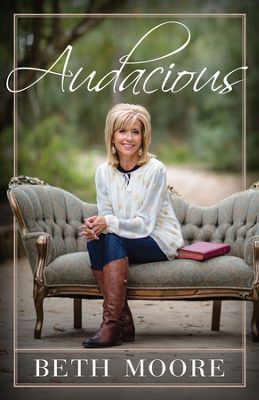
Beth Moore’s Simulcast "Audacious", her new book, and a discernment lesson

Mrs Sharon Lareau has written several excellent blog essays preparing to review and then reviewing Beth Moore’s simulcast which was broadcast this past September. She used the simulcast to illustrate HOW to prepare to absorb biblical truths, and HOW to discern. I recommend the series.

Evaluating Beth Moore’s Upcoming Live Simulcast
Evaluation and Red Flags:
To that end, I would like to use this opportunity to do an exercise that can help increase discernment. Today we are going to do a pretest. It is a short investigation into the official, available material that we have about the simulcast. This is something we can do whenever we are heading to any Christian event. It can help us get an indication of the soundness of the message or teacher before we even show up.

Class on Discernment: Living Proof Live Simulcast
I invite you to do something as you watch. I invite you to turn the simulcast into a class on discernment. This means, we will use the simulcast to practice the ability to confirm truth and detect error in a Bible message or teaching. Some may feel it is unnecessary to do that with a Beth Moore event since she is so established and well liked as a Bible teacher. I would respond that it is always necessary to be discerning at every event or service where God’s word is taught. It is necessary even when the preacher you’ve sat under for 20 years gets up to preach.

Simulcast Review Update
I have had a couple of inquiries about if and when there would be a follow-up post regarding the Living Proof Live simulcast from September 12, 2015. Since almost two weeks have passed since then, I thought it might be a good idea to give an update here. After viewing the simulcast, I did decide that I would write a review. There is a lot to cover, and I am being careful in my analysis. It is taking time and my health situation comes into play too, but I do hope to have it ready in a few weeks. Please pray for me as I work towards presenting a fair and thorough review. There are definitely some things worth writing about that I hope to share with you.

———————————

When Mrs Lareau posts her actual review I’ll post it here. Meanwhile please refer to her previous entries for great lessons on how to discern.

After all this, I became curious as to Mrs Moore’s new book, Audacious. Moore said that she tailored the book specifically for simulcast and that for the first time her simulcasts would have a theme (read: book to buy AKA merchandising). The book Audacious will be released November 1, but online buzz about it is heightened to a fever pitch.

Regular readers of the blog know that I am not a fan of Mrs Moore or her teachings. I have written extensively regarding the unbiblical nature of her teaching, her poor interpretive capabilities, her twisting scripture, pop psychology substituting for biblical truth, her legalism, and her unbiblical direct revelations. There are also issues with her lifestyle, all of which combine to show her not only below reproach as a teacher of the Word but a false convert. She is a wolf in sheep’s clothing. I have used scripture to show these things and have prayerfully considered all the ramifications of my statements.

Now, turning to the blurb for Audacious, we read some troubling things just in those two short paragraphs, things which not only definitively show in short order the ‘living proof’ of Moore’s unworthiness to teach. These things also genuinely stir me to a righteous anger and a deep sorrow over the women who follow Moore. The righteous anger comes in because I am zealous for the name of Jesus, and Mrs Moore says and does things which impugn His name and character. I am sorrowful for the women who follow Moore because I know these women are in bondage somewhere and attachment to Moore is the out-working of it.

Here is the book blurb for Audacious:

Thirty years in the making, “Audacious” is a deep dive into the message that has compelled Beth Moore to serve women around the globe. Glancing over the years of ministry behind her and strengthening her resolve to the call before her, she came to the realization that her vision for women was incomplete. It lacked something they were aching for.

Something Jesus was longing for. Beth identifies that missing link by digging through Scripture, unearthing life experiences, and spotlighting a turning point with the capacity to infuse any life with holy passion and purpose. What was missing? Well, let’s just say, it’s “audacious” and it’s for “all” of us. And it’s the path to the life you were born to live.”

1. Mrs Moore is fulfilling HER vision for women? God gives us HIS vision set down in the Bible, which we fulfill by obeying it. (Mt 12:50).

2. Anyone who has taught for 30 years and is just realizing that a critical component of “her” vision for women has been lacking all this time, is not a very good student of the Word. We’re not talking about increasing sanctification where the disciple gains deeper insights atop earlier insights, but language expressed here and elsewhere that states “OOPS, Here is something new to know that I overlooked for 30 years, and you ALL need it!” That is an audacious statement. A classic ‘tell’ of the false teacher is that they have the heretofore unknown or undiscovered answer to the fulfillment of some fleshly lust or want, NOT they they will use scripture to show who Jesus is so that we may glorify Him. (2 Peter 2:18)

So the true teacher asks, “What has God said in his Word?” The false teacher asks, “What do people want to hear? What will appeal to their flesh?” (Source)

3. Mrs Moore flatly says she is speaking for “all” women. I resent a person speaking for me, saying I have been aching for something unbenownst to me and that Mrs Moore knows what I ache for and that she has the answer to that ache. This is simply ridiculous on the face of it. More than ridiculous, it’s audacious to claim to be speaking for “all” women. It is the basest appeal to the flesh: ‘I have something you “all” need.’ (Genesis 3:5-6). I’m sorry, but I am not aching nor am I incomplete. (Colossians 2:10).

4. Mrs Moore spends much time inflaming emotional and spiritual lusts and she tempts women with how she can fulfill them with her new revelation/information/book/method… Of course satisfying fleshly lusts never lasts, which is why you need another Beth Moore book so you can try again.

5. Worst of all is her statement that Mrs Moore purports to know what is in the heart and mind of Jesus, and that He is “longing.” Get a close grip on what Moore is saying here. Moore actually says in her book blurb, ‘It [her message] lacked something they [women] were aching for. Something Jesus was longing for.’ Beth Moore has a message Jesus is longing to hear? I think not. (1 Timothy 6:4, Isaiah 14:14). When I hear statements like these and their blasphemy sinks in, I become righteously angry.

The book publication date is known to be Nov. 1, and in essays, write-ups and interviews she consistently says that it would “spoil” the simulcast to “reveal” it ahead of time. This is one reason the buzz has become so inflamed but if you pierce the buzz you will see how unbiblical this kind of merchandising is. (2 Peter 2:3). We will pierce the buzz and expose Mrs Moore’s message by comparing her approach to teaching this ‘new’ message and how Paul approached the same at Mars Hill.

Paul had been preaching in Athens, Greece for a while. The message of the Gospel was igniting among the populace as Paul preached on hillsides and the synagogues. (Acts 17:17). His message, which really WAS new at the time, aroused a buzz, and the Stoics and Epicureans (who were always ready to hear some new thing, Acts 17:21) invited Paul to speak at Mars Hill in the Areopagan arena to a large number of people.

Let’s say between the time of the Philosophers’ invitation and the time Paul preached to the masses in the arena was 6 weeks, the same amount of time between the first Audacious-themed September 12 simulcast and the publication of the Moore book. Let’s say Paul said and did what Mrs Moore is doing. Let’s use actual Audacious FAQ language but overlay it to Paul’s experience at the Areopagus at Mars Hill in Athens Greece.

—————————–

Areopagus FAQ

I have a teaching from God that you ALL need to hear, it will fulfill you and you will ache no more.

And they took him and brought him to the Areopagus, saying, “May we know what this new teaching is that you are presenting? For you bring some strange things to our ears. We wish to know therefore what these things mean.” (Acts 17:19-20)

You must attend the Areopagus to hear it. The Stoics and Epicureans must pay 800 sheckels to host me in the arena, and you must pay $20 individually to attend.

May we hear your special message or read it on the scrolls prior to your speech you’ll deliver at the Areopagus?

I wrote this message down in a book called “Mars Hill Explosion”, with Athenians at the Areopagus participants in mind with the idea that it would be used as a follow up to my message on that day. You can buy it later, after I reveal the secret message on the day. The book is a great way to continue walking out the Mars Hill weekend’s theme through personal reflection or group discussion at local synagogues or house churches. While it is possible that some could receive my book before the event at the Areopagus, I do not recommend spoiling my message by reading it beforehand!” (actual language, source)

For now, people of Athens, here is the book blurb:

“Mars Hill Explosion” is the newest book written by Paul the Apostle. He wrote it specifically thinking of YOU, the Areopagan audience! “Mars Hill Explosion” is an exclusive pre-release for arena participants! Do you have the audacity to make an unseen Savior the Supreme romance of our lives? I pray you are already walking in a brand new sacred romance with Jesus.

If you don’t attend the Areopagus, you can always buy the book later. For now, just let the anticipation of my new message and the new book build up. *Just a little bit of a hint I’ll give you. What is your dream? What is your vision for the future? I don’t want to give away the message, but I do want you to know this, I added some audacity to that vision statement. I added some audacity to the dream that I have for men, and I do mean all men. I am hoping and praying with all my heart that my message at the Areopagus will become the place where men will remember that was where they fell head over heels in love with Jesus. My vision for men will result in the path to the life you were born to live.

*actual Beth Moore words.

I thought it was Jesus’ vision revealed in the Bible that results in us living the life we were born to live. But that’s just me.

—————————–

Hard to picture Paul promoting HIS message and selling it secretly? Hard to see Paul writing a Mars Hill FAQ like that? That is because Paul openly shares the message of God unconnected to money, self-promotion, or secrecy; while Mrs Moore makes merchandise of you. The merchandise and the money is her point, not the message. Mrs Moore would do well to follow Christ’s example:

Jesus answered him, “I have spoken openly to the world. I have always taught in synagogues and in the temple, where all Jews come together. I have said nothing in secret. (John 18:20)

Finally, a tidbit. We read from this excerpt of Audacious that Mrs Moore says that her good friend Travis Cottrell gave her a book and it impacted her greatly. She based her Audacious message on that book, adding a word to the seminal question posed within it. Was it the Bible that impacted her so greatly she felt compelled to write Audacious in response? No. Was it a great theological tome authored by one of the towering men of faith in history? No. The book that impacted her so mightily is–

21 Great Leaders: Learn Their Lessons, Improve Your Influence by Pat Williams, a motivational speaker and senior vice president of the NBA’s Orlando Magic.

I look very much forward to Mrs Lareau’s review of the September 12 Beth Moore “Audacious” simulcast. I reiterate, Beth Moore is not to be trusted, followed, or taught anywhere at any time in any part of Christendom. Her teachings lead to bondage, impugn both Christ and the scriptures, and only serve to fatten her wallet and puff her pride.

The word audacious has two meanings.

1. showing a willingness to take surprisingly bold risks. “a series of audacious takeovers”
2. showing an impudent lack of respect. “an audacious remark”

Mrs Moore meant #1, but with all she says and does, she betrays #2.

———————————–

Aimee Byrd reviews Beth Moore’s book Audacious

Further Reading

5 Ways to Spot the Wolf In Sheep’s Clothing

7 Traits of False Teachers

Wolves Among the Sheep

UPDATED: Five Reasons It’s Time to Start Exercising “Moore” Discernment

Posted in Book of Revelation, encouragement, genesis, jesus, prophecy

The Tree of Life

It is profitable to ponder God’s role as vine-dresser, and the agricultural metaphors of the branch, the tree, and the pruning, and the fruit.

I was listening to a sermon about us being the branches connected to the vine, (John 15:4). We had a rain-wind event here and a tree in the yard lost a good portion of itself. Can this branch produce any fruit? No. Apart from the tree, it can do nothing. That is any lost person who is apart from Jesus and any saved person operating in the flesh and not the Spirit.

EPrata photo

In addition to the branch, I was also thinking of the agricultural metaphors of vine, tree, branch, fruit, and then…I started thinking about the Tree of Life.

I like trees, and I love the Tree of Life. I like thinking about God’s tree, the life He gives us, and the tree of life in Heaven we will see. Here are some mentions in scripture of the Tree of Life. It is mentioned in Genesis and Revelation (nice bookends), and also in other places.

The Tree of Life defined:

One of two trees situated in the centre of the Garden of Eden. It is also mentioned in Revelation, where it symbolises life and salvation. [Manser, M. H. Dictionary of Bible Themes]

The tree of life as a metaphor:
Pr 15:4 See also Pr 3:13-18; 11:30; 13:12. [Manser, M. H. (2009). Dictionary of Bible Themes]

The Tree of Life described:

Some people wish they had a tree which grew money, but there is an even better tree—the “tree of life.” The term in Greek, xulon zōēs, denotes “a tree that gives life”—that is, eternal life (John 20:31). This tree symbolizes the eternal life God has made available to humanity. We see this tree in the very beginning of the Bible and at the very end. 

The “tree of life” was placed by God in the midst of the garden of Eden (Gen. 2:8–9). God told Adam that he could eat from every tree of the garden except the “tree of the knowledge” of good and evil (Gen. 2:16–17). When Adam and Eve disobeyed God by eating from the tree of the knowledge of good and evil, they were expelled from the garden lest they “take also of the tree of life, and eat, and live for ever” (Gen. 3:22). The Genesis narrative suggests that God intended the “tree of life” to provide Adam and Eve with a symbol of life in fellowship with and dependence on Him. Human life, as distinguished from that of the animals, is much more than merely biological; it is also spiritual—it finds its deepest fulfillment in fellowship with God. 

The book of Revelation contains the only references to the “tree of life” in the New Testament (Rev. 2:7; 22:2, 14, 19). The Bible begins and ends with a Paradise in the midst of which is a “tree of life.” The way to the “tree of life,” which was closed in Genesis 3, is open again for God’s believing people. This was made possible by the second Adam, Jesus Christ. He died on the cross for the sins of all humanity—from Adam to you and me. Those who have washed their robes in the blood of Christ (Rev. 7:14) and have sought forgiveness of their sin through the redemptive work of Christ, receive the right to the “tree of life” (Rev. 22:14), but the disobedient will have no access to it. This tree will give constant, continuous life to all who partake of it, for it symbolizes the eternal life of God made available to redeemed humanity. [Carpenter, E. E., Holman Treasury of Key Bible words]

And out of the ground the LORD God made to spring up every tree that is pleasant to the sight and good for food. The tree of life was in the midst of the garden, and the tree of the knowledge of good and evil. (Genesis 2:9)

And the LORD God said, “The man has now become like one of us, knowing good and evil. He must not be allowed to reach out his hand and take also from the tree of life and eat, and live forever.” (Genesis 3:22)

After he drove the man out, he placed on the east side of the Garden of Eden cherubim and a flaming sword flashing back and forth to guard the way to the tree of life. (Genesis 3:24)

through the middle of the street of the city; also, on either side of the river, the tree of life with its twelve kinds of fruit, yielding its fruit each month. The leaves of the tree were for the healing of the nations. (Revelation 22:2)

Blessed are those who wash their robes, so that they may have the right to the tree of life and that they may enter the city by the gates. (Revelation 22:14)

The fruit of the righteous is a tree of life, and whoever captures souls is wise. (Proverbs 11:30).

The Garden must have been so beautiful. I can’t wait until all is restored (Isaiah 51:3). Heaven where the Tree is must be so majestic. What the tree symbolizes is even more wonderful- eternal fellowship in righteous and holy life with God. Thank you, Lord, for all you have given us now and all we have to look forward to, forever.

The Tree of Life in art:

In Gustav Klimt’s famous mural, The Tree of Life … signifies the connection between heaven and earth and the underworld. For Klimt’s admirers, the mural also has another significance, being the only landscape created by the artist during his golden period. Klimt used oil painting techniques with gold paint, to create luxurious art pieces during that time.

The concept of the tree of life is illustrated by Gustav Klimt’s painting, in a bold and original manner. The swirling branches create symbolism, suggesting the perpetuity of life. The branches twist, twirl, turn, spiral and undulate, creating a tangle of strong branches, long vines and fragile threads, an expression of life’s complexity. With its branches reaching for the sky, the tree of life roots into the earth beneath, creating the connection between heaven and earth…While the artist uses a richness of symbols, gold for paint and other luxurious techniques to illustrate a magical world, the presence of a single black bird draws the viewer towards the central part of the painting. The black bird is a reminder that everything that has a beginning also has an end, as black birds have been used as a symbol of death by many cultures… (source)

Posted in abide, encouragement, macarthur, scripture photo

Scripture photo and sermon recommendation

I recommend this recent series from John MacArthur, on John 15:1-11

I am the true vine, and My Father is the vinedresser. 2“Every branch in Me that does not bear fruit, He takes away; and every branch that bears fruit, He prunes it so that it may bear more fruit. 3“You are already clean because of the word which I have spoken to you. 4“Abide in Me, and I in you. As the branch cannot bear fruit of itself unless it abides in the vine, so neither can you unless you abide in Me. 5“I am the vine, you are the branches; he who abides in Me and I in him, he bears much fruit, for apart from Me you can do nothing. 6“If anyone does not abide in Me, he is thrown away as a branch and dries up; and they gather them, and cast them into the fire and they are burned. 7“If you abide in Me, and My words abide in you, ask whatever you wish, and it will be done for you. 8“My Father is glorified by this, that you bear much fruit, and so prove to be My disciples. 9“Just as the Father has loved Me, I have also loved you; abide in My love. 10“If you keep My commandments, you will abide in My love; just as I have kept My Father’s commandments and abide in His love. 11“These things I have spoken to you so that My joy may be in you, and that your joy may be made full.

The Benefits of Abiding in Christ, Part 1

The Benefits of Abiding in Christ, Part 2

The Benefits of Abiding in Christ, Part 3