When I do a discernment essay, I am often treated to an old chestnut of a comment that is becoming practically standard for those without discernment to post:
He alone is sovereign and fully knows all hearts!
God is sovereign. God knows the heart. But we do too.
If a teacher’s doctrine has been proven false by comparing it with the Bible, then we DO know their heart! The Bible tells us this. Only God knows the hearts of the people, but if their teaching is not of the Lord, then the God who sees hearts has exposed those hearts to us by the verses of His word!
Their hearts are full of deceit. Colossians 2:8
Their hearts are filled with their own appetites. Romans 16:17-18
Their hearts are disguised with light. 2 Corinthians 11:13-15
Their hearts are full of greed. 2 Peter 2:3
Their hearts are ravenous. Matthew 7:15.
Their hearts are inwardly full of sensuality. Jude 1:4
Their hearts are full of secrets, such as destructive heresies. 2 Peter 2:1
Their hearts are full of intent to exploit. 2 Peter 2:3
Their hearts are full of fleshly passions. 2 Timothy 4:3
Their hearts are puffed up with conceit. 1 Timothy 6:4
His heart understands nothing. 1 Timothy 6:4
Their hearts are cunning and crafty. Ephesians 4:14
Their hearts serve the creature. Romans 1:25
Their hearts are slaves of corruption. 2 Peter 2:19.
Their hearts deny the Master who bought them. 2 Peter 2:1
Their hearts prophesy lies. Jeremiah 23:26
So whenever I expose a testimony as false or a teaching as false, or a teacher as false, using biblical proof, STOP saying that this is a bad activity because “only God knows the heart”. He does, that’s true, but He has shown us the heart of the false teacher in His word. He taught us this in His word for the purpose of being mature, discerning, and so we can learn for ourselves and also teach the younger to be edified and strong.
It’s Father’s Day and Facebook is all aglow with well wishes for loving fathers and family photos vintage and current of dads with their happy families. I find this heartwarming. I love seeing pics of dads with daughters proclaiming their father’s virtues.
My experience was different. I didn’t have a loving father and he wasn’t traditionally involved in my life to any appreciable degree. He was a good worker, and intelligent. He created a business from scratch and made a successful go of it. I’m so proud of him for that. He was a raconteur, regaling dinner guests with humorous stories he told in entertaining fashion. But as a father…his virtues take a little longer to discover.
He did provide us a home, and a nice one, too. He paid for my college, no strings, the best gift he he ever gave me. He did keep his promise to financially support us after he and his wife divorced. He helped me financially at periods through my early adult life. He usually remembered my birthday and Christmas with a check, signed “Love, Dad.”
But in all his 81 years of life he never said the important words “I love you.” Not once.
Neither did he show through action any love hidden deeply and unspoken. Despite invitations to personally come to Parents’ Day at College, or the ribbon cutting of my new business or other celebratory things Facebook Fathers seem to enjoy, that was not my lot. Despite tragedies such as unwanted divorce or hospitalization, no father appeared by my bedside or at the lawyer’s to give support. There simply was a great, silent, empty vacuum on the Interstate corridor between his home and mine.
It was kind of a blessing to learn late what kind of relationship other girls had with their dad. I was unaware for a long time of what I had been missing. For example, I had not known that dads and daughters spent time alone together, like having a picnic or going to the movies. I was shocked to learn this. I was never alone with my father, for any reason at any time, casual or scheduled. I literally would not know what to say to him if we ever had been.
He was a man full of laughter during dinner parties but with the family that was another matter. He had a low tolerance for many things, such as noise, questions, failing an unspoken standard, moving his remote control, sitting in his chair, and lots of other stuff. Anger eruptions would occur at any time and send us fleeing to separate quarters to escape the wrath.
As an adult things eased. There was a period of time we were socially friendly. Me and my husband and he and his live-in, long term girlfriend would go out to dinner, sail on his boat, swim in the pool. It was like we were his young friends, not family. I remember one time he was telling a story about kids and we were laughing and laughing at the foibles of this kid he was recalling and the story picked up steam and the laughter got more hilarious and unthinkingly at the end he wiped his eyes and blurted, “I’m glad I never had kids.”
That was how far we were from his heart, so far that we weren’t his children at all. When we were little, we were noisy inconveniences not usually tolerated. As young adults we were a financial obligation. As older adults we were a built-in social network to ease his loneliness. And as a senior, he completed his life-long rejection thus- with disownment.
He not only wrote us off but specifically made note that this was intentional. The last act of Mr Prata regarding his children is an act of bitterness. He wrote an ending to a relationship that wasn’t over yet, but punctuated it anyway with a stroke of a pen.
I’m not writing this out of anger, just sadness. Sadness for him and of what he missed, and what he is missing now. I believe he died outside of the grace of Jesus, and that means he will remember for a punishing eternity the things written here and all the rest of his acts during his 81 years of life, forever. Nothing I could say or do about him is worse than that.
I hope that the silent daughters who are sad on this day looking online or in real life at all the happy dads and daughters would take heart. Coming up is an encouragement.
Daughters of Jesus, we know that the sweetness of a Father that will not reject us nor cast us out of His hand is a balm for the soul where the dad’s love should have been. Sisters who are watching the Facebook wall scroll by with happy cries of well-wishes for dads alive and dads gone on to glory, if that had not been your experience, just remember that we have a Father in Heaven. He has said we cry Abba! Father! for all our needs and upon whom to pour out all our love as he pours out His upon us. He is perfect, having formed us and known us from heart to soul to mind to strength. He is a Dad who sees us, El Roi, whose eyes roam to and fro over the earth “to give strong support to those whose heart is blameless toward him.” (2 Chronicles 16:9a).
We are His children-
But to all who did receive him, who believed in his name, he gave the right to become children of God, (John 1:12) See what kind of love the Father has given to us, that we should be called children of God; and so we are. (1 John 3:1).
We are heirs to our Abba-
To redeem those who were under the law, so that we might receive adoption as sons. And because you are sons, God has sent the Spirit of his Son into our hearts, crying, “Abba! Father!” So you are no longer a slave, but a son, and if a son, then an heir through God. (Galatians 4:5-7) For all who are led by the Spirit of God are sons of God. For you did not receive the spirit of slavery to fall back into fear, but you have received the Spirit of adoption as sons, by whom we cry, “Abba! Father!” The Spirit himself bears witness with our spirit that we are children of God, and if children, then heirs—heirs of God and fellow heirs with Christ, provided we suffer with him in order that we may also be glorified with him. (Romans 8:14-19)
I will not leave you as orphans; I will come to you. (John 14:18)
If you have lost your family due to the faith-
And everyone who has left houses or brothers or sisters or father or mother or children or lands, for my name’s sake, will receive a hundredfold and will inherit eternal life. (Matthew 19:29)
All these promises and more are for us and in us and about us, those who believe. There is much to take heart over. There is everything to be encouraged by in our relationship with the heavenly Father.
If you are not saved by grace of Jesus, and you’re feeling alone on Father’s Day with no father in your life, my deepest empathy goes out to you. I don’t know how you cope with the loss and not have the comfort of Jesus – the true Father – to turn to. If you would like to know something of this sweetness, comfort, and joy, email me. My email is in the “About this blog” tab up top.
With his seething pen, my father sought to obliterate the memory of his children from his heart and to puncture us with a long lasting wound. The irony is, the Lord causes those who reject Him to remember each and every sin of their earthly life, forever, while we, children of God, will not remember sorrows nor shall these things come to mind. (Isaiah 65:17). He will remember forever and lay in an eternal bed of anger and bitterness, while I will forget him and go on in joy and peace with my heavenly Father.
The former sorrows of the earth, under the fall, shall be so far from recurring, that their very remembrance shall be obliterated by the many mercies I will bestow on the new earth (Re 21:4-27). Jamieson-Fausset-Brown Bible Commentary on Is 65:17.
So take heart, sad or mourning or grieving daughters! I am happy to say that it has become my joy to rely on the love of my real Father and it will remain so all through eternity. I have a Father, and every day is Happy Father’s Day. You do too.
Slaying sin is the daily responsibility of the Christian, in submission to the Holy Spirit, Who is the mechanism for its effectual execution.
John MacArthur said that if you are comfortable with your spiritual growth, that is a very dangerous place to be. Dear Sister, if you’ve grown lax or complacent, as I tend to be from time to time, here are some resources for you to help you revive the urgency in our daily endeavor to kill the sin within us and to resist the temptations that come with it. And as Dr Barnhouse reminded us, when you flee sin, make sure that you’re running toward Christ.
Let’s take a look at step three in slaying sin: Fill your mind with Scripture.
John Bunyan, author of the classic Pilgrim’s Progress, wrote in the cover of his Bible, “Either this book will keep you from sin, or sin will keep you from this book.” Bunyan understood what many in the war against sin don’t—the Word of God is the weapon you simply cannot neglect.
Have you ever considered some of the symbols the Bible uses to describe itself? Scripture is called a light, hammer, fire, rock, mirror, milk, seed and water. Each highlights a unique characteristic of God’s Word, but by far the most memorable metaphor of the Bible is a sword (Ephesians 6:17). Any idea why?
~~~~~~~~~~~~~~~~~~~
Temptation and How to Meet It, Sermonby Dr Donald Grey Barnhouse. In this teaching, Dr Barnhouse gives three ways to defeat temptation. The Youtube review of the sermon states,
At the InterVarsity Christian Fellowship conference in Urbana 1957. Brilliantly useful teaching of a caliber seldom found in modern sermons.
Spurgeon on slaying sin, from his sermon The Old Man Crucified, #882:
if you will not have death to sin, you shall have sin to death. There is no alternative, if you do not die to sin you shall die for sin; and if you do not slay sin, sin will slay you.
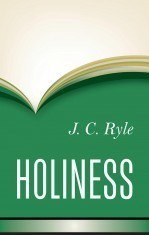
JC Ryle’s book titled Holiness is generally acknowledged to be one of the faith’s top books on the subject. Buy it from this excellent publisher, Banner of Truth.
‘…this book is simply the best of Ryle the Puritan-type pastor. Real Christians will find it a gold mine, a feast, a spur and a heart-warmer, food, drink, medicine, and a course of vitamins, all in one.’ — J.I. PACKER
BOOK DESCRIPTION- Holiness: Its Nature, Hindrances, Difficulties, and Roots is perhaps J. C. Ryle’s best-known and, arguably, best-loved book. Although many things have changed since 1877, when this book was first published, one thing remains the same: ‘real practical holiness does not receive the attention it deserves.’ It was to remedy this attention deficit, and to counter false teaching on this most important subject, that Ryle took up his pen.
The sword is only good if your hand wields it, and we don’t wield it with accuracy and precision if we are not studying it first.
a persistent sinner
a long-time sinner
a depraved sinner
a mocking sinner
an unrepentant sinner
and yet you, Most High God, condescended to enter this world of sin to save us. Lord, you broke my heart. You broke my heart of stone and gave me a heart of flesh, soft, beating in love for Abba and Your ways. (Ezekiel 11:19).
You are a Friend to Sinners, compassionate in all your paths, the beloved Groom. The Woman at the Well said, “Come, see a man who told me all that I ever did.” (John 4:29a). All I ever did was evil. (Genesis 6:5). And yet You loved me while I was still a sinner. (Romans 5:8)
You have set around me a sacred circle, outside of which are cares and burdens, worries and problems. Inside is your throne of peace, love, and Fatherly care. Let me always to come to You boldly humble, timorously brave, to the Father of Lights and the Ancient of Days. Inside this circle is all, because You are there.
I recall my worldly days outside the circle, wandering and unhappy, yet sinning all the more, never seeing your circle of color, the rainbow of covenant, as shining gloriously bright. (Revelation 4:3). My eyes were dim and blind. It is You, Lord Most High, Abba, who brought me in, washed me with Your blood, and saved me from the penalties of all my evil deeds. You gave me Your righteousness, a soft heart longing for purity, and a mind of transformation.
You gave me grace.
Spurgeon said:
The other evening I was riding home after a heavy day’s work. I felt very wearied, and sore depressed, when swiftly, and suddenly as a lightning flash, that text came to me, “MY GRACE IS SUFFICIENT FOR THEE.” (2 Cor. 12:9). I reached home and looked it up in the original, and at last it came to me in this way, “MY grace is sufficient for thee”; and I said, “I should think it is, Lord,” and burst our laughing! I never fully understood what the holy laughter of Abraham was until then. It seemed to make unbelief so absurd.
It was as though some little fish, being very thirsty, was troubled about drinking the river dry, and Father Thames [River, London] said, “Drink away, little fish, my stream is sufficient for thee.
Or, it seemed after the seven years of plenty, a mouse feared it might die of famine; and Joseph might say, “Cheer up, little mouse, my granaries are sufficient for thee.”
Again, I imagined a man away up yonder, in a lofty mountain, saying to himself, “I breathe so many cubic feet of air every year, I fear I shall exhaust the oxygen in the atmosphere,” but the earth might say, “Breathe away, O man, and fill the lungs ever, my atmosphere is sufficient for thee.”
Oh, brethren, be great believers! Little faith will bring your souls to heaven, but great faith will bring heaven to your souls!
Let this little fish never say, I have drunk enough.
Let this little mouse never say, I have eaten my fill.
Let this man never say, I do not need this air any more.
How foolish! Breathe deeply the Words of Life, for where else would I go? (John 6:68). I am in the circle of Your love and the days of wrath have ceased for me. Where else would I go? Let me not wander. This circle of grace is enough.
Do you notice that many of today’s news headlines refer to the apocalypse? ‘Drachmageddon”… “Election Apocalypse”, “Apocalypse-like hailstorm..” etc. … Though fewer people say they don’t believe in apocalypse, more and more the secular world is talking about it. Society is expecting…something. Carl Worline explained his opinion of this phenomenon:
“It is a pervasive feeling that something really big is about to happen. This feeling is exceptionally difficult to define. Christians hopefully look for the return of the Messiah. Many in the New Age Movement look[ed] for the Age of Pisces to end on the winter solstice on December 21, 2012, and for the Age of Aquarius to begin as the earth’s equatorial plane aligns exactly with the center of our galaxy. Buddhists look for the return of Maitreya sometime in the very near future. Mayans predicted and end of an epoch on December 21, 2012, and a new epoch to begin. The Aztec looked for the return of the flying serpent, Quetzalcoatl, sometime around the end of 2012. Aztecs also predict the possible end of time, as we know it, and possibly the end of the world. The I-Ching independently predicts the end to occur on the winter solstice this year. … The entire world is on edge because its inhabitants from every nation and culture feel something. Something that is almost impossible to identify or define…”
That’s the secular world for you, nibbling at the edges of the meaning of spiritual things but never quite coming to the truth. However, we have Christ, the mind of Christ, and His Spirit, so we know the definition of Apocalypse. We don’t have to guess. Though it’s often referred to as an event that is of great destruction or even the end of the world, it literally meansunveiling. It comes from the Book of Revelation, where the word is used in Revelation 1:1. God’s intent for the world is unveiled. From Strong’s Greek in Revelation 1:1,
The revelation of Jesus Christ, which God gave him to show to his servants the things that must soon take place. He made it known by sending his angel to his servant John,
Apokalypsis Ἀποκάλυψις [The] Revelation
In that sense, the entire Bible could be called the Apokalypsis, because it is God’s inspired revelation of Himself to humanity. But the word and the concept is deeply explored in Revelation 1-22 because Jesus specifically reveals His Second Coming.
Do not avoid prophecy, study it! Why study prophecy? Aside from the fact that we are commanded to? (Mark 13:37).
I study prophecy because –
–it is part of the bible, God’s revelation of Himself through holy inspired word
–it is commanded (See above)
–it instills in me an urgency to live righteously and to witness. We don’t study just for the information and go our way. It has to affect our Christian walk, just as any scripture does.
–It comforts me to think of these things being fulfilled:
In the last days the mountain of the Lord’s temple will be established as chief among the mountains; it will be raised above the hills, and peoples will stream to it. Many nations will come and say, Come, let us go up to the mountain of the Lord, to the house of the God of Jacob. He will teach us his ways, so that we may walk in his paths. The law will go out from Zion, the word of the Lord from Jerusalem. (Micah 4:1-2)
Isn’t that beautiful! I’m sometimes saddened by the number of people who profess Christianity but obviously do not possess Him. It’s comforting to know the peoples will stream to the holy Hill to worship! Or this prophecy from Isaiah 19:23-25, it’s so beautiful, uplifting, and hopeful.
In that day there will be a highway from Egypt to Assyria, and Assyria will come into Egypt, and Egypt into Assyria, and the Egyptians will worship with the Assyrians. In that day Israel will be the third with Egypt and Assyria, a blessing in the midst of the earth, whom the Lord of hosts has blessed, saying, “Blessed be Egypt my people, and Assyria the work of my hands, and Israel my inheritance.”
We study the Bible to know God and worship Him rightly. We also study it to know of His past mighty deeds. If you avoid prophecy you won’t be studying His future deeds! Again, why study prophecy?
–observing and studying is not just for knowledge, but to apply as we grow in knowledge
–to learn the entire sweep and scope of God’s promises,
–to instill a wonder at His sovereign hand from beginning to end
–to create in us an urgency so as to live righteously and to share boldly
–to be encouraged
When the fog totally lifts and it becomes apparent to all that the end IS near (Revelation 6:15-17), it is most comforting of all to know that the greatest revival on earth will take place. Though it takes place through blood and judgment, the LORD saves many to be with Him in heaven. (Revelation 7:9, 14).
What a prophecy, the best of all. This age will conclude with myriad upon myriad of saints worshiping Jesus at His throne! Despite the crushingly low count of seeming Christians around today, even in churches, the Lord wakes many hearts for His name. This is the best reason of all to study prophecy, to see His future handiwork in hearts.
After this I looked, and behold, a great multitude that no one could number, from every nation, from all tribes and peoples and languages, standing before the throne and before the Lamb, clothed in white robes, with palm branches in their hands, 10and crying out with a loud voice, “Salvation belongs to our God who sits on the throne, and to the Lamb!”
And all the angels were standing around the throne and around the elders and the four living creatures, and they fell on their faces before the throne and worshiped God, 12saying, “Amen! Blessing and glory and wisdom and thanksgiving and honor and power and might be to our God forever and ever! Amen.”
13Then one of the elders addressed me, saying, “Who are these, clothed in white robes, and from where have they come?” 14I said to him, “Sir, you know.” And he said to me, “These are the ones coming out of the great tribulation. They have washed their robes and made them white in the blood of the Lamb.
15“Therefore they are before the throne of God,
and serve him day and night in his temple;
and he who sits on the throne will shelter them with his presence.
16They shall hunger no more, neither thirst anymore;
the sun shall not strike them,
nor any scorching heat.
17For the Lamb in the midst of the throne will be their shepherd,
and he will guide them to springs of living water,
and God will wipe away every tear from their eyes.”
I know your works: you are neither cold nor hot. Would that you were either cold or hot! So, because you are lukewarm, and neither hot nor cold, I will spit you out of my mouth. For you say, I am rich, I have prospered, and I need nothing, not realizing that you are wretched, pitiable, poor, blind, and naked. I counsel you to buy from me gold refined by fire, so that you may be rich, and white garments so that you may clothe yourself and the shame of your nakedness may not be seen, and salve to anoint your eyes, so that you may see. Those whom I love, I reprove and discipline, so be zealous and repent. Behold, I stand at the door and knock. If anyone hears my voice and opens the door, I will come in to him and eat with him, and he with me. (Revelation 3:15-20)
Often forgotten in the prophecies are the warnings Jesus gives to the churches in Revelation. As with many prophecies, there is a near fulfillment that is and a far fulfillment. The 7 letters to 7 churches that open the Book of Revelation were actual letters sent to actual churches and actually read as warnings, encouragements or indictments against them. The second reason the letters were sent was to reveal seven different types of individuals/churches throughout history and instruct them in God’s truth.
The last verse is the one I want to point to. Jesus is not ‘knocking at the door of your heart’ in this verse. It is obvious he is knocking at the door of the church. The church had become (and will become, like it is now) so pale and non-Gospel oriented that Jesus is outside it! Just think of Joel Osteen’s church at Lakewood and you have a perfect fulfillment of the kind of church Jesus is warning about here. Mr Osteen never preaches sin or wrath or judgment because he doesn’t want to offend anyone, wanting to stay positive. But how can a person repent if they don’t know they are sinning? He refuses to put a cross on his stage, because it might prove an “obstacle to anyone who might come.” But if they are not coming to the cross, what are they coming to??? Jesus is standing outside Mr Osteen’s church, knocking to get in.
That sad indictment is repeated over many parts of the body of Christ today. I pray you find a good church that has solid beliefs, and participate there. Support your pastor, if he stands on the foundational principles of the faith, and preaches them. He is a rarity these days, and precious. Treat him like he is.
The decline of belief is symbiotic. If you attend a church like Lakewood for any length of time, then you will fade into lukewarmness because the fire of wrath and rebuke from a holy God has disappeared. With the full counsel of God being preached, His perfect message of sin & wrath/mercy & redemption is held up and you will grow in Christ-likeness. Without the cross preached, who are the Laodicean congregants growing into looking like? Man, not God.
Remember the Weebles commercial of the early 1970s? Back then the commercials were of a more innocent quality than the ones we’re subjected to now. This Weebles ad from the 1970s is just so cute.
Whoever created that ad was a genius. Why? I remember the tagline even 40 years later! THAT is an effective ad. ‘Weebles wobble but they don’t fall down.” These Hasbro toys, launched in 1971, were a small, egg shaped toy with a weight at the bottom. If you pushed the toy over with your finger, the toy tipped because of the spherical shape at the bottom but the weight inside at the bottom immediately returned the toy to its center of gravity and it popped upright. No matter how often you pushed it over, it always returned upright.
A weeble
The events of the world are dark and evil. They can easily infiltrate our heart with a depression that clouds us and weighs heavy. We do Rejoice with those who rejoice, weep with those who weep as Paul advised in Romans 12:15. Christians should be defined by their faith, which includes compassion and love. We not only weep with those brethren who weep, but like Jesus, we weep for those who should weep but do not (Luke 19:41, MacArthur Commentary).
As the world descends into its prophesied Days of Noah, (Matthew 24:37), more and more of the world’s tragedies shock our sensibilities. The state of the world would surely cause any sane person to become depressed just by looking at headlines for one moment, never mind living in this cauldron of evil day after day. Opposition to the truth of Jesus Christ is another depressing item that causes many to weep with broken hearts at the broken churches and the broken bibles littering what today is called Christianity.
And dark clouds not only hover from without, but they can hover from within. Dark clouds of upset and impatience drift over the heart on little cat’s feet and poise, ready to descend at a moment’s notice. From within, a discouragement, frustration, a melancholy, or a depression can creep over the believer. Biblical illiteracy and confusion sets in to the heart, allowing more and more sin to infiltrate it. This becomes ripe ground for defeatism and depression. If some people are struggling with the dark clouds of spiritual depression, imagine how difficult these time are for preachers, whose main instrument is the heart! They labor with broken hearts much of the time.
I’ve been asked two questions recently. One is, don’t I get frustrated or discouraged with the rise in deception of the serpent, and its capturing into false doctrine of so many who profess to believe? And, how can a person stay positive in these dark times?
Many of the great believers of times past suffered from spiritual blackness of one level or another for periods of time that lasted from fleeting to lengthy. Asaph, Jeremiah, David, Paul, Martin Luther, Charles Spurgeon, Martyn Lloyd-Jones, Randy Alcorn, and John Piper were oppressed with clouds of melancholy or frustration or even full-blown depression at various times in their lives. Please don’t think you are alone. You’re not. Charles Spurgeon is almost universally recognized as a mature leader of the faith who also had a deep, long-lasting spiritual depression. Spurgeon said that depression happens frequently to many people.
However, please excuse my straight-forwardness, but please also don’t think wallowing in a spiritual depression is proper. It’s not.
Less talked about was that Spurgeon himself considered this a sinful weakness. He distinguishes between a God-appointed weakness and a human sinful weakness, and he places depression squarely in the latter category. Spurgeon believed despondency was not a virtue, but a vice.
He said “that to be unbelieving, desponding, nervous, timid, cowardly, inactive, heartless is not excusable and not proper” and of despondency, Spurgeon said “I am heartily ashamed of myself for falling into it, but I am sure there is no remedy for it like a holy faith in God.”
I was 40, halfway through my vacation, sitting on the steps, sobbing. Noelle comes down the stairs, asks me “What’s wrong?” I said, “I don’t have a clue.”
As the segment is summarized here, we learn of depression and two pastors’ responses to it-
…it begins with “MacArthur explaining that he has never really been depressed. Some Christians are a bit like MacArthur. To be honest, that can make it hard for them to empathize with the Pipers of this world who goes on to describe how he had a period of his life where he was significantly depressed that lasted several years. MacAthur’s incredulous “Years?!” demonstrates how very differently they are wired.”
“Years?!”
So how do we stay positive when the world is crazy and it seems like the visible church is collapsing under top-heaviness of celebrity pastors, megachurches, and false doctrine?
1. The number one way is to recognize, worship, and rest in the sovereignty of God.
Ecclesiastes reminds us that from the top government down, from Kings, Prime Ministers, Presidents, and Judges, down to the lowliest of tax collectors and pagan sinners, God has His hand in all they do and don’t do. He ordains everything and purposes it according to His plan. Judgment for the evil done on earth WILL happen.
I said in my heart, God will judge the righteous and the wicked, for there is a time for every matter and for every work. (Ecclesiastes 3:17)
Why would God delay judgment, and not take care of it all at once? One reason is this, the Preacher of Ecclesiastes continues:
I said in my heart with regard to the children of man that God is testing them that they may see that they themselves are but beasts. (Ecclesiastes 3:18).
He will not let evil go on forever, and He will purge the world of all unrighteousness.
2. Have faith. Ask for more faith. Faith.
Spurgeon preached that faith was the cure. Use your faith to trust God, ask for more faith to trust Him more. This is what Charles Spurgeon did. He noted,
When the sinner is pointed to the Cross and comes to trust himself with Jesus—viewing the blood sprinkled and the righteousness worked out—then the man can pray, can sing, can melt in penitence or can rise up in flames of love! … The inability of human nature is instrumentally removed by the energy of faith.
Speaking of energy… 3. Stay busy in spiritual disciplines.
In the conversation between Piper and MacArthur, MacArthur said that he stays very busy. Having to write several sermons per week keeps him in the Word. Studying for preaching infuses him with a joy that drags him past the discouragement and he leaves it behind. Staying busy in the word is his primary mechanism to stave off discouragement or depression. Also, he said he ponders Paul and other biblical heroes who have endured worse and yet stayed hopeful.
John Piper said prayer is his go-to discipline. He prays to the Lord to keep him and preserve him, more than any other prayer. Piper said he prays to God to keep him in His will, keep him in his marriage, keep him in understanding and wisdom, etc.
3. Bask in the glory of God in His creation, in faith
To sit long in one posture, poring over a book, or driving a quill, is in itself a taxing of nature; but add to this a badly-ventilated chamber, a body which has long been without muscular exercise, and a heart burdened with many cares, and we have all the elements for preparing a seething cauldron of despair, especially in the dim months of fog—
“Heaviest the heart is in a heavy air,
Ev’ry wind that rises blows away despair.”
“Creation” by EPrata
Others like Alcorn took heart during his two-month depression just knowing he wasn’t alone, that other men battled spiritual depression was a balm. He battled it and his other periodic depressions by taking time to pray in thankfulness and gratitude.
I opened this essay by mentioning the old toy “Weeble.” They wobble, but they don’t fall down. They don’t stay down because they have a weight in the bottom that keeps the center of gravity centered. No matter the length of your Christianity, whether you’ve been saved for days or decades, no matter the level of maturity, babe or grizzled soldier, Jesus is our center of gravity. With our feet on the weighty rock, we might be knocked around a bit, but He will not let us stay down. Sometimes our battles are with temptations, or with the enemy, or sometimes it’s with despondency or depression. Don’t let the evil of the world get you down, or even wobble you for a moment. Jesus has overcome all the world’s evil, and if we are in Him, we have overcome it, too.
Peace I leave with you; My peace I give to you. I do not give to you as the world gives. Do not let your hearts be troubled; do not be afraid. (John 14:27)
In the bible, vines (usually grape) and fig trees were emblematic of agricultural abundance and that abundance bespoke wealth. Many fig trees meant prosperity. The promised land was described in Deut. 8:8 as “a land of wheat and barley, and vines and fig-trees and pomegranates.” It was not described as a land flat and therefore ripe for land prospecting development. It was not described as a land full of silver and gold mines. It was not described a land of great cities producing a rich population. The prosperity that was promised was riches from a bountiful earth.
Remember, that after the Fall, Adam was cursed with toil, and that the land would not yield unless he toiled with sweat and labor. What was it like before the Fall when the curse will be released? I can’t wait to find out, and that is what the Bible’s prophecies promise.
“Cursed is the ground because of you; through painful toil you will eat of it all the days of your life. It will produce thorns and thistles for you, and you will eat the plants of the field. By the sweat of your brow you will eat your food until you return to the ground,” (Genesis 3:17b-19b).
Doesn’t sitting under our own fig tree and our vine and sound relaxing? Refreshing? Cool? Like walking with God in the garden in the cool of the day. He used the vine and fruit metaphor to symbolize spiritual abundance.
And Jesus said, “I am the vine; you are the branches. Whoever abides in me and I in him, he it is that bears much fruit, for apart from me you can do nothing.” (John 15:5).
And look what Jesus did! He did everything! He accomplished redemption for mankind, by breaking His own body and allowing it to be poured out! We are His branches, connected to the Great Gardener whose vine covers us, and which provides all sustenance.
In the end, the “Land” will not solely be the Middle-East lands promised long ago to Abraham, but all the earth. (2 Peter 3:10-13).
When you’re out haying this summer, sweat running down your face, or you’re out mowing this summer, and thirsting because of the heat, or you’re gardening and battling the bugs who are killing your bean plants, remember, the prophecies.
“My people will live in peaceful dwelling places, in secure homes, in undisturbed places of rest.” (Isaiah 32:18).
“I will sing for the one I love a song about his vineyard: My loved one had a vineyard on a fertile hillside.” (Isaiah 5:1)
How beautiful the relationship. We are the branches, closely grafted into the true vine. The true vine covers us, and we sit under it in peace and abundance. The abundance comes from the Vine Dresser who is the Father (John 15:1), who cares for the true vine in love and cares for his children, the branches.
Because writing a discernment lesson about a false teacher takes so much time, which means I have to spend a lot of time wallowing in her muck, it necessitates a spiritual wash afterwards. I got curious about Moore’s teaching on Ephesians 3:19, which The Hairbrush Story was allegedly about. She focused on the part of the verse which promises the full measure of God (NIV), or the fullness of God (ESV).
and to know the love of Christ that surpasses knowledge, that you may be filled with all the fullness of God. (Ephesians 3:19)
I love Martyn Lloyd Jones’ sermons, especially on Ephesians, which I am going through anyway. I decided to listen to his treatment of the verse, the same verse, the one and only verse, and see what I could learn. After hearing Moore, I really did want to know more about the full measure of Christ it is a majestic topic. The phrase kept rolling around in my head. So I headed over to the Martyn Lloyd Jones (MLJ) Trust Sermons and listened so my mind could be cleansed from the mud and I could learn about Jesus from a credible preacher. I found the MLJ sermon All the Fullness of God
As I was pondering these things, a tweet came up from my twitter friend Landon Chapman at Entreating Favor website and Fire Away! podcast. Here it is:
This is very, very wise. I take his advice to heart.
I have never immediately compared a false teacher’s lesson on a verse to a credible teacher’s treatment of it. Of course I always compare the false teacher’s lesson to the Bible. Also, it’s not often I can find a false teacher having focused solely on one verse for the point of her lesson and then find a preacher who also preached on that exact sole verse. Comparing would be easy. Not uncomplicated or fast, but easy as in apples to apples. The Moore teaching was still fresh in my mind, as I listened to Jones’. I listened to MLJ’s sermon three times in fact.
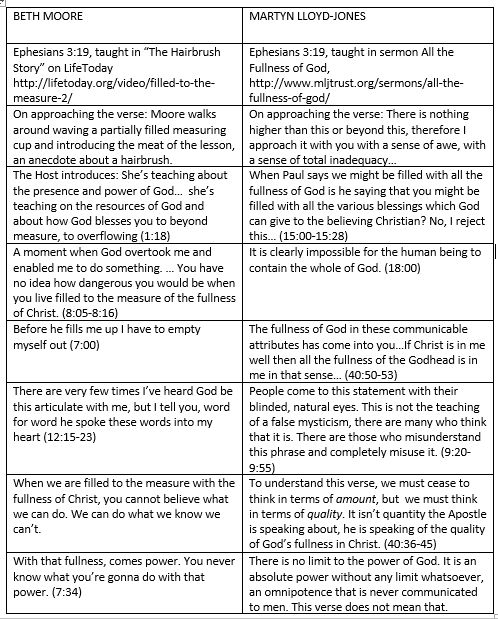
I found that Beth Moore and Martyn Lloyd Jones, having taught the same single verse, came to exactly opposite conclusions. Totally at odds with each other. One says yes, the other no. One says black, the other says white. One says up, the other down. By the picture below, you can easily see which Bible teacher’s teaching I found biblical.
Lloyd Jones’ well known nickname; A nickname I dub Moore
Moore taught that the full measure of Christ in us believers is something we do not currently possess.
Jones taught that the fullness of Christ is something we currently do possess.
Moore taught that we could possess it IF we do certain things.
Jones taught that the fullness is something every believer already has as a gift.
Moore taught that the reason we want the full measure of Christ is so we can get blessing and power.
Jones categorically rejects this.
Moore taught that the fullness was a feeling.
Jones taught that the fullness was a doctrine.
Moore taught that we want the full measure of Christ so we can get something, power, love, blessing.
Jones taught that having the fullness of Christ is something we aspire to because Christ is the prize.
They even have a different summation point-
Beth Moore teaching the point of lesson: “I’ve got to know somebody totally loves me.”
Lloyd Jones says the point of the verse is: “It is the highest doctrine of all.”
I won’t go on, you can see it on this chart I made. I included the links from which I delved into each lesson, and the minute at which I heard each teaching so if you care to check it out yourself, you can. Below the chart are the two illustrations each teacher gave. Moore’s was with the measuring cup and Jones’s was about a bottle. They come to opposite conclusions. Moore believes the fullness has a quantity to it and Jones says the full measure is about the quality of it.
Note: MLJ preached the Ephesians series between 1957 and 1980. Moore’s hairbrush story was re-published on LifeToday in 2012 and that is where I reviewed it, though she had delivered it at least as early as 2011 and maybe a year or two earlier than that. The comments in the chart are direct quotes.
The illustration: Moore’s measuring cup and liquid.
With this visual prop, Moore was teaching that we do not possess the full measure. However if we do certain things in our own power and then ask for the fullness, Christ will give it AND “the power that comes with it”. In Moore’s interpretation, we are all 16 oz measuring cups and some of us have 2 ounces of the fullness and others of us have 4 ounces and others get to be filled up completely. A total filling is not something that will happen on this side of eternity anyway.
Lloyd-Jones teaches the opposite. He focuses on ton the vessel but on the quality of the filling. He said we already possess the fullness of Christ in us when we’re saved. He said the power of God (omnipotence) is an attribute of God that is NON-communicable. MLJ also said the fullness is not a quantity, but a quality. Why?
because the amount varies. It varies in the same man from time to time. It varies from one of us to the other, and yet we all can have the fullness.
Here is an illustration to show how you can possess the fullness and yet have more of it. Take a bottle and put it into the sea. You can fill it. Then you can say that bottle is full of the sea. Then you can take a great tank and do the same thing. They both have a fullness but they haven’t the same amount. And the sea is always the sea. The little bottle full of sea has just the same characteristics of the sea in fullness as the tank has.
The drastic difference between the two teachings comes from their view of Jesus and of self. Jones’ eyes are on Christ, Moore’s is on herself. With her, the fullness is something we get, power comes with it, we do things with this power, we get blessing, we receive affirmation of love, and we can have more of it. We, we, we. Her eyes are on self.
Jones shows us where our eyes should be. Not on the bottle, not on the amount that is IN the bottle, not on the tank, not on anything we might think we get, but on the SEA. It is what is IN us that matters. It’s all about Christ in us, His righteousness, His fullness. It has nothing to do with our works, our deeds, our emptying, our effectiveness, our requests, or anything whatsoever to do with us. He bestows His fullness of Himself to us on salvation. It is all about Christ.
For this reason I bow my knees before the Father, from whom every family in heaven and on earth is named, that according to the riches of his glory he may grant you to be strengthened with power through his Spirit in your inner being, so that Christ may dwell in your hearts through faith—that you, being rooted and grounded in love, may have strength to comprehend with all the saints what is the breadth and length and height and depth, and to know the love of Christ that surpasses knowledge, that you may be filled with all the fullness of God. Now to him who is able to do far more abundantly than all that we ask or think, according to the power at work within us, to him be glory in the church and in Christ Jesus throughout all generations, forever and ever. Amen. (Ephesians 3:14-21)