Posted in end time, high priest, melchizedek, prophecy

Jesus as High Priest

By Elizabeth Prata
This first appeared on The End Time in December 2010

There are many aspects to the Lord’s personality, aspects we have been given through His grace to explore for all eternity. We will never learn all there is to learn about Him, because He is infinite, but the glory will be in the journey, drawing ever closer to Him.

The Christmas season rightly focuses attention to Him as savior, the babe born of a virgin and who lived a sinless life, died as the sacrifice to satisfy God’s Holy righteousness and fulfill the sin-debt that must be paid. We usually focus on Him as Savior, friend, father, and occasionally as judge. But there is another aspect to Him that I would like to explore today: Priest.

David refers to the coming Messiah as a priest on the order of Melchizedek. “The LORD has sworn and will not change His mind. You are a priest forever According to the order of Melchizedek.” (Psalm 110:4)

Who was Melchizedek and why is his Order considered higher than Aaron’s, the first High Priest of the Levites? We read of Melchizedek when he meets with Abraham in Genesis. He is an actual King and an actual Priest, living and walking on the earth in Abraham’s day.

And Melchizedek king of Salem brought out bread and wine; now he was a priest of God Most High. He blessed him and said, “Blessed be Abram of God Most High, Possessor of heaven and earth; And blessed be God Most High Who has delivered your enemies into your hand.He gave him a tenth of all.” (Gen 14:18-20).

The city of Salem was later known as Jerusalem.

In Hebrews 7:3 we read again of Melchizedek, and notice that there is an omission. Usually, especially in the Old Testament, people are introduced to the reader by their genealogy. “So-and-so who was the son of so-and-so and father of…” But it is specifically noted that Melchizedek has no genealogy, so we wonder how anyone who claims Melchizedek is actually Shem, for example, and some Talmudic scholars do, learned of Melchizedek’s lineage. No one knows his genealogy, as is stated in the Hebrews verse below.

In any case, the personage of Melchizedek is certainly righteous. Anyway, the story of the meeting with Abraham is repeated in Hebrews, and introduced this way:

Melchizedek’s Priesthood Like Christ’s
For this Melchizedek, king of Salem, priest of the Most High God, who met Abraham as he was returning from the slaughter of the kings and blessed him, to whom also Abraham apportioned a tenth part of all the spoils, was first of all, by the translation of his name, king of righteousness, and then also king of Salem, which is king of peace. Without father, without mother, without genealogy, having neither beginning of days nor end of life, but made like the Son of God, he remains a priest perpetually.” (Heb 7:1-3).

Melchizedek is referred to again in Hebrews 5:6-10; Hebrews 6:20; Hebrews 7:1-21: “Thou art a priest forever after the order of Melchizedek”; and Hebrews 8:1. From his initial introduction at the meeting with Abraham it was another thousand years until David mentioned him and another thousand again until the writer of Hebrews mentioned him, and then Melchizedek disappears from the biblical record. But the notion of Jesus as Priest does not.

High Priests of the Temple died and their office was given to the son. But Jesus is perpetual and His office of High Priest will never die. High Priests in the temple managed the sacrifices, which were daily. Thousands upon thousands of lambs and other animals were killed, blood ran by the buckets all day every day, but Jesus is the once for all sacrifice. He IS our High Priest, forever.

Therefore, holy brethren, partakers of a heavenly calling, consider Jesus, the Apostle and High Priest of our confession;” (Hebrews 3:1-3)

So what does a High Priest do? They were compassionate about sins, being human themselves. They participated in the sacrificial system, managing others’ sacrifices. Yet being human, they also had to sacrifice on behalf of their own sins. They represented humans before God.

In Revelation 1:6 we read that we are made to be Kings and Priests. “and He has made us to be a kingdom, priests to His God and Father–to Him be the glory and the dominion forever and ever. Amen.” 

Again, in Rev. 5:9b-10 we read that

Worthy are You to take the book and to break its seals; for You were slain, and purchased for God with Your blood men from every tribe and tongue and people and nation. “You have made them to be a kingdom and priests to our God; and they will reign upon the earth.”

Peter reveals that we as believers are part of a royal priesthood:

you also, as living stones, are being built up as a spiritual house for a holy priesthood, to offer up spiritual sacrifices acceptable to God through Jesus Christ. … But you are a chosen people, a royal priesthood, a holy nation, God’s special possession, that you may declare the praises of him who called you out of darkness into his wonderful light. Once you were not a people, but now you are the people of God; once you had not received mercy, but now you have received mercy.” (1 Pet 2:5,9).

Matthew Henry writes:

“All true believers are a holy priesthood; sacred to God, serviceable to others, endowed with heavenly gifts and graces. But the most spiritual sacrifices of the best in prayer and praise are not acceptable, except through Jesus Christ. Christ is the chief Corner-stone, that unites the whole number of believers into one everlasting temple, and bears the weight of the whole fabric. Elected, or chosen, for a foundation that is everlasting.”

What Grace! What Mercy! He as the Chief Cornerstone as High Priest, elects His priests and unites us in a priesthood to serve Him! We are called privileged and we are. Our duties today and forever are to offer up spiritual sacrifices to Him the Most High. Is this a good gift in your eyes? Better than an X-box or a bike or a diamond bracelet? It is a tremendous gift to be called to a royal priesthood serving the High Priest in heaven. It is a high calling. Are you living a holy life worthy of Him and making spiritual sacrifices so His name is magnified? I am rejoicing! I am singing His praises!

As you ponder the mysteries of His very Being this Christmas season, ponder Him as high Priest representing us before God. What a blessed Gift to be able to serve for Him and with him!

Posted in theology

When the canon is challenged…

By Elizabeth Prata

Elaine Pagels book “Revelations: Visions, Prophecy & Politics in the Book of Revelation” was published in 2012. Pagels is a lifelong apologist for the secular worldview. Her 1979 book “The Gnostic Gospels” won the National Book and the National Book Critics Circle Awards, hit the mainstream, and won her a MacArthur Felowship (AKA Genius Grant).

I’ve seen first-hand the damage that her books, and other books like hers, do. They up-end the unstable, cause the believer to doubt, impugn the spotless Lamb, and draw away the unbeliever. I know a woman who was fascinated with the 1979 book, read it and re-read it. Pagels (and Bart Ehrman who wrote “Misquoting Jesus: The Story Behind Who Changed the Bible and Why” are false teachers of the

“the kind who worm their way into households and captivate vulnerable women who are weighed down with sins and led astray by various passions, always learning but never able to come to a knowledge of the truth.” 2 Timothy 3:6-7).

The woman I’m thinking of was exactly that type, always learning but never able to come to truth. This is because her fleshly mind aligned with the writers’ fleshly mind and these women want to learn, just not the truth. Anything but that. Books like Ehrman’s and Pagels have enormous appeal.

Pagels’ Revelation book is built around a simple question: What does Revelation mean? Of course, being non-Christian and lacking the Holy Spirit, she misinterprets the book and dismisses its majestic truths. She impugns its reputation by saying things like ‘people have clashed over the meaning of Revelation ever since it was virtually forced into the New Testament canon over the protests of some early church leaders.’

How does one ‘force’ a book into the canon? Was there a monk held at knifepoint somewhere, told to sew the codex into the canon or else? Were there archers pointing arrows at the participants at the Council of Hippo, intimidate their vote to get it in?

When you take Pagels’ phrasing to its logical conclusion, it’s pretty silly.

Pagels sees the book of Revelation: “As a tale of conflict where one side is wholly righteous and the other wholly evil,”

The fleshly mind cannot concieve of one side being completely evil and the other as completely holy. Writers are told by mentors and professors that their villain should not be written as totally bad, there must be included a redeeming quality about him. The same with the hero, he is not totally good, there has to be written some kind of flaw in him somewhere, “for the story to be believable.”  But of course Jesus is perfectly holy, and never wrong. Satan is totally corrupt and is evil personified. The unsanctified mind cannot grasp this.

One main way people challenge the canon, besides questioning the authenticity by direct or subtle means as noted above, is to challenge its authorship and/or its age.

“It’s just an old book written by a bunch of ignorant shepherds,” they say. Well, Moses was a shepherd, but he was also educated in Pharaoh’s courts, the highest education available at the time. Additionally, it was written by fishermen, tax collectors, physicians, and farmers etc.

“It’s old, shouldn’t be taken seriously,” they say. Matt Slick’s opening paragraph well-rebuts this issue-

The New Testament is constantly under attack, and its reliability and accuracy are often contested by critics. If the critics want to disregard the New Testament, then they must also disregard other ancient writings by Plato, Aristotle, and Homer. This is because the New Testament documents are better-preserved and more numerous than any other ancient writings. Because they are so numerous, they can be cross checked for accuracy . . . and they are very consistent.

Some of the ancient writers’ works, such as Plato, Euripides, Caesar, were copied hundreds of years after the facts, and there might only be ten copies. Yet their works are used in schools and colleges to teach history and literature. The Bible’s first copies arose less than 100 years after the events, within the participants’ lifetimes, and there are 5800 copies available, with 99.5% accuracy among and between the copies.

books

These are but a bare scratch of the surface of this wonderful subject. I recommend Matt Slick’s article above, as well as these below, if you are interested in learning more about how the canon of the Bible was formed and why it is complete, with nothing missing, and lol, nothing “forced” in.

Further Resources

Canon of Scripture (explained and defended)

The Canon of the Bible Ligonier

Answers in Genesis: Why 66 Books?

Posted in theology

Prophecy shows that no matter how crazy the culture gets, Jesus is in control

I’ve been a Christian for only 15 years, but I’ve been alive for 58. Even as a youngster, I asked the eternal question to myself, “Why is the world like this?”

Young people, the unsaved, adults, no matter your age, location, or spiritual status, anyone, can see that the world is broken. People are crazy. Just watch the news, if you dare.

An 11 year old boy who was repeatedly told to clean his room, got out the gun his grandfather had, snuck up behind his grandma watching TV, who was raising him, and shot her in the back of the head. Then he shot himself.

A Chinese woman angered shemissed her stop, and further angered when the bus driver refused to let her off between stops, began hitting her, He pushed her off, and distracted, swerved off a bridge into the Yangtze River, killing all on board.

There have been five separate stabbing attacks in South London this week.

And so on.

The world has always been filled with sinners seeking to fulfill their own desires. A sinner’s desires are completely corrupt and unholy. (Genesis 6:5). They will seek to fulfill these desires by any means they can find, and will eventually resort to graft or deception or bullying or anger, etc.

But it seems lately that the percolating anger in sinners is closer to the surface than ever. Sin makes people insane and they do insane things. That is what having a reprobate mind means. (Romans 1:28-32). I means that people are so darkened that they can’t think straight. For moral and spiritual purposes, they’re effectively insane.

It used to be that people seemed to be held in check from expressing their baser desires by cultural pressure. Even though we in America have never really been a Christian nation, people acted Christian. The veneer fo morality prevented things from being said, acts from being done.  Over time though, the social-moral fabric has frayed. Badly.

But… Jesus is alive and in control. He sees this foolishness and He will come back to take care of it.

The Great Day of the LORD
I will utterly consume everything From the face of the land,” Says the LORD; “I will consume man and beast; I will consume the birds of the heavens, The fish of the sea,And the stumbling blocks along with the wicked. I will cut off man from the face of the land,” Says the LORD. “I will stretch out My hand against Judah, And against all the inhabitants of Jerusalem.I will cut off every trace of Baal from this place,” (Zephaniah 1:1-4)

This was a prophecy against Judah. Do you see that? EVERY TRACE of Baal will be gone!

Therefore wait for Me,” says the LORD, “Until the day I rise up for plunder; My determination is to gather the nations To My assembly of kingdoms, To pour on them My indignation, All My fierce anger; All the earth shall be devoured With the fire of My jealousy.” (Zephaniah 3:8).

And He rose from the dead so that He could conquer death and atone for our sins and to fulfill all the promises since Genesis! He is risen! He lives! He loves! He is with us in our time of trouble and He will come for His beloved! He will rectify the wrongs and rid the world of polluted governments and wretched religions, the Baals and the Mammons will be banished from the earth forever!

And if Christ be not raised, your faith is vain; ye are yet in your sins.” (1 Corinthians 15:17)

But He IS risen, and we are with Him, “Buried with him in baptism, wherein also ye are risen with him through the faith of the operation of God, who hath raised him from the dead.” Colossians 2:12

Mighty is our God who raises from the dead, justifies our sins through Jesus, and Who sets all prophecies down so we may see what must come to pass. Prophecy shows that no matter how crazy the culture gets, Jesus is in control

god is sovereign

Posted in christian life, theology

Clothing: Readying the outer man and the inner man

By Elizabeth Prata

I didn’t do laundry this weekend. I have just enough clothing to get me through the week, and then I need to do laundry on Saturday to ready for Sunday services and then the work week again. I didn’t do that this weekend. So Sunday I was sort of stuck when I was getting ready for church. What to wear for worship service?

The Pharisees were obsessed with clothing. They not only wore the biblically required garments to show their ordained position, which was being obedient, but they deliberately altered their clothes to show they were even more holy than that, which was disobedient. They sought adulation and honors and were doing it through their apparel. Jesus saw through that of course.

He accused them of enlarging the borders of their garments (Matthew 23:5-6) – This refers to the loose fringe at the borders of the outer garment. This fringe was commanded in order to distinguish them from other nations, specifically as God’s people, and that they might remember to keep the commandments of God, (Numbers 15:38-40; Deuteronomy 22:12). Adorning the fringes were bells, and the Pharisees added more than the required amount so people would hear them coming. The Pharisees made the fringe border broader than other people wore them, so people would see them coming, and hear them when they walked on the corners to pray aloud.

But they do all their deeds to be noticed by men; for they broaden their phylacteries and lengthen the tassels of their garments they love the place of honor at banquets and the most important seats in the synagogues; 7they love to be greeted in the marketplaces and to have men call them ‘Rabbi.’” (Matthew 23:5-7).

They loved the trappings, but not the reason for the trappings.

Yesterday I thought about what I would wear to church, I do not think it is too good to overly dwell on our apparel, church wear or work wear, or casual wear. There is a fine line beteen carefully considereing clothing formodesty and propriety’s sake, and suing clothing to gain status or pretension. The Bible is replete with admonitions about outer wear, believe it or not. It’s also replete with metaphorical warnings instructing us on the comparison of the outer garment and the inner man.

In Zephaniah 1:8 God warns that He will strike down those wearing ‘foreign garments’, or ‘strange apparel’ depending on your translation. The pagans wore strange apparel, often an indicator of degeneracy, especially in the old days when it signified allegiance to pagan gods.

As a woman, I’ve noticed the degeneracy in women’s wear. Skirts are shorter than ever, and necklines seem to plunge lower every day. It truly is hard to find a modest shirt these days.

Paul said, perhaps with a sigh of relief, that he never coveted other apparel: “I have not coveted anyone’s silver or gold or clothing.” (Acts 20:33). It may seem strange to us today that the list of things that were coveted in Paul’s day were not only the expected items like gold and silver, but also apparel. But clothing bespoke wealth. Remember Lazarus and the rich man. (Luke 16:19-31). In Luke 16:19 the rich man’s name is forever forgotten but his wealth is what is listed, among the riches mentioned are clothing. “There was a certain rich man who was clothed in purple and fine linen and fared sumptuously every day.”

Wearing purple was the Gentile way of signalling wealth and status. Pharisees might have enlarged their fabric borders and lengthened their tassels, but pagans showed off too, by wearing purple. Purple dye was expensive and only the richest of the rich could afford it.

Yet on the Day of the Lord, their wealth and clothing will not save them.

Neither their silver nor their gold will be able to deliver them. On the day of the LORD’S wrath; And all the earth will be devoured in the fire of His jealousy, For He will make a complete end, indeed a terrifying one, Of all the inhabitants of the earth. (Zeph 1:18)

It’s the inner man that counts more than the clothing of the outer man.

Woe to you, teachers of the law and Pharisees, you hypocrites! You are like whitewashed tombs, which look beautiful on the outside but on the inside are full of dead men’s bones and everything unclean.” (Matthew 23:27)

I’m not saying that dressing up is a bad thing. I’m not saying nice clothes are bad, either. But if dressing up is the way we show off for church service, or to cal attention ot our bidies at work, then it is a bad thing. He knew the Pharisees and scribes were hypocrites, even though they were splendidly attired, because He could see their hearts were far from God. He knew the Rich Man was far from God too, despite the fine linens He wore to all his banquets. The poor man was justified, even though he wore rags.

Let’s think about how we can prepare ourselves inside and come to Him clean. Are we willing to examine ourselves? As we ready the outer man for church or work, let’s make sure we’re doing it correctly, not to show off wealth, status, or our bodies but as a token of our esteem to the One we worship. Even better, let’s ready the inner man for the day even more than we ready the outer man.

For if the willingness is there, the gift is acceptable according to what one has, not according to what he does not have“. (2 Cor 8:12)

Do not offer the parts of your body to sin, as instruments of wickedness, but rather offer yourselves to God, as those who have been brought from death to life; and offer the parts of your body to him as instruments of righteousness.” (Romans 6:13)

Do your best to present yourself to God as one approved, a worker who does not need to be ashamed and who correctly handles the word of truth.” (2 Tim 2:15).

He doesn’t care if we have a new dress or are wearing a tie, He does care if we over-spent in getting the new dress or tie and worse, if obtaining it was for the purpose of showing off. He does see the effort we make to ready our outer and our inner selves for the day and for His worship services.

If our heart is in right standing to Jesus (repentant and humble, a servant desiring change from the inside out) He will clothe us with the best clothes of all. —

I delight greatly in the LORD; my soul rejoices in my God. For he has clothed me with garments of salvation and arrayed me in a robe of righteousness, as a bridegroom adorns his head like a priest, and as a bride adorns herself with her jewels.” (Isaiah 61:10).

clothespins

Posted in theology, word of the week

Sunday Word of the Week: Sovereign

By Elizabeth Prata

In addition to the familiar Bible verses speaking to God’s sovereignty, one of which is at the conclusion of this essay, there is a famous quote from RC Sproul that exalts God’s sovereignty:

If there is one single molecule in this universe running around loose, totally free of God’s sovereignty, then we have no guarantee that a single promise of God will ever be fulfilled.

It is a great quote because it speaks to how God created and upholds every single atom in the universe. He is the author, architect, and absolute king over all.

Jesus, His Son, has been given all power and authority as God. (Matthew 28:18). Jesus is the exact imprint of His Father.

He is the radiance of the glory of God and the exact imprint of his nature, and he upholds the universe by the word of his power. After making purification for sins, he sat down at the right hand of the Majesty on high, (Hebrews 1:3).

We Americans are unfamiliar with sovereignty. We shed our King back in 1783 when we signed the peace treaty at Paris, concluding the Revolutionary War. Today, sovereignty has changed somewhat from the kings of old. According to the Stanford Encyclopedia of Philosophy, sovereignty means

Sovereignty, though its meanings have varied across history, also has a core meaning, supreme authority within a territory. …  Historical variants can be understood along three dimensions — the holder of sovereignty, the absoluteness of sovereignty, and the internal and external dimensions of sovereignty.

Sovereignty can also be absolute or non-absolute. How is it possible that sovereignty might be non-absolute if it is also supreme? … absoluteness refers not to the extent or character of sovereignty, which must always be supreme, but rather to the scope of matters over which a holder of authority is sovereign.

Today, many European Union (EU) member states exhibit non-absoluteness. They are sovereign in governing defense, but not in governing their currencies, trade policies, and many social welfare policies, which they administer in cooperation with EU authorities as set forth in EU law.

The major change to international sovereignty happened in 1648 with the signing of a treaty called the Peace of Westphalia. Please bear with me for a brief history lesson. The rise of the Holy Roman Empire and the Catholic Church had caused friction, Martin Luther’s theses complicated matters, and the continent of Europe had been at war ecclesiastically and politically for a very long time (Thirty Years War, Eighty Years War, etc). The Westphalia treaty effectively ended those wars, and also limited the Roman Catholic Church’s widespread and growing power. In addition, the RCC’s claim as the only moral and spiritual truth was now effectively void. Catholicism, Lutheranism, and Calvinism were officially recognized as religions, within which, an adherent could worship freely.

Henry Kissinger wrote:

The Westphalian peace reflected a practical accommodation to reality, not a unique moral insight. It relied on a system of independent states refraining from interference in each other’s domestic affairs and checking each other’s ambitions through a general equilibrium of power. No single claim to truth or universal rule had prevailed in Europe’s contests. Instead, each state was assigned the attribute of sovereign power over its territory. Each would acknowledge the domestic structures and religious vocations of its fellow states and refrain from challenging their existence

The Treaty itself is explained here

The Peace of Westphalia was a series of peace treaties signed between May and October 1648 in the Westphalian cities of Osnabrück and Münster, largely ending the European wars of religion. The treaties of Westphalia brought to a close a calamitous period of European history which caused the deaths of approximately eight million people. Scholars have identified Westphalia as the beginning of the modern international system, based on the concept of Westphalian sovereignty.

The Peace of Westphalia established the precedent of peace established by diplomatic congress. A new system of political order arose in central Europe, based upon peaceful coexistence among sovereign states. Inter-state aggression was to be held in check by a balance of power, and a norm was established against interference in another state’s domestic affairs. As European influence spread across the globe, these Westphalian principles, especially the concept of sovereign states, became central to international law and to the prevailing world order.

Of course, the Roman Catholic Church was furious at this continental limit to the Holy See’s sovereignty, with Pope Innocent X calling the Treaty “null, void, invalid, iniquitous, unjust, damnable, reprobate, inane, empty of meaning and effect for all time” in the papal bull Zelo Domus Dei.

People today aren’t aware that the Pope is the world’s last absolute monarch. In framing the concept of sovereignty, of course we understand that our nation has sovereign powers with its globally recognized borders. Every nation is recognized so, and this is codified in the UN Charter. Political sovereignty is a normal, natural concept readily understandable by even a young person learning history.

The RCC is spiritual entity as well as a global power with a territory, standing army (The Swiss), internationally recognized borders, taxes extracted, a treasury, and sovereign power, in fact, an absolute power that cannot be contested. The Pope is the last absolute sovereign power in existence on the planet today.

The Holy See is the last absolute monarchy in the world today. The pope, when he is elected, is answerable to no human power. He has absolute authority over the entire Roman Catholic Church, direct authority that reaches down to individual members.

All of the governing officers in the Vatican itself, what we call the Vatican Curia, operate on delegated authority from the pope. They speak in the name of the pope. In the Roman Catholic Church, there are no separation of powers as we know of in most democratic societies. In the Roman Catholic Church, the office of pope includes the three main offices of government. He is the supreme judge, the supreme legislator and the supreme executive, so there’s no separation of powers. There is no possibility of checks and balances. Source PBS

The problem comes in with the Roman Catholic Church’s view of supremacy and sovereignty. The Protestant Church acknowledges Jesus as Head of the Church in heaven and on earth. The RCC acknowledges Jesus as head of the Church in heaven only. The Pope is supreme on earth in matters spiritual. Vicar of Christ means the pope operates as a vicarious substitute for Christ on earth. That God has handed the Pope the jurisdiction of earth in the sovereign execution of matters spiritual.

Paragraph 937 of the Catechism of the RCC states,

Papal supremacy is the doctrine of the Roman Catholic Church that the Pope, by reason of his office as Vicar of Christ and as pastor of the entire Christian Church, has full, supreme, and universal power over the whole Church, a power which he can always exercise unhindered: that, in brief, “the Pope enjoys, by divine institution, supreme, full, immediate, and universal power in the care of souls.”

Of course this is wrong. It competes with Jesus’s own statement in Matthew 28:18 that all authority in heaven and on earth has been granted Him. The difference in a Catholic’s view of sovereignty of God and the Protestant’s view of the sovereignty of God is vast. It is an eternally damning error. Only Jesus enjoys, by divine bestowal from God and in conjunction by the working of the Holy Spirit in Truine unity, supreme, full, immediate, and universal power in the care of souls- on heaven AND on earth. What it comes down to is, do you serve a sovereign Pope, or a sovereign God?

What’s so great about the sovereignty of God?

Many people do not believe in God’s sovereignty, yet still serve the Lord. But there is a great difference. Those who see the Lord in His sovereign glory have an inward compulsion to serve this God. Serving God is the glory of their lives. Their service is measured not so much in what they achieve–or what God achieves through them–but rather in the sheer wonder of the God they serve. Like little boys dividing up into teams on the playground, being picked to play on this team is the greatest joy imaginable, especially for those who are so unworthy. “Here am I! Send me,” is not merely the response of those who see God’s sovereign glory, it is their delight. Since God is certain to be glorified, they want to be among those glorifying God.

I’ll finish with AW Pink

“What do we mean by [the sovereignty of God]? We mean the supremacy of God, the kingship of God, the god-hood of God. To say that God is Sovereign is to declare that God is God. To say that God is Sovereign is to declare that He is the Most High, doing according to His will in the army of Heaven, and among the inhabitants of the earth, so that none can stay His hand or say unto Him what doest Thou? (Dan. 4:35).

To say that God is Sovereign is to declare that He is the Almighty, the Possessor of all power in Heaven and earth, so that none can defeat His counsels, thwart His purpose, or resist His will (Psa. 115:3). To say that God is Sovereign is to declare that He is “The Governor among the nations” (Psa. 22:28), setting up kingdoms, overthrowing empires, and determining the course of dynasties as pleaseth Him best. To say that God is Sovereign is to declare that He is the “Only Potentate, the King of kings, and Lord of lords” (1 Tim. 6:15). Such is the God of the Bible.” A. W. Pink, The Sovereignty of God, chapter 1.

1 Sunday sovereignty verse

Posted in christian living, theology

A Day in the Life of: A Fisherman

By Elizabeth Prata

Previous essays in A Day in the Life of:

A Day in the Life of: A Roman Centurion
A Day in the Life of: A Professional Mourner
A Day in the Life of: A Potter
A Day in the Life of: A Scribe
A Day in the Life of: A Shepherd
A Day in the Life of: A Tanner
A Day in the Life of: A Seller of Purple
A Day in the Life of: Introduction

I admire and respect fishermen. I’ve watched the hardy lobstermen of Maine, or the cod fishermen of Massachusetts, the watermen fishing for crabs in the Chesapeake, the shrimpers of the south or the bonefish, sponge, and conch fishermen of the warmer waters. Fishing for a living is hard. It is not for the weak or the lazy.

There are no days off, you go out in storms, heat, rain, and ice. You use your body as one with the boat and the sea, drawing from it food and life.

It was no different for the fishermen of Galilee in Jesus’ day. Jesus called four fishermen as His disciples. Simon-Peter and his brother Andrew, and John and his brother James, the sons of Zebedee, who was also a fisherman.

Fishing villages along the shore of the Sea of Galilee included Capernaum, where Jesus based much of His ministry, (Mark 2:1); Bethsaida (Luke 9:10); and Magdala, town of Mary Magdalene (Matt 15:39).

The pictures of the Holy Land around 1900 are important because life and traditions in Palestine didn’t change much until after WWI. A photo depicting life in 1900 would be almost a copy of any scene from the time of Jesus. These Library of Congress photos offer a glimpse into not just the recent past of the 20th century, but a peek back 2000 years.

Galilean fishermen boat nets
Galilean fishing boat, around 1900. Source Library of Congress

While walking by the Sea of Galilee, he saw two brothers, Simon (who is called Peter) and Andrew his brother, casting a net into the sea, for they were fishermen.  And he said to them, “Follow me, and I will make you fishers of men.” Immediately they left their nets and followed him. And going on from there he saw two other brothers, James the son of Zebedee and John his brother, in the boat with Zebedee their father, mending their nets, and he called them. Immediately they left the boat and their father and followed him. (Matthew 4:18-22).

We learn so much from just these 4 verses.

WHERE: They fished the Sea of Galilee
WHO: as mentioned, the two sets of brothers
WHAT: They were net fishermen as opposed to hook and line fishermen. They cast from boats they owned and they mended their nets (this shows us they were diligent).
WHY: Fishing was hard, but gave a living, generationally, in John and James’s case. Yet when He called, the men left their profession and immediately followed Jesus.

The Sea of Galilee was also called Kinneret or Kinnereth, and Lake Tiberias. It’s Israel’s largest freshwater lake. A fisherman’s day would begin at pre-dusk, because they fished at night. Why? The nets were made of linen which were lighter colored. They’d be more visible to the fish by day, since the waters were cool and clear. The fish would avoid the nets.

In addition, the fish were more active and feeding closer to the surface at night. You caught fish at night, in shallow water.

So they fished at night. (John 21:3). The men would launch their boat from shore and sail gently into the shallow areas along the shore. They’d cast their nets, which were really a three-walled net of decreasing size mesh holes, into the water. Little weights along the bottom would help the net sink vertically down, and the top would float, since there were little buoys of cork or wood attached.

They might be catching little fish, (Matthew 15:34), a Kinneret sardine, processed at the salting and drying station of the town of Bethsaida (House of Fish). Or they might be catching big fish, a kind of tilapia with white flesh and good to eat. (John 21:11).

If the fisherman wasn’t using his boat or didn’t have one, he stood near shore, casting a smaller net. When Jesus called Simon-Peter and Andrew, they were on the shore throwing out their nets from land. (Matthew 4:18). When He called James and John, they were throwing nets from their boat with their father Zebedee.

One other way to fish with nets was with a dragnet. Jesus compared dragnet fishing to the kingdom of heaven-

Once again, the kingdom of heaven is like a dragnet that was cast into the sea and caught fish of every kind. (Matthew 13:47)

This is where a net would be laid out in a horseshoe shape from shore, and dragged in, catching many different kinds of fish. The men would then sort the good fish from the bad, tossing the unmarketable fish away and keeping the good.

Above, Dragnet fishing at Sea of Galilee, circa 1900. Library of Congress, LC-matpc-04570

Either way, the fisherman would swim to the center and dive down to gather either the fish or draw up the net. He’d do this naked. (Meaning with only his light undergarment on, not bare-skin naked). Peter was fishing this way when the verse says he put on his clothes to go meet Jesus. (John 21:7). The nets set from the boat could be several hundred feet long and 20 feet high. In Luke 5:6 when Jesus miraculously filled their nets, the huge nets became so heavy that they needed the other boat crew to help drag it aboard, then the nets were breaking, and the boat began to sink as they brought in the haul!

On a normal, miracle-less day, whether from the boat or from the shore, it still was heavy labor to throw the nets out, wait for them to settle, and then circle back by sail or swim back to haul them in. Repeat. All night. Fishermen were hard workers, strong, and were usually peasants and therefore used to a rough life.

In the morning, the fishermen would stop and bring their gear ashore. They’d eat breakfast. Then they would set to fixing their gear. It was time to spread their nets and examine them. (Ezekiel 47:10). Do any of the stone weights along the bottom need replacing? They’d have to gather more stones, drill holes, and tie them to the bottom. Do any of the cork or wood buoys along the top need replacing? Do the nets need re-sewing? Are they rinsed off? Is the debris picked out of the nets?

galilee fisherman
Photo Library of Congress, Galilean Fishermen, approx 1900.

The same attention needs to be given to the boat. These items were their livelihood. So the fishermen would examine the sails and sew or patch any worn areas. Check the anchor rope and the mast and the underside. Tar or pitch could be heated to cover the planks to seal them. Ropes need to be re-twined and add pitch to the ends to ensure it doesn’t fray.

At the end of their day they would fold the nets and store them in the boat, waiting for the night-time when they’d put out in the Sea of Galilee again.

A day in the life of a Galilean fisherman was hard, but it offered a living. As with any trade, a father taught the son. Joseph taught Jesus carpentry. Zebedee taught his sons James and John how to fish. Net fishing hasn’t changed much in 2000 years. You could see similar scenes as the ones above in Indonesia, China, Viet Nam, Venezuela or any place. What has changed is the incarnation of Jesus, molding these rough outdoor peasant men into gentle, loving Christians, ready to catch men with the net of the Gospel. And as with these men, our spiritual forefathers, they teach us to this day.

And Jesus said to Simon, “Do not be afraid; from now on you will be catching men.” And when they had brought their boats to land, they left everything and followed him. (Luke 5:10b).

I pray you and I catch many souls with our net of the Gospel and a life well lived through following Him.

Posted in doctrines of grace, theology

Does John 3:16 teach that anyone can be saved?

RC Sproul often spoke in defense of the Doctrines of Grace when someone challenged them by quoting John 3:16. Here is one of his responses over the years to that challenge:

By RC Sproul
From “Knowing Scripture

“The principle of literal interpretation gives us another rule, namely that the Bible in one sense is to be read like any other book. Though the Bible is not like any other book in that it carries with it the authority of divine inspiration, nevertheless, the inspiration of the Holy Spirit over a written text does not turn verbs into nouns or nouns into verbs. No special, secret, arcane, esoteric meaning is poured into a text simply because it’s divinely inspired. Nor is there any such mystical ability we call “Holy Ghost Greek.” No, the Bible is to be interpreted according to the ordinary rules of language.”

“Closely related to this point is the principle that the implicit must be interpreted by the explicit, rather than the explicit interpreted by the implicit. This particular rule of interpretation is violated constantly. For example, we read in John 3:16 that “whoever believes in him should not perish but have eternal life,” and many of us conclude that since the Bible teaches that anyone who believes shall be saved, it therefore implies that anyone can, without the prior regenerative work of the Holy Spirit, exercise belief. That is, since the call to believe is given to everyone, it implies that everyone has the natural ability to fulfill the call. Yet the same gospel writer has Jesus explaining to us three chapters later that no one can come to Jesus unless it is given to him of the Father (6:65). That is, our moral ability to come to Christ is explicitly and specifically taught to be lacking apart from the sovereign grace of God. Therefore, all of the implications that suggest otherwise must be subsumed under the explicit teaching, rather than forcing the explicit teaching into conformity to implications that we draw from the text.”

john 316verse.jpg

Posted in theology

From whence our mercies come

By Elizabeth Prata

In The Pilgrim’s Progress, Part 2, there is a scene with Christiana in the House of the Interpreter. The Interpreter was showing Christiana, Mercy, and the boys some things happening in different rooms of the house.

He had them into another room, where were a hen and chickens, and bid them observe a while. So one of the chickens went to the trough to drink, and every time she drank she lifted up her head and her eyes towards heaven. See, said he, what this little chick doth, and learn of her to acknowledge whence your mercies come, by receiving them with looking up.

Of course the Interpreter is making reference to something by using a picture. Chickens actually need to drink by tipping their heads back.

Often times in late medieval literature, the author used emblems to convey an idea. An emblem is not a symbol, exactly.

According to Wikipedia, “although the words emblem and symbol are often used interchangeably, an emblem is a pattern that is used to represent an idea or an individual. An emblem crystallizes in concrete, visual terms some abstraction: a deity, a tribe or nation, or a virtue or vice.”

Just a paragraph above in this section of Pilgrim’s Progress, author John Bunyan had directly referred to an emblem. As the Interpreter showed Christiana a robin eating a spider, he proceeded to explain its meaning.

A few moments later in the scene, we come upon the chickens. It’s a vivid word picture. Not much needs to be explained about what we see here. The picture is good to ponder. Do we acknowledge from whence our mercies come? Are we thankful to the Father who gives all good gifts to His children?

chickens

Posted in theology

On life, death, buses, and trains

By Elizabeth Prata

A man died in his car after a collision with a train last week. His small child was airlifted from the scene to Atlanta and was listed in critical condition.

He was the father of four and 3 of his children attended our county schools.

I have a love-hate relationship with trains. 50 years ago, the town dump was just that, a dumping ground. Old fridges, lawn chairs, lamps, trash and the like were just dumped onto a landfill. My dad took the trash every weekend and always asked if me and my brother wanted to go. We always did. The dump was at the same time scary, spooky, alluring, and fun to pick around at the dump. You never knew what you might find.

The dump was fun but there was terror in going because of the train.

You had to cross the railroad tracks to get there. My father used to stop on the tracks and turn off the car and pretend we were stalled. He’d yell that the train was coming and we were all going to die. We’d scream terrified in the back seat, peering wild-eyed up the tracks to see where the train was. Then he would laugh hysterically at his joke and turn the car on and we’d go.

Yeah, I know.

The church I attend is down a main road that parallels the tracks for a good 7 miles. I get really nervous around train tracks, even to this day. There are a lot of crossings. Most of them have lights and gates. A few don’t. It was at one where there were no gates or lights that the accident happened.

As I approached the scene on my way to church that night, I saw that the train had stopped, and the train guy in reflective jacket had descended the steps and was running alongside the train. His face looked terrified… Anyway, I wondered what he was running toward, because the train doesn’t stop there and the train guy doesn’t usually exit the train, usually. I looked ahead and spotted the vehicle in the ditch. I winced, the car was pretty wrecked. Ambulances hadn’t gotten there yet. I said a prayer as I passed.

I was saddened by this tragedy, pretty deeply. I thought about it all week. I prayed for the family. I wondered of the man was saved.

Then another tragedy struck. Not in our immediate area like the train accident, but in Indiana. A mother/church-goer/children’s minister, had her life turned inside out in a flash. She struck and killed three small children as they crossed the road to their bus. A fourth child was gravely injured. The three children were siblings, twin boys and a girl, from the same family.

“I haven’t seen first responders and troopers cry in a long time” said Indiana State Police Sergeant Tony Slocum. It was a heart-rending scene. It is one I cannot contemplate too long if I am not going to cry.

A mother somewhere in Indiana lost her three children in a flash. The last thing those children saw was a truck grill bearing down on them. It is awful thought. Investigators do not yet know why the wreck happened. The driver had stopped and had his flashing lights on and the arm out. He doesn’t seem to have contributed to the accident. The mother alone has been charged, three counts of reckless homicide and failing to stop at a school bus.

There is a lot to absorb regarding this incident, if one wants to mull it over. I don’t blame you if you don’t. We all know that our lives could be changed in a moment, but we don’t really think about it. When it happens, it often happens fast, like the father who was killed by the train. One moment you’re trundling along and the next you’ve arrived at your eternal destination.

The man’s wife was suddenly widowed, and her children fatherless, all in a moment. The mother who ran over the three kids at the bus stop, will never be the same, she has felonies on her record and never mind the insane grief and guilt she will bear forever.

I got to thinking about all that is done under the sun. What God must think of us, going about our business…lost sheep who have all gone astray

This may seem trite but it is true and applicable to how things are on this earth.

For everything there is a season, and a time for every matter under heaven:

2a time to be born, and a time to die;
a time to plant, and a time to pluck up what is planted;
3a time to kill, and a time to heal;
a time to break down, and a time to build up;
4a time to weep, and a time to laugh;
a time to mourn, and a time to dance;
5a time to cast away stones, and a time to gather stones together;
a time to embrace, and a time to refrain from embracing;
6a time to seek, and a time to lose;
a time to keep, and a time to cast away;
7a time to tear, and a time to sew;
a time to keep silence, and a time to speak;
8a time to love, and a time to hate;
a time for war, and a time for peace.
(Ecclesiastes 3:1-8)

And this

For who knows what is good for man while he lives the few days of his vain life, which he passes like a shadow? For who can tell man what will be after him under the sun? (Ecclesiastes 6:12)

My Lord and My God ordains all. He knows what goes on under the sun. He allows sin to permeate a life, its effects to take a life, innocents to be killed, wives to become widows, mothers to become childless, children to become motherless.

It is a world full of sorrow and pain, heartache and tragedy. This isn’t such a positive essay, and I am sorry if you were looking for that today. But in this world, unexpected events happen which defy our comprehension but still hurt our heart. Trusting God is the only answer.

Consider the work of God: for who can make that straight, which he has made crooked? (Ecclesiastes 7:13)

Barnes’ Notes on the Bible

The work of God – The scheme of Divine Providence, the course of events which God orders and controls (compare Ecclesiastes 3:11). It comprises both events which are “straight,” i. e., in accordance with our expectation, and events which are “crooked,” i. e., which by their seeming inequality baffle our comprehension.

God sent His Son so that even when baffling things happen, we can turn to Him for comfort. We know that He knows. He is working things out to the good for those who love Him. He has reasons and ways and plans that we don’t understand, but we have the Light of understanding that He does, and that’s enough.

Once again, Jesus spoke to the people and said, “I am the light of the world. Whoever follows Me will never walk in the darkness, but will have the light of life.” (John 8:12).

My Post (7)

Posted in prayer, theology

What are some good books on prayer?

I am always thrilled when one of the ladies asks me a question, either a theological question, one on Christian life, or a book recommendation. It means she is thinking, seeking God’s glory, and striving on her walk. With so much negtivity around, it’s great to be reminded, that nothing and no one will overthrow Jesus’s church. It is thriving, growing, and will endure till the last day. There are still many Christians on earth who care about the way God wants to receive worship and prayer and who care about their Christian walk. What a blessing the brethren are.

prayer

A reader recently asked me for recommendations on books about prayer. My first thought immediately went to the Valley of Vision. Valley of Vision! It’s a book OF prayers by Puritans. But reading it will teach you to pray. It is THE most convicting, moving, and stirring book one could hope to read! (after the Bible). These Puritans’ prayers are deep and God centered. I’d say it’s #3 of best loved books in the English language, with the Bible first and Pilgrim’s Progress next. If you have those three books on your shelf, the seeds of theological solidity have been planted, with more books to sprout as you go.

Also, I recommended “The Power Of Prayer In A Believer’s Life“, by C.H. Spurgeon, a collection of sermons. Charles Spurgeon preached numerous times on prayer.

Considered by his peers then and now as “The Prince of Preachers,” Charles Spurgeon built London’s Metropolitan Tabernacle into the world’s largest independent congregation during the nineteenth century. While many factors have been highlighted that help explain the effectiveness of Spurgeon’s preaching, the foremost secret that empowered Charles Spurgeon was his devotion to prayer.

Or this one on Amazon is a good one.

7 classics on PRAYER: Here is the blurb:

This fantastic compilation brings you 7 Christian classics on PRAYER. Ever struggled with how to pray, what to pray for, or just needed encouragement to keep praying? These powerful writings will stir your heart and strengthen your faith, helping you grow in communion with God.

 How To Pray – by R. A. Torrey [12 chapters]
• With Christ in the School of Prayer – by Andrew Murray [32 chapters]
• Prevailing Prayer – by D. L. Moody [11 chapters]
• How I Know God Answers Prayer – by Rosalind Goforth [10 chapters]
• Answers to Prayer – from George Muller’s Narratives [6 chapters]
• Power Through Prayer – by E. M. Bounds [20 chapters]
• A Short and Easy Method of Prayer – by Madame Jeanne Guyon [24 chapters]


Jeanne Guyon was a Catholic Mystic, so that section of the book appears to be the only dud chapter.

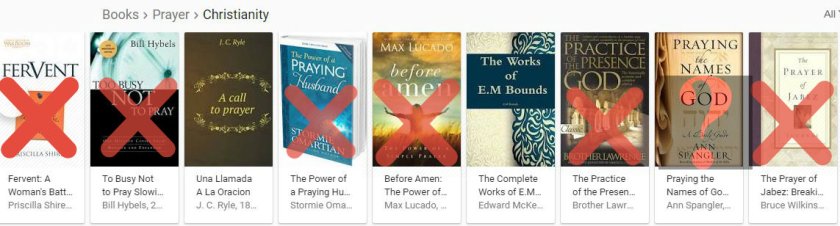
I am extremely hesitant to recommend something newer. Of late many people have been writing about prayer, but the authors are outight heretics or in some cases blossoming heretics. Or they quote Catholics or mystics in the book. Others twist the discipline of prayer into a prosperity or self-help notion. If you know of a recent and solid book on prayer, please do share. When I recommend, I think it’s better to stick with the more solid older books on this subject. See what a search for ‘Christian books on prayer’ yields:

Clipboard01

One can always go to the gty.org store and look for something there, or the same at Ligonier.org. Banner of Truth books is pretty trustowrthy, this is their page on the subject of prayer

Thanks for the question, keep them coming!