Posted in theology, word of the week

Sunday Word of the Week: Fruit of the Spirit, Kindness

By Elizabeth Prata

But the fruit of the Spirit is love, joy, peace, patience, kindness, goodness, faithfulness, gentleness, self-control; against such things there is no law. Galatians 5:22-23

kindness here in Greek (xrēstótēs) means a useful kindness, referring to meeting real needs, in God’s way, in His timing (fashion). Hence 5544 (xrēstótēs) is listed as a fruit of the Holy Spirit (Gal 5:22). With the believer, 5544 /xrēstótēs (“divine kindness”) is the Spirit-produced goodness which meets the need and avoids human harshness (cruelty). Strong’s

People have shown me kindness before in the big things in meeting physical needs, which is always amazing and welcome. Kindness shown in the little things too, are also a welcome act and often more precious than the big acts. A hug well-timed, a kind word, a surprise donation, a small gift for no reason, deference shown, restraint in a tough situation, all these are kindnesses. Below in Further Resources, Alistair Begg preaches that kindness softens peoples’ hearts to hear the Gospel.

At Ligonier, we read that patience and kindness are tied together. Excerpt:

Whoever pursues righteousness and kindness will find life, righteousness, and honor” (Prov. 21:21).

As we continue our study of Christian character, let us remember that the fruit of the Spirit as listed in Galatians 5:22–23 provides a helpful way to see if we are imitating Christ. Jesus alone perfectly displayed these fruits in His life, and we must strive to do the same if we have trusted in Him. As we seek to follow the example of Christ, we must recognize that we are able to follow Him on account of the Holy Spirit. …

The Lord has not only been patient to us, He has been kind. Therefore, we must mimic this kindness in our dealings with other people. We must avoid the temptation to be petty in our dealings with other people. We must overlook minor faults in love, and we will only be able to do this when we are patient, recognizing that not every situation is equally deserving of our correction.

In Acts 28:2 we read that

The native people showed us unusual kindness, for they kindled a fire and welcomed us all, because it had begun to rain and was cold.

They showed us not little kindness. So far were they from making a prey of this shipwreck, as many, I fear, who are called Christian people, would have done, that they laid hold of it as an opportunity of showing mercy. …

When in the extremities of bad weather we find ourselves fenced against the rigours of the season, by the accommodations of a warm house, bed, clothes, and a good fire, we should think how many lie exposed to the present rain, and to the cold, and pity them, and pray for them, and help them if we can. ~Matthew Henry’s commentary on the whole Bible

The Maltese people came out in the torrential rain to serve and save those drenched sailors washed up on shore. It was winter, cold, storming, and these people put themselves out in order to show kindness. There were several hundred sailors, on commenter says. It must have been no small thing to mount a bonfire large enough to warm all of them, and in the drenching winter rain, too.

In the end, kindness defined is simple but doing it Christ’s way is hard. We must meet needs (extravagantly) and avoid harshness (at all times). Be kind.

Further Resources

Alistair Begg sermon – Cultivating Kindness

Ligonier Devotional – A Call to Kindness

word cloud

Posted in christmas hymns, theology

Christmas Carols are on, including The Coventry Carol

By Elizabeth Prata

Being home now on Thanksgiving Break all week has put me into the holiday mood. I started listening to Christmas carols this morning. At The Special Store (vintage estate resale store) yesterday I’d seen an Anne Murray CD called Christmas, issued in 2008. It was damaged unfortunately, but the songs on it were all the ones I liked, including The Coventry Carol. I was disappointed it was too damaged to buy but I am glad the song list reminded me of The Coventry Carol.

The Coventry Carol is a dirge, a lament for the dead. Wikipedia explains this medieval song’s origin

The “Coventry Carol” is an English Christmas carol dating from the 16th century. The carol was traditionally performed in Coventry in England as part of a mystery play called The Pageant of the Shearmen and Tailors. The play depicts the Christmas story from chapter two in the Gospel of Matthew: the carol itself refers to the Massacre of the Innocents, in which Herod ordered all male infants under the age of two in Bethlehem to be killed, and takes the form of a lullaby sung by mothers of the doomed children.

Why, one might ask, would I be excited to have a Christmas CD that included among the joyous songs about the savior’s coming, a dirge about dead children?

Well, as stated above, the song is part of a traditional play that enacts the Gospel of Matthew chapter 2. So it’s biblical. The massacre of the innocents was a terrible display of man’s cravenness and a part of the bloodshed that Christ’s coming initiated and has not yet abated.

Christ’s coming was incredible, joyous, and an opportunity for salvation of mankind in general and salvation effectually for all those who are called. But Christ came to die. His intent and point was death, as the sacrificial lamb. (Matthew 20:28). His coming as the babe often overshadows that fact.

The bloodshed began almost immediately, with Herod slaughtering the innocent children, just so he could retain temporary and pitiful ower in his part of the backwater kingdom of Israel. This caused Jesus’s family to flee their home and live as exiles for many years in Egypt. And the sorrows continued. The Christmas story is wonderful, but it has its parts that are bloody, depraved, and sad. I first wrote about The Coventry Carol in 2016, here in the essay The Saddest Christmas Carol Ever, which explains more.

Lully, lullay, thou little tiny child,
Bye bye, lully, lullay.
Thou little tiny child,
Bye bye, lully, lullay.
O sisters too, how may we do
For to preserve this day
This pore yongling for whom we do singe
By by, lully, lullay?
O sisters too, how may we do
For to preserve this day
This poor youngling for whom we sing,
“Bye bye, lully, lullay”?
Herod, the king, in his raging,
Chargid he hath this day
His men of might in his owne sight
All yonge children to slay,—
Herod the king, in his raging,
Chargèd he hath this day
His men of might in his own sight
All young children to slay.
That wo is me, pore child, for thee,
And ever morne and may
For thi parting nether say nor singe,
By by, lully, lullay.
That woe is me, poor child, for thee
And ever mourn and may
For thy parting neither say nor sing,
“Bye bye, lully, lullay.”

Posted in discernment, theology

“We’ve always had false teachers…”

By Elizabeth Prata

Discussions about false teachers makes many people feel uncomfortable. It isn’t my favorite topic of conversation, either. For someone who might be saved but is teaching an errant doctrine, it’s a tragedy, because they are laboring under an incorrect interpretive method, or delusional thinking, or whatever it is that is making them believe something falsely. This means there is a significant stumbling block in their relationship with Christ. Over time that block may be removed by the gracious work of the Holy Spirit, or it may linger for a long while, hindering the Christian’s full effectiveness for Jesus’s name.

If a person is unsaved and is teaching falsely, it’s worse. Their eternal destination will be hell, (Jude 1:4) and that, of course, is a matter of grave concern.

However, it is important to have these discussions. There is danger in not having them. John MacArthur, from his commentary on Matthew 1-7,

There is danger, however, even for the truly humble and repentant believer. The first danger is of concluding that we have no right to oppose wrong doctrine or wrong practices in the church, lest we fall into judgmental self-righteousness. We will then not be willing to confront a sinning brother as the Bible clearly calls us to do. The second danger is closely related to the first. If we are afraid to confront falsehood and sin in the church, we will be inclined to become undiscriminating and undiscerning. The church, and our own lives, will become in more and more danger of corruption. Realizing the impact of sin in the assembly, (1 Peter 4:15), Peter made a powerful call for a confrontive church when he said, “For it is time for the judgment to begin with the household of God.” (v. 17). Believers must be discerning and make proper judgments when it is required.

One way that people deflect their discomfort in discussing about false teachers or false doctrine, is that when the topic arises, they use this familiar phrase-

“We’ve always had false teachers.”

The phrase is used as a subtle way to shift our attention away from the danger of false teachers. As if their presence all along is normal. This is a sort of Uniformitarian stance. John MacArthur on The Fallacy of the Uniformitarian stance

It is the theory that natural and geological phenomena are for the most part the results of forces that have operated continuously, with uniformity, and without interruption, over billions and billions of years. Uniformitarians assume that the forces at work in nature are essentially fixed and constant. Scientists who hold this view explain nearly all geological phenomena in terms of processes that are still occurring.

I’m extrapolating here from the Uniformitarianism in Geology and ecology but it’s the same kind of thinking. Peter said this about scoffers, which is in fact a uniformitarian stance:

They will say, “Where is the promise of his coming? For ever since the fathers fell asleep, all things are continuing as they were from the beginning of creation.” (2 Peter 3:4).

False teachers have been around since the beginning. I also agree that each generation tends to think it’s got it worst. Except, sometimes that generation is right. It IS the worst. For example, the generation living right before the flood was the worst ever up until then. (Genesis 6:5)

The generation living while Jesus was incarnated was the most hypocritical up until then. (Luke 3:7, for example)

In Matthew 24:12 Jesus warned that in the days between His first and second coming the love of many will grow cold. This indicates that the flood of falsity against the church will not remain static, but will grow and grow and grow. Paul wrote to Timothy in 2 Timothy 3:13,

But evil men and seducers shall wax worse and worse, deceiving, and being deceived. 

“Worse and worse.” So while yes, I agree “there have always been false teachers”, there will be an increase in their evil doctrines during the intermediate period between the two comings. Ergo, as time goes on, “there will be MORE false teachers.” I don’t know if this particular generation is the worst, but it certainly is worse than the one before it, and the next one will be worse still. It will be thus until He comes again to put an end to it.

And besides, so what if false teachers have always been with us?. Is that a reason to ignore them? Do we say that about murderers? ‘Ach, killers have always been with us, so…’

We speak up about false teachers because we are discerning and we care about the souls of those people false teachers are trying to seduce. We are discerning because we put into training our discernment, by speaking up.

But solid food is for the mature, for those who have their powers of discernment trained by constant practice to distinguish good from evil. (Hebrews 5:14).

We train in discernment but it’s not an academic exercise. After we train, we use what we’ve trained for. As Dr MacArthur said, “If we are afraid to confront falsehood and sin in the church, we will be inclined to become undiscriminating and undiscerning.” In other words,we’ll become theologically flabby.  We train, we hone our skill,s and we put them to use, just like any good muscle.

That’s not to say that we as ladies go all around pointing our every minor difference in theology, that’s not discernment, anyway. If we find something truly startling or errant, we go to our husbands, we see the pastor (not on Sunday, please), we pray, we study more, we wait, we do lots of things besides running around crying wolf. There is a time and a way to confront.

Even though it’s not a favorite topic, (confronting false doctrine/false teachers in church), we do cling to the promise of future purity for the Church. Someday, we will not have to confront anything or anyone. We will worship in perfect peace and accord with the Savior. What a day that will be.

books1

Posted in creation grace, theology

Creation Grace: Build Your House Upon the Rock

By Elizabeth Prata

This post first appeared on The End Time in November, 2013

house

Build Your House on the Rock

“Everyone then who hears these words of mine and does them will be like a wise man who built his house on the rock. And the rain fell, and the floods came, and the winds blew and beat on that house, but it did not fall, because it had been founded on the rock. And everyone who hears these words of mine and does not do them will be like a foolish man who built his house on the sand. And the rain fell, and the floods came, and the winds blew and beat against that house, and it fell, and great was the fall of it.”
~Matthew 7:24-27

Posted in discernment, theology

A plague of false teachers

By Elizabeth Prata

“The early church was married to poverty, prisons and persecutions. Today, the church is married to prosperity, personality, and popularity.” Leonard Ravenhill.

We are living in a plague now. It is a plague of false teachers. False teachers bring a different Gospel, or meld the true Gospel with a false one, and they try to make the people forget the True and Living God. Jeremiah had complained to God about the false prophets and their message.

But I said, “Alas, Sovereign LORD! The prophets keep telling them, ‘You will not see the sword or suffer famine. Indeed, I will give you lasting peace in this place.'” (Jeremiah 14:13)

Jeremiah was concerned that the falsely positive messages would dampen their fervor and alertness of the people. Any message that a person accepts that is not from God is inherently damaging in some way, and ultimately damaging in every way. Paul referred to this process as gangrene. (2 Timothy 1:7). False teaching spreads and it kills as it goes.

This is why we must insist on proper interpretation of biblical messages from our pulpits, read books that have proper representations of the Gospel and God, it is why we must study for ourselves so when a TRUE message of peace does come, we can rely on it.

Later God answered Jeremiah,

They think the dreams they tell one another will make my people forget my name, just as their ancestors forgot my name through Baal worship.” (Jeremiah 23:27).

Has the United States forgotten God’s name? From my vantage point and in my opinion, yes.

Jeremiah was broken by the false prophets’ falsehoods and treachery upon the people and against our Holy God. Do we have that same attitude today? Do we simply say, “Meh” when learning this one or that one is a false teacher, or say “Well, let’s be loving and not say anything negative about it”? Let it not be so! Were Jeremiah’s tears in vain?

Matthew Henry’s explanation of Jeremiah’s concern:

“Because of the prophets and their sin, the false doctrine they preached, the wicked lives they lived; especially it filled him with horror to hear them making use of God’s name and pretending to have their instruction from him. Never was the Lord so abused, and the words of his holiness, as by these men. Note, The dishonour done to God’s name, and the profanation of his holy word, are the greatest grief imaginable to a gracious soul.”

There will come a day when Jesus will take care of the false teachers. We will shout hallelujah! Until then, do not forget the Lord’s name. Do not seek after false messages brought in another’s name. Do not ignore messages that the false ones bring, but reject them!

Matthew Henry continues:

“He charges it all upon the prophets and priests, especially the prophets. They are both profane (v. 11); the priests profane the ordinances of God they pretend to administer; the prophets profane the word of God they pretend to deliver;” … “God threatens to punish these prophets for their wickedness. They promised the people peace; and to show them the folly of that God tells them that they should have no peace themselves. They were very unfit to warrant the people, and pass their word to them that no evil shall come upon them, when all evil is coming upon themselves and they are not aware of it,”

Honor God’s name by studying His word. Encourage your pastor and teachers. Speak highly of Jesus and lift up fellow Christians, encouraging each other. Reject even the smallest amount of leaven, for it is dishonoring to His mighty name. Most importantly, do not let false messages creep in, for their design is to make you forget the name of God, and so instead, say,

I will proclaim Thy name to My brethren, In the midst of the congregation I will sing Thy praise.” (Hebrews 2:12).

Some day the visible Bride will be spotless.

wedding dress

Posted in encouragement, theology

Lord, give me strength to be valiant

By Elizabeth Prata

The greatest gift is Jesus and His greatest gift to us is eternal peace with Him and the right to be called His brothers. That is pretty amazing if you think about it. One of my favorite Bible books is the Book of Hebrews. In it, it is written-

Both the one who makes men holy and those who are made holy are of the same family. So Jesus is not ashamed to call them brothers. He says, “I will declare your name to my brothers; in the presence of the congregation I will sing your praises.” And again, “I will put my trust in him.” And again he says, “Here am I, and the children God has given me.” ( Hebrews 2:11-13 )

I hope your week, month, life is happy because you know Jesus. If you do, I hope your walk with Him is full of Light and joy. If you don’t then I hope you consider them when you read the Word all year. It is a sweet thing to be a child of God and not an enemy of God.

spurgeon.jpg

Posted in prophecy, theology

Praises for prophecy, higher praises for the One who ordains it

By Elizabeth Prata

I love prophecy. In the early days of the blog I did newspaper eisegesis, where I looked at the newspaper (AKA the global news) and then looked at the Bible to see how close we were to fulfillment. I don’t mind that though, those were heady days. My eyes had been opened to all the answers I’d been seeking all my life, the reasons humankind was the way it was, the reasons why there was chaos and turmoil, and I was exploring with wonder and amazement my new Christian worldview. Suddenly everything made sense! Graciously, the Spirit grew me out of that, and I soon looked to the Bible only.

Prophecy is all about movement. The LORD’S plan is always moving toward fulfillment. The first prophecy given was the Lord’s to Adam & Eve, in Genesis 3:15. Another example of the Lord’s every move as an inching toward fulfillment of His overall plan in prophecy is the lineage of Jesus was ordained from the beginning. Each and every union resulting in a child was a movement toward Mary’s birth of the Messiah.

Sometimes prophecy seems to be fulfilled suddenly, sometimes extremely so by those who have not been following it. All of a sudden, the Babylonians were invading and carrying away the nation of Israel into bondage. Jeremiah had been prophesying this for decades, but to those who didn’t listen, the sudden appearance of the invading army seemed sudden.

Other times His prophecies seem impossible to follow, and only with the benefit if hindsight do we understand. For example, in the generations that preceded Jesus, who knew that 1300 or so years prior to the birth of the Messiah that Rahab the prostitute’s faith would save her and that she would subsequently be included in the line that would produce the Savior? Either way, God’s hand is always moving, His Divine Providence is always working in the world.

Divine providence is the means by and through which God governs all things in the universe. The doctrine of divine providence asserts that God is in complete control of all things. This includes the universe as a whole (Psalm 103:19), the physical world (Matthew 5:45), the affairs of nations (Psalm 66:7), human birth and destiny (Galatians 1:15), human successes and failures (Luke 1:52), and the protection of His people (Psalm 4:8).” (source)

So everything that happens, He is aware of, causes, or allows. And that means everything that happens is on a path toward fulfilled promises, including prophecy.

What I, and many others, notice is that the movement seems to be speeding up. I shake my head in wonder at the cruelty of abortion and yet as Romans 1:32 says, many heartily applaud this craven act, the killing of babies and selling their parts. I mourn over the constant mass shootings in America, the advance of the homosexual agenda, marriages and family units reconfigured, gender-bending, the breakdown of civility and boiling hatred of those who oppose Jesus, right here in America. Even within my own lifetime, it seems the nation has gone from activist (the 1960s) to purely insane (2000s).

And what it is speeding up toward? The rapture of the saints from the earth, the Tribulation, and the end this Church age. We are hurtling toward the culmination of all of God’s works regarding sin, with the exception of the short rebellion at the end of the 1000 year Millennium Kingdom, where the earth will be renewed. It will have no graves, bones, cemeteries, or sin upon it to mar its holiness and beauty. At last the earth will be the Garden God intended, except this time, the incarnated Jesus will bodily rule and reign in purity and perfection over His trophies of grace.

From Genesis 3:15, the promise of the coming of the savior and defeat of sin, to Revelation 22:3, the conclusion, whether it be tomorrow or a thousand years from now, will happen. Every day we are one day closer to this:

No longer will there be anything accursed, but the throne of God and of the Lamb will be in it, and his servants will worship him. 4 They will see his face, and his name will be on their foreheads. 5 And night will be no more. They will need no light of lamp or sun, for the Lord God will be their light, and they will reign forever and ever.

Prophecy is grand and amazing. The God who ordained His prophecies, shared them with His people, and works every day to uphold and fulfill his promises is even more amazing. All praise for the Lord God Almighty!

prophecy.jpg

Posted in theology, word of the week

Sunday Word of the Week- Fruit of the Spirit: Patience

By Elizabeth Prata

But the fruit of the Spirit is love, joy, peace, patience, kindness, goodness, faithfulness, 23 gentleness, self-control; against such things there is no law. (Galatians 5:22).

The fruit of the Spirit is singular. It’s all one fruit. It’s not like the believer works on love one month and then patience the next and then moves on to self-control. It’s all one, and the one is love. If one loves the Savior, they will be joyful, and that joy will permeate all that he or she does, including relationships with believers and non-believers. Same with peace. Peace will characterize their relationships, and patience will be a hallmark of relationships, and so on.

What IS patience? GotQuestions explains:

Answer: There are two Greek words translated as “patience” in the New Testament. Hupomonē means “a remaining under,” as when one bears up under a burden. It refers to steadfastness in difficult circumstances. Makrothumia, which is used in Galatians 5:22, is a compound formed by makros (“long”) and thumos (“passion” or “temper”). “Patience” in Galatians 5:22 literally means “long temper,” in the sense of “the ability to hold one’s temper for a long time.” The KJV translates it “longsuffering.” A patient person is able to endure much pain and suffering without complaining. A patient person is slow to anger as he waits for God to provide comfort and punish wrongdoing. Since it is a fruit of the Spirit, we can only possess makrothumia through the power and work of the Holy Spirit in our lives.

More here

Be patient in prayer. Be patient in sanctification. Be patient in persecution. Be patient with the children. Be patient with mockers, slanderers, and gossips.

I’ve found that praying for people brings patience, because it casts my cares and worries onto the Lord, who has His own timeline. Once an issue is on His timing, it makes being patient easier.

Patience is a fruit of the Spirit. When He works through us, we can exhibit the fruit. He grows it. As the sap that runs through the tree, His growing of us will yield beautiful fruit, an honor of the King.

Spurgeon Sermon: The Pearl of Patience

Ligonier Article: The Fruit of Patience

Ligonier Devotional: Patience and Kindness

patience is a fruit of the spirit

Posted in poetry, theology

Kay Cude Poetry: Be Killing Sin or it Be Killing You

I recommend John Owen’s works. Admittedly, his writing is dense and difficult, being 350 years old. However, there are many helps available to aid understanding of his writing, many notes and modern language updates. Here is one from Meet the Puritans. It is very much worth it to pursue a study of Owen’s monumental books.

Here is Texas Poet Kay Cude with her thoughts sprung from Owen’s work Mortification of Sin. Used with permission.

kay cude mortification.jpg


Posted in theology

Blasphemy: Jesus is not Isa, Isa is not Jesus

By Elizabeth Prata

For several years now we have been hearing stories of Muslim people in closed Islamic societies claiming to have had a dream of a certain person appearing to them in a white robe, sometimes introducing Himself as Isa, and variously either sharing the Gospel in the dream or saying that someone will soon come to share the Gospel with them. Missionaries have reported many Muslims allegedly coming to faith by this method.

Sadly, even former International Mission Board President David Platt repeated one of these stories in his report to the Board last summer.

Here is a full transcription of David Platt’s missions report to the IMB at the 2018 SBC meeting in June 2018.

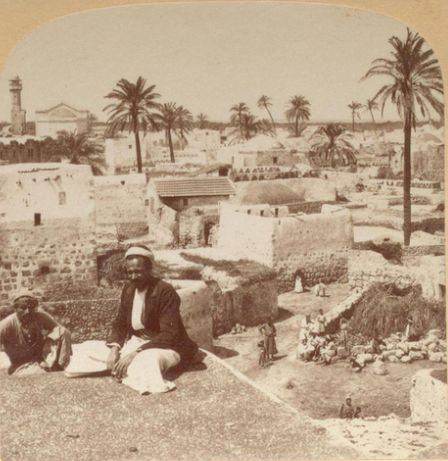
Village in Palestine, 1890s

I explicitly said “full transcription” for a reason you’ll discover below. To read my full transcription, go here. Below is the pertinent section-

Starting at 4:18-

And here’s one fuller story: In one Muslim country in southeast Asia, one of our missionaries was with one of his national partners named Ahmad. It looked like it was about to rain, and Ahmad asked our missionary if he could borrow an old shirt to wear as he rode his motorcycle. He didn’t want to get his new jacket wet. Our missionary handed him a big, white tee shirt. It looked like it was about to rain and as Ahmad got on his motorcycle. He started on his trip though, and indeed it started raining. As many people do, he pulled his motorcycle over under an awning. As he stood there, the owners of the house nearby came out and as was their custom invited him in for tea. He went in and over tea Ahmad thought, ‘I might as well share the Gospel.’ And after he did, he asked the couple ‘Do you want to believe and be baptized?’ Without any hesitation, they said yes. Ahmad was taken back at how quickly they responded. He said, ‘Do you understand what you’re doing? You will probably be shunned by your family for this or even worse?”

“The man said, ‘You don’t understand. I’ve had several dreams over the last three nights. And in each dream a man wearing white has told me he had the way to salvation for my family and me…[interrupted by applause, Platt raises his voice]

“Last night, a man, that man, appeared to me again, and told me a man dressed in white would come to my home the next day telling me the way of salvation. When we saw you standing outside we knew we needed to invite you in and hear whatever you had to say to us.”  [rising applause].

“This formerly Muslim couple is now a follower of Isa the Messiah.”

So, if anyone asks you what’s happening at the IMB, you tell them, disciples are being made, churches are being multiplied, and Jesus Christ is being glorified among people who have never even heard his name. Mr. President that is my report on the work of the International Mission Board.

Heavy applause/ standing ovation

I transcribed this from the live video as it was being recorded by someone who was physically present. The transcription published on the IMB website OMITS that Platt had stated that the couple is now following “Isa the Messiah”, instead choosing to transcribe that Platt said the couple is following “the Messiah”. His speech was 6-minutes long and his final story about the man in the white robe began at 4:18. Unlike in past years where the full report is published on Youtube or the IMB site, this year only a recap video is available at the IMB site.

As warm and joyful as it makes any Christian to hear that many are coming to the Messiah, the method of their coming must align with the Bible. Secondly, the Messiah they are coming to must be this same Jesus. (Acts 1:11). Names are important. Count how many times in Acts, a mission-book of the Bible if there ever was one, the word “name” is stated. One must know to whom one is appealing for forgiveness of sins. Isa is not the Messiah.

Isa is a devil.

There are two issues with the Muslim dreams stories, the name and the method. First, let’s examine the issue with the name.

In Islam, Isa is a prophet of Muhammad and a messenger of Allah. In Islam, it is written that “Jesus/Isa” did not die on the cross, but was alive and unconscious, taken down and nursed in a cave.

Although this source says Christians believe ‘Isa died on a cross, and Jews claim they killed him, in reality he was not killed or crucified, and those who said he was crucified lied (An-Nisa’ 4:157). ‘Isa did not die, but ascended to Allah. (An-Nisa’ 4:158) On the day of Resurrection ‘Isa himself will be a witness against Jews and Christians for believing in his death. (An-Nisa’ 4:159).

Muslims teach that “Jesus/Isa” will arrive to break the cross and kill the pigs (Jews and Christians). (Sahih Bukhari, Volume 3, Book 43, Hadith #656)

His name Isa in the Muslim world is translated Jesus in the English speaking world, but he is not THE Jesus of the Bible. Therefore he is not the real Jesus. Saying that Jesus is Isa is attributing his power to Allah, who is actually satan. Let that sink in. (Luke 12:10).

Defenders of these Muslim dreams and visions say Jesus is doing that in order to make himself known to a people who are already familiar with the name Isa and also because they readily accept supernatural dreams than Westerners. Incidentally, Muslims are not the only culture that accepts the supernatural, especially dreams and apparitions. Why would Jesus not also go to the Native American, the Aboriginal Australian, the Guajiro of Columbia, South America, or the Dene Tha of northwestern Alberta, who all also (among others) involve dreams and visions as part of daily life?

Jesus would never refer to Himself as anything but who He is, certainly He would not introduce himself as Isa, a satanic idol. He has revealed Himself in His word (Hebrews 11:1). I AM WHO I AM, He said. He is not Isa.

Now, let’s examine the issues around the method of his appearing. Would Jesus appear to Muslims and share the Gospel in this way? Or send an emissary in dreams to speak for Him?

Here is Fred Butler from Grace To You with an answer to the question:

Though it should be recognized that God can communicate the Gospel message in any fashion He so chooses, the NT teaching on evangelism involves God proclaiming the Gospel of salvation to the lost world by the means of human preaching, see for example Matthew 28:19-20, Romans 1:16, 10:13-15, and 1 Corinthians 1:21.  The Gospel message comes by the preacher who preaches biblical and theological content as contained in Scripture.  The recipients hear that message and then respond to it by either rejecting the message or believing in it with a supernaturally produced faith.

If Muslims are having dreams about Jesus who then in turn directs them to salvation, such an activity would seem to have God contradicting what He has clearly ordained in Scripture as the only legitimate means of Gospel evangelism for the Church age.

It is a shame that a well-known person such as David Platt repeated these stories of dreams and visions as credible, and worse, disastrously called Jesus Isa, (which he did, edited IMB transcription notwithstanding).

We so very much want to evangelize and disciple converts to the faith, but we should not be so eager to immediately accept conversion stories of dreams and visions until and unless we compare these methods to the Bible to see if they align.

Here are further links to credible and scriptural essays on the subject.

Gary Gilley: Muslim Dreams and Visions

An Evaluation of Muslim Dreams and Visions of Jesus [Part 1] and
An Evaluation of Muslim Dreams and Visions of Jesus [Part 2]