Posted in encouragement, theology

God CANNOT forsake you

By Elizabeth Prata

I know we sometimes have a hard time understanding the permanent perfect love, such as the love the Triune God lavishes on his saved children.

With child abuse, abortion, abandonment, betrayals, and divorce, the love we say we have for others is oftentimes fatally flawed.

However, when Jesus says He will not leave you or forsake you, He means it. It’s not up for discussion.

When we’re saved, we become part of the Body of Christ.  Therefore, when God looks at us, He sees His Son. We are as Paul would say, “in Christ.” (Romans 12:5, 1 Corinthians 1:30, 1 Corinthians 3:1, 1 Corinthians 4:15, 1 Corinthians 15:18, etc.) When He looks at you, He is looking through His Son to see you.

If God were to decide not to love us (which He wouldn’t because He promised to love us forever and He does not fail in His promises) He would be deciding not to love His Son. And that is impossible.

Never fear, if you are “in Christ” you are safely in the arms of God, never not to be loved, never not to be cherished, cared for, provided for. If you struggle with assurance of God’s love, leave the struggle behind God loves His Son and He loves all that are in His Son, you, me, all.

Give thanks to the God of heaven, for his steadfast love endures forever. – Psalm 136:26

love forever verse

Posted in encouragement, theology

Give God gratitude for salvation

By Elizabeth Prata

When I was growing up our family belonged to a country club. It had nice grounds, ice cream and Popsicles in the clubhouse, yum, and two huge pools. One was a kiddie splash pool. The other was an olympic sized pool with a shallow end, a deep end, and a jut-out where there were two diving boards. One was short and the other seemed as high as a skyscraper.

Of course when you’re a kid, your parents put you in the kiddie pool first.

popsicle gal pool
Then when you grow a bit and become a more confident swimmer, you can go in the big pool. You splash around and play and have fun in the shallow end. After a while when you’re ready, you venture into the deeper water.

The biggest goal is to pluck up the courage to climb all those steps on the high diving board and jump off.

Our growth in sanctification is like that. At first we’re on milk, not meat, though meat is the goal. As time passes in our studies, we begin to understand the plain meanings of short verses, then grow in understanding and have insight into the deeper meanings. We learn nuances of words, historical contexts, the culture of the time, and theological constructs. Soon we feel confident enough to debate and get involved in hair-splitting controversies, defending and exhorting the faith.

It’s good to get back into the kiddie pool for a while. It’s wise to remember the plain things. Exult in the commonplace verses. You never, ever ‘grow out of’ those, you know. It’s good to just get back to the beginning and bask in that initial feeling of joy you had when you were first saved.

Contemplate your salvation.

Our church had its annual retreat this weekend. about 70 of us from all ages piled into a mountain resort for three sessions of learning “Ordinary Faithfulness.” In between sessions we either spent time in solitary study and contemplation in the different corners of the property, or fellowshipping together in a hike along the waterfall, or visiting the nearby town.

The lessons we were taught during the retreat were fantastic, and I enjoyed them. They were edifying. As I spent time in solitary thought back at the retreat center in between sessions, my mind and heart locked on to the ‘basic’ truth.

I would not be here if not for Jesus. None of us would be at this mountain today if not for Jesus. I owe SO MUCH to His decision (not mine) to yank me out of sin and into His throne room. I owe Him all for giving me the spirit of Repentance, and lifting the scales that had been firmly glued to my eyes for 4 decades. The thrill of salvation itself and all its mystery, wonder, and glory never fades.

Do you savor your salvation? Actively thank Jesus for it? Remember the ‘simple things.’ Salvation is grace itself.

There would be no manifestation of God’s grace or true goodness, if there was no sin to be pardoned, no misery to be saved from. ~Jonathan Edwards

For God so loved the world, that He gave His only begotten Son, that whoever believes in Him shall not perish, but have eternal life. (John 3:16)

Posted in christian life, theology

Popular Christian Blogger says you don’t have to “do” church

By Elizabeth Prata

Kendra Fletcher is a popular podcaster, blogger, and book author. She writes at her own space but also directs you her archive of articles she’s written for at KeyLife Ministry, where the motto is “God is Not Mad At You.”

Kendra’s latest blog essay is titled,

What To Do When You Just Can’t Do Church Anymore

You read that correctly.

Mrs Fletcher’s very first point begins thus:

YOU DON’T HAVE TO DO CHURCH ANYMORE.
For some of us, church attendance was a non-negotiable weekly imperative with many assumptions attached to it. Our attendance and involvement has been linked to our faithfulness, our commitment, and our spiritual depth. Church attendance should be none of those things. It’s entirely okay to step out.

For all of us, church attendance IS a non-negotiable. Mainly for the reasons of: the Body (Romans 12:5), gratitude (Colossians 3:16), and command (Hebrews 10:25).

It is entirely not OK to step out.

Mrs Fletcher’s second point is that it is OK to step out if you were doing it for the wrong reasons. Take time to reassess, navel gaze, grab some me-time, she says. Not in those exact words, but close.

If you find that your church has become an idol, or ritual, or that you have become spiritually neglectful toward others within that body, or whatever wrong motivation you’d had- the solution is not to step out. You repent and confess. You lay your sin down in front of the throne, asking for forgiveness, and lay your sin down in front of the pastor and church people, and ask for forgiveness. Then pick yourself up and go next Sunday, pleading with the Spirit to help you grow in this area.

In the essay there is a lot of me-me-me. She writes-

Answering a concerned or critical question about why you aren’t involved/serving/plugged in/part of a community group can be answered with a simple, gracious, “I’m working through some stuff and just need some time, thanks.” Then walk out the back door.

What about relying on the Holy Spirit to help you through ‘your stuff’? What about dumping the prevalent attitude that I can work through my own stuff, Jesus need not apply, thanks. What about realizing that ‘your stuff’ is the Body’s stuff and that you’re not supposed to carry it alone? (Galatians 6:2). What about setting aside ‘your stuff’, die to self, and help someone else who is going through stuff?

Sadly, Mrs Fletcher equates church attendance with ‘doing’. It’s not. It’s called obedience.  Mrs Fletcher does as so many bloggers, writers, and teachers these days do- equates obedience with ‘legalism.’

Ladies, following the commands of scripture is not legalism, try as many female bloggers tell you that it is. It’s called obedience. Developing Godly habits and adhering to them is not legalism, hard as many woman essayists explain to you that it is. It’s called Discipline. Legalism defined by Theopedia is,

a term referring to an improper fixation on law or codes of conduct for a person to merit or obtain salvation, blessing from God, or fellowship with God, with an attendant misunderstanding of the grace of God. Simply put, legalism is belief that obedience to the law or a set of rules is the pre-eminent principle of redemption and/or favor with God.

Arthur Pink put it simply, legalism is the notion  ‘that sinners become saints by obeying the Law.’

We know that grace first abounded in God’s sovereign choice to regenerate us as a person from dead in sins to alive in Him.

POST salvation, our gratitude becomes so great and our worship so deep, we want to obey the Word that comes from a wellspring inside us that flows from our regenerated heart up to heaven, into the throne room, passing the cross with a wide-eyed gaze of wonder and relief.

Here is TableTalk’s most recent essay that happens to be on the topic of Joining and Being a Member of a Church. Their biblical take on it is that church membership and regular attendance is non-negotiable.

There’s not a hint of individualism or independence anywhere in those images. Nowhere does Scripture describe, much less prescribe, the Christian life as something that can be lived alone. In Christ, each Christian is related to every other Christian, and together we are the family of God (Rom. 8:14–16; Eph. 2:19–22). Deep commitment to and active participation in the church are nonnegotiable.

There are legitimate reasons for leaving a church, and the TableTalk essay covers those and gives practical ideas for maintaining one’s obedience to the Word as you transition.

Ladies, don’t let popular bloggers deceive you into thinking church attendance is a negotiable. You really can’t hit the pause button for temporal, selfish reasons and then pick it back up when you’re good and ready.

To say that it’s OK not to “do church”? That is a repellent phrase. It’s undignified given the majesty of the Triune God whom we worship the wondrous Person we praise, Him who saved us from a craven life of rebellion and an eternity from the tortures of hell.

The chief end of man is to glorify God and enjoy Him forever. One way we do that is go to church, faithfully, regularly. Not ‘doing church’ but loving the God who gave us His body, of which we are a part.

church

Posted in encouragement, theology

‘Ordinary faithfulness,’ Church retreat 2019

By Elizabeth Prata

I attended our annual church retreat this weekend, at Sautee Mountain Resort. I just got home. It was a delightful time of learning, song, and fellowship in the mountains of North Georgia. Instead of the usual theological post or book/movie review I write here, I’ll just post a few photos. I’m still processing the experience, but hopefully soon I’ll reformat my notes and post what I learned. What I can say at this point is that I’m grateful for my church family, our leaders, and the Lord. 🙂

This slideshow requires JavaScript.


Posted in encouragement, theology

Habakkuk’s pain is our pain

By Elizabeth Prata

But know this, that in the last days perilous times will come: 2 For men will be lovers of themselves, lovers of money, boasters, proud, blasphemers, disobedient to parents, unthankful, unholy, 3 unloving, unforgiving, slanderers, without self-control, brutal, despisers of good, 4 traitors, headstrong, haughty, lovers of pleasure rather than lovers of God…(2 Timothy 3:1-4)

As you see the people all over the world wantonly killing, sinuously infiltrating societies only to choke them off, and the rest of the ungodly continuing unrighteous ways without ceasing, the righteous cry out, ‘Oh, God, why do the wicked prosper?’

Habakkuk asked the same thing. If you want a picture of a beleaguered prophet asking, and asking, why do things have to be this way, then you have Habakkuk in 620BC.

Habakkuk expresses the attitude that many righteous people have. He is outraged at the violence and injustice in his society. He lists six different problems. His list is repetitious, but it emphasizes just how bad things were. There was sin, wickedness, destruction and violence, no justice in the courts, and the wicked outnumbered the righteous. Sort of like today, eh?

Habakkuk puts his questions to God and in His grace they are answered. Habakkuk listens, is calmed, and ends with a Hymn of faith: Habakkuk 3:17-19,

Though the fig tree may not blossom,     
Nor fruit be on the vines;     
Though the labor of the olive may fail,     
And the fields yield no food;     
Though the flock may be cut off from the fold,   
And there be no herd in the stalls—
Yet I will rejoice in the LORD,   
 I will joy in the God of my salvation.
The LORD God is my strength;
He will make my feet like deer’s feet,
And He will make me walk on my high hills.

God will judge all the wicked. We praise Him for that.

God will always love all His righteous (made righteous through Christ). And we praise Him for that.

He is worthy of praise. This temporary earthly time of pain and sin will end. And then…glory.

May your feet be like deer’s feet wherever you tread this week!

praise verse

Posted in encouragement, theology

Please enjoy these encouraging moments: All tribes, tongues, nations, peoples…

By Elizabeth Prata

By Tim Challies:

At the 2018 G3 Conference I spoke on “Discipleship in Diversity.” I told of how we, at Grace Fellowship Church, have learned to be a church that is united in a context of great diversity. I concluded the message with a video of some of the people of Grace Fellowship Church reading Revelation 5 in many different languages. I hope you enjoy it.

God is MAGNIFICENT in His plan to save a people for His Son, because “by your blood you ransomed people for God from every tribe and language and people and nation,” (Revelation 5:9b).

I’ve posted this Kimyal clip before, but it’s always encouraging. It goes with the above newer video in the same way, making the same point. The Pastor’s prayer is especially moving. The Kimyal Tribe receive their first Bibles translated into their language.

With all the discouraging news I thought it would be nice to put up something pleasant and of what we have to look forward to.


Posted in heaven, theology

Where is heaven?

By Elizabeth Prata

I love to linger in thoughts of the supernatural. God is supernatural, of course. He is above us here in the natural world. The Trinity is supernatural. Who can understand it? The creation in 6 days is supernatural, and amazing too. His omnipotence is surely on display right from the first verses of Genesis.

Angels are supernatural. Sometimes invisible hordes are all around us (2 Kings 6:17). And demons are supernatural. They are real, led by satan, the former highest angel. The Bible depicts demon possession. Jesus spent quite a bit of time casting them out. Just because 2000 years have gone by does not mean the demons are gone. They are still around, and will make an even more prevalent appearance during the Tribulation. (Rev 9:3, Rev 16:14, Rev 18:2, Matthew 24:37).

Do you ever wonder where heaven is? Is it right there, in a nearby dimension we can reach out and touch? The unseen gathering chariots at Elisha’s battle were there and became visible after Elisha prayed and God graciously opened his servant’s eyes. (2 Kings 6:17-20).

Heaven is absolutely a real place, it has physical properties, inhabitants, and activities within it. Bible verses say that it is above the earth, or people are called to ‘come up here.’ Or that they ‘went down’ from heaven to earth. But that could be language indicating that its heights are gloriously high because of the One who dwells there.

On the Mt. of Transfiguration, Jesus was changed as His glory shone out, and ‘suddenly’ He was speaking with Moses and Elijah personally and bodily. Is heaven parallel with us, alongside with us the whole time? After all, Jesus is omnipresent, and always ‘near.’ As Daniel was praying, before he even finished his request, Gabriel appeared. (Daniel 9:21). Is heaven that close?

Or, is heaven not yet physical and only a spiritual place where souls dwell, and God as Spirit dwells? That it will only become physically real after the New Jerusalem is completed and descends to earth? However, Jesus as God-Man IS physical, so how could He as a Person with physical properties dwell in a non-physical place?

Ow, my head hurts.

Thee is a story told by Dr. David Leininger at The Presbyterian Pulpit about heaven.

I love the old story of the rich man who, on his death bed, negotiated with God to allow him to bring his earthly treasures with him when he came to heaven. God’s reaction was that this was a most unusual request, but since this man had been exceptionally faithful, permission was granted to bring along just one suitcase. The time arrived, the man presented himself at the pearly gates, suitcase in hand – BOTH hands, actually, since he had stuffed it with as many bars of gold bullion as would fit. St. Peter said, “Sorry, you know the rules – you can’t take it with you.” But the man protested that God said he could…one suitcase. St. Peter checked, found out that this one would be an exception, prepared to let the man enter, then said, “OK, but I will have to examine the contents before you pass.” He took the suitcase, opened it, saw the gold bars and asked quizzically, “You brought PAVEMENT?”

Certainly this cute story makes the point to us that what we value here on earth will not be what we value in heaven, wherever heaven may be now or in the future. We will value Jesus above all, His glory, His ways, His nail-scarred hands and riven side. We will value each other as HIS trophies of grace, having no pride, love and care for our brethren as Jesus cares for us. We will value past salvations borne from His grace, the cross, His plans and ways.

The most precious commodity currently on earth, gold, will then be just dusty matter under our feet, our eyes not upon its glitter any longer, but upon the glorious Light shining from ever corner of the Universe, Jesus.

These are fun things to ponder. One of our Elders always says ‘Think Eternally!’

——————————————–

Further reading

My essay was just a few thoughts, not an exhaustive or scholarly treatment of the location of heaven. Others have written aobut that, in the following links that may be of interest to you:

Grace To You: Where is Heaven?

Randy Alcorn at Ligonier: Heavenly Mindedness

Alistair Begg: Our Heavenly Dwelling

heaven

Posted in hell, theology

Will they repent in hell? Will they finally be sorry?

By Elizabeth Prata

Sometimes we think that when people die outside of Jesus and they earn their final resting place in the fires of hell, they will be sorry. That at least we might have the comfort of knowing they see Jesus for who He really is, see their sin for what it was, and repent. Everyone should bow to Jesus in true repentance, and so, we might be tempted to come up with a fantasy of everyone being sorry and being contrite and repentant in the end.

Will the abuser be sorrowful for his deeds against his family?
Will the molester be repenting for his evil?
Will the serial adulterer be sad for what he did to his wife?
Will the neglectful parent be contrite for their perfidy?

No. They will not.

They will not repent in hell.

But this gives us two lessons.

1. Never underestimate the power of sin.
2. The hell-dwellers’ unrepentance should make us love Jesus for the savior He is. We need a power outside of us to bring us to repentance.

First, what in the Bible tells me they will not repent? Do I even have grounds for saying so? Hell is a very powerful motivator, isn’t it?

First, the Pharisees knew Jesus was from God. Nicodemus said to Jesus that ‘We know you’re from God…” (John 3:2). They personally saw His miracles. For example, no one had ever, in the history of time, been healed of blindness. (John 10:21). Yet they would not repent despite clear proof and sure knowledge of Hades. They saw Jesus for who He is, and refused to repent.

Lazarus’s Rich Man…he lived an expensive life of wealth and comfort. Lazarus the poor man lay at the rich man’s gate begging, with sores. When Lazarus died he went to Abraham’s bosom and a peaceful rest. The Rich Man went to Hades and torment.

Yet the Rich Man kept ordering Abraham to “send” Lazarus topside to perform tasks for him. Even though the situation was explained to the Rich Man, that he’d had his comforts and now Lazarus was receiving his, the Rich Man displayed not an ounce of compassion or generosity for poor Lazarus. He just kept wanting to disturb Lazarus from his rest to go do more stuff for the Rich Man.

In Revelation 16:9, it says,

They were scorched by the fierce heat, and they cursed the name of God who had power over these plagues. They did not repent and give him glory.

They knew the plagues were supernatural and further, they know it was God’s doing. They did not repent. The Tribulation is hell on earth, wrath poured out. What makes anyone think that if someone is removed to a different location, hell under the earth instead of on the earth, that at last they would be sorry?

No, I tell you; but unless you repent, you will all likewise perish.

Luke 13:3 above indicates the timeline. Repent, OR perish. The time for repentance is topside. (Not that any person can change locations after death, but even repentance will not be possible, nor remorse.) The Rich Man was only sorry that his brothers might have to come to Hades, but he never said he was remorseful for anything he had done.

1. Never underestimate the power of sin in an unregenerated heart.

Eve and Adam sinned. They personally knew God. They lived in a perfect state of being- emotionally and physically. They sinned.

Lucifer was the most beautiful, the most high angel. He dwelled in glory in close proximity to God. He watched the power of God create the universe. Yet, Lucifer sinned.

Sin is the most powerful force in the universe under God. Sin enslaves. What can enslave a person? Something so powerful you cannot extricate yourself. A force beyond your control or ability to cope. That’s powerful.

Sin kills. That’s powerful.

People underestimate sin’s draw. They dabble. They worship their sin. They succumb to temptation. Sin is powerful.

2. Therefore, hell-dwellers’ unrepentance should make us love Jesus all the more for the Savior He is. Without Him, no one would be saved! We need a power outside of us to bring us to repentance. Grace is MORE powerful!! He chose to save us, despite our unrepentance and our hell-bound trajectory. He saved us with grace, grace, grace. What relief! What joy!

No, repent while you can, While the Light is here, before the darkness comes…while it is day, before the night.

Seek the LORD while he may be found;
call upon him while he is near;
let the wicked forsake his way,
and the unrighteous man his thoughts;
let him return to the LORD, that he may have compassion on him,
and to our God, for he will abundantly pardon. (Isaiah 55:6-7).

So Jesus said to them, “The light is among you for a little while longer. Walk while you have the light, lest darkness overtake you. The one who walks in the darkness does not know where he is going. (John 12:35)

So Jesus said to them, “The light is among you for a little while longer. Walk while you have the light, lest darkness overtake you. The one who walks in the darkness does not know where he is going. (2 Corinthians 6:2).

Here is a VERY sobering essay from Banner of Truth:

The Lake of Fire: What’s It Like, Who Goes There, and Why?

 

wrath

Posted in discernment, theology

Resources: How to Spot a False Teacher

By Elizabeth Prata

I’m helping a new believer. She is hungry for the word and wide eyed with wonder at everything being new and shiny. She started watching TV Preachers and we in our local body (I) have the sad job to let her know that not all that glitters in the Christian world is gold. We have to protect the lambs.

I remember the days after my conversion. I thought I was safe and that everything would now and forever be OK. The change in my worldview was immediate, it literally was like scales fell off my eyes. In eternity, it is true that everything will be OK, but there will be a lot of work, struggle, vigilance and not-OK stuff happening until I get there. The church is less safe than I thought and definitely takes vigilance to remain on the upward path of sanctification. Satan and the flesh and the world wants to knock us off our pins. It is our job to help new believers learn how to avoid these traps and pitfalls false teachers lay for us.

One main way satan operates is seeding the church with false teachers. Did you know that every New Testament Book except Philemon has strong warnings about being alert for false teachers and false doctrine? Some books of the NT are entirely devoted to the topic! (Galatians, 2 Peter, 1 John, 2 John, and Jude.)

Since it’s a big topic in the Bible, it should be a big topic for us. We shouldn’t focus on false teaching all the time, after all, the best way to spot a counterfeit is to learn the real thing. Thus, our study is God’s word, not false teachings. However, we do need to hone our discernment. (Hebrews 5:14).

Here are some good essays I’ve read lately that help us to identify false teachers.

Natasha Crain:

10 Signs the Christian Authors You’re Following are (Subtly) Teaching Unbiblical Ideas

The following are 10 signs that the Christian authors you’re following may be subtly teaching unbiblical ideas. I say “subtly” because I think most people would spot a problem immediately if a Christian said they didn’t believe in the Trinity. But it’s just as important to identify when less obvious warning signs—like the following—are present.

Denny Burk part 1 & 2-

How to identify false teachers

Given this obligation, it becomes all the more imperative to be able to identify false teachers when they emerge. Sometimes false teaching originates from outside of the church. Sometimes such teaching originates from within. The New Testament teaches that a more rigorous response is required when it arises within. Thus faithful pastors must learn how to identify and deal with false teachers. But how do we do that?

How To Deal With False teachers

In my last post, we looked at six characteristics that help us to identify false teachers. In this post, we will consider what pastors and congregations are supposed to do in response to such persons who emerge in their midst.

Michelle Lesley:

Popular False Teachers

The articles below are evidentiary findings on today’s most popular “divangelistas” (as well as a few male teachers and ministries in general). Please use them as teaching tools in the spirit of 2 Timothy 2:24-26 to help others understand the false doctrine these people are proclaiming, keeping in mind that the people who follow them most likely simply don’t know they’re following false teachers.

John MacArthur, blog essay

The Pathology of False Teachers

It takes careful discernment to see that the light is really darkness. Paul taught Timothy how to diagnose satanic darkness masquerading as divine light. Here’s how he described the key symptoms that identify those infected with the spiritual disease of false teaching:

Colin Smith:

7 Traits of False Teachers

In the same way Peter says, “There will be false teachers among you.” Notice the words “among you.” Peter is writing to the church and says, “There will be false prophets among you.” So he is not talking about New Age people on television. He is talking about people in the local church, members of a local congregation.

Luke Wayne at Christian Apologetics and Research Ministry. I like this one because he mentions the behavior of a false teacher. It’s not only about doctrine. Examine the teacher’s doctrine AND life. (1 Timothy 4:16).

How do you Identify a False Teacher?

We can identify a false teacher or a false prophet by examining first and foremost their teaching and secondly their behavior in light of Scripture. If what they are teaching is not consistent with what the Holy Spirit has plainly revealed in Scripture, they are a false teacher and are to be ignored, even if they live extraordinary lives, even if they appear to have supernatural insight, or even if they seem to work great miracles.

We are one body. Help the new believers, our vulnerable lambs, stay in the flock, growing and maturing in healthy ways.

lamb

Posted in prophecy, theology

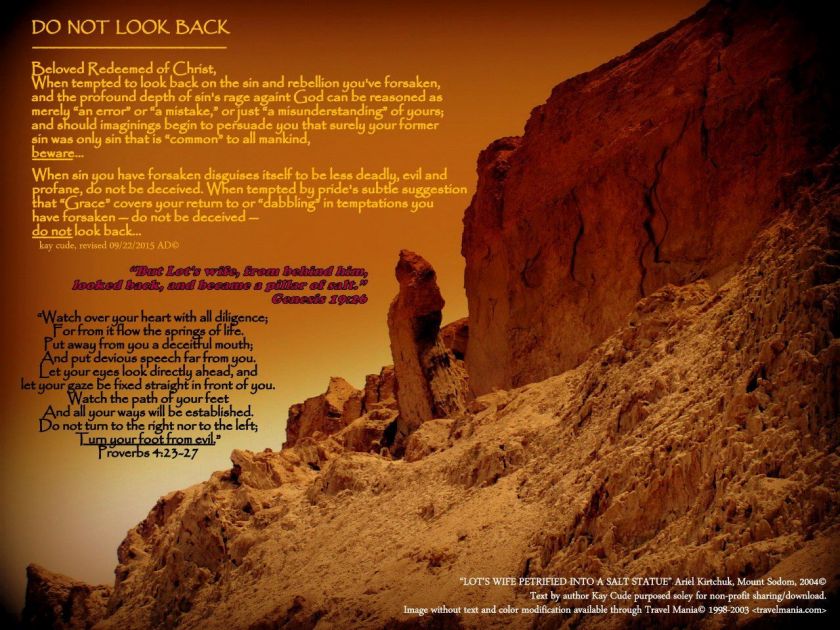
‘Do Not Look Back’

By Elizabeth Prata

Embedded within Jesus’s lengthy speech on the Day of the Lord, He said,

Remember Lot’s wife. (Luke 17:32)

Remember Lot’s wife – See Genesis 19:26. She looked back – she delayed – perhaps she desired to take something with her, and God made her a monument of his displeasure. Jesus directed his disciples, when they saw the calamities coming upon the Jews, to flee to the mountains, Matthew 24:16. He here charges them to be in haste – not to look back – not to delay – but to escape quickly, and to remember that by delaying the wife of Lot lost her life. ~Barnes’ Notes on the Bible

DO NOT LOOK BACK