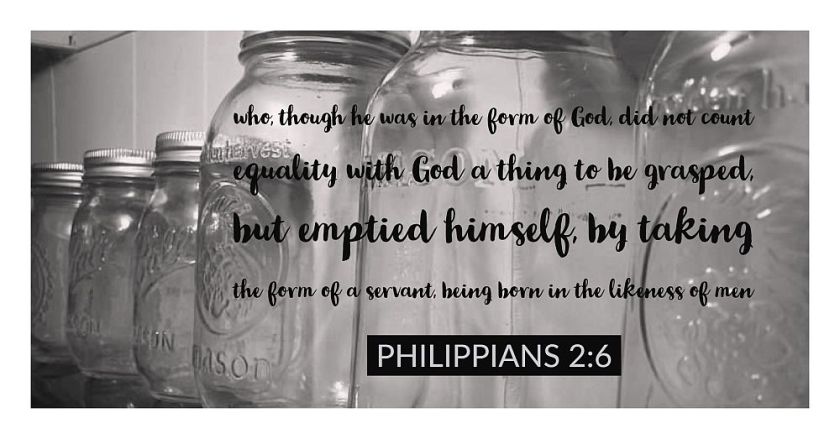
The word does not occur elsewhere in the New Testament, except in the passage before us. The essential idea is that of bringing to emptiness, vanity, or nothingness; and, hence, it is applied to a case where one lays aside his rank and dignity, and becomes in respect to that as nothing; that is, he assumes a more humble rank and station.
In regard to its meaning here, we may remark:
(1) that it cannot mean that he literally divested himself of his divine nature and perfections, for that was impossible. He could not cease to be omnipotent, and omnipresent, and most holy, and true, and good.
(2) it is conceivable that he might have laid aside, for a time, the symbols or the manifestation of his glory, or that the outward expressions of his majesty in heaven might have been withdrawn. It is conceivable for a divine being to intermit the exercise of his almighty power, since it cannot be supposed that God is always exerting his power to the utmost. And in like manner there might be for a time a laying aside or intermitting of these manifestations or symbols, which were expressive of the divine glory and perfections. Yet,
(3) this supposes no change in the divine nature, or in the essential glory of the divine perfections. When the sun is obscured by a cloud, or in an eclipse, there is no real change of its glory, nor are his beams extinguished, nor is the sun himself in any measure changed. His luster is only for a time obscured.
When you’re a kid in an abusive home, the number one feeling is uncertainty. The abused child is uncertain that this is the way things are supposed to be. One is unsure. Is this love, when daddy hits me? Is this what love is when mommy neglects me? They tell you they love you, but then act in ways that don’t seem loving. How do other families do it? The child doesn’t know, the other family is behind closed doors. When the child visits the other families, they seem nice. But then again, so does the kid’s family when other people visit the abusive home.
When you’re a kid in an abusive home, the number one feeling is uncertainty. The abused child is uncertain that this is the way things are supposed to be. One is unsure. Is this love, when daddy hits me? Is this what love is when mommy neglects me? They tell you they love you, but then act in ways that don’t seem loving. How do other families do it? The child doesn’t know, the other family is behind closed doors. When the child visits the other families, they seem nice. But then again, so does the kid’s family when other people visit the abusive home.
As the child grows, he or she becomes a little more sure that this dynamic isn’t the way that it’s supposed to be. Therefore what grows alongside the uncertainty is hope. As maturity forms, hope forms. The tween/teen/young adult thinks, I’m not sure this is the way things are supposed to be, but I hope tomorrow will be better. One hopes that tomorrow they’ll love me. They’ll stop hitting me. They’ll quit neglecting me. They won’t molest me anymore. Mommy won’t bully or belittle me. When they promise something, like a trip to the park or an ice cream, they really mean it this time; it will happen. The child hopes against hope that it will happen.
EPrata photo
The hope becomes a lifesaving ring but also an albatross. Each time the hope is dashed, one clings to it but it becomes more drenched with tears. And again, and again. The hope is battered and then one sad day, inevitably dashed. No trip to the park after all. Dad got mad and threw the ice cream cones to the ground. Mom wasn’t home to greet the kids after school again. The belt comes out, again. Tears drench the life ring, which becomes soggy and begins to sink.
The child cries, ‘Why are things like this?’ Why don’t parent have natural affection for their children? One thing the abused child knows is that parents are supposed to love their kids. This can’t be love. Is it? The abused wants to know what love IS…
The Bible says that in the end time, parents won’t have natural affection for their children.
Without natural affection, trucebreakers, false accusers, incontinent, fierce, despisers of those that are good, (2 Timothy 3:3 KJV).
The end time is the time between Jesus’ first coming and second coming. The end time is happening now. We’re in it.
This phrase “without natural affection” is the translation of one Greek word, astergeo. … The word stergeo (“natural affection”) is one of four Greek words for “love,” but it is never used at all in the New Testament. It refers to the natural love that members of the same family have for each other. It is such a common characteristic of all peoples that there was apparently no occasion to refer to it at all — except when it is not present, when people lose their instinctive love for their own parents and children, and thus are “without natural affection.” One thinks of the widespread abortionism of these last days, as well as the modern breakdown of the family in general. (Source: Institute for Creation Research)
The Christian mind does not want to, or can’t comprehend, the absence of natural affection from a parent to a child. It seems impossible that a parent does not love their child, batters them physically or emotionally, sometimes, just for fun. But it exists. The Bible says it does, our experience as social workers, police, teachers, shows that it does, the news reports illustrate that it does. But to the child, they simply don’t know why people who are supposed to love them actually do not.
John MacArthur has said that God uses three mechanisms to restrain sin in the unsaved: the individual conscience, the government’s laws, and the family. The family is basic to nurturing the God-instilled sense of right and wrong. Without that natural affection, there’s an absence of nurturing and cultivation of the conscience within the family. Society suffers a dreadful result.
EPrata photo
I think we are seeing that result in these days. The days and years ahead will be worse, I’m afraid. Any cycle, once reaching its tipping point, proceeds at an increased pace.The child with no footing will search for the love that is lacking in their nuclear home, making it easier for satan to lure the child/youth/adult into schemes and situations that are detrimental to him or her. He will try to find a substitute family that operates on a twisted cycle of love. Gangs become more attractive. Polyamorous relationships or even a cult will seem normal. The perversity of a kinky bondage Master/slave pairing will seem OK. Homosexual partners raising children. And so on.The horror of the end of the end times is pretty horrible. We see in movies and books, not to mention Revelation, the natural disasters and such that will go on, relentlessly. But the worse horror is a world full of twisted, perverse, emotionally stunted people with no conscience or sense of right and wrong.That’s the real horror.The beauty, the grace, the relief, is that God’s grace doesn’t stop. His Gospel in Jesus Christ’s life, death and resurrection now still has and always will have power to save the soul, revive the conscience, and enlarge the heart. Keep sharing. We know the times will get worse and worse. (2 Timothy 3:13). Fewer people will respond, but many will. God has ordained the times, and though we mourn the tragic life of those child en raised in homes without natural affection, the love of Jesus will pierce some of them and allow love to flow back in.Then they will eternally know the natural affection of the family of God, never to be offered conditionally, abused, or withdrawn ever again What a day that will be.
Though the verse is literally speaking about King David, the relation of David to Christ means the verse also prefigures the preeminence of King Jesus. The throne, through David’s line, would last forever through Christ.
Gill’s Exposition says,
Also I will make him my firstborn,…. Or, “make him the firstborn”; make him great, as Jarchi interprets it; give him the blessing, the double portion of inheritance: so Christ is made most blessed for ever, and has all spiritual blessings in his hands; and is heir of all things, and his people joint-heirs with him. Christ is God’s “firstborn”, or “first begotten”, Hebrews 1:6, being begotten by him, and of him; … even him the Father promises to make “higher than the kings of the earth”; having a kingdom of a superior nature to theirs, and a more extensive and durable one; and even they themselves shall be subject to him; hence he is called “King of kings”, Revelation 19:16.
The King of Kings shall reign forever, His Kingdom shall endure.
I saw a meme on Facebook that made me laugh. I can’t find it again, but it went something like, ‘I have prayer ADHD, I start, drift into thinking other things, then come back saying ‘Where was I, Lord?’
I think we have all had the same experience. Our fleshly minds want to think of anything except compass point north, Jesus Christ. It zones out on us, drifts off, creates a grocery list, listens to the birds outside, or the traffic, anything but laser focus on the throne of grace.
Why is it so hard? Praying is an act of war, spiritual war. We are opposed at every turn by the evil one and his minions, and when we clasp our hands together, we are effectively sounding a trumpet to those demons that we are entering another battle with them.
In his book The Hidden Life of Prayer by David MacIntyre, we read that,
The main reason for this unceasing insistence is the arduousness of prayer. In its nature it is a laborious undertaking, and in our endeavor to maintain the spirit of prayer we are called to wrestle against principalities and powers of darkness.
Dr. Andrew Bonar used to say that, as the King of Syria commanded his captains to fight neither with small nor great, but only with the King of Israel, so the prince of the power of the air seems to bend all the force of his attack against the spirit of prayer.
If he should prove victorious there, he has won the day. Sometimes we are conscious of a satanic impulse directed immediately against the life of prayer in our souls; sometimes we are led into “dry” and wilderness-experiences, and the face of God grows dark above us; sometimes, when we strive most earnestly to bring every thought and imagination under obedience to Christ, we seem to be given over to disorder and unrest; sometimes the inbred slothfulness of our nature lends itself to the evil one as an instrument by which he may turn our minds back from the exercise of prayer.
Because of all these things, therefore, we must be diligent and resolved, watching as a sentry who remembers that the lives of men are lying at the hazard of his wakefulness, resourcefulness, and courage. “And what I say unto you,” said the Lord to His disciples, “I say unto all, Watch!”
How do you pray? I used to kneel but my knees and back can’t take that any more. So now I sit in my chair and pray aloud. Praying out loud helps me focus and not drift off. However there is no one particularly commanded position for praying. I don’t imagine Paul had too many options for prayer positions when he was chained up in jail.
Hannah famously prayed a whisper prayer in the temple. The priest watching her thought she was drunk. But no, she was just agonizing in spirit and pressing that agony upward to the LORD. (1 Samuel 1:9-17).
Jonah prayed to the LORD in the belly of the great fish, he also cried out (Jonah 2:2). I think his cries were probably pretty loud, too!
David no doubt prayed silently but no doubt he prayed aloud too. David had an active prayer life with the LORD. His prayers were appeals, praises, repentance, appreciation for provision, imprecations…his type of prayers are a good model for us, because he conversed with the Savior through prayer as if the LORD was standing right beside David. In effect Jesus was, and David knew that.
No matter how you pray, the point is, pray. It’s a mechanism that is commanded, after all, but it is also a grace that we have been given as a gift. Practice focusing on what you are saying to the Lord and not drifting off, because He is standing right there with you (and me) after all.
In the end, when Hannah finished pouring out her prayer to the LORD, “her face was no longer downcast.” (1 Samuel 1:18). What a blessing to be able to commune with Jesus.
“Our first act in prayer ought to be the yielding of our souls to the power of the blood of Christ”. ~The Hidden Life of Prayer, by David MacIntyre.
We’ve been commissioned by Jesus to share His Gospel with everybody and make disciples with those who convert. (Matthew 28:16-20).
And we do. But… There are some people, especially those close to us, who refuse to hear it, but we keep trying, for the sake of their eternal souls.
On the other hand we are told,
Do not give dogs what is holy, and do not throw your pearls before pigs, lest they trample them underfoot and turn to attack you. (Matthew 7:6).
How do we know when to stop sharing the Gospel with someone who refuses? How many times do we share it? After all, we are supposed to forgive seventy-seven times. (Matthew 18:20-22). Do we share it that many times with the reluctant hearer? How do we know when to leave the peson who refuses aside? This is hard to do when it’s your dad or yrou uncle or your brother.
Here is where developing our discernment helps us. Matthew Henry has some advice.
As a rule to all in giving reproof. Our zeal against sin must be guided by discretion, and we must not go about to give instructions, counsels, and rebukes, much less comforts, to hardened scorners, to whom it will certainly do no good, but who will be exasperated and enraged at us. Throw a pearl to a swine, and he will resent it, as if you threw a stone at him; reproofs will be called reproaches, as they were (Lu. 11:45; Jer. 6:10), therefore give not to dogs and swine (unclean creatures) holy things.
Note, [1.] Good counsel and reproof are a holy thing, and a pearl: they are ordinances of God, they are precious; as an ear-ring of gold, and an ornament of fine gold, so is the wise reprover (Prov. 25:12), and a wise reproof is like an excellent oil (Ps. 141:5); it is a tree of life (Prov. 3:18). Matthew Henry’s commentary on the whole Bible
Warren Wiersbe also has some good advice.
As God’s people, we are privileged to handle the “holy things” of the Lord. He has entrusted to us the precious truths of the Word of God (2 Cor. 4:7), and we must regard them carefully. No dedicated priest would throw meat from the altar to a filthy dog, and only a fool would give pearls to a pig. While it is true that we must carry the Gospel “to every creature” (Mark 16:15), it is also true that we must not cheapen the Gospel by a ministry that lacks discernment. Even Jesus refused to talk to Herod (Luke 23:9), and Paul refused to argue with people who resisted the Word (Acts 13:44–49).
The reason for judgment, then, is not that we might condemn others, but that we might be able to minister to them. Notice that Jesus always dealt with individuals according to their needs and their spiritual condition. He did not have a memorized speech that He used with everybody. He discussed the new birth with Nicodemus, but He spoke of living water to the Samaritan woman. When the religious leaders tried to trap Him, He refused to answer their question (Matt. 21:23–27). It is a wise Christian who first assesses the condition of a person’s heart before sharing the precious pearls. Wiersbe, W. W. The Bible exposition commentary
————————-
It’s imperative that we constantly train ourselves in discernment skills. Discernment is not only for the detecting of false teaching, but it is also an aid for helping us in witnessing, (among many other reasons!)
But solid food is for the mature, who by constant use have trained themselves to distinguish good from evil. (Hebews 5:14).
I love biblical art, and I’m entranced with a few particular pieces. One I come back to a lot happens at Christmas time, and I love to look at it. I’ve written about it before, here, in December 2015, and here, in December 2017. It is called The Nativity, by Gari Melchers.
When preaching about this moment in history, Pastor S. Lewis Johnson emphasized the virgin conception rather than the virgin birth. He preached that the birth was typical, human, bloody, and messy. It was the conception that was immaculate. The art by American painter Gari Melchers depicts a scene more reflective of a birth than most nativity scenes usually do.
Here, we see a deeply concentrating Joseph gazing at his newborn son, perhaps pondering the spiritual implications of this new life that promised to bring new life to one and all. Note his furrowed brow. Mary, exhausted, drooping, leans against her husband sleepily, a recently used washbowl and cloth by her side. Is the glow from the Babe’s head, or the lantern that has been set by Him? The scene depicts exhaustion, wonder, light, and hope.
Julius Garibaldi Melchers (1860-1932) was an American artist. He was one of the leading American proponents of naturalism. He won a 1932 Gold medal from the American Academy of Arts and Letters, according to Wikipedia.
As for the setting itself, it is unusual in that it does not show the usual display of a barn or stable, with animals around. Certainly the Wise Men from the East were not present. Historically we know that appeared up to two years later, when Mary and Joseph were living in a house and the babe was a toddler. This is another reason I’ve always liked this painting, above all others. It is more closely historical and accurate than many people know in setting the scene in a house.
It was highly likely, almost certain, that Mary gave birth in a house. Perhaps the house was crowded with other relatives who’d arrived for the census prior to their arrival, so the only spot left was the downstairs entry where the animals were usually kept. Here is information about the likelihood that Jesus was not born in a barn or stable, but in a home, and probably a relative’s domicile. The essay also discusses what is meant by “inn”, and more.
The mention of a ‘manger’ in Luke’s nativity story, suggesting animals, led mediaeval illustrators to depict the ox and the ass recognising the baby Jesus, so the natural setting was a stable—after all, isn’t that where animals are kept? (Answer: not necessarily!)
The third issue relates to our understanding of (you guessed it) the historical and social context of the story. In the first place, it would be unthinkable that Joseph, returning to his place of ancestral origins, would not have been received by family members, even if they were not close relatives.
Thanks be to God for his inexpressible gift! (2 Corinthians 9:15)










 the-end-time.org