Posted in theology

“If” then, and “If” now

By Elizabeth Prata

Amy Carmichael was a missionary to India, arriving in 1895 to Dohnavur, just 30 miles from India’s southern tip. Once in South India she began evangelizing women and learning the difficult Tamil language. She developed a special burden for the many children who were dedicated by their parents to temple life, which included prostitution, and committed herself to rescuing them. She would travel long distances on hot, dusty roads just to save one child. Over her years there she saved over 1000 children from a dissipated, amoral, and spiritually barren life.

She retired from active missionary life in 1931 due to ill health, but remained in country, writing, helping incoming female missionaries, and encouraging those around her until her death in 1951. Amy wrote nearly 40 books, and penned hymns and songs, too. She died in 1951, having expended her life in sacrificial love for her Savior and through her work with missions in a difficult, dusty, hot country. She served there for 55 years, without furlough. Above, Amy with children, source Wikimedia.

While serving in India, Amy received a letter from a young lady who was considering life as a missionary. She asked Amy, “What is missionary life like?” Amy wrote back saying simply, “Missionary life is simply a chance to die.”

Dohnavur, India. Photo source

One of her writings was a short book about Calvary love in common life. Based on 1st Corinthians 13, it’s simply titled, If. It’s a little book with a huge understanding of what Calvary love means in our everyday lives. The book is a beloved classic, and quite powerful. The book is based on a series of If – Then statements. Here are a few excerpts:

Amy Carmichael’s If – Then statements encapsulating her life’s aim–

If I love to be loved more than to love, to be served more than to serve, then I know nothing of Calvary love.

If a sudden jar can cause me to speak an impatient unloving word, then I know nothing of Calvary love.

If souls can suffer alongside, and I hardly know it, because the spirit of discernment is not in me, then I know nothing of Calvary love.

If I belittle those whom I am called to serve, talk of their weak points in contrast perhaps with what I think of as my strong points; if I adopt a superior attitude, forgetting, “Who made thee to differ? And what hast thou that thou has not received?” then I know nothing of Calvary love.

If I can easily discuss the shortcomings of any; if I can speak in a casual way of a child’s misdoings, then I know nothing of Calvary love.

If I rebuke without a pang, then I know nothing of Calvary love.

If I find myself taking lapses for granted, “Oh, that’s what they always do,” “Oh, of course she talks like that, he acts like that,” then I know nothing of Calvary love.

If I can enjoy a joke at the expense of another; if I can in any way slight another in conversation, or even in thought, then I know nothing of Calvary love.

If I can write an unkind letter, speak an unkind word, think an unkind thought without grief and shame, then I know nothing of Calvary love.

~~~~~~~~~~~~~~~~~~~~~~~~~~~~

Cut to 80 years later. There is a different sort of woman now, the women who create ministries apart from any church. Whose aim is to raise up women to lead (not to serve? Not to die?). Who delight in promoting their ministry with softened photos of feminine tables on manicured lawns, laid with china and fresh cut flowers.

This is a different sort of woman from Amy Carmichael, whose life among the dusty-hot roads of Tamil Nadu meant hardship and sacrifice. These are more modern evangelical-ish women, laughing joyfully as they skip through shallow Bible studies and look forward to being the next generation of leaders. These women have an If-Then statement too. Here it is.

If God is real…then what?

I wonder what Amy would have thought about their IF-Then statement. Perhaps she had women like these in mind when she wrote:

We [Protestants] have had some who have gone back to the early ideal, and lived it out. But they have had to press through the solid weight of modern Christianity, a sort of piled up decorousness, comfortableness, utter negation of the Cross as lived, shocked surprise at the bare thought of that.

It’s good to look back and see where we were and look at now and see where we are. The incremental creep away from biblical living and Calvary loving is hard to detect unless one deliberately shocks the system with cold, hard facts like this comparison between Amy Carmichael’s If-Then statements of Calvary love, and the foundational premise of a ministry based on doubting that God is even real.

Paul wrote, Be imitators of me, as I am of Christ. (1 Corinthians 11:1). We all have a choice in who to imitate.

amy
A South India street, circa 1900, from book Things as They Are, by Amy Wilson-Carmichael
Posted in encouragement, Uncategorized

Thirty Days of Jesus Redux: Day 13, God is pleased with His Son

thirty days of jesus day 13

Further Reading

Desiring God: The Pleasure of God in His Son

Kay Arthur/Precepts: Oh My Child, Do You Know How Pleased I Am With You?

God’s Well-pleasing Son

JMac sermon: The Commissioning of the King

~~~~~~~~~~~~~~~~~~~~~~~~~~~~~~

Thirty Days of Jesus Series-

Introduction/Background
Day 1: The Virgin shall conceive
Day 2: A shoot from Jesse
Day 3: God sent His Son in the fullness of time
Day 4:  Marry her, she will bear a Son

Day 5: The Babe has arrived!
Day 6: The Glory of Jesus
Day 7: Magi seek the Child
Day 8: The Magi offer gifts & worship
Day 9: The Child Grew
Day 10: The boy Jesus at the Temple
Day 11: He was Obedient!
Day 12: The Son!

Posted in theology

Love Thy Neighbor? That’s only half of it

By Elizabeth Prata

We hear the term ‘love they neighbor’ a lot. We hear it so frequently that it’s almost a motto or a mantra, bandied about. But it’s a Bible verse, which means it’s spoken from the mouth of God. ‘Love thy neighbor’ is also not the whole verse. The verse is in the Old Testament and the New Testament. The verse is known as The Greatest Commandment. The first part of the verse is to love God with all your mind, heart, and strength. The second part is to love your neighbor. Here it is in full-

You shall not take vengeance or bear a grudge against the sons of your own people, but you shall love your neighbor as yourself: I am the Lord. (Leviticus 19:18). Emphasis added.

Teacher, which is the great commandment in the Law?” And he said to him, “You shall love the Lord your God with all your heart and with all your soul and with all your mind. This is the great and first commandment. And a second is like it: You shall love your neighbor as yourself. On these two commandments depend all the Law and the Prophets.” (Matthew 22:36-40). Emphasis added.

We are commended to love thy neighbor AS THYSELF. There are two parts to this concept I am addressing in this essay.

1. What does it mean to love someone as myself?

Barnes’ Notes explains

To this he added another – the duty of loving our neighbor, Leviticus 19:18. This Christ declared to be the second great commandment of the law, Matthew 22:39.

This commandment means, evidently:
1. that we should not injure our neighbor in his person, property, or character.
2. that we should not be selfish, but should seek to do him good.
3. that in a case of debt, difference, or debate, we should do what is right, regarding his interest as much as our own.
4. that we should treat his character, property, etc., as we do our own, according to what is right.
5. that, in order to benefit him, we should practice self-denial, or do as we would wish him to do to us, Matthew 7:12.

2. Secondly, what is love? Defined according to Strong’s from the Greek word Agapeo, it is,

preferring to “live through Christ” (1 Jn 4:9, 10), i.e. embracing God’s will (choosing His choices) and obeying them through His power. agapáō (“to love”) means actively doing what the Lord prefers, with Him (by His power and direction).

Sadly, I have seen this verse used as a twisted cover by an increasingly perverse culture to mean that we should love homosexuality. Of course we love the person, they are a neighbor. But the twist the culture puts onto this verse is that we should also love their sin, because, they say, “it is who they are”, as if homosexuality is a biological part of a person’s identity and nothing can be done to alter it. “Loving your neighbor” has become code for accepting all behavior, including, in this culture & time, the sin of homosexuality.

The other verse I often see twisted in this way, as a cover to accept homosexuality, is 1 Corinthians 13:4-5, Love is patient, love is kind. It does not envy, it does not boast, it is not proud. It does not dishonor others, it is not self-seeking, it is not easily angered, it keeps no record of wrongs.

Love being kind does not mean we avoid telling people the Gospel, which includes condemnation for sin. Yes, it’s awkward to tell somone they are a sinner (as we all are, and someone had told us). Conversations like that often spark anger, because the pride from which all sin stems rears up in rage. It feels unloving at the time. But this culture insists that if we share the condemnation of God for sins, including (and especially) the sin of homosexuality, we are not being kind and we’re therefore unloving.

Loving our neighbor means sharing the Good News of the Gospel. We are all sinners, and we need a savior. The savior is Jesus. He came down from heaven, lived a perfectly holy life, and sacrificed Himself on the cross so that His blood would cover the sins of the people God had elected to salvation before the foundation of the world. (Ephesians 1:4). If we repent, Jesus forgives us and he becomes the door through which we enter heaven. His righteousness is given to us and that is how God sees us forevermore, righteous in His Son.

Gill’s Exposition says of the loving one’s neighbor verse,

This law supposes, that men should love themselves, or otherwise they cannot love their neighbour; not in a sinful way by indulging themselves in carnal lusts and pleasures; some are lovers of pleasures more than lovers of God; but in a natural way, so as to be careful of their bodies, families, and estates; and in a spiritual way, so as to be concerned for their souls, and the everlasting happiness of them: [emphasis added]

and in like manner should men love their neighbours, in things temporal do them all the good they can, and do no injury to their persons or property; and in things spiritual pray for them, instruct them, and advise as they would their own souls, or their nearest and dearest relations. And this is to be extended to every man;

The world calls it hate but it’s love. See how condemnation and compassion are simply two sides of the same coin:

How should you respond to the success of the gay agenda? Should you accept the recent trend toward tolerance? Or should you side with those who exclude homosexuals with hostility and disdain?

In reality, the Bible calls for a balance between what some people think are two opposing reactions—condemnation and compassion. Really, the two together are essential elements of biblical love, and that’s something the homosexual sinner desperately needs.

We are to love our neighbor as ourselves, through Jesus and embracing God’s will. It is not God’s will to accept homosexuality as a loving part of a person. It’s a sin. It is loving to share the news that one can be forgiven of this sin and released from bondage to satan through it. It’s the same with any besetting or occasional sin one commits. We can be forgiven if we repent. Loving a person but leaving them in their sin is only half the story- and it’s not love, it’s hate.

~~~~~~~~~~~~~~~~~~~~~~~~~~~~~~~~

Further resources

Homosexuality

What does the Bible say about homosexuality?

Thinking biblically about homosexuality


Posted in encouragement, Uncategorized

Thirty Days of Jesus Redux: Day 12, The Son!

By Elizabeth Prata

We’ve flowed through the first section of this series, in looking at verses that prophesy Jesus’ coming, His arrival, and His early life.

Starting today, from Day 12-16 we will look at verses that focus on Jesus as The Son.

thirty days of Jesus day 12

~~~~~~~~~~~~~~~~~~~~~~~~~~~~
Further Reading

Ligonier: What does ‘the world’ mean in John 3:16?

Ligonier: John 3:16 and man’s ability to choose God

Crosswalk: Why John 3:16 should be more than a slogan

Spurgeon: Devotional on John 3:16, His Love, His Gift, His Son

~~~~~~~~~~~~~~~~~~~~~~~~~~~~~

Thirty Days of Jesus Series-

Introduction/Background
Day 1: The Virgin shall conceive
Day 2: A shoot from Jesse
Day 3: God sent His Son in the fullness of time
Day 4:  Marry her, she will bear a Son

Day 5: The Babe has arrived!
Day 6: The Glory of Jesus
Day 7: Magi seek the Child
Day 8: The Magi offer gifts & worship
Day 9: The Child Grew
Day 10: The boy Jesus at the Temple
Day 11: He was Obedient!

Posted in encouragement, Uncategorized

Thirty Days of Jesus Redux: Day 11, He was obedient

By Elizabeth Prata

We’ve flowed through the first section of this series, in looking at a few verses that prophesy Jesus’ coming, His arrival, and His early life.

Starting tomorrow, from Day 12-16 we will look at verses that focus on Jesus as The Son.

From Day 17-26, verses will focus on the preeminence of the Son, His works, and Ministry.

Days 27-36, His resurrection, ascension, and return.

Yes, there are more than 30 verses, lol. There’s a postlude.

thirty days of Jesus day 11

Coffman’s Commentaries on the Bible

The precocious wisdom of the boy Jesus, and his certain consciousness of his unique relationship to the Father in heaven, were not looked upon by Jesus as sufficient to his earthly mission; but he recognized himself still to be a child. The hour of his emergence as the world’s Saviour would be awaited by him until some sure indication of the Father’s will informed him that “his hour” had come. In the meanwhile, he would not disgrace himself as a child prodigy. He manifested the noblest quality of youth, that of loving submission to his earthly parents.

Further Reading

Answers in Genesis: Christ’s Obedience to the Father

~~~~~~~~~~~~~~~~~~~~~~~~~~~~~~~~~~~~~
Thirty Days of Jesus Series-

Introduction/Background
Day 1: The Virgin shall conceive
Day 2: A shoot from Jesse
Day 3: God sent His Son in the fullness of time
Day 4:  Marry her, she will bear a Son

Day 5: The Babe has arrived!
Day 6: The Glory of Jesus
Day 7: Magi seek the Child
Day 8: The Magi offer gifts & worship
Day 9: The Child Grew
Day 10: The boy Jesus at the Temple

Posted in theology

John MacArthur isn’t dispensationalist, YOU’RE dispensationalist! Reaction to Shapiro/MacArthur interview pt 2

By Elizabeth Prata

I wrote yesterday that I had enjoyed the hour long interview conservative talk podcaster Ben Shapiro had conducted with pastor-teacher John MacArthur this past Sunday. I had never listened to Shapiro before (confession: I don’t really enjoy podcasts of any kind) but I tuned in because MacArthur is wise and always worth listening to. It was also exciting because many people listen to Shapiro who are likely not saved (as Shapiro himself isn’t) and we always get excited when the Gospel is presented to people, and on Sunday it certainly was.

I enjoyed that Shapiro asked a question and did not interrupt the answer. Also I liked that it was just the two of them, not a panel, so there was nobody else butting in or chomping at the bit to butt in. The topics covered were wide ranging, but centered squarely on Jesus and theology. Here is the link, I recommend listening to the interview. It’s really good.

Most people, no matter their flavor of theology, recognize that MacArthur’s ministry is a Spirit-filled, God-given, Jesus-centered ministry without moral blot or doctrinal failure. In this day and age, that is quite an achievement, especially for one as long lasting as MacArthur’s. He is weeks away from his 50th year of preaching at one church.

Yet this day and age also has its theological nitpickers. It seems that no matter how sterling the ministry, no matter how well the minister presented the Gospel, no matter how many people were blessed by hearing it, there will be some who take issue. This past Sunday was no exception.

One of the biggest criticisms I read about the interview were charges against MacArthur’s “dispensationalism.” One person wrote on social media that he had decided, in the end, to listen to the interview despite MacArthur’s “blatant dispensationalism.” Wow.

The definition of dispensationalism is

belief in a system of historical progression, as revealed in the Bible, consisting of a series of stages in God’s self-revelation and plan of salvation

Another explanation of dispensationalism from GotQuestions is

a theological system that emphasizes the literal interpretation of Bible prophecy, recognizes a distinction between Israel and the Church, and organizes the Bible into different dispensations or administrations.

When many Christians, especially male theologians, refer to dispensationalism, it’s uttered as a dirty word. It’s spoken of as if it’s something to either avoid, a cause to look upon that theologian as sketchy, or to dismiss him altogether.

That’s wrong. On so many levels, too.

But I’ll get to my editorializing in a moment.

Characterizing John MacArthur as a dispensationalist is to mischaracterize him. He calls himself a ‘leaky dispensationalist,’ if one must call him anything at all. He takes care to distance himself from the dispensationalist doctrines that are man-made and faulty.

Here is John MacArthur’s statement on what he believes regarding this term “dispensationalism”:

I try to distance myself from what most people think of as dispensationalism. You know, the seven different dispensations, new covenants, to the difference between kingdom of heaven and the kingdom of God. … Those are convoluted kinds of things imposed on the text.

I simply believe, and this is the sum total of my quote-unquote “dispensationalism”, I simply believe that there is still a future for Israel the nation as an entity in the purposes of God. Because, that’s what’s promised in the Old Testament. And that’s it. … I take the Old Testament at face value and I’m unwilling to change my hermeneutics when it comes to those passages, and make promises made to Israel become promises to some other entity, including the Church.

In the 2-minute clip, MacArthur went on to say,

Everybody believes in dispensations. Everybody. We all understand pre-Fall/post-Fall, we understand pre-Law/post-Law, pre-Cross/post-Cross. We understand this age and the age to come. So we all understand that there are different economies in which God has operated. … It’s making sure that the distinctions are biblical distinctions and not some kind of external distinctions imposed on the text.

Based on his own declaration of what he believes, I think it is unfair to characterize MacArthur as dispensationalist. Based on what what the Bible says, and at root we’re all dispensationalists, one can just call him, and us, biblicists.

Now for my editorial. Everyone has their limits to what they can tolerate. I know lots of Christian brothers and sisters are tired of the negativity. I do OK with that, or did, up until the Social Media reaction to JMac’s interview with Shapiro. Naively, I thought that people would be so thrilled that the Gospel was going to be presented on a secular program, they’d be basking in joy. I thought, foolishly, that JMac as elder statesman with his wisdom and skill in presenting difficult theological concepts concisely and accurately while speaking extemporaneously, that the brethren would be tickled. Most were, to be sure. At the least, I thought that people would be quick to listen and slow to speak (James 1:19). I thought, ingenuously, that people would simply be happy about this.

I was wrong.

While I was disappointed with the nitpicking, and I thought the discussions would have better served the body to be held in private messaging, I was terribly upset at the name calling. Not harsh names, none of the Christians I saw called MacArthur anything bad. I’m talking about the pigeonholing kind of name calling. I’m tired of people hurling around titles as if they define a person. “He’s a dispensationalist”. “She’s a Calvinist.” “They’re amillennialists.” “He’s an Arminian.” “She’s Reformed.”

Do we have nothing to learn from Adrian Rogers, a conflicted Arminian-almost-Calvinist? Or RC Sproul, an Amillennialist ? Or MacArthur, charged with the crime of dispensationalism? Or Spurgeon, a Calvinist? Why define these men by these terms, all of which relate back to the Gospel anyway? Unless you believe a dispensationalist, Arminian, Calvinist, amillennialist is not saved. Then, don’t listen to them.

You know what? We’re all brothers and sisters. I am weary of the pigeonholing and of arguing from the pigeon’s holes. The only name we will call each other when the Kingdom finally comes, is family. What a day that will be.


Posted in encouragement, Uncategorized

Thirty Days of Jesus Redux: Day 10, the Boy Jesus at the Temple

By Elizabeth Prata

thirty days of Jesus day 10

With Him are wisdom and might; To Him belong counsel and understanding (Job 12:13).

Further Reading:

The Day Jesus Went AWOL

Twelve-year-old Jesus goes to the Temple

The Son of God at twelve years old
~~~~~~~~~~~~~~~~~~~~~~~~~~~~~~~~~~~~~~

Thirty Days of Jesus Series-

Introduction/Background
Day 1: The Virgin shall conceive
Day 2: A shoot from Jesse
Day 3: God sent His Son in the fullness of time
Day 4:  Marry her, she will bear a Son

Day 5: The Babe has arrived!
Day 6: The Glory of Jesus
Day 7: Magi seek the Child
Day 8: The Magi offer gifts & worship
Day 9: The Child Grew

Posted in theology

John MacArthur on Ben Shapiro Show: Reaction Part 1

By Elizabeth Prata

I was excited to watch John MacArthur’s interview with conservative talk show host (and Orthodox Jew) Ben Shapiro on Sunday. Phil Johnson, Executive Director of Grace to You (John MacArthur’s online ministry) has said John MacArthur is a Charles Spurgeon for this century, and I agree. John has a succinct way of stating the Gospel and applying it clearly. He has good insights on current culture, as well, yet always brings it back to God.

I enjoyed the beginning part of the interview about government, leaders’ morals, and how to assess a candidate for an election.

I also enjoyed the middle part about how to respond to people who say there are contradictions in parts of the Old Testament. I loved the part where John expounded Isaiah 53. When MacArthur concluded his verse-by-verse exposition through the New testament, he then went to Isaiah 53 and preached Christ from that chapter. It was a tremendous series, later formatted into the book The Gospel According to God.

And I enjoyed the end part where the two men discussed how Judaism and Christianity are alike, and different. The two men have belief systems that are complementary, but diametrically opposed. It’s a so close, yet so far situation.

It’s a great interview to watch not only for the theology. It’s a great piece to watch about how two men who disagree can remain listening to one another, and be affable and gracious.

Here’s the link, and it’s embedded below.

Above I mentioned that MacArthur is a Spurgeon for this century. That isn’t just a fangirl claim. I believed it to be so, but before I publicly make a claim like that, I do my diligence and research to see if it’s true. In 2015 I looked both Spurgeon and MacArthur’s service to the Lord. They are quite similar. See the chart at the end.

The Lord sends us honorable and trustworthy overseers, no matter the generation in which we live. He sent the early church fathers, the generation after the Apostles, many of them martyrs: Polycarp, Ignatius, Clement…and He has sent us men from then until now. I’d like to focus on the now and one of these trustworthy and honorable men: Dr. John F. MacArthur


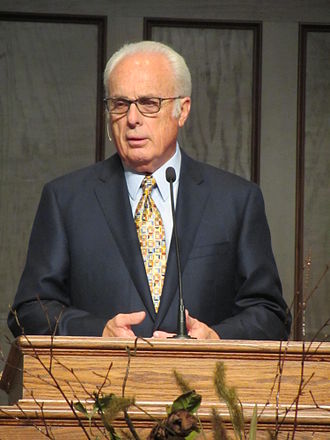
John_F._MacArthur_Jr.Photo source Wikipedia

The Lord sends us honorable and trustworthy overseers, no matter the generation in which we live. He sent the early church fathers, the generation after the Apostles, many of them martyrs: Polycarp, Ignatius, Clement…and He has sent us men from then until now. I’d like to focus on the now and one of these trustworthy and honorable men: Dr. John F. MacArthur

Dr John Fullerton MacArthur was born on June 19, 1939, he is a few months away from 80 years of age. He has been serving as a pastor continuously since 1964. He is pastor of Grace Community Church in Sun Valley California, and at this writing is a few weeks shy of being the senior pastor-teacher there for 50 years.

He has preached 3300 sermons at grace Community Church and many others besides at various conferences. He has written over 150 books. He has authored innumerable essays. He is currently President of The Master’s University (though a plan is in place to step down) and The Master’s Seminary, the seminary he founded specifically to raise up men in the faith and strengthen them in solid doctrine. He has participated in countless conferences, one of which he founded, The Shepherds’ Conference, a gathering designed to minister to men.

From Grace Community Church website

To my knowledge MacArthur is the only preacher to have taught expositorily through the whole New Testament, and from one church no less. John Gill, who died in 1771, did it prior to MacArthur. Even more of a blessing, each and every one of those sermons are recorded and transcribed. And best of all, they are all available for free online for the edification of the body. Here is one man’s reaction to that accomplishment who was present for the milestone:

Sunday, June 05, 2011
John MacArthur – Unprecedented Preaching Achievement

In addition, there is solace in trusting a man who has continued to live a long life of holiness and is a leading example of godliness right before our eyes. We mourn but are also saddened and angry when authors, theologians, professors and pastors we had trusted fall, one after another. MacArthur hasn’t swerved either morally or doctrinally.

MacArthur with his wife Patricia on the day he completed
preaching the New Testament verse by verse. 43 years! Source

So I exhort the elders among you, as a fellow elder and a witness of the sufferings of Christ, as well as a partaker in the glory that is going to be revealed: shepherd the flock of God that is among you, exercising oversight, not under compulsion, but willingly, as God would have you; not for shameful gain, but eagerly; not domineering over those in your charge, but being examples to the flock. And when the chief Shepherd appears, you will receive the unfading crown of glory. (1 Peter 5:1-4)

——————————

Further Reading

Website, many resources: Grace To You

Church: Grace Community Church

John MacArthur’s Biography (and book list)

Posted in encouragement, Uncategorized

Thirty Days of Jesus Redux: Day 9- The Child Grew

By Elizabeth Prata

thirty days of jesus day 9
Photo by Samuel Zeller on Unsplash

Further Reading

What happened during Jesus’ childhood?

Why doesn’t the Bible say much about Jesus childhood?

The boyhood of Jesus

~~~~~~~~~~~~~~~~~~~~~~~~~~~~~~~~~~~~~~~~~~~~~~~

Thirty Days of Jesus Series-

Introduction/Background
Day 1: The Virgin shall conceive
Day 2: A shoot from Jesse
Day 3: God sent His Son in the fullness of time
Day 4:  Marry her, she will bear a Son

Day 5: The Babe has arrived!
Day 6: The Glory of Jesus
Day 7: Magi seek the Child
Day 8: The Magi offer gifts & worship

Posted in encouragement, Uncategorized

Thirty Days of Jesus Redux: Day 8, The Magi offer gifts & worship

thirty days of jesus day 8

By Elizabeth Prata

Thirty Days of Jesus Series-

Introduction/Background
Day 1: The Virgin shall conceive
Day 2: A shoot from Jesse
Day 3: God sent His Son in the fullness of time
Day 4:  Marry her, she will bear a Son

Day 5: The Babe has arrived!
Day 6: The Glory of Jesus
Day 7: Magi seek the Child

Further Reading:

Grace To You: What the Magi Mean To Christmas

Answers in Genesis: We Three Kings

Love Worth Finding: The Gifts of the Wise Men and Our Gifts to Jesus