Posted in theology

The devastating consequences of jealousy

By Elizabeth Prata

The Bible is replete with examples of real people living real lives. Since the Bible people are real people, AKA sinners, they sin. The Bible doesn’t shy away from showing that.

In thinking over some of the more famous cases of bad acts, the brotherly jealousy/sibling rivalry issue formed in my mind. It happened a lot.

Cain, jealous over God favoring his brother Abel’s sacrifice more than his own, he slew Abel. (Genesis 4:4, 8).

Happy little Joseph awoke one day and told his brothers an amazing dream he’d had. (Genesis 37:4-5). The brothers hated Joseph because their father favored Joseph. When Joseph told the brothers his dream, one that showed how he’d rule over them one day, the brothers were jealous of him all the more. (Genesis 37:11, Acts 7:9). Then they plotted to kill him. (But God intervened and providentially saved Joseph).

David and his brothers. We read of that whole process where prophet Samuel comes to David’s father asking him to assemble all the sons. (1 Samuel 16). He is going to anoint a new king. The sons must have felt great excitement! One by one, though, they were rejected. Only after little David was brought in from the fields, too young and small to even be considered in the original lineup, were the halted proceedings resumed. In front of the father and brothers, Saul, on behalf of God, anointed David.

After that, the brothers were in the encampment awaiting the day when someone, anyone, would come forward to slay Goliath the Philistine. Errand-boy David arrived with provisions for the brothers, but was angrily mocked and scorned instead. What had David done to merit such treatment? He’d spoken up against Goliath.

And David said to the men who stood by him, “What shall be done for the man who kills this Philistine and takes away the reproach from Israel? For who is this uncircumcised Philistine, that he should defy the armies of the living God? (1 Samuel 17:26)

His brother Eliab heard and became angry. Presumably he was embarrassed. I mean, it had been 40 days of listening to Goliath taunt them and not one Israelite had stood up to fight. Not one. Certainly not Eliab. Then comes little David and he makes a bold statement immediately.

Now Eliab his eldest brother heard when he spoke to the men. And Eliab’s anger was kindled against David, and he said, “Why have you come down? And with whom have you left those few sheep in the wilderness? I know your presumption and the evil of your heart, for you have come down to see the battle.” (1 Samuel 17:28).

The jealousy between Jacob and Esau is well documented. Esau was favored by the father, Jacob by the mother. Instead of enjoying this unique relationship, mother and son plotted to get an upper hand. Esau helped by throwing away his birthright for a bowl of soup. Then Jacob tricks father and brother into gaining the blessing. Thus began a decades-long separation due to anger and rivalry.

Then I saw that all toil and all skill in work come from a man’s envy of his neighbor. This also is vanity and a striving after wind. (Ecclesiastes 4:4)

Being jealous of another is a sin. And please don’t cite “God is jealous so I can be, too”. God’s jealousy is for us, not against us. His perfection makes His jealousy righteous.

God’s jealousy is always a product of his perfect, self-sufficient love (Exodus 3:14; Psalm 50:9–15; Isaiah 40:28), which provides the opportunity for him to feel deeply jealous about the people with which he has freely covenanted. Source

How to overcome this sinful emotion?

Here is an article from Desiring God about jealousy (also quoted above). Hey, Jealousy

Here is a one-minute audio from Grace To You’s ‘Portrait of Grace’ series, Overcoming Jealousy

What Does the Bible Say about Jealousy?

snake
Posted in potpourri, theology

Prata Potpourri: Women’s Day, Fencing the Lord’s Table, Discernment thinking, Girl, again?? More…

By Elizabeth Prata

My friend the school secretary related a cute story. One of the staff is retiring. The office personnel were congratulating him. A little student was nearby, and she was asked, ‘He is retiring, do you know what retiring means?’

She piped up, “Yes. It’s when you don’t actually quit your job, you just get old and go home”.

Well then! Out of the mouths of babes…

On to Potpourri:

thornsThink the grass will be greener over there in those ministries? Not always so…A good essay from Michael Kruger.
Yes, There are ‘Thorns’ in Vocational Ministry Too

~~~~~~~~~~~~~~~~~~~~

Girl, you got problems… Rachel Hollis’s book(s) Girl, Wash Your Face and Girl, Stop Apologizing lack a proper theological framework, thereby being unsuitable for Cristian consumption. And by the way, they also seem to be plagiarized from un-acknowledged sources, which render them unsuitable for anyone.

Jen Oshman reviews Hollis’s latest book: Girl, Follow Jesus

Buzzfeed presents some information on the allegation of plagiarizing in Influencer Rachel Hollis Is Facing Accusations She Is Plagiarizing On Her Instagram

Katelyn Beaty at Christianity Today adds to the conversation about Hollis’s books in Girl, Get Some Footnotes: Rachel Hollis, Hustle, and Plagiarism Problems

~~~~~~~~~~~~~~~~~~~~

The discernment lesson in this one is good. Hey, the whole thing is good.
The Servant Leader Shuns Unbiblical Thinking

How did Spurgeon fence the Lord’s Table, anyway? A view on the issue of open communion, or closed?

Open Book: Books by R.C. Sproul and John MacArthur have had a profound impact on so many people. But which books influenced their lives and ministries? Listen each week on Open Book as we hear about the books that shaped their thinking. This week- John MacArthur and A.W. Pink’s Spiritual Growth (Podcast)

Properly Celebrating Women’s Day at Delivered By Grace. “While we can certainly recognize progress of women’s equality in many ways in our culture, how should we as followers of Jesus celebrate women and the place of women in our lives, our culture, and our churches?”

~~~~~~~~~~~~~~~~~~~~

Table Talk Magazine examines individual and societal loneliness. I’ve been interested in this topic ever since I was a journalist in the early 2000’s, observing and reporting on society via sports events, civic meetings, clubs, and organizations. How do people interact these days? In 2001 Robert Putnam published his groundbreaking book Bowling Alone: The Collapse and Revival of American Society. I recommend it.

TableTalk article: All the Lonely People

I read this book by Wiersbe in order to review it, recommended:

Lonely People: Biblical Lessons on Understanding and Overcoming Loneliness Living Lessons from God’s Word, by Wiersbe, Warren

weary

~~~~~~~~~~~~~~~~~~~~

Julie-Ann Baumer in Maine has a nice folksy way about her. I enjoy her blog posts
In the Rear-view Mirror

Jessica Fisher at Good, Cheap Eats has an article on 8 Great Taco Fillings. I’ve been enjoying Mexican food a lot lately, so it’s on my mind. Maybe you’ll enjoy these too.


Posted in theology

“If you’re physically able to attend your church on the Lord’s Day, and you choose not to, you’re sinning”

By Elizabeth Prata

Recently I wrote about the importance of attending church regularly. (Popular blogger says you don’t have to “do” church). I refuted her premise, which is summarized in her statement:

It’s entirely okay to step out.

She offers pious sounding reasons, but upon even a cursory examination of her ‘reasons’ that it’s OK to step out of church, they are flimsy and collapse when looking at the light of scripture. Or just common sense.

However, I received push-back for my stance. It was this that surprised me. Greatly. I thought it was a given. You’re a Christian. You go to church. Why? You go to church to worship the Lord who saved your soul, to edify the Body with the gifts we’ve been given, to serve, and so on. It was clear.

church communionBut apparently this is not clear to everyone. I thought there were non-negotiables in Christendom and that regular church attendance was one. However, everything seems up for grabs these days to disparage, question, or reject.

Excuses made for lack of regular attendance were: work interferes (for ten years), small groups can substitute, it’s legalistic to expect this, the Bible never commands it, there’s no good churches nearby…

I’ve been pondering this ever since. I have wanted to write about it again.

A teaching in Ephesians 3. Ephesians 3:10 brought sudden light to the church attendance issue in a way I’d not thought of before. Here’s the verse:

[grace was given] so that through the church the manifold wisdom of God might now be made known to the rulers and authorities in the heavenly places.

Again, “so that through the church the manifold wisdom of God might now be made known to the rulers and authorities in the heavenly places…

The passage is talking about how God uses His church to demonstrate His wisdom to holy and unholy angels. Choosing to step out of church means you’re choosing to step out of His plan to be used for His display in the heavenly realms of His wisdom to His creatures.

~~~~~~~~~~~~~~~~~~~~~~~~~~~~

On another note to this notion of ‘you don’t have to attend church’, this segment of the latest 9Marks Mailbag was also highly pertinent. It directly answers the question of whether you should regularly attend. I asked permission to reprint this part of their essay and they said yes.

Must Christians Go to Church Every Sunday?

Dear 9Marks,

How many Sundays count as regular church attendance? Twice a month? Or are Christians required to be at church every Sunday? —Desmond

Dear Desmond,This is an important question. In short: if physically able, Christians should be present at every Lord’s Day gathering. It’s what we do. But let me explain.

First, before we receive a command to attend, we receive a promise: Jesus is present. Throughout the Bible, God is drawing his people to himself. In Genesis, we’re created to be in God’s delightful presence—and since the Fall, God has been redeeming his people for such a privilege. For Israel, God’s presence was restricted to the tabernacle (and later, temple).

But in Christ, all of God’s promises are fulfilled and these former images are transformed (2 Corinthians 1:20). Jesus is the temple—he’s “the place” we experience God’s delightful presence. Before Jesus left this earth, he gave a promise: “where two or three are gathered in my name, there I am present” (Matthew 18:20). What Jesus had in mind is what we call our “church services”: a group of people (at least two or three) who gather in the name of Jesus to represent him to the world. Therefore, church services aren’t like religious classes or moral fill-up stations or personal worship times. Jesus is present at our services in a unique way as the church gathers to worship and represent him. That’s the promise.

Second, consider the backdrop of the Sabbath. God himself established the seven day cycle of creation, rested on the seventh day, and then gave his old covenant people the covenant sign of the Sabbath both for rest and to mark them off as belonging to him. Almost immediately and universally, the churches of the New Testament stopped celebrating the Sabbath and began gathering on the first day of the week, resurrection day (e.g. Acts 20:7; 1 Cor. 16:2; Rev. 1:10). By doing so they both affirmed that they found their “rest” in the Lord of the Sabbath and marked themselves off as those who belong to him. That’s what it means to “gather in his name,” a gathering sealed by his presence (see previous point). In the same way, the seven-day cycle orders creation, so gathering on the first day orders new creation. If you want to make gathering every other week your regular practice, you first need to convince me God established a 14-day cycle in creation.

Third, the command to attend isn’t a pastor’s idea, but God’s. Members have responsibilities to one another, and elders have responsibilities to members. Practically speaking, the only way we can fulfill these duties is to be present when the church gathers. Hebrews 10:24–25 puts it bluntly: “And let us consider how to stir up one another to love and good works, not neglecting to meet together, as is the habit of some, but encouraging one another, and all the more as you see the Day drawing near.” The habit of attending church every other week would also be the habit of forsaking church every other week. Of course, physical ailments, unforeseen emergencies, and other providential occurrences will occasionally keep you from attendance. But generally speaking, if you’re physically able to attend your church on the Lord’s Day, and you choose not to, you’re sinning.

I know that might sound strange to many modern-day Christians in America, but anything else would sound strange to many Christians of the past and in other parts of the world. Attending church on the Lord’s Day is the most natural thing we do. Geese fly in Vs, wolves hunt in packs, elephants travel in herds, penguins survive the winter in huddles, and Christians gather for worship. It’s our nature. It’s what we do.

—Joel Kurz

Please consider these things. Regular, faithful church attendance is so important. It should be made a priority in a Christian’s life, a high priority.

church

Posted in poetry, theology

Poetry: Waiting for the Day

By Elizabeth Prata

creation

The clarity of grey moonlight
Focused determination of the ant
Joyous song of the mockingbird
Rushing clamor of the tides

All these You have made

The scudding clouds before the coming storm
The bask of the lioness on the burnt plain
The hurry of the hummingbird, sipping red throated
Of nectar from vibrant blooms

All these You have made

The granite mountains, solidly overseeing
The futility of man’s works and doings
Nesting birds at rest, yet groaning for better days
When the curse shall be lifted

Man, o man! Our deceitful heart has made this place a trial to the animals
Rocks and hills, oceans and rivers
They wonder at us
Your creation, your beautiful creation…

All these You have made

Will be changed, in a blink of an eye,
In fervent heat You will melt away the curse.
We are waiting for new heavens and a new earth
in which righteousness dwells.

All this You will make. Then-

The creation itself will be set free
from its bondage to decay
and brought into the glorious freedom
of the children of God. (Romans 8:21)

creation2

Posted in encouragement, theology

Encouragement for ladies living with an abusive past

By Elizabeth Prata

A friend of mine sent these recommendations to me. You might consider these two resources if you are struggling to shed the baggage of an abusive past, need some encouragement, or just want to read about how God’s love triumphed in these womens’ hearts. I personally haven’t read them but here is what my friend said:

I wanted to share with you two books I recently read. They are great books for anyone, but especially helpful for women who suffer from an abusive past. Both books were recommended to me by my Biblical counselor from the Master’s Seminary. You may have heard of them or read them, but just in case I thought I’d pass them along for you to read or share with other women you know that may need some encouragement 🙂

Glenda’s Story: Led by Grace : by Glenda Revell (forward by Elisabeth Elliot). Amazon blurb:

Unwanted from birth and abused throughout her childhood, Glenda was desperate for love and a sense of belonging. Her only respite from a miserable home life was school, and the welcoming shade of her favorite willow tree, under which she would dream of another life, another family, and pray to a God she did not yet know. Ultimately, Glenda’s afflictions became the cords with which God drew her to Himself. Receiving His salvation, she understood that God had saved her from her own sinfulness, more than horrid conditions and treatment by others. This is a story of great hope, an amazing account of how our merciful Savior brings light out of darkness, joy out of sorrow, and peace out of pain. Highly recommended by Elizabeth Elliot.

Dorie: The Girl Nobody Loved : by Dorie Van Stone. Amazon blurb:

“Someone has said that when you have nothing left but God, you realize that God is enough. God had stood beside me when no one else wanted me. He was not going to abandon me now. God would have to heal the emotional pain that throbbed through my body.”
As a child, Dorie was rejected by her mother, sent to live in an orphanage where she was regularly beaten by the orphanage director, was beaten time and again by cruel foster parents, and was daily told that she was ugly and unlovable. Dorie never knew love until a group of college students visited the orphanage and told her that God loved her. As she accepted that love, her life began to change.
Dorie is a thrilling true account of what God’s love can do in a life. Doris Van Stone takes readers through the hard years of her childhood into her fascinating years as a missionary with her husband to the Dani tribe in New Guinea. With the rise of illegitimate births, the increase in divorce statistics, and the frightening escalation of child abuse, this story stands as a reminder that God’s love, forgiveness, and grace are greater than human hurt and sorrow.

Finally, be strong in the Lord and in the strength of his might. (Ephesians 6:10)

be strong verse

Posted in encouragement, theology

There is true freedom in Jesus

By Elizabeth Prata

I’m originally from New England. New Hampshire’s state motto is “Live Free or Die”.

It’s so cold in NH, locals say ‘live, freeze, and die.’

That witticism aside, the motto actually comes from a letter penned by a veteran of the French & Indian Wars and the American Revolution, General John Stark. In 1809 Stark sent a letter to his compatriots at a reunion long after the war had ended. His letter included a brief passage to be read as a toast to the veterans: “Live free or die. Death is not the greatest of evils.”

The secular person’s view of freedom is quite different than a saved person’s view of freedom.

The Revolutionary War veterans fought to get out from under the yoke of tyranny. The tyrannical entity in that case was Britain. But there was a greater tyranny under which they were living, if they were not in Jesus: the tyranny of sin.

There IS a greater evil than death. It is our sin against a holy God. The Revolutionary War was considered treasonous by the king of Britain. However, sin is “cosmic treason” as RC Sproul famously said.

“Sin is cosmic treason.” What I meant by that statement was that even the slightest sin that a creature commits against his Creator does violence to the Creator’s holiness, His glory, and His righteousness. Every sin, no matter how seemingly insignificant, is an act of rebellion against the sovereign God who reigns and rules over us and as such is an act of treason against the cosmic King. Source

There is something worse than death, and that is eternal death in the Lake of Fire enduring God’s wrath for our treason. Sins, that great evil, must be repaid, and thus God has made a plan for those who perpetrate it will pay.

But God!

But God, being rich in mercy, because of the great love with which he loved us, even when we were dead in our trespasses, made us alive together with Christ—by grace you have been saved— and raised us up with him and seated us with him in the heavenly places in Christ Jesus, (Ephesians 2:4-6)

Consider your freedom today as you go about in worship of the Lord. My gratitude for Jesus having set me free flows through my soul as a balm. He set me free…

Free from the wrath of God
Free from the guilt I carried
Free from the burden of worry
Free from ignorance
Free from enslavement to sin
Free from pursing a vain life
Free from biblical blindness
Free from darkness

For freedom Christ has set us free; stand firm therefore, and do not submit again to a yoke of slavery. (Galatians 5:1).

Now the Lord is the Spirit, and where the Spirit of the Lord is, there is freedom. (2 Corinthians 3:17).

So if the Son sets you free, you will be free indeed. (John 8:36)

Live as people who are free, not using your freedom as a cover-up for evil, but living as servants of God. (1 Peter 2:16)

There is therefore now no condemnation for those who are in Christ Jesus. For the law of the Spirit of life has set you free in Christ Jesus from the law of sin and death. (Romans 8:1-2).

But now that you have been set free from sin and have become slaves of God, the fruit you get leads to sanctification and its end, eternal life. (Romans 6:22).

free indeed verse

Posted in encouragement, theology

Mail Call: Our identity in Christ

By Elizabeth Prata

mail
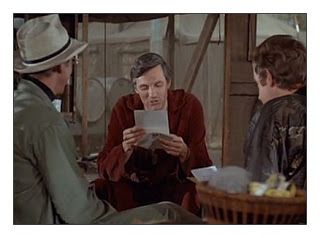
Mail Call from the old TV show M*A*S*H

I was asked-

“What does it truly mean and practically mean for us to find our identity in Christ? What does that look like daily?”

I know a lot of younger women ask this or wonder this.

I personally don’t think it’s as big of a deal as a lot of people think, but that could just be me.

Who are we?

Before salvation, we were in satan. After salvation, we are in Jesus. Having our identity in work, children, hobby, etc prior to salvation just means that it was a masked idol with satan behind the mask. If we find identity in those things after salvation, it’s sin blocking us from seeing Jesus.

Our identity is “in Christ”

and be found in him, not having a righteousness of my own that comes from the law, but that which comes through faith in Christ, the righteousness from God that depends on faith (Philippians 3:9)

Actually, all of Philippians 3 is helpful. Also, this from RC Sproul is helpful here-
Our True Identity

But even if we are sinning in finding identity in other things besides Jesus, what does God see when He looks at us, whose identity does HE see? Jesus’. He sees the righteousness of Jesus Christ imputed to us by faith.

Where we begin to have questions about our identity is when we wonder if He sees that righteousness of Christ imparted by the Holy Spirit working its way out into our attitudes and behaviors. In other words, are we living it?

In practical terms, our identity IS in Christ. Nothing we think or say or do changes that. We can wonder, mull, question, or believe anything we want, but our identity is in Christ. That is how God sees it.

LIVING like we are in Christ is another thing. Daily, that means we–

–pray
–read our Bible
–give
–worship
–repent
–sacrifice for others (be a doer not just a hearer)

Just keep putting one foot in front of another every day doing the above, and we will daily know in greater measure that we are in Christ. The more we perform the outworking of our salvation the more we will see HIS outworking of our sanctification (via answered prayer, shifted affections, more diligent works, less pride, etc) and grow more sure.

PS focusing on our identity after a certain point, and only the individual would know that point, is navel gazing and not edifying. It’s a good question to ask, but obsessing over it is inward thinking and not outward Jesus focusing.

The Sproul piece is short.

in him

Posted in prophecy, theology

The Usefulness of Dystopian Fiction

By Elizabeth Prata

Tim Challies is a reader and a book reviewer. He is the author and promoter of the Annual Christian Reading Challenge, in which I participate.

I was glad to see this article by by Jon Dykstra linked from Tim Challies’ site:

Why Is Dystopian Fiction Worth Reading?

Yay! Someone else is a fan of dystopian fiction.

Dystopian is a word from Greek meaning ‘bad place’ according to the article. It’s the opposite of Utopian, meaning ‘perfect place’.

Dystopian fiction is a genre that describes people surviving or trying to, after a holocaust of some kind, or a societal collapse, or a nuclear war, and the like. The article speaks of this kind of fiction being worthwhile because it helps us in predictive prophecy of the secular kind, in connecting the dots to see a current credible future threat. The author’s point was that this kind of fiction spins a credible threat into scenarios that help us understand where these threats may lead us.

This is a genre well worth exploring, though with care and caution. It’s a big blank canvas that insightful writers can use to paint pictures of grim futures, all in the hopes that they, and we, will ensure such futures never come to be.

I enjoy this fiction but had felt mildly guilty about it, as though I needed to be doing something more productive. I’d wonder, ‘Am I a ghoul?’ ‘Why do I find this absorbing?’

Mr Dykstra helped me see my interest in it was to go where my own imagination lacked facility, to ‘see’ a future that is all too real in some cases, and to develop opinions and thoughts to guard against it. EM Forster’s The Machine Stops is a future that is practically already here, as is Stephen King’s The Running Man. Chilling.

The most famous work of dystopian fiction is George Orwell’s 1984, which the article mentions. That work was published in 1949. Another famous work of dystopian fiction is Aldous Huxley’s Brave New World. Other classic dystopian books are PD James’s Children of Men, and the Canadian book The Handmaid’s Tale. Of this last one, the author of the article discounts it as predictive or even helpful as understanding a credible threat, though a good yarn, because it was Chrfistianity that led to the dystopian society being described in the fictional account. Dystopian fiction is good where it helps us see ahead and cope with credible current or near current threats.

I mentioned I’m participating in the Challies’ Christian Reading Challenge, at the “Avid Level” (26 books read this year.) I added several others of my own choosing to Challies’ list, making myself a separate genre nook of dystopian books I wanted to read. They included The Running Man, The Machine Stops, and It Can’t Happen Here. I’d like to add these and some other dystopian material to you as recommended. I’ve read most of these and have watched the movies.

Stephen King’s The Running Man (1982)-

is a science fiction novel by American writer Stephen King, first published under the pseudonym Richard Bachman in 1982 as a paperback original. It was collected in 1985 in the omnibus The Bachman Books. The novel is set in a dystopian United States during the year 2025, in which the nation’s economy is in ruins and world violence is rising.

The end of The Running Man is absolutely chilling, as the final action the main character takes has already come to pass.

EM Forster’s The Machine Stops. (1909). Amazingly prescient, predicting the rise in technology that impacts both individuals and society, this novella is a short but chilling read. In many ways, we are living Forsteer’s future now.

William Forschen’s book One Second After (2009) depicted the effect upon America from an EMP, (electro-magnetic pulse), and the nation’s societal collapse and resulting high death rate. The author consulted with psychologists, economists, and sociologists to base his fiction on real scenarios those experts stated would most likely happen if we suffered an EMP.

Pat Frank’s book Alas, Babylon (1959)-

-was one of the first apocalyptic novels of the nuclear age and has remained popular more than half century after it was first published, consistently ranking in Amazon.com’s Top 20 Science Fiction Short Stories list. The novel deals with the effects of a nuclear war on the fictional small town of Fort Repose, Florida, which is based upon the actual city of Mount Dora, Florida. The novel’s title is derived from the Book of Revelation: “Alas, alas, that great city Babylon, that mighty city! for in one hour is thy judgment come.”

Nuclear winter wasn’t a very known or understood event back then, so the survival rate of the population in Alas, Babylon, this initial entry into the American dystopian nuclear fiction isn’t realistic, but most of the rest of the book is.

Sinclair Lewis’s It Can’t Happen Here. (1935). I have not read this book but it is on deck to be started this weekend. I’ve read three pages so far so I can’t review it, lol. Not yet. The synopsis seems like we are living it now…

Here is Wikipedia’s synopsis of Lewis’ book-

Published during the rise of fascism in Europe, the novel describes the rise of Berzelius “Buzz” Windrip, a demagogue who is elected President of the United States, after fomenting fear and promising drastic economic and social reforms while promoting a return to patriotism and “traditional” values. After his election, Windrip takes complete control of the government and imposes a plutocratic/totalitarian rule with the help of a ruthless paramilitary force, in the manner of Adolf Hitler and the SS. The novel’s plot centers on journalist Doremus Jessup’s opposition to the new regime and his subsequent struggle against it as part of a liberal rebellion

With the current rise in tensions between nuclear powers India and Pakistan, these two movies might be worth a look.

Threads. I watched this 1982 film a few years ago. I wrote a review of it below. It affected me greatly.

The most unrelentingly horrific and unsettling apocalyptic movie you will ever watch that comes the closest to what the Tribulation will be like: “Threads.

The Wikipedia synopsis of the film states:

Threads is a 1984 British apocalyptic war drama television film jointly produced by the BBC, Nine Network and Western-World Television Inc. Written by Barry Hines, and directed and produced by Mick Jackson, it is a docudrama account of nuclear war and its effects on the city of Sheffield in Northern England. The plot centres on two families as a confrontation between the United States and the Soviet Union erupts. As the nuclear exchange between NATO and the Warsaw Pact begins, the film depicts the medical, economic, social and environmental consequences of nuclear war.
Shot on a budget of £400,000, the film was the first of its kind to depict a nuclear winter. Certain reviewers nominated Threads as the “film which comes closest to representing the full horror of nuclear war and its aftermath, as well as the catastrophic impact that the event would have on human culture”.

And even then, the film, though it comes near to depicting the horror of the Tribulation, doesn’t even come close to its actuality. But Threads is as close as I’d want to see it anyway. Our minds can’t fully comprehend the full evil that will occur at that point in history. As this reviewer said, in his article, ‘Threads’ Is One of the Most Horrifying Films I’ve Ever Seen: This BBC docudrama scarred a generation,

Threads absolutely forces you to face the unthinkable.

People, the Tribulation is unthinkable. But we must think on it, the Lord’s wrath already hangs over the unsaved. Things like this should spur us to witness with eagerness and fervor.

The War Game (1965) is another film that horrified audiences. Created in 1965, it was deemed TOO horrifying to be released widely. See below-

The War Game is a 1965 television drama, filmed in a documentary style, that depicts a nuclear war. Written, directed and produced by Peter Watkins for the BBC’s The Wednesday Play anthology series, it caused dismay within the BBC and also within government, and was subsequently withdrawn before the provisional screening date of 7 October 1965. The corporation said that “the effect of the film has been judged by the BBC to be too horrifying for the medium of broadcasting.

I don’t think a steady diet of this kind of material should be on our plates, but books or movies like this can be a legitimate addition to our bookshelves or movie queue, for the reasons stated above. Happy reading…or in this case, unhappy reading.

hammer mural1

Posted in theology

Our Days are Numbered

By Elizabeth Prata

*I heard an Adrian Rogers sermon several years ago that stayed with me. He talked about how people delay their decision for or against Jesus, thinking they have lots of time to go into that. Rogers shared several deaths that were unexpected, sudden, and odd that shows we don’t have the time we think we do. One was when a man was lawnmowing and ran over a nail, which the mower threw up and it went into his heart. The other was a woman walking by a building at the same time a person sitting on the edge of the sill nudged a plant pot and it fell out the window onto her head. His point was, decide now, today, what you will believe.

There have beem some equally odd deaths I’ve read about that brought his sermon to mind again. Isolated, freak accidents, they are called. But the person involved in them winds up just as dead as if the death was expected.

Grief spreads far and wide for hunting guide killed in accident near Faribault
On Sunday southwest of Faribault, a motorist who lives nearby agreed to be Pineur’s good Samaritan and attached a strap to the two vehicles intending to pull the pickup from the ditch. However, the hitch broke on Tyler Nusbaum’s vehicle and part of it went hurtling toward Pineur’s pickup. The piece went through the windows of the camper top and the back of the pickup, and it hit Pineur in the back of the head, the Sheriff’s Office said.

Rock Thrown From Mower Kills Passing Woman
“A freak highway accident left one woman dead and the Georgia Department of Transportation trying to answer questions. A Georgia DOT crew was mowing the grass on the side of a sparsely-traveled rural highway. At the exact same time, a car with five passengers passed by.” (The mower) ran over a rock. The rock was a pretty good-sized rock. But it was launched from the side of the bush hog,” said Sgt. Chad Mann, of the Troup County Sheriff’s Office. Annie Lee, 58, was sitting in the back seat with her family when the volleyball-sized rock smashed through the windshield, grazed the driver and killed her instantly. Police said it was a shocking incident, but not one that could have easily been prevented or one that would happen again.”This was an isolated freak incident,” said Mann.”

The woman was sitting in the back. The rock went through the windshield, missing the driver and the passenger, and hurtled toward Ms Lee, and she was killed.

Just like that. Tragic.

Think about it, one moment you are sitting on your truck and the next second you are in hell. Or heaven. One moment you are laughing with your family in the back seat of the car and the next second you are in heaven. Or hell. It happens that fast. Paul didn’t leave any time for there to be limbo, or to hang around and wait for the Ghost Whisperer to show up. He said if you are absent from the body you are with the Lord. (2 Corinthians 5:8) The rapture takes place in the blink of an eye, where your bodies are transformed from flesh to eternal in 1/150th of a second. The same happens with many people in the way they die. It happens instantly, just like it did for the two unfortunates in the news articles above.

The Bible says our days are numbered.

Man’s days are determined; you have decreed the number of his months and have set limits he cannot exceed. (Job 14:5).

David cried out, Show me, O LORD, my life’s end and the number of my days; let me know how fleeting is my life. (Psalm 39:4).

As Matthew Henry explains,

He prays to God to make him sensible of the shortness and uncertainty of life and the near approach of death (v. 4): Lord, make me to know my end and the measure of my days. He does not mean, “Lord, let me know how long I shall live and when I shall die.” We could not, in faith, pray such a prayer; for God has nowhere promised to let us know, but has, in wisdom, locked up that knowledge among the secret things which belong not to us, nor would it be good for us to know it. But, Lord, make me to know my end, means, “Lord, give me wisdom and grace to consider it (Deu. 32:29) and to improve what I know concerning it.”

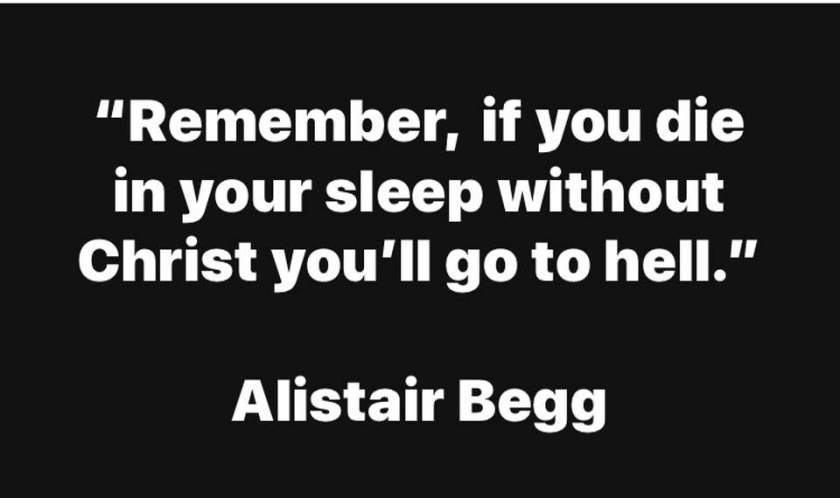
Do you have the wisdom and grace to consider your end, and the courage to improve what you know concerning it? It could happen any time. Repenting after death is too late. Now is the acceptable time. Now.

begg.jpg

*This essay first appeared on The End Time in June 2011. I updated one of the news articles