Does the Bible speak to whom we should marry? Which college to attend? Whether to join the Army? Should we relocate to another state? Change careers now, later, or never? Go back to college?
Christian decision-making … I’m often asked these very questions by women who care about being obedient to the will of God. But the Christian culture of the last generation has introduced a mysticism to decision-making (and to Christian life in general) that unfortunately includes waiting for personalized whispers, looking for signs, or other extra-biblical methods that will guide them along in deciding things that aren’t directly in the Bible.
Phil Johnson has explained about inner promptings and whispers, (transcript here from Super Session at the 2002 Shepherds’ Conference, audio here)
Now this kind of thinking is totally at odds with the principle of Sola Scriptura. We believe as Protestants don’t we, that the written Word of God – the Bible – contains everything necessary for our salvation and our growth in grace. 2 Timothy 3:16-17, All Scripture is given by inspiration of God and is profitable for doctrine, for reproof, for correction, for instruction in righteousness…listen to the next phrase…that the man of God may be PERFECT, thoroughly furnished unto all good works. Scripture alone is able to equip us thoroughly, perfectly for all good works. Everything we need in the process of our sanctification. There is no need for extrabiblical revelation. The Bible will equip you for all good works. It will give you all the explicit guidance you can possibly get from God. It contains principles to help you be wise and discerning as you pursue the course of your life, and beyond that we simply trust God in His providence to order our steps. You don’t need an explicit message from God telling you whom to marry, or where to go to school, or where to go to the mission field. [italics mine]
So how should we approach making decisions?
Any precursor to decision making would assume first that one is saved. Apart from Christ, we can do nothing. (John 15:5). Secondly it assumes that the thing you’re undecided about does not involve sin. We never decide toward sin, we flee from sin. ( 2 Timothy 2:22; Genesis 39:12). Thirdly, it assumes that you’re relying completely on God’s word. If the item you’re trying to decide about is directly in the Bible, follow that command. “Should I submit to my husband?” isn’t really a decision to ponder, because it is already commanded.
Fourthly, the decision-making process assumes that you’ve yielded yourself to the Spirit of Christ within you. You’re striving, repenting, obeying, praying, etc. You’re as much as a clean plate as you can be, being a sinner, lol.
Now, how to decide those things which are not directly addressed in God’s word?
As from a pamphlet I found online which no longer is online, from Crossroad Bible Church,
Here are four questions to ask yourself:
• Have I yielded myself completely to Christ’s Spirit?
• Is there a clear Bible command concerning this decision?
• Is there a Bible principle that will guide me in this decision?
• Which choice would be most prudent in this situation?
The above wee fleshed out more with scriptures at their website but sadly is gone now.
Did you know that You Are Part of a Grand Plan? It’s not like you can mess it up. If you make this decision or that decision, it isn’t going to surprise God, or alter what He has planned for you. Providence, as mentioned above by Phil Johnson, is secure. His plan will be fulfilled, and your decision making isn’t going to change it. You aren’t going to miss out on anything. Beyond what is specifically prescribed in the Bible, and “we simply trust God in His providence to order our steps” as Pastor Johnson explained.
In my own life, I moved from Maine to Georgia. I wanted a place with lower cost of living, and warmer weather. That’s it. He would have worked it out of I’d chosen Texas or North Carolina. Deciding on Georgia wasn’t a life-or death decision, just one that fit my life and made sense.
When I got to GA I applied for a number of jobs. I applied using common sense. What did I have experience in, was trained for, and was good at? It’s not like I consulted the Lord and waited for a sign or anything. I was following the biblical principle that he who does not work does not eat. I sought jobs I thought I had the best chance of getting and sustaining my means.
Some jobs I applied for were at the University in the journalism department, some with local magazines. The one I got (in His providential care) was for the Athens Banner Herald writing feature stories of people in my county as a freelancer. Later when I decided to go back to education – subbing at first and applying for parapro jobs, I didn’t consult the Lord. I just used common sense. The freelance job simply wasn’t paying enough. A job with the County Education system would:
-be fairly secure as jobs go (education is the largest employer in the county)
-had health benefits (I was soon to be 50)
-was what I was trained for. (formerly certified teacher with Masters degree)
-I’d be working with kids (something I love and I’m told I’m good at).
If I’d decided to get a job as a bungee jumper trainer, lol, that would not be common sense.
I knew the Lord would work it out. In His providence He did not ordain that I was given the first job I’d interviewed for as a parapro at another school, but a year later I got a job at the school I’m at now, a great fit. I’ve been there 11 years, 9 as a parapro. It’s not like there is only ONE decision or only ONE path.
If your life is in harmony with all the commands and principles of the Bible, you can actually do what you want to do without beating yourself up with introspection and fretting over whether God told you to do something or not. When Scripture says He orders our steps it’s talking about His guidance through His hand of providence. We step out in faith, and He guides our steps.
I saw a certain obituary the other day. I was struck by how unique it was even in terms of obituary writing. You see, obit writing is a genre all unto itself, and the focus of it is not death, but life.
Apparently this gentleman was quite a character. When a family is faced with the certainty of death, how does one encapsulate their departed one’s life? Which highlights to put in, and which to leave out? What CAN one say about ‘the other side’? There is great curiosity about what happens to a departed one post-death, but only Christians can say with certainty what happens as a soul’s life continues.
Mr Schrandt’s life was marked by one consistent characteristic. Please read the following obituary, and then I’ll discuss it down below. See if you notice the same thing I did…
——————————————–
Tim Schrandt*
Tuesday, April 2, 2019 12:56 PM
Tim Schrandt, 63, of Spillville, died Friday, March 29, 2019, at Gundersen Health System in La Crosse, Wis., after a short battle with cancer. A funeral service is at 11 a.m., Thursday, April 4, at the St. Wenceslaus Catholic Church in Spillville, with Deacon Pat Malanaphy presiding. Burial is in the church cemetery, with full military rites. Visitation was from 3 to 7 p.m. Wednesday, April 3, at the St. Wenceslaus Catholic Church in Spillville, and continues after 10 a.m. at the Church Thursday morning.
Tim ‘Lynyrd’ Schrandt made his last inappropriate comment March 29, 2019. If you are wondering if you may have ever met him, you didn’t – because you WOULD remember. For those of you that did meet him, we apologize, as we’re sure he probably offended you. He was world renowned for not holding back and telling it like it is.
Tim was born to William (Bill) Schrandt and Mary (Malanaphy Schrandt) Manning June 11, 1955 – 100 years too late. Given Tim’s demeanor he would have been the perfect weathered cowboy in the old west or a rough-and-tough pioneer, or maybe he just should have been Amish.
Tim was the fourth of eight kids, the bottom rung of the top tier (the big kids). Instead of taking his place on that rung, listening to the older kids and doing as he was told by his older siblings, he decided to anoint himself “king” of the four little kids. Tim spent his childhood and early adulthood ordering them around and, in general, tormenting them. He was a great orator (not like Shakespeare, but more like Yogi Berra), as he always had something to say and always had to get in the last word.
His position as “king” and orator was challenged by the nuns at St. Wenceslaus school in Spillville. He may have met his match. We’re not saying the nuns won, but they put up a good fight. We mean literally – he got into a fist-a-cuff with a nun. In fairness, she probably started it. You didn’t take a swing at Tim and not expect one back. Tim’s fondness for authority (his own, not others) followed him to South Winneshiek High School in Calmar and later into the Army. This provided for many interesting episodes and stories, detentions and demotions, and a few “run ins” with the law – not just locally, but globally.
Tim worked at Camcar/Stanley Black and Decker in Decorah as a tool and die maker for 30-plus years. Tim worked with many friends and “a bunch of morons.” His words, not ours. Well, not exactly his words – because that would have included a bunch of swearing.
Tim leaves behind a lot of stuff that his family doesn’t know what to do with. So, if you are looking for a Virgin Mary in a bathtub shrine (you Catholics know what we’re talking about) you should wait the appropriate amount of time and get in touch with them.
Tomorrow would be fine.
In addition to his stuff he leaves behind two great boys of whom he was extremely proud: Cody (Jenny) Schrandt and Josh (Lydia) Schrandt were the product of his marriage to Crystal Hilmer. He will be missed by his two granddaughters whom he adored and taught to cuss, Peyton and MacKenna. Also left to keep the stories alive (but, there won’t be any new material) are his mother, Mary Manning and siblings: Mike (Rita Dixon) Schrandt, Marty (Clint) Berg, Becky Schrandt-Miles, Bill ‘Grease’ Schrandt, Pam (Rick) Barnes and Peter (Sandra) Schrandt; and many nieces, nephews and cousins who wanted to hang out near him, because you just knew he was going to say or do something good. It’s not that he was such a great storyteller – it’s that he WAS the story!
To his siblings’ amazement he was actually able to snag a good woman, Cheryl Murray, and hold onto her for the past 13 years; and as far as we know, restraints were not used. Tim also created great memories and stories for Cheryl’s kids, Alex (Christina) Murray and Samantha (Evan) Ludeking; and grandkids, Tatum and Grace.
He will be having a reunion with his infant daughter, Ashley; his brother, Duke; his dad, Bill Schrandt; many aunts and uncles and a handful of cousins that passed before him. Tim was in charge of getting the beer and ice for our family reunions, so they will be happy to see him.
A common line in obituaries is “He never met a stranger.” In Tim’s case: He never met a rule he couldn’t break, a boundary he couldn’t push, a line he couldn’t cross and a story he couldn’t stretch. Another common obituary phrase is “He’d give the shirt off his back”; well Tim was prepared to do that, and he could do it quickly – because he always wore his shirts unbuttoned ¾ of the way down. Tim was anything but common!
Despite his crusty exterior, cutting remarks and stubbornness, there is actual evidence that he was a loving, giving and caring person. That evidence is the deep sorrow and pain in our hearts, that his family feels from his passing.
Tim led a good life and had a peaceful death; but the transition was tough. And for the record, he did not lose his battle with cancer. When he died, the cancer died – so technically, it was a tie! He was ready to meet his Maker, we’re just not sure “The Maker” is ready to meet Tim.
Good luck God!
We are considering establishing a Go-Fund-Me account for G. Heileman Brewing Co., the brewers of Old Style beer, as we anticipate they are about to experience significant hardship as a result of the loss of Tim’s business. Keep them in your thoughts.
————————————-
The characteristic distinguishing Mr Schrandt’s life was rebellion. He rebelled against parents, his nun teachers, Army superiors, family, and every line, rule, or boundary he met. He rebelled against every verse that commands a man not to be offensive, mouthy, stubborn, argumentative, bossy, quarrelsome, a fighter, drunkard, immodest, liar, and vulgar. Such a life does not please the Lord. Rebellion in any one form displeases the Lord. We are called to submit, not rebel.
The obit writer calls Mr Schrandt’s ‘a good life.’ Does the Bible?
The Book of Ephesians can be split into two parts. The first 3 chapters focus on theology, stressing New Testament doctrine. The the last 3 chapters focus on Christian behavior and are practical.
Ephesians 5 presents commands for life in relation to other people. It’s all about submission. The forms of submission are different for each person within their unique relationship. Submission is key, but applies differently. For example, Christ submitted to God. But parents don’t submit to their children.
Persistent rebellion and refusal to submit to authority is evidence of a pride-filled, egotistical life, not a life in the Spirit. Such a life does not please God.
The verse in Ephesians 5:22 causes a lot of controversy these days. Here it is: Wives, submit to your own husbands, as to the Lord. It shouldn’t be controversial. The list of relationships in that passage is long, describing different demographics of people submitting to other people. Wives to husbands. Husbands to Jesus. Jesus to God. Slaves (employees) to employers. Children to parents. In Hebrews, congregants to pastors. In Romans, citizens to government. Submission is part of the Christian life.
Did you know that in first century times, the shocking part was not that wives should submit to husbands? It was that husbands should love their wives! (Ephesians 5:25).
The population of the Greco-Roman world during the first wave of NT churches, was 2/3 men, 1/3 woman. Yet the church was full of busy women, doing ministry. It was an extremely unpopular religion, and it took a high cultural hurdle and a personal toll to convert. Yet women were flocking to it. Why? They wanted to prop up the patriarchy? They wanted doormat lessons? No, they saw that it was a religion that honored and valued women!
Marriage at the time of the first church was totally advantageous to men. Men could divorce their wives for petty infractions such as not using enough salt on the dinner. Early Christianity was actually mocked because so many women were participants in it. Women were held in low esteem, and Christianity was mocked and derided for being “just” a religion of women and children. Christianity was mocked for being PRO-women.
–Christianity gave women real opportunities for involvement with honor and dignity.
–Christianity had a very different sexual ethic than most other religions or civic life at the time- purity for both spouses. In the culture of many of the different religions, women were expected to be pure, but the men were allowed all manner of sexual freedom, from enjoying temple prostitutes, homosexual encounters, mistresses, etc.
–Christian handling of divorce. In the 1st century, husbands can and did cut their wives loose for any reason or no reason. This was effectively a death sentence. Left destitute, with no remedy, the divorcées were in dire circumstance if that happened.
No wonder women were attracted to this new way of marriage! Wives, submit to your husbands? Yes, because the men were commanded to love their wives, not divorce, maintain sexual purity, and enjoy life-long mutual care.
I hope that some of the Christian sisters who might balk at the Ephesians ‘submission’ passage would take these facts on board.
A life of rebellion such as the man in the obituary might be a fun read, but such a life – one of rebellion in any form – (and I believe Mr Schrandt tried them all) dishonors the Savior, who Himself submitted to the Father’s plan. That plan included the worst spiritual agony any person has ever or will ever endure. It included physical agony of a kind that no one can even conceive, much less can or will endure. And it included the hottest, grossest shame, naked on a cross the worst kind of execution that the depraved Roman government ever invented.
What kind of obituary would you want written about you? What highlights of your life would you want to grace the pages of your final essay? What lasting memory do you desire people to have of your life?
And if anyone tells you that wifely submission it’s sexist or patriarchal or culturally passe or chauvinist, kindly correct them with the historical and spiritual facts of our great faith. Refer them to Michael Kruger’s talk. And … ask them if ‘husbands loving their wives’ is passe, too.
I think that Oh, how the grace of God amazes me should rank among such hymns as Amazing grace by John Newton. To begin with, it is an experiential hymn. It speaks about our experience of the grace of God. Anyone who “has been there” will immediately identify with it. Something in your soul resonates with the lyrics as you sing the hymn. It is not the senseless excitement of those who are drunk with wine, but an informed warmth of heart because of a godly reflection on what God has done for you in Christ. And by the time you get to the last stanza, you really want the whole of creation to join you in singing your divine Saviour’s eternal praise.
Sinclair said that he had begun a project with the church organist to play through and intently listen to all the hymns in the hymn book at their church. They did this over successive nights. When they came to O How His Grace Amazes Me, Ferguson was struck by the power of the hymn and its progression into all the important doctrines, and unusually, on grace.
The hymn caused him to ponder these things for a good while, until finally breaking forth into the book he decided to write.
When Sinclair is asked if the world needed yet another book on grace, he said the world should be filled with books on grace. Amen! I love the doctrine of grace. I pray that the music at your services cause you to truly reflect on the great doctrines and the awesome attributes of God.
Here is Emmanuel Sibomana’s hymn O How His Grace Amazes Me:
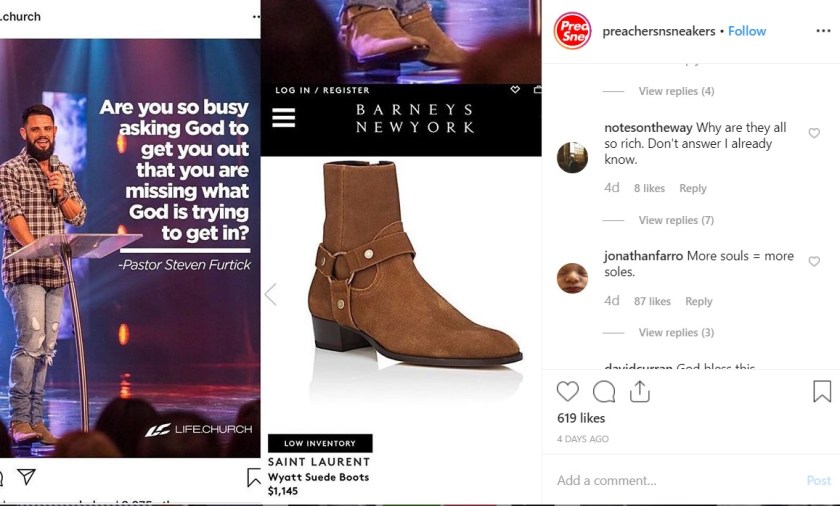
@PreachersNSneakers is a hilarious new Instagram account that reposts photos of preachers’ selfies, focusing on their sneakers and apparel. Apparently it is possible to purchase sneakers that cost upwards of $1000 to even $4000 dollars. The site features the online picture with price of the sneaker/footwear, along with a funny comment. Here is one example featuring Steven Furtick
Reactions in the comments range from complaining to approving-
–What’s the point of this account?
–Why are they all so rich? Don’t answer, I already know.
–I bet lots of traditional churches pastors wear $1000 suits…
Preachers from Levi Lusko, Louis Giglio, Furtick, Judah Smith, Chad Veach, Erwin McManus and others are, ahem, ‘featured’ on the page. Ladies, it’s not only doctrine that sheds light on who may be a false teacher, it’s their lifestyle too. Not that one pair of sneakers makes a false teacher, but it’s a piece of evdence to be taken into consideration. Doctrine AND life, as Paul said to Timothy in 1 Tinothy 4:16…
———————————————
I love art and I love to make art. However the chasm between seeing good art and making my own is a gulf that is fixed, wide and not overcomeable, if that is a word. I started The Sketchbook Challenge in January and didn’t last a week. I’ve been trying on and off for 40 years to draw, or at least make some recognizable art, but I am simply no good at it. My brain and my hands have a disconnect.
There are countless publications that say they’ll teach you to draw, so how do you choose? We’ve done the hard work for you and sifted through many of the best sellers. Some of the books on our list are decades old—one is even from the 1950s—but are still regarded as fantastic resources. It’s a reminder that the fundamentals of drawing will never change, and that owning one (or more) of these books will prove useful months and years down the road.
Sketch on, ladies, do it for me…
———————————————
Speaking of ten best, here is Travel Channel’s picks for Ten Best Botanical Gardens in the US. It’s spring, that time of year where our eyes want to see green, vivid color, and maybe some bees.
Entries include desert gardens, many in the midwest, also the north and the south are represented. Maybe one of these will be in your area. I personally also like the Marie Selby Botanical Gardens in Sarasota FL, and the State Botanical Garden of Georgia, a part of the University of Georgia in Athens.
When we hear people talking about the Holy Spirit, it’s not uncommon to hear people talking about the Holy Spirit in terms of an evangelical version of Casper the Friendly Ghost. At other points, evangelicals derail by putting all of their focus upon the Holy Spirit to the marginalization of Christ. When the Holy Spirit is cartoonized or overly emphasized and brought to the forefront of our worship—we grieve the Holy Spirit of God.
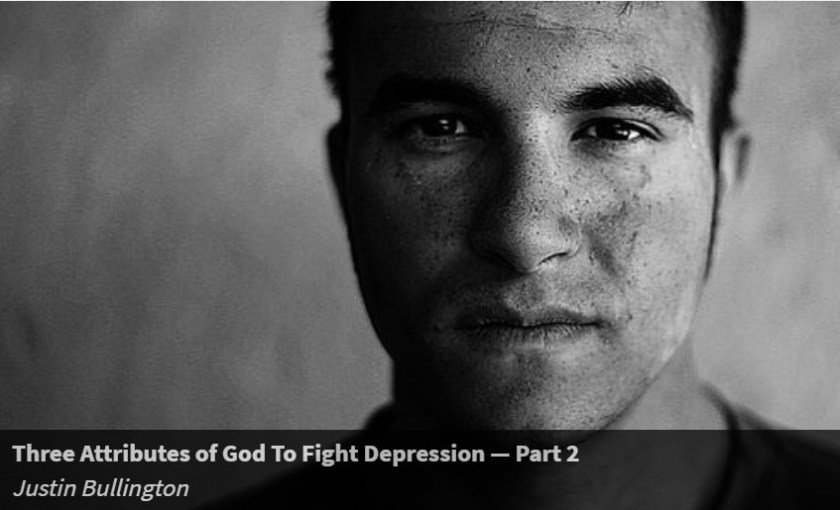
If you find yourself in a battle with depression today, understanding God’s sovereignty is critical. If God is sovereign, there are no limits to God’s rule. This is part of what it means to be God. He is sovereign over the whole world, and everything that happens in it. He is never helpless, never frustrated, never at a loss. And in Christ, God’s awesome, sovereign providence is the place we feel most joyful, most secure, most free.
———————————————
Samuel D. James at Mere Orthodoxy reviews The Coddling of the American Mind: How Good Intentions and Bad Ideas Are Setting Up a Generation for Failure, with a reminder that The Public Square Is about Parenting.
Parenting is arguably one of the last remaining cultural institutions in which we are constantly invited to feel worse about ourselves and yet better than other people. Everyone acknowledges that parenting is difficult, yet many today cannot shake the nagging suspicion that it hasn’t always been this difficult.
If I were to ask you where does Jesus rank among your daily priorities, how would you respond? Would your first impulse be to give a “spiritual” answer—that is, to say what you think you’re supposed to say as a Christian—or would you reply with what you know in your heart to be true? These questions aren’t in any way meant to be presumptive or accusatory. Not at all…
———————————————
Well, those were a few items that I hope catch your fancy, stir your affections for Christ, or simply challenge your thinking. I hope you enjoy your spring wherever you are, and enjoy your days here on earth. It is not our home. Let’s long for our permanent and eternal abode, together-
He will wipe away every tear from their eyes, and death shall be no more, neither shall there be mourning, nor crying, nor pain anymore, for the former things have passed away. (Revelation 21:4)
Doesn’t it seem that way, looking for a family friendly movie? You want good production values, well-written script, well-acted scenes, and interesting? For every ten hours I spend looking researching, and trying to find a movie, I might find one movie that fits those requirements.
As I grow in sanctification, there’s a lot that bothers me. Foul language, cleavage, tight jeans on men or women, sex scenes, drinking, adultery…all that and more. But most movies and television shows not only contain those things, they glory in them (Romans 1:32). Sometimes it takes all the time I have to find something suitable to watch but by then my limited leisure time is used up!
I was glad to have found East Side Sushi.
Single mom Juana can slice and dice anything with great speed and precision. After working at a fruit-vending cart for years, she decides to take a job at a local Japanese restaurant. Intrigued by the food, she learns to make a multitude of sushi on her own. Eventually she attempts to become a sushi chef, but is unable to because she is the ‘wrong’ race and gender. Against all odds, she embarks on a journey of self-discovery, determined to not let anyone stop her from achieving her dream.
When Juana is robbed at gunpoint and the entire day’s earnings is stolen, she realizes that her job has become too dangerous, too dead end, and too unwieldy. She must get her daughter out of bed in at 4 am, and her aging father is struggling to keep up the pace as her co-vendor/helper. She applies at various Mexican restaurants, but the only opening (with medical benefits) is at the Osaka sushi restaurant. So her journey begins.
Juana is entranced by the precision of Japanese cooking, the appearance of the restaurant, and the complexity of sushi. Initially content to put her copious knife skills to work behind the scenes in the kitchen prepping the sushi vegetables and other ingredients, she soon tries her hand at home with actual sushi, practicing and presenting Japanese dinners – much to her father’s Latino chagrin. Juana has found her calling and wants more from her work at Osaka.
I enjoyed the relationship Juana has with her father. Juana is ambitious but respectful of her dad. She is also respectful in the restaurant with the head sushi chef (who trains her and admires her skills), and with the owner, who visits his restaurant several times per week.
In the movie there is no inappropriate dress, no foul language that I heard or saw (part of the movie is in subtitles), no sex or any inappropriate touching, or anything I personally consider objectionable. Your mileage may vary. Use your own discernment.
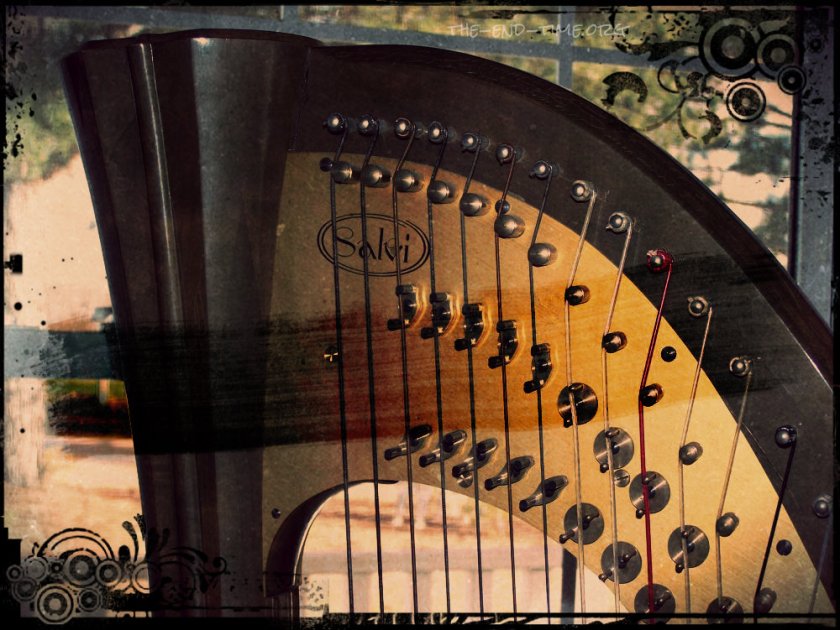
And Saul commanded his servants, “Find me someone who plays well, and bring him to me.” One of the young men answered, “Behold, I have seen a son of Jesse the Bethlehemite, who is skillful in playing, a man of valor, a man of war, prudent in speech, and a man of good presence, and the LORD is with him.” (1 Samuel 16:17-18).
King Saul is distressed. He gets these spells of despondency and near madness due to an evil spirit plaguing him. Music quells these incidences, and in v. 16, Saul is calling for help. Saul’s servant replies that ‘he has seen’ a young man of good character. We’ll come back to ‘he has seen.’
You notice that the servant didn’t just leave it at ‘plays well’. Anyone can hire a good musician. But when you’re feeling down, who do you want nearby to comfort you, even if it is through music with potentially not much personal interaction? You want a good man. So the servant also included David’s character qualities in this verbal resume. He said that it is seen that David is known to be valorous, strong (man of war), and discerning. That’s the Hebrew word for ‘prudent in speech’. What is meant here is “intelligent, discreet, discerning, have understanding”. When you’re King and enter into a spell of weakness, you don’t want a blabbermouth running your private business all over town and you want someone compassionate.
Finally, the servant ends with a kicker: the Lord is with David.
In the New Testament times one would likely say “He is in the Lord”, or “The Spirit is in him.”
The saints of God are recognized by their fruit. One example is Samuel, “Now the boy Samuel continued to grow both in stature and in favor with the LORD and also with man.” (1 Sam 2:26; cf Luke 2:40).
Luke 6:44 reminds us that a good tree will bear good fruit. Galatians 5:22-23 reminds us that the fruit is:
“love, joy, peace, patience, kindness, goodness, faithfulness, gentleness, self-control; against such things there is no law.”
Matthew 5:14 says we are to be light in the world. Light is not hidden but bright and high so all can see. We believers are to have evidence in our lives that we are one of the Lord’s. That evidence needs to be seen in our words and deeds. (James 2:14). We need to have observable evidence because sanctification means we are daily being conformed to the image of Christ. We must reflect His character in more observable ways as we grow though our life.
I am not talking about personal reputation. I am not speaking of a motivation where we cultivate the approval of man. I am not speaking of that at all.
As James M. Hamilton explained in his book Work and Our Labor for the Lord,
We live obediently and humbly “as a good testimony for unbelievers (1 Corinthians 9:12; 1 Thessalonians 4:12; 1 Timothy 5:14; 6:1; Titus 2:5,9). At many points in his letters Paul instructs Christians to live in a way that reflects concern for how non-Christians perceive Christianity and its adherents. That is to say, Christians are to work in ways that commend the faith to outsiders. Believers are to be winsome and attractive, not repulsive and obnoxious. This concern for how unbelievers perceive the faith is inextricably connected to a desire for others to know, enjoy, and glorify God in Christ. This aspect of doing good work links up with the Great Commission (Matthew 28:18-20). Christians contribute to the task of making disciples of all nations by doing good work that gives the faith a good reputation.”
It’s the reputation of Christ that is at play here, not ours. If we are observably joyful, kind, faithful, self-controlled, good, patient, peaceful, loving, full of light, it will be obvious that it is Christ’s character in us, by the Spirit.
David’s character was observable and noted. Remember, whether you realize it or not, even if you work from home or work in a cubicle, people are watching you (us). They note your (our) character. The more we walk with Christ, the more our character will be His character.
What are people observing about you? Is Christ in you and evident? When someone wants to choose a person for a project or a team or a club, would they say you (me) are brave, prudent, skillful, with good presence, and the Lord with us? Like David? I hope and pray that people see the Lord in me, and not me in me, or at least less and less of me. Christ’s character is beautiful.
Mr Chan was big news in March, because he was participating in a conference called The Send, at which were false or heretical preachers including Bill Johnson, Daniel Kolenda, Lou Engle, Todd White, Benny Hinn, Jesus Culture, Hillsong, etc. These men are the rankest of the rank heretics, and many people have become concerned that Chan continually persists in attending conferences such as these, where heretics reign. The concerned ones cited the verse to Chan, Do not be unequally yoked with unbelievers. For what partnership has righteousness with lawlessness? Or what fellowship has light with darkness? (2 Corinthians 6:14). Chan revealed that many people spoke to him, imploring him to correct his course and stop affirming these people as brothers. His response? “Whatever.” (18:30-19:30).
For example, Chan first appeared as a speaker in 2013 at the International House of Prayer’s conference, OneThing, in 2013 with Mike Bickle. He repeated his attendance there in subsequent years. Chan explained in 2018’s conference that actually he initiated the first invitation to OneThing. Chan had sent an email to Mike Bickle, asking to participate in OneThing, not necessarily as a speaker but because he wanted to be a part of what was going on there. They made him a speaker. Chan accepted.
Chan did this because he said he’s impressed with Bickle having “led people into the presence of God 24/7 for 20 years, and I just want to be around…” and also “because of when the Lord speaks to Mike and tells him about things…there’s a trust I have in Mike. If the Lord has been speaking to you [Mike], and you have been learning things from the Word, I just want to come under that and I want to learn from that.”
With these statements, Chan affirms that he relies on charismatic utterances and believes that the Lord speaks today to individuals outside of and apart from the Bible. He said as much in 2019, stating on his We Are Church website, that his “theology leaves some room for hearing directly from God.” Chan must have learned well during these years of participating and learning from charismatic folks like Mike Bickle, because now Chan regularly hears from God himself, too.
In defending his decisions to tacitly affirm these false teachers and heretics, Chan has in the very recent past explained why he participates in them. Chan told Christianity Today last month that it is because he wants to preach the word. Oh. Again, why?
The short answer: to share the truth. … Chan warned followers that he plans to continue to accept invitations to conferences whose speakers fall outside his own beliefs. “I recognize, now more than ever, that sometimes my participation can give the impression that I align with every other speaker at the event. I’m not sure what to do about that other than to tell you that I don’t,” he said.
Oh, but he does. He absolutely does, more than he aligns these days with Protestant evangelicals. He said in the 2018 OneThing stage that he was intrigued by Bickle’s ability to hear from God and wanted to ‘come under that and learn from that’. This is the opposite of sharing the truth.
But wait, it gets worse. A friend recently made me aware of a video from OneThing 2018. It is the entirety of Chan’s session at the Catholic Ecumenical track of the conference. Did you know that the IHoP’s intention is to minimize the doctrinal lines between the Catholic/Orthodox/Coptic Church and the true Bride of Christ? That folks there accept and promote Catholicism as part of Christ’s church? That they consider the Catholic/Orthodox/Coptics as just another denomination, another ‘tradition’? At the sessions at OneThing’s Catholic Ecumenical Track, they sing Taize Chants and Lectio Divina, Chanting Liturgy of the Hours, they have Mass, and they engage in ‘new evangelism‘. New Evangelism is a program in Catholic church where they seek to re-evangelize Catholics who have fallen away from the Catholic church. And if errant Protestants are evangelized into the Catholic Church, too, all the better.
Back to Chan’s Catholic Ecumenical stream video. After Chan was introduced, Chan goes on to speak for a length of time about his wish that the ‘labels, boxes, and categories’ as Chan calls them, things that keep Catholics and Protestants apart, are just that, labels. Chan continually affirms Catholics as brethren.
But wait, it gets worse.
Before I write this next bit, please understand that this pains me greatly. When I watched the video and got to this part, it was a ‘crossing the Rubicon‘ moment for me. I realize that even though much material is available online that documents Francis Chan’s growing apostasy, many people are not aware, or haven’t looked, or refuse to put the pieces together that form the conclusion I have arrived at. That’s OK. We are all at different places on the discernment line, and everyone has their one moment when they step off. For me, Chan has stepped away from orthodoxy and aligned himself on the other side of the river where the false teachers and heretics are. To me, he is gone.
This moment in the video is my own jump the shark moment. Chan says he goes to these conferences because he loves the organizers, and he loves the people who come, and he wants to share the word. But this moment unquestionably demonstrates, he does not. Not any of it.
At the 52-minute mark, we see a woman at the microphone identify herself as Catholic. She asks Chan the following:
I wanted to thank you for being here as well. This is my one comment. This morning when I saw you and you started speaking I said ‘I just love his heart’ and the Lord said to me, ‘It’s because he has my heart.”‘
Ummm, Okayyy. She continues please note that her reference to reset is the theme of 2018’s conference,
I wanted to ask a question…as we’re in this church, (gesturing to their immediate location) I feel like this reset is also for Catholics and the whole church. This is a call for all of us to go deeper into the heart of the Lord. As I’m reflecting on that and as I’m trying to enter into some of the challenges in our own church, I just wanted to ask in your eyes…like, you gave a beautiful word this morning about being an outsider stepping in and having a word,
I wanted to see if you had any words for the Catholic Church and the time that we’re in, what you see as an evangelist in the church, the needs and the heart of the church as someone who loves the bride as well and what message that would be for our church today and the tensions that we face. [italics mine]
You see what she is asking. You hear her voice and hear the sincerity. You can practically hear her soul begging for truth. When she is finished you hear Chan go “Wow”. You hear the audience go ‘Whoa’. The audience laughs nervously then whoops. They know what she is asking. Here is the moment! The Rubicon River is flowing in front of Chan at his feet! Here is the very reason Chan says he comes to these places! To speak the word! To evangelize! At last, to proclaim Christ to those who ‘believe differently!’ She opened the door wide for him to share the seeds of the Gospel with lost souls!! To explain. What will he say?
Chan responds. “I don’t believe I’m supposed to answer that question. …” “I don’t believe the Holy Spirit wants me to answer that question.”
WHAAAAAT?!?!?!? Nooooo…
He begins his response by saying to the woman, pointing to her,
“It’s that spirit that I love”. He enters a 1 1/2-minute segue about his son-in-law and goes on a rabbit trail on the badness of doctrinal differences. Then Chan praises the woman for her seeking heart and her spirit of wanting to know, of the importance of wanting to conform to what is in the Bible (waves Bible). He thanks her for so earnestly “wanting to know.”
Then he keeps her in the dark.
He stops and looks up to the ceiling silently for 15 long seconds. That’s when he says the Spirit doesn’t want him to answer.
A Catholic woman asked him, as an evangelist, what message he had for those struggling in this day in the Catholic church. Chan had none.
Do you realize how repulsive this is? Do you realize how blasphemous this is?
He did the most unloving things a person, especially an evangelist, could ever do. He kept the Gospel seeds to himself. Worse, he co-opted the Holy Spirit in his repugnant answer.
I wept.
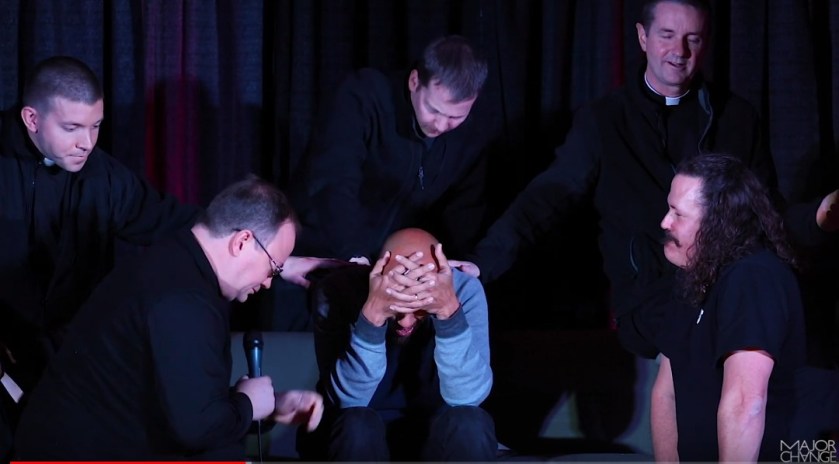
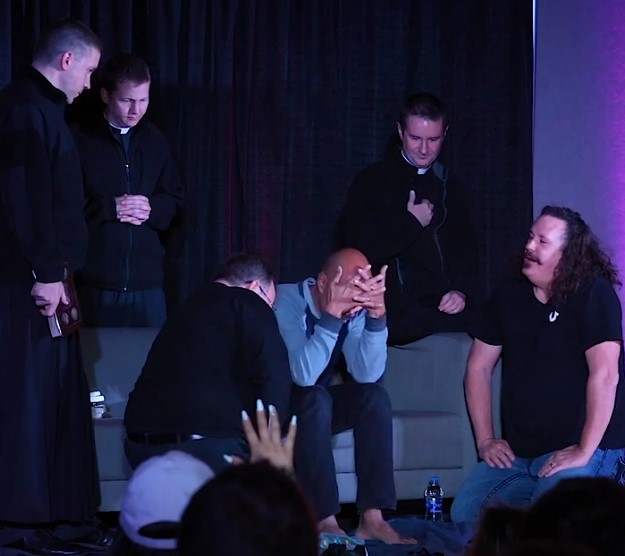
The session included four priests praying over Chan, to which Chan submitted. Chan’s feet were also washed, also something to which he submitted.
Starting at 25:24 in the video aboveThe priest behind Chan is making the sign of the crucifix, the symbol Catholics use which has Jesus still hanging on it
When Chan responded that the Holy Spirit did not want Chan to give an answer to the lost person asking for a message from the evangelist, it was disobedience (1 Peter 3:15) and it was blasphemy. Why? It involves “blasphemy against the Holy Spirit” (Matthew 12:31-32). Though the blasphemy against the Spirit verse has been argued over and controversially understood, John MacArthur’s explanation has made the most sense to me over the years.
Those who spoke against the Holy Spirit were those who saw His divine power working in and through Jesus but willfully refused to accept the implications of that revelation and, in some cases, attributed that power to Satan.
The leaders of Israel committed the unpardonable sin, and what was that unpardonable sin? It was attributing to Satan the work of the Holy Spirit. Remember that? It was attributing to Satan the work of the Holy Spirit, Matthew 12:31-32. What’s going on today is the opposite. Attributing to the Holy Spirit the work of Satan.
It is the Holy Spirit’s ministry to point to the Lord of Truth. To illuminate the Word to people’s minds. To draw them to Christ. The Spirit would never ever ‘tell’ an evangelist NOT to share the truth. Chan’s reasons for not doing so were meager and paltry “I don’t know you well enough”. “It isn’t the right time”. But mainly because “The Spirit doesn’t want me to”. It is satan who does not want us to share the truth. It is satan who delays the sharing of the word. It is satan who makes cowardly the supposedly passionate evangelist. What happened here is that Chan attributed the work of satan to the Holy Spirit.
Chan instead pretended to be hearing from the Spirit and attributed his failure and cowardice to Him. Shame on him for being ashamed of the Gospel.
Ladies, I urge you to mark and avoid Francis Chan. Absorbing his materials and speeches would cost too much. Following him would cost too much. What would it cost?
–to begin to see the canon as open
–to seek and accept personal revelation from Jesus or the Spirit
–to partner with heretics
–to wave away and gloss over foundational doctrinal differences that make the faith The Faith
–to call foundational doctrinal differences with heretical churches merely labels or denominations or boxes
–to drop out of church, calling it a problematic institution
–to avoid submission to orthodox elders but instead to seek submission to heretics
–to become an evangelist who will not evangelize
–to become a hypocrite
That last two are a logical end game to one who will not describe and adhere to doctrines that make Christianity what it is. If there are no doctrinal lines, all people are your brother. If there are no doctrinal lines and we’re all brothers, there is no need to evangelize. Sadly, one becomes a hypocrite who blasphemes the Spirit.
So on The Christian Worldview, Mike Gendron, a former Roman Catholic and now founder of Proclaiming the Gospel Ministry, will join us to explain what the Roman Catholic Church teaches (from their own documents), why born-again Christians should not enter into spiritual enterprise with Catholics, and how to reach out to them with the biblical gospel of faith alone in Christ alone by God’s grace alone.
Pastor Adrian Rogers has gone on to glory, but I enjoy his sermons and the clips that are still broadcast on the radio or Youtube. His large body of work remains with us even if his soul is now with Jesus.
I was driving home from church on Sunday and the Christian radio station I was listening to broadcast this short clip from his ministry Love Worth Finding. Dr. Rogers began it by saying Satan is the cleverest liar. It turns out the clip was from a longer sermon called “The Great Deceiver”.
It’s not that often these days that a preacher forthrightly discusses the evil qualities of our adversary. I turned up the volume to listen.
I can’t find the audio to that clip but here is a transcription I found in a book about Dr Rogers. I’ll post it and then below flesh it out from my memory of it as I heard it in the car.
Two things we learn about Satan from the Lord Jesus Christ. 1. He is a murderer. 2. He is a liar. Never forget this about the devil. His motive is murder. His method is the lie. And he is the father of all liars. And he is the best liar. He is the master liar. And because he is the master liar he tells the cleverest lies. And the cleverest lies sound the most like the truth. And every good lie has just a little truth in it. We had a clock that wouldn’t even run that was right twice a day. And any lie has some truth in it.
But I want to say, dear friend, that a clock that is five minutes wrong is more dangerous than a clock that is five hours wrong. You see a clock that is five hours wrong, and you say, “Ha, that’s wrong, what time is it? Somebody tell me.” But a clock five minutes wrong could have caused you to miss your plane. And so the devil wants you to believe the wrong thing. And there are seducing spirits with doctrines of devils. And the devil is not primarily a pusher of dope, though he is; he is primarily a pusher of lies.
He is making an excellent point here. A false teacher who is waaaaay off base and on the fringes of orthodoxy, will be seen for who he is much more easily. You look at a clock that has stopped and you know that is the wrong time, except for one minute, twice a day.
But a clever false teacher will be a clock that is only 5 minutes off. He will blend lots of orthodoxy with the false. He will twist in subtle ways the verses he is preaching. This is a more dangerous path to follow because whether you are 2 hours off or 5 minutes off, you will still miss your plane. You will miss that important appointment. Follow a five-minutes-off clock long enough and your course will soon be off by a wider margin than you realize.
One rebuttal I usually hear when I point to this or that false teacher is, “But they follow/mention/preach Jesus!” This Gospel Coalition article titled “7 Traits of False Teachers” reminds us that,
It’s rare for someone in church to openly deny Jesus. Movement away from the centrality of Christ is subtle. The false teacher will speak about how other people can help change your life, but if you listen carefully to what he is saying, you will see that Jesus Christ is not essential to his message.
In this essay, John MacArthur sticks close to the Bible when explaining the marks of a false teacher by his life and his doctrine.
Invariably, if I write about a false teacher’s lifestyle, a rebuttal will include that it’s none of my business how they live. However in this article by Wyatt Graham, we learn that False Teachers Out Themselves by Their Way of Life, too.
False teachers by definition teach false doctrine. Usually, we imagine that this means that false teachers deny certain concepts like the Trinity, the Incarnation, or the Second Coming. Yet second Peter challenges the idea that false doctrine only means denying true ideas. In Peter’s second letter, false teachers primarily are called such because of how they live. For Peter, false doctrine can mean denying true concepts or denying our Master by our behaviour.
The Bible is precise The Gospel is precise. God is precise. The Word is so precise it can divide bone from marrow (Hebrews 4:12). A clock that is five minutes off is still wrong.
I teach in an elementary school. When I gather my second graders for our small group reading instruction, I rely on the clock to finish the session so I can go pick up my third graders for their small group instruction. I have to release each group to within a minute of the scheduled time because they are on to the next session and they need to arrive punctually so the next teacher has a full period of teaching. The 3rd graders leave me and go to their classes to pack up their books and then disperse for the bus. The buses need to roll within a minute of their schedule so that car riders can get going and release all the children in the gym one by one into the waiting cars. This needs to be completed by 3:10. And the car riders can’t get started until the buses roll, and the buses can’t roll until all the kids are aboard, and the kids can’t get aboard until they pack up and line up, and they can’t pack up until I release them from our group. And so on. It’s an interlocked and cascading schedule of events that relies on precision in order to work.
If I am 5 minutes late letting the kids go from group, the entire school schedule will be put off. The other day I re-adjusted my clock because it was 2 minutes slow.
Why do we care about precision during our commuting/working day, but not about the Gospel? Or a favored Bible teacher’s teaching?
My church service in Sundays goes from 2-2:45 (Sunday School), then the main service from 3:00-4:30. I love the afternoon schedule. It gives me time to prepare my heart in the morning, arrive unrushed at church, and enjoy the day in a different way than the usual10-12:30 timing of other churches.
On the way home from church one Sunday I stumbled onto a radio station which I had not heard before. Driving home from a sweet service filled with good music, I want to keep that atmosphere going. It’s hard with today’s radio programming.
In being frustrated one day with the quality of radio stations I had set on my buttons, I took some time to really search around and found WWQE “The Life”. It’s a Dove-award winning station. During my drive home there is a particular show called Gospel Vinyl Gold. These are Southern Gospel songs from the 50’s onward that are considered classics.
I love older Southern Gospel songs, I always have. That is strange because I didn’t grow up in the South and I didn’t become converted until I was 42. Even as a newbie I liked these older songs. The radio station played some good ones.
Newer songs are good too. Matt Papa and Keith Getty write good lyrics. Some of these are included in the new hymnal John MacArthur and others created called Hymns of Grace. I am not against new songs. But oftentimes newer songs leave out important doctrines.
I wrote previously about a song I heard back along while driving that struck me so much I had to stop the car. It was a song of eschatology, where the rapture happened and a father was left behind. The man turned out to have been having a dream, but the song focused on the scripture from Matthew 7:21-23 where (in his dream) he discovers he is a false convert. He faces Jesus and Jesus tells him ‘Depart from me, I never knew you.’ When the man in the song awoke to discover it was only a dream, he hastened to fall on his knees and really repent.
My pastor friend posted this morning from Patheos (a site I don’t generally recommend for women) and the section of that online magazine called Church for Men. The article was titled, Where did the Call-to-Repentance Songs Go? by David Murrow.
The author is reminiscing about singer-songwriter Ketih Green. Murrow says,
As my wife and I listened to Green’s music, we were struck by how strange his late 1970s lyrics sounded to our 2019 ears. Green employed a lyrical technique that used to be common in Christian music, but is virtually absent today: the call to repentance, or CTR. CTR songs are designed to convict the singer of his own sin. Here are two reasons CTR songs sound so out of place today:
1. While most contemporary worship songs focus on comfort and assurance, CTR songs point out our shortcomings. CTR songs are anything but positive and encouraging.
2. While most of today’s praise songs are sung from the perspective of the disciple, CTR songs are sung from the perspective of God (or a prophet). In praise and worship, we are the speaker, telling God how we feel about him. With CTR, God is the speaker, telling us how he feels about us.
CTR songs are sometimes hard to listen to. Too much CTR can lead to discouragement and even legalism. However, I can personally testify to their effectiveness. Keith Green’s songs were the slap in the face I needed as a young believer.
Slap in the face is a good way to put it. When I heard Sego Brothers And Naomi’s song Sorry, I Never Knew You, it WAS a slap in the face. I was dumbstruck. Lyrics like that catch your attention and re-orient the mind toward eternal things, holiness of Jesus, and our own sin. It’s good to get back to that occasionally.
Bible Studies aimed at women, the publishing industry aimed at the female demographic, the songs aimed at ladies these days, tend to focus on phrases and concepts that assure women of their worth, that they are loved, that they have power and abilities, that they are esteemed, and so on. Where are the songs that call us sinners to repentance? Remind us that we are sinners? Remind us of the eternal consequences of sin? Largely absent.
I agree with Murrow that a steady diet of call-to-repentance songs would lead to dispirited attitudes and/or legalism. But a stead diet of affirming-only songs also isn’t healthy. Those simply puff us up and don’t always point to the real hero, Jesus. We must forget what is past but also remember we are sinners called to daily repent – as the Lord’s Prayer says. (Philippians 3:13-14; Matthew 6:12). We look forward to eternity but examine ourselves now to see if we are in the faith. (2 Corinthians 4:18; 2 Corinthians 13:5).
I told the Lord that I had been
A Christian all the while
But through his book he took a look
and sadly shook his head
then placed me over on his left
and this I heard him say,
“Sorry, I never knew you.
I find no record of your birth.”
Don’t avoid songs with hard truths. Ones that sing of the blood, redemption from sin, salvation. Here are a few:
Come, Thou Fount of Every Blessing
There is a Fountain
The Old Rugged Cross
Alas and Did My Savior Bleed
When we survey the wondrous cross
All for Jesus! All for Jesus!