Posted in theology

Praying for riches or prosperity this year? Consider this warning from Proverbs

By Elizabeth Prata

Proverbs 30:7-9 says

7Two things I ask of you;
deny them not to me before I die:
8Remove far from me falsehood and lying;
give me neither poverty nor riches;
feed me with the food that is needful for me,
9lest I be full and deny you
and say, “Who is the LORD?”
or lest I be poor and steal
and profane the name of my God.

In reference to the first part of the verse, God hates lying, slander, gossip, all the negative things involving the tongue. Heed the many warnings of scripture about that.

In reference to the latter part of the verse… there are also many warnings about money. Judas’s sin was greed. He stole from the purse as he wanted. (John 13:29). The Rich Young Ruler forewent eternal salvation because “he had great possessions”. (Matthew 10:22).

Jesus warns twice in the same sermon how riches obscures your view of God, saying, “Again I tell you, it is easier for a camel to go through the eye of a needle than for a rich person to enter the kingdom of God.”

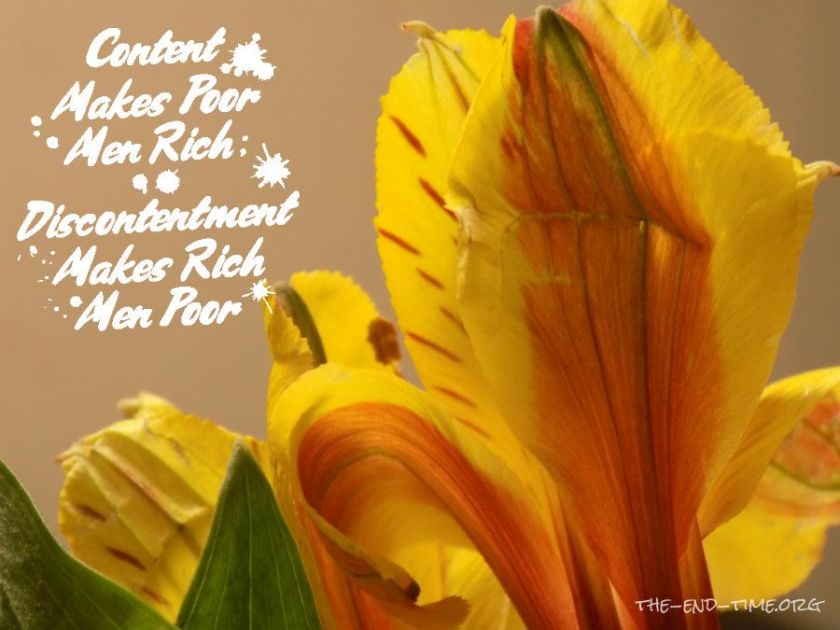
It is not a sin to be rich, but having a lot of money makes it very hard to let go of the world and open one’s hands to Jesus, clinging to Him, as Proverbs verse 9a states. Alternately, poverty also puts temptation on one’s life, tempting the impoverished person to steal, as verse 9b indicates. Poverty also gives rise to discontent, jealousy, and covetousness.

Our sin nature gives us so many different paths to take, doesn’t it? Learning to be content with what we have, under any circumstances (Philippians 4:11) is a good goal for 2019. The scriptures tell us to cast all our cares on him, (1 Peter 5:7; Philippians 4:6) and to pray daily for our bread (i.e everything necessary to sustain life, Luke 11:3) so I believe it is perfectly all right to pray for provision. Learning to pray for what we need rather than what we want is the goal.

The key is to pray for sustenance, i.e., means to live as we need to live in the circumstances in which God placed us. We should find that middle ground where we aren’t hoarding wealth rather than looking to Jesus, nor so lacking we’re tempted to sin. Relying on His bountiful grace, is the true prosperity.

riches profit not verse

Posted in discernment, theology

Looking at Christine Caine’s speech at Passion 2019

By Elizabeth Prata

The Passion 2019 conference concluded last weekend. The event has expanded to four simultaneous venues spread among three cities, and all four were sold out. A total of just over 43,000 youths between the ages of 18-25 were in attendance.

One of the speakers this year was Christine Caine. Christine hails from Australia and is known for having founded the Propel Women organization and A21. Propel aims at “Activating every woman’s passion, purpose, & potential.” A21 “is abolishing slavery everywhere, forever.”

Caine is popular, but sadly she is a false teacher. Michelle Lesley wrote about Caine here. I wrote about her here.

The three-day Passion conference event is specifically a youth-oriented event. There is a restricted age-range that is allowed to attend. No one under 18 (unless you’re a senior in High School) and no one over the age of 26. Only the Pastor or Leader of the group attending may enter. No parents, no elder siblings, no elders of your church. Access denied.

Here are videos of the event.

I received a query about Caine’s sermon, so listened to Caine’s it, which was almost an hour. Well, I muted the sound and pushed forward the slider in ten second increments while reading the closed captions. I read what she taught and it was straight Word of Faith, twisted verses and all. Here are specifics on how to detect Word of Faith teaching.

The Word of Faith movement is decidedly unbiblical.

At the heart of the Word of Faith movement is the belief in the “force of faith.” It is believed words can be used to manipulate the faith-force, and thus actually create what they believe Scripture promises (health and wealth). GotQuestions

Here are a few screen shots from the video with the captions of statements that stood out to me. Her base text is from Matthew 8:10,

When Jesus heard this, he marveled and said to those who followed him, “Truly, I tell you, with no one in Israel have I found such faith.”

In Word of Faith you’ll often hear the word ‘allow.’ The WoF believes (GotQuestions again) that ,

“Laws supposedly governing the faith-force are said to operate independently of God’s sovereign will and that God Himself is subject to these laws.”

In WoF world therefore, when we do something according to these laws, God can then be ‘allowed’ to operate within them. The section of Caine’s lecture as seen on the screen shot shows she is teaching classic WoF.

In WoF land, you will hear the word “activate” a lot. In WoF teachings, the object of our faith is our faith (really, us). We possess faith. Something we DO activates it, then God works within it. That’s why within WoF if something doesn’t happen the way we decreed it, (healing, prosperity) it means WE didn’t have enough faith. Things depend on us and our faith, not on God. You see the switch: in WoF teachings it’s switched from God being sovereign to us being sovereign. Word of Faith teachers need to read and re-read Job 38-41 to learn man’s place befroe a sovereign God.

As for activating things, God is not a dried up sea monkey waiting for a drop of water to activate Him. If we are regenerated, then the Holy Spirit is in us and He is always working. His will is independent of ours and He does as He wants. He needs no “activation.” Even the printed word of God is living and “active.” Nothing WE do activates it.

In WoF you will hear the word “miracle” a lot. Miracles are important to these people because they are the proof of ‘our’ faith. The emphasis, again, is on our faith, and the results from our faith, such as miracles (or health or prosperity). Biblically, miracles were a sign authenticating the unique personage of Jesus, who was sent from God. (John 20:30,31; John 2:23). The WoF teachers do not focus on Jesus as He is for Who He is.

So why did Jesus marvel at the centurion’s faith? Doesn’t Jesus already know everything? We remember that Jesus is God, but in His incarnation He was also man, and when He marveled it is this side of his dual-single nature that comes into play.

For example, Jesus “grew in wisdom”, (Luke 2:52). The God side of Jesus already knows everything, but the man side of Jesus grew because that is what men do, grow. We can’t really grasp how He can know everything but also grow wiser- but that is the mysterious nature of the hypostatic union. [FMI see this Theological Primer from Keven DeYoung on the Hypostatic Union].

Alternately, can Jesus be surprised enough to marvel at a person’s faith? It is the man-God nature again. Jesus dispenses all faith, so the Centurion received it from Jesus as God. Remember the verse in Mt 16:17 when Jesus told Peter,

“And Jesus answered him, “Blessed are you, Simon Bar-Jonah! For flesh and blood has not revealed this to you, but my Father who is in heaven.”

Jesus as man can be astounded at a man who was a Gentile, had never learned the scriptures, but who had faith enough to trust that Jesus’s power permeated all the universe and that His physical presence or absence to do a miracle was of no matter.

MacArthur:

“When Jesus heard this remarkable expression of the centurion’s humble faith, He marveled at him. Here is a glimpse of Jesus’ true humanity, since as God He is omniscient and cannot be surprised by anything. But just as in His humanity He became tired (John 4:6), hungry, (Matt. 4:2), and thirsty (John 19:28; cf. 4:7), so also could He be astonished at the faith displayed by this Roman soldier.”

Matthew Henry:

He turned him about, as one amazed, and said to the people that followed him, I have not found so great faith, no not in Israel. Note, Christ will have those that follow him to observe and take notice of the great examples of faith that are sometimes set before them—especially when any such are found among those that do not follow Christ so closely as they do in profession—that we may be shamed by the strength of their faith out of the weakness and waverings of ours.

RC Sproul explains why WoF folks like Caine believed as she does, here is a snippet from his devotional,

“Some professing Christians have concluded from texts like this that human faith gives power to God.”

In addition to Caine’s Word of Faith doctrines showing her as a false teacher, she was inappropriate elsewhere in her speech. She spoke twice of how husbands can be “getting some action” out of their wives. She spoke of a skiing accident where she was loaded onto a stretcher and bemoaned the fact that she wasn’t wearing any underwear. Yes, these items were included in her speech to thousands of teenage and young male adults listening. Should a teacher or pastor say this ever? Of course not.

Jude 1:4 warns that false teachers will pervert the grace of our God into sensuality-

For certain people have crept in unnoticed who long ago were designated for this condemnation, ungodly people, who pervert the grace of our God into sensuality and deny our only Master and Lord, Jesus Christ.

If Christine Caine’s “sermon” raised red flags to you, good for you. If anything in this essay raised red flags for you, good. He needs no activation, no Word of Faith Law to operate within, and He does not depend on us.

Our God is in the heavens; he does all that he pleases. (Psalm 115:3).

sproul

Posted in theology

Word of the Week: Angel

By Elizabeth Prata

The thread of Christianity from generation to generation depends on a mutual understanding of our important words. Hence the Word of the Week. Past Words of the Week have included Justification, Transcendence, Immanence, Propitiation, Sanctification, Glorification, Orthodoxy, Heresy, Omniscience, Aseity, and Immutability. I then went to a series examining each of the 9 characteristics of the Fruit of the Spirit: Love, Joy, Peace, Patience, Kindness, Goodness, Faithfulness, Gentleness, and on December 29, 2018, wrapped up the Fruit series with Self-Control. Now it’s back to individual words of the week and this week I chose Angel.

Angel

Aren’t we fascinated with Angels! They appear in art, literature, drama, and of course, the Bible. They are first mentioned in Genesis 2:1 where it is written,

Thus the heavens and the earth were finished, and all the host of them.

Host is another name for the angel army. Since God finished His work and called it all good, why does there need to be an army, which fights in warfare? Warfare isn’t good. Matthew Henry explains,

The creatures made both in heaven and earth are the hosts or armies of them, which denotes them to be numerous, but marshalled, disciplined, and under command.” (Matthew Henry Commentary on the Whole Bible)

Other names for angel besides host or heavenly host is sons of God, Morning Stars, Principalities, Rulers and Authorities, and Watchers. Because the Heavenly Host of angels is an army, some of their divisions or classes are also named, Seraphim, Cherubim, and Archangel. Also possibly Rulers, Authorities, Powers and Forces of evil (Ephesians 6:12).

Some angels’ names are given. They are Gabriel, Michael, Lucifer and Apollyon/Abaddon. Wormwood is also another possible name for a specific angel.

Angels are a class of beings that are not human and not part of the Trinity. They have superior power and abilities than humans, but are not human. When humans die, they do not turn into angels. We should stop saying things like “Heaven gained another angel with the death of…”

A personal peeve of mine is the continual depiction of angels as babies with wings. In Italian Renaissance art (where they became ubiquitous) these beings are called putti and that morphed into what we think of as cherubs or cherubim. However, this is a gross distortion of the actual cherubim, who are extremely powerful and magnificent, as are all angels. In 2 Peter 2:11 they are referred to as “angelic majesties”, beings whom the false prophets are unafraid to rebuke, and this is written as a negative. (So don’t go around “rebuking satan”).

Angels roam between the three heavens. When God completed Creation week, we learn that the angels were present in the universe and “the heavenly host sang together [gave a ringing cry] and all the sons of God shouted for joy” (Job 38:7). Angels appear in the throne room of heaven, (Isaiah 6:2) and they roam the earth. (Job 1:7). Some angels are even under the earth AKA in the abyss, chained up and waiting for the day of judgment. (Jude 1:6). Angels are everywhere!

When Lucifer rebelled, he convinced a third of the host to ally with him. They sinned, and thus they fell. These unholy angels are now the demons. They oppose God, His people, and His plan. Though they fell morally, they still have access to the heavenly throne room. (Job 2:1). The unholy angels still retain the power and strength they were created with. So be careful, they can deceive and masquerade as holy angels and they do it well!

It will be during the Tribulation that the door to the throne room will be shut against the unholy angels and they will no longer have access. This enrages Lucifer, now called Satan (because that means adversary) and his wrath ramps up the Tribulation into high gear. He takes his anger out on the remaining earth population. (Revelation 12:7-9, 13-17). Angels who rebelled will not be redeemed. Their condemnation is fixed. (Matthew 25:41)

Angels are spirit beings (Hebrews 1:14) but sometimes when they appear to humans they appear as flesh and blood men (the Bible always refers to angels as men, there are no female angels). We don’t know how they change to flesh and blood looking men when they appear on earth but suffice it to say that part of it is a mystery. Angels have personal will (otherwise Lucifer & Co. would not have fallen). They also have intelligence and emotions.

They holy angels praise God, perform His will, minister to humans, render His judgments, learn (“angels long to look into these things” 1 Peter 1:12), and so much more!

In fact there is an entire niche of study called Angelology. Different areas of Biblical study include,

Theology Proper (Doctrine of God)
Angelology (Doctrine of angels & demons)
Anthropology (doctrine of man)
Bibliology (origin of the Bible)
Christology (Doctrine of Jesus)
Ecclesiology (Doctrine of the Church)
Eschatology (Doctrine of The End Times, or Last Things)
Hamartiology (Doctrine of the Holy Sin)
Pneumatology (Doctrine of the Holy Spirit)
Soteriology (Doctrine of Salvation)
Prayers & Worship

So rest assured if you want to study the topic of Angels it is a legitimate field of study. They are certainly fascinating beings. Caution is warranted, however. Though the field of study is legitimate, many people who write about angels are not. There is a glut of less than credible resources out there.

C. Fred Dickason’s book Angels Elect & Evil is a good resource I am told.

Martyn Lloyd Jones did a sermon on Good Angels, here. Though the sermon for Jones’s companion to Good Angels sermon, called The Devil and Fallen Angels is lost, the transcription of that sermon is here.

S. Lewis Johnson has a sermon series on angels, here

RC Sproul has a couple of teaching series at Ligonier. This one on angels is two parts and can be listened to for free. This one on Angels & Demons is 4 parts and just the first lecture can be heard for free.

Further reading:

GotQuestions: Angels (this page lists a series of further essays)

Essay by Phil Johnson- Angels: Messengers of God

The End Time: Back to Basics- All About Angels

angel

Posted in theology

Encouraging global news from Grace To You

By Elizabeth Prata

Brother Justin Peters tweeted this monthly newsletter from John MacArthur at Grace To You. It is a year-end wrap up letter. I found it so encouraging! With so much negative news today (another shooting at a bowling alley last night) and negative Christan news constantly barraging us with the alleged imminent failure of the church, the alleged Exodus of youth from the faith, and the rising number of false teachers and doctrines, we tend to get overwhelmed with the sad news.

So here is some great news. The Lord is alive and constantly working in the world, making converts in every nation for the glorification of His name!

———————————————————————–
From John’s Desk
Dear Friend,

A couple of weeks ago our board of directors met. I am part of the board, and every fall we review Grace to You’s finances, hear reports on how the Lord is using the ministry, and receive updates on current projects and new endeavors. I can’t imagine how the meeting could have been more encouraging. Here are some of the key points and highlights:

The men and women who benefit from Grace to You, share our commitment to Bible exposition, and want a role in reaching others with it, are supporting our efforts at an unprecedented level. By God’s grace, all our financial needs are being met. I’m so thankful.

  • Users of our website and apps are downloading or streaming an average of more than 60,000 sermons every day. In the ten years since we opened the vault, visitors worldwide have downloaded nearly 190 million sermons, all at no charge.
  • We continue serving our Grace to You family through the more than 100,000 CDs, booklets, and books we distribute by mail free of charge every year. Since 2017 we have given away four major titles, including 35,000 copies of The MacArthur Study Bible anniversary edition.
  • We recently formed a new radio network partnership. We now air on that network’s nearly one hundred stations, expanding our reach to more than 1,350 outlets in the United States and Canada. We also air on more than one thousand radio outlets across dozens of nations in the Spanish-speaking world.
  • We are more than halfway finished with phase one of our Grace Reaches Out initiative, a project begun in 2015 to translate six hundred of my sermons into Arabic, French, Mandarin, and Portuguese. We’re adding the sermons to our website for free download as soon as they’re recorded.
  • We also received a report on the ministry’s plans for an important celebration in 2019. I delivered my first sermon as pastor of Grace Community Church on February 9, 1969, which means this year marks the fiftieth anniversary of Grace to You. Our celebration will span all of 2019, and of course you are a part of our plans. Our goal as we mark the occasion will be to minister to the Body of Christ and to thank the Lord for His faithfulness and goodness—and to thank the many people through whom He has blessed us.
  • Our board meeting culminated with a report from a pastor in Asia who has translated a large number of my sermons and placed the recordings on portable “radios.” A ministry partner that specializes in international broadcasting is now spreading the devices across urban and rural areas, reaching an estimated 600,000 people. (We were told of a farmer hanging the radio on the horns of his water buffalo and listening while working in his field.) These same ministry friends have also translated the entire MacArthur New Testament Commentary series for free electronic distribution to pastors nationwide. All of that started when the pastor found—and began downloading—sermons at our website.

As I ponder what I’ve written in this letter, I am utterly amazed. Amazed by the goodness of God. Amazed by the power of His Word to transform lives. Amazed by how He is using our resources to evangelize, edify, and equip His people. And amazed by the thought of the opportunities, known and unknown, that await us in the future.

As we launch into 2019, I really believe this ministry’s best days are yet to come. Every day that we air on radio and TV, every day that all the resources of our website are available for download by people wherever they live, every day that men and women are receiving and using the CDs and books we mail out—every day is an opportunity to reach a person, a family, a church, and a community with biblical truth. It’s a big world, and the spiritual needs are significant; we are poised to help in significant ways.

Of course, we don’t want to presume on God’s provision for next year. So if the opportunities that are before us—opportunities to reach people with the Word of God—resonate with you, I encourage you to help make them realities through your support for Grace to You. Your generous gift now will help us sustain and extend our ministry in your neighborhood and others like it around the world, bringing clear, transforming, biblical truth to people who desperately need it. Thank you for doing whatever the Lord leads and enables you to do.

Love in the Truth,
John MacArthur

———————end———————-

hydrant

Posted in discernment, theology

There’s such a thing as fake [Christian] news

By Elizabeth Prata

Introduction

We hear a lot these days from our President about ‘fake news.’ Wikipedia defines this new term fake news as,

Fake news or junk news is a type of yellow journalism or propaganda that consists of deliberate disinformation or hoaxes spread via traditional print and broadcast news media or online social media

I’m sure you’ve all seen examples of this. Fake news is news that the mainstream media publishes which turns out to have been twisted or are simply untrue.

Well, there’s fake news in the Christian world too. Sometimes it happens due to ignorance. Not that the person passing it on is an ignorant person, but is perhaps ignorant of the scriptures. Sometimes it happens because someone is lazy and doesn’t dig, research, or think it through. Sometimes it’s carelessness. We see examples of the carelessness aspect via Jess Pickowitz’s eye-opening examples in her series called, “Meme Heresies.” We women tend to pass along the beautiful scripture quotations on Pinterest, Facebook, Instagram etc., but many of these contain heresies of their own, as Jess points out. She says,

#MemeHeresies is an effort to correct heresy with biblical truth and encourage women to reflect on the theological implications of what we’re sharing in the fast-paced world of social media.

Example of Fake Christian news

Well as I said, it happens in the Christian blogosphere media too. In 2007, John Piper wrote an article called,

The Morning I Heard the Voice of God

It began,

Let me tell you about a most wonderful experience I had early Monday morning, March 19, 2007, a little after six o’clock. God actually spoke to me. There is no doubt that it was God. I heard the words in my head just as clearly as when a memory of a conversation passes across your consciousness. The words were in English, but they had about them an absolutely self-authenticating ring of truth. I know beyond the shadow of a doubt that God still speaks today.

The essay continued in this vein, with Piper extolling all the virtues and wonders of hearing the voice of God. It wasn’t until near the end of his essay that the punchline became evident, Piper was writing about hearing the voice of God via his own scripture reading that day. The article was actually a rebuttal to an article that had appeared in Christianity Today that week written by an ‘anonymous middle-aged professor of theology’ at a ‘well-known university’ and whose name was ‘on the masthead of CT’. Anonymous had written that he had actually heard the voice of God and it had been specific. He was commanded to give all the royalties of his book to a certain needy student.

Piper’s article was a rebuttal against this kind of extra-biblical communication. (Though Piper certainly doesn’t let us down. In typical Piper fashion he fails to state outright that extra-biblical revelation isn’t true because it destroys the sufficiency of scripture, but wishily-washingly says that ‘when’ it happens it should not supersede our joy in His written word…)

Anyway, Piper stated,

I grieve at what is being communicated here. The great need of our time is for people to experience the living reality of God by hearing his word personally and transformingly in Scripture. … It has increased my love for the Bible as God’s very word, because it was through the Bible that I heard these divine words and through the Bible I have experiences like this almost every day. The very God of the universe speaks on every page into my mind — and your mind.

Yet the person/s writing at a blog called New Calvinist, a Dr. ES Williams and friends, apparently did not read to the end of the article or missed the punchline. He spent a long essay “debunking” Piper’s stance, a stance Piper didn’t even hold. However, you as a reader would not know that unless you took the time to also read Piper’s original essay the Anonymous Professor was contending against.

Williams’ essay was a thorough and blow-by-blow takedown of Piper’s hearing from God stance that seemed legitimate because it contained scripture. And also because it was written in elevated language.

Fake Christian news exists, so how do we practice discernment and get wise against Christian fake news?

Debunking Fake Christian News

1. It seems to not need saying, but it does: when you read Christian blogs or news sites, have your Bible handy. Or have a Bible tab open on your screen. Look up the scriptures used in the article and determine if they are the right address, the full scripture, and used in context. Many times, one or all of these is incorrect. I always double check my own scriptures when I write, because a numerical typo in a scripture address will bring you to a completely different scripture. And typis ar eazsy to make, lol.

For an example of a scripture used out of context, in a book I’m reading now, the scripture referenced is Matthew 18:20 ‘where two or more are gathered.’ The verse is used to buttress the author’s point that wherever two or three are gathered, the Holy Spirit and/or Jesus is there with them. Yet that is not the point of the scripture. It’s about church discipline.

One off-reference is not a reason to throw away an entire book, but it’s the start of a discernment path. If an author uses one scripture out of context or to make a wrong point, what else might there be in the book/article/pamphlet etc? Discernment is usually a gathering of a preponderance of evidence, weighed against the Scriptures, and used in a prayed-for wisdom.

2. If an article is mentioned in your news story or blog essay, then go ahead and read the original article the author is quoting. Context is important in studying the scriptures, and it’s important in judging Christian news, too.

3. Look up the author by simply googling his or her name, see what comes up. Read reviews of your author on Amazon or Goodreads, I usually look at the 3-star ones. The middle of the road reviews tend to be more even-keeled with credible pros and cons.

4. Look up who the author pals around with. Is his book recommended by credible authors, or non-credible ones? If you look on the back of a book, or at the blogger’s blog roll, you’ll see and understand a lot of where this author is coming from by whose names are there.

5. You can read the “About” page of the author/s blog or his bio at Amazon or wherever. You can also do the same with a Christian News Outlet author’s hyperlinked name. When the author page of the news piece you’re reading comes up with a lot of headlines like “So-and-So exposed!” or ” You won’t believe…” then you know they like to use hyperbole to make their case or to entice readers. The point should be the glory of God and the deepening understanding of the reader of our Savior, not clickbait.

I’m sure you can think of many other ways to spot and combat fake Christian news. The biggest thing is to stay in the Word. Studying the real thing always reveals the fake.

real fake

Posted in theology

“I know…”

By Elizabeth Prata

Jesus is omniscient. We read this in the Bible and we accept it. But accepting it and understanding it at the deepest level are sometimes two different things. In listening to Pastor Eric Spuur of Mt. Angel Bible Church go through Revelation (series begins here, and is also here on iTunes), he emphasized the following point.

Jesus knows. He is fully aware of all that occurs in His church. See how many times it is written-

To Ephesus
“I know your works…” (Revelation 2:2)

To Smyrna
“I know your tribulation…” (Revelation 2:9)

To Pergamum
I know where you dwell…” (Revelation 2:13)

To Thyatira
“I know your works…” (Revelation 2:19)

To Sardis-
“I know your works…” (Revelation 3:1b)

To Philadelphia
“I know your works…” (Revelation 3:8)

To Laodicea
“I know your works…” (Revelation 3:15)

‘I know’…’I know’…’I know’…’I know’…’I know’…’I know’…’I know’… it hammers you as your mind becomes aware of how many times Jesus declares this truth.

We live on earth where no one is omniscient, so of course we get comfy in the notion that this head that we carry around atop our necks is self-contained. It isn’t. Jesus knows the hearts and minds of men and He knows the thoughts and intentions of it to the nth degree.

In an article called Seventeen Minutes, we learn it’s the daily thoughts that count. As you read this, (and the impact is heightened if someone reads it aloud to you) you’ll no doubt see some of your own thoughts in there. I did. They’re ordinary thoughts. Normal, right?

They are also sin.

They are thoughts that Jesus knows.

There isn’t anything that Jesus doesn’t know, which when we understand to the deepest level, slays us to the marrow, making us cringe. As the unsaved Tribulation folks discover, it makes them cry out to the mountains and the rocks to crush them so they will not have to face Him.

Our lot is infinitely better, for we can cry out not in fear, but to our Abba! Father! (Romans 8:15). Yes, Jesus knows our thoughts and deeds and works. But He loves us despite the sin crushing force of ordinary thoughts in our mind and heart. He took that wrath that was due us and loves His own to the nth degree.

Will we ever understand grace as we should? Likely not here on earth. It surely is grace to be able to serve a God who knows, knows us through and through, yet stands in heaven as our Father, loving us anyway.

wickedness in heart verse

Posted in theology

We should train the mind. It’s time to get our creativity going! Read, write, draw

By Elizabeth Prata

As 2019’s new year launches off into the timeless void, lots of people are making resolutions. Many of those resolutions are vows to take better care of our bodies, by eating well or losing weight or exercising more.

But do we take care of our mind?

Christianity is a religion of the mind. We have the mind of Christ. (1 Corinthians 2:16). The Spirit transforms us by the renewing of our mind. (Romans 12:2). The mind governed by the Spirit is
life and peace, as Romans 8:6 says. Mark reminds us in verse 12:30 that we must ‘Love the Lord your God with all your heart and with all your soul and with all your mind and with all your strength.’

Start looking in the New Testament and the Psalms and Proverbs for the ‘mind’ and you may be surprised at how many times it’s mentioned.

The Internet was commercialized and came into widespread use in the US by 1995 or so, making the generation in their 20s now the first generation to live post-Internet. The rest of us, like me in my 50s, have used some version of the Internet for most of my adult life. I’ve been an Amazon customer since 1997. My final email address was established in 1998 and it has remained the same ever since.

As the Internet grows, our mind diminishes. You might think I am overstating the case, but the Internet, while having many boons and pluses, has served to make our thinking more shallow. 21st century media has pummeled our minds and not in a good way. We listen in sound bites and read in tweet-length script. Yet the two greatest books ever written, the Bible and The Pilgrim’s Progress, are old.

The Bible has a variety of literature within it, many genres, difficult concepts, and is a demanding read. It requires study.

Pilgrims’ Progress by John Bunyan is the single best selling English language book in the world, after the Bible. It was written in 1678 and uses antiquated language. Even if you read a modernized version, it is a book that again, demands the reader’s attention and requires lengthy thought.

Our minds are being trained away from that kind of reading. The kind of thinking we are commanded to do in the Bible is the opposite, it’s the kind of reading that edifies us. Not to mention reading the ancients and the Puritans are, every day, getting out of reach because they demand attention spans that nearly don’t exist any more

I write essays that range from 500 words to 2000 words. I remember the first time on the blog a reader commented “TLDR”. I had to look it up. It stands for ‘Too Long, Didn’t Read.’ I was irked and shocked. 2000 words is only about 4 single spaced pages long.

I’m speaking to myself here, not just you. As I get older and I come home from a busy day of work, all I want to do is make a cup of tea, sit down, watch a comedy, then go to bed- in that order. I have to work at keeping the energy up so that I can have a clear mind to absorb Christian classics and other great material.

I’m fairly aghast at myself, because reading didn’t used to be this hard. My reading material of choice in High School and as a twenty-something were the classics. As I went through my 30s, my Graduate School reading was easy peasy, I got a 4.0 and thought nothing of it. But now I’m nearing 60, and my mind is balking at difficult material. Reading Moby Dick last summer was hard. I was surprised at how hard. My mind is a terrible thing to waste.

I don’t want to waste it. It’s the mind of Christ.

I feel it’s important to keep our mind active and our creativity up. When we spend time in the creative side of our mind different things happen. Here are a few resources along these lines:

3 Reasons Why You Should Read More Classic Literature in 2019
Why Great Literature, Especially Old Literature, Has Become Essential Medicine In the Age of Social Media

Call me Ishmael.

The famous opening sentence of Moby Dick, so short and provocative, is welcoming and familiar to the 21st century reader, who is accustomed to snappy prose with short sentences and lots of white space. A few sentences later in Melville’s masterpiece we get a sentence that’s more representative of the novel to come. In just a bit I’m going to quote that sentence, and insist that you read it.

My own personal reading challenge that I’d modified from Challies’ (by adding to it) is to read the following classics this year:

  • Sense & Sensibility By Jane Austen
  • It Can’t Happen Here by Sinclair Lewis
  • The Running Man Stephen King
  • The Machine Stops, E.M. Forster
  • The Decameron, Boccaccio
  • Heart of Darkness by Joseph Conrad

The Classics Spin is an activity from an online book club devoted to the classics. Readers list the top 20 classics they would like to read, sometimes the game is along the lines of a theme (Shakespeare challenge, Really Huge Book challenge) and other times not. They pick a number at random and you read that book. Since the Club is a community, the Admins of the site say,

We know it can be hard to stay on track and enthused about your Spin Book for the whole journey. We plan to provide support and encouragement to all our CC Spinners via twitter, fb, instagram and goodreads. We hope you can join us in cheering everyone on to finish another fabulous classics reading experience!

Four Good Reasons to Read Good Books
Tim Challies lists 4 reasons, here’s one of them-

Identify areas of weakness and read books to strengthen yourself there. This may be weakness of knowledge, weakness of character, or weakness of understanding. If you have too low a view of God, read The Holiness of God by R.C. Sproul. If you are struggling with parenting, read Gospel-Powered Parenting by William Farley. If you struggle with making decisions, read Decisions, Decisions by Dave Swavely. If you don’t know where you are weak, read a book on humility. Whatever your weakness, there is almost definitely a book that answers it specifically and well.

Colin Adams, the Unashamed Workman, goes Challies 16 better and lists 20 good reasons to read good books. Here are a few of them

–You will be forced to cease from incessant activity and think
–You will receive a historical perspective on current problems and spot present day blindspots
–You will have some of your questions answered and confront other questions you hadn’t even thought of
–You will be able to practically apply Paul’s command to think upon “wholesome” things

Do you like Bible journaling, sketching things that Bile reading or Christian classics bring to mind? I’m a visual person too. I see all these magnificently illustrated journals and theologically rich blogs and I get intimidated and when I’m intimidated I quit before I start. So if you’re like me, scared of generating huge or fabulous content, write one sentence or sketch one quick scene. Everyone can do that. Even me! Here are two ‘challenges’ along those lines-

The Sketchbook Challenge is a daily draw where you draw, paint, or sketch one quick scene from your day that stands out to you. I think this is a good way to both practice your skills and keep the creativity going. You can adapt this to a quick sketch of a Bible visual. Whatever helps the brain keep flowing! I am not a good draw-er but here are my two-


Gretchen Rubin wanted to enhance her writing skills, and all writers know that to be a good writer you need to write every day. But she worked and had kids. Busy! So she developed the one-sentence journal. Gretchen says

Instead, each day, I write one sentence (well, actually, I type on the computer) about what happened that day to me, the Big Man and the girls.

She suggests that you can even do a one-sentence journal on a particular topic, your day at work, your divorce, a catastrophic event. In like manner, you can keep a one-sentence journal of your spiritual reactions or insights as you read the Bible or a Christian classic. By the end of the year you’ll have 365 sentences or around 15-20 pages.

Let 2019 be the year you spent 21 days developing a new habit (some say that is how long it takes, others say that it takes longer, but I stick with the 3 weeks because it’s not, well, intimidating). Read, write, draw, whatever kind of activity you know enhances your mind is the one.

Let’s train and protect our bodies, but also let’s take care of the mind.

What am I to do? I will pray with my spirit, but I will pray with my mind also; I will sing praise with my spirit, but I will sing with my mind also. (1 Corinthians 14:15).

Posted in theology

“In 2019 let’s open the Bible differently” by Ayanna Thomas

I really like Ayanna’s writing. This is a repost/share from her Instagram. She posts photos, long captions, and mini-videos frequently. If you want, check her out.

ayanna


View this post on Instagram

LET’S OPEN THE BIBLE DIFFERENTLY IN 2019 Tonight, some woman who desires to know the path God has chosen for her, will hear a false teacher tell her that all she has to do is “activate” the will of God by some human means. Tonight, some woman will struggle to see how God’s sovereignty sustained her this year, even though her 2018 was riddled with bad decisions and sinful choices, despite God saving her with the shedding of irrevocable, non-refundable blood of Christ. This New Year, many women will be enticed by, carried along into, and some willfully deceived, by those who hate their God, yet declare things about Him from an unregenerate state, week after week. The podcasts misconstruing God’s Word, the influencers promoting doctrines that have no merit up against God’s Word, the inward wrong beliefs, that keep us from having assurance of our salvation, will come and fight to take your attention from our Savior and His Word. I know this may sound pretty grim, but as a teacher, I’ve watched, listened, read, prayed and grieved over so much of what has been targeting God’s daughters this year. I’ve listened to the popular sermons, I’ve read some of the books and lots of the articles that we’re fed, I’ve seen how far so much of it, is from the heart of God, the truth of His Word, the nature of His character. Sisters, we don’t have to go into the New Year with the same things we did in 2018. We can build ourselves up in healthy local church communities. We can believe and rehearse The Gospel message daily. We can understand and get through the hard to read passages in The Bible. We can pray, Study The Scriptures, see a therapist and take medication if needed, WHILE trusting God for healing ALL at the same time! We can leave behind our shares and reposts of teachers who dangerously twist and take out of context, what is supposed to be for our instruction and help. We CAN do this differently. But, it starts here, IN God’s Word, pacing ourselves, doing it in community, wrestling with the tension of learning and trusting that God wants this more for us than we do. Please, share with me below, what you desire to do differently with God’s Word this New Year!

A post shared by Ayanna Thomas (@ayannazariya) on

Posted in encouragement, theology

Those who reject are putting themselves in grave danger!

By Elizabeth Prata

As witnesses to His Gospel, in sharing with other people, I’m sure you, as have I, experienced the gamut of reactions. Some are curious, some are polite but have closed ears, and some, sadly are like wild pigs who turn on you ferociously and tear you to pieces.

Give not that which is holy unto the dogs, neither cast
ye your pearls before swine, lest they trample them
under their feet, and turn again and rend you.
Matthew 7:6 (KJV)

There is an example of such a ferocious rejection in Acts 13. Paul and Barnabas had reasoned with the Jews in Antioch. Some were persuaded to stay and follow Paul and learn more. Others rejected. But when Paul went to give the Gospel to the Gentiles, the Jews became jealous and when they began opposing Paul all the harder, they blasphemed. Paul’s response was this:

Then Paul and Barnabas waxed bold, and said, It was necessary that the word of God should first have been spoken to you: but seeing you put it from you, and judge yourselves unworthy of everlasting life, see, we turn to the Gentiles. (Acts 13:46).

Those who reject put themselves in grave danger. Felix rejected. Though he was curious and listened to Paul then became alarmed to hear of the judgment, ultimately he remained apathetic. Stalling for a decision, he sent Paul away ’till a more convenient time, (Acts 24:25) putting off what he should do today. (2 Corinthians 6:2). How different from the reaction of the Philippian jailer who rushed in to Paul asking, “What must I do to be saved?”

Those who reject ferociously are in the greatest danger of all. Here is an excerpt from Barnes Notes on the Acts 13:46 verse. What does it mean when Paul said they judged themselves unworthy?

Barnes’ Notes on the Bible

Ye put it from you – You reject it.

And judge yourselves – By your conduct, by your rejecting it, you declare this. The word “judge” here does not mean they “expressed such an opinion,” or that “they regarded themselves” as unworthy of eternal life – for they thought just the reverse; but that by their conduct they condemned themselves. By such conduct they did, in fact, pass sentence on themselves, and show that they were unworthy of eternal life, and of having the offer of salvation any further made to them. Sinners by their conduct do, in fact, condemn themselves, and show that they are not only unfit to be saved, but that they have advanced so far in wickedness that there is no hope of their salvation, and no propriety in offering them, any further, eternal life. See the notes on Matthew 7:6.

(1) When people, even but once, deliberately and solemnly reject the offers of God’s mercy, it greatly endangers their salvation. The probability is, that they then put the cup of salvation forever away from themselves.

(2) the gospel produces an effect wherever it is preached.

(3) when sinners are hardened, and spurn the gospel, it may often be the duty of ministers to turn their efforts toward others where they may have more prospect of success. A man will not long labor on a rocky, batten, sterile soil, when there is near him a rich and fertile valley that will abundantly reward the pains of cultivation.

——————–end Barnes’ Notes——————–


I’ve shared the Gospel with people once, twice thrice, but when I see the reaction is hardening them more than producing a softening effect, I stop sharing. I stop talking about it. Withdrawing, I pray for them.

We like to think of a soft and seeking Jesus who pursues to the end (or woos as the lady snowflakes would have us believe). It is more probable, to use Barnes’ word, that once they reject, they likely put the cup of salvation away from them forever. When their conduct in so rejecting makes them act like unreasoning animals, they show themselves condemned.

This is one of the most heartbreaking things to watch, especially when it’s a family member or colleague or a friend. Even if it’s the guy at the gas station you’ll never see again…when you see them reject the Gospel, it’s sad. When it’s ferocious, the I get the haunting feeling that they have just sealed their coffin, and that is nearly unendurable.

In the coming year, I pray that your sharing and witnessing and loving will fall on fertile soil. I pray that the Lord gives you and me strength when we have to watch their rejection of You, the most beautiful person in the universe, casting away the only salvation that exists. I pray that many come through Your door, Jesus, in 2019.

manton ark

Posted in new year, theology

2018 roundup and thank you

By Elizabeth Prata

Y2K! Stock up! Computers will crash! Hysteria!

That was the year-end feeling on December 31, 1999. It seems like yesterday that the millennium changed and we said goodbye to the 1990s and hello to the 2000s. Now we are looking at climbing into the last year of the second decade of the 2000s! Time flies, it really does.

My Plan for 2019

I started this blog in 2016 in response to a growing concern that increasing social media  mogul scrutiny into what they term ‘hate speech’ left my blogspot blog in perilous condition. If Blogger shut it down for hate speech I’d have lost a ten year archive of 4,600 Christian essays. So I started this blog as a mirror blog to that one. It’s the same content, though the oldest essays didn’t migrate to WordPress because they exceeded the limit.

I’ve been writing this blog every day for ten years. TEN YEARS! Can you believe it! My first essay on the blogspot was posted on January 6, 2009. The blog was born from a weekly newsletter I was composing and sending out via email in 2007-08. That was born from an increasing drift in content from secular essays to Christian ones on my other blog, The Quiet Life. I started that blog in 2006. When it became obvious that my main interest was Christian content, I started this blog so I could maintain a sole Christian theological focus and not mix in recipes or cat stories in it, lol, like I do on my personal blog.

So for 13 years I’ve been writing publicly.

It’s normal, I think, for a Christian blogger or anyone in any kind of ministry to occasionally wonder if it is doing any good. Is it edifying? Is it helping? Is it honoring to Christ? Or is it adding to the general confusion? Am I mature enough to handle the word of God in this public way? Should I quit? Does the Lord want me to move into a different ministry using the gifts of the Spirit in a different manner?

I’ve asked myself all those questions and more. Just because the Lord started me on this path doesn’t mean it’s a forever thing. I was asking myself those ‘take stock’ questions the other day. I received an answer. A kind lady emailed with some encouragement, letting me know that indeed some things I’ve written had alerted her to an unwanted spiritual state, had strengthened her, and had pointed her toward good ministries and sermons.

Not that we look for personal accolades, but we do look for Spirit delivered affirmations that we are obeying in the manner the Lord wants us to obey. I take to heart these signs that the Lord is pleased with the ministry and wants me to continue.

As long as there is even one woman out there who is edified, I’ll continue.

I love writing. I am grateful for this ministry and for the women who read it.

The outlook for 2019 is more writing. I’ll continue in the same vein as I always have been. I’ve tried to do schedules and write on similar topics on each day of the week, but that just doesn’t work for me. My style is more organic. I like waiting to see what the Spirit brings to mind. Don’t you think it’s amazing that for over 4,600 essays every day He has been faithful to bring something to mind? That’s one of the things I love about writing, the clear working of the Spirit to guide my mind into insights, or revealing biblical truths, or helping me adopt a biblical worldview instead of my formerly secular one.

The one series I do is of the more old-fashioned theological stuff I write on Sundays. I’ve been writing about the Word of the Week Since June. I fear a decrease in Christian literacy and a lack of mutual understanding of the important words of the faith. I had with a 22-year-old who was raised in a strong Christian home who was confused between what sanctification and justification meant. I decided on the spot to do my part in promoting the understanding of the important words.

I’ve written in the series that resulted, Word of the Week, about Justification, Transcendence, Immanence, Propitiation, Sanctification, Glorification, Orthodoxy, Heresy, Omniscience, Perspicuity, Aseity, and Immutability. Then in October I shifted to the Fruit of the Spirit, writing about each of the 9 characteristics in succession. Love, joy, peace, patience, kindness, goodness, faithfulness, gentleness, and last week, self-control. I enjoyed that series. I think the Word of the Week is a good Sunday kind of essay. As of now, I plan to continue it.

Launching off the Word of the Week I create scripture photos based on that word, my own visual interpretation of the word, to extend the theme throughout the week. I’ll keep doing the scripture pictures, too.

Top Ten Essays of 2018

The top essays this year on this blog (it’s different on the other End Time Blogspot blog, interestingly) are below. Here is the rundown-

1. Two divorce cases: Looking at Summer White and Melissa Moore’s divorces wase the number one essay on The End Time wordpress version. In that 2016 essay, I had examined the reasons for and behavior of two prominent women serving in Christian ministries that have a global impact: Summer White (daughter of James White) and Melissa Moore (daughter of Beth Moore). I’d explored the following questions:

If the adult children or the wife of a leader sins, does that mean the leader falls below biblical standard for acceptable leadership? When the children are minors and living under the leader’s roof, certainly there is no doubt since the scripture is clear. But what if the child is 22 years old? 32 years old? 42 years old? Certainly if the sinning adult child is involved in the parent’s ministry then that adult child should be asked to step away. When it was revealed that RC Sproul Jr. had been involved in the Ashley Madison adultery site, he was temporarily suspended from the ministry that was founded and is led by his father, RC Sproul Sr. The actions (sins) of the adult child do impact the ministry of the elder, especially if the younger is involved in the ministry. I’ve come across two situations where adult children of a leading Bible teacher have divorced: James R. White’s daughter Summer and Beth Moore’s daughter Melissa. Remember, divorce is a sin. It bears mentioning because Christians often focus on other ‘big sins’ to the exclusion of divorce.

2. The Home Page with archives was #2. People must have it bookmarked.

3. Lifestyles of the mega-rich pastors with estates and private jets: You’ll be shocked to see who is among them (OK it’s Beth Moore). The ridiculous extravagance of some of the word of faith preachers such as Kenneth Copeland, Jesse Duplantis, Creflo Dollar, Joyce Meyer and Joel Osteen with their jets and mansions and vacation homes and gold commodes is well known. Less well known is that Beth Moore is reaching the same benchmark in greed and accumulated wealth. Using primary documents such as various city GIS maps with property valuations, IRS returns (all of which is public), and her own public words, I showed that undeniably Beth Moore is living a lifestyle far from her carefully presented one. Interestingly the number one search query leading people to this site is ‘Beth Moore Net Worth’. How much these non-profit ministries make and how the Bible teachers live is important. It’s a fact that Moore is not a down-home sister, but is in theology and in lifestyle more similar to Joyce Meyer and Victoria Osteen.

As a matter of fact 7 of the top 10 search queries that bring people to this blog involve Beth Moore. As I said, she looms large.

4. Is Billy Graham in heaven? The 99 1/2 year old evangelist died in February of this year. I posted the essay asking the question the same day. I used primary documents and quotations from the man to show that despite his world wide acclaim as a great evangelist, Graham held unorthodox views that seriously tilted the answer to the title question toward “no.” I’d ended the essay by saying-

“What I hope is that Billy Graham will be in heaven. What I fear is, that he is not.”

5. In 2016 I wrote about One more reason to avoid Lysa TerKeurst of Elevation Church

In case anyone wonders if discernment essays are still needed, they are. Two years after I wrote that essay women are still looking for information on Lysa’s ever growing ministry. Ladies please, please, just read your Bible. Most Bible studies aimed at women from the Christian publishing industry continually promote lies (Heaven tourism and God Spoke to Me genre), proffer error-ridden books (Beth Moore, Sarah Young), wind up diverting you from your own fellowship (Great Banquet/De Colores/Walk to Emmaus) or give you books and studies that simply weaken you. The mainstream publishing industry is not your friend. Neither are the parachurch organizations like If Gathering and the ladies ministry conferences glutting the market.

Go to church, read your Bible. Pray. Repeat. No matter how many ladies claiming to have heard from God tempt you to buy their books, there is no magic formula and there are no short cuts.

6. This year’s Book Review of Rachel Hollis’s juggernaut and seriously silly book Girl, Wash Your Face made it to #6. This was only 4 months ago, which tells you in the face of 411 other essays I wrote this year just how popular Hollis’s book was and is.

7.  Beth Moore looms large. Her publishing blitz since 1995 with the issuing of her first ‘study’, A Woman’s Heart – God’s Dwelling Place Bible, launched her writing career. By 2018 and 342 published materials later her glut goes unabated. Books, studies, Spanish editions, CDs and audio books, leader guides, fiction books, DVD’s, storm the Christian world year after disgustingly relentless year. In 2015 Moore even delved into acting, taking a speaking part in the War Room movie. She continues to make news, and not in a good way. In 2018 Moore tweeted something that insightful believers would know is effectually an anointing of Kevin Jones as a Third Adam.

Moore is seriously an evil influence on women in Christendom. I’ve collected a list discernment essays written by me, other women, and men who critique her ministry, doctrine, and lifestyle. The list begins in 2011 and goes to this day.  So, coming in at #7 is All Beth Moore Critiques in One Place

8. John MacArthur on the Ben Shapiro Show was published just a few weeks ago but widespread interest in the steady old pastor and his Gospel-drenched witness to Jewish tv show host Ben Shapiro drew thousands of views. For that I am glad.

9. My “About” page gets a lot of traffic. That’s good. People should be looking at who is writing this stuff, what I believe, and what credentials I have, if any. Check me out, email me with questions or concerns, and don’t just take my word for it, but always read with your Bible open and next to you.

10. Another discernment essay, this one about Ted Dekker and The Forgotten Way, rounds out the top ten list.

Blog Stats: The End Time is not an echo chamber, thankfully!

Capture3

This year saw a growth in the blog despite having started it just a year and a half ago and not doing anything active for search engine optimization, other than posting new content every day. And despite the glut of millions of blogs, articles, and podcasts all trying to draw the attention of the Christian consumer.

I’m grateful to the Spirit for that. It’s kind of dizzying when I think about what I write going all around the world in an instant. Between the blogspot blog and the wordpress blog this year there were 633,000 views of the material I’ve published.

I remember what John MacArthur said of his ministry when someone asked him if he ever thought it would go far,

Early in my ministry I committed, before the Lord, that I would simply worry about the depth of my ministry, and I would let Him take care of the breadth of it.

Facebook came on strong this year too. On the other blog, I received 49% of my referrals from Facebook and 28% from Pinterest. I don’t know how this plays out on WP because I don’t have the sme kind of stats pak, but I’m sure it’s consistent. That’s the trend. This shows me that the bulk of my readership is female and I’m glad, because ladies are my target audience. It also tells me to curate those social media outlets well.

Thank you for a great year!

Thank you to all my wonderful readers. I truly appreciate you and value you. I appreciate the people who have sent me questions or asked for advice, who have emailed encouragement and sent donations. Thank you for the donations! I am really grateful.

Thank you most of all for your prayers. I love this ministry. Sometimes when things get into a conflict and I have to go against popular opinion, it gets hairy. I am thankful for prayers to strengthen me. I also appreciate prayer that helps me stay doctrinal. Please, please don’t let me drift. That is an important prayer to pray for me, if you are so inclined.

I pray you all have a wonderful New Year! May this year be the year of the rapture!