
Poetry by Kay Cude. Right- Click to see bigger in new tab. Used with permission.
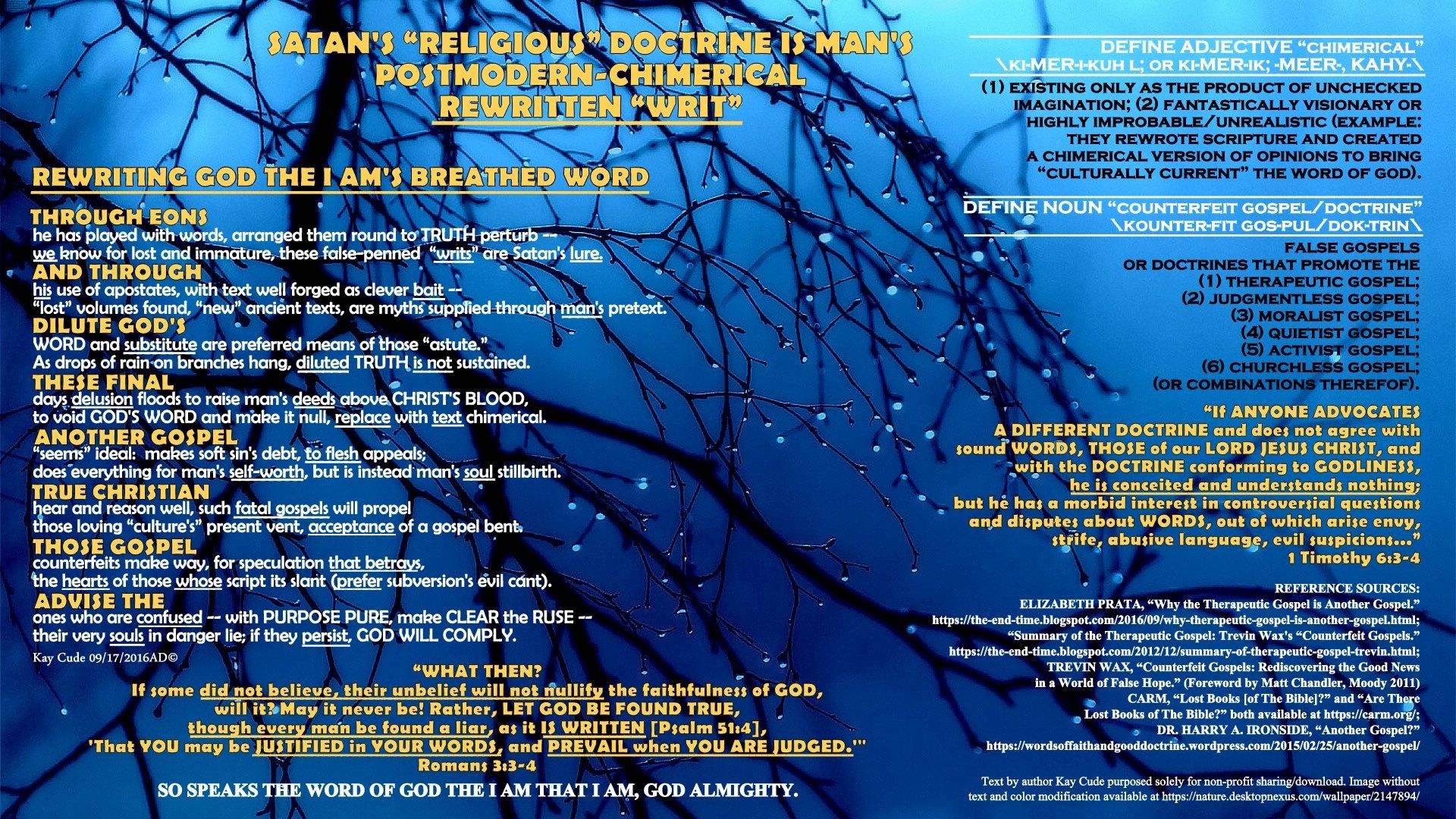
Poetry by Kay Cude. Right- Click to see bigger in new tab. Used with permission.
By Elizabeth Prata
 |
| Abimelech rebuking Abraham by Wenceslaus Hollar |
After Abraham was personally visited by angels and by Jesus, (Genesis 18:1-3, 14), and after Abraham personally asked for the LORD to protect his nephew Lot from destruction in Sodom, (Genesis 18:22-23), and after Abraham personally witnessed the destruction of four of the five Cities of the Plain (Genesis 19:28), despite having had another reassurance by God of His chosen plan involving Abraham (Genesis 15:6), thus knowing his God’s sovereign power, holiness, and mercy, in the next chapter Abraham lied. And why? To help God out.
In Genesis 20:1, Abraham is journeying in King Abimelek’s lands. (“toward the territory of the Negeb and lived between Kadesh and Shur; and he sojourned in Gerar.” Gen 20:1). Abraham thought to himself that since the people in that area are not God-fearing, I am going to need to lie about my beautiful wife Sarah.
And Abraham said of Sarah his wife, “She is my sister.” And Abimelech king of Gerar sent and took Sarah. (Genesis 20:2).
Twenty-five years earlier, Abraham said that of his wife when he feared Pharaoh. Pulpit Commentary said of Abraham’s lie then and in this chapter, that lying was “an ignoble expedient.”
Did Abraham think God didn’t know that the lands in the Negev were filled with pagans who did not fear God? Did Abraham think God needed to be helped out? Did Abraham not want to bother God with a prayer-petition for safety for his wife and himself? Or did Abraham just not trust God enough?
Let’s look at what Abraham’s lie did to himself and others. Then I’ll look at the sovereignty of God and how He worked through Abraham’s sinful lie.
Now, Sarah really was his sister, or half-sister to be specific. “she is indeed my sister, the daughter of my father though not the daughter of my mother, and she became my wife.” (Genesis 20:12). So Abraham’s lie was a half-truth. Alternately it can be called a lie of omission. It is still a lie. Lies we tell have effects upon the people who hear them. In this case, Abimelek went forward with an action that was based on faulty information, and he took Sarah. Then night God came to him in a dream with a message. And the message was not good.
“Behold, you are a dead man because of the woman whom you have taken, for she is a man’s wife.” (Genesis 20:3b)
Thanks a lot, Abraham.
Now the King did plead with the LORD earnestly. I mean, Abimelek was told that she was not a wife. Here is where God’s sovereignty over ALL FLESH comes in.
“Yes, I know that you have done this in the integrity of your heart, and it was I who kept you from sinning against me. Therefore I did not let you touch her.” (Genesis 20:6)
God is sovereign and can and does control ALL that happens on earth and even within the hearts of men and allows or prevents certain actions. Example: God would not let Abimelek touch Sarah. Did God put a wall around Sarah or consign her to a room in chains far away from Abimelek? No. He invisibly ordained that Sarah would remain untouched and in His power He made that come to pass, even though the King, Sarah, and the entire household was not aware of His workings. This is Providence.
God told the King to release Sarah and not to touch her or the King would certainly die. Abimelek called all the servants together and told them all that had happened, and followed God’s commands immediately. (So much for NOT being God-fearing, eh? Not that the King was a believer, but the king did recognize God’s authority and His power, and submitted to it in this instance.)
Then the King severely rebuked Abraham.
“What have you done to us? And how have I sinned against you, that you have brought on me and my kingdom a great sin? You have done to me things that ought not to be done.” (Genesis 20:9b-10).
That is the problem with lying. Not only did Abraham sin, not only did Abraham lead his wife into sin, but it caused the King to sin also, albeit unknowingly. He had a right to be angry. As did Pharaoh 25 years prior. Pulpit Commentary says of Abraham’s current lie and the 25 year old lie,
Abraham should a second time have resorted to this ignoble expedient after the hazardous experience of Egypt and the richly-merited rebuke of Pharaoh, but more especially after the assurance he had lately received of his own acceptance before God (Genesis 15:6), and of Sarah’s destiny to be the mother of the promised seed (Genesis 17:16), is well nigh unaccountable, and almost irreconcilable with any degree of faith and piety.
Of course we know Abraham was faithful and pious. (Hebrews 11:11). Our Bible is so great to show us the successes and the foibles and fumbles of the great men and women who are recounted in this record. We are all sinners, tending toward doing wrong most of the time, yet our God uses us again and again in His plan to move history forward to the end goal of displaying His glory to an unspotted Bride. Abraham was no different. But more gloriously, God is no different. He is totally sovereign over all that happens. After Abimelek gave Abraham 1000 pieces of silver, animals, and free passage through the land, he said you have been vindicated and this matter is concluded.
Just as God had promised Abimelek, (Genesis 20:7) Abraham then prayed to God on the King’s behalf (Genesis 20:17). God opened the wombs of all the women in the house of Abimelek because he had closed them on behalf of Sarah. God is sovereign over wombs, minds, flesh, and events. He is also merciful, in sparing Abimelek, in not punishing Abraham, in protecting Sarah, and in allowing the females of the house of Abimelek to conceive babies once again.
Genesis 20 is a tremendous chapter on the sinfulness of man, of what lies do to people (even lies of omission). Imagine what Abimelek might have been thinking. ‘Why would God pick THAT guy, he’s a liar.’ Do you want your witness on behalf of Holy God to be polluted by a legacy of lies?
The chapter is also a wonderful example of God’s sovereignty and Providential outworking, and His mercies.
Gill’s Exposition on Genesis 20:2-
And Abraham said of Sarah his wife, she is my sister,…. This he gave out in all conversation he came into, and said it to every one that asked who she was, which was little better than a lie; it at least was an equivocation and deception, and not at all justifiable, and tended to expose his wife’s chastity, and discovered a distrust of divine Providence; the same infirmity be had given way to, and the same evil he had fallen into in Egypt, Genesis 12:11, and therefore was the more inexcusable now; good men not only fall into sin, but have their relapses:
BibleGateway’s All the Men of the Bible explains of Abimelek:
THE MAN WHO REBUKED ANOTHER FOR LYING
Abimelech would have taken Sarah, Abraham’s wife, into his harem, but learning that she was the wife of another, returned her uninjured. Abraham appears here in a bad light. He deceived Abimelech, but when found out was justly rebuked by the God-restrained Abimelech. Certainly the righteous should rebuke the ungodly (1 Tim. 5:20), but how sad it is when the ungodly have just reason for rebuking the righteous. What a degradation it was for Abraham, then, to be rebuked by a heathen king!
Abraham sought to palliate his deception by claiming that Sarah was actually his half sister, daughter of the same father but not the same mother (Gen. 20:12, 16).
A lie if half a truth Is ever the worst of lies.
Abraham was the more blameworthy because he had done the same thing before (Gen. 12) and had suffered much in the same way as upon this occasion. How grateful Abimelech was for the dream warning him of his danger! The covenant made with Abraham is somewhat significant—
I. It was proposed by Abimelech who, although knowing how Abraham had failed God, yet saw how favored he was of God (Gen. 21:22).
II. It revealed certain distrust of Abraham. Abimelech requested Abraham not to be tempted to sin in such a direction again (Gen. 21:23).
Wow, a pagan praying for the righteous!
We faithful Christians sure do have relapses. We are redeemed by, governed by, supported by, sustained by, and provided for by a gracious and loving God. He knows all the details, He is calmly in control of all that happens. He even forgives our sins (like when we lie). We don’t need to “help” God in His plans but we do need to submit to them. We need to remember that our actions and words affect other people. We need to have integrity in all that we do for Jesus (Colossians 3:17).
PS: trivia- did you know that Genesis 20 is the first time we read the word “prophet”? God said Abraham was His prophet. (Genesis 20:7). The Bible is so wonderful to read!
By Elizabeth Prata
Israel is a dry land. It is verdant in some areas where it is close to the humid Mediterranean, and in the north rain does fall between November and March. More than 70% of the average rainfall in Israel falls between those months. June through September are usually rainless, however. For the most part it is a dry country. The Jordan rift valley is the the lowest place on earth (1300 feet below sea level) where where only one to two inches of rain fall annually.
Egypt, where major portions of the bible events take place, of course is also dry, with rainfall averaging from 8 inches per year in the north to 2-4 the further south one travels.
It is dry there. Water is an issue.
The first time a well is mentioned in the Bible is in Genesis 16:14, where as so often a well is the major landmark- “Wherefore the well was called Beerlahairoi; behold, it is between Kadesh and Bered.”
David longed for a sip of water from the well at Bethlehem. (2 Samuel 23:15)
Famously, when the Israelites were wandering in the desert, and they got thirsty, they grumbled and clamored for water. So Moses inquired of God what to do and God said to strike the rock and when Moses did a flow of water gushed out. (Exodus 17:1-7).
Think of how many times in the Bible Jesus (or The Angel of the LORD) met someone by a well or a spring.
When Abraham and Sarah put out the slave girl Hagar that had begotten Ishmael, Abraham gave her a skin of water and sent her on her way with the boy. They wandered, but the water ran out. She put the boy Ishmael under a bush and sat weeping a little ways off so she would not have to watch the boy die. The Angel of the Lord (Jesus in a probable pre-incarnate appearance) heard Hagar weeping, and comforted her with His words and when she opened her eyes there was a well of water. (Genesis 21:8-21).
I’ve mentioned before that the Woman at the Well is my favorite story in the Bible. John 4 has the story. A woman who seems to have been marginalized came to the well at midday (hot!) to draw water by herself (unusual- wells were the original water cooler place for talk and gathering). Jesus was there, being tired and thirsty. He was sitting. He told the woman to draw water for Him, and this was also unusual because it broke a gender and race taboo- men did not speak to women alone and Jews did not speak to the hated Samarians. She exclaimed in surprise.
“Jesus answered her, “If you knew the gift of God, and who it is that is saying to you, ‘Give me a drink,’ you would have asked him, and he would have given you living water.”” (John 4:10)
Living water? He seemed to her to be an unusual man speaking of an unusual thing. And indeed He is an unusual Person and the Living Water is the everflowing Holy Spirit. He said in John 7 in the section titled Rivers of Living Water:
On the last day of the feast, the great day, Jesus stood up and cried out, “If anyone thirsts, let him come to me and drink. Whoever believes in me, as the Scripture has said, ‘Out of his heart will flow rivers of living water.’” Now this he said about the Spirit, whom those who believed in him were to receive, for as yet the Spirit had not been given, because Jesus was not yet glorified. (John 7:37-39)
Of course the enemy hates that the people have water. Wells were often targets of the enemy to plug up.
“For all the wells which his father’s servants had digged in the days of Abraham his father, the Philistines had stopped them, and filled them with earth. (Genesis 26:15)
“And ye shall smite every fenced city, and every choice city, and shall fell every good tree, and stop all wells of water, and mar every good piece of land with stones.” (2 Kings 3:19).
In the Bible, water is a symbol for Salvation, Holy Spirit Truth, and Everlasting Life.
Peter likens false teachers and false prophets to dry and empty wells, hypocrites offering a pretense of Christian life but having no water at all: “These are wells without water, clouds that are carried with a tempest; to whom the mist of darkness is reserved for ever.” (2 Peter 2:17)
Can you imagine if Hagar, for example, had wandered alone with her son in the desert, her skin empty and the sun beating down, knowing life would end for herself and her boy if she didn’t find water, spotted a well. Eagerly moving the rock so as to draw water, she lets down the bucket, only to come up with nothing but sand and earth. Her wailing would have been all the worse for this bitter disappointment, having had the glimmer of hope only to have been fooled by the pretense of life giving water.
There is nothing worse than pretense! There is nothing more disappointing to sit under a teacher only to discover they were only offering dry earth and vain hope all along! (Colossians 2:8). They were a dry well and a broken cistern!
In Jeremiah 3:10 God says that He hated the pretense Judah was putting forth in their devotion to Him. Matthew Henry Commentary explains:
“Josiah went further in destroying idolatry than the best of his predecessors had done, and for his own part he turned to the Lord with all his heart and with all his soul; so it is said of him, 2 Ki. 23:25. The people were forced to an external compliance with him, and joined with him in keeping a very solemn passover and in renewing their covenants with God (2 Chr. 34:32, 35:17); but they were not sincere in it, nor were their hearts right with God. For this reason God at that very time said, I will remove Judah out of my sight, as I removed Israel (2 Ki. 23:27), because Judah was not removed from their sin by the sight of Israel’s removal from their land. Hypocritical and ineffectual reformations bode ill to a people. We deceive ourselves if we think to deceive God by a feigned return to him.”
“for my people have committed two evils: they have forsaken me, the fountain of living waters, and hewed out cisterns for themselves, broken cisterns that can hold no water.” (Jeremiah 2:13)
Have you heard the phrase “carrying water in a sieve?” That comes from Greek Mythology. “In Greek mythology, the Daughters of Danaus were the fifty daughters of Danaus. They were to marry the fifty sons of Danaus’s twin brother Aegyptus, a mythical king of Egypt. In the most common version of the myth, all but one of them kill their husbands on their wedding night, and are condemned to spend eternity carrying water in a sieve or perforated device. In the classical tradition, they come to represent the futility of a repetitive task that can never be completed.” (Wikipedia)
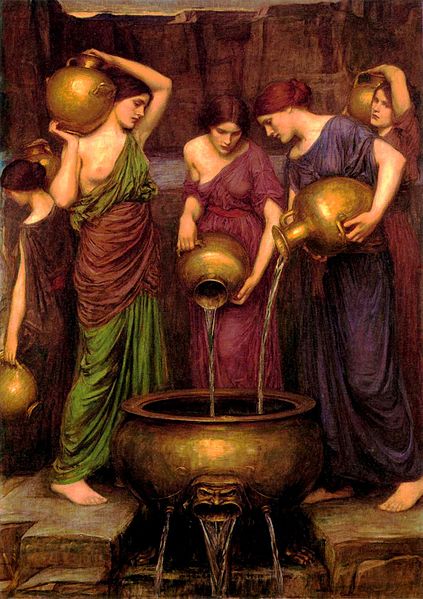 |
| John William Waterhouse The Danaides, 1903 |
You cannot earn your own salvation. If you are not complete in Christ (Colossians 2:9-10) you are no better off than the Danaides daughters, carrying water to fill an endlessly leaking well. If you’re in church and you believe that to be enough, it isn’t. Filling a leaking cistern in a church is just as leaky and incomplete as it would be in any other place.
Whenever you’re reading the bible and you see a reference to a spring or a well or a fountain, then think of these symbols of water and what they mean.
“Christ loved the Church and gave himself for it; that he might sanctify and cleanse it with the washing of water by the word.” (Ephesians 5:25-26)
“Whosoever drinks of the water that I shall give him shall never thirst; but the water that I shall give him shall be in him a well of water springing up into everlasting life.” (John 4:14)
How might you get some of this living water? Here is a simple explanation of The Gospel
The gospel is the good news about what Jesus Christ has done to reconcile sinners to God. Here’s the whole story:
Now that’s good news.
A good way to summarize this good news is to biblically unpack the words God, Man, Christ,
Response.
(Some of this material has been adapted from The Gospel and Personal Evangelism by Mark
Dever, p. 43)
By Elizabeth Prata
The Glorious Return
29“But immediately after the tribulation of those days THE SUN WILL BE DARKENED, AND THE MOON WILL NOT GIVE ITS LIGHT, AND THE STARS WILL FALL from the sky, and the powers of the heavens will be shaken. 30“And then the sign of the Son of Man will appear in the sky, and then all the tribes of the earth will mourn, and they will see the SON OF MAN COMING ON THE CLOUDS OF THE SKY with power and great glory. 31“And He will send forth His angels with A GREAT TRUMPET and THEY WILL GATHER TOGETHER His elect from the four winds, from one end of the sky to the other. (Matthew 24:29-31)
I charge you in the presence of God and of Christ Jesus, who is to judge the living and the dead, and by his appearing and his kingdom: (2 Timothy 4:1)
And inasmuch as it is appointed for men to die once and after this comes judgment, (Hebrews 9:27)
But they will have to give account to him who is ready to judge the living and the dead. (1 Peter 4:5)
 |
| The Judgment of Babylon |
God will judge all people for their lives. No one these days likes to think about the LORD as judge, not even some Christians. Of course, the difference between Christians and non-believers is that though our lives will be examined and assessed, we will not be judged in wrath. Jesus exhausted God’s wrath for our sins while He was on the cross. There is no condemnation for us now. (Romans 8:1). Even at that, it is still excruciating to think of Jesus staring at our heart and soul with His piercing eyes (Revelation 1:14) and know all our words, deeds, and even motives as He sends our works through the fire to either become silver and gold, or burn away as hay and stubble. (1 Corinthians 3:12)
For those who are not in Christ, the judgment will be terrible. Who can stand?
The arrogant cannot stand in your presence. You hate all who do wrong; (Psalm 5:5)
The LORD reigns forever; he has established his throne for judgment. (Psalm 9:7)
He rules the world in righteousness and judges the peoples with equity. (Psalm 9:8)
God is holy and He judges. He knows each and every word the unsaved say. He sees all their deeds. He knows motives in the heart. Nothing is hidden from Him.
Sheol and Abaddon lie open before the LORD, How much more the hearts of men! (Proverbs 15:11)
Make no mistake. Jesus is a loving God, but He is a holy God who judges all men.
As a part of his sovereignty and authority, God is executor of his righteousness within the created order. Jesus Christ shares in this ongoing work.
(Source: Manser, M. H. (2009). Dictionary of Bible Themes)

He judges individuals, nations, rulers, families, cities, and His own people. The eternal punishment of the ungodly is sure. (certain Ro 1:18 See also Pr 10:24; Isa 13:11; 26:21; 66:16; Jn 5:28-29; Eph 5:6; Col 3:6; 1Th 5:3; Heb 2:2-3. Source: Manser). It will be everlasting,(2Th 1:8-9, Isaiah 33:14), and the wicked will be forever separated from God’s presence.
God is serious business. He means what He says, that all rebellion will be judged and punishments meted out accordingly. I am firm on this today because as I said earlier, man does not like to think of God’s judgments. But we must.
They diminish His holiness by vain talk and babblings about visions, as Beth Moore does when she says God calls her “Honey” and “Babe” in her alleged visions. They besmirch His majesty and His wrath by writing books about erotic encounters, as Anne Voskamp did in her book One Thousand Gifts (“I fly to Paris and discover how to make love to God.” etc.) They blaspheme Him like in The Shack by William P. Young, by portraying God as a female pancake making Aunt Jemimah who says “Sin is its own punishment, devouring you from the inside. It’s not my purpose to punish it; it’s my joy to cure it.”
Oh, but God does both.
God is a MAJESTIC JUDGE, potent in holiness and coming in wrath to judge all the living and the dead.
The following verses speak to judgment
JUDGMENT.
The General: 1 Chr. 16:33; Job 14:17; Job 21:30; Job 31:13–15; Psa. 9:7; Psa. 50:3–6; Psa. 96:13 Psa. 98:9. Eccl. 3:17; Eccl. 11:9; Eccl. 12:14; Ezek. 18:20–28; Dan. 7:9, 10; Amos 4:12; Matt. 3:12 Luke 3:17. Matt. 7:22, 23; Matt. 8:29 With 2 Pet. 2:4; Jude 6. Matt. 11:22 Matt. 10:15. Matt. 12:36, 37, 41, 42 Luke 11:31, 32. Matt. 13:30, 40–43, 49, 50; Matt. 16:27 Mark 8:38. Matt. 22:13 vs. 11–13.; Matt. 23:14; Matt. 25:1–14 [Luke 19:12–26.] Matt. 25:15–46; Mark 4:22; Mark 13:32; Luke 10:10–14; Luke 12:2–5; Luke 13:24–29; Luke 20:45–47; John 5:22; John 12:48; Acts 2:19–21; Acts 10:42; Acts 17:31; Acts 24:25; Rom. 2:5–10, 12–16; Rom. 14:10–12; 1 Cor. 3:13; 1 Cor. 4:5; 1 Cor. 6:2; 2 Cor. 5:10; 2 Thess. 1:7, 8; 2 Tim. 4:1, 8; Heb. 6:2; Heb. 9:27; Heb. 10:27; 1 Pet. 4:5, 7; 2 Pet. 2:4, 9; 2 Pet. 3:7, 10–12; 1 John 4:17; Jude 6, 14, 15, 24; Rev. 1:7; Rev. 6:15–17; Rev. 11:18; Rev. 20:11–15; Rev. 22:12.
According to Opportunity and Works: Gen. 4:7; Job 34:11; Prov. 11:31; Prov. 12:14; Prov. 24:11, 12 Psa. 62:12; 2 Tim. 4:14. Isa. 3:10, 11; Isa. 5:15, 16; Isa. 24:2; Isa. 59:18; Jer. 17:10, 11; Jer. 32:19; Ezek. 7:3, 4, 27; Ezek. 9:4–6; Ezek. 16:59; Ezek. 18:4 [vs. 5–9.] Ezek. 18:19–32; Ezek. 33:18–20; Ezek. 39:24; Hos. 4:9 Hos. 12:2. Amos 3:2; Zech. 1:6; Matt. 10:14, 15 Matt. 11:24; Mark 6:11; Luke 9:5; 10:12–15. Matt. 12:37; Matt. 23:14 Luke 20:47. Mark 14:21; Luke 11:49, 50 v. 51.; Luke 12:47, 48 [See parable of the vineyard, Isa. 5:1–6. Of the farmer, Isa. 28:24–28. Of the wicked tenant farmers, Matt. 21:33–36. Of the talents, Matt. 25:14–30.]Luke 13:6–9; Luke 19:12–27; Luke 21:1–4; John 3:19, 20; John 5:45; John 9:41; John 12:48; John 15:22, 24; Rom. 2:5–12, 27; 1 Cor. 3:8, 13–15 v. 12.; 1 Cor. 4:5; 2 Cor. 2:15, 16; 2 Cor. 11:15; Gal. 6:5–10; Eph. 6:7, 8; Col. 3:25; 1 Tim. 1:13; Heb. 2:2, 3; Heb. 10:26–30; Heb. 12:25; Jas. 2:12, 13; 1 Pet. 1:17; 2 Pet. 2:20, 21; Rev. 2:23; Rev. 20:12, 13.
(Source: Swanson, J., & Nave, O. (1994). New Nave’s Topical Bible. Oak Harbor: Logos Research Systems.)
Why am I writing about judgment? Because it is infrequently discussed these days. It is an unpalatable topic for too many people. But our God is holy and He is glorified in judging the wicked. Judgment in Holiness is one of His sovereign attributes and as such is is profitable for men to ponder His great and mighty decisions.
Anyone not in Christ has not been forgiven of their deeds, which are hostile to God and against Him as enemy. He will judge them and they will then endure eternal torment in hell forever to pay the penalty for those sins. DId you know that…
“And they shall go out and look on the dead bodies of the men who have rebelled against me. For their worm shall not die, their fire shall not be quenched, and they shall be an abhorrence to all flesh.” (Isaiah 66:24)
Matthew Henry Commntary speaks of that verse from Isaiah-
But our Saviour applies it to the everlasting misery and torment of impenitent sinners in the future state, where their worm dies not, and their fire is not quenched (Mk. 9:44); for the soul, whose conscience is its constant tormentor, is immortal, and God, whose wrath is its constant terror, is eternal. (3.) What notice shall be taken of it. Those that worship God shall go forth and look upon them, to affect their own hearts with the love of their Redeemer, when they see what misery they are redeemed from. As it will aggravate the miseries of the damned to see others in the kingdom of heaven and themselves thrust out (Lu. 13:28), so it will illustrate the joys and glories of the blessed to see what becomes of those that died in their transgression, and it will elevate their praises to think that they were themselves as brands plucked out of that burning. To the honour of that free grace which thus distinguished them let the redeemed of the Lord with all humility, and not without a holy trembling, sing their triumphant songs.
Henry, M. (1994). Matthew Henry’s commentary on the whole Bible: complete and unabridged in one volume (p. 1218). Peabody: Hendrickson.
Oh, yes, the gratitude that we are spared! The humble thankfulness with which we sing His praises. Our Redeemer! We are a blessed group, never forget His lovingkindness to those whom He chose for Himself. We are His trophy of grace, and looking upon the wicked in torment, how much more will be fall to our own knees in crushed and broken contriteness and relief to worship such a God!
Why we receiving a kingdom which cannot be moved, let us have grace, whereby we may serve God acceptably with reverence and godly fear (Hebrews 12:28)
By Elizabeth Prata
Paul opens his massive and majestic letter to the Romans with effusive rhapsodies of his love for the Roman believers and his gratitude for their faith- which he said is known the world over. He speaks of his intense desire to come to them so that he can be encouraged by their faith. Paul mentions them all the time to everyone. And so on.
First, we note Paul’s ministerial desire for his flocks and his obedient submission to his ordained role as Christian, pastor, sufferer. He is surely a super-Christian, if one such designation existed.
In the iconic movie The Princess Bride, Inigo is sailing a boat with all due speed in attempt to get away with a kidnapping. He looks back at one point and sees a distant boat on the horizon. The breeze is gentle and the night is long, so he has no worries. When he looks up again, he sees the boat is now close. And after a while, closer, then closer… This perplexing phenomenon causes him to utter the well-known line,
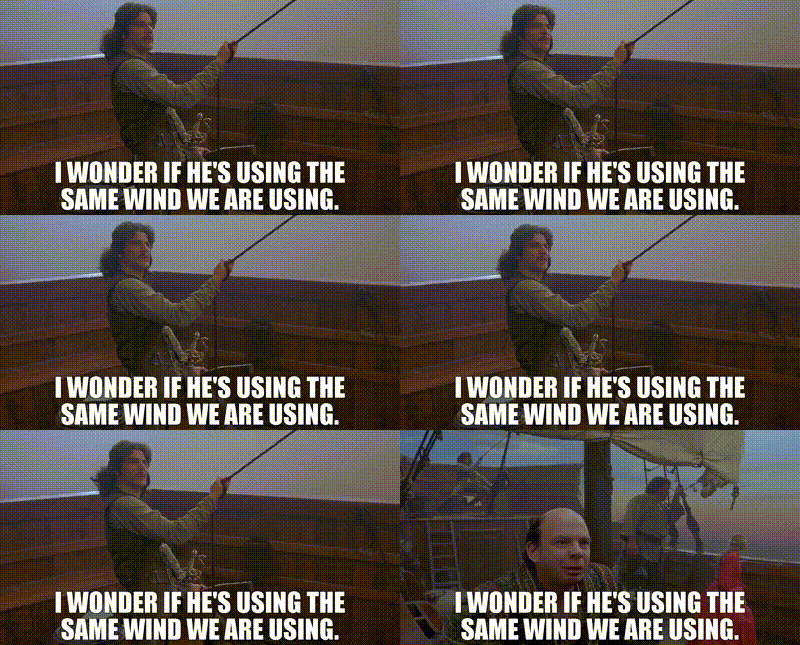
It’s like that with Paul. We might say, “I wonder if he is using the same Spirit we are using?” and the answer would be “Yes”. I am awed by Paul’s fervor, dedication, diligence and deep obedience never having wavered. He died poured out as a drink offering, a rushing torrent of obedience and love spilling across the altar of his beloved Savior.
Then in verse 15 of chapter 1, Paul says this-
So I am eager to preach the gospel to you also who are in Rome. (Romans 1:15).
Wait, what?
Hadn’t Paul confirmed the Roman believers’ solid faith, their well-known faith, their doctrinal and loving faith? Yes.
Some could interpret the verse as Paul being anxious to come minister to them, which is definitely true. But he didn’t say only that. He said he is eager to come preach the Gospel at Rome to Greeks and barbarians, to the wise and the foolish, “and also to you.” The Greek word for Gospel in this verse is euaggelizó which means bringing or preaching the full Gospel of Christ.
Some could interpret this as Paul’s eagerness to preach the Gospel indiscriminately to all, and that would also be true.
But do believers need the Gospel?
The answer would be “Yes.”
The Gospel is not a once-for-all mechanism that saves a person from the wrath of God and installs him into the kingdom as a child of God. Not only. It is the launching pad, and the eternal linchpin. It is the indispensable necessity for life eternal in the believer on earth and forever. The Good News is always Good News, and it continues being so, even for believers. Especially for believers.
The Good News is the fullness of Jesus, the encompassing message, the total plan of God, the victory of Jesus over sin, death, and hell. It is a message of resurrection, triumph, power, and abundant life. We all need this message, every day! Paul knew this. The Gospel is the mighty rushing wind of power and sustenance for every believer on earth who lives by the Spirit. We are reminded of the verse from 1 Thessalonians 1:5a
because our gospel came to you not only in word, but also in power and in the Holy Spirit and with full conviction.
Paul said in the very next verse, Romans 1:16 these famous and everlastingly glorious words:
For I am not ashamed of the gospel, for it is the power of God for salvation to everyone who believes, to the Jew first and also to the Greek. 17For in it the righteousness of God is revealed from faith for faith,e as it is written, “The righteous shall live by faith.”
The faith we live by is that Gospel, Good News of the savior Jesus Christ. We needed it when we were foolish, wise, Greeks, and barbarians. Now that we are saved, it’s a message “And also to you.” The gospel necessity never ends.

By Elizabeth Prata
I know your works: you are neither cold nor hot. Would that you were either cold or hot! So, because you are lukewarm, and neither hot nor cold, I will spit you out of my mouth. For you say, I am rich, I have prospered, and I need nothing, not realizing that you are wretched, pitiable, poor, blind, and naked. I counsel you to buy from me gold refined by fire, so that you may be rich, and white garments so that you may clothe yourself and the shame of your nakedness may not be seen, and salve to anoint your eyes, so that you may see. Those whom I love, I reprove and discipline, so be zealous and repent. Behold, I stand at the door and knock. If anyone hears my voice and opens the door, I will come in to him and eat with him, and he with me. (Revelation 3:15-20)
Often forgotten in the prophecies are the warnings Jesus gives to the churches in Revelation. As with many prophecies, there is a near fulfillment that is and a far fulfillment. The 7 letters to 7 churches that open the Book of Revelation were actual letters sent to actual churches and actually read as warnings, encouragements or indictments against them. The second reason the letters were sent was to reveal seven different types of individuals/churches throughout history and instruct them in God’s truth.
The last verse is the one I want to point to. Jesus is not ‘knocking at the door of your heart’ in this verse. It is obvious he is knocking at the door of the church. The church had become (and will become, like it is now) so pale and non-Gospel oriented that Jesus is outside it! Just think of Joel Osteen’s church at Lakewood and you have a perfect fulfillment of the kind of church Jesus is warning about here. Mr Osteen never preaches sin or wrath or judgment because he doesn’t want to offend anyone, wanting to stay positive. But how can a person repent if they don’t know they are sinning? He refuses to put a cross on his stage, because it might prove an “obstacle to anyone who might come.” But if they are not coming to the cross, what are they coming to??? Jesus is standing outside Mr Osteen’s church, knocking to get in.
That sad indictment is repeated over many parts of the body of Christ today. I pray you find a good church that has solid beliefs, and participate there. Support your pastor, if he stands on the foundational principles of the faith, and preaches them. He is a rarity these days, and precious. Treat him like he is.
The decline of belief is symbiotic. If you attend a church like Lakewood for any length of time, then you will fade into lukewarmness because the fire of wrath and rebuke from a holy God has disappeared. With the full counsel of God being preached, His perfect message of sin & wrath/mercy & redemption is held up and you will grow in Christ-likeness. Without the cross preached, who are the Laodicean congregants growing into looking like? Man, not God.

By Elizabeth Prata

It might seem strange to say this, but we are not living to live. Living is not the point of our living. Waiting is. We live while we’re waiting.
For the grace of God has appeared, bringing salvation for all people, 12training us to renounce ungodliness and worldly passions, and to live self-controlled, upright, and godly lives in the present age, 13waiting for our blessed hope, the appearing of the glory of our great God and Savior Jesus Christ, (Titus 2:11-13).
Paul is giving Titus some instructions and reminders as to our duties as Christians, to be done while we wait.
Matthew Henry’s Commentary on the Whole Bible reminds us also that this life is a preparatory for the one to come.
To look for the glories of another world, to which a sober, righteous, and godly life in this is preparative: Looking for that blessed hope, and the glorious appearing of the great God and our Saviour Jesus Christ. Hope, by a metonymy, is put for the thing hoped for, namely, heaven and the felicities thereof, called emphatically that hope, because it is the great thing we look and long and wait for; and a blessed hope, because, when attained, we shall be completely happy for ever.
In today’s time it’s not considered mature to speak of prophecy. I believe that’s wrong. I believe that because so many verses stress that we are to look forward, to hope in His coming promises, to wait for His return. I can’t think of a better encouragement than to dwell on His prophecies. This life is difficult. (John 16:33). It’s full of evil people and seducers waxing worse and worse. (2 Timothy 3:13). It’s full of disease, strife, challenge, and vigilance. (1 Corinthians 11:30, 2 Corinthians 12:7-10, Proverbs 28:25, Psalm 46:1,1 Peter 5:8).
We are being trained while we wait. But waiting is our task, our joy, our hope. We should look to His return for encouragement. He is the blessed hope!
 |
| Illustration by Chris Powers |
Kay Cude poetry. Right click to see larger in new tab. Used with permission

By Elizabeth Prata
We have 4 elders. One is the main teaching elder, though any of the men can teach at the pulpit. The other three men rotate in leading the confessional. The Confessional-teaching elder gives a short talk based on what the upcoming sermon will be and then stands silently as we individually confess and repent in our pews. Then he closes in an audible prayer. I appreciate the opportunity to set my heart and mind aright, and to confess, particularly when it’s a Lord’s Table Sunday.
On a past Sunday, our elder gave a confessional talk that had so many wonderful points. I’m paraphrasing, but-
If You want to look like Jesus, look at Jesus.
Our elder made the statement that we should fix our gaze upon Jesus, not the latest comedy or sports teams. I ended up focusing on the phrase “fix your eyes upon Jesus” from Hebrews 12:2. I looked up the word “fix” and the Strong’s says
872 aphoráō (from 575 /apó, “away from” and 3708 /horáō, “see”) – properly, “looking away from all else, to fix one’s gaze upon” (Abbott-Smith).
How helpful. I should not glance, not peek, not glimpse, but FIX my GAZE upon him, looking away from all else and steadily drinking in all that He is.
I need to spend more time with Jesus to look more like Him. What a great line. Moses only got to see God’s ‘back’ and His face after being with God was so bright it had to be veiled. We have the privilege of looking at Jesus’ “face” as it were, through His word. I want my face to be shining, to have my being conformed to Him, to have my mind transformed. But it won’t happen unless I read the Bible. I must look away from all other distractions and FIX my GAZE on Jesus. A Bible skim won’t even do.
If you’re interested in hearing the Confessional, here it is, in all its 13 minute power. I pray it convicts you as it did me, in some way that will honor and glorify the Lord as a result. I know what I’m going to be doing when I get home.

By Elizabeth Prata
 |
| Martin Luther, 1483-1546 |
It is Reformation year 504. Five hundred and four years ago this October 31st, Martin Luther nailed his 95 theses to the door of the All Saints’ Church in Wittenberg, Electorate of Saxony within the Holy Roman Empire. Luther wrote,
Out of love for the truth and from desire to elucidate it, the Reverend Father Martin Luther, Master of Arts and Sacred Theology, and ordinary lecturer therein at Wittenberg, intends to defend the following statements and to dispute on them in that place. Therefore he asks that those who cannot be present and dispute with him orally shall do so in their absence by letter. In the name of our Lord Jesus Christ, Amen.
Here are the actual 95 theses if you want to read them:
The 95 theses
History.com sums the Reformation up this way-
Luther spent his early years in relative anonymity as a monk and scholar. But in 1517 Luther penned a document attacking the Catholic Church’s corrupt practice of selling “indulgences” to absolve sin. His “95 Theses,” which propounded two central beliefs—that the Bible is the central religious authority and that humans may reach salvation only by their faith and not by their deeds—was to spark the Protestant Reformation
Is there any event that is not connected in time by a previous event? Isn’t time a constant stream of events, all tumbling one after another, connected by their confinement to the visible riverbanks by the hands of God? Did the Reformation emerge all of a sudden, or were there catalysts and stepping stones laid first? Were there forerunners? I believe so.
As RC Sproul said, that before Luther there was Hus, (or Huss, spellings vary) who was preceded by Wycliffe, who was preceded by Augustin who was preceded by Paul who was preceded by Jesus.

The reason there are forerunners to Martin Luther and the Reformation is that Jesus never leaves Himself without a witness, and He as Master Husbandman tends soils so that there is always a soil ready to receive the Gospel. Even in “The Dark Ages”, the Gospel was doing its work in hearts. Salvations were always occurring.
Burk Parsons wrote of this connection from one era to the next, the vine as I envision it. It is planted by God and watered by Him, with men springing up along the vine as forerunners to His particular plan and path regarding the Reformation.
John Wycliffe was the morning star of the Reformation. He was a protestant and a reformer more than a century before Martin Luther ignited the Protestant Reformation in 1517. Through Wycliffe, God planted the seeds of the Reformation, He watered the seeds through John Hus, and He brought the flower of the Reformation to bloom through Martin Luther. The seed of the flower of the German Augustinian monk Luther’s 95 theses was planted by the English scholar and churchman John Wycliffe.

Josh Buice wrote that The Reformation Resulted in an Explosion of Gospel Missions. He started a preaching series in–
–2017 with an emphasis on the Reformation and how our salvation is directly connected to the work of the Reformers. R. C. Sproul writes, “The Reformation was not merely a Great Awakening; it was the Greatest Awakening to the true Gospel since the Apostolic Age.”
During the days that preceded the Reformation, the Bible had been locked away in a dark dungeon by the Roman Catholic Church. They insisted that the Word of God must be heard by the priests, who would speak it only in Latin. The Roman Catholic Church insisted that the common person was unable to understand the Word of God without the aid of a priest. However, they were unwilling to release control of the Bible, and in order to prevent anyone from getting their hands on the Word of God—they would burn people at the stake as an example to all who resisted their authority.
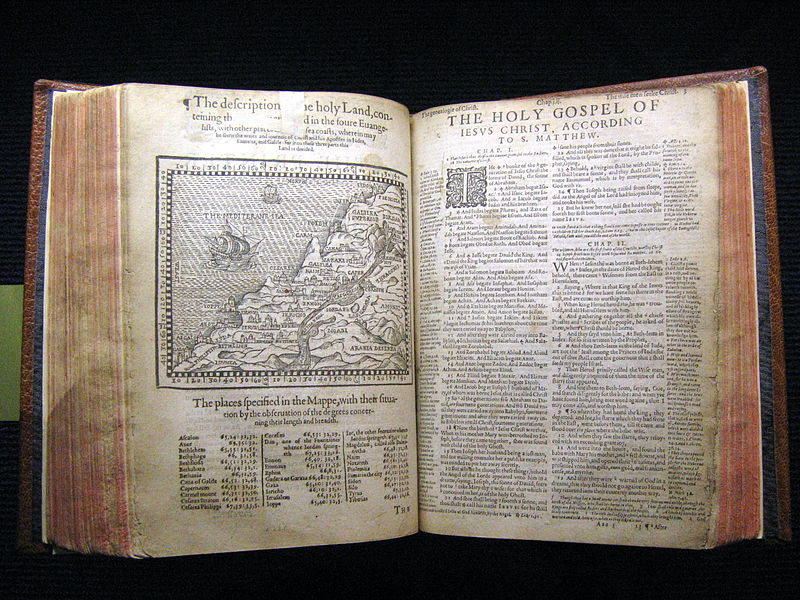
Under John Calvin’s leadership in Geneva Switzerland, thousands of missionaries were being trained and by 1562, over 2,000 churches had been planted in France. In 1560, the Geneva Bible was published which was greatly used in Europe and was also the Bible that was brought off of the Mayflower by the early Pilgrims of America. Through the Reformation, an explosion of gospel missions took place that shook the world.
 |
| Source Wikimedia Commons |
The Reformation is an extremely important part of church history. One would think with the release of the Bible in the people’s language, the explosion of missions, the work of the Gospel in the hearts of many subsequent to the reformation, that our ecclesiology would progress in an upward trajectory. But satan does not like upward, only downward. He fights back. He fought back since the moment the first Geneva Bibles were released. And the Geneva Bible’s history is interesting in itself! It was the first Bible to be translated directly from the Hebrew. It had extensive notes and cross references, making it the first study Bible. It was translated so that the people could read it. More here.
Sadly, 500 years after the start of The Reformation, there is currently a definite softening toward the Catholic Church by many people who should know better.
Philosopher and poet George Santayana famously said,
Those who cannot remember the past are condemned to repeat it. (The Life of Reason: Reason in Common Sense. Scribner’s, 1905: 284)
We must remain vigilant because we are not unaware of satan’s schemes. (2 Corinthians 2:11). We should learn the past in order to remember the past and to push forward with clear, honest, uncomplicated Gospel evangelization. We shouldn’t ever remain ignorant of what has happened in the past of our church history. This is the 500th year of the Reformation. Here are some resources for you to learn more:
The Heresies of the Catholic Church
Evangelical Syncretism: Rethinking the Reformation
John MacArthur and RC Sproul on Sola Scriptura and the Reformation
Undermining the Headship of Christ (The line between John Hus and Martin Luther is explained here).
A History of the Reformation, article by RC Sproul
Memoirs of a Medieval Woman: this is a biography of Margery Kempe, taken from her dictated autobiography. She was born sometime around 1373 and died after 1438, which makes her a devotee of the Catholic Church at a time when both the rise of the Lollards (Wycliffe followers) was gaining traction and also the incessant Catholic pilgrimages to Jerusalem were occurring. It is also set in the time just prior to the Council of Constance. This Council was held between 1414 and 1418, principally to reunite Christendom from the ‘too many popes’ syndrome (schism) but also to examine the teachings of John Wycliffe and Jan Hus and to reform the RCC as a reaction to the attack on the Church’s authority.
Wikipedia lists her as “an English Christian mystic, known for dictating The Book of Margery Kempe, a work considered by some to be the first autobiography in the English language.” Kempe wrote of it all from a first person perspective. I liked the book for its attention to vivid detail on the practices of the Catholic Church, the realities of the pilgrimage journeys to the middle East, the ecstatic visions and examination of same by any and all church authorities Margery could get to listen (anchorites, priests, bishops, other mystics like Julian of Norwich, lay people…)
 the-end-time.org