Posted in theology

Patronesses Phoebe and Susanna: Two named women in the Bible

By Elizabeth Prata

Susanna and Phoebe are both mentioned as women who believed in Jesus and supported his ministry. In Romans 16:2 Phoebe is named as a benefactor, and Susanna was giving out of her means. (Luke 8:2).

A woman is depicted at prayer in an early Christian mosaic seen in the Vatican’s Pio Cristiano Museum. (Wikimedia Commons/Miguel Hermoso Cuesta)

Now I commend to you our sister Phoebe, who is a servant of the church which is at Cenchrea; that you receive her in the Lord in a manner worthy of the saints, and that you help her in whatever matter she may have need of you; for she herself has also been a benefactor of many, and of myself as well. (Romans 16:1-2).

And it happened that soon afterward He was going around from one city and village to another, preaching and proclaiming the good news of the kingdom of God. The twelve were with Him, and also some women who had been healed of evil spirits and sicknesses: Mary who was called Magdalene, from whom seven demons had gone out, and Joanna the wife of Chuza, Herod’s manager, and Susanna, and many others who were ministering to them from their possessions. (Luke 8:1-3)

Some women actually did have a job in Bible times. Lydia was a Seller of Purple- it seems she had her own business. Whether she was a widow or born into it is unknown, but she was successful enough to host Paul and his entourage in her home. (Acts 16:14, Acts 16:40) Rachel was named as a shepherdess. (Genesis 29:9). Priscilla with her husband is listed as a tentmaker. (Acts 16:2-3) Shiprah and Puah were Hebrew midwives. (Exodus 1:15). Sherah was a builder. (1 Chronicles 7:24). Professional mourners was a job that women had, too. (Jeremiah 9:17).

And Susanna and Phoebe were Patronesses. This was an actual title and job in the Bible times. In Rome especially, patrons & patronesses, and their clients, lived by a codified set of rules for their engagement. It was a system that was part of the social order. It was always the upper class person giving largesse to the lower, in the form of money, food, or legal help. The client had certain obligations as well to his patron. The client was expected to show deference to his patron, especially by calling upon him each morning (salutatio) and by aiding him in his private and public life. If one or the other ended up in court, neither could give evidence against the other, just as husbands and wives today can’t be compelled to testify against each other.

Patronage was a relationship distinct from other relationships.

In Israel, the rules in the patron/client relationship were not as well-known, but patrons and patronesses existed. In Christianity, those who gave out of their means were under a different set of standards, which is to say, a relationship based on grace and the ultimate benefactor being God.

For example, Bible verses tell us we are commanded this or that about money, i.e. to give sacrificially, to help the brethren where needed, to love one another, not to show partiality, etc. But it’s interesting to note that benefactors existed in that era and Phoebe and Susanna were given special mention. Phoebe had gained special respect from Paul and given a sensitive charge- bring the letter. In this case it was Romans 16.

“Phoebe was entrusted by Paul with a key letter on which the next phase of his ministry depended. The phrasing of Romans 16:1–3 makes it clear she fulfilled the usual role of letter carrier.” Source

In those days, there was a postal route but no postal carrier. If you wanted to send a letter you had to have someone to deliver it for you. Paul regularly sent his co-workers for this very reason.

By sea the trip was about 700 miles and could take 5-10 days in good weather. With a combination sea/land route following the Adriatic Sea, the distance was about 800 miles. There were paved roads and travelers often rode donkeys and stayed in inns along the way. This route took considerably more time–3 to 4 weeks–but in the winter months it was the only open route for travelers.

Phoebe was also most likely responsible for paying her travel expenses, including sea passage for her and any travel companions, food and wine for her journey, etc. Importantly, Phoebe needed to physically protect Paul’s letter. Source
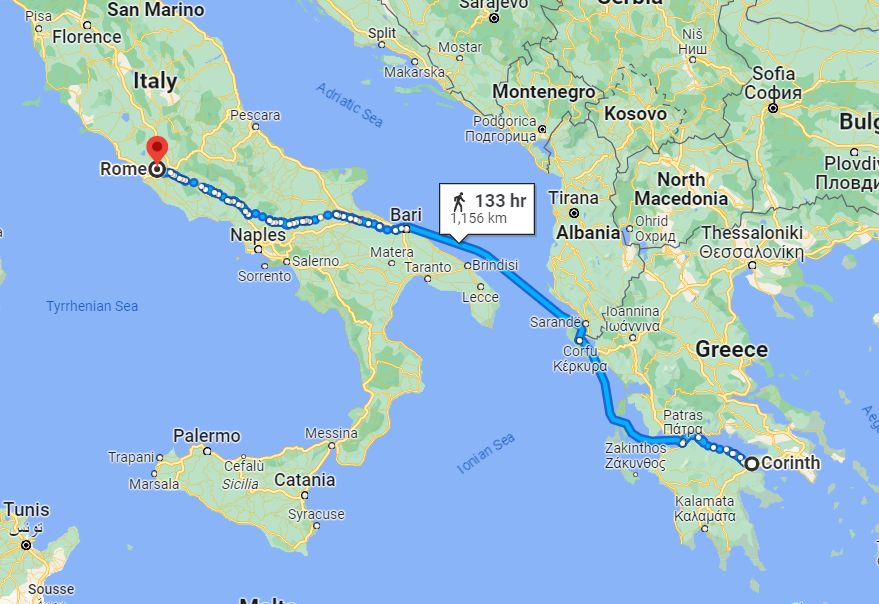
In the case of Romans 16, Phoebe traveled almost 800 miles if she went by the direct route shown on this modern day map. Entrusted, as a woman, to travel to Rome with scripture, fragile papyrus, all that way is certainly an indicator of Paul’s esteem and trust of this woman. Perhaps he had met her when he was with Prisca and Aquila setting out for Syria and stopping in Phoebe’s home base in Cenchreae to have his hair cut for the vow. Cenchreae is a coastal town about five miles from the city of Corinth.

It would be important to say the word he used for helper with reference to Phoebe in Acts 16:2, is prostatis. It can mean a person in a position of leadership, whether as a president, chief, or presiding officer. It can also refer more broadly to a guardian or a helper, often meaning someone who takes the lead in ensuring someone else’s protection and provision via their own means, usually, wealth. It’s not likely Paul meant the former in reference to Phoebe, since women were not leaders in that sense. We know he meant helper, and he likely used the word in its definition of patron, though translators are unsure.

“She [Phoebe] had taken it on herself to ensure the practical well-being of many through hospitality and financial assistance, which indicates she probably possessed significant wealth. Perhaps she was the host of a house church. Cenchreae was the location of a busy seaport, affording many opportunities to offer financial assistance and hospitality.” Source The Lexham Bible Dictionary. Lexham Press.

Can you imagine the uncertainty the first century disciples lived under? Guilds, which were unions on steroids, would block out Christians because of their negative impact on idol making (Acts 19:24-27), not having a place to live, being persecuted, chased, beaten up. Not knowing where the next meal would come from sometimes. But they could count on Phoebe. They knew they had support there. No wonder Paul said ‘succorer’ in reference to Phoebe.

We know less than less about Susanna, because only a very few words surround her name in the Bible. But we can glean.

First, we know that Jesus had healed her, so she was probably grateful.

Susanna doesn’t even have her own GotQuestions entry but is mentioned with Joanna:

Joanna was one of several women in the Bible healed of “evil spirits and diseases” by Jesus Christ (Luke 8:2). After being healed, Joanna accompanied Jesus and the twelve disciples on their travels from town to town and helped support the Lord’s ministry. As the wife of Chuza, the manager of Herod Antipas’ household estate, Joanna was a woman of means and influence. Along with Mary Magdalene, Susanna, and others, Joanna helped provide food and supplies for the missionary troupe from her own wealth (Luke 8:1–3).

Susanna was able to travel with Jesus and his other followers and provide him/them with a level of financial support. She was presumably single, seemingly not needing permission from a man (husband, father, brother, uncle, owner, etc.) to give out of her means, and indicating she had her own means. If she was married, her husband would be extremely tolerant of her being away and turning into an itinerant pilgrim, or perhaps he had divorced her when she converted. We simply do not know.

Both Phoebe and Susanna traveled. Phoebe to bring the letter 800 miles to Rome and Susanna to follow Jesus. This was highly unusual in that day. It indicates the two women were likely unmarried since they were apart from their own home for such long periods. Yet they had means enough to support a large and growing ministry.

Patronage in Christian life of course is vastly different from patronage in Rome. It involves often a one-way generosity without expecting something in return, a sacrificial generosity, a denial of self, and a love of others. It is based on grace and a love for the Savior, not a codified set of socio-economic rules. Both Phoebe and Susanna were ‘patrons’ in the sense of living a grace-filled, loving life in service to their Lord and His Apostle, whom they were blessed to help in person.

I am eager to meet these women. I’m amazed at how the Lord collects the people he wants, fashions them into people in various socio-economic stations of life (think of the leper asking for healing or the blind man since birth, yet also wealthy Joseph of Arimathea and the women mentioned today) to do their part in His plan of this long road to the culmination of history.

TRIVIA

Susannah was the name of Charles Spurgeon’s wife.

The name Phoebe means “pure”, “radiant”, or “bright”

Posted in theology

The Fickle Finger of Fate

By Elizabeth Prata

I was listening to Dr. RC Sproul explain the Doctrine of Concurrence in a 2004 sermon. He opened with an explanation of it, and after a short while of preaching, mentioned “The Fickle Finger of Fate”. The audience, ones of a certain age, lol, laughed.

I think he was referencing a famous skit during a 1960s variety comedy show called “Rowan & Martin’s Laugh-In”. The whole title of the skit was the Flying Fickle Finger of Fate.

That dubious honor—which became a weekly staple of the series—was awarded to public figures, corporations, and government agencies, for their many questionable achievements” said one website. Laugh-In was a sort of a cross between Saturday Night Live and Monty Python, and was very popular for its time.

Of course, the fickle finger of fate phrase preceded that television show. People who don’t believe in God refer to seemingly random happenings as fate or chance.

There is no chance.

Literally, there is no such thing as chance, or fate, or randomness, in the events happening on earth. God is in control of ALL of it, down to the very last dust mote. As Sproul has famously said, “There is not one maverick molecule in the universe.”

John Murray has said,

1: There is a Providence
“Providence is an old fashioned word and has a strange ring to modern ears. Yet when we break it down into its parts the meaning becomes clear. It comes from the Latin video ‘to see’ and pro ‘before’, meaning ‘to see beforehand’. In our lives we plan beforehand but we do not see what is going to happen. God has planned everything for His creation and because He is the sovereign God everything will come to pass as He purposed. Providence is that marvelous working of God by which all the events and happenings in His universe accomplish the purpose He has in mind.” ~Source: Behind a Frowning Providence

Surely, rolling the dice or casting lots is chance…right?

No.

Proverbs 16:33 says The lot is cast into the lap, But its every judgment is from Yahweh.

The casting of the lot is an extraordinary or unusual request made to God that He would reveal His will in an important controversy which cannot be resolved by either wisdom, skill, or strength. It pertains to an issue that must be resolved, as there would otherwise be danger or great disadvantage to the country, church, or individual. By Wilhelmus à Brakel, The Christian’s Reasonable Service

Before I was saved I spent a lot of mental time pondering why things are the way they are…why things happen…the nature of ‘chance’. Far from being totally clueless about these concepts, non-believers do think of them. They know there is a God but they suppress that truth in unrighteousness, and continue on their way thinking it is all chance or fate.

We have will and moral agency. We decide to do things, either aligned with God’s holy standards, or not. Witness Joseph’s brothers, who hated Joseph and put him in a pit, plotted to murder him, and then sold him to the slave traders.

Yet Joseph said at the end of those long decades, they meant it for evil but God meant it for good. God meant it to happen. How do those two things work together to accomplish God’s plan? And what of tornadoes and hurricanes, i.e. ‘natural’ disasters?

Sproul explained that the doctrine of Concurrence (or confluence) can be seen in an analogy of the Three Rivers merging together in Pittsburgh.

The Monongahela River and the Allegheny River flow along in their individual riverbanks for hundreds of miles then merge to form the Ohio River.

The Allegheny River (left) and the Monongahela River (right) join to form the Ohio here.
The West End Bridge crosses the Ohio in the foreground. Source

Though each river does its own thing according to its own nature, they eventually and inexorably flow into the mighty Ohio. What man does, man does, but unknowingly he is being directed, even by use of his own nature, to the flow God wants to direct it. Man’s actions and God’s will create a confluence that is part of God’s perfect plan. This same thing happens with ‘natural disasters’ such as floods, hurricanes, lightning and so on. God is in control of it all.

Even the adversities and disasters come upon a person’s life.

When adversity comes into our lives we tend to react in one of two ways. We may say that it is from a source other than God and He has no power to stop it; or we may say it is an evidence of God’s anger against us. Either way we are guilty of casting aspersions on the character of our Father and consequently of perverting our attitude to Him. John Murray

There is no such thing as a problem-free Christianity. God ordains all that will occur, including all that will occur to me, before I was even born. Before the first person – Adam – was even created.

Sadly such teaching seems far removed from the outlook that prevails in large parts of the Church today. The impression is given that the purpose of the Christian life is enjoyment. Everything that stands in the way of that is to be eliminated. People are looking for a problem-free Christianity. Murray.

We can’t say “God did good to me” or “God did evil to me”. All that God does is good. All that God does is perfect. All that God does is to the good of those who love Him, even and especially, the ‘dark providences’. There is no fickle finger of fate. There is only the steady and assured hand of God, doing all that He sees fit.

The hurricane, the car crash, the Down’s syndrome, the ‘untimely’ death of a young one, a miscarriage, are all part of God’s plan. Also part of His plan is our prospering, our sanctification, the joys of a newborn, the uniting of two into one through marriage, His assurance of salvation and eternity with Him, and all the other blessings He gives.

Our sins and evil doings both pre-and-post salvation are also absorbed into His plan and used for the good of those who love Him. As an Allegheny River flowing along, we don’t know there is an Ohio River ahead into which we eventually flow, banked by His rod and staff, nurtured and cleansed, until we reach the purest fountain of all: Jesus in His heaven.

Posted in approach, encouragement, mediator, throne

The approachability of Jesus

By Elizabeth Prata

There are so many attributes of Jesus Christ than we can praise and ponder. One of them is His kingliness.

He is King of Kings and Lord of Lords. (Revelation 19:16). God has given Jesus all authority in heaven and in earth (Matthew 28:18), therefore He is above all authorities anywhere that can possibly be imagined. He is High and exalted on His throne and He is KING.

On earth few of us have actually been in the presence of a King or Queen. There are relatively few royals on earth, compared to number of the population of the plebeians like us.

If one is favored enough to visit a royal, there is strict protocol. ABC News reminds us, regarding a visit with Queen Elizabeth II-

There is a long list of protocols that guides one’s behavior in the presence of Her Majesty and even though the president and the first lady are not required to abide by all of them, there are certain formalities they do have to follow.

There is the “no-touch” rule…
     Wait until the Queen extends her hand to shake it
     No gripping her hand or tightly pumping it
     No hugs, no kiss on the cheek, no touching the shoulder

Refer to the Queen as “Your Majesty” initially then “ma’am” subsequently
Bow upon being introduced
Do not turn your back to the Queen
Wear conservative clothing with not much flesh showing

And so much more.

I remember the HBO mini-series John Adams. It was an excellent series, showing the life of our second President from a fiery attorney in his youth through to old age, in other words, most of his political life.

There came the moment when the Americans had won the Revolutionary war. Adams had been given the privilege and responsibility as diplomat to begin relations with The United Kingdom as national co-equals. He was to meet with the King. The moment was fraught with tension for two reasons. He had all of the future of America resting on his shoulders in how he approached the Monarch these next few moments. Would the United Kingdom be an enemy or an ally?

The second reason was protocol. Here was a scrappy lawyer born in 1735 in British America, (Quincy MA), and was American through and through, about to meet the most powerful man in the world, King George III. Americans had not been known to stand on formality and protocol, and Adams had been strongly tutored for this meeting. Bow three times, once upon entering, once when halfway to the ‘Royal Presence’ and a third time as you enter the ‘Royal Presence’. Avert your eyes until standing before the ‘Royal Presence’. Wear suitable clothing, “something more British.” Unsuitable clothing has been the undoing of many an Ambassador, we learn.

There have always been strict protocols when meeting royalty. In Esther 4:11 we read,

All the king’s servants and the people of the king’s provinces know that if any man or woman goes to the king inside the inner court without being called, there is but one law—to be put to death, except the one to whom the king holds out the golden scepter so that he may live. But as for me, I have not been called to come in to the king these thirty days.

This scene is described in Esther 5:1. The King is holding his scepter.

On the third day Esther put on her royal robes and stood in the inner court of the king’s palace, in front of the king’s quarters, while the king was sitting on his royal throne inside the throne room opposite the entrance to the palace.

Wikipedia

Thrones were always higher, set upon a dais in order to visibly indicate the lower position of the person approaching the Royal Presence. This is a photo of Napoleon’s throne. Pharaoh is described as sitting on a throne in Exodus 11:5; Exodus 12:29.

Solomon wrote,

Do not claim honor in the presence of the king, And do not stand in the place of great men; 7For it is better that it be said to you, “Come up here,” Than for you to be placed lower in the presence of the prince, Whom your eyes have seen.

And yet, another aspect of the uniqueness of Jesus continues. He sits upon His throne, the highest of the high and lifted up (Isaiah 6:1) and yet we may approach!

Let us then with confidence draw near to the throne of grace, that we may receive mercy and find grace to help in time of need. (Hebrews 4:16)

In him and through faith in him we may approach God with freedom and confidence. (Ephesians 3:12).

Must we dress in a certain way? Must we wait to be introduced or summoned? Must we bow in sequential order as we reach certain spots in the throne room? Must we avert our eyes until He speaks? No! No! No! No!

Our Lord Jesus is said to be the Mediator between God and man. Now, observe, that the office of mediator implies at once that he should be approachable. ~SpurgeonHe is Lord of Lords and King of Kings and yet He has told us we may approach Him with petitions large and small! He is tremendous. Every time we pray we approach Him. He is a God who sees (El Roi Genesis 16:14) and a God who hears!

In 1920 Frank Boreham wrote a book titled “A bunch of everlasting; or, Texts that made history“. His book contains biographies of famous Christians who came to the saving grace of salvation as the light of one particular verse broke upon their hearts.

From Boreham’s text we read,

In his pitiful distress, there broke upon the soul of John Bunyan a vision of the infinite approach-ability of Jesus. John Bunyan’s text-verse was a revelation to him of this approach-ability.

‘This scripture did most sweetly visit my soul; and him that Cometh to me, I will in no wise cast out.” Oh ! the comfort that I had from his word, in no wise! As who should say, “By no means, for nothing whatever he hath done. ‘Him that cometh I will in no wise cast out!’ Like the gate that swings open on hearing the magic ‘sesame’; Like the walls that fell at Jericho when the blast of the trumpets arose; the wall round Bunyan’s mountain fell with a crash before that great and golden word. ‘Him that cometh to Me I will in no wise cast out!’ The barriers had vanished! The way was open!

Christ is approachable. Praise Him! Approach today, with no worries of what you must say or how you must look. He will in no wise cast you out. How sweet is this knowledge.

————————–

Further Reading

Spurgeon sermon- The Approachableness of Jesus

Frank Boreham, A Bunch of Everlastings, online text

Wikipedia entry about John Bunyan

Etiquette: How to Address a King or Queen

Posted in discernment, Uncategorized

Practical magic’s resurgence

By Elizabeth Prata

The NY Times published an article titled The modern charm of practical magic. I found it interesting for many different reasons. I was not saved by grace of the Lord Jesus until I was 42 years old. I spent all of my adulthood prior to the salvation moment, searching for the magic key to the magic in life, the unexplainable, explained. I dabbled in lots of different kinds of magic. Ouija boards, Kirlian aura photography, dreamcatchers, sage burning, Reiki, astral projection, summoning spirits & spirit guides, clairvoyance…

We all want to know what’s on the other side. We do enjoy peeking behind the veil, knowing the unknowable. Because, the unsaved person knows there is a higher power. (Romans 1:19-20). They just deny Who it is. ‘Oh it can’t be God. It must be runes…solstice…labyrinths…”

The NYT article says that they notice more than ever, people seeking answers through magic,

You may have noticed it at work. Perhaps your co-worker has ornamented her cubicle with rose quartz crystals? Has a friend uploaded an I Ching app onto his phone? Or maybe your boyfriend blamed his failure to respond to your text messages on Mercury being in retrograde? 

Why magic, and why now? The lack of religious faith so prevalent in our age is an anomaly in history. Magic, which usually does not demand faith in a particular deity, or the sometimes exclusionary imperatives of organized religion, allows people to access a sense of the miraculous on the level of the quotidian.

The article concedes the yearning for a higher power but subtly warns against it actually being God,

There is relief to be found in simply accepting a higher order, in letting go, but what of appeals to reason? Is it not important to disbelieve things that aren’t real? Might faith in the healing powers of a vibratory sound bath lead the next day to outlandish conspiracy theories?

I liked this NY Times article, for many reasons but mainly for its use of my favorite word, quotidian. Where else are you going to read an essay where the author uses such a fancy word which means mundane?

The Christian is bombarded with practical magic all the time. Did you know that? The fads are part of the devilish worming into your home of these magical activities. Labyrinths, Breath prayer, mantras, prayer beads, Mandala coloring books, the false gospel of telling you your words have power, drawing prayer circles, horoscopes, seeking the Presence (which is actually summoning spirits)…and more, are just different kinds of old magic that satan is using to take your eyes off Jesus.

Beware of the charm of practical magic, brethren. The warning is not just for unbelievers, but for believers. Satan insinuates practical magic into our lives under the guise of it being Christian, but it never is. We have the answers. We have the mind of Christ. (1 Corinthians 2:16). Our answers are in the all-sufficient Bible. We do not need additional practices that promise to deliver information, (but never does), or promises to give added insight (but won’t) or gives a special closeness to Jesus (but never does).

Here are some resources about the dangers of Christian magic:

Desiring God:Jesus vs. the Occult

Critical Issues Commentary: Contemporary Christian Divination

GotQuestions: What does the Bible say abut Divination?

Posted in theology

The dramatic cleansing of the leper

By Elizabeth Prata

I wrote this a couple of years ago, but our elder preached on this Sunday so I unearthed my essay to re-read it and mull over what he said. I hope you enjoy it too.

Jesus Cleanses a Leper

When Jesus came down from the mountain, large crowds followed Him. And a leper came to Him and bowed down before Him, and said, “Lord, if You are willing, You can make me clean.” Jesus stretched out His hand and touched him, saying, “I am willing; be cleansed.” And immediately his leprosy was cleansed. And Jesus said to him, “See that you tell no one; but go, show yourself to the priest and present the offering that Moses commanded, as a testimony to them.” (Matthew 8:1-4).

Notice that in the Bible it’s almost always (with two exceptions) a cleansing of a leper, not a healing of a leper. This essay examines why that distinction exists, and looks at the life of a person in New Testament times who has the disease of leprosy.

Continue reading “The dramatic cleansing of the leper”
Posted in end of days. prophecy, end time, enering His rest

Hating sin and loving Jesus

By Elizabeth Prata

I totally get Paul’s lament in Romans 7:15: “For what I am working out, I do not understand; for I am not practicing what I would like to do, but I am doing the very thing I hate.” Every day I ask the Lord for opportunities to obey. For the most part I do, but sometimes I don’t. I hate that. I love Jesus and I want to make a Kingdom difference, but when He presents something I still balk sometimes. As Paul said, “I don’t understand what I do…”

There are a lot of serious illnesses, heartaches, and tremendous difficulties facing our people. Many people are hurting in some way or another.

I am so, so, so sick of sin, in other people of course- isn’t it easier to hate sin in others? lol, but I truly hate it worse in myself. I hate my sin!!! I’m convinced that the Bible’s promises of entering His rest (Hebrews 4:1) do not mean rest from labors. We will be doing a lot of work on New Earth and New Jerusalem. Adam was created to work the garden. I am convinced the verse means rest from our struggles with sin. In our glorified bodies in a sinless world, we will no longer have to guard every thought, control the tongue, fail, confess, obey, and repeat the fleshly cycle. It’s tiring. I can’t wait for rest. I really can’t.

The best part thought is that He is so present in the world, and so active and alive in us. He is so gracious to accept my repentance when I fail, and to bless me afterwards with a peace that He knows my heart (and loves me anyway.) I love Him so much. We have the truest God and the best God possible.

Posted in theology

Don’t shy away from the prophetic books

By Elizabeth Prata

Prophecy gives us urgency. It reveals God’s plan and offers us the wonder of seeing it fulfilled to the jot and tittle, from the past by reading the Bible, and the future as we await His return. Prophecy shows us His holy anger, of which we must fear. We gain comfort and hope- think of Simeon and Anna in the temple, eagerly awaiting the Consolation of Israel, their hope and comfort fulfilled before their eyes as Mary and Joseph came to present the babe. (Luke 2).

I like being heavenly minded. I think of seeing the face of Jesus, singing to Him with all the redeemed. I think of the street of gold, the saints of the past I’ll get to know, and so much more. Being heavenly minded also means seeing the justice of God as He renders it in the final judgments. Judgment, wrath, and hell. There but for the grace of God go I… He took my ragged and pitifully polluted life and turned it into something glorious for the Father. He put in me a new heart and my soul daily being cleansed of sin.

In all the ways above and many more, prophecy demonstrates His glory.

I encourage you all to read and study the Book of Revelation. It is not difficult, and the Spirit will make it clear. You know, it is written in that book that we receive a blessing if we read the Book of Revelation. Zechariah has as much prophecy in it related to the final days on earth as Revelation does, if not more. I enjoyed Steve Hadley’s verse-by-verse sermons from Zechariah. There is so much prophecy in the Old Testament. I guess I should just say that the entire Bible is wonderful. Some say that a quarter of the whole Bible is prophetic. There is history, Law, narrative, poetry, wisdom, and prophecy. Something for everyone! So get to it today, don’t shy away from prophecy, especially Revelation.

Prophecy puts me in my place. I am a crumb, saved by grace, and at His perfect appointed time, placed within the Age of Grace to do His will, and perhaps gloriously see His return while I’m alive. What a privilege. Share Jesus with another, His prophetic timetable is moving quickly toward the climactic moments on earth.

Posted in crystal cave, end time, end time. prophecy, new jerusalem

Crystal Caves in Mexico remind of New Jerusalem

By Elizabeth Prata

Christians who diligently focus on worship, study, encouragement, and ministry are doing the right thing. But Paul eagerly looked forward to his crowns and to the rewards awaiting him. He often encouraged his brethren with news of the future rewards and glory. “I have fought the good fight, I have finished the race, I have kept the faith. Finally, there is laid up for me the Crown of Righteousness, which the Lord, the righteous Judge, will give to me on that Day, and not to me only but also to all who have loved His appearing.” (2 Timothy 4:7-8). We are made a promise, “Be ye strong therefore, and let not your hands be weak: for your work shall be rewarded.” (2 Chronicles 15:7) It is right and also good to look forward to what the Lord has prepared for us, including rewards, for they are also His handiwork.

In 2000, miners accidentally broke through to a heretofore unknown chamber. It contained the most magnificent crystals ever seen anywhere on earth, absolutely stunning the geologists. Some of the crystals had grown to be 60 feet high. The place is called the Cave of Crystals and it is in Naica, Mexico. Because the chamber is exceedingly hot and humid and humans are overcome with the bad air within minutes, and also to preserve the display, the cave is closed to visitors except under strict circumstances. “This year, BBC Two sent Professor Iain Stewart into the cave, and he “got a rare glimpse of the subterranean spectacle while filming for the new BBC series “How the Earth Made Us.” If you ignore the show title and focus on the cave, you will be blessed. The trailer is only 1:20 minutes.

Now, Christian, capture the wonder and amazement of the beauty of these magnificent and translucent crystals and translate that to a tiny window of the beauty of the gems and crystals that are awaiting us in New Jerusalem!

The New Jerusalem
“Then I saw a new heaven and a new earth, for the first heaven and the first earth had passed away, and there was no longer any sea. I saw the Holy City, the new Jerusalem, coming down out of heaven from God, prepared as a bride beautifully dressed for her husband.” (Rev 21:1-2)

“The wall was made of jasper, and the city of pure gold, as pure as glass. The foundations of the city walls were decorated with every kind of precious stone. The first foundation was jasper, the second sapphire, the third chalcedony, the fourth emerald, the fifth sardonyx, the sixth carnelian, the seventh chrysolite, the eighth beryl, the ninth topaz, the tenth chrysoprase, the eleventh jacinth, and the twelfth amethyst. The twelve gates were twelve pearls, each gate made of a single pearl.” (v. 18-19)

“The great street of the city was of pure gold, like transparent glass.” (v. 21)

“I did not see a temple in the city, because the Lord God Almighty and the Lamb are its temple. The city does not need the sun or the moon to shine on it, for the glory of God gives it light, and the Lamb is its lamp.” (v. 22-23)

Oh, the tremendous beauty that is awaiting us with our Lord! His creativity is unparalleled. That He will share this beauty with us is amazing in itself, but that He is creating it for us, to dwell with him, is enough to bring me to my knees. When you watch this video of the gorgeous crystals, think of the street of gold in New Jerusalem, think of His light and His glory illuminating the entire city, the world, the universe. Think on this: “And if I go and prepare a place for you, I will come again, and receive you unto myself; that where I am, there ye may be also.” (John 14:3). The place He is preparing is so much more beautiful than the Crystal Cave at Naica, the mind cannot conceive its artistry.

Will YOU be there? You will be if you ask Him forgiveness of your sins and make Him the Lord and Savior of your life. Understand that sin cannot enter into the heavenly realms and that you, if you have sin in you, will be excluded from this glory. But if you repent of it and ask Him to forgive, you will be walking the street of gold with all the other forgiven sinners in eternity.

Christian, the Crystal Cave at Naica is not what awaits. What He is preparing for us is even better. Can our eyes take it in? Can our hearts remain beating or explode with joy at His grace and generosity? When you feel tired, when satan whispers ‘it’s not worth it’ or ‘why bother’, think on New Jerusalem’s beauty that the Lord took care to make for us, and persevere.

Posted in comforter, encouragment, God, orphans, spirit

We are not orphans

By Elizabeth Prata

I was thinking of how wonderful God is. The Trinity, Three-In-One, Father, Son, Spirit are intimately involved in our lives. The Father’s Providence, bringing all things to pass at the good will and pleasure of Himself. The Spirit, dwelling inside us as a deposit of the guarantee to come. The Son, Priest, interceding for us on our behalf in heaven. Each Person of the Godhead intimately knowledgeable of each one of us and loving us and leading us and providing for us. It is amazing.

The Bible’s treasures are limitless. Each time we open it to read more of what God will reveal to us about Himself is a journey into love, wonder, and awe.

I will not leave you as orphans; I will come to you.” (John 14:18).

The word orphan here means fatherless, bereft, desolate. In the context of the entire passage, Jesus is comforting the disciples, because He is going to leave them. They are lost, confused, heartbroken. They don’t quite understand but they sense something bad is about to happen and they are upset. Jesus is reassuring them. He is explaining that He is going to prepare a place for them and will return. He says He will not leave them as orphans, He will come to them.

Alexander McLaren’s commentary is excellent in explaining this beautiful moment. Imagine, the God of the Universe, softly and reassuringly comforting His little children. That was how Jesus began the conversation in chapter 13:33- “Little children.” He IS our Father, and He will not leave us Fatherless as orphans. See McLaren on the unification of the Christ and the Spirit. One says He is leaving, but One is actually present.

Then, note, further, that this coming of our Lord is identified with that of His divine Spirit. He has been speaking of sending that ‘other Comforter,’ but though He be Another, He is yet so indissolubly united with Him who sends as that the coming of the Spirit is the coming of Jesus. He is no gift wafted to us as from the other side of a gulf, but by reason of the unity of the Godhead and the divinity of the sent Spirit, Jesus Christ and the Spirit whom He sends are inseparable though separate, and so indissolubly united that where the Spirit is, there is Christ, and where Christ is, there is the Spirit. These are amongst the deep things which the disciples were ‘not able to carry’ at that stage of their development, and which waited for a further explanation. Enough for them and enough for us, to know that we have Christ in the Spirit and the Spirit in Christ; and to remember ‘that if any man have not the Spirit of Christ, he is none of His.’

“Christ is the only Remedy for the orphanhood of the world” ~McLaren

What a mystery the Trinity is! How tremendous His care of us in sending the Spirit! I can hardly contain myself. McLaren again-

Then, note, further, that this present Christ is the only Remedy for the orphanhood of the world. The words had a tender and pathetic reference to that little, bewildered group of followers, deprived of their Guide, their Teacher, and their Companion. He who had been as eyes to their weak vision, and Counsellor and Inspirer and everything for three blessed years, was going away to leave them unsheltered to the storm, and we can understand how forlorn and terrified they were, when they looked forward to fronting the things that must come to them, without His presence. Therefore He cheers them with the assurance that they will not be left without Him, but that, present still, just because He is absent, He will be all that He ever had been to them.

Wonder of wonders! He is good. He is so good!

And the promise was fulfilled. How did that dis-spirited group of cowardly men ever pluck up courage to hold together at all after the Crucifixion? Why was it that they did not follow the example of John’s disciples, and dissolve and disappear; and say, ‘The game is up. It is no use holding together any longer’? The process of separation began on the very day of the Crucifixion. Only one thing could have stopped it, and that is the Resurrection and the presence with His Church of the risen Christ in His power and in all the fullness of His gifts. If it had not been that He came to them, they would have disappeared, and Christianity would have been one more of the abortive sects forgotten in Judaism. But, as it is, the whole of the New Testament after Pentecost is aflame with the consciousness of a present Christ, working amongst His people. And although it be true that, in one aspect, we are absent from the Lord when we are present with the body, in another aspect, and an infinitely higher one, it is true that the strength of the Christian life of Apostles and martyrs was this, the assurance that Christ Himself-no mere rhetorical metaphor for His influence or His example, or His memory lingering in their imaginations, but the veritable Christ Himself-was present with them, to strengthen and to bless.

Please know, no matter what you are going through, no matter how trying the hardship, no matter how difficult the circumstances, your Comforter is here. He has not left us as orphans.